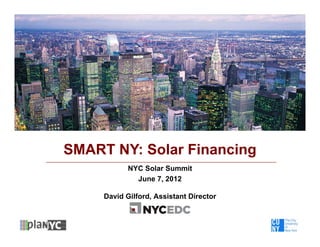
SMART NY: Solar Financing
            NYC Solar Summit
              June 7, 2012

     David Gilford, Assistant Director
SMART NY: Financing Options Working Group
NYCEDC and Mayor’s Office partnering to facilitate solar financing


                      Lack of financing slows solar adoption
    Why Does
    Financing         Removing barriers is both an environmental and
     Matter?           economic opportunity


                      Understand and address financing barriers, including:
   What’s Our           – Complexity
    Goal?               – Lack of information
                        – Regulatory or policy constraints

                   1. Evaluate financing best practices and barriers
    What Will
                   2. Analyze market needs and opportunities
    We Do?
                   3. Develop plan to facilitate financing


                                                                               2
Why solar financing matters
Upfront costs are a major barrier to solar market growth
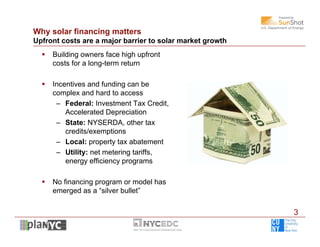
     Building owners face high upfront
      costs for a long-term return

     Incentives and funding can be
      complex and hard to access
       – Federal: Investment Tax Credit,
          Accelerated Depreciation
       – State: NYSERDA, other tax
          credits/exemptions
       – Local: property tax abatement
       – Utility: net metering tariffs,
          energy efficiency programs

     No financing program or model has
      emerged as a “silver bullet”


                                                           3
Task 1: Evaluate Financing Best Practices and Barriers
    Working group will research and diagnose issues


         Research                       Identify                     Diagnose

   Research current             Identify best practices      Diagnose the primary
    status and survey solar       for third-party               financing barriers
    developers and                ownership and other           facing solar
    financial institutions:       financing models:            Prioritize barriers
      – Customer                    – Locally                   based on their impact
        feedback                    – Regionally                on market growth
      – NYC compared to             – Nationally
        other markets
      – Impact of policies,
        regulations or
        tariffs


                                                                                        4
Task 2: Analyze Market Needs and Opportunities


   Gather data from Con
    Edison, NYSERDA, City
    agencies and the NYC
    Solar Map

   Analyze data to evaluate
    New York City’s building
    stock according to the
    economic feasibility of
    solar

   Segment the potential
    market according to likely
    financing needs and
    opportunities
                                                 5
Task 3: Develop Plan to Facilitate Financing


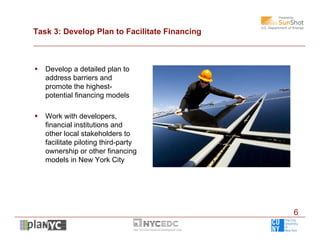
   Develop a detailed plan to
    address barriers and
    promote the highest-
    potential financing models

   Work with developers,
    financial institutions and
    other local stakeholders to
    facilitate piloting third-party
    ownership or other financing
    models in New York City


                                               6
Initial focus is on third-party ownership models
PPAs and leases offer solar with no (or low) upfront costs

Power Purchase Agreement (PPA)             Solar Leases
“Pay by the kWh”                           “Pay by the month”
 Partial upfront pre-payment for           Typically no money down
  electricity (often optional)              Customer pays flat monthly fee to
 Customer pays for actual solar             lease the solar PV system
  power generated                           Monthly fee may increase at
 Fixed electricity rate or yearly           predetermined rate
  percentage increase                       Long-term, transferable agreement
 Long-term, transferable agreement


          Potential advantages over direct bank loans:
          – Simplifies incentives, tax benefits and maintenance
          – Enables paying for electricity by the month, as usual
          – Mitigates reliability and performance concerns
                                                                             7
Looking forward, other innovative models will be explored

   Crowdfunding: individuals invest small amounts of
    money directly in community solar projects
     – Startups like Solar Mosaic are bringing the
       “Kickstarter” model to solar

   On-bill financing: utility collects payments on behalf of
    third-party system owner, with generally no increase to
    customer’s monthly bill

   Property Assessed Clean Energy (PACE):
    municipality facilitates a low-interest loan that is repaid
    over time through customer’s property tax bills
     – Roadblocks remain for residential PACE, but
       Florida launched commercial solar PACE program
       in April 2012


                                                                  8
Thank you


   “Generating reliable and affordable solar energy is both
             a public good and a national goal.

     A necessary component to achieve this vision is the
         availability of scalable, low-cost financing.”

              - US Department of Energy, SunShot Grand Challenge


                                                                   9

NYC Solar Summit 2012: Financing Options

  • 1.
    SMART NY: SolarFinancing NYC Solar Summit June 7, 2012 David Gilford, Assistant Director
  • 2.
    SMART NY: FinancingOptions Working Group NYCEDC and Mayor’s Office partnering to facilitate solar financing  Lack of financing slows solar adoption Why Does Financing  Removing barriers is both an environmental and Matter? economic opportunity  Understand and address financing barriers, including: What’s Our – Complexity Goal? – Lack of information – Regulatory or policy constraints 1. Evaluate financing best practices and barriers What Will 2. Analyze market needs and opportunities We Do? 3. Develop plan to facilitate financing 2
  • 3.
    Why solar financingmatters Upfront costs are a major barrier to solar market growth  Building owners face high upfront costs for a long-term return  Incentives and funding can be complex and hard to access – Federal: Investment Tax Credit, Accelerated Depreciation – State: NYSERDA, other tax credits/exemptions – Local: property tax abatement – Utility: net metering tariffs, energy efficiency programs  No financing program or model has emerged as a “silver bullet” 3
  • 4.
    Task 1: EvaluateFinancing Best Practices and Barriers Working group will research and diagnose issues Research Identify Diagnose  Research current  Identify best practices  Diagnose the primary status and survey solar for third-party financing barriers developers and ownership and other facing solar financial institutions: financing models:  Prioritize barriers – Customer – Locally based on their impact feedback – Regionally on market growth – NYC compared to – Nationally other markets – Impact of policies, regulations or tariffs 4
  • 5.
    Task 2: AnalyzeMarket Needs and Opportunities  Gather data from Con Edison, NYSERDA, City agencies and the NYC Solar Map  Analyze data to evaluate New York City’s building stock according to the economic feasibility of solar  Segment the potential market according to likely financing needs and opportunities 5
  • 6.
    Task 3: DevelopPlan to Facilitate Financing  Develop a detailed plan to address barriers and promote the highest- potential financing models  Work with developers, financial institutions and other local stakeholders to facilitate piloting third-party ownership or other financing models in New York City 6
  • 7.
    Initial focus ison third-party ownership models PPAs and leases offer solar with no (or low) upfront costs Power Purchase Agreement (PPA) Solar Leases “Pay by the kWh” “Pay by the month”  Partial upfront pre-payment for  Typically no money down electricity (often optional)  Customer pays flat monthly fee to  Customer pays for actual solar lease the solar PV system power generated  Monthly fee may increase at  Fixed electricity rate or yearly predetermined rate percentage increase  Long-term, transferable agreement  Long-term, transferable agreement  Potential advantages over direct bank loans: – Simplifies incentives, tax benefits and maintenance – Enables paying for electricity by the month, as usual – Mitigates reliability and performance concerns 7
  • 8.
    Looking forward, otherinnovative models will be explored  Crowdfunding: individuals invest small amounts of money directly in community solar projects – Startups like Solar Mosaic are bringing the “Kickstarter” model to solar  On-bill financing: utility collects payments on behalf of third-party system owner, with generally no increase to customer’s monthly bill  Property Assessed Clean Energy (PACE): municipality facilitates a low-interest loan that is repaid over time through customer’s property tax bills – Roadblocks remain for residential PACE, but Florida launched commercial solar PACE program in April 2012 8
  • 9.
    Thank you “Generating reliable and affordable solar energy is both a public good and a national goal. A necessary component to achieve this vision is the availability of scalable, low-cost financing.” - US Department of Energy, SunShot Grand Challenge 9