Property Assessed Clean Energy
            (PACE)
 Municipal Energy Financing in the United States

                      John Farrell, Director
      Energy Self-Reliant States and Communities program
                         jfarrell@ilsr.org
                       612.276.3456 x210
                Adapted from a presentation to the Smart Energy Dialogue
                                 Berlin | June 9, 2010


                                                                           Photo credit: Flickr user OZinOH
PACE Financing
• Overview
• Rationale
• Potential
• Challenges


Municipal	
  Energy	
  Financing:	
  Lessons	
  Learned
     h6p://bit.ly/munienergyfinance
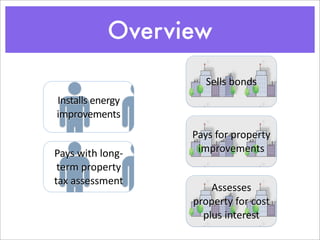
Overview
                              Sells	
  bonds
Installs	
  energy	
  
improvements
                          Pays	
  for	
  property	
  
Pays	
  with	
  long-­‐    improvements
 term	
  property	
  
tax	
  assessment
                              Assesses	
  
                          property	
  for	
  cost	
  
                            plus	
  interest
Overview


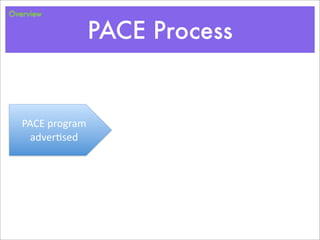
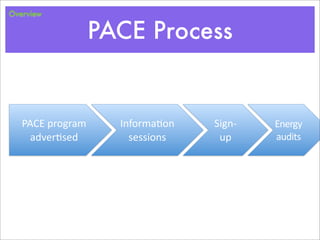
                     PACE Process


   PACE	
  program	
  
     adver?sed
Overview


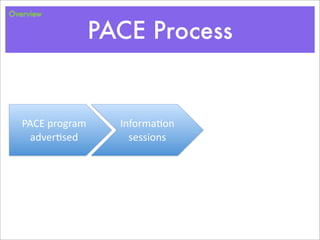
                     PACE Process


   PACE	
  program	
     Informa?on	
  
     adver?sed             sessions
Overview


                     PACE Process


   PACE	
  program	
     Informa?on	
     Sign-­‐
     adver?sed             sessions        up
Overview


                     PACE Process


   PACE	
  program	
     Informa?on	
     Sign-­‐   Energy	
  
     adver?sed             sessions        up       audits
Overview


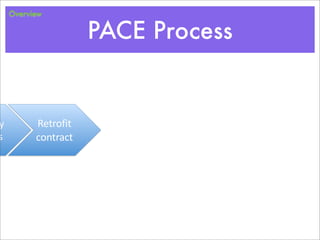
                             PACE Process


y	
           Retrofit	
  
s             contract
Overview


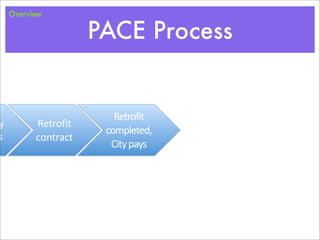
                             PACE Process


                                Retrofit	
  
y	
           Retrofit	
  
                              completed,
s             contract
                               City	
  pays
Overview


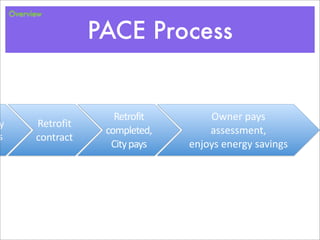
                             PACE Process


                                Retrofit	
         Owner	
  pays	
  
y	
           Retrofit	
  
                              completed,           assessment,	
  
s             contract
                               City	
  pays    enjoys	
  energy	
  savings
Rationale


            Financing Mismatch

              5-­‐6	
  years                5-­‐6	
  years


                               10-­‐15	
  years


              5-­‐6	
  years
Rationale

Solution: Property Tied Financing


            5-­‐6	
  years                5-­‐6	
  years


                             10-­‐15	
  years
Rationale


            Information Disjointed
              State	
           U?lity	
  
             rebate             rebate
                                             U?lity	
  
                                             audit


                                          Energy	
  
                   Nonpro                   Star	
  
                     fit	
                  ra?ng
                   energy	
           Federal	
  
                    guide               tax	
  
                                       credit
Rationale


     Solution: One-stop Shop
                           U?lity


                            State
                PACE	
  
              program
                           Federal

                           Nonpro
                             fit
Potential


             PACE Status (2010)
        • 21 states
        • 4 established municipal programs
            • Almost $40 million spent
            • 2,000 properties served

                                                Legend
                                             Recently	
  enacted	
  
                                                 PACE	
  laws
                                             Pre-­‐2009	
  statutes	
  
                                             suppor?ng	
  PACE
Potential


               PACE Status (2010)
                                         Spending	
  in	
  2009


       PACE	
  Programs $40


  Utility	
  Energy
  Efficiency	
  Programs                     $3,600


                           $0   $1,000          $2,000            $3,000   $4,000
                                               Millions
Potential


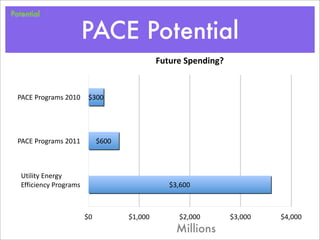
                             PACE Potential
                                                  Future	
  Spending?


  PACE	
  Programs	
  2010    $300


  PACE	
  Programs	
  2011        $600


   Utility	
  Energy
   Efficiency	
  Programs                            $3,600


                             $0          $1,000         $2,000          $3,000   $4,000
                                                       Millions
Challenges & Solutions
• Challenge: Fannie Mae objects
• Solutions
 • Lawsuits
 • Legislation
 • Alternatives
• Challenge: Participation v. Energy Savings
Challenges & Solutions


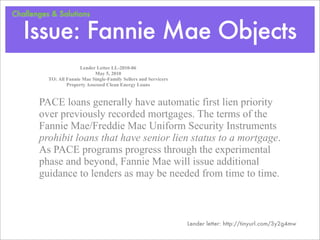
   Issue: Fannie Mae Objects
                        Lender Letter LL-2010-06
                               May 5, 2010
          TO: All Fannie Mae Single-Family Sellers and Servicers
                  Property Assessed Clean Energy Loans


       PACE loans generally have automatic first lien priority
       over previously recorded mortgages. The terms of the
       Fannie Mae/Freddie Mac Uniform Security Instruments
       prohibit loans that have senior lien status to a mortgage.
       As PACE programs progress through the experimental
       phase and beyond, Fannie Mae will issue additional
       guidance to lenders as may be needed from time to time.


                                                                   Lender letter: http://tinyurl.com/3y2g4mw
Challenges & Solutions


   Issue: Fannie Mae Objects
                        Lender Letter LL-2010-06
                               May 5, 2010
          TO: All Fannie Mae Single-Family Sellers and Servicers
                  Property Assessed Clean Energy Loans


      1. We don’t come second.
      2. This isn’t a public good.
      3. “We’re buried in a subprime mess. Nothing new,
         please.”
Challenges & Solutions


         Solution #1: Lawsuits
       • FHFA, Fannie, & Freddie sued by:
         • California Attorney General
         • Sierra Club
         • Sonoma County, CA
         • Town of Babylon, NY


Small victory: Aug. 31, 2011 ruling
 requires FHFA to start over with
         formal rulemaking
Challenges & Solutions


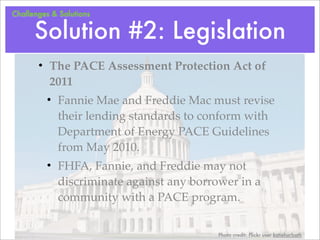
      Solution #2: Legislation
       • The PACE Assessment Protection Act of
         2011
         • Fannie Mae and Freddie Mac must revise
           their lending standards to conform with
           Department of Energy PACE Guidelines
           from May 2010.
         • FHFA, Fannie, and Freddie may not
           discriminate against any borrower in a
           community with a PACE program.


                                         Photo credit: Flickr user katieharbath
Challenges & Solutions


    Solution #3: Alternatives
       • On-bill financing
         • Utility finances improvements
         • Utility ties billing to the meter instead of
           individual
         • “Pay As You Save” (now defunct)
       • Drawbacks
         • Requires utility participation
         • Utility billing system may need upgrade
Challenges & Solutions


    Solution #3: Alternatives
       • Junior liens (e.g. Maine)
         • Does not come before mortgage in event of
           default
         • Still tied to property tax bill
       • Drawbacks
         • No secondary market
         • Can’t transfer between owners?
Challenges & Solutions


    Solution #3: Alternatives
       • Subsidized home retrofits
         • E.g. weatherization
       • Drawbacks
         • Who pays for subsidy?
Challenges & Solutions


    Solution #3: Alternatives
       • Loan loss reserves
         • Can insulate lender
       • Drawbacks
         • Who pays for reserve?
Challenges & Solutions


    Solution #3: Alternatives
       • Loan insurance
         • Insulates lenders
         • Low cost
       • Drawbacks
         • Offered to FHFA, but rejected
         • No private market right now
Challenges & Solutions

 Issue: Participation v. Savings
Challenges & Solutions


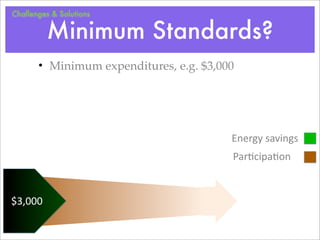
         Minimum Standards?
       • Minimum expenditures, e.g. $3,000


                                         Energy	
  savings
                                         Par?cipa?on


$3,000
Challenges & Solutions


         Minimum Standards?
       • Minimum expenditures, e.g. $3,000
       • Minimum energy savings, e.g. 10%


                                         Energy	
  savings
                                         Par?cipa?on


$3,000            10%
Challenges & Solutions


         Minimum Standards?
       • Minimum expenditures, e.g. $3,000
       • Minimum energy savings, e.g. 10%
       • Efficiency threshold, e.g. EPA Yardstick

                                           Energy	
  savings
                                           Par?cipa?on


                            EPA
$3,000            10%
                          Yardstick
Challenges & Solutions


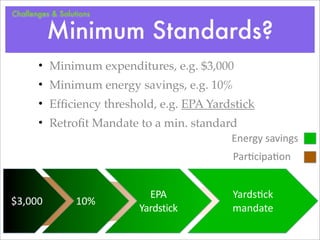
         Minimum Standards?
       • Minimum expenditures, e.g. $3,000
       • Minimum energy savings, e.g. 10%
       • Efficiency threshold, e.g. EPA Yardstick
       • Retrofit Mandate to a min. standard
                                           Energy	
  savings
                                           Par?cipa?on


                            EPA            Yards?ck	
  
$3,000            10%
                          Yardstick        mandate
Thank you!
John Farrell                        Other Resources
  www.energyselfreliantstates.org   •PACENOW.org
  jfarrell@ilsr.org                 •This report:
  johnffarrell
  612-276-3456 x120


                                    Municipal	
  Energy	
  Financing:	
  Lessons	
  Learned
                                         h6p://bit.ly/munienergyfinance

PACE Financing 101 and Status

  • 1.
    Property Assessed CleanEnergy (PACE) Municipal Energy Financing in the United States John Farrell, Director Energy Self-Reliant States and Communities program jfarrell@ilsr.org 612.276.3456 x210 Adapted from a presentation to the Smart Energy Dialogue Berlin | June 9, 2010 Photo credit: Flickr user OZinOH
  • 2.
    PACE Financing • Overview •Rationale • Potential • Challenges Municipal  Energy  Financing:  Lessons  Learned h6p://bit.ly/munienergyfinance
  • 3.
    Overview Sells  bonds Installs  energy   improvements Pays  for  property   Pays  with  long-­‐ improvements term  property   tax  assessment Assesses   property  for  cost   plus  interest
  • 4.
    Overview PACE Process PACE  program   adver?sed
  • 5.
    Overview PACE Process PACE  program   Informa?on   adver?sed sessions
  • 6.
    Overview PACE Process PACE  program   Informa?on   Sign-­‐ adver?sed sessions up
  • 7.
    Overview PACE Process PACE  program   Informa?on   Sign-­‐ Energy   adver?sed sessions up audits
  • 8.
    Overview PACE Process y   Retrofit   s contract
  • 9.
    Overview PACE Process Retrofit   y   Retrofit   completed, s contract City  pays
  • 10.
    Overview PACE Process Retrofit   Owner  pays   y   Retrofit   completed, assessment,   s contract City  pays enjoys  energy  savings
  • 11.
    Rationale Financing Mismatch 5-­‐6  years 5-­‐6  years 10-­‐15  years 5-­‐6  years
  • 12.
    Rationale Solution: Property TiedFinancing 5-­‐6  years 5-­‐6  years 10-­‐15  years
  • 13.
    Rationale Information Disjointed State   U?lity   rebate rebate U?lity   audit Energy   Nonpro Star   fit   ra?ng energy   Federal   guide tax   credit
  • 14.
    Rationale Solution: One-stop Shop U?lity State PACE   program Federal Nonpro fit
  • 15.
    Potential PACE Status (2010) • 21 states • 4 established municipal programs • Almost $40 million spent • 2,000 properties served Legend Recently  enacted   PACE  laws Pre-­‐2009  statutes   suppor?ng  PACE
  • 16.
    Potential PACE Status (2010) Spending  in  2009 PACE  Programs $40 Utility  Energy Efficiency  Programs $3,600 $0 $1,000 $2,000 $3,000 $4,000 Millions
  • 17.
    Potential PACE Potential Future  Spending? PACE  Programs  2010 $300 PACE  Programs  2011 $600 Utility  Energy Efficiency  Programs $3,600 $0 $1,000 $2,000 $3,000 $4,000 Millions
  • 18.
    Challenges & Solutions •Challenge: Fannie Mae objects • Solutions • Lawsuits • Legislation • Alternatives • Challenge: Participation v. Energy Savings
  • 19.
    Challenges & Solutions Issue: Fannie Mae Objects Lender Letter LL-2010-06 May 5, 2010 TO: All Fannie Mae Single-Family Sellers and Servicers Property Assessed Clean Energy Loans PACE loans generally have automatic first lien priority over previously recorded mortgages. The terms of the Fannie Mae/Freddie Mac Uniform Security Instruments prohibit loans that have senior lien status to a mortgage. As PACE programs progress through the experimental phase and beyond, Fannie Mae will issue additional guidance to lenders as may be needed from time to time. Lender letter: http://tinyurl.com/3y2g4mw
  • 20.
    Challenges & Solutions Issue: Fannie Mae Objects Lender Letter LL-2010-06 May 5, 2010 TO: All Fannie Mae Single-Family Sellers and Servicers Property Assessed Clean Energy Loans 1. We don’t come second. 2. This isn’t a public good. 3. “We’re buried in a subprime mess. Nothing new, please.”
  • 21.
    Challenges & Solutions Solution #1: Lawsuits • FHFA, Fannie, & Freddie sued by: • California Attorney General • Sierra Club • Sonoma County, CA • Town of Babylon, NY Small victory: Aug. 31, 2011 ruling requires FHFA to start over with formal rulemaking
  • 22.
    Challenges & Solutions Solution #2: Legislation • The PACE Assessment Protection Act of 2011 • Fannie Mae and Freddie Mac must revise their lending standards to conform with Department of Energy PACE Guidelines from May 2010. • FHFA, Fannie, and Freddie may not discriminate against any borrower in a community with a PACE program. Photo credit: Flickr user katieharbath
  • 23.
    Challenges & Solutions Solution #3: Alternatives • On-bill financing • Utility finances improvements • Utility ties billing to the meter instead of individual • “Pay As You Save” (now defunct) • Drawbacks • Requires utility participation • Utility billing system may need upgrade
  • 24.
    Challenges & Solutions Solution #3: Alternatives • Junior liens (e.g. Maine) • Does not come before mortgage in event of default • Still tied to property tax bill • Drawbacks • No secondary market • Can’t transfer between owners?
  • 25.
    Challenges & Solutions Solution #3: Alternatives • Subsidized home retrofits • E.g. weatherization • Drawbacks • Who pays for subsidy?
  • 26.
    Challenges & Solutions Solution #3: Alternatives • Loan loss reserves • Can insulate lender • Drawbacks • Who pays for reserve?
  • 27.
    Challenges & Solutions Solution #3: Alternatives • Loan insurance • Insulates lenders • Low cost • Drawbacks • Offered to FHFA, but rejected • No private market right now
  • 28.
    Challenges & Solutions Issue: Participation v. Savings
  • 29.
    Challenges & Solutions Minimum Standards? • Minimum expenditures, e.g. $3,000 Energy  savings Par?cipa?on $3,000
  • 30.
    Challenges & Solutions Minimum Standards? • Minimum expenditures, e.g. $3,000 • Minimum energy savings, e.g. 10% Energy  savings Par?cipa?on $3,000 10%
  • 31.
    Challenges & Solutions Minimum Standards? • Minimum expenditures, e.g. $3,000 • Minimum energy savings, e.g. 10% • Efficiency threshold, e.g. EPA Yardstick Energy  savings Par?cipa?on EPA $3,000 10% Yardstick
  • 32.
    Challenges & Solutions Minimum Standards? • Minimum expenditures, e.g. $3,000 • Minimum energy savings, e.g. 10% • Efficiency threshold, e.g. EPA Yardstick • Retrofit Mandate to a min. standard Energy  savings Par?cipa?on EPA Yards?ck   $3,000 10% Yardstick mandate
  • 33.
    Thank you! John Farrell Other Resources www.energyselfreliantstates.org •PACENOW.org jfarrell@ilsr.org •This report: johnffarrell 612-276-3456 x120 Municipal  Energy  Financing:  Lessons  Learned h6p://bit.ly/munienergyfinance