Building Connecticut’s
Clean Energy Economy
Opportunities for Regional Economic Xcelleration


Regional Economic Development Forum
New Haven, CT
December 2, 2011
Agenda


History   of Clean Energy in Connecticut
From the Connecticut Clean Energy Fund to the
 Clean Energy Finance and Investment Authority
Strategic  Direction towards Scale with an Example
 (i.e. Residential Sector)
Other   Important Policies of Public Act 11-80
Your    Towns and Next Steps


                                                  2
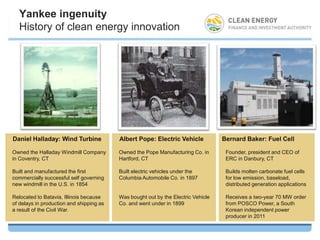
Yankee ingenuity
  History of clean energy innovation


Daniel Halladay: Wind Turbine             Albert Pope: Electric Vehicle            Bernard Baker: Fuel Cell

Owned the Halladay Windmill Company       Owned the Pope Manufacturing Co. in       Founder, president and CEO of
in Coventry, CT                           Hartford, CT                              ERC in Danbury, CT

Built and manufactured the first          Built electric vehicles under the         Builds molten carbonate fuel cells
commercially successful self governing    Columbia Automobile Co. in 1897           for low emission, baseload,
new windmill in the U.S. in 1854                                                    distributed generation applications

Relocated to Batavia, Illinois because    Was bought out by the Electric Vehicle    Receives a two-year 70 MW order
of delays in production and shipping as   Co. and went under in 1899                from POSCO Power, a South
a result of the Civil War.                                                          Korean independent power
                                                                                    producer in 2011
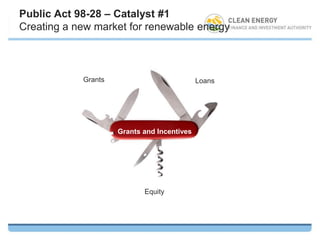
Public Act 98-28 – Catalyst #1
Creating a new market for renewable energy


            Grants                           Loans


                     Grants and Incentives


                            Equity
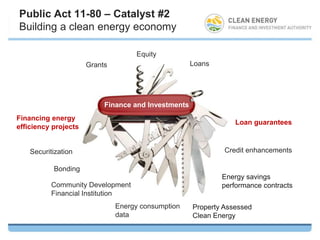
Public Act 11-80 – Catalyst #2
Building a clean energy economy

                                    Equity
                      Grants                         Loans


                           Finance and Investments
Financing energy
                                                                 Loan guarantees
efficiency projects


    Securitization                                            Credit enhancements

           Bonding
                                                             Energy savings
          Community Development                              performance contracts
          Financial Institution
                               Energy consumption    Property Assessed
                               data                  Clean Energy
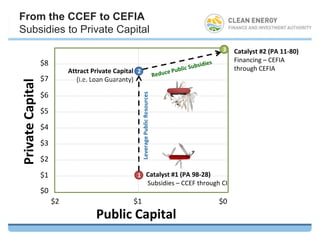
From the CCEF to CEFIA
Subsidies to Private Capital
                                                                                                   3    Catalyst #2 (PA 11-80)
                  $8                                                                                    Financing – CEFIA
                            Attract Private Capital 2                                                   through CEFIA
                  $7           (i.e. Loan Guaranty)
Private Capital


                  $6


                                                        Leverage Public Resources
                  $5

                  $4

                  $3

                  $2

                  $1                               1 Catalyst #1 (PA 98-28)
                                                                          Subsidies – CCEF through CI
                  $0
                       $2                         $1                                              $0
                                     Public Capital
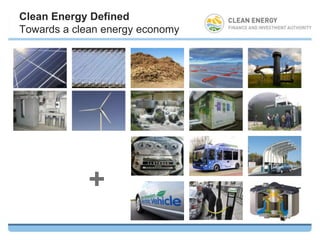
Clean Energy Defined
Towards a clean energy economy


            +
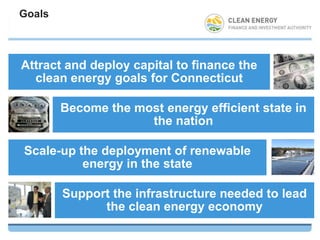
Goals


Attract and deploy capital to finance the
  clean energy goals for Connecticut

        Become the most energy efficient state in
                     the nation

Scale-up the deployment of renewable
          energy in the state

        Support the infrastructure needed to lead
              the clean energy economy
Job Creation
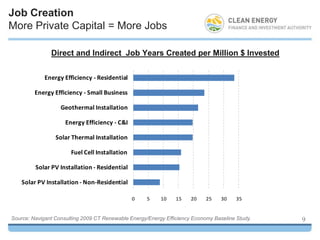
More Private Capital = More Jobs

               Direct and Indirect Job Years Created per Million $ Invested


             Energy Efficiency - Residential

         Energy Efficiency - Small Business

                   Geothermal Installation

                     Energy Efficiency - C&I

                 Solar Thermal Installation

                       Fuel Cell Installation

         Solar PV Installation - Residential

    Solar PV Installation - Non-Residential

                                                0    5    10    15    20    25    30    35


Source: Navigant Consulting 2009 CT Renewable Energy/Energy Efficiency Economy Baseline Study.   9
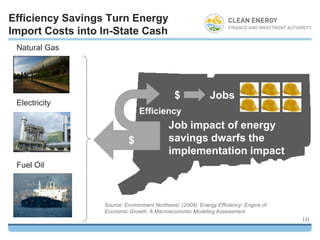
Efficiency Savings Turn Energy
Import Costs into In-State Cash
 Natural Gas


                                              $              Jobs
 Electricity
                       $        Efficiency
                                            Job impact of energy
                           $                savings dwarfs the
                                            implementation impact
 Fuel Oil


                  Source: Environment Northeast. (2009). Energy Efficiency: Engine of
                  Economic Growth. A Macroeconomic Modeling Assessment
                                                                                        10
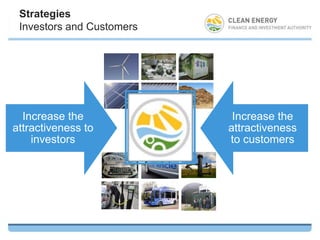
Strategies
 Investors and Customers


  Increase the              Increase the
attractiveness to          attractiveness
    investors              to customers
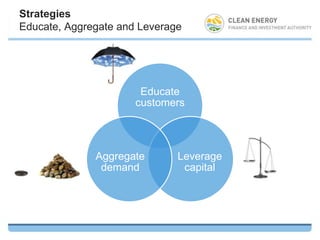
Strategies
Educate, Aggregate and Leverage


                       Educate
                      customers


              Aggregate       Leverage
               demand          capital
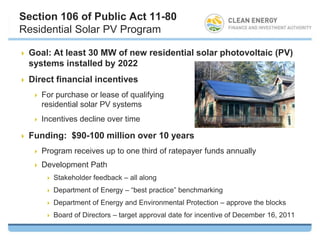
Section 106 of Public Act 11-80
Residential Solar PV Program

   Goal: At least 30 MW of new residential solar photovoltaic (PV)
    systems installed by 2022
   Direct financial incentives
       For purchase or lease of qualifying
        residential solar PV systems
       Incentives decline over time

   Funding: $90-100 million over 10 years
       Program receives up to one third of ratepayer funds annually
       Development Path
            Stakeholder feedback – all along
            Department of Energy – “best practice” benchmarking
            Department of Energy and Environmental Protection – approve the blocks
            Board of Directors – target approval date for incentive of December 16, 2011
Green Loan Guaranty Fund


   Up to $18 million in state bond funds for loan guarantees
       Guarantees loans by participating lenders for energy efficiency and
        renewable energy projects
   Projects include purchase and installation of:
       Clean energy generation systems
       Energy conservation materials
       Replacement furnaces and boilers
       Advanced energy-conserving equipment
   Eligible: individuals, nonprofits, small businesses
    (≤ 50 full-time employees)


                                                                              14
x
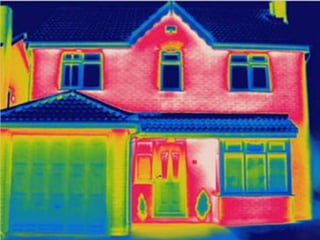
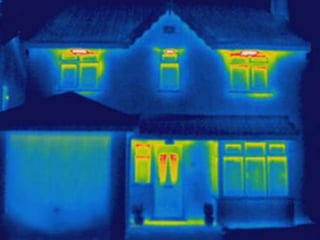
Undertake Energy Efficiency
Quick payback to finance solar PV
Undertake Energy Efficiency
Quick payback to finance solar PV
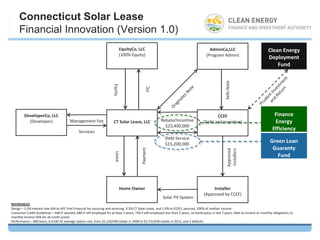
Connecticut Solar Lease
     Financial Innovation (Version 1.0)
                                                                                 EquityCo, LLC                                              AdminCo,LLC                               Clean Energy
                                                                                 (100% Equity)                                            (Program Admin)
                                                                                                                                                                                      Deployment
                                                                                                                                                                                          Fund
                                                                                                                                                                                          Fund


                                                                                                                                                        Sells Note
                                                                        Equity


                                                                                                 ITC
         DeveloperCo, LLC                                                                                                                      CCEF                                       Finance
           (Developer)                   Management Fee                 CT Solar Lease, LLC               Rebate/Incentive              (Debt and Incentive)                              Energy
                                                                                                            $23,400,000
                                                Services
                                                                                                                                                                                         Efficiency
                                                                                                             Debt Service
                                                                                                             $15,200,000
                                                                                                                                                                                       Green Loan
                                                                                                                                                                                        Guaranty
                                                                                            Payment


                                                                                                                                                          Approved
                                                                                                                                                          Installers
                                                                         Lease


                                                                                                                                                                                          Fund


                                                                                 Home Owner                                                  Installer
                                                                                                                                        (Approved by CCEF)
                                                                                                           Solar PV System
REFERENCES
Design – 5.5% interest rate (4% to AFC First Financial for sourcing and servicing, 0.5% CT Solar Lease, and 1.0% to CCEF), secured, 200% of median income
Consumer Credit Guidelines – 640 if salaried, 680 if self-employed for at least 2 years, 720 if self-employed less than 2 years, no bankruptcy in last 7 years, debt to income or monthly obligations to
monthly income 50% for all credit scores
Performance – 800 loans, 6.0 kW AC average system size, from $5,320/kW rebate in 2009 to $2,731/kW rebate in 2012, and 2 defaults.
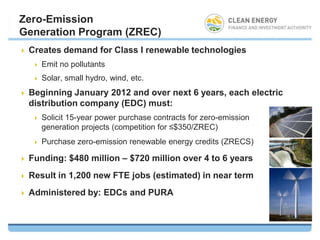
Zero-Emission
Generation Program (ZREC)
   Creates demand for Class I renewable technologies
       Emit no pollutants
       Solar, small hydro, wind, etc.
   Beginning January 2012 and over next 6 years, each electric
    distribution company (EDC) must:
       Solicit 15-year power purchase contracts for zero-emission
        generation projects (competition for ≤$350/ZREC)
       Purchase zero-emission renewable energy credits (ZRECS)

   Funding: $480 million – $720 million over 4 to 6 years
   Result in 1,200 new FTE jobs (estimated) in near term
   Administered by: EDCs and PURA
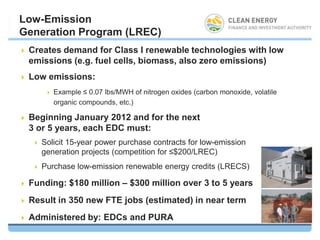
Low-Emission
Generation Program (LREC)
   Creates demand for Class I renewable technologies with low
    emissions (e.g. fuel cells, biomass, also zero emissions)
   Low emissions:
            Example ≤ 0.07 lbs/MWH of nitrogen oxides (carbon monoxide, volatile
             organic compounds, etc.)

   Beginning January 2012 and for the next
    3 or 5 years, each EDC must:
       Solicit 15-year power purchase contracts for low-emission
        generation projects (competition for ≤$200/LREC)
       Purchase low-emission renewable energy credits (LRECS)

   Funding: $180 million – $300 million over 3 to 5 years
   Result in 350 new FTE jobs (estimated) in near term
   Administered by: EDCs and PURA
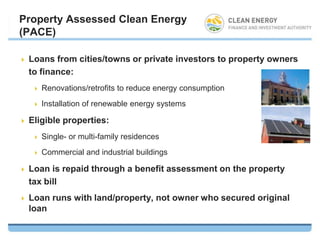
Property Assessed Clean Energy
(PACE)

   Loans from cities/towns or private investors to property owners
    to finance:
       Renovations/retrofits to reduce energy consumption
       Installation of renewable energy systems

   Eligible properties:
       Single- or multi-family residences
       Commercial and industrial buildings

   Loan is repaid through a benefit assessment on the property
    tax bill
   Loan runs with land/property, not owner who secured original
    loan
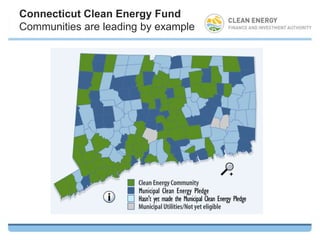
Connecticut Clean Energy Fund
Communities are leading by example
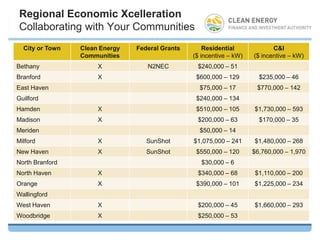
Regional Economic Xcelleration
Collaborating with Your Communities
  City or Town   Clean Energy   Federal Grants       Residential             C&I
                 Communities                     ($ incentive – kW)   ($ incentive – kW)
Bethany               X            N2NEC          $240,000 – 51
Branford              X                           $600,000 – 129        $235,000 – 46
East Haven                                         $75,000 – 17        $770,000 – 142
Guilford                                          $240,000 – 134
Hamden                X                           $510,000 – 105      $1,730,000 – 593
Madison               X                           $200,000 – 63         $170,000 – 35
Meriden                                            $50,000 – 14
Milford               X            SunShot       $1,075,000 – 241     $1,480,000 – 268
New Haven             X            SunShot        $550,000 – 120      $6,760,000 – 1,970
North Branford                                      $30,000 – 6
North Haven           X                           $340,000 – 68       $1,110,000 – 200
Orange                X                           $390,000 – 101      $1,225,000 – 234
Wallingford
West Haven            X                           $200,000 – 45       $1,660,000 – 293
Woodbridge            X                           $250,000 – 53
Next Steps


1.   Matchmaking Event – “How Electricity Consumers
     Can Take Advantage of Clean Energy Incentives” on
     January 5, 2012 at the Rocky Hill Marriott with
     REEBA, CEEF, and CEFIA

2.   Energy Savings Performance Contracts – work
     with the State of Connecticut to make your municipal
     buildings more energy efficient.

3.   Support Property Assessed Clean Energy – work
     with CEFIA to revise legislation that will enable
     private capital to invest in clean energy in
     businesses in your communities
Deliver Measurable Results
at Scale


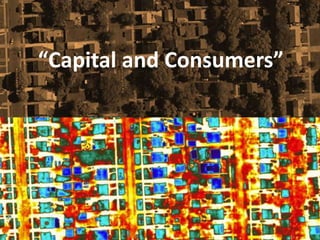
   “Capital and Consumers”
Visit us online at
    www.ctcleanenergy.com

          Bryan Garcia
            President
        865 Brook Street
   Rocky Hill, CT 06067-3444
        (860) 257–2170
bryan.garcia@ctcleanenergy.com
                                 26

Cefia regional economic development forum 120211

  • 1.
    Building Connecticut’s Clean EnergyEconomy Opportunities for Regional Economic Xcelleration Regional Economic Development Forum New Haven, CT December 2, 2011
  • 2.
    Agenda History of Clean Energy in Connecticut From the Connecticut Clean Energy Fund to the Clean Energy Finance and Investment Authority Strategic Direction towards Scale with an Example (i.e. Residential Sector) Other Important Policies of Public Act 11-80 Your Towns and Next Steps 2
  • 3.
    Yankee ingenuity History of clean energy innovation Daniel Halladay: Wind Turbine Albert Pope: Electric Vehicle Bernard Baker: Fuel Cell Owned the Halladay Windmill Company Owned the Pope Manufacturing Co. in Founder, president and CEO of in Coventry, CT Hartford, CT ERC in Danbury, CT Built and manufactured the first Built electric vehicles under the Builds molten carbonate fuel cells commercially successful self governing Columbia Automobile Co. in 1897 for low emission, baseload, new windmill in the U.S. in 1854 distributed generation applications Relocated to Batavia, Illinois because Was bought out by the Electric Vehicle Receives a two-year 70 MW order of delays in production and shipping as Co. and went under in 1899 from POSCO Power, a South a result of the Civil War. Korean independent power producer in 2011
  • 4.
    Public Act 98-28– Catalyst #1 Creating a new market for renewable energy Grants Loans Grants and Incentives Equity
  • 5.
    Public Act 11-80– Catalyst #2 Building a clean energy economy Equity Grants Loans Finance and Investments Financing energy Loan guarantees efficiency projects Securitization Credit enhancements Bonding Energy savings Community Development performance contracts Financial Institution Energy consumption Property Assessed data Clean Energy
  • 6.
    From the CCEFto CEFIA Subsidies to Private Capital 3 Catalyst #2 (PA 11-80) $8 Financing – CEFIA Attract Private Capital 2 through CEFIA $7 (i.e. Loan Guaranty) Private Capital $6 Leverage Public Resources $5 $4 $3 $2 $1 1 Catalyst #1 (PA 98-28) Subsidies – CCEF through CI $0 $2 $1 $0 Public Capital
  • 7.
    Clean Energy Defined Towardsa clean energy economy +
  • 8.
    Goals Attract and deploycapital to finance the clean energy goals for Connecticut Become the most energy efficient state in the nation Scale-up the deployment of renewable energy in the state Support the infrastructure needed to lead the clean energy economy
  • 9.
    Job Creation More PrivateCapital = More Jobs Direct and Indirect Job Years Created per Million $ Invested Energy Efficiency - Residential Energy Efficiency - Small Business Geothermal Installation Energy Efficiency - C&I Solar Thermal Installation Fuel Cell Installation Solar PV Installation - Residential Solar PV Installation - Non-Residential 0 5 10 15 20 25 30 35 Source: Navigant Consulting 2009 CT Renewable Energy/Energy Efficiency Economy Baseline Study. 9
  • 10.
    Efficiency Savings TurnEnergy Import Costs into In-State Cash Natural Gas $ Jobs Electricity $ Efficiency Job impact of energy $ savings dwarfs the implementation impact Fuel Oil Source: Environment Northeast. (2009). Energy Efficiency: Engine of Economic Growth. A Macroeconomic Modeling Assessment 10
  • 11.
    Strategies Investors andCustomers Increase the Increase the attractiveness to attractiveness investors to customers
  • 12.
    Strategies Educate, Aggregate andLeverage Educate customers Aggregate Leverage demand capital
  • 13.
    Section 106 ofPublic Act 11-80 Residential Solar PV Program  Goal: At least 30 MW of new residential solar photovoltaic (PV) systems installed by 2022  Direct financial incentives  For purchase or lease of qualifying residential solar PV systems  Incentives decline over time  Funding: $90-100 million over 10 years  Program receives up to one third of ratepayer funds annually  Development Path  Stakeholder feedback – all along  Department of Energy – “best practice” benchmarking  Department of Energy and Environmental Protection – approve the blocks  Board of Directors – target approval date for incentive of December 16, 2011
  • 14.
    Green Loan GuarantyFund  Up to $18 million in state bond funds for loan guarantees  Guarantees loans by participating lenders for energy efficiency and renewable energy projects  Projects include purchase and installation of:  Clean energy generation systems  Energy conservation materials  Replacement furnaces and boilers  Advanced energy-conserving equipment  Eligible: individuals, nonprofits, small businesses (≤ 50 full-time employees) 14
  • 15.
  • 16.
    Undertake Energy Efficiency Quickpayback to finance solar PV
  • 17.
    Undertake Energy Efficiency Quickpayback to finance solar PV
  • 18.
    Connecticut Solar Lease Financial Innovation (Version 1.0) EquityCo, LLC AdminCo,LLC Clean Energy (100% Equity) (Program Admin) Deployment Fund Fund Sells Note Equity ITC DeveloperCo, LLC CCEF Finance (Developer) Management Fee CT Solar Lease, LLC Rebate/Incentive (Debt and Incentive) Energy $23,400,000 Services Efficiency Debt Service $15,200,000 Green Loan Guaranty Payment Approved Installers Lease Fund Home Owner Installer (Approved by CCEF) Solar PV System REFERENCES Design – 5.5% interest rate (4% to AFC First Financial for sourcing and servicing, 0.5% CT Solar Lease, and 1.0% to CCEF), secured, 200% of median income Consumer Credit Guidelines – 640 if salaried, 680 if self-employed for at least 2 years, 720 if self-employed less than 2 years, no bankruptcy in last 7 years, debt to income or monthly obligations to monthly income 50% for all credit scores Performance – 800 loans, 6.0 kW AC average system size, from $5,320/kW rebate in 2009 to $2,731/kW rebate in 2012, and 2 defaults.
  • 19.
    Zero-Emission Generation Program (ZREC)  Creates demand for Class I renewable technologies  Emit no pollutants  Solar, small hydro, wind, etc.  Beginning January 2012 and over next 6 years, each electric distribution company (EDC) must:  Solicit 15-year power purchase contracts for zero-emission generation projects (competition for ≤$350/ZREC)  Purchase zero-emission renewable energy credits (ZRECS)  Funding: $480 million – $720 million over 4 to 6 years  Result in 1,200 new FTE jobs (estimated) in near term  Administered by: EDCs and PURA
  • 20.
    Low-Emission Generation Program (LREC)  Creates demand for Class I renewable technologies with low emissions (e.g. fuel cells, biomass, also zero emissions)  Low emissions:  Example ≤ 0.07 lbs/MWH of nitrogen oxides (carbon monoxide, volatile organic compounds, etc.)  Beginning January 2012 and for the next 3 or 5 years, each EDC must:  Solicit 15-year power purchase contracts for low-emission generation projects (competition for ≤$200/LREC)  Purchase low-emission renewable energy credits (LRECS)  Funding: $180 million – $300 million over 3 to 5 years  Result in 350 new FTE jobs (estimated) in near term  Administered by: EDCs and PURA
  • 21.
    Property Assessed CleanEnergy (PACE)  Loans from cities/towns or private investors to property owners to finance:  Renovations/retrofits to reduce energy consumption  Installation of renewable energy systems  Eligible properties:  Single- or multi-family residences  Commercial and industrial buildings  Loan is repaid through a benefit assessment on the property tax bill  Loan runs with land/property, not owner who secured original loan
  • 22.
    Connecticut Clean EnergyFund Communities are leading by example
  • 23.
    Regional Economic Xcelleration Collaboratingwith Your Communities City or Town Clean Energy Federal Grants Residential C&I Communities ($ incentive – kW) ($ incentive – kW) Bethany X N2NEC $240,000 – 51 Branford X $600,000 – 129 $235,000 – 46 East Haven $75,000 – 17 $770,000 – 142 Guilford $240,000 – 134 Hamden X $510,000 – 105 $1,730,000 – 593 Madison X $200,000 – 63 $170,000 – 35 Meriden $50,000 – 14 Milford X SunShot $1,075,000 – 241 $1,480,000 – 268 New Haven X SunShot $550,000 – 120 $6,760,000 – 1,970 North Branford $30,000 – 6 North Haven X $340,000 – 68 $1,110,000 – 200 Orange X $390,000 – 101 $1,225,000 – 234 Wallingford West Haven X $200,000 – 45 $1,660,000 – 293 Woodbridge X $250,000 – 53
  • 24.
    Next Steps 1. Matchmaking Event – “How Electricity Consumers Can Take Advantage of Clean Energy Incentives” on January 5, 2012 at the Rocky Hill Marriott with REEBA, CEEF, and CEFIA 2. Energy Savings Performance Contracts – work with the State of Connecticut to make your municipal buildings more energy efficient. 3. Support Property Assessed Clean Energy – work with CEFIA to revise legislation that will enable private capital to invest in clean energy in businesses in your communities
  • 25.
    Deliver Measurable Results atScale “Capital and Consumers”
  • 26.
    Visit us onlineat www.ctcleanenergy.com Bryan Garcia President 865 Brook Street Rocky Hill, CT 06067-3444 (860) 257–2170 bryan.garcia@ctcleanenergy.com 26

Editor's Notes

  • #4 Key Take-Away Message – to lead in the clean energy economy, we have to figure out how to support the entrepreneurial ecosystem and infrastructure and how to deploy these technologies at scale.Daniel HalladayInvented the Halladay Standard Windmill – a self-regulating windmill that would automatically adjust itself to the direction of the wind and control its own speed.Purchased by thousands of farmers and ranchers on the plains and prairies of North America and they were used by railroad locomotives traveling across the country to pump water.Left to Illinois as the Civil War was disrupting his business and went to Batavia, which eventually became known as “The Windmill City” during the second industrial revolution and was located just outside of Chicago, the “Windy City,” the term of which was coined around the 1850’s.Albert PopeHe was an entrepreneur who took up bicycle patents on European models and became the leading bicycle manufacturer of the Columbia Bicycle. With the lack of roads to ride bicycles, he advocated for public policies to develop and improve roads, which led to an increase in demand those bicycles.From the Columbia Bicycle he created the first electric vehicle manufacturing over 500 of them where he employed more than 10,000 people in Hartford, Connecticut.Pope despised the internal combustion engine because of its noise and pollution – he felt electric vehicles were cleaner and easier to use.Harford was the center of the automobile industry until Henry Ford made automobiles cheaper through improving assembly line manufacturing, whichled to the gas powered engine revolution.
  • #5 Key Take-Away Message – Connecticut Clean Energy Fund was the catalyst that created a new market for renewable energy in Connecticut Undergone a lot of transition from being pure equity through venture capital and the Connecticut Innovations model in the early days to grants and incentives more recently Between 2001-2011 CCEF invested about $165 million in the deployment of clean energy systems Approximately 3,000 clean energy installations leading to about 45 MW – enough to power about 15,000 homes (1% of the household market) 85% of our program expenses were in the form of grants and incentives with debt making a majority of the remaining through the Connecticut Solar Lease The Connecticut Clean Energy Fund created a new market for renewable energy
  • #6 Key Take-Away Message – move from “creating a market for renewable energy” through Connecticut Innovations and the Connecticut Clean Energy Fund to “building a clean energy economy for Connecticut” through the Clean Energy Finance and Investment Authority We are in a state of transition, or a revolution to take clean energy to scale in Connecticut and have been given a lot of financial tools to do that:Loan Guarantees We have access to an $18 million green loan guaranty fund that can replenish itself at $5 million a year This new capital can attract private capital into Connecticut’s clean energy economy. We now have a tool that can leverage 5, 10, or perhaps even 20 times from private capital to support residential, non-profit, and small business energy efficiency and renewable energy projects How do we use loan guarantees to attract private capital into Connecticut?Financing Energy Efficiency Projects Our clean energy definition has been broadened to include energy efficiency There is quite possibly no better tool to finance renewable energy than energy efficiency Energy efficiency has quick payback periods and streams of long-terms cash flow savings that can be used to help finance renewable energy How can we work with our utility partners and the Connecticut Energy Efficiency Fund to work together and not view renewable energy and energy efficiency as separate areas of focus, but instead as co-solutions to helping Connecticut lead the nation in building a clean energy economy?
  • #7 Key Take-Away Message – a new quasi-public organization has been established to serve as a new catalyst to take the Connecticut Clean Energy Fund from developing a new industry in Connecticut to creating a new clean energy economy.Point 1 We need to take what the Connecticut Clean Energy Fund catalyzed through Connecticut Innovations from 2001 through 2010 in creating a new industry through Public Act 98-28 into what the Clean Energy Finance and Investment Authority will do catalyzing a new clean energy economy through a new quasi-public organization from 2011 through 2020 through Public Act 11-80.Point 2 The Clean Energy Finance and Investment Authority will leverage its limited resources to attract more private capital investment in Connecticut’s clean energy economy and create real commercial markets for clean energy – a market where subsidies are no longer needed By attracting more private capital investment into Connecticut, we can take clean energy to scale. How does CEFIA use a loan guaranty to ensure that private capital is attracted into Connecticut’s clean energy economy and trusts that there is a return to be made? How does CEFIA move away from providing subsidies as a financial tool for renewable energy deployment and transitioning to a newer approach in financing energy efficiency projects as a means towards scaling up renewable energy investments? How does CEFIA diversify its sources of funds from Connecticut ratepayers to attracting private sector capital investment into our organization and into our state? The more efficiently we can use our limited financial resources to effectively attract more private sector capital into Connecticut’s clean energy economy, the more jobs we will create, the cleaner our environment will be, the more resilient and secure our energy infrastructure will be from mishaps and disasters. The catalyst for creating a new renewable energy industry in Connecticut has run its course – the Connecticut Clean Energy Fund has helped Connecticut create a new renewable energy industry. A new catalyst has been put in place – the Clean Energy Finance and Investment Authority – which will take that renewable energy industry created by the Connecticut Clean Energy Fund and turn it into a new clean energy economy for Connecticut that will serve as an example for the nation.
  • #8 Key Take-Away Message – area of our prior investment activity has expanded from renewable energy to now include energy efficiency and essentially the “green” infrastructure (i.e. alternative fuel vehicle stations)
  • #9 Energy EfficiencyLead by Example – help the state and municipalities achieve the goal of 20 percent energy reduction by 2020Renewable EnergySustained Orderly Deployment – work towards sustained orderly deployment of renewable energy in Connecticut – create stable, predictable, and long-term investment climateLeadershipConsumers – build demand for clean energy services across the state (marketing – ensure volume of consumers)Capital – create innovative financial products and services (finance –ensure volume of capital)Innovation Hubs – partner with universities, corporate R&D centers, and our public and quasi-public agency colleagues to create innovation hubs – let Connecticut Innovations do venture capital, CEFIA will continue to support entrepreneurs through its technology innovation programs
  • #12 Connector of capital and consumersRaises questions about our brand – who are we speaking to[Let BOD members discuss these strategies]
  • #13 EducateEducate the finance community about the investment opportunities in ConnecticutDevelop a broad messaging campaign about Connecticut’s clean energy future for all consumersAggregate – aggregate demand for clean energy to aid customers and financiersLeverage – leverage private capital using limited public funds[Let BOD members discuss these strategies…]
  • #14 Take-Away Message – $90-$100 million opportunity to solve a major challenge
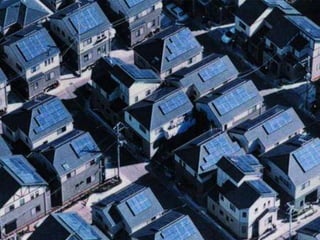
  • #16 How do we get to this? Solar PV system on every rooftop.
  • #19  Goal of deploying 30 MW of residential solar in 10 years: our challenge is to reach that target in half the time our objective is to use less resources than allocated by statute our approach is to incorporate energy efficiency as a form of financing the end result is 30 MW of residential solar PV deployed and between 5 to 10 MW of avoided energy consumption from the grid as a result of energy efficiency CCEF’s first financial innovation – Connecticut Solar Lease Released in 2008 for Connecticutwhen SolarCity (a company backed with financing by Google) was unveiled in California $60 million in capital - $25 million rebates, $15 million in debt service, $17.5 million in equity, and $5 million in development costsQuestionIs this the way the BOD wants CEFIA to think about deployment of clean energy in general? Scale – from 800 to 8,000 to 80,000! What does our
  • #23 Key Take-Away Message – the Connecticut Clean Energy Fund was catalyst for developing new and innovative models for engaging consumers to act and “lead by example” within their communities We have built a nationally recognized and sought after community infrastructure that has resulted in lower customer acquisition costs for clean energy. Over 100 towns have committed themselves to a clean energy future and 60 of them are leading by example and demonstrating strong results. Connecticut is #7 in the nation in both sales and customers out of over 850 utilities offering green pricing programs. Through the options program, there are more than 25,000 customers who are paying a little more every month to support clean energy. They are purchasing every month about 20 million kilowatt-hours of clean energy (about 250 GWh per year) – the equivalent production of 16 MW of annual solar PV generation every month or about 200 MW of installed solar PV! Through the Connecticut Clean Energy Communities Program, we now have an infrastructure that helps us compete for federal grants We won a $4.2 million competitive EECBG grant to support the N2NEC in 14 communities We applied to the DOE’s SunShot Initiative and are competing to win another $2.8 million for Connecticut The Connecticut Clean Energy Fund built an infrastructure for consumer action!
  • #24 Key Take-Away Message – the Connecticut Clean Energy Fund was catalyst for developing new and innovative models for engaging consumers to act and “lead by example” within their communities We have built a nationally recognized and sought after community infrastructure that has resulted in lower customer acquisition costs for clean energy. Over 100 towns have committed themselves to a clean energy future and 60 of them are leading by example and demonstrating strong results. Connecticut is #7 in the nation in both sales and customers out of over 850 utilities offering green pricing programs. Through the options program, there are more than 25,000 customers who are paying a little more every month to support clean energy. They are purchasing every month about 20 million kilowatt-hours of clean energy (about 250 GWh per year) – the equivalent production of 16 MW of annual solar PV generation every month or about 200 MW of installed solar PV! Through the Connecticut Clean Energy Communities Program, we now have an infrastructure that helps us compete for federal grants We won a $4.2 million competitive EECBG grant to support the N2NEC in 14 communities We applied to the DOE’s SunShot Initiative and are competing to win another $2.8 million for Connecticut The Connecticut Clean Energy Fund built an infrastructure for consumer action!