1
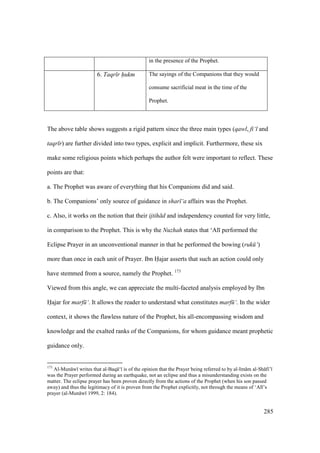
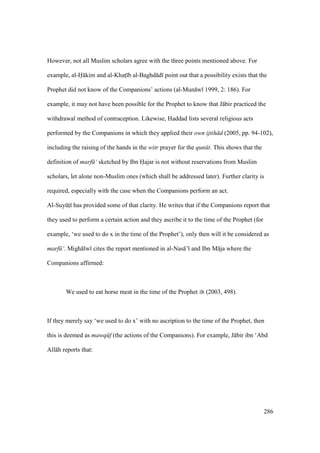
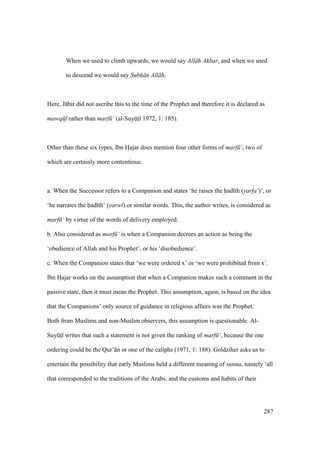
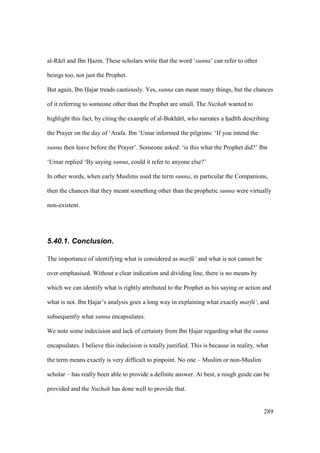
The Nuzhah of Ibn Hajar al-‘Asqal n (d. 852/1449); a
translation and critical commentary.
By
Ather Shahbaz Hussain.
A thesis submitted to
The University of Birmingham
for the degree of
DOCTOR OF PHILOSOPHY.
School of Philosophy, Theology & Religion
The University of Birmingham
May 2012.
Student ID; 305611
University of Birmingham Research Archive
e-theses repository
This unpublished thesis/dissertation is copyright of the author and/or third
parties. The intellectual property rights of the author or third parties in respect
of this work are as defined by The Copyright Designs and Patents Act 1988 or
as modified by any successor legislation.
Any use made of information contained in this thesis/dissertation must be in
accordance with that legislation and must be properly acknowledged. Further
distribution or reproduction in any format is prohibited without the permission
of the copyright holder.
2
Abstract.
This subject of this thesis is Nuzhat al-nazar f tawd h Nukhbat al-fikar, a manual written
by Ibn Hajar al-‘Asqal n (d. 852/1449), outlining the science of prophetic traditions
(‘ilm al-had th). The thesis aims to fulfill two tasks. Firstly, an accurate and accessible
translation of the Nuzhah will be presented in English. Secondly, this will be coupled
with a detailed and critical commentary of Ibn Hajar’s work. This commentary will
assess the worth of the Nuzhah in many ways; the writings of Ibn Hajar will be analysed
to learn what it said about the climate of the ninth Islamic century, by comparing it with
the works of Muslim scholars before and after Ibn Hajar. Additionally, where the works
of modern, non-Muslim scholars such as Schacht and Juynboll are mentioned, it will be
with the purpose to show the interaction with their Muslim counterparts. Themes such as
the use of technical terms in the discipline, the importance of seniority and the
pedagogical nature of the Nuzhah will also be discussed.
3
The Nuzhah of Ibn Hajar al-‘Asqal n (d. 852/1449).
Contents.
1.0 Introduction to the thesis………………………………………………………..7
2.0 The life and works of Ibn H5ajar al-‘Asqal:n;………………………………...18
3.0 The Nuzhah of Ibn H5ajar; the Author’s Introduction and the related
literature………………………………………………………………………...32
4.0 The Nuzhah of Ibn H5ajar……………………..………………………..............41
5.0 The Main Section; a translation of the Nuzhah, with the commentary
and critical analysis………………………………………………....………….51
5.1 Author’s Introduction.
5.2 The division of traditions according to how they reached us.
5.3 Mutaw tir- the Widespread.
5.4 Mashh r- the Famous and its types.
5.5 ‘Az z- the Scarce.
5.6 Ghar b- the Rare.
5.7 Maqb l & mard d- the division of traditions according to the accepted and
rejected.
5.8 Fard- the Solitary.
5.9 Sah" h"- the Sound.
5.10 Hasan- the Fair.
5.11 Sh dhdh & mahf z$- The Preserved and the Anomalous.
5.12 Ma‘r f & munkar- the Familiar and the Unfamiliar.
5.13 Mut bi‘, sh hid & i‘tib r- the Parallelisms, the Attestations and the Analysis.
5.14 Muh"kam- the Clear.
5.15 Mukhtalif al-had th - the Contradictory Tradition.
5.16 N sikh & mans kh- the Abrogating and the Abrogated.
5.17 Mard d- the Rejected and the reasons for rejection.
5.18 Mu‘allaq- the Suspended.
5.19 Mursal- the Loose.
5.20 Mu‘dil & munqati‘- the Problematic and the Interrupted.
5.21 Mudallas- the Misrepresented.
5.22 Mursal khaf - the Hidden Loose.
5.23 Reasons for defamation in the tradition.
5.24 Mawd$ ‘- the Forged.
5.25 Matr k- the Discarded.
5.26 Munkar- the Unfamiliar.
5.27 Mu‘allal- the Defective.
5.28 Mudraj- the Material Interpolated.
5.29 Maql b- the Mixed-Up.
5.30 Maz d f muttas"il al-as n d- the Addition in Cohesive Chains.
4
5.31 Mud$t$arib- the Disrupted.
5.32 Mus"ah"h"af & muh"arraf- the Misread and the Misspelling.
5.33 Riw ya bi-al-ma‘n - Transmission by Meaning.
5.34 Sharh" al-ghar b- the Commentary of the Rare Words.
5.35 Jah la- the Unknown.
5.36 Mubham- the Obscure.
5.37 Bid‘a- the Innovation.
5.38 Mukhtalat$- the Merged.
5.39 Hasan li-ghayrih- the Fair by other.
5.40 Marf ‘- the Raised.
5.41 Sah b - the Companions.
5.42 T bi‘ (the Successors) and the Mukhad$ram n.
5.43 Marf ‘ (the Raised), mawq f (the Halted), maqt$ ‘ (the Cut-Off) and athar (the
Traces).
5.44 Musnad- the Supported.
5.45 ‘Uluww- the Elevated.
5.46 Muw faqa & badal- the Agreements and Substitutions.
5.47 Mus w h & mus faha- the Equivalent and the Hand-Shaking.
5.48 Aqr n- the Generations.
5.49 Riw yat al-ak bir ‘an al-as ghir- the Narration of the Seniors from the Juniors.
5.50 Riw yat al-abn ’ ‘an al-.b ’ - the Narration of the Sons from the Fathers.
5.51 S biq & l hiq- the Preceding and the Reaching.
5.52 Muhmal- The Obscure.
5.53 Man haddatha wa nasiya- The one who narrated and then forgot.
5.54 Musalsal- the Enchained.
5.55 Siyagh al-ad ’- the Words of Delivery.
5.56 Mu‘an‘an- the Continuous ‘an.
5.57 Wij da- the discovery.
5.58 I‘l m- the declaration.
5.59 Muttafiq & muftariq- The homogeneous and the non-homogeneous.
5.60 Mu’talif & mukhtalif- the Similar and the Different.
5.61 Mutash bih -The Similar.
5.62 Conclusion: Knowing the generations of reporters, their birth-dates, their death-
dates and their places of origins and travels.
5.63 Mar tib al-jarh wa-al-ta‘d l- the stages of accreditation and dis-accreditation.
5.64 Other rulings relating to jarh & ta‘d l.
5.65 Knowing the paidonymics of the reporters and other related matters.
5.66 Knowing the etiquettes of the shaykh and disciple.
5.67 The age of hearing and delivering reports, and the reports of a non-Muslim and a
Muslim wrong-doer.
5.68 Knowing the method of writing and recording.
5.69 Travelling in pursuit of had th.
5.70 Types of had th Compilation.
5.71 The reasons behind the had th.
5.72 Final Supplication.
5
6.0 Findings………………...…………………………………………………...…425
7.0 Conclusion……………………………….………………………………….…495
8.0 Appendix A; Ibn H5ajar’s literary works…………………………………….501
9.0 Bibliography………………………………………………………………..….505
List of Diagrams.
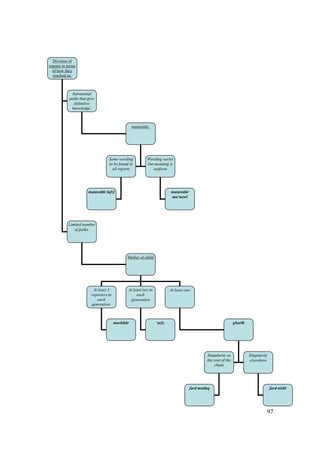
Section 5.8.2. A Summary of reports according to how they reached us.
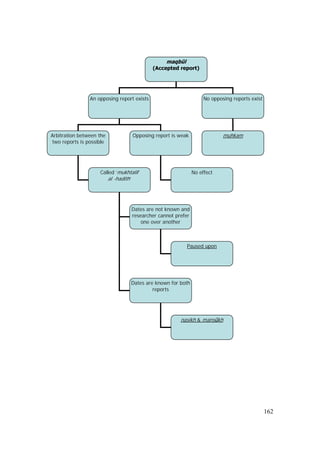
Section 5.16.3. A Summary of the maqb l (accepted reports).
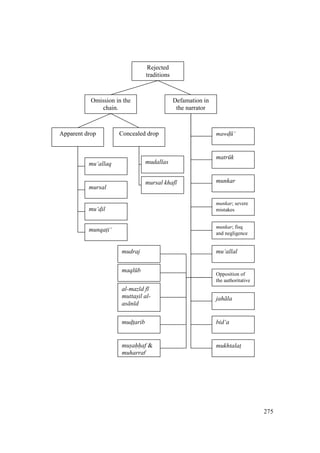
Section 5.38.2. A Summary of the rejected traditions.
6
Transliteration Table.
Consonants.
G A H DI
J B L TI
M C N ZI
P Th Q ‘A
R J S Gh
T H U F
V Kh W Q
Y D Z K
[ Dh  L
] R ^ M
_ Z ` N
a S b H
c Sh d W
e SI f Y
h -t in the construct state, -a in the non-construct state.
Vowels.
Short. Fathia: a Kasra: i DIamma: u
Long. j : f : d : k
Dipthongs. d preceded by a DIamma: aw.
f preceded by a Fathia: ay.
Arabic broken plurals have been translated into English. So, for example, I have written
had ths rather than ah d th.
7
The Nuzhah of Ibn Hajar al-‘Asqal n (d. 852/1449); a
translation and critical commentary.
1.1. Introduction to the Thesis.
Nuzhat al-nazar f tawd h nukhbat al-fikar is one of the most famous and respected
manuals in the discipline of ‘ilm al-had th. Written by Ibn Hajar al-‘Asqal n (d. 852
A.H./1449 C.E.)1
, it was one of the last major works on the subject, aimed at
consolidating the vast array of literature that preceded it. The work is still revered today
and continues to be taught in seminaries throughout the Muslim world.
Nuzhat al-nazar is actually a detailed commentary of a much shorter treatise written by
Ibn Hajar, Nukhbat al-fikar f mustalah al-athar. The latter consists of only a few pages.
In his introduction to Nuzhat al-nazar, Ibn Hajar explains that his contemporaries asked
him to offer a brief overview of ‘ilm al-had th. Ibn Hajar duly obliged in the form of
Nukhbat al-fikar, but he was then later asked to expand on this work. The result was
Nuzhat al-nazar f tawd h nukhbat al-fikar. Though in reality the Nuzhah is two separate
works (Nuzhat al-nazar and Nukhbat al-fikar), Ibn Hajar wrote his final piece in an
amalgamated style.2
The result is that it can be read as if it is one piece of work.
As it will be shown in chapter three, the Nuzhah is only a small reflection of Ibn Hajar’s
knowledge and academic contribution to the discipline of ‘ilm al-had th. He wrote
1
A.H. denotes ‘After Hijra’, the date from which the Muslim calendar commenced. C.E. denotes
‘Common Era’. All corresponding dates in this thesis have been taken from The Muslim & Christian
Calendars. G.S.P. Freeman-Grenville. Oxford University Press: London, 1963.
2
What this means is that when Ibn Hajar embarked on writing the Nuzhah, he did not delete anything from
the Nukhbah. Rather, he added the commentary in between.
8
individual treatises on countless areas in this field. But the accessibility of the Nuzhah is
just one reason why the work has remained in the public domain for such a long period of
time. The work strikes a perfect balance between being a sound appreciation of ‘ilm al-
had th, but without deviation and without stretching into volumes of work. It offers an
excellent overview of the main terminologies used in the field, a simple and systematic
presentation of the division of traditions and an invaluable insight into Ibn Hajar’s own
methodology. In short, the importance of this work should not be overestimated and this
is why an appreciation of it is required.
1.2. The Objectives of the Thesis.
The primary aim of this thesis is:
a. to offer an English translation of the Nuzhah.
b. to couple this with a critical analysis and an evaluation of the work, through the means
of an innovative commentary.
1.2.1. The translation.
This work will present an accurate yet easily-accessible English rendition of Nuzhat al-
nazar f tawd h nukhbat al-fikar. The actual text of the Nuzhah will be presented in bold
font throughout the chapter. In the Nuzhah, I have tried to keep the translation as literal as
possible. In places, this is difficult not least because the Nuzhah itself is an amalgamation
of two works. Therefore there are places where I have added words in square brackets
that are not to be found in the original Nuzhah. This is for the sake of easier reading in
English. Additionally I have sometimes added words in round brackets that are usually
9
the translation of certain terminologies that Ibn Hajar employs. Admittedly, there are
places where the English translation of the Nuzhah does not flow as well as one could
hope for, but as much as possible, I wanted the English to resemble the original Arabic.
In translation terminology, there is a distinction between dynamic equivalence (which
attempts to capture the thought and meaning at the expense of word order and
grammatical features) and formal equivalence (which attempts literal fidelity at the
expense of readability or even understanding). In practice translation tends to be a
mixture of the two, and I think the same could be said for my translation of the Nuzhah.
For the translation, I have depended upon the copy published by Mu’assasat Man hil al-
‘Irf n, in Beirut, Lebanon (1990). This version has been edited by Muhiammad ‘Abb s al-
SIabb gh.3
1.2.2. The Commentary.
A thesis at this stage of academia needs to display an original contribution to knowledge.
Certainly the translation of the Nuzhah into English will fulfil this aim, as this is, to my
knowledge, the first time the Nuzhah has been translated in full into English at PhD
level.4
But it is in the commentary of the Nuzhah where I hope to display a unique
understanding of the discipline, as well as show a degree of independent, critical and
analytical skills. I intend to do this with the following points in mind:
3
Unfortunately, I did not come across any information regarding the Nuzhah in original, manuscript form.
Informally, I was told that it can be found at the al-Azhar University manuscript archives, in Cairo.
4
I have not come across a full English translation of the Nuzhah. The shorter Nukhbah has been translated
into English by Musa Furber in the appendix to G.F. Haddad’s work, Sunna Notes - Studies in Hadith &
Doctrine Volume I; Hadith History & Principles. (Aqsa Publications: UK. 2005)
10
m Muslim scholars after Ibn Hajar showed their admiration for the Nuzhah by penning
detailed commentaries on it, of which several are in circulation today. Many of these
works, such as al-Mun w ’s contribution, provided an unreserved and uncompromising
explanation running into volumes of work. However, the nature of these existing works
on the Nuzhah has followed a routine pattern. For most part, they have commented on the
Nuzhah, not necessarily critically assessed and evaluated it. The technical terms in the
commentaries have been explained, but the wider implication of them has not been
outlined. These works tell us little about the academic and social climate of the ninth
Islamic century. Certainly, the likes of al-Q r and al-Mun w have not asked what the
Nuzhah said about the development of ‘ilm al-had th as a whole.
This is precisely where I hope to contribute with a fresh input and show true originality.
My purpose is not to comment on the Nuzhah for the sake of it. As much as possible and
wherever appropriate, I will ask what the writings of Ibn Hajar tell us about his era and
the nature of had th academia at the time. If there are areas in the Nuzhah that received
more attention – areas such as mutaw tir, bid‘a and marf ‘ for example – then the
possible reasons behind this will be assessed. Similarly, the emphasis will not be on what
a particular technical term means, but more on what purpose it served in the discipline.
m The thesis is centred on a work written over five centuries ago. Yet there will be places
where I will refer to recent, relevant literature stemming from non-Muslim, Western
academics such as Burton (1994), Brown (1999), Goldziher, Guillaume (1924), Juynboll
(1983, 1996), Muir (1858) and Schacht (1959). Wherever appropriate, I will compare the
writings of Ibn Hajar with what non-Muslim academics have had to say. For instance, in
11
the section on riw yat al-ak bir ‘an al-as ghir (the narration of the seniors from the
juniors), I will compare Ibn Hajar’s observations with that of Schacht on ‘family isn ds’.
The issue of asahh al-as n d (in particular, the strength of the isn d M lik – Nafi‘ – Ibn
‘Umar) has been looked at in detail by Schacht (1959), and I will assess this in light of
Ibn Hajar’s own writings on it. Leites (2000) analysed bid‘a in considerable detail,
showing how differences in reporter denomination were reflected in had th transmission.
It is important to stress the reason why non-Muslim input will be mentioned in this thesis.
It is not to entertain the authenticity debate over had th literature as such. It is not to
answer whether Ibn Hajar’s opinion on family isn ds is correct or whether Juynboll’s is.
Rather, my purpose is to show how the contrasting camps interact with one another, and
what this tells us about Muslim academia. In places, I will show how the input of
Westerners has been portrayed by Muslim and frequently, I will suggest that the
convergence of views on a particular area is more apparent than one first assumes.
m In order to fulfil the above point, I believe that the methodological approach I intend to
adopt for the commentary is pivotal to the quality of the work. My intention is to offer a
unique commentary that attempts to show utmost impartiality. The commentary will
attempt to neutrally assess the views held on the discipline by Muslim scholars5
on the
one hand and non-Muslim scholars on the other. This task will not be easy. To highlight
the problem with this task, a brief example of s"ah" fa will be briefly presented.
Collections marking the earliest period of had th documentation took on the forms of
small booklets, called s"ah" fas. At this stage, reports were simply put together in writing.
5
I accept that the term ‘Muslim scholars’ is a sweeping generalisation. In this thesis, ‘Muslim scholars’
will refer to the mainstream Sunni Muslims who trust the sources of the Qur’ n and Had th. This therefore
excludes the likes of the Ahl al-Qur’ n movement and the Ahmadis.
12
Primarily, such works pertain to the Prophet’s lifetime until the second Islamic century
(Kamali 2005, 31).
One of the earliest s"ah" fas was ‘Abd All h ibn ‘Amr’s (d. 65/684) al-S" diqa6
. When
assessing the worth of this collection, one cannot fail to ignore the contrasting views from
academics. Muslims view this work in a favourable light whereas non-Muslims do not.
Al-So liho referred to it as ‘one of the most reliable historical documents…’ (in Kamali 205,
25) whereas Juynboll declared it to be the ‘the fruit of someone’s imagination’ (1996, XI:
173-4). Such contrasting conclusions question the neutrality of both Muslim and non-
Muslim academics to the discipline.
This partiality issue is further seen in the language employed in the field. When assessing
the work of those who share a similar viewpoint, the tone is one of appreciation and
respect. When the Muslims analyse the works of non-Muslims – and vice-versa – the
temper and approach is dismissive and sometimes insulting. So Burton talks of
‘Goldziher’s magnificent insight’ (1994, xvii) and Schacht of his ‘brilliant investigations’
(1994, xx). Al-Sib ‘ , on the other hand, describes Goldziher as ‘the most dangerous of
the Orientalists, the one with the longest hand, the most evil and corruptive in this field...’
(1998, 213).
So to a large extent, the discipline is marked by two contrasting approaches in terms of
interpreting early had th literature. Non-Muslim academics have generally shown doubt
and suspicion, whereas Muslim academics have merely rebutted western observations
and have not appreciated it, with Azami’s On Schacht’s Origins of Muhammadan
6
The work pertains to the family isn d ‘Amr ibn Shu‘ayb ibn Muhoammad ibn ‘Abd All h ibn ‘Amr ——
father —— (the latter’s) grandfather —— ‘Abd All h ibn ‘Amr —— Prophet.
13
Jurisprudence being a prime example. Theoretically, the work of Edward Said on
Orientalism is perhaps pivotal in understanding the conflicting conclusions reached by
western academics on had th literature. He argued that the production of knowledge,
especially western knowledge on the east, can never be impartial and value-free. Findings
and conclusions are influenced by the author’s own social, religious and political position.
He implied that:
For if it is true that no production of knowledge in the human sciences can ever
ignore or disclaim its author’s involvement as a human subject in his own
circumstances, then it must also be true that for a European or American studying
the Orient there can be disclaiming the main circumstances of his actuality: that
he comes up against the Orient as a European or an American first, as an
individual second (1995, 11).
But the same applies to Muslims studying Islam too. They come up against their religion
as a Muslim first, and then as an individual academic. This explains their robust rebuttal
of any criticism directed at the second principal source of Islam.
My commentary – it is hoped – will avoid these two extremes. With western works on
had th, I will attempt to appreciate their endeavours and not just refute them as many
Muslim observers have done. With Muslims’ works on the Nuzhah, I will explore the rich
commentary offered by the Muslim scholars like al-Mun w and al-Q r . Such works are
crucially important because they offer an analysis of had th through the prism of ‘ilm al-
14
had th literature. In order to do this, I will have to display impartiality and act as a
researcher first and foremost, not as a Muslim.
In brief, through the means of the commentary I intend to:
m assess what the Nuzhah indicated about the social and academic climate of the ninth
Islamic century.
m through comparison with earlier and later works, ask what the Nuzhah said about the
development (or lack of it) of ‘ilm al-had th by that era.
m display a balanced criticism between the Muslim and non-Muslim scholars.
m enquire how the field of had th related to others such as fiqh using the Nuzhah as a
basis.
m show the pedagogical nature of the work.
m ask what Ibn Hajar’s writings highlighted about the relationship between the isn d and
matn, and what it said about the usage of technical terms.
m show how the interaction between Muslims and non-Muslims in the field has brought
benefit and indeed loss.
1.3 Presentation of the thesis and chaptering.
This thesis will consist of many chapters, all aimed at offering an extensive and useful
overview of the Nuzhah. In order to reach this objective and to fully appreciate the work
in the wider context, the thesis will commence with a brief overview of the life and works
15
of Ibn Hajar al-‘Asqal n . This will allow us to assess his authority in the field and will
help answer wider questions on the importance of the Nuzhah.
Ibn Hajar al-‘Asqal n was preceded by a long line of had th masters who made
invaluable contributions to the field. The richness and depth of the discipline we
appreciate today was only possible thanks to the input of scholars like al-R mahurmuz
(d. 360/970), al-Khats b al-Baghd d (d. 463/1071) and Ibn Sal h (d. 643/1245). On this
basis, it is only befitting that a section of the thesis is devoted to the had th works
preceding the Nuzhah. The need for this is further amplified when we note that in his own
introduction to the Nuzhah, Ibn Hajar paid tribute to seven important milestone works
that preceded him. The literature assessment will thus provide an insight into how
important the Nuzhah is in the historical context of had th literature.
The following chapter will focus exclusively on the Nuzhah. It will be shown how this
work relates to the Nukhbah, and where the work fits in with the development of ‘ilm al-
had th literature between the third and ninth Islamic century.
The main section – chapter five – will primarily have two aims: to present a lucid
translation of the Nuzhah and to offer a detailed commentary and analysis.
To fulfil these aims, the simplest and most effective method of presentation is to divide
the works into two sections. The first section would offer the translation of the text void
of additional notes and commentary. The second section would provide a detailed
analysis of selected areas. The advantage of such a method is that the reader can easily
16
refer to the translation without being deterred by the commentary. If and when required,
he/she can refer to the commentary in the second section.
However, after much deliberation and thought, I decided that the translation and
commentary should be provided together (with the translation in bold font and the
commentary in normal font). There are two reasons for this.
Firstly, in many areas of the Nuzhah, a detailed and lengthy commentary is not required,
but rather a simple section to clarify key points. Without any deviation and distraction
from the main translated text, the reader will be able to refer to this if required, rather
than continuously referring to the second section.
Secondly, by adopting such an approach in the presentation, the work will resemble the
method used by classic scholars in their commentaries, and indeed what Ibn Hajar used
for his own commentary on the Nukhbah. Thus it is appropriate to assess a classic treatise,
in a style and method favoured by the classics.
Thus the thesis will be divided into the following chapters:
1. Introduction to the thesis.
2. The life and works of Ibn Hajar.
3. The Nuzhah of Ibn Hajar; the Author’s Introduction and the related literature.
4. The Nuzhah of Ibn Hajar.
5. The Main Section; a translation of the Nuzhah, with commentary and critical
analysis.
6. Findings of the commentary.
7. Conclusion.
17
_______________________
It is sincerely hoped that the thesis will expose some very important points and display an
original contribution to knowledge.
18
2.0. The Life and Works of Ibn Hajar al-‘Asqal n .
2.1. Introduction.
Nuzhat al-nazar f tawd h nukhbat al-fikar is one of the most famous and widely-used
treatises on the discipline of ‘ilm al-had th. The author of this important work was Ibn
Hiajar al-‘Asqal n , who was born in 773 A.H./1372 C.E. In order to gain a fruitful insight
into the Nuzhah – which is the primary focus of the thesis – it is important that an effort
is made to understand the author behind the work. By assessing his ability, his other
works and what he was like as an individual, we can better evaluate the significance of
the Nuzhah, how it came about and how the era may have influenced the actual work.
2.2. His name.
Al-Im m al-Hi fizi Abk Fadl Shih b al-D n Ahimad ibn ‘Al ibn Muhiammad ibn
Muhiammad ibn ‘Al ibn Mahimkd ibn Ahimad ibn Hajar al-‘Asqal n al-Sh fi‘ al-Misir
al-Q hir was born in Cairo on the twelfth of Sha‘b n in 773 A.H./1372 C.E. (al-Waj d
1996, 13: al-Q r 1994, 26).
2.3. His parents.
Ibn Hajar’s father, Nkr al-D n ‘Al , was a Sh fi‘ scholar who excelled in fiqh, Arabic,
literature and poetry. Sources states that he was known for his knowledge, piety,
trustworthiness and exemplary moral character. He died in 777/1375 in the month of
19
Rajab when Ibn Hajar was four years old (al-Barr et al. 1995, 92; al-Waj d 1996, 13).
His mother died before this, and thus his sister Sitt al-Rakb assumed the responsibility to
raise him (al-Waj d 1996, 13). She undertook this duty under the guardianship of the
brother of his father’s first wife, Zak al-D n al-Kharrkb , who was a renowned and
affluent trader (al-Barr et al. 1995, 93).
2.4. His education.
Despite the early setback of losing both parents, Ibn Hajar’s religious education was
given utmost attention. At the age of five, his formal Islamic education commenced with
the memorisation of the Qur’ n, and by the age of nine, he had completed it under the
guidance of SIadr al-D n Muhiammad ibn Muhiammad al-Safti (al-Barr et al. 1995, 94).
The practice of the time (as indeed today) was to allow newly-graduated Qur’ n
memorisers to recite it in its entirety in tar w h prayers during the month of Ramads n.
Because laws of shar ‘a stipulate that the im m must be mature (b ligh) to lead the
Prayer, Ibn Hajar had to wait three years – when he reached the age of twelve – to fulfil
this practice (al-Barr et al. 1995, 94). His wait was rewarded when he received the
honour of leading the Prayers at the Sacred Mosque in Makka, in the companionship of
his early mentor and teacher Zak al-D n al-Kharrkb .
Thus by the age of twelve, Ibn Hajar reached a landmark achievement that the majority of
other Muslims could only dream of. He led the tar w h prayers in the holiest mosque in
Islam, a commendable accolade.
20
Ibn Hajar was fortunate to learn from the best scholars of his generation in a variety of
Islamic disciplines. His astute memory and intelligence attracted the attention of the
leading shaykhs of the time. After the demise of his early teacher Zak al-D n al-Kharrkb ,
Shams al-D n ibn al-Qatti n7
(737-813/1336-1410) took responsibility for his education.
Ibn Hajar took jurisprudence and Arabic from him (al-Barr et al. 1995, 96). Al-Qatti n
then entered him in the courses given by the great Cairene scholars al-Bulq n (d.
806/1403) and Ibn al-Mulaqqin (d. 804/1401) in Sh fi‘ fiqh. He also benefited from the
likes of Ibr h m Burh n al-D n al-Sh m (709-800/1309-1397)8
, Muhiammad ibn
Muhiammad al-Dimishq (751-833/1350-1429), known famously as al-Jazar 9
, ‘Abd All h
ibn Muhiammad ibn Muhiammad ibn Sulaym n al-N s bkr (705-790/1305-1388)10
,
Ibr h m ibn Ahimad al-Tankkh (709-800/1309-1397)11
, Nkr al-D n al-Misor (735-
807/1335-1405), known famously as al-Haytham 12
, Muhiammad ibn ‘Abd All h al-
Makhzkm (751-8171350-1414)13
and Ibr h m ibn Mks al-Abn s (725-802/1324-
1399)14
.
7
He was proficient in several disciplines such as qir ’a, Arabic, jurisprudence and mathematics.
8
Ibn Hajar recited the seven readings of the Qur’ n from the beginning to Skrat al-Muflihkn with him, as
well as the Sah hI of al-Bukh r (al-Barr et al. 1995, 103).
9
He was one of the leading shaykhs of qir ’a of his era and the author of Hisn al-has n and Gh yat al-
nih ya f t"abaq t al-qurr ’. He was born and brought up in Damascus, where he later laid the foundations
of a school called D r al-Qur’ n (al-Q r 1994, 28). Though he excelled in jurisprudence too, Ibn Hajar
learnt qir ’a from him. It was al-Jazr who encouraged him to travel to Damascus to further his academic
career (al-Barr et al. 1995, 103).
10
He was a had th master of Makka and one of the first teachers Ibn Hajar took had th from (al-Barr et al.
1995, 103).
11
He resided in Damascus, where over four hundred disciples gained permission to narrate from him in
prophetic traditions (al-Q r 1994, 28).
12
After beginning his education with the memorization of the Qur’ n, he became the closest disciple of al-
‘Ir q . His most renowned works are Majma‘ al-zaw ’id wa manba’ al-faw ’id, Tart b al-thiq t li Ibn
Hibb n and Gh yat al-maqsad f zaw ’id Ahmad (al-Q r 1994, 33).
13
Al-Makhzkm was an outstanding character who was known for his piety, good character and love for
knowledge. He learnt the seven readings of recitation in his youth and adhered to teachers such as al-
All ma Shih b al-D n and Kam l al-D n Abk al-Fadl (al-Q r 1994, 31). Al-Makhzkm was the first to
teach Ibn Hajar the jurisprudence of had th in Makka. At the time, Ibn Hajar was only twelve years old.
14
He was born in the Egyptian village of Abn s and moved to Cairo in his youth. He gained proficiency in
fiqh and studied had th in Cairo, Makka and Syria. He later became a teacher and Mufti at al-Azhar
21
Importantly, it was the stature of these men which certainly shaped Ibn Hajar’s own
education, simply because each of these teachers were men of outstanding ability
themselves. Ibn Hajar’s student al-Sakh w (831-902/1328-1497) notes that it was
precisely because of the academic support available to him that he was able to excel as a
religious expert. He writes:
He amassed shaykhs which his contemporaries did not amass. All of his shaykhs
were experts and renowned authorities in their respective disciplines. Thus al-
Tankkh [was an expert] in qir ’a; al-‘Ir q in hiad th and related disciplines; al-
Haytham in prophetic texts; al-Bulq n in his outstanding memory and awareness:
Ibn al-Mulaqqin in his countless written works… (in al-Q r 1994, 33).
Perhaps the most renowned of these early teachers was H fiz Zayn al-D n ‘Abd al-Rah m
ibn Husayn al-‘Ir q (d. 806/1403). 15
He spent approximately ten years studying had th
with him (Ahmadayn 1958, 9; al-Barr et al. 1995, 96). It was here he was given the title
of h fiz, as a tribute to his proficiency and expertise in had th (Anwar 2003, 21). Al-‘Ir q
described him as his ‘most learned disciple in hiad th’ (al-Waj d 1996, 14).
University (al-Q r 1994, 29). Ibn Hajar acknowledged the vast contribution he made to his academic
development on countless occasions (al-Barr et al. 1995, 104)
15
Ibn Hajar first became his disciple in 786/1384 and later studied under his guidance for ten years (al-
Barr et al. 1995, 103). Al-H fiz al-‘Ir q originated from Kurd and migrated to Cairo as a youngster. His
extensive travels took him to the leading teachers of his time. His famous works are Dhayl ‘al al-m z n,
al-Alfiyya, and its commentary Fath al-mug th (al-Q r 1994, 31).
22
Ibn Hajar was able to excel in all fields not only because of the famous teachers behind
him, but because he had a sustained love for learning. For example, on his first trip to
Makka, his main intention was to perform the Hajj. Yet he also found time to memorise
‘Umdat al-ahk m under Hi fizi al-Jam l ibn Zah ra, a renowned scholar of Hij z (al-Barr
et al. 1995, 95). Like many great scholars, Ibn Hajar travelled extensively to learn. For
instance, he travelled to Damascus and Jerusalem, where he studied under the likes of
Shams al-D n al-Qalqashand (d. 809/1406) and Badr al-D n al-Bal s (d. 803/1400), as
well as Yemen. Additionally, Ibn Hajar did not merely study the important books, but
memorised them too. He memorised the text Mukhtasar of Ibn al-H jib on usi l, al-
‘Umda, al-Alfiyya and al-H w al-sagh r (al-Q r 1994, 26). Ibn Hajar as a teacher also
depended heavily on his memory and in fact showed surprise to others who did not. He
‘reported as a novel practice that one of his biographees “used to teach law from a book!”
(Makdisi 1981, 148).
2.5. His career.
Ibn Hajar occupied many important posts during his life. Firstly, he undertook the
responsibility of delivering sermons in several mosques in Cairo, including the
prestigious Azhar and ‘Amr (al-Barr et al. 1995, 100; al-Waj d 1996, 14). Secondly, he
taught numerous religious sciences in various seats of learning. For instance:
i. At al-Madrasa al-Shaykhkniyya, a school founded by Sayf al-D n Shaykhk al-‘Umr in
756/1355, he taught Sh fi‘ jurisprudence (al-Mun w 1999, 1: 121).
23
ii. At al-Madrasa al-Jam liyya, a school specializing in Hianaf fiqh founded by ‘Al ’ al-
D n al-Jam l , he taught had th.
iii. At al-Madrasa al-SIal hiiyya, which was built by SIal hi al-D n al-Ayykb (al-Mun w
1999, 1: 121; al-Barr et al. 1995, 102), he taught had th.
iv. He also taught at D r al-Had th al-K miliyya,
v. He also taught at J mi‘ al-Qal‘a (founded by al-N sir Muhammad ibn Qal wan in
718/1318),
vi. At al-Madrasa al-Hasaniyya, he taught exegesis.
vii. He also taught exegesis at al-Madrasa al-Husayniyya and al-Manskriyya (al-Q r
1994, 52).
viii. He taught had th at al-Madrasa al-Zayniyya (al-Q r 1994, 53)
ix. He dictated had th at al-Madrasa al-Mahimkdiyya (Ibid.).
Two points are worthy of mention here. Firstly, Ibn Hajar primarily occupied himself
with the study and teaching of had th, though he was competent enough to teach other
disciplines like jurisprudence and exegesis. He was known as a had th scholar first and
foremost and certainly the extensive literature on had th and ‘ilm al-had th he produced
reflects this point too.
Secondly, the periods he spent in these numerous institutions were relatively short. This
was normal practice for the time. Esteemed scholars were known to extend their
knowledge and reach to as many places as possible. However, the exception was the sIkf
lodges (khanqah) of Baybars in Cairo, where he taught for over twenty years. Perhaps the
prolonged period here was a result of his love for the sIkf mystics and their way of life.
24
Ibn Hajar also served as the chief justice of Egypt for some time. He undertook this
responsibility in the judiciary in 827/1423 and fulfilled this until 852/1449 (Ahmadayn
1958, 10; al-Barr et al. 1995, 102). His experience as a judge was not pleasant overall, as
he was appointed, dismissed and re-appointed several times. More will be mentioned on
this in section 5.19.
2.6. The climate of Mamluk Cairo.
The outline of his career and the factors that shaped it were to some extent a product of
the tense political atmosphere of Mamluk Cairo at the time. During Ibn Hajar’s time,
there was a degree of dependency between the all-important military elite and the
religious scholars in Mamluk Cairo. The military provided the financial and material
patronage to the scholars in return for legitimation and integration into Cairo’s dominant
Islamic environment (Broadbridge 1999, 85). But the frequent tensions at state level
affected the position of the scholars and their proximity to the corridors of power. The
death of a sultan provoked shifts in the power relations within the military rule and, by
extension, could alter the way certain scholars were treated (Broadbridge 1999, 89).
Ibn Hajar’s early career was a product of the good relationship with the power elite. Upon
his return to Cairo in 806/1403-4, Ibn Hajar quickly established himself as a force in
Cairene intellectual society under the son and successor of Barqkq, al-N sir Faraj
(Broadbridge 1999, 90).
25
Broadbridge notes that compared with other notable scholars of his time, al-Maqr z in
particular, Ibn Hajar endured a relatively stable relation in a system that encouraged
patronage (1999, 93). In 822/1419, al-Mu’ayyad Shaykh (815-24/1412-21) asked Ibn
Hajar to judge in the case of al-Haraw , who had been accused of embezzlement. After
Ibn Hajar’s successful resolution of the case, he was appointed instructor of Sh fi‘ fiqh
at the Mu’ayyadi mosque, which was one of the two most important mosques of
Shaykh’s regime in terms of patronage (1999, 95).
When relations were not at their best, he still persevered and seldom spoke out. He did
not enjoy the best personal relationship with Barsb y but that did not lead to public
attacks on him. This was down to his character. He was a scholar who occupied a ‘moral
middle ground’, as Chamberlain described it (in Broadbridge 1999, 97). He found it
difficult to maintain his justness and politeness which he inherently had, in a corrupt and
short-sighted political climate (ibid.)
2.7. His literary works.
Ibn Hajar’s ability is perhaps best reflected by the vast number of quality, literary works
he produced during his lifetime. The majority of these works relate to had th and ‘ilm al-
had th. Estimates vary, but it is clear he wrote over one hundred and fifty books and
treatises (Anwar 2003, 21: al-Mun w 1999, 1: 123). Many of his works are still highly
regarded today by Muslim scholars. His student al-Sakh w wrote:
26
His works exceeded – of which most were in the disciplines of had th, adab and
fiqh – more than one hundred and fifty. All were universally acclaimed,
particularly Fath al-b r bi sharh sah h al-Bukh r (in al-Barr et al. 1995, 106).
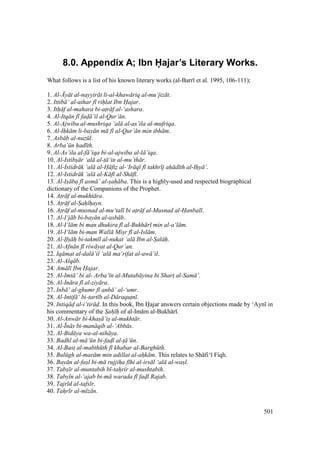
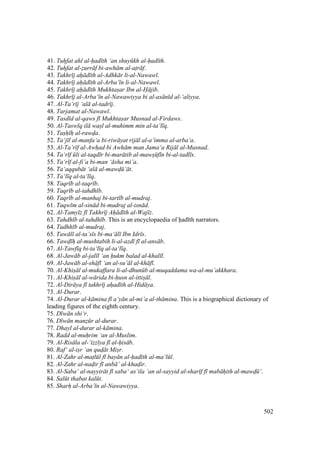
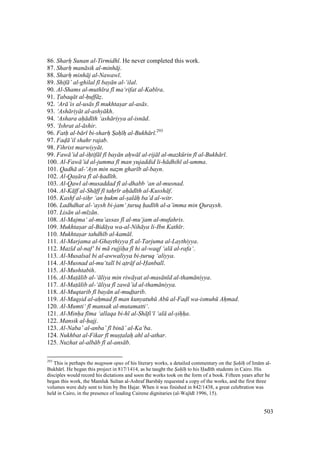
A list of his known literary works has been listed in Appendix A, at the end of the thesis.
Today, Ibn Hajar is primarily remembered in the Muslim world as the author of a detailed
commentary on the Sah h of al-Im m al-Bukh r . This work, called Fath al-b r , is
perhaps the magnum opus of his literary works. He began this project in 817/1414, as he
taught the Sah h to his had th students in Cairo. His disciples would record his dictations
and soon these notes took on the form of a book. The work was not even complete yet it
still warranted attention from leading figures around the Muslim world. In 833/1429,
Timur’s son Sh hrkkh sent a letter to the Mamluk sultan al-Ashraf Barsb y requesting
several gifts, including a copy of Fath al-b r . Ibn Hajar sent him the first three volumes.
Similarly, the Moroccan sultan Abk F ris ‘Abd al-‘Az z al-Hafsz requested a copy before
its completion. When it was finally finished in 842/1438, a great celebration was held in
Cairo, in the presence of leading Cairean dignitaries, scholars and judges (al-Waj d 1996,
15). Ibn Hajar sat on a platform and read out the final pages of his work, after which
poets recited eulogies.
The reputation of Fath al-b r today is unquestioned in the Muslim world. But during his
life, Ibn Hajar must have enjoyed semi-celebrity status for his masterpiece to attract
attention from leading dignitaries, even before he had completed writing it.
27
There are a few points worthy of contemplation regarding his vast literary works.
a. Firstly, his works related to fiqh were not only focussed on his own school of thought
(Sh fi‘ ). Al-Dir ya, for example, identified the prophetic narrations used in the Hianaf
manual on fiqh, al-Hid ya. This shows that Ibn Hajar had utmost respect for religious
sciences in general, and was not prejudiced in favour certain categories of works and
scholars.
b. Secondly, many of his works were geared towards supplementing the works of
previous scholars. For instance, al-Istidr k ‘al al-H fiz al-‘Ir q f takhr j ah d th al-
Ihy ’ was written to identify the original sources of the prophetic narrations used in the
Ihy ’ ‘ul m al-d n of Im m Ghaz l and Takhr j ah d th al-arba’ n li-al-Nawaw did the
same for the Forty Had th of al-Nawaw . This shows that as a Muslim, he had a degree of
respect for scholars, classical and contemporary, and wished to advance the popularity of
such works. Perhaps more importantly, it indicates the type of literary works that were
popular and in demand in the ninth Islamic century. Rather than original and ground-
breaking material, the scholars had resigned themselves to improving and editing existing
works prior to them.
c. Thirdly, though he wrote works in all Islamic disciplines, the majority of his works
related to hiad th and ‘ilm al-had th. This in turn means that the Nuzhah is by no means a
true reflection of the depth of his knowledge in ‘ilm al-had th; it is merely a manual
covering the discipline in general. For instance, a very brief analysis of mudtarib is
28
offered in the Nuzhah.16
The extent of his knowledge on this type of tradition is reflected
in his separate treatise on the topic, al-Muqtarib f bay n al-mudtarib. The same applies
to his works like al-Alq b, Bay n al-fasl bi-m rujjiha f hi al-irs l ‘al al-wasl and al-
Ta’r j ‘al al-tadr j, to mention a few. These are all separate, detailed works on different
areas of ‘ilm al-had th that he simply touched upon in the Nuzhah.
The Nuzhah is still significant however because it is the only work of his where he
analysed the discipline of ‘ilm al-had th as a whole. Certainly, Ibn Hajar himself
emphasised the importance of the Nuzhah from his vast literary works. He only expressed
pride in a handful of his books, and the Nuzhah was one of them (al-Mun w 1999, 1: 27).
2.8. The moral development of Ibn Hajar; his outlook as
an individual.
To his contemporaries, Ibn Hajar was a simple and devout Muslim. He was known as a
gentle man, who was inclined to charity and kind-heartedness. Those who knew him
acknowledged his willingness to be good to those who wronged him and forgiving to
those he was able to punish. He was very spiritually-centred as an individual. The
extended time teaching in the sIkf lodge of Baybars for approximately twenty years must
have played a role in determining his outlook. Alternatively, it could be argued that a
lifetime of studying the traditions of the Messenger had imbued him with a deep love for
his morally-upright example.
16
This will be referred to in Section 5.31.
29
Ibn Hajar’s wife too played a role. When he reached the age of twenty-five, he married
{nas Kh tkn (al-Barr et al. 1995, 97), in 798/1395. She was the daughter of al-Q d
Kar m al-D n ‘Abd al-Kar m ibn ‘Abd al-Az z. {nas was a hiad th scholar too, having
studied under al-‘Ir q just like Ibn Hajar did. Observers note that she always surrounded
herself with the poor, the old and the physically handicapped, whom it was her privilege
and pleasure to support.
Ibn Hajar passed this love of Islam on to his children. His wife had four daughters with
Ibn Hajar: Zayn Kh tkn, Farhia, ‘{liya and F tiima. Ibn Hajar had one son – Badr al-D n
Muhiammad – from a later marriage (al-Barr et al. 1995, 100). Ibn Hajar paid utmost
attention to his religious education and development. He memorised the Qur’ n and led
tar w h prayers in 826/1422. The book Bul gh al-mar m min adillat al-ahk m was
written by Ibn Hajar as a dedication to his son (al-Barr et al. 1995, 101).
As far as the Nuzhah is concerned, there are places in the work where his moral outlook
as a good Muslim is reflected in his writings as an academic. For instance, he sometimes
corrects and refutes the opinions of previous hiad th scholars, mainly related to the use of
certain hiad th terminologies. The tone and style employed by Ibn Hajar suggests subtlety
and respect, even when he does not agree with someone.
2.9. Conclusion.
The fame and acceptance that he enjoyed throughout his life extended to his demise too,
since even his funeral turned into a major event. Following his death on the twenty-eighth
of Dhkl Hijjah in 852/22nd
February 1449 (Anwar 2003, 21), fifty thousand people,
including the Sultan and Caliph, attended his funeral.
30
In relation to the Nuzhah, the analysis has indicated that:
a. Ibn Hajar was first and foremost a hadith scholar. Therefore, this may suggest his
preference to focus on this alone, rather than fiqh and other disciplines in the Nuzhah.
b. Ibn Hajar was a spiritually-inclined Muslim. This may manifest itself in the Nuzhah via
the non-confrontational approach he chooses to adopt.
c. He lived in a turbulent political climate. His character helped immensely in
overcoming such hurdles.
d. Many of his literary works were improvements of previous literature in the Islamic
sciences. This could indicate that Ibn Hajar lacked originality. Alternatively, it could say
something about academia in the ninth century in that it was largely void of pioneers and
original thinkers.
Where and when required, these themes will be referred to during the thesis.
To conclude, from the abundance of material we have on his life and works, it is
explicitly clear that Ibn Hiajar al-‘Asqal n was a famed and revered had th scholar. There
is no shortage of praise from fellow Muslim scholars, who have described him with
unique and outstanding qualities. Al-Mun w (d. 1021/1612) praised him with the
following words:
The unique of his time, the bearer of the flag of the sunna in his time…the jewel
who has been a source of pride for many generations, the im m of this discipline
and the forerunner of the army of hiad th experts, the resort of the people in
[hiad th] authentication and dis-accreditation … (1999, 1: 117)
31
Al-Q r (d. 1014/1605) wrote a detailed commentary on the Nuzhah. He commenced it
with the following words of praise for Ibn Hajar:
…our leader, the shaykh of our own shaykhs, our dependable, the finest of the
outstanding scholars…Shaykh al-Isl m, and the seal of the huff z$ and hiad th
masters…Shaykh, Shih b al-D n Ahimad ibn Hajar al-‘Asqal n … (1994, 118).
Many titles have been bestowed on him, to reflect his position in the discipline. Fellow
Muslim scholars used the term Shaykh al-Isl m and Am r al-mu’min n f -al-had th 17
when referring to him (al-Barr et al. 1995, 102). This latter title has usually been
reserved for the elite of had th masters, such as al-Im m al-Bukh r .
But it is the title of ‘the seal of the huff z$’ (kh tam al-huff z$) which perhaps best
indicates his rank. It is as if he was the last great had th master to have existed (and
therefore the Nuzhah was the last great work on the subject). This title is a great
compliment to Ibn Hajar because it reflects his expertise in had th. But for that era, the
title can be interpreted as anything but complimentary. This is because it suggests that
after Ibn Hajar, the discipline of ‘ilm al-had th resigned itself to apathy and passiveness.
It suggests that by the era of Ibn Hajar, the field of hiad th had been deprived of fresh
methodology and analysis of the prophetic traditions. He was the last great had th master,
who himself resorted to improving, commentating and editing literature that preceded
him by centuries.
17
The Leader of the Faithful in had th.
32
3.0. The Nuzhah of Ibn Hajar; the Author’s
Introduction and the Related Literature.
As mentioned in the introduction, one of the aims of this thesis is to assess the Nuzhah in
light of the ninth Islamic century, namely the academic, religious and social climate of
that period. This aim will be mainly fulfilled in section five, where a critical commentary
will be offered of the Nuzhah. In part, however, the same issue will also be tackled in this
section (albeit through a different approach) by looking at a brief, historical account of
the ‘ilm al-had th literature that preceded the Nuzhah.
A historical account of ‘ilm al-had th literature is pivotal towards us gaining a sound
appreciation of the Nuzhah. Ibn Hajar’s work was not the first work in the field, or the
last. It was neither the shortest nor the longest. Yet it certainly was and still is one of the
most popular. By assessing the literature that preceded him, we can understand why the
Nuzhah became so popular. Moreover, such an account will help us evaluate whether the
Nuzhah was filling a void that had hitherto been unaddressed by his predecessors. Or,
alternatively, it can assist in answering whether the Nuzhah was merely one treatise on
‘ilm al-had th, like the many before and after it.
In order to present a background to the literature in ‘ilm al-had th prior to the Nuzhah, I
have used Ibn Hajar’s own introduction to the Nuzhah as the basis in this chapter18
, since
18
In this chapter and the main section, the translation of the Nuzhah has been presented in bold font.
33
he reviews key works that preceded him in this short introduction. Though he obviously
does not mention every work that came before him, the books he does quote gives us an
insight into the works which he personally saw as significant.
His introduction also indicates why he wrote the Nuzhah, and where this work lies in
relation to his shorter work Nukhbat al-fikar. To conclude the chapter, I will assess the
worth of the Nuzhah in relation to the development of ‘ilm al-had th literature throughout
the centuries. Two opinions will be presented. One suggests that the Nuzhah holds a
substantially important place in ‘ilm al-had th literature. The second implies that the
Nuzhah was typical of its era, and that the work highlighted the stagnant nature of the
development of ‘ilm al-had th literature as a whole.
The Shaykh, the Im:m, scholar, practising [on what he knows], the H5:fizD19
, the
exceptional of his time, the unique of his generation, meteor of the religion, AbE al-
FadDl AhFmad ibn ‘Al; al-‘Asq:lan;, famous by the title ‘Ibn H5ajar’20
– may All:h
reward him with Paradise, through His grace and favour – writes;
In the Name of All:h, Most Merciful and Benevolent.
19
The word h fiz literally means ‘someone who memorises.’ In the discipline of ‘ilm al-had th, it refers to
someone who has memorised over one-hundred thousand prophetic reports (Migh lw 2003, 27). The
writings of earlier scholars suggest that h fiz and muhaddith are synonymous terms. Later scholars explain
a subtle difference; that a h fiz is a title of higher rank. ‘Al al-Q r writes that it refers to a scholar who has
memorised at least one-hundred thousand prophetic reports (Khalifa 2003, 42).
20
It is not clear where the title Ibn Hajar originated. Some scholars believe it was a title he was given as he
accumulated a small wealth of gold and silver. Others believe the title has a metaphorical connotation: his
thought and astuteness was as rigid as stone. Another opinion is that the fifth generation down from his
father’s side was called Hajar (Sab gh 1990, p. viii). All these reasons are plausible.
34
All praise is to All:h, Who remains the All-Knowing, All-Able, the Ever-Living, the
Firm, the All-Listening, and All-Seeing. I testify that there is no god except All:h,
He is Alone with no partner and I glorify Him excessively.
I testify that MuhFammad is His Servant and Messenger. May All:h send blessings
upon our Leader Prophet MuhFammad, who was sent to humanity in its entirety, as
a bringer of glad-tidings and as a warner. And many salutations be upon his family
and his Companions.
Undoubtedly, there is an abundance of literature in the science of h5ad;th, [written]
by classical and contemporary scholars. Amongst the first to write in this area was
al-Q:dF; AbE MuhFammad al-R:mahurmuz; , his book called al-Muhaddith al-f sil.
However, he did not complete this work. Then came al-HF:kim AbE ‘Abd All:h al-
N;s:bEr; but the book was not ordered systematically or refined. He was followed by
AbE Nu‘aym al-IsFbah:n;, who added to his predecessor’s works, and left out areas
for those after him [to complete]. Then came al-KhatM;b AbE Bakr al-Baghd:d;. Thus
he wrote al-Kif ya on the rules of narration and al-J mi‘ li akhl q al-r w wa d b
al-s mi‘, on the etiquettes of narration. [In fact] he wrote separate treatises on
almost all areas of h5ad;th criticism. As al-H5:fizF AbE Bakr ibn NuqtMa said: ‘Every
impartial observer knows that all h5ad;th scholars after al-KhatM;b al-Baghd:d; were
dependant upon his books.’
Then after them came others and they took a portion from this knowledge. Thus al-
Q:dF; ‘Iy:dF compiled a wonderful book which he called al-Ilm ‘ and AbE H5afsF al-
Mayy:nish; wrote a pamphlet called M l yasa‘u al-muhaddith jahluh .
35
Examples of these literary works which became famous are plentiful, (of which)
some were detailed to offer comprehensive knowledge, and some were abridged (to
make understanding easy).
(This was such) until al-H5:fizF al-Faq;h Taq; al-D;n AbE ‘Amr ‘Uthm:n ibn al-SFal:hF
‘Abd al-RahFm:n al-ShahruzEr;, resident of Damascus, appeared. He gathered his
famous book when he took over teaching at al-Madrasa al-Ashrafiyya. He refined
the fields of h5ad;th (in this piece) and dictated it bit by bit. For this reason, its order
was not achieved in a suitable manner. He included the various works of al-KhatM;b
al-Baghd:d;, gathering its antecedent points and adding selected beneficial points
himself. In this book, he gathered what had hitherto been scattered in different
books. For this reason, people adhered to it and followed its path. The book resulted
in countless literature devoted to it, such as poems, abridged versions, commentaries,
shortened versions and (indeed) critical literature.
3. 1. The Existing Literature.
Ibn Hajar begins the book – after the customary praise of All h and salutations and
blessings upon Prophet Muhammad – with a brief overview of the existing literature in
the field of ‘ilm al-had th. Though the works mentioned are by no means exhaustive, he
does refer to the key works on this subject prior to him. The works and authors he refers
to are;
i. Al-Muhaddith al-f sil bayn al-r wi wa-al-w ‘ .
By Abk Muhammad al-Hasan ibn ‘Abd al-Rahm n ibn al-Khall d al-R mahurmuz (d.
360/970).
36
Almost certainly, al-Muhaddith was the first piece of work on ‘ilm al-had th that
encompassed the discipline as a whole. 21
The works include discussions on areas such as
the etiquettes of the narrator and had th master, methods of delivery and the efforts of
had th masters in the pursuit of knowledge.
As Ibn Hajar notes, the pioneering work of al-R mahurmuz was not complete, precisely
because it was the first treatise written specifically in ‘ilm al-had th. More crucially, the
timing of the book is important to note. It was the middle of the fourth century – when
had th reporting and collecting was in its full swing – before an individual and exclusive
treatise on ‘ilm al-had th first appeared. This indicates that to some extent at least, the
‘ilm al-had th scholars had to write what had happened in the field and not what should
happen. In other words, the work of al-R mahurmuz was in part descriptive rather
prescriptive.
ii. Ma‘rifat ‘ul m al-had th.
By Abk ‘Abd All h Muhammad ibn ‘Abd All h al-N s bkr (d. 405/1014).22
Though it was not systematically ordered, the author addressed fifty sections relating to
the rules of narration.
21
Although al-Muhaddith al-f sil was most certainly the pioneering treatise on the discipline, it does not
mean it was the first time the rules pertaining to ‘ilm al-had th were written down. Prior to this, treatises
could be found on an array of individual topics, such as the words of accreditation and dis-accreditation, the
narrations of seniors from juniors, and the biographical details of reporters. For example, the Ris la of al-
Im m al-Sh fi‘ (150/767-204/820) did contain random writings on ‘ilm riw yat al-had th (Siddiqi 1993,
108). Muslim’s (d. 261/874) introduction to his S"ah" h" also contained various rules regarding the discipline
(Khal fa 1983, 10). Al-Tirmidh included key ‘ilm al-had th terminologies at the end of al-‘Ilal al-mufrad
and at the end of his Sunan (Khal fa 1983, 10). Al-R mahurmuz ’s contribution was to attempt to amass
these rulings into one document.
22
Abk ‘Abd All h Muhammad ibn ‘Abd All h ibn Muhammad ibn Hamdawiyya al-N s bkr , known as al-
H kim, was one of the most respected authorities in the field of had th. Author of the famous al-Mustadrak
‘al -al-sah hayn, he was born in 321/933 and died in 405/1014. He was a prolific writer with
approximately fifteen hundred books to his name, including al-‘Ilal and Faw ’id al-shuy kh. His quest for
knowledge took him to Hij z and ‘Ir q. In 359 he was appointed as the judge of his birthplace N s bkr.
(Mig lw 2003, 68-69).
37
iii. Ma‘rifat ‘ul m al-had th ‘al kit b al-H kim.
By Abk Nu‘aym al-Iszbah n (d. 430/1038).23
The term used by Ibn Hajar to describe this book in relation to the work of al-Hakim is
that it is a mustakhraj.24
This indicates that al-Iszbah n most certainly took the works of
al-H kim as his starting point, and wrote on areas he had left out, or expanded on parts
which had been left brief. However, as Ibn Hajar points out, his efforts were incomplete.
This indicates a theme that perhaps marks the discipline as a whole; dependency and
improvements on the works of others and not a desire to innovate and think outside the
box.
iv. Al-Kif ya f ‘ilm al-riw ya.
v. Al-J mi‘ li-akhl q al-r w wa d b al-s mi‘.
Al-Khats b Abk Bakr al-Baghd d (d. 463/1071).25
Al-Kif ya dealt primarily with the rules of narrations that disciples were expected to
adhere to. Al-J mi‘ was a more extensive treatise, covering areas such as how to respect
the muhaddith, who a disciple should avoid taking traditions from and the etiquettes of
listening.
23
Abk Nu‘aym Ahmad ibn ‘Abd All h ibn Ish q al-Iszbah n was one of the most celebrated classical
scholars. He had permission to hear hadith from his teachers at the age of six. He heard had th from –
amongst others – al-Tabar n and counts al-Khats b Abk Bakr al-Baghd d as one of his close disciples. Al-
Iszbah n ’s other works include Hilyat al-awliy , Ma‘rifat al-sah ba, Kit b dal ’il al-nubuwwa, Kit b al-
mustakhraj ‘al al-Bukh r and Tabaq t al-asfiy . He died in 430/1038, at the age of 94 (al-Waj d 1996,
20).
24
In ‘ilm al-had th terminology, this refers to when a hadith master takes an existing book of hadith and
derives the isn ds for each narration himself (Tahh n 2001, 32).
25
Abk Bakr Ahiimad ibn ‘Al ibn Th bit ibn Ahiimad ibn Mahd al-Baghd d was perhaps one of the most
important figures in the field of had th ever to have existed. Born in 392 /1002, al-Baghd d became a
master of had th, History, Jurisprudence, Doctrines to mention but a few fields of knowledge (al-SuyktI
1972, 2: 397). The historian al-Dhahab described him as ‘the most peerless Im m, erudite scholar and
mufti, meticulous had th master, scholar of his time in had th, prolific author, and seal of had th masters’
(1994, 31: 86). His most famous works were al-Rihla f talab al-had th, T r kh Baghd d, al-Kif ya f ‘ilm
al-riw ya and al-J mi‘ li akhl q al-r w wa d b al-s mi‘. He died in 463/1071.
38
vi. al-‘Ilm ‘ il ma‘rifat al-riw ya wa taqy d al-sam ‘.
Al-Q dz ‘Iy dz.26
This text was by no means a comprehensive one on ‘ilm al-had th; the book primarily
dealt with the process of receiving and passing on narration (al-tahammul wa-al-ad ’).
Nevertheless the work was commended for its clarity and layout (Toahoho n 2001, 10).
vii. M l yasa‘u al-muhaddith jahluh .
Abk Hafsz al-Mayy nish (d. 580/1184).
This short work offered a brief yet precise guide to the technical terms used in the
discipline.
viii. Muqaddima (‘Ul m al-had th).
By al-Hz fizz al-Faq h Taq al-D n Abk ‘Amr ‘Uthm n ibn al-Szal hz ‘Abd al-Rahzm n al-
Shahruzkr (d. 643/1245).
Though the work is officially known as ‘Ul m al-had th, it is popularly referred to as
Muqaddimat Ibn al-Sal h. As Ibn Hajar notes, the book became an important milestone
in ‘ilm al-had th literature due to its scope, clarity and comprehensiveness. He drew on
the works of his predecessors, such as al-Khats b al-Baghd d , and gathered sections that
had previously not been confined to one work. A minor criticism of the work – as noted
by Ibn Hajar – was that the order was still somewhat unsystematic. The reason for this
was that, according to Ibn Hajar, Ibn al-Sal h did not aim to write the book per se; the
works were put together from his lecturing at al-Madrasa al-Ashrafiyya.
As a form of praise for this momentous work, Ibn Hajar writes in the introduction that
‘Ul m al-hadith resulted in a surge of related works. These included n zIims (poems) like
26
Abk al-Fadzl ‘Iy dz ibn Mks ibn ‘Iy dz, better known as al-Q dz ‘Iy dz, was an exceptional scholar of the
fifth/sixth Islamic century. His masterpiece Al-Shif bi ta‘r f huq q al-mustafa refers to the life of
Muhammad, and is still universally revered and respected today. He died in 544/1149.
39
the efforts of Zayn al-D n al-‘Ir q , Muhammad ibn Ahmad ibn al-Khal l Shih b al-D n
al-Khkb and al-Qadi Shih b al-D n al-Harb (al-Mun w 1999, 1: 220). It also led to
summaries (mukhtasar), like the two written by al-Nawaw (d. 676/1277). The first was
called al-Taqr b, upon which Jal l al-D n al-SuyktI (d.911/1505) later wrote a
commentary entitled Tadr b al-r wi f sharh taqr b al-Nawaw . The second summary was
called Kit b Irsh d t$ull b al-haq ’iq il ma‘rifat sunan khayr al-khal ’iq, or al-Irsh d
for short. Al-Hafiz ibn Kath r wrote his own summary upon the works of al-Nawaw (al-
Mun w 1999, 1: pp. 220-221).
Mustadraks (supplements) were also written on ‘Ul m al-hadith. This term refers to a
literary work where a later author improves and adds to the existing, original work (al-
‘Uthaymin 2002, 29). Examples of such works on ‘Ul m al-hadith are Isl h ibn al-Sal h,
by Maghlatsai ibn Qal j ibn ‘Abd All h (d. 762/1360) and Mah sin al-istil h by al-Im m
al-Bulqin . In short, Ibn Hajar wanted to highlight the importance of ‘Ul m al-had th. In
fact it still remains a text of paramount importance today.27
Ibn Hajar deemed it important to mention these seven treatises that preceded him in the
field of ‘ilm al-had th. There were other important works which he did not refer to, such
as:
1. Al-Iqtir h f bay n al-Istil h by Ibn Daq q al-‘|d (d. 702/1302).
2. Al-Khul sa f us l al-had th by al-Husayn ibn ‘Abd All h al-T b (d. 732/1331).
3. Al-Muqni‘ f ‘ul m al-hadith by ‘Umar ibn ‘Ali ibn al-Mulaqqin (d. 804/1401).
4. Alfiyyat al-had th by Zayn al-D n al-‘Ir q (d. 806/1403).
27
The text has recently been rendered into English, by Dr. Eerik Dickinson. (2006) An Introduction to the
Science of Hadith (Garnet: Reading, UK).
40
Of these books, it is most surprising that he did not give his teacher’s work, al-‘Ir q , a
mention. Perhaps because this was based on the Muqaddima of Ibn al-Szal hz, which he
does mention in considerable detail, Ibn Hajar did not feel the need to refer to the Alfiyya
separately.
41
4.0. The Nuzhah.
Some friends of mine asked me to offer a brief overview of the important parts of
this book. Hence I wrote it in a few papers and I named it Nukhbat al-fikar f
mustalah al-athar with an order I produced and a style I pursued, adding unique
and additional points. My friends re-approached me and asked me to write a
commentary for it, which would unlock its secrets and open its treasures, and
expose what had been hidden before. I duly obliged in hope of being included among
the people of h5ad;th, and made extensive effort in explaining the hidden facets, since
the homeowner knows best as to what is in his home. It became apparent to me that
a comprehensive account was more suitable and an amalgamation (of the original
and the commentary) was more useful. Hence, I adopted this rare style, and I say,
seeking assistance from All:h…
In the last part of the introduction, Ibn Hajar explains how his own book on the subject
came about. It is clear from his own wording that he based his work on the writings of
Ibn al-Sal h, but aimed to offer a ‘brief overview of it.’ The result was a small
manuscript which he named Nukhbat al-fikar, consisting of only a few pages.28
Clearly,
this summary was almost too brief since he was asked to elucidate on the Nukhbah. This
second work was called Nuzhat al-nazar. Rather than treating the two works separately,
Ibn Hajar merged both works together, so it could be studied as one text. The uniqueness
of the work is reflected by the fact that the Nukhbah can still be read individually.
28
The Nukhbah has been recently rendered into English, by Musa Furber, in Sunna Notes; Studies in
Hadith & Doctrine (Haddad, G. F., 2005, Aqsa Publications, UK).
42
4.1. The Relationship between the Nuzhah and Nukhbat al-Fikar.
The request for a small manual on ‘ilm al-had th by his contemporaries led to Ibn Hajar’s
writing the Nukhbah. His second effort – a more-detailed commentary of the Nukhbah –
followed and this was called the Nuzhah. What did Ibn Hajar do in the Nuzhah which was
an addition and improvement on the original Nukhbah? Anwar (2003) comments that by
comparing the original Nukhbah and the subsequent Nuzhah, it becomes clear that Ibn
Hajar focused on improving and developing three areas:
1. Firstly, he geared effort towards what Anwar refers to as tawd h mat lib, or clarifying
the aims of the book (Anwar 2003, 33). For example, Ibn Hajar begins the Nukhbah with
the division of different types of khabar. However, he does not mention in detail what is
meant by the term khabar in the actual Nukhbah despite the importance of this term.
Considerable detail is provided in the Nuzhah, where he provides us with how the term is
used, its comparison with the term had th, and how the term is used in the Arabic
language (section 5.2. of this thesis).
2. Anwar writes that the second aim of the Nuzhah was tawj h ‘ib ra, or ‘attention to the
text’ (2003, 33). Certainly, this is referring to how the reader is reminded of the meanings
and derivations of certain words used in the Nukhbah. For instance, we are reminded that
the word t$uruq is the plural of t$ar q on the template of jam‘ kathra. It must be noted
however that as the book progresses, less emphasis is provided on points relating to the
meanings of words in relation to syntax and etymology. Instead, Ibn Hajar provides this
only in the earlier parts of the Nuzhah.
43
3. Thirdly, the purpose of the Nuzhah, as expressed by Anwar, was izh r ish ra, or
‘revealing of indications.’ Perhaps this refers to where Ibn Hajar gives his own preference
over a disputed terminology, or where he expresses his dismay over commonly-
misunderstood or misinterpreted matters. For example, Ibn Hajar highlights the fact that
many have considered i‘tib r a type of had th, basing this on the sub-heading Ma‘rifat al-
i‘tib r wa-al-mut bi‘ t wa-al-shaw hid in Ibn al-Sal h’s ‘Ul m al-had th. I‘tib r – as he
rightly points out – is not a type of had th; rather it is the means of investigation by which
mut bi‘s and sh hids are found.29
4.2. The Unique Qualities of the Nuzhah.
Ibn Hajar – as shown in the previous section – was a prolific writer in both ‘ilm al-had th
and other Islamic disciplines, writing over one-hundred and fifty works. His student al-
Sakh w commented that of all his works, he showed pride in only a handful of his works.
He writes:
I heard Ibn Hajar say: ‘I am not entirely content with any of my literary works,
because I initially wrote them and felt the need for re-editing in all of them. The
exceptions are Sharh sah h al-Bukh r , its introduction al-Mushtabih, Tahdh b
[al-tahdh b] and Lis n al-m z n.’
[Al-Sakh w added]: ‘In fact I have seen him on occasions praise his own Sharh
sah h al-Bukh r , the Ta‘l q and the Nuzhah’ (in al-Mun w 1999, 1: 27).
29
See section 5.13.
44
Al-Mun w echoed the sentiments of Ibn Hajar when he identified key and outstanding
qualities of the Nuzhah (1999, 1: pp. 29-33). He highlighted the following unique
attributes;
1. He gathered the most important elements of Ibn al-Szal hz’s Muqaddima.
2. He arranged the Nukhbah in a pioneering manner not done by his predecessors.
3. He amalgamated the Nukhbah into the Nuzhah in such a way that the Nukhbah can still
be read and treated as a separate book.
4. Along with defining and explaining each type of had th, he supplemented it with
examples of each from had th literature, as well as existing literary works on each
particular type. There are exceptions however, like mursal and mudallas; for which he
did not provide examples of such traditions, nor did he highlight the works of previous
scholars on them.
5. Ibn Hajar mainly concentrated on the preferred opinion on disputed issues. There are
places however where he did expand into other, weaker opinions on certain issues. For
example, he felt the need to highlight and refute the weak opinion of certain scholars who
defined a sah h report as one which consists of at least two reporters in each generation.30
6. Ibn Hajar felt the need to stress certain points which he felt had been neglected by
previous experts in ‘ilm al-had th. When explaining the contrasting difference between
mursal and munqati‘, for example, he added how certain scholars considered the two
types synonymous. And ‘very few are aware of this point’ he wrote.31
30
See section 5.5.
31
See section 5.8.1.
45
7. Ibn Hajar praised the works and efforts of previous Muslim scholars in his Nuzhah.
With regards to al-Im m al-Dhahab , he praised him as a scholar ‘of complete
competence in the criticism of [had th] reporters.’32
Al-Mun w ’s observations do give an indication of the target audience for the Nuzhah,
something which will be addressed as this thesis progresses. It seems the work was
primarily aimed to be an introduction to ‘ilm al-had th for young students wishing to
learn about the discipline. This is because the Nuzhah defines each type of had th along
with practical examples. Countless sections are concluded with an insight into further
literature available and he is keen to highlight the correct opinion on areas that are
sources of dispute. If this is true, then the ‘friends of mine [who] asked me to offer a brief
overview’ could well have been fellow teachers, who wanted to provide their disciples
with an introductory guide to the discipline.
The other point which is apparent from al-Mun w ’s observations is that the
improvement was largely in the structure and detail, not necessarily in the content.
4.3. The Nuzhah and the historical development of ‘ilm al-h(ad)th
literature.
The ‘ilm al-had th literature which Ibn Hajar provides in his introduction is useful in
providing an insight into how the Nuzhah fits in historically with previous works, and
what all this says about the development of the discipline as a whole. There are key
observations that are crucial to mention:
32
See section 5.64.
46
m In its earliest form, ‘ilm al-had th literature took the form of the merging of ‘ilm al-
had th rules and principles within had th texts that mentioned chains and narrations. This
commenced in the second Islamic century, up until the fourth century. Al-Im m al-
Sh fi’ ’s al-Umm and the al-Ris la are two examples of works reflecting this stage.
During the second half of the fourth Islamic century, texts on ‘ilm al-had th exclusively
appeared for the first time, as the Nuzhah indicates in the introduction. Most agree that
al-Muhaddith al-f sil by al-R mahurmuz (d. 360) was the pioneering work in this field.
Thereafter, a pattern emerged in ‘ilm al-had th literature. After a period of individual
treatises on all or part of the disciplines by various scholars, a milestone work would
appear that would summarise, elucidate and edit the works preceding it. In the fifth
century, Ma‘rifat ‘ul m al-had th of Abk Nu‘aym al-Iszbah n (d. 430/1038) served this
function and the next milestone work was most certainly the Muqaddima of Ibn al-Szal hz
(d. 643/1245).
Between the Muqaddima of Ibn al-Szal hz and the Nuzhah of Ibn Hajar (d. 852/1449), ‘ilm
al-had th literature continued to grow with the appearance of refined works,
commentaries and summaries on existing works in ‘ilm al-had th. But owing to the
universal acceptance of the Muqaddima, most literature after it was based on Ibn al-
Szal hz’s work. For example, the Alfiyya of Zayn al-D n al-‘Ir q (d. 806/1403) was based
on the works of Ibn al-Sal h, as was al-Nawaw ’s (d. 676/1277) al-Taqr b.
The Nuzhah of Ibn Hajar was the next important – and perhaps the last – milestone work
on ‘ilm al-had th. This is because in essence, subsequent works after it were based on it,
just as the Muqaddima of Ibn al-Szal hz led to a surge of related literature before. Al-
Mun w (1999, 1: 34) identifies thirty-six works that are directly based on the Nukhbah
47
or the Nuzhah, in the form of commentaries, h shiyas or nazms. 33
Some were written by
esteemed scholars in their own right.
So in essence, the discipline’s literary development can be understood through two
important works. The Muqaddima of Ibn al-Szal hz (d. 643/1245) became an important
milestone because it summarised the previous important works on the discipline, and it
became the foundation upon which many subsequent scholars based their works on. The
extensive praise Ibn Hajar directs to it in his introduction indicates this fact amply.
Then the Nuzhah of Ibn Hajar (d. 852/1449) acted as a summary of Ibn al-Szal hz’s
exceptional works and thereafter, a large majority of literature was based on this.
33
Here are some of the most-celebrated works written based on the Nuzhah or the Nukhbah (1) ‘Unw n
ma‘ n nukhbat al-fikar f mustalah ahl al-athar by Ahimad ibn Siadaqa al-Q hir (d. 905/1499) (2) Sharh
nukhbat al-fikar by Ath r al-D n (3) H shiya ‘al nuzhat al-nazar by Ibr h m al-Shahruzkr (d. 1101/1689)
4. Sharh nukhbat al-fikar by Ibr h m al-Kurd . (5) Al-‘.l al-rutba f sharh nazm Nukhbah by Ahimad ibn
Muhiammad ibn Muhiammad ibn Hasan Taq al-D n Abk al-‘Abb s al-Shamn (d. 872/1467) (6) Naz$m li-
matn nukhbat al-fikar by Ahimad ibn Muhiammad ibn ‘Abd al-Rahim n Shih b al-D n al-Tikkh al-Q hir (d.
893/1487) (7) Sharh nukhbat al-fikar by Ahimad ibn Muhiammad al-Kaw kb (8) Sharh nazm al-nukhba by
al-Ashmkn (9) ‘Aqd al-durar f sharh mukhtasar nukhbat al-fikar by al-{lks (d. 1342/1923) (10) Zubdat
al-nazar f sharh nukhbat al-fikar by Taq ibn Sh h Muhiammad ibn ‘Abd al-Malik al-L hor (11) A‘l al-
rutba f sharh al-nukhba by Fasi hi al-D n al-Haydar . (12) Qasab al-sukar f nazam nukhbat al-fikar by
Muhiammad ibn Ism ‘ l al-Am r al-Hasan al-Sian‘ n (d. 1182/1768).
(13) Thamar t al-nazar f ‘ul m al-athar by Muhiammad ibn Ism ‘ l al-Am r al-Hasan al-Sian‘ n (d.
1182/1768). This book only deals with the knowledge of al-jarh wa-al-ta‘d l (14) Istijl ’ al-basar min
sharh nukhbat al-fikar by ‘Abd al-Az z ibn Abd al-Sal m al-‘Uthm n (15) Sharh mukhtasar nukhbat al-
fikar by ‘Abd al-Az z ibn Muhiammad al-Abhar (d. 895/1489) (16) Sharh qasab al-sukkar nazm nukhbat
al-fikar by ‘Abd al-Kar m ibn Mur d al-Athar (17) H shiyat laqt al-durar bi-sharh matn nukhbat al-fikar
by ‘Abd All h ibn Husayn Kh tiir al-Sam n (18) Naz$m li-nukhbat al-fikar by ‘Abd All h ibn ‘Umar al-
Yam n (d. 1196/1781) (19) Sharh nukhbat al-fikar by ‘Abd All h ibn Fathi All h.
(20) Al-Mukhtasar min nukhbat al-fikar by ‘Abd al-Wahh b ibn Ab al-Barak t al-Sh fi‘ al-Ahimad (d.
1150/1737) (21) Bahjat al-basar li-nathar nukhbat al-fikar by ‘Uthm n ibn Sanad al-Baqar (d. 1236/1820)
(22) Al-Ghurar sharh bahjat al-basar by ‘Uthm n ibn Sanad al-Baqar (d. 1236/1820).
(23) ‘Aqd al-durar f nazm nukhbat al-fikar and Sharh ‘aqd al-durar f naz$m nukhbat al-fikar by
Abk al-Mahi sin Abk H mid (d. 1052/1642) (24) Sharh nukhbat al-fikar by ‘Al ibn Sulti n al-Q r (d.
1014/1605) (25) Sharh nukhbat al-fikar by Muhiammad ibn Ibr h m ibn al-Si ’igh (26) Mukhtasar ‘ul m al-
had th by Ibn al-Waz r Muhiammad ibn Ibr h m (d. 840/1436).
(27) Manh al-nughba ‘al sharh al-Nukhba by Muhiammad ibn Ibr h m ibn Yksuf Ridi al-D n ibn al-
Hanbal (d. 971/1563) (28) Im‘ n al-nazar f sharh nukhbat al-fikar by Muhiammad Akram ibn ‘Abd al-
Rahim n al-Sanad al-Makk (29) Nazm li-nukhbat al-fikar by Muhiammad ibn Ab Bakr al-Husayn al-
SuyktI (d. 856/1452) (30) Tash h al-nazar f sharh nukhbat al-fikar by Muhiammad ibn Husayn Haz w r .
48
It is quite possible to argue that after the Nuzhah, no independent, fresh and original
treatise was written in the field. If it is argued that Tadr b al-r wi f sharh taqr b al-
Nawaw , by Jal l al-D n al-SuyktI (d. 911/1505), was regarded as an instrumental work
after Ibn Hajar’s Nuzhah, one can reply by pointing out that even this work was based on
al-Nawaw ’s work, who based his work on the Muqaddima.
This analysis of Ibn Hajar and his Nuzhah thus explains why many scholars consider him
as one of the last great h fiz$s. In fact, by referring to him as kh tam al-huff z$ (the seal of
the hiad th masters), al-Q r implicitly suggests that he marked the end of the period of
great had th experts (1994, 118). Ibn Hajar’s service to the discipline of ‘ilm al-had th
could be viewed as the last major input; thereafter scholars in the field perhaps passively
geared their efforts in consolidating existing works and offering commentaries on the
books written by their predecessors. Undoubtedly, this further amplifies the importance
of a critical and detailed analysis of his Nuzhah. But this is not to say that the Nuzhah is a
true reflection of his in-depth knowledge of ‘ilm al-had th. As we have already shown, he
wrote individual treatises on countless areas within the discipline. The Nuzhah is merely
an indication to his true wealth of knowledge, not an accurate reflection.
m The introduction of the Nuzhah therefore provides a rough guide to the development of
‘ilm al-had th literature and how Ibn Hajar’s own work fits in. However, the same
introduction also indicates another important pattern. Even by Ibn Hajar’s own admission,
the literature in this field over the centuries largely depended on slightly improving the
works of predecessors, rather than a radical review of it. Abk Nu‘aym’s efforts were
simply geared towards refining the work of al-H kim, proven by the fact that it is referred
49
to as a mustakhraj. Ibn al-Szal hz’s Muqaddima, despite its importance, can be viewed as
an attempt to simply gather the works of previous scholars into one book. There is little
or no indication that as time went by, the classification and indeed authentication of
prophetic reports was radically overhauled. Instead, it was mildly refined. The Nuzhah
was a result of a personal request from Ibn Hajar’s contemporaries, rather than an urgent
requirement. Even he himself admits that only the approach of writing was original
(‘…with an order I produced and a style I pursued…’). Like what had gone on for
centuries before, ‘ilm al-had th literature never seriously questioned the issue of
authenticity and never attempted to think outside the consensual norm.
Objectively-speaking, it is clear that there are only a handful of places where there is
some real originality in the Nuzhah in comparison with Ibn al-Szal hz’s work. Al-Mun w
identifies only ten sections which feature in the Nuzhah and not in the Muqaddima (1999,
1: pp.32-3). Eight of them simply relate to how we group different names and kunyas
(section 5.65.) such as ‘reporters whose teacher’s name coincides with their father’s
name’. This can hardly described as pioneering and important. There are only two
sections which are truly original, muhkam (section 5.14.) and the reasons behind the
had th (5.71.). Otherwise, the material, classification and even the examples are similar to
the Muqaddima. Only the literary style is perhaps different.
On a wider scale, the fact that there are many similarities between the Nuzhah and the
Muqaddima raise a more important question about whether the discipline ever really
continuously developed throughout the centuries, or whether it suffered from academic
passiveness. A case can be made for the latter, and proof for this can be found in the
opinion of Ibn Hibb n (d. 354/965), who said: ‘…I see that the [Islamic] disciplines are
50
all developing except this discipline [of had th]. For this is declining day by day’ (in al-
Mun w 1999, 1: 4). Perhaps Ibn Hibb n wanted to highlight that as early as the fourth
Islamic century, there was not enough original work being done in ‘ilm al-had th.
In short, the Nuzhah’s introduction suggests two themes. One suggests that milestone
works appeared in the discipline every so often which proved to be the depended guide
for scholars and disciples thereafter. Like the Muqaddima, the universal acceptance of the
Nuzhah suggests this too received such an accolade. The fact that esteemed scholars such
as al-{lks (d. 1342/1923) and al-Q r (d. 1014/1605) have written commentaries on the
Nuzhah is undoubtedly a testimony to its acceptance and appeal. The other theme
suggests that the discipline largely depended on the endeavours of the early scholars;
thereafter there were modifications and slight alterations throughout the centuries. This
reached a terminal end with the Nuzhah.
Only a critical analysis of the Nuzhah will identify which of these two opinions is closer
to the truth. Therefore it is a theme which will be touched upon – where possible –
throughout the thesis.
51
5.0. The Main Section; a Translation of the Nuzhah,
with the Commentary and Critical Analysis.
5.1. The Author’s Introduction.34
The author’s introduction has been translated (in bold) and analysed in the previous
section (4.0) and therefore it has not been duplicated here.
5.2. Khabar al-ah+d and mut+watir; The division of
traditions according to how they reached us.
The khabar – according to the scholars of this field – is synonymous with [the
meaning of] h5ad;th. It is said h5ad;th is that which derives from the Prophet , and
khabar is that which derives from others. Furthermore, it is said to a person who
occupies himself with history and similar [disciplines] ‘al-akhb r ’, and a person
who occupies himself with h5ad;th ‘muhaddith’.35
It is [also] said that the difference
between them is ‘um m wa-khas s mutlaq 36
; thus every h5ad;th is a khabar, and not
vice versa. It has been described here with khabar to be more encompassing.
34
Throughout section five, the translation of the Nuzhah is presented in bold font.
35
To clarify the general usage of the two terms, Ibn HIajar writes that a person who occupies himself with
the study of history and similar subjects is called an akhb r and not a muhaddith. Likewise, a person who
occupies himself with the study of the Prophetic sunna is called a muhaddith, and not an akhb r .
36
This terminology is derived from us" l al-fiqh (principles of jurisprudence) and refers to when two things
are related through generality and particularity. For example, ‘every football is round, but not every round
object is a football’ and ‘every Messenger (ras l) is a prophet (nab ), but not every Prophet is a Messenger.
The other type is ‘um m wa-khas" s" wajh . This refers to a general statement from which some part has
been made particular. For instance, the Prophet said ‘there is no Prayer after ‘As"r until the sun disappears.’
52
So according to consideration of how it reached us, the khabar either has t!ar qs,
namely many chains; because the plural of t!ar q is t!uruq. The word [on the template]
of fa‘ l pluralises on fu‘ul for kathra – with two dammas – and af‘ila for qilla. And
what is meant by ‘t!ar qs’ is chains [isn ds]. The isn d is the report of the path
leading to the matn. The matn is the final text at which the chain finishes. And the
‘numerous chains’ is one of the conditions of mutaw tir when it appears.
Commentary
In this opening section, Ibn Hajar sets up the discussion for the forthcoming analysis on
mutaw tir. He begins with the definitions of oft-used technical terms which he employs
throughout the book, namely khabar, had th, t$ar q37
, isn d and matn38
. Owing to the
dispute surrounding its definition, he offers three definitions for khabar, of which he
prefers the first.39
Interestingly, Ibn Hajar opts for a more detailed analysis of the word t$ar q by providing
information about what its plural is too. The reason for the in-depth analysis of this
(S"ah" h" al-Bukh r , h"ad th no. 551; Book, the Times of Sal h; Chapter, Prayer is not performed before the
sun sets.’) Here, ‘there is no Prayer’ is general and ‘after ‘‘As"r’ is particular (al-‘Uthaymin 2002, p. 37).
37
Tar q (pl. t$uruq). Ibn Hajar writes that the plural for a word on the template of fa‘ l falls under two
possibilities- fu‘ul if it is jam‘ kathra and af‘ila if it is jam‘ qilla. The literal meaning of t$ariq is path, but
here it refers to the chains of narration, or isn ds.
38
The intended dialogue and text.
39
i. Khabar means the same as had th, an opinion which al-Khats b al-Baghd d inclines to (1988, 16). In
other words, it is a narration ascribed to the Prophet , regardless of whether this narration describes the
words, actions or silent approvals of the Prophet. Commentators assert that this is the position which Ibn
HIajar himself adheres to (al-‘Uthaymin 2002, 36). The reason for this is that the latter two opinions are
cited using the word q la (‘it is said’), thus giving the indication that they are weaker opinions.
ii. Whatever originates from the Prophet is called had th, and that which comes from others (such as the
Companions) is called khabar. Under this position, it is not permissible refer to the sayings of the
Companions or those after them using the word ‘had th’, except with further clarity. In other words, we
would be required to say had th mawq f, rather than just had th, when referring to the sayings of the
Companions (al-Mun w 1999, 1; 228).
iii. The third opinion cited is that the terms had th and khabar are related to one another through ‘um m
wa-khas s mutlaq. On this basis, a saying that stems from the Prophet can equally be referred to as a
had th or khabar, but a narration stemming from a Companion can only be referred to as a khabar.
53
particular word is that the number of chains is the fundamental difference between the
first two types of reports he discusses in the Nuzhah. If the narration reaches us through
numerous chains40
, then it is classified as mutaw tir. If there are limited chains, then it is
khabar al- h d.
A few points are important to clarify regarding this opening section from Ibn Hajar:
i. He only provides such detailed, linguistic analysis in the early parts of the Nuzhah. As
the work progresses, less and less emphasis is given to the linguistic aspects of technical
terms. This is not inconsistency on his part; rather it makes sense to provide a detailed
definition for oft-used terms early on, which then creates ease for the reader for the rest
of the book. Additionally, providing such detail does indicate that the target-audience of
the Nuzhah was disciples embarking on had th studies for the first time, rather than the
experts.
ii. Ibn Hajar commences the Nuzhah with the term khabar rather than had th. This seems
incorrect as the discipline is known as ‘ilm al-had th rather than ‘ilm al-khabar. He pre-
empts this possible objection and therefore answers it himself. He writes that the word
khabar is generally accepted to be more encompassing in referring to the traditions of the
Prophet and others such as the Companions.41
This indicates that he sees the study of
40
Sanad, or isn d (pl. as nid). According to most had th scholars, the word sanad and isn d are
synonymous. Tahh n notes that isn d can mean ascribing a tradition to its origin through a chain, or it
means exactly the same as sanad (2001, pp.13-14).
41
The literal meaning of had th is ‘new’. The traditions of the Prophet are thus called to contrast it with the
Qur’ n, which is considered as qad m (al-SuyktI 1972, 42 & Khal fa 1983, 26).
We find that the Prophet himself explicitly used the word had th or its derivatives to refer to his own
sayings. For instance; (i) ‘Report from Ban Isr ’ l and there is no hindrance. Report (haddith ) from me
and do not lie (Musnad Ahmad, had th no. 11111; Book, The chains of the remaining oft-narrators;
Chapter, The Musnad of Abk Sa‘ d al-Khudr .) (ii) In a report narrated by Abk Hurayra, the Prophet
said: ‘Shall I not report to you a had th about Dajj l…’(S"ah" h" al-Bukh r , Book; the Reports of the
Prophets, Chapter, the Saying of All h, ‘Verily We sent Nkho to his people.’ Had th no. 3090). Azami notes
that the word ‘had th’ has been used twenty-three times in the Qur’ n (1977, 1).
54
traditions as not just limited to the words and actions of the Prophet; it can refer to others
too.
iii. Related to the above point is the fact that he chose not to define sunna here in the
early part of the Nuzhah. Rather, he elaborates on this term much later on in the book
(section 5.40). This could be because he wanted to begin with the relatively easier terms
such as had th and refer to the more complex terms such as sunna later on. Alternatively,
the reason could be because he viewed had th and sunna as two, entirely separate things.
If this is the case, then his view is not dissimilar to the view of non-Muslim scholars on
the issue. Schacht, for example, has suggested that the word sunna was a source of
confusion amongst early Muslims. He writes that the likes of M lik ibn Anas understood
‘sunna’ to mean the ‘living tradition’ of the community, rather than a term specific to the
actions and sayings of the Prophet (1959, 62). More will be said about this in section 5.40,
once we have identified what Ibn Hajar’s stance actually is on the term sunna.
iv. In his introduction, Ibn Hajar declared that the Nuzhah would be presented in a ‘rare
style’. This is perhaps referring to the sequence adopted by him in presenting the
different types of prophetic reports and their classification. What we notice is that the
choice to begin with mutaw tir differs with the scholars prior and just after him. For
instance:
a. Ibn al-SIal hI began his Muqaddima with the division of prophetic reports according to
its authenticity, thus categorising them into sah h, hasan and d"a‘ f (1986, pp. 11-41).
b. Al-Mayy nish began with an introduction on the importance and superiority of
reporting prophetic reports, after which he outlined the different words used to relate
them, such as akhbaran (Librande 1982, 42).
55
c. Ibn Hajar’s own teacher al-‘Ir q commenced with the division of reports into sah h,
hasan and d"a‘ f (1995, 7).
d. Al-SuyktI too began with the division of reports into sah h, hasan and d"a‘ f (1972, 62)
Ibn Hajar’s choice to begin with mutaw tir could be due to three reasons. Firstly, as he
points out in the next section, mutaw tir is not technically part of ‘ilm al-had th.42
Hence,
he felt the need to define it at the beginning, and then dedicate the rest of the book to
what is widely understood to be the field of ‘ilm al-had th. Secondly, a plausible reason
may be that he felt the need to commence with the strongest type of tradition, which is
mutaw tir. From the onset, Ibn Hajar wanted to alert the reader to the strong and
authentic nature of had th material. Therefore it made sense to discuss mutaw tir first.
Finally, Ibn Hajar perhaps wanted to adopt a ‘rare style’ for the sake of it. If it could be
shown that the Nuzhah has largely repeated what fellow Muslim scholars have written in
their works on ‘ilm al-had th prior to him, then this certainly would support this opinion.
Whether this is true or not will be highlighted throughout section five.
From this short, introductory section from the Nuzhah, we can at least begin to gain an
insight into Ibn Hajar’s intentions and the character of the Nuzhah. By defining the oft-
repeated terms used in the field early on, he shows good literary skills and identifies his
potential target audience. By choosing to refer to mutaw tir first (and not sah h, hasan
and d"a‘ f), Ibn Hajar may be expressing originality for the sake of it. Alternatively, he
could be making a statement of bold intent: to present a truly original and ground-
breaking treatise in ‘ilm al-had th.
42
He writes: ‘And the conditions of mutaw tir have not been mentioned in the original [text of the
Nukhbah], because on this basis, it is not part of the discussions of ‘ilm al-had th.’
56
5.3. Mutaw+tir.
[Either the khabar has many paths but] without a specified number; rather,
experience makes it impossible for them to collude on a lie. Additionally [it is
impossible] to occur coincidentally [and] unintentionally. According to the correct
[position], there is no requirement in specifying the number. Amongst them are
those who have specified four43
[as the minimum number of reporters required in
each generation]; though five44
, seven45
, ten46
, twelve47
, forty48
, seventy49
and other
figures have [also] been mentioned. Every advocate has held to some evidence that
mentions that number, and thus gives knowledge. It is not necessary to repel other
[opinions], due to the possibility of specification.50
Hence, when the khabar is
mentioned as such and this is coupled with the aforementioned number manifesting
itself from the beginning to the end – and what is meant by this is that the
aforementioned number does not lessen in some places, not that it increases, since
an increase is desired by all means – and that the end information is a witnessed or
43
A minimum of four transmitters; this is on the basis that at least four witnesses are required to prosecute
an adulterer (Anwar 2003, 36).
44
A minimum of five transmitters; when a husband accuses his wife of adultery but has no credible
evidence, then the Qur’ n outlines a procedure known as li‘ n. Because the husband curses the wife on the
fifth attempt, some scholars accept that the minimum amount should be five (Qur’ n, 24: 7-9).
45
A minimum of seven transmitters; this is on the basis that this is the number of days in a week, as well as
the number of heavens.
46
A minimum of ten transmitters; in Arabic grammar, this is the minimum number of jam‘ kathra (the
plural of plenitude).
47
A minimum of twelve transmitters; in the Qur’ n, Moses delegated twelve representatives for his
meeting with All h (Qur’ n, 7: 160).
48
A minimum of forty transmitters; this is on the basis that when the verse ‘O Prophet! Sufficient for you is
All h and those who follow you from the believers’(Qur’ n, 8: 64), the number of the Prophet’s followers
were forty.
49
A minimum of seventy transmitters; again, this has its roots from the Qur’ n (7: 155). Moses chose
seventy people from his community for the place of meeting (Anwar 2003, 37).
50
Ibn Hajar also suggests that other suggestions should not be ruled out, as this will lead to an objective
definition of mutaw tir. If, for instance, twelve were to be defined as the universal minimum number, a
had th may be found that has this number in each generation, but still does not give the benefit of
knowledge.
57
heard matter and not something proven by mere conjecture; thus when these four
conditions are found – and they are a large number which makes it impossible for
them to have colluded on a lie or coincidentally agreed on a lie; they narrate it from
their likes from the beginning to the end; the last person witnessed the matter, and
that their khabar gives the benefit of knowledge to its listener – then this is
mutaw tir. Anything that is short of giving the benefit of knowledge is mashh r only.
So every mutaw tir is mashh r, and not vice versa. It is said that when the four
conditions are achieved it necessitates the attaining of knowledge. This is the case
mostly, but it does not sometimes due to a hindrance. And by this, the definition of
mutaw tir is clear. The opposite [of mutaw tir] sometimes appears with indefinite
numbers too, but with the absence of other conditions.
[The khabar reaches us with numerous isn ds] or reaches us with a limit, of more
than two; namely three or more, so long as it does not fulfill the conditions of
mutaw tir; or [it reaches us] with two only, or one only. What is meant by our
saying ‘that it reaches us with two’ is that less than two is not found. Thus, if it
appears with more than two in some places in one chain, it does not harm [it], since
the minimum is considered in this field over the maximum. So the first is mutaw tir
with its conditions. This gives the benefit of certain knowledge (‘ilm al-yaq n). [By
mentioning this], this excludes controvertible knowledge (‘ilm al-nazar), which will
soon be explained. And ‘yaq n’ is strong belief corresponding [to the truth]. This is
the trusted opinion; that khabar mutaw tir gives the benefit of definitive knowledge.
This [knowledge] forces a person to accept it in such a way it is not possible to refute.
It has also been said that [mutaw tir] does not give knowledge except controvertible
58
knowledge. This is not so. The reason is that knowledge via mutaw tir is achieved by
him who does not have the ability of contemplation (nazar), like a layperson.
‘Contemplation’ (nazar) requires the ordering of known or presumed facts, leading
to [further] facts or presumptions. A layperson does not have the ability to do that.
Thus, if [the result of mutaw tir] were controvertible knowledge, it would not be
achieved for them. With this discussion, the difference between definitive knowledge
and controvertible knowledge is clear; definitive knowledge gives benefit without
evidence-building and controvertible knowledge gives benefit but with evidence-
building. And controvertible knowledge can only be attained by the one who has the
ability to contemplate.
The conditions of mutaw tir have not been mentioned in the original [text of the
Nukhbah], because on this basis, it is not part of the discussions of ‘ilm al-had th,
since ‘ilm al-isn d involves the investigation of the authenticity and weakness of the
h5ad;th so it can be acted upon or discarded, in terms of the attributes of the
narrators and the words of delivery. And the narrators are not investigated in
mutaw tir, but rather it is compulsory to act upon it without investigation.
Note: Ibn al-SDal:hPP has mentioned that the examples of mutaw tir – based upon the
aforementioned definition – are rare in existence, apart from what he claims for,
‘Whoever deliberately ascribes a lie to me, let him find a seat for himself in hell.’
What he has claimed of its rarity is unfound, as is the claim of other [scholars] who
say that there are no mutaw tir at all. This is because [these opinions] stemmed from
a lack of awareness of the excessive number of chains, the states of the narrators
and the [other] characteristics required to repel experience from allowing them to
59
collude on a lie, or for them to narrate the same coincidentally. The best explanation
for proving the significant existence of such reports is that the famous, widespread
books in the hands of the people of knowledge, east and west, that are definitively
proven to be ascribed to their compilers, when these compilers agree on recording a
h5ad;th, and their isn ds are sufficient to allow the impossibility of colluding on a lie,
along with the other conditions, this gives definitive knowledge of correctly
ascribing it to its speaker. Such examples in the famous books are plentiful.
Commentary
Ibn Hajar offers his definition of mutaw tir (the multiply-attested), which literally means
‘widespread’.51
Four principal conditions of mutaw tir are identified. Firstly,
the number of transmitters forms the primary element of a mutaw tir had th – that the
tradition must be reported by such a large number that realistically speaking, it would
have been impossible for all the transmitters to have colluded on a lie, or that they all
coincidentally happened to narrate the tradition correctly. However, this actual number is
left ambiguous and subjective, as Ibn Hajar offers no definitive opinion on how many
transmitters must appear in each generation for the tradition to be labelled as mutaw tir.
Rather he cites different opinions on the matter.
Secondly and importantly, this ‘large number’ must be found in all generations. If a
particular tradition is reported by dozens of Companions, only to be reported by two or
three in the generation of Successors (t bi‘ n), the had th will not be classified as
mutaw tir. From the beginning to the end of the chain, the numbers must be maintained.
51
This word is derived from taw tara, meaning to be continuous or torrential (Tahh n 2001, 17).
60
Thirdly, the last person must have seen or heard the event (hiss) and the information in
the report should not be mere conjecture or guesswork.52
Finally, the had th gives the
listener the benefit of knowledge.
Ibn Hajar does provide additional information which is related to mutaw tir. In detail, he
refers to the difference between definitive (al-‘ilm al-yaq n , also called al-‘ilm al-dar r
and al-‘ilm al-qat‘ ) and controvertible knowledge (al-‘ilm al-nazar ) and how mutaw tir
gives the benefit of the former. Owing to the strength of a mutaw tir had th, this, he
believes, gives definitive knowledge.
5.3.1. Conclusion.
The section on mutaw tir is long and extensive, and part of this is because of needless
repetition. In full, he mentions the four conditions of mutaw tir twice in the above text
for no reason whatsoever. It is muddled too sometimes: his discussion on al-‘ilm al-
yaq n and al-‘ilm al-nazar is more suited for an oral audience rather than for a written
book, because he ventures into defining yaq n rather than al-‘ilm al-yaq n .
This indicates that the Nuzhah – or at least this section – may have been produced
through the students’ notes gained from his lecturing. Ibn Hajar was known to employ
this method; this was the case with Fath al-b r . His disciples would record his dictations
and soon the works took on the form of a book. Nor was he the first to adopt such a
methodology: Ibn al-Szal hz (d. 643/1245), author of the renowned ‘Ul m al-had th, did
not aim to write the book per se; the works were put together from his lecturing at al-
52
In other words, the last narrator uses words which suggest he witnessed the event related to the matn. For
example, the narrator would use words such as ‘I heard’, or ‘I saw’, and so on (Tahh n 2001, 18; al-Waj d
1996, 29).
61
Madrasa al-Ashrafiyya. Though dependency on students must have brought many
benefits to Ibn Hajar – the time he could save, for example – it does expose a
compromise in the quality of literary style.
There are other key observations to note from this section on mutaw tir:
a. Ibn Hajar outlines the different opinions held on how many transmitters need to be
found in each generation for a report to be deemed as mutaw tir, four, seven, ten, twelve,
forty and seventy. It is important to note that none of the aforementioned numbers has
any direct link or affiliation with the field of ‘ilm al-had th. Instead, they are merely
numbers that have Islamic importance, mostly because these numbers have been
mentioned in the Qur’ n or have other Islamic significance. There may be seven heavens,
but this is no valid reason to affirm that the minimum number of transmitters in each
generation must also be seven in a mutaw tir had th. This view is further proved by the
fact that some Muslim scholars have suggested that each generation should consist of at
least three hundred and thirteen transmitters, based on the number of Muslims that fought
in the Battle of Badr (Anwar 2003, 37). This is purely hypothetical since no had th exists
with such a high number of transmitters in each generation.
Ibn Hajar asserts that a specific number of transmitters in each generation is not required,
and this has led to some confusion. Simply stating that a ‘large number’ is required
possibly leads to a particular had th being classified as mutaw tir according to one
scholar and not another. Al-Mun w implicitly acknowledges this problem when he
writes that:
62
Know that mutaw tir is sometimes relative. So a khabar is mutaw tir according
to one community and not another (1999, 1: 246).
The fact that the exact number required is left ambiguous means defining mutaw tir is a
subjective exercise.
Moreover, do all scholars agree that mutaw tir does not require a specific number? Al-
SuyktI maintains the generally-held position that ‘there is no consideration for a specific
number’, but then later writes that ten ‘is the chosen opinion’ (al-SuyktI 1972, 2: 176-
177).
To conclude, considering mutaw tir is the strongest type of tradition, then it is surprising
to see that even by the ninth Islamic century, there was still no clear guideline as to what
exactly constitutes a mutaw tir had th.
b. Compared to other Muslim scholars, Ibn Hajar does not divide mutaw tir into lafz and
ma‘naw .53
Al-SuyktI clearly divides and defines the two:
Verily, the people of uskl have divided mutaw tir into lafz – and this is whose
wordings are repeated – and ma‘naw ; this is when a group transmit a narration
[to such an extent] it is impossible for them to have agreed on a lie, in different
ways on a shared matter (1972, 2: 180).
53
If the words of the matn repeat ad verbum in all the narrations, then this is considered as mutaw tir lafz .
If the same meaning is found in all the narrations – though the actual wording differs from report to report
– then this is mutaw tir ma‘naw .
63
Had Ibn Hajar done so, then he would not have the need to criticise Ibn al-Sal h for
suggesting that ‘Whoever deliberately ascribes a lie to me, let him find a seat for himself
in hell’ is the only mutaw tir had th, adding that such an opinion stems ‘from a lack of
awareness… .’
It seems Ibn Hajar may have simply misunderstood Ibn al-SIal hi’s statement. Ibn al-SIal hi
was referring to mutaw tir lafz , not ma‘naw . And undoubtedly, most scholars are
severely strained in producing a mutaw tir lafz had th, other than ‘Whoever deliberately
ascribes a lie to me, let him find a seat for himself in hell.’ In conclusion, Ibn Hajar
assumed that Ibn al-SIal hi denied the existence of mutaw tir ma‘naw , when in fact he
questioned the existence of mutaw tir lafz .
Regardless of this, Ibn Hajar – and indeed other had th scholars – all agree that mutaw tir
are very few in number. Ad verbum, there is only one mutaw tir report and the ma‘naw
are hardly excessive in number.54
Though mutaw tir is undoubtedly strong in terms of
authenticity for the Muslims, the almost non-existence of it means it is irrelevant. This
may raise questions about the field of ‘ilm al-had th as a whole, something which Sayyid
Ahimad Kh n certainly asked. Kh n, a close admirer of Muir, rejected the authenticity of
almost all prophetic reports and deemed only mutaw tir as worthy of acceptance, which
he counted as five (Brown 1999, 34).
54
For instance, (a) the had th related to the hawd (Fountain). Al-SuyktI writes that over fifty Companions
have reported traditions on this topic (1972, 2: 179). (b) wiping on the khuff during ritual ablution. Al-
SuyktI asserts that seventy Companions have reported traditions relating to this ruling (1972, 2: 179). (c)
The raising of the hands in Prayer. According to al-SuyktI , fifty Companions have transmitted such
traditions (1972; 2: 179). (d) The intercession of the Prophet (Anwar 2003, 41). (e) The had th, ‘the Qur’ n
was revealed in seven qir ’as.’ Twenty-seven Companions transmitted this tradition (al-SuyktI 1972, 2:
180).
64
c. Ibn Hajar makes no mention of the matn with regards to mutaw tir. This suggests that
he saw the soundness of a had th largely dependent on the isn d alone. Moreover, Ibn
Hajar writes that with mutaw tir, there is no need to investigate the isn d either. ‘Ilm al-
had th is widely defined as the study of the literature of the Prophet by analysing the text
and chain in order to evaluate its authenticity. Ibn Hajar argues that since mutaw tir are
universally accepted, and additional research into the chain is not required, it is not
technically ‘part of the discussion of ‘ilm al-had th.’ The often difficult and long-winded
analysis required for other types of had th – sah h, hasan and da‘ f for instance – is not
required as all mutaw tir are accepted unequivocally. In fact, in this section, Ibn Hajar
actually refers to the discipline as ‘ilm al-isn d, rather than ‘ilm al-had th, which clearly
indicates the importance of the isn d in his view.
However, other Muslim scholars do not agree. Al-Mun w implicitly suggests that the
exact nature of the transmitters can make a difference. When discussing the issue of the
requirement of the large number to be found in each generation, he writes:
Seven credible narrators – outwardly and inwardly – are like ten narrators who are
[only] outwardly credible…sometimes seven pious learned people give the
benefit of knowledge, whereas ten non-pious people do not. So what is meant is
equality in the [benefit of] knowledge, not equality in numbers (1999, 1: 244).
Thus this gives some weight to the opinion that not all mutaw tir are readily-accepted
and that, like with other types of prophetic reports, mutaw tir does require further
analysis.
65
d. Fourthly, Ibn Hajar spends considerable effort in explaining that mutaw tir gives the
benefit of al-‘ilm al-yaq n , which thus adds to its credibility. Surely, if mutaw tir gives
the benefit of definitive knowledge, then it would be necessary to act upon it without
question. Al-SuyktI asserts that ‘it is compulsory to act upon mutaw tir’ (1972, 2: 176).
But one can argue that not all mutaw tir are acted upon (ma‘m l bih ). Tahh n cites the
raising of the hands in Prayer as mutaw tir, but it is not universally acted upon. Fifty
Companions have transmitted this had th, but Abk Han fa does not adhere to the position.
He argues that the practice of raising the hands in Prayer – despite narrations on the
matter being mutaw tir – is abrogated (2001, 13). Mutaw tir may give the benefit of
definitive knowledge, but this does not guarantee it is acted upon.
On a wider scale, this suggests that Ibn Hajar was primarily focussing on ‘ilm al-had th in
the Nuzhah, to the exclusion of fiqh. This is because he does not refer to how a mutaw tir
report would manifest itself in the field of shar ‘a, when it came to being acted or not
acted upon. He was only interested in how this report relates to ‘ilm al-had th.
e. Despite these points, there is one very important matter derived from the author’s
explanation on mutaw tir here. The text most worthy of attention in Ibn Hajar’s Nuzhah
is where he remarks:
And the best explanation for proving the significant existence of such [multiply-
attested] reports is that the famous, widespread books in the hands of the people
of knowledge, east and west, that are definitively proven to be ascribed to their
authors, when they agree on recording a had th, and their chains are plentiful to
allow the impossibility of colluding on a lie, along with the other conditions, this
66
gives definitive knowledge of correctly ascribing it to its speaker. And examples
of that in the famous books are plentiful.
Ibn Hajar’s argument here is that geography actually helps to prove the authenticity of
traditions, not disprove them. In an age lacking fast and effective communication
methods, the only way a reporter in Kkfa could have agreed with a reporter in Madina
was if they had both heard an authentic report, stemming from the Prophet. Practically, it
would have been all but impossible for them to have colluded on a lie from such a
distance.
This argument is crucial for one particular reason: it is precisely this point that modern,
Muslim scholars have used to defend the authenticity of had th literature against non-
Muslim scholars. Muslims such as Azami argue that the geographical disparity of the
reporters seriously question whether large-scale collusion could have occurred, not just
for one report but for thousands. This is exactly what Ibn Hajar advocates here in the
Nuzhah. For instance, the had th commanding Muslims to wash their hands thrice when
they awake consists of thirteen students reporting from Abk Hurayra, of which eight
come from Madina, one from Kkfa, two from Basra, one from Yemen and one from Syria.
In the next generation of reporters, the reporters spread to Khur san and Makka, in
addition to the aforementioned places (Azami 1977, 34).
Ibn Hajar argues that certain traditions have been so widely reported – albeit with slightly
different wording – that one cannot imagine the possibility of all transmitters colluding
on a lie. Hence, such traditions are classified as mutaw tir.
67
In short, the Nuzhah has helped modern Muslim scholars to convince the sceptics about
the early had th literature with what they see as a very strong argument: that geography
proves the impossibility of collusion. Azami writes:
To claim that hundreds of thousands of scholars spent their lives making forgeries
in collusion and provided this literature with all biographical details is to show an
utter disregard for human nature (Azami 1992, 92).
But there is one point that Azami and other Muslim scholars have ignored. In the text of
the Nuzhah, Ibn Hajar suggests that one prophetic report found in the various ‘famous,
widespread books in the hands of the people of knowledge’ is proof that the report cannot
be forged. Most of these books that Ibn Hajar was referring to were compiled in the third
and fourth century. By then, the fabrication and collusion, as depicted by Schacht, had
already taken place and the compilers such as al-Bukh r were merely compiling these
reports by the time they appeared, and not verifying them. So though it seems like a
strong argument to the likes of Azami, it is quickly dismissed by non-Muslim scholars
because the efforts of al-Bukh r and others came too late.
Therefore a contrasting view from the Muslim scholars on the one hand and the non-
Muslim ones on the other is apparent. This gulf is epitomised perfectly with the one and
only mutaw tir lafz that the likes of Ibn Hajar refer to: ‘Whoever deliberately ascribes a
lie to me, let him find a seat for himself in hell.’ For the Muslims, this report is
undoubtedly sound in terms of authenticity. For non-Muslims, it is forged (Goldziher
1971, 127).
68
To conclude, Ibn Hajar’s decision to begin his Nuzhah with mutaw tir was owing to its
importance and position. But we should also entertain another possibility, which would
enable us to comprehend the importance of mutaw tir in the ninth Islamic century. The
purpose of mutaw tir is not only to display that some reports were transmitted in a rigid
and fool-proof manner throughout the early period of Islam. It had another purpose; to
appeal to the Muslims of later times to participate in religious studies en masse (Graham
1993, 501). After all, this is the only method by which a report reaches such a lofty height
of mutaw tir.
5.4. Mashh.r.
The second – and this is the first division of al-ah d – is that which has limited
chains but more than two. This is mashh r, according to the h5ad;th scholars. It is so
called because of its apparentness. This is [also called] mustaf d5 based upon the
opinion of a group of the im ms of the jurists. It is thus called because of its
dispersion, from [the verb] f d5a al-m ’ yaf d5u fayd5. There are some who have
differentiated between mustaf d and mashh r; that mustaf d is where the beginning
and ending are equal, and mashh r is more general than that. Then there are some
[scholars] who have differentiated them upon another basis; and this is not part of
discussions of this field [of knowledge].55
Then, mashh r is the name given to what
we have explained, and upon what is famous on the tongues. Thus, this [latter type]
55
This other basis, al-Q r notes, is defining mustaf d as a report which the people accept without looking
at how many people have reported it in each generation. Therefore, there is no difference between mustaf d
and mutaw tir (1994, 194). And because Ibn Hajar believes that mutaw tir is not technically part of ‘ilm
al-had th, he writes here that ‘this is not from the discussions from this field [of knowledge].
69
can consist of that which has one isn d or more; in fact [it can refer to] that which
does not have an isn d at all.
Commentary
5.4.1. The division of khabar al-+h+d - mashh.r.
In terms of sequence and arrangement, this section corresponds well with the previous
one on mutaw tir. Ibn Hajar explained earlier that any had th which does not reach the
stage of mutaw tir is called h d. The first type of this is mashh r, which he defines as a
had th which has more than two narrators in each generation. He also entertains the term
mustaf dz, which he indicates is used by the jurists. However, he does not elaborate on this
much. There could be two reasons for this. Firstly, it is because mustaf d is a term used
by the jurists and he wants to concentrate on terms used by the had th scholars. Secondly,
it could be due to the fact that, quite simply, mustaf d hardly exists and hardly matters.
Mustaf d is where the same number of narrators is to be found at the beginning and end
of the chain, mashh r is where the number may vary. No had th scholar has cited such an
example of mustaf d, Ibn Hajar or others before and after him. Even if it did exist, then
the fact that the same number of narrators is to be found at the beginning and the end
does not in any way strengthen the report, particularly if there is a drop in the number in
the middle of the isn d. This leads to the question as to whether there is any function of
the term mustaf d.
Nevertheless, Ibn Hajar’s section here on mashh r is concise yet very clear. In a simple
section, the reader is able to understand that the term mashh r has two types: the
70
terminological type and the non-terminological type. As for the former, this is where in
each generation there are more than two narrators (and does not reach the stage of
mutaw tir). The latter is where the had th is considered ‘famous’, regardless of how
many narrators are to be found in each part of the chain. For instance, the had th ‘actions
are judged according to intention’ can be referred to as mashh r in the sense it is famous
and known amongst the Muslims. But in terms of formal had th terminology, it is
ghar b.56
In fact, a had th can be classified as mashh r in this sense if it only has one
narrator, or does not even possess a chain and is thus fabricated. Al-SuyktI several
traditions that he says are famous, but have no authentic basis such as ‘Whoever knows
himself, knows his Lord’ and the had th quds ‘I was an unknown treasure…’ (1972, 2:
176). The fact that Ibn Hajar adds the words ‘according to the had th scholars’ after
defining the technical term shows that he wants the reader to understand that this is not to
be confused with non-technical term.
Importantly, this clear difference between the two types of mashh r is missing from Ibn
al-SIal hi’s Muqaddima. In a long analysis of mashh r, he dismisses the terminological
definition entirely and only focuses on reports that are famous amongst the Muslims in
general, or a particular group of Muslims like the jurists and the linguists (Ibn al-SIal hi
1986, pp. 265-269). The clarity of Ibn Hajar’s explanation is perhaps best reflected by the
fact that after him, al-SuyktI repeated the Nuzhah’s section on mashh r almost in its
entirety in his own Tadr b. (1972, 2: 173).
56
Other examples of traditions, as al-SuyktI points out are; (i)‘Verily All h does not retract knowledge, he
retracts it from the death of the scholars… .’This tradition is classified as sah h, in formal ‘ilm al-had th
terminology, and mashh r too, because it is a famous and widely-known report. (ii) ‘The seeking of
knowledge is compulsory for every Muslim.’ This is mashh r in the sense of being famous, and hasan in
‘ilm al-had th classification (al-SuyktI 1972, 2: 174).
71
Ibn Hajar’s section on mashh r therefore highlights his skill as a writer and as a had th
scholar. He presents the section in the correct place in terms of sequence. He identifies
the term clearly and alerts the reader of its other usage. Though the section does without a
practical example of mashh r, it is still sufficient; Ibn al-SIal h mentions several
examples in his section yet it is still unconvincing.
To conclude this section, there are two points to raise.
a. Though Ibn Hajar differentiated between the two types of mashh r in meaning, he does
not do so in terms of technical terms. In order to prevent confusion, it would have been
useful to lend separate names for the technical and the non-technical type. The only
Muslim scholar to do this is Tahh n, who uses the terms mashh r istil h and mashh r
ghayr-istil h (2001, 20-21).
The opposite has seemed to happen with the term mustaf d: that a term has been coined
for a type of report which is rare to find practically and serves little function.
b. The second point relates to non-Muslim interest in the discipline. Schacht was of the
opinion that al-Sh fi‘ was the first jurist to identify the term ‘sunna’ with the Prophet,
and that prior to this, Muslims associated the term with the ‘living tradition’ of the
community (1959, 80). In some sense, the non-terminological type of mashh r has some
overlap with this opinion. This is because this type of report shows how influential the
opinion of the community can actually be, in that they can assume a saying to be from the
Prophet when in fact it is not. Ibn Hajar’s own disciple al-Sakh w wrote al-Maq s"id al-
hasana, a large work listing all the prophetic reports that are well-known amongst
Muslims.57
There are many reports in this book that are famous, but have not been proven
57
Al-Maq s"id al-hasana f bay n kath r min al-ah d th al-mushtahira ‘ala al-alsina. Dar al-Kutub al-
‘Ilmiyya, Beirut (2003).
72
to be the words of the Prophet. In the same way, one could argue that certain practices
prevailed in the Arab community which people automatically assumed to be the sunna of
the Prophet, when in fact they were not. Schacht certainly seems to suggest that this is the
case with many pre-Islamic and post-Muhammad practices, like mut‘a for example (1959,
266). He also wrote that M lik ibn Anas preferred common practice to traditions
stemming from the Prophet (1959, 64). For Muslims, the implication of this argument is
that many of the legal practices they know today are more ‘Arab’ than they are ‘Islamic’.
The works of non-Muslim scholars is crucial in adding to the understanding of the
discipline and adds another layer that is lacking in Muslim works. Plenty of examples are
offered of the non-technical mashh r by the Muslim scholars. Yet, nowhere do we find a
discussion of a more pressing concern: how did prophetic reports become famous and
dispersed amongst the Muslims whereas in reality, they were forged and fabricated?
Migh lw cites the tradition ‘whoever smells a rose and does not send salutations upon
me, then he has disowned me’ (2003, 345). He admits it is most probably forged. Yet he
does not elaborate on why this tradition reached a stage where it was assumed by the
Muslims to have stemmed from the Prophet.
This is where the works of Schacht add an important dimension. By arguing that the term
sunna may have simply meant the living tradition of the community and not particular to
the example of the Prophet, we can now begin to appreciate how certain traditions may
have become subject to confusion regarding its true source, the community or the Prophet.
Thus, the work of non-Muslim scholars is important, even in understanding the Nuzhah
of Ibn Hajar. Sometimes, their opinions are not totally different from that of the Muslims
(as it has been shown here), and therefore they are possible to accommodate. This shows
73
that Oriental studies can be of worth to Muslims, if they overcome the stereotype they
hold that all western interest in had th is negative. They add a level of analysis which is
so lacking in Muslim works, even today.
5.5. ‘Az)z.
The third is ‘az z. This is where a minimum of two reporters narrate from two
others. It is so called either because of its rare existence, or because it strengthens;
in other words it strengthens with its appearance via another path.58
‘Az z is not a
condition for the sah h, as opposed to whoever assumes so. This is AbE ‘Al; al-
Jubb:’; of the Mu‘tazila. The writings of al-H5:kim AbE ‘Abd All:h also indicate
this opinion when he states: ‘The sDahD;hD is that which is narrated by a Companion
void of ambiguity who then narrates it to two; then the people of h5ad;th circulate it
until our time, like the testimony upon the testimony.’ Also, al-Q:d5; AbE Bakr ibn
al-‘Arab; has clarified in the commentary of Sah h al-Bukh r that this was the
condition of al-Bukh:r;.
In response to the argument presented to them, they offer a contentious answer.
This is because they said, if it is said the h5ad;th ‘actions are judged by intentions’ is
fard59
[as] no one narrated it from ‘Umar except ‘Alqama, we say that ‘Umar
narrated it on the pulpit in the presence of the Companions. If the Companions did
not know of it, they would have surely questioned it; this is what they have said.
58
As Tahh n explains, the word ‘az z in Arabic has two meanings; ‘to be rare’ or ‘to be strong.’ If the
former meaning is taken here, then the had th is so called because very rarely are such traditions to be
found. Under the latter meaning, the had th is so called because it strengthens in terms of authenticity when
it is supported by another chain (2001, 22).
59
i.e. solitary.
74
This is followed up with [the response] that the silence [of the Companions] does not
necessitate that they could not have heard it from someone else. [Moreover], though
the argument can be accepted in [the case of] ‘Umar, it cannot be accepted in the
singularity of ‘Alqama from him. Then Muh5ammad ibn Ibr:h;m was solitary from
‘Alqama. Then Yah5y: ibn Sa‘;d was solitary from Muh5ammad, based upon the
authentic, known [path] from the h5ad;th masters. Yes, supporting chains have
appeared but they cannot be considered. Likewise we do not accept in the answer in
other than the h5ad;th of ‘Umar. Ibn Rushayd states that it is sufficient to refute the
claim of al-Q:d5; AbE Bakr (that it is a condition of al-Bukh:r;) that this is the first
h5ad;th of al-Bukh:r; mentioned in his Sah h.
Ibn H5ibb:n has made the opposite of this claim. He said that the narration of two
from two to its end cannot be found at all. I say, if he intends the narration of two
only from two only cannot be found at all, then it is possible to accept. As for the
form of ‘az z that we have explained, thus it is present: that less than two do not
narrate from two. Its example is that which the two Shaykhs have narrated from
Anas – and al-Bukh:r; from AbE Hurayra – that the Prophet said: ‘No one is a
[true] believer until I become more beloved to him than his father, his son…[to the
end of] the h5ad;th. From Anas, Qat:da and ‘Abd al-‘Az;z ibn S5uhayb have narrated
it. Shu‘ba and Sa‘;d have narrated it from Qat:da. And Ism:‘;l ibn ‘Ulayya and
‘Abd al-W:rith have narrated it from ‘Abd al-‘Az;z. Then a group have narrated it
from each one [of them].
75
Commentary
In the section on the second type of khabar al- h d – ‘az z – Ibn Hajar covers a variety of
different issues.
a. To commence, he offers a definition of ‘az z, along with the possible origins of the
name. In ‘ilm al-had th terminology, he writes that the definition of ‘az z is when at least
two reporters narrate the had th in each generation. Implicitly, this is a criticism of Ibn al-
SIal hi. He writes:
We heard that the expert Abk ‘Abd All h ibn Manda al-IsIbah n said: ‘The rare
[ghar b] is like those of al-Zuhr , Qat da and the other authorities whose had th
are collected. When a single transmitter is alone in relating a particular had th
from them, it is called ‘rare’ [ghar b]. When two or three transmitters relate from
them and they all have a single had th, it is called ‘scarce’ [‘az z] (1986, 270).
However, very few scholars have voiced this same opinion and certainly Ibn Hajar does
not agree. If this definition of Ibn al-SIal hi is accepted, then in some cases, there would be
no difference between ‘az z and mashh r, since the latter is accepted as the existence of
at least three reporters in each generation. In the previous section, it was noted that Ibn al-
SIal hi’s analysis of mashh r concentrated on the non-terminological type entirely (1986,
pp. 265-269). Here, we observe that his definition of ‘az z indicates that he does not
acknowledge that terminological type of mashh r at all, since the term ‘az z covers both.
76
b. The bulk of the section then refers to a debate that preceded the author; the argument
as to whether a had th has to be at least ‘az z to be deemed as sah h. He cites the scholars
who believe that it does have to be at least ‘az z, Abk ‘Al al-Jubb ’ (d. 303/915) of the
Mu‘tazilites,60
al-H kim Abk ‘Abd All h and al-Q d Abk Bakr ibn al-‘Arab (d.
543/1148). Then in detail, he explains why this opinion is not correct, citing the had th
‘Actions are judged according to intentions’ as proof.61
c. Ibn Hajar also felt the need to supplement the definition of ‘az z with the form it can
take on. The reason for doing so is to refute the opinion of Ibn Hibb n, who wrote that no
‘az z had th exists, namely two narrators in each generation. In reality, however, Ibn
Hajar clarifies that ‘az z is where a minimum of two are to be found in each generation,
not that exactly two are found in each part of the chain. Then as evidence, he cites a
prophetic report from al-Bukh ri’s Sah h, along with the names of the reporters in the
first two generations.
60
According to the Mu‘tazila, a khabar is not accepted until it is reported by at least four narrators in each
generation (Anwar 2003, 43). Al-Nawaw heard from the Qadariyya sect that they too only accept a had th
when it is narrated by at least four narrators in each generation (al-Mun w 1999, 1: 283).
61
Ibn Hajar explains their argument regarding the famous had th ‘Actions are judged according to
intentions.’ When opponents argue that this had th is deemed sah h despite the fact only ‘Umar narrated it
in the Companion’s generation, the likes of Ibn al-‘Arab reply by stating that this is difficult to accept,
since he narrated this had th on the pulpit, in the presence of others. If they had only heard it for the first
time, then they would surely have questioned him further regarding it.
But this is a weak reply, since it is quite possible they all kept quiet individually, thinking that everyone
else was familiar with the saying. Also, they may have remained silent because they all trusted ‘Umar and
knew he would not narrate something unproven (al-‘Uthaymin 2002, 59).
Ibn Hajar adds that even if we accept it as being ghar b at this point of the chain, ‘Alqama was alone after
‘Umar, and after ‘Alqama, Muhzammad ibn Ibr h m was the sole narrator, after which YahIy ibn Sa‘ d was
alone. This is the correct chain according to the scholars of had th. Other chains are to be found for this
had th but they are not considered authentic enough to consider.
Ibn Rushayd (d. 721/1321) states that it is sufficient to refute the claim of al-Q dI Abk Bakr when we
remember that the first had th of al-Bukh r is this had th of ‘Actions are judged according to intentions’,
which is an ‘az z had th.
77
5.5.1. Conclusion.
Three points can be deduced from this section on ‘az z regarding the approach Ibn Hajar
chose to adopt in the Nuzhah. Firstly, he provides clarification for what he saw as
mistakes by his predecessors in the definitions and usage of the technical terms. This is
shown when he refutes Ibn Hibb n and Ibn al-SIal hi. This also indicates that Ibn Hajar
felt the need to explain differences of opinion in the Nuzhah, even if he did not agree with
them personally.
Secondly, only four types of reports have been analysed so far, but we can already
appreciate the boundaries Ibn Hajar set in the Nuzhah with regards to what to include and
what to exclude. The issue of whether a had th has to be at least ‘az z in order to be
deemed as sound touches upon the issue of the acceptance of khabar al- h d (or khabar
al-w hid) and whether a lone reporter is sufficient to guarantee a report’s authenticity.
Schacht shows that the acceptance of a lone reporter can be seriously questioned, since
even ‘Umar was not content with the information of a single individual on a decision of
the Prophet, but instead asked for conformation from a second source (1959, 50). Ibn
Hajar sees such discussions as off-limit in the Nuzhah, despite its importance.62
Earlier
scholars such as al-Khats b al-Baghd d did include sections on the acceptance of khabar
al- h d in their works (1988, pp. 26-31). Ibn Hajar may have felt that this discussion
would have prolonged his treatise, which he felt needed to be a mere introduction to ‘ilm
al-had th. Alternatively, he may have excluded such discussions because they pertain
more to the legal sphere. His treatise, as he makes clear, deals purely with ‘ilm al-had th.
62
Two modern works are worthy of mention which comprehensively outline the issue of khabar al- h d:
Pir Karam Shah in Sunnat khayr al-an m (1973: pp. 180-200) and G.F. Haddad in Sunna Notes - Studies in
Hadith & Doctrine Volume I; Hadith History & Principles. (2005: pp. 111-133).
78
In the section on mashh r (5.4.) we already noted his refusal to elaborate on mustaf d,
which he noted was a term used by the fiqh scholars. Again, here he does not spend
energy on issues (the acceptance of khabar al- h d) which, though important to ‘ilm al-
had th, could also be seen as more related to fiqh. So early on, we note his tendency to
concentrate on purely ‘ilm al-had th matters. As the analysis on the Nuzhah proceeds, we
will observe whether this theme continues and ask the possible reasons behind it.
Finally, he acts as an arbitrator between contrasting views on had th classification, as
shown in the dispute whether a had th has to be at least ‘az z in order to be deemed sound.
The fact that he chooses to give this debate so much deliberation is interesting. Firstly,
the argument was not topical since the likes of Abk ‘Al al-Jubb ’ lived six hundred
years earlier. Secondly, the debate was not covered by other ‘ilm al-had th scholars: Abk
Hafsz al-Mayy nish (d. 580/1184), Ibn al-Szal hz (d. 643/1245), al-SuyktI (d.911/1505) and
al-Ir q (d. 806/1404) all skipped this debate in their works. So why did Ibn Hajar give it
attention? The climate of Ibn Hajar is crucial in answering this. With the ceasing of
finding genuinely new had ths, the attention turned to consolidating the existing ones,
and widening the pool from which scholars of law and dogma could work from. By
stating that a had th has to be at least ‘az z in order to for it to be considered sound meant
seriously diminishing the amount of had th literature available. This is why Ibn Hajar was
insistent on clarifying this debate and giving the reader satisfaction that a had th could be
reported by a solitary reporter, and still be considered as sah h.
79
5.6/5.7. The Division of khabar al-ah? d into the
‘accepted’, the ‘rejected’ and the ‘paused upon.’
The fourth is ghar b. This is where one person is alone with its narration, regardless
of where the singularity occurs in the isn d, [based] upon the forthcoming division
into ghar b mutlaq and ghar b nisb . And all of them – namely the four
aforementioned types, except the first which is mutaw tir – are h d. Each one of
them are [individually] called khabar al-w hid. Khabar al-w hid literally is that
which is narrated by one person. In [h5ad;th] terminology, [it is] that which does not
meet the conditions of mutaw tir.
Amongst them – namely in h d – are the ‘accepted’. This is a report which is
compulsory to act upon, according to the majority. Amongst them are [also] the
‘rejected’. This is a report where the truthfulness of the transmitter has not been
established. [The division is such] because of the investigation [required] on the
states of the narrators before using as evidence, to the exception of the first, which is
mutaw tir. Thus all mutaw tir are accepted because of the certainty in the
truthfulness of the khabar, as opposed to the other types of khabar al- h d.
But it is only compulsory to act upon the accepted of them. This is because either an
essence of acceptance is found in it – and this is the proving of the transmitter’s
truthfulness – or an attribute of rejection is found in it; and this is the proving of the
untruthfulness of the transmitter. Thus [with] the first, the truthfulness of the
khabar is overwhelmingly established, because of the truthfulness of the transmitter.
[With] the second, the untruthfulness of the khabar is overwhelming established,
because of the untruthfulness of the transmitter. Therefore it is repelled. When
80
acting upon the khabar is paused upon, it becomes like the rejected [but] not
because of the proving of an attribute of rejection, but because an attribute that
necessitates acceptance is not found. And All:h knows best.
Commentary
Khabar al- h d is divided into mashh r, ‘az z and ghar b, depending on how many
transmitters are to be found in each generation. Having presented a discussion on
mashh r and ‘az z, Ibn Hajar should ideally have dealt with the final type ghar b.
However, even before concluding his analysis of all three types of khabar al- h d, here
he introduces two other discussions on it. The first is the division of khabar al- h d into
the accepted (maqb l), the rejected (mard d) and the paused upon (mutawaqqaf). The
second is again related to khabar al- h d and concerns how this can sometimes be
coupled with advantageous, external factors that helps to strengthen a prophetic report.
Ideally, he should have concluded the discussion on ghar b before pursuing these two
new discussions. This is because these two discussions relate to mashh r, ‘aziz and
ghar b, not just mashh r and ‘az z. Therefore this is one of the places where Ibn Hajar’s
Nuzhah suffers from inconsistency in presentation style.
Nevertheless, Ibn Hajar here is indicating that khabar al- h d can be subject to another
form of division, not according to how many reporters there are in each generation, but
whether the report is now worthy of acceptance or not. Worthy of attention in this
section is the fact that Ibn Hajar almost explicitly suggests that the soundness of a had th
is dependent solely on the ‘reporter’s truthfulness’. The rejected report, he writes, is
81
where ‘the truthfulness of the transmitter has not been established’. There is no mention
here of what role the matn (text) plays in determining whether a report is deemed
accepted or rejected. Certainly this is a criticism which the discipline of ‘ilm al-had th
has found difficult to respond to. The likes of Schacht (1959, 3) have exposed how the
had th masters restricted their investigations almost exclusively to the isn d, and largely
ignored the importance of the matn. Ibn Hajar’s writings here suggest that he too views
the authenticity of a report dependant on the men reporting it.
5.7.1. Advantageous Factors.
Sometimes a factor is found in khabar al- h d – which is divided into mashh r,
ghar b and ‘aziz – that gives the benefit of controvertible knowledge, based upon the
chosen opinion. This is as opposed to those who deny that. The dispute in reality is
literal. This is because those who permit the benefit of knowledge specify that the
knowledge [given] is controvertible; this is achieved from evidence. Then those who
refute it specify the word of ‘knowledge’ to mean mutaw tir, and other than that, it
is controvertible. But this does not negate that those [traditions] marked by factors
are more preferred than those void of it. 63
The [advantageous] factors that can be attached to the khabar are of many types.
From them is that which the two shaykhs have recorded in their Sah h, when it does
not reach the stage of mutaw tir. This [itself] is attached with many factors; amongst
63
Ibn Hajar writes that there are some scholars who argue that it does not give this type of knowledge. In
reality, it seems there is no difference of opinion, but rather there are lingual differences as to which type of
knowledge it gives; (i) Those who say it does give knowledge mean it gives al-‘ilm al-nazar . (ii) Those
who say it does not give knowledge mean it doesn’t give al-‘ilm al-qat‘ or mutaw tir knowledge. Hence
both mean the same thing.
82
them is their rank in this field, their precedence in differentiating the sDahD;hD from
others and the scholars’ acceptance of their books. [In fact] this acceptance alone is
stronger in terms of giving the benefit of knowledge than mere numerous chains
that are short of being mutaw tir. However, this is specific to those [traditions] in the
two books that have not been criticised by anyone from the experts, and to those
[traditions] where a contradiction has not occurred between the two texts in the
books, in such a way that one cannot be preferred; since it is impossible for two
opposing facts to be truthful without preferring one over the other. With the
exception of these two, the [scholarly] consensus exists upon accepting their
authenticity. If it is said, the [scholars] have merely agreed on the necessity of acting
upon them, not on their authenticity, we will disagree. The reason for disagreement
is that they are unanimous upon the necessity of acting upon all [traditions] that are
sah h, even if the two shaykhs do not record it. Thus no uniqueness would remain
for the two Sah hDs, though the consensus exists regarding their uniqueness.64
Amongst the scholars who clarify that whatever the two shaykhs have recorded
gives the benefit of controvertible knowledge are the al-Shaykh AbE Ish5:q al-
Isfar:’in;, and from the im ms of h5ad;th AbE ‘Abd All:h al-H5umayd;, AbE al-Fad5l
ibn T5:hir and others. It is possible to say that the aforementioned uniqueness refers
to them being the most authentic of reports.
64
Some scholars suggest that the consensus is that it is w jib (compulsory) to act upon these reports from
the two Sah hs, not that they are authentic. If this position is maintained, then surely it is necessary to act
upon all sah h reports, whether Muslim and al-Bukh r have narrated it or not. Thus, the two Sah hs would
have no reason to be considered superior to other compilations.
83
Amongst [the factors] is the mashh r, when it has clear, individual chains free from
the weakness of narrators and hidden ailments. Amongst those who have asserted
that it gives the benefit of controvertible knowledge are al-Ust:dh AbE MansFEr al-
Baghd:d;, al-Ust:dh AbE Bakr ibn FErak, and others.
Amongst [the factors] is the continuous isn d consisting of the expert, competent
im ms, in such a way that it is not ghar b. [For instance], like the h5ad;th narrated by
Ah5mad ibn H5anbal (when someone else partners him) from al-Sh:fi‘; (when
someone else partners him), from M:lik ibn Anas. For undoubtedly it gives the
benefit of knowledge with evidence to the listener, in view of the grandeur of its
narrators, and because they have suitable attributes that make them necessary to
accept, which equals that which is narrated by a large number from others. There
can be no doubt for one who has the smallest knowledge of this field and of the
information of people that if M:lik – for example – participates in a khabar, then he
is truthful in it. When this is coupled with someone who is of that same rank, it
increases in strength and the fearing of mistakes becomes distanced.
With these types that we have mentioned, the knowledge of its authenticity is not
attained except for a scholar of h5ad;th, who is emerged in it study, learned of the
states of the narrators and aware of the hidden ailments. Others will not attain the
knowledge of its authenticity because of his lack of these mentioned attributes,
though it will for the experts.
84
The attainment of these three types we have mentioned – the first is that which is
specific to the two Sah hs, and the second is that which has many chains and the
third is that which is narrated from the im ms – is possible in one h5ad;th. At this
time, it will not be far from being definitive in its authenticity. And All:h knows best.
Commentary
In the second discussion relating to khabar al- h d, the author asserts that they
sometimes have additional, external factors attached to it which gives the benefit of al-
‘ilm al-nazar and therefore allows them to have preference over other reports void of
them. Three types are identified by the author; (i) a had th which al-Bukh r and Muslim
have recorded in their Sah h, when it does not reach the stage of mutaw tir (b) a
mashh r had th, when they have clear chains, free from weak narrators and hidden
ailments (c) a had th which the expert im ms continuously narrate, so long as they are not
ghar b.
From these three factors, Ibn Hajar does not refer to mashh r in detail, possibly because
he has already presented a discussion on it (section 5.4.). He does elaborate on how a
had th which both al-Bukh r and Muslim have recorded in their Sah hs is given
preferential treatment. This, he explains, is:
i. Because of their status and rank as had th experts and as pious Muslims.65
65
The title Am r al-mu’min n is frequently used to refer to al-Bukh r , which is perhaps the highest title
that can be given to a had th scholar. Qutayba ibn Sa‘ d said: ‘People from the east and west came to me to
seek had th, but no one was like al-Bukh r .’ (Migh lw 2003, 253). Ibn al-Mad n commented: ‘Al-
Bukh r himself never met anyone of equal calibre to himself.’ (Mighalw 2003, 253).
His intellectual ability was also matched by his unparalleled piety. Al-Firabr said: ‘Muhiammad ibn Ism ‘ l
said to me: I never included in the Sah h a had th except I made a major ablution (ghusl) and prayed two
raka‘ t before hand.’ (Haddad 2005, 105).
Al-Im m Muslim’s teacher Muhiammad ibn ‘Abd al-Wahh b Farr ’ said of him: ‘Muslim is a treasure of
knowledge; I have seen nothing but good traits in him’ (Migh lw 2003, 265).
85
ii. Because of their advanced ability to differentiate authentic sayings from
rejected ones over other scholars.
iii. The scholar’s acceptance of their work.
Ibn Hajar merely reinforces what Muslim scholars before him said on the exalted rank of
these two masters and their works. Al-H kim described the reports of the two shaykhs as
the ‘first grade of what is sound’ (Robson 1953, 14) and Ibn al-SIal hi too gave them his
backing.66
Yet importantly, Ibn Hajar does not give their works an unequivocal backing. This is
shown where he asserts that the reports mentioned in the two Sah hs will only be
considered as advantageous when: (a) any of the had th masters (h fizs) have not
criticised the had th in question (b) there are no contradictions between two reports found
in them in such a sense that one cannot be favoured over the other.
On the lively debate as to whether the two Sah hs contain weak reports, the Muslim
scholars fall into two groups. The first group accepts the rank of the works, but
acknowledges some shortcomings. For instance, in his Kit b al-tatabbu‘, al-D raqutzn
argues that 78 weak reports are to be found in al-Bukh r , 100 in Muslim and 32 that are
to be found in both (Haddad 2005, 106).
The second group seem to defend al-Bukh r and Muslim to the death, scholars such as
al-SkyktI and al-Dhahab . They argue that all the reports to be found in the two Sah hs
66
Ibn al-SIal hi wrote: ‘The highest (the sound had th recorded by both al-Bukh r and Muslim) is the first,
and it is the one scholars of had th often call ‘agreed upon to be authentic.’ When they apply that term
without qualification, they mean by it the agreement of al-Bukh r and Muslim on it, and not the agreement
of the Muslim community. However, the agreement of the Muslim community on it necessarily follows
from the agreement of al-Bukh r and Muslim and is concurrent with it, because of the agreement of the
Muslim community to receive with acceptance whatever al-Bukh r and Muslim agreed upon’ (1986, 28).
86
are sah h, but not all of them reach the same high degree of sah h. 67
Al-Dhahab notes
that none fall below the rank of hasan, which one can also view as the lowest rank of
sah h (Haddad 2005, 107). Haddad explains:
What al-D raqutzn and others criticised is only on the basis that it did not reach
the high criterion which each of them defined in their respective books. As for the
[criterion of] soundness of the h d ths themselves, then both of them lived up to it
(2005, 108).
Ibn Hajar seemingly belongs to the first group of scholars. Whilst he acknowledges the
reputation and fame of al-Bukh r and Muslim, he also accepts some deficiencies in their
works.
The other factor which the author covers in detail is a had th which the expert im ms
continuously narrate, so long as they are not ghar b. An example would be a had th
which al-Im m Ahzmad narrates with another narrator. Then on the same topic, al-Im m
al-Sh fi‘ narrates with another narrator, as well as al-Im m M lik. Ibn Hajar gives three
reasons for this in the Nuzhah
But one can ask that if their rank stipulates their acceptance, then why does Ibn Hajar
assert that another narrator must also be present with them? In the text itself, Ibn Hajar
writes that such is their calibre and acceptance that their narration alone is equal in
strength to several narrators. Surely a ghar b tradition narrated by one of the masters
67
As it will be shown later (section 5.9), the factors which deem a report as sah h are to an extent relative
and subjective and therefore two reports with varying authenticity can still both be declared as sah hI.
87
would still warrant its acceptance and preference, even if no other transmitter participates
in the narration. No explanation is offered by Ibn Hajar.
Another criticism of this section is related to the last part in the Nuzhah. We are informed
that sometimes, all three of these factors feature in just one had th. When this is the case,
then the had th will be of great strength and not far from giving the benefit of al-‘ilm al-
qat‘ (definitive knowledge). Despite this claim, an example of a particular tradition has
not been offered by Ibn Hajar, or indeed any other scholar. Hence, this last statement is
perhaps more hypothetical than practical. No narration of al-Im m al-Sh fi‘ is to be
found in the works of al-Bukh r and Muslim (al-Mun w 1999, 1: 317).68
To conclude, this section – along with some other, forthcoming sections69
- touches upon
the protectionism that certain famed, individuals hold in the discipline. Here, Ibn Hajar
praises the piety of al-Bukh r , Muslim and M lik70
and sees this as a reason for
accepting their works too. An impartial observer is confused when he compares the
opinions of such individuals from the Muslim scholars on the one hand and the non-
Muslim ones on the other. For example, Juynboll describes M lik as a common-link
transmitter, which can be translated as a forger (1996, VIII: 310). Elsewhere Juynboll
notes that M lik was often at the tail-end of family isn ds, ‘and that it is therefore not
inconceivable – albeit far from proven, of course – that he brought the rumour about a
S"ah" fa of ‘Amr —— father —— great grandfather —— into circulation.’ (1996, XI: 174).
68
The closest example is where AhImad ibn Hanbal, al-Sh fi’ and M lik have featured in the isn d. There
is only one such had th and even this, as al-SuyktI notes, is in reality four separate reports merged as one
(al-SuyktI 1972, 1: 78).
69
Sections 5.18, 5.22, 5.36 and 5.41.
70
He writes: ‘And there can be no doubt for one who has the smallest knowledge of this field and of the
information of people that if M lik – for example – participates in a khabar, then he is truthful in it.’
88
Perhaps it is impossible to objectively judge what al-Bukh r , Muslim and M lik were
really like as Muslims and as scholars, because they lived so long ago. Juynboll did not
meet them but then nor did Ibn Hajar. But that has not prevented a perception being
painted by others; the Muslims who see them as largely competent and pious and the
non-Muslims who see them in a lesser light. The theory of Orientalism helps to answer
the polemics of ‘ilm al-had th. Edward Said explains:
For if it is true that no production of knowledge in the human sciences can ever
ignore or disclaim its author’s involvement as a human subject in his own
circumstances, then it also must be true that for a European or American studying
the Orient, there can be no disclaiming the main circumstances of his actuality: he
comes up against the Orient as a European or American first, as an individual
second (1995, 11).
In other words, Ibn Hajar, as a Muslim, had a vested interest in defending the piety and
ability of his fellow Muslims, and hence the positive review. The non-Muslims do not
necessarily have this vested interest, and hence the more critical review. Sometimes it is
not the empirical data in front of us that affects our conclusions, but our actuality. As the
main analysis of the Nuzhah proceeds, there will be other places where the theory of
Orientalism can play a role in our understanding of the discipline.
89
5.8. Ghar)b/Fard.
Then the singularity is either at the root of the isn d – which is the place where the
chain circulates and returns to, even if the paths to it are numerous; namely the
Companion’s side – or it is not at the root of the isn d. This [latter form] is when the
singularity occurs in its duration. [This is] like when more than one narrates from
the Companion, then one person is alone in its narration. Thus the first is fard
mut!laq, like the h5ad;th of the prohibition of selling wal ’ and of its gift.71
‘Abd All:h
ibn D;n:r was alone from Ibn ‘Umar. Sometimes one narrator is solitary from that
single person, like the ‘Branches of Faith’ h5ad;th. 72
AbE SF:lihF is alone from AbE
Hurayra and ‘Abd All:h ibn D;n:r is alone after AbE SF:lihF. Sometimes the
singularity continues throughout the transmission, or most of it. Many examples of
such are in the Musnad of al-Bazz:r and al-Mu‘jam al-awsatF of T5abar:n;.
The second is fard nisb . It is called nisb because the singularity has occurred in
relation to a specific person, even if the h5ad;th per se is mashh r. Rarely is the term
fard applied to fard nisb though ghar b and fard are synonymous, literally and
terminologically. However, the people of terminology have differentiated between
the two in terms of frequent and infrequent usage. Thus fard is mostly applied to
fard mut!laq and ghar b is mostly applied to fard nisb . This is in terms of their usage
as nouns. As for their usage in terms of the derived verb, then they do not
differentiate. Thus they say for mut!laq and nisb , tafarrada bih ful n (‘x was solitary
in reporting it’) or aghraba bih ful n (‘x was solitary in reporting it’).
71
This is the narration in which the Prophet said, ‘Al-wal ’ lahm ka-lahm al-nasab…’.
72
The Prophet said: ‘Faith consists of seventy-something branches. The highest is to testify that there is no
God but All h and the lowest is to remove a (harmful) object from the path. And modesty is a branch of
Faith.’
90
Similar to this difference is munqat!i‘ and mursal. Are they different or not? Most
scholars [agree] upon its difference, but [only] in terms of its usage as a noun. As for
usage as the derived verb, they use irs l only. So they say arsalah ful n (‘x made it
discontinuous’), regardless whether that was mursal or munqat!i‘. Then there are
numerous [scholars] who do not consider the place of its usage, in that they do not
differentiate between mursal and munqat!i‘. And they are not the same, for the
reasons we have explained. Only a few are aware of this point. And All:h knows
best.
Commentary
5.8.1. Fard mut4laq and fard nisb).
Ibn Hajar concludes his discussion on mutaw tir and khabar al-ah d with a look at the
last type of the former. When the isn d contains a solitary reporter in a particular
generation, then it is called ghar b or fard. There are two types, fard mut$laq and fard
nisb .
Owing to the confusion surrounding the usage of these two terms, the author offers an
excellent explanation of where each term is and should be applied. This particular part of
the Nuzhah gives an indication of who his target-audience was. Ibn Hajar eradicates any
confusion that exists between ghar b and fard, explains which is typically used to denote
fard mut$laq and fard nisb and warns readers not to confuse the usage of the terms when
they are used as a noun and when they are used as a verb. Certainly, this indicates that the
Nuzhah was meant as an introductory text to the study of ‘ilm al-had th for the first time.
Even today, the Nuzhah is largely used as an introductory treatise on the discipline in
91
Muslim universities and seminaries. The clarity shown by Ibn Hajar here indicates why
the Nuzhah was and still is an indispensable guide for the field.
5.8.2. Conclusion.
We previously briefly noted (section 5.7.1) that Orientalism can play a part in
understanding why the Muslims and non-Muslims have reached such different
conclusions in the discipline of ‘ilm al-had th. In general, the Muslims have a more
optimistic view on the authenticity of had th material. Noth epitomised the polemics
when he remarked:
Leaving aside the fact that the autonomous Muslim ‘ilm al-had th as well as
Orientalist had th scholarship recognise the existence of had th forgery, the two
groups do not seem to have much in common. The reason for this is that the
burden of proof in the case of had th forgery is distributed differently: For Muslim
had th scholars, it has to be proved that a had th is a forgery; for Orientalists, that
it is genuine (in Motzki (ed.) 2004, 310).
Yet using the discussion presented by Ibn Hajar on ghar b and fard, it is possible to show
how both Muslims and non-Muslims can benefit from one another, towards a better,
more impartial and more objective appreciation of the discipline. Two issues will be
raised here that are related specifically to ghar b and fard, one where the Muslims can
learn from the non-Muslims, and one where the non-Muslims can learn from the Muslims:
92
a. Where the Muslims can benefit.
One of the prominent theories of Schacht is the idea of the Common Link (CL)
transmitter. He argues that a common link in the chain of transmission indicates that the
had th in question originated at the time of that common member (1959, pp. 171-172).
This person is then responsible for providing a fictitious isn d back to the Companion
and the Prophet.
I wish to show that his theory can be assessed in the light of Ibn Hajar’s writings on fard
nisb , where the singularity occurs in some other part of the chain and not at the side of
the Companion. Common sense dictates that the chains of transmission are usually
expansive in nature rather than shrinking. In other words, as the isn d progresses, we
expect to find more transmitters. But fard nisb is where there are more people in the first
part of the chain and then this shrinks to a solitary reporter later. This resembles the
common link form that Schacht was keen to portray. Therefore the cases where the isn d
becomes solitary in its duration, namely fard nisb , is more likely to have been
‘projected’ backwards. Otherwise, it is difficult to explain why a report, for example, was
reported by two Companions and two Successors, only for them both to report to one
solitary person in the generation thereafter. We would expect to see the isn d expand in
its later part and not shrink. It can therefore be argued that Ibn Hajar and the scholars
before him actually gave a name to the common link theory of Schacht in fard nisb .
Ibn Hajar explains the form that fard nisb assumes in the Nuzhah but not why it takes on
this shape. The lack of clarification from him and indeed other Muslim scholars adds to
the suspicion surrounding this type. It is here where Muslims can re-assess the evidence
after appreciating the issues presented by non-Muslim academics.
93
As a criticism of this comparison between the common link theory and fard nisb , one
important point is worthy of mention. A common link transmitter would certainly want
his report to gain acceptance, and therefore he would only claim to have heard from
reliable and trustworthy reporters. But then there are unexplainable cases where the
person the report has supposedly been projected back to is weak and rejected. This can
only be the case where the isn d is genuine. Otherwise, no right-minded transmitter
would project the report back to weak reporters and thus have his report rejected.
a. Where the non-Muslims can benefit.
Importantly, Ibn Hajar writes that the cases where the singularity continues throughout
the chain of transmission are not those reports which are recorded in the six canonical
collection. Rather such reports are to be found in the lesser books of compilations, such
as the Musnad of al-Bazz r.73
This contrasts with the opinion of Juynboll who writes:
In other words, canonical Muslim tradition literature is first and foremost
characterised by the feature that the transmission of a particular saying allegedly
uttered by the Prophet travelled during the first sixty to one hundred and fifty
years or so of its existence along a path of consecutive single individuals. (1996,
VII: 172).
Juynboll’s observations are part of his theory on the role of the mu‘ammar n, which will
be dealt with in Section 5.51. Elsewhere, Juynboll gives an indication why he was keen to
73
He writes in the text: ‘And sometimes the singularity continues throughout the transmission, or most of it.
And many examples of such are in the Musnad of al-Bazz r and al-Mu‘jam al-awsatz of Tzabar n .’
94
portray single individuals in a chain as the predominant norm in had th transmission;
because he felt that ‘more often than not, [it is] a sure sign of its having been put together
by the youngest person mentioned in that strand or possibly the latter’s master’ (XI: 154).
But for our analysis here, we must first note that Ibn Hajar totally differs with Juynboll
regarding where the bulk of ghar b reports are to be found. Juynboll believes that the
works of Muslim, al-Bukh r , al-Tirmidh and their likes are littered with them whereas
Ibn Hajar believes they are confined to the lesser works like al-Mu‘jam al-awsatz of
Tzabar n . Al-Mayy nish asserted that one of the conditions of al-Bukh r and Muslim
was that at least two or more narrated from the Prophet, and then at least four narrate
from each of these.74
If this opinion is accepted, then it means that chains marked by a
‘path of consecutive single individuals’ was at the very least a rarity for two of the six
major had th compilations, and not the norm.
Moreover, the works of Azami in particular cast doubts about the common nature of
ghar b reports that Juynboll is so keen to depict. In his analysis of the works of Suhayl,
he found that there were only five reports where the isn d featured one report from the
Companion, transmitted to one Successor and then to one further reporter. There are
eleven traditions where only one Companion has reported it to one Successor, but the
report has been attested by other Companions. Thirty-two traditions take on the form
where a certain Companion has more than one student and this is attested with similar-
wording reports from other Companions. Azami identifies only a single tradition that
takes the form of fard nisb : namely where a report is transmitted from many
Companions but later, there is only a single transmitter (Azami 1992, 236). In other
74
See section 5.5.
95
words, most of the work is distinguished by mashh r and ‘az z reports, rather than ghar b.
And the semi-contentious fard nisb is only found once in the works.
My approach here has not been to answer who is correct and who is not. Rather, it aims
to show that our understanding of the discipline is best appreciated through knowledge,
Muslim and non-Muslim knowledge. For too long, the sceptism (as highlighted by the
quote from Noth) has acted as a barrier to both parties from accepting each other’s views.
In short, the Nuzhah can help us to understand and answer new approaches laid down by
non-Muslim scholars to some degree. Crucially, new approaches laid down by non-
Muslim scholars can also help us to understand the Nuzhah, as shown with the similarity
between Schacht’s view on Common Link (CL) transmitter and fard nisb .
96
5.8.3. Summary: Reports according to how they reached us.
97
Division of
reports in terms
of how they
reached us.
Substantial
paths that give
definitive
knowledge.
Limited number
of paths.
mutaw tir.
khabar al-ah d
Same wording
to be found in
all reports
Wording varies
but meaning is
uniform
At least 3
reporters in
each
generation.
At least two in
each
generation
At least one
mutaw tir lafz mutaw tir
ma‘naw
mashh r ‘az z ghar b
Singularity at
the root of the
chain
Singularity
elsewhere
fard mutlaq fard nisb
98
5.9. S:ah:)h:.
The khabar al- h d with the transmission of upright and completely accurate
[narrators], coupled with the continuation of the isn d, without it [being] sh dhdh
or mu‘allal, is [called] sah h li-dh tih. This is the first division of the accepted into
four types. This [division exists] because either it consists of attributes of acceptance
upon its highest form, or it does not. The former is sah h li-dh tih; and the second –
if something is found which compensates for that shortcoming, like numerous
chains – then it is sahih too, but not li-dh tih. And where there is no compensating
factor, then it is hasan li-dh tih. If an indication is found that gives preference to the
side of acceptance in what was [previously] paused upon, then this is h5asan too, but
not li-dh tih. The dialogue for sah h li-dh tih has been preceded because of its high
rank.
Commentary
Perhaps owing to its importance, Ibn Hajar offers an extensive analysis on sah h. The
discussion commences with four divisions of the accepted (maqb l). They are;
i. Sah h li-dh tih- the Sound per se. This is a tradition that fulfills the five
conditions mentioned above, which the author elaborates on later.
ii. Sah h li-ghayrih- the Sound by other. In essence, this is a had th that is hasan
in terms of grading. However it is promoted to the rank of sah h due to the
appearance of evidence that suggests its authenticity, like numerous,
supporting chains. Since it was originally hasan, it cannot be labelled as sah h
99
outright, and thus it is called sah h li-ghayrih, or ‘Sound by other means’
rather than per se.
iii. Hasan li-dh tih - the Fair per se. As Ibn Hajar later explains, this is a sah h
had th in all respects, except the accuracy of the narrator is not of the highest
standard.
iv. Hasan li-ghayrih- the Fair by other. Here, Ibn Hajar suggests that a had th
which was previously not acted upon due to some weakness can be upgraded
to the rank of hasan, when supporting evidence is found. Again, because it
was not originally Fair, it is only given the title of Hasan li-ghayrih, or Fair by
other means.
This opening section is very clear. It outlines the four types of the accepted and how they
relate to one another. He then proceeds to offer a detailed commentary of the first type,
sah h li-dh tih:
What is meant by ‘upright’ is whosoever possesses a force that carries him upon the
adherence of pious, courteous behaviour. What is meant by piety (taqw ) is the
refraining from evil acts, namely polytheism, lewdness and innovation. ‘Accuracy’ is
of two types; the accuracy of the chest; this is that he preserves what he has heard in
a fashion such that he can present it when he wishes. [And the second type of
accuracy] is accuracy of the book; this is protecting it in his possession from the
time that he heard it, to verify it, until the point he gives it. Added is the condition of
‘completely’ to indicate the higher rank in that. ‘Continuation’ is that whose isn d is
100
free from any drop, in the sense that all of them from the men have heard the
narrated [text] from their shaykh. The ‘sanad’; its definition has been mentioned.
‘Mu‘allal’ literally is that which contains a defect. Terminologically, it is that in
which there is a hidden, defamatory, defect. Sh dhdh literally means solitarily and
terminologically, it is that [tradition] in which the narrator has been opposed by
someone more preferred. And for it is another interpretation; this will soon come, if
All:h wills.
Commentary
5.9.1. Defining s:ah:)h:.
Ibn Hajar defines a sah h75
had th as the ‘transmission of upright and completely accurate
[narrators], with the continuation of the chain, without it [being] sh dhdh or mu‘allal.’
For reasons that will become clear later, it is worth comparing this with what some other
had th masters – before and after Ibn Hajar – have said regarding the definition of sah h.
a. Ibn al-SIal hii (d. 643/1245) defines the sah h as ‘a supported (musnad) had th, the isn d
of which coheres continuously throughout the transmission of one upright and accurate
person from another up to its point of termination. The sound had th can be neither
sh dhdh nor mu‘allal’ (1986, 11-12). Though worded slightly differently, it is in essence
the same as the definition offered by Ibn Hajar, because he mentions the same conditions.
75
The term sah h as used here to describe prophetic traditions metaphorically. This is because the word
literally (haq qa) is used in Arabic to describe persons and bodies (al-SuyktI 1972, 1: 64).
101
b. Al-‘Ir q (d. 806/1403), who was the teacher of Ibn Hajar, defines sah h in his Alfiyya
as ‘the continuously supported, with the transmission of the upright and accurate
throughout the chain, without it being sh dhdh and without the existence of a hidden
defect which harms it’ (1995, 7). Again, the definition is identical.
c. Al-SuyktI (d.911/1505) defined it as a had th ‘whose isn d in continuous with upright,
accurate reporters, without it [being] sh dhdh or mu‘allal’ (1972, 1: 64).
From these definitions offered by the Muslim scholars, we can see notice the conformity
quite clearly. The key elements mentioned by Ibn Hajar are to be found in the definitions
offered by those before him and indeed after him. In fact, we note that even when Muslim
scholars have offered a different definition, the others have suggested it still confirms
with that of the majority. It is as differences are muted quickly. Two examples will be
sufficient to prove this:
a. Al-Khatsts b (d. 388/998) defined sah h as ‘ma ittasala sanaduh wa-‘addalat
naqlatuh ’, or ‘whose chain is continuous and whose transmission is verified reliable’
(al-SuyktI 1972, 1: 64). Note that in this version, there is no mention of the transmitters
being accurate and that the report must not be sh dhdh or mu‘allal. Rather than accepting
his difference of opinion, the other Muslim scholars have attempted to show that at least
implicitly, these three elements are to be found in his definition. Al-SuyktI believes this
very fact, on the basis that he used the word ‘addalat rather than ‘adalat. The former
refers to when a narrator is verified as being reliable, by other marked scholars. ‘A
102
negligent, deserved of disregard is not described as being verified reliable by the
companions of had th, though he may express ‘adl in his religion’, al-SuyktI writes (1972:
1: 64). Al-Nawaw too comes to the defence of the established definition of sah h when
he states that the comprehensiveness of the term ‘adl means it automatically negates the
inaccuracy of the narrator. He writes:
The condition of ‘ad la stipulates the truthfulness of the narrator, the absence of
negligence and the absence of disregard at the point of preserving the report (in
al-SuyktI 1972, 1: 64).
What this shows therefore is that though al-Khatsts b ’s definition is much shorter, it is still
the same as Ibn al-SIal hii’s and Ibn Hajar’s, or made to look the same as theirs.
b. Al-H kim (d. 405/1014) writes in ‘Ulum al-had th that for a report to be considered
sound, the reporter ‘must be known (mashh r) for seeking had th’ (cited in al-SuyktI
1972, 1: 69). This is an addition to what the likes of Ibn al-SIal hii and Ibn Hajar have
offered. But again, this addition is quickly portrayed as being no different to the
established definition. Al-Nawaw believes that the condition of dabt encompasses this
element, since being known for narrating simply means that he has great care and
consideration for the task. Al-Sam‘ n echoed this sentiment when he wrote:
103
The sah h [reporter] is not merely known to narrate from the authoritative. It is
being renowned for understanding, acknowledgment, excessive listening and
revision (in al-SuyktI 1972, 1: 70).
Therefore, even the slight variations to be found from some Muslim scholars can be
interpreted and incorporated into the widely-accepted definition of sah h.
The fact is that from the fourth Islamic century until Ibn Hajar’s time, the definition of
sah h has never really been questioned. It has been refined and tweaked, but not at all
revamped and critically assessed. For some scholars, it is not just the definition of sah h
that has suffered from stagnation, but the entire discipline of ‘ilm al-had th. For instance,
Ibn Hibb n (d. 354/965) said:
…I see that the [Islamic] disciplines are all developing except this discipline [of
had th]. For this is declining day by day (in al-Mun w 1999, 1: 4).
This quote from Ibn Hibb n suggests that even by the fourth Islamic century, had th
scholars had succumbed to apathy and were happy to confirm to what their predecessors
had written. In the definition of szahz hz, we can appreciate the point Ibn Hibb n was
making.
For the sake of our analysis of the Nuzhah, we find that Ibn Hajar does not deviate from
the works of his predecessors in defining sah h. Instead, he opted for uniformity.
What Ibn Hajar does do in the Nuzhah is accept the widely-held definition of sah h and
then indulge in a pinpoint analysis of each important word found in it. So we are given a
104
detailed analysis of (i) ‘adl (ii) dabt (iii) t mm (iv) ittis l (v) sanad (vi) mu‘allal (vii)
sh dhdh. In fact, ‘adl is given a two-tier analysis by him. This is because he defines ‘adl
as ‘a force that carries him upon the adherence of taqw and mar wwa (or mar ’a). He
then proceeds to define taqw and mar wwa too. Perhaps the added detail on ‘adl from
Ibn Hajar was so that he could show that a reporter must be known for his taqw as much
as his ability to transmit accurately; he reminds readers that ‘ilm al-had th has a religious
worth and not just an academic one. In transmitting the words and actions of the Prophet,
reporters are expected to follow his model too.
Ibn Hajar did not want to question the definition of sah h which he inherited from his
predecessors in the field. He accepted it unequivocally. This definition was almost like an
unchangeable constitution, engraved in stone. His duty, it seems, was to elaborate and
laud it, as the next part of the Nuzhah suggests.
Note: His saying ‘and the khabar al- h d’ is like the jins and the remaining
conditions are like fasl. His saying ‘with the transmission of upright’ excludes what
is transmitted by non-upright [reporters]. His saying ‘it’ [huwa] is called fasl 76
; it
appears between the predicate and the news. It states that whatever appears after it
is the news for what is before it, and is not its description. And his saying ‘li-dh tih’
excludes that which is sah h through an external matter, like it has passed.
76
The dam r huwa appearing in between clarifies that the two parts of the sentence are not related through
the means of maws f and sifa (the described and the description) (al-Waj d 1996, 54).
105
Here, Ibn Hajar comments on the literary style employed in defining sah h from a
grammatical perspective. The definition takes on the form of jins and fasl, where a
general, universal statement is made followed by a more precise description of who or
what is excluded from it.
This text of the Nuzhah does not in any way add to our understanding what sah h is. It is
merely a grammatical analysis of the widely-accepted definition of sah h.
So we see that in this section on sah h, Ibn Hajar meticulously elaborates on sah h. But it
is hardly though-provoking, critical or evaluative. It is quite a superficial analysis. Had it
have been more critical, then he may questioned the absence of reference to the matn in
the definition of sah h. Had it been more reflective of his climate, he may have
highlighted the fact that elevation – which was so preciously sought in his time – is not a
condition for sah h (Dickinson 2002, 491). What he does do is show the dependency on
the men reporting the report as a means of establishing its authenticity, as the next section
suggests.
5.9.3. The ‘most sound of chains’.
The ranks of sah h differ, according to the varying attributes that are required for
authenticity in terms of strength. For indeed when it gives the benefit of
overwhelming thought – upon which is the basis of soundness – this stipulates that
for it will be stages, some higher than others in accordance to the strengthening
matters. When the matter is as such then that [report] whose transmitters are of the
highest calibre in reliability and accuracy and all of the other attributes that
necessitate soundness, will be more authentic than what is void of this. Thus from
106
the highest rank in that [matter] is that which some im ms have declared as the
most sound of chains; like al-Zuhr; — S:lim ibn ‘Abd All:h ibn ‘Umar — his father;
and like MuhFammad ibn S;r;n — ‘Ubayda ibn ‘Amr — ‘Al;; and like Ibr:h;m al-
Nakha‘; — ‘Alqama — Ibn Mas‘Ed. Less than that in rank is like Burayd ibn ‘Abd
All:h ibn ‘Umar ibn Ab; Burda — his grandfather — his father AbE MEs:; and
like H5amm:d ibn Salama — Th:bit — Anas. Less than that in rank is like Suhayl
ibn Ab; S5:lih5 — his father — AbE Hurayra; and like ‘Al:’ ibn ‘Abd al-Rah5m:n —
his father — AbE Hurayra. For verily all of them comprise the name of integrity
and accuracy, except that in the highest stage are preferred attributes that stipulate
precedence over the ones which are next. In the next stage are strengths of accuracy
that stipulate precedence upon the third. And this [third stage] is preceded upon the
ones which are considered as Fair only, like MuhFammad ibn IshF:q — ‘Usim ibn
‘Umar — J:bir; and [like] ‘Amr ibn Shu‘ayb, from his father, from his grandfather.
Perform analogy with these stages with that which is similar to it in [terms of]
preferred attributes. The highest rank is that which some im ms have declared as
the ‘most sound of chains.’ The depended [opinion] is the non-declaration [with this
title] to a specific chain. Yes, the chains that the im ms have mentioned [as such] are
deserved of precedence over the chains they have not declared as such.
Commentary
We have already seen in this main section that Ibn Hajar largely refers to the isn d rather
then the matn. For him, the credibility of the reporters plays a paramount role in
determining the acceptance and rejection of a report. In this section, Ibn Hajar explains
107
the issue of the asahh al-as n d, or the ‘most sound of chains.’ Again, it indicates how
important the isn d was for him.
If, the author explains, a report has a chain of highly-credible reporters then this adds to
its validity. Ibn Hajar offers examples of such chains, such as al-Zuhr — S lim ibn ‘Abd
All h — Ibn ‘Umar, which is considered the ‘most sound of chains’ by Ishz q ibn
R hawiyya and Ahzmad ibn Hanbal (al-SuyktI 1972, 1: 77). He also offers examples of
chains which are considered slightly less in terms of credibility, such as the family isn d
of Burayd ibn ‘Abd All h ibn ‘Umar ibn Ab Burda.
The lively discussion on asahh al-as n d goes back to the early period of had th
compilation. Other than the ones mentioned by Ibn Hajar above, examples are M lik —
N fi‘— Ibn ‘Umar, vouched for by al-Im m al-Bukh r (al-SuyktI 1972, 1: 78), and al-
Zuhr — ‘Al ibn al-Husayn — his father — ‘Al , vouched for by Abk Bakr ibn Ab
Shayba (Ibid.).
Is there benefit to be derived from listing certain chains as the most sound? In principal,
Ibn Hajar believes there is. The chains can be used as a litmus paper test to examine the
worth of other chains.77
Also, as al-‘Uthaymin points out, knowing the ‘most sound of
chains’ is useful when two reports contradict one another; the report with the higher
grade of reporters is one factor by which a report can be preferred (2002, 110).
77
This is shown where Ibn Hajar says: ‘And perform analogy with these stages with that which is similar to
it in [terms of] preferred attributes.’
108
But interestingly, Ibn Hajar does not give the practice unequivocal backing. 78
Firstly, Ibn
Hajar’s main reservation – it seems – is that people may begin considering these chains
are authentic without doubt, to the exclusion of all other chains that are not classified as
such. The conditions of acceptance for a particular report depend on many factors and not
just the reliability and accuracy of the narrators. Al-‘Al ’ voices this sentiment when he
writes:
‘As for the chain, a group has classified them as such (namely the most sound of
chains’). As for the had th [in its entirety], it is not explicitly stated from anyone
from the experts of had th that such and such had th is unequivocally the most
sound of reports. This is because the chain being the most sound of chains does
not necessarily mean the matn will be as such too’ (cited in al-SuyktI 1972, 1: 77).
78
It is clear that Ibn Hajar has followed the steps of Ibn al-SIal hii when refraining from decreeing a chain as
the ‘most sound’ in general. The latter writes:
‘The grades of sound had th vary in potency according to the degree that the had th possesses the
aforementioned characteristics upon which soundness is based. In view of this, sound had th can be
categorised into innumerable subcategories. For this reason, we think it is better to refrain from judging any
chain or had th to be the absolute most sound, although a number of authorities have ventured into this
matter and their opinions were therefore contradictory. We heard that Ishz q ibn R hawayh said: ‘the
soundest of all chains is al-Zuhr , from S lim [ibn ‘Abd All h ibn ‘Umar], from his father.’ We also heard
something similar from Ahzmad ibn Hanbal. We heard that ‘Amr ibn ‘Al al-Fall s said: ‘the soundest chain
is Muhzammad ibn S r n, from ‘Ubayda ibn ‘Amr from ‘Al .’ We heard something similar from ‘Al ibn al-
Mad n and this view was related from others too. There are some who specify the narrator from
Muhzammad ibn S r n, some making him Ayykb al-Sakhtiyl n and others Ibn ‘Awn. One of the things we
hear from Yahzy ibn Ma‘ n is that he said: ‘the finest chain is al-A‘mash from Ibr h m al-Nakha‘ , from
‘Alqama from Ibn Mas‘kd.’ We heard that Abk Bakr ibn Ab Shayba said: ‘the soundest of all isn ds is al-
Zuhr , from ‘Al ibn al-Husayn, from his father, from ‘Al .’ We heard that Abk ‘Abd All h al-Bukh r – the
author of the Sah h – said: ‘the soundest of all chains is M lik, from N fi‘, from Ibn ‘Umar.’ The expert
Abk Manskr ‘Abd al-Q hir ibn T hir al-Tam m extrapolated from this that the most exalted chain must be
al-Sh fi‘ from M lik from N fi‘ from Ibn ‘Umar, and he cited as proof the consensus of the scholars of
had th that there was no transmitter from M lik more exalted than al-Sh fi‘ . And God knows best.’ (1986,
pp. 14-16)
109
In other words, there is an acceptance that the best possible reporters do not mean the
best possible had th. A had th consists of two parts, the isn d and matn. Having the ‘most
sound of chains’ tells us little about the matn.
Secondly, the practice may lead to academic apathy. Once a tradition has the ‘most sound
of chains’, the observer may accept it unequivocally and refuse to investigate its
authenticity any further.
Thirdly, Ibn Hajar’s refusal to give this practice total backing could be due to an
epistemological reason. The discipline of ‘ilm al-rij l is not an exact science since
ultimately the authenticity of a report lies largely with the interaction and rationality (or
irrationality) of the reporters. Even if all the reporters of a particular chain are of the
highest calibre, there is still no guarantee that they did not slip or err in reporting it.
Perhaps this is why Ibn Hajar wrote that the ‘depended [opinion] is the non-declaration
[with this title] to a specific chain.’ Quite simply, this is because ‘ilm al-rij l cannot be
made scientific. Siddiqi writes:
The Muslims not only gave a scientific form and basis to the system of isn d, but
also tried to make a comparative study of the various isn ds deployed in the
literature, with a view of establishing their relative value. It is said that Ahzmad ibn
Hanbal, Ibn Ma‘ n and Ibn al-Mad n once gathered together with some other
traditionists and debated which was the most authentic of all isn ds…the
consensus among later traditionists, however, was that it is impossible to qualify
any isn d as the best of all (1993, 81).
110
Certainly, ‘ilm al-had th as often been translated as ‘the science of had th.’ Most scholars,
Muslims and non-Muslims, have assumed this to be the correct definition for it. Daniel
Brown has repeatedly used this terminology (1999, pp, 9, 28, 93, 99, 110) as has SIidd q
(1993, pp. 38, 84, 108, 115). Perhaps the reason for this is that ‘science’ is characterised
by a high-level of precision, objectivity, and the ability to prove or disprove rigid
hypotheses. Brown and SIidd q may have translated ‘ilm al-had th as a science because of
the existence of formal rules and procedures laid down by had th scholars to determine
the authenticity of narrators and reports. If the narrator – for example – is found to be
neglectful and has a short memory, then his reports will not be accepted. If he is
trustworthy, pious and intelligent, then his report will be accepted. If the matn consists of
a ruling which complies with the Qur’ n perfectly, then it is accepted. If the matn refers
to a matter which does not fit with the established and consensual doctrines of Islam, it is
to be rejected. To a considerable extent, therefore, it is simple to see why ‘ilm al-had th is
described as a ‘science of had th’; because it is marked with a level of formality and
objectivity, just like physics and chemistry is.
However, the issue of the ‘most sound of chains’ has highlighted the certain frailties in
describing ‘ilm al-had th or ‘ilm al-rij l as a ‘science.’ Though the discipline is marked
with strict procedures and analytical methods, it is ultimately the study of men, and men
do not behave like compounds and elements in chemistry. This explains why Ibn Hajar
acknowledged the practice of labelling certain chains as the ‘most sound’, but stopped
short of giving it unequivocal backing.
111
This analysis of the ‘most sound of chains’ here in the Nuzhah does show some insight
and evaluative skills from the author. Whereas in the definition of sah hz he shows rigid
conformity to his predecessors, Ibn Hajar does at least question a practice that they
indulged in. More importantly, he steps back and accepts that men are fallible. And if this
is the case, then he is also implicitly accepting that had th literature can be subject to
changes, shortcomings, alterations and indeed forgery.
Ibn Hajar indicates a lukewarm reservation on the ‘most sound of chains.’ But he does
not question them empirically. The findings of the non-Muslim academics do. Schacht
argues that the chain M lik — N fi‘— Ibn ‘Umar, which incidentally al-Bukh r
personally sees as the ‘most sound of chains’, is dubious. Based on the birth and death-
dates of M lik and N fi‘, Schacht doubts whether they could have exchanged reports
first-hand and believes that his reporting from him was perhaps based on written reports.
Secondly, because N fi‘ was the freedman of Ibn ‘Umar, the isn d is now a ‘family
isn d’, which he sees as a ‘general indication of the spurious character of the tradition in
question’ (Schacht 1959, pp. 176-177).
In response, the Muslim scholar Azami (1996) has revealed some shortcomings in
Schacht’s views. Firstly, Schacht writes that N fi‘ died in 117 and M lik in 179, meaning
their association could only have been when ‘M lik was little more than a boy’ (1959,
177). Azami points out that the bibliographical works state that M lik was born in 93,
with other variations putting the date as 90, 94 and 97. But there is no one who suggests
he was born later than this. Therefore ‘M lik was at least twenty years old, if not 24 or 27,
when N fi‘ died’ (Azami 1996, 171). Moreover, both lived in the same city, which meant
112
their exchanges were more likely to have been in person rather than through written
reports. Secondly, the ‘family isn d’ can be viewed in two ways. Schacht believes it was
‘only a device for securing its appearance’ (1959, 170), whereas it can also be viewed as
a more rigid form of reporting. Family members engaged in had th narration will enjoy
extensive companionship and this prolonged company will mean more opportunities to
check and revise the had th from the source.79
Despite Azami’s response to Schacht, questions still remain regarding the chain M lik —
N fi‘— Ibn ‘Umar. Juynboll’s detailed analysis of the position of N fi‘ in had th
literature shows that the isn d ‘cannot be maintained as a historically feasible chain of
transmission’ (1996, IX, 241). Like Schacht, he questioned whether M lik could have
heard from N fi‘ directly. Firstly, all the biographical information available to us on
N fi‘ is from M lik himself, which, for Juynboll, raises suspicions (1996, IX, 219).
Secondly, he cites reports which show that M lik was a sh bb or fat (youth or boy) in
the year 134/752, which seems to suggest that M lik was born in the year N fi‘ died.
Thirdly, Juynboll shows through his ‘isn d bundle analysis’ that N fi‘ is the common
link transmitter in isn d strands, thus suggesting the lack of ‘tangible evidence’ for the
respect and popularity this chain holds (1996, IX: 238).
If Juynboll’s findings are accepted, then the entire debate surrounding the ‘most sound of
chain’ is thrown into jeopardy. This is because if the most famous sound chain, M lik —
N fi‘— Ibn ‘Umar, is questionable and suspect to fraud, then this raises questions about
the other ones too. It also raises questions about the authority of al-Bukh r and al-Sh fi‘ ,
who vouched for the soundness of this particular isn d.
79
More will be said on ‘family isn ds’ in section 5.50.
113
Viewed from afar, this is an example where the debate has taken place on empirical
evidence and the Muslim scholars and the non-Muslim ones are engaged in a healthy
debate. There is more reliance on facts than perception. This suggests that the interaction
between them can be of great benefit to both parties.
5.9.4. The superiority of the S:ah:)h: of Muslim and the S:ah:)h: of al-
Bukh+r).
Related to this superiority is that which the two shaykhs have agreed upon in
[recording it in their] compilations, in relation to what [only] one of them has
recorded. [This is followed by] what al-Bukh:r; has recorded in relation to what
Muslim has recorded alone. [This is] because of the agreement of the scholars after
them of taking their books with acceptance. There is a dispute regarding which one
of them is preferred; [though] what they both agree on is more preferred in this
respect over what they have not agreed upon. The majority has clarified the
precedence of the Sah h of al-Bukh:r; in terms of soundness. The opposite claim
(that Sah h of Muslim is preferred) has not been found from anyone. As for what
has been reported from AbE ‘Al; al-N;s:bEr; that ‘there is nothing under the sky
more authentic than the book of Muslim’, he did not state that it is more authentic
than the Sah h of al-Bukh:r;. This is because he merely negated the existence of a
book more authentic than the book of Muslim, since the negated fact here – by use
of the term af‘al – is a book similar to Muslim’s in authenticity. He did not negate
114
the [possible] equality [of the two in terms of authenticity].80
Similar to this is what
has been reported from some scholars of the west (North Africa) in giving
superiority to the Sah h of Muslim over the Sah h of al-Bukh:r;. This [statement]
refers to the good style, excellent placing and arrangement; no one has said that this
superiority refers to its authenticity.81
Commentary
In this detailed section, Ibn Hajar highlights how in the same way that the ‘most correct
chains’ have certain superiority over reports that are void of this quality, a report
mentioned by the two shaykhs al-Bukh r and Muslim also have qualities of acceptance
and preference. Two general statements are purported by Ibn Hajar;
a. A had th recorded by both al-Bukh r and Muslim is preferred to a had th that is not
recorded by anyone of them. This is because the scholars of had th have for long accepted
80
In answer to Abk ‘Al al-N s bkr ’s opinion, Ibn Hajar believes that his statement does not contradict the
overwhelming opinion that al-Bukh r is more authentic. Abk ‘Al only negated that there is a more
authentic book than Muslim. Hence he could mean that al-Bukh r is the same as Muslim in terms of
authenticity. Al-SuyktI provides a clear literary example to prove this grammatical point: ‘And that which
indicates the customary usage of such quotes is the saying of Ahiimad ibn Hanbal: ‘There is no one in Basora
more learned than Bishr ibn MufadIdIal. As for equal to him, then possibly’ (al-SuyktI 1972, 1: 94). Also, al-
‘Uthaymin adds that even if the opinion of Abk ‘Al al-N s bkr was to be interpreted to mean that the book
of Muslim alone was superior to all others – including the book of al-Bukh r – then this would not affect
the opinion of Ibn Hajar regarding the superiority of the Sah h of al-Bukh r . This is because: ‘this is his
own opinion on an issue…and when only one person has an opinion on an issue in contrast to what the
majority say, then…it is not worthy of consideration’ (2002, 113).
81
As for the opinion expressed by the scholars of the Maghreb, Ibn Hajar writes that the superiority
expressed is regarding the good layout, clear presentation and excellent arrangement of the chapters found
in the Sah h of Muslim. Undoubtedly, Muslim has won many admirers for his clarity and simplicity. Al-
‘Uthaymin expresses a commonly-held view when he writes that Muslim has arranged reports on a certain
event or issue in a more accessible manner than al-Bukh r has. This in addition to the excellent
introduction Muslim wrote for his Sah h, something that is not found in the Sah h of al-Bukh r (al-
‘Uthaymin 2002, 113). However, there is no mention that this superiority is in terms of the greater
soundness of the reports in the works of Muslim. Al-SuyktI writes:
‘Maslama ibn Q sim al-QurtIub – from the generation of al-D raqutIn – said: ‘No one has compiled the
likes of the Sah h of Muslim. And this is in terms of excellent placing and outstanding ordering, and not in
terms of soundness’ (al-SuyktI 1972, 1: 91).
115
the high standard and rigid methodology employed by these two scholars. A report
mentioned by both is classified as muttafaq ‘alayh, or ‘agreed upon.’
b. Of the two scholars, the reports of al-Bukh r in his Sah h are deemed as more
preferred than those of Muslim in his Sah h.
In the next part of the text, he offers a comprehensive account on why the Sah h of al-
Bukh r is preferred in general over the Sah h of Muslim. The above text also indicates a
common theme found in the Nuzhah. The author himself champions the preference of the
Sah h of al-Bukh r , but he acknowledges the ikhtil f surrounding this issue. Why this
point is considered important will be discussed in detail in chapter six.
Were they to maintain [the claim], then the clear reality would refute them. For
instance, the attributes upon which the soundness rotates is more complete and rigid
in the book of al-Bukh:r; than in the book of Muslim. His conditions in it are
stronger and firmer. As for preferring al-Bukh:r; in terms of the continuity [of the
isn d], his condition is that the meeting of the reporter from whom he heard from
must be proven, even if it is [only] once. Muslim merely depended on them being
contemporaries. As a result, al-Bukh:r; has been objected upon that he should be
required not to accept mu‘an‘an at all. This objection directed upon him is not valid,
because when the meeting of a narrator has been proven once, the possibility that he
has not heard from him no longer exists. And if he has not heard from him, then it
follows that he is a mudallis; and this matter is regarding other than the mudallis.82
82
Al-Bukh r ’s condition is that the reporter and the shaykh must have met, even if it was only once.
Muslim says that being contemporaries is sufficient. A possible objection results from this difference in
116
As for his preference in terms of the credibility and accuracy [of the reporters], the
men who have been criticised from the men of Muslim are more in number than the
men of al-Bukh:r;, along with the fact that al-Bukh:r; did not utilise them often. In
fact, most of them are his own shaykhs who he [directly] took from and was familiar
with their reports. [This is] as opposed to Muslim in both matters. As for [al-
Bukh:r;’s] preference in terms of not being sh dhdh or mu‘allal, the reports of al-
Bukh:r; that have been criticised are less than the reports of Muslim that have been
criticised. This along with the consensus of the scholars upon the fact that al-
Bukh:r; was more competent than Muslim in the disciplines, more learned in h5ad;th
and that Muslim was his student and graduate who continued to take benefit from
him and follow his steps. To the extent that al-D:raqutDn; said: ‘If al-Bukh:r; had
not [existed], there would never have been Muslim.’
Commentary
In detail, Ibn Hajar offers evidence as to why the compilation of al-Bukh r is considered
more authentic than Muslim’s. He identifies four reasons; (i) in terms of the continuity of
the isn d (ii) in terms of the credibility and accuracy of the reporters employed (iii) in
terms of not being sh dhdh or mu‘allal (iv) in terms of knowledge and ability. With all
four of these reasons, al-Bukh r is stronger. For instance, in the Sah h of Muslim, there
methodology: if al-Bukh r maintains this stringent condition, then it necessitates that he should not accept
a mu‘an‘an had th at all. This is because with such a had th, the term ‘an is used throughout as the word of
delivery, and in some cases the meeting of the reporter with his shaykh is not proven. Ibn Hajar replies by
dismissing such an objection. He writes that one it has proven that the reporter has met the person he is
reporting from once, then the possibility that he has not heard from him no longer exists. If he does now
narrate from him by using his name, though in fact he has not heard the particular report from him, then he
is labelled a mudallis. (This is someone who changes the chain or text of the hadith with malicious intent.
This type will be covered later in section 5.21.) And here the question is regarding the mu‘an‘an and not
the mudallas had th.
117
are more objected-upon narrators than there are in al-Bukh r ’s. Al-SuyktI elucidates
when he writes that the number of reports that al-Bukh r has used to the exclusion of
Muslim are approximately 430 men. Of these, about eighty men are of dubious nature.
Muslim on the other hand as used 720 reporters who have not been used by al-Bukh r ,
of which 160 are reported to have some weakness (al-SuyktI 1972, 1: 92). In general, the
disputed narrations that are to be found in the Sah h of al-Bukh r and Muslim amount to
approximately two hundred and ten; the Sah h of al-Bukh r only contains eighty from
this number. Clearly, this highlights that the Sah h of al-Bukh r is more sound than the
Sah h of Muslim (al-SuyktI 1972, 1: 93).
In section 5.7.1., we observed how Ibn Hajar considered the existence of a report in the
works of al-Bukh r and Muslim as an advantageous factor. The reason, he explained,
was because of their piety, the scholars’ acceptance of their works and their academic
ability. With precision, he mainly concentrates on this last reason here and shows why
from the two grand masters of had th, al-Bukh r is given preference.
This point is important. The reason is that other Muslim scholars too have highlighted the
exalted nature of al-Bukh r and Muslim. But it seems they have ascribed this superiority
to their piety, rather than their academic ability. Ibn Hajar’s analysis here focuses almost
entirely on their academic ability, particularly that of al-Bukh r ’s. The Nuzhah
systematically points to al-Bukh r ’s precision in rooting out the sound from the weak.
On the other hand, others tend to remember his status as a good Muslim. Al-SuyktI writes:
118
The first compilation in only sound had th is the Sah h of al-Bukh r . And the
reason for that is what Ibr h m ibn Ma‘qil al-Nasaf reports, who said: ‘We were
with Ishii q ibn R hawayh and he said: ‘If you were to gather a brief book for the
sound of the sunna of the Prophet .’ Al-Bukh r said: ‘Thus this thought
occurred in my heart and I began to compile the compendium of the sound.’ He
also said: ‘I saw the Prophet [in a dream] as if I was standing over him and
repelling [something] with a fan in my hand. And so I asked some experts in
dreams about this. And they told me ‘you are repelling the lies from him.’ Hence
this is what drove me to compile the compendium of the sound (al-SuyktI 1972, 1:
88).
Al-SuyktI asks us to reflect on al-Bukh r ’s rank as a man who saw the Prophet in his
dream, a man blessed with a divine touch. Ibn Hajar asks us to reflect on his excellent
methodology and attention to detail. For Ibn Hajar, being a good Muslim is an asset in the
field of had th but more important is being a great academic.
Why does this point matter? Simply because piety is not a guarantee against forgery. As
we shall see later (in section 5.24.4), all Muslim scholars, including Ibn Hajar, admit that
one of the main forgers in early Islam were the pious traditionists. The had th scholar
Yahya ibn Sa‘ d (d. 198/813) said: ‘I have not witnessed lying about the Prophet more
than I have seen it in those known for ascetism and piety’ (Brown 2009, 73). Ibn Hajar
here accepts al-Bukh r ’s status but he ascribes it to his ability. This certainly shows his
common sense and why the Nuzhah is important compared to other works on the
discipline.
119
From this – namely from the aspect of the preference of al-Bukh:r;’s conditions
over others – the Sah h of al-Bukh:r; is preferred over others from the books
written in h5ad;th; then the Sah h of Muslim, because of its coupling with al-Bukh:r;
in the agreement of the scholars of accepting their books, other than those which are
mu‘allal; then preferred in terms of soundness is that which complies with both of
its conditions, because what is meant by this is their reporters with the present of
their conditions. And the consensus has been reached in accepting their reporters as
credible by the means of necessity; thus they are preferred over others. This is a
principle that cannot be reversed except with evidence. If [the narration] complies
with both of their conditions together, it will be less than what Muslim narrates or
his likes. If [the narration] complies with one of their conditions, then the report
that complies with al-Bukh:r; alone is preferred over the one that complies with
Muslim alone, following the principle for each. Thus, derived from this [account]
are six types that differ in rank of soundness. Then there is a seventh type; and that
is what complies with neither of their conditions, collectively and individually. And
this ranking is merely in view of the aforementioned method. If, for instance, one
type is preferred over another through a means which necessitates preference, then
it is preceded, as sometimes a factor features which makes it higher in ranking. Like
[for example] a h5ad;th with Muslim that is mashh r though short from the stage of
mutaw tir, that possesses a factor which makes it give the benefit of knowledge;
undoubtedly this is preferred to a h5ad;th that al-Bukh:r; records alone. Similarly a
h5ad;th that neither have recorded but has been deemed as the ‘most sound of
120
chains’ like M:lik, from N:fi‘, from Ibn ‘Umar; for indeed this is preferred over
that which only one of them records, especially when their isn d contains a reporter
in which there is doubt.83
Commentary
Based on his analysis highlighting the exalted nature of al-Bukh r and Muslim’s works,
the author draws a general list of the compilations which are considered the most reliable.
The order is;
1. That which both al-Bukh r and Muslim record.
2. Al-Bukh r .
3. Muslim.
4. That had th which complies with the condition of al-Bukh r and Muslim.
5. That had th which complies with the condition of al-Bukh r .
6. That had th which complies with the condition of Muslim.
7. That had th which complies with neither al-Bukh r nor Muslim.
As a criticism, Ibn Hajar’s list here does not explain what the conditions of al-Bukh r
and Muslim were. The reason for the lack of explanation here is because they themselves
were very abstract and vague about what conditions they laid down for a report to be
considered s"ah" h". ‘Ajl n writes:
83
The author here means that this order is by no means exhaustive. If a strengthening factor or indication is
found in a had th, then it will be preferred. For example, if a had th recorded by Muslim is mashh r (but
not mutaw tir), but a factor is found which means it gives the benefit of al-‘ilm al-yaq n , then this is
preferred to a narration from al-Bukh r , when it is only fard.
121
The scholars of this field are unanimous that al-Bukh r and Muslim did not
clarify in writing that ‘these are my conditions’. Their conditions have merely
been outlined from later research [from other scholars] (1999, 63)
One cannot expect to utilise this list if one is unaware of what exactly the conditions of
al-Bukh r and Muslim were.
To conclude this section on s"ah" h", one cannot fail to notice the vast amount of literature
and emphasis that Ibn Hajar gave here in the Nuzhah to the two S"ah" h"s, in particular to al-
Bukh r ’s superiority. In general, few Muslim scholars have dared to question their
authority in the field and Ibn Hajar does not venture into this either.
The extensive analysis can be explained via different means. First, the lengthy discussion
reflects his personal admiration for al-Bukh r , which is shown elsewhere by his
commentary on the S"ah" h" of al-Bukh r , Fath al-b r bi sharh sah h al-Bukh r .
Secondly and perhaps more plausibly, the admiration for al-Bukh r was really a result of
the religious and academic climate of the ninth Islamic century. Brown notes:
Commentaries attained an important station in the late 1300s, when writing one
on al-Bukh r ’s or Muslim’s S"ah" h" became the principal means for scholars
throughout the Sunni Muslim world to interact with the had th tradition. At the
peak of intellectual activity in Mamluk Cairo in the fourteenth and fifteenth
122
centuries, almost every had th scholar or note wrote a commentary on S"ah" h" al-
Bukh r (2009, 53).
Before, during and after Ibn Hajar’s time, writing a commentary on S"ah" h" al-Bukh r was
in fashion. Al-Kirm n (d. 796), Ibn Kath r (d. 774), al-SuyktI (d. 911), ‘Al ’ al-D n
Mughulat y (d. 792), al-Bulq n (d. 995), Ibn Rajab al-Hanbal (d. 795) and Badr al-D n
al-‘Ayn (d. 855) had all written commentaries on S"ah" h" al-Bukh r . A strong defence of
al-Bukh r ’s position was now required to defend this academic activity during this
period. This is the reason why the Nuzhah gave such a strong backing to al-Bukh r and
Muslim, the former in particular. It also clearly shows how Ibn Hajar’s work was affected
by the academic climate he resided in.
But this section – which praises the rank of al-Bukh r and Muslim – does raise an
important question. Clearly, the starting point for reliable, authentic had th literature in
Ibn Hajar’s mind is the S"ah" h" of al-Bukh r and the S"ah" h" of Muslim. If this is true, then
what does this say about the vast had th literature that preceded these two grand shaykhs?
We could interpret this as an acknowledgement from Ibn Hajar that the early s"ah" fas were
not reliable, or that the Muwat$t$a’ of M lik was not truly a had th compilation. The
emphasis on al-Bukh r ’s methodology in sifting the sound from the forged could indeed
suggest that Ibn Hajar believed this was ineffective prior to him.
123
5.10. Hasan.
If the accuracy is lighter – namely less; it is said khaffa al-qawm khuf f, when it
decreases – and what is meant here is with the presence of the remaining
aforementioned conditions in the definition of sah h, then this is hasan li-dh tih, and
not by other. Hasan is a report whose [grade of] fairness is because of compensating
factors, like, for example, a mast r h5ad;th when its paths become numerous. By
mentioning the remaining conditions of [sah h], the weak is excluded. This type of
hasan is synonymous to sah hF in terms of usage as evidence, though it is less than it
[in rank]. It is [also] synonymous to it in its division into ranks, some above others.
And with numerous chains, it becomes sound. It is declared as sound with more
chains because the collective form now has a power by which the lack of accuracy of
the fair narrator is compensated for. Then [the term] sound is called upon the chain
which is hasan li-dh tih, when the chains become numerous. And this is [only] when
the attribute is solitary.
After a comprehensive account of the sound, sah h, the author identifies hasan, and in
particular hasan li-dh tih. This is identical to sah hz in all aspects but one. Whereas the
accuracy of the narrator in sah hz is expected to be of the highest calibre, hasan li-dh tih
is where the accuracy can be somewhat lighter, or less. Therefore the difference between
sah hz and hasan is trivial rather than fundamental.
Nothing more is said on the issue of hasan in the Nuzhah. The rest of the section on this
type is devoted to a problem regarding the terminology of al-Tirmidh , which he
employed in his Sunan.
124
Thus if they both gather, namely sah h and hasan in one description; like the saying
of al-Tirmidh; and others: ‘[this is a] hasan sah hF h5ad;th’, then this results in
confusion for the mujtahid in its transmission. Does it entail the conditions of sah hF
or not? This is the case when the report in question is solitary. And it will be
clarified in this [discussion] the answer to those who deem it difficult to reconcile
between the two attributes and who say ‘hasan is less than sah h’ like it is known
from each of the definitions. So in gathering the two attributes is an affirmation for
that shortcoming and its negation.
Commentary
Here Ibn Hajar tackles the long-standing debate regarding al-Tirmidh ’s (d. 279/892)
unique terminology used in his Sunan. As it has been identified, there is a marked
difference between sah hz and hasan. In the former, the accuracy of the narrator is of the
highest standard, whereas with the latter, there is more leniency permitted.
In his Sunan, al-Tirmidh transmits a report and usually follows it with a statement
regarding its rank in ‘ilm al-had th. For example, he will say ‘this is a sound had th’ or
‘this is a fair had th.’ However, there are several places where one solitary had th will be
described as being ‘hasan sah h’, ‘hasan ghar b’ or so on. This results in confusion; how
can one narration be described as being sound and fair simultaneously? The problem is
amplified when the particular narration in question only has one variant. Referring to a
had th as both sah hz and hasan proves its accuracy and disproves it.84
84
Implicitly, Ibn Hajar acknowledges that though al-Tirmidh is the most famous scholar to refer to one
report with two descriptions, he is not the only one to do so. In the text, Ibn Hajar writes ‘like the saying of
al-Tirmidh and others.’ Al-Mun w clarifies that other scholars who declared reports as ‘hasan sah h’,
125
The summary of the answer [to this] is that it is required from the mujtahid not to
describe it with one attribute [to the exclusion of the other].85
Thus it can be said
‘hasan’ with consideration of its attribute according to one community, ‘sah hF’ with
consideration of its attribute according to another community. The conclusion of
this is that the particle of doubt (i.e. ‘or’) has been omitted. This is because he
should have said ‘hasan or sah hF’. This is similar to how the particle of conjunction
has been omitted from the type described after this.
Upon this [basis], that which is described as being ‘hasan sah h’ is less in rank than
that in which is described as ‘sah h’, because conviction is stronger than doubt. This
is when the report is solitary. When it is not, namely when the narration is not
solitary, then the calling of two attributes simultaneously on one report is done
according to it possessing two chains; one of them is sah h and the other is hasan.
And upon this [basis], that which is described as being ‘hasan sah h’ is higher in
rank than that in which is described as ‘sah h’ only when it is fard, because
numerous chains strengthens [the report’s validity].
If it is said that al-Tirmidh; has clarified that the condition of hasan is that it is
narrated by more than one path, then how can he say in some reports, ‘hasan ghar b,
we do not know of it except by this path’? The answer is that al-Tirmidh; did not
define hasan in general; he merely defined it specifically for his book. This is for
‘hasan ghar b’ and so on were the likes of Ya‘qkb ibn Shayba, Ibn al-Mad n and Abk ‘Al al-Toks , in his
book al-Ih$k m (1999, 1: 396-397).
85
In his reply, Ibn Hajar begins by stating that an observer cannot simply say that one term (from hasan,
sah h and ghar b) is applicable to the exclusion of the others. There must be a reason by al-Tirmidh chose
to declare a certain report as ‘hasan sah h’ rather than just ‘hasan’ or ‘sah h’. This is proven by the fact that
there are countless reports in his Sunan that are declared as ‘hasan’ only or ‘sah h’ only.
126
when the report is ‘hasan’ without another attribute [attached to it]. In [describing]
some reports, he says ‘hasan’ and in some ‘sah hF’ and in some ‘ghar b’ and in some
‘hasan sah hF’ and in some ‘hasan ghar b’ and in some ‘hasan sah hF ghar b’. His
definition [of hasan] only applied to the first (hasan). His writings suggest that when
he said at the end of his book:
And a hFad;th described as hFasan in our book, we merely intend it to mean
hasan in terms of its chain according to us. Every hFad;th which is narrated
by people who have not been accused of lying, and is narrated by more than
one chain of its like, and is not sh dhdh, this is considered as hasan according
to us.
Hence it is deduced from this that he only defined that hFad;th which is called
‘hasan’ only. As for that for which he says ‘hasan sah hF’ or ‘hasan ghar b’ or ‘hasan
sah h ghar b’ he did not indulge in its definition, like he did not indulge in the
definition of ‘sah h’ only or ‘ghar b’ only. It is as if he left out defining these because
of lack of need, as they were known by the people of this discipline. He sufficed on
the definition of ‘hasan’ only either because of its ambiguity or because it was a new
terminology. And that is why he added ‘according to us’ to his definition and he did
not ascribe it [universally] to the people of hFad;th, just as al-KhatMtM:b; did.
With this analysis many objections that lengthen the discussion and do not lead to a
prefential view are repelled. So for All h is praise upon what He has inspired and
taught.
127
Commentary
Ibn Hajar adopts great detail and clarity in explaining the apparent confusion resulting
from al-Tirmidh ’s unique usage of technical terms. But it is not an academic answer, but
rather a practical and easy one. In essence, Ibn Hajar gives two answers. The first answer
offered regards those reports that have only one variant. Quite simply, al-Tirmidh may
have meant to say ‘hasan or sah h’; that according to one set of scholars, the report in
question has been declared ‘hasan’ whereas another set of scholars have declared it as
‘sah h’.
The second answer is where the report in question has two variants. Ibn Hajar believes
that if a particular report is declared as ‘hasan sah h’, then this means that according to
one chain, the report is ‘hasan’ and according to the other chain, it is ‘sah h’. Again, this
is perhaps a display of shorthandness from al-Tirmidh since he should have said ‘hasan
and sah h’.
The Nuzhah’s outline of this debate raises some crucial points worthy of closer analysis.
a. Ibn Hajar’s lengthy-analysis suggests that he desired the Nuzhah to be an arbitrator and
clarifier of difficult terminologies. Perhaps this gives us an indication that the text was
not aimed at experts in the field, but for the new disciples. It was a guide for readers to
alert them of terms they would come across as their reading and research developed.
b. Ibn Hajar does not question the terms used by al-Tirmidh such as hasan sah h. If they
are confusing, it is because we do not understand them, not because of any deficiency in
al-Tirmidh . The task of scholars like Ibn Hajar is to make sense of the works of the
128
previous greats, not to question their work. Owing to his seniority in the field, al-
Tirmidh is protected by later scholars like Ibn Hajar.
c. Having said this, Ibn Hajar is perhaps admitting the Sunan of al-Tirmidh does contain
weaker reports, in relation to the works of al-Bukh r and Muslim. This is because he
interprets ‘hasan sah hz’ as possibly meaning ‘hasan or sah h’. In other words, the
scholars are divided as to whether the report has reached a sound standard. This is the
opinion that Goldziher reached. Because the aim was to gather a ‘proof or argument for a
lawyer in legal practice’, the Sunan of al-Tirmidh was much more liberal (1971, 231)
and the transmitters used were either weak or too distant (in time or place) to have heard
from one another. This, Goldziher writes, led to this new classification of reports using
terms such as hasan sah hz (1971, 232). What this shows is that there are occasions when
the findings of Muslim scholars and non-Muslim ones are similar. Despite this, Muslims
tend to belittle the observations and research of the non-Muslims. Why this occurs will be
taken up in detail in section six.
d. Upon concluding the discussion explaining the difficulty in interpreting al-Tirmidh ’s
terminology, Ibn Hajar praises his own analysis. He writes that the Nuzhah here has
repelled ‘many objections that lengthen the discussion and do not lead to views of
preference’ and therefore ‘for All h is praise upon what He has inspired and taught.’
Ironically though, Ibn Hajar has merely plagiarized the views of his predecessors in
explaining al-Tirmidh ’s terminology. The majority of the views aired are from his
predecessors; he only amalgamated and edited the opinions of other scholars. Al-Mun w
notes:
129
And this, all of it, is an amalgamation of three answers; from Ibn al-SIal hii86
, Ibn
Daq q al-‘|d and Ibn Kath r. And the author [Ibn Hajar] merely gathered, ordered
and summarised it. (1999, 1: 407-8)
5.10.1. Conclusion.
This final point needs closer deliberation. If, as al-Mun w notes, Ibn Hajar merely re-
wrote the views of his predecessors on the terminology of al-Tirmidh , we need to
establish why this happened. Two possible reasons are plausible here.
a. The intellectual climate of Ibn Hajar’s time.
In short, academic originality had dried up by the time of Ibn Hajar in the ninth Islamic
century. The period of hzad th compilation had ceased centuries ago and was replaced by
an era of consolidation and analysis. New work was in reality the work of the
predecessors arranged in a different matter. We have the compilation of Zayn al-D n al-
Z bid (d. 893/1488) called Tajr d al-sah h, a small one-volume digest of all the reports
to be found in the Sah h of al-Bukh r (Brown 2009, 57). Then there is the attempt to
amass all of the hzad th corpus into one book by al-SuyktI , which he called Jam‘ al-
jaw mi‘. In such a climate, new, original ideas and approaches were the exception, not
the norm. In this particular section on al-Tirmidh ’s terminology, the Nuzhah too has
fallen victim to this apathy.
86
The similarities between the Nuzhah and Ibn al-SIal hii’s Muqaddima are quite blatant in places. For
example, the latter wrote:
‘The statement of al-Tirmidh and others, ‘this is a fair and sound hzad th’ is problematic because the fair
hzad th is inferior to the sound, as was explained above. The conjunction of these two states in a single
hzad th is the conjunction of the negation and assertion of this inferiority. The answer here is that the
expression concerns the chain. When a single hzad th is related with two chains, one of them fair and the
other sound, it may be properly called a ‘fair and sound hzad th’; that is, it is fair in relation to one chain and
sound in relation to the other’ (1986, 39).
130
b. The lack of copyright laws.
If Ibn Hajar was guilty of copying the works of his predecessors, it was because there
was nothing stopping him from doing so. There were no laws or agreements to prevent
plagiarism. Goldziher notes:
Oriental authors always accepted much latitude in respect of literary ownership.
An index of plagiarists would contain many important names...In the seventh
century, ‘Im d al-D n b. al-Ath r simply copied the historical commentary of Ibn
Badrkn and passed the work off as his own without even mentioning the true
author (1971, 246).
There is no reason why both these points could have been applicable to the time of Ibn
Hajar. Importantly, the observations of Goldziher are important to adding to our
understanding of the Nuzhah and in fact, are not radically different to that of Ibn Hajar.
The Nuzhah suggests that al-Tirmidh ’s innovative terminology suggested some degree of
weakness and this is the same conclusion that Goldziher reached. The difference is in the
perception. Because most Muslims have already made their mind up about Goldziher, his
views are rejected as blasphemous, even if they converge with respected Muslim scholars
like Ibn Hajar. A genuine appreciation of Goldziher cannot be made if al-Sib ‘ describes
him as ‘the most dangerous of the Orientalists, the one with the longest hand, the most
evil and corruptive in this field...’ (1998, 213). So in search of a better appreciation of
‘ilm al-had th, knowledge as a universal entity needs to be respected, not just Muslim
knowledge.
131
5.10.2. The Addition of Reliable Narrators.
The addition of their narrators, namely hasan and sah h, is accepted so long as it
does not contradict the narration of someone more authoritative who has not
mentioned that addition. [This is] because the addition is either such that it does not
contradict between it and between the report that does not mention it. Thus this is
generally accepted, because it is like the principle of a solitary h5ad;th which an
authoritative narrator has reported alone and no one else reports it from his shaykh.
Or either it contradicts it in the sense that accepting this one will necessitate
rejecting the other narration. Thus this is the one in which comparison is required
between it and the one opposing it; so the more preferred will be accepted and the
other will be rejected.
There is a famous opinion from the scholars that the addition is unequivocally
accepted without detail. This [opinion] cannot make sense from the [same] hFad;th
scholars who identify the condition in sah h that it must not be sh dhdh. They then
define sh dhdh as the opposition of a reliable narrator of someone more
authoritative. It is surprising to see such negligence from them though they accept
the condition in sah hF of not being sh dhdh, as well as in hasan. Examination of the
addition when deciding its worth has been transmitted from the classical hFad;th
masters, like ‘Abd al-RahVm:n ibn Mahd; (d. 198/814), YahVy: al-QatFtF:n (d. 198/813),
AhFmad ibn HVanbal (d. 241/855), YahFy: ibn Ma‘;n (d. 233/847), ‘Al; ibn al-Mad;n; (d.
234/848), al-Bukh:r; (d. 256/870), AbE Zur‘a al-R:z; (d. 264/877), Ibn Ab; H5:tim (d.
327/938), al-Nas:’; (d. 303/915), al-D:raqutFn; (d. 375/985) and others. It is not
known from any of them to accept the addition unequivocally.
132
More surprising is the opinion of some Sh:fi‘; scholars who unequivocally accept
the addition, though the text of al-Im:m al-Sh:fi‘; indicates otherwise. For indeed
he said, when describing the state of a narrator’s accuracy, that:
…and when one of the h fizs share the report he does not oppose them. If it
does, and the hFad;th is shorter, then this is proof upon the authenticity of the
source of the hFad;th. And when it is not shorter [but exists some other
shortcoming] then this proves the inaccuracy of the hFad;th.
The [text] stipulates that when the report contradicts another and it is longer, this
can harm the [authenticity of the] hFad;th. This indicates that the addition of a
reliable narrator according to him does not necessitate acceptance unconditionally;
merely it is accepted from the h fiz. For he has considered [and preferred] the
shorter hFad;th than the hFad;th of the one he opposes from the h fizs; and he has
made the shortcomings of this narrator’s hFad;th evidence of its authenticity since it
indicates precaution. Then he has made what is other than that harmful for the
hFad;th. So if it was accepted unequivocally according to him, it would not be
harmful for the narrator of the hFad;th.87
87
Al-Im m al-Sh fi‘ writes, when describing the state of a narrator’s accuracy, that a narration is accepted
when a narrator does not oppose the h fizs. If it does, and the had th is shorter, then this is proof of the
authenticity of the source of the had th.
Al-Im m al-Sh fi‘ means that when a narrator has a longer narration, then this is sometimes harmful for
the had th. What this thus proves that al-Im m al-Sh fi‘ did not accept the additions unequivocally, but
only from the h fizs. He considers that the had th must be shorter for it to be accepted, as it is a sign of
more precaution. If al-Im m al-Sh fi‘ believed that additions are accepted unconditionally, then the
addition would not have been rejected.
133
Commentary
Ibn Hajar explains the principle of ziy dat al-thiqa, or the addition of reliable narrators.
When extra words sometimes occur in a hasan or sah h hzad th, then they are accepted as
long as they do not oppose the narrations of those who are more authoritative (who have
not mentioned these extra words). Two possible cases can result, both which are clearly
explained in the Nuzhah.
This section gives considerable emphasis to the dispute surrounding the issue. Ibn Hajar
here refutes those scholars who claim that the extra words of narration will be accepted
unconditionally, without explanation or detail. He does so via two means. Firstly, he
reminds readers that the established definition of sah h states that the had th must not be
sh dhdh. Sh dhdh is when an authoritative narrator is opposed by a more authoritative
narrator. Secondly, he lists names of esteemed scholars who were of the opinion that the
extra words are not accepted unconditionally. This suggests that Ibn Hajar saw their
opinions as trustworthy evidence. This shows that for the author, there are two ways of
supporting an argument in had th studies; through empirical means and through referring
the matter to the opinion of esteemed scholars in the field. It reminds the reader of the
role seniority plays in this discipline. It is also an indication that the Nuzhah’s task was
not only to present the overwhelming opinion on a matter, but also to alert the reader of
minority views too.
134
5.11. Sh+dhdh & mahPfBz?- The Preserved and the
Anomalous.
Thus if it is opposed (i.e. the narrator of a hasan or sah hF), because [in contrast] a
narration is to be found which has more accuracy in the narrator, or more in
number or other reasons of preference are found, then the preferred is called
mahf z and the rejected is called sh dhdh. An example is that [narration] which al-
Im:m al-Tirmidh;, al-Nas:’; and Ibn M:ja recorded from Ibn ‘Uyayna, from ‘Amr
ibn D;n:r from ‘Awsaja from Ibn ‘Abb:s that ‘a man passed away in the time of the
Prophet and did not leave a heir except for a slave which he had freed…’ 88
Mut ba‘a 89
has been done for its continuation for Ibn ‘Uyayna by Ibn Jurayj and
others. HXamm:d ibn Zayd has opposed this narration as he narrated it from ‘Amr
ibn D;n:r from ‘Awsaja and did not mention Ibn ‘Abb:s. Ibn Ab; HX:tim said ‘the
hFad;th of Ibn ‘Uyayna is mahf zF.’ So HFamm:d ibn Zayd is from the narrators of
accuracy and trustworthiness; despite this Ibn Ab; HX:tim gave preference to the
narration which has more numbers. It is thus deduced from this explanation that
sh dhdh is where an accepted narrator is opposed by someone more authoritative.
This is the established definition of sh dhdh according to [hFad;th] terminology.
Commentary
88
The text of Ibn H•ajar only mentions part of the had th. The full report is; ‘A man died and did not leave a
heir except for a slave he had freed. The Prophet asked, ‘Does the man have anyone?’ They said, ‘No,
except the slave for him that he had freed.’ So the Prophet made the inheritance for him.’ This has been
recorded by Abk D wkd, al-Tirmidh and Ibn M ja.
89
This is the process of finding a similar supporting chain for a had th. The explanation is provided later in
section 5.13.
135
In this brief section, the author explains the difference between sh dhdh and mahf z. The
former is where an authoritative narrator’s report is not accepted, either because a more
authoritative narrator opposes him (by reporting the isn d or matn differently), or
because a report more in number is to be found. The latter is the name given to the report
that in contrast is accepted.
The example offered by Ibn H•ajar in the Nuzhah (of H•amm d ibn Zayd) relates to
sh dhdh according to the chain. However, a report can be considered sh dhdh by virtue
of the matn (text), which is then called sh dhdh al-matn. Abk D wkd and al-Tirmidh
have narrated from the had th of ‘Abd al-W hzid ibn Ziy d, from al-A‘mash, from Abk al-
SI lihii, from Abk Hurayra, that the Prophet said:
When one of you performs the two units of fajr [prayer], he should then lie down
on his right side.
Bayhaq writes that this version of ‘Abd al-W hzid opposes many authoritative narrators.
This is because they have recorded this as an action of the Prophet, rather than his saying.
Therefore this particular version of ‘Abd al-W hzid is deemed as sh dhdh (Migh lw 2003,
437).90
90
Likewise there is a report in which the Prophet said: ‘The days of tashr q are the days of eating and
drinking.’ Mks ibn ‘Al ibn Rb hz - from his father, from ‘Uqba ibn ‘{mir – added the words ‘and the day
of ‘Arafa’ too. But because all reports exclude this addition, it is considered as sh dhdh and thus is not
accepted.
136
5.11.1. Conclusion.
It has already mentioned (in section 5.9) that the definition of a sah h report almost
exclusively centres on the isn d to the exclusion of the matn. One of the conditions of a
sah h report is that it must not be sh dhdh. Ibn H•ajar only explained sh dhdh al-isn d
here with an example and did not elucidate at all on sh dhdh al-matn. Implicitly, this
suggests that even sh dhdh mainly relates to the isn d and not the matn. The analysis of
sh dhdh and mahf zz shows the dependency on men as well as the importance of seniority
in the field; a higher authority is automatically ‘preserved’ and the less-renowned one is
rejected.
Moreover, sh dhdh also highlights the lack of clarity in the definition of sah hz. We are
informed that a sah h report must not be sh dhdh, but there is a difference of opinion as
to what exactly sh dhdh is. For instance, it is said that sh dhdh is a report that only has
one isn d, which is reported solitarily by an authoritative shaykh. Others have understood
by the term ‘sh dhdh’ (which literally means ‘alone’) that this refers to a report that has
only been reported by one authoritative narrator. Even Ibn Hajar seems to accept the
variety of definitions by writing that his view on sh dhdh is ‘the established definition’,
thus suggesting that variations do exist.
Despite this, most scholars after him do accept the definition offered by Ibn Hajar. This
itself suggests his authority in the field. So in essence, sh dhdh is where an authoritative
reporter is opposed by someone who is more authoritative. Otherwise, the had th ‘actions
are judged merely by intentions’ would be considered as sh dhdh and no Muslim scholar
adheres to this opinion.
137
5.12. Ma‘r.f & munkar- the Familiar and the Unfamiliar.
If the opposition occurs with the weak [reporter], then the preferred is called ma‘r f
and the opposing one is called munkar. Its example is that which is reported by Ibn
Ab; H5:tim from HXubbayb ibn HXab;b, the brother of HFamza ibn HXab;b al-Zayy:t al-
Muqr;, from AbE Ish5:q, from al-‘Yz:r ibn H5urayth from Ibn ‘Abb:s from the
Prophet who said: ‘Whoever performs Prayer, gives zak:t, performs the h5ajj,
fasts and is hospitable to guests, will enter Paradise.’
Ibn Ab; HF:tim said: ‘This tradition is munkar because others from the reliable
narrators have recorded the tradition as being from AbE Ish5:q only 91
, [and not up
to the Prophet]. This is the ma‘r f narration.’
It is known from this that between sh dhdh and munkar is [a relation of] ‘um m wa-
khus s min wajh,92
because between them there is similarity in terms of opposition
and there is difference in that sh dhdh is the narration of an authoritative or
truthful and munkar is the narration of a weak. Ignorant are those who made them
synonymous. And All:h knows best.
Commentary
Following the discussion on sh dhdh and mahf zz, Ibn Hajar refers to ma‘r f and munkar
in this section. The reason for this is because there is a close resemblance between the
two. Whereas sh dhdh is the report of a reliable narrator being opposed by those who are
91
i.e. mawq f.
92
Because of the similarity between sh dhdh and munkar, Ibn Hajar describes the relationship between the
two as one of ‘um m wa khus s min wajh. This means that they in some form, they share some similarity
and in some form it does not. Sh dhdh and munkar are similar in the sense that both involve the rejection of
the report because of the existence of a higher authority or because of more numbers. They are different
because the reporter of the sh dhdh is deemed reliable (thiqa) whereas the reporter of the munkar is weak.
138
more reliable or more in number, munkar is where the report of a weak narrator is being
opposed by someone who is more reliable.
At the end of the discussion on ma‘rkf and munkar, Ibn Hajar shows his dismay to the
scholars who do not differentiate between sh dhdh and munkar when he comments, ‘And
ignorant are those who made them synonymous.’ The target of his criticism is Ibn al-
SIal hii, though he does not mention him by name. In his ‘Ul m al-had th, he divides
munkar into two types; (i) the isolated had th (munfarad) which contradicts what the
reliable transmitters relate (ii) the isolated had th (fard) in which the transmitter does not
possess the reliability and exactitude to narrate by himself (1986, 80, 82). Clearly, neither
of these definitions comply with the one offered by Ibn Hajar.
Perhaps the criticism of Ibn Hajar is somewhat severe; this is because not all had th
scholars adhere to the given definition of munkar. In fact Ibn Hajar himself acknowledges
that the term has divided scholars. Later in the Nuzhah, he defines munkar as:
The had th in which the chain is a reporter whose mistakes are common, or his
negligence is severe or his lewdness (fisq) is apparent (section 5.26.)
Migh lw cites the opinion who H fizi Abk Bakr Bard j from al-W sits who defines
munkar as:
The had th whose matn is not known except from its [lone] reporter (2003, 431).
139
By the time of Ibn Hajar, the majority of the technical terms used in the discipline were
harmonised. Munkar is one of the few exceptions. What can also be deduced from this
section is that purpose of the Nuzhah is also to analyse contrasting definitions on a
particular had th terminology and offer the correct or most-trusted opinion on it. This is
seen with munkar as well as with sh dhdh and i‘tib r (which is explained in the next
section). Finally, the fact that Ibn Hajar singled out Ibn al-SIal hii for criticism also shows
that he saw his work as the benchmark and standard-marker in the discipline. This
criticism here regarding munkar and sh dhdh is hardly devastating. But perhaps Ibn
Hajar felt the need to mention it to show how his own Nuzhah did not merely copy the
views of those before him, but did in fact introduce new ideas and correct previous
mistakes.
5.13. Mut+bi‘, sh+hid & i‘tib+r- the Parallelisms, the
Attestations and the Analysis.
[With regards to] what has been mentioned regarding fard nisb ; if it is found – after
assuming that it was solitary – that others have agreed with it, then this is mut bi‘,
with a kasra on the b ’. Mut ba‘a has stages; if the agreement is with the [original]
narrator, then it is [called] t mma. And if it occurs for his shaykh or whoever is
below him, thus it is q s-ira. The benefit of this is strengthening. The example of
mut ba‘a t mma is that which al-Im:m al-Sh:fi‘; narrated in al-Umm, from M:lik,
from ‘Abd All:h ibn D;n:r, from Ibn ‘Umar that the Messenger of All:h said:
‘The month is twenty-nine days. Thus do not fast until you see the crescent [of the
140
moon] and do not cease [the fasts] until you see it. Therefore if it is cloudy upon you,
then complete (fa-akmil ) the period [of] thirty.’ So this h5ad;th with these words, a
group thought that al-Sh:fi‘; was alone in narrating it from M:lik, thus counting it
as one of his ghar bs (solitary reports). This is because the companions of M:lik
have transmitted from him with the word ‘therefore if it is cloudy upon you, then
count (faqdir la-h ) for it.’ But we have found a mut bi‘ for [the report of] al-
Sh:fi‘;. And this is ‘Abd All:h ibn Maslama al-Qa‘nab; – this is how al-Bukh:r; has
recorded it – from M:lik. This is mut ba‘a t mma. We have also found for it
mut ba‘a q s-ira in the Sah h of Ibn Khuzayma, from the narration of ‘UsVim ibn
MuhVammad, from his father MuhVammad ibn Zayd, from his grandfather ‘Abd
All:h ibn ‘Umar with the word ‘thus complete (fa-kammil ) thirty.’ And [also] in
the Sah h of Muslim from the narration of ‘Ubayd All:h ibn ‘Umar, from N:fi‘,
from Ibn ‘Umar with the word ‘thus count (faqdir ) thirty.’ In this mut ba‘a, there
is no condition that the exact words [are mentioned], regardless of whether it is
t mma or q s-ira. Rather, if it is transmitted with [mere] meaning, it is sufficient,
though the condition is that it is from that [same] Companion.
If a matn is found that is narrated from another Companion that resembles it in
wording and meaning, or meaning alone, then this is sh hid. The example is al-
Nas:’;‘s version of the same h5ad;th which we have mentioned, from the narration of
MuhVammad ibn Jubayr, from Ibn ‘Abb:s, from the Prophet ; thus he mentioned
the likes of the h5ad;th of ‘Abd All:h ibn D;n:r, from Ibn ‘Umar equally. This is in
terms of wording. As for in terms of meaning, then it is that which al-Bukh:r; has
reported, from the narration of MuhVammad ibn Ziy:d, from AbE Hurayra with the
141
words: ‘therefore if it is cloudy upon you, then complete the period of Sha‘b:n
thirty.’
A group [of scholars] have specified mut ba‘a with that [report] which occurs [the
same] in wording, regardless of whether it is from that [same] Companion or not,
and that sh hid is that [report] which occurs [the same] in meaning. Moreover
sometimes mut:ba‘a is applied to sh hid, and vice versa. The matter in it is easy.93
Know that the examining of chains, from the j mi‘s, the musnads and the juz’s, to
know whether that h5ad;th which was assumed to be solitary does in fact have a
mut bi‘ is called i‘tib r. The statement of Ibn al-SDal:hP ‘Knowing the i‘tib r, the
mut ba‘ t and the shaw hid’; some have assumed that i‘tib r is a division like the
[other] two. That is not the case; rather it is the means of attaining the two.94
The
benefit of the division of everything that has passed from the types of the accepted is
preference when there is conflict. And All:h knows best.
Commentary
Here, Ibn Hajar introduces three technical terms; mut bi‘, sh hid and i‘tib r. In essence,
these are not terms used for describe a had th per se, rather they are terms used to
93
Ibn Hajar is aware of the different definitions that exist for mut bi‘ and sh hid. Some scholars have said
that mut bi‘ is when the agreement occurs in terms of the words, regardless of whether the Companion is
different or not. Sh hid is where the agreement occurs in terms of the meaning, regardless of whether the
Companion is the same or not. Others have inversed the definition of both. Ibn Hajar dismisses the
importance of the exact definition of each (when he writes the matter in it is easy) because both mut bi‘
and sh hid serve exactly the same purpose; to strengthen reports that are first deemed solitary.
94
Ibn al-Szal h• wrote as a sub-heading in his book ‘Knowing the i‘tib r, the mut bi‘ t and the shaw hid.’
Some people have understood from this text that i‘tib r is a type of had th, though this is not the case. In
fact it is the means and process by which we discover mut bi‘and sh hid. In defence of Ibn al-Szal h•, it
must be mentioned that he merely mentioned this as a sub-heading for the fifteenth type, and his actual
writings in the section do not indicate a failure to understand that i‘tib r is the name given to the means of
investigation (Ibn al-SIal hii 1986, pp. 82-85). In fact, al-SuyktI uses exactly the same words (‘Knowing the
i‘tib r, the mut bi‘ t and the shaw hid’) in the sub-heading of his ‘ilm al-had th manual, Tadr b (1972, 1:
241).
142
describe the resulting outcome when scholars attempt to find supporting narrations for a
solitary report.
Considerable emphasis is given by Ibn Hajar to this section. It is one of the few places in
the Nuzhah where he cites a had th with its full chain of narration. This very fact reflects
his maturity as a teacher and writer; the reason being that mut bi‘, sh hid and i‘tib r is
perhaps best understood through a practical example.
Implicitly, we deduce four things from this section. Firstly, Ibn Hajar is accepting that a
fard (solitary) report is deficient in ‘ilm al-had th. If it was not, then there would be no
need to indulge in the practice of i‘tib r to find supporting narrations. The section here
only suggests a need for seeking supporting narrations for a solitary report, not a mashh r
or ‘az z one.
Yet at the same time, the section also suggests that Ibn Hajar wanted to highlight the
strength and authenticity of had th literature. This is because the process of i‘tib r helps
to find support for existing material. The chain N fi‘ from Ibn ‘Umar is cited as an
example in the Nuzhah. By finding supporting chains for it from other Companions (Ibn
‘Abb s & Abk Hurayra), a case can now be made for its authenticity. So the author uses
the section, with a detailed example, to show what tools the had th masters had at their
disposals to vouch for existing solitary reports.
Thirdly, this section indicates the direction had th studies did take on by this period
though. By the ninth Islamic century, finding new, undiscovered had ths was not possible.
The aim was of i‘tib r was to support and authenticate existing reports and perhaps more
importantly, promote weak and solitary reports to acceptable levels through corroborative
research. This is turn would extend the pool of resources scholars of that period could
143
work from. It is here we see a marked difference between Ibn al-SIal hii and Ibn Hajar in
terms of methodology. The former was of the opinion that ‘these days, it is no longer
feasible for someone to apprehend sound had th on his own my merely examining isn ds’
(1986, 25). This was because of the decline in reporter standards by his time. By Ibn
Hajar’s time, the reporter standards must have worsened much more, but he was of the
opinion that a qualified scholar could authenticate had th material not previously
authenticated. I‘tib r could help immensely in this respect. When Dickinson wrote that
the abstract mechanism of collective acumen replaced the reliability of the individual
transmitters as the guarantor of the authenticity of had th texts in later times (2002, 488),
he was referring to mechanisms such as i‘tib r.
Thirdly, by outlining mut bi‘, sh hid and i‘tib r in detail, Ibn Hajar is suggesting that
knowing the different research techniques was important, even in the ninth Islamic
century. Rather than passively accepting the knowledge gathered by the had th masters of
the past, the Nuzhah here suggests that new research in the field – finding supporting
narrations and re-checking the paths – was indeed still desired and possible. In short, he
wanted to show had th studies still mattered, even in the ninth Islamic century.
However, the reality was that fresh-thinking and original research was rare during the
time of Ibn Hajar. Most of Ibn Hajar’s own literature was based on earlier works, in the
form of commentaries, compilations and collections. New research was an exception
rather than the norm. Instead, the serious and academic form of had th studies was
viewed as dull and hardly thought-provoking in his time. Makdisi notes:
144
The atmosphere of a classroom of a had th differed dramatically from that of a
classroom on law. Had ths were copied word for word from dictation. The process
was tedious and dull. Teachers of had th were praised in biographical notices for
their patience. Notices mention the complaints of teachers regarding the bad
behaviour of students in class, talking and distracting other students: no doubt
because some took dictation faster than others, and had th classes were usually
much more crowded than law classes (1981, 115).
This contrasted with law classes, which was marked by ‘controversy, argumentation and
debate’ (Makdisi 1981, 115).
Owing to such a climate, it is feasible to suggest that the section here on mut bi‘, sh hid
and i‘tib r was an appeal from Ibn Hajar that had th studies could still be engaging,
thought-provoking and interesting in the Mamluk period. In short, that had th studies still
mattered.
5.14. & 5.15. Muh@kam (the Clear) and the mukhtalif al-
h(ad)th (the Contradictory Tradition)
Then the accepted can also be divided into the acted upon and the non-acted upon.
This [division exists] because if it is immune from opposition – in the sense that a
report contradicting it does not appear – then it is muh/kam. Its examples are
plentiful. If the report is opposed, then either the opposing is accepted just like it or
it is rejected. As for the latter [case] there is no effect for it, since the strong is not
145
affected by the opposition of the weak. If the opposing [report] is equal to it, then
either it is possible to harmonise between the two meanings without deviation, or it
is not. Thus if harmonisation is possible, then it is the type called mukhtalif al-had th.
Ibn al-SDal:hPP has given the example of the h5ad;th: ‘There is no contagion or evil
fortune’ with the h5ad;th ‘Flee from a leper as you would from a lion.’ Both of them
are sound and are apparently contradictory. The form of harmonisation is that
illnesses do not infect by their nature. But All:h has made the mixing with the ill a
reason for a sound person to become ill, but then sometimes He does not, like with
other causes. This is how Ibn al-SDal:hPP has harmonised between the two, in similar
fashion to others. The best [opinion] in harmonisation between the two is to say that
the negation from the Prophet remains in its generality. For it has been
authenticated from him that he said: ‘Nothing infects another’ and that he
refuted the one who remarked that an ill camel mixes with sound camels and thus
becomes ill by saying: ‘Then who infected the first?’ In other words, All:h initiated
the illness in the second just as He did in the first. As for the order to flee from the
leper, it is to stop the means [of wrongful thought]; that if a person mixes with the ill,
then this [has occurred] with the will of All:h originally, not from the negated
contagion. Lest in which case he will think that mixing with the ill was the reason
for his illness, and that he will [now] believe contagion does exist and thus he will
occur in sin. So he is ordered to stay way to prevent such thought. And All:h knows
best.
146
Al-Im:m al-Sh:fi‘; has written a book in this type called Ikthtil f al-had th, but he
never intended to cover all aspects. After him, Ibn Qutayba, al-TVahV:w; and others
have also compiled literature.
Commentary
In this new section, Ibn Hajar offers a different way of dividing the accepted (maqb l),
based on whether the had th is acted upon.
The particular section can only truly appreciated when one reflects upon the intellectual
period Ibn Hajar was residing in. By the ninth Islamic century, the process of had th
reporting with the full chains of transmissions had long ceased. Bayhaq (d. 458/1066)
declared that all the reports that could reliably be attributed to the Prophet had been
documented by his time (Brown 2009, 42). The likes of al-Dhahab (d. 748/1348) had
resigned to the fact that no new, previously-undetected had th would be unearthed by his
contemporaries. So by the ninth century, the emphasis moved to sifting the sound from
the weak from the gathered material. Additionally, the scholars turned their attention to
commenting on the material and understanding its application in shar ‘a.
This is where muhkam and mukhtalif al-had th matters. In essence, this was the process
of focussing on the matn and see what could be acted upon and what could not. Whereas
the emphasis before in the Nuzhah was on the isn d, here the attention turns to the matn,
to see whether the rich existing material on any given subject matter largely complied
with one another or conflicted. Therefore this particular section in the Nuzhah is where
the matn comes to the forefront in terms of importance.
147
In the Nuzhah, Ibn Hajar does admit that reports do exist that contradict one another
(mukhtalif al-had th). But he also implicitly dismisses the extent of contradictory reports
in had th literature. This is shown in many ways.
a. Firstly, he asserts that the bulk of had th literature is muhkam. The thousands of reports
gathered on the Prophet’s life during the early period of Islam seamlessly complement
and support one another. This, Ibn Hajar is implying, is an indication of its authenticity.
b. Secondly, Ibn Hajar gives the same example of mukhtalif al-had th which Ibn al-SIal hii
has offered in his Muqaddima (‘Ul m al-had th), as indeed al-SkyktI has cited in Tadr b
(1972, 2:197). In fact, al-‘Ir q too cites the same example (1995, 335). The two
contradictory reports in question are ‘There is no contagion or evil fortune and ‘flee from
a leper as you would from a lion.’95
It may simply be a coincidence that Ibn Hajar cited
the same example as Ibn al-SIal hii and al-‘Ir q before him. Another possible
interpretation is that by citing the same example, Ibn Hajar was trying to suggest that
finding contradictory reports was so difficult and hard to come by, that the ‘ilm al-had th
masters were pressed to find such examples and had resigned to using the same one
everyone else had. This interpretation may not be so far-fetched when we observe that
95
Seemingly, the two reports contradict one another and both have been recorded in the celebrated works
of al-Bukh r and Muslim. But it is possible to arbitrate between the two in the sense that both can be acted
upon, and that it is not necessary to disregard one in favour of the other.
Ibn Szal h• states that in essence, there is no such thing as contagious diseases. This is supported by a similar
had th of the Prophet where he said that nothing spreads from one host to another. All h does cause a
person to sometimes catch a disease by mixing with a person who suffers from a particular ailment. But we
also know that this is not always the case; a person can stay with a person with such a disease for a long
period of time and be perfectly fine. This is how Ibn al-Szal h• had offered reconciliation between the two
prophetic reports (1986, 284-5).
Ibn HIajar offers an answer from a slightly different angle, but agrees with Ibn al-Szal h• in that in essence,
there is no basis to contagious diseases. The Prophet once refuted a person who argued that a healthy
camel usually becomes ill by mixing with ill camels, by asking ‘then who infected the first camel with the
disease?’ It was All h, and He infected the second camel like He did with the first.
The question remains as to why the Prophet ordered to flee from the leper. The scholars write that this
was a precautionary measure, so that a person does not think he was infected by the leper (and that he
would never had been infected otherwise), but instead appreciates that everything occurs through the fate of
All h. The Prophet himself was reported to have shared a meal with a leper (al-Waj d 1996, 93).
148
only in the last section on i‘tib r, sh hid and mut bi‘, Ibn Hajar chose a different
example (the crescent moon sighting) from that of Ibn al-SIal hii on the same subject
matter (tanning) (1986, pp. 84-5). Now, using a different example served the purpose of
showing the soundness of had th material; that supporting evidence in the form of
sh hids and mut bi‘s could be found for countless examples and not just for one.
c. Thirdly, the nature of the example given in the Nuzhah suggests its unimportance.
Knowing whether to flee from a leper or not is hardly a matter affecting the fundamental
faith of a believer. This is typical according to Muslim scholars like al-Sib ‘ . He
indicates that the subject area of the contradictory reports all relate to relatively trivial
matters in shar ‘a. None relate to the fundamental beliefs of Islam (1998, 229)
d. Fourthly, the previous section on mut bi‘, sh hid and i‘tib r was given an extended
analysis, which we suggested may be an indication of its importance to the author for that
particular time. On the other hand, Ibn Hajar’s treatment of muhkam and mukhtalif al-
had th is brief and concise. This is a surprise to some extent; the Nuzhah tends to cover
matters of significance and controversy with more detail 96
, this is perhaps one of the
rarer occasions where the subject matter’s significance is not matched with the same
emphasis by Ibn Hajar.
Why is mukhtalif al-had th important? It is important because it touches upon a
theological problem that the Muslim scholars have had to deal with; is it possible for the
Prophet to have contradicted himself in his dialogues?
96
For example, the section on bid‘a, mawd ‘ and sah" h" are widely regarded as important areas in the
discipline, and the length of analysis in the Nuzhah reflects this fact.
149
The response from Muslim scholars on the issue – past and present – has been simple and
straightforward. We are reminded that the words of Muhiammad are semi-divine and
approved by God himself. The Qur’ n affirms:
Your companion (Muhoammad) has neither gone astray nor has erred. Nor does he
speak of (his own) desire. It is only an Inspiration that is inspired. (53; 2-4)
Therefore, Muslims should not for a moment entertain the idea that he contradicted
himself.
Following on from this, the scholars explain that if the words of Muhoammad are
seemingly contradictory, then this is because of our misunderstanding and
misinterpretation, rather than the fallibility of Muhoammad. Ibn al-SIal hii highlights this
when he writes:
We heard that the authority Abk Bakr Muhoammad ibn Isho q ibn Khuzayma said:
‘I am not aware that two [genuinely] antithetical (mutad$ ddayn) had th with
sound chains were related from the Messenger of God (peace be upon him).
Whoever has seemingly contradictory had th, let him bring them to me for me to
harmonise.’ (1986, 285)
We have seen this protectionism before, when discussing al-Tirmidh ’s unique
terminology such as hasan sah h (section 5.10). If it is confusing, it is because we do not
150
understand it, not because of any deficiency in al-Tirmidh . Here, if there are any
contradictory reports, it is our shortcomings, not the Prophet’s.
This mindset of the Muslim scholars produces a very clear set of results. The Prophet
could not have been wrong because he is flawless and perfect. The way the reports got to
us cannot be wrong because they have sound chains supporting them. Therefore the
scholars are left to take the seemingly contradictory material and employ a vast array of
factors to prefer one narration over another. Al-SuyktI reminds us that there are over such
fifty factors and in fact, according to others, over one hundred factors (1972, 2:198).97
If
the sayings and actions of the Prophet seem to oppose one another, we simply need to
apply one (or more) of these factors to the texts and reach a suitable conclusion.
The Syrian scholar al-Sib ‘ follows a very similar approach to the Muslims before him.
He does not view the contradictory material from the Prophet as an indication of forgery
or contradiction. Rather, he suggests that these inconsistencies were sometimes deliberate
and mostly understandable. Such an approach allows him to protect the Prophet and the
scholars after him. In short, al-Sib ‘ shows that contradiction can occur:
a. Because the Prophet performed an act twice, in two different circumstances. One
Companion reported one occurrence whereas the second Companion reported the other.
An example of that is the dispute whether the minor ablution breaks when a person
touches the genitals.
b. Because the Prophet performed an act twice differently to show its permissibility. An
example of this is where the Prophet performed the evening witr prayer. Some
97
For example, the general rule is that a reporter known for excessive narration is favoured over someone
who narrates less frequently, the shorter chain over the long chain, the reporter who is known for his
expertise in judicial matters over the one who is not, the report which mentions words of delivery
expressing certainty (like ‘I heard’) over the one using lesser words (such as ‘from’), the precedence of a
Madinan report over a Makkan report, and so on.
151
Companions reported the number of units of this prayer to amount to three, whereas
others reported seven, nine and eleven. The Prophet read all of these numbers to show its
permissibility.
c. Because one report is acting as an abrogation of the other (which Ibn Hajar covers in
section 5.16).
d. Because the Companions were reporting an act from the Prophet which they could not
know the full extent of. For example, there is a difference of opinion regarding the exact
type of hajj the Prophet performed before his demise; was it tamattu‘, mufrad or qir n.
Al-Sib ‘ believes that because this ritual related largely on one’s niyya (intention), no
one could know for sure which type of hajj it was (al-Sib ‘ 1998, pp. 229-231).
Muslims therefore entertain the possibility that perhaps the Prophet meant to show
variation in his sayings and actions, which has subsequently been wrongly interpreted as
contradiction. Al-Sakh w reports that the Prophet said: ‘The ikhtil f (difference of
opinion) of my Companions is mercy for my umma’ (2003, 46). In other words, the
conformity of his practice may have led to theological apathy after him. To avoid this, he
deliberately showed ‘contradiction’ which would then allow Muslims after him to make
the effort to study his sayings and actions. ‘Umar ibn ‘Abd al-‘Az z too agreed that
difference was not necessarily a bad thing when he said:
It would not have pleased me to learn that the Companions of Muhammad never
differed. This is because if they did not differ, there would be no room for rukhsa
(concession) for us (al-Sakh w 2003, 46).
152
In short, the section here on mukhtalif al-had th symbolises how the Muslims deal with
inconsistencies in the field. Disciples are taught to prefer one report over the other, using
the countless factors available to them. Muslims are taught that the Prophet could not
have been inconsistent, for this is a sign of weakness. In fact, it is better to believe that
the inconsistencies were deliberate from the Prophet, for the sake of his believers. The
Muslim approach on mukhtalif al-had th does not radically question the authenticity of
the material, as the non-Muslim approach does. Muir is of the opinion that the existence
of contradictory reports (allegedly) stemming from the Prophet was extensive proof of
forgery and fabrication. His research on the numerous traditions of the Prophet on his
Signet Ring points out that there are reports suggesting that the Prophet wanted a ring
made from pure silver, whereas other reports suggest that Kh lid ibn Sa‘ d had a ring
made from iron, which he appropriated to his own use. A third report suggests that the
ring was purchased for him from Abyssinia. There are also conflicting reports regarding
what was inscribed on the ring. In fact, Muir writes, there are reports that suggest that he
never had a ring (1858, I: LXXVI).
Goldziher and Schacht offer a simple answer as to why contradictory prophetic reports do
exist; because the Prophet never uttered the words in the first place. Rather the opposing
reports were fabrications, as a reaction to the political and doctrinal tensions that existed
in the first two centuries. Goldziher writes:
If [the ruling power] wished an opinion to be generally recognised and the
opposition of pious circles silenced, it too had to know how to discover a had th to
suit its purpose. They had to do what their opponents did: invent, or have invented,
153
had ths in their turn…it is not surprising that, among the hotly debated
controversial issues of Islam, whether political or doctrinal, there is none in which
the champions of the various views were unable to cite a number of traditions, all
equipped with opposing isn ds (1971, pp. 43-4).
Schacht’s own observations are not radically different from Goldziher’s when he writes
that every legal tradition is in reality a ‘fictitious expression of a legal doctrine
formulated at a later date’ (1959, 149). Elsewhere, Schacht writes that ‘traditions are
formulated polemically with a view to rebutting a contrary doctrine or practice’ (1958,
152). Competing geographical centres fought with one another through these fabrications.
For example, the reports about Funeral prayers inside the mosque were directed at
refuting the Medinese practice.
To conclude, mukhtalif al-had th seemingly suggests a large gulf between the western
academics on the one hand and the Muslim scholars on the other. Muslims are faced with
the crisis of defending the Prophet – the SI diq – from discrepancies and inconsistencies,
and their views on the subject reflect the seriousness of such a charge. For the western
observers, mukhtalif al-had th is further proof that there remains real doubt over the
authenticity of had th literature. Even if Muslims maintain that the contradictory reports
to be found are over trivial matters in shar ‘a, the western scholars suggest that they still
call into question the whole edifice of had th as sources for Islamic law. Yet viewed from
another angle, the difference between the two camps is smaller than depicted. Both agree
154
on the existence of ikhtil f, the disagreement lies in the extent of it and the reasons
behind it.
5.16. N+sikh & mans.kh- the Abrogating and the
Abrogated.
If harmonisation is not possible, then there are possibilities; either the date is known
[of the tradition] or not. If the date is known and one is proven as being later, or it is
clarified [elsewhere], then this is n sikh and the other is mans kh. Nuskh is lifting
the principle of a proof from shar ‘a with a later proof from shar ‘a. N sikh is that
which indicates this mentioned lifting. Calling it n sikh is metaphorical, because the
abrogator in essence is All:h Almighty.98
The abrogation is identified by [several] means; the clearest of them is the
clarification in the text. [This is] like the h5ad;th of Burayda in S/ah h// Muslim [that
the Prophet said] : ‘I had forbidden you to visit graves. Visit them; for indeed it
reminds of the hereafter.’ Amongst [the means of identification] is that which the
Companion states is the latter. [This is] like the saying of J:bir , ‘The last of the
two orders from the Messenger of All:h was the abandoning of ablution for what is
touched by fire.’ The Companions of the Sunan 99
have recorded this. Also amongst
[the means of identification] is that which is known by the date; these are plentiful.
Not included is that which is narrated by a Companion who accepted Isl:m late
opposing that which is reported by someone who preceded him, because of the
98
The author here means that in reality, the force behind nuskh is All h; He abrogates a certain verse with
another from the Qur’ n or inspires His Messenger to replace a ruling with another.
99
This means the works of al-Bukh r , Muslim, M lik and al-Tirmidh (al-Waj d 1996, 96).
155
possibility that he heard it from a Companion [even] older than the one he is
opposing, or like it and he made it mursal. However, if clarification occurs of him
hearing it from the Prophet then it directs it towards it being the abrogating, with
the condition that he did not narrate anything from the Prophet before his Isl:m.
As for the Consensus (ijm ‘), thus this may not abrogate, but rather it indicates that.
Commentary
One of the most important types of prophetic reports to know and understand is analysed
in this section, the abrogating (n sikh) and the abrogated (mans kh). Naskh is the process
of replacing one ruling from shar ‘a and replacing with a latter one, provided that the
latter is of a subsequent origin and the two rulings are enacted separately from one
another (Kamali 2005, 127). Ibn Hajar’s analysis here is short yet very comprehensive.
He explains well how it relates to the previous section on mukhtalif al-had th100
, defines
the terms involved and he offers different ways the scholars have differentiated the
abrogating from the abrogated. A brief word on the role the ijm ‘ plays in abrogation
concludes the section.
Like with mukhtalif al-had th, this discipline is reserved for the most skilled and
experienced scholars. Ibn al-SIal hii writes:
100
In essence n sikh and mans kh are a type of mukhtalif al-had th, because there are two reports which
seemingly contradict one another and there is a means of arbitrating between them. The difference however
is that with mukhtalif al-had th, both reports are still acted upon whereas with the abrogating and the
abrogated, only one report – the latter one – is acted upon.
156
This discipline is important and regarded as difficult. We heard that al-Zuhr said,
‘It wears out legal scholars and makes it impossible to distinguish the abrogating
had th from the abrogated’ (1986, pp. 276-7).
He warns further on:
Some of the scholars of had th who have occupied themselves with this discipline
have included in it what does not properly belong, because of the obscurity of the
meaning of abrogation and what it constitutes. (1986, 277)
If this is the case, then the Nuzhah here does not venture into the difficulties surrounding
it and instead portrays the issue as relatively straightforward. Ibn Hajar argues that in
identifying the abrogating and the abrogated, a researcher sometimes does not need to do
anything, because a clear statement exists from the Prophet or the Companions
identifying which ruling is n sikh and which is mans kh.101
Ibn Hajar also suggests that
the dates too can be of great help in differentiating the n sikh and mans kh and requires
little effort. The only difficulty a researcher may come across is when the report stems
from a Companion who accepted Islam late on.102
101
The Nuzhah provides the example of J bir to show how the statements of the Companions can help to
identify the abrogating and the abrogated. Ibn al-SIal hii offers another example of the abrogated by the
statement of the Companion when he writes: ‘Examples of this are the had th which al-Tirmidh and others
have related in which Ubayy ibn Ka‘b said: ‘The major ablution was optional in the case of a seminal
emission in the beginning of Islam and then the option was forbidden’’ (1986, 277).
102
Ibn Hoajar explains in the Nuzhah that if a had th narrated by a Companion who accepted Islam late
contradicts a Companion who accepted Islam early on, then the former’s narration will not necessarily be
accepted as abrogating. This is because there is a possibility that he heard the narration from a Companion
who is even older than the one he’s opposing, or he may have narrated it as mursal al-sah b (This is where
the Companion ascribes a report to the Prophet, though he did not hear it himself; rather he heard it from
another Companion, who heard it directly from the Prophet).
157
In reality, it is the role of the ijm ‘ (scholarly consensus) in abrogation that is most
difficult to comprehend, yet Ibn Hajar gives it the least emphasis. He simply states that
this cannot per se act as an abrogator, though it does indicate as to when a certain act is
abrogated. There are two reasons offered by the scholars as to why the Consensus (ijm ‘)
cannot act as an abrogating element. Firstly, the Consensus is merely the consensus of the
scholars, and this is not strong enough in shar ‘a to outweigh the sunna of the Prophet.
Secondly, the Consensus only came into effect after the Prophet passed away, after which
time, the abrogation had ceased.
Ibn Hoajar has favoured an over-simplified outline of the abrogation, rather than an
appreciation of its difficulty and indeed the controversy surrounding it. Burton has amply
highlighted the controversy attached to n sikh and mans kh (1994, 85-88, 113-115).
With references to the verses 2:234 and 2:240, he shows that the abrogation performed in
the Qur’ n do not address a common issue (1994, 113). Then there is evidence to suggest
that the rulings related to the penalty for illegal sexual relations imply that the Qur’ n can
be abrogated by the sunna, something which many Muslim scholars feel uncomfortable
with (1994, 114). Goldziher’s observations too question the role the ijm ‘ in relation to
n sikh and mans kh. He argues that the ijm ‘ is ‘a counterweight to the attempt of
traditionists to reform existing customs according to their own views and to oppose
sharply the customary laws of society’ (1971, 88). Put simply, it was a political tool used
by early Muslims to promote or demote certain principles.
As with many other sections covered so far, Ibn Hoajar may have avoided detailed
discussions on the abrogation because it does technically fall outside the sphere of ‘ilm
If he does clarify, however, that he heard it directly from the Prophet, then this can be accepted as n sikh,
as long as he did not narrate anything before he accepted Islam.
To summarise, Ibn Hoajar clarifies that the abrogating report must be later in date than the abrogated.
158
al-had th. It is more related to fiqh. Alternatively, the section can be complimented for
acting as a satisfactory introduction to nuskh, ideal for first-time students. The term is
defined, examples are given and the means of spotting it is mentioned too. Nevertheless,
the works of Burton do highlight the controversy surrounding n sikh and mans kh which
are simply not addressed in the Nuzhah.
5. 16. 2. The Paused Upon.
If the date is not known, then there are possibilities. Either it is possible to prefer
one report over the other by the many means of preference that pertain to the matn
or isn d, or it is not possible. If harmonisation is possible, the preferred is specified.
And if not, then it is not. Thus in reports in which there is apparent contradiction, it
materialises in the following order; harmonisation if possible, then consideration for
the abrogation and the abrogated, then preference if specified, then the paused upon
from acting on one of the two reports. Describing it as ‘paused upon’ is better than
describing it as ‘dropped’, because the impossibility of preferring one over the other
is only in relation to the researcher at that [particular] moment. [There exists a]
possibility that what is hidden becomes apparent [later] for someone else. And All:h
knows best.
In this last section, Ibn Hoajar states that there will be circumstances where two
contradictory reports cannot be harmonised by declaring one as an abrogating. If this is
159
the case, then there are many means by which one report can be preferred over another.103
As mentioned earlier, such factors are numerous; al-SuyktI wrote that there are over such
fifty factors and in fact, according to others, over one hundred factors (1972, 2:198).
In the rare case where one report cannot be preferred over another, then this is shelved in
a category called tawaqquf, or paused. Though this now means the report is not acted
upon, it is not to say that the report is rejected. Rather, it is an acknowledgement that later
scholars may be able to arbitrate between the reports which, for some reason, is
unachievable by the earlier scholars. This itself is a moral statement from the had th
scholars to say that they are fallible. The Companion Ibn Mas‘kd once said that for a man
to say: ‘I do not know’ in a matter he is ignorant of is in fact a sign of knowledge (al-
‘Uthaymin 2002, 151).
5.16.2.1. Conclusion.
The last point in the preceding section needs further deliberation. The existence of
tawaqquf implicitly suggests that no Muslim scholar claims to know all there is to know
in had th literature. Al-Im m Sh fi‘ said:
We know of no one who possesses knowledge of all the sunnas without failing to
have a portion of it. So if the knowledge of all the scholars is gathered, the entire
sunna would be known. However, if the knowledge of each scholar is taken
103
For example: (i) Preferring the report declared as sah h"o over h"asan (ii) Preferring the marf ‘ over the
mursal (iii) Preferring the riw ya bi-al-lafz" over the riw ya bi-al-ma‘n (transmission by words over
transmission by meaning).
160
separately, each might be found lacking in some portion of it (in Azami 1996,
186).
This point is important because Schacht argues that:
The best way of proving that a tradition did not exist at a certain time is to show
that it was not used as a legal argument in a discussion which would have made
reference to it imperative, if it had existed (1959, 140).
His theory is based on the assumption that one scholar’s ignorance of a particular had th
is sufficient proof that the had th did not exist, and the emergence of it later proves that it
was later forged. But tawaqquf suggests otherwise. The simplest reason for the scenario
Schacht describes is that the earlier scholars did not perhaps have knowledge of that
had th. It is not necessary that all reports were apparent and available to all scholars at all
times. Due to geographical differences, some could not have heard reports that others
knew well.
Additionally, Azami points to what he sees as shortcomings in Schacht’s thesis. Firstly,
he cites examples where the had th is to be found in earlier works but not later ones (1996,
119), such as the had th about ablution and touching the genital organs. This is the
inverse of the pattern Schacht describes. Secondly, Schacht’s work is littered with
references such as x had th was known to y and x had th was unknown to y104
. What does
‘unknown’ mean? Does it mean the scholar in question did not know it or did not record
it? For instance, al-Bukh r recorded only approximately four-thousand reports in his
104
For example, (1959, 141).
161
celebrated works, but knew in the region of seven-hundred thousand prophetic reports.
There is no clarification from Schacht as to what he meant by ‘unknown’ to x; either it
means the scholar in question knew it but did not record it in writing, or he did know of it
at all.
In general, Azami dismisses Schacht’s observations because they are based on:
…the e silentio principle, which assumes that if any one scholar at any given time
was ignorant of a particular had th or failed to mention it or, rather, that if it is
was not mentioned by later scholars that earlier scholars used that particular
had th, then the had th did not exist at that time. If the had th is first found with
incomplete isn d, and, later, with complete isn d, then the isn d has been
‘improved’, in other words, fabricated. In a Reductio ad absurdum, this argument
would mean that if writer in the Middle East failed to mention London as one of
the major cities in the world, then all the writers who mentioned it later would be
guilty of collusion in creating a fictional city (1996, pp.115-6).
5.16.3. Summary of the accepted reports.
162
maqb l
(Accepted report)
An opposing report exists No opposing reports exist
muhkamArbitration between the
two reports is possible
Opposing report is weak
No effectCalled ‘mukhtalif
al -hadith’
Dates are not known and
researcher cannot prefer
one over another
Dates are known for both
reports
nasikh & mans!kh
Paused upon
163
5. 17. Mard.d- the Rejected and the reasons for rejection.
Then the rejected and the reasons that necessitate it is either because of a drop in
the isn d or because of defamation in the narrator; according to the varying reasons
for defamation that are more general than for a matter pertaining to the narrator’s
piety and his accuracy. Thus the drop is either at the beginning of the isn d from the
actions of the compiler or at the end, after the Successor, or other than that.
Commentary
In this prolonged and important section, Ibn Hajar focuses on rejected narrations
(mard d), and the reasons for their rejection. In principle the factors which necessitate
the rejection of a had th are two;
a. A drop in the chain.
b. Defamation in the character of one of the narrators.
According to the number of drops and where the drop occurs, there are different types of
rejected traditions. Likewise, there are different traditions according to the varying
degrees of shortcomings in the narrator. Ibn Hajar commences with the mu‘allaq, a
rejected had th due to a drop at the beginning of the chain.
Again, it seems that the isn d plays the pivotal role in the acceptance and the rejection of
a prophetic report, not the matn. Both factors identified by Ibn Hajar have nothing or very
little to do with the matn.
164
5.18. Mu‘allaq- the Suspended.
Thus the first is mu‘allaq, regardless of whether the drops are one or more. Between
mu‘allaq and mu‘d!il, that will soon be explained, is ‘um m wa-khus/ s/ min wajh.
Thus in terms of the definition of mu‘d!il – that two or more narrators are dropped –
it resembles mu‘allaq in some cases. In terms of specifying mu‘allaq that it is [a
result] of the actions of the compiler at the beginning of the chain, then it is different
to mu‘d!il, as that is more general.105
Amongst the forms of mu‘allaq is that the entire chain is omitted and it is said, for
example, ‘the Messenger of All:h said x.’ Another form is that it is [all] omitted
except the Companion, or the Successor and the Companion. Another form is that
the person the report is reported from is omitted and it is ascribed to the one above.
If the one above is the shaykh for the compiler, then there is a dispute; is it called
mu‘allaq or not? The correct opinion in this matter is that detail [is required]. If it is
known through textual evidence or investigation that the one doing this is a mudallis,
then it is declared as such. Otherwise, it is [declared as] mu‘allaq.
Mu‘allaq has been mentioned in the section of the rejected because of the ignorance
surrounding the omitted narrator. However, sometimes it is declared as sound if the
[same] report is mentioned elsewhere with the narrator named. If someone says
‘everyone that I have omitted are authoritative (thiqa)’ then the issue of
‘authentication by ambiguity’ arises. According to the majority, it will not be
105
Ibn Hajar cites a scenario where one had th can be categorised under two different terminologies;
mu‘allaq and mu‘d$il. The former is where there are one or more consecutive drops at the beginning of the
chain, and the latter is where there are two or more consecutive drops, irrespective of where exactly in the
chain. Thus, when there are two consecutive drops at the beginning of the chain, the had th can be labelled
mu‘allaq and mu‘d$il. If there is only one drop at the beginning, then it will be classified as mu‘allaq, and if
there are two consecutive drops in the duration of the chain (and not at the beginning), then it will be
categorised as mu‘d$il.
165
accepted until he names them. However, Ibn al-SDal:hPP said here: ‘If the omission
occurs in a book devoted to authentic traditions only, like Sah h al-Bukh r and
Sah h Muslim, then if the words of narrations are words of conviction and certainty,
then it will be accepted and [it will be assumed] that he omitted the chain for a
[genuine] reason from the various reasons. And if the words of narration are not
words of conviction, then there is a dispute. I have explained such examples in al-
Nukat ‘al Ibn al-Sal h.
Commentary
The first type of the rejected which Ibn Hajar explains in this new section is mu‘allaq, a
had th where one or more narrators are missing at the top part of the chain, namely the
side of the compiler. After outlining how this compares with mu‘d$il, he shows some of
the forms it can assume,106
followed by a discussion on its principle. A clear indication is
given from the author that the Nuzhah is not intended as the final word on the discipline,
but rather an introductory text. Like we shall see elsewhere in this section, Ibn Hajar
sometimes asks the reader to extend his/her sights on his other more detailed works on a
106
Ibn Hajar outlines the different forms mu‘allaq can assume;
i. Sometimes the whole isn d from the beginning is omitted, and the compiler first mentions the words
‘The Prophet said x’.
ii. Sometimes the whole isn d is omitted except the Companion (sah b ).
iii. Sometimes the whole isn d is omitted except the Companion (sah b ) and the Successor (t bi‘ ).
iv. Sometimes only the narrator’s shaykh is missing and it is ascribed to the person after him. This practice
is frowned upon because some narrators have omitted the shaykh for fraudulent purposes, which in ‘ilm al-
had th terminology is called tadl s (A full explanation for tadl s is offered later by the author, covered here
in section 5.21.). Thus Ibn Hajar writes that if it is known that the narrator commits tadl s through evidence
and investigation, then the had th will be classified as such. Otherwise, it will be considered as mu‘allaq.
v. There have been cases where the reporter has refused to explicitly name the chain and instead merely
says that all of his omitted men are authoritative. This, as Ibn Hajar writes, is called ta‘d l ‘al al-ibh m
(authentication by ambiguity). Such a statement from the narrator is not sufficient to warrant the
authenticity of the had th. Rather the majority of scholars adhere to the opinion that his men must be named
before the report can be accepted. This is because the men may be considered authoritative according to
him, but not to other scholars (al-Mun w 1999, 1: 491).
166
particular area, or that of the esteemed scholars. Here, he writes that a more detailed
discussion on the ruling of mu‘allaq can be found in al-Nukat ‘al Ibn al-Sal h.
All scholars unanimously agree that in principle, mu‘allaq is rejected. The reason is
simple: the absence of one narrator or more means the chain is now discontinuous. And
as outlined earlier, one of fundamental prerequisites for a sound report (sah h"o) is that the
isn d is continuous.
However, like scholars before him, Ibn Hajar offers to make an exception to this general
rule. If mu‘allaq appears in a compilation reserved for authentic traditions only, like
Sah h"" al-Bukh r and Sah h"" Muslim, then it will be accepted if reported with words
suggesting certainty. This means that the compiler uses words such as q la (he said)
rather than q la (it was said).
In effect, Ibn Hajar is bailing out al-Bukh r , whose Sah h" is full of mu‘allaq reports.107
By including this exception, one can still readily accept the authenticity of his Sah h",
despite the existence of mu‘allaq reports in it. In addition to this bail-out, the Muslim
scholars have gone on to justify the frequent inclusion of mu‘allaq reports in his Sah h".
For instance:
a. One reason offered is that he often names a chapter or sub-chapter using the words of a
had th. Because it was merely acting as a heading, he did not see the need to mention the
full isn d. An example of this is ‘Chapter: the ears are from the head.’
107
From the different forms of mu‘allaq mentioned in the Nuzhah, many are to be found in the works of al-
Bukh r . As an example where al-Bukh r omitted the entire chain, he includes a had th where he simply
states: ‘The Prophet said: ‘The most beloved religion to All h is the moderate, tolerant one’ (Book of
Faith; Chapter; ‘the religion is easy’). In other instances he has omitted the entire chain except the
Companion. For example, he writes: ‘Abk Mks al-Ash‘ar said: ‘The Prophet covered his thighs when
‘Uthm n entered.’ (Book of Prayer; Chapter; what has been mentioned regarding the thighs.)
167
b. Another answer is that he mentioned the same report repetitively in his Sah h"". There
are 7275 prophetic reports in the work of al-Bukh r , but excluding the repetitions, this
number falls to four thousand. So because he mentions one had th in his works with the
full chain named, he did not see the need to mention the same had th with the full chain
again elsewhere. Rather he shortened it and simply wrote ‘the Prophet said’, without
mentioning the full isn d again (al-Mun w 1999, 1: 488).
But it seems that the Muslim scholars after al-Bukh r have fallen somewhat short of
offering a credible and fool-proof reason for the large scale inclusion of mu‘allaq reports
in the works of al-Bukh r . According to al-SuyktI , there are one hundred and sixty
reports in Sah h"" al-Bukh r that are mu‘allaq and have not been mentioned elsewhere
with the full isn d in his works (1972, 1: 117). It was the later scholars who analysed
these reports and mentioned the full chain for them, like al-Nawaw in his treatise Tawf q
(al-SuyktI 1972, 1: 117).
More importantly, no scholar has entertained the idea that perhaps the mu‘allaq reports in
his work should simply be rejected, owing to the drop in the isn d. Because of the
prestige and esteem attached to his work, it seems that the scholars, including Ibn Hajar,
dare not declare the mu‘allaq reports in his works as inadequate and short of the standard
of sah h"". In short, the scholars are saying that mu‘allaq should certainly be rejected, but
only if it is not in the prized works of al-Bukh r and Muslim.
Leading on from this, we can see that the Nuzhah is descriptive of ‘ilm al-had th and not
prescriptive. Ideally, Ibn Hajar wanted to declare mu‘allaq rejected but he had to
incorporate a ruling for it which justified al-Bukh r ’s large-scale inclusion of such
168
reports. To some extent therefore, the Nuzhah laid down the laws of what had occurred
and not what should occur.
In conclusion, we can note the protectionism given by later scholars (like Ibn al-Szal hz, al-
Nawaw and Ibn Hajar) to the had th masters such as al-Bukh r . We have already seen
this in section 5.7 too. This section on mu‘allaq shows that the later scholars started with
the assumption that al-Bukh r was correct, and that if there are discrepancies, it is
because of our shortcomings. By the time of Ibn Hajar, it was the duty to defend the
works of their predecessors’ endeavours, not question their methodology and results. So
this section on mu‘allaq works on many levels. In its simplest form, it is an informative
account of what mu‘allaq is, what forms it can take on and what the ruling for it is, all of
which is suitable for a disciple wishing to learn about ‘ilm al-had th for the first time. On
another level, it is an attempt by Ibn Hajar to defend his field, his climate and indeed his
personal circumstances; as noted in section 5.9.4, the ninth Islamic century was a time
when writing a commentary on Sah h"" al-Bukh r was in vogue (Brown 2009, 53). Ibn
Hajar’s magnum opus was the commentary of Sah h"" al-Bukh r called Fath al-b r . It
would be seen as contradictory on his part to present a prized and coveted work relating
to the great al-Im m al-Bukh r , and then seriously question his material.
5.19. Mursal- the Loose
The second – and this is where there is a drop after the successor (t bi‘ ) – is mursal.
And from its forms is that the t bi‘ will say – regardless of whether he is a senior or
junior t bi‘ – that ‘the Prophet said x’, or ‘did x’ or ‘x was done in his presence’
or its likes.
169
Mursal is mentioned in the types of rejected traditions because of ignorance
surrounding the missing reporter. This is because it is possible the missing person is
a sah b or a t bi‘ . In the latter case, then he could be weak or authentic. In the case
of him being authentic, he could have narrated it himself from a sah b or from a
fellow t bi‘ . And in the latter case, the previous possibility returns and multiplies.
As for in theory, this pattern could continue endlessly. In practice, this has occurred
up to six or seven times; this is the most found where Successors have narrated from
one another.
If it is known from the habit of a t bi‘ to drop only from an authoritative narrator,
then the majority of h5ad;th scholars are of the opinion of tawaqquf (pausing)
because of the [aforementioned] existing possibility. This is one of the opinions of al-
Im:m AhFmad . His second opinion – which is also the opinion of the M:lik;s and
KEf;s – is that it will be accepted unequivocally. Al-Im:m al-Sh:fi‘; said that if
support is found in another h5ad;th – whether this second supporting narration is
continuous or mursal – then this favours accepting the h5ad;th and assuming the
missing person is authoritative. It has been reported from AbE Bakr al-R:z; (from
the HFanaf;s) and AbE al-Wal;d al-B:j; (from the M:lik;s) that when the narrator
performs irs l from authoritative narrators and other than them, their mursal
report will unanimously not be accepted.
Commentary
Of the rejected traditions based on a drop in the chain, mursal is perhaps the type which
has led to most disagreements, something which Ibn Hajar touches upon:
170
a. Disagreement in the definition.
i. Ibn Hajar simply describes mursal as where the drop occurs after the Successor, namely
the t bi‘ . He does not elaborate on the age of this Successor and therefore, according to
him, this can be a senior or junior t bi‘ .108
ii. According to the scholars of fiqh and us$ l al-fiqh, mursal is defined in a more general
way. Any type of disconnection is called mursal according to them, regardless of where
and what type of disconnection it is. This is also the opinion of al-Khats b al-Baghd d (in
Ibn al-SIal hii 1986, 52).
iii. Bayqkn also offers another variation on the definition. He writes that mursal is where
the ‘Companion is dropped in the chain’ (in al-‘Uthaymin 2002, 161). Technically, this is
not always the case, as Ibn Hajar clearly indicates in the Nuzhah.109
iv. Ibn ‘Abd al-Barr believes that the Successor’s age is of paramount importance in the
definition of mursal. He writes that when the likes of al-Zuhr , Abk Ho zim and Yahoy ibn
Sa‘ d al-Anso r – all junior Successors – say ‘The Prophet said…’ then their had th is
not called mursal but munqati‘. This is because they only met a handful of Companions
and most of their reports originate from fellow Successors. Only the reports of the senior
Successors are classified as mursal (Ibn al-SIal hii 1986, 52-3). Ibn al-SIal hii too implicitly
suggests that the age of the Successor must be taken into consideration with a mursal
report when he writes:
108
A senior t bi‘ is defined as one who spent a considerable amount of time with the Companions, such as
Qays ibn Ab H zim and Sa‘ d ibn al-Musayyab. A junior t bi‘ refers to someone who spent only a short
period of time in the Companions, like Yahoy ibn Sa‘ d al-Anso r .
109
The Successor’s missing narrator is usually a Companion because this is the next logical generation after
theirs. But as Ibn Hajar points out, the person who he missed could be a t bi‘ or it could be a sah b .
Therefore, Bayqkn ’s definition does not case for the unconventional cases where a Successor takes from a
fellow Successor, rather than from a Companion.
171
The form of the mursal had th about which there is no disagreement is the had th
of a senior (my italics) Successor – like ‘Ubayd All h ibn ‘Adi ibn al-Khayy r,
Sa‘ d ibn al-Mussayab and those like them who met a number of the Companions
and attended their classes – when he says, ‘the Messenger of God said (Ibn al-
SIal hii 1986, 52).
b. Disagreement regarding its ruling.
i. Mursal is deemed as weak and rejected according to the majority of the had th scholars
(Migh lw 2003, 393). In the introduction to his Sah h"", al-Im m Muslim states that ‘a
mursal tradition does not constitute a hujja on the basis of the principles of our doctrine
and of the doctrine of the tradition experts’ (Juynboll (ed.) 1996, III: 296, Ibn al-SIal hi
1986, 55). They maintain that the missing narrator could be other than a Companion, and
thus could be weak (Tahh n 2001, 54-55).
ii. The Nuzhah states that mursal is considered as a rejected had th because the isn d is
not continuous. One would assume that if the Successor reports a had th and ascribes it
directly to the Prophet, then the missing person would only be a Companion. But Ibn
Hajar warns that this is not the case. It could be that he heard from a fellow Successor
who then heard from a Companion in which case there are two reporters missing.110
110
There have been examples in the past where the number of reporters between the Successor who is
doing the irs l and the Prophet is six or seven. Al-Khats b al-Baghd d cites a tradition from a reporter
belonging to the Successors in which there were six more reporters before it reached the wife of Abk
Ayykb. He commented that:
‘If the wife of Abk Ayykb was a Companion, then there are six people missing. If she is not, then there are
seven missing’ (cited in al-Mun w 1999, 1: 500-1).
172
However, Ibn Hajar deems it important to mention the cases where the Successor omits
the person he narrated from, but he is known only to report from authoritative reporters.
As clarified in the text, the majority of had th scholars state that we will pause upon it,
since the possibility still remains that he did not narrate from an authoritative person in
this case. However, some scholars – like the M lik s and Kkf s – state that it will be
accepted without question.
Seemingly, this position contradicts with the ruling made in the section on mu‘allaq.
There, Ibn Hoajar clearly affirms that when a narrator does not name his sources and
instead merely says that all of his omitted men are authoritative, then this is not accepted.
Rather the majority of scholars adhere to the opinion that his men must be named before
the report can be accepted. Thus on this basis, the report of a Successor who omits a
narrator should also be rejected until the source is named. Why is it that some scholars
will accept this unequivocally, like al-Im m Ahzmad in one of his two opinions on the
issue and like the M lik and Kkf had th scholars? Ibn Hoajar offers no answer to this
change in opinion.
The answer to this question lies in the fact that with mursal, if the missing reporter is only
one Companion, then his ambiguity does not affect the authenticity of the had th. This is
because all Companions are deemed credible and reliable in ‘ilm al-had th. As a result,
therefore, the scholars of had th are willing to offer more leniency in the principle of
mursal.
173
The idea of the ‘ad la (integrity) of the Companions is not new. Al-Khats b al-Baghd d
elucidates on it in al-Kif ya. He states that it is necessary to ask about the character of all
narrators in an isn d, except the Companions. This is – as al-Khats b al-Baghd d
maintains – because their ‘ad la is ‘proven and known by the confirmation of All h
Almighty, by informing us of their purity and worthiness in the Qur’ n’ (1988, 46). Thus,
questioning their rank is on a par with questioning the opinion of All h and His Prophet
on the matter.
Therefore, the ruling for mursal and mu‘allaq differs on this basis. With the mu‘allaq the
missing reporters do not belong to the generation of Companions and thus they must be
explicitly identified and investigated. As for mursal, because there is a possibility that
only a Companion is missing, the scholars are willing to loosen the ruling governing it.111
ii. According to the three im ms of fiqh – Abk Han fa, M lik and Ahzmad112
(in a famous
report from him) – mursal is accepted and used as evidence so long as the person doing
the irs l is authoritative and only reports from authentic narrators. Their justification is
that an authoritative Successor would not consider it permissible to say ‘the Prophet
said x’ except when they heard it from someone authoritative (Tahh n 2001, 54-55:
Migh lw 2003, 393).
111
More will be mentioned on the integrity of the Companions in section 5.41.
112
According to al-Im m al-Sh fi‘ it is accepted but under certain conditions. The conditions are four;
three concerning the narrator (mursil) and one concerning the actual had th. They are (a) that the narrator is
from the Senior Successors (b) when he does name his source, he names someone authoritative (c) when he
narrates alongside the renowned huff z, he does not oppose them. The fourth condition must be from one of
the following (i) The had th is narrated via another isn d which is continuous. (ii) That had th is narrated
via another isn d which is mursal, but the narrators are different from the original mursal had th. (iii) The
had th complies with the saying of a Companion. (iv) That the scholars decree in compliance with the
meaning of the had th.’ (Tahh n 2001, 54-55). It is also reported that al-Sh fi‘ was of the opinion that only
the mursal reports of Sa‘ d ibn al-Musayyab are worthy of acceptance. Al-SuyktI believes that this is not
true and people have misunderstood his text in al-Umm (al-SuyktI 1972, 1: 199).
174
So in short, the fiqh scholars are more lenient in accepting mursal whereas the had th
scholars are stricter. The reason for this is simple; a large degree of prophetic reports
which relate to fiqh (such as worships and dealings) are mursal. If the fiqh specialists
such as Abk Han fa chose to reject mursal like the had th scholars did, then this would
seriously diminish the number of prophetic reports they could use for evidence. Burton
writes that:
Attitudes to the mursal had th varied, although the greatest scholars, especially
those engaged in codifying the Law, view it with indulgence, this type of had th
being the source of a great quantity of badly-needed material (1994, 112).
Goldziher agrees when commenting on the Muwat$t$a’ of M lik:
A proper isn d chain is not considered an absolute necessity, and nearly a third of
the sayings employed by M lik are mursal or even maqt$ ‘, i.e. they do not go as
far back as the Prophet but end the chain with the name of a Companion… (1971,
202).
For example, the jurists have struggled to find marf ‘ (namely, a report proven as the
actions or sayings of the Prophet himself) reports that legitimise the recitation of the
Qur’ n in congregational prayer behind the im m. Abk Han fa argues that the person
behind the im m is not required to perform recitation, based on the report ‘whosoever has
175
an im m, then the im m’s recitation is considered his recitation too’ (Sa‘ d 2009, 196).
This report is mursal but Abk Han fa happily accepts it as evidence.
So mursal shows how the scholars in the past disagreed according to their respective
specialty, fiqh and had th in this example. It also suggests like, with mu‘allaq, that the
ruling applied to a particular type of had th (mursal in this instance) was based on
convenience and necessity, rather than objectivity. Ideally, mursal should be rejected
because of the absence of a reporter in the isn d, but applying this ruling would leave the
fiqh scholars with less resources to work with. We noted a similar theme in the discussion
on ‘az z in the Nuzhah. In order to protect and widen the had th literature available,
rulings were made to increase the amount of material, not to lessen it. That is why the
Nuzhah discarded the argument that a sah h had th has to be at least ‘az z for it to be
accepted. Here, in a similar fashion, rulings are made that ensure the had th literature
pool is as wide as possible and so mursal is accepted.
Secondly, one could argue that Ibn Hoajar’s approach was centred towards had th rather
than fiqh. Any discussions that technically felt outside this sphere, he perhaps felt, were
not his jurisdiction.
5.19.1. Conclusion.
Though less than a third of the Nuzhah has been looked at so far, we can already
appreciate the author’s insistence on focusing on ‘ilm al-had th only, to the exclusion of
176
fiqh. Sometimes, the refusal to extend his analysis to such areas has hindered a true
portrayal of the had th type in question, like with mursal.
It is hard to dismiss this as a mere coincidence; that matters relating to ‘ilm al-fiqh are
largely ignored or only touched upon. What is the reason behind this? Why did Ibn Hoajar
focus on had th matters only? The real answer may be difficult to find, but what follows
is a few plausible suggestions:
1. From the onset, the Nuzhah was meant to be a simple treatise, with no excess and no
needless deviation from ‘ilm al-had th. As mentioned in his introduction, his
contemporaries asked for a brief book on had th not shar ‘a. Had he indulged in debates
such as the acceptance of khabar al- h d, it would have prolonged what was meant to be
an introductory short treatise to the field.
2. As a skilled author, Ibn Hoajar did not want overlap with his literary works. He had
authored twenty-eight books on fiqh-related matters (al-Q r 1994, pp. 48-49). It made
sense to him to discuss fiqh matters in such books, rather than had th ones.
3. Ibn Hoajar may have possessed a possible distaste for fiqh. Or to word it differently, his
own personal circumstances affected his literary works. He served as the chief justice of
Egypt for some time. He undertook this responsibility in the judiciary in 827/1423 and
fulfilled this until 852/1449 (Ahmadayn 1958, 10; al-Barr et al. 1995, 102).
Ibn Hajar himself admitted that he reluctantly undertook this responsibility. The reason
was that countless students and disciples eager to learn from him would travel from afar
to meet and learn from him. But because of his preoccupation with judicial duties, many
could not meet him (al-Barr et al. 1995, 102). Other commentators write that lack of
177
autonomy was the reason for his reluctance (al-Q r 1992, 53).113
Mulla ‘Al al-Q r
suggests that he did not enjoy this responsibility:
Ibn Hajar maintained that he would not enter into the judiciary. He turned down
the post of deputising SIadr al-D n al-Mun w before 800. He was then offered the
post independently in the days of Mu’ayyad, which he refused. His colleagues
pressed him to take up the position and so he eventually accepted it. He was
appointed the justice for the Sh fi‘ madhhab in the reign of al-Ashraf Barsb y in
827/1423. He showed increasing regret for taking up the position because the
representatives of the state did not differentiate between the scholars and others,
and because they refused to accept the scholars’ proposals, though the proposals
were compliant with haqq (truth). His absence from the office became more and
more apparent, until he tendered his resignation in 852/1449 after twenty-one
years of service. Because of his persistence on the truth and his refusal to pay lip-
service [to the state], the post became too difficult for him (al-Q r 1992, 53).
Ibn Hajar was not acting indifferently by showing reluctance to fully engage with this
post. Makdisi notes that ‘many jurisconsults of high repute are known to have refused to
accept an appointment in spite of the insistence of the caliph.’ Others, Makdisi notes,
only accepted it with ‘certain conditions’ (1981, 200). Broadbridge notes that it was not
only Ibn Hajar who found it difficult to hold positions of importance during that period:
the likes of al-‘Ayn and al-Maqr z had similar problems (1999, pp. 88-90).
113
More will be said about this is section 5.36.
178
Implicitly, this suggests that Ibn Hajar may have been affected by the political climate of
his era, in his teaching and in his literary works too.
To summarise this section on mursal, there are countless different rulings of mursal114
and it is here where one can appreciate how different scholars in their respective
specialist areas offer different opinions. Ibn Hajar’s analysis is narrowly-focussed on
mursal from a had th perspective, not a fiqh one.
5. 20. Mu‘d-il & munqat4i‘- the Problematic and the
Interrupted.
The third type pertaining to the drop in the chain; if it is two drops or more
consecutively, then it is mu‘d-il. And if it is not [consecutive], namely that the drops
are two inconsecutively in two [separate] places, for example, then it is munqat!i‘.
Similarly, if there is one single drop only, or there is more but with the condition of
being inconsecutive [then this is also mu‘d-il].
Commentary
The third and fourth type of had th based on the drop in the isn d are mentioned here,
mu‘dil and munqat$i‘. Little commentary or explanation is offered regarding its forms and
114
Al-SuyktI summarises the scholars’ different opinions on mursal: (i) used as evidence unequivocally (ii)
not suitable for evidence at all (iii) used as evidence if the irs l is done from a reporter belonging to the first
three generations (iv) used as evidence if done by someone credible (v) accepted only from Sa‘ d ibn al-
Musayyab (vi) used as evidence only if no other report in the subject area (of the matn) exists (vii) used as
evidence in a mustahabb (preferred) manner, not in an obligatory manner (viii) used as evidence only if the
irs l is done by a Companion (al-SuyktI 1972, 1: 201).
179
principle, though sufficient is mentioned to outline its appearance. What is clear is that
mu‘dil is worse than the other types in this category because there are at least two,
consecutive missing reporters.
As for munqat$i‘, modern had th scholars state that this is the name given to a general
drop in the chain when it does not take on the appearance of other types of had th. In
other words, for a had th to be classified as munqat$i‘, the drop must not be;
(i) At the beginning of the chain, as this is categorised as mu‘allaq.
(ii) After the Successor, as this is called mursal.
(iii) Two consecutive ones, as this is referred to as mu‘dil.
Only when the had th avoids the above three scenarios is it classified as
munqat$i‘ (Tahh n 2001, 57).
The other opinion regarding munqat$i‘ is the one held by earlier scholars; that any type of
drop is called munqat$i‘. Al-SuyktI writes:
The correct opinion towards which the jurists, al-Khats b [al-Baghd d ], Ibn ‘Abd
al-Barr and others from the had th masters have inclined to is that munqat$i‘ is that
whose chain is not continuous in any form. And most commonly it is used for the
report of those beneath the Successors from the Companions (1972, 1: 208).
Therefore it seems the exact definition of munqat$i‘ differs according to earlier and later
scholars. In a literal sense, both interpretations are feasible as the word means to ‘be cut-
off’. However, the word should not be confused with maqt$ ‘115
, which is a term that
115
This will be referred to in section 5.43.
180
relates to the matn rather than the isn d. It seems that Schacht fails to acknowledge this
difference, and sees the two as synonymous. He writes:
…Shaib n and al-Sh fi‘ confront each other objections to their respective
traditions because they are maqt$ ‘, which means the same as munqat$i‘ (1959, 38).
This section shows how the technical terms in the discipline developed throughout the
centuries. During the early period, one term (such as munqat$i‘) would be sufficient to
encompass a multiple of scenarios. By the time of Ibn Hajar, the technical terms had
flourished to cover all possible outcomes and scenarios.
The introduction of new terms such as mu‘dil did not increase the authenticity of
prophetic traditions. What it did do was portray the discipline as a very intricate and
multi-layered one, with a plethora of terms to cover each and every possibility. This itself
did add to the authenticity debate in some form. The reason is because it portrayed the
discipline as a rigid, objective and professional field, able to cope with the task of sifting
the sound from the forged. The method in which Ibn Hajar has so far presented the
rejected traditions in the Nuzhah suggests that he too was keen to the discipline in such a
manner.
5. 21. Mudallas- the Misrepresented.
Then the drop in the chain is sometimes visible so all [observers] can identify it,
because the narrator – for example – is not a contemporary of the one he narrated
from; or sometimes the drop is hidden. Thus this cannot be identified except by the
181
expert im ms who are aware of the [different] paths of the h5ad;th. Thus the first –
the visible one – is identified by the non-meeting between the narrator and the
shaykh as he did not live in his time, or he did live in his time but he did not meet
him and he did not have permission from him or discovery.116
For this, historical
records are required as they consist of the birthdates of the narrators, their death-
dates, the dates of their studies and their travels. Verily groups [of reporters] have
achieved notoriety by claiming to have narrated from their shaykhs, only for
historical records to refute their claims.
The second type – the hidden one – is mudallas (with a fath/a on the l m). [This is] so
called because the narrator has not named the one he heard from and has created
doubt in hearing the h5ad;th from someone he did not narrate from. Its origins is
from ‘dalas’ with a haraka [on the l m]; and this means ‘the mixing of darkness’.117
This [type of h5ad;th] is so called because both involve concealment. The one
committing tadl s mentions it with the words of delivery that give the possibility of
the occurrence of the meeting between him and the one he ascribes it to, like ‘an and
like q la. When it occurs with the words of certainty, he will be [classified as] a liar.
The ruling for the reliable narrator for whom it is proven that he has committed
116
Ibn Hajar acknowledges that there can be certain cases where the report of the narrator from the shaykh
can be proven as sound even if they lived in two different times and places. This can be the case when the
shaykh delivers his traditions in written form to the narrator and grants him permission to report them
further. This is called ij za. Secondly, it can be where the narrator finds a script of traditions in which the
compiler has granted permission to narrate to all. This is called wij da (see section 5.57). Neither of these
cases relates to mudallas, as suggested in the text when Ibn Hajar writes, ‘he did live in his time but he did
not meet him and he did not have permission from him or discovery.’
117
This term comes from the root word dalas, which literally means ‘a mixture of darkness’, like when the
night first falls. When a person sells a good to someone and hides a defect to be found in it, then the Arabs
say that the seller has committed dalas (al-Waj d 1996, 109; al-‘Uthaymin 2002, 167). This had th is so-
called because of this resemblance to the root meaning; the narrator has hidden a certain quality of the
report.
182
tadl s is that he will not be accepted until he clarifies he heard the report, according
to the most correct opinion.
Commentary
In this section, Ibn Hajar refers to mudallas. This term refers to when on previous
occasions, the reporter has heard reports from his shaykh. In the particular report in
which he is committing tadl s, he has not heard from him and he reports it with such
words of delivery that give the impression he did hear from him.118
To understand how delicately the author has treated this section on mudallas, it is
important to outline how the matter has divided the experts. Only then can we appreciate
the skill employed by Ibn Hajar as an author here.
In short, mudallas is finely balanced. For some, it is a serious problem which highlights
the tricks used by the forgers to escape detection whereas for others, it is an exaggerated
problem. Ibn Hajar’s analysis of mudallas in the Nuzhah captures these two moods well,
thus indicating his good skills as a writer.
5. 21. 1. The seriousness of mudallas.
Rather than simply acknowledging its rejection, the Muslim scholars have gone to
considerable descriptive detail to highlight how vile tadl s is. For example, Shu‘ba said:
118
This can be such as ‘x said’ (q la) or ‘from x’ (‘an), as opposed to words such as ‘I heard’ (sami‘tu) or
‘x informed me’ (akhbaran ). Using the latter words of delivery would necessitate him being a liar,
something the person committing tadl s wants to avoid (al-‘Uthaymin 2002, 168).
183
Committing adultery would be more beloved to me than performing tadl s (al-
Mun w 1999, 2: 16).
Al-Im m al-Sh fi‘ said:
Tadl s is the brother of the lie (in Ibn al-SIal hii 1986, 74).
Brown sees tadl s as large-scale isn d forgery (1999, 98) and similar expressions and
statements are offered almost universally condemning this practice.
Ibn Hajar only refers to one type of tadl s that is tadl s al-isn d.119
Scholars such as al-
SuyktI and Ibn al-SIal hii have identified a second variation called tadl s al-shuy kh (al-
SuyktI 1972, 1: 223; Ibn al-SIal hii 1986, 74). This is where a narrator narrates a had th
from a shaykh whom he has heard from. He then refers to him with a name, title or
description that others are unfamiliar with, so that his status remains ambiguous. For
example, Abk Bakr ibn Muj hid once said: ‘Abd All h ibn Ab ‘Abd All h told us…’
He meant Abk Bakr ibn Ab D wkd al-Sijist n (Tahh n 2001, 61). One reason why a
reporter may commit such an act is to hide the embarrassment that he is reporting from
someone younger than him, or from his own son. There are other instances where the
reporter has changed the name because the one he is reporting from is considered weak
(al-Mun w 1999, 17-18). Al-SuyktI adds that the reporter may have narrated from one
particular shaykh excessively and thus he alters the name to give the impression that he
has a variety of sources (1972, 1: 231). These factors certainly give us an insight into the
119
Perhaps the reason why Ibn Hajar does not mention tadl s al-shuy kh in this section is because he
mentioned it further on in the book, under the name of jah la. See section 5.35.
184
subjective side of had th transmission. Rather than an objective academic exercise where
a report is heard and passed on to others, the practice of tadl s shows that sometimes,
reporters had to consider the personal and social impact of whom they narrate from
would have.
5. 21. 2. The over-precaution surrounding mudallas.
Closer analysis and insight can reveal that the issue of tadl s is not as serious as depicted
by the Muslim scholars. Firstly, the issue of tadl s was never a universal problem.
According to al-H kim, the issue of committing tadl s was particular to certain areas. He
said:
The people of Hij z, the two Sanctuaries, Egypt, ‘Aw l , Khur s n, al-Jib l,
Isobah n, the countries of F rs and Khkzist n; we do not know any of their im ms
to commit tadl s. Most of tadl s stems from the inhabitants of Kkfa and a small
percentage from the inhabitants of Basora. As for the inhabitants of Baghd d, tadl s
has not been reported from any of them bar Abk Bakr Muhoammad ibn
Muhoammad al-B ghand al-W sits : he was the first to commit tadl s there. If
anyone thereafter did commit tadl s then it was because of his precedent (in al-
SuyktI 1972, 1: 232).
Secondly, the mudallis (one committing tadl s) is not technically a liar. He is declaring
that a senior said x (q la) which is true. All that is disputed is whether he heard him say
this directly or indirectly. Azami writes:
185
This is similar to the modern situation when we say that the king or the President
said so and so, though we have not had the opportunity to hear him directly,
except through press or TV etc. But this expression may be used in direct hearing
as well (1977, 63).
Brown notes:
Tadl s did not always occur for insidious reasons. If a student had to leave a
dictation session to answer nature’s call, for example, he would hear the had ths
that he had missed from a class-mate. When narrating those had ths, however, he
might leave out the classmate’s name and simply say ‘Teacher so-and-so said.’
Because tadl s was often innocuous, very few transmitters were totally innocent
of it (2009, 91).
This last point from Brown can be shown from the example given by Ibn al-SIal hii in his
Muqaddima:
‘Al ibn Khashram said: ‘We were with [Sufy n] Ibn ‘Uyayna and he said, ‘al-
Zuhr said’. He was asked: ‘Did you hear from al-Zuhr ?’ He fell silent and then
said, ‘al-Zuhr said.’ Then someone asked him, ‘Did you hear it from al-Zuhr ?’
He replied: ‘No, I did not hear it from al-Zuhr nor from whoever heard from al-
Zuhr . ‘Abd al-Razz q told me from Ma‘mar from al-Zuhr .’
186
Hence in this example, Ibn ‘Uyayna dropped two narrators between himself and
al-Zuhr though he gave the impression he did by saying ‘al-Zuhr said’ (Ibn al-
SIal hii 1986, 73-74).
Sufy n Ibn ‘Uyayna committed tadl s when purporting to have heard from al-Zuhr . This
was a one-off example from him and, generally, it did not tarnish his reputation. It cannot
be said that committing tadl s once renders all of the reporters’ narrations null and void.
It is well known amongst the Muslims that the two Sufy ns (Ibn ‘Uyayna and Thawr ) are
credible reporters (Kamali 2005, 105), to the extent that Muslim declares him as one of
the ‘im ms of tradition’ in the introduction to his S"ah" h" (Juynboll 1996, III: 270). In the
same text, al-Im m Muslim implicitly suggests that tadl s is to some extent tolerable:
‘Abd All h ibn al-Mub rak said: ‘What an excellent man Baq ya ibn al-Wal d is!
If he could only refrain from his habit of calling transmitters by their kunyas when
they are better known by their names, and calling transmitters by their names
when they are better known by their kunyas. In the past he transmitted traditions
from Abk Sa‘ d al-Wuho z ; when we looked into this, we found that he referred to
‘Abd al-Quddks ibn Hab b’ (Juynboll 1996, III: 290)
As the above explanation has shown, this practice is known as tadl s al-shuy kh. But the
comments of Ibn al-Mub rak suggest that Baq ya did not deserve to be discredited on this
basis alone.
187
5. 21.3. Conclusion.
Whilst acknowledging the depth of criticism directed at tadl s by the likes of al-Im m al-
Sh fi‘ , an equal case could be made for their over-precautious ness. The unease
surrounding the acceptance of tadl s is on the basis that the mudallis may not have heard
the report directly. So as a precaution, the had th masters prefer to dislike such a practice.
Whilst a case can be made for the fraudulent nature of tadl s, an equal one can be made
suggesting an over-cautious nature of the had th masters.
In explaining this type, Ibn Hajar skilfully admits both opinions. In the Nuzhah, he does
this by firstly dividing the drop in the chain into the hidden drop and the concealed drop.
In doing so, he is showing the vast array of tools and methods that were available to the
had th masters in stopping fraud and forgery. This suggests confidence in the system
employed by his predecessors.
For instance, a check on the biographical information of the shaykh and narrator can
identify whether the two reporters lived in the same period and whether they lived or
visited a certain area. Historical sources can be analysed to check the dates of birth, when
they passed away, when they studied and the period and place of their travels. An
example of spotting an apparent drop is provided by al-Mun w when he writes:
H kim said: ‘When Abk Ja‘far al-Kassh came to us and claimed that he had
reported from ‘Abd All h ibn Humayd, I asked him of his birth-date. He
mentioned that it was in 260. I said to our companions: ‘This shaykh heard from
‘Abd All h ibn Humayd thirteen years after he died!’ (1999, 2: 8)
188
But importantly, in explaining the concealed drop (to which mudallas belongs), Ibn Hajar
is accepting that there were cases where such tools were insufficient to stop the forgers.
Sometimes, checking the biographical information of the reporters did not help in
identifying the genuine cases of transmission from the fraudulent ones.
This can be viewed as a very pragmatic stance from Ibn Hajar and an admission of his
realism. Whilst accepting the sincerity of the methods employed by early Muslims, he
also admits their fallibility. And when we read the text of the Nuzhah – which was most
likely aimed at readers of had th for the first time – then we appreciate the fine line that
he took as a writer. He wanted the reader to be aware of the skills employed by the early
Muslims in stopping isn d fraud, but to also warn of how sometimes the forgers were a
step ahead. In short, the Nuzhah’s section on mudallas is a fine balance between an
admission of forgery in the system, and a willingness to uproot it. It is also an indication
of Ibn Hajar’s skill as a good writer in that he captures mudallas, the positive and
negative of it, in a delicate manner.
5. 22. Mursal khaf)- the Hidden Loose.
Also [rejected] is mursal khaf when it emits from a contemporary who has not met
the one he reports from, but rather between him and the [alleged] reporter is a gap
[of another reporter]. The difference between mudallas and mursal khaf is intrinsic;
this explanation can be outlined with that which is mentioned here. Tadl s is specific
to the narration from someone he is known to have met. As for when he is the
contemporary of him and his meeting with the narrator is not known, then this is
mursal khaf . Whoever has added in the definition of tadl s of ‘being a contemporary
189
even if they have not met’ has thus necessitated including mursal khaf in the
definition [too], though the correct [opinion] is that there is a difference between the
two. The evidence that indicates consideration of having met in tadl s – and not just
being mere contemporaries – is the agreement of the people of knowledge in h5ad;th
that the reports of the mukhad!ram n, like AbE ‘Uthm:n al-Nahd; and Qays ibn Ab;
H5:zim, from the Prophet are classified as irs l and not tadl s. If being the
contemporaries was sufficient in tadl;s, then these [people] would be mudalliss,
because they certainly lived in the time of the Prophet but it is not known if they
met him or not. Amongst the scholars who have agreed with the [condition of]
meeting in [the definition of] tadl;s are al-Im:m al-Sh:fi‘; and AbE Bakr al-Bazz:r
and the writings of al-KhatM;b al-Baghd:d; in al-Kif ya stipulate this. This is the
trusted opinion.
The absence of meeting is identified by the reporter himself informing such, or by
the firm statement of a versed im:m.120
It is not sufficient that an addition of one
reporter or more occurs in some variations, because of the possibility that this is an
addition.121
Thus in this form, a definitive ruling will not be applied because of the
conflicting possibility of continuation and discontinuation [of the isn d]. Verily al-
KhatM;b [al-Baghd:d;] has compiled a book on this called al-Tafs l li-mubham al-
mar s l and al-Maz d f muttasil al-as n d.
120
For example, Ibn M ja narrated from ‘Umar ibn ‘Abd al-‘Az z from ‘Uqba ibn ‘{mir up to the Prophet
that ‘May Allah have mercy upon the guard of the army’. Al-Mizz writes in al-Atr f that ‘Umar did not
meet ‘Uqba (al-Mun w 1999, 2: 26)
121
One may assume that when comparing two reports – one with an additional reporter in the chain and one
with the absence of that person – it must mean that the latter report is mursal khaf . Ibn Hajar warns against
jumping to such a swift conclusion in such circumstances. This is because the had th with an additional
reporter may simply have an extra reporter in the chain, which is called al-maz d f muttasil al-as n d
(section 5.30). Thus, it is difficult in such cases to decree the report as being continuous or discontinuous
until stronger evidence arises.
190
And with this, the types based on the drop in the chain conclude.
Commentary
5. 22. 1. Mursal khaf) and how it differs from mudallas
Ibn Hajar explains that there is a slight difference between mursal khaf and mudallas. In
tadl s, the narrator has met the narrator, whereas in mursal khaf the narrator is a
contemporary of the missing person, but he has not met him.
The Nuzhah accommodates the other minority opinions on the issue too. Some scholars
have said that tadl s is where they are contemporaries, even if they have not met. But Ibn
Hajar rightly points out that if this definition is accepted, then it is the same as mursal
khaf . Perhaps it is out of respect that he does not mention who these people are; it is in
fact his teacher al-‘Ir q and al-Nawaw (al-Q r 1994, 425).
Two pieces of evidence are provided for this majority opinion by Ibn Hajar. Firstly he
writes that the narrations of the mukhad$ram n122
– those who lived in the time of the
Prophet and prior to it in the time of j hiliyya but were not known to have physically met
him – are unanimously considered as mursal khaf , and not tadl s. If for tadl s being mere
contemporaries was sufficient, then they would be termed as mudallises, because they
were contemporaries of the Prophet , but never met him. But no one refers to them with
this term.
Secondly, Ibn Hajar cites the opinions of previous scholars who agree with him on this
issue, such as al-Im m Sh fi‘ , Abk Bakr al-Bazz r and al-Khats b al-Baghd d .
122
See Section 5.42.
191
This last ‘evidence’ needs closer analysis. We have observed places in the Nuzhah
already where Ibn Hajar cites the opinions of past, had th masters in order to show how
his own views correspond with theirs. For instance:
a. In section 5.7.1., he argues that what the two shaykhs have recorded gives the benefit
of controvertible knowledge, and that al-Humayd , Abk al-Fadl ibn T hir and others too
agree to this.
b. In the same section, he writes that a mashh r report is considered an advantageous
factor. This complies with the opinion of Abk Manszkr al-Baghd d and Abk Bakr ibn
Fkrak, he asserts.
c. In the section on the addition of reliable narrators (5.10.2.), he shows that his opinion is
the same as many of the classical hzad th masters, like Yahoy al-Qatztz n, Ahzmad ibn
Hoanbal, Yahzy ibn Ma‘ n, ‘Al ibn al-Mad n , al-Bukh r , al-Nas ’ , al-D raqutzn and
others.
Realistically speaking, there could be two reasons for Ibn Hajar cites the opinion of his
predecessors on contentious matters. Firstly, it could be simply a sign of good academia.
The issues he refers to in the Nuzhah have been debated for centuries and so it makes
sense to alert the reader of past opinions on the matter.
Secondly, Ibn Hajar is alerting the reader of the importance of seniority in ‘ilm al-had th.
The fact that scholars like Ahzmad ibn Hoanbal, Yahzy ibn Ma‘ n and ‘Al ibn al-Mad n
have agreed (or disagreed on a matter) is as good as empirical and objective evidence. In
this particular section on mursal khaf , this is precisely what Ibn Hajar has done;
mudallas is different from mursal khaf because al-Im m al-Sh fi‘ , Abk Bakr al-Bazz r
192
and al-Khats b al-Baghd d said so. As an introduction to the discipline, the Nuzhah
encourages the disciple to respect the classical hzad th masters and their opinions.
Though seemingly not important, this point has larger ramifications felt elsewhere in the
discipline. For example, should a Muslim feel uncomfortable with the fact that the
Muwat$t$a’ contains 1720 reports, of which 295 are simply the opinions of M lik? Most
Muslims would not. After all, they will argue, he was a pious, hzad th master whose
endeavours in Islam will forever be appreciated. Therefore, his opinion is of great
significance. To the non-Muslim observer, it is more of a concern.
5. 23. Reasons for defamation in the tradition.
Then the defamation is with ten things, some are worse than others in severity. Five
from them pertain to the integrity (‘ad la) [of the reporter] and five pertain to the
accuracy (d/abt!). Care for the [separation] of each type has not been done [here in
the text] for a reason; this is to arrange [these ten] from the worse in terms of
rejection downwards. [The division varies] because the defamation is either because
of the lying of the narrator in a Prophetic report, in that he deliberately narrates
something from the Prophet which he did not say. Or [the rejection is due to]
accusation of lying, in that the h5ad;th has not been reported except by him and that
it contradicts known principles; and similarly the reporter is known to lie in his
[everyday] conversation though his lying has not been proven in Prophetic
traditions. This [type] is less than the first [in terms of severity]. Or [the rejection is
due to] his obscene mistakes, meaning plentiful [mistakes]. Or [the rejection is due
to] his negligence of accuracy. Or [the rejection is due to] his lewdness in action or
193
sayings when it does not reach the stage of disbelief. Between this and the first (i.e.
the lie) is [a difference] of generality. The former has been mentioned separately
because the defamation in it is worse in this discipline [of ‘ilm al-had th]. As for
lewdness in terms of doctrine, its explanation will follow soon. Or [the rejection is
due to] his doubts, in that he reports ambiguously. Or [the rejection is due to] is
opposition, namely of the authoritative narrators. Or [the rejection is due to] his
ignorance, in that his credibility or lack of it is not identified clearly. Or [the
rejection is due to] his innovative beliefs; and this is belief in something which
contradicts the established from the Prophet , not out of conviction but with a
shade of doubt. Or [the rejection is due to] is bad memory, an expression to mean
his mistakes are more than his corrections.
Commentary
The above paragraph serves as an introduction to the next section. The author writes that
there are ten primary reasons for defamation in the narrator; five are related to the
integrity (‘ad la) of the narrator and five are related to his/her accuracy (d"abt$).
The five related to integrity are;
a. Lying.
b. Accusation of lying.
c. Lewd behaviour.
d. Ignorance of the narrator.
e. Innovation.
The five related to accuracy are;
194
a. Severe mistakes.
b. Negligence.
c. Opposing authoritative narrators.
d. Bad memory.
e. Excessive doubt.
Ibn Hajar writes that in his forthcoming explanation of each type, he will not present
them in order of those rejected on the basis of lack of integrity and then those rejected
based on the lack of accuracy. Rather, as he clarifies in the text, he prefers to mention
them in order of the most severe to the least severe, commencing with the fabricated or
forged tradition.
5. 24. Mawd4.‘- the Forged.
Thus the first type – and this is defamation due to the lying of the reporter in the
Prophetic tradition – is mawd! ‘. The declaration of forgery is merely by the means
of overwhelming evidence and not definitive [knowledge], since [even] the liar
sometimes tells the truth. [To combat forgery] the people of knowledge in [‘ilm] al-
had th possess a strong ability to differentiate the reports [from the sound]. Only
those scholars whose knowledge is comprehensive, whose intellect is penetrating,
whose insight is complete and whose knowledge of the different indications of
forgery is sound can stand [successfully] in this field.
Sometimes the forgery is identified by the admission of the forger. Ibn Daq;q al-‘Yd
said: ‘But that [confession] will not be considered definitively due to the possibility
195
of him lying in the confession.’ Some have understood from this [statement] that his
confession will not be acted upon at all, because he is a liar. But this is not what he
meant. He only negated accepting it definitively. And negating it definitively does
not result in negating its ruling, because a ruling can be made with overwhelming
evidence, as is the case here. If this was not the case, then it would not be permissible
to apply capital punishment to the confessor of murder, nor to the confessor of
adultery, due to the possibility of their lying in their confession.
Amongst the indications by which the forged is identified is that which is found in
the state of the reporter, like what occurred to Ma’mEn ibn AhFmad; in his presence
the debate of whether H5asan has heard from AbE Hurayra was mentioned. Thus he
read an isn d immediately to the Prophet , who [allegedly] said: ‘H5asan heard
from AbE Hurayra.’ Similar to this is what occurred with Ghiy:th ibn Ibr:h;m
when he entered upon al-Mahd; who was playing with his pigeons. Immediately, he
read an isn d up to the Prophet , who [allegedly] said: ‘There is no competition
except in archery, camel racing, horse racing and pigeon racing.’ He had added the
words ‘and pigeon racing’ [himself]. Al-Mahd; knew that he had lied for his sake
and thus ordered the pigeons to be killed.
Amongst the indicating factors [by which the forged is identified] is the state of the
text, such as contradicting the text of the Qur’:n or the mutaw tir sunna, or the firm
consensus or the clear, common sense in a manner that [harmonising] interpretation
is not possible.
Then the reporter sometimes invents the text and sometimes he takes the dialogue
from others [and then ascribes it to the Prophet], like [the words of] some of the
196
pious predecessors, or the ancient wise or from biblical sources. Or he sometimes
takes a weak-chained h5ad;th and invents a sound isn d for it so it can circulate.
The reasons for the forger to fabricate are either the absence of religion, like the
zind qs (disbelievers); or the prevalence of ignorance, like some worshippers; or
some adherents [to a madhhab]; or in pursuit of pleasing some leaders; or rarity
with the intention of attaining fame. All such acts are forbidden by consensus of [all
the scholars] considered in it. However, it has been reported from some Karr:miyya
and some S5Ef;s the permissibility of lying in the area of targh b and tarh b (instilling
virtue and inspiring fear). This is the mistake from the one who does it and it stems
from ignorance. This is because targh b and tarh b too are part of the rulings of
shar ‘a. The scholars are unanimous that deliberately ascribing a lie to the Prophet
is from the major [sins]. AbE MuhVammad al-Juwayn; has over-emphasised [this
ruling] by decreeing the deliberate forger a disbeliever. The scholars have agreed on
the prohibition of reporting a forged report, except by explaining its forgery, due to
the saying of the Prophet :‘If anyone narrated a h5ad;th from me which he knew
was fabricated, then he is one of the liars’. Al-Im:m Muslim reported this.
Commentary
5.24.1. Forged (Fabricated Traditions); an introduction. 123
No field of had th literature has been the focus for non-Muslim academics, or a cause for
concern for Muslims more than mawd$ ‘, forged (or fabricated traditions). It is, for most
123
The section on the Forged is in part taken from ‘The Characteristics of a Had th Narrator,
with reference to the al-J mi‘ of al-Khat$ b al-Baghd d (d. 463/1071)’ a thesis submitted to the University
of Birmingham for the Degree of Master of Philosophy, by Ather Hussain in November 2005.
197
part, the Achilles heel for Muslims. From a very early period, up until today, the subject
has roused a vast array of opinions and controversy.
This extensive section will begin with a definition of mawd$ ‘ and a brief explanation of
how it differs from da‘ f. Then, there will be a short outline of when forgery in prophetic
traditions begun, who the fabricators were and the methods they employed. Then it will
be shown what was done to stop and detect fabricated traditions, and prevent its
circulation. The chapter will conclude by assessing the extent of mawd$ ‘s in had th
literature.
5. 24. 2. Defining mawd4.‘.
A mawd$ ‘ is a fabricated or forged tradition, a report which cannot be described as a
saying or action of the Prophet. Ibn al-SIal hz defines it as al-mukhtalaq al-masn ‘,
meaning ‘created and fabricated’ (1986, 98) and al-SuyktI defined it too with these same
words (1972, 1: 274).
It is imperative that a distinction is made between da‘ f (weak) and mawd$ ‘ (fabricated
traditions). Ibn al-SIal hz defines the former as ‘any had th which does not fulfill the
aforementioned conditions of sah h or hasan’ (1986, 41). In other words, a da‘ f tradition
does have some foundation to its authenticity, whereas a mawd$ ‘ has no foundation or
basis whatsoever. This is the reason why some Muslim scholars do not consider
mawd$ ‘ as a type of had th at all, and consider it external to the discussion on had th
criticism. Al-SI lihi, for instance, writes that mawd$ ‘ can only be labelled as a type of
had th in the investigative stage, when one is determining whether there is any
198
authenticity in the report. Once it has been established as forged, then it should be
referred to as mawd$ ‘ and not al-had th al-mawd$ ‘ (1999, 142).
The fundamental difference between da‘ f (weak) and mawd$ ‘ (fabricated traditions) is
most apparent when the ruling concerning its narration and transmission is analysed. It is,
according to most scholars, permissible to narrate and circulate da‘ f traditions. Ibn al-
SIal hz writes:
According to the scholars of had th, it is permissible to adopt leniency in the isn d
and in the narration of da‘ f traditions, other than mawd$ ‘ traditions, without
having to explain its weakness. This is not [however] where the text deals with
the attributes of All h, or Islamic rulings like the forbidden and permitted things.
It is [only] permissible where the text refers to admonition, stories, the superiority
of certain actions and in all areas of preaching [al-targh b wa-al-tarh b]. Amongst
the scholars who have reported leniency with such narrations are ‘Abd al-Rahim n
ibn Mahd and Ahiimad ibn Hanbal (1986, 103).
So, for example, a Muslim would be allowed to use da‘ f narrations to extol the virtues of
charitable donations but not to prove a fundamental tenet of Islam.
With mawd$ ‘ however, all scholars unanimously agree that transmitting such narrations
is strictly forbidden. Al-Khats b al-Baghd d confirms this fact in the chapter entitled ‘The
Prohibition of narrating fabricated tales and the necessity of discarding forged traditions’
(my italics) (1996, 2: 134). Later scholars too reiterated this view, including Ibn al-SIal hz
(1986, 98), al-SuyktI (1972, 1: 274) and Ibn Hajar here in the Nuzhah.
199
It seems the distinction between da‘ f and mawd$ ‘ has been a source of long-standing
confusion, rather than an issue which has come to light recently. Al-SuyktI condemned
Ibn al-Jawz on his work on fabrications, al-MawdN ‘ t. Al-SuyktI writes:
[Ibn al-Jawz ] has exaggerated the number of fabricated traditions in his two-
volumed book al-MawdN ‘ t, which contains many traditions which have no basis
to be referred to as fabricated, but da‘ f, sah h and hasan. Stranger still is the fact
he has included a had th of Muslim [as being fabricated] (1972, 1: 280).
Ibn al-SIal hi was reported to have showed similar dismay with the findings of Ibn al-
Jawz (Ibn al-SIal hi 1986, 99). What this tells us is that historically, certain scholars have
erroneously confused the two.
To conclude therefore, a clear distinction must be made between the usage of the terms
da‘ f (weak) and mawd$ ‘ (fabricated traditions). The former is rejected though it can be
used in certain areas of preaching. The latter is rejected too but cannot be used at all and
in fact has no real right to be referred to as a prophetic tradition.
5.24.3. When did the forging of traditions begin?
There is no unanimous opinion on when exactly the practice of forging traditions began.
William Muir believed it began in the caliphate of ‘Uthm n (cited in SIidd q 1993, 32).
Siddiqi writes that intermittent examples of fabrications were found in the time of the
200
Prophet and during the caliphate of Abk Bakr (1993, 32). 124
On the basis of the prophetic
report ‘Let whoever tells lies about me deliberately take his place in hell’, Brown
concludes that ‘…this can be taken to mean that Muhzammad knew that there were those
among his Companions who were spreading lies about him’ (1999, 85).125
Al-Sib ‘ believes that the year forty was the dividing point between the ‘purity of the
sunna from lies and forgery’ (1998, 92). He adds that it is extremely difficult to believe
that the Companions would forge traditions on a large scale, in the time of the Prophet
and immediately after. Instead, it was the subsequent events between ‘Al and Mu‘ wiya
which resulted in the first serious assault on the sunna of the Prophet (1998, 93-5). Muir
too voices a similar opinion (1858, I: xxxix), as does al-SI lihi when he said that forgery
begun in the year forty one, in the Caliphate of ‘Al . (al-SI lihi 1999, 266). Goldziher
points out that al-Muhallab (d. 83/702) forged traditions, which, if true, makes him one of
the earliest fabricators of had th (1971, 52).
It is perhaps easier to identify when fabricated traditions became a major issue in Islam,
rather than attempting to pinpoint when exactly it started. M lik (d. 179/795) did not
allow fabricators under the disguise of story-tellers into the Prophet’s Mosque in Madina
(SIidd q 1993, 35). Hamm d ibn Zayd (98/716-179/795) famously said that the heretics
had fabricated fourteen thousand traditions (al-SuyktI 1972 1: 284). What is clear from
124
The example he refers to is recorded by al-SuyktI , which describes a man called Jadjad who desired to
marry a woman from a far-off tribe. He approached the tribe leaders and told him he had authority from the
Prophet in Madina. The tribe leaders checked the authenticity of the report by sending someone to the
Prophet to enquire further. When the falsity of the report became apparent, the Prophet ordered his
followers to find the liar. If they were to found him alive, they were to kill him. If they were to find him
dead they were to burn his body. Before the followers of the Prophet reached him, Jadjad was killed by a
snake bite (al-SuyktI 1998, 2: 136).
125
The integrity of the Companions will be discussed in detail in section 5.41.2.
201
both of these references is that by the middle of the second Islamic century, forgery was a
serious problem.
In light of all the vast arrays of opinion regarding when exactly forgery began, it can be
said with some certainty that other than a handful of sporadic examples, the forgery of
prophetic traditions was not widespread in the lifetime of the Prophet, or immediately
after it. By the end of the first Islamic century however, it was evident enough to be
considered a source of anxiety for had th scholars.
5.24.4. Who were the fabricators?
Clearly, the culprits who forged traditions did not fit a particular description and instead
took on a number of different disguises. The main categories of fabricators were;
a. The pious traditionists.
Al-Sib ‘ writes that a considerable number of Muslims who were known for their piety
and devotion to Islam fabricated traditions. The aim was to encourage people to perform
righteous actions (1998, 104). Ordinary Muslims would judge their outwardly character
and consequently accept their tales as authentic. How could someone accuse a Muslim of
fabricating traditions, when, like the example of Abk D wkd al-NakhIa‘ , they would
spend the entire night in Prayer and the entire day in fast? (al-SuyktI 1972, 1: 283). For
this reason, the had th masters considered this category of fabricators as the worst,
because of their contradiction between outlook and practice (al-SuyktI 1972, 1: 281: Ibn
al-SIal hii 1986, 99).
202
There are no shortages of such examples. Al-SuyktI writes that Nkhii ibn Ab Maryam had
fabricated several traditions, by falsely using the chain of Ibn ‘Abb s. Most of the reports
he forged were regarding the superiority of different chapters of the Qur’ n. When the
had th specialists uncovered his antics and asked what had driven him to such behaviour,
he replied: ‘I saw people turning away from the Qur’ n and becoming immersed in the
fiqh of Abk Han fa and the Magh z of Ibn Ishii q. So I fabricated these traditions’ (al-
SuyktI 1972, 1: 282; Azami 1977, 69).126
This oft-repeated quote from Nkhi does not comply with the writings of Goldziher, who
wrote that the early Umayyad period was marked by ‘the promotion of profane literature’
(1971, 189). He adds that Muhiammad ibn Ishii q ‘had the merit of diverting the princes
from occupying themselves with books that were of no use and turning their attention to
the conquests of the Prophet, his mission and the beginning of creation’ (1971, 190). Nkhi
disagrees because he noted the lack of attention to prophetic literature was because of the
unhealthy obsession with the Magh z of Ibn Ishii q. For Goldziher, Ibn Ishii q marked the
return to the had th literature; for Nkhi he marked the diversion from it.
This aside, however, the Muslim and non-Muslim academics agree: that the pious
traditionists did forge reports. Where they differ is the reason behind it. The above
analysis shows that the Muslim academics believe they forged them for religious
purposes. The Westerners, particularly Goldziher, believe that they forged reports to fight
the tyrant Umayyad regime.
126
Maysara ibn ‘Abd Rabbihi was another devout character who forged fabrications. To the ordinary
masses, he was known as an ascetic and pious Muslim. In fact, on the day he died the shops of Baghdad
closed in his respect. Despite this, he forged countless traditions relating to the superiority of certain
chapters of the Qur’ n and the superiority of ‘Al (al-SuyktI 1972, 1: 282).
203
b. Heretics (zind qs).
In an attempt to confuse unrest and confusion, many non-Muslims – often of Manichean
leanings (Siddiqi 1993, 33) – forged traditions and diluted them into the mainstream
sayings and traditions of the Prophet. Hammad ibn Zayd comments that the zind qs
fabricated in the region of fourteen thousand traditions in the name of the Prophet. ‘Abd
al-Kar m ibn Ab al-‘Awj was caught and as he was about to be executed, confessed that
he personally had forged four-thousand traditions (al-SuyktI 1972, 1: 284).
c. Story-tellers (qus-s- s-)
This category of fabricators probably gained prominence early on in the history of Islam.
To attract a larger audience as possible and to achieve fame and fortune, the story tellers
would attempt to narrate the strangest and most amusing stories. Often this meant forging
reports and attributing them to the sayings of the Prophet (Siddiqi 1993, 34). Al-Sib ‘
adds that unfortunately, rather than ousting them from the public eye, the Muslims
merely fuelled their antics by attending such events (1998, 104).
d. Sectarian groups.
Al-Sib ‘ writes that political and religious indifferences was perhaps the main catalyst in
the diffusion of fabricated traditions (1998, 96). The R fidI s and Sh ‘as were undoubtedly
responsible for seeking assistance for their innovative beliefs by the fabrications of
traditions. Hamm d ibn Zayd once said that a shaykh from the R fidI s had personally
told him that they would hold gatherings to fabricate traditions (al-SuyktI 1972, 1: 275).
204
One Muslim belonging to a sectarian group reverted from his beliefs and confessed: ‘Pay
attention to whom you take narrations from, for when we adopted any opinion, we would
forge it into a had th’ (al-SuyktI 1972, 1: 275). Al-Im m al-Sh fi‘ too was aware of the
R fidI s’s tendencies to forge traditions and warned they were the most likely to ascribe
lies to the Prophet (cited in al-Sib ’ 1998, 96).
e. Other categories of fabricators.
The above four categories account for the majority of the fabricators in early Islam. There
were however other groups who were spurred by other motives. Some for instance forged
traditions to achieve proximity to political personalities. Ghiy th ibn Ibr h m, an
associate of al-Mahd , forged a tradition regarding racing pigeons to please him (al-Sib ‘
1998, 105). In the Nuzhah, Ibn Hajar mentions this example and adds that one of the
reasons why Muslims in the past fabricated was ‘in pursuit of pleasing some leaders.’
Therefore there is substantial substance in Goldziher’s view that politics played a major
role in the fabrication of prophetic reports. Azami, on the other hand, totally dismisses
such a possibility. When discussing the different types of forgers that existed, he wrote:
Scholars mention a class of fabricators who used to fabricate for the sake of rulers.
It is very remarkable that one finds only one example [i.e. Ghiy th ibn Ibr h m’s
pigeon-racing report] of this sort which has been repeated by the scholars (Azami
1977, 69).
205
Another minor group of fabricators were those who forged traditions to support a
particular school of thought, or a particular disputed religious issue. For example, one
person forged a tradition proclaiming Abk Han fa as the ‘lantern of the umma’ and
simultaneously degrading al-Im m al-Sh fi‘ as ‘more harmful than the devil’ (al-SuyktI
1972, 1: 278). Another forged tradition claimed that a person who denies that the Qur’ n
was created (makhl q) exits the fold of Islam (al-Sib ’ 1998, 105).
In short, it is clear that the had th masters had an additional problem in dealing with
forged traditions in that they did not fit any one particular category. The above analysis
shows they often came from all walks of life, with various motives.
5. 24. 5. The method of the fabricators.
Ibn Hajar comments in the Nuzhah that the fabricators had two main methods. Either they
would forge the text themselves, or would take a saying of pious individuals, traditional
leaders or Christians and Jews and ascribe it to the Prophet. Most forged traditions were
of the former type (al-SuyktI 1972, 1: 277).
5. 24. 6. Fabricated Traditions; A problem out of control?
It is easy to readily assume that the issue of forged traditions spiralled out of control and
the had th masters had no means to prevent it spreading. This is the conclusion many
have made including Brown. He writes:
206
…the muhaddith n, no matter how dedicated, were simply too distant from the
time of the Prophet, and forgery had become too rampant, for authentic had th to
be recovered (1999, 96).
However, one must not neglect the fact that the had th masters had several means to
detect fabrications and to sift the authentic sayings from the forged ones. If the problem
of forgery was extensive, the had th masters’ efforts to identify them were also extensive
and long-reaching. Also, as it will be shown, perhaps many have exaggerated (Muslims
and non-Muslims) the extent of the problem.
So far, an account has been given of who the fabricators were and the methods they
employed. It has been conclusively shown that the had th masters were up against a vast
array of fabricators who did not fit one particular description. Moreover, the had th
masters had to deal with a century or more of forgeries. In this next section, it will be
shown how the had th masters tackled the problem, and how, for Muslims at least, the
problem was not as epidemic as many assumed.
a. Confessions of the fabricators.
Quite often, the guilty narrators themselves confessed to their crimes and gave
themselves up to the authorities. Nkhii ibn Ab Maryam fabricated countless traditions
relating to the superiority of different chapters of the Qur’ n. Eventually, he came
forward and confessed to the fabrications (al-SuyktI 1972, 1: 282; al-Sib ’ 1998, 105;
Ibn al-SIal hz 1986, 100). Maysara, another narrator who forged traditions concerning the
207
Qur’ n, too confessed (al-SuyktI 1972, 1: 274). Hence, occasionally the had th masters
did not have to do anything to tackle the problem of forgeries.
b. Biographical research by the h5ad;th masters.
This method was to check the validity of the report by investigating when the narrator
heard the tradition from the shaykh. The had th master would then cross-reference the
claim with each of the individuals’ birth dates, dates of travel and death date. History
testifies that this was an exceptionally useful tool to prevent fabrications. For example,
Ma’mkn ibn Ahimad al-Haraw claimed that he had heard from Hish m ibn ‘Amm r. Ibn
Hibb n asked him when he went to Syria to take the narration. He replied in the year 250.
Ibn Hibb n replied: ‘The Hish m you heard from died in 245’ (al-Sib ‘ 1998, 115). ‘Abd
All h ibn Ishii q al-Kirman reportedly heard from Muhiiammad ibn Ab Y ‘qkb. He was
told that Muhiiammad died nine years before he was born (al-Sib ‘ 1998, 115-6).
There are many such examples given by the Muslim scholars. It shows how ‘ilm al-rij l
did play a role in the prevention and detection of fabrications. ‘Ilm al-rij l never claimed
to cover every aspect of a reporter’s life. But it did certainly help in providing the basic
biographical dates of the reporters, which then helped immensely in validating claims of
transmission. It may have been ‘only an approximate science’ and sometimes ‘flawed’,
like Brown described it (1999, pp. 96-7), but this field of knowledge did serve some
function.
Perhaps the saying of Sufy n al-Thawr epitomises the usefulness of applying historical
data to identify forgery. ‘When the narrators began lying’ he remarked, ‘we began using
history against them’ (cited in al-Sib ‘ 1998, 115).
208
c. Indication in the narrator.
Ibn Hajar writes that the condition and circumstances of the narrator sometimes suggests
the had th is fabricated. He cites the example of Ghiy th who forged a tradition regarding
pigeon racing. Al-Mahd was playing with pigeons at the time. Al-SuyktI writes that if
the matn of the had th is regarding the family of the Prophet, and the narrator is a R fidI ,
then this also gives reasons for the had th master to believe the report is fabricated (al-
SuyktI 1972, 1: 276). For example, one report they forged was where the Prophet was
supposed to have said: ‘When you see Mu‘ wiya on the throne, kill him’ (al-Sib ‘ 1998,
98).
Thus sometimes the circumstances of the narrator clearly suggest that tradition has no
basis.
d. Indication in the matn of the h5ad;th.
Muslims assert that if one assumes it was simple to fabricate a few words and then simply
ascribe it to the Prophet, it was most certainly not easy to fabricate a few words which
resembled the words of the Prophet. After all, the Prophet was gifted with a unique
command of the Arabic language, able to convey a message with striking effect and
eloquence (‘Iy dI 2002, 48). What this meant was that more often than not, the words of
the Prophet could be easily distinguished from the word of others.
The had th scholars had many ways of detecting forgeries from looking at the text of the
had th. These included;
209
a. The text contradicts the Qur’ n, the established and proven sunna, the unanimous
consensus and common sense (Ibn Hajar 1995, 71: Siddiqi 1993, 114) Earlier it was
mentioned how the heretics (zind qs) had forged fourteen thousand traditions. For most
part, they contradicted the basic tenets of Islam and thus its forgery was readily
identifiable, even by the most amateur of scholars. For example, one tradition claimed
that Noah’s Ark circled the Ka‘ba seven times and read two units of Prayer at the Station
of Ibr h m (al-SuyktI 1972, 1: 279, al-Sib ‘ 1998, 117). Clearly, this defies logic and
common sense.
b. The text refers to a substantially large reward for a relatively small action, or refers to a
severe punishment for a relatively trivial error (al-SuyktI 1972, 1: 276). Storytellers were
identified earlier as known forgers, and very often their crime were uncovered because of
the blatant discrepancy between action and reward. An example is the forged tradition:
When someone reads ‘there is no God but All h’, All h then creates a bird for
him which has seventy thousand tongues. Each tongue of the bird can speak
seventy thousand languages and they all seek forgiveness for the person (al-Sib ‘
1998, 120).
Al-Sib ‘ adds that the fabrications of storytellers were simple to identify because the
meaning was far-fetched and contrary to common sense (1998, 103). Muir believes that
fabrications could be identified by:
210
…the attempts of narrators to exaggerate their labours and exploits, and to
multiply their losses and perils, in the service of the Prophet and of Islam. (Muir
1858, I; LX)
c. Traditions which contain detailed prophecies of future events, equipped with dates
(Siddiqi 1993, 114).
d. Traditions in which the matn violate the basic rules of Arabic grammar and style
(Ibid.).
e. Traditions that describe the excellence of certain chapters of the Qur’ n and mention
the superior virtues of persons, tribes and particular places should also be viewed with
some scepticism, according to Siddiqi (1993, 114).
What this proves is that matn criticism did exist in some form. Brown quotes Sayyid
Ahzmad Kh n who argues that the had th masters were so concerned only with the
continuity of transmission and the character of the transmitters that they completely
ignored the subject matter of the traditions and failed to look at either internal or
historical evidence (1999, 97). A similar opinion has been voiced from Schacht (1959, 3).
But what the above analysis shows is that the had th masters did take matn criticism on
board, and that it played some role in rooting out the authentic reports from the forged.
This is certainly the case with the reports extolling the virtue of certain chapters in the
Qur’ n (Azami 1977, 69).
Likewise, when a report mentioned a specific event, the scholars could validate it by
analysing whether it complied with the proven dates. For example, one had th reports that
211
the Prophet levied tax (jizya) on the people of Khaybar but spared them doing unpaid
labour, upon the testimony of Sa‘d ibn Mu‘ dh and written advice of Mu‘ wiya. History
testifies that this report must be fabricated: jizya was not introduced in the year of
Khaybar, but after the Battle of Tabkk. Moreover, Sa‘d died before this and Mu‘ wiya
did not accept Islam until much later, at the conquest of Makka (al-Sib ‘ 1998, 118).
e. The intuitive method.
So far, the formal and objective methods of detecting forged traditions have been
mentioned. However, perhaps the most useful yet unscientific tool the had th masters
possessed in the fight against forgery was the intuitive method.
The had th masters had accumulated and learnt thousands of traditions of the Prophet.
Yahzy ibn Ma‘in had written six-hundred thousand prophetic reports (al-Khats b al-
Baghd d 1996, 2: 255). Abk Zur‘ had written two-hundred thousand prophetic reports
(al-Khats b al-Baghd d 1996, 2: 256). Al-Bukh r knew in the region of seven-hundred
thousand traditions. In fact, most of the had th masters had learnt over one-hundred
thousand traditions. This had enabled them to develop an acute appreciation of the style
of prophetic speech and his actions. Years of studying the sayings and actions of the
Prophet had bestowed them the instinctive ability to identify his sayings and differentiate
them from the sayings and actions of others. Thus, the detection of forgery became
second nature. Their intuition could immediately help to identify which sayings could be
accurately described as being prophetic.
Ibn Daq q al-‘|d was an early advocate of this method. He stated that owing to the depth
and length of their studies, the had th masters could easily appreciate what the Prophet
212
could and could not have said (al-Sib ‘ 1998, 116-7). Al-Im m Bulqin too was of the
same opinion when he said that when a servant serves a master for a number of years, he
gains an understanding of what the master likes or dislikes. When someone claims that
the master likes a certain object, the slave can instantly and instinctively vouch for the
authenticity of the claim (al-SuyktI 1972, 1: 276: al-Sib ‘ 1998, 117). Azami writes:
Scholars who spent a great deal of their lives with the ah d th of the Prophet
developed a sense which they could use instantly in detecting error. Their
example was like that of a man who lived with a beloved friend for scores of
years, knew him very well in every situation and so could easily say which
statement belonged to him and which not. Similarly, a literary critic who studies a
poet for a long time and becomes fully acquainted with his style can, on the basis
of his perception and personal experience, easily detect a poem which does not
belong to the poet (1977, 71).
Therefore, the had th masters did not have a huge task on their hand in detecting forgery.
Along with the objective tools, their own intuition and instinct was a significant asset. Al-
Rab ‘ was most probably referring to the value of the intuitive method when he remarked:
‘the had th has a light as bright as daylight which helps to identify it…’ (in al-SI lihi 1999,
264). It also explains Ibn al-Mub rak’s response when he was asked about the extent of
fabrications. He coolly remarked, ‘the fabrications live with the experts; Indeed we
revealed the Remembrance and verily We are its protectors’127
(al-SuyktI 1972, 1: 282).
127
Qur’ n, 15; 9.
213
5.24.7. Conclusion.
No scholar – Muslim or non-Muslim – would dare to suggest the problem of forgery in
prophetic traditions was of minor significance. It sometimes left the had th masters
baffled and it distorted the portrayal of the sunna. In reply however, one must not neglect
the extent of the effort employed by the had th scholars to fight forgery. Their dedication
and devotion in sifting the authentic traditions from the fabricated is unquestioned. Many
non-Muslim writers have overlooked their effort and argued that by the time forgery had
become common practice, it was too late to save the sunna. In response to this claim,
Brown raises an interesting point:
Who are we to judge, when we are so much farther removed from the events then
they [the had th masters] were? The experts in had th certainly knew much more
than we do. All the research in the world will not turn up anything new that the
muhaddith n did not take into account; any reassessment will therefore amount to
nothing but personal opinion. New research cannot change past events (1999, 99).
An additional point to highlight is the discussion of how the issue has been portrayed by
Muslims. Undoubtedly, the Muslim scholars took the issue of fabrications very seriously
and this was reflected by the effort they exerted to detect it. Perhaps no type of had th
received as much interest and investigation than fabricated traditions. Ibn Hajar’s own
lengthy analysis reflects how important he viewed it. It is easy therefore to misinterpret
214
the extent of the problem, because of the large amount of care and attention it received
from Muslim scholars.128
Had th scholars were marked by a large degree of precaution in their work and analysis.
Even the slightest doubt was sufficient for a scholar to decree a tradition as not authentic.
Perhaps this precaution also resulted in the misinterpretation of the extent of the problem
of forged traditions. This is certainly the case with the works of Ibn al-Jawz , who was
severely criticised by al-SuyktI 129
and others for including several authentic traditions in
his book devoted to fabricated traditions. Included in this number were traditions to be
found in Sunan Ab D w d, Sunan al-Tirmidh , Sunan al-Nas ’ , Sunan Ibn M ja and
even Sah h al-Bukh r (al-SuyktI 1972, 1: 278-9). Part of the problem of Ibn al-Jawz ’s
work was that he based a large part of it on al-Ab t$ l, by al-Jkzq n , who was known to
deem any had th contrary to the sunna as fabricated (al-SI lihi 1999, 271). The other factor
was that he was prone to rash generalisations. Because some forged traditions did
certainly exist on the merits of individuals, tribes or towns, he decreed that all or most
traditions of this genre too were forged (Kamali 2005, pp. 40-1). This is despite the fact
that a large array of authentic traditions do exist on the merits of certain individuals and
places.
Likewise, we learn that the likes of al-AsIm ‘ , Shu‘ba and al-‘Abb s ibn al-Mugh ra held
the view that anyone who studies had th without learning Arabic grammar is categorised
as a forger (Siddiqi 1993, 85). In other words, there are numerous ways a report has been
classified as forged when it is clearly not.
128
The Muslim scholars have in fact compiled individual anthologies on forged traditions, the most famous
being the works of Ibn al-Jawz , Mull ‘Ali al-Q r and al-Shawk n .
129
Al-SuyktI wrote a book criticising him entitled al-Ta‘aqqub t ‘al al-mawd ‘ t.
215
Scholars have frequently categorised a certain had th as mawd$ ‘, though in reality it
belongs to another type. This too obscures the extent of the problem of forgery. An
example of this is mudraj, where a text has been mistakenly inserted by one of the
narrators130
. Ibn al-Szal hz has viewed this type of had th as a forgery (1986, 100). In his
book, he writes: ‘…sometimes forgery happens unintentionally, as what happened to
Th bit ibn Mks al-‘{bid al-Z hid in the had th: ‘Whosoever performs Prayer by night,
his face is beautiful by day’ (1986, 100).
Scholars are quick to point out that this occurrence falls under the category of mudraj, not
mawd$ ‘ (al-Sz lihz 1999, pp.272-3).131
Ibn al-SIal hii wrote that labelling a report as sah hz merely guarantees that the stated
conditions are to be found in it (1986, pp.13-14).132
Likewise, when a report is labelled as
‘not sah hz’ it means that the one or all of the conditions are missing, and not that the
report is baseless (Ibid.). Unfortunately, when a particular report has been declared as
‘not sah h’, some have jumped to the conclusion that it is therefore forged. This, however,
is simply not the case, since it could mean it is Fair or Weak. Certainly, Muir (1858) is
one such academic who has seemingly fallen into this trap. He cites the famous fact that
al-Bukh r knew six-hundred thousand prophetic reports and deduces that only four
thousand from them were authentic, since that is how many he included in his own Sah h
(1858, I; xliii). Muir does not entertain the fact that by not being sah h, the reports could
130
Mudraj will be discussed in section 5.28.
131
The full story is that Th bit ibn Mks al-‘{bid al-Z hid entered upon Shar k whilst he was dictating
traditions. As he finished reading a chain, he paused so the auditor could finish writing. When he saw
Th bit he said ‘Whosoever performs Prayer by night, his face is beautiful by day’, as a praise of his ascetic
qualities and piety. Listeners however thought the words linked to the isn d, and began narrating it as one
had th.
132
In section 5.9.2.
216
have been fair or weak, rather than forged. When something is described as ‘not being
black’, it does not automatically mean it is white: it could be grey, red or blue. Al-
Bukh r made it explicitly clear that he knew of thousands of more sound reports than
what he included in his Sah h, but did not include them because he feared the compilation
would be too long (Khal fa 1983, 57).133
There is further evidence to suggest the problem of fabrications was not as extensive as
suggested. Earlier, it was mentioned that the heretics had fabricated thousands of
traditions, including ‘Abd al-Kar m ibn Ab al-‘Awj who confessed to fabricating four
thousand traditions. Azami writes that one should be cautious in accepting such
confessions, particularly since he was about to be hanged. ‘After [the] confession’, writes
Azami, ‘we grade him as a liar. And it might be part of a conspiracy that when that
person was unable to destroy the faith of the people in the sunna of the Prophet, he used
this final trick’ (1977, 69). Hence, Azami suggests that the heretics perhaps did not
fabricate as many traditions they claimed to have.
On a last note, Muslims take comfort in the fact that paradoxically, mawd$ ‘ proves the
authenticity of had th literature. The existence of mawd$ ‘ is the biggest proof that early
Muslims did not fabricate traditions on a grand-scale as depicted by Schacht and
Goldziher. As Robson asks, ‘why were some men blamed for acting dishonestly while
others were allowed to do the same thing without any attention being drawn to the fact?’
(in Azami 1992, 243). Or as al-Sib ‘ bluntly asks:
133
Kamali offers an alternative explanation. He writes that the figure of 600,000 was reduced to 9,082
because ‘he has repeated ah d th which had more than one chain of isn d as the strength and reliability of
the isn d is deemed to increase with the plurality of its chains of transmission. When such repetitions are
taken into account, the original figure of 600,000 is also likely to be drastically reduced. For a single had th
is sometimes transmitted through ten different chains of transmission all of which in the end establish just
one had th.’ (2005, 33).
217
The pious scholars of Islam in the Umayyad period; did they collude with the
scholars of Madina in fabrication? And how did this happen? And where did the
conference to enact this tactic take place? And if they did not collude with the
scholars of Madina, why did they remain silent (about their supposed mass
fabrication) and why did they take prophetic reports from them? (1998, 225).
5. 25. Matr.k – the Discarded.
The second type from the rejected [traditions] is by reason of the narrator being
accused of lying, [which is called] matr k.
Commentary
Ibn Hajar does not expand on the matr k, and in fact Ibn al-SIal hi did not mention this
type at all. However from other sources, we learn that a had th can be categorised as
matr k for two possible reasons. Firstly, a narrator narrates a tradition which no one else
has mentioned, and the meaning of the text contradicts established, practiced laws.134
Secondly, a narrator lies in his everyday speech, though it has not been established as to
whether he has lied in narrating prophetic reports.135
134
For example, ‘innocent till proven guilty.’
135
An example of such a had th is provided by Tahh n, when he cites the case of ‘Amr ibn Shimar al-Ju‘f
al-Kkf al-Sh ‘ , from J bir, from Abk Tufayl, from ‘Al and ‘Amm r who said: ‘The Prophet would
perform qun t at fajr Prayer, and he would perform takb r on the day of ‘arafa after fajr, and stop at ‘asr on
the last day of tashr q.’ Al-Nas ’ , al-D raqutsn and others have said that the had th of ‘Amr ibn Shimar al-
Ju‘f is matrkk (Tahh n 2001, 70).
218
5. 26. Munkar.
The third is munkar according to the opinion of those who do not add the condition
of opposition in munkar. And similarly, the fourth and the fifth [is also called
munkar]. So whoever makes severe mistakes, or whose negligence is excessive, or his
lewdness is apparent, then the h5ad;th is munkar.
Commentary
The author previously defined munkar in the section on ma‘r f and munkar (section 5.12).
It is where the report of a weak narrator is opposed by someone who is more reliable. The
report which is accepted is then called ma‘r f.
Not everyone adheres to this definition of munkar. Here, Ibn Hajar cites the definition of
munkar according to those who do not agree with the above definition. He writes that the
third, fourth and fifth reason for rejection all have the same name – munkar. These
reasons are severe mistakes by the reporter, negligence and open lewdness. Any of these
three reasons results in classifying the report as munkar.
Perhaps munkar is the most ambiguously defined type of had th amongst the scholars. In
essence, a had th labelled as munkar can be (i) because a weak narrator has opposed
someone more authoritative (ii) because the reporter makes severe mistakes (iii) because
the reporter is negligent (iv) or because the reporter is of lewd character. There is even a
219
fifth definition from H fizi Abk Bakr Bard j who defines munkar as ‘the had th whose
matn is not known except from its [lone] reporter’ (Migh lw 2003, 431).136
It is however possible to harmonise between these different views when one utilises the
views of al-Im m Muslim as a backdrop. In the introduction to his S"ah" h", he refers to
munkar in detail and identifies how this type can be identified; when the reporter’s
transmissions are compared with reliable reporters and it contradicts them (Juynboll 1996,
III: 269). It is quite possible that the other views on what constitutes munkar – the severe
mistakes, the reporter’s negligence and his lewd conduct – is directly as a result of his
opposition of more reliable reporters. This contradiction is a clue that he did not take it
from the sources he claims to have done so, or that he did not show the same precautions
his contemporaries did.
Additionally, the section on munkar does indicate a reversal of what is otherwise a
prevalent trend in the Nuzhah; the abundance of technical terms. Here we find that one
term – munkar – is sufficient to cover an array of scenarios.
5. 27. Mu‘allal- The Defective.
Then the doubt – and this is the sixth type; and it has been clarified by name
because of the long explanation of it137
– if the doubt in it is known through the
136
For example, al-Nas ’ and Ibn M ja have recorded from Abk Zukayr Yahoy ibn Muhoammad ibn Qays,
from Hish m ibn ‘Urwa, from his father, from ‘{’isha marf ‘an: ‘Eat unripe dates with ripe dates. For
when man does so, the devil becomes angry.’ Al-Nas ’ remarked: ‘This had th is munkar. Abk Zukayr is
alone in narrating this. He is a pious shaykh as [al-Im m] Muslim uses him in supporting narrations, but he
has not reached the point where he can be trusted to narrate alone’ (Tahh n 2001, 72).
137
Ibn Hajar did not elaborate on munkar and matr k. In fact the original Nukhbah merely reads: ‘…and
the second type is matr k and the third is munkar according to an opinion. And so munkar is [also] the
fourth and fifth.’ This is why at the beginning of this section on mu‘allal, he writes that the reason for
220
means of indicating factors, such as making the mursal or the munqat!i‘ continuous ,
or such as inserting a h5ad;th into another or harmful acts similar to these; and this
is identified by intensive investigation and the gathering of the [numerous] chains,
then this is [called] mu‘allal. This is one of the deeply [ambiguous] types [to uncover]
in ‘ilm al-had th and one of the most intrinsic. No one can aspire to [tackle it] except
he whom All:h Almighty has favoured with a penetrating understanding, a vast
memory, a complete awareness of the different ranks of reporters and a strong
grasp of chains and texts. For this reason, only a few have spoken on the issue from
the people of this field, like ‘Al; ibn al-Mad;n;, AhFmad ibn H5anbal, al-Bukh:r;,
Ya‘qEb ibn Ab; Shayba, Ibn Ab; H5:tim, AbE Zur‘a and al-D:raqutMn;. Sometimes
the investigator of mu‘allal falls short from establishing evidence for his claim [that
a particular report is mu‘allal], like a money exchanger in deeming counterfeit
dirhams and d n rs.
Commentary
As a technical term, mu‘allal needs close analysis before we proceed to look at Ibn
Hajar’s discussion on it. Mu‘allal as a term does not appear in the works of al-
Mayy nish ’s (d. 581/1185) in his treatise on ‘ilm al-had th (Librande 1982). In al-
SuyktI ’s Tadr b we are told who can tackle this field (‘the men of memorization,
information and penetrating understanding’), what an ‘illa is literally (‘a hidden
defamatory defect which looks sound apparently’), where it can appear (mostly in the
isn d though sometimes in the matn) and the different forms it can assume, which is the
elaborating on this type (and it has been clarified by name because of the long explanation of it) is due to
its importance and thus the extra explanation required.
221
same as what is mentioned in the Nuzhah (1972, 1: pp. 251-3). Ibn al-SIal hi again informs
us that it is a discipline reserved for the most competent scholars (1986, 89). He gives an
example of how it can occur in the matn and isn d and how the term can be used in
different ways (1986, pp. 90-1). Al-Ir q ’s Alfiyya refers to whether the correct term is
mu‘allal or ma‘l l, where it can occur (isn d and matn) and how it can be spotted (by
intense investigation) (1995, pp. 100-103).
In all of these discussions, the detail is present but it is still difficult to pinpoint what
exactly mu‘allal is. It seems that the had th scholars have tried to give an objective
portrayal of mu‘allal though in reality it is anything but. Other terms pertain to a
particular problem and scenario and can easily be differentiated from others. Mawd$ ‘,
matr k, munkar, mursal and bid‘a are easy to define and their over-whelming feature can
be explained. Mursal is a drop after the Successor. Munkar is the opposition of an
authoritative. This is totally missing in mu‘allal. It can occur in the matn and the isn d. It
can come about because of issues related to the continuity of the isn d or because of a
hidden defect in the narrator. In my opinion, it is a term coined for when the had th
masters cannot objectively explain why it is rejected. It is an ‘ad hoc’ term used when it
cannot categorised as mawd$ ‘, matr k, munkar, mursal, bid‘a and so on. When al-
Bukh r and the other experts declare a report as rejected (based on their intuition) and
later scholars cannot objectively see how they reached that decision, then it is
conveniently labelled mu‘allal. This explains why the Nuzhah states that a mu‘allal report
does not need to be justified for its rejection, in the same manner a money exchanger
does not need to give proof why he thinks the dirhams and d n rs in front of him are
counterfeit.
222
This point is important for two reasons. Firstly, mu‘allal shows that the later had th
scholars did not fully know the methodology of al-Bukh r when it came to declaring
reports sound or otherwise. If they did, then there would be no need for a type called
mu‘allal. Secondly, it indicates how important the technical terms were for the had th
scholars. Even in the absence of technicality and objectivity and in the presence of
intuition and ‘gut-feeling’, they still gave a technical feel to the discipline. It was a
scientific term to an intuitive method and an attempt to define something vague. This
shows how the technical terms in the field were used for different, covert purposes.
Proceeding to the Nuzhah on mu‘allal, we see that Ibn Hajar offers only a glimpse into it.
One of the reasons perhaps is because he defined it earlier in the text on the section on
szahz hz.138
There he wrote:
And ‘mu‘allal’ literally is that which contains a defect. And terminologically, it is
that in which there is a hidden, defamatory, defect.
In this section, the text does inform us that;
i. This type of had th is based on the premises of doubt. For example, a reporter may try
to pass a mursal or munqati‘ had th off as continuous when in fact it is clearly
discontinuous.
ii. Finding such faults is extremely difficult. This is the reason why only a handful of
scholars can claim proficiency in this type of had th, such as ‘Al ibn al-Mad n .
138
See section 5.9.
223
iii. Even such experts sometimes fail to present evidence as to why a particular report is
mu‘allal. Instead they intuitively justify their opinion, rather like an experienced money-
exchanger who can pass a judgement on a currency note being fake, without objectively
explaining why.
These two last points, it seems, relate to one another. A prominent theme that we have
already observed throughout the Nuzhah is the appeal to respect authority and to accept
the opinion of past, great had th masters. Here again, Ibn Hajar is highlighting this theme,
but in a more intense manner. The Nuzhah is informing the reader that it is the task of the
great had th masters like ‘Al ibn al-Mad n , Ahzmad ibn Hanbal and al-Bukh r to analyse
mu‘allal. In fact, their authority is so great that they sometimes do not even need to
empirically prove why a particular report is defective. Rather, like a money-exchanger
who cannot objectively explain why he feels a currency is counterfeit, we do not require
an explanation why the past had th masters have declared a report as mu‘allal; their
decree is simply sufficient.
Again this section highlights the primacy of seniority in the discipline. It also questions
whether the methods employed by the early had th were indeed empirical and scientific.
Ibn Hajar is suggesting that sometimes, their mere opinion and intuition is sufficient as
evidence for us.
5. 28. Mudraj- the Material Interpolated.
Then the opposition – and this is the seventh type – if it occurs by reason of the
changing of the text or the changing of the isn d, then that alteration is mudraj al-
isn d. And this is of many types. The first is that a group reports a h5ad;th with
different chains. Then one from them reports it by gathering all into one chain from
224
the numerous chains and then does not explain the variation. The second is that a
narrator has the text except part of it. The remainder he has with a different isn d.
He then reports the entire text using the first isn d. 139
And from [this type too] is
that the narrator hears a text from his shaykh and hears the rest of it indirectly. He
then narrates it collectively with the omission of the indirect [reporter]. The third is
that the reporter has two reports with two different chains. He then reports both of
the reports using one of the chains only, or he narrates one of the reports with its
own specific chain and adds in the second text that which is not found in the first.
The fourth is that the narrator reads an isn d and is then distracted, after which he
says something himself. Some of the listeners think the [distracted] dialogue is the
text for that chain and then narrates it [to others] as such. These are the types of
mudraj al-isn d. As for mudraj al-matn, this is when dialogue occurs in the matn that
does not belong to it. Sometimes it is at the beginning of the matn, sometimes in the
middle and sometimes in the end, which is the most common because it occurs by
joining a sentence to the next. Or [mudraj can be] by the merging of a mawqEf from
the speech of the Companions or those after them into a marf ‘ from the speech of
the Prophet without clarification. This is then mudraj al-matn. The interpolated
can be identified by the appearance of a detailed report highlighting the
interpolated part, or [it can be identified] by the statement from the reporter or
from some of the versed im ms, or [it can be identified] due to the impossibility that
139
Ibn al-SIal hii offers an example of this scenario:
‘An illustration of this is the had th of Sufy n ibn ‘Uyayna and Z hida ibn Qud ma from ‘{soim ibn Kulayb
from his father from W ’il ibn Hujr concerning the description of the prayer of the Messenger of God, at
the end of which we find: ‘He came in the winter and saw them raising their hands under their cloaks.’ The
correct version is the transmission of those who related from ‘{soim ibn Kulaib under this chain the
description of the prayer by itself and kept separate from it the reference to their raising their hands. They
related the [second part] from ‘{soim ibn Kulayb from ‘Abd al-Jabb r ibn W ’il from one of the members
of his family from W ’il ibn Hujr’ (1986, 98).
225
the Prophet could have said it. Al-KhatM;b [al-Baghd:d;] has compiled a book on
mudraj, and I have summarised it and added to it twice or more than what he
mentioned.140
And for All:h is praise.
Commentary
Ibn Hajar sees mudraj as important, which is reflected here by the fact he spends
considerable effort in explaining its division (mudraj al-isn d and mudraj al-matn) and
the forms it can assume. This is in addition to the fact that he alerts the reader of his work
specifically on this topic, which he asks readers to consider.
It does not require substantial effort to deduce why the author sees mudraj as important,
in particular mudraj al-matn. Ibn Hajar wants the reader to appreciate how crucial it was
to keep the text of the had th pure from additional and alien input. If mechanisms are not
found to root out mudraj, then it can lead to forgery or at the very least, confusion over
what the Prophet said and what others (like the Companions reporting it) said in one
report.
Additionally, Ibn Hajar here is implicitly adding weight to the had th authenticity debate.
The existence of mudraj, and in particular mudraj al-matn, is a clear indication of the
had th scholars’ expertise and awareness. They had the ability to study one text and
deduce which part belonged to the Prophet’s words and which belonged to the
Companions or other transmitters. If they could sift the prophetic words from the non-
prophetic from one text, surely they could identify texts in which all of it did not stem
from the Prophet, namely a forged report. So in essence, the complexity of the system
140
Al-Khats b al-Baghd d wrote a treatise on the subject, which he later edited and improved on. Al-
Khats b’s text is called al-Fas"l li-al-was"l al-mudraj f - al-naqal. Ibn Hajar’s book is called Taqr b al-manhaj
bi tart b al-mudraj.
226
laid down by the had th scholars was a means of refuting those who doubted it and the
Nuzhah here reflects this sentiment. For Muslims, this is a running theme which brings
comfort and reassurance. The dialogue of the Prophet was so extraordinary that others
simply could not imitate his sayings. Al-Rab ‘ remarked that ‘the had th has a light as
bright as daylight which helps to identify it…’ (in al-SI lihi 1999, 264).
5. 29. Maql.b- the Mixed-up.
If the opposition is due to preceding and delaying, namely in the names like Murra
ibn Ka‘b and Ka‘b ibn Murra, as the name of one of the two is the name of the
father of the other, then this is maql b. For al-KhatM;b [al-Baghd:d;] is a book on this
[called] R fi‘ al-irtiy b. 141
The mixing sometimes occurs in the text too, like the
h5ad;th of AbE Hurayra recorded by al-Im:m Muslim, regarding the seven who
All:h will shade on the Day of Judgement beneath His throne which includes ‘a man
that gives charitable donations discreetly to the extent that that the right hand does
not know what the left hand has spent.’ This has been mixed up by one of the
narrators; in reality it is ‘to the extent the left hand does not know what the right
hand has spent’, as it is recorded in the two S/ah h//s.
Commentary
Ibn Hajar explains maql b here, a had th where the existing text does not have any
omission in the text or chain, but one part has been altered and swapped for the other.
141
Al-Khats b al-Baghd d ’s treatise on the subject is called R fi’ al-irtiy b f -al-maql b min al-asm ’ wa -
al-ans b (The Removal of doubt in the maqlkb from the names and ancestries).
227
As Ibn Hajar highlights, this alteration can occur both in the text or chain.
Maql b can take on various degrees of severity in terms of weakness, as mentioned
below:
a. That a narrator swaps a narrator for someone else, with the intention of making the
had th rare. An example is a had th from S lim, which one narrator swapped for
N fi‘ (al-SuyktI 1972, 1: 291).
This has been the practice of forgers in the past, such as Hamm d ibn ‘Amr al-Nasz b ,
Ism ‘ l ibn Ab Hayya al-Yasa‘ and Buhlkl ibn ‘Ubayd al-Kind (al-Q r 1994, 476).142
A person who performs this type of qalb is known to have ‘stolen the had th’ (al-SuyktI
1972, 1: 291)
b. That a narrator swaps a narrator’s name with his father’s. For example, Ka‘b ibn Murra
has been erroneously reported as Murra ibn Ka‘b.
c. That the narrator precedes and delays some words of the had th. In the text, Ibn Hajar
gives the example where a reporter swapped the ‘right hand’ for the ‘left hand’.143
d. That the narrator takes the full chain of one had th and places it on another matn, with
the intention of testing someone, like what famously happened to al-Im m al-Bukh r
when he first visited Baghdad. 144
142
In one example, Hamm d ibn ‘Amr al-Nasz b narrated from al-A‘mash, from Abk Sz lihz, from Abk
Hurayra: ‘When you meet the polytheists in the streets, do not greet them first.’ Hamm d made this had th
maqlkb. Though he said it was from al-A‘mash, it was in fact from Suhayl ibn Ab Sz lih, from his father,
from Abk Hurayra, as Muslim recorded it in his Sah hz.
143
Al-‘Uthaymin writes that frequently the swapping does corrupt the meaning of the had th and this report
is one such example. The reason is because the Prophet encouraged his followers to perform righteous
actions with their right hands. The maql b version of the report suggests giving charitable donations with
the left is permissible (al-‘Uthaymin 2002, 218).
228
From these four forms, Ibn Hajar mentions the second and third form in the Nuzhah. He
does not mention the swapping done for the sake of testing (d) and the alteration with the
intention of making the had th rare (a).
This omission, however, is justified. He does not mention form (d) here because Ibn
Hajar refers to this type as mud$t$arib, which he explains later in the Nuzhah. Though it
seems that this type should also be called maql b (as a form of swapping and mixing has
occurred, which is what maql b means), scholars such as al-Khats b al-Baghd d (1996, 1:
207-8), Ibn al-SIal hii (1986, 101), al-‘Ir q (1995, 132), al-SuyktI (1972, 1: 292) and
Tahh n (2001, 80) prefer to label this as a type of maql b. Al-Mun w explains that this
is also the opinion voiced by al-Nawaw (1999, 2: 90).
As for form (a), that a narrator swaps a narrator for someone else, with the intention of
making the had th rare, Ibn Hajar does not mention it here in the Nuzhah because for him,
this is now a mawd$ ‘ had th, not maql b. Therefore, this short section on maql b does
cover all the forms, though not necessarily all in this section.
This aside, maql b can be due to an innocent mistake. But it can also come about due to
malicious intent. What this shows is that the forgers and fraudulent reporters had a vast
144
In al-J mi‘ li akhl q al-r w wa d b al-s mi‘, al-Khats b al-Baghd d writes that in order to test the
academic potency of the had th scholar, testing him by swapping the text and chain of reports is permissible.
Perhaps one of the most famous tests was when al-Im m al-Bukh r came to Baghdad. Ten had th scholars
changed the isn ds and text of one hundred traditions and read them to al-Bukh r . After hearing each
scholar reading ten traditions each, he told them that he had no knowledge of the traditions. He then
proceeded to correct each scholar and his narrations, so that the isn d and matn matched (Ibn al-SIal hii 1986,
101: al-SuyktI 1972, 1: 293). Al-Bukh r faced a similar test in Samarqand and again he succeeded in
highlighting his proficiency and outstanding intellect (Siddiqi 1993, 55). Al-Im m Muslim too was put
through similar tribulations (Ibid.), as was al-‘Uqayl (Ibn Hajar 1995, 82).
As for the permissibility of such a practice, it seems the scholars of had th do not encourage it. Al-SuyktI
cites the opinion of al-‘Ir q who believes the swapping the had th’s chain and text for the sake of testing is
a deviant practice, because in the swapped state, the report can no longer be considered a ‘had th’ (1972, 1:
294). Haram said in disgust to Shu‘ba when he swapped the reports in order to test Abb n ibn Ab
‘Ayy sh: ‘Most vile is that which you have done. Is this permissible?’ (al-SuyktI 1972, 1: 294).
229
array of means at their disposal to tarnish the discipline. It also implicitly shows the
frailty of attempting to understand fabricated traditions had th just by looking at mawd$ ‘.
Ill-practice took on different forms (such as qalb, tadl s and mu‘an‘an) and only a holistic
approach to the discipline can address the problem.
5. 30. Al-Maz)d f) muttas@il al-as+n)d- the Addition in
Continuous Chains.
Or if the opposition is due to the addition of a narrator in the duration of the isn d –
and the narrator who does not include the addition is more reliable – then this is
maz d f muttasil al-as n d. Its condition is that clarification of hearing it [is found]
in the place of addition. If not, then when it is mu‘an‘an for example, the addition
will be preferred.
Commentary
Maz d f muttasil al-as n d is a rejected had th due to the addition of a narrator in the
continuous isn d. This type will only be rejected when the words of delivery suggest
clarification (such as ‘I heard’ rather than ‘an (from)) in the place where the addition is
assumed. Also, the report must be compared with other ones to see whether the narrator
who does not include the addition is more authoritative (al-Mun w 1999, 2: 94). When
these two conditions are met, then the had th is declared as an addition. Otherwise, if both
230
or one of these conditions are not found, then the report with the addition will be
accepted and the contrasting report will be deemed as a hidden drop (Anwar 2003, 461).
No example is offered in the text of this type of had th from Ibn Hajar. Moreover, the
author does not elaborate on why an extra reporter would appear in a chain.145
5. 31. Mud(t4arib- The Disrupted.
Or if the opposition is with the changing of a narrator and there is no means of
preferring one report over the other, then this is mud!t!arib. This usually occurs in the
chain and sometimes occurs in the text. But rarely does a h5ad;th master declare a
h5ad;th as mud!t!arib in relation to the text (matn) rather than the isn d. Sometimes
the changing happens deliberately for whom is intended to be tested, like what
happened to al-Bukh:r;, ‘Uqayl; and others. The condition [for such a practice] is
that the report should not remain [in that altered state]. Rather the practice should
stop as the need for it ceases. If the alteration occurs intentionally and not for a
certain purpose, like to make the report rare for example, then this is from the types
of forgery. If it occurs due to a mistake, then it is from the maql b or mu‘allal.
145
Ibn al-SIal hi cites that which Ibn al-Mub rak narrated who said Sufy n told us, from ‘Abd al-Rahzm n
ibn Yaz d, from Busr ibn ‘Ubayd All h, from Abk Idr s, from W thila from Abk Marthad, from the Prophet
who said: ‘Do not sit on graves or pray towards them’ (Ibn al-SIal hi 1986, 286-7). Ibn al-SIal hi explains
the addition in this example:
‘The mention of Sufy n in this chain is an addition and a mistake, just as the mention of Abk Idr s is. The
mistake of mentioning Sufy n was made by someone after Ibn al-Mub rak. This is because a number of
reliable narrators related it from Ibn al-Mub rak directly from Ibn J bir himself. Some of these narrators
made explicit use of the phrase ‘He informed us’ (ikhb r) between them there. The mention of Abk Idr s in
the chain is a mistake attributable to Ibn al-Mub rak. This is because a number of reliable narrators related
it from Ibn J bir and they did not mention Abk Idr s between Busr and W thila. Some of them explicitly
mention there the audition of Busr from W thila’ (Ibn al-SIal hi 1986, 287).
231
Commentary
As mentioned earlier (5.29.), there is a difference amongst the scholars with regards to
what exactly mudt$arib is. Ibn Hajar writes here that mudt$arib is where changing of some
form has occurred and one report cannot be preferred over the other. Most scholars such
as al-Khats b al-Baghd d (1996, 1: 207-8), Ibn al-SIal hii (1986, 101) and al-SuyktI (1972,
1: 292) are of the opinion that when the isn d and matn have been swapped, as in order to
test someone, then this is labelled as maql b. Ibn Hajar believes that such a type is called
mudt$arib. Because they see the testing form as maql b, the other scholars entertain a
different definition of muditsarib. For instance, al-SuyktI writes that mudt$arib is a had th
which is narrated in different contradicting ways, in a manner that one cannot be given
preference over the other (1972, 1: 262).
Confusion over its exact definition is amplified further when we note that Ibn Hajar does
not give an explicit definition or an example of such type of had th. This could possibly
be the case because prior to the Nuzhah, he had completed the independent treatise on
mudt$arib, called al-Muqtarib f bay n al-mudt$arib. He felt that a prolonged discussion on
this type was not therefore required in the Nuzhah. But this also points to some
inconsistency on the author’s part. So far we have seen that when Ibn Hajar has an
independent work on a particular had th type, then he alerts the reader of it in the relevant
section. He did this with mu‘allaq (section 5.18.) and mudraj (5.28). Here, despite a
separate work on mudt$arib, he does not mention it in the Nuzhah.
Nevertheless, Ibn Hajar does make an interesting point regarding muditsarib here.
Previously in the section on muhkam and mukhtalif al-had th (5.14. & 5.15.), the author
232
was keen to stress that prophetic reports which contradict one another (in terms of the
matn) hardly exist, and that the had th masters had tools at their disposal to harmonise
seemingly contradictory reports. Once again, he makes the same point when he writes
‘rarely does a had th master declare a had th as mud$t$arib in relation to the text (matn)
rather than the isn d.’ He alerts the reader that deficiencies found in a had th normally
relate to the isn d, not the matn.
An example of mudstsarib given by the Muslim scholars highlights this point amply.
Al-Tirmidh narrated from Shar k, from Abk Hamza, from Sha‘b , from F tsima bint Qays,
who said: ‘The Prophet was asked about Zak t and he said: ‘Indeed there is a right in
wealth except Zak t’. Ibn M ja narrates it through the same means with the words:
‘There is no right in wealth except Zak t’. Al-‘Ir q notes: ‘This had th is mudt$arib, and
impossible to interpret’ (al-‘Ir q 1995, 109).
Whereas al-‘Ir q believes the matn is impossible to interpret, al-SuyktI writes that this
had th as an example of mud$t$arib is not correct, because harmonisation is possible and
the text of the had th is possible to interpret so that both versions make sense. The
affirmed ‘right’ in the wealth refers to the mustahabb, and the negated ‘right’ refers to the
necessary (w jib). Moreover, because the shaykh of Shar k is rejected and weak as a
reporter, the contrasting report is given preference (al-SuyktI 1972, pp. 266-7).
What this example shows is that the had th masters exerted great effort in portraying
contrasting texts from the Prophet as reconcilable. The explanation for this is the
religious aspect of it. Accepting deficiencies in the matn suggests that the Prophet himself
had erred, something which no Muslim had th master would want to acknowledge, even
implicitly. Accepting deficiencies in the isn d on the other hand was tolerable, because
233
now the blame is on the men reporting it, not the Prophet directly. This indicates why the
had th scholars like Ibn Hajar preferred isn d-based investigations rather than matn-ones.
The isn d-based investigations could unearth discrepancies and defects in the reporters at
most. The matn-based investigations however could expose Prophet Muhammad as
contradictory and inconsistent. The fact that ‘ilm al-had th has for long been accused of
focussing on the isn d only and not the matn is well known. Importantly, this section
indicates why this has been the case.
5.32. Mus@ah@h@af & muh@arraf- the Misread and the
Misspelling.
If the opposition is due to the changing of a letter or several letters though the form
of the word remains the same; then if the changing is because of the dots [on the
letter] then it is mus/ah/h/af. If the changing is because of the form [of the word], then
[it is] muh/arraf. Knowing this type is important. Indeed al-Im:m al-‘Askar; 146
, al-
D:raqutMn; and others have compiled books on this. It most often occurs in the text
and sometimes occurs in the names [to be found] in the chains.
Commentary
In this relatively simple text, Ibn Hajar explains that two types of rejected reports can
result due to the misspelling of a word;
146
The name of this book is Tash f t al-muhaddith n. Other scholars to have written on this topic are al-
KhatItI b and Ibn Jawz (al-Waj d 1996, 136).
234
(i) If there is a change in the dots (with the actual letter remaining the same), then this is
called mus"ah"h"af. For example, the name Shurayho (with the letter sh n) is erroneously
read or written Surayho (with the letter s n).
(ii) If the changes are because of a change in the actual letter then this is called Muharraf.
In other words, the word in question is mis-spelt due to the wrong letters. For example,
Hafso is erroneously read Ja‘far.
Ibn Hajar’s classification here differs from that of his predecessors:
a. Scholars such as Ibn al-SIal hii have classified the mus"ah"h"af and muharraf according to
whether the mistake has occurred due to a reading error or an audible error (1986, 283).
b. Others choose to categorise it according to whether the mistake occurred in the chain
or in the text.
c. A third possible division is according to whether the change has occurred in wording or
in terms of meaning. In the latter case, it will be called muharraf. The famous linguist Ibn
Manzskr writes that the word muharraf derives from the root word tahr f. This means ‘to
change the meaning of the word’ (in Anwar 2003, 111).
As a guide to this section, it would have been useful to provide examples of mis-readings
in the text or matn, as al-‘Ir q does (1995, pp. 332-3). Ibn Hajar does not do so. Had he
had done so, then it would have given the reader an idea of how mistakes could occur,
and more importantly, how it could sometimes distort the meaning of the report. Ibn al-
SIal hii gives an example where Zayd ibn Th bit reported that ‘the Messenger of All h was
cupped (ihtajama) in the mosque.’ Instead it should read, ‘He made an enclosure
(ihtajara) in the mosque’ (1986, 280).
235
5.32.1. Conclusion.
For many observers, the fact that the early Muslims preferred and favoured oral
transmission over written records has been difficult to fathom. Ahzmad Am n argued that
precisely because prophetic reports were left to memory and were not recorded on paper,
fabrication and corruption began very early, perhaps during the lifetime of the Prophet
himself (Brown 1999, 89).
But this section does amplify the primacy of audible reports over written reports. This is
because an error committed from audible reports is easier to rectify as one can refer to the
original shaykh the report was taken from. The same cannot always be said for written
reports. Moreover, Ahzmad Am n fails to acknowledge the remarkable memory of the
Arabs (Azami 1992, 20), as well as the fact that written records too have their pitfalls and
disadvantages. Ibr h m al-Nakha‘ pointed out that ‘whoever writes becomes dependent
on it’ (Azami 1977, 29). But perhaps most importantly, the early Arabs saw nothing
wrong with dependence on oral transmission, like perhaps we do today. They simply
never saw books as a necessary advantage. This is what Goldziher was referring to when
he remarked: ‘[For the early Muslim] it was not desired to learn from books. Books are
for practical use; he who wishes to gain the merit of seeking for the Prophet’s words must
hunt these out from the mouth of the carriers’ (1971, 169). 147
147
More will be mentioned on oral transmission and its worth in section 5.55, 5.61 and 5.68.
236
5. 33. IkhtisI+r al-h(ad)th and riw+ya bi-al-ma‘n+-
Shortening the had th and transmission by meaning.
It is not permissible to deliberately change the form of the matn at all, or shorten it
with deletions, or by changing a word with an equivalent one, or by changing it to
divert the meaning, except by a scholar aware of the indications of the words,
according to the correct opinion in both issues [of shortening and transmission by
meaning].
As for the shortening of the h5ad;th, the majority [of scholars] express its
permissibility with the condition that the one shortening it is an expert. This is
because the expert will not omit except that which has no link with the remaining
text [and he will do it] in such a way that the indicated meaning will not differ and
the explanation will not suffer from shortcomings, to the extent that the included
and the excluded will be like two [independent] reports, or that which is included
will [at least] indicate that which is excluded. This is as opposed to the ignorant, for
he may omit that part which holds significance, like omitting the exception.
As for transmission by meaning, thus the difference [amongst the scholars] is well-
known. Most are also of the opinion of its permissibility. Their strongest proof is the
consensus on the permissibility of commentaries on shar ‘a [sources] done by non-
Arabs undertaken by their experts. So when it is permissible to change it into
another language, then changing it into Arabic is [certainly] allowed.
It is said that transmission by meaning is only permissible with solitary words and
not sentences. It is also said that it is permissible for he who knows the original
words so that he can revert to it. Additionally, it is said it is only permissible for he
237
who had memorised the h5ad;th but then forgets it and the meaning still remains
firm in his mind. Thus for him is the permissibility to narrate by meaning in order
to explain a ruling, as opposed to someone who knows the h5ad;th by its wording.
Everything here that has been mentioned concerns the permissibility and
impermissibility of it. [However] there is no doubt that it is preferred that the
h5ad;th is reported with its [exact] words without change. Al-Q:dM; ‘Iy:dM said: ‘It is
desirable that the practice of transmission by meaning is stopped so that those who
think that they are good at it but are not do not become prevalent, as it has
happened with reporters in classic and modern times. And All:h is the provider of
guidance.
Commentary
Ibn Hajar refers to two issues here; shortening the had th and transmission by meaning. It
is important to note that both are not part of the discussion on the rejected traditions on
the basis of defamation of the narrator. Rather it seems Ibn Hajar has included this
section unsystematically, though it does seem to have some similarity with the previous
section on mus"ah"h"af and muharraf, since both involve alteration.
5. 33. 1 IkhtisI+r al-h(ad)th – The shortening of the h(ad)th.
Narrators are expected to narrate the entire text of the had th, as they heard it from their
source. However, circumstances can arise where the had th as a whole does not need to
be mentioned. This could be because the reporter wants to highlight a certain ruling and
needs to quote a had th for reference purposes. He may feel that this function can be
served by only quoting part of the text. The shortening method has been employed by
238
classical scholars; al-Bukh r frequently mentioned only part of the had th as the sub-
headings to his compilation.
However, allowing the practice in general could open the gate to the mass distortion of
the had th. As Ibn Hajar highlights, an un-skilled reporter could leave out critical parts of
the text which would then divert the listener from the had th’s true meaning.
Goldziher, it seems, has fallen to victim to this. In an attempt to show that al-Zuhr was
willing to lend his name to politically support the Umayyad regime through mass
fabrication, Goldziher writes that al-Zuhr himself had asserted that ‘these Emirs forced
us to write had ths’ (1971, 47). The full text of al-Zuhr ’s statement exposes the true,
intended meaning:
We did not originally approve of the written recording of religious knowledge
until these Emirs obliged us to do so. Then we decided we should withhold it
from none of the Muslims (cited in al-Sib ‘ 1998, pp. 248-9).
Not only does this quote show that the early Muslims preferred oral transmission and
disliked the dependence on books alone, it also highlights the stark dangers in selectively
picking one part of a quote, to the exclusion of the rest. Even Burton expresses dismay
over Goldziher’s tactics:
This [statement from al-Zuhr ] has nothing to do with the formation of a ministry
of propaganda where, behind closed doors, officials engaged in concocting false
had ths to be disseminated among the public to further the regime’s public
239
relations. The remark occupies its own place in the academic quarrel over the
legitimacy or otherwise of preserving and transmitting the had th in writing (1994,
51).
This shows that sometimes the facts are there in front of us. What’s crucial is how one
shapes and evaluates it.
So on this basis, the had th scholars dislike the practice of shortening the had th in
general, but as Ibn Hajar points out, it has been permitted for the skilled scholars who are
well-versed. Ibn al-SIal hi voiced the same sentiments in his Muqaddima (1986, 216), as
does al-SuyktI in Tadrib (1972, 2: 103).
5.33.1. Riw+ya bi-al-ma‘n+ – Transmission by meaning.
A constant theme that the Nuzhah has so far highlighted is the importance of the isn d. It
would not be an exaggeration to say that the authenticity of a had th largely depended on
the chain of transmission, epitomised by the fact that the conditions of a sah hz report
centre around the reporter. Little is said about the conditions pertaining to the matn.
In this section, the matn comes to the forefront. After thirty-three sections, this is only the
second time that the Nuzhah focuses entirely on the matn (the other was section 5.14/5 on
muhkam and mukhtalif al-had th). The author clarifies the ruling on how to report the
matn; does it have to reported in exactly the correct form the Prophet said the words, or
can it be worded differently by the reporter?
240
Common sense dictates that during transmission, the reporter must use the exact words he
himself gained the report. As most Muslims believe, the words of the Prophet are
considered as revelation (wahOy), attested by All h himself (al-Mahd 1989, 23: Burton
1994, 17). Surely therefore, narrators are required to transmit the exact words of the
Prophet as they heard them. Otherwise, they would be guilty of distorting the commands
of All h.
Moreover, if each individual was permitted to use his own words when passing on the
report, then undoubtedly the message and meaning would be affected. Allowing the
practice of riw ya bi-al-ma‘n would mean that by the time the report trickled down to
al-Bukh r , for example, it would not tally with what the Companions reported from the
Prophet initially. Seen from this angle, one would expect a rigid ruling concerning riw ya
bi-al-ma‘n : that it should be outlawed to protect the matn. Instead, we find that Ibn
Hajar here is torn between ideal and reality.
Ibn Hajar does show he is aware of the dangers relating to the practice. In the Nuzhah, the
opinion of al-Q dz ‘Iy dz (d. 544/1139) is cited, who comments that it is preferable to
prevent non-literal narration altogether. Otherwise, granting Muslims the free hand to
relate the words of the Prophet would lead to a mass distortion of his message. Therefore
the author does suggest that ideally, it should not be permitted.
But Ibn Hajar’s analysis here deals more with the reality: that riw ya bi-al-ma‘n did
flourish in the early period of Islam. For example, al-Zuhr (d. 124/742) said: ‘When you
have expressed the meaning [of the had th], then there is no objection’ (al-Khats b al-
Baghd d 1996, 2: 22). Sufy n al-Thawr (d. 161/777) said: ‘Were we required to narrate
traditions of the Prophet exactly as we heard it, we would not transmit a [single] saying
241
of his’ (al-Khats b al-Baghd d 1996, 2: 23). Ibn S r n was reported to have said: ‘I used to
collect traditions from ten [narrators]; the meaning was one but the wording differed’ (al-
Khats b al-Baghd d 1988, 206). These three quotes show that during the earliest period of
had th collection and transmission, riw ya bi-al-ma‘n was rampant.
The practice of it meant its justification too was required. Again, early scholars suggested
why riw ya bi-al-ma‘n was acceptable. One supporting evidence cited by al-SuyktI is
ascribed to al-Im m al-Sh fi‘ . He argues that the Qur’ n was revealed in seven qir ’as,
and the Prophet gave permission to the Muslims to choose whichever recitation they
found the easiest. The seven qir ’as differ slightly in wording. So, if permission is
granted with the Qur’ n, then naturally it should be permissible in the had th of the
Prophet (al-SuyktI 1972, 2: 99). Ibn Hajar in the Nuzhah suggests that it is theoretically
impossible to deny the legitimacy of riw ya bi-al-ma‘n . If translating religious texts in
other languages is perfectly legitimate – by consensual agreement – then it must be
permissible to change the words of the Prophet into the Arabic language.
In fact, Muslims went to extremes to justify the practice. Take, for instance, the following
example cited by al-SuyktI in his had th manual Tadr b al-r w . As proof for riw ya bi-
al-ma‘n ’s permissibility, he cites the incident of ‘Abd All h ibn Sulaym n, who once
said to the Prophet:
‘O Prophet of Allah! I hear your sayings but I am not able to transmit it to others
in exactly the same form as you said it; a letter is added or omitted’. The Prophet
replied: ‘So long as you do not make forbidden things legal, or legal things
242
forbidden, and you express the meaning, then there is nothing wrong’ (al-SuyktI
1972, 2: 99).
This report is not sufficient to prove the legitimacy of riw ya bi-al-ma‘n . Firstly, we do
not know as to whether the Prophet was making ‘Abd All h ibn Sulaym n the exception
to the rule, owing to his unique circumstances. Secondly, al-Sakh w classifies this very
narration as mud$t$arib, which is rejected (Ibn a-Szal hz 1986, 94). In fact, some scholars
have also suggested that the narration is fabricated (Lat f in al-SuyktI 1972, 2: 99). Even
if it is not fabricated, it is still interesting that al-Khats b al-Baghd d – a strong, early
advocate of transmission by meaning – did not mention the same narration in al-J mi‘.
Put simply, it is an indication of how fabrication was used for religious purposes,
something which non-Muslim academics like Goldziher have for long suggested.
The result of this conflict between ideal and reality is that the Nuzhah lacks conviction on
riw ya bi-al-ma‘n . The section falls short of offering a rigid verdict on its ruling and
instead cites different opinions on the matter. Perhaps this is a reflection of how the
Muslim scholars have approached the issue with indecision and uncertainty. On the one
hand, al-SuyktI writes that traditions relating to a specific occurrence have passed down
to us, but the wording from the various Companions who heard it differs slightly. This,
therefore, indicates that to narrate according to the meaning was common practice
amongst the Companions (1972, 2: 99). Yet on the other hand, there is ample evidence to
suggest that the Companions would narrate a had th of the Prophet, in exactly the form
they heard it, but would still take precaution by reminding the auditors that this was
according to how they heard it. Al-Khats b al-Baghd d writes that ‘Abd All h would
243
narrate a saying from the Prophet, and then say ‘or like that’, or ‘to that effect’ or ‘similar
to that’. Even then, he would tremble in fear (1996, 2: 26). Anas ibn M lik too would
tremble after narrating the words of the Prophet (1996, 2: 28). What this tells us is that
they would go to extreme lengths to transmit the words of the Prophet in exactly the same
form they heard it themselves. Al-Khats b al-Baghd d adds: ‘…They [the Companions]
would only add these words at the end to prevent distortion, as they knew the possible
dangers of narrating by meaning. And All h knows best’ (1996, 2: 25-6).
5.33.2. Conclusion.
With such a vast array of opinions on whether one can report traditions by meaning,
clarity on the issue is essential. Daniel Brown quotes several Muslim modern scholars
who advocate that riw ya bi-al-ma‘n led to an influx of unsound traditions in had th
literature. For instance, Ahmad Khan believes this practice is a serious flaw in the process
of transmission (cited in 1999, 88). Jayr jpkr (1881-1955) writes that:
Since the Companions had not written had th down when they were with the
Prophet, nor consciously memorised his words, the best that they could do was to
transmit what they remembered. As a result, the muhadd thkn had no choice but
to accept such transmissions (cited in Brown 1999, 89).
Ibn HIajar does at least attempt to offer that clarity. He states in the Nuzhah that the whole
discussion revolves around the permissibility of riw ya bi-al-ma‘n . All scholars agree
244
that ideally, the practice of riw ya bi-al-lafz$ is preferred. Hence, most scholars see
riw ya bi-al-ma‘n as an option and not a norm.
Secondly, the Nuzhah tries to offer clarity by allowing the practice, but with strict
conditions. Here, Ibn HIajar depends on the writings of al-Khats b al-Baghd d who
suggests that practice of riw ya bi-al-ma‘n is permissible, but with strict conditions.
These conditions are:
i. That the narrator is well-versed with meanings of the word (al-Khats b al-Baghd d
1996, 2: 25-6).
ii. He has ample insight into the topic of the narration (Ibid.).
iii. He has a firm understanding of Arabic in all of its variations and dialects (Ibid.).
iv. That the text being transmitted must be clear and known. If the meaning of the had th
is hidden, ambiguous and open to interpretation, then it is not permissible to narrate by
meaning (Ibid.).
v. That the narrator is permitted to change individual words but not whole sentences
vi. It is said that it is only permissible for he who can recall the exact words so that he can
use them if needed (Ibid.)
vii. It is also said that it is permissible for he who remembers the had th, forgot the words,
but still remembers the meaning well (Ibid.)
viii. Some scholars have allowed the practice when the saying refers to someone other
than the Prophet (al-SuyktI 1972, 2: 99).
In my opinion, the issue is much clearer than Ibn HIajar has depicted and indeed many
other had th scholars. Quite simply, we must venture into the precise type of had th which
245
is subject to this practice. This is instrumental in determining the permissibility and non-
permissibility of riw ya bi-al-ma‘n . Numerous scholars – classical and contemporary –
have divided the traditions according to nature of whether it is a saying, action or
affirmation of the Prophet. Al-Mahd writes:
The sunna of the Prophet (peace be upon him) encompasses his sayings, actions,
affirmations and descriptions of his physical and moral characteristics (1989, 11).
When the Companions reported the actions, affirmations and characteristics of the
Prophet, they used their own words, which is why narrations relating to the same theme
differed in wording. However, when the Companions reported the actual sayings of the
Prophet, they took utmost care to narrate the transmission exactly as they heard it from
the Prophet. This also explains why many Companions would tremble as they related the
words of the Prophet; it was an expression of how important they deemed it to report his
words exactly as he said them. This also explains why many experts expressed leniency
in allowing individuals to transmit narrations using their own words; it specifically
referred to non-verbal traditions of the Prophet.
To prove this thesis, consider the following example. The Prophet said:
If Allah wishes good for a person, then He grants him the understanding of
religion.148
148
Man yurid All h bih khayran yufaqqihhu f -al-d n.
246
This is a verbal had th of the Prophet (al-had th al-qawl ). Al-Bukh r 149
, Muslim 150
, al-
Tirmidh 151
, Ibn M ja 152
, al-D rim 153
, Ahmad 154
and M lik 155
have all reported this
tradition. The wording of each narration is identical, with no addition or omission. All
narrations express exactly the same meaning with exactly the same words. This is
because it was a saying of the Prophet (rather than his action) which therefore led to the
reporters expressing more accuracy in how they reported it.
Even in prophetic reports that are not considered his sayings but a description of his
actions, the reporters still showed a considerable amount of uniformity. Take the example
of the ‘method of revelation’ tradition, which describes how divine revelation would
descend upon the Prophet. Al-Im m al-Bukh r records the following had th as the
second entry in his Sah h:
Narrated ‘{’isha, that al-H rith ibn Hish m asked All h's Apostle: ‘O Allah's
Apostle! How is the Divine Inspiration revealed to you?’ Allah's Apostle replied:
‘Sometimes it is (revealed) like the ringing of a bell, this form of Inspiration is the
most difficult of all and then this state passes off after I have grasped what is
inspired. Sometimes the Angel comes in the form of a man and talks to me and I
149
P. 26. al-Bukh r in al-Kutub al-Sitta. Vol. 1. (Book, of Knowledge). D r al-Da‘wa Publications,
Istanbul, Turkey, 1981.
150
p. 719. Muslim in al-Kutub al-Sitta. Vol. 4. (Book of Zak t). D r al-Da‘wa Publications, Istanbul,
Turkey, 1981.
151
p. 26. al-Tirmidh in al-Kutub al-Sitta. Vol. 14. (Book of Knowledge). D r al-Da‘wa Publications,
Istanbul, Turkey, 1981.
152
p. 80. Ibn M ja in al-Kutub al-Sitta. Vol. 17. (Introduction). D r al-Da‘wa Publications, Istanbul,
Turkey, 1981.
153
p. 74. al-D rim , 1: 74. in Introduction; ‘the necessity to follow scholars’.
154
p. 92, Ahmad in al-Kutub al-Sitta. Vol. 22. (Chains of the Syrians). D r al-Da‘wa Publications, Istanbul,
Turkey, 1981.
155
p. 901, M lik in al-Kutub al-Sitta. Vol. 20. (Book of Fate) D r al-Da‘wa Publications, Istanbul, Turkey,
1981.
247
grasp whatever he says.’ ‘{’isha added: ‘Verily I saw the Prophet being inspired
divinely on a very cold day and noticed the sweat dropping from his forehead [as
the Inspiration was over].
This same had th has been recorded by several scholars of had th, including Muslim, al-
Tirmidh , al-Nas ’ , Ahzmad and M lik. The wording and sequence in each of these
compilations slightly differ, but each had th in all of these sources;
i. Compare the revelation to the ‘ringing of a bell’. In fact all narrations describe this
phenomenon with exactly the same words (salsala al-jaras)
ii. Mention that this form of revelation is the hardest for the Prophet to endure (wa huwa
ashaddu ‘alayya).
iii. Use the same verb (wa‘ ) to describe how the Prophet would ‘grasp’ the revelation
that had come to him.
These approach of mine can help mute the large barrage of criticism riw ya bi-al-ma‘n
leads to. Some observers have suggested that riw ya bi-al-ma‘n was an ideal
opportunity for fabricators to inundate had th literature with forged traditions. In theory at
least, such suggestions seem to have some basis. The formal and universal writing of
prophetic traditions also would have ensured that riw ya bi-al-ma‘n would not have to
exist at all.
To conclude, the section serves as a reminder that knowledge is not the prerogative of
Muslims exclusively or non-Muslims exclusively. They both possess it and they both
248
have an equal right to earn it and indeed share it. Ibn HIajar warns against the practice of
the shortening a report that leads to its distortation and Goldziher did exactly that.
Goldziher warned that the early period of had th collection was marked by forgery for
religious purposes and the report of ‘Abd All h ibn Sulaym n suggests exactly that.
5.34. Sharh@ al-ghar)b- the Commentary of the Rare
Words.
Thus if the meaning is unclear – that the word is used rarely – then the compiled
books in the commentary of rare words are required, like AbE ‘Ubayd al-Q:sim ibn
Sall:m’s work; and this is unarranged. Shaykh Muwaffaq al-D;n ibn Qud:ma
arranged the book in order of letters. The most comprehensive book is the book of
AbE ‘Ubayd al-Haraw;. Al-H5:fizD AbE MEs: al-Mad;n; edited this work and made
improvements to it. And by al-Zamkhashar; is a book called al-F ’iq [which is]
arranged well. Then Ibn al-Ath;r gathered all in al-Nih ya; this is the easiest book to
use as a reference, with only a few places where additional help is required.
If a particular word is used often, but [in the hDad;th] it is used in a specific context,
then compiled works like Sharh ma‘ n al-akbh r (commentaries on the meanings of
the report) and Bay n al-mushkil (explanation of the difficult) are needed. Many
scholars have written books in this field, like al-T5ahD:w;, al-Kh:tMtMab;, Ibn ‘Abd al-
Barr and others.
249
Commentary
This section certainly amplifies the opinion that Ibn Hajar’s Nuzhah was aimed at
students embarking on had th studies for the first time. It explains which types of works
one can refer to find the explanation of rare words found in the text of prophetic reports,
and some of the scholars who have authored such works. 156
One may reach the conclusion that the existence of reference books called Sharh al-
ghar bs suggests that the prophetic reports are generally difficult to understand and
fathom. The Muslim scholars reply that to a large extent, this is not the case. Firstly, the
Prophet himself ensured that his words were not to subject to misunderstanding and
would often repeat a sentence thrice (Azami 1977, 9). Secondly, it was the rapid
expansion of Islam to non-Arab lands that really led to the need of such supporting
literature, in the third generation of Muslims (Kamali 2005, 123). This is reflected by the
fact that the first works on reference books called Sharh al-ghar b appeared in the first
part of the second Islamic century.
156
Scholars who have written on the commentary of rare words include:
(i) Abk ‘Ubayd al-Q sim’s (d. 224/838) book, though this was not arranged in order. It took him forty years
to compile this book (Migh lw 2003, 582). Later, Shaykh Muwaffaq al-D n ibn Qud ma (d. 620/1223)
arranged the book in order. (ii) Abk ‘Ubayd al-Haraw ’s (d. 401/1010) book, which is more comprehensive
than the above. Al-H fiz Abk Mks al-Mad n (d. 581/1185) edited this work and made improvements to it.
(iii) Al-Zamkhashar ’s (d. 538/1143) book called al-F ’iq, which Ibn Hajar praises for its good, systematic
order. (iv) Ibn al-Ath r (d. 606/1209) then gathered all previous works in the field into one book, called al-
Nih ya. Later, al-SuyktI summarised this work and improved on it in al-Durr al-nath r f talkh s nih yat
Ibn al-Ath r.
Scholars with works in this field not mentioned by Ibn Hajar include; (v) al-Im m al-H fizs al-Nadsr ibn
Shumayl Ibn Kharsha al-Basro (d. 203/818) with Ghar b al-had th. He is thought to be the first person to
write on this discipline (al-Mun w 1999, 2: 126, al-SuyktI 1972, 2: 185). (vi) Abk ‘Ubayda Ma‘mar ibn al-
Muthanna (d. 209/824). (vii) al-Im m Abk Muhiiammad ‘Abd All h ibn Muslim ibn Qutayba (d. 276/889)
in Is"l h al-khat$a’ (Migh lw 2003, 582). (viii) ‘Abd al-Gh fir ibn Ism ‘ l ibn ‘Abd al-Gh fir (d. 529/1134).
His book was called Majma‘ al-ghar ’ib (al-Mun w 1999, 2: 127).(ix) Q sim ibn Th bit ibn Hazm al-
SarkastI (d. 313/925). His al-Dal ’il covered those difficult prophetic reports not to be found in the
compilations of Abk ‘Ubayd al-Q sim and Ibn Qutayba (al-Mun w 1999, 2: 128).
Scholars who have written on the commentary of difficult texts include:(i) al-Im m al-Tah w in Sharh"
ma‘ n al- th r. (ii) al-Khatztz b in Ma‘ lim al-sunan and I‘lam al-h"ad th ‘al al-Bukh r . (iii) Ibn ‘Abd al-
Barr in al-Tamh d and al-Istidhk r. (iv) Ibn Fkrak (Migh lw 2003, 582).
250
5.35. Jah+la - the Unknown.
Then the unknown [state] of the reporter – this is the eighth reason for defamation –
can appear for two reasons. One of them is that the narrator has numerous [means
of] references, like [his] name, lineage, title, occupation, description or ancestry. He
becomes known by one of them, only then to be mentioned with a name he is not
known with, for one reason or another. So it is thus assumed it is someone else
[when in fact it is the same person]. Hence, his state becomes unknown. The scholars
have written in this discipline al-Muwad!d!ih li-awh m wa-al-tafr q; al-KhatM;b [al-
Baghd:d;] has done excellently in it. He was preceded by ‘Abd al-Ghan;, then al-
SDawr; 157
. An example [of an unknown narrator] is MuhPPammad ibn al-S:’ib ibn
Bishr al-Kalb;. Some have ascribed his name to his grandfather and have said
‘MuhPPammad ibn Bishr’. Others have named him HFamm:d ibn al-S:’ib. Some have
ascribed him to his son [by calling him] AbE al-NadMr and AbE Sa‘;d and AbE
Hish:m158
. It became [to the point] where it was assumed these were a group of
reporters, though it is one. He who is not aware of the reality of the matter will be
oblivious of this.
The other [reason] is that the reporter sometimes only narrates rarely and thus
reports are not taken from him often.159
The scholars have written [compilations
called] wah-d n; namely those reporters from whom only one narrate, even if he is
157
This is Ibn Sa‘ d al-Azd al-Misr (d. 441/1049), one of the teachers of al-Khats b al-Baghd d ; the name
of the book is Pd$ h al-ishk l (al-Mun w 1999, 2: 131).
158
Al-Mun w adds that he has also been referred to as ‘AtIya al-‘Awf (1999, 2: 132).
159
Abk al-Ashr ’ al-D rim , for example, rarely reported narrations and only Hamm d ibn Salama was
known to report from him (Tahh n 2001, 89: Ibn al-SIal hii 1986, 322). Wahb ibn Khanbash al-T ’ , ‘{mir
ibn Shahr, ‘Urwa ibn Mudsarris, Muhiiammad ibn SIafw n, Muhiiammad ibn SIayf are all examples of
Companions from whom only Sha‘b reported from (al-Mun w 1999, 135). Muhiiammad ibn Ab Safw n
al-Thaqaf from the Successors only reported to Thawr (Ibn al-SIal hii 1986, 322).
251
named. From [the scholars] who have compiled [in this area] are Muslim, al-HFasan
ibn Sufy:n160
and others.
Commentary
Ibn Hajar returns to the division of reports based on defamation in the reporters. Jah la is
where the had th is rejected because of surrounding confusion regarding who the reporter
actually is. The author indicates two reasons why this ignorance may come about, too
many names and lack of had th reporting.
Ibn Hajar’s short account of jah la avoids the controversy surrounding the area. The
impression given by his writings is that the obscurity of the reporter is of no or little fault
of himself. Rather, he is a victim of the mistake of others.
What is clear however from other scholars is that the practice of naming a reporter with
an unclear name is sometimes done with ill intent. This is called tadl s al-shuy kh (see
section 5.21.1). Forgers too can indulge in this practice to avoid detection. Muhiiammad
ibn Qays al-Sh m had fifty different aliases, and as al-Mun w writes, possibly one
hundred (al-Mun w 1999, 2: 133).
Perhaps because the ill-intent now causes it to be classified as a separate type of had th
such as mawd ‘ and tadl s, Ibn Hajar chose not to expand on the cases where jah la takes
on a more contentious form.
160
Al-Im m al-H fizs Abk al-‘Abb s ibn ‘{mir (d. 303/915).
252
5.36. Mubham – The Obscure.
Or the [ambiguity of the reporter can occur] because the reporter is not named
from the one he is reporting from due to short hand, like ‘such and such informed
me’ or ‘the shaykh informed me’ or ‘the man informed me’ or ‘the son of such and
such informed me’ and its likes. Identifying the obscure [person’s] name is achieved
by his mentioning in another isn d with his name. The scholars have written
mubham t in this field. The h5ad;th of the obscure is not accepted until he is named,
because the condition of acceptance is the credibility of the reporter. When a person
whose name is obscure cannot be identified, how will his credibility be known? And
similarly, the report will not be accepted when his name is obscured with a credible
title, like ‘the authoritative informed me’. This is because he may be credible
according to him but not to others. This is the most correct opinion in the matter.
Because of this point, the mursal is not accepted, even if a reliable person does the
irs l with certainty. It is said that the h5ad;th will be accepted, in adherence to the
apparent state, since defamation (jarh/) is not the default state. It is [also] said that it
is accepted if the one doing it is a [reputed] scholar or someone who shares the same
school of thought. This is not part of the discussions on ‘ilm al-had th. And All:h
provides religious guidance.
If the reporter names the source, and one reporter is solitary in reporting from him,
then this is majh l al-‘ayn. This is like mubham [in that it is rejected] unless
someone other than him verifies him, according to the most sound opinion. Likewise,
it will be accepted if the sole person reporting from him is an authority.
253
If two or more report from him but he is not verified as credible, then this is majh l
al-h l, [also called] mast r. A group of scholars have accepted such a narration
without condition, though the majority has rejected this [stance]. The detail is that
the narration of a mast r and its likes in which there is possibility will neither be
unequivocally accepted or rejected. Rather it is paused upon until its state is
clarified, as Im:m al-H5aramayn has asserted and Ibn al-SDal:hPP regarding someone
who defames someone without a detailed reason.
Commentary
Three different types of rejected reports are identified here by Ibn Hajar; mubham, majh l
al-‘ayn and majh l al-h l. Mubham is where the narrator is not clarified in the had th.
Majh l al-‘ayn is where the narrator’s name is mentioned, but only one person narrates
from him. Examples are such reporters include ‘Amr Dhk Murr, Jabb r al-T ’ and Sa‘ d
ibn Dhk Hudd n: only Abk Ishii q al-Sab ‘ has reported from these men (Ibn al-SIal hii
1986, 113). Majh l al-h l (also called mast r) is where two or more narrate from an
individual, but he is yet to be authenticated. Three crucial points are worthy of closer
inspection in this particular section in the Nuzhah.
a. The rulings related to these three types of report do suggest the rigidity employed by
the had th masters. This is certainly shown with majh l al-h l. Two people are known to
report from him, yet the majority say the report is still rejected, or at least paused upon.
b. As it has already been shown in the Nuzhah, this section reflects the role seniority
plays in the discipline. Majh l al-‘ayn is rejected, unless, Ibn Hajar writes, ‘the sole
person reporting from him is an authority.’ Once an individual reaches a certain status
and ability, then he becomes protected and enjoys a different set of rules to others. In
254
particular, the ‘authorities’ being protected with the ruling of majh l al-‘ayn are al-
Bukh r and Muslim. Ibn al-SIal hii notes that al-Im m al-Bukh r has included the reports
of those from whom only one has narrated in his S"ah hiiii: only Qays ibn Ab H zim has
reported from Mird s al-Aslam . The same can be said of Muslim in his S"ah hiii: only Abk
Salma ibn ‘Abd al-Rahiim n has reported from Rab ‘a ibn Ka‘b al-Aslam (Ibn al-SIal hii
1986, 113). This suggests that the rule of rejection is not universal but particular to
individual cases and circumstances, based on seniority. As with the ruling on mu‘allaq,
everyone is expected to adhere to one rule and the likes of al-Bukh r and Muslim enjoy
another.
c. Thirdly, Ibn Hajar’s analysis refers to cases where the name of the reporter is not
clarified in the had th. The section does not go beyond this and no real explanation is
offered as to why such circumstances arise. Nor is he the only Muslim scholar to offer
such an objective approach to the obscurities in names: the same can be said of Ibn al-
SIal hii and of al-Mun w .
The answer to the question – to some extent – is politics. Due to political unrest and fear
of persecution, some had th reporters were sometimes fearful of mentioning their source
(al-‘Uthaymin 2002, 236).
5.36.1. Conclusion.
To conclude, an appreciation of the discipline in light of the political and social climate
of the time would help us understand ‘ilm al-had th better. The loss of such an approach
is undoubtedly shown in this section on the obscurities, where, as it has been suggested,
the political climate can have ramifications on the method of had th transmission.
255
One can appreciate why the Nuzhah did not expand on such crucial issues. It was meant
to be an introduction to ‘ilm al-had th, not to historical studies. If Ibn Hajar’s approach
was so narrowly focussed on ‘ilm al-had th – remember that he hardly ever entertains
discussions related to fiqh in the Nuzhah – there was clearly no need to discuss why
reporters often hid their sources due to political reasons.
The target audience is perhaps another factor. As an introduction to the discipline for
students embarking on the studies for the first time, discussions on politics would perhaps
cause unease and alarm for the reader. Ibn Hajar’s Nuzhah was there to express the
perfection and rigidity of the field, not to explore the darker side of it.
But importantly, did Ibn Hajar at least acknowledge the effects of politics on had th
transmission? In his works, he hardly did. The only place where politics gets a mention in
the Nuzhah is where the author acknowledges that forgery was done ‘in pursuit of
pleasing some leaders.’
This, in many ways, was typical of most Muslim scholars. They were eager to paint a
dividing line between religion and politics and to play down the importance of politics in
had th transmission. A divorce from political life was the norm for the had th masters,
according to Siddiqi and his likes. Siddiqi points out that none of the Companions known
for had th transmission participated in the civil unrests that erupted after the Prophet
passed away. He adds that:
Abk Dharr, Muhiammad ibn Maslama, Sa‘ d ibn al-Musayyab, Abk al-‘{liya, al-
Mutsarrif, al-Hasan ibn Yas r, Masrkq and many other Companions and
Successors kept entirely out of politics. Some preferred prison and torture to
256
lending support to any of the warring factions against their own conviction. Sa‘ d
ibn al-Musayyab, for instance, was flogged by Ibn al-Zubayr… al-Im m M lik
was whipped on the orders of al-Mansikr, because some of his legal judgements
did not suit the Caliph (1993, 39).
Similarly according to Azami, the discipline of ‘ilm al-had th as a whole worked
independently from the field of politics. He cites the example of Ibn Hanbal and his clash
with the creeds of the Caliph and Mu‘tazila sect. He asked the Caliph to bring forward a
single had th of the Prophet that supported the official view. But the Caliph was unable to
do so. Azami purports that if fabrication was so widespread, and – in the opinion of
Schacht (1959, 164) – prophetic reports were produced and forged on demand to prove a
particular religious point – then certainly the Caliph would not have struggled to prove
Ibn Hanbal wrong by producing evidence (Azami 1996, 2).
However, the reality is somewhat different. There were cases where politics did mix with
religion. Ever since the Prophet passed away, politics has always been a source of dispute
and indeed bloodshed for the Muslims. The restriction of political power to Quraysh, the
hints of nepotism from ‘Uthm n and his violent death, the Companions fighting one
another in the ‘Battle of the Camel’, the stand-off between Mu‘ wiya and ‘Al and the
tragedy of Karbal - who can confidently claim that these political and violent clashes did
not affect the theological affairs of Muslims? Al-Sib ‘ wishes to dismiss the relationship
between had th and politics, but also admits that the political tension between Mu‘ wiya
and ‘Al was the starting point for forgery in had th (1993, 93). ‘Aw na ibn al-Hakam
was known to forge prophetic reports in favour of the Umayyads, whereas other
257
traditionists – though not necessarily forgers – did enjoy limited patronage from the state,
such as ‘Urwa ibn al-Zubayr, Raj ’ ibn Hayawayh and Muhiammad ibn Muslim al-Zuhr
(Siddiqi 1993, 90).
These examples are the ones which Muslim scholars will admit to. Then there are the
cases highlighted by non-Muslim scholars like Goldziher, which highlight the close
interaction between politics and the transmission of had th. He suggested that the
Umayyad regime used had th as a vehicle to strengthen and consolidate their grasp on
power. The fact the some reporters were unwilling to name their sources suggests that
Goldziher may have had some basis to his research. He famously suggested that al-Zuhr
forged the report encouraging Muslims to visit the Furthest Mosque in Jerusalem in order
to help ‘Abd al-Malik against his political opponent ‘Abd All h ibn al-Zubayr (1971, II:
44-5).161
In fact, Goldziher suggested that had th literature told us very little about the
161
Goldziher wrote:
‘When the Umayyad caliph ‘Abd al-Malik wished to stop the pilgrimages to Mecca because he was
worried lest his rival ‘Abd All h b. Zubayr should force the Syrians journeying to the holy places in Hijaz
to pay him homage, he found recourse to the expedient of the doctrine of the vicarious hajj of Qubbat al-
Szakhra in Jerusalem. He decreed that the obligatory circumambulation could take place at the sacred place
in Jerusalem with the same validity as that around the Ka’ba ordained in Islamic Law. The pious theologian
al-Zuhr was given the task of justifying the politically motivated reform of religious life by making up and
spreading a saying back to the Prophet, according to which there are three mosques to which people may
make pilgrimage; those in Mecca, Medina and Jerusalem. This had th shows its sharp tendentiousness in an
addition which, apparently, belonged to its original form but was later neglected by leveling orthodoxy in
this and related sayings ‘and a prayer in the Bayt al-Maqdis of Jerusalem is better than a thousand prayers
in other holy places’ i.e. even Mecca and Medina’ (1971, pp. 44-45).
Guillaume made a similar claim in his works too (1924, pp. 47-48).
In reply, the Muslims have tried to mute the seriousness of this claim. Al-Sib ‘ makes several important
remarks regarding Goldziher’s observations. Firstly, ‘Abd al-Malik did not build the Dome of the Rock; his
son al-Wal d did, according to historians such as Ibn ‘As kir, al-Tabar , Ibn al-Ath r, Ibn Khaldkn and Ibn
Kath r. Secondly, the supposed forged had th extolling the virtue of travelling to Jerusalem could not have
been forged by al-Zuhr . This is because identical reports have been recorded in the six canonical
collection, with chains of transmission featuring reporters other than al-Zuhr . Thirdly, if the had th was
supposedly forged by al-Zuhr to encourage people to perform the Pilgrimage at Jerusalem, the matn of the
report hardly suited and assisted this objective. The report only mentions how the mosque should be visited
and how prayers should be held in it. If, as Goldziher suggests, the place was meant to be a rival to Makka
258
Prophet, and more about the Muslims wrestling with their political and social
circumstances in the first and second century.
So despite reassurances from the Muslim academics, it is difficult to dismiss the
importance politics played in early had th transmission. Like many treatises on ‘ilm al-
had th, such controversies are avoided by Ibn Hajar in the Nuzhah, in favour of an
objective portrayal of the discipline. We are told of the great rank of pious traditionists
such as al-Bukh r , Muslim, Ahimad ibn Hanbal and M lik ibn Anas, but there are no
clues why they all faced political trouble or even persecution by their respective state
leaders. Such accounts are left to the history compilations rather than the had th books.
5. 37. Bid‘a – The Innovation.
Then the innovation – and this is the ninth reason for defamation in the narrator –
either it necessitates disbelief, in that he believes in something which results in
disbelief, or the innovation necessitates fisq (deviance). Thus the majority do not
accept the first, though it is said that it is accepted unequivocally and it is [also] said
that it is accepted if the person does not believe in the permissibility of lying to assist
his opinion. The reality is that every report of the mubtadi‘ that leads to disbelief
will not be rejected. This is because every sect claims that the opposing party is
heretical and sometimes they exaggerate the claim by declaring them disbelievers. If
this opinion was to be accepted generally, then it would necessitate that all sects are
disbelievers. Hence the trusted opinion is that the narration of someone who denies
for hajj, why was there no mention of when the mosque should be visited, namely in the season of the
Pilgrimage? (al-Sib ‘ 1998, 243-7)
259
the multiply-attested (mutaw tir) matters of shar‘ a, known in religion through
conviction will be rejected. And similar is the case for one who does the opposite (in
that he believes in something which is definitively known to be forbidden in shar ‘a).
As for someone who is not of this attribute, coupled with the fact that he is careful in
what he reports with awareness and piety, then there is no hindrance to accepting
his report.
In the second – namely the one whose innovative beliefs do not lead to disbelief –
there lies a dispute too in accepting and rejecting it. Thus it is said that it is
unequivocally rejected. This opinion is far-fetched. The most common reason given
for its rejection is that narrating from him will be promoting his belief and will be
an approval of it. If this is the case, then the report of a mubtadi‘ in which a non-
mubtadi‘ also features should also be rejected. It is also said that the report of the
agent is accepted in general, except if he believes in the permissibility of lying, like
what has already been mentioned. It is also said the mubtadi‘’s report is accepted if
he does not propagate his bid‘a. This is because appeal to his innovation may result
in distorting the narrations [in his favour] and moulding it to comply with the
requirements of his innovation. This is the most correct opinion. Ibn H5ibb:n has
deviated by claiming the consensus on accepting the agent’s report without further
investigation, when he does not propagate it. Yes, most are of the opinion of
accepting such a report, but if he reports that which strengthens his innovation,
then it is rejected according to the preferred, majority opinion. This is what al-H5:fizM
AbE IshPP:q Ibr:h;m Ya‘qEb al-Jurzj:n;, the shaykh of AbE D:wEd has clarified, as
well as al-Nas:’; in his book Ma‘rifat al-‘ilal. In this he said when describing the
260
different grades of a narrator, of which one of these is ‘turning away from the truth’
(z ’igh ‘an al-haqq):
If such a person speaks the truth and his h5ad;th is not munkar 162
, even if he
is a mubtadi‘, then there is nothing to stop us from accepting his narration as
long as he does not promote his innovative beliefs openly.
This opinion is strong because the reason why we reject a sectarian’s h5ad;th is when
the text of the h5ad;th apparently promotes his own innovative beliefs, even if he is
not an open propagator. And All:h knows best.
Commentary
The author tackles the debate regarding the narration of an agent of bid‘a (mubtadi‘) by
dividing the innovation into two types. The first, bid‘a mukaffara, is where the belief in
question is so severe and deviant that it can no longer be considered as part of Islam. For
instance, if a person believes that Muhiammad is not the last Messenger of God, a matter
which is proven by unanimous consensus in Islam, then the innovation is deemed as
bid‘a mukaffara. The second, bid‘a mufassaqa, is where the belief in question leads to
deviance or wrongdoing but not disbelief, like believing in the created nature of the
Qur’ n (khalq al-Qur’ n). Implicitly, this also shows the role the ijm ‘ plays: that to
some extent, the consensus decides what is considered as innovation and what is not.
Owing to the importance of this issue, it is necessary to first begin with outlining the
seriousness of bid‘a amongst the had th scholars. This is so we can evaluate whether Ibn
162
This is where a weak narrator has been opposed by someone more authoritative.
261
Hajar’s own writings on the issue reflect this. To conclude we will reflect on the strengths
of his arguments as well as the weaknesses.
5.37.1 The seriousness of bid‘a.
It is impossible to offer a full picture of how serious the issue of bid‘a has been viewed in
‘ilm al-had th. A few points will presented to at least show how a had th containing a
mubtadi‘ reporter in its isn d is one of the most problematic in the discipline.
a. Ibn S r n famously remarked:
People never used to ask others to name the isn ds. But when the discord (fitna)
happened, they said: ‘name your men.’ Thus the people of the sunna would be
viewed and their reports would be accepted, and the people of bid‘a would be
viewed and their reports would be discarded. 163
Two points can be deduced from this remark. Firstly, isn ds did exist before Ibn S r n’s
(d. 110/729) time. This is because he only negated the naming of the isn d, not the
existence of them.164
Secondly, and importantly for our analysis here on bid‘a, the remark
explicitly ascribes the rise of had th examination to the appearance of heretical Muslims.
163
The Introduction to Sahih Muslim. Cited in Khalifa 1983, 10.
164
This saying has attracted more attention than it perhaps deserves, because many western observers see it
as the pivotal means by which one can identify when the use of isn ds began. Schacht writes that the fitna
(civil war) being referred to was the killing of Umayyad Caliph Wal d ibn Yaz d (126) (1959, 37). Juynboll
believes that ‘Abd All h ibn al-Zubayr’s seizing control of Hijaz, which came to an end in 73/692, was the
fitna being referred to. Conveniently, he dismisses a report from al-Bukh r which clearly identifies the
‘first fitna’ as the killing of ‘Uthm n (in 35/656) as forged (1996, III, 305). Azami shows that al-
Shawk n ’s work contained 42 spurious traditions about the Prophet, 38 regarding the first three caliphs, 96
about ‘Al and F tsima and 14 about Mu’ wiya (1992, 217). This suggests that the fitna started much earlier
than otherwise depicted. Thus the quote is far from conclusive in suggesting that the fitna led to the use of
isn ds amongst Muslims. Ibn S r n could have easily meant that the isn d became common practice after
262
b. Al-Khats b al-Baghd d refers to a confession made by a shaykh from the Kh rijites
who said:
…look whom you take your religion from. For when we used to create a forged
lie, we turned it into a hsad th. (al-Khats b al-Baghd d 1996, 1:210)
Al-Khats b al-Baghd d suggests that the people of innovation should be abhorred since
they were the one of the main culprits of forgery. On this basis, if there is any type of
had th which requires precaution and close examination on the part of the had th masters,
it is bid‘a.
c. Al-Khats b al-Baghd d cites Sufy n al-Thawr , who said: ‘All h will not benefit
someone from what has been heard from an innovator. And he who dictates from an
innovator is diminishing Islam bit by bit’ (al-Khats b al-Baghd d 1996, 1: 210).
5.37.2. The Nuzhah on bid‘a.
Ibn Hajar’s section on bid‘a is a prime example of his diplomacy and pragmatism. He
suggests that despite its seriousness, one cannot simply avoid reports from heretical
Muslims. He explains that every sect accuses the other sect of being heretical and deviant
from the truth. Sometimes they even exaggerate their claims and refer to the opposing
groups as infidels. So if the had th was not to be accepted, then sects would not accept
most reports since each sect would deem the others as disbelievers. A vast amount of
the fitna, and that they did exist in less stringent form before this point. The quote certainly does not
translate as ‘they used not to bother to ask for the isn d…’, like Burton has suggested (1994, 106).
For an in-depth analysis of the origins of chains, the works of Azami (1992, 212-217), Juynboll (1996, III:
303-311) and Robson (1955) are worthy of mention.
263
had th literature would be disregarded purely on the basis that each sect considered the
other as unworthy of acceptance. ‘Al ibn al-Mad n highlighted this point clearly when
he remarked that if all Kkfans narrations were to be rejected [i.e. the Sh ‘as], then the
hsad th of the Prophet would all but disappear (al-Khats b al-Baghd d 1988, 129). Not the
first time in the Nuzhah, we see that the rulings in the discipline aim to create a larger
source as possible for had th literature. In this particular section, it means that the report
of a mubtadi‘ is treated with cautionary acceptance.
This is not to say that the reports of all heretical Muslims are accepted. Rather, Ibn Hajar
offers guidelines to clarify whose reports can be accepted and whose reports should be
avoided. For example, he states that the report of a heretic will be accepted, so long as the
reporter firmly believes in the prohibition of lying in prophetic narrations, since all
scholars agree that the report of someone as such will be rejected. On this basis, the
narrations of the Khatsts biyya sect are not accepted.165
Al-Im m al-Sh fi‘ and al-Im m
Abk Han fa stated that to use the testimony of the people of innovation (ahl al-ahw ’) is
permissible, except from a specific group of the R fidsa (al-Khats b al-Baghd d 1988,
125-6). Abk Yksuf allowed the narrations of innovators, except the Khatsts biyya and
Qadariyya sects (al-Khats b al-Baghd d 1988, 126).
This condition shows insight and sense from Ibn Hajar. On the one hand, it allows had th
masters to use the reports from heretical Muslims (except the most serious ones) which
then extends the pool of material they can work from. On the other hand, the refusal to
accept all their reports shows the seriousness they attached to bid‘a.
165
This was a group named after their leader, Abk al-Khatsts b from Kkfa. He was of the belief that ‘Al was
a senior deity and that Ja‘far al-So diq was a junior deity.
264
5.37.2. The Shooting Stars traditions.
However, it is the second condition which Ibn Hajar mentions that is more problematic.
The Nuzhah states that the agent’s report is accepted if he does not openly propagate his
bid‘a.166
Al-Khats b al-Baghd d records a saying attributed to Ibn al-Mub rak, which
shows how this condition works in practice:
…Yahiy ibn ‘Uthm n narrates from Nu‘aym ibn Hamm d who said: ‘I heard Ibn
al-Mub rak say when asked why he left the narration of ‘Amr ibn ‘Ubayd but
accepted the narration of Hish m al-Dustaw ’ and Sa‘ d [though all were
innovators], “‘Amr used to propagate his beliefs” (al-Khats b al-Baghd d 1998,
127).
A similar expression is recorded from Yahiy ibn Ma‘ n and Ahimad ibn Hanbal, who
again accepted the innovators who did not openly propagate their beliefs but rejected
those who did (Ibid.).
Unfortunately, no guideline or methodology has been offered by the had th scholars as to
how one can establish whether an innovator is promoting his beliefs in the narration.
Presumably, traditions relating to the Islamic doctrines will be rejected, and ones relating
to less important matters – perhaps on the respect for parents for instance – will be
accepted. But there will inevitably be a grey area in between where it becomes difficult to
establish whether a covert attempt to promote a certain belief is being attempted. In short,
166
An example of propagation would be when a narrator belonging to the R fids sect narrates a had th
extolling the virtue of ‘Al when no one else has reported its likes (al-‘Uthaymin 2002, 239).
265
there is no clear method one can employ to establish whether there is a correlation
between the matn and the narrator’s own belief and doctrine.
Adrien Leites has exposed this frailty quite comprehensively (in Motzki (ed.) 2000, 49-
66). By analysing the ‘Shooting Stars’ traditions, he has argued that the different beliefs
held by the opposing Sunnis and Sh ‘as about the nature of the Prophet has been
expressed in subtle differences in various narrations.
Leites begins his analysis by citing the works of Tor Andrae, whose works showed that
the figure of Muhiiammad gave rise to two different conceptions of his prophethood (2000,
54) amongst Sunni and Sh ‘a scholars. According to the former, the Prophet is a mere
man invested with the function of prophethood at a certain point in his life. According to
the latter, Muhiiammad is a superhuman being invested with the attribute of prophethood
through an election preceding his terrestrial existence. This dichotomy forms the basis of
Leites’s own interpretations.
With these two conceptions in mind, Leites offers an analysis of the traditions relating to
the Shooting Stars. The Shooting Stars traditions relate to the practices which used to
occur before the emergence of Islam. In the period prior to the appearance of the Prophet,
the demons had a certain amount of autonomy to roam throughout the skies, but with the
appearance of Islam, their powers were neutralised by shooting stars. Leites shows that
the many traditions relating to this event and all have slight variations in the words of
narration. But it is possible to divide them into two categories; those which state that the
demonic powers ceased when the Prophet was born and secondly, those which state that
it ceased when Muhiiammad officially was bestowed with prophethood, at the age of forty
(Ibid.).
266
Interestingly, Leites notes that the traditions which state that the ‘old order’ of demonic
powers ceased with the prophethood of Muhiiammad (i.e. when he reached forty) consist
of mainly Sunni narrators (in Motzki (ed.) 2000, 55). For instance, the report by Yknus
ibn Bukayr and Ziy d ibn ‘Abd All h from Muhiiammad ibn Ishz q, the words of narration
read ‘When the Messenger of God was about to receive his call and when his mission
was about to start’ (Ibid.). A report by Ibn Sa‘d mentions the same meaning, as does a
further report by Abk Nu‘aym (The words are ‘When the day came on which the
Messenger of God started the prophecy’).
Leites identifies that the only Sunni report which links the shooting stars with the birth of
Muhiiammad is via the chain of the Mawl of ‘Uthm n Ma‘rkf ibn Kharrabkdh. The words
of the tradition are:
Ibl s used to travel across the seven heavens. When Jesus was born, he was
debarred from [entering] the three [upper] heavens but still had access to the four
[lower] heavens. When the Messenger of God was born, he was debarred from
[entering] the seven heavens, and the devils were pelted with stars (2000, 55).
The Sunni reports ascribe the occurrence of the shooting stars when Muhiiammad was
bestowed with prophethood at the age of forty, but Leites shows that all the Sh ‘a reports
ascribe the same occurrence with the birth of Muhiiammad. For example, in a report
adduced by Ibn B bawayh, with a chain going back to Ab n ibn ‘Uthm n (a disciple of
Ja‘far al-Si diq and Mks al-K zim), {mina tells the story about the day Muhiiammad was
born:
267
When he fell onto the earth, he protected himself against [its impurities] with his
hands and knees, and raised his head towards the sky. A light came out of me
which illuminated what is between the heavens and the earth. The devils were
pelted with stars, and they were debarred from [entering] the heavens (Ibid).
A question remains over the sole Sunni report of Ibn Kharrabkdh, which states that the
shooting stars are associated with the birth of Muhiiammad. This report aside, the pattern
is uniform in that all the Sunni reports refer to the shooting stars with prophethood, and
all the Sh ‘a reports refer to it with the birth of Muhiiammad. But Leites shows that Ibn
Kharrabkdh himself has Sh ‘a tendencies, thus completing the symmetry of the two
contrasting camps of narrations. He writes:
In Sunni rij l literature, Ibn Kharrabkdh appears as a rather controversial figure,
although it is his mere reliability as a transmitter that seems to have been
questioned. It is Sh ‘a rij l literature that provides us with a decisive piece of
information, namely that Ibn Kharrabkdh was a disciple of Muhiiammad al-B qir
and Ja‘far al-Si diq, and that he played an important role in the transmission of
their teaching. On the basis of this evidence, and in the view of the ascription of
al-Barq ’s report, we may conclude that the present report was originally
transmitted by Sh ‘a scholars on the authority of Ja‘far al-Sz diq, perhaps
ultimately from him, and through a channel starting from Ibn Kharrabkdh (Leites
2000, 60).
268
In short then, Leites has found a degree of frailty in the conditions laid down by had th
scholars like Ibn Hajar. Leites has shown it is difficult to determine whether a narrator his
promoting his doctrine in the wording of the tradition. More importantly, the analysis
from Leites shows how western writers can contribute to areas which the likes of Ibn
Hajar have outlined. Muslims frequently dismiss the findings of non-Muslims in had th
studies quite simply because it stems from non-Muslims. Leites’ extensive research
shows there is no reason to adopt such a stance, since he has merely given a practical
manifestation of a ruling that the Nuzhah itself outlines.
5.37.3. Conclusion.
The Nuzhah’s analysis does seem to treat bid‘a with considerable leniency, when
compared with other types of rejected traditions. This leniency is exposed through many
means:
a. Firstly, when introducing the section on the rejected traditions on the basis of
defamation of the narrator (section 5.23), Ibn Hajar clarifies that he has listed them in
order of the most severe to the least severe. On this basis, he believes that bid‘a is only
the ninth worse type of had th from ten.
b. Secondly, Ibn Hajar’s preference to pragmatism means that in essence, there are few
reports stemming from a mubtadi‘ that are rejected outright. So long as a reporter does
not openly propagate his beliefs and does not believe in the permissibility of lying in
traditions – which very few Muslims sects do – then the report is accepted.
269
c. Thirdly, in Ibn Hajar’s definition of sah h167
, he clarified that the reporter must be
known for his taqw , namely his ability to refrain from forbidden acts. Migh lw (2003,
353) writes that the term taqw stipulates that the reporter must refrain from bid‘a. Yet,
here we are led to believe that a reporter known for innovation is not rejected outright.
It can be argued therefore, that the stance taken by Ibn Hajar and his likes is a clear break
from the early Muslims (like Ibn S r n), who viewed the traditions of mubtadi‘s very
seriously. This argument is supported by the fact that M lik (d. 179/795) did not accept
the narrations of an agent of bid‘a, regardless of the nature of his bid‘a (Kamali 2005,
190). In the introduction to his S"ah" h", al-Im m Muslim gives many examples of
traditionists who were rejected because of their ill-beliefs.168
The classic masters attached
importance to the close scrutiny of the isn d and matn precisely because of such people
and their antics.
A case can thus be made to suggest that bid‘a has perhaps not been viewed with the
required seriousness by Ibn Hajar it should have. It could be argued that Ibn Hajar was
torn between practice and ideal when discussing the issue of bid‘a. Perhaps owing to the
severe nature of bid‘a, as highlighted from the famous quote from Ibn S r n, Ibn Hajar
ideally would have desired to adopt a firm stance against the innovators and curb their
influence in had th literature. But he also had to acknowledge the practice that preceded
him. Many had th scholars prior to him had accepted the reports of an agent of bid‘a. Al-
Im m al-Bukh r relied on the innovator ‘Imr n ibn Hitt n. Likewise Yahzy ibn Ma‘ n
167
Section 5.9.
168
For example, Abk Ghass n Muhoammad ibn ‘Amr al-R z — Jar r: ‘I met J bir ibn Yaz d al-Ju‘f but I
did not write any traditions down from him for he believed in [the heresy of] the ‘return’ (raj‘a) of ‘Al .
(Juynboll 1996, III: 283).
270
and Ahzmad ibn Hanbal validated ‘Abd al-H mid ibn ‘Abd al-Rahzm n al-Himm n , who
actively propagated his deviant beliefs (Kamali 2005, 191). Ibn Hajar found himself in a
compellingly-difficult situation: a desire to highlight the seriousness of bid‘a along with
an acceptance that had th masters before him did take reports from such men.
Not only did he have to acknowledge the practice that preceded him, but the reality of his
time. Ibn Hajar lived in a turbulent political era that affected the religious climate too.
Tensions were high between different denominations in Cairo and sometimes between
different madhhabs (Broadbridge 1999, 89). Viewed from this angle, the section on bid‘a
in the Nuzhah was the perfect antidote to the tense religious atmosphere he lived in,
because he appeals to unity and tolerance.
Nor is this the first time we have seen this dilemma confront Ibn Hajar. In the section on
mu‘allaq (5.18), we saw how Ibn Hajar had to simultaneously declare mu‘allaq as
rejected and defend al-Bukh r ’s large-scale inclusion of such reports in his own Sah h.
Owing to a drop in the chain, there is no real justification to accept a mu‘allaq report. But
taking such a hard-line stance would mean that hundreds of mu‘allaq reports in al-
Bukh r ’s Sah h would have to be declared as rejected. Due to his rank and position in
the Muslim world, very few scholars would want the task of making such a statement.
The solution taken by Ibn Hajar therefore was to reject such reports in general, but allow
a loophole to cover al-Bukh r ’s large-scale inclusion of such reports. So Ibn Hajar
observed the practice that had occurred before him and created the rulings attached to it
accordingly.
Leading on from this, we can see that the Nuzhah is descriptive of ‘ilm al-had th and not
prescriptive. By the time Ibn Hajar wrote this manual, the process of reporting and
271
sharing traditions had ceased for half a millennium. The Nuzhah therefore laid down the
laws of what had occurred and not what should occur.
5. 38. Mukhtalat4- the Merged.
Then the bad memory – and this is the tenth reason for defamation in the reporter;
and what is meant by this is the narrator’s ability to be correct is outweighed by his
tendency to be incorrect – is of two types. If this attribute is permanent for the
reporter in all states then this is sh dhdh according to the opinion of some people of
h5ad;th. Or if the bad memory is sudden on the reporter, either because of old age, or
loss of sight or the burning of his books or its loss; in that he used to depend on them,
reverted to memory and found that it worsened, than this is mukhtalat!. The
principle for it is that what was reported before the loss is accepted when one can
[clearly] identify it [as belonging to the period before the loss]. And that which
cannot be identified is paused upon, as is that in which it cannot be known either
way. This is only identified by investigating those who took from him.
Commentary
In this last section on the rejected due to defamation in the reporters, Ibn Hajar refers to
mukhtalat$, where the had th is rejected due to the memory loss of the reporter. He
explains that this can take on two forms and clearly explains the principle for each.
A third scenario is also described; where the had th scholars cannot clearly identify which
period the had th in question belongs to – before or after memory loss. Ibn Hajar writes
272
that such a report will be paused upon until further evidence comes to light. Ibn al-SIal hii
also adheres to this stance (1986, 392).169
5.38.1 Conclusion.
To conclude this section of the Nuzhah that discusses all of the different types of rejected
traditions, Ibn Hajar’s deserves praise for the overall clarity of the analysis. It is for most
part well-arranged and well-defined. In particular, the length and depth of Ibn Hajar’s
analysis of mawd$ ‘ is worthy of credit.
What the Nuzhah does quite effectively is shows that the Muslim scholars did not totally
deny shortcomings and deficiencies in the system. In sufficient detail, the Nuzhah accepts
that reporters were sometimes cheats, deceitful and forgetful. It accepts the mechanisms
in place to preserve the had th corpus were sometimes not rigid enough. This itself is a
great statement from the Muslim scholars; that they were fallible.
As a renowned had th master, Ibn Hajar did not want to highlight the shortcomings in
‘ilm al-had th per se. After all, this would be a source of embarrassment rather than pride.
But instead, he wanted to show that paradoxically, the existence of rejected traditions
proved the existence of authentic ones too. This is shown in his analysis of mawd$ ‘.
169
In a very useful section in his Muqaddima, Ibn al-SIal hii lists several narrators who did suffer from
memory loss later in their life. Included in this list are the following:
(i) ‘At ’ ibn al-S ’ib. He suffered from memory loss late in his life and for that reason, only the reports of
the elders (ak bir) such as Sufy n al-Thawr and Shu‘ba are accepted. (ii) Abk Isho q al-Sab ‘ . Abk Ya‘l
al-Khal l writes that Sufy n ibn ‘Uyayna heard from him after the memory loss. (iii) Sa‘ d ibn Iy s al-
Jurayr . (iv) Sa‘ d ibn Ab ‘Arkba. Yahoy ibn Ma‘ n remarked that he suffered from memory loss from
142/759 onwards. The reports of Yaz d ibn H rkn from him are however legitimate.
(v) Husoayn ibn ‘Abd al-Rahom n al-Kkf . This is according to al-Nas ’ and others.
(vi) Sufy n ibn ‘Uyayna. Yahoy ibn Qatsts n was reported to have said: ‘I testify that Sufy n ibn ‘Uyayna
suffered from memory loss in 197 A.H. Thus whosoever heard from him in this year and after it, then it is
of no worth.’ Sufy n ibn ‘Uyayna died in 198 A.H. (vii) ‘Abd al-Razz q ibn Hamm m. Ahomad ibn Hanbal
said: ‘he went blind at the end of his life. He used to be prompted and he responded to it, but his reports
after the blindness are worthless.’ (Ibn al-SIal hii 1986, 392-6).
273
274
5.38.2 Summary of the rejected traditions.
275
Rejected
traditions
Defamation in
the narrator
Apparent drop Concealed drop
Omission in the
chain.
mu‘allaq
mursal
mu‘d$il
munqat$i‘
mudallas
mursal khaf
mawd$ ‘
matr k
munkar
munkar; severe
mistakes
munkar; fisq
and negligence
mu‘allal
Opposition of
the authoritative
jah la
bid‘a
mukhtalat$
mudraj
maql b
al-maz d f
muttasil al-
as n d
mud$t$arib
musahhaf &
muharraf
276
5. 39. H(asan li-ghayrih
When supporting attestations from someone above him [in rank] or equal, but not
less, is found for a reporter suffering from memory loss, or for a mast r report, or
for a mursal h5ad;th, or likewise for a mudallas report when the omission is not
known, then the h5ad;th becomes hasan li-ghayrih, not li-dh tih (per se). This is
because each type of report has an equal chance of being correct and incorrect.
When a supporting narration is found for one of them from the attesters, then one
of the two possibilities is preferred and this then indicates that the h5ad;th is
preserved. Thus it is promoted from the rank of ‘paused upon’ to the rank of the
accepted. And All:h knows best. Though it is promoted to the rank of accepted, it is
short of the rank of hasan (and thus is called li-ghayrih), though some scholars have
refused to call this type hasan.
And this concludes the discussion on that which pertains to the matn, in terms of
acceptance and rejection.
Commentary
Ibn Hajar first identified the four types of accepted (sah h li-dh tih, sah h li-ghayrih,
hasan li-dh tih, hasan li-ghayrih) in section 5.9, where he offered an in-depth analysis of
the first. He then discussed hasan li-dh tih briefly in section 5.10. Now, twenty-nine
sections later, he identifies hasan li-ghayrih.
Seemingly, this is bad arrangement from Ibn Hajar since it would have made sense to
discuss the four accepted together in one section. But in fact, it makes good sense to
277
mention hasan li-ghayrih here, after the discussions he has covered in-between. The
reason is because there are certain grades of report which are neither wholly accepted nor
rejected, and are thus classified as ‘paused upon.’ Examples are like:
• When a had th is reported by someone who suffered from memory loss (5.38), and it
cannot be identified when exactly the had th in question was reported, before or after
memory loss.
• A mursal had th (5.19), namely where the reporter after the Successor is missing.
• A mudallas had th (5.21), when the omission is not known.
Such reports can be accepted and promoted from ‘paused upon’ to hasan li-ghayrih,
when supporting narrations are to be found for it. So Ibn Hajar delays the discussion on
hasan li-ghayrih (and mentions the paused upon and the rejected types in between) to
show how they can be upgraded to this type of the accepted.
The section on hasan li-ghayrih also indicates how the technical terms were used to serve
certain purposes in the era of Ibn Hajar. Before explaining how, it is important to note
that Ibn al-SIal hii and al-Mayy nish did not explicitly divide hasan into li-dh tih and li-
ghayrih and nor did al-‘Ir q . Ibn Hajar was the pioneer in this respect. As the above
commentary has shown, finding a corroboration for a mursal or a mudallas report (and
similar types which are normally rejeced) means there is more chances of its authenticity.
Rather than giving this newly-promoted type a new name, it has been given the name of
hasan, albeit li-ghayrih. This is deliberate. Giving it a new, unrelated name would
suggest that in terms of rank and ruling, it differs from the accepted hasan. Though in
reality it was weak and rejected, labelling it as hasan (li-ghayrih) suggests that it is
278
perfectly acceptable and fit for use in Islamic law and dogma. In short, the technical
terms were used precisely by Ibn Hajar to dress the weak with a cloak of acceptance. This
is turn would increase the pool of acceptable reports Muslims could claim to have access
to.
At the end of this section, Ibn Hajar declares that this outline of hasan li-ghayrih
‘concludes the discussion on that which pertains to the matn, in terms of acceptance and
rejection.’ In reality, references to the matn up until this point in the Nuzhah have been
almost non-existent.
5. 40. Marf.‘ – The Raised.
Then the isn d – this is the path leading to the matn; and the matn is the dialogue at
which the isn d terminates – either ends at the Prophet , and the wording
suggests either explicitly or implicitly that the transferred text is from his sayings ,
or from his actions and from his silent approvals.
An example of an explicit (tas/r hP) marf ‘ from his sayings is that the Companion
says: ‘I heard the Messenger of All:h say x’, or ‘the Messenger of All:h informed
us (haddathana) of x’ or the Companion or someone else says: ‘The Messenger of
All:h said x’, or ‘from (‘an) the Messenger of All:h that he said x’ and its likes.
An example of an explicit (tas/r hP) marf ‘ from his actions is that the Companion
says: ‘I saw the Messenger of All:h do x’, or the Companion or someone else says:
‘the Messenger of All:h used to do x.’
279
An example of an explicit (tas/r hP) marf ‘ from his silent approvals is that the
Companion says: ‘I did x in the presence of the Prophet ’ or the Companion or
someone else says: ‘such and such person did x in the presence of the Prophet and
he did not object to it.’
An example of an implicit (hukm) marf ‘ and not explicit from his sayings is when
the Companion – who does not take biblical reports (isr ’ liyy t) – says something
which does not concern his independent thought (ijtih d) and has no reference to an
ambiguous word or commentary of a rare word. [For instance] informing of past
events like the beginning of creation and the occurrences of the [previous] prophets
(peace be upon them), or informing of future events, like the [forthcoming]
calamities and events, and the descriptions of the Day of Judgement. And likewise,
[when the Companion gives] information of an act which results in a specific reward
or specific punishment, [this too will also be considered as marf ‘ implicitly].
This is given the ruling of marf ‘ because the information stipulates that there must
be an informer for it, and in that in which there is no link to independent thought, it
also demands that there is an informer for it. There is no informer for the
Companions except the Prophet , or [possibly] some people who report from the
old scriptures. For this reason precaution is taken against it being the second type.
When it is as such, then for it is the ruling as though he said: ‘The Messenger of
All:h said x’. This is marf ‘ regardless of whether it originates from the one who
heard from the Prophet [directly] or from him through a means.
An example of an implicit (hukm) marf ‘ from his actions is that the Companions
does something that has no link with his own independent thought, and it becomes
280
manifest that this action stemmed from the Prophet . [This is] like what al-Im:m
al-Sh:fi‘; said about the Prayer of Eclipse performed by ‘Al; in which each unit
consisted of more than one bowing.
An example of an implicit (hukm) marf ‘ from his silent approvals is that the
Companion informs others that they used to perform a certain act in the time of the
Prophet . For indeed this has the ruling of being marf ‘ in the sense that it is clear
the Prophet told them of it, as they had the full means to question him on religious
affairs. Moreover, this was the period of divine revelation; no wrongful action
occurred from the Companions on a continual basis except it was prohibited. Indeed
J:bir ibn ‘Abd All:h and AbE Sa‘;d (may All:h be pleased with them) used this
point to prove the permissibility of the withdrawal method [of contraception], in
that they used to perform this whilst the Qur’:n was being revealed. If it was from
the actions which were prohibited, then the Qur’:n would have outlawed it.
[Also] applicable to my saying ‘implicitly’ [in the text] is that which is mentioned
through an indirect word (kin ya) in the place of a direct word (s/ar hP), in relation to
the Prophet . [This is] like the saying of the Successor from a Companion: ‘he
raises the h5ad;th (yarfa‘)’, or: ‘he narrates the h5ad;th’ (yarw ) or: ‘he ascribes the
h5ad;th’ (yanm ), or: ‘the narration’ (riw ya) or: ‘he reaches it to’ (yablughu bih ) or:
‘he narrates it’ (raw ).
Sometimes they suffice with the saying with the omission of the speaker, and they
intend the [omission to be the] Prophet. [This is] like the saying of Ibn S;r;n from
AbE Hurayra who said: ‘you will fight with a community…’ In the works of al-
281
KhatM;b al-[Baghd:d;] is the suggestion that this is the specific terminology of the
people of BasVra.
Amongst the possible words [of delivery] is the saying of the Companion: ‘from the
sunna is x’. Thus most of the scholars are of the opinion that this is marf ‘. Ibn ‘Abd
al-Barr has transmitted a consensus on this matter. He said: ‘And when someone
other than the Companions says this, then it is as such (namely marf ‘), so long as it
is not ascribed to another person, like ‘the sunna of the two ‘Umars.’ 170
In saying that there is a consensus on this is contentious, as al-Im:m al-Sh:fi‘; has
two opinions on this issue. AbE Bakr al-SVayraf; has said that such a saying is not
marf ‘, along with AbE Bakr al-R:z; from the H5anaf;s and Ibn H5azm from the Ahl
al-zV:hir. Their evidence is that the [word] sunna can be used for the Prophet and
others. The answer to this is that the possibility of the sunna of other than the
Prophet being meant is far-fetched. For al-Im:m al-Bukh:r; has recorded in his
S/ah h- in the h5ad;th of Ibn Shih:b, from S:lim ibn ‘Abd All:h ibn ‘Umar, from his
father; in the story of the pilgrims when he said: ‘If you intend the sunna, then leave
before the Prayer.’ Ibn Shih:b said: ‘I asked S:lim: ‘Did the Prophet do this?’ He
replied: ‘And what do they mean by sunna except his sunna?’ So S:lim transmitted
– who is one of the seven jurists from the people of Madina and one of the h fiz!s
from the Successors – that when the Companions use the term ‘sunna’ they only
mean the sunna of the Prophet .
As for the opinion of some, that if it is marf ‘, then why do they not say: ‘the
Prophet said’, then the answer is that they left [the words of] conviction due to
piety and precaution. An example of this is the saying of AbE Qil:ba, from Anas
170
The sunnas of the two ‘Umars refers to the example of Abk Bakr and ‘Umar.
282
that: ‘From the sunna is that when a man marries a virgin over a non-virgin, then
he stays with the virgin for seven days.’ This report has been recorded in the two
S/ah h-s. AbE Qil:ba said: ‘If I wished, I could have said that Anas reported this
marf ‘ from the Prophet .’ In other words, had he said such, he would not have
lied, because saying ‘from the sunna’ implies this, but it is better to mention it with
the [exact] words the Companion did.
From the forms of marf ‘ [also] is the saying of the Companion ‘we were ordered x’
or ‘we were prohibited from x’. The dispute in this is the same as the previous
dispute, because the generality of the statement apparently ascribes it to the one
who orders and prohibits, and this is the Messenger .
A group [of scholars] have disputed this and have held on to the possibility that
what is meant is something (or someone) other than the Prophet, like the order of
the Qur’:n, or the order of the Consensus or the order of some of the caliphs or the
order of the derived ruling. The answer given is that the default position is the
Prophet and anything else is [merely] a possibility. It is most likely to be the Prophet
since whosoever is under the rule of a leader, when he says ‘I have been ordered’ it
is not understood from this except that the one ordering is the leader.
As for the opinion of those who say that the Companion could think something
which is not an order, as an order, then there is no specification in this matter and
in fact is possible when there is clarification in when he says: ‘the Prophet
ordered us x.’ This is a weak possibility because [all of] the Companions are credible
and competent Arabic speakers. They would not say such a thing except after
assurance.
283
Also from the forms of marf ‘ is their saying: ‘we used to do x’. This too has the
ruling of marf ‘, like it has been mentioned.
From the forms of marf ‘ is when the Companion decrees an action as being the
obedience of All:h and His Messenger, or the disobedience. [This is] like the saying
of ‘Amm:r: ‘Whosoever fasts on the day of doubt, then he has shown disobedience
to AbE al-Q:sim .’ This has the ruling of marf ‘ too because it apparently seems
he has taken this from him .
Commentary
Having completed the discussions relating to the matn (text), Ibn Hajar proceeds to
analyse aspects relating to the isn d. To commence this section, he offers a detailed
explanation of marf ‘, which perhaps is the longest section in the Nuzhah devoted to a
particular type.
In its simplest form, marf ‘ is a had th ascribed to the Prophet , regardless of whether
this is a saying, action or silent approval.171
Though in essence, marf ‘ is of three types172
– the Prophet’s words, actions or silent approvals – Ibn Hajar’s analysis clearly shows
that marf ‘ can take on numerous forms. Indirectly, the text indicates that like before
(with ‘az z and mursal), the Nuzhah lays down rulings that extend the had th literature
pool, not reduce it. At first sight, marf ‘ should only be that which stems from the
Prophet. But the wording used by the Companion (or someone else) and the nature of the
171
There is no difference whether the actual chain is continuous or not. Hence, a marf ‘ had th can also be
maws l, mursal, muttasil or munqati‘ (al-SuyktI 1971, 1: 184; Ibn al-SIal hi 1986, 45). There is also no
difference if the last narrator is a Companion or someone below him. However, al-H fizs Abk Bakr ibn
Th bit is of the opinion that a report is only classified as marf ‘ when the Companions report it. On this
basis, he does not consider a mursal from a Successor as marf ‘ (Ibn al-SIal hi 1986, 45). Al-Khats b al-
Baghd d too voices the same opinion in al-Kif ya (1988, 58).
172
Al-SuyktI mentions a fourth type; when the Companions describe the physical and moral characteristics
of the Prophet, then this too is considered as marf ‘ (1972, 1: 187).
284
text can help us declare a had th as marf ‘ though it apparently seems otherwise. The
definition and forms of marf ‘ offered in the Nuzhah suggests that there is an extensive
and vast pool of material available, not a restricted one.
In this long text, the first six forms of marf ‘ outlined by Ibn Hajar can be summarised as
follows:
Type Sub-Type Example.
Marf ‘ 1. Qawl tas"r h The Prophet said: ‘From the sign of a good
person’s faith is leaving that which does not
concern him.’
2. Qawl hukm Ibn Mas‘kd said: ‘Whosoever approaches a
magician or fortune-teller, then he has disbelieved
in that which has been revealed to the Prophet.’
Similarly, those sayings that do not have any link
with the reporter’s own independent thought, and
when it stems from a Companion not known to
take biblical reports.
3. Fi‘l tas"r hi ‘The Prophet used to accept gifts…’
4. Fi‘l hukm ‘Al performed the Eclipse Prayer in an
unconventional manner in that he performed the
bowing (ruk ‘) more than once in each unit of
Prayer. Similarly, those actions from the
Companions that cannot be ascribed to his/her
independent thought.
5. Taqr r tas"r h The report mentioning that a lizard was consumed
285
in the presence of the Prophet.
6. Taqr r hukm The sayings of the Companions that they would
consume sacrificial meat in the time of the
Prophet.
The above table shows suggests a rigid pattern since the three main types (qawl, fi‘l and
taqr r) are further divided into two types, explicit and implicit. Furthermore, these six
make some religious points which perhaps the author felt were important to reflect. These
points are that:
a. The Prophet was aware of everything that his Companions did and said.
b. The Companions’ only source of guidance in shar ‘a affairs was the Prophet.
c. Also, it works on the notion that their ijtih d and independency counted for very little,
in comparison to the Prophet. This is why the Nuzhah states that ‘Al performed the
Eclipse Prayer in an unconventional manner in that he performed the bowing (ruk ‘)
more than once in each unit of Prayer. Ibn Hajar asserts that such an action could only
have stemmed from a source, namely the Prophet. 173
Viewed from this angle, we can appreciate the multi-faceted analysis employed by Ibn
Hajar for marf ‘. It allows the reader to understand what constitutes marf ‘. In the wider
context, it shows the flawless nature of the Prophet, his all-encompassing wisdom and
knowledge and the exalted ranks of the Companions, for whom guidance meant prophetic
guidance only.
173
Al-Mun w writes that al-Baq ‘ is of the opinion that the Prayer being referred to by al-Im m al-Sh fi’
was the Prayer performed during an earthquake, not an eclipse and thus a misunderstanding exists on the
matter. The eclipse prayer has been proven directly from the actions of the Prophet (when his son passed
away) and thus the legitimacy of it is proven from the Prophet explicitly, not through the means of ‘Al ’s
prayer (al-Mun w 1999, 2: 184).
286
However, not all Muslim scholars agree with the three points mentioned above. For
example, al-H kim and al-Khats b al-Baghd d point out that a possibility exists that the
Prophet did not know of the Companions’ actions (al-Mun w 1999, 2: 186). For
example, it may not have been possible for the Prophet to know that J bir practiced the
withdrawal method of contraception. Likewise, Haddad lists several religious acts
performed by the Companions in which they applied their own ijtih d (2005, pp. 94-102),
including the raising of the hands in the witr prayer for the qun t. This shows that the
definition of marf ‘ sketched by Ibn Hajar is not without reservations from Muslim
scholars, let alone non-Muslim ones (which shall be addressed later). Further clarity is
required, especially with the case when the Companions perform an act.
Al-SuyktI has provided some of that clarity. He writes that if the Companions report that
they used to perform a certain action and they ascribe it to the time of the Prophet (for
example, ‘we used to do x in the time of the Prophet’), only then will it be considered as
marf ‘. Migh lw cites the report mentioned in al-Nas ’ and Ibn M ja where the
Companions affirmed:
We used to eat horse meat in the time of the Prophet (2003, 498).
If they merely say ‘we used to do x’ with no ascription to the time of the Prophet, then
this is deemed as mawq f (the actions of the Companions). For example, J bir ibn ‘Abd
All h reports that:
287
When we used to climb upwards, we would say All h Akbar, and when we used
to descend we would say Subh" n All h.
Here, J bir did not ascribe this to the time of the Prophet and therefore it is declared as
mawq f rather than marf ‘ (al-SuyktI 1972, 1: 185).
Other than these six types, Ibn HIajar does mention four other forms of marf ‘, two of
which are certainly more contentious:
a. When the Successor refers to a Companion and states ‘he raises the had th (yarfa‘)’, or
‘he narrates the had th’ (yarw ) or similar words. This, the author writes, is considered as
marf ‘ by virtue of the words of delivery employed.
b. Also considered as marf ‘ is when a Companion decrees an action as being the
‘obedience of Allah and his Prophet’, or his ‘disobedience’.
c. When the Companion states that ‘we were ordered x’ or ‘we were prohibited from x’.
Ibn Hajar works on the assumption that when a Companion makes such a comment in the
passive state, then it must mean the Prophet. This assumption, again, is based on the idea
that the Companions’ only source of guidance in religious affairs was the Prophet.
Both from Muslims and non-Muslim observers, this assumption is questionable. Al-
SuyktI writes that such a statement is not given the ranking of marf ‘, because the one
ordering could be the Qur’ n or one of the caliphs (1971, 1: 188). Goldziher asks us to
entertain the possibility that early Muslims held a different meaning of sunna, namely ‘all
that corresponded to the traditions of the Arabs, and the customs and habits of their
288
ancestors’ (1971, 25). On this basis, when a Companion says ‘we were ordered x’, it does
not automatically mean the Prophet ordered it, rather it could have meant the living
tradition of the Arabs.
d. When the Companion says: ‘from the sunna is x.’ An example is the quote of ‘Al who
said:
From the sunna is to place the palm on the [other] palm in Prayer beneath the
navel. (in al-SuyktI 1971, 1: 188).
It is this last type that needs further analysis, owing to the rich debate around it. For Ibn
Hajar what does sunna mean and what does it encompass?
In principle, the Nuzhah indicates that when the Companion says ‘from the sunna is x’,
then it is given the ruling of marf ‘, meaning it can safely be ascribed to the Prophet.
Therefore Ibn Hajar saw the sunna reflective of the Prophet’s own example. In order to
suggest the strength of this, he cites the opinion of Ibn ‘Abd al-Barr in the Nuzhah, who
states that a consensus exists on the fact that such a statement is deemed as marf ‘.
However, the Nuzhah cautiously accepts this general observation because it suggests that
the term sunna does not always mean prophetic sunna. This is because Ibn Hajar writes
when a non-Companion uses the phrase ‘from the sunna is x’, then we have to evaluate
whether he has ascribed it to someone else, like the ‘sunna of ‘Umar’ or the ‘sunna of
Abk Bakr.’ Hence, it is an indirect acceptance that sunna does not always mean prophetic
sunna. In fact, the Nuzhah clarifies that many scholars actually say that when someone
says ‘from the sunna is x’ it is not marf ‘. They include Abk Bakr al-Soayraf , Abk Bakr
289
al-R z and Ibn HIazm. These scholars write that the word ‘sunna’ can refer to other
beings too, not just the Prophet.
But again, Ibn Hajar treads cautiously. Yes, sunna can mean many things, but the chances
of it referring to someone other than the Prophet are small. The Nuzhah wanted to
highlight this fact, by citing the example of al-Bukh r , who narrates a hIad th describing
the Prayer on the day of ‘Arafa. Ibn ‘Umar informed the pilgrims: ‘If you intend the
sunna then leave before the Prayer’. Someone asked: ‘is this what the Prophet did?’ Ibn
‘Umar replied ‘By saying sunna, could it refer to anyone else?’
In other words, when early Muslims used the term sunna, in particular the Companions,
then the chances that they meant something other than the prophetic sunna were virtually
non-existent.
5.40.1. Conclusion.
The importance of identifying what is considered as marf ‘ and what is not cannot be
over-emphasised. Without a clear indication and dividing line, there is no means by
which we can identify what is rightly attributed to the Prophet as his saying or action and
what is not. Ibn Hajar’s analysis goes a long way in explaining what exactly marf ‘, and
subsequently what sunna encapsulates.
We note some indecision and lack of certainty from Ibn Hajar regarding what the sunna
encapsulates. I believe this indecision is totally justified. This is because in reality, what
the term means exactly is very difficult to pinpoint. No one – Muslim or non-Muslim
scholar – has really been able to provide a definite answer. At best, a rough guide can be
provided and the Nuzhah has done well to provide that.
290
Literally speaking, there are difficulties with the term. The ‘sunna’ merely means ‘path’
or ‘example’ and is not used exclusively to refer to the example of the Prophet.
Even the Prophet himself said: ‘Adhere to my sunna and the sunna of the Rightly-Guided
Caliphs’, thus suggesting the actions of others too can be classified as ‘sunna’.
But viewed in a different light, this had th actually proves that the dispute over the term
sunna is purely academic. Implicitly, the Prophet indicated that his sunna and the
Companions’ sunna are the same thing, that following ‘Umar was in essence following
the Prophet. The Prophet himself encouraged Muslims to emulate the examples of his
Companions, precisely because he knew they were following his footsteps. 174
The wide-ranging use of the term sunna too has led to confusion. According to Schacht,
the term ‘sunna’ only came to refer to the Prophet thanks to the efforts of al-Im m al-
Sh fi‘ (Brown 1999, 7) and that prior to this period, the Muslims took the literal
meaning of ‘sunna’ and thus applied it to refer to anyone’s example. But it is possible to
acknowledge al-Sh fi‘ ’s efforts and believe that Muslims held value to the Prophet’s
sunna from an early period. As Brown himself acknowledges, al-Sh fi‘ was largely
responsible for developing ‘a coherent system of jurisprudence’ (1999, 7). In order to
differentiate between the different sources of Islamic law, al-Sh fi‘ restricted the term
‘sunna’ to the Prophet’s sayings and actions, so that extracted laws could be systemically
ascribed to the Qur’ n, sunna or scholarly consensus. Additionally, more confusion is
likely when the jurists use the term to describe an act as sunna, as opposed to mand b,
har m or mub h" in the field of shar ‘a.
174
‘Adhere to my sunna and the sunna of the rightly-guided caliphs…’ Sunan al-Tirmidh , Book of
Knowledge, Chapter: what has been mentioned about adhering to the sunna and refraining from bid‘a.
hadith no. 2600.
291
Besides the analysis in the Nuzhah, we should seriously entertain the possibility that early
Muslims differentiated between sunna and al-sunna. Azami points out that:
Sometimes the Arabic definite article (Al) was affixed to the word sunna to
denote the sunna of the Prophet, while the general use of the word continued,
though decreasing day by day. At the end of the second century it began to be
used exclusively in the legal books for the norms set by the Prophet or norms
deduced from the Prophet’s norm (1977, 4).
Azami’s interpretation is useful in allowing us to accommodate the view of Brown and
Schacht, as well as maintaining the view that early Muslims did use the term sunna to
refer to the actions and sayings of the Prophet. If Muslims did use sunna to refer to the
example of other prominent people other than the Prophet in the first century, they used
the term sunna rather than al-sunna.
The writings of non-Muslims suggest the gulf between the sunna of the Prophet and the
sunna of the Companions. Juynboll highlights examples where ‘Umar acted contrary to
the sunna regarding the spoils of war (1996, V:101). In my opinion, such opinions have
come about because all of the Companions have been treated with equal regard. As the
next section will highlight, some Companions were known for their judicial insight more
than others. This is why ‘Umar acted with more autonomy than, for example, Abk
Hurayra.
A closer look reveals that Juynboll is actually in closer agreement with Muslims than one
perhaps first assumes regarding the usage of the term sunna. Though he advocates the
292
varied use of the term sunna in the first one hundred and fifty years – to mean the
example of Muhoammad and others – he does also accept that divorcing the term from
him is all but impossible:
…But since it is inconceivable, given the existence of the concept sunna and
given the prestige the Prophet had acquired especially towards the end of his life,
that Muhoammad’s actions would not inspire his associates to follow his example,
we can safely assume that at least a significant part of the sunnas – preserved in
later had th collections and allegedly instituted during his lifetime – were indeed
his (1996, V: 100).
Moreover, he accepts that in had th literature, the use of the term sunna overwhelmingly
refers to the sunna of the Prophet (1996, V: 101). He successfully shows the term can be
applied in many different ways, but this is not from had th literature, instead it is from the
aw ’il literature (1996, V: 103) and from the kal m compilations (1996, V: 104).
Muslims too would not doubt that this is the case. No Muslim suggests that sunna is
exclusive to the Prophet alone. But in had th literature, the default meaning is sunna al-
nab like the Nuzhah indicates. On this point, Juynboll agrees. Ibn Manzskr’s Lis n al-
‘arab lists many meanings of the word (1988, x: pp. 234-8). The Qur’an mentions the
word sixteen times, mostly to refer to the ‘way’ God has dealt with the disobeying people.
The Prophet himself used the word to refer to a ‘bad practice’.175
Azami quotes nine
different ways the term sunna has been used in early fiqh-had th literature (1996, pp. 31-
33). Thus if a case is being made to suggest that sunna does not necessarily refer to the
175
Man sanna fi-al-Isl m sunna sayyi’a…
293
example of the Prophet, there is no disagreement. Here, the Muslims and the non-
Muslims converge.
Where the disagreement lies is in the implications. The western scholars’ extensive
observations on the concept sunna are aimed at proving that early Muslims had no real
idea that they had to follow the example of the Prophet, and instead they preferred to
continue old practices, the ‘living tradition’. This is why Juynboll suggests that the verse
describing the Prophet as a ‘perfect example’176
is particular to a certain incident; aimed
at those who did not march with the Prophet against the Confederates (Juynboll 1996, V:
107). This is the reason why Juynboll wants to suggest that h"ikma in the verse177
translates as ‘knowledge and insight’ rather than the sunna of the Prophet. This is why he
makes the point to indicate that the Qur’ n mentions sunna sixteen times, but none refer
to the sunna of the Prophet (Juynboll 1996, V: 101). This is why Schacht translates sunna
as the ‘living tradition’ of the community, which is unrelated to the model behaviour of
the Prophet (1959, 29). And this is why Goldziher is keen to suggest that the had th had a
‘troubled existence’ in the first Islamic century and that it was the likes of ‘Umar II who
set out the task to revive the sunna and abolish the bid‘a (1971, 43). Paradoxically, this
last observation from Goldziher actually proves the existence of the sunna of the Prophet
in the first Islamic century. This is because sunna and bid‘a are opposing terms; one can
only abolish the sunna if one knows the sunna originally. Additionally, one can only
revive the sunna if it existed in the first place.
There are implications for the Muslims too. Confusion surrounding the term sunna
suggests that early Muslims had no real role model in the Prophet, that the Qur’ n gave
176
The Qur’ n, 33:21.
177
Wa yu‘allimuhum al-kit b wa‘l hikma (2:129). (Juynboll 1996, V: 106-7).
294
no weight to his precedence, and that it was only al-Sh fi‘ who saved Muslims from this
confusion. There would be no meaning to the countless verses in the Qur’ n which stress
the need for Muslims to express obedience to the Prophet (33:21, 4:64, 3:32, 3:132, 4:59,
4:65, 59:7). Because this is difficult for the Muslims, they assert that the word sunna as
the model of the Prophet came into existence during the lifetime of Muhoammad (Azami
1996, 31). They show that the uniformity in the core aspects of rituals and worships could
only have come about if the Muslims took their example from one source, Prophet
Muhoammad.
What this shows is how the starting point for the Muslims and the non-Muslims affects
the end conclusion. Because some non-Muslim academics start with a negative
assumption about Muhoammad, it affects the direction of the research. And because
Muslim academics start with the positive assumption that Muhoammad was the mercy for
all mankind, the most perfect of God’s creation and the final Messenger of God, then this
too affects the nature and direction of the research.
On a final note, we return to the Nuzhah in particular. It was mentioned in section 5.2.1
that Ibn Hajar had chosen to define had th in the opening section on khabar, but left the
discussions on sunna much later on in this section. Having analysed both sections, it
seems that owing to the complexity surrounding sunna, it made sense to define it much
later in a book designed for first time readers of ‘ilm al-had th. It also shows that perhaps
Ibn Hajar did agree with Goldziher in some respects. This is because Ibn Hajar defined
had th in a much narrower sense whereas his analysis of sunna suggested a much-wider
295
scope. Goldziher agrees when he suggests that had th is sunna though not every sunna is
a had th (1971, 24).
5.41. Al-Sah-+b)- the Companions.
[The isn d either ends at the Prophet] or at the Companion (Sah- b ) in a similar
fashion. In other words, like what has passed in that the wording clarifies that the
transmitted [text] is from the saying of the Companion, or from his actions or from
his silent approvals. Not all of the types previously mentioned are applicable to this,
but rather most of it. Similarity does not entail resemblance in every aspect.
Since this short treatise covers all of the branches of ‘ilm al-had th, I have embarked
on offering a definition of the Companions and who they are. Thus I say [that a
Sah- b is] “he who met the Prophet as a believer in him178
and [then] died as a
Muslim179
, even if he became an apostate in between, according to the most correct
opinion.” What is meant by meeting the Prophet is a more general application than
sitting with him, walking with him and going to one another; even if they did not
talk to one another [he is still considered as a Companion]. Inclusive in this is one
seeing the other, regardless of whether this occurs through his own means or
through the means of someone else.
178
The person in question must have seen the Prophet as a Muslim and as someone who believed in him as
a Prophet. This thus excludes the disbelievers like Abk Jahl and excludes those who met him, but as a
believer in previous prophets like Jesus.
179
He must then have died as a Muslim for him to be classified as a Companion. This excludes the
apostates such as ‘Abd All h ibn Jahosh, Rab ‘a ibn Umayya and Ibn Khatsl (Migh lw 2003, 517).
296
Referring it with ‘meeting’ rather than ‘seeing’ [the Prophet] is preferred, because
with the latter, the definition would not include Ibn Umm MaktEm and his likes
from the blind, as they are undoubtedly [classified as] Companions.180
‘Meeting’ in this definition here is like the jins181
and my saying ‘as a believer’ is like
a fas/l that excludes those who achieved the meeting but as a disbeliever. My saying
‘in him’ is the second fas/l that excludes those who met him as a believer but in the
state of believing in someone else from the [previous] prophets. But does this exclude
he who met the Prophet as a believer [prior to the public announcement of Prophet-
hood] and knew he would be declared a Prophet [later], and then did not live until
the announcement? In this is a dispute.182
My saying ‘and [then] died as a Muslim’ is the third fas/l which excludes those who
became apostates after meeting him as a believer and then subsequently died as a
disbeliever, like ‘Abd All:h ibn JahVsh and Ibn KhatMl.
My saying ‘even if he became an apostate in between’ – namely between meeting the
Prophet as a believer and between dying as a Muslim – means the attribute of
Companionship still remains, irrespective of whether he reverted to Islam during
the Prophet’s life [or not] or whether he met the Prophet again [as a reverted
Muslim] or not.
180
Ibn Hajar chose deliberately not to define a Companion as someone who ‘saw’ the Prophet, because that
would then exclude the likes of Ibn Umm Maktkm, who was blind.
181
Ibn Hajar employs terminology from bal gha (prose) to explain how he has expressed the definition of a
Companion. A jins is like a general statement and any exceptions are expressed through the means of a fas"l.
For example, ‘all the Muslim, male students came to class’ is a general statement regarding who came to
class. From the statement, we readily understand that no non-Muslims came to class, no females did and no
non-students did. These three points are classified as the fas"l for the jins.
182
Disputed are the group of people who saw the Prophet before he officially announced his Prophet-hood
and knew he was a Prophet, like Baho ra the monk.
297
My saying ‘according to the most correct opinion’ is an indication of the dispute
[that exists] regarding the issue [of defining the Companion]. The story of al-
Ash‘ath ibn Qays gives preference to the first opinion; for he is from the ones who
became an apostate and he was brought to AbE Bakr as a prisoner. He then
reverted to Islam and AbE Bakr accepted it and he married him to his sister. No one
[from the scholars or other Companions] refrained from calling him a Companion
and no one refused to mention his h/ad ths in the musnads and other sources.
Two notes: One of them is that there is no hiding the fact of the preferred rank of
him who adhered to the Prophet for a long time, fought with him or died under
his commandership over one who did not stay with him for long, did not participate
with him in the [key] events, or spoke to him or walked with him only rarely, or saw
him as a child. This is despite the fact that the honour of Companionship is still
applicable to all of them.
The h5ad;th of one who did not hear from him is mursal in terms of narration,
though they themselves are classified as Companions, as they attained the honour of
seeing him.
The second of the two notes is that a person’s Companionship is known by the
means of mutaw tir183
, through the dispersed and famous nature of this fact184
,
183
For example, the fact that Abk Bakr was a Companion is known by definitive means, as he was the one
being referred to with the Prophet in the verse: ‘For All h did indeed help him, when the Unbelievers drove
him out: he had no more than one companion; they two were in the cave, and he said to his companion,
"Have no fear, for All h is with us"’ (9: 40). All Qur’ n experts are unanimous that the ‘companion’ being
referred to here is Abk Bakr. Likewise, Zayd ibn H ritha is known as a Companion through the means of
taw tur, as he is the only Companion mentioned explicitly in the Qur’ n, in the verse: ‘Then when Zayd
had dissolved (his marriage) with her…’ (33: 37)
184
Migh lw writes that Doamz m ibn Thalaba and ‘Ak sha ibn Muhosin are deemed as Companions through
this mean (2003, 519).
298
through the means of another Companion informing such185
, through the means of a
credible Successor informing such or through the means of the person affirming it
himself, when his claim is plausible.186
A group of h5ad;th scholars have expressed
concern over this last means in the sense that such a claim from someone is akin to
someone claiming ‘I am credible’ and [thus] this requires [further] analysis.
Commentary
As Ibn Hajar notes in the text of the Nuzhah, it is important to identify and know who the
Companions were. One benefit is being able to identify the mursal from the muttasil
had th (al-SuyktI 1972, 2: 206). Owing to the importance of this issue, Ibn Hajar firstly
offers a comprehensive definition of the Companion (Sah b ) and then offers his own
commentary and analysis of the definition. The definition he adheres to for a Sah b is as
follows:
185
For instance, when Hamama ibn Ab Hamama died as a result of a stomach illness during the caliphate
of ‘Umar, Abk Mks remarked that he heard the Prophet once inform him that he would die as a martyr
(Migh lw 2003, 519). In Islam, there are several types of ‘martyr’. In a report recorded by al-Bukh r , the
Prophet affirmed that a person who dies in a plague, who dies through drowning, who dies under a
collapsed building and dies due to a stomach illness are all considered as martyrs (shah d).
186
Precisely, this means that if someone claimed to be a Companion one hundred years after the Prophet, it
would be rejected. The Prophet himself was reported to have said to his Companions: ‘Do you observe this
very night? For verily, one hundred years after tonight, no one present here will remain on the face of the
earth.’ (cited in Migh lw 2003, 520-1). According to the report narrated by J bir, the Prophet said these
words one month prior to his demise (Migh lw 2003, 521).
Some people did erroneously claim to be Companions when in fact they were not, such as Abk Duny al-
Ashajj and Ratan Hind (Migh lw 2003, 520). The scholars’ research and the above prophetic report were
critical in rejecting such claims.
Not all scholars believe that the person’s own statement is sufficient to determine whether he is a
Companion or not. This is because if someone says ‘I am credible’, his opinion on himself is not accepted.
Hence, scrutiny is essential.
299
A Sah b is he/she who met the Prophet as a believer in him and [then] died as
a Muslim, even if he/she became an apostate in between, according to the most
correct opinion.
Two important facts are crucial to analyse with regards to the Companions. Firstly, in
terms of religious rank, Muslim scholars accept that all Companions hold an equal,
exalted rank, as testified by the Prophet himself and the Qur’ n. Secondly, it is agreed
that the conventional investigations required to establish the accuracy and credibility of a
had th reporter are wavered for the Companions.187
Ibn Hajar and other had th scholars have treated these two points as fundamentally
related. We do not need to check the accuracy of a reporter precisely because their
character is described as exemplary by the Qur’ n. But an observer can argue that the two
points need to be treated differently as in reality, they belong to different spheres. The
Companions’ exalted rank is due to their religious sacrifice and assistance to Islam. This
is different to their academic capability as had th reporters. Certainly, it is not contentious
to decree all Companions as equal in terms of religious worth, but the same cannot
always be said regarding their academic and intellectual capability. The following points
show why a strong case can be made to treat the Companions differently; theologically
and academically.
187
Al-Khats b al-Baghd d writes: ‘It is not necessary for anyone to analyse their character once All h has
done so, He Who knows their inner state’ (1988, 46).
Ibn al-SIal h writes: ‘…[Mursal al- Sah b ] has the same principle of a had th which is connected, because
the narrator took the had th from a Companion. And not knowing from which Companion the had th was
taken is not defamatory, because all Companions are ‘ud l (credible)’ (1986, 56). See also al-SuyktI (1972,
2: 215-6).
300
a. Firstly, some Companions stayed with the Prophet longer than others. Though this may
not affect their spiritual position, it will certainly affect their ability to comprehend what
they are transmitting. It is strange that Ibn Hajar accepts that some Companions were
better than others because the amount of time they spent with the Prophet188
, but then
does not elaborate on the ramifications of this fact in the sphere of had th reporting.
b. Secondly, some Companions were known as specialists in shar ‘a affairs whereas
others were not. The most experienced in religious decrees was Ibn ‘Abb s, as certified
by Ahomad ibn Hanbal (Migh lw 2003, 526). He is followed by the senior Companions,
who Masrkq classifies as six; ‘Umar, ‘Al , Ubayy ibn Ka‘b, Zayd ibn Th bit, Abk al-
Dard ’ and Ibn Mas‘kd (al-SuyktI 1972, 2: 218: Migh lw 2003, 527). Needless to say,
this suggests that not all were academically equal.
c. Kamali is of the opinion that the development of jarh & ta‘d l can be traced back to the
prominent Companions such as Abk Bakr, Ibn ‘Abbas, Anas ibn M lik
and ‘Al (2005, 81). What this implicitly means is that they felt the need to evaluate and
analyse each others’ statements. If all the Companions were academically equal, then
there would be no need for them to approve or disapprove each others’ reports.
d. The Companions’ ‘ad la (credible nature) is not synonymous with their immunity
from mistakes. Al-Bukh r reports the statement of the Prophet, delivered when some
news broke out in Madina that considerable wealth had arrived from the collection of
jizya. He said:
188
He writes in the Nuzhah: ‘there is no hiding the fact of the preferred rank of he who adhered to the
Prophet for a long time, fought with him or died under his commandership over one who did not stay
with him for long, did not participate with him in the [key] events, or spoke to him or walked with him only
rarely, or saw him as a child. This is despite the fact that the honour of Companionship is still applicable to
all of them.’
301
By God! I do not fear poverty for you. I only fear that when this material world
has been opened to you, as was opened to those who came before you, it may
distract you from the right path, just as it distracted them (fa-tulhikum kam
alhathum).
In another version of the same report, the last three words have been recorded as
fatuhlikukum kam ahlakathum (it will destroy you as it destroyed them). The two
variations are most probably due to two different Companions hearing the words of the
Prophet differently, as both variations sound the same and can apply to the context
(Kamali 2005, 98-99). What this shows is that the Companions may be dedicated
servants of Islam, but they were still human and were thus prone to mistakes.
In short, my thesis is that the Companions as religious men and the Companions as had th
reporters needs to be viewed separately, but it seems that very few Muslim scholars have
departed from the official view that all Companions are credible, regardless of age and
academic ability. With difficulty, I have come across three such scholars only who
indirectly suggest that not all the Companions are equal. One of these exceptions is al-
M zar , when he wrote:
By the statement ‘All Companions are credible’, we do not mean every person
who saw the Prophet on one occasion, or visited him momentarily and met him
[briefly] for a moment. What we mean are those people who stayed with the
302
Prophet for a considerable amount of time, served him and assisted him. (al-
SuyktI 1972, 2: 214).
Perhaps al-M zir ’s definition was an acknowledgement that intellectually, the rank of
those Companions who stayed with the Prophet for a longer period is much greater, and
thus their capacity as had th reporters will therefore also be greater. But al-M zir ’s
opinion is not considered strong amongst the Muslim scholars. Al-‘Al ’ was quick to
refute al-M zir because holding such a view excludes prominent Companions who only
stayed with him for a short period of time, like W ’il ibn Hujr and Malik ibn al-
Huwayrith (Ibid.).
Another possible exception is Sa‘ d ibn Musayyab. He refuses to define Companions in
such a general state as most of the scholars have. He argues that a Sah b is one who
stayed with the Prophet for at least two years, and participated in at least one battle with
him (al-SuyktI 1972, 2: 211). 189
Finally, there is al-W qid (d. 207/822-3), who only
considered those who reached adulthood during the lifetime of the Prophet to be
Companions (Brown 2009, 87).
The argument I have presented above has at least been touched upon in the Nuzhah, but it
has certainly not been critically assessed. The guidelines set down for who is considered
a Companion in the Nuzhah are very loose and far-ranging. A Muslim can be deemed a
Sah b if he saw the Prophet just once, even unintentionally and without any
conversation of any form. In other words, all of them enjoy this nobility of the title of
Companion, regardless of the extent of his/her interaction with the Prophet.
189
Ibn al-SIal hii writes that this definition is more likely to be according to the legal theorists, rather than the
hiad th masters. If Sa‘ d’s opinion is accepted, then Jar r ibn ‘Abd All h would not be classified as a
Companion (1986, 293).
303
Yet he also intricately points out that the status of a Companion who stayed with the
Prophet for a considerable length of time and fought alongside him in battles is clearly
greater than those Companions who only momentarily met him, despite the fact all are
labelled as ‘Companions.’ This duality is accepted therefore by Ibn Hajar in some form.
Hence a balance is required; this is only realistically possible when we view the
Companions differently, according to their religious rank on the one hand and according
to their ability to fully fathom the Prophet’s words and accurately pass it on to others on
the other.
Perhaps owing to the sensitivity of the issue, some scholars, including Ibn Hajar, have
chosen to imply that the theological status of the Companions automatically vouches for
their academic ability too. After all, no Muslim would want to be smeared with the
charge of questioning the rank of the Companions in any form. In the ninth Islamic
century, Abk Zur‘a al-R z stated that anyone who criticised a Companion was a heretic
(Brown 2009, 87), clearly indicating that questioning their rank was off-limit.
More recently, Mawdud wrote that ‘even the noble Companions were overcome by
human weakness, one attacking another.’ This comment led to a barrage of criticism from
his Muslim contemporaries who saw the remarks as nothing short of slanderous (Brown
1999, pp.86-87).
The protectiveness enjoyed by the Companions and the sensitivity surrounding criticising
them has affected the nature of the debate regarding the Companions. Rather than dealing
with these sensitive issues, the Muslim scholars opt for the less controversial ones in their
analysis and commentaries. A prime example of this is the dispute as to whether someone
304
is considered as a Companion if he saw the Prophet after his demise before he was buried.
Migh lw and al-Mun w are of the opinion that such people will not be considered as
Companions.190
Another example is the dispute as to whether small infants who the
Prophet saw are considered as Companions.191
Ibn Hoajar does exactly the same here in
the Nuzhah when he touches upon whether Baho ra the monk was a Companion or not.
Muslim scholars are content to analyse such discussions because it is not blasphemous in
any way. On the other hand, separating the religious and academic rank of the
Companions is controversial at the very least, if not blasphemous.
If Muslims are not willing to hear criticism about the Companions from Muslims, it is
obvious that they will not desire to hear it from non-Muslims. A few examples of their
constructive remarks are mentioned below:
a. Brown has suggested that even the Prophet did not ‘completely trust all those who
could be called Companions’ (1999, 85). After quoting the famous had th in which the
Prophet said: ‘Let whoever tells lies about me deliberately take his place in hell’, he
concludes that:
190
Migh lw writes: ‘According to aforementioned definition (which is the same as Ibn Hajar’s), such a
person will not be classified as a Companion who saw the Prophet after his demise but before his burial.
For example, Abk Zuwayb Khuwaylid ibn Kh lid Hazl accepted Islam during the lifetime of the Prophet,
but did not attain the honour of meeting him. He appeared in Madina on the day the Prophet passed away’
(2003, 517). See al-Mun w (1999, 2: 206) too.
191
‘Abd All h ibn H rith ibn Nawfal was brought to the Prophet as a newborn child, for whom he
performed the ceremonial tahn k and supplicated for him. Al-‘Al ’ does not count him as a Companion.
However, al-Mun w voices the opinion of the majority when he asserts that small children such as the
above example are included under the definition (al-Mun w 1999, 2: 201 & 210).
305
…this can be taken to mean that Muhzammad knew that there were those among
his Companions who were spreading lies about him (1999, 85). 192
b. Brown also notes that there were ‘reports of conflicts and mutual accusations among
the Companions’ (1999, 86).
c. In fact, Brown suggests, the Companions were marked by mistrust and dispute to the
extent that ‘Umar felt the need to confine three Companions to Madina to keep them
spreading traditions (Ibid.).
In response to such remarks, Muslim scholars have felt the urgent need to mute such
voices, precisely because it questions the most dedicated men of Islam.
Over sixty Companions narrated ‘Let whoever tells lies about me deliberately take his
place in hell’ from the Prophet, including those figures whom the Prophet promised a
192
Brown’s opinion clearly shows the wide discrepancy of western scholars on this tradition (Let whoever
tells lies about me…). By suggesting that the Prophet did say these words to his Companions, he implicitly
suggests that there is some authenticity to the report. This is in stark contrast to other western academics
who strongly assert that the hadith is forged. Guillaume, for example, writes, ‘A most remarkable feature
of the reaction [of increased forgery] was that the theologians borrowed the weapons of the liars. In order to
combat false traditions they invented others equally destitute of prophetic authority. An extra ordinary
number of Companions are cited as witnesses that the Prophet said, ‘whoever shall repeat of me that which
I have not said, his resting place shall be in Hell’ (1924, pp.78-79)
Several points must be raised with regards to Brown’s objection;
Firstly, the logic of his reasoning is not conclusive. Merely because the Prophet warned of lying against
him does not automatically mean that the Companions were lying. Instead, the saying can be seen as a
reminder to those around him that his words are to be reported with utmost accuracy and integrity. If x
warns y to refrain from lying, it does not necessitate that y is already indulging in lying; it could mean that
x is asking y to refrain from lying as he has done in the past.
Secondly, the had th itself, as classical scholars agree, is not directed at the Companions but at the
generations thereafter. In other words, the saying is a prophecy of what will occur after the Companions’
times. Several traditions exist which do not address the Companions but those who come after them. For
example, the Prophet was reported to have said: ‘Do not insult my Companions. For I swear by All h, if
you were to spend the weight of Mount Uhzud in gold [in All h’s path], you would not even reach their
sight, nor half of it’ (al-Khats b al-Baghd d 1998, 48). Clearly, this is directed to those after the
Companions. The had th warning against lying against the Prophet is to be interpreted in the same light.
306
place in paradise during their lifetime. It seems illogical – to say the least – that for the
same group of people, the Prophet would be promising a place in Paradise, as well as
warning them of entering into Hell-Fire.
Without doubt, the Muslims admit that conflicts did arise between the Companions, but
the nature of these disputes has been misinterpreted by certain observers. More often than
not, the dispute centred on which traditions were to be acted upon and which would not,
in terms of abrogation for example. The nature of the disputes was not because the
Companions did not trust one another in terms of their character, honesty and ability to
accurately transmit what they had heard from the Prophet.193
The supposed report194
alleges that ‘Umar confined the three Companions because they narrated too many
traditions. But the three Companions in question were not known for their excessive
narration. Ibn Mas‘kd narrated 848 traditions, Abk al-Dard ’ narrated 179 and Abk Dharr
narrated 281. (SIidd q 1993, 18) As P r Muhammad Karam Shah asks, why did ‘Umar
not confine Abk Hurayra (5374 reported traditions), Ibn ‘Abb s (1660 traditions) or his
own son ‘Abd All h ibn ‘Umar (2630 traditions)? (1973, 114) There are at least twenty-
one Companions who narrated more traditions than Abk al-Dard ’, but ‘Umar did not
take any action against them.
193
For instance, the Hanafi Jurist al-Sh sh (d. 335/946) cites the dispute that occurred between Abk
Hurayra and Anas as to whether it was necessary to perform ablution again after eating cooked meat.
Conflicting traditions exist on the matter; some state that ablution must be performed whereas others state it
is not necessary. The dispute between the two Companions on the matter was with regards to which
tradition had been abrogated. It was not because they questioned the authenticity of each others’ narration.
194
The actual narration which supposedly claims that ‘Umar prevented three Companions from narrating
traditions is very weak. Abk Shuhba quotes Ibn Hazm who has shown the report has a discontinuous chain.
According to his investigations, Ibr h m ibn ‘Abd al-Rahm n ibn ‘Awf could not have heard from ‘Umar.
This is because Ibr h m died in either 95/713 or 99/717, at the age of seventy-five. He was born in either
20/640 or 24/644, at the end of the caliphate of ‘Umar. Hence, according to the dates of each, Ibr h m was
only three years old when ‘Umar died, an age at which it would have been impossible to hear and transmit
narrations (Abk Shuhba 1996, 280, al-Sib ‘ 1998, 83).
307
5.41.1. Conclusion.
This section on the Companions reflects the polemics that marks the study of ‘ilm al-
had th. The Muslims dare not question the integrity of these servants of Muhoammad
whilst the western scholars highlight the tension and accuracy that existed between them.
The truth – it seems – lies in between these two spectrums. The Companions were
religiously credible but not necessarily academically equal, as my analysis has shown.
Like with many other sections in the Nuzhah, it highlights the protectionism that certain
individuals and groups hold. Muslims cannot and should not question the rank of the
Companions, even if the result of its absence is a blurred understanding ‘ilm al-had th.
5.42. Al-T+bi‘) and al-Mukhad4ram.n.
[The isn d either ends at the Prophet, at the Companion (Sah- b )] or at the T bi‘
(Successor). The T bi‘ is the is one who met the Companion(s) with the same detail
as before (as a believer in the Prophet, and then died as a Muslim), except the
condition of faith in the Companion, as this is specific to the Prophet only. This
is the chosen opinion, as opposed to those [scholars] who add the condition of
extensive adherence for the Successor [to the Companion], the validity of hearing
from him or the condition of acknowledgement.
There lies between the Companions and the Successors a group upon which there is
a dispute regarding which of the two [aforementioned] categories they belong to.
These are the Mukhad!ram n, who lived through the period of Ignorance and the
period of Islam, but did not see the Prophet . Thus Ibn ‘Abd al-Barr has
308
[seemingly] classified these as Companions and ‘Iy:dM and others have claimed that
Ibn ‘Abd al-Barr has explicitly said such. In this opinion lies doubt, because Ibn
‘Abd al-Barr clarified in the introduction of his book that he included the
mentioning of the Mukhad!ram n so that it could entail all those who lived in the
first generation. The correct opinion is that they are classified as the senior
Successors, irrespective of whether it is known one of them became a Muslim in the
time of the Prophet – like al-Naj:sh; 195
– or not.
However, if it is proven that the all of the people of the earth were unveiled to the
Prophet on the Night of Ascension and he observed them all, then the
Mukhad!ram n should be classified as among those who believed in him during his
lifetime, even if he did not meet them as [conventional] Companions, since the seeing
has been achieved by the Prophet . 196
Commentary
195
He was the king of Abyssinia, who became a Muslim in the time of the Prophet. When he died, the
Prophet described him as a ‘pious man’ (al-‘Uthaymin 2002, pp. 285-6).
196
Ibn Hajar himself is inclined to the opinion that the Mukhad$ram n are deemed as senior Successors
rather than Companions. He does however raise an interesting point which could suggest that they are in
fact Companions. Muslims believe that on the Night of Ascension, the Prophet saw the entire people of the
world. As previously mentioned in the definition of a Companion, it does not matter if the Prophet saw the
person in question and not vice versa; he will still be considered as a Companion. On this basis, the
Mukhad$ram n should be classified as Companions. Al-Waj d believes this is insufficient evidence to
classify them as Companions. On the night of Ascension, the Prophet observed all the people of the earth in
the ‘ lam ghayb (the unseen realm), whereas the matter here pertains to the ‘ lam shuh d (the visible realm)
(al-Waj d 1996, 178). Additionally, al-‘Uthaymin writes that if such a line of argument is maintained, then
all the previous prophets and messengers too should be classified as ‘Companions’, because the Prophet
met (and conversed with many of them) them too on this night (2002, 289). But of course, no scholar
adheres to such an opinion.
309
5.42.1. The Successors.
Ibn Hajar effectively defines the Successors (T bi‘ ) in relation to the Companions. In the
same manner a Companion is defined as someone who met the Prophet as a Muslim and
then died in such a state, a Successor is one who met one of the Companions as a Muslim
and died as a Muslim. As Ibn Hajar highlights, the part which is not applicable to the
Successors is actually ‘believing’ in the Companion, as this is only a requirement for the
Prophet.
In the previous section, it was shown that Muslims have dealt with the issue of
Companions with great sensitivity, lest it insult the closest men to the Prophet. This
section from Ibn Hajar too suggests a similar theme, albeit in a different manner.
When outlining his definition of a Companion, Ibn Hajar’s is cautious not to exclude
anyone; if a person even saw the Prophet from afar, he is still considered a Sah b . The
likes of Sa‘id ibn Musayyab – it was noted – suggest that a person has to have extensive
companionship with the Prophet before he is deemed a Sah b . Ibn Hajar in the Nuzhah
steered clear from any condition as such.
However, in this section, the Nuzhah offers the definition of a T bi‘ and then does
mention how some scholars add ‘the condition of extensive adherence for the Successor
[to the Companion], the validity of hearing from him or the condition of
acknowledgement’. He does at least entertain such conditions, even though he does not
agree with them.
What is the reason behind this difference? Because adding such conditions to the
definition of a Companion may exclude certain individuals as being a Sah b , which is
quite a sensitive exercise. That sensitivity does not exist with the Successors and
310
therefore there is nothing wrong with suggesting that a T bi‘ needs to have extensive
companionship in order to have this title.
This interpretation reflects a theme that we have noted before in the Nuzhah; that certain
groups and individuals are protected in the discipline. For Ibn Hajar, we can question the
conditions surrounding the definition of a T bi‘ . But for the Companions, such
discussions are off-limit.
5.42.2. The Mukhad4ram.n.
This term refers to the Muslims who lived in the time of Ignorance197
and Islam, but did
not meet the Prophet. There is a dispute amongst the scholars regarding whether they are
classified as Companions or Successors. The word derives from the Arabic ‘khad$rama’
to mean ‘cut off’ (al-‘Uthaymin 2002, 285).198
They are so-called because they were cut-
off from the Muslims who resided with the Prophet.
Al-Im m Muslim has declared that the Mukhad$ram n were twenty in total, which include
Abk ‘Umar Shayb n , Sa‘d ibn Iy s al-Shayb n , Shar ho ibn H n , Suwayd ibn Ghafala,
Bash r ibn ‘Amr ibn J bir, al-Aswad ibn Yaz d al-Nakha‘ , ‘Amr ibn Maymkn al-Azd ,
Abk ‘Uthm n al-Nahd , Abk al-Hil l Rab ‘a ibn Zur ra al-‘Atak , al-Aswad ibn Hil l al-
Muho rib and Ma‘rkr ibn Suwayd. Most scholars believe there are more however. Al-
SuyktI includes ‘Abd All h ibn ‘Ukaym and Ahnaf ibn Qays, Abk Muslim Khawl n as
well as Uways al-Qarn . (1972, 2: 239).
197
The time of Ignorance (j hiliyya) refers to the period prior to the Prophet. A minority opinion is that it is
the time before the Conquest of Makka.
198
Al-SuyktI writes that the root word can also mean ‘confused.’ The Arabs say lah"m mukhad$ram to
describe meat when it is not known whether it derived from a male or female animal. (1972, 2: 238).
311
It has already been observed how the Nuzhah acts an arbitrator between disputed
technical terms in the discipline. Here in this section is an example of how Ibn Hajar
helps us to overcome misunderstandings that have existed between Muslim scholars.
In his biographical account of all the Companions al-Ist ‘ b fi asm ’ al-ash" b199
, Ibn
‘Abd al-Barr did include the biographies of the Mukhad$ram n. Al-Q ds ‘Iy ds used this to
suggest that he considers them as Companions. But Ibn Hajar believes that Ibn ‘Abd al-
Barr included them in his account so that his works could comprehensively cover all
those who lived in the first generation, not necessarily because he firmly believes they are
technically classified as Companions.
5.43. Marf.‘, mawq.f, maqt4.‘ and athar.
Thus the first type – in what has passed from the three types – and that is where the
end of the isn d concludes at the Prophet , is called marf ‘, irrespective of whether
that is with a continuous isn d or not. The second is mawq f; and that is what ends
at the Companion. And the third is maqt! ‘: and that is what ends at the Successor
and those beneath the Successors, namely the Followers of the Successors (atb ‘ al-
t bi‘ ) and those after them. It is equal in terms of naming it maqt! ‘, namely that
which is from the Successor and that which is from those after them. And if you like,
you can say: ‘[the report is] mawq f to such and such.’
So there is a difference in terminology between maqt! ‘ and munqat!i‘: the latter
relates to the isn d, like it has already been mentioned, and the former relates to the
199
The Comprehensive, in the name of the Companions.
312
matn, as you can see. Some [scholars] have placed one in the place of the other,
contrary to the [correct] terminological use. And the last two, namely mawq f and
maqt! ‘ are [also] called athar.
Commentary
In this short section, the author summarises the previous discussion on the Companions
and the Successors by highlighting what a report narrated by their likes are called in
had th terminology. Variations do exist on the above definitions. For example, Abk Bakr
ibn Th bit defines marf ‘ as that report in which the Companion informs of a saying,
action or silent approval of the Prophet (Ibn al-SIal hii 1986. 45). On this basis, he does not
consider a mursal report as marf ‘.
Owing to the fact that both derive from the same root word, Ibn Hajar reminds the reader
that there is a clear difference between maqt$ ‘ and munqat$i‘. Maqt$ ‘ is used to describe
the actual text, in that it stems from the Successors or those after them. Munqat$i‘ on the
other hand refers to a report which has a discontinuation in the isn d. This is the
renowned definition for both, though the author does acknowledge that some scholars
have inverted the two. It seems that it is the earlier scholars who have deviated from the
definition offered by Ibn Hajar, such as al-Im m al-Sh fi‘ (Ibn al-SIal hii 1986, 47). This
is somewhat excused, because they lived at a time when the terminology of ‘ilm al-had th
was still in its infant stage. Such discussions on the technical terms and their usage
display why the Nuzhah is an ideal guide for disciples embarking on prophetic studies for
the first time.
313
5.44. Musnad.
The musnad – in the saying of the h5ad;th master ‘This is a musnad h5ad;th’ – is a
marf ‘ [through the means of the] Companion with a chain that it is visibly
continuous [leading to the Prophet]. Thus my saying ‘marf ‘’ is like a jins and my
saying ‘[through the means of the] Companion’ is the fas/l that excludes that which
the Successor raises [to the Prophet]. That [will be declared as a report which] is
mursal and [if the report is raised by] someone below the Successor, then that is
mu‘d!il or mu‘allaq. My saying ‘visibly continuous’ excludes that which apparently
looks discontinuous, and includes that report which seemingly looks continuous.
Clearly, that which is in reality continuous [though looks otherwise] will also be
included in musnad. It becomes apparent from the condition of ‘visibly looking
continuous’ that a hidden discontinuation – like the ‘an‘ana from a mudallis and the
contemporary for whom the meeting [with his shaykh] has not been proven – does
not exclude a report from being musnad, by virtue of the fact that the im ms [of
h5ad;th] have recorded musnads upon this form.
This definition complies with the saying of al-H5:kim [when he writes]: ‘The musnad
is that which a h5ad;th master reports from his shaykh in which he seemingly heard
from him, and likewise so has his shaykh from his shaykh, continuous to the
Companion and to the Prophet .’
As for al-KhatM;b [al-Baghd:d;], [he says that the] musnad is continuous. For this
reason, then the mawq f, when it is reported with a continuous chain, is called
musnad according to him. However, he says that this [terminology] is used rarely.
314
Far-fetched is the remark of Ibn ‘Abd al-Barr when he said: ‘The musnad is the
marf ‘’ with no consideration for the continuity of the isn d. This definition then
will also befit the mursal, the mu‘d!il and the munqat!i‘, when the text (matn) is raised
[to the Prophet]. There is no one [else] of this opinion.
Commentary
In essence, the musnad is the term which refers to a perfect had th. What this means is
that the had th is marked by the following attributes:
• The isn d leads to the matn that expresses the sayings, actions or silent approvals of the
Prophet. In other words, it is marf ‘.
• The Companion reports the saying or action of the Prophet in the musnad report. This
therefore excludes mursal, in which the reporter after the Successor (which is usually the
Companion) is missing (al-‘Uthaymin 2002, 296).
• There are no visible breaks in the isn d. This means that it cannot be mursal, mu‘d$il or
munqat$i‘. However, by saying ‘visible’, it means that the isn d can have an invisible
break in the isn d. On this basis, the term musnad can still be employed to describe a
had th that is mu‘an‘an, mudallas or mursal khaf . As proof for this opinion, Ibn Hajar
reminds the reader that such reports are included in the works of the had th masters and
are still declared as musnads. Also, the definition offered by al-H kim lends firm support
to Ibn Hajar’s definition.
315
5.44.1. Other definitions for musnad.
Ibn Hajar’s task in the Nuzhah was to offer a brief overview of the discipline and inform
the reader of the different names and terms used in the discipline. This section shows that
he also felt it important to highlight the ikhtil f that exists too, when he included the
definition of musnad according to other scholars. The importance of ikhtil f in the
Nuzhah will be referred to in detail in chapter six. For now, we can see how he refers to
musnad according to the understanding of others:
1. Al-Khats b al-Baghd d writes that a musnad report is that which is continuous even if
it falls short of the Prophet (1988, 58). However, he admits that this usage for the term is
rare.
2. Ibn ‘Abd al-Barr holds musnad to be synonymous with marf ‘ in al-Tamh d (Ibn al-
SIal hii 1986, 43). Ibn Hajar’s remarks suggest that his definition is wholly contrary to
general usage and more far-fetched than al-Khats b al-Baghd d ’s variation. Ibn al-SIal hii
does acknowledge that this is not the only definition offered by Ibn ‘Abd al-Barr. In
another variation, he adheres to the definition offered by Ibn Hajar (Ibn al-SIal hii 1986,
43).
5.45. ‘Uluww - The Elevated.
If the numbers are less – namely the numbers of the people of the isn d – then either
it ends at the Prophet with that small number, in comparison to the another isn d
for that same h5ad;th that has more numbers; or either it ends to a highly-attributed
316
im:m from the im ms of h5ad;th, such as [attributes of] memorisation, accuracy,
literary works and so on from the demanded attributes for the sake of preference,
like Shu‘ba, and M:lik, al-Thawr;, al-Sh:fi‘;, al-Bukh:r;, Muslim and other [highly-
decorated] im ms. Thus the first type, and that is what ends at the Prophet , is
‘uluww mut!laq.
If coincidentally the shorter isn d is sound, that will be the most desired [matter]. If
it is not, then the form of ‘uluww is still present in it, so long as it is not forged; for
this is synonymous to non-existence. 200
The second [type], is ‘uluww nisb . This is where the numbers are less leading to that
im:m, even if the number from that im:m to the end of the chain is numerous.
Certainly, the efforts of the earlier reporters have been great in seeking the
elevation (‘uluww) to the extent that this has deviated them from more pressing
matters. This elevation is [dearly] sought because it is closer to authenticity and
nearer to fewer mistakes. This is because there is not a reporter in an isn d except
the possibility of error exists for him. As the means increase and the isn d extends,
then the possibility of errors greatens. As this decreases, so do the chances of errors.
If a distinction exists in the non-elevated isn d that is not to be found in the elevated
isn d – like the men of the isn d are more authoritative, or more outstanding in
memorisation or more learned in jurisprudence, or that the continuation is more
apparent – then there is no hesitation in deeming the non-elevated isn d as better.201
200
In other words, a shorter chain for a report that is forged is of no significance whatsoever.
201
Ibn Hajar is quick to point out that this is the general rule and not the universal one. There may be cases
where despite the existence of a shorter isn d for a particular report, the longer may still be preferred. For
instance, the latter may consist of more reliable and authoritative reporters than the shorter one. The words
of delivery employed may suggest more accuracy in the longer chain (al-‘Uthaymin 2002, 303). In such
cases, the shorter isn d is still deemed as isn d ‘ l (the elevated chain), but the longer one will be
preferred. Based on this principle, al-‘Uthaymin writes that there are two types of ‘uluww; in terms of
317
As for those people who prefer the non-elevated in general because the extensive
analysis demands more hardship which subsequently results in more reward, then
this is showing preference owing to an alien matter, not linked to the soundness and
weakness [of a h5ad;th]. 202
Commentary
Continuing his discussion specifically on the isn d, Ibn Hajar introduces the term ‘uluww,
which means ‘elevated’. When a had th specialist possesses an isn d for a report, then it
is desirable for him to seek elevation for it. This means he seeks means by which he can
shorten the chain, and thus minimise the chances of error. Al-‘Uthaymin explains:
For instance, a reporter possesses a had th in which there are two men between
himself and al-Im m M lik. The reporter would then go to the furthest land to
ensure no reporter remained between himself and M lik, by hearing the reporter
directly from him (2002, 302).
Ibn Hajar states the obvious when he indicates why the elevated chain is a matter which
carries great importance. If the isn d consists of five narrators, then the chance for error
attributes (s"ifa) and in terms of number. The former is where the narrators are marked by more accuracy
and a higher degree of memorization and integrity. The latter is simply where there are less reporters in the
chain compared to another (2002, 302).
202
A minority opinion exists from some scholars suggesting that the low isn d is better. Perhaps Ibn Hajar
implies the opinion of Ibn Khall d, who argued that the non-elevated chain is better (Ibn al-SIal hii 1986,
264). This is on the basis that more narrators in a chain requires more analysis and investigation, which
thus results in more religious reward. Ibn Hajar dismisses this opinion by saying that reward lies in
differentiating the sound from the weak, not in investigation and analysis per se. And if seeking an elevated
chain leads to more authenticity then there is no reason why a non-elevated chain should be accepted. Ibn
al-SIal hii voices the same sentiment when he writes: ‘Indeed, we heard ‘Al ibn al-Mad n and Abk ‘Amr al-
Mustaml al-N s bkr say, ‘Lowness (in chains) is a calamity’ (1986, 264).
318
is much greater in an isn d for the same report that only contains three narrators. The
shorter the chain, then the less room for error. Here is an implicit indication from Ibn
Hajar that the discipline depends on men and can therefore never be totally soundproof:
reporters of even the highest calibre can make mistakes. The decreased chance of error is
the simple reason why had th specialists occupied their time with seeking elevation over
other matters.
But was the purpose of seeking elevation purely for the sake of increased authenticity?
Seemingly not. This is shown implicitly in two parts of the Nuzhah. Firstly, Ibn Hajar
writes that the elevation can be of two types. The first is called ‘uluww mut$laq and is
marked by an attempt to shorten a report that leads to the Prophet. The second, ‘uluww
nisb , is where the disciple attempts to shorten the isn d that leads to a renowned had th
master, irrespective if the isn d thereafter (namely, from that im m to the Prophet) is
long (Ibn al-SIal hii 1986, 257). The existence of ‘uluww nisb suggests the idea that
prestige is more important that authenticity. This is because it leads to a closeness not to
the Prophet, but to one of these celebrated men of had th ‘like Shu‘ba, and M lik, al-
Thawr , al-Sh fi‘ , al-Bukh r , Muslim and other [highly-decorated] im ms.’
The second part where Ibn Hajar suggests that seeking an elevated isn d had a function
other than had th authenticity is where he notes that ‘certainly, the efforts of the earlier
reporters have been great in seeking the elevation (‘uluww) to the extent that this has
deviated them from more pressing matters.’ The ‘pressing matters’ Ibn Hajar is referring
to here is had th authenticity. But he acknowledges that past Muslims sometimes saw the
elevated isn d as the goal, not the means. This makes sense when we remember that the
isn d also provided a connection to the Prophet and established a person as part of the
319
Muslim scholarly class. As a result, one’s proximity to the Prophet in the isn d and
access to reports that other scholars lacked served as marks of precedence in the scholarly
community (Brown 2009, 47). Owing to this prestige, seeking an elevated isn d became
a goal in its own right, rather than the goal of had th authenticity. Brown observes:
As in any society, Muslim religious scholars and pious individuals established a
system of honors and valuable items that individuals could earn or attain; like
educational degrees. Muslim scholars sought out shorter and shorter isn ds, rarer
and rarer had ths, as a way to gain precedence, fame and respect in their religious
culture (2009, 47).
A prime example of someone who gave preference to elevated chains rather than had th
authenticity was al-Tabar n (d. 360/971) in his three Mu‘jams. Some of the isn ds he
mentioned were unbelievably short, calling into question what the aim of his work
actually was. Whereas al-Bukh r only included twenty-eight instances that contained
three men in the chain, a hundred years later al-Tabar n regularly included chains with
four men (Brown 2009, 48). His entire intention is further questioned when we observe
that after each had th, he would add a comment on how rare the report is, not how
authentic it was.
The desire for a direct link to the Prophet and the absurdity surrounding this quest is
perhaps best epitomised by al-Zab d (d. 1791). He claimed to have heard a had th via an
isn d of two jinns (supernatural beings) from the Prophet (Brown 2009, 48).
320
This section suggests that not all Muslims that occupied themselves in had th studies
were doing so for religious reasons. For some, it was a social pastime and a means of
gaining staus in society. This was also the reality in Mamluk Cairo too, as we shall
explain in section six.
5.46. Muw+faqa & badal- the Agreements and
Substitutions.
In it – namely ‘uluww nisb – is muw faqa. This is reaching one of the shaykhs of
compilations203
through another [independent] means, namely the path that leads to
that specific compiler. Its example is that al-Bukh:r; has reported a h5ad;th from
Qutayba from M:lik. If we narrate it through his means then there will be eight
[reporters] between him and Qutayba. And if we report that same h5ad;th through
the means of AbE al-‘Abb:s al-Sarr:j, from Qutayba, for example, then there will
be seven [reporters] between him and Qutayba. So muw faqa has been achieved
with al-Bukh:r; with his own shaykh, along with the elevated isn d to it.
Also in it – namely ‘uluww nisb – is badal. This is reaching the shaykh of his shaykh
in a similar fashion. An example is the same isn d through another means to
Qa‘nab;, from M:lik. Thus Qa‘nab; will be in the substitute place for Qutayba.
203
This means the compilers of the six canonical compilations.
321
[The terms] muw faqa and badal are mostly applied when it couples with elevation
(‘uluww). If it does not occur with elevation, then the term muw faqa and badal is
still applied, [even] in the absence of elevation.204
Commentary
The introduction of the terms muw faqa and badal is directly related to the previous
section where ‘uluww nisb was outlined. Ibn Hajar here gives a practical example to
show how the terms are used. In this brief paragraph, one cannot ignore the fact that the
terms muw faqa and badal are very similar (badal is like muw faqa, except that the
elevation has been attained to the shaykh of the shaykh). The had th scholars’
introduction of such terms served to show the exactness of the discipline.
Additionally, no indication is given here as to how shortening the chain to a celebrated
im m adds to the authenticity of a report. Elevation is not a condition for sah h. This adds
to the suspicion – as highlighted in the previous section – that seeking an elevated isn d
(‘uluww nisb ) had a prestige attached to it which Muslims sought to gain.
204
Ibn Hajar notes that these two terms are usually applied when the process leads to an elevated chain. In
other words, muw faqa and badal should be sought along with the intention of minimising the number of
reporters in the chain. If the elevation is not attained during this process, then the scholars do still refer to it
with these terms.
322
5.47. Mus+w+h & mus-+fah-a- the Equivalent and the
Hand-Shaking.
In it – namely ‘uluww nisb – is mus w h. This is equalling the number in the isn d
from the reporter to its end, namely in the isn d of ‘uluww nisb , with the isn d of
one of the compilers. Like for example, [al-Im:m] al-Nas:’; reports a h5ad;th in
which between him and the Prophet are eleven people. The same h5ad;th with
another isn d has come across us in which there are eleven people between us and
the Prophet . Hence we have equalled al-Nas:’; in terms of number, in exclusion to
that specific isn d of al-Nas:’;’s.
Also in it – namely ‘uluww nisb – is mus- fah-a. This is the equalling with the disciple
of that compiler in the aforementioned form. It is called mus- fah-a because it is
usually a habit for two people to handshake when they meet. And we in this form
have almost met al-Nas:’;; thus it is as if we have shook hands.
The opposite of ‘uluww with its aforementioned types is nuz l. 205
So each type of
‘uluww has an opposite form from nuz l, as opposed to those who assume that
‘uluww does not have its contrasting type in nuz l.
Commentary
In theory, ‘uluww mut$laq is of greater importance for the authenticity of a had th than
‘uluww nisb . This is because the former is an attempt to shorten the isn d to the Prophet
whereas the former is an attempt to shorten it to a renowned had th master. In portrayal, it
205
In contrast to the ‘uluww is the nuz l, or ‘low’. When referring to the actual isn d, the scholars apply the
term al-isn d al-‘ l (the elevated chain) and the al-isn d al-n zil (the low chain).
323
seems ‘uluww nisb is more important for Ibn Hajar. Four additional terms have been
introduced related to ‘uluww nisb – muw faqa, badal, mus w h and mus faha along
with practical examples to show how they work. In contrast, none of these four terms
relate to ‘uluww mut$laq. This is an indication that the isn d was not merely a connection
to the Prophet, but membership to a scholarly elite. Additionally, it is a clue into how the
technical terms in the discipline were used. The terms were not just to define and
differentiate different types of prophetic reports. The terms also gave an indirect insight
into what scholars saw as more important in the field. Here, the fact that ‘uluww mut$laq
have no related terms and that ‘uluww nisb have four suggests that a connection to a
renowned scholar was of greater importance than to the Prophet, perhaps more so in the
ninth Islamic century.
5.48. Aqr+n- the Contemporaries.
If the narrator shares similarities with the one he reported from in a matter from
the matters pertaining to narration, such as age or taking reports from the same
shaykhs, then this a type which is called the narration of the aqr n, so called because
the narrator is of his like. Thus when each one from the contemporaries report from
the other, then this is mudabbaj – this is more specific than the first as every
mudabbaj is aqr n and not every aqr n is mudabbaj.
Verily al-D:raqutMn; has compiled [a book] on the latter 206
, and AbE al-Shaykh al-
IsVbah:n; has compiled [a book] on the former. 207
206
This book is called al-Mudabbaj.
207
This book is called Riw yat al-aqr n.
324
When the shaykh reports from his disciple, it is true that each one has [now]
reported from the other. So is it called mudabbaj? In this is a debate. Apparently, it
is not [called mudabbaj] because it is [considered as] the reporting of the seniors
from the juniors. Tadb j is derived from the d b ja (cheeks) of the face. So this
suggests that each one should be equal on both sides. So it does not appear as such
[with the case of the shaykh taking from the student].208
Commentary
Aqr n and mudabbaj in essence is where similarities are to be found between two
narrators. As the Nuzhah indicates, this similarity can take on different forms. For
instance, they both can be of approximate similar age, which is then deemed as aqr n.
Likewise, the two can be similar in terms of the fact that both have often relied on one
particular shaykh.
At first it may seem that mudabbaj and aqr n are not directly related to the field of ‘ilm
al-had th and are merely an academic exercise of little worth. However, Muslim scholars
state there are cases where knowing the two can help us to differentiate the authentic
report from the non-authentic. Al-‘Uthaymin explains:
Sometimes, a disciple forgets a had th that he took from his shaykh. His
contemporary may have better memory than him who has not forgotten the had th.
208
Mudabbaj is where similarities are to be found between the two reporters and it is known that they have
reported from another. There is a dispute amongst the scholars as to whether the term mudabbaj is applied
when a shaykh reports from his disciple. Ibn Hajar believes that his comes under the reporting of the senior
from the junior, rather than mudabbaj. He argues from a linguistic perspective. Because the word
mudabbaj derives from d b ja which means cheeks, then when a shaykh takes from the disciple, this
should not be referred to as mudabbaj, because they are not equal in terms of narrating from another, just
like the cheeks of the face are. In terms of rank, the shaykh is clearly greater than the disciple (in most
cases) and so the exact similarity has not been achieved. The narrations in the form of mudabbaj include
the reporting of Abk Hurayra from ‘{’isha and vice versa, the reporting of al-Zuhr from ‘Umar ibn ‘Abd
al-Az z and vice versa and the reporting of M lik from al-Awz ‘ and vice versa (Ibn al-SIal hi 1986, 309).
325
So the disciple can take the had th from the contemporary, who has heard it from
the shaykh (2002, 312).
Moreover, when two contemporaries feature in the isn d, one after the other, then this
can give us assurance that they are not an addition in the isn d209
, but rather have actually
narrated from one another (Tahh n 2001, 151). Also, knowing the mudabbaj and aqr n
can help us overcome difficulties in writings. If two narrators are mentioned in an isn d
and it is not known whether the report says ‘from’ (‘an) or ‘and’ (wa) in between them,
then information gained regarding the mudabbaj and aqr n can help us solve this
dilemma.
On a final note, the section here indicates the type of debate that existed in Ibn Hajar’s
time surrounding ‘ilm al-had th. One gets the impression that a radical overhaul of the
discipline or a serious critical evaluation of it was not on the agenda during the ninth
Islamic century. Rather, there were minor concerns like whether the shaykh reporting
from his disciple is termed mudabbaj or riw yat al-ak bir ‘an al-as ghir.
5.49. Riw+yat al-ak+bir ‘an al-as-+ghir- the Narration of
the Seniors from the Juniors.
If the reporter narrates from someone who is less than him in age210
, or in terms of
[frequency of] meeting211
or in terms of rank212
, then this type is the narration of the
209
When this happens, it is called Ziy dat al-ruw t.
210
This was the case with al-Zuhr and Yahoy ibn Sa‘ d al-Anso r with M lik (Ibn al-SIal hii 1986, 307).
211
For example, a disciple takes a had th from someone who has stayed with his shaykh for two years,
though he himself has spent twenty years with the same shaykh (al-‘Uthaymin 2002, 313).
326
seniors from the juniors. This [application of the term] includes narration of the
fathers from the sons213
, the Companions from the Successors214
, the shaykh from
his disciple and its likes. The opposite of [these forms] is common215
because this is
the overwhelming form of narration. The benefit of this is differentiation between
the different ranks and putting people in their place. Verily al-KhatM;b [al-Baghd:d;]
has written a book on the narration of the fathers from the sons 216
and has
dedicated a beautiful treatise on the narration of the Companions from the
Successors.
Commentary
Ibn Hajar here refers to the area in ‘ilm al-had th known as the narration of the seniors
from the juniors. This can take many forms, as highlighted in the Nuzhah.
One of the benefits of this identification is to prevent a person from assuming the isn d
has been swapped (qalb). Al-‘Uthaymin explains:
212
Ibn al-SIal hii cites the example of M lik in his relation with ‘Abd All h ibn D n r, and Ahomad ibn
Hanbal and Isho q ibn R hawayh in their relation to ‘Ubayd All h ibn Mks (1986, 308).
213
For example, al-‘Abb s ibn ‘Abd al-Mutstsalib took a had th from his son al-Fadsl regarding the combining
of two Prayers at al-Muzdalifa (Ibn al-SIal hii 1986, 313; al-SuyktI 1972, 2: 254).
214
For instance, the ‘Abd All hs and other Companions took from Ka‘b al-Ahob r (Ibn al-SIal hii 1986, 308).
Al-SuyktI notes that prophetic reports were narrated by the Companions from the Successors, and not just
biblical and mawq f reports (1972, 2: 388).
Note: The ‘Ib dalah refers to anyone whose name was ‘Abd All h from the Companions, which are
approximately two hundred and twenty in number (al-SuyktI 1972, 2: 220). However, specifically it refers
to four prominent Companions who were called ‘Abd All h. According to Ahomad ibn Hanbal they are; (i)
‘Abd All h ibn ‘Umar (ii) ‘Abd All h ibn ‘Abb s (iii) ‘Abd All h ibn al-Zubayr (iv)‘Abd All h ibn ‘Amr
ibn al-‘{so. These four are prominent and famous because they passed away late and thus diffused
knowledge to the Muslims (Tahh n 2001, 155). ‘Abd All h Ibn Mas‘kd does not feature under this
classification because he passed away relatively quickly (Migh lw 2003, 528: al-SuyktI 1972, 2: 219).
Other scholars have different opinions regarding the ‘Ib dalah. Al-Im m Jawhar confined the ‘Ib dalah to
three, omitting ‘Abd All h ibn al-Zubayr. Al-Nawaw classified ‘Abd All h Ibn Mas‘kd as one of the four
in the place of ‘Abd All h ibn ‘Amr ibn al-‘{so (Migh lw 2003, 529).
215
In other words, cases where the junior narrates from the senior, the Successor narrates from the
Companion and the son narrates from the father are common-practice and the normal, expected mode of
reporting (al-‘Uthaymin 2002, 314).
216
The name of this treatise is Riw yat al-.b ’ ‘an al-Abn ’.
327
When a narrator reports a had th and finds a narration of a father from the son,
then what will he initially think? He will assume that it has been swapped,
because normally the son narrates from the father (2002, 314).
A detailed list of people who have reported from their sons can help us to differentiate the
swapped reports from the un-swapped ones.
The other benefit, as Ibn Hajar notes, is to ‘put people in their place’. What this means is
that people do not automatically and arrogantly assume their elevated rank because they
are the more senior in narration. Rank stems from integrity and accuracy in the discipline
of ‘ilm al-had th rather than from age and academic rank. Ibn al-SIal hii reflects this
opinion when he writes:
It has been established that ‘{’isha said: ‘The Messenger of All h ordered us to
put people in their proper place’ (1986, 307).
So in this short section, Ibn Hajar is making two statements, an academic one and a
religious one. The academic one is that the men in the chain took on all different forms,
with fathers sometimes reporting from their sons and the seniors narrating from the
juniors. Ibn Hajar is suggesting that this could only come about if the chains were
genuine. The religious one is that the men engaged in had th transmission also had a duty
to uphold the teachings of the Prophet. This meant respecting the men of knowledge,
regardless of age, background and social esteem.
328
5.50. Riw+yat al-Abn+’ ‘an al-Mb+’ - the Narration of the
sons from the fathers.
From [the opposite of] this [form] is he who reports from his father, from his
grandfather. Al-H5:fizM SDal:hPP al-D;n al-‘Al:’; from the later scholars has compiled a
large volume in identifying those who reported from their father, from their
grandfather, from the Prophet 217
. He has divided them into types; that from
which the his in the statement ‘from his grandfather’ refers to the narrator218
, and
that from which the his in the statement ‘from his grandfather’ refers to the
narrator’s father.219
He has explained it and has evaluated it, as well as referred to
the h5ad;th to be found in each form. Indeed I summarised the aforementioned book
and added many other variations. The most number to be found where there is the
continuous narration from the father to the son is fourteen fathers. 220
Commentary
In this straight-forward section, Ibn Hajar describes the common cases where the sons
narrate from their fathers.221
This is following a theme reflected in the previous sections
where readers are informed of the novel factors which are shared between reporters.
217
The name of this book is al-Washy al-mu‘allam f man raw ‘an ab ‘an jaddih , ‘an al-nab s"alla All h
‘alayhi wa sallam.
218
For example, there is a sanad which reads: ‘Bahz ibn Hak m from his father, from his grandfather, from
the Prophet.’ This means the report stemmed from Bahz ibn Hak m ibn Mu‘ wiya, from his father Hak m
and then from his grandfather Mu‘ wiya (al-SuyktI 1972, 2: 259).
219
An example of this is the sanad ‘Amr ibn Shu‘ayb, from his father, from his grandfather. This means
the report of ‘Amr ibn Shu‘ayb ibn Muhiammad ibn ‘Abd All h ibn ‘Amr ibn al-‘{so, from his father
Shu‘ayb, from his grandfather ‘Abd All h ibn ‘Amr ibn al-‘{so (al-SuyktI 1972, 2: 257).
220
This is the prophetic report Laysa al-khabar ka-al-mu‘ yana, from ‘Al which al-Q r has quoted with
its full isn d in his commentary of the Nuzhah (1994, 644-5).
221
Al-Mun w notes that also included in the category of narration of the sons from the fathers is the
narration of daughters from the mothers, though he admits this is extremely rare (1999, 2: 261).
329
Ibn Hajar suggests this issue is important for a variety of reasons. Firstly, as explained in
the Nuzhah, the isn d sometimes mentions a reporter’s name followed by the remark
‘from his father, from his grandfather’. This can lead to ambiguity since it is not clear
whether the statement ‘from his grandfather’ refers to the reporter’s grandfather or the
father’s grandfather (al-SuyktI 1972, 256: Migh lw 2003, 550). So knowing this subject
area can create clarity.
Secondly, one of the primary reasons for the rejection of a had th is the discontinuity of
the isn d. In numerous ways, a report sometimes faces rejection because it cannot be
proven that the disciple heard from whom he claims to have done so. To a large extent,
the ‘family isn ds’ help us overcome this problem. The researcher will find that if the
reporter is the father and the reported-to is the son, it is now difficult to reject such a
had th on the basis of the non-meeting.
Thirdly, ‘family isn ds’ can mean more accuracy. Family members engaged in had th
narration will enjoy extensive companionship and this prolonged company will mean
more opportunities to check and revise the had th from the source.
Fourthly Ibn Hajar in this section is perhaps drawing on his own personal experiences.
He himself married a had th scholar (al-Barr et al. 1995, 97), in 798/1395. {nas Kh tkn
was the daughter of al-Q d Kar m al-D n ‘Abd al-Kar m ibn ‘Abd al-Az z, and studied
under al-H fiz Zayn al-D n al-‘Ir q just as Ibn Hajar did. Ibn Hajar had one son – Badr
al-D n Muhiammad – from a later marriage (al-Barr et al. 1995, 100). Ibn Hajar paid
utmost attention to his religious education and development. He memorised the Qur’ n
and lead tar w h Prayers in 826/1422. The book Bul gh al-mar m min adillat al-ahk m
was written by Ibn Hajar as a dedication to his son (al-Barr et al. 1995, 101). This shows
330
that as Muslims passed on had ths through the family in previous times, Ibn Hajar
continued this religious duty within his own family too.
This last observation shows that viewed in a religious light, the narration of sons from
their fathers was a reflection of the care and importance people took in the field of had th.
Ensuring that their sons inherited knowledge and not just property and wealth was of
paramount importance to early Muslims.
Along with these positive notes related to the ‘family isn ds’, there are some negatives.
In early times, it was used as a means of deceitfully enhancing the appearance of the
chain. Schacht writes:
There are numerous traditions which claim an additional guarantee of soundness
by representing themselves as transmitted amongst members of one family, for
instance from father to son (and grandson)…whenever we come to analyse them,
we find these family traditions spurious and we are justified in considering the
existence of a family isn d not an indication of authenticity but only a device for
securing its appearance (1959, 170).
Goldziher shows distrust to the sah fa of ‘Abd All h ibn ‘Amr al-‘{sI precisely because it
was passed down through his family (1971, 23). Even Azami accepted cases where
reporters used such chains to circulate forged traditions (1996, 197).
Overall, I believe that the observations of Schacht and others on ‘family isn ds’ does not
deter one from its significance. In fact, Schacht is actually acknowledging the security
331
surrounding it. By writing that forgers would use it to secure the chain’s appearance, this
proves that it was seen as rigid; otherwise forgers would not use ‘family isn ds’.
Secondly, if a family isn d was a means of ‘securing its appearance’ then surely we
would see the existence of such chains more widespread in had th literature. The
relatively small ratio of family chains compared to conventional ones therefore does not
lend support to Schacht’s theory. Burton agrees when he notes that in terms of had th text
statistics, the family isn ds are ‘of infrequent occurrence’ (1994, 111). Perhaps Robson
strikes the correct balance when he remarked:
Was the family isn d invented to supply apparent evidence for spurious traditions,
or did genuine family isn ds exist which later served as models? It seems better to
recognise that they are a genuine feature of the documentation, but to realise that
people often copied this type of isn d to support spurious traditions. Therefore,
while holding that family isn ds do genuinely exist, one will not take them all at
face value (1955, 23).
To conclude, this section shows that Muslims and non-Muslims do sometimes agree on
an issue in the discipline. Their view points on family isn ds are not radically different,
as both agree it was used for fraudulent purposes and both agree on its strengths too.
5.51. S+biq & l+h-iq- the Preceding and the Reaching.
If two reporters share [in reporting] from one shaykh, and one’s death precedes the
other’s, then this is s biq and l h-iq. The most we have come across between two
332
reporters in terms of death is one hundred and sixty years. This is as such because
AbE ‘Al; al-Burd:n; heard a h5ad;th from al-H5:fiz5 al-Silaf; who was one of his
shaykhs. He narrated from him and died in 500/1106. Then the last from the
companions of al-Salaf; to hear from him was his grandson AbE al-Q:sim ‘Abd al-
Rah5m:n ibn Makk;, who died in 650/1252. An older example is that of al-Bukh:r;
who heard from his disciple222
AbE al-‘Abb:s al-Sarr:j some reports on history and
its likes. He died in 256/870. The last to hear from al-Sarr:j was AbE al-H5asan al-
Khaff:f, who died in 393/1002.
The most common reason for this gap is that of the two reporters who have heard
from the shaykh, one lives for a considerable time after the other. Then in the final
days of the shaykh’s life, the other reporter (of lesser age) hears a report from him
and lives for a long period thereafter. This results in the large time gap. And All:h
provides assistance.
Commentary
The terms s biq and l hiq refer to when two disciples have narrated traditions from one
shaykh and there is a considerably large period in between. The one who dies first is
referred to as the s biq and the one who dies later (and heard from the same shaykh) is
called l hiq. Through experience of narration, the largest gap between the s biq and l hiq
to be found was one hundred and fifty years. In the Nuzhah, the example of al-Bukh r
and al-Khaff f is given, with their shaykh, Abk al-‘Abb s.
222
Al-Mun w writes that the text should read his shaykh and not his disciple (1999, 2: 265).
333
Another example is al-Zuhr and Ahomad ibn Ism ‘ l, who both heard from M lik. Al-
Zuhr died in 124/742 and Ahomad died in 259/872, a gap of one hundred and thirty five
years (Migh lw 2003, 553).
The last few sections of the Nuzhah seem to touch on novelty factors related to the men
of transmission in an isn d. S biq and l hiq seems to be following this same pattern. It is
difficult to justify such studies and how it helps had th authentication.
But a closer analysis shows that s biq and l hiq does have an academic function. The
benefit of this is to prevent the wrongful assumption that there is a drop in the chain (al-
‘Ir q 1995, 385). It also touches upon the issue of older transmitters, which Juynboll has
analysed in detail and used to deduce the fraudulent nature of prophetic reports.
Juynboll draws attention to ‘the frequent occurrence of transmitters reportedly blessed by
God with unusually advanced ages’ (1996, VII: 156), particularly in Kkfa. These
mu‘ammar n served an important function; they were introduced, or invented, to span the
large gap between the common link reporters (present at the end of the first century) and
the alleged Companion the report was supposed to have stemmed from (1996, VII: 160).
Because this span would be for more than sixty years, and because it would be more
acceptable if the isn d was shorter, it made sense for the person to be one, old, solitary
person.
Juynboll’s interesting findings do question had th transmission activities in the first
century, particularly in Kkfa. But there are several matters which he overlooks. Firstly,
his thesis is based on the premise that the majority of chains for the majority of prophetic
reports consisted of sole reporters. He writes that:
334
In other words, canonical Muslim tradition literature is first and foremost
characterised by the feature that the transmission of a particular saying allegedly
uttered by the Prophet travelled during the first sixty to one hundred and fifty
years or so of its existence along a path of consecutive single individuals. (1996,
VII: 172).
There are thousands of reports to be found in the canonical collection that are either
mashh r or ‘az z, namely where there are at least two transmitters in each generation.
Secondly, Juynboll explicitly writes that the common link transmitters would routinely
create false biographical information about the mu‘ammar n, and that there were a
‘number of mu‘ammar n who are invented, lock, stock and barrel, complete with their
miraculously advanced age of death.’ (1996, VII: 175). As it will be shown in 5.64, any
reporter in an isn d must be authenticated by at least two people according to many
had th masters, or one reliable had th master at the very minimum. If Juynboll’s theory is
accepted, then it means that the had th masters were authenticating imaginary figures, and
were all part of the mass collusion to fill the gaps of forged chains. No indication is given
from Juynboll as to how and why all the people in the field of sunn had th literature, for
centuries, all kept quiet and did not feel the need to become whistle-blowers.
Thirdly, there is another explanation for the wide gap between reporters sharing the same
teacher. As the centuries progressed, the age at which reporters were allowed to sit in
had th circles formally became younger (more will be said about this in section 5.67)
Fourthly and most importantly, Ibn Hajar’s analysis here shows that early Muslims did
not have to span the gap between two reporters that were parted by a large number of
335
years. This is because the concept of s biq and l hiq could explain the large gap. So this
shows that to some degree at least, there was a justification to include a section on s biq
and l hiq in the Nuzhah.
5.51.1. Conclusion.
Throughout his work, Ibn Hajar’s analysis of had th classification has shown the wide
variety of forms the isn d would assume. As s biq and l hiq clearly shows, the isn ds
would sometimes feature two reporters who were divided in age by a number of years.
Elsewhere we have seen that the dispersed nature of the report means that there are
several people in each generation, like mashh r or ‘az z. Some chains did not follow the
conventional path of Prophet to Companion to Successor; his analysis of mursal has
shown that the chain can pass amongst several Successors before eventually reaching the
Companion.223
Common sense dictates that the usual pattern would be that the juniors
would report from the elders, but riw yat al-ak bir ‘an al-as ghir shows that this pattern
too can be broken.224
In short, there was no typical pattern of an isn d. Juynboll gives the
impression that common link transmitters were persistent in creating an isn d in a typical
and common manner, and that is where the mu‘ammar n came in. But s biq and l hiq
shows that there was no typical and common isn d, and that some justifiably took on the
form where there would be a gap of a hundred years between two reporters.
223
See Section 5.19.
224
See Section 5.49.
336
5.52. Muhmal – the Obscure.
If a reporter narrates from two people who share the same name, or have the same
father’s or grandfather’s name, or the same ascription and one cannot be
differentiated from the other; then if both are credible then it does not harm [the
authenticity of the h5ad;th]. An example is that which occurred with al-Bukh:r; in
his narration from ‘AhVmad’ – who is not described further – from Ibn Wahb. This
is either AhVmad ibn SD:lihPP or AhVmad ibn ‘Ys:. Or [the example of] ‘MuhVammad’ –
who is not described further – of the people of ‘Ir:q. For this is either MuhVammad
ibn Sal:m or MuhVammad ibn YahVy: al-Dhuhal;. Verily I have encompassed these
[obscurities] in the introduction to the Commentary of al-Bukh:r;.225
Whosoever
desires a comprehensive and accurate means by which one is identified from the
other and one from the two is specified, then muhmal [as a means] is required.
When one is not clear from the other in that the descriptions are shared by both,
then this [results] in severe difficulty. One then must resort to [external] factors and
overwhelming evidence.
Commentary
In ‘ilm al-had th, there are some technical terms which have a very close overlap with
other terms in the discipline and muhmal is one such example. There is only a subtle
difference between muhmal and mubham.226
As explained earlier, mubham is where the
person’s name in the chain has not been mentioned at all and instead the reporter merely
says ‘such and such informed me’ or ‘the credible one informed me.’ Muhmal is slightly
225
This is Fath" al-B r , Ibn Hajar’s detailed commentary on the compilation of al-Bukh r .
226
Section 5.36.
337
different in that the person’s name has been mentioned but because there are several
people with the same name, it is still not clear who the reporter in question is.
Along with showing the close overlap with certain technical terms in the discipline, the
section also serves to indicate the nature of research in the ninth Islamic century. As Ibn
Hajar mentions, he included a section on muhmal in his introduction to Fath" al-b r , thus
suggesting its importance. Knowing that Sul yman reported the had th is not sufficient
for the scholar. If this refers to Sul yman ibn D wkd al-Khawl n , then he is credible. If
however it refers to Sul yman ibn D wkd al-Yam m , then he is deemed a weak reporter
(Tahh n 2001, 165).This research will take on the form of analysing other reports where
the reporter and the one who he is reporting from is mentioned (al-SuyktI 1972, 2: 343).
Muhmal therefore indicates more detail, intricacy and assurance. It aims to clarify any
vagueness in the reporters of the isn d.
However, muhmal also suggests that Ibn Hajar did not question the actual isn ds
mentioned by al-Bukh r . His duty was to gather additional information on the reporters
who shared the same names so one could be clearly differentiated from the other. His
duty was not to question whether the isn ds were actually fictitious.
Overall though, Muslim desired to show the exactness employed by their scholars and
muhmal for them performs this function well. Muslims believe that based with such
intricate levels of research on the reporters, it is perhaps difficult to believe that common-
link transmitters simply ‘invented’ their authorities (Juynboll 1996, VII; 158). Ibn Hajar’s
analysis of muhmal shows that a person could not simply say ‘Sul yman reported to me’
and expect the report to gain acceptance. There would be extensive checks to identify
338
which Sul yman the reporter is. In many ways, Muslim scholars argue that it is the detail
which refutes the ‘mass collusion’ argument, like muhmal highlights.
5.53. Man h(addatha wa nasiya – The one who narrated
and then forgot.
If the reporter narrates a h5ad;th from a shaykh and the shaykh then denies
reporting it; then if he rejects it outright in that he says: ‘he lied to me’ or ‘I did not
report this to him’, and a rejection occurs from him for that report, then this means
one of them has lied, not specifically [one of them]. [Moreover] this will not be
detrimental for any one of them, because of the contradiction [found in the
verification]. If he rejects it with uncertainty in that he says ‘I do not remember
this’ or ‘I do not know’, then the h5ad;th will be accepted according to the most
correct opinion. This is because the shaykh may have forgot. It is also said that the
h5ad;th will not be accepted, because the peripheral (i.e. that the disciple took it from
the shaykh) follows the core (i.e. that the shaykh possessed the h5ad;th originally) in
affirming the [authenticity of the] h5ad;th. In other words, when the core (shaykh)
affirms the h5ad;th, the reporting of the peripheral (disciple) is proven. Similarly, it
is therefore desirable that the same is applied in terms of verification. This opinion
is refuted by the fact that the credibility of the periphery (disciple) stipulates his
truthfulness, and the fact the core does not know of it will not negate it. Thus,
affirmation is preceded over negation.227
As for analogy with the testimony, this is
227
Or, to rephrase it, the certain is preceded over the uncertain and conviction is preferred over doubt.
339
invalid because the testimony of the witness of the witness (periphery) is not heard
over the testimony of the original witness when he is able to do so, as opposed to
h5ad;th narration. Hence they are different [cases].228
In this discipline, al-D:raqutMn; has compiled a book called Man haddatha wa nasiya.
In it is that which offers support for the correct opinion. This is because there are
many [cases mentioned in this book] where reporters narrated traditions. When
these traditions were presented to them, they did not recall [reporting them]. But
because of their trust with those who heard from them, they began to hear from
those they had reported to. [This is] like the h5ad;th of Suhayl ibn Ab; SD:lihPP, from his
father, from AbE Hurayra as a raised report in the story of the testimony and the
oath. 229
‘Abd al-‘Az;z ibn MuhVammad al-Dar:ward; said: ‘Rab;‘a ibn Ab; ‘Abd al-
RahVm:n informed me, from Suhayl. He said: ‘I met Suhayl and asked him of it. He
did not know of it. I said to him, verily Rab;‘a informed me of it from yourself.
228
The line of argument purported by scholars who say the report will not be accepted is that in terms of
proving the had th’s authenticity, the shaykh is the core and the disciple is the periphery. If the had th
cannot be affirmed from the core, then surely it cannot be proven authentic from the periphery, namely the
student. The same applies to when declaring a report as non-authentic. The disciple here follows the lead of
the shaykh. When the shaykh is refusing to affirm the had th, it is implausible to suggest that the disciple
can (Anwar 2003, 153).
Moreover, in a testimony, when the original witness expresses uncertainty regarding the testimony given,
then the witness of the witness too is put into doubt. For example, Zayd testifies that he witnessed a car
crash and Suhayl testifies that Zayd was there at the scene. If later, Zayd expresses his doubt or uncertainty
over whether he actually was there at the scene or not, this brings Suhayl’s testimony into dispute too. The
same analogy is thus applicable to the shaykh and the disciple.
Ibn Hajar refutes this line of argument by stating that the credibility of the disciple suggests that he must
also be truthful. This position cannot be overridden simply because the shaykh cannot remember whether
he reported it to him or not. When there is no clear denial from the shaykh, then the conviction of the
disciple is preferred over uncertainty of the shaykh (Anwar 2003, 153).
As for the testimony analogy, it is not applicable to the discipline of narration for several reasons. Firstly,
when the core witness is able to bear witness, then the witness of the witness is not even considered. This is
not the case with reporting prophetic traditions. Secondly, conventional testimonies can only be taken from
free individuals; narrating traditions can be taken from slaves too. Thirdly, the testimony of two women is
equal to one man in conventional testimonies; this is not the case with riw ya. Fourthly, conventional
testimonies require two witnesses; riw ya can be accepted from one (al-Mun w 1999, 2: 276).
229
This is referring to the famous case when the Prophet accepted one testimony and an oath, rather than
the conventional two witnesses.
340
Thereafter, Suhayl used to say: ‘Rab;‘a informed me that I reported it to him, from
his father.’ Examples as such are plentiful.
Commentary
This section refers to the cases where a disciple has taken a report from a shaykh, who
thereafter expresses doubt over the occurrence. The author explains that this can take on
two forms and outlines the rulings for each.
As a moral statement, this section is an acknowledgement from the had th scholars that
no human is perfect, and that mistakes and forgetfulness can occur from anyone.
The task of the scholars is to accept this weakness and devise mechanisms to minimise its
effect on had th literature. For Muslims, the rarity of such cases also points to the
authenticity of had th literature. This is because it is liars who tend to forget, not the
truthful.
5.54. Musalsal- the Enchained.
If the narrators coincide with one another in a chain from the chains in terms of
words of delivery – like ‘I heard x who said I heard x’ or ‘x reported to me who said
x reported to me’ and similarly other words of delivery – or in terms of other verbal
forms – like ‘I heard x say I bear witness with All:h that verily x reported to me’ to
the end of the chain – or in terms of an action – like ‘we entered upon x and he gave
us a date to eat’ to the end of the chain – or in terms of the same words and actions
together – like their saying ‘x reported to me whilst holding his beard saying ‘I
believe in fate’ to the end, then this is [called] musalsal. This pertains to the
341
description of the isn d. Sometimes the enchaining occurs in most of the isn d, like
the h5ad;th with Awwaliyya.230
The enchaining ends at Sufy:n ibn ‘Uyayna only.
Those who report [this tradition] enchained to its end have erred.231
Commentary
Musalsal refers to when a similar attribute is to be found in all of the narrators of the
report, or most of them. Ibn Hajar shows that this can take on three forms: similar in
terms of words of delivery, similar in terms of action and similar in terms of words and
action.
Other than the ones mentioned by Ibn Hajar, musalsal can take on other forms. If all the
reporters share the same name – for instance, all are called Muhoammad – then this too
will be referred to as musalsal (al-SuyktI 1972, 188). Similarly, all the reporters can
originate from the same town or country or all can be renowned jurists.
Largely, musalsal simply adds to our knowledge of the reporters of the had th. When the
isn d is musalsal in terms of action, it can lead to increased accuracy in the sense that one
can appreciate that the disciple did not merely hear the had th, but also noted each and
every action of the shaykh. Similarly, when the isn d is continuous with jurists or
renowned scholars, this gives the impression of more accuracy (al-Mun w 1999, 2: 286).
In fact, earlier in the Nuzhah, Ibn Hajar writes that a had th which the expert im ms
230
Literally, this means ‘the firsts’. Here, it means where all the reporters (or most of them) state that the
report was the first they heard from the shaykh in question (al-Mun w 1999, 2: 285).
231
Some scholars such as Abk al-Muzoaffar Muhoammad ibn ‘Al Toabr al-Shayb n have erroneously
assumed that the enchained report of Sufy n ibn ‘Uyayna is musalsal throughout, from beginning to end.
This is not the case as the author points out (al-Mun w 1999, 2: 285).
342
continuously narrate gives the benefit of al-‘ilm al-nazar , so long as the report is not
ghar b.232
Conversely, it could be argued that musalsal reflects less accuracy and authenticity, not
more. The continuous usage of ‘haddathan ’ (x reported to me) through the isn d may be
a sign of carelessness from a forger.
5.55. S-iyagh al-ad+’- the words of delivery.
The words of delivery that indicate reporting are of eight stages. The first is sami‘tu
and haddathan . Then akhbaran and qara’tu ‘alayhi – and this is the second stage.
Then quri’a ‘alayhi wa-ana asma‘ – and this is the third. Then anba’an – and this is
the fourth. Then n walan – and this is the fifth. Then sh fahan , namely with ij za,
and this is the sixth. Then kataba ilayya, namely with ij za, and this is the seventh.
Then ‘an and its likes from the words of delivery that can possibly mean listening or
ij za, or [even] not hearing it. This is like with the words q la and dhakara and raw .
Thus the first two words from the words of delivery – sami‘tu and haddathan – are
suitable for when he hears it alone from the words of the shaykh. The
[terminological] specifying of tah/d th for what he hears from the words of the
shaykh (from memory) is famous amongst the people of h5ad;th. Literally, there is no
difference between tah/d th and ikhb r.
There is severe hardship in claiming a difference between the two (tah/d th and
ikhb r). However, since they have become established [as being synonymous] in
terms of terminology, it has become a reality through customary use. Thus this
232
See section 5.7.1.3.
343
opinion is preceded over what they mean literally. Moreover, this terminology
[citing the difference between the two] has merely stemmed from the eastern
scholars and those who follow them. As for the majority of the western scholars,
they have not employed this terminology; rather for them tah/d th and ikhb r have
the same meaning.
If the narrator uses the plural form – namely he brings forth the first two words in
the plural sense by saying sami‘n and haddathan – then this is evidence that he
heard the h5ad;th in the presence of others. Sometimes the n n is for respect [and not
to say he heard it with others] but this is seldom applied. The first of the two
(namely sami‘n or sami‘tu) is the clearest [word of delivery] to clarify the speaker
heard it, because it does not result in the possibility of an [additional] source [in
between], and because the word haddathan is sometimes said in ij za with tadl s.
The highest [form of words of delivery] is that which occurs through iml ’, because
it entails [added] accuracy and memorisation.
The third – and this is akhbaran – is like the fourth which is qara’tu ‘alayhi for
whosoever reads himself to the shaykh. If he uses the plural form in that he says
akhbaran or qara’n , then this is like the fifth, which is quri’a ‘alayhi wa-ana s mi‘.
It is known from this [analysis] that when he has read it [to the shaykh] referring to
it with qara’tu ‘alayhi is better than akhbaran , because it better indicates the actual
state.
Note: According to the majority [of scholars], reading in the presence of the shaykh
is one of the forms of receiving reports. Distanced [from the correct opinion] are
344
those who have denied this, from the people of ‘Ir:q.233
Verily al-Im:m M:lik and
other scholars of Mad;na have vehemently refuted such an opinion to the extent that
some have ranked qara’tu ‘alayhi higher than sami‘tu from the words of the shaykh.
A large group of scholars – from them al-Bukh:r; [as mentioned] in the beginning of
his S/ah/ h/ who cites from the im ms – have opted for the opinion that listening from
the words of the shaykh and recitation to him are equal in terms of authenticity and
strength. And All:h knows best.
Inb ’ – literally and terminologically – is the same as ikhb r according to the earlier
scholars, though the later scholars use it for ij za (licensing) like ‘an.
The scholars have referred to verbal licensing as mush faha. Similarly, they have
referred to written licensing as muk taba; and this is common-practice in the texts
of the later scholars, as opposed to the earlier scholars. For they only call it
muk taba when the shaykh writes the h5ad;th for the disciple, irrespective or
whether he permitted him to narrate it or not. They do not call it muk taba when
the shaykh writes to him with licensing alone.
The scholars have placed the condition of permission to narrate for the legitimacy of
a narration of mun wala. When this is achieved, then it constitutes the highest form
of ij za (licensing), because it entails specification and [exact] personage. Its form is
that the shaykh gives his original manuscript or its equivalent to the disciple, or the
disciple is presented with the shaykh’s original manuscript, and in both forms he
233
Some scholars from Iraq have actually questioned whether reciting to the shaykh constitutes a form of
reporting. Ibn Hajar expresses grave reservations about the validity of such an opinion. He cites al-Im m
M lik and other scholars of Mad na who vehemently refuted such an opinion. In fact some such as Abk
Han fa and Layth went to the extent to rank qara’tu ‘alayhi higher than sami‘tu from the words of the
shaykh (al-Mun w 1999, 2: 295). Al-Bukh r , the scholars of Hij z, al-Sakh w and Zarkhash did not
rank qara’tu ‘alayhi higher than sami‘tu but did suggest that they are at least equal in terms of authenticity
and strength (al-Mun w 1999, 2: 295).
345
says: ‘these are my narrations from x, so narrate them from me.’ Its [other]
condition is that he has control over the manuscript, either through ownership or
lease so that he may transfer it and study it. And if not, namely the student takes it
and it is taken back immediately, then this is no longer the highest form, though it
still has some distinction over the specified licensing (ij za mu‘ayyana); this is when
the shaykh grants permission to narrate a specific book of his and [also] specifies
the method to narrate them.
When the mun wala is void of permission, then according to the majority of
scholars it will not be considered [worthy of narration]. Those scholars who have
permitted this have compared it to sending a book from one country to another.
Hence a group from the im ms of h5ad;th have deemed such a practice as correct,
even if this sending is not coupled with permission. It is as if the [actual] sending
itself of the books is an indication of permission. I do not see a strong difference
between the shaykh giving the book to the disciple and between sending the book
from one place to the other, when both are void of permission.
Commentary
Siyagh al-ad ’ refers to the words employed by the had th reporters to express how they
received their reports. Ibn Hajar offers a detailed section here on the words employed by
had th transmitters and divides these various words into eight categories in terms of
strength. They are:
(i) Sami‘tu (I heard x) and haddathan (x transmitted to me).
(ii) Akhbaran (x informed me) and qara’tu ‘alayhi (I recited to x).
346
(iii) Quri’a ‘alayhi wa-ana asma‘ (It was recited to x whilst I was listening).
(iv) Anba’an (x told me).
(v) N walan (x transferred to me).
(vi) Sh fahan bi-al-ij za (x shared with me with licensing).
(vii) Kataba ilayya bi-al-ij za (he corresponded with me with licensing).
(viii) ‘An (from), dhakara (he mentioned), raw (he narrated) and other words
which can indicate he actually heard it directly or not.
For a first-time reader, the section is an excellent overview of siyagh al-ad ’. The
grading is mentioned in order, along with a brief description of the disputed terms.
Certainly the extensive analysis given by the author suggests its importance. An
important question is why Ibn Hajar felt the need to discuss siyagh al-ad ’ in such detail.
The reason is not because it still mattered greatly in the ninth Islamic century. The words
of delivery mattered more in the early period of Islam, before the documentation of the
prophetic reports into collections like the Sah h of al-Bukh r (Kamali 2005, pp.13-14).
As time progressed, it became less and less important. This is reflected by the fact that in
al-Mayy nish ’s (d. 581/1185) treatise on ‘ilm al-had th, discussions on the words of
delivery come early on in the text (Librande 1982, pp.42-43). In Ibn Hajar’s Nuzhah, the
discussion comes near the end of the work.
Instead, it is plausible to suggest that the reason for the extensive coverage of siyagh al-
ad ’ in the Nuzhah was to indicate the meticulous exactness and accuracy employed by
the early transmitters in recording the traditions of their Prophet. For Muslim scholars,
siyagh al-ad ’ symbolised how had th scholars covered all aspects of the field. They
347
were not content with a simple guarantee that x took the report from y. Rather, they
wanted assurances of how exactly that report was received; was it done individually or in
a group? Did the had th master dictate it from memory or from his written records? Did
the disciple read the traditions back to the had th master or did he simply listen? The rich
literature surrounding siyagh al-ad ’ helped us to answer these important questions. The
extensive section in the Nuzhah therefore aimed to give comfort and assurance to the
reader of the exactitude of early Muslims in recording early had th literature.
Indirectly, Ibn Hajar’s coverage of siyagh al-ad ’ in the Nuzhah also indicates the
primacy of oral transmission. This is proven by the fact that transmission through written
forms alone is generally seen as inferior. More will be said on this in the conclusion of
this section.
The attention given by the early and later had th scholars on siyagh al-ad ’ cannot be
overlooked. For example, 16% of al-Khats b al-Baghd d ’s al-Kif ya is devoted to such
matters (1988, pp. 283-355). Despite this, there are inconsistencies that even Muslim
scholars admit to regarding siyagh al-ad ’. A few are mentioned below:
a. The had th scholars noted the words of delivery for each part of the chain. The
exception was the Companions on how they took the report from the Prophet. Kamali
notes:
When a Companion narrated a had th from the Prophet, he or she was not
normally faced with the question of how he or she actually received it from the
Prophet (2005, 14).
348
This indicates two possible things. Firstly, attention to siyagh al-ad ’ did not exist in the
Companion’s time and it only developed later. Secondly, it supports the notion of the
‘ad la of the Companions; that because All h had vouched for their integrity and
truthfulness in the Qur’ n, there is no need for had th scholars to scrutinise them. But
scrutiny is ideally required even for the Companions. Abk Hurayra only spent a short
time with the Prophet. As a result, most of his reports commence with ‘the Prophet said’
rather than ‘I heard the Prophet (Brown 2009, 19). If such a word featured elsewhere in
the chain (after the Companions), it would have been questioned by the Muslim scholars.
Because it stems from a Companion here, it is not.
b. Perhaps the most pressing concern was that siyagh al-ad ’ was a rough guide to how
the reporter actually took the had th, not an exact description. There were too many
exceptions to the rule and inconsistencies for the area to be considered exact and
scientific. The Nuzhah implicitly too suggests this reality. A few examples will highlight
this fact:
i. Like other scholars before him, Ibn Hajar writes that haddathan is the strongest word
of delivery. However, it can still be misused according to the Nuzhah for fraudulent
purposes. Ibn Hajar writes that ‘the word haddathan is sometimes said in ij za with
tadl s.’
ii. There is no consistency with the grading of these words. According to Ibn Hajar,
saying q la and dhakara falls in the eighth category, indicating its relative weakness. It
was known of Ibn Jurayj (d. 150/767) that he did not narrate anything without directly
349
hearing it himself. Yet most of the reports from him simply state ‘q la Ibn Jurayj’. So
from these two opening observations, we see that the strongest word could be used for
fraudulent purposes and the weakest word could be used for certainty.
iii. There are lingual inconsistencies too. Anba’an stems from the Arabic word naba’,
which means ‘news’. In this respect, there should be no difference between anba’an and
akhbaran , because the latter derives from khabar, which also means ‘news’. In fact, it
could be argued that naba’ is stronger than khabar since the former means ‘news of grave
importance’ (Ibn Manzskr 1988, iv: 8). Earlier scholars did hold the two as synonymous
but later scholars preferred anba’an to refer to cases where the report has been taken
through the means of ij za (licensing) (Anwar 2003, 159). So literally, anba’an and
akhbaran are at least the same but in practice, the latter is considered much stronger.
Based on these observations, siyagh al-ad ’ could help to spot real forms of transmission
but it was not foolproof. It was a rough guide to how each person heard the report. At the
same time, the fact that siyagh al-ad ’ mattered so much is an indication of the scholars’
endeavours. At face level, it did indicate the had th masters’ close scrutiny of matters
pertaining to the isn d.
5.55.1. Conclusion.
What is clear from this analysis is that sami‘tu (I heard x) and haddathan (x transmitted
to me) are the highest words of transmission. The weakest forms of transmission are
where written manuscripts are void of permission from the shaykh. This indicates that
350
according to Ibn Hajar and had th scholars, oral transmission holds a much greater rank
and worth than the mere written form.
For many observers the primacy of oral transmission has been difficult to comprehend.
The secure safeguarding of prophetic traditions seems difficult to argue when for at least
one hundred years, written transmission and records were rare to say the least, or in the
words of Muir, ‘meagre, suspicious and contradictory’ (1858, I: XXXII). Sidqi writes:
It is evident in every era and in every nation that people find it hard to preserve
traditions, when they are lengthy or numerous and especially if they are reported
only once, without corruption of the words and the meaning and without changes,
additions or mistakes (in Brown 1999, 89).
In defence of oral transmissions, it must be noted that owing to their own experiences,
non-Muslim observers have not fully appreciated how oral transmission can actually be
viewed as more accurate rather than less. Certainly, the remarkable memory of the Arabs
has been under emphasised (Azami 1992, 20). As Brown admits, ‘remarkable powers of
memory are common among illiterate peoples, and the ability to memorise large amounts
of information with precision was especially well developed among the Arabs’ (1999, 90).
Secondly, an assumption is made that written records are far superior and more immune
from forgery and change. This is not necessarily the case. Brown writes:
Regardless of whether reference was made to a written record, a report could only
be transmitted by direct contact between master and student. Just as in legal
351
matters documentary evidence carried little weight, so too in had th transmission,
a written account was worthless without oral attestation (1999, 83).
Specific proof for Brown’s comments can be shown. In his analysis of the ‘ard$ method
of transmission, Azami notes that the student would possess a copy of the traditions, as
provided by the teacher. Whenever a student finished the reading of a had th he made a
sign in the circle or somewhere else to show that this had th had been read to the teacher.
This was necessary because even when a student knew had ths through books, he was not
entitled to use those materials for teaching or for his own compilation till he received
them through properly recognised methods of learning. If one did not follow this method,
he could be accused of ‘stealing a had th’, (s riq al-had th), which meant that a scholar
used material that he obtained through an incorrect manner (Azami 1977, 19). In other
words, a written form still needed oral authentication.
Sidqi doubted whether the exact words of the Prophet could be preserved especially when
they were mentioned only once. Along with his clear style of speaking, the Prophet did
not merely relay his dialogue once, but deliberately repeated his remarks thrice. ‘{’isha
has been quoted to have said that ‘the Prophet spoke in such a way that if one were to
count his words, they could be counted’ (Kamali 2005, 11). Anas observed that when the
Prophet spoke a word he repeated it three times until it was understood (Ibid.). Moreover,
Sidqi does not evaluate how the Companions took steps to memorise them. It is well
documented that the Companions set aside time for the oral memorisation of what they
had heard and seen from the Prophet. An example is that of Anas ibn M lik’s statement:
352
We sat with the Prophet, maybe sixty persons in number and the Prophet taught
them had th. Later on when he went out for any necessity, we used to memorise it
amongst us, when he departed it was as if cultivated in our hearts (Azami 1977,
13).
To conclude, when analysing the issue of oral transmission, because we see learning by
memory alone as a defect, it does not necessarily mean the same for the early Muslims. In
other words, a cultural gap exists which hinders us from understanding the issue entirely.
Even today, thousands of Muslims throughout the world memorise the Qur’ n and are
able to recite it on demand. In fact, Muslims who depended solely on their books were
actually viewed in a lesser light by had th scholars. The lowly rank of wij da 234
proves
this point implicitly. Brown makes an interesting point which makes it easier for us in the
west to appreciate why the Muslims never felt the need for written records in the early
period:
…[T]he Companions more often recounted their memories of the Prophet in oral
form only. Even to modern readers accustomed to writing everything down, this is
understandable to an extent; to them the Prophet was a contemporary figure
whose words and deeds lived on in their memories as freshly as we remember our
own teachers or parents. Only rarely do we put down these memories on paper
(2009, 21).
234
Section 5.57.
353
This remark from Brown indicates that non-Muslims have not understood how special
Muhammad was to his immediate followers. They did not need paper to register and
record his sayings and actions. Their love for him meant very little about him escaped
their memories.
Ibn Hajar’s work did not defend the practice of oral transmission over written reports to
any great lengths openly in the Nuzhah. The fact that the issue did not arouse questions
amongst early Muslims proves that oral transmission was a virtue and not a vice.
5.56. Mu‘an‘an – the continuous ‘an.235
The statement of ‘an from the contemporary is deemed as an audible report (sam ‘),
as opposed to a non-contemporary, as this is mursal or munqati‘. Therefore the
condition for deeming it as sam ‘ is the proof of being contemporaries, except from
the mudallis; this is not deemed as sam ‘. It is said that the condition for deeming
the mu‘an‘an as sam ‘ from the contemporary is evidence of the meeting between
the shaykh and the disciple, even if it is once. This is so immunity is achieved from
the report being mursal khaf . This is the chosen opinion, in compliance with ‘Al;
ibn al-Mad;n;, al-Bukh:r; and the other scholars.
Commentary
Mu‘an‘an is where ‘an is used as a word of delivery throughout the chain, with no
clarification as to whether this delivery was through the means of sam ‘, tah"d th or
235
In the Nuzhah, this brief section appears between the discussion on inb ’ and mush faha.
354
ikhb r (al-SuyktI 1972, 1: 214). Because of the lack of clarity in the word, the scholars
have long disputed as to whether it should be assumed the person heard the report
directly (sam ‘) or not. Frequently, it has been the method of those who misrepresent the
isn d (mudallis) to give the impression of sam ‘ by employing words such as ‘an.
Similarly, it has been used in mursal khaf reports.236
In the Nuzhah, the author touches upon the dispute between al-Bukh r and Muslim on
this very issue. Al-Im m Muslim wrote in the introduction to his S"ah" h" that when the
mu‘an‘an report does not contain a mudallis reporter and each narrator could have
theoretically met the other, then it is accepted. He added that the requirement of proof of
meeting was something his predecessors had never asked for (al-SuyktI 1972, 1: 215).
The opinion of al-Bukh r , (and Ibn al-Mad n )237
was that proof was needed to show the
two actually met. The detail of this debate has been meticulously explained by Goldziher
in his works (1971, pp. 228-9). This is certainly an indication that non-Muslims
understood the intricate details of the discipline excellently. The question then arises as
to why the Muslims are more sceptical to accept an opinion from the likes of Goldziher,
even when it is clear they have some credible input to offer and when they understand the
issue in question well. The answer is perception; because Muslims largely see the
endeavours of non-Muslims aimed at degrading Islam, they do not welcome their views.
To an extent, the Muslims do not focus on what is being said, but who is actually saying
it. And when it stems from a non-Muslim, their mindset and intention is automatically
questioned. Siddiqi shows this when he writes:
236
This is where a person narrates from someone – who is a contemporary of his or whom he has met –
something which he has not heard, with words of delivery which suggest that he could have heard from
him, like ‘an.
237
It is said that al-Bukh r did not see this as a condition for a prophetic report to be deemed as s"ah" h";
rather this is a requirement he adhered to alone for his own compilation (al-SuyktI 1972, 1: 216).
355
We do not need Foucault to remind us that academic discourse is a product of
power relationships: Goldziher’s diary gives us very adequate proof that scholarly
theories, especially those involve the assessment of one culture by a historical
rival, can easily be deconstructed into their psychological, historical and political
constituents. The point is often noted, too, that American scholars, whose
government has had no direct colonial involvement in Muslim countries, have in
the past been somewhat more sympathetic to Islamic culture and its scholarship
than their European colleagues (1993, pp.134-5).
5.56.1. Conclusion.
Mu‘an‘an can be viewed in two contrasting ways. Firstly, the presence of ‘an throughout
the isn d points to the weakness of it, because the reporter is avoiding words such as
akbaran (x informed me) which show conviction that he heard the report. ‘An can be
thus seen as a loophole by which contentious and even fraudulent reporters can avoid
detection and forgery since the usage of this term suggests non-committal.
Secondly, a case could be made for the depth and rigidity of the had th scholars’
investigations. Not only is the reporter himself subject to analysis, but how exactly he
heard the report and which term is used to affirm this hearing. ‘An is thus suspicious
because one cannot wholly establish the continuity of the isn d.
356
5.57. Wij+da & was@iyya– The Discovery and the Bequest.
Similarly, the scholars have laid down the condition of permission with wij da; this
is when he finds [the book] with the handwriting of one he knows. Thus he says: ‘I
found with the handwriting of x’. By finding it, he cannot merely say ‘x informed
me’ (akbaran ) except when he has permission to narrate from him. Some people
have used this term [of akhbaran when one finds the book] and by doing so have
erred.
Similar is the case with was/iyya; this is when the shaykh bequeaths the book or
books at the time of his death or at the time of travelling, to a specific person. Verily
a group from the earlier im ms has allowed the narration merely by the means of
the bequest. The majority have not permitted the narration, except when it is
coupled with permission.
Commentary
The sequence chosen by Ibn Hajar here is crucial to appreciate because it allows us to
appreciate the development of siyagh al-ad ’. In section 5.55, the Nuzhah highlighted the
eight grades of words, which overall suggested the rigidity of the system. This section on
wij da and was"iyya suggests the relaxation that crept in to the system. Then the next
section on i‘l m highlights how the system became open to abuse and allowed some
absurd situations to arise. For this reason, Ibn Hajar’s Nuzhah and the section sequence is
useful in painting the gradual decline in the importance of siyagh al-ad ’.
Ibn Hajar indicates the weakness surrounding wij da quite openly. Whereas before (in
section 5.55), the importance of face-to-face transmission was applauded, wij da
357
encourages a system where a reporter can take possession of reports without even sitting
with the shaykh. Instead, he merely needs to be able to identify the handwriting. More
worrying is the fact that Ibn Hajar states that some Muslims would use the highest word
of delivery – akhbaran – to indicate taking possession of reports through this means.
Again, like we highlighted in section 5.55, the strongest words were used to describe
transmission in the weakest form. The Nuzhah indicates the disliked nature of wij da but
it does not condone it outright. Interestingly, al-SuyktI notes that there are many reports
to be found in the Musnad of Ahomad ibn Hanbal which take on the form of wij da (1972,
2:61).238
Was"iyya is where the shaykh gives his had th manuscripts to a particular person as he
approaches death, or as he embarks on a journey. This too was problematic because it
was often void of permission. Some earlier scholars however argue that the shaykh would
only give the book if he wanted others to report it after his demise or disappearance. In
other words, the fact that the book has been handed over itself is a form of permission.
The majority of scholars – which include the likes of al-Nawaw (Migh lw 2003, 570) –
do not accept this argument; he may have bequeathed the book but he did not give
permission to narrate it (Tahh n 2001, 125).
In short therefore, it seems that according to the Muslim scholars, both was"iyya and
wij da are only legitimate when there is clear evidence of permission to narrate. Or to
rephrase, when there are more checks in place to ensure the bequeathed fully
238
Moreover, al-SuyktI identifies three reports in the S"ah" h" of Muslim where the isn d features wij da:
This isn d is ‘Abk Bakr ibn Ab Shayba informed us who said, I found in the book of Abk Us ma, from
Hish m, from his father…’ However, al-Rash d al-ItI r quickly points out that these three reports have also
been mentioned through another supporting isn d, through the means of Hish m and Abk Us ma without
wij da (al-SuyktI 1972, 2: 61-2).
358
comprehends what has been given to him. Again, this highlights the benefits of oral
transmission over written ones.
5.58. I‘l+m – The declaration.
Similarly the scholars have specified the condition of permission in i‘l m; this is
when the shaykh informs one of his disciples that he has narrated book x from
person y. If this is coupled with permission, then it is considered. And if not, it is not,
just like the ij za ‘ mma (general permission) in which he says: ‘I grant permission
to all Muslims’ or ‘to everyone who is a contemporary of mine’ or ‘to the people of x
territory’ or ‘to the people of x country.’ [This last form] is closest to correctness
because of more restriction. Likewise [permission is required] for the ij za majh l,
in that he states an unidentified person or unidentified book. Similarly [permission
is required] for the ij za ma‘d m, in that he says: ‘I give permission to whom shall
soon be born’. It is said that specifying a living person is correct, in that he says: ‘I
give permission to you and whoever you bore’. The opinion closest to the correct
position is that it is not legitimate either. And similarly [permission is required] for
the permission to the present or non-existent which is dependant on the wish of
others, in that he says: ‘I give you permission if x wishes’ or ‘I give permission to
whomever x wishes’, as opposed to when he says: ‘I give you permission if you wish’.
This is the correct opinion in all these cases [that it will not be considered]. Verily al-
KhatM;b has permitted all of these forms bar the [ij za] majh l when the person [or
book] is not specified. He has cited the permissibility from a group of his shaykhs.
From the classical scholars, ij za ma‘d m has been employed by AbE Bakr ibn Ab;
359
D:wEd and AbE ‘Abd All:h ibn Manda. The attached [form of permission] has
been used too, by AbE Bakr ibn Ab; Khaythama. Many scholars have permitted
ij za ‘ mma (general permission); some of the h fiz!s have gathered these forms in a
book in alphabetical order due to their sheer number.
All of these forms, as Ibn al-SDal:hPP states, are a disliked leniency. This is because
there is a severe dispute in accepting the specified ij za, though the later scholars
accept this form. This is less than the audible (sam ‘) unanimously, so how less in
rank will the aforementioned forms be? Verily, it will be much weaker. However,
these forms are still better than narrating them as mu‘d!il.
With this, the discussion on the words of delivery has ended.
Commentary
If anything, i‘l m indicates the end of any importance attached to siyagh al-ad ’. The
Nuzhah gives clear indication of the abuse it resulted in, statements such as ‘I give
permission to whom shall soon be born’ ‘I permit ‘Abd All h to report from me’, (when
there is no clarification which ‘Abd All h is being referred to) and ‘I give permission to
all my contemporaries to report from me’. In fact, Ibn Hajar highlights how some
scholars actually agreed with such forms, like Abk Bakr ibn Ab D wkd and Abk ‘Abd
All h ibn Manda.
The problems with i‘l m are stark. When a shaykh gives universal permission to report
from him, one cannot expect this transmission to be void of shortcomings and
discrepancies. If the person receiving the report does not fully understand the had th in
360
question, or cannot comprehend the text in the book, there is no real means of verification
available to him. Goldziher reports that Ibn Wadd h said:
‘Abd al-Malik b. Hab b visited me and brought a load of books which he put
before me saying, “This is your contribution to scholarship. Grant me ij za to
teach it all in my turn.” I granted his request, but he never himself has never heard
a word from me personally and I have never lectured to him (1971, 177).
Admittedly, the majority of scholars frowned upon such forms of transmission. Ibn Hazm
described reporting in these forms as a ‘disallowed innovation’ (al-Mun w 1999, 2: 315).
But the scholars’ rejection of this method simultaneously tells us that it did exist.
5.58.1. Conclusion.
Progressively, siyagh al-ad ’ became less and less important. Early discussions held by
had th scholars centred on how exactly the person received the report from the visible
shaykh. By the fifth Islamic century, ij za in absentia (ij za ma‘d m) had become
normal (Goldziher 1971, 177). The early period of had th collection was marked by
zealous travels by eager disciples. Later, ij za was a factor in the decrease of such
journeys. Goldziher observes:
Ij za became a surrogate for those Muslims who were eager to obtain had ths but
either did not think long journeys convenient or when they did go on t$alab travels
361
were not able to stay long enough in the home town of the ‘carrier’ of the had ths
to receive them directly from him (1971, 176).
In the early period, the disciple’s ability was assessed to see whether he was capable of
carrying and understanding the words of the Prophet. As time passed, seeking ij za
became a social pastime which enhanced a Muslim’s standing in the community. In fact,
others turned to the system to make material profit from it (Goldziher 1971, 178).
Ibn Hajar does not describe the abuses associated with siyagh al-ad ’ in great detail, like,
for example, Goldziher does. But I believe he says enough in the section to reflect the
benefits and drawbacks of it. He is honest, even if it is only indirectly, about how siyagh
al-ad ’ reached absurd stages with i‘l m and ij zat ma‘d m. And he is also clear about
how the system was an indication of the great care early had th scholars took in recording
and preserving the had th literature.
5.59. Muttafiq & muftariq- The homogeneous and the
non-homogeneous.
Then the reporters; if their names and the names of their fathers upwards are the
same and they are [in reality] different people – regardless of whether two share the
same name or more – and likewise when two or more share the same kunya and
nisba, then this is a type which is called muttafiq and muftariq. The benefit of this
[discipline] is to [prevent] the fear of assuming two different people being one.
362
Verily al-KhatM;b has compiled a vast book on this. I summarised this and added
much more.
This type is the opposite of the type which has passed called muhmal. With muhmal,
it is feared that one person is actually two. With this type, it is feared that two
people are really one.
Commentary
Muttafiq and muftariq refers to the case one name of the reporter is shared by two or
more different individuals. It is so called because it is agreeing (muttafiq) in terms of the
name and it is different (muftariq) in terms of the persons it refers two. The purpose of
this area is simple; to prevent people from seeing one name and assuming it only refers to
one individual when it reality it refers to two or more.
This type does share some similarity with muhmal.239
The difference is subtle; with
muhmal there is a chance that one person is assumed to be two different individuals. With
muttafiq and muftariq, there is a chance that two people are assumed to be one.
An example of muttafiq and muftariq is the name Muhoammad ibn ‘Abd All h al-Anso r .
This is the name of two individuals; Q do Abk ‘Abd All h Muhoammad ibn ‘Abd All h
al-Anso r from whom al-Bukh r took reports, and Abk Salama Muhoammad ibn ‘Abd
All h al-Anso r , who is considered a weak reporter (Ibn al-SIal hii 1986, 362).
The section is a reminder of how the had th scholars coined technical terms for all types
of cases and scenarios where the need was actually minimal. With only a small difference
between muttafiq and muftariq on the one hand and muhmal and the other, there was
perhaps not a requirement to add more terms to the discipline. The section also points to
239
This has been mentioned previously in section 5.52.
363
the great care the had th scholars took in ensuring each and every reporter could be
reasonably differentiated from another. The fact that Ibn Hajar wrote a separate book on
this topic area suggests that it was still deemed important, even by the ninth Islamic
century.
5.60. Mu’talif & mukhtalif – the similar and the different.
If the names are the same in terms of writing but differ in pronunciation,
irrespective of whether this difference is in terms of the dots or the form, then this is
mu’talif and mukhtalif. Knowing this is one of the most important [parts] of this
discipline [of ‘ilm al-had th]. This is to the extent that ‘Al; ibn al-Mad;n; said: ‘The
most errors [in reading] occur in the names.’ Others have explained that [there is
severe difficulty in correctly reading the names] because identifying it cannot be
based on analogy, nor is there something prior or after the text to indicate [the
correct form].
Verily, AbE AhVmad al-‘Askar; compiled a book on this field but he amalgamated it
to another book compiled on spelling errors (tas/h/ f). Then ‘Abd al-Ghan; ibn Sa‘;d
wrote an independent treatise on it and he included in it two books; one [mentioning]
the confusing names and one [mentioning] confusing ascriptions. Then the shaykh
[of ‘Abd al-Ghan; ibn Sa‘;d] al-D:raqutMn; compiled a comprehensive book on the
topic. Then, al-KhatM;b [al-Baghd:d;] completed this book. Thereafter, AbE NasVr ibn
M:kEl: gathered all of the previous works in his book al-Ikm l. In another treatise,
he gathered all of the obscure names not mentioned in previous works and offered
an explanation for each. His book is the most comprehensive [of the ones prior to
364
him] and thus is the depended source for h5ad;th scholars after him. Names which
AbE NasVr missed out or the new names [of obscurity] were compiled in a large
volume of work by AbE Bakr ibn NuqtMa. Then, MansVEr ibn Sal;m – with a fath/a on
the letter s n – completed this in an outstanding volume. Similarly, AbE H5:mid ibn
al-SV:bEn; also offered a completion of this work. Al-Dhahab; also wrote a very brief
treatise on the discipline. He depended on mere indication when writing the exact
pronunciation and thus there are many mistakes and clear errors in it, which
therefore contradict the purpose of the book. All:h has enabled ease for us in
clarifying this in a book which I named Tabs/ r al-muntabih bi tah/r r al-mushtabih.
This consists of one volume and I have arranged the names alphabetically in a
manner worthy of praise. In it, I added a considerable amount which al-Dhahab;
did not include or did not come across. Praise is for All:h in this.
Commentary
According to the Nuzhah, mu’talif and mukhtalif is certainly one of the most important
and difficult areas of ‘ilm al-had th to comprehend. It refers to when a name looks
identical in terms of writing, but differs in terms of pronunciation. For example, the name
Sal m can also be read Sall m; when written they look identical (Tahh n 2001, 161).
Similarly, when it is written without the dots on the letters, the name al-Bazz r and al-
Bazz z look identical. As Ibn Hajar explains, identifying the correct pronunciation in the
names is made harder by two factors. Firstly, the names cannot usually be identified by
the means of analogy. In other words, one cannot exert his own thought to evaluate
whether the name is Sal m or Sall m. Secondly, when there is an ambiguous word in the
365
matn, one can examine the text surrounding the word and reach a reasonably-rigid
conclusion as to what the word is. However, the same cannot be done when there is an
ambiguous word in the isn d. Moreover, al-‘Uthaymin writes that the problem was more
severe in earlier times when the writings did not include the dots and harakas on the
letters (2002, 351).
There are some shortcomings in this section from Ibn Hajar. Firstly, he does not mention
the methods used by scholars to identify the correct pronunciation for unclear names. For
this, there are two main methods. Firstly, the scholars have analysed which names are
used for a particular compilation. For instance, it is said that the name Yas r has featured
as a reporter in all of the reports to be found in the two S"ah" h"s and the Muwat$t$a’ of M lik
(Tahh n 2001, 162). Secondly, the scholars have identified the common and oft-used
pronunciation for a particular name and have then alerted the reader of the few exceptions.
For example, it is said that wherever it is found, the correct pronunciation is Sal m; then
the reader is informed of the handful of exceptions where it is in fact Sall m (Tahh n
2001, 162).
Secondly, there are no examples given of mu’talif and mukhtalif in the Nuzhah, which is
not typical for the author. In contrast, Ibn al-SIal hii’s own analysis is littered with over
twenty examples (1986, pp. 344-358) Instead, Ibn Hajar uses the section on mu’talif and
mukhtalif to provide a comprehensive historical list of books and compilations on this
topic. Perhaps the reason for this is so he could explain the literature background for his
own work on the topic, Tabs" r al-muntabih bi tah"r r al-mushtabih.240
The way Ibn Hajar
240
(a) On this topic area, Abk Ahomad al-‘Askar wrote a book called Sharh" ma yaqa‘ f hi al-tash" f wa- al-
tah"r f. However, because this was an amalgamation with another treatise of his called Tash" f t al-
366
has done this in the Nuzhah indicates three things. Firstly, it highlights his humility.
Before highlighting his own literature, he acknowledges the endeavours of his
predecessors and their influence in shaping his own work. Secondly, it indicates how
literature on a particular topic area within had th studies developed through the ages. Like
with so many other areas within the discipline, it was the fourth and fifth century scholars
who pioneered the research, and later scholars merely refined the works.
Finally, Goldziher remarked that: ‘Nobody is allowed to say: ‘because the matn contains
a logical or historical absurdity I doubt the correctness of the isn d’ (1971, 141). This
section, which highlights the preoccupation with the isn d, confirms what many non-
Muslim scholars like Goldziher believed.
muh"addit n his work cannot be considered as an independent work on mu’talif and mukhtalif exclusively.
(b) It fell on ‘Abd al-Ghan ibn Sa‘ d (d. 409/1018) to write an independent book on mu’talif and mukhtalif.
This work was split into two main parts; unclear names and unclear ascriptions (nisba). (c) Al-D raquton (d.
385/995), who was the teacher of ‘Abd al-Ghan ibn Sa‘ d, also wrote a book on this topic called al-
Mu’talif wa-al-mukhtalif.
(d) The completion of this previous work was fulfilled by al-Khats b al-Baghd d (d. 462/1071) in his al-
Mu’tanif f takmilat al-mu’talif wa-al-mukhtalif. (e) All the previously-mentioned works were gathered by
Abk Nasor ibn M kkl (d. 475/1082) in his work al-Ikm l, consisting of seven volumes. (f) Abk Nasor ibn
M kkl then wrote a second book called Tahdh b mustamirr al-awh m in which he included names that
had not been mentioned by his predecessors. As Ibn Hajar notes, this work became the basis upon which
later scholars based their works. (g) Abk Bakr ibn Nuqtoa’s work Takmilat al-ikm l served two functions.
Firstly, it covered the names left out by previous works and secondly, it included new names that had
become the source of ambiguity.
(h) Then Mansokr ibn Sal m and Abk H mid ibn al-So bkn edited and completed the previous works.
Mansokr ibn Sal m’s work was entitled Dhayl kit b mushtabih al-asm ’ wa-al-nasab al-muz l ‘al kit b ibn
M k l . Al-So bkn ’s book was called Takmilat ikm l al-ikm l.
(i) Al-Im m al-Dhahab wrote a condensed version of this, which he called al-Mushtabih. Ibn Hajar singles
out this work for criticism; he writes that because he did not include the dots and h"arakas on the names, it
actually confused the matter rather than clarify it.
(j) Finally, Ibn Hajar wrote his own book on the topic called Tabs" r al-muntabih bi-tah"r r al-mushtabih. In
this one-volumed work, he corrected the mistakes of al-Im m al-Dhahab , as well as refined the order to
make finding the names simpler.
367
5.61. Mutash+bih – The Similar.
If the names resemble one another in [terms of] writing and pronunciation; and the
[name of the] father’s differ in terms of pronunciation though similar in writing –
like MuhVammad ibn ‘Aq;l (with a fath/a on the ‘ayn) and MuhVammad ibn ‘Uqayl
(with a d/amma), the first being N;s:bEr; and the second being Fary:b; who are both
famous and of the same generation – or the opposite occurs; namely that the [actual]
name differs in terms of pronunciation and is different in writing, and the [name of
the] father’s is the same in pronunciation and writing – like ShurayhV ibn al-Nu‘m:n
and Surayj ibn al-Nu‘m:n (the first is read with a sh n and h/ ’; he is a Successor
who reported from ‘Al; , and the second is read with a s n; he is one of the shaykhs
of al-Bukh:r;) – then this a type which is called mutash bih. The same is said if the
name and father’s name is similar but there is difference in the nisba.
Verily, al-KhatM;b [al-Baghd:d;] has written an outstanding book which he called
Talkh s al-mutash bih. He then added that which he had previously not mentioned
[in a new book] which is of great benefit.
Many categories are generated from this type (namely mutash bih) and the one
before it (namely mu’talif and mukhtalif). From these categories is when the
resemblance occurs in the name and the father’s name, for instance, except in a
letter or two. This is then of two types; either the number of letters in the names is
the same but there is difference in one or two letters, or the number of letters is not
the same in one name compared to the other. The example of the first type is
MuhVammad ibn Sin:n (with a kasra on the s n and two n ns divided with an alif)
can refer to a group of [possible] individuals. From them include al-‘Awaq; (with a
368
fath/a on the ‘ayn and alif) who is the shaykh of al-Bukh:r;. From this type also
include MuhVammad ibn Sayy:r (with a fath/a on the s n, a double y ’ followed by a
r ’) who can also refer to many individuals, which include al-Yam:m; who is the
shaykh of ‘Umar ibn YEnus. From this type includes MuhVammad ibn H5unayn (with
a d/amma on the h ’ and two n ns, the first having a fath/a, and divided with a y ’);
he is a Successor who reported from Ibn ‘Abb:s as well as others; and MuhVammad
ibn Jubayr (with a j m, followed by a b ’ and r ’) along with MuhVammad ibn
Jubayr ibn MutM‘im, the renowned Successor.
Amongst these types include Mu‘arrif ibn W:sVil, the famous KEfan, and MutMarrif
ibn W:sVil (with a t! ’ in place of the ‘ayn), who is another shaykh from which AbE
H5udhayfa al-Nahd; has reported. Also from this type is AhVmad ibn H5usayn,
companion of Ibr:h;m ibn Sa‘;d as well as others, and AhVyad ibn H5usayn, which is
similar to the first name except there is a m m in place of the y ’. He is the shaykh of
al-Bukh:r;, from which ‘Abd All:h ibn MuhVammad al-Baykand; has reported.
From these types is also H5afsV ibn Maysara, the famous shaykh from the generation
of M:lik, with Ja‘far ibn Maysara, the shaykh of ‘Ubayd All:h ibn MEs: al-KEf;.
The first is read with a h ’, f ’ and s/ d and the second is read with a j m, ‘ayn and
then a r ’.
And the example of the second type241
is ‘Abd All:h ibn Zayd, who can be [referring
to] many; of them from the Companions include the one who reported the h5ad;th
regarding the call to Prayer (adh n) whose grandfather’s name was ‘Abd Rabbih,
and the one who reported the h5ad;th on ablution whose grandfather’s name was
241
Namely, where the number of letters are not the same in the names in question.
369
‘UsVim. Both were AnsV:r242
. [Then there is] ‘Abd All:h ibn Yaz;d (with an extra alif
in the name of the father, and a kasra on the z ’), which too can refer to many
[individuals]. Of them from the Companions include al-KhatMm;, who was given the
kunya AbE MEs: and whose h5ad;th can be found in the two S/ah/ h/s. [The name ‘Abd
All:h ibn Yaz;d also] includes al-Q:r;, who is mentioned in the h5ad;th of ‘U’isha.
Some have deemed him to be al-KhatMm;, in which there is doubt.
From this type include ‘Abd All:h ibn YahVy:, which again refers to many, and ‘Abd
All:h ibn Nujayy (with a d/amma on the n n and a fath/a on the j m and a double y ’);
he is a famous Successor who reported from ‘Al; .
[Also included in the category of mutash:bi is where] there is similarity in terms of
writing and pronunciation, but there is difference and confusion in terms of
preceding and delaying. This is either in both names or its likes, in that the
preceding and delaying happens in one name in relation to some letters. The
example of the first243
is al-Aswad ibn Yaz;d and Yaz;d ibn al-Aswad, and this is
apparent.244
And [another example of this is] ‘Abd All:h ibn Yaz;d and Yaz;d ibn
‘Abd All:h. The example of the second is AyyEb ibn Sayy:r and AyyEb ibn Yas:r;
the former is a famous resident of Mad;na who is not strong and the latter is
unknown (majh l).
242
This means they belonged to the group of Companions who did not migrate from Makka but originally
resided in Madina.
243
Namely where the name has been preceded and delayed.
244
The author means that it is apparent that al-Aswad ibn Yaz d is referring to the Successor and that Yaz d
ibn al-Aswad is referring to the Companion.
370
Commentary
In this detailed and self-explanatory section, the author refers to mutash bih. This is
where the names are very similar sounding and hence results in possible confusion. As
with the previous type, the problem is perhaps amplified when one remembers that earlier
works were void of the harakas and dots on the letters.
Four points are worthy of mention here. Throughout the book, Ibn Hajar has never felt
the need to mention numerous examples to explain a certain classification of had th. In
fact, there are a handful of places where no examples at all are offered, such as with
munkar (section 5.26) and indeed the previous section. It is interesting to note that in this
section, Ibn Hajar offers more than one example for each of the different variations of
mutash bih.
It is apparent that this inconsistency in detail is quite deliberate from Ibn Hajar.
This is because this type of had th is perhaps best described by real, practical examples
rather than an outline of how to spot such a had th. Without actually showing how names
have been wrongly and rightly attributed to the actual person, it is difficult – if not
impossible – for the disciple to grasp the importance of mutash bih. Certainly, this
indicates Ibn Hajar’s maturity and originality in his teaching methods.
Secondly, Ibn Hajar shows here that mutash bih – as well as mu’talif and mukhtalif –
implicitly supports the argument that oral transmissions amongst the had th scholars were
preferred and more reliable. The difficulty in deciding whether it is Sal m or Sall m is
amplified in the absence of a shaykh and it is solved in his presence. A written report is
only of worth and significance if it is backed up by oral transmission. The first revelation
to Muhoammad in the Cave of Hir was done orally (from the Archangel Gabriel) and not
371
in written form. Symbolically this teaches Muslims that the true method of teaching and
receiving knowledge is through a shaykh, and not just mere dependence on a written
scripture. As mutash bih shows, the written form (without oral support) is sometimes
inadequate and creates more problems than it solves.
Thirdly, the difference between mu’talif, mukhtalif and mutash bih is very nominal. One
could seriously question whether such an abundance of technical terms was really
required to cover such a narrow topic area. In the early period of the discipline, there was
a real need to standardise the terms; several examples have been offered of these types in
the Nuzhah already. But a time eventually appeared when terms were introduced for the
sake of it, not because of real requirement. For had th scholars, this equalled development
and academic progress. By the time of al-‘Ir q (d. 806/1403), (the teacher of Ibn Hajar),
the excessive technical terms became the goal per se, reflected by the fact that al-‘Ir q ’s
book on ‘ilm al-had th was called Alfiyya, the Thousand. Judging by the title, the aim of
the book was to laud the state of the discipline with its thousand technical terms and
definitions, rather than subjectively and critically assess the field.
Fourthly, the detail and precision of this section may have been a product of Ibn Hajar’s
time and climate. There were had th transmitters in the ninth Islamic century who had
sacrificed accuracy for elevation (Dickinson 2002, 500). The true carriers of had th were
marked by the correct pronounciation of names, especially similar-sounding ones. The
depth of this section was thus a statement from Ibn Hajar that he belonged to the very
best of had th transmitters of his era.
372
5.62. Conclusion; Knowing the generations of the
reporters, their birth-dates, their death-dates and their
places of origins and travels.
Important for the h5ad;th masters is knowing the generations (t!abaqa) of reporters.
The benefit of this [discipline] is immunity from possible confusion, the increased
chances of identifying the tadl s and uncovering the essence of what is meant from
the ‘an‘ana. The t!abaqa in the h5ad;th masters’ terminology is used to refer to a
group who are similar in age and in meeting the shaykhs. Sometimes, one individual
belongs to two generations through two different factors, like Anas ibn M:lik. For
in terms of companionship with the Prophet he is regarded as the generation of
Ten.245
And in terms of his young age [when he met the Prophet] he is classified as
from the generation thereafter. Thus whosoever views the Companions according to
‘companionship’ has made all of them as one generation, like what Ibn H5ibb:n and
others have done. And whosoever has viewed them in terms of additional factors,
like in terms of when they accepted Isl:m, or participation in the excellent events or
the Migration, has thus made the Companions into many generations. This is what
AbE ‘Abd All:h MuhVammad ibn Sa‘d al-Baghd:d; has inclined himself to. His book
is the most comprehensive of all in this field. 246
The same applies to those after the Companions, and they are the Successors. Those
who have viewed them in terms of taking [reports] from some Companions have
made them one generation, as Ibn H5ibb:n has done. And those who have viewed
245
Namely, the ten Companions who were given glad-tidings of Paradise during their lifetime.
246
This work is called T"abaq t ibn Sa‘d.
373
them in terms of meeting have divided them, as MuhVammad ibn Sa‘d has done. For
each one of them is a reason [for their particular methodology.]
Also important is knowing their birth-dates and their death-dates, because by
knowing this, the truth is achieved from the claim of someone that he met another,
when in reality, he did not. Also important is knowing their countries; the benefit of
this is safeguarding oneself from confusion in two similar names that are different in
terms of affiliation.
Commentary
Ibn Hajar offers a brief overview of t$abaq t al-ruw t, or the generations of reporters. In
‘ilm al-had th terminology, this is the area which looks to classify reporters according to
certain elements, mainly when they lived, when they died and which shaykhs they heard
had th from (al-SuyktI 1972, 2: 381).
It seems that here, Ibn Hajar felt the need to defend the rich literature compiled by his
Muslims predecessors on the reporters. He points out in the text that it serves many
important functions. Firstly, when an isn d features the consecutive ‘an as a word of
delivery, then knowing which generation each reporter belongs to can help us identify
whether each part of the isn d is based on actual hearing or not. The same applies to
when a reporter attempts to misrepresent the had th through the practice of tadl s.
Secondly, as the previous section has highlighted, the had th scholars sometimes
experience difficulty in pinpointing which reporter is which when two or more share the
same name or similar sounding names. The discipline of t$abaq t al-ruw t is a useful tool
in differentiating such individuals.
374
What Ibn Hajar does not defend is why the same type of work was duplicated several
times by his predecessors, albeit in slightly different form. The had th masters fulfilled
the same purpose but merely presented the work in different ways. Ibn Hibb n, Ibn Sa‘d
and al-H kim all compiled works on the Companions, but presented it differently.
Whereas Ibn Hibb n treated all the Companions as one category, al-H kim divided the
Companions into twelve sub-divisions (Migh lw 2003, pp. 530-1).247
This is an
indication of the academic stagnation that unfortunately marked the discipline of ‘ilm al-
had th.
There is also a rare academic mistake from Ibn Hajar in the Nuzhah in this section. When
referring to Anas ibn M lik, he writes that in terms of companionship with the Prophet,
he is regarded as the generation of Ten, namely the ten individuals given glad-tidings of
paradise during their lifetime. This is incorrect as Anas is not part of this group. The ten
Companions in question were in fact Abk Bakr, ‘Umar, ‘Uthm n, ‘Al , Talha, Zubayr,
‘Abd al-Rahm n ibn ‘Awf, Sa‘d ibn Ab Waqq s, Sa‘ d ibn Zayd and Abk ‘Ubayda ibn
al-Jarr h.
By using the example of Anas ibn M lik and the Companions, Ibn Hajar gives the
impression that t$abaq t al-ruw t mattered more for the early Muslims. The section also
indicates the academic reasons behind this area, which he states is ‘immunity from
247
(i) The Companions who accepted Islam early on in Makka, like the four Rightly-guided Caliphs. (ii)
Those Companions who accepted Islam before the consultation with the Makkans in D r al-Nadwa. (iii)
The Companions who migrated to Abyssinia.(iv) The Companions who accepted Islam on the occasion of
the First ‘Aqba. (v) The Companions who accepted Islam on the occasion of the Second ‘Aqba. (vi) The
Companions who migrated to Madina prior to the Prophet’s own migration there. (vii) The Companions
who took part in the Battle of Badr. (viii) The Companions who migrated to Madina between the Battle of
Badr and the Treaty of Hudaybiyya. (ix) The Companions who participated in the Pledge of Ridw n during
the Treaty of Hudaybiyya. (x) The Companions who migrated to Madina between the Treaty of
Hudaybiyya and the conquest of Makka. (xi) The Companions who accepted Islam on the occasion of the
conquest of Makka. (xii) The young Companions who saw the Prophet late in his life, as on the occasion of
the farewell pilgrimage (Migh lw 2003, 530-1).
375
possible confusion, the increased chances of identifying the tadl s and uncovering the
essence of what is meant from the ‘an‘ana’. What he totally avoids here is how t$abaq t
al-ruw t may have had social benefits, not for early Muslims, but Muslims of his time.
As this section in the Nuzhah has indicated, the classification of reporters was not
necessarily based on dates, but ‘meeting shaykhs’. Or to word it differently, what was
stressed was not which year a reporter was born in, but which place he occupied in the
chain in terms of elevation. Regardless of when a person was born or when he died, the
focus was on how many intermediaries existed between him and the Prophet and this
meant, as al-‘Ir q indicated, using the isn d as the basis for deciding which generation a
person belonged to (Dickinson 2002, 504). In Ibn Hajar’s time, the earlier children could
attend had th sessions and have their presence recorded officially in the registers, the
easier it was for them to be included in earlier t$abaqas with fewer intermediaries.
Dickinson writes that:
It is interesting to note that the word used for “generation”, t$abaqa, is the same as
the one most commonly applied to the document commemorating the audition of
a text (2002, 504).
This analysis shows that t$abaq t al-ruw t in its simplest form was a means of gathering
information on reporters. In a more complex form, it perpetuated the obsession with
seeking elevation, particularly for later generations like Ibn Hajar’s era.
376
5.63. Mar+tib al-jarh@ wa-al-ta‘d)l- The stages of
accreditation and dis-accreditation.
Also important is knowing the reporters’ state in terms of discrediting, accrediting
and [whether his actual state is] unknown. This is because either the reporter is
known for his integrity, for his lewdness or nothing is known about his state. After
knowing this, it is important to know the stages of discrediting and accrediting,
because the scholars sometimes defame a person with something that does not
necessitate rejecting all of his reports. Indeed we have explained the reasons for
defamation previously and have confined them to ten reasons, along with a detailed
commentary for each. The purpose here is to mention the words which indicate the
different stages according to the h5ad;th masters’ terminology.
For discrediting there are stages. The worst is that word which indicates
exaggeration in the matter and features the word in the form of af‘al248
, like akdhab
al-n s (the greatest of the people in lying), or when they say ilayhi al-muntah f - al-
wad!‘ (he is the last word in fabrication), or rukn al-kidhb (the pillar of lying) and its
likes. Then [words like] dajj l (compulsive liar), or wad!d! ‘ (excessive fabricator), or
kadhdh b (excessive liar). [These form the next stage] because even though they
contain indications of exaggeration, they are still deemed less than the first stage.
The most lenient words of discrediting is when they say x is layyin (lenient), or sayyi’
al-hifz! (bad memory), or f hi maq l (in him is dispute). Between the first [which is
the worst] stage and the most lenient stage are [further] stages, like their saying
248
In Arabic, a word that features on the template of af‘al is called ism tafd$ l, or the noun of superiority. In
essence, it delivers the meaning of ‘most’ or ‘greatest’. For example, as"ghar means smallest.
377
matr k (discarded), or s qit! (dropped), or f h/ish al-ghalatM (maker of blatant
mistakes), or munkar al-had th (one whose h5ad;th is rejected), which is more severe
in discrediting than when they say d/a‘ f (weak), or laysa bi-al-qaw (he is not strong),
or f hi maq l (in him is dispute).
Also important is identifying the stages of accrediting. The highest form is also the
one which indicates exaggeration and features the word in the form of af‘al, like
awthaq al-n s (the most reliable of people), or athbat al-n s (the most proven of
people), or ilayhi al-muntah f -al-tathb t (he is the last word in dependency). Then
[the next stage is] when an attribute of accreditation is stressed, or when then are
two attributes [mentioned collectively], like thiqa thiqa (reliable, reliable), thabt thabt
(proven, proven) or ‘adl d/ bit! (just, accurate) or its likes. The lowest form [of
accreditation] are the words which indicate leniency in accrediting, like shaykh, and
yurw had thuh (his h5ad;th is reported), yu‘tabaru bih (he is considered) and its
likes. Between these two stages [of the highest and the lowest] are [other] stages.
Commentary
It is the task of the had th masters to not only offer an in-depth account of each reporter
featured in a had th, but to term them so that other scholars can readily understand the
strength of each person in question. This area is known as mar tib al-jarh" wa-al-ta‘d l, or
the stages of discrediting and accrediting which Ibn Hajar briefly highlights in this
section.
Certainly, this discipline has attracted considerable attention, most of which is
contentious. Firstly, Islam warns of the dangers of backbiting and the Qur’ n in fact
378
describes this evil trait synonymous to ‘eating the flesh of one’s dead brother.’249
The
practice of al-jarh" wa-al-ta‘d l will inevitably include referring to someone with
attributes they would condone or deny, which is what backbiting is.
Secondly, the practice of al-jarh" wa-al-ta‘d l seems too subjective. One had th master
may deem a person credible and appropriate whereas another may have an entirely
different opinion of the same person. Is it possible that reporters can unanimously be
graded with one particular attribute?
In response, the had th scholars however have allowed the practice of al-jarh" wa-al-ta‘d l,
purely because it serves a greater good; to protect the sayings of the Prophet from
inaccuracy and forgery. Though it may seem unfair to criticise individuals with terms
they would disapprove of, the scholars have overlooked this in favour of identifying what
can truly be attributed to the Prophet and what cannot. In fact, some have sought to
justify al-jarh" wa-al-ta‘d l from the Qur’ n directly, where believers are asked to verify
the report of a lewd person when he brings important news.250
5.63.1. The stages of discrediting.
Ibn Hajar does not offer a comprehensive list of all of the terms used to discredit
someone; rather he mentions the worst stage and the subsequent one, and then suffices
with a few examples of the most lenient words used to discredit someone. The stages are
presented in a table, so that it can be easily compared with Ibn al-SIal hii’s opinion.
249
The Qur’ n, 49:12.
250
The Qur’ n, 49:6.
379
Stage Ibn H5ajar Ibn al-SDal:hPP, who took
the works of Ibn Ab;
H5:tim al-R:z; (d.
327/938) as his
foundation (1986, 121-7).
i. The worst stage. • akdhab al-n s.
• ilayhi al-muntah f -al-
wad$‘.
• rukn al-kadhib.
• dh hib al-had th.
• matr k al-had th.
• kadhdh b.
ii. The next stage in
terms of severity.
• dajj l.
• wad$d$ ‘.
• kadhdh b.
• d"a‘ f al-had th.
iii. The intermediary
stage.
• matr k.
• s qit$.
• f h"ish al-ghalats.
• munkar al-had th.
• Laysa bi-al-qawi.
• layyin al-had th.
iv. The next intermediary
stage.
• d"a‘ f.
• laysa bi-al-qaw .
• f hi maq l.
v. The most lenient
words of discrediting.
• layyin.
• sayyi’ al-hifz$.
• f hi adn maq l.
380
The table highlights the discrepancies in the terms used to grade reporters. According to
Ibn al-SIal hi, matr k is considered the worse grade of al-jarho, whereas Ibn Hajar
classifies it in the third stage. Similarly, there is no agreement on which stage terms like
d"a‘ f, layyin and kadhdh b belongs to. Owing to these differences, it is quite possible that
a researcher may choose to grade a report higher or lower than he actually is.
5.63.2. The stages of accrediting.
Stage Ibn H5ajar Ibn al-SDal:hPP, who took
the works of Ibn H5:tim
al-R:z; (d. 327/938) as his
foundation.
i. The highest stage. • awthaq al-n s.
• athbat al-n s.
• ilayhi al-muntah f -al-
tathb t.
• thiqa.
• mutqin.
• thabt.
• hujja.
• h fiz$.
• d" bit$.
ii. The second stage. • thiqa thiqa.
• thabt thabt.
• ‘adl d" bits.
• thiqa h fiz$.
• s"ad q.
• mahalluhu al-s"idq.
• l ba’sa bih .
381
iii. The intermediary stage. • shaykh.
iv. The lowest form of
accreditation.
• shaykh.
• yurw had thuh .
• yu‘tabaru bih .
• s lih al-had th.
Again, there is disagreement over which stage certain terms belong to and an observer
will experience considerable difficulties in understanding the grades.
5.63.3. Conclusion.
At the very least, there is a lack of consensus amongst the scholars regarding the terms
employed to accredit or discredit someone. In the worse scenario, it can lead to serious
confusion. For instance, Yahiy ibn Ma‘ n was asked to comment on someone whom he
had graded as laysa bih ba’s (there is no objection with him). He explained that such a
comment meant the reporter is deemed thiqa (reliable). According to Ibn al-SIal hii’s
grading, the two comments (laysa bih ba’s and thiqa) belong to different stages (1986,
124). Similarly, sad q (very truthful) and mahalluh al-sidq belong to the same stage
according to Ibn al-SIal hii. Al-Dhahab believes that mahalluh al-sidq is lesser in rank
than sad q. This is because sad q is a noun of exaggeration whereas this quality is not to
be found in mahalluh al-sidq (al-Suykts 1972, 1: 344-5).
382
Nor are there are a set number of stages within either accrediting or discrediting. Al-
Dhahab classified them into four, al-‘Iraqi into five and Ibn Hajar into six (al-Suykts
1972, 1: 342).
Additionally, the rating also frequently does not make sense from an Arabic language
perspective. For example, akdhab al-n s (the greatest of the people in lying) is deemed
worse than dajj l (the anti-Christ) according to the had th masters, though linguists may
actually deem the latter term as infinitely worse.
The other problem is agreeing on what is considered good grounds to accredit someone
or to discredit them. Again, this is a largely subjective exercise. Ibn al-Mub rak believed
that – amongst other factors – attendance to congregational prayer was pivotal in
establishing a person’s credibility as a had th reporter (al-Khats b al-Baghd d 1988, 79).
Similarly, Yahiy ibn Ma‘ n identified four qualities in an acceptable narrator, of which
one was ‘refraining from the major sins.’ Depending on which verse is analysed, which
prophetic report is viewed and which scholar’s opinion is considered, there can be from
seven to seventy major sins. In one had th for example, we are informed there are seven
major sins (polytheism, sorcery, murder, usury, devouring the property of orphans,
fleeing from Jihad and slanderous accusations), whereas others include disobedience to
parents (Kamali 2005, 86-7).
Then there are the excessive terms have been used within each stage. For instance, thiqa
(reliable), mutqin (firm), thabt (proven), hujja, h fiz$ and d" bits (accurate) are all terms of
the highest stage according to Ibn al-SIal hii. Perhaps it would have been easier for the sake
of the researcher if steps had been taken to limit them to just one or two words in each
stage. This issue touches on a pattern which is seen elsewhere in the Nuzhah too (and will
383
be discussed in detailed in section six) – that the technical terms in the discipline
sometimes did more than just define a type of report. In this section, the excessive terms
used within each stage did not add to our clarification in any way, and perhaps made the
area more confusing. They may have simply been introduced to give the impression of
development and progress in ‘ilm al-had th, the more terms equalled the more exactitude
of the discipline.
In defence of the terming, firstly, one must not forget the richness of the Arabic language
which may have played a part in the multiple terms in each stage. The fact that the
highest stage of accreditation can be described with so many different terms may simply
be down to the vast vocabulary available at the researcher’s disposal. Secondly, Ibn Hajar
does not venture into the possible geographical reasons behind the vast arrays of terms
used within each stage. It may well be that scholars of a certain locality – for example,
Mad na – preferred to use thiqa as the highest stage rather than thabt.
Nevertheless, whereas a large portion of the field of ‘ilm al-had th terminology went
through a process of harmonisation as the discipline developed, the terms employed in al-
jarh" wa-al-ta‘d l have perhaps not been subject to the same uniformity.
In short, at best the terms give us a good but not a definitive guide to the rank of different
reporters. At worst, the vast array of terms used can lead to considerable dispute as to
whether someone is fit for reporting or not.
384
5.64. Other rulings relating to al-jarh- wa-al-ta‘d)l.
These are the rulings pertaining to accrediting and discrediting. I have mentioned
[further detail] to complete the benefit and thus I say: the accreditation is accepted
from the one who knows the reasons [behind accrediting and discrediting], and not
from one who does not know of the reasons. This is to prevent one from accrediting
someone from the apparent state without expertise and analysis. [This is the case]
even if the accrediting stems from one creditor, according to the most authentic
opinion. This [opinion] contrasts with those who specify that the accrediting will not
be accepted except from two (men), like it is necessary in a [conventional] testimony.
The difference between the two is that accrediting is the same as a ruling (hukm)
and so therefore there is no condition of numbers for it. [Moreover] the testimony
occurs from the witness in the presence of a ruler (h kim) [and therefore it is not the
same as a ruling] and thus differs.
If it is said to differentiate between when the accrediting in the narrator stems from
the creditor’s own independent thought (ijtih d) and when it stems from ascribing
the accrediting to others, then there is a case [for dispute]. This is because in the
first form [where the opinion stems from the creditor’s own independent thought],
there is no condition of number, since it is the same as a ruling (hukm). If it is the
second form [where the creditor ascribes the opinion to another person] then there
is a difference of opinion. It is apparent however that in this second form, there is no
condition of number. This is because when the core did not require the condition of
385
number, the periphery should not require the condition of number either. And
All:h knows best.251
It is desirable that the discrediting and accrediting is not accepted except from a
reliable and acquainted person. Therefore the discrediting is not accepted from one
who shows prejudice in the matter and thus criticises the muh/addith’s h5ad;th with
something that does not deserve rejection. Likewise, the accrediting is not accepted
from one who relies merely on the apparent state and decrees on this basis. Al-
Dhahab; – who is one of the people of outstanding competence in the criticism of
men – said:
Two scholars from this discipline have never agreed on deeming a weak
reporter reliable and a reliable reporter as weak.
It is for this reason that the position of al-N:sa’; was not to discard the h5ad;th of a
man until all the scholars [of this discipline] rejected him.
The agent in this field should be wary of leniency in discrediting and accrediting.
This is because if he accredits someone without due care, then it is as if he has
affirmed a disapproved ruling. It is then feared such a person will be considered in
the group of people who authentically report narrations, though in reality he thinks
of the h5ad;th as false. [Conversely] if he discredits someone without precaution, then
251
If there are disputes, then it centres on how exactly the had th master reaches his opinion. If he deems
someone weak on the basis of his own research and independent thought, then his situation is rather like a
judge in a court case: his hukm (ruling) will be accepted without a requirement of numbers (al-‘Uthaymin
2002, 362). If the had th master deems someone weak not on the basis of his own analysis, but upon the
opinion of scholars prior to him, then this does not resemble a hukm (ruling) but ikhb r (informing). In
other words, he is merely relaying the opinion of others. According to some scholars, in such a case there
must be a minimum of two.
386
he has inflicted defamation on an innocent Muslim and has coloured him with an
evil trait that will remain with him forever.
Prejudice sometimes occurs [in accrediting or discrediting someone] due to ill-
behaviour or corrupt motives, [though] the opinions of the earlier scholars is mostly
free from this. Sometimes it occurs due to disagreement in Islamic creed, and this is
widespread in earlier and later times. It is not desirable to use this [alone] as a
means of discrediting; we have previously mentioned the discussion on the narration
of an agent of bid‘a.
Discrediting is preceded before accrediting and a group [of scholars] have said this
is the case unequivocally. However [the correct opinion is that] discrediting is
preceded when it is explained in detail from one who knows the reasons of
defamation. This is because if the discrediting is without detail, it will not be
defamatory in someone whose integrity has been proven. Also, if the discrediting
stems from someone who does not the reasons for defamation, it will not be
considered.
According to the chosen opinion, if the defamed was void of accreditation before
being discredited, then the discrediting will be accepted [when expressed] in a brief
form without requiring the reasons for defamation, if the opinion stems from an
expert. This is because when he has not been accredited, he is deemed as one whose
state is unknown. And [then in such a case] acting upon the opinion of the one who
defames [the reporter in question] is better than ignoring the opinion. In this case,
Ibn al-SDal:hP has inclined to pausing [on decreeing the state of the reporter].
387
Commentary
As a detailed addition to the discussion, Ibn Hajar refers to certain rulings and principles
related to al-jarh wa-al-ta‘d l (discrediting and accrediting). In summary, he covers the
following important areas;
•Who is permitted to decree whether a reporter is weak or reliable?
•Is the opinion of one expert sufficient to accredit or discredit someone?
•What guidelines should the scholars adopt when accrediting and discrediting someone?
•What is the default state: al-jarh or al-ta‘d l?
• What factors sometimes lead to inaccuracy is accrediting and discrediting?
5.64.1. Who is permitted to decree whether a reporter is weak or
reliable?
Owing to the importance of the task, Muslim scholars have explicitly suggested that the
graders were men of utmost reliability and integrity. We are informed that the task of
accrediting or discrediting someone does not fall upon the shoulder of all had th scholars
– rather this duty is confined to the had th masters who are comprehensively aware of the
different stages of narrators, the ranks used in ‘ilm al-had th terminology to grade
reporters and the reasons why a reporter can be discredited. Such masters must be marked
by integrity, fairness and must not be known to adopt unjustified leniency (al-‘Uthaymin
2002, 363). Siddiqi notes that of the Companions who became specialists in had th
reporting and had th criticism, all kept out of politics and thus were un-swayed by
political pressure from either the Umayyads or Abbasids. This includes the likes of ‘Abd
All h ibn ‘Umar, Ibn ‘Abb s, ‘Abd All h ibn ‘Amr ibn al-‘{so and Abk Dharr (1993, 39).
388
5.64.2. Is the opinion of one expert sufficient to accredit or
discredit someone?
In essence, the opinion of one is sufficient to accredit or discredit someone. This is the
position favoured by Ibn Hajar, {mid , Ibn al-H jib, al-Hind and al-Khats b al-Baghd d
(al-Mun w 1999, 2: 358).
The quote from al-Dhahab on the matter suggests that the had th masters worked
harmoniously with one another. He said:
Two scholars from this discipline have never agreed on deeming a weak reporter
reliable and a reliable reporter as weak.
At first sight, the claim seems to suggest that the had th masters always agreed with one
another when declaring the status of a reporter. But the quote merely affirms that they
never declared a weak (d"a‘ f) reliable (thiqa) and vice versa. Owing to the contrasting
grades within discrediting and within accrediting, this is not difficult to do. Within ta‘d l
for example, a person can be thiqa, awthaq al-n s, th bit, h fiz$, d" bit, to mention but a
few grades. What al-Dhahab is claiming is that when declaring the status of one reporter,
the had th masters have always kept within these parameters. What he is not claiming is
that when one had th master declares someone thiqa, all the had th masters have followed
suit and used the same grade for him. This would certainly then be a testimony to the
had th masters’ accuracy and conformity.
389
Seen in another light, the statement of al-Dhahab could be interpreted as a sign of a loss
of vigour in the discipline. As time went on, had th masters merely conformed to the
opinions given by their predecessors rather than embarking on fresh investigations on any
given reporter.
5.64.3. What is the default state: al-jarhI or al-ta‘d)l?
If the situation arises where a particular reporter is accredited by some had th masters and
discredited by others, then the opinion inclining to the reporter’s discrediting will be
accepted. However, as Ibn Hajar highlights, this is only the case when the master clarifies
the reason for his opinion. If he merely deems someone as weak, without offering an
opinion as to why, then such a statement carries no value. Al-‘Uthaymin explains why the
opinion discrediting the reporter will be preferred:
An example is a man called ‘Abd All h ibn ‘Al al-N s bkr who one of the had th
masters (h fiz$s) has criticised as possessing bad memory. None of the other had th
masters have declared him good, or of good memory. Here we accept the opinion
of the one discrediting him. Why? Because since no one has accredited him, then
his state his deemed majh l (unknown). So when someone discredits him, it is
necessary to accept the opinion, because it is an opinion stemming from someone
who has the capability to make such a statement and it does not oppose the
opinion of anyone else on that reporter. Therefore we must give the statement
consideration (2002, 367).
390
5.64.4. What factors sometimes lead to inaccuracy in accrediting
and discrediting?
Despite an assurance from Ibn Hajar that only the most competent and impartial had th
masters are permitted to perform al-jarh or al-ta‘d l, he does warn of certain factors
which sometimes result in prejudice when declaring the rank of a particular reporter.
Firstly, a reporter is sometimes wrongly aspersed due to corrupt motives, namely that the
master has a personal grudge against the reporter he is accrediting or discrediting (al-
‘Uthaymin 2002, 366). Ibn Hajar believes this is a problem not usually associated with
the experts of had th. However, al-Mun w writes:
Al-H fizs Abk ‘Amr ibn ‘Abd al-Barr narrates with his chain from Ibn ‘Abb s
that he said: ‘Listen attentively to the opinions of the scholars. But do not believe
them in opinions of one regarding another… ’ M lik ibn D n r said: ‘The
opinions of the scholars and recitation experts are taken in everything except their
opinion on each other.’ And in Mu‘ n al-ah"k m, by Ibn ‘Abd al-Raf ‘ al-M lik , it
states: ‘It is not permissible for a scholar to bear testimony on his colleagues. For
indeed they are the most severe in terms of envy, hatred and animosity [for one
another] (1999, 2: 369).
Later, he cites the opinion of Ibn Daq q al-‘|d who said:
391
‘The objecting of Muslims to one another is a pit from the pits of the Hell-Fire.
Two groups stand on its banks; the muh"addith n and the judges (h kims)’ (1999,
2: 375).
These two references certainly raise the question whether the opinions of had th masters
should be entirely trusted.
Secondly, and more commonly, a reporter is judged in a prejudiced manner due to
differences in doctrine and denomination. This may be where the had th master belongs
to the mainstream sunni denomination and the reporter in question is a sh ‘a (al-
‘Uthaymin 2002, 366).
Despite these objections, Muslims argue that the large majority of the had th masters
conducted their research with impartiality and religious devotion. Yahiy ibn Sa‘ d was on
his death-bed when he asked an attendee what the people of Basira thought about him.
‘They admire you, but they are only afraid of your criticism of the scholars.’ Yahiy
replied: ‘Listen to me. In the Hereafter I would prefer to be opposed by anyone rather
than have the Prophet saying: “You heard a had th attributed to me, and it came to your
mind that it was not true but you did not criticise it”’ (Azami 1977, 47).
5.64. Conclusion.
Despite the best efforts of the had th masters, the discipline of al-jarh wa-al-ta‘d l has
many shortcomings, which have been exposed in classical and modern times. Ibn Hajar
largely steers clear of such aspects and instead attempts to highlight its worth and validity.
Sayyid Ahomad Kh n questions whether a reliable and objective account of reporters can
392
be given, since ‘it is difficult enough to judge the character of living people, let alone
those long dead’ (Brown 1999, 98). Opinions as to what exactly constitutes jarhi vary
from person to person. When al-Im m al-Sh fi‘ learned that someone had discredited a
reporter because he urinated in the standing position, he asked why his prophetic reports
should be rejected as a result. He informed the im m that the urine would splash onto his
clothes and praying in such clothes became questionable. Al-Im m al-Sh fi‘ then asked
the man whether he had actually seen the accused in such clothes, to which the man
replied ‘no’. Al-Im m al-Sh fi‘ then remarked that a learned man would not discredit
another on such weak grounds (Kamali 2005, pp.93-94).
As the above quotes have shown (in 5.64.4.), we can seriously question the worth of the
scholars, no matter how esteemed, on what they had to say on fellow colleagues in the
field. Broadbridge showed that even Ibn Hajar himself had indifferent opinions of his
fellow scholars like al-‘Ayn (1999, pp. 99-103). In short, the had th masters were given
the task of accrediting and discrediting the reporters, but who accredits the had th masters?
Certainly, the grading differed from scholar to scholar. While some like Yahiy ibn Ma‘ n
and Yahiy ibn Sa‘ d were strict in their assessment of the reliability of the narrators,
others like al-Tirmidh and al-H kim were not strict (Kamali 2005, 82). In the same way
that actual prophetic reports were sometimes subject to forgery, there are not sufficient
assurances from Ibn Hajar that the biographical reports were immune to forgery.
But this shortcoming is not in any way specific to the field of ‘ilm al-had th. This is
because questions have always been raised whether a science of human behaviour is at all
possible. Can we quantify the behaviour of reporters in the same way we can with
conforming atoms in a cell, like positivists would perhaps argue? Thus, it could be argued,
393
that early had th masters – when they cast doubt upon their own opinions on others –
were in fact acknowledging that a true science of humans was not possible.
On the other hand, however, one must not ignore the efforts of the had th masters in
attempting to address the important area of reporter credibility. If Ibn Sa‘d (d. 230/845)
had not compiled the T"abaq t consisting of the biographical detail of over four thousand
reporters, if al-Dhahab (d. 748/1348) had not investigated the state of eleven thousand
individuals in his M z n al-i‘tid l and if Ibn Hajar had not provided data on fourteen
thousand reporters in Lis n al-m z n, then certainly we would have more reasons to
doubt the credibility of prophetic reports. Even the most basic information on reporters,
like their birth and death dates, can help us identify whether the isn d is continuous or
not and whether a reporter’s claim of hearing a report from a person is feasible or not.
So despite the shortcomings highlighted above, the field of al-jarh wa-al-ta‘d l
nonetheless is important in sifting the sound reports from the weak. This is because some
information about the reporters is better than none at all. What perhaps would be required
from the researcher – in order to offset the discrepancies in the grades of accreditation
and dis-accreditation and the sometimes unreliable opinions of had th scholars on
colleagues in the field – is reliance on several biographical dictionaries rather then one.
This would be instrumental in identifying if the had th masters had shown partiality based
on sectarian or geographical grounds when grading a particular reporter.
394
5.65. Knowing the paidonymics of the reporters and
other related matters.
Important in this field [of h5ad;th] is knowing the paidonymics (kunya) of the named
[reporters], from those who are renowned by their names but they have a kunya.
One is not immune from the situation where in some narrations, he is mentioned by
his kunya, lest that one assumes he is someone else.252
[Also important in this field is] knowing the names of those called by their kunya.
This is the opposite of the aforementioned case. 253
[Also important in this field is] knowing he whose name is his kunya. Such instances
are rare. 254
[Also important in this field is] knowing those reporters in which there is a
difference of opinion regarding the kunyas. Such instances are common.
[Also important in this field is] knowing the reporters who have several kunyas, –
like Ibn Jurayj; he has two kunyas, AbE al-Wal;d and AbE Kh:lid – or has several
descriptions (s/ifa) and several laqabs.
[Also important in this field is] knowing the reporters whose kunya is the same as
the name of their father, like AbE IshV:q Ibr:h;m ibn IshV:q al-Madan;, one of the
Successors of the Successors. The benefit of knowing this is to prevent mistakes
from one who ascribes it to his father and says: ‘Ibn IshV:q informed me’ and by
252
The author writes that there are certain cases where a reporter is known by his actual name, though he
does a semi-renowned kunya too. It is important to know by his name and his kunya in case he is
mentioned by his kunya in a particular report, which may lead to some assuming it refers to another person.
253
This case refers to when a person is usually called by his kunya, rather than his actual name. Again, one
must be acquainted with both to ensure the person is not assumed to be two separate individuals.
254
A rare case where this has occurred is Abk Bil l al-Ash‘ar , the son of Abk Mks al-Ash‘ar (al-Mun w
1999, 2: 386).
395
doing so makes an error; the correct form is ‘AbE IshV:q informed me’. The opposite
case [should also be known where the name of the reporter is the same as the kunya
of the father] like IshV:q ibn Ab; IshV:q al-Sab;‘;.
[Also important in this field is] knowing the reporters whose kunya is the same as
the kunya of the wife, like AbE AyyEb and Umm AyyEb who are two renowned
Companions.255
[Also important in this field is] knowing the reporters whose shaykh’s name
corresponds with the father’s name, like ‘Rab;‘ ibn Anas, from Anas’. This is how it
appears in some narrations. It is assumed [sometimes] that he is reporting from his
father, similar to what has occurred in the S/ah/ h/ [of al-Bukh:r;]: ‘from ‘Umir ibn
Sa‘d, from Sa‘d’ who is his father. Anas, the shaykh of Rab;‘, is not his father but
rather his father is Bakar; and his shaykh is AnsV:r;. The aforementioned Rab;‘ is
not from his children, [namely Anas ibn Malik’s]. 256
[Also important in this field is] knowing the reporters who are ascribed to someone
other than their fathers, like Miqd:d ibn al-Aswad. He was ascribed to al-Aswad al-
Zuhr; because he was his mutabanna257
though his real name is al-Miqd:d ibn ‘Amr.
[Also important in this field is] knowing the reporters who are ascribed to their
mothers, like Ibn ‘Ulayya. He is Ism:‘;l ibn Ibr:h;m ibn Miqsam, one of the reliable
[reporters]. ‘Ulayya was the name of his mother and he became famous with this
255
Another example is Abk al-Dard ’ and Umm al-Dard ’ (al-Mun w 1999, 2: 391).
256
The author here gives two examples from parts of a chain. In the first - ‘from ‘{mir ibn Sa‘d, from
Sa‘d’ which is to be found in the S"ah" h" of al-Bukh r - ‘{mir is the son of Sa‘d, from whom he narrated.
The second example, ‘Rab ‘ ibn Anas, from Anas’, is not a case of the son narrating from the father. Rab ‘
here narrates from the famous Companion Anas ibn M lik al-Anso r and not his father who is Anas Bakar .
257
It was common for Arabs to informally adopt someone as their child, which is referred to making one a
mutabanna. Islam later put an end to this practice (Qur’ n 33:4).
396
name. He did not like being called Ibn ‘Ulayya; for this reason, al-Sh:fi‘; would say:
‘Ism:‘;l – who is known as Ibn ‘Ulayya – informed me.’
[Also important in this field is] knowing the reporters who are ascribed to
something that does not make apparent sense, like [Kh:lid] al-H5adhdh:’
(shoemaker). Apparently, it seems it is a reference to his manufacturing or business,
though this is not the case. Merely, he used to keep the company of shoemakers and
so he was ascribed accordingly. Similarly, [the case of] Sulaym:n al-Taym;; he was
not from [the clan of] BanE Taym but rather resided with them.
Likewise [it is important to know] those who have been ascribed to their
grandfather so that confusion does not arise when a person’s name and his fathers is
the same as the grandfather’s. 258
[Also important in this field is] knowing the reporters whose own name, father’s
name and grandfather’s name are the same, like H5asan ibn al-H5asan ibn al-H5asan
ibn ‘Al; ibn Ab; T5:lib, may All:h be pleased with them. Sometimes this similarity of
name occurs more frequently, and [thus] is a type of musalsal. 259
Sometimes the
name of the reporter and the name of his father is the same as the grandfather’s,
like AbE al-Yumn al-Kind;, whose full name is Zayd ibn al-H5asan ibn Zayd ibn al-
H5asan ibn Zayd ibn al-H5asan.
[It is important to know the cases where] the reporter’s name coincides with the
name of his shaykh and his shaykh’s shaykh upwards, like ‘‘Imr:n, from ‘Imr:n
from ‘Imr:n’. The first is known as ‘Imr:n al-QasV;r, the second is AbE Raj:’ al-
258
For example, Muhoammad ibn Bishr and Muhoammad ibn al-S ’ib ibn Bishr are two, separate individuals.
The former is deemed reliable whereas the latter is deemed weak (Anwar 2003, 184).
259
Musalsal is where an attribute is to be found in all or most of the reporters of the chain. It has been
discussed in section 5.54.
397
‘UtM:rid; and the third is Ibn H5usayn, the Companion . Likewise is the example of
‘Sulaym:n, from Sulaym:n, from Sulaym:n’. The first is Ibn AhVmad ibn Ab;
TVabar:n;, the second is Ibn AhVmad al-W:sitM; and the third is Ibn ‘Abd al-RahVm:n
al-Dimishq;, renowned with the name Ibn bint ShurahVb;l.
[The similarity between the reporter’s name and his father’s] sometimes occurs in
the reporter and his shaykh collectively, like AbE al-‘Al:’ al-Hamadh:n; al-‘AtMtM:r,
known for narrating from AbE ‘Al; al-IsVbah:n; al-H5add:d. Both of them share the
name al-H5asan ibn AhVmad ibn al-H5asan ibn AhVmad ibn al-H5asan ibn AhVmad. They
are similar in this respect but differ in kunya, nisba to their country and occupation.
AbE MEs: al-Mad;n; has written a comprehensive treatise on this.
[Also important in this field is] knowing the cases where the name of the reporter’s
shaykh coincides with the one he reported from. This is a unique form which Ibn al-
SDal:hPP did not come across. The benefit of knowing this is immunity from assuming
repetition or swapping in the chain. From such examples is al-Bukh:r;, who
narrated from Muslim and also narrated to Muslim. Thus his shaykh is Muslim ibn
Ibr:h;m al-Far:d;s; al-BasVr; and the one who reported from him is Muslim ibn al-
H5ujj:j al-Qushayr;, compiler of the S/ah/ h/. The same case occurred for ‘Abd ibn
H5umayd; he reported from Muslim ibn Ibr:h;m and Muslim ibn al-H5ajj:j narrated
from him in the S/ah/ h/ with this exact chain [featuring the aforementioned Muslim
ibn Ibr:h;m al-Far:d;s; al-BasVr;]. From this [form] is [also] the example of YahVy:
ibn Ab; Ibn Kath;r. He reported from Hish:m and Hish:m also reported from him.
Thus his shaykh is Hish:m ibn ‘Urwa who was from his generation and the one
reporting from him is Hish:m ibn Ab; ‘Abd All:h al-Dastaw:’;. From this is also
398
[the example of] Ibn Jurayj; he narrated from Hish:m and Hish:m reported from
him. The higher (shaykh) is Ibn ‘Urwa and the lower (disciple) is Ibn YEsuf al-
SVan‘:n;. From this is also [the example of] al-H5akam ibn ‘Utayba260
; he reported
from AbE Layla and AbE Layla reported from him. The higher (shaykh) is ‘Abd al-
RahVm:n and the lower (disciple) is the aforementioned MuhVammad ibn ‘Abd al-
RahVm:n [al-Dimishq;]. Such examples are plentiful.
Also important to know in this field are the solitary names.261
A group of scholars
have gathered [compilations] on this. Some have compiled them without
differentiation, like Ibn Sa‘d in T/abaq t, and AbE Khaythama and al-Bukh:r; in
their T r kh, and Ibn Ab; H5:tim in al-Jarh- wa-al-ta‘d l. From the scholars are those
who have singled out the credible [reporters who have solitary names], like ‘Ijl;, Ibn
H5ibb:n and Ibn Sh:h;n. From the scholars are those who have singled out the
defamed [reporters who have solitary names], like Ibn ‘Add; and again Ibn H5ibb:n.
From the scholars are those who have singled out the reporters from a specific
compilation, like the reporters of al-Bukh:r;; done by AbE NasVr al-Kal:b:d;h, and
the reporters of Muslim; done by AbE Bakr ibn ManjEya, and the reporters of both
[al-Bukh:r; and Muslim]; done by AbE al-FadMl ibn TV:hir, and the reporters of AbE
D:wEd; done by AbE ‘Al; al-Jayy:n;. Likewise the men of al-Tirmidh; and the men
of al-Nas:’;; which has been done by a number of western scholars, and the men of
the six canonical collection – the two S/ah/ h/s, AbE D:wEd, al-Tirmidh;, al-Nas:’; and
Ibn M:j: – done by ‘Abd al-Ghan; al-Maqdis; in the book al-Kam l. This work was
then refined by al-Mizz; in Tadh b al-kam l. I summarised this work and also added
260
In some scripts, this has been written as ‘Uwayna rather than ‘Utayba.
261
This refers to when reporters are known by a single, solitary name rather than ‘x son of y’ and so on.
399
many new aspects to it, and I named it Tadh b al-tadh b. This is an additional one-
third to the original [aforementioned] work.
Also important is to know the unique names.262
Verily, al-H5:fizM AbE Bakr AhVmad
ibn H:rEn al-Bard;j; compiled a work on this. He wrote many things in it which
were [later] criticised. From these criticisms is his mentioning SVughd; ibn San:n,
one of the weak reporters. This is with a d/amma on the s/ d, changed from a s n, and
with a suk n on the ghayn, followed by a d l and a y ’ similar to one used for nasab
(affiliation). This is a common [name] and is not unique. For in Ibn Ab; H5:tim’s al-
Jarh- wa-al-ta‘d l there is a reporter named SVughd; al-KEf;, who has been deemed
credible by Ibn Ma‘;n. Ibn Ab; H5:tim has differentiated between him and [the
previously-mentioned] SVughd; ibn Sin:n, who he considers as weak. Also, in T r kh
al-‘Uqayl there is a SVughd; ibn ‘Abd All:h who reported from Qat:da. Al-‘Uqayl;
said of him: ‘His reports are not preserved.’ I believe it is the same person which
Ibn Ab; H5:tim mentioned. As for al-‘Uqayl; and the fact that he mentioned him as
one of the weak reporters, it is because of the h5ad;th he reported from him. The
weakness is not because of him; rather it is due to the reporter ‘Unaysa ibn ‘Abd al-
RahVm:n [who is in the isn d]. And All:h knows best.
From such examples is that of Sandar, on the same template as Ja‘far. He is the
mawl (client) of Zinb:‘ al-Judh:m;, who has companionship [of the Prophet] and
narrations [from him]. He is known with the kunya AbE ‘Abd All:h. This is a
unique name not to be found in others according to our knowledge but AbE MEs:
has mentioned in al-Dhayl ‘al ma‘rifat al-s/ah/ ba by Ibn Manda a reporter called
Sandar AbE al-Aswad and has reported a h5ad;th from him. This [opinion of AbE
262
Al-Asm ’ al-mufrada means names that are rare and are not shared by others.
400
MEs:] is refuted by the fact that he is the same Sandar mentioned by Ibn Manda.
MuhVammad ibn al-Rab;‘ al-J;z; has mentioned that same h5ad;th in the historical
account of the Companions who took residence in Egypt, under the section
mentioning Sandar Mawl: Zinb:’. I have clarified this in my book on the
Companions.
Likewise it is important to know the kunyas that are solitary and are unique, as well
as knowing the unique laqabs. This sometimes occurs with the name, sometimes
with the kunya, sometimes with a defamatory reason – like al-A‘mash263
– and
sometimes with the occupation.
Similarly, knowing the nasab264
is important. This sometimes occurs through the
tribes – this is more common in the older names than the modern ones – and
sometimes through the place; this is more common-practice in the later names than
the older ones. Nisba can refer to the town, rural area or temporary residence. It
can also occur through occupation, like al-khayy tM (tailor) or trade, like bazz r (cloth
merchant).
The nasab can be subject to similarity and ambiguity like it does in names.
Sometimes the nasab is mentioned as a laqab, like Kh:lid ibn Makhlad al-QatMaw:n;;
he was KEf; and was given the laqab of al-QatMw:n; which he disliked.
Also important is to know the reasons for the nicknames and nasabs which are
contrary to the apparent. Also it is important to know the mawl s (clients) in terms
of the higher and lower, by reason of slavery or by reason of clientage through
263
His real name was Sulaym n ibn Mihr n. Literally, a‘mash means blear-eyed.
264
Nasab means a person’s lineage.
401
alliance and protection, or by reason of accepting Islam.265
Both forms are called
mawl and one cannot be identified from the other except through contextual
evidence.
[Also important in this field is] knowing the brothers and sisters. The classical
scholars have compiled works on this, like ‘Al; ibn al-Mad;n;.
Commentary
This section is largely self-explanatory. Implicitly, what the section does do is perhaps
highlight the intended, target-audience for the work. By identifying these different areas
which Ibn Hajar feels one needs to know, it seems he is offering advice to the young
disciples intending to embark on a study of ‘ilm al-had th for the first time. His intended
readership was those students wishing to gain their first insight into the discipline.
The section also reflects the area of ‘ilm al-had th in particular that Ibn Hajar excelled in,
which is rij l literature. Not only is this section littered with many examples for each type
mentioned, but he often provides additional information on the reporter in question, like
his other names, where he resided and from whom he took reports from. There are certain
sections that are longer in the Nuzhah owing to their importance. This section could be
longer, not because of its importance, but because of the author’s added expertise in it.
Inadvertedly, Ibn Hajar may have added more detail than he actually thought.
Alternatively, the extensive emphasis on the men in the isn d could be for a religious
reason. Ibn Hajar wanted to indicate that it is not just the matn which is sought in ‘ilm al-
had th but the men who carry it too. By virtue of carrying the words of the Prophet, these
265
For instance, Abk ‘Al al-Hasan ibn ‘|s was a Christian who accepted Islam at the hands of Ibn al-
Mub rak. Thereafter, he was known as Mawl ibn al-Mub rak.
402
men now carry a spiritual blessing (baraka) that is of value too. This is what led Ibn
Wahb to comment that: ‘What we acquired from the mannerisms of M lik was greater
than what we learnt from his knowledge’ (al-Dhahabi 1985, 8: 113).
5.66. Knowing the etiquettes of the shaykh and disciple.
Also important is to know the etiquettes of the shaykh and disciple. Both share the
[requirement of] the correct intention, purity from the distractions of the world and
sublime morals. The shaykh’s requirement [alone] is that he reports when he is
required to do so, he should not report when there is a more senior h5ad;th master in
the town but rather should refer [the disciple] to him and he should not refuse to
relate prophetic traditions to anyone on the basis of a corrupt intention. [Moreover],
he should perform ritual purity (before relating the traditions) and sit with dignity;
he should not report whilst standing, whilst in a hurry or in the streets unless he is
compelled to. He should resign from reporting when he fears alteration and
forgetfulness, due to illness or old-age. When he reports in a gathering using
dictation, he should employ an alert mustaml .266
The disciple’s requirement [alone] is that he respects the shaykh and does not
trouble him. He should inform others of what he has learned from the shaykh. He
should not cease deriving benefit on the basis of embarrassment or pride. He should
accurately record in writing what he has heard and take due care in recording the
harakas to it. He should revise the recordings often so it remains rigid in his mind.
266
A mustaml is employed in a gathering, particularly a large one. Such a person has the task to relay the
shaykh’s words to those who cannot hear him directly (Ibn al-SIal hii 1986, 242).
403
Commentary
In the introduction of the Nuzhah, Ibn Hajar acknowledged the vast contribution of al-
Khats b al-Baghd d (d. 463/1071) to the field of ‘ilm al-had th. His works such as al-
Kif ya on the rules of narration and al-J mi‘ li akhl q al-r w wa d b al-s mi‘ on the
etiquettes of narration became important, milestone works. Ibn Hajar praised him by
citing al-H fizz Abk Bakr ibn Nukta’s quote:
Every impartial observer knows that all had th scholars after al-Khats b al-
Baghd d were dependant upon his books.
This small yet informative section on the moral requirements expected from the shaykh
and the disciple is based largely – if not exclusively – on the works of al-Khats b al-
Baghd d , thus showing the dependency of later scholars on the works of earlier ones. Ibn
Hajar touches on just a few expected etiquettes here that al-Khats b al-Baghd d otherwise
covers in great depth in al-J mi‘. For instance, Ibn Hajar writes that both shaykh and
disciple require the correct intention; al-Khats b al-Baghd d includes a thirteen-page
section on this area in al-J mi‘ (1996, 1:pp. 123-136). Similarly, the need to adopt
sublime morals (1996, 1:215), to respect the shaykh (1996, 1: 271), to listen with the full
presence of the heart (1996, 1:354) and to revise the traditions (1996, 1: 363) are all
covered in considerable detail in al-J mi‘. So this is the first function of this section; to
pay respects to the previous, had th masters and their endeavours.
404
The second function is a religious point; that listening to prophetic traditions and then
passing it on to others was seen as a religious exercise, not just an academic or even
political one. The Muslims – particularly the early ones – saw indulgence in this
discipline as a form of worship. Had th scholars often cite the example of al-Im m M lik
as most worthy of mention to highlight this point: Ibn al-SIal hi writes:
When M lik ibn Anas wanted to transmit prophetic traditions, he used to perform
his ablution, sit on the edge of his bed and comb his beard. He sat erect,
displaying gravity and reverence and then transmitted. He was asked about that
and he replied: ‘I like to honour the had th of the Messenger of All h. I transmit
only in the state of ritual ablution and sitting up straight.’ He used to dislike
transmitting had th in the street, while standing or in haste...It is also related that
he would perfume his beard before transmitting. If someone raised his voice in his
gathering, he would scold them saying: ‘All h said [in the Qur’ n], ‘O believers!
Do not raise your voice over that of the Prophet.’ 267
Whenever someone raises
their voice during the recitation of the had th of the Messenger of All h, it is as if
he has raised his voice over that of the Messenger of All h (1986, 240).
For Muslims, this attitude to the field was helpful in reassuring their faith in M lik as a
scholar. If he treated in each and every had th of the Prophet with such care and dignity,
it meant he would never include sub-standard and forged reports in his works. On the
other hand, a reporter with ill-motives would care less for understanding the words and
wisdom of the Prophet. Al-HIasan al-Basir reflected this point when he said:
267
Qur’an, 49:2.
405
When a man used to seek knowledge [of had th] it was apparent in his
humbleness, his conduct, his tongue, his sight and in his hands (cited in al-Khats b
al-Baghd d 1996, 1: 216).
Ibn Hajar therefore wanted the Nuzhah to teach new disciples the etiquettes the previous
greats adhered to, in the hope they too adopt such morals. In the section on the forged
(5.24.), he did openly accept that piety is not a total guarantee of genuineness; after all,
some of the worst forgers were the pious Muslims. But this section was important in a
religious sense, that learning had th meant applying its teachings and spiritual dimensions
too to one’s faith and character.
5.67. The age of hearing and delivering reports, and the
reports of a non-Muslim and a Muslim wrong-doer.
Also important is to know the method of receiving and delivering [the reports]. The
most correct opinion on receiving it is at the age of ‘differentiation’. Verily, the
muhPaddithEn made it customary to bring their children to the gatherings of h5ad;th
and recorded their attendance. It is necessary to seek permission from the shaykh [if
the child, after reaching the age of maturity, desires to narrate the reports].
The most correct opinion on seeking h5ad;th himself is that he possesses the ability to
do so. The receiving of the non-Muslim is correct too when he delivers it after his
406
Islam.268
The same therefore applies to the wrong-doer (f siq) for sure, when he
delivers it after his repentance and his credibility is proven [once again].269
As for delivering the h5ad;th, for it has already been mentioned that there is no
specific age for it, but instead [the criteria is] his requirement to deliver it and his
ability to do so. This (age) differs from person to person. Ibn Khall:d said: ‘When
he reaches fifty [he is fit to deliver to others] and he cannot be criticised if he does so
as forty.’ This has been criticised as M:lik reported before this age.270
Commentary
In this small section, Ibn Hajar outlines some of the conditions that pertain to the process
of taking and delivering prophetic reports. The terms used by the author are tah"ammul –
which means taking the had th by one of the established means – and ad ’, which refers
to passing it on to others (Migh lw 2003, 558). In particular, Ibn Hajar refers to three
areas; (i) the age of competence for hearing reports (ii) the age when the reporter is fit to
268
Ibn Hajar affirms that a non-Muslim can hear prophetic reports before accepting Islam, so long as he
delivers them after accepting Faith. For instance, both al-Bukh r and Muslim have included the report of
Jubayr ibn Muts‘im in their S"ah" h"s, in which he reported that the Prophet would recite Skrat al-Tkr in
Maghrib prayer. At the time of this actual event, he was a captive from the Battle of Badr (al-Q r 1994,
796).
269
Once the scholars have accepted the reports of a non-Muslim, there is little room for controversy in
accepting the reports of a Muslim who is a wrong-doer, after he repents from his mistakes and his
credibility is proven.
270
Ibn Hajar cites the opinion of Ibn Khall d, who believed the age was forty or fifty. Perhaps he is
implicitly referring to the Qur’ nic verse where the age of forty is referred to as the age of ‘full strength’
(46:15). But again, Ibn Hajar states that owing to the different ability of people, a definitive age cannot be
set. He then reminds the reader that M lik ibn Anas was delivering prophetic reports at a very younger age;
according to Ibn al-SIal hi, at the age of seventeen (1986, 237). Ibn al-SIal hi too seems to agree that setting
an exact age is difficult when he writes:‘There used to be disagreement over the age when it becomes
suitable for a transmitter to take up teaching had th and to be appointed to relate them. Our view is that
when the need arises for the had th in his possession, it becomes desirable for him to take up relating and
spreading them, no matter what his age his...There is nothing wrong with his transmitting at forty because
that is the threshold of maturity and the zenith of perfection. The Messenger of All h was informed of his
mission when he was forty. At forty, a person’s resolution and strength reach their peak and his intellect
becomes abundant and his judgement is improved’ (1986, 236-8).
407
pass it on to others (iii) and whether the reports of a non-Muslim and a Muslim wrong-
doer are accepted. Owing to the controversy surrounding the age of competence, it is
certainly worthy of more analysis.
5.67.1. The age of competence for hearing reports.
In order to listen to prophetic reports, it seems that the many scholars seem to suggest
that a reporter can be very young in order to fulfill this task. Al-Q r writes that al-
Isobah n 271
himself explains that he memorised the Qur’ n by the age of five. When he
was just four, he was taken to the had th gathering of Abk Bakr al-Muqr . Some attendees
objected to his presence. Abk Bakr al-Muqr asked him to recite Skrat al-K firkn which
he did so without error. Al-Muqr allowed him to remain in the gathering and took
responsibility for his presence (al-Q r 1994, 793). Al-Khats b al-Baghd d writes that a
child is permitted to learn prophetic reports once he can differentiate between a cow and
a donkey (1988, 64).
Perhaps with such cases in mind, Migh lw and al-Mun w have suggested that the
person can be as young as five (2003, 559 & 1999, 2: 424) and implicitly, al-Bukh r
believes this age is suitable. This is because under the chapter ‘When it is legitimate to
allow the minor to listen’ (al-Mun w 1999, 2: 424-5), he includes the report of Mahomkd
ibn al-Rab ‘, who was four or five at the time when he heard traditions. Certainly, Ibn
Hajar too suggests a young age when he points out that had th scholars would bring their
young children to such gatherings and then ensure their presence was formally recorded.
271
Al-H fizo Abu Muhoammad Abd All h ibn Muhoammad al-Isobah n .
408
However, allowing the hearing of reports at such a young age is not without its problems.
Firstly, it seems strange that a Muslim is not required to perform the obligatory prayers
until the age of puberty, yet he is permitted to listen to prophetic reports. Secondly, there
is a substantial difference between hearing reports and understanding them. For instance,
Abk Mks al-‘Anaz once said:
We are a privileged tribe. We are from ‘Anaza. The Prophet read towards us
(Migh lw 2003, 467).
Abk Mks thought the report meant that the Prophet prayed for their tribe. In fact, ‘Anaza
is a spear. The Prophet read SIal h with a spear in front so people could pass by ahead
of him. If grown men can make such mistakes, then children certainly can.
Thirdly, it is also doubtful that children can fully appreciate the task they are involved in
and subsequently display maturity. Al-Q r mentions how one child was bought to the
gathering of Ma’mkn. He recited the Qur’ n when requested but he would cry when he
felt hungry (1994, 793).
Fourthly, the customary order of seeking Islamic education does not begin with listening
to prophetic reports but in fact commences with mastery in other fields. ‘Abd All h al-
Zubayr disliked disciples seeking had th before the memorisation of the Qur’ n and
before studying the far ’id$ (al-Q r 1994, 792). Azami notes that after the Qur’an,
students were expected to gain expertise in ‘Islamic Law, religious practices and
grammar’ before indulging in had th studies, typically at the age of twenty (1977, 23).
Al-Thawr went as far as to suggest that a person should ‘worship All h for twenty years’
409
before seeking had th (al-Q r 1994, 792-3). Ibn Hajar’s own experience also points to
this very fact. Before embarking on had th studies, he memorised the Qur’ n, followed by
studies in jurisprudence, Arabic and mathematics. He studied the Mukhtasar of Ibn al-
H jib on us l and took lugha from al-F rkzab d (Ahmadayn 1958, 9; al-Waj d 1996,
13). In short, there are a number of disciplines that must precede had th studies in order
for a disciple to fully comprehend the words and actions of the Prophet. By allowing
children as young as five to attend had th circles, it either means the child must have
studied disciplines like fiqh and Qur’ n before this, or the child simply did not study
them at all.
Fifthly, we learn that seeking had th at a small age resulted in some reporters being
branded weak. Azami notes that the likes of ‘Amr al-Bayrut and Hish m ibn Hass n
were considered weak precisely because they took their reports from their teachers at too
young an age (1977, 23).
Sixthly, it could be argued that socially, had th gatherings were the place to be seen.
People attached significance to scholarly circles, and tried to add to their rank in society
by taking their children to such gatherings. Al-Zuhr (d. 124/742), for example, noted that
the youngest student he came across was Ibn ‘Uyayna, who was fifteen years old. Al-
Thawr (d. 161/777) identified twenty as the ideal age for commencing had th studies
(Azami 1977, 23). But as time progressed, these restrictions were lifted so that infants
could attend these gatherings. By the late second century, people brought their children to
these circles for the social benefits rather than its academic one. This partially explains
why Ibn Hajar wrote ‘the muhaddith n made it customary to bring their children to the
gatherings of had th and recorded their attendance.’ Actually understanding the reports
410
from the shaykh was preceded by a desire to simply be counted as members of an elite,
scholarly circle. This bizarre situation reached its peak when, as Azami notes, ‘the
attendance of a child to such lectures entitled him to a certificate which gave the name of
the child, if he was under five, as proof that he attended the lectures’ (Azami 1977, 23).
Despite all of these points, it must be noted that Ibn Hajar steers clear from explicitly
stating a minimum age. Rather, he states that the person must be at a stage of tamy z, or
‘differentiation’. In essence, this means that the reporter must be at such an age where he
now possesses sound intellect and understanding, by which he can clearly differentiate
between right and wrong. Moreover, it means he is at a stage where he can differentiate
between the words of the Prophet and ordinary, everyday talk and is able to record the
shaykh’s words, either through memory or written records (Migh lw 2003, 559).
To evaluate the debate, it is clear that in order to avoid controversy and in order to reflect
the importance of the hearing prophetic reports, it is perhaps better to analyse each
individual case, rather than state a particular age at which he can attend had th gatherings.
Al-Mun w indicates towards this opinion when he writes:
When the person can understand dialogue and can reply competently, then his
listening to had th is correct, even if he is at an age less than five. And if he does
not possess such qualities, then his listening is not correct, even if he is fifty (1999,
2: 425).
In other words, the minimum age debate should be deemed a relative exercise.
411
The scholars (such as al-Q r and al-Bukh r ) who wished to highlight the certain cases
where children of a very young age were listening to prophetic reports chose abnormal
and exceptional cases. Otherwise for the majority of periods and places, the thought of
five-year olds sitting in had th circles was un-entertained.
In defence of the ‘social circle’ debate mentioned earlier, Azami notes that the awarding
of certificates to five year olds was not as bizarre as it seems, and in fact served an
important purpose. He writes:
The main use of this certificate was to mark the purity and authenticity of the text
itself. The graduate’s name was put in the certificate of reading which was not
written on a sheet of paper but either on the margin of the book or at the end of
the book. After growing up, he was not entitled to read any copy of the same book.
No, he must read from the same manuscript or from a copy transcribed from the
book which bore his name and which was checked carefully. Therefore by this
very mean, the scholars were able to safeguard the purity of the text while
keeping the isn d ‘ l , that is, the least number of scholars between the reader and
the Prophet (1977, 24).
This shows that the attendance of the infants was to protect the texts rather than teach the
children at that age. The attendance of infants served another purpose too, to keep the
chain as short with fewer intermediaries as possible. This proves that actually
understanding the reports was not the purpose for these infants.
412
To conclude, Ibn Hajar’s Nuzhah is in places timeless. He provides a clear definition and
example which makes sense for all readers in all ages. Other sections are influenced
heavily by the nature of had th activity of his time. This section falls under the latter. We
know this because the young age of students that were coming to had th circles was a
problem during his time (something which will be analysed in detail in chapter six). In
this exact section, he also highlights whether the report of a non-Muslim is accepted. This
too was a product of his era. Ibn Hajar’s student al-Sakh w noted that non-Muslims
attended the recitation of texts and their names were recorded with the Muslim auditors in
the hope they would one day accept Islam (Dickinson 2002, 503). So the Nuzhah, as far
as this section is concerned, is largely a product of its time.
5.68. Knowing the method of writing and recording.
Also important is to know the method of writing the correct letterings in the book,
and the method of recording it in it. This is that he writes the h5ad;th clearly and
with explanation, adding the h5araka to the difficult words and the dots. The
remaining text [when something has been missed] should be written on the right-
hand margin as long as there is space to do so; otherwise on the left margin.
He should know the correct means of presentation; this is reading the written text to
the shaykh, or with a reliable person or with himself bit by bit.
He should know the correct way of listening to reports, in that he does not occupy
himself with matters that distract him, like copying, talking and tiredness.
413
Commentary
Ibn Hajar tenders simple yet informative advice to the disciple on how exactly to record
the traditions he has heard from the shaykh. This includes writing the full vocalisation on
the words, particularly the difficult ones, revising the texts and expressing full awareness
when listening to the shaykh.272
If the Nuzhah felt the need to ask students to avoid
distraction whilst listening to reports, then perhaps this is something which was a
problem during that particular period. Makdisi writes that because the had th classes were
more crowded than fiqh ones, and because some students could copy the dictations to
paper quicker than others, distraction became a marked feature of had th gatherings (1985,
115).
5.69. Travelling in pursuit of had th.
Also important to know is the attributes of traveling for h5ad;th, in that the disciple
commences with the reports of his town and encompasses them all, then travels to
acquire that which he does not already have. His desire for excessive reports should
outweigh his desire for excessive shaykhs.
Commentary
272
Interestingly, Ibn Hajar offers specific advice in that omitted comments should be added to the right
hand margin, and should only be written on the left if there is no space on the right. Ibn al-SIal hi elucidates:
‘The preferred method of including textual omission in the margins is for the student to make a line going
up from the spot of omission in the line of text and then curve it for a short distance between the two lines
of text in the direction of the spot in the margin where he will write the addition….let that be in the right
margin’ (1986, 193-4).
The advice to insert the addition on the right-hand margin can be interpreted in two ways; firstly, it may
simply be a reference to the Islamic teaching which encourages Muslims to prefer the right over the left in
their affairs. Secondly, as al-‘Uthaymin notes, it perhaps is because writing on the left may be unclear,
owing to the middle binding and stitching of the book (2002, 383).
414
As the Nuzhah draws to an end, Ibn Hajar reminds disciples that part of the expected
etiquettes from the had th master is to possess a real and lasting desire to seek knowledge
from all the shaykhs available to him at his disposal. In a short paragraph of only a few
words, the Nuzhah indicates that traveling is important and also warns of the danger and
pitfalls associated with it. In this sense, Ibn Hajar’s description is very accurate, because
in reality traveling served good purposes as well as bad ones.
Religiously, rihla was important for Muslims. The Prophet amply highlighted the
importance of knowledge and the need for Muslims to gain it from all possible persons
and places (Goldziher 1971, 165). To hear prophetic reports first hand was also an
important reason for Muslims to travel. If a disciple wished to seek an ‘elevated’273
isn d
for a had th that he already possessed, then he was encouraged to travel (al-Khats b al-
Baghd d 1988, 2:333). Abk Ayykb, for example, travelled from Mad na to Egypt in
order to refresh his memory of a had th which he had already heard directly from the
Prophet (SIidd q 1993, 40). J bir ibn ‘Abd All h travelled for an entire month to Syria for
the sake of one had th (al-Khats b al-Baghd d 1988, 2: 336-7, P r Karam Shah 1973, 122).
In both cases, they could have perhaps heard the same report indirectly from the locals.
However, they chose to make the journey in order to hear the report first-hand.
There are no shortages of such eager-travellers. In fact, many became known precisely
for their extensive travels. Masrkq (d. 63/682) ‘travelled so widely for the sake of
learning that he was known as ‘Abk al-Safar’’ (SIidd q 1993, 41).
The Nuzhah indicates the darker side of travelling too. The author warns that disciples
should seek knowledge, not a reputation. Travelling merely for the sake of travelling and
an interest in accumulating shaykhs rather than reports is fruitless. On this basis, he
273
This has been covered in detail in section 5.45.
415
advises the disciple not to travel until he has heard from the shaykhs that reside in his
own town. Also, his aim should be amassing different reports rather than amassing a
reputation of having heard from a variety of sources. Al-‘Uthaymin explains:
Some people have an interest in boasting that ‘I have heard from the scholars of
Makka’ or ‘I have heard from the scholars of Cairo’. They begin to compete with
one another in numbers and in who has heard from the furthest place. This is a
great error on their part (2002, 375).
The early Muslim scholars certainly did learn from a variety of sources and places. Ibn
al-Mub rak (d. 181/797) had 1,100 teachers, M lik ibn Anas had nine-hundred and
Hish m ibn ‘Abd All h leant from 1,700 teachers (Siddiqi 1993, 41). But for most part,
their primary intention was to seek knowledge, not to boast about the number of shaykhs
they acquired knowledge from. Of later generations, the same cannot be guaranteed. Al-
Khats b al-Baghd d lambasted those who travelled but had no desire to learn and
appreciate the Prophet’s message (1988, 3). Others who possessed exotic reports made a
paying business out of eager travellers who came to hear such reports (Goldziher 1971,
169). In short, travelling became a mere sport.
In the ninth Islamic century, was there still any function behind travelling? Like many
great scholars, Ibn Hajar himself travelled extensively to learn. For instance, he travelled
to Damascus and Jerusalem, where he studied under the likes of Shams al-D n al-
Qalqashand (d. 809/1406) and Badr al-D n al-Bal s (d. 803/1400), as well as Yemen.
416
Up until the sixth century, disciples of had th did have to travel extensively but the
appearance of new high schools for had th put that to an end. D r al-had th Nkriyya was
established in Damascus by Nkr al-D n Mahmkd ibn Ab Sa’ d Zeng (d. 569). This led to
the establishment of similar schools elsewhere in the Muslim world (Goldziher 1971,
174).
To conclude, rihla is an area where there was a convergence of views from Ibn Hajar
and Goldziher more than perhaps anywhere else. But by citing the example of Ahiimad ibn
Mks al-Jaw l q , even Goldziher acknowledged the dedication and sincerity which
drove these narrators:
Ahiimad ibn Mks al-Jaw l q from Ahw z (210-306), usually known as ‘Abd n,
travelled to Basira every time he heard of a tradition transmitted by Ayykb al-
Sakhtiy n , in order to obtain these traditions from men who gathered them
immediately at the source. Altogether he made that journey eighteen times (1971,
167).
Elsewhere, he observes how rihla served corrupt purposes. In the Nuzhah, Ibn Hajar
follows a similar argument. He reminds readers of its importance and warns against the
pitfalls associated with it.
5.70. Types of had th compilations.
Also important to know is the types of compilations. This can either be in [the form
of] musnads, in that the compiler gathers the reports of each Companion
417
individually. If he wishes he can then arrange them according to their precedence
[to Islam], or if he wishes, he can arrange them alphabetically, which is then easier
for reference purposes. Or [the compilation can be done] in chapters of
jurisprudence or its like, in that he gathers all the reports that affirm or negate a
certain principle. It is better to suffice on that which is deemed as s/ah/ hV and hasan:
if he does include all, then he should explain the reason for the [inclusion of] weak
reports.
Or [the compilation can be done] through the means of ‘ilal. He mentions the matn
with its path, along with the different variations [of the isn d]. It is best to arrange
them according to chapters so that it is easier for reference purposes.
Or [the compilation can be done] through the means of at!r f: here he mentions part
of the h5ad;th which is [sufficient] to indicate the remainder, and then gathers the
isn ds for it, either comprehensively or particular for specific books.
Commentary
In the penultimate discussion, Ibn Hajar outlines the different forms the compilation of
had th can take on. This includes: (a) musnad274
(pl. mas n d), sunan275
(pl. sunna),
274
This is a compilation where the reports are gathered and arranged according to the top narrator, namely
the Companion (al-Mun w 1999, 1:442) and can take on two contrasting forms, which Ibn Hajar clearly
highlights in the above text. Goldziher writes that this type of compilation is better suited for ‘an individual
achievement, a repertory for private use’ (1971, 214). This therefore suggests that this not ideally suited for
public use.
275
This is where the compilation is according to the topic of the had th’s text. In other words, all reports
relating to Prayer are recorded in one chapter, all the reports on ablution in a separate chapter and so on.
The Six Canonical Collection are all arranged in this format, with only slight differences in methodology.
Because the nature of such a compilation is also useful in acting as a book of jurisprudence, Ibn Hajar
writes that the compiler should try to avoid weak reports in such a compilation. This is because a doa‘ f
had th cannot be used to prove or disprove principles relating to shar ‘a. If he does include them, then he
must clearly label them as weak, and inform the reader the reason behind its inclusion.
418
‘ilal276
(pl. ‘illa) and at$r f277
(pl. t$araf). Ibn Hajar only mentioned these four types of
compilations, though other forms do exist. The most common forms are: j mi‘ (pl.
jaw mi‘)278
, mu‘jam (pl. ma‘ jim)279
, juz’ (pl. ajz ’)280
, mustadrak, mustakhraj281
and
s"ah" fa. This last type refers to collections marking the earliest period of had th
documentation. At this stage, reports were simply put together in writing. Primarily, such
works pertain to the Prophet’s lifetime until the second Islamic century (Kamali 2005,
31). The authenticity of such works can be viewed in two contrasting manners. Firstly,
they can be viewed reliable because they originated from such an early period. Secondly,
they can be seen as suspect because of the absence of proper chains for them.
276
This is a less-established way of compiling prophetic reports. It involves recording the reports that have
some form of hidden weakness in them. Having mentioned the text of the had th and the various chains
pertaining to it, the compiler then explains the reasons behind the weakness in them (Anwar 2003, 197).
Al-‘Uthaymin writes that one benefit of such a form of compilation is to allow disciples to systemically
study reports that contain hidden weaknesses, and understand the reasons behind their rejection (2002, 387).
Works in this format include the compilations of Ahomad ibn Hanbal, al-D raqutsn and Ibn Ab H tim
(Ahzmadayn 1958, 92).
277
Literally, this means ‘part’. It is where the compiler does not mention the full had th but instead
abbreviates it to a shortened form. This abbreviation is then sufficient to allow the reader to understand
which particular had th is being referring to.
278
This is where the compiler includes chapters on areas pertaining to Islamic doctrines, worship, dealings,
moral and social teachings, the exegesis of the Qur’ n, the biography of the Prophet, the virtues of
esteemed individuals, calamities and events relating to the Day of Judgement (Tahh n 2001, 129; al-
Mun w 1999, 1:442). The most famous example of such is the al-J mi‘ of al-Bukh r . The difference
between this type of compilation and sunan is that the latter usually concentrates on shar ‘a rulings, to the
exclusion of areas such as Islamic doctrines and the virtues of esteemed individuals.
279
This is where the compiler arranges the book in order of the names of his shaykhs, usually in
alphabetical order (Tahh n 2001, 129). The most famous example is the Mu‘jams of Toabar n – al-Kab r,
al-Awsat$ and al-S"agh r.
280
This refers to smaller compilations where the compiler has recorded all the reports of one narrator, or
has gathered all the reports on a particular topic area (Tahh n 2001, 129). An example is al-Bukh r ’s small
treatise on raising the hands in Prayer.
281
Works on had th literature have sometimes taken on the forms of mustadrak and mustakhraj. The
former is where the author includes reports that meet the conditions set down by an existing author – for
example, al-Bukh r – into a new compilation which the original author missed, such as the works of
H kim on the two S"ah" h"s (Tahh n 2001, 129). A mustakhraj is where the author compiles the same reports
mentioned by the original author, but with a different chain leading to the text. For example, the work of
Abk Nu‘aym al-Isobah n on the two S"ah" h"s is in this format.
419
5.70.1 Conclusion.
The section is a simple and useful account for had th disciples, informing them what type
of collections they are likely to come across and what benefit they can derive from them.
Where this chapter appears in the Nuzhah is also crucial: as his own book on ‘ilm al-
had th concludes, Ibn Hajar introduces other works of had th for the disciple to explore.
This section is therefore a transitional introduction to the next steps in had th studies
which the disciple should embark upon.
Despite its apparent simplicity, the section does raise important points. Firstly, Ibn Hajar
only mentions four types of collections and does not, for example, touch upon s"ah" fas.
The fact that he chose to dismiss this type may be read as an indication that he does not
consider the authenticity of this type, perhaps because they lack proper chains.
Secondly, Ibn Hajar does not offer an historical account of how sunan and
j mi‘ collections came about, which would have been most useful. Muslims would argue
that after the musnads, the sunans and j mi‘s were a natural progression. The extent of
the had th literature available in the third century meant it was now possible to categorise
them into different chapters in an all-binding treatise on the sunna of the Prophet. This
view contrasts with that of Goldziher. He writes that the musooannaf type of collections
were preceded by works such as the Muwat$t$a’ which depended on ra’y (opinion) more
than had th material. Al-Bukh r and other members of the as"h b al-had th needed to
‘point to the importance of the had th for religious and legal practice and to bring
practical proof that every chapter of the fiqh could be filled with clear had th material.’
(Goldziher 1971, 216). As evidence, he notes that al-Bukh r depended almost entirely on
had th rather than ra’y, the latter being more prevalent in M lik’s work (1971, 216).
420
Moreover, the first mus"annaf originated from Iraq, ‘where the theoretical conflict was
most violent’ (ibid).
Thirdly, the text of the Nuzhah indicates that these types of compilations are for reference
and research purposes available to the disciple. Ibn Hajar is not advocating the production
of new material. The proof for this is the fact that he mentions sunan. As a form of
compilation, this had ceased five hundred years earlier and no new work appeared
thereafter. Goldziher comments:
The science of tradition also past its prime with its first classics. With the closing
of that literature which we have just described as the canonical one, boundless
compilation began to gain ground. It is true that had th literature in its very nature
could be little else but the fruit of collection and compilation. (1971, 246)
In fact many of Ibn Hajar’s countless literary works were in reality improvements,
completions (takmila) and additions to famous, existing works. Al-Mat lib al-‘ liya min
riw yat al-mas n d al-tham niya was a work compiled by him that merely gathered the
reports of eight famous musnad collections. Al-Q r , who himself wrote a commentary of
the Nuzhah, notes that a large bulk of Ibn Hajar’s works were nothing but completions.
Fath al-b r bi sharh sah h al-Bukh r too is a case in point; it is but a commentary on an
existing work.
So whilst this section can be seen as a useful guide to further reading and research in the
field of had th, it also serves as a grim reminder of the academic drought that had set in
by the time Ibn Hajar appeared in the ninth Islamic century.
421
5.71. The reasons behind the had th.
Also important is to know the reasons of h5ad;th. On this, the shaykh of al-Q:dM; AbE
Ya‘l: ibn al-Farr:’ al-H5anbal; has compiled a book, namely AbE H5afsV al-‘Ukbar;.
Shaykh Taq; al-D;n ibn Daq;q al-‘Yd said that some scholars of his generation began
writing on this topic area, perhaps because they were unaware of AbE H5afsV al-
‘Ukbar;’s existing work.
Commentary
In theory at least, knowing the reason why prophetic reports came about is of paramount
importance for Muslims. Firstly, it could assist in dispelling any doubts about the
authenticity of a had th. Not only would Muslims possess the saying of the Prophet, but
they would be aware of the events that perhaps led up to the saying. Using s ra literature,
the events and the characters involved could be verified. For example, the famous report
‘Actions are merely judged by intention’ stems from a story where a Companion wished
to migrate to Madina to marry a woman rather than to seek the reward of migration for
the sake of Islam (al-SuyktI 1972, 2: 394). Knowing the name of the man and woman
involved in the story would certainly add weight to the authenticity of the story and the
actual had th.
Secondly, knowing the background to the had th can help us to overcome sectarian
differences between Muslims. The had th ‘He for whom I am his master (mawl ), then
‘Al is his master’ is such an example.282
282
The Sh ‘as maintain that this prophetic report is the basis for the Im mate of ‘Al after the demise of
Muhammad. They cite the opinion of Ibn ‘Abb s that All h ordered the Messenger to openly publicise the
caliphate of ‘Al . The Prophet was [supposedly] scared that people would criticise him for handing
422
Thirdly and perhaps most importantly, it would help Muslims to defend the charge from
western observers that had th criticism ignored the matn almost entirely. Schacht, for
instance, noted that ‘the criticism of traditions as practiced by Muhammadan scholars
was almost invariably restricted to a purely formal criticism of isn ds on these lines’
(1959, 3). Studies on the background to how a had th came about would help refute this
charge, and show the sceptics that Muslims treated the matn with equal regard as the
isn d.
But having said this, this short section in the Nuzhah implicitly suggests that knowing the
reasons behind the report was not particularly important to Ibn Hajar. No explanation is
offered as to how this can help with the study of had th. No examples are offered either.
Rather he simply refers to the existing literature on the topic area. Certainly, the practice
of investigating the reason behind the had th has not received the same focus employed
leadership to such a close tie of his. So All h revealed the verse ‘O Messenger! Proclaim the message that
has been sent down to you from your Lord. And if you do not, then you have not conveyed His message
(5:67) on the day of Ghad r Khumm, after which the Prophet took the hand of ‘Al and proclaimed: ‘He for
whom I am his master (mawl ), then ‘Al is his master ({lks , Part VI, 193).
The Sunnis give a very different background to this had th. The Prophet was told that some Muslims had
criticised the heavy-handedness of ‘Al in Yemen. Yaz d ibn Talha reports that when ‘Al was returning
from Yemen to meet the Prophet in Makka, he wanted to meet the Prophet urgently and so he parted from
his caravan and made one man the deputy of the group. This man adorned each person a garment that
belonged to ‘Al . When ‘Al met up with the group once more nearer to Makka, he saw the garments. ‘Al
asked: ‘What is the reason behind these garments?’ The man replied: ‘I adorned the people with this so
they would look good when the people greet them.’ ‘Al ordered them to remove the garments before the
Prophet reached them. So they removed the garments. In defence of ‘Al , the Prophet said these words to
show his support to him. This was on the eighteenth of Dhk al-Hijjah. ({lus , Part VI. p. 193.)
Support for this version is to be found in the Musnad of Ahmad, from Ibn ‘Abb s, from Burayda al-Aslam
that:
‘I took part in the military expedition with ‘Al in Yemen, where I witnessed his heavy-handedness. Thus
when I came to the Prophet I mentioned ‘Al and somewhat belittled him. I saw the face of the Prophet
change colour as he remarked: ‘O Burayda! Am I not the closer to the believers than their own selves?’ I
said: ‘Of course O Messenger of All h!’ He then said: ‘He for whom I am his master (mawl ), then ‘Al is
his master.’ (Musnad Ahmad. The Ahad th of Burayda al-Aslam , Had th no. 21867)
This is further supported by the report of Zaynab bint Ka‘b – who was with Abk Sa‘ d al-Khudr – from
Abk Sa‘ d that:
‘The people complained about ‘Al . So the Prophet stood amongst the people ordering the people not to
complain about him.’ ({lks , Part VI, p. 194)
These authentic reports clearly show that background to the famous saying ‘He for whom I am his master
(mawl ), then ‘Al is his master’ was the events of Yemen.
423
by the scholars on the Qur’ n (al-‘Uthaymin 2002, 389). There are several works
compiled by early scholars that examine the reason and story behind the revelation of
certain verses in the Qur’ n, called asb b al-nuz l.
The fact that Ibn Hajar largely dismissed the reasons behind the had th may be simply
because of the nature of the Nuzhah. If this manual was indeed aimed at disciples
embarking on the study of had th for the first time, then the basic classification and
grading of had th is more important than knowing the reasons behind it. The latter is
investigated and studied after a student has grasped the fundamentals. Or to use the
correct terminology, students needed to fathom had th riw ya before dir ya.
Alternatively, Ibn Hajar did not give this section extensive coverage because of the lack
of interest in it in his time. Muslims were not interested with the details of the had th and
its background. They were more interested in elevation and the prestige attached to had th
gatherings.
The scholars have compiled works on most of the types that we have touched upon
in this concluding [section]. We have merely introduced the types by defining them
and have not given their examples. Including them all [in this work] is difficult.
Therefore, one should refer to the more comprehensive treatises in order to
understand their true reality.
Commentary
Ibn Hajar asks the reader here to extend his sights to the countless books and treatises that
have been written specifically on the areas covered in the concluding section of his own
424
works. Owing to the difficulty in highlighting them all with examples, he writes that he
has defined each type briefly, and that readers who require a fuller explanation should
refer to these works. For example, Ibn Hajar swiftly refers to the need for the disciple to
travel for the sake of had th in a few lines. Al-Khats b al-Baghd d has written an entire
book on this subject, entitled Al-Rihla f talab al-had th.283
Again this implicitly suggests
that the Nuzhah acts as an introduction to the discipline of ‘ilm al-had th, rather than the
final word.
5.72. Final Supplication.
And All:h is the provider of religious-assistance, the Guide to the truth. There is no
God but He. Upon Him we trust, and to Him we return. Sufficient for us is All:h
and great is He as a Guardian. All Praise is for All:h, the Lord of the Worlds. And
salutations be upon the best of His creations, the Prophet of mercy MuhVammad; and
salutations be upon his family, his Companions, his wives, his lineage till the Day of
Judgement.
283
‘Travel in Pursuit of the Had th’.
425
6.0. The Findings.
In this thesis, I have presented a lucid translation of the Nuzhah, coupled with a detailed
and original commentary. Despite my sincere efforts, I acknowledge that there is a wealth
of material that has been neglected in this study, from both Muslim scholars and non-
Muslim ones. This has mainly resulted because of the limitations in terms of the length of
the thesis.
However, I believe the analysis has gone some distance in offering an original and useful
way of viewing the discipline of ‘ilm al-had th. In particular, there are certain general
findings that have become apparent in the course of the thesis. In brief, these findings and
reflections will be mentioned below. I have expressed these findings at the end of the
thesis because many of them relate to different areas of the discipline, not just one.
Therefore it made sense to express them collectively once an overview of the entire
Nuzhah had been presented. Collectively, these findings indicate why an appreciation of
the Nuzhah was so important. Ibn Hajar’s work can be viewed as merely a simple manual
on ‘ilm al-had th. But these points show that the work can be interpreted as an important
work that still has significance in today’s academic field.
426
6.1. Matn criticism.
By observing Ibn Hajar’s Nuzhah, one can allude to the general criticism that has always
haunted the discipline; that had th criticism is largely focussed on the isn d to the
exclusion of the matn. In the Nuzhah, this is apparent in many ways. The conditions of a
sah h report (section 5.9.) largely centre on the men transmitting the report, not the actual
message itself. The rejected traditions are such because, as Ibn Hajar identifies, there is a
drop in the isn d or some defaming attribute in the reporter (section 5.17.). In section
5.11., Ibn Hajar refers to sh dhdh al-isn d but totally avoids a mention of sh dhdh al-
matn. Of the seventy-two sections in the Nuzhah, only two can be viewed as being
entirely matn-centred, muhkam (5.14) and the reasons behind the had th (5.71). The lack
of matn criticism is perhaps the primary reason why the likes of Muir dismissed the
methods of early had th criticism methods (1858: lxxxvii). To many western observers,
the absence of attention given to the text gives the impression that the early had th
masters’ methodology was not entirely adequate.
However, there is a limit, religiously, to how far matn criticism can go, and in my opinion,
that is why the Muslims did not indulge in it too much. They faced a very serious
dilemma; to what extent could they decide whether the Prophet’s words were ‘contrary to
reason’ or not? Under which criteria could they assess the possibility of the words
emitting directly from the Prophet? Owing to the Prophet’s rank, who were the humble
Muslims to decide whether the matn was worthy of acceptance or not? Certainly Muslims
are encouraged to resort to their own reason, but does this extend to the Holy Prophet too?
427
In a field where seniority means so much, which Muslim would want to question the
Prophet’s gilt-edged words?
A prime example of the difficulty in matn criticism is the ‘laughing in Prayer’ report.
Tabar n reports that after some Companions laughed loudly in congregational prayer,
the Prophet instructed them to repeat their prayer and ablution. Abk Han fa acts upon this
report and declares that laughing in prayer invalidates the ablution. Al-Im m al-Sh fi‘ ,
on the other hand, criticises this report on the basis of the matn (al-Jaz r 2001, 54). Some
form of bodily discharge is the primary reason why the ablution breaks, so how can
laughing in prayer invalidate the ablution?
Brown cites the example of the Muslim Khw ja Ahimad D n Amritsar , one of the
originators of the Ahl al-Qur’ n movement, who began to show scepticism towards the
authenticity of had th when he came across a report suggesting that Moses knocked out
the eye of the angel of death (1999, 95). If the Muslims dismiss such had ths because
they defy logic, it pushes them down a slippery slope where they begin to question all
areas of religion. The miraculous night journey of the Prophet (al-Isr ’ wa-al-mi‘r j)
should also then be rejected, as this seems even more unlikely and contrary to common
sense. Are we in a position to correct the Prophet, who came as a teacher and guide from
his Lord?
So perhaps because of the sensitivity of matn criticism, Muslim scholars have avoided the
area or at least indulged in it with great care. Criticising the reporters of the had th in
question does not have wider implications on one’s faith. Questioning the matn does.
Westerners, who are oblivious of Muslim sensitivity on the issue, have then assumed that
had th criticism was only centred on isn d criticism.
428
Though the Nuzhah of Ibn Hajar has very little to say on matn criticism – the exception is
perhaps in the section on mawd$ ‘ where we are informed of means by which a fabricated
report can be identified by the weak wording of the text – there is at least some indication
in the works of other Muslim scholars that matn criticism did exist in some form. In fact,
some reports in the universally-accepted works of al-Bukh r and Muslim faced criticism
because of the matn, not because of weakness in the isn d or the unreliability of the
reporters. There is a had th in al-Bukh r ’s works which state that the verse of the Qur’ n
‘And if two parties of the believers fall to fighting, then make peace between them’ (49: 9)
refers to the conflict between the sincere Companions and the followers of ‘Abd All h
ibn Ubayy. Ibn Batsts l points out that the verse actually refers to a quarrel between two
groups of Muslims, whereas Ibn Ubayy had not accepted Islam when the verse was
revealed (Siddiqi 1993, 115). Similarly, a had th in the works of Muslim – in which the
Prophet instructed Abk Hudhayfa’s wife to allow the fully-grown man S lim to suckle
her – has been severely criticised by scholars for the contents of the matn, not because of
any doubts surrounding the isn d (Kamali 2005, 208). Forged reports regarding the
superiority of certain chapters of the Qur’ n were detected by the matn, not the isn d
(Azami 1977, 69).
But such examples are sporadic and relatively rare. And more crucially, there is a pattern
found in the reports that are criticised on the basis of the matn. In the rare instances where
had th scholars have rejected a report on the basis of the matn, they have interpreted it in
such a way that it still protects the dignity of the Prophet. Or to word it differently, the
Muslims were carefully selective in which types of reports could be criticised on the basis
of the matn and which could not. Abbott reached the conclusion that Muslim scholars
429
dealt with reports on al-targh b wa al-tarh b with much more leniency than reports on
shar ‘a (1967, 77). What this shows that if they had genuinely wanted to, they could have
looked into matn criticism for all types of reports. Their piety prevented them from doing
so.
Or was the isn d over-emphasised?
The above analysis has approached the matter suggesting that the Nuzhah did not give
enough attention to the matn. This same matter can be approached differently which
involves asking: why too much emphasis on the isn d? So rather than observing the
limited emphasis given to the matn, we can instead ask why a substantial emphasis was
given to the isn d. What did Ibn Hajar see in the isn d which made it such an integral
part of his Nuzhah? Four theories of proposed:
His personal position.
Ibn Hajar was an expert in rij l literature and he allowed this proficiency to manifest
itself in the Nuzhah. Al-Is ba f asm ’ al-sah ba, Tahdh b al-tahdh b, al-Durar al-
k mina f a‘y n al-mi’a al-th mina and Lis n al-m z n are all, well-known literary works
by Ibn Hajar. All relate to ‘ilm al-rij l. It is quite natural for an author to over-expand a
certain area in a book because he has more expertise in it. As an expert in rij l literature,
Ibn Hajar did exactly that. The longest section in the Nuzhah is devoted to ‘knowing the
paidonymics of the reporters and other related matters’ (5.65). Other extensive sections in
the Nuzhah such as mutash bih (5.61) again relate to the isn d and the men in them. So
430
therefore Ibn Hajar’s academic actuality affected his Nuzhah in many ways and led to the
extra emphasis on the isn d.
New research.
Ibn Hajar gave considerable emphasis to the isn d in the Nuzhah because he genuinely
thought that new research still could be done in this area. Admittedly, this ‘new’ research
took on the form of correcting the mistakes of his predecessors. For instance, in section
5.65, Ibn Hajar felt the need to correct al-H fizs Abk Bakr Ahomad ibn H rkn al-Bard j
over the issue of whether Soughd was in fact a unique name or not. Nevertheless he saw
gaps in the field which had not been addressed by those before him. This is proven by the
fact that of the ten completely original sections found in the Nuzhah and not to be found
in the influential Muqaddima of Ibn al-SIal hii, eight of them relate to rij l literature. These
are: (i) knowing the reporters whose kunya is the same as the name of their father (ii)
where the name of the reporter is the same as the kunya of the father (iii) knowing the
reporters whose kunya is the same as the kunya of the wife (iv) knowing the reporters
whose shaykh’s name corresponds with the father’s name (v) knowing the reporters
whose own name, father’s name and grandfather’s name are the same (vi) knowing where
the reporter’s name coincides with the name of his shaykh and his shaykh’s shaykh
upwards (vii) knowing the cases where the name of the reporter’s shaykh coincides with
the one he reported from (viii) knowing the reporters whose name is their kunya (ix)
knowing when the name of the reporter and the name of his father is the same as the
grandfather’s.
431
Ibn Hajar saw this new addition as important, shown by the fact that with form vii, he
adds the words ‘This is a unique form which Ibn al-SIal hii did not come across.’ This
suggests that maybe Ibn Hajar was not underselling the matn; rather he was addressing
areas that needed modification and introduction, of which many did still relate to the
isn d.
A continued tradition.
Previous had th masters continued to rate and review reporters to people living in their
own time too. Al-Khats b al-Baghd d (d. 463/1071) reviewed reporters belonging to
generations before him, as well as people occupied in had th during his own time. Ibn
‘As kir (d. 571/1176) too reviewed the men of the discipline until his own era, as well as
al-Dhahab (d. 748/1348). Ibn Hajar continued the tradition by showing interest in
transmitter evaluation, just like his predecessors had.
The isn d as a means of ittisD:liyya.
There is another theory, voiced by William Graham284
, which can answer why Ibn Hajar
gave so much attention to the isn d, but it requires us to step back for a moment from the
idea that the isn d’s only function is to support the had th’s authenticity.
Graham commences with the observation that for the Islamic world, traditionalism has
played a much greater role than in largely industrialized and developed countries. All
great figures that are highly regarded in Islam made a similar call; a return to the early
Islam, the abhorrence of bid‘a and a desire to protect the early heritage. As we get to the
end of time, this is the time when Muslims will find it harder to practise their religion, it
284
Traditionalism in Islam: An Essay in Interpretation (1993).
432
is the time when fas d will set in. In all this, the isn d helps immensely to create a sense
of belonging to the earlier times. Graham writes:
One particular element of this Islamic traditionalism is pervasive, even
indispensable: a “sense of connectedness”, or to coin an Arabic neologism for this,
ittis liyyah – the need or desire for personal “connection” across the generations
with the time and the personages of Islamic origins – something that has been a
persistent value in Muslim thought and institutions over the centuries (Graham
1993, 501).
Graham asks us to entertain the possibility that the isn d was much more than just a chain
of men reporting an incident. We must remember that had th was not just an authoritative
maxim used to elaborate Islamic law and dogma; it was also a ‘form of connection to the
Prophet’s charismatic legacy’ (Brown 2009, 15). The Qur’an and Sunna may provide the
fundamental basis of Islam, but it ‘is the isn d system of documenting the authenticity of
all transmission of knowledge that provides the specific model for various forms of
unbroken “connection” with the first generation of the Salaf, the idealized Muslim
Ummah’ (Graham 1993, 506).
This idea of ittis liyyah therefore focuses on touching the previous greats and the men of
learning via the means of the isn d. Clearly, the matn is of pivotal importance to the
Muslims, particularly when it is ascribed directly back to their Prophet. But the men who
carried that message also hold something for us too. Graham writes:
433
What is crucial here is the fundamental presupposition that truth does not reside in
documents, however authentic, ancient, or well-preserved, but in authentic human
beings and their personal connections with one another. Documents alone,
without a line of persons possessed of both knowledge and righteousness to teach
and convey them across the years, are useless as instruments of authoritative
transmission (Graham 1993, 507).
The fact that early had th works were in the form of musnads suggests the importance of
this connection because this type of collection concentrates on whom one heard from, as
well as what one heard.
This observation of Graham can only be worthy of mention here if we can link it to Ibn
Hajar and prove that he believed in ittisI liyya, and thus that is why the isn d was the
focus of so much attention in his Nuzhah. There is sufficient evidence that indicates that
the isn d did have more than an academic function to him. For instance:
a. It was noted in chapter two that Ibn Hajar taught in a number of institutions in Mamluk
Cairo. He did not teach in most of these places for an extended period of time. However,
the exception was the sIkf lodges of Baybars in Cairo, where he taught for over twenty
years. Perhaps the prolonged period here was a result of his love for the sIkf mystics and
their way of life. This point is crucial because the sIkf attach great importance to the
isn d, not so much in the had th authenticity sense, but more in its spiritual sense. After
the first three centuries, Sufism began to develop into discreet teaching traditions, or
434
paths (t$ar qas), all of which could be linked back to a grand teacher. These paths
themselves then could be ascribed back to the Prophet’s Companions, most notable ‘Al .
Therefore at the centre of the Sufism lied ‘the key concept of an initiatory isn d of
spiritual guides or masters that is most commonly referred to as a chain or silsilah’
(Graham 1993, 515). Brown writes that Sufism believed in two types of isn ds; isn d al-
tazkiya (also called isn d al-suhba) and the isn d as a vehicle to transmit and pass on
esoteric knowledge (2009, pp. 188-9). Either way, the fact is that for the sIkf s, the isn d
was all important and from what we know about his life, Ibn Hajar was close to Sufism.
b. Ibn Hajar spent approximately ten years studying had th with al-‘Ir q (d. 806/1404)
(Ahmadayn 1958, 9; al-Barr et al. 1995, 96). His teacher was known to conduct
occasional am l sessions (Brown 2009, 46). The reason why this took place is answered
by Brown when he writes:
It is evident from these developments that by the eleventh century the
transmission of had ths and books via a living isn d possessed little practical
value. Why then did it continue? Simply put, the foundational principle of the
Islamic tradition, that authority comes through a connection to God and His
Prophet, still dominated Muslim scholarly culture. The isn d was that chain that
connected a scholar to the Prophet and allowed him to act as an authoritative
interpreter of Islam. Hearing a had th or a book of had ths by an isn d, even if by
ij za, breathed a soul into otherwise lifeless pages and rendered the book legally
compelling (2009, 45).
435
Academically speaking, there was little point in such sessions conducted by al-‘Ir q . It
was done more for the sake of the spiritual benefit, or to use Graham’s terms, to give a
sense of ittis liyya to the earlier times. Perhaps such sessions made Ibn Hajar realise that
the isn d held a special place in his religion.
c. Ibn Hajar dedicated a whole section in the Nuzhah appealing to students to adopt the
correct outlook and etiquettes when engaged in had th studies section (5.66). The section
was in essence an appeal to understand that studying had th was more than just the
science of it. Rather, it involved immersing oneself in the religious and spiritual benefit to
be derived from it, and becoming part of a long chain of pious men dedicated to
preserving Islam’s heritage.
Graham’s theory is important because it bridges the cultural gap that is otherwise
sometimes missing in the works of non-Muslim academics (this will be referred to later
on in this section). For our analysis here on the Nuzhah, it supports the idea that perhaps
Ibn Hajar did not give too little emphasis on the matn, but too much emphasis on the
isn d. Graham’s essay answers why someone like Ibn Hajar would choose to adopt such
a stance. Because he was further away from the Prophet’s time than, for example, Ibn al-
SIal hii, it allows us to appreciate why the Nuzhah concentrated on matters related to rij l
literature more than the Muqaddima. It also allows us to appreciate why d r al-had ths
had limited success during that period than compared to schools related to fiqh. In short,
had th was about the shaykhs, his personality and his baraka and not the places he taught.
Additionally, Graham’s observations allow us to answer why Ibn Hajar dedicated so
much of his literary efforts on rij l-related literature such as Tahdh b al-tahdh b and al-
436
Durar. For Graham, such literature is important to highlight how much emphasis
Muslims gave to not just to knowledge, but the carriers of it too. It was not just a matter
of creating a who’s who account for the sake of it. Rather, the idea behind such works
was to show that ‘the history of the Islamic community is essentially the contribution of
individual men and women to the building up and transmission of its specific culture’
(Gibb in Graham 1993, 509). Finally, it shows that the isn d meant authority in the ninth
Islamic century just as much as it did in the fourth Islamic century. Even today, the isn d
gives Muslims a sense of attachment. The twentieth century scholar Ahmad al-Ghumar
(d. 1960) recited had ths with full chain of transmissions back to the Prophet in dictation
sessions in Cairo’s al-Husayn mosque (Brown 2009, 46). Such a practice would only
make sense if the isn d is a timeless mechanism that allows Muslims of all times to
connect to the ‘best of generations’.
6.2. The technical terms.
The technical terms served many functions in ‘ilm al-had th. First and foremost, they
existed to differentiate one type of had th from the other, with the aim of creating ease for
the reader. In the early period of had th studies, there was less harmonisation between the
terms and so this need was felt more. Sometimes, the lack of clarity could matter dearly.
Like it has been shown in 5.43., there was no clear dividing line between maqt$ ‘ and
munqat$i‘ early on, two terms which are quite different since one pertains to the isn d and
the other to the matn. Sometimes, these variations were small and trivial. For instance,
some treatises used the work saq m in the place of da‘ f, like al-Mayy nish ’s (d.
580/1184) work, M l yasa‘u al-muhaddith jahluh (Librande 1982, 39). This also
437
suggests that the terms did not always follow common-sense; literally speaking, saq m is
more correct than da‘ f because the opposite of sah h is saq m, and the opposite of qaw
is da‘ f.
With this function in mind, the Nuzhah was not so pivotal. Most observers would agree
that the Nuzhah was not instrumental in laying down the technical terms used in ‘ilm al-
had th. That honour fell to the Muqaddima, which led to ‘agreement on the meaning of
each term by had th specialists’ (Librande 1982, 34). Even Ibn Hajar had accepted that
Ibn al-SIal hii had cemented the foundation and basis for the technical terms. This is
evident because:
a. He did not question his technical terms largely, except in a handful of places. Even
then, the difference could hardly be described as devastating. For instance, Ibn Hajar
indirectly criticised Ibn al-SIal hii for suggesting that sh dhdh and munkar were
synonymous (section 5.12).
b. Ibn Hajar did not introduce any new term that had not mentioned in the Muqaddima.
The lone exception is muhiikam (5.14.).
However, I think the thesis has indicated other purposes the technical terms served, many
which relate to the ninth Islamic century. The analysis of the Nuzhah has shown the
following in relation to the terms:
1. The vast array of technical terms was used to display the exactitude of the discipline.
Certainly in the Nuzhah, Ibn Hajar used this tactic to highlight the rigid, scientific and
complex system painted by his predecessors in ‘ilm al-had th. Both muhmal (5.52) and
438
mubham (5.36) refer to when the name of the reporter is unclear and one term perhaps
would have been sufficient. But giving each situation its own name and definition served
to show the complexity of the field. The difference between mu’talif, mukhtalif (5.60) and
mutash bih (5.61) is hardly noticeable yet each one is meticulously differentiated from
the other. Even when a type lacked objectivity, like with mu‘allal, it was given a
scientific and objective feel to it. For someone reading ‘ilm al-had th for the first time,
this theme suggested that the had th scholars were aware of all the differences and
variations they came across in their research, and possessed the correct tools to analyse
them.
2. The use of technical terms indicated what area was considered more important than
others. In the Nuzhah, the prime example of this was explained in section 5.47. For terms
relate to ‘uluww nisb – muw faqa, badal, mus w h and mus faha, and none to ‘uluww
mut$laq. It seems that by the ninth Islamic century, the social and scholarly rank
associated with an isn d was more important than the main and underlying purpose of the
isn d: to prove the authenticity of a had th.
3. Following on from the above point, it seems that in some form, the technical terms
became the goal per se by the time of Ibn Hajar. Just prior to him, his teacher al-‘Ir q
penned the Alfiyya, a poem-based work lauding the thousand terms and rulings related to
the discipline. In the sixth century, al-Mayy nish ’s influential work – which Ibn Hajar
mentions in the introduction to the Nuzhah – only mentioned fourteen; sah h, saq m
(weak), hasan, mashh r, sh dhdh, ghar b, mu‘dil, musnad, maws l, mufrad, mawq f,
439
munqat$i‘, mursal and maqt$ ‘. This indicates that an appreciation of ‘ilm al-had th was
possible minus the plethora of terms. Judging by the attention given to the terms in the
Nuzhah, Ibn Hajar preferred the use of as many terms as possible.
The stagnant nature of ‘ilm al-had th by the eighth and ninth Islamic centuries may have
well been the catalyst to this. The scholars saw few fresh, innovative and original avenues
to explore as far as research was concerned. In this academic drought, scholars such as al-
‘Ir q and Ibn Hajar turned their attention to fine-tuning established terms and praising
their predecessors’ exactness.
4. One final aim of the technical terms, in my opinion, was to extend the pool of material
that had th scholars could work from. The deliberate use of certain words gave the
impression that the scholars had a wide source of sound, acceptable traditions to work
from. This was highlighted clearly in section 5.39. Ibn Hajar could have used a different
word for hasan li-ghayrih, but doing so would mean suggesting that it was different to li-
dh tih, and therefore should be treated differently in terms of ruling. On the other hand,
using the same term would give the impression of a close resemblance to sah h and hasan.
The term hasan li-ghayrih was deliberately used and introduced to conceal the fact that in
essence, it was weak and rejected.
Undoubtedly, the technical terms coined and employed by the had th masters were
wonderful and a testimony to their hard work. For most part, the terms were clear,
concise and eventually harmonised by the time of Ibn Hajar. But my analysis here has
avoided this portrayal entirely, purely because it was been voiced and promoted by
440
Muslim scholars for centuries and needs no repeating here. What does need to be
evaluated is the other implicit and covert functions behind the terms, which has been the
purpose of this overview here. This is missing in the analysis of Muslim scholars –
classic and contemporary ones. The four points I have elaborated above show that by the
ninth Islamic century, there were more to the terms than meets the eye.
6.2.1 The use of the technical terms in Fath( al-b+r).
The previous section on the technical terms suggests they were used in different
circumstances to serve different purposes. Just as important as this discussion is whether
the technical terms had any practical importance. The Nuzhah offers a comprehensive
account of the technical terms, their usage and for most part, examples for each. But was
this just merely an academic exercise? Did Ibn Hajar felt bound to define the terms
because they were part of the tradition? Or did he elaborate on the terms in the Nuzhah,
knowing and expecting them to be useful to critics and readers in his own time and after?
In order to answer these questions, the following section is an analysis of the technical
terms employed in Ibn Hajar’s Fath al-b r bi sharh sah h al-Bukh r . The first eight
chapters of the Fath have been observed (kit b bad’ al-wahy, kit b al- m n, kit b al-‘ilm,
kit b al-wud" ’, kit b al-ghusl, kit b al-haydo, kit b al-tayammum and kit b al-s"al h until
kit b suj d al-Qur’ n) to note the frequency, reasons and purpose behind the usage of the
terms that have been outlined in the Nuzhah.
441
From the analysis I have conducted, the ten oft-used technical terms in Fath al-b r bi
sharh sah h al-Bukh r (that can be found in the Nuzhah too) are:
1. Sah" h"
2. Marf ‘
3. Mawsul
4. Mu‘allaq
5. Da‘if
6. Hasan
7. Mursal
8. Mudallas
9. Mu‘allal
10. Musahhaf.
After offering an analysis of some of these terms specifically, the section will conclude
with some general observations on the use of technical terms in Fath al-b r .
Sah h
Owing to the fact that Fath al-b r is a commentary of Sah h al-Bukh r – a work
dedicated to gathering the sound reports – it is no surprise that the term sah" h" has featured
the most.
442
Interestingly, the term is often used to describe the isn d rather than the entire had th. So
for example, Ibn Hajar will alert the reader of other variations of the report listed by the
words bi sanad sah" h". This could suggest two things. Firstly, the report in question has a
sah" h" isn d, not necessarily a sah" h" matn. Secondly, and perhaps more plausibly, because
the conditions of a sah" h" report mainly pertain to the isn d, he has used this phrase.
Mursal
Typically, Ibn Hajar highlights the other reports to be found (in other compilations) to
support the existing one to be found in the Sah h of al-Bukh r . There are several places
where these supporting narrations are mursal. Importantly, this suggests that though
mursal is in essence rejected, Ibn Hajar believes they do carry weight in the sense they
can be used to support existing sound reports. Explicitly, he voices this opinion in Fath
al-b r when he writes:
The mursals are suitable for evidence according to the opposition (in this case, the
Hanbalis) and according to us too (Sh fi‘ s), when it is supported (by other chains)
(2004, 1:310).
In the chapters related to fiqh in Fath al-b r , the term mursal is more frequent than the
chapter on faith. Practically, this supports the general observation made by many
researchers that prophetic traditions in the fiqh genre are frequently mursal. I have
443
already noted this in the thesis on the section on mursal (section 5.19). For instance, the
term mursal has been used in kit b al- m n six times. In kit b al-wud" ’ alone, the same
term has been used thirteen times. Perhaps more significantly, there are three places in
kit b al-wud" ’ where Ibn Hajar clarifies the ruling of mursal in some detail (2004, 1: 310,
351 & 387).
Mu‘allaq and maws-ul
The term mu‘allaq too has featured often in the Fath and again for understandable
reasons. This thesis has already highlighted (section 5.18) how mu‘allaq is usually
rejected though the scholars have made an exception when such reports feature in a
compilation dedicated to the sound, like the Sah h of al-Bukh r . It is well documented
that the Sah h of al-Bukh r contains many mu‘allaq reports. In the chapter on knowledge
alone, one–hundred and two reports are included, of which eighteen are mu‘allaq (2004,
1: pp.172-280).
Ibn Hajar therefore uses the term mu‘allaq (and ta‘l q) to alert the reader of the places
where al-Im m al-Bukh r has included such reports in his compilation. Coupled with
this is the frequent use of wa-sa-la when Ibn Hajar wants to show where the full,
uninterrupted report is to be found. In this regard, wa-sa-la may be different to the
technical noun (and not verb) maws l.
444
Marf ‘
Marf ‘ is used often too. However, I think there is sufficient evidence to suggest that
Ibn Hajar did not always mean the technical term per se, but rather a means of short-
handing the text. For example, Ibn Hajar writes:
It has been proven in Sah h Muslim through another chain, from ‘{’isha marf ‘:
‘I did not see him – namely Jibr l – in the form that he was created in except on
two occasions’ (Ibn Hajar 2004, 1: 30).
Ideally, he should have written ‘from ‘{’isha, from the Prophet (peace and blessings of
Allah be upon him)’…
There are only a handful of places where it seems he has used marf ‘ in its correct,
technical usage. For instance, he writes:
Sal m ibn ‘{mir said: I saw Abk Bakr, ‘Umar and ‘Uthm n consume [food] that
had been touched by fire and they did not perform the minor ablution [after it].’
We have reported this from many paths, from Jabir as marf ‘ and as mawq f…’
(2004, 1: 371).
Here the term has been used correctly, namely a report that stems from the Prophet, as
opposed to a report stemming from the Companions (mawq f).
445
Mu‘allal
In the Nuzhah, Ibn Hajar chooses the term mu‘allal to refer to a had th that has a hidden,
defamatory weakness in it (section 5.27). However, in his Fath al-b r he uses the term
ma‘l l instead, and for the verb he uses a‘alla.
The scholars of the discipline have for long discussed which term is more suitable; ma‘l l
or mu‘allal. Ibn al-SIal hi begins his section in the Muqaddima with the title ma‘rifat al-
had th al-mu‘allal, but immediately points out that the experts of had th also call it ma‘l l
(1986, 89) and that this is more appropriate from a linguistic perspective. Al-SuyktI too
discusses which term is more suitable from a grammatical perspective and also indicates
which had th scholars use the term ma‘l l (1972, 1: 251).
In my opinion, there are two possible reasons why Ibn Hajar used ma‘l l rather than
mu‘allal in Fath al-b r . Firstly, he preferred the term that had more resonance with
experts and non-experts in ‘ilm al-had th, and that was ma‘l l. Fath al-b r was aimed at
a more universal audience and therefore it made sense to use terms that could be
understood more easily from a grammatical perspective.
Secondly, al-SuyktI writes that al-Bukh r , al-Tirmidh , al-H kim and al-D raqutIn
preferred ma‘l l rather than mu‘allal (1972, 1: 251). Perhaps because Fath al-b r was a
commentary of al-Bukh r ’s work, he deemed it appropriate to use the term al-Bukh r
preferred.
In short, this is an example where his opinion in the Nuzhah on the terms differs from his
choice of terms in his other written works.
446
General observations
m Overall, the use of technical terms in Fath al-b r is infrequent. Therefore, I do not
believe that a reader who has little or no knowledge of ‘ilm al-had th will find his
ignorance is a major hurdle to understanding Fath al-b r . The reason for this opinion is
two-fold:
a. Firstly, the presentation skills employed by Ibn Hajar in Fath al-b r are exemplary.
After each had th, he includes the relevant information and commentary in a systematic
order. Typically, he (i) why al-Im m al-Bukh r has included the had th in the relevant
section (ii) provides information on the men in the isn d, like important biographical
information and their rank in had th reporting (iii) a word by word analysis of the words
in the matn (iv) the derived rulings and observations from the had th as a whole. In
addition to this, each kit b ends with an overview of the type of reports (in terms of ‘ilm
al-had th terminology) found in the section. For example, the chapter on adh n – which
also features prophetic reports on congregational prayers and imamate – concludes with
the title f ’idah, under which Ibn Hajar writes:
The chapters on congregational prayers and imamate consist of one hundred and
twenty-two marf ‘ had ths. Of them, ninety-six are maws l and twenty-six are
mu‘allaq. The repeated reports (elsewhere) are ninety and the non-repeated are
thirty-two. [Al-Im m] Muslim has recorded the same reports [in his Sah h] except
for nine of them’ (2004, 2: 252).
447
Owing to this good ordering, a reader can quickly and effortlessly refer to the section
which he needs for his research or reading. A person who is not versed with ‘ilm al-
had th simply does not have to read the section relating to the isn d or the concluding
section analysing the type of reports featured in the chapter.
b. Secondly, Fath al-b r is a work of dir ya rather than in riw ya. In other words, it
concentrates much more on the message of the had th rather than the science behind it.
For instance, the commentary provided in the chapter on Friday prayers (2004, 2: pp.
407-491) concentrates more on the ruling, principle and method of this prayer, rather than
the ranking and strength of each prophetic report.
m There are rare places where Ibn Hajar does not just mention technical terms but
explains the detail of some of the rulings related to ‘ilm al-had th in Fath al-b r . Overall,
this has happened for two reasons.
a. In places, there is an obvious need for it. For example, there are several sub-sections in
kit b al-‘ilm where discussions on ‘ilm al-had th are totally unavoidable in the
commentary, precisely because the section pertains to ‘ilm al-had th rulings specifically.
Al-Im m al-Bukh r has included sub-sections in kit b al-‘ilm such as
‘the saying of the had th master haddathana or akhbarana or anba’ana’ (Ibn Hajar 2004,
1:175), ‘al-qir ’a and al-ard upon the had th master’ (Ibid. 1: 181) and ‘when it is
legitimate to allow the minor to listen’ (Ibn Hajar 2004, 1: 208). Naturally, the
commentary from Ibn Hajar in these sections was centred around discussions on ‘ilm al-
had th almost entirely.
448
b. There are other instances where he offers an elaboration of ‘ilm al-had th rulings in
order to prove or disprove a certain opinion, particularly when it relates to the ikhtil f
between the different schools of judicial thought. A prime example is on the discussion
on whether the head needs to be wiped once or thrice during the minor ablution (Ibn
Hajar 2004, 1:313). Ibn Hajar cites the opinion in the commentary of al-Im m al-Sh fi‘ ,
who believes it is better (mustahabb) to perform the wiping thrice. As a follower of the
Sh fi‘ school, Ibn Hajar too gives preference to this opinion. He writes:
Abk D wkd has reported from two variations – Ibn Khuzayma and others have
verified one of them as sound – the had th of ‘Uthm n [which supports the]
wiping of the head thrice. And the addition from a thiqa is accepted (2004, 1:313).
The last sentence is a rule of ‘ilm al-had th which Ibn Hajar has expanded on in the
Nuzhah (section 5.10.2). The only purpose of mentioning in the section of wiping is to
support the practice of wiping the head thrice and thus supporting the opinion of his
madhhab. So the rules of ‘ilm al-had th have been mentioned in the Fath sometimes for
reasons other than explaining the inner-workings of the actual discipline.
Another example is that of mursal. Ibn Hajar in the Fath deems it important to outline
that mursal can be used as evidence (2004, 1: 310). The reason why he explained this
ruling here is owing to the rich debate between the different schools of thought on what
can and cannot be used for istinj ’. The same ruling regarding mursal is mentioned again
449
(2004, 1: 351) on the discussion on what part of the head needs to be wiped during the
minor ablution.
m Ibn Hajar does sometimes deviate from conventional ‘ilm al-had th terms in favour of
simpler ones. We have noted this already with his preference to ma‘l l rather than
mu‘allal. The reason for opting for simpler terms is so the appeal of Fath al-b r extends
beyond the reader of ‘ilm al-had th specifically and reaches a far wider audience. In the
section on marf ‘ in the Nuzhah (section 5.40), Ibn Hajar uses terms such as tas"r hi and
hukm to explain the different forms marf ‘ can take on. In a much simpler manner, he
explains the same idea in Fath al-b r (2004, 1: 358). When describing the isn d, terms
such as hasan, da‘ f and sah h are standard practice. There are instances in Fath al-b r
where he used unconventional words like s qit and s lih to describe the isn d. This, in
my opinion, is for the purpose of ease for the average reader.
In the same manner the excellent arrangement of Fath al-b r favours a universal
audience, the language and terms employed too sometimes portrays the work as a non-
elitist and accessible commentary. As a writer, this shows the skill Ibn Hajar possessed.
He could express the same idea in different ways, depending on the intended audience.
To conclude the analysis of the technical terms in Fath al-b r , for most part they are rare.
The terms that have been used frequently are for most part famous, such as sah h. To
understand ‘ilm al-had th through a manual such as the Nuzhah before reading a detailed
commentary like Fath al-b r is ideal and commendable. However, in my opinion, it is
not an essential prerequisite and it is not a major deterrence.
450
6.3. Over-protectionism.
For early Muslim had th literature to be taken seriously by non-Muslim scholars, it must
move from the over-protectionism shown to certain individuals and groups related to the
discipline. The Nuzhah is a simple manual on ‘ilm al-had th but there is still indication of
prejudice and partiality in places. Just by evaluating the Nuzhah, we have shown that:
a. The works of al-Bukh r and Muslim have been given semi-divine status in the Nuzhah.
Ibn Hajar devotes an entire section on the esteemed works of these scholars. Only a
passing mention is given to the fact that their works do contain sub-standard reports
(section 5.7.1.).
b. Mu‘allaq (section 5.18) is rejected. But when featured in the exemplary works of al-
Bukh ri, the scholars defend his inclusion of them, rather than question whether the
reports are of acceptable standard or not.
c. The likes of M lik are described as ‘truthful’ in the Nuzhah (5.7.1.) without a full
explanation why. The likes of Schacht, on the other hand, view him as a mass fabricator.
d. Ibn Hajar informs us that there is a slight difference between mursal khaf and
mudallas. In mudallas, the narrator has met the narrator, whereas in mursal khaf the
narrator is a contemporary of the missing person, but he has not met him (section 5.22.1.).
The reason why this opinion is to be accepted, Ibn Hajar writes, is that al-Im m al-Sh fi‘
said so.
e. In section 5.36.1.2, majh l al-‘ayn was defined and explained. This is where the
narrator’s name is mentioned, but only one person narrates from him. Its principle is that
451
it will not be accepted, until he is authenticated. But Ibn al-SIal hii does highlight the fact
that al-Im m al-Bukh r has included the reports of those from whom only one has
narrated in his S"ah hiiii. Only Qays ibn Ab H zim has reported from Mird s al-Aslam . The
same can be said of al-Im m Muslim in his S"ah hiii; only Abk Salama ibn ‘Abd al-Rahiim n
has reported from Rab ‘a ibn Ka‘b al-Aslam (Ibn al-SIal hii 1986, 113). Again, we see that
a report should ideally be rejected or seriously questioned at the very least, but because it
features in the S"ah hiiii of al-Bukh r and Muslim, it is conveniently overlooked.
f. The Companions are above criticism in had th transmission, because All h and His
Messenger have vouched for their honesty and integrity. As I have shown in section 5.41,
their religious outlook and honesty can be seen as something entirely different to their
academic ability.
g. In section 5.27 on mu‘allal, we are ordered to trust the had th master’s intuition when
he declares a report as defective, even if he does not explain his decision.
These seven examples from the Nuzhah show that there are certain individuals and
groups that Muslims see as above criticism. Religiously, one can appreciate the difficulty
for Muslims in indulging in open criticism of such esteemed figures. Who will want to
impugn al-Bukh r when he claimed he saw the Prophet in his dream instructing him to
write his S"ah hiiii? (Saidi 1977, 195) How can we question the sincerity of al-Bukh r when
he would perform istikh ra prayer for every had th he included in his compilation? (P r
Karam Shah 1973, pp.163-4). If Muslims begin to seriously question the integrity of the
Companions, then it means they are seeking a second opinion after All h’s.
452
In order to portray their efforts as an impartial and neutral assessment, Muslim scholars
must identify whether the celebrated figures, like al-Bukh r , M lik and the Companions,
are such because of their religious piety or because of their outstanding ability. If they
believe that they are unique because of their piety, then this is not sufficient to warrant
their immunity from criticism. This is because piety alone is not a safeguard against
forgery and mistakes. The worse fabricators were the pious, something which even
Muslim scholars, including Ibn Hajar, admit to (section 5.24.4.a.). In fact, Goldziher
makes this one of the central pillars of his works; that the tension between the pious
traditionists and the rulers was the reason for the appearance of fabrications.
Therefore, in order to add weight to their detailed contribution to the field of ‘ilm al-
had th, Muslim scholars need to move away from this over-protectionism and instead
they need to stress that the reputation of certain individuals is due to ability and potency.
They need to show that M lik is respected in the discipline because of his ability to sift
the sound from the unsound. The fact that he saw the Prophet every night in his dreams is
a religious quality (P r Karam Shah 1973, 152). Many Muslims see the two as intricately
related, but for non-Muslim academics, piety means much less.
I am not suggesting that criticism is totally absent in Muslim works. The Nuzhah shows
partial criticism of al-Bukh r and warns that not all reports in his S"ah hiiii are of the highest
stage of soundness (section 5.7.1.). Al-jarh" wa-al-ta‘d l is akin to backbiting but the
Muslim scholars have allowed it because it serves a greater good (5.63).
453
But generally, Muslims have to write sometimes with their minds and not their hearts.
They have to detach themselves from their religious background and behave like
impartial observers. Only then can they be taken seriously by the non-Muslim academic
world.
6.4. The Nuzhah; between stagnation and development.
In section 4.3, we presented two theories regarding the Nuzhah. The first suggested that
like the Muqaddima of Ibn al-Szal hz (d. 643/1245), the Nuzhah of Ibn Hajar became a
milestone work that left a lasting impression on the field right up until this very day. The
second theory suggested that ‘ilm al-had th largely depended on the endeavours of the
earlier scholars, and that the later middle ages marked slight modifications and alterations,
but no serious development and originality. After an analysis of the Nuzhah in section
five, we are now in a better position to assess which observation is closest to the truth.
There are indications that up until the ninth Islamic century, the field of ‘ilm al-had th did
develop and continue to advance to some extent. Many of the terms took on a more
definitive and exact meaning. We saw in section 5.20 how munqat$i‘ had a very loose
application early on, but took on a very specific meaning later. The Nuzhah of Ibn Hajar
provided much more detail, explanation and examples for types of reports that his
predecessors had merely outlined. Certainly, the later works like the Nuzhah provided
readers with more accessibility as a result of these changes and modifications.
Overall however, it is extremely difficult to maintain a strong argument for the continued
development of ‘ilm al-had th up until the ninth Islamic century. Scholars like Ibn Hajar
454
displayed the late-medieval tendency to refine earlier knowledge, not to enquire into
epistemological questions of importance. Goldziher observed that:
In the fifth century of Islam, the literature, especially in the religious field – al-
Ghaz l is the last author with independent ideas – shows few original concepts or
independent attitudes; compilation and writing of commentaries and glosses is in
full swing. (1971, 245)
Specifically in the field of had th, he noted that the period of compilations like the
canonical collections quickly gave way to ‘dry and lifeless compilation’ (1971, 245).
By analysing the Nuzhah, we can understand his viewpoint. What follows is just a small
indication of how Ibn Hajar’s work reflected the stagnant nature of the discipline.
a. In section 5.9, I amply highlighted how the definition of sah hz has never really been
questioned. From the fourth Islamic century onwards, it has been mildly refined but never
questioned. Moreover, the variations of sah h to be found from the few scholars who
question it are viewed to be no different to the standard, accepted version.
b. After an excellent account of siyagh al-ad ’ in section 5.55, the Nuzhah refers to
wij da (5.58) and i‘l m (5.59). Ibn Hajar’s account of these three clearly indicate how the
importance of this area did not develop at all, but rather declined drastically until had th
reporting became more of a social pastime.
455
c. In section 5.62, Ibn Hajar reviews the various works pertaining to t$abaq t al-ruw t
written by his predecessors. He refers to Ibn Hibb n’s work as well as Ibn Sa‘d’s on the
Companions. In almost explicit terms, the Nuzhah indicates that scholars duplicated
works on this area, and that only the arrangement and sequence of these works differed.
d. In section 5.70, Ibn Hajar outlines the different forms of compilation that disciples can
refer to. He does not advocate the need for new, original material.
e. In fourteen sections of the Nuzhah, Ibn Hajar informs the reader of other more-detailed
works on the particular type being discussed. For example, in the section on mudraj
(5.28), he refers to his own work on the subject, a treatise called Taqr b al-manhaj bi-
tart b al-mudraj. In five of these fourteen sections, he specifically asks readers to
consider the works of al-Khats b al-Baghd d (d. 463/1071) on the relevant subject matter.
In fact, Ibn Hajar’s work on mudraj is nothing but a slight improvement on al-Khats b’s
al-Fas"l li-al-was"l al-mudraj f -al-naql. This implicitly suggests that Ibn Hajar is
admitting that even by the ninth Islamic century, the best works available were written
five hundred years earlier. If there had been better, more developed and improved works
on mudraj, maql b, mursal khaf , jah la, mutash bih and riw yat al-ak bir ‘an al-
as ghir, Ibn Hajar would have asked the reader to refer to them. Not once in the Nuzhah
does he ask readers to refer to the works of his teacher al-‘Ir q . Instead, the stagnant
nature of the discipline meant the best works belonged to the likes of al-Khats b al-
Baghd d five hundred years earlier.
f. Of the commentaries that were written on the important works like the Muqaddima of
Ibn al-Szal hz, all of them felt the need to explain the text, not to critically assess it. The
456
authors of these had accepted the endeavours of their pious ancestors and geared their
effort towards explaining their work in a better manner.
This pattern is more of a concern in the modern period. During the thesis I utilised the
writings of recent Muslim scholars like Ahomadayn, Anwar, Migh lw and al-‘Uthaymin,
all notable experts in ‘ilm al-had th. None showed a desire the question the methodology
of the earlier works in the field. In D"iy ’ ‘ilm al-had th (2003) Migh lw offered his own
account of the discipline, which included an explanation of all of the technical terms and
a brief biographical account of the early had th masters. Almost all of the definitions
were taken from the Nuzhah directly, word by word.
In this sense, this is precisely what I feel differentiates my commentary on the Nuzhah
from the many available ones in the Arabic and Urdu language. Whereas others have
merely repeated and re-phrased works like the Nuzhah, I have asked more engaging and
critical questions that tell us more about the discipline and the era these works were
produced in.
Based on these observations, it is clear that the Nuzhah did indicate a decline in academic
activity in had th studies at that period. The Nuzhah itself is an indication of that decline
in so many ways. Once we have established the relative stagnancy of ‘ilm al-had th at
that time, we need to ask why this happened. A few plausible explanations are offered
below:
a. ‘Ilm al-had th declined because had th declined. Bayhaq (d. 458/1066) declared in his
time that all the prophetic reports that could be reliably attributed to the Prophet had been
457
documented, and thus any previously unrecorded reports should be considered de facto
forgeries (Brown 2009, 42). This was the case by the fifth Islamic century. By the eight,
‘not even the greatest had th scholars of their day such as Shams al-D n al-Dhahab (d.
748/1348) and Jam l al-D n Mizz (d. 742/1341) would dare to claim that they were in
possession of a had th reliably said by the Prophet that had gone unnoticed until their
time’ (ibid.). If there was no new material to classify, study and comment on, then there
was no need for a radical overview of ‘ilm al-had th either. So by the ninth Islamic
century, ‘ilm al-had th scholars like Ibn Hajar had no choice but to follow and adhere to
their pioneers in the field. They genuinely believed that they could not add anything new
to the field.
Related to this is the way had th were gathered and compiled after the six canonical
collection. The emphasis shifted away from unearthing new reports, to simply
categorising existing ones for easier access. Al-Nawaw (d. 676/1277) gathered the
prophetic reports on different times and forms of supplications in Adhk r. He also
compiled Riyad al-s lih n, a collection of had ths aimed at encouraging pious and ethical
conduct. There were no new prophetic reports in this collection, but instead drew its
sources mainly from the Shaykhayn. Other scholars concentrated on gathering had ths in
the sham ’il genre, like al-‘Iy ds’s al-Shif and al-SuyktI ’s al-Khas ’is al-Kubr . In all of
these works (and indeed others that have not been mentioned here), the material was not
new. Rather it had been re-arranged for easier access. Novelty, not originality, was the
key essence.
‘Ilm al-had th went through a similar process. After the sixth Islamic century, the
scholars succumbed to presenting the same material, but in a different arrangement. Al-
458
‘Ir q ’s Alfiyya was merely the Muqaddima of Ibn al-Szal hz, but in poem form. The
Nuzhah, even by Ibn Hajar’s own admission in his introduction, was a ‘brief overview of
the Muqaddima’ (section 4.0).
In contrast, the fields of fiqh and tafs r continued to develop during this same period.
Fiqh developed because new scenarios and circumstances continuously arose which
required original thinking from the fuqah ’. Tafs r too continued to show originality. In
the area of tafs r bi-al-athar, there was little room for manoeuvre, areas where the
explanation of a verse could be directly linked to a saying of the Prophet on the matter.
But through the avenue of tafs r bi-al-ra’y, the Qur’ n experts could write commentaries
based on the climate they resided in.
b. Like discussed in section 5.10.1, the lack of copyright laws meant that an academic
climate prevailed that did not frown upon plagiarism. It was perfectly acceptable to copy
the views and findings of other scholars. In the Nuzhah (section 5.10), we saw how Ibn
Hajar explained al-Tirmidh ’s complex terminology using the precise answer that Ibn al-
SIal hii, Ibn Daq q al-‘|d and Ibn Kath r had given previously. When explaining a certain
type of had th, the Nuzhah often gives the same example that al-‘Ir q gave in his Alfiyya.
Then al-SuyktI after Ibn Hajar simply copied large pieces of text from the Nuzhah for his
Tadr b. If a climate existed that viewed plagiarism as a major academic crime, we may
have witnessed fresh thinking during the later middle ages of Islam. But the absence of it
meant apathy and laziness. Goldziher is right when he observes:
When an Arab critic points to the tenth century as the period in which there are
hardly any more authors but merely copyists he is too lenient towards the
459
preceding five hundred years. Al-Muqaddas (fourth century) was already able to
say that some of his predecessors were but compilators (1971, 245).
c. The above two points indicate why ‘ilm al-had th struggled to develop after the golden
period in the fifth and sixth Islamic century. In my opinion, the biggest factor was what I
have described in detail in the previous sub-section, the seniority and over-protectionism
that marked the discipline. Even if they wanted to, the later scholars like Ibn Hajar knew
their reputation would be smeared if they chose to critically assess and re-evaluate the
work of M lik, al-Bukh r and Muslim. Sah h al-Bukh r and Sah h Muslim transcended
from being a book of academic significance to being a book of ritual relevance. Brown
writes:
In cities from Damascus to Timbuktu the Sah hayn would be read in mosques as
part of celebrations culminating in the month of Ramadan. Al-Bukh r ’s Sah h in
particular was read as a cure for illness from Egypt to India, and the great
Moroccan conqueror Mawl Ism ‘ l (d. 1727) had a copy of the Sah h carried in
front of his army ‘like the Ark of the Children of Israel’ (2009, 40).
With such an esteem attached to the early works, critical assessment became impossible.
More damaging would be the choice to question the ‘ad la of the Companions, a well-
established cornerstone of had th studies. The only alternative therefore was to ‘toe the
line’. The victim in this climate was ‘ilm al-had th.
460
To conclude this section, the seniority attached to certain individuals and groups made it
difficult for the discipline to evolve. Ibn Hajar at least tried to circumvent that by
developing areas that would not lead to religious and social outcry. The rij l literature is
an example of that. Other than the three reasons cited above, there is a simpler reason
why the discipline did stagnate to a large extent. Quite simply, the further away one is
from the time of compilation, the more difficult it becomes to add something new.
Kamali touches upon this fact when he writes:
There is clearly little scope for any new methodology or research that would add
anything substantial and useful to the work that has already been done by people
who were better positioned and qualified for what they attempted and achieved
(Kamali 2005, 202).
Seen from this viewpoint, we must commend Ibn Hajar for writing a book in a dull
climate that led to universal acceptance, up until this very day.
Additionally, we should remember that what we see as development and progress in the
field of ‘ilm al-had th may not have been what Ibn Hajar saw as development. In fact, it
may have been decline for him. For example, modern scholars may ask for a
reassessment regarding the ‘ad la of the Companions. As the author of al-Is ba and after
an extensive section on the Companions in the Nuzhah, I cannot see how Ibn Hajar would
see that as fruitful and an indication of development. This links in with the idea of
traditionalism that Graham referred to. The Islamic world was one where ‘greater value is
461
still placed upon continuity with perceived traditional norms of great antiquity’ (1993,
499). What non-Muslims see as development and re-assessment is not the same as what
the Muslims see them to be. Therefore when we talk about development and stagnancy in
‘ilm al-had th, we have to analyse such words more carefully and ask what they mean to
non-Muslim academics on the one hand and traditional scholars like Ibn Hajar on the
other.
Finally, we should also remember Ibn Hajar’s position in Mamluk Cairo too. As a senior
member of the religious elite, there was no need to display radical and therefore possibly
controversial ideas in his Nuzhah. His commentary on the Sah h of al-Bukh r became
famous before he had even completed it. He had become a leading authority on the
biographies of others, including men of his own generation. He occupied some of the best
posts in Cairo. This fame meant he did not have to present something radical in his
Nuzhah that would lead to fame and attention; he already had this in abundance.
Therefore the status quo was ideal for him.
6.5. Islamic and non-Islamic thought on h(ad)th; between
convergence and divergence.
The analysis of the Nuzhah in section five has undoubtedly shown that Muslims are no
strangers to ikhtil f in the field of ‘ilm al-had th. Independent treaties on the discipline
first appeared in the fourth Islamic century. Five hundred years later, a large degree of
harmonisation for the technical terms and their rulings did exist, but by no means did it
462
reach a consensual stage. Of these differences, some were major whereas others were
petty. The Muslim had th scholars only disagreed on the name for the case when the matn
and isn d had been swapped with the purpose of testing; for some it is called maql b and
for some it is mud$t$arib (section 5.29 & 5.31). Areas such as mursal (5.19) show a much
wider degree of difference, in both definition and ruling. Throughout the Nuzhah, Ibn
Hajar mentions the majority opinion as well as outlining other views. We saw this clearly
with ‘az z (section 5.5.), ziyad t al-thiqa (5.10), mursal khaf (5.22), bid‘a (5.37) and
musnad (5.44). In fact, right from the onset of the book, Ibn Hajar defines khabar
according to his understanding, and also entertains two other variations of it according to
others.
The fact that Ibn Hajar does mention the ikhtil f in the field is important. He shows in the
Nuzhah that they deserve an audience, even if he personally does not agree with them.
Throughout the Nuzhah, the author attempts to offer a consistent opinion on terms and
rulings, but he does accommodate the view of others. In short, Ibn Hajar did believe in
ikhtil f.
But what is the result when a difference of opinion stems from a non-Muslim academic?
In the same manner Ibn Hajar at least acknowledges the opinions of others in the Nuzhah,
have Muslims in the past two centuries accommodated the views of westerners? Largely,
they have not. Their views have been treated differently and in a less-appealing light. For
instance, Schacht’s observations on M lik have been totally dismissed by Muslim
scholars as bordering on the insulting. If a rich tradition of ikhtil f can and has existed
between Muslims – like the Nuzhah highlights – why is this now rejected when it stems
463
from non-Muslims? Three gaps in my opinion exist which at least begin to answer why
the Muslims are less accommodating to the views of non-Muslims in the field of ‘ilm al-
had th.
The cultural gap.
Muslims assert that there are certain practices, norms and values associated with their
lifestyle that have not been truly appreciated by the west. They have not been able to step
into the shoes of Muslims to fully grasp their viewpoint. In the discipline of ‘ilm al-
had th specifically, there are certain areas that do not arouse suspicion amongst Muslims,
but are seen in a very different light by western academics.
A prime example is the primacy of oral transmission, which the Nuzhah touches upon
indirectly (section 5.32, 5.55 & 5.61). Many non-Muslim academics, mainly western
ones, studying had th view oral transmission by narrators as insufficient and saw it as a
reason to cast doubt over the authenticity of had th literature. Because common practice
in the West was to give preference to written testimony over oral testimony, western
academics assumed that Muslims too should follow suit. Westerners have totally ignored
the fact that in the Middle East, oral transmission was actually preferred. Brown writes:
Classical scholarship portrays the process of had th transmission as primarily oral,
or at least through the first century. Even after written collections of had th were
compiled, oral transmission remained the ideal. Orality, in this system, was a
virtue rather than a vice. Just as Islamic jurists belittled documentary evidence,
464
preferring direct oral testimony, so the scholars of had th insisted on the
superiority of direct, personal, and oral transmission of had th (1999, 88).
Western scholars dismissed the accuracy of oral transmission because they saw it as
inadequate. They did not appreciate its value and rank in Arab society. For Muslims, this
is the case with the vast majority of Orientalists studying Islam and thus a reason to reject
their findings outright. Their own methods and approaches are described as ‘advanced’
‘civilized’ and ‘modern’, whilst others, particularly Eastern ones, are ‘backward’
‘primitive’ and ‘traditional’ (Tucker in Munck & O’ Hearn (eds.) 1999, pp. 5-6). If the
practice or approach does not originate from the west, it is automatically declared as
inadequate. This is reflected in the way Juynboll rejects how the mustaml s285
could
dictate traditions to thousands of people at a time, not on the basis that there is no record
of such events happening, but because his own intuition says it was impossible. Juynboll
observes:
Visualising sessions such as this with many dozens of mustaml s moving about,
shouting the traditions down to the last rows of eager had th students may lift the
reader into the realm of 1,001-night fantasies, but in whatever way you look at it,
it is difficult to take accounts like that seriously (cited in Siddiqi 1993, 133).
Whether Juynboll is right or not here is almost irrelevant. Muslims like Siddiqi argue that
it is the evidence of ‘of an impairing cultural distance’ (1993, 133) that is more worrying.
285
A mustaml is employed in a gathering, particularly a large one. Such a person has the task to relay the
shaykh’s words to those who cannot hear him directly (Ibn al-SIal hii 1986, 242).
465
The academic gap.
For Muslims, studying Islam is their prerogative, to the exclusion of all others. In
particular, Muslim had th scholars based in the Middle-East (like al-Sib ‘ ) have shown
utmost disbelief and dismay that English-speaking and European scholars have embarked
on had th studies. Their inability to even understand Arabic is sufficient for the Muslims
to reject their findings. How can Goldziher be taken seriously, when he cannot
differentiate between tadw n and kit ba, asks al-Sib ‘ ? 286
(1998, 237)
The religious gap.
Even if the non-Muslims can overcome the academic and cultural hurdles, the religious
ones still remain. Put simply, the Muslim scholars argue that the westerners’ writings on
Islam cannot be taken seriously because they have never really understood Muhammad.
This is the reason why their views are inadequate. Specifically in the field of ‘ilm al-
286
Muslims assert that the Companions did write down the sunna of the Prophet during his time. As
SIidd q points out, ‘Abd All h ibn ‘Amr would write the sayings of the Prophet, and the same has been
proven from ‘Al , Samura ibn Jundab, J bir ibn ‘Abd All h, ‘Abd All h ibn Ab ‘Awf and Ibn ‘Abb s
(1993, 24). P r Karam Shah too cites several examples of writing during this period (1973, pp.107-110) as
does Guillaume (1924, 16).
It was the Umayyad Caliph ‘Umar ibn ‘Abd al-‘Az z who implemented the project of compiling and
gathering these scattered works, during his reign between 99-101/717-19. In 100, he wrote a letter to Abk
Bakr ibn Hazm, the governor of Madina, asking him to find the traditions of the Holy Prophet, and gather
them systematically (Karam Shah 1973, 140). In response, numerous scholars answered his call and began
this divine project to protect the second source of Islam. They included Im m Muhzammad ibn Muslim al-
Zuhr , al-Im m al-Awz ‘ , Ma‘mar ibn Rash d, Hsamm d ibn Salama (d. 167/783), ‘Abd All h ibn al-
Mub rak (121/738- 181/797) and Jar r ibn ‘Abd al-Ham d (d. 188/803) (al-Mahd 1989, 122).
Al-Mahd , along with several other scholars, classified this period as the period of tadw n (1989, 120).
Some non-Muslim scholars such as Goldziher (1971, 195) have misinterpreted this word and assumed it
means the same as ‘writing’. As a consequence, they understand that al-Zuhr was the first to write the
had ths of the Prophet. The word tadw n actually means ‘to gather’. The famous linguist Ibn Manzskr offers
a detailed account of the word. A d w n (which derives from the same root word) for instance, is a
compilation of papers. However, of the various ways the word can be used, he does not include ‘writing’ as
one of them (1988, 4: pp.451-2). Other reports use the word to describe al-Zuhr as the first to initiate
tas$n f. Ibn Manzskr defines this as ‘differentiating one element from another’. To do the tas$nif of something
is to place them in groups and orders (1988, 7: 423). Again, the word does not mean ‘writing’. In this
context, it means that al-Zuhr was the first to compile the had th systematically, not to write it. Guillaume
too implicitly accepts that ‘Umar ibn ‘Abd al-‘Az z was the first to collect traditions, not write them (1924,
18). He writes: ‘The earliest date which Muhammadans give for the collection of hadith… (my italics)
(1924, 18). Writing took place in a much earlier period, in the time of the Prophet.
466
had th, Muslims state that once an observer has truly understood Muhammad, only then
can one appreciate the high and protected rank of the Companions. These are the men
who followed every step of their Messenger, who loved him immensely and recorded
each and every aspect of his life. They knew precisely how many white hairs he had in
his beard. How can we now accuse these men of neglecting his sunna, to the extent that
they had no real idea in the first century how to implement his law-based rulings? When
al-Im m M lik wanted to transmit prophetic traditions, he used to perform his ablution,
sit on the edge of his bed and comb his beard. He used to dislike transmitting had th in
the street, while standing or in haste (Ibn al-SIal hi 1986, 240). How can we now believe
that he was a mass-fabricator? A faq h is an honourable title given to those who spend
their life studying Islamic law and applying it themselves in practice. Would it be feasible
to suggest that mere story-tellers developed into fully-fledged faq hs? (Juynboll 1996, XI:
159-170). Muslim observers are outraged by such a remark and have viewed this as a
sufficient reason to dismiss Juynboll’s writings outright. On the one hand, he portrays the
jurist M lik as a forger and on the other, he suggests money-seeking street-entertainers
developed into effective jurists, with ‘some sort of general expertise’ (1996, XI:191).
Muslim scholars have never really accepted the findings of non-Muslims because they
feel they have never fully comprehended the exalted status Muhammad and his
immediate followers hold in their religion.
These are the stumbling blocks that exist for Muslim academia that prevent a fair,
impartial and realistic appreciation of the non-Muslim views in had th studies. What I
have tried to show in the analyst of the Nuzhah is that if Muslims are open to ikhtil f
467
within their own circles, then they should be open to it from others too. In short, that
these gaps mentioned above may not be as vast as depicted. The starting point for such an
acceptance is to acknowledge two facts, both of which can be related to the Nuzhah.
Western academics are skilled and competent.
It is naïve for Muslims to think that the westerners are not capable enough to study had th,
owing to an academic gap. This is precisely why in section 5.56, I deemed it important to
mention that Goldziher had explained the dispute between al-Bukh r and Muslim over
mu‘an‘an reports quite brilliantly. In fact, it is a much better attempt to understand this
complex argument than many Muslim experts. Muslims who reject the input of all
westerns needs reminding of the translation of several classics by Western scholars from
Arabic into English, which has helped Muslims living in the west immensely, such as
James Robson’s Mishk t. One of the greatest contributions has been the Concordance
and Indices of Muslim Tradition. This is an easy reference guide to all the prophetic
reports to be found in the six most prominent collections, together with the Sunan of al-
D rim and the Musnad of Ahiimad ibn HIanbal. More recently, Juynboll’s translation of
Muslim’s introduction to his Sah h is – quite simply – phenomenal. 287
It is proof that
western scholars can understand even the most difficult of classical Arabic texts. If there
are a few cases of prejudice in the writings of western scholars, Muslim scholars should
not see this as a reason to reject every comment and analysis that stems from the west.
287
1996, III, 263-311.
468
Western academics are studying the same area.
Admittedly, there are certain areas in the discipline which arouse suspicion for the
Muslim scholars. They feel that non-Muslim academics are deliberately studying their
religion through the wrong spectrum, which has then affected their conclusions. For
instance, Muslims argue that:
a. Muir (1858) is seen as a pioneer of had th criticism but according to Siddiqi, his main
aim was to slander ‘Mahomet’, rather than criticise had th specifically. It was in essence,
he says, a biographical account of the Prophet, which was ‘rather hostile’ and a ‘now
outclassed biography of the Prophet’ (1993, 124).
b. Schacht made it abundantly clear that he intended to ‘concentrate as much as possible
on the legal sphere’ (1959, v), though his work looks at isn ds (which is related to the
sphere of had th) in detail.
c. Daniel Brown acknowledged the importance of defining the ‘position of sunna’ but his
methodological approach seems to defy this objective. In his studies, he deliberately
chose sources that were ‘mostly connected with a handful of controversies over sunna’
(1999, 5).
d. Schacht himself accepts that magh z and s ra lacks proper isn ds (1959, 139), as does
Goldziher (1971, 192), but this is the source which many western scholars, particularly
Juynboll, have based their works on. Muslims argue that the study of isn ds is best
appreciated in ‘ilm al-had th manuals such as the Nuzhah, not in s ra and fiqh papers.
469
Whilst acknowledging these instances, my analysis has also reminded Muslims that the
non-Muslim academics have looked at the same issues which the likes of Ibn Hajar have
analysed in his Nuzhah. For example, Ibn Hajar writes that ‘the mubtadi‘’s report is
accepted if he does not propagate his bid‘a’ (section 5.37). I have shown that this is
exactly the same area that Leites analysed via the Shooting Stars traditions (5.37.2) and
made some very commendable observations. There is overlap between the non-
terminological type of mashh r and the idea of the ‘living tradition’ (5.4). If western
academics have called into question the meaning and usage of sunna in early Islam, Ibn
Hajar did exactly the same thing (5.40). Burton showed a deep understanding of n sikh
and mans kh (5.16), an area which Ibn al-SIal hii writes is so difficult that it ‘wears out
legal scholars (1986, pp.276-7).
This is the reason why in many places during the commentary of the Nuzhah, I have
presented the views of the non-Muslim academics. The purpose has not been to compare
and contrast the views with the intention of concluding which view is correct. The
purpose has not been to analyse the authenticity debate per se. My aim has been to show
that Muslims should appreciate the ability of the western scholars and understand that
they are interested in exactly the same area. In short, that their input is of value too.
Then why the distrust?
If the non-Muslim academics are skilled and are studying the same area, then why the
distrust? Earlier, I mentioned the cultural, academic and religious gap that acts as hurdles
which all play a part. The biggest gap however, in my opinion, is the gap in terms of
perception. The way that Muslims define Orientalists and Orientalism, coupled with the
470
history of Islam and the west means that they find it very difficult to accept the views of
westerners.
Take, for example, the definition of Orientalism, as defined by Edward Said. He writes
that:
Taking the late eighteenth century as a roughly defined starting point Orientalism
can be discussed and analysed as the corporate institution for dealing with the
Orient- dealing with it, making statements about it, authorising views of it,
describing it, by teaching it, settling it, ruling over it: in short, Orientalism as a
Western style for dominating, restructuring and having authority over the Orient
(1995, 3).
The definition is biased and makes a negative sweeping judgement about all western
studies.
Sh h n (1998, pp.75-7) shows his distaste for non-Muslim studies on Islam when he
clarifies the main aims and objectives of Orientalists.
a. To give a wrong impression of everything related to Islam, its goals and intentions.
b. To give a false impression of Muslims in general, and of the scholars and renowned
figures in particular.
c. To portray the Islamic community throughout history – in particular the first generation
of Muslims – as a disassembled community who often killed one another.
471
d. To portray the Islamic civilization negatively, to belittle its status, to insult its heritage
and ignore its contribution to human development.
e. To propagate ignorance of the nature of Muslim society, and to perceive it according to
what the Orientalists know of their own culture and norms.
f. To intentionally distort the Islamic texts, by creating a feel of uncertainty and doubt.
g. To have their own way in choosing the sources they wish to use. For example, they use
sources of Arabic Literature (adab) as a basis to judge the sunna of the Prophet, or they
use historical sources to judge matters of judicial law.
Some of this ill-feeling is justified. For example:
i. In the commentary, I highlighted in section 5.33 that Goldziher distorted the text
regarding al-Zuhr and his relationship with the state.
ii. The coverage of ‘ilm al-had th by western academics is uneven and disproportionate
sometimes. Both Schacht and Juynboll criticise the family isn ds to considerable depths,
but they are rare, as even Burton admits.
iii. Burton notes that the language employed by Goldziher in Muslim Studies bordered on
the insulting. He writes:
Serious issue…must be taken with his generous use of emotive, not to put too fine
a point upon it, pejorative language. Consider the frequency with which he
interlards his most penetrating analyses with vocabulary of deception and
conspiracy, using, for instance, such terms as ‘fraud’, ‘fabrication’, ‘invention’,
‘falsification’ – even ‘lies’ (1994, xii).
472
Similar remarks have been made about the tone Juynboll adheres to in his works (Siddiqi
1993, 134). For Muslims, this is an indication that the aim of the Orientalists’ interest in
Islam is to degrade the religion, not to study it.
iv. Goldziher’s key findings were that the had th does not tell us anything about
Muhiammad, but the political, social and theological context that it appeared in during the
first and second Islamic century. Muir deemed traditions to be untrustworthy if the text
furthered a common bias to all Muslims and if the narrator appears to have a special
interest or prejudice (Muir 1858, liii). But Muslims say that surely this same argument
can be turned on its head and used to criticise the context Muir and Goldziher found
themselves in. Both were writing in the nineteenth century, a time of colonialism,
enlightenment and the academic ascendancy of the west, coupled with a general decline
in the east. If a had th narrator cannot detach himself from a special interest he holds,
theological or political, it also means we can dismiss the works of Muir because he
worked as a Christian missionary in India, and the works of Goldziher, because he was
the secretary at the Hebrew Congregation in the Hungarian city of Pecs.
On the other hand, a large proportion of this ill-feeling is not justified and this is what I
tried to show in the commentary of the Nuzhah. Merely because the view stems from
‘them’ and not ‘us’, it is refuted, rejected, rebuked and dismissed by Muslims. And this is
where we return to the very first comment in this particular section; that Muslims do and
can accept dispute, and are no strangers to ikhtil f. The Muslims’ own research shows
473
doubt, uncertainty and difference of opinion. If they can accept it from within, they must
learn to accept it from others too.
With reference to the Nuzhah, take the example of al-Tirmidh ’s innovative terminology
(5.10). Ibn Hajar suggests some degree of weakness in his reports and this is the same
conclusion that Goldziher reached. The Nuzhah indicates how some Muslims travelled
for the sake of fame and fortune and again, this is not radically different to the
conclusions Goldziher made (5.69). Ibn Hajar warns of the problems associated with
riw ya bi-al-ma‘n and so have non-Muslim academics (5.33).
Precisely because treatises like the Nuzhah indicate a variety of opinions on any given
issue, there is room for more of a convergence between Muslims and non-Muslims. It
does not have to be viewed as ‘them’ versus ‘us’. This is not an argument that they both
agree entirely; rather once the perceptions and presumptions are put to one side, there is
room for better dialogue. At the moment, the polemics is a result of perception more than
it is facts. I deemed it important to note that on the issue of asahh al-as n d (5.9), the
debate between Muslims and non-Muslims were based more on empirical facts than it
was perception. There is no reason why other areas too can be treated similarly. Brown
too makes a similar call to base findings on facts rather than perception when he calls for
a more ‘accurate approach’ of had th studies that accepts:
…the had th tradition is so vast and our attempts to evaluate its authenticity so
inevitable limited to small samples, that any attitudes towards its authenticity are
necessarily based more on our critical worldview than on empirical fact (2009,
198).
474
Unfortunately, it seems that often, one empirical data is producing two very different
conclusions. In the Nuzhah (5.24.4.e.), the author mentions how some Muslims forged
reports ‘in pursuit of pleasing some leaders’, citing the example of Ghiy th. Azami is
adamant that this was a one-off occurrence, proved by the fact that almost all ‘ilm al-
had th scholars have used the same example. Goldziher too cites the story of Ghiy th.
But he reaches the conclusion that this story was typical of the era and pointed to an
endemic problem (1971, 74). Brown sums up the contrasting conclusions from one event
when he writes:
Sunni had th critics reviled Ghiy th b. Ibr h m as a forger and referred to the
incident as an example of how one person forged a had th and how the network of
critics immediately caught it. Goldziher, on the other hand, uses a story to
illustrate an exception to represent the rule (2009, 209).
To conclude, how does all this relate to this thesis on the Nuzhah? There are areas where
Ibn Hajar does explain an issue which can help us to understand it better, in light of the
writings of westerners. I showed this in section 5.51 with s biq and l hiq, in light of what
Juynboll observed with regard to the mu‘ammar n. But as I have already stressed, the
Nuzhah helps because it shows that ikhtil f is customary in this discipline. It is irrelevant
whether its stems from Cairo or Berlin, because knowledge is the prerogative of all, not
just Muslims. And Muslims need no better way to believe this than the saying of their
Messenger:
475
Hikma is the lost-property of the believer. So wherever he finds it, he is most
worthy of it.288
The key word in this had th is wherever. When knowledge stems from a non-Muslim,
then at the very least, it deserves to be entertained and appreciated. If it is appreciated,
then this will result in benefits in another area which we have brought up during the
analysis of the Nuzhah, the stagnation of the discipline by the ninth century. A
convergence of thought between Muslims and non-Muslims will perhaps spark a real,
new development in the field for Muslim scholars which, otherwise, has been largely
missing since the time of Ibn Hajar.
6.6. The pedagogical nature of the Nuzhah.
Though the Nuzhah is only one book of the hundreds written by Ibn Hajar, the
commentary has allowed us to some extent to reflect on the teachings methods of the
ninth Islamic century, as well as indicate the nature of authorship at that particular period.
So in this section, we will highlight the pedagogical nature of the Nuzhah.
6.6.1. How did the Nuzhah come about?
Importantly, we need to first establish whether Ibn Hajar actually wrote the book. What
this means is to enquire whether the Nuzhah was the result of his lectures and the
subsequent notes from his students, or whether he actually dedicated time to pen the book
288
Sunan Ibn M ja, Book of Zuhd.
476
personally. There is no explicit indication from Ibn Hajar himself or later scholars
commenting on the Nuzhah that provides an answer to this question, and therefore our
own investigation is required.
There are clues to suggest that the Nuzhah was the direct result of him teaching had th in
the various institutions, rather than direct authorship. For instance:
a. In section 5.3.1, we first entertained this possibility, upon the observation that the
section on mutaw tir was muddled, repetitive and excessively detailed. In short, the
wording in the Nuzhah suggested that it had been dictated rather than hand-written
personally.
b. He is not uniform in detail. For instance, at the beginning of the Nuzhah, he
meticulously defines t$ar q, isn d and matn, including the grammatical background to the
word. The same attention is not given later during the book. In section 5.65, he gives five
to six examples in detail where the name of the reporter’s shaykh coincides with the
disciples. In the same section, the other variations are not given the same attention.
c. There is precedence for such methodology in the work of Ibn Sal h, ‘Ul m al-had th.
In the introduction to the Nuzhah, Ibn Hajar notes that Ibn Sal h’s book came about:
When he took over teaching at al-Madrasa al-Ashrafiyya. He refined the fields of
had th (in this piece) and dictated it bit by bit. For this reason, its order was not
achieved in a suitable manner.
477
In other words, Ibn Sal h did not intend to write ‘Ul m al-had th per se; rather it was
gelled together from his lectures. Ibn Hajar’s own Fath al-b r came about from public
teaching sessions.289
It is quite possible that the Nuzhah was formed in a similar manner.
d. It would have been easier and more time-saving to produce the books from lecturing.
In chapter two, it was shown how Ibn Hajar wrote over one hundred and fifty books and
treatises (al-Mun w 1999, 1: 123), including the lengthy Fath al-b r . He also spent
much of his adult life teaching in various institutions and fulfilling judicial duties. Rather
than lecturing and writing on had th, he merged the two duties with the help of some
students.
My own opinion is that Ibn Hajar did actually intend to write the Nuzhah as a book per se,
based on the following observations:
a. Certainly the section on mutaw tir is muddled and repetitive, but the same cannot be
said for the remaining book. The rest of the book does follow a set pattern, with little
deviation from the subject matter.
b. Ibn Hajar clarifies in the introduction of the Nuzhah (section 4.0) that his friends
approached him, requesting a brief overview of the discipline. This first resulted in the
Nukhbah, which only consists of a few pages. The significantly short-length of the
Nukhbah, I believe, made it impossible for it to have resulted from lectures.
c. The lack of uniformity in the Nuzhah is largely justified. The decision to define t$ar q,
isn d and matn meticulously at the beginning made sense because these were terms that
would be repeated often throughout the rest of the Nuzhah. Therefore it made sense to
clarify their meaning and usage early on, to create ease for the reader for the rest of the
289
The Encyclopaedia of Islam, III: 778.
478
book. Certain sections are longer than others. But for the most part, this was due to the
importance of the subject area, not because of inconsistency. The sections on sah h, bid‘a,
riw ya bi-al-ma‘n and mawd$ ‘ are longer but they are also more important.
d. Certainly, Ibn Hajar was a busy man and must have found it difficult to find quality
time to pen the Nuzhah individually. But he was also known to work fast. For example,
he finished al-Mu‘jam al-sagh r of Tabar n in one sitting between Zuhr and ‘Asr (al-
Qari 1994, 52).
e. The precedence of Ibn Sal h’s ‘Ul m al-had th as a book written from lecture notes is
questionable, despite Ibn Hajar’s insistence on it. According to Ibn Hajar, because Ibn
Sal h ‘dictated it bit by bit’ he feels ‘its order was not achieved in a suitable manner’. But
I believe that the order and sequence of ‘Ul m al-had th has few shortcomings and rarely
does the work suggest it came about due to lecture notes. Dr. Eerik Dickinson reached the
same conclusion. He translated the entire ‘Ul m al-had th into English and wrote articles
on Ibn Sal h. He believes that ‘it is unclear to me what evidence Ibn Hajar had at his
disposal indicating that Ibn Sal h wrote the book in the Ashrafiyya’ (2002, 484 (footnote
19). On this basis, Ibn Hajar may have been mistaken. Only the timing may have
coincided between ‘Ul m al-had th and teaching at al-Madrasa al-Ashrafiyya.
This debate may be seen as trivial, but it perhaps gives an insight into early Muslim
academia and methodology. It indicates that the scholars of that period felt the need to
provide education not only to their contemporaries through lectures, but for future
generations too in the forms of books and treatises. Religiously, we can say that Ibn Hajar
wanted to leave sadaqa j riya for later generations, an act during his lifetime that would
479
bring him benefit, reward and indeed fame after his lifetime. Politically, Ibn Hajar’s
climate meant that he could not depend on teaching and high-profile posts to enhance his
reputation alone. He did occupy respected posts in Cairo, but the competition between
fellow religious scholars and the changing hands in power at state level meant a lack of
continuity and real success (Broadbridge 1999, pp. 87-8). Writing books gave him a
sense of independency, where the success would lie in his own hands, not in the hands of
the ruling elite.
6.6.1. The target audience of the Nuzhah.
During the Mamluk period, had th studies was still important. There were many notable
seats of learning during this period in Cairo, such as al-Madrasa al-Shaykhkniyya, al-
Madrasa al-Jam liyya, al-Madrasa al-SIal hiiyya and al-Madrasa al-K miliyya. Ibn Hajar
taught had th to large crowds in all of these places. The list of renowned scholars that
were produced under the guardianship of Ibn Hajar – the likes of al-Sakh w (d. 902) for
example – suggests his success as a teacher.290
However, like it was shown in section 5.67 and 5.45, there was also an interest in had th
studies for social reasons. Hearing had th from esteemed scholars was the path to upward
social mobility in an otherwise rigid class system.
Of the two, it seems the Nuzhah was aimed at the madrasa crowd, rather than the general
public who saw only the social benefits of the discipline. This is mainly, I believe,
because of the depth of the book. Admittedly, it is a foundational book in the discipline
290
Al-Q r (1992) provides a detailed list of his most famous students (pp. 33-37).
480
but in many places, the text seems to appeal to an audience who will go on to develop a
long-term and real interest in had th. This is why:
m In approximately a fifth of the topic areas he covers in the Nuzhah, Ibn Hajar asks
readers to refer to additional books and treatises on that particular type. Implicitly, the
Nuzhah is suggesting that the book is the first step on the road, not the end destination.
m Two sections refer to bal gha terms like jins and fasl, section 5.9., on the definition of
sah hz and in section 5.41., on the definition of Sah b . Understanding this requires added
proficiency in other fields of knowledge too. Similarly the section on khabar (5.2) covers
matters pertaining to Arabic grammar, which again suggests the Nuzhah targeted a higher
calibre of an audience.
m Some sections required a good, retentive memory. This is particularly the case for the
concluding sections that mention different aspects of the narrators. The section ‘Knowing
the paidonymics of the reporters and other related matters’ (5.65) contains dozens of
narrator names that require learning.
m Perhaps the biggest indication that he did not aim the Nuzhah at laymen is that he
indirectly criticizes them in his book. When highlighting the difference between al-‘ilm
al-nazar and al-‘ilm al-qat‘ , he writes that laypersons do not ‘have the ability of
contemplation (nazar)’. Elsewhere in al-Durar, Ibn Hajar’s writings as a biographer did
show some dismay towards commoners. Muhammad ibn ‘Al , a low class commoner, did
not impress Ibn Hajar at all. In al-Durar, he shows his feelings towards him when he
describes his death in 823. ‘And in this year, God freed us from him’, he wrote (Perho
2011, 32).
481
In the ninth Islamic century, Muslims were interested in had th studies for different
reasons. The Nuzhah’s sequence and excellent layout suggests it was aimed at the
genuine students of had th, not the ones who saw the financial and social benefit in the
practice. Had it been aimed at the commoners, it may have been much shorter in length
and certainly less detailed. In section 5.66, Ibn Hajar mentions the etiquettes the shaykh
and disciple should adopt when studying had th. Again the section appeals to the genuine
seekers, not the ones seeking fame and fortune through had th. In his work Talb s Ibl s,
Ibn al-Jawz (d. 597/1201) was critical of the had th students ‘who spent as much as fifty
years on writing, memorizing and collecting had ths without understanding their contents
(Makdisi 1981, 212). The Nuzhah aimed to eradicate this lack of understanding, not
perpetuate it.
To conclude this sub-section, there is sufficient indication in the Nuzhah to highlight the
good authorship undertaken during the ninth Islamic century. It was written for a public
audience, not a private one. In the past, had th scholars were required to write for
dignitaries and kings. For example, al-H kim’s al-Ikl l on had th was written for an am r.
The Nuzhah was not written with such an audience in mind. In terms of length, the
Nuzhah shows wisdom and care. It is not long and over-detailed like the Muqaddima of
Ibn al-SIal hi, nor is it too short like al-Mayy nish ’s M l yasa‘u al-muhaddith jahluh .
Rather it strikes a good balance between accessibility and required detail. The book
indicates that had th studies in the ninth Islamic century was arranged well and structured
logically. In the Nuzhah, all the rejected traditions are mentioned together, the accepted
together and all the matters related to the isn d are mentioned together too. Where there
482
is an apparent lack of sequence, it is justified. I indicated in section 5.39 how the
discussion on hasan li-ghayrih was delayed by Ibn Hajar for a legitimate and very good
reason.
The fact that the Nuzhah is still used today in Islamic seminaries throughout the world as
an introduction to ‘ilm al-had th tells us two things. My feeling is that this is a testimony
to the Nuzhah’s clarity, good arrangement and its balanced length. Alternatively, it could
be an indication of apathy from Muslims after Ibn Hajar to re-think and re-structure ‘ilm
al-had th.
6.7. The climate of Ibn H(ajar’s time and its influence on the
Nuzhah.
The aim of this thesis is to analyse the Nuzhah, not Ibn Hajar himself. If the intention was
to analyse him personally, then certainly a biographical account would have been the
better option, a thesis that enquired into his life, works and personality in detail. Rather
my aim has been to focus on one particular work of his, and ask what this indicates of the
ninth Islamic century. Was the Nuzhah reflective of the type of material being produced
during that period? Who was the target audience of this important work? Was it his own
people or did he intend the work to be a universal treatise on ‘ilm al-had th for all people
living in all times? So in this sub-section, an overview will be presented of the climate of
Ibn Hajar’s era and how this may have affected his Nuzhah.
483
Before we proceed, there is a degree of precaution that needs to be considered.
Methodologically, there are two problems that we must keep in mind as we commence
this section:
a. Ibn Hajar lived to a ripe age of seventy-nine. He was known to be swift in teaching and
writing. Sh h ‘Abd al-‘Az z wrote that he was known to have completed the teaching of
Sunan Ibn M ja in just four sittings (al-Waj d 1996, 14). When we combine these two
facts, then it means that the Nuzhah as a literary project made up only a very small part of
his life in particular, and his era in general. Therefore we must show precaution in
making sweeping generalisations about him and his era, based on the Nuzhah alone.
b. Ibn Hajar wrote over one hundred and fifty books during his lifetime. Larger projects
such as Fath al-b r took up a large amount of his time. Other works of his were much
shorter in length. Therefore it is difficult to make statement x about Ibn Hajar and his
time on the basis of statement y in the Nuzhah. The Nuzhah was only one of many books
he penned.
Despite these two constraints, an attempt will be made to highlight how the Nuzhah gave
us an insight into the Mamluk period during the ninth Islamic century. At the same time, I
will be cautious, owing to the two points mentioned above. Also, I will not in this
particular section indulge in what the Nuzhah told us about the academic climate of the
ninth Islamic century. The reason is because this has been covered in section 6.4 (The
Nuzhah: between stagnation and development).
484
In my opinion, the Nuzhah indicated the following about the ninth Islamic century:
2. The Nuzhah indicates that the isn d was used as a social tool during that period.
In section 6.1 of this chapter, it was mentioned how the Nuzhah – like so many other ‘ilm
al-had th works – did not give the matn its due attention. The section also entertained the
possibility that rather than underselling the matn, the Nuzhah oversold the isn d.
Different reasons were given for the possible over-emphasis of the isn d, including the
idea of ittisI liyya. This idea looked at the isn d as a religious and spiritual tool. Here, we
view the isn d as a social tool.
The first point to note is that during the Mamluk period in Cairo, upward social mobility
was very difficult (Perho 2011, 19). Using Ibn Hajar’s own al-Durar to assess the climate,
Perho suggested that ‘a commoner (‘ mma) only rarely reached the status of a notable’
(2011, 19). Elsewhere he describes the commoner’s ascent as ‘difficult and infrequent’
(2011, 21). However, there was an exception to this general rule. If there was any class of
people who could shatter the glass ceiling, it was the transmitters of traditions, the
muhaddiths, whose ‘fame rested in their ability to memorize had ths and pass them onto
others’ (Perho 2011, 21). In his conclusion, he observes that ‘most of the commoners
who gained prestige in scholarly circles were muhaddiths (2011, 34).
It was not only the social status at stake. Had th was also lucrative for the fortunate few.
Transmitters who possessed a rare had th or a shorter, elevated isn d could charge
substantial fees to transmit in esteemed seats of learning. Ibn al-SIal hii asserted that a
485
had th master possessing elevated isn ds that wished to teach at al-Ashrafiyya would be
given two dirhams every day, and upon completion, would receive thirty dinars, each
worth seven dirhams (Dickinson 2002, 490).
For the majority of the Muslims in that era, it was the elevated chain (‘uluww) that
became the social pastime. Certainly the pursuit of elevated chains was not something
unique to the Mamluk period, but in fact it had been a problem for many centuries. It was
a precious commodity even in the third Islamic century (Dickinson 2002, 491). Al-
R mahurmuz (d. 360/970) wrote about it in detail in his had th manual al-Muhaddith al-
f sil. The fact that it had now become a means of social upward mobility during Ibn
Hajar’s time suggests it had become more endemic than ever before. The masses were
interested in had th for a very superficial reason and had neglected its religious value.
The purpose was no longer to serve the primary function of the isn d, which is the matn.
Owing to this climate – where seeking elevation became a social pastime and where
had th studies became undermined – Ibn Hajar’s Nuzhah was a plea for the Muslims to
take the discipline seriously once again. There are many sections which implicitly at least,
tell us that the Nuzhah tried to mute those who viewed had th in a social pastime. For
example:
i. One of the enduring practices of Muslims throughout the middle and later medieval
period was to bring their children to had th circles and then to ensure their attendance was
duly recorded. The problems associated with this practice have been amply highlighted in
section 5.67. The reason behind it was so that the child could enjoy the highest degree of
elevation (Dickinson 2002, 498). Taking the children to such circles meant there were
486
fewer intermediaries in the isn d. Hardly no consideration was given as to whether the
child could understand what he was participating in and whether, in fact, he knew what
was being recited. Dickinson cites Ibn al-SIal hii in giving one appalling case where ‘a
student tells of attending a class without even knowing which of those present was
granting the audition (2002, 498).
Owing to the depth in which Ibn Hajar covered this in the Nuzhah, the attendance of
absent-minded children was still a persistent problem during his period too. Interestingly
he does not prohibit it outright, most probably because it had become such a common
feature during his time that outlawing it would lead to controversy and outcry. Discreetly,
he reminds the reader that reports that a child takes in his youth still requires the shaykh’s
permission when he eventually passes it on. In a similar fashion, he steers clear from
providing a definitive age after which a child can attend had th gatherings, though he
does ask Muslims to enable youngsters to reach an age of tamy z, or differentiation. Were
it not for the prevailing practice of taking young children to had th gatherings for the
purpose of elevation, it is seriously questionable whether this discussion would have been
even mentioned in the Nuzhah. In the early period of collection and compilation, children
attending such had th circles was unheard of and certainly unproductive. The great-
grandfather of Abk al-Q sim al-Baghaw (d. 241/829) started to take the latter to had th
classes when he was ten and a half, which for that period was seen as the youngest age
(Dickinson 2002, 498). Early had th masters ensured that their attendees had mastered
disciplines like ‘Islamic Law, religious practices and grammar’ before sitting in had th
gatherings (Azami 1977, 23). It is only because of it developing into a social practice did
487
it now warrant a mention in the Nuzhah. Therefore, the discussion in the Nuzhah on the
age of reporting was a product of its time.
ii. Ibn Hajar’s section on siyagh al-ad ’ (5.55), wij da (5.57) and i‘l m informs us how
the practice of hearing a report and passing it on to others started as a very rigid system,
only for it to develop into a farce. In the early days, hearing a had th from an established
shaykh and reciting it to him for verification purposes was the lauded practice. Anything
else was frowned upon. The Caliph ‘Umar was reported to have said:
Whenever one of you finds a book containing knowledge that you did not hear
from a scholar, place it in a container of water and soak it in there until the black
ink [of the pen] becomes mixed with the white [of the paper] (Dickinson 2002,
488).
By the seventh Islamic century, ijaz from a teacher took on a very vague form
(Dickinson 2002, 488) and by Ibn Hajar’s time, a ridiculous one. This is shown by the
fact that in the Nuzhah, he discusses the ruling for when someone says ‘I give permission
to whom shall soon be born’ ‘I permit ‘Abd All h to report from me’, (when there is no
clarification which ‘Abd All h is being referred to) and ‘I give permission to all my
contemporaries to report from me’. Ibn Hajar would have only felt the need to discuss
these forms of ijaz if they existed in the first place. And there are sufficient examples to
show that these absurd for permission did prevail in his time. Again, this shows how the
contents of the Nuzhah were shaped by the sorry state of affairs during that period.
488
iii. Ibn Hajar’s section on travelling in pursuit of had th (5.69) is admittedly short. But it
is still indicative enough to criticise those who sought ‘excessive shaykhs’ rather than
‘excessive reports’. Again, it suggests that the Mamluk period was one where had th
studies was in demand for the wrong reasons. Ibn Tklkn (d. 953/1546) acknowledged this
when he commented:
The young and old, the poor and rich, and the ignorant and the learned all
participate in it… [though] the study of had th [had become] something other than
had th (Dickinson 2002, 489).
Rather than the disciple travelling to seek the shaykh, the shaykh would sometimes travel
extensively to seek the largest and most-lucrative crowds (Dickinson 2002, 495). Again,
it shows how had th had become a sport in the later medieval ages.
iv. Near the end of the Nuzhah, a section is included which outlines the required
etiquettes of the shaykh and disciple (5.66). Undoubtedly, this advice was tendered from
the very early beginnings of had th reporting and collection and so in this respect, Ibn
Hajar continued this important teaching. But the exact nature of the advice given in the
Nuzhah suggests that he was criticising his contemporaries who had lost the religious
value attached to had th. As it was mentioned in section 5.66, M lik attached great
importance to his gatherings and ensured he and his audience were fully aware in the
importance of the subject material. Acts like applying perfume and performing ritual
ablution before had th reporting was standard practice back then. By Ibn al-Kath r’s (d.
774/1373) time, the gatherings were occupied by Muslims falling asleep and talking to
489
one another (Dickinson 2002, 498). Based on the fact that Ibn Hajar in the Nuzhah
reminds readers to ‘sit with dignity’ and ‘not to report whilst standing’ or ‘in the streets’,
it would be accurate to say that standards had declined drastically by his era.
This was the case with the students of had th and in some cases, the state of the teacher
was no better. Ibn Hajar’s student al-Sakh w complained of inept readings from
uncollated texts stemming from incompetent teachers during his time. But he also adds
that it was tolerated in order to perpetuate the custom of the using the isn d (Dickinson
2002, 501).
v. The section on ‘knowing the method of writing and recording’ (5.68) could be
interpreted as an appeal to the masses to pay due attention to the had th circles. In this
part, he asks readers to avoid distractions like ‘copying, talking and tiredness’. In earlier
times, Muslims went to had th gatherings to learn. It seems that by the ninth Islamic
century, Muslims went to be seen. Ibn Hajar’s advice in the Nuzhah attempted to correct
this feature.
vi. The section on i‘tib r (5.13) too can be viewed as reflective of Ibn Hajar’s time. Here
was an appeal to engage in finding corroborations for existing reports and to actively
engage in cross-checking different reports. This, for Ibn Hajar, was the real purpose of
had th studies in the ninth Islamic century. It was not a social pastime that attracted the
ignorant and short-sighted.
To conclude, the pursuit of elevation during the era of Ibn Hajar had resulted in some
damning repercussions on the discipline. Undoubtedly, this was not specific to his time,
but it had become an unhealthy obsession for many centuries prior to him. The
490
justification for it was sought on religious and spiritual grounds since there was no means
by which it could be justified academically. Al-Sakh w voiced this sentiment when he
said that ‘those who acquire an elevated isn d as children hope in their old age to belong
to a generation better than the one they are in or the one after it and following it’
(Dickinson 2002, 504).
2. Forgery and weak reports were still a problem during that period. This is due to the
fact that a large proportion of his work was dedicated to the rejected traditions and the
reasons behind them. The added emphasis and clarification from Ibn Hajar on this area
suggests that the public still did not fully understand what constituted a rejected report
and why they could not be used for evidence. In al-Durar, Ibn Hajar includes the entry of
Wadidi hi who in 753, claimed that he was a Prophet (Perho 2011, 33). This shows that in
the eight and ninth century, there was a degree of religious turbulence and indeed
ignorance. One of the tricks of such imposters was to justify their claims through
prophetic traditions. An example was the forged report:
I am the last Prophet. There is no Prophet after me. Unless Allah wills.
Within the section on the rejected in the Nuzhah, extensive emphasis is given to bid‘a.
Ibn Hajar’s feeling on bid‘a is one of tolerance and leniency. He suggests that in spite of
sectarian differences, Muslims should collectively take transmissions from one another
for the sake of a common goal, namely the protection of had th literature. In a similar
style, the presence of different sectarian groups during his time may have been
491
encouraged to put aside their differences for the sake of a common goal, a harmonious
society. Ibn Hajar displayed this attitude of tolerance himself; he took knowledge from
the Z hir s (literalists) (al-Barr et al. 1995, 87).
After the documentation of had ths centuries earlier, is it possible that forgeries still
presented a problem and a matter for grave concern for the likes of Ibn Hajar? In my
mind, absolutely. In fact, it is still a major problem for Muslims within themselves in this
day and age. Different denominations refute and counter-refute the beliefs of their
counterparts by frequently deeming reports as forgeries. A good example of this is the
practice of kissing the thumbs and placing them on the eyes upon hearing Muhammad’s
name, based on a had th which reports that Abk Bakr did this in the presence of the
Prophet. The had th does have some authenticity to it, as declared by al-Sakh w in al-
Maq s"id al-hasana. But because it is a practice which today has become a means of
differentiating the Sufi Muslims from their Wahhabi counterparts, the latter have declared
the report has a blatant forgery (Zaheer 2011, pp. 140-1).
3. Particularly in the early parts of the Nuzhah, there was a marked absence of fiqh-
related matters. Three possible reasons behind this were outlined in the section on mursal
(5.19). Of these reasons, it is possible that Ibn Hajar’s own personal experience in fiqh-
related matters was the main catalyst behind its absence in the Nuzhah. In short, fiqh
became a source of embarrassment for Ibn Hajar. The manner in which he was recruited
for judicial positions only then to be ousted was disruptive at even comical. At the very
least, there was no continuity whatsoever. The Encyclopaedia of Islam informs us that:
492
A judgeship, which he did not accept, was offered to him in the Yemen in his
early years. Reluctantly, he had been holding an associate judgeship in
conjunction with Jal l al-D n al-Bulq n when his great opportunity came on 27
Muharram 827. He was dismissed for the first time less than eleven months later,
but the office of Chief Judge of Egypt (and Syria) remained his for a combined
total of about twenty-one years. He was reinstated on 2 Rajab 828; dismissed on
26 SIafar 833, and reinstated on 26 Jam da I 834; dismissed on 5 Shaww l 840,
and reinstated on 6 Shaww l 841; dismissed in Muharram 844, and reinstated on
26 Safar 844; dismissed on 15 Dhk al-Qa‘da 846 and reinstated after two days
(followed by another even briefer period out of office in Rab ‘ I 848); dismissed
on 11 Muharram 849 (after the collapse of a minaret with much loss of life, when
attempts were made to hold the office of the Chief Judge responsible for the
safety of the structure), and reinstated on 5 SIafar 850; dismissed in Dhk al-Hajja
850, and reinstated on 8 Rabi‘ II 852. He lost the office finally on 25 Jam da II
852. A few months later… he died. (vol. III, 777)
This experience contrasts widely with the discipline of had th. Beginning with al-
Shaykhkniyya in 808/1405 until Zayniyyah in 851/1447, Ibn Hajar had a trouble-free
time in teaching had th. At the sIkf lodges (khanqah) of Baybars in Cairo, he taught
had th for over twenty years. His most prized work was Fath al-b r , a product of
teaching had th. This brought him unparalleled fame and fortune, even before he had
completed it. The kings and dignitaries of the time requested his Fath al-b r for their
493
scholars to learn and teach. It is said that it was then sold for three hundred din rs. When
it was finally finished in 842/1438, a great celebration was held in Cairo, in the presence
of leading Cairean dignitaries, scholars and judges (al-Waj d 1996, 15).
Thus this love for had th and distrust of the judiciary (and not necessarily fiqh per se, as
he did write many books on fiqh-related topics) may have seriously affected the contents
of the Nuzhah and shaped its final form. This theory has weight when we observe the
lengthy praise he directs to al-Bukh r and his Sah h in the Nuzhah.
4. There are other instances where Ibn Hajar as a person influenced the Nuzhah. The
above point regarding the judiciary centres more on his experiences. Upon analysing his
personality, character and outlook, there are indications that these traits found themselves
way into the Nuzhah.
To a considerable extent, Ibn Hajar was a man of good traits. In al-Nuj m al-Z hira, al-
Atab k described him with words such as ‘dignity, radiance and deliberation’. He added
that:
He rarely spoke to a person in a manner that would be disliked by him. In fact he
would behave well and forgive the one who was evil towards him (1992, 15: 259).
His student al-Sakh w noted his excellent manners and his veneration of the elderly (2:
39). The Nuzhah too has won admirers for displaying similar traits. It is largely non-
confrontational and not provocative. When he disagrees with an opinion, he refutes it
494
mildly and with respect. In fact, there are places where he mentions the actual criticism
minus the person who advocated it. In this respect, it did differ from earlier works of the
same genre. Dickinson writes:
Almost all of the works in the genre of us l al-had th begin with condemnations
of the sorry state into which had th scholarship had fallen. The Muqaddima [of
Ibn al-SIal hii] does too… (2002, 485).
Rightly so, Dickinson also points to al-Khats b al-Baghd d ’s al-Kif ya as an example of a
treatise bemoaning the moral outrage of his time in had th affairs (2002, 485). There is no
indication of such condemnation in the Nuzhah. In fact, his work commences with praise
of the efforts his predecessors exerted in the discipline.
5. Related to the above point is the political climate he resided in. Undoubtedly, it was a
turbulent time, when a scholar’s success depended on his proximity to the state. His
character was key in overcoming these hurdles and focussing on religious matters as
much as possible.
495
7.0. Conclusion.
At the beginning of this thesis, I set out to provide an accessible and accurate translation
of the Nuzhah, coupled with a critical commentary. The translation, I believe, is an
accurate rendition of the original Arabic. The benefit and result of the commentary has
been outlined clearly in the previous chapter. The themes that I referred to there – matn
criticism, the technical terms, seniority, between stagnation and development, the
convergence and divergence of Muslim and non-Muslim thought, the pedagogical nature
of the Nuzhah and the climate of the ninth Islamic century – could only have been
unearthed by mostly reading between the lines of the Nuzhah. They were all intricate and
hidden points that needed close attention and analysis. With confidence I can say that this
is what differentiates my commentary from the many produced by Muslim scholars on
the Nuzhah. The likes of Ahomadayn, al-Mun w , Migh lw , al-Q r , al-‘Uthaymin and al-
Waj d all wrote highly-coveted works specifically on the Nuzhah. None really
questioned the material in front of them but merely set about directing undiluted praise at
the work. I too agree that it is a brilliant piece of work. But reading between the lines and
setting the work within its climate tells us show much more about Ibn Hajar, the field of
‘ilm al-had th and why the work has stood the test of time academically. In comparison to
non-Muslim works on ‘ilm al-had th, again I believe my work shows a fresh outlook and
originality. This is because this work has analysed ‘ilm al-had th in a holistic manner that
covers all aspects of it, not just on a particular area like the forged reports or rij l
literature.
496
I will admit that in many parts of the main section, I have been overtly critical of the
Nuzhah. In many of these places, Ibn Hajar is not at fault. He merely outlined a discipline
that he inherited from his ancestors. If seeking elevation distracted Muslims from the real
purpose of had th in his time, then this was also a problem in centuries before him. The
respect for senior figures in had th studies (and then the subsequent acceptance of their
findings without question) had existed from the early period of had th collection. If Ibn
Hajar openly praised the brilliance of al-Bukh r , then so did al-‘Iy ds, Ibn al-SIal hii and
al-H kim before him.
In spite of these shortcomings and criticisms, the Nuzhah does offer a brilliant, holistic
account of the discipline. We know that the Nuzhah is not a true reflection of Ibn Hajar’s
knowledge of had th; he wrote separate treatises on countless areas of the discipline
which are only mentioned briefly in the Nuzhah. But he showed great skill as a writer to
condense his vast expertise and authority in the field into one, accessible and relatively-
brief book, which is perfect – to this very day – as an introduction to ‘ilm al-had th. Most
observers will agree that it is easier to expand, harder to shorten and summarise. On this
basis alone, Ibn Hajar deserves praise for providing such a clear guide to the discipline in
a short work. Deliberately, I presented three diagrams that (i) summarised how the
reports reached us (section 5.8.2.) (ii) summarised the maqb l reports (5.16.3) (iii)
summarised the rejected traditions (5.38.2). The purpose was to show how simple the
Nuzhah is. Over 70% of the book can be easily condensed into three brief and clear
diagrams. This is a sign of good authorship (especially for a book that is five hundred
years old) and indicates why from London to Lahore, the Nuzhah is still in demand in
497
Muslim seminaries. Perhaps this is the primary reason why Ibn Hajar himself was proud
of the Nuzhah. He wrote hundreds of books during his lifetime, but according to his
disciple al-Sakh w , he only showed pride towards a handful; Sharh Sah h al-Bukh r , its
introduction al-Mushtabih, Tahdh b al-tahdh b, Lis n al-m z n and the Nuzhah (al-
Mun w 1999, 1: 27).
The tone of the Nuzhah too is worthy of mention too. It is straight-forward and un-
confrontational. His criticism of the field in general or certain individuals is rare. In this
sense, it has some similarities with the M L Yasa‘u of al-Mayy nish (d. 581/1185),
which Librande says presents ‘no controversy or variant or opposing points of view for
his readers’ (1982, 39). Primarily, I think this has come about because of his character
and good personality, which then trickled itself into his works.
Every work, even if it is to the smallest extent, is a product of its time and place. This
thesis itself would have been different in contents had it been written three hundred years
ago or in modern-day Cairo. The same can be said of the Nuzhah too. Undoubtedly, he
did live in a politically turbulent time. But Ibn Hajar’s outlook and character was pivotal
in dealing with the state in a largely fruitful manner and more importantly for our purpose,
allowing little of this to affect his writings in the Nuzhah. We learn a substantial amount
about the era in which the Nuzhah was produced, socially and certainly academically and
less so about the political climate from the Nuzhah alone. Perhaps a work like al-Durar
would have been more useful for this purpose.
498
Personally, the thesis has been a great learning curve. In particular, I have appreciated
that good authorship requires a person to ‘step-back’ from his own actuality in order to
produce a fair and impartial piece of work. Many Muslim scholars have showed great
scepticism towards the non-Muslim literature on had th, because it is quite critical. This
is understandable. A Muslim believes wholeheartedly in the truth of Muhammad and the
religion he bequeathed. This certainly affects his/her academic judgement as it becomes
difficult to hear anything that in any way lessens his God-given stature.
I have tried to overcome these hurdles and work as a researcher first and foremost. And I
truly believe that Muslims can benefit immensely from non-Muslim interest in had th.
This thesis has gone a long way in persuading me that knowledge is important, produced
from Muslims and non-Muslims equally.
At the moment, Muslims to a large extent find this a hard pill to swallow. Many Muslim
scholars argue that the western academics’ only intention is to belittle Islam, not study it.
But the Muslim academics only want to refute the western works on Islam, and not
appreciate and digest it. In short, if a case is to be made for the importance of Orientalism
in the study of ‘ilm al-had th, then the presence of Occidentalism must also be accepted.
If the western academics are guilty of using derogative language against the Muslims, so
are the Muslims. Siddiqi writes that Goldziher’s thesis on early had th was ‘in many ways
a characteristic product of his troubled and instinctively polemic mind’(1993, 125). This
view itself is difficult to prove and it seems that Siddiqi misunderstood the text.291
If
291
The assertion from Siddiqi is that Ignaz Goldziher 'privately acknowledged the superiority of Islam'
while remaining a synagogue official. I contacted Professor Gordon Campbell (International Office, the
499
Azami is to be wholly believed, then Schacht ‘misunderstands the text he quotes’ (1996,
3), he ‘quotes out of context’ (ibid.) and is guilty of ‘frequent methodological errors’
(1996, 17). The name of his book (On Schacht’s Origins of Muhammadan Jurisprudence)
suggests his intention is only to rebuke him.
Non-Muslims too can learn. By observing the Nuzhah’s coverage, it can also be deduced
that Muslim had th masters accepted their own fallibility and that of early transmitters.
Nowhere do we find a suggestion of perfection. Quite the contrary, the Nuzhah
extensively refers to reports that have some form of imperfection in them, and how they
can be identified. There are twenty categories of the rejected. We are informed of how
reports were either mis-spelt or misread. Ibn Hajar devotes a large part of his work
explaining how to avoid confusion over the names of different reporters. This shows that
Muslim had th masters were critical of the discipline centuries before the appearance of
serious western interest. And this point also thus amplifies the need for a work like the
Nuzhah to be taken seriously by western scholars.
University of Leicester) regarding this. He believes Siddiqi’s view is a hostile oversimplification. Campbell
explained that:
‘The point could usefully be asserted by reference to the famous passage in his Tagebuch:
‘Ich lebte mich denn auch während dieser Wochen so sehr in den mohammedanischen Geist ein, dass ich
zuletzt innerlich überzeugt wurde, ich sei selbst Mohammedaner und klug herausfand, dass dies die einzige
Religion sei, welche selbst in ihrer doktrinär-offiziellen Gestaltung und Formulirung philosophische Köpfe
befriedigen könne. Mein Ideal war es, das Judenthum zu ähnlicher rationeller Stufe zu erheben. Der Islam,
so lehrte mich meine Erfahrung, sei die einzige Religion, in welcher Aberglaube und heidnische Rudimente
nicht durch den Rationalismus, sondern durch die orthodoxe Lehre verpönt werden.’
Here it is in English:
‘In those weeks, I truly entered into the spirit of Islam to such an extent that ultimately I became inwardly
convinced that I myself was a Muslim, and judiciously discovered that this was the only religion which,
even in its doctrinal and official formulation, can satisfy philosophic minds. My ideal was to elevate
Judaism to a similar rational level. Islam, as my experience taught me, is the only religion, in which
superstitious and heathen ingredients are not frowned upon by rationalism, but by orthodox doctrine.’
This is a complex position, but I think that he is saying that Judaism could be enriched by drawing on the
insights of Islam; Siddiqi's suggestion of hypocrisy is misplaced.’
500
My final word is on Ibn Hajar and his Nuzhah. At the beginning of the thesis, I explained
how Nuzhat al-nazar was an expansion on another work of his, Nukhbat al-fikar f
mustalah al-athar. In my mind, the relationship between the Nuzhah and the Nukhbah
captures what the discipline went through as a whole. In the same manner the Nuzhah
simply added detail to the Nukhbah, the later scholars merely added detail to the work of
the earlier ones. Ibn Hajar marked the terminal end to this process, as his ‘life work
constitutes the final summation of the sciences of had th’292
And on this point, it is only
befitting we remind Muslims of one of the titles associated with Ibn Hajar, Kh tam al-
huff z$ (the seal of the had th masters). This title is a great compliment to Ibn Hajar
because it reflects his expertise in had th. But for subsequent Muslims, the title is
anything but complimentary. This is because it suggests that after Ibn Hajar, the
discipline of ‘ilm al-had th resigned itself to apathy and passiveness.
292
Encyclopaedia of Islam, III:776.
501
8.0. Appendix A; Ibn Hajar’s Literary Works.
What follows is a list of his known literary works (al-Barr et al. 1995, 106-111);
1. Al-.y t al-nayyir t li-al-khaw riq al-mu‘jiz t.
2. Ittib ‘ al-athar f rihlat Ibn Hajar.
3. Ith f al-mahara bi-atr f al-‘ashara.
4. Al-Itq n f fad ’il al-Qur’ n.
5. Al-Ajwiba al-mushriqa ‘al al-as’ila al-mufriqa.
6. Al-Ihk m li-bay n m f al-Qur’ n min ibh m.
7. Asb b al-nuz l.
8. Arba’ n had th.
9. Al-As’ila al-f ’iqa bi-al-ajwiba al-l ’iqa.
10. Al-Istibs r ‘al al-t ‘in al-mu’th r.
11. Al-Istidr k ‘al al-H fiz al-‘Ir q f takhr j ah d th al-Ihy ’.
12. Al-Istidr k ‘al al-K f al-Sh f .
13. Al-Is ba f asm ’ al-sah ba. This is a highly-used and respected biographical
dictionary of the Companions of the Prophet.
14. Atr f al-mukht ra.
15. Atr f al-Sah hayn.
16. Atr f al-musnad al-mu‘tal bi atr f al-Musnad al-Hanbal .
17. Al-I‘j b bi-bay n al-asb b.
18. Al-I‘l m bi man dhukira f al-Bukh r min al-a‘l m.
19. Al-I‘l m bi-man Wall Misr f al-Isl m.
20. Al-Ifs h bi-takm l al-nukat ‘al Ibn al-Sal h.
21. Al-Afn n f riw yat al-Qur’an.
22. Iq mat al-dal ’il ‘al ma‘rifat al-aw ’il.
23. Al-Alq b.
24. Am l Ibn Hajar.
25. Al-Imt ’ bi al- Arba‘ n al-Mutab yina bi Shart al-Sam ’.
26. Al-In ra f al-ziy ra.
27. Inb ’ al-ghumr f anb ’ al-‘umr.
28. Al-Intif ‘ bi-tart b al-D raqutn .
29. Intiq d al-i‘tir d. In this book, Ibn Hajar answers certain objections made by ‘Ayn in
his commentary of the Sah h of al-Im m al-Bukh r .
30. Al-Anw r bi-khas ’is al-mukht r.
31. Al-Pn s bi-man qib al-‘Abb s.
32. Al-Bid ya wa-al-nih ya.
33. Badhl al-m ‘ n bi-fadl al-t ‘ n.
34. Al-Bast al-mabth th f khabar al-Bargh th.
35. Bul gh al-mar m min adillat al-ahk m. This relates to Sh fi‘ Fiqh.
36. Bay n al-fasl bi-m rujjiha f hi al-irs l ‘al al-wasl.
37. Tabs r al-muntabih b -tahrir al-mushtabih.
38. Taby n al-‘ajab bi-m warada f fadl Rajab.
39. Tajr d al-tafs r.
40. Tahr r al-m z n.
502
41. Tuhfat ahl al-had th ‘an shuy kh al-had th.
42. Tuhfat al-zurr f bi-awh m al-atr f.
43. Takhr j ah d th al-Adhk r li-al-Nawaw .
44. Takhr j ah d th al-Arba’ n li-al-Nawaw .
45. Takhr j ah d th Mukhtasar Ibn al-H jib.
46. Takhr j al-Arba‘ n al-Nawawiyya bi al-as n d al-‘aliyya.
47. Al-Ta’r j ‘al al-tadr j.
48. Tarjamat al-Nawaw .
49. Tasd d al-qaws f Mukhtasar Musnad al-Firdaws.
50. Al-Tasw q il wasl al-muhimm min al-ta‘l q.
51. Tash h al-rawda.
52. Ta‘j l al-manfa‘a bi-riw yat rij l al-a’imma al-arba‘a.
53. Al-Ta’r f al-Awhad bi Awh m man Jama‘a Rij l al-Musnad.
54. Ta‘r f li al-taqd r bi-mar tib al-maws f n bi-al-tadl s.
55. Ta‘r f al-fi’a bi-man ‘ sha mi’a.
56. Ta‘aqqub t ‘al al-mawd ‘ t.
57. Ta‘l q al-ta‘l q.
58. Taqr b al-taqr b.
59. Taqr b al-tahdh b.
60. Taqr b al-manhaj bi-tart b al-mudraj.
61. Taqw m al-sin d bi-mudraj al-isn d.
62. Al-Tamy z f Takhr j Ah d th al-Waj z.
63. Tahdh b al-tahdh b. This is an encyclopaedia of had th narrators.
64. Tadhh b al-mudraj.
65. Taw l al-ta’s s bi-ma‘ l Ibn Idr s.
66. Tawd h al-mushtabih li-al-azd f al-ans b.
67. Al-Tawf q bi-ta‘l q al-ta‘l q.
68. Al-Jaw b al-jal l ‘an hukm balad al-khal l.
69. Al-Jaw b al-sh f ‘an al-su’ l al-kh f .
70. Al-Khis l al-mukaffara li-al-dhun b al-muqaddama wa-al-mu’akkhara.
71. Al-Khis l al-w rida bi-husn al-ittis l.
72. Al-Dir ya f takhr j ahad th al-Hid ya.
73. Al-Durar.
74. Al-Durar al-k mina f a‘y n al-mi’a al-th mina. This is a biographical dictionary of
leading figures of the eighth century.
75. D w n shi‘r.
76. D w n manz r al-durar.
77. Dhayl al-durar al-k mina.
78. Radd al-muhrim ‘an al-Muslim.
79. Al-Ris la al-‘izz ya f al-his b.
80. Raf‘ al-isr ‘an qud t Misr.
81. Al-Zahr al-matl l f bay n al-had th al-ma‘l l.
82. Al-Zahr al-nadir f anb ’ al-khadir.
83. Al-Saba‘ al-nayyir t f saba‘ as’ila ‘an al-sayyid al-shar f f mab hith al-mawd ‘.
84. Sal t thabat kal t.
85. Sharh al-Arba’ n al-Nawawiyya.
503
86. Sharh Sunan al-Tirmidh . He never completed this work.
87. Sharh man sik al-minh j.
88. Sharh minh j al-Nawaw .
89. Shif ’ al-ghilal f bay n al-‘ilal.
90. Al-Shams al-muth ra f ma‘rifat al-Kab ra.
91. Tabaq t al-huff z.
92. ‘Ar ’is al-us s f mukhtasar al-as s.
93. ‘Ash riy t al-ashy kh.
94. ‘Ashara ah d th ‘ash riyya al-isn d.
95. ‘Ishrat al- shir.
96. Fath al-b r bi-sharh Sah h al-Bukh r .293
97. Fad ’il shahr rajab.
98. Fihrist marwiyy t.
99. Faw ’id al-ihtif l f bay n ahw l al-rij l al-mazk rin f al-Bukh r .
100. Al-Faw ’id al-jumma f man yujaddid li-h dhih al-umma.
101. Qadh al-‘Ayn min nazm ghar b al-bayn.
102. Al-Qas ra f al-had th.
103. Al-Qawl al-musaddad f al-dhabb ‘an al-musnad.
104. Al-K ff al-Sh ff f tahr r ah d th al-Kussh f.
105. Kashf al-sihr ‘an hukm al-sal h ba’d al-witr.
106. Ladhdhat al-‘aysh bi-jam‘ turuq had th al-a’imma min Quraysh.
107. Lis n al-m z n.
108. Al-Majma‘ al-mu’assas f al-mu‘jam al-mufahris.
109. Mukhtasar al-Bid ya wa-al-Nih ya li-Ibn Kath r.
110. Mukhtasar tahdh b al-kam l.
111. Al-Marjama al-Ghaythiyya f al-Tarjuma al-Laythiyya.
112. Maz d al-naf‘ bi m rujjiha f hi al-waqf ‘al al-rafa‘.
113. Al-Musalsal bi al-awwaliyya bi-turuq ‘aliyya.
114. Al-Musnad al-mu‘tal bi atr f al-Hanbal .
115. Al-Mushtabih.
116. Al-Mat lib al-‘ liya min riw yat al-mas n d al-tham niyya.
117. Al-Mat lib al-‘ liya f zaw ’id al-tham niyya.
118. Al-Muqtarib f bay n al-mudtarib.
119. Al-Maqsid al-ahmad f man kunyatuh Ab al-Fadl wa-ismuh Ahmad.
120. Al-Mumti‘ f mansak al-mutamatti‘.
121. Al-Minha f ma ‘allaqa bi-h al-Sh fi‘ ‘al al-sihha.
122. Mansik al-hajj.
123. Al-Naba’ al-anba’ f bin ’ al-Ka‘ba.
124. Nukhbat al-Fikar f mustalah ahl al-athar.
125. Nuzhat al-alb b f al-ans b.
293
This is perhaps the magnum opus of his literary works, a detailed commentary on the Sah h of Im m al-
Bukh r . He began this project in 817/1414, as he taught the Sah h to his Had th students in Cairo. His
disciples would record his dictations and soon the works took on the form of a book. Fifteen years after he
began this work, the Mamluk Sultan al-Ashraf Barsb y requested a copy of the works, and the first three
volumes were duly sent to him by Ibn Hajar. When it was finished in 842/1438, a great celebration was
held in Cairo, in the presence of leading Cairene dignitaries (al-Waj d 1996, 15).
504
126. Nuzhat al-qul b f ma‘rifat al-mubdal ‘an al-maql b.
127. Nuzhat al-nazar f tawd h nukhbat al-fikar.
128. Al-Nukat al-had thiyya ‘al kit b Ibn al-Sal h.
129. Nih yat al-taqr b wa-takm l al-tahdh b bi-al-tahdh b.
130. Al-Nayyir t al-sab‘ d wan Ibn Hajar.
131. Hid yat al-ruw t il takhr j al-mas b h wa-al-mishk t.
132. Hady al-s r li muqaddimat fath al-b r .
Al-Mun w – in addition to the aforementioned works – has also ascribed the following
to Ibn Hajar (1999, 1: pp. 123-46);
133. Nuzhat al-s mi‘ n f riy wat al-sah ba ‘an al-t bi‘ n.
134. Tabayyun al-‘ajab f m warada f siy m Rajab.
135. Zaw ’id al-adab al-mufrad li-al-Bukh r .
136. Tart b al-mubham t al al-abw b ma‘ al-as n d.
137. Al-I‘l m bi-man summiya Muhammad qabl al-Isl m.
505
9.0. Bibliography.
Abbott, N. (1967) Studies in Arabic Literary Papyri II; Qur’anic Commentary and
Tradition. University of Chicago, Chicago, USA.
Abk Shuhba, M.M. (1996). Dif ‘ ‘an al-sunna. (1st
edition) Sunna Publications: Cairo,
Egypt.
Ahomadayn, M. A. (1958) D"aw al-qamar ‘al nukhbat al-fikar (2nd
edition). D r al-
Ma‘ rif: Cairo, Egypt.
‘Ajl n, M. A. (1999) Al-Im m al-Bukh r wa kitabuh al-j mi‘ al-s"ah" h". D r al-Sal m:
Cairo, Egypt.
{luso , Abk Fadsl Shih b al-D n al-Sayyid. (n.d. on publication). R h al-ma‘ n f tafs r al-
Qur’ n al-‘az$ m wa-al-sab‘ al-math n . Maktaba Imd diyya: Multan, Pakistan.
Anwar, M. U. (2003). Sharh" nukhbat al-fikar. Zamzam Publications: Karachi, Pakistan.
Al-Atab k , Jam l al-D n Abk al-Muho sin (1992). al-Nuj m al-Z hira f mul k Misr wa-
al-Q hira. D r al-Kutub al-‘Ilmiyya: Beirut, Lebanon.
Al-Azami, M.M. (1977). Studies in Had th Methodology and Literature (2nd
edition).
American Trust Publications: Indianapolis, USA.
—— (1992). Studies in Early Had th Literature. 3rd
ed. American Trust Publications:
Indianapolis.
——(1996). On Schacht’s Origins of Muhammadan Jurisprudence. Islamic Texts
Society: Cambridge, UK.
Al-Barr , M. A. M., Abk Sinna, A. F., al-Najj r, J. T. (1995) Introduction to al-Is ba f
tamy z al-sah ba. D r al-Kutub al-‘Ilmiyya: Beirut, Lebanon.
Broadbridge, A. (1999) Academic Rivalry and the Patronage System in Fifteenth-Century
Egypt: al-‘Ayn , al-Maqriz and Ibn H"ajar al-‘Asqal n in Mamluk Studies Review (3,
1999: pp. 85-108)
Brown, D. (1999). Rethinking Tradition in Modern Islamic Thought. Cambridge
University Press: Cambridge, UK.
Brown, J.A.C. (2009). Hadith; Muhammad’s Legacy in the Medieval and Modern World.
One World: Oxford, UK.
506
Burton, J. (1994). An Introduction to the Had th. Edinburgh University Press: Edinburgh,
UK.
Dickinson, E. (2002). Ibn al-Sal h al-Shahruz r and the Isn d in the Journal of the
American Oriental Society. Volume 122, No. 3 (Jul-Sep 2002), pp. 481-505.
Al-Dhahab , Shams al-D n (1985). Siyar a‘l m al-nubal ’. Mu’assasat al-Ris la (2nd
edition): Beirut, Lebanon.
Freeman-Grenville, G.S.P. (1963). The Muslim and Christian Calendars. Oxford:
London.
Goldziher, I. (1971). Muslim Studies (Volume Two). George Allen and Unwin Ltd:
London, UK.
Graham, W.A. ‘Traditionalism in Islam; An essay in interpretation’ in The Journal of
Interdisciplinary History. Vol. 23, No. 3. Religion and History (Winter 1993), pp. 495-
522.
Guillaume, A. (1924). The Traditions of Islam: An Introduction to the Study of Had th
Literature. Clarendon Press: Oxford.
Haddad, G.F. (2005). Sunna Notes - Studies in Hadith & Doctrine (Volume I; Hadith
History & Principles. Aqsa Publications: UK.
—— (2005). Sunna Notes - Studies in Hadith & Doctrine (Volume II; The Excellent
Innovation in the Qur’an and Hadith. Aqsa Publications: UK.
Al-H kim Abk ‘Abd All h al-Nis bkr (1953) An Introduction to the Science of Tradition.
Translated by J. Robson. The Royal Asiatic Society of Great Britain and Ireland, London,
UK.
Ibn Hajar, al-‘Asqal n (2000). Selections from the Fath" al-b r (Commentary of S"ah" h"
al-Bukh r ). Translated by A.H. Murad. Muslim Academy Trust, Cambridge, UK.
—— (1990) Nuzhat al-nazar f tawd h nukhbat al-fikar. Mu’assasat Man hil al-‘Irf n:
Beirut, Lebanon.
—— (2004) Fath al-b r bi sharh sah h al-Bukh r . D r al-Had th, Cairo, Egypt.
Ibn Manzskr (1988), Lis n al-‘arab. D r Ihiiya’ al-Tur th al-‘Arab : Beirut, Lebanon.
Ibn al-SIal hii ‘Uthm n ibn ‘Abd al-Rahim n (1986). Muqaddima (‘Ulum al- had th). D r-
al-Fikr: Beirut, Lebanon.
507
—— (2006) An Introduction to the Science of Hadith. (Translated by E. Dickinson.)
Garnet: Lebanon.
Al-‘Ir q , H fiz Zayn al-D n ‘Abd al-Rah m ibn Husayn (1995). Fath al-mug th bi sharh
alfiyyat al-had th. Mu’assasat al-Kutub al-Thaq fiyya: Beirut, Lebanon.
Al-‘Iy ds, al-Qads Abk al-Fadsl (2002). Al-Shif bi ta‘r f huq q al-mustaf . D r Ibn Hazm:
Beirut, Lebanon.
Al-Jaz r , A.R.M. (2001) Kit b al-fiqh ‘al al-madh hib al-arba‘a. D r Ibn Hazam:
Beirut, Lebanon.
Juynboll, G.H.A. (1983). Muslim Tradition. Studies in Chronology, Provenance and
Authorship of Early Had th. Cambridge, UK.
—— (1996) Studies on the Origins and Uses of Islamic Had th. Variorum: Aldershot,
UK.
Kamali, M. H. (2005) A Textbook of Hadith Studies: Authenticity, Compilation,
Classification and Criticism of Hadith. The Islamic Foundation: Markfield, UK.
Karam Shah, P. M. (1973) Sunnat khayr al-an m. Doiya-al-Qur’ n Publications: Lahore,
Pakistan.
Khal fa, A. M. (1983). Dar s t f ‘ul m al-had th (Vol. I). D r al-Tib ‘a al-
Muhiammadiyya: Cairo, Egypt.
Al-Khats b al-Baghd d , Abk Bakr Ahiimad ibn ‘Al (1988). Al-Kif ya f ‘ilm al-riw ya.
Al-Kutub al-‘Ilmiya Publications: Beirut, Lebanon.
—— (1996) Al-J mi’ li-akhl q al-r w . 2 vols. Mu’assasat al-Ris la Publications: Beirut,
Lebanon.
Librande, Leonard T. ‘The Supposed Homogeneity of technical terms in hadith study’ in
The Muslim World 72 (1982) pp. 34-50.
Al-Mun w , M.A.R. (1999). al-Yaw q t wa-al-d"urar f sharh nukhbat Ibn Hajar. 2 vols.
Maktabat al-Rushd: Riyadh, Saudi Arabia.
Makdisi, G. (1981) The Rise of Colleges: Institutions of Learning in Islam and the West.
Edinburgh University Press, Edinburgh, UK.
Marsh, D. & Stoker, G. (1995) Theory and Methods in Political Science. MacMillan:
Basingstoke, UK.
508
Migh lw , M. A. (2003). D"iy ‘ilm al-had th. Doiy al-Qur’ n Publications: Lahore,
Pakistan.
Motzki, H. (ed.) (2000). The Biography of Muhammad: The Issue of the Sources. Brill:
Netherlands.
—— (ed.) (2004). Had th. Ashgate: UK.
Al-Mahd ibn ‘Abd al-H d (1989) Al-Sunna al-nabawiyya. D r al-I’tisz m Publications:
Cairo, Egypt.
Muir, W. (1858). The Life of Mahomet and the History of Islam to the Era of Hegira.
Smith, Elder & co.: London, UK
Perho, Irmeli (2011) Climbing the Ladder: Social Mobility in the Mamluk Period in
Mamluk Studies Review. Vol. XV. University of Chicago, USA.
al-Q r , Mulla ‘Al (1992) Mirq t al-maf t h sharh mishk t al-mas bihz. 10 vols. D r al-
Fikr Publications: Beirut, Lebanon.
—— (1994) Sharh" sharh" nukhbat al-fikar f mus"talah t ahl al-athar. Dar al-Arqam:
Beirut, Lebanon.
Robson, J. (1955). Isn d in Muslim Tradition. Glasgow University Oriental Society XV.
Said, E. (1995) Orientalism. Penguin Books: London.
Sa‘ d , G.R. (1977). Tadhkirat al-muhhadith n. Far d Book Stall Publications: Lahore,
Pakistan.
—— (2009). A Commentary of S rah F tiha, based on Tiby n al-Qur’ n. HSBT
Publications, Birmingham, UK.
al-Sakh w , Shams al-D n Muhiammad ibn ‘Abd al-Rahim n (2003). al-Maq s"id al-
hasana f bay n kath r min al-ah d th al-mushtahira ‘ala al-alsina. Dar al-Kutub al-
‘Ilmiyya: Beirut, Lebanon.
——al-Daw’ al-l mi‘ li-ahl al-qarn al-t si‘. D r Maktabat al-Hay t, Beirut, Lebanon.
al-SI lihi, S. (1999) ‘Ul m al-had th wa must$alahuh. 4th
ed. D r al-‘Ilm: Beirut, Lebanon.
Schacht, J. (1959). The Origins of Muhammadan Jurisprudence. Oxford, UK.
Sh h n, A.A. (1998) al-‘I‘l m. 1st
edition. D r al-Tab ’a al-Muhammadia (al-Azhar):
Cairo, Egypt.
509
al-Sh sh , Abk Ya‘qkb Ishi q ibn Ibr h m (2001). Us l al-Sh sh . Bayt al-‘Ilm: Karachi,
Pakistan.
al-Sib ‘ , Musitsaf , (1998). Al-Sunna wa mak natuh f -al-tashr ‘ al-Isl m . D r al-
Warr q Publications: Beirut, Lebanon.
SIidd q , M. (1993) Had th Literature; its Origin, Development & Special Features.
Edited by Murad, A.H. Islamic Texts Society: Cambridge, UK.
Sprenger, A. (1856). ‘On the Origins of Writing Down Historical Records among the
Musalmans’ in Journal of the Asiatic Society of Bengal. XXV (1st
series).
Al-SuyktI , Jal l al-D n ‘Abd al-Rahim n ibn Abk Bakr (1972). Tadr b al-r wi f sharh
taqr b al-Naw w . 2 vols. (2nd
edition). D r al-Tur th Publications: Cairo, Egypt.
—— (1985). al-L ’al al-masn ‘a f al-ah d th al-mawd$ ‘a. D r al-Ma‘rifa: Beirut,
Lebanon.
Tucker, V. (1999) ‘The Myth of Development: A Critique of a Eurocentric Discourse’ in
Critical Development Theory; Contributions to a New Paradigm. Edited by Munck, R. &
O’ Hearn, D. Zed Books: New York, USA.
Tahh n, M. (2001). Tays r must$alah al-had th.
Al-‘Uthaymin, M. S. (2002) Sharh" nuzhat al-naz$ar f tawd h nukhbat al-fikar li Ah"mad
ibn ‘Al ibn Hajar al-‘Asqal n . Maktabat al-Sunna: Cairo, Egypt.
Al-Waj d , M. M. (1996). Sharh nukhbat al-fikar. Sheikh Ghulam & Sons Ltd: Karachi,
Pakistan.
Zaheer, E.E. (2011) The Reality of Bareilawi’ism. Orthodox Press: UK.

Nuzhat Al-Nadhr

  • 1.
    1 The Nuzhah ofIbn Hajar al-‘Asqal n (d. 852/1449); a translation and critical commentary. By Ather Shahbaz Hussain. A thesis submitted to The University of Birmingham for the degree of DOCTOR OF PHILOSOPHY. School of Philosophy, Theology & Religion The University of Birmingham May 2012. Student ID; 305611
  • 2.
    University of BirminghamResearch Archive e-theses repository This unpublished thesis/dissertation is copyright of the author and/or third parties. The intellectual property rights of the author or third parties in respect of this work are as defined by The Copyright Designs and Patents Act 1988 or as modified by any successor legislation. Any use made of information contained in this thesis/dissertation must be in accordance with that legislation and must be properly acknowledged. Further distribution or reproduction in any format is prohibited without the permission of the copyright holder.
  • 3.
    2 Abstract. This subject ofthis thesis is Nuzhat al-nazar f tawd h Nukhbat al-fikar, a manual written by Ibn Hajar al-‘Asqal n (d. 852/1449), outlining the science of prophetic traditions (‘ilm al-had th). The thesis aims to fulfill two tasks. Firstly, an accurate and accessible translation of the Nuzhah will be presented in English. Secondly, this will be coupled with a detailed and critical commentary of Ibn Hajar’s work. This commentary will assess the worth of the Nuzhah in many ways; the writings of Ibn Hajar will be analysed to learn what it said about the climate of the ninth Islamic century, by comparing it with the works of Muslim scholars before and after Ibn Hajar. Additionally, where the works of modern, non-Muslim scholars such as Schacht and Juynboll are mentioned, it will be with the purpose to show the interaction with their Muslim counterparts. Themes such as the use of technical terms in the discipline, the importance of seniority and the pedagogical nature of the Nuzhah will also be discussed.
  • 4.
    3 The Nuzhah ofIbn Hajar al-‘Asqal n (d. 852/1449). Contents. 1.0 Introduction to the thesis………………………………………………………..7 2.0 The life and works of Ibn H5ajar al-‘Asqal:n;………………………………...18 3.0 The Nuzhah of Ibn H5ajar; the Author’s Introduction and the related literature………………………………………………………………………...32 4.0 The Nuzhah of Ibn H5ajar……………………..………………………..............41 5.0 The Main Section; a translation of the Nuzhah, with the commentary and critical analysis………………………………………………....………….51 5.1 Author’s Introduction. 5.2 The division of traditions according to how they reached us. 5.3 Mutaw tir- the Widespread. 5.4 Mashh r- the Famous and its types. 5.5 ‘Az z- the Scarce. 5.6 Ghar b- the Rare. 5.7 Maqb l & mard d- the division of traditions according to the accepted and rejected. 5.8 Fard- the Solitary. 5.9 Sah" h"- the Sound. 5.10 Hasan- the Fair. 5.11 Sh dhdh & mahf z$- The Preserved and the Anomalous. 5.12 Ma‘r f & munkar- the Familiar and the Unfamiliar. 5.13 Mut bi‘, sh hid & i‘tib r- the Parallelisms, the Attestations and the Analysis. 5.14 Muh"kam- the Clear. 5.15 Mukhtalif al-had th - the Contradictory Tradition. 5.16 N sikh & mans kh- the Abrogating and the Abrogated. 5.17 Mard d- the Rejected and the reasons for rejection. 5.18 Mu‘allaq- the Suspended. 5.19 Mursal- the Loose. 5.20 Mu‘dil & munqati‘- the Problematic and the Interrupted. 5.21 Mudallas- the Misrepresented. 5.22 Mursal khaf - the Hidden Loose. 5.23 Reasons for defamation in the tradition. 5.24 Mawd$ ‘- the Forged. 5.25 Matr k- the Discarded. 5.26 Munkar- the Unfamiliar. 5.27 Mu‘allal- the Defective. 5.28 Mudraj- the Material Interpolated. 5.29 Maql b- the Mixed-Up. 5.30 Maz d f muttas"il al-as n d- the Addition in Cohesive Chains.
  • 5.
    4 5.31 Mud$t$arib- theDisrupted. 5.32 Mus"ah"h"af & muh"arraf- the Misread and the Misspelling. 5.33 Riw ya bi-al-ma‘n - Transmission by Meaning. 5.34 Sharh" al-ghar b- the Commentary of the Rare Words. 5.35 Jah la- the Unknown. 5.36 Mubham- the Obscure. 5.37 Bid‘a- the Innovation. 5.38 Mukhtalat$- the Merged. 5.39 Hasan li-ghayrih- the Fair by other. 5.40 Marf ‘- the Raised. 5.41 Sah b - the Companions. 5.42 T bi‘ (the Successors) and the Mukhad$ram n. 5.43 Marf ‘ (the Raised), mawq f (the Halted), maqt$ ‘ (the Cut-Off) and athar (the Traces). 5.44 Musnad- the Supported. 5.45 ‘Uluww- the Elevated. 5.46 Muw faqa & badal- the Agreements and Substitutions. 5.47 Mus w h & mus faha- the Equivalent and the Hand-Shaking. 5.48 Aqr n- the Generations. 5.49 Riw yat al-ak bir ‘an al-as ghir- the Narration of the Seniors from the Juniors. 5.50 Riw yat al-abn ’ ‘an al-.b ’ - the Narration of the Sons from the Fathers. 5.51 S biq & l hiq- the Preceding and the Reaching. 5.52 Muhmal- The Obscure. 5.53 Man haddatha wa nasiya- The one who narrated and then forgot. 5.54 Musalsal- the Enchained. 5.55 Siyagh al-ad ’- the Words of Delivery. 5.56 Mu‘an‘an- the Continuous ‘an. 5.57 Wij da- the discovery. 5.58 I‘l m- the declaration. 5.59 Muttafiq & muftariq- The homogeneous and the non-homogeneous. 5.60 Mu’talif & mukhtalif- the Similar and the Different. 5.61 Mutash bih -The Similar. 5.62 Conclusion: Knowing the generations of reporters, their birth-dates, their death- dates and their places of origins and travels. 5.63 Mar tib al-jarh wa-al-ta‘d l- the stages of accreditation and dis-accreditation. 5.64 Other rulings relating to jarh & ta‘d l. 5.65 Knowing the paidonymics of the reporters and other related matters. 5.66 Knowing the etiquettes of the shaykh and disciple. 5.67 The age of hearing and delivering reports, and the reports of a non-Muslim and a Muslim wrong-doer. 5.68 Knowing the method of writing and recording. 5.69 Travelling in pursuit of had th. 5.70 Types of had th Compilation. 5.71 The reasons behind the had th. 5.72 Final Supplication.
  • 6.
    5 6.0 Findings………………...…………………………………………………...…425 7.0 Conclusion……………………………….………………………………….…495 8.0Appendix A; Ibn H5ajar’s literary works…………………………………….501 9.0 Bibliography………………………………………………………………..….505 List of Diagrams. Section 5.8.2. A Summary of reports according to how they reached us. Section 5.16.3. A Summary of the maqb l (accepted reports). Section 5.38.2. A Summary of the rejected traditions.
  • 7.
    6 Transliteration Table. Consonants. G AH DI J B L TI M C N ZI P Th Q ‘A R J S Gh T H U F V Kh W Q Y D Z K [ Dh L ] R ^ M _ Z ` N a S b H c Sh d W e SI f Y h -t in the construct state, -a in the non-construct state. Vowels. Short. Fathia: a Kasra: i DIamma: u Long. j : f : d : k Dipthongs. d preceded by a DIamma: aw. f preceded by a Fathia: ay. Arabic broken plurals have been translated into English. So, for example, I have written had ths rather than ah d th.
  • 8.
    7 The Nuzhah ofIbn Hajar al-‘Asqal n (d. 852/1449); a translation and critical commentary. 1.1. Introduction to the Thesis. Nuzhat al-nazar f tawd h nukhbat al-fikar is one of the most famous and respected manuals in the discipline of ‘ilm al-had th. Written by Ibn Hajar al-‘Asqal n (d. 852 A.H./1449 C.E.)1 , it was one of the last major works on the subject, aimed at consolidating the vast array of literature that preceded it. The work is still revered today and continues to be taught in seminaries throughout the Muslim world. Nuzhat al-nazar is actually a detailed commentary of a much shorter treatise written by Ibn Hajar, Nukhbat al-fikar f mustalah al-athar. The latter consists of only a few pages. In his introduction to Nuzhat al-nazar, Ibn Hajar explains that his contemporaries asked him to offer a brief overview of ‘ilm al-had th. Ibn Hajar duly obliged in the form of Nukhbat al-fikar, but he was then later asked to expand on this work. The result was Nuzhat al-nazar f tawd h nukhbat al-fikar. Though in reality the Nuzhah is two separate works (Nuzhat al-nazar and Nukhbat al-fikar), Ibn Hajar wrote his final piece in an amalgamated style.2 The result is that it can be read as if it is one piece of work. As it will be shown in chapter three, the Nuzhah is only a small reflection of Ibn Hajar’s knowledge and academic contribution to the discipline of ‘ilm al-had th. He wrote 1 A.H. denotes ‘After Hijra’, the date from which the Muslim calendar commenced. C.E. denotes ‘Common Era’. All corresponding dates in this thesis have been taken from The Muslim & Christian Calendars. G.S.P. Freeman-Grenville. Oxford University Press: London, 1963. 2 What this means is that when Ibn Hajar embarked on writing the Nuzhah, he did not delete anything from the Nukhbah. Rather, he added the commentary in between.
  • 9.
    8 individual treatises oncountless areas in this field. But the accessibility of the Nuzhah is just one reason why the work has remained in the public domain for such a long period of time. The work strikes a perfect balance between being a sound appreciation of ‘ilm al- had th, but without deviation and without stretching into volumes of work. It offers an excellent overview of the main terminologies used in the field, a simple and systematic presentation of the division of traditions and an invaluable insight into Ibn Hajar’s own methodology. In short, the importance of this work should not be overestimated and this is why an appreciation of it is required. 1.2. The Objectives of the Thesis. The primary aim of this thesis is: a. to offer an English translation of the Nuzhah. b. to couple this with a critical analysis and an evaluation of the work, through the means of an innovative commentary. 1.2.1. The translation. This work will present an accurate yet easily-accessible English rendition of Nuzhat al- nazar f tawd h nukhbat al-fikar. The actual text of the Nuzhah will be presented in bold font throughout the chapter. In the Nuzhah, I have tried to keep the translation as literal as possible. In places, this is difficult not least because the Nuzhah itself is an amalgamation of two works. Therefore there are places where I have added words in square brackets that are not to be found in the original Nuzhah. This is for the sake of easier reading in English. Additionally I have sometimes added words in round brackets that are usually
  • 10.
    9 the translation ofcertain terminologies that Ibn Hajar employs. Admittedly, there are places where the English translation of the Nuzhah does not flow as well as one could hope for, but as much as possible, I wanted the English to resemble the original Arabic. In translation terminology, there is a distinction between dynamic equivalence (which attempts to capture the thought and meaning at the expense of word order and grammatical features) and formal equivalence (which attempts literal fidelity at the expense of readability or even understanding). In practice translation tends to be a mixture of the two, and I think the same could be said for my translation of the Nuzhah. For the translation, I have depended upon the copy published by Mu’assasat Man hil al- ‘Irf n, in Beirut, Lebanon (1990). This version has been edited by Muhiammad ‘Abb s al- SIabb gh.3 1.2.2. The Commentary. A thesis at this stage of academia needs to display an original contribution to knowledge. Certainly the translation of the Nuzhah into English will fulfil this aim, as this is, to my knowledge, the first time the Nuzhah has been translated in full into English at PhD level.4 But it is in the commentary of the Nuzhah where I hope to display a unique understanding of the discipline, as well as show a degree of independent, critical and analytical skills. I intend to do this with the following points in mind: 3 Unfortunately, I did not come across any information regarding the Nuzhah in original, manuscript form. Informally, I was told that it can be found at the al-Azhar University manuscript archives, in Cairo. 4 I have not come across a full English translation of the Nuzhah. The shorter Nukhbah has been translated into English by Musa Furber in the appendix to G.F. Haddad’s work, Sunna Notes - Studies in Hadith & Doctrine Volume I; Hadith History & Principles. (Aqsa Publications: UK. 2005)
  • 11.
    10 m Muslim scholarsafter Ibn Hajar showed their admiration for the Nuzhah by penning detailed commentaries on it, of which several are in circulation today. Many of these works, such as al-Mun w ’s contribution, provided an unreserved and uncompromising explanation running into volumes of work. However, the nature of these existing works on the Nuzhah has followed a routine pattern. For most part, they have commented on the Nuzhah, not necessarily critically assessed and evaluated it. The technical terms in the commentaries have been explained, but the wider implication of them has not been outlined. These works tell us little about the academic and social climate of the ninth Islamic century. Certainly, the likes of al-Q r and al-Mun w have not asked what the Nuzhah said about the development of ‘ilm al-had th as a whole. This is precisely where I hope to contribute with a fresh input and show true originality. My purpose is not to comment on the Nuzhah for the sake of it. As much as possible and wherever appropriate, I will ask what the writings of Ibn Hajar tell us about his era and the nature of had th academia at the time. If there are areas in the Nuzhah that received more attention – areas such as mutaw tir, bid‘a and marf ‘ for example – then the possible reasons behind this will be assessed. Similarly, the emphasis will not be on what a particular technical term means, but more on what purpose it served in the discipline. m The thesis is centred on a work written over five centuries ago. Yet there will be places where I will refer to recent, relevant literature stemming from non-Muslim, Western academics such as Burton (1994), Brown (1999), Goldziher, Guillaume (1924), Juynboll (1983, 1996), Muir (1858) and Schacht (1959). Wherever appropriate, I will compare the writings of Ibn Hajar with what non-Muslim academics have had to say. For instance, in
  • 12.
    11 the section onriw yat al-ak bir ‘an al-as ghir (the narration of the seniors from the juniors), I will compare Ibn Hajar’s observations with that of Schacht on ‘family isn ds’. The issue of asahh al-as n d (in particular, the strength of the isn d M lik – Nafi‘ – Ibn ‘Umar) has been looked at in detail by Schacht (1959), and I will assess this in light of Ibn Hajar’s own writings on it. Leites (2000) analysed bid‘a in considerable detail, showing how differences in reporter denomination were reflected in had th transmission. It is important to stress the reason why non-Muslim input will be mentioned in this thesis. It is not to entertain the authenticity debate over had th literature as such. It is not to answer whether Ibn Hajar’s opinion on family isn ds is correct or whether Juynboll’s is. Rather, my purpose is to show how the contrasting camps interact with one another, and what this tells us about Muslim academia. In places, I will show how the input of Westerners has been portrayed by Muslim and frequently, I will suggest that the convergence of views on a particular area is more apparent than one first assumes. m In order to fulfil the above point, I believe that the methodological approach I intend to adopt for the commentary is pivotal to the quality of the work. My intention is to offer a unique commentary that attempts to show utmost impartiality. The commentary will attempt to neutrally assess the views held on the discipline by Muslim scholars5 on the one hand and non-Muslim scholars on the other. This task will not be easy. To highlight the problem with this task, a brief example of s"ah" fa will be briefly presented. Collections marking the earliest period of had th documentation took on the forms of small booklets, called s"ah" fas. At this stage, reports were simply put together in writing. 5 I accept that the term ‘Muslim scholars’ is a sweeping generalisation. In this thesis, ‘Muslim scholars’ will refer to the mainstream Sunni Muslims who trust the sources of the Qur’ n and Had th. This therefore excludes the likes of the Ahl al-Qur’ n movement and the Ahmadis.
  • 13.
    12 Primarily, such workspertain to the Prophet’s lifetime until the second Islamic century (Kamali 2005, 31). One of the earliest s"ah" fas was ‘Abd All h ibn ‘Amr’s (d. 65/684) al-S" diqa6 . When assessing the worth of this collection, one cannot fail to ignore the contrasting views from academics. Muslims view this work in a favourable light whereas non-Muslims do not. Al-So liho referred to it as ‘one of the most reliable historical documents…’ (in Kamali 205, 25) whereas Juynboll declared it to be the ‘the fruit of someone’s imagination’ (1996, XI: 173-4). Such contrasting conclusions question the neutrality of both Muslim and non- Muslim academics to the discipline. This partiality issue is further seen in the language employed in the field. When assessing the work of those who share a similar viewpoint, the tone is one of appreciation and respect. When the Muslims analyse the works of non-Muslims – and vice-versa – the temper and approach is dismissive and sometimes insulting. So Burton talks of ‘Goldziher’s magnificent insight’ (1994, xvii) and Schacht of his ‘brilliant investigations’ (1994, xx). Al-Sib ‘ , on the other hand, describes Goldziher as ‘the most dangerous of the Orientalists, the one with the longest hand, the most evil and corruptive in this field...’ (1998, 213). So to a large extent, the discipline is marked by two contrasting approaches in terms of interpreting early had th literature. Non-Muslim academics have generally shown doubt and suspicion, whereas Muslim academics have merely rebutted western observations and have not appreciated it, with Azami’s On Schacht’s Origins of Muhammadan 6 The work pertains to the family isn d ‘Amr ibn Shu‘ayb ibn Muhoammad ibn ‘Abd All h ibn ‘Amr —— father —— (the latter’s) grandfather —— ‘Abd All h ibn ‘Amr —— Prophet.
  • 14.
    13 Jurisprudence being aprime example. Theoretically, the work of Edward Said on Orientalism is perhaps pivotal in understanding the conflicting conclusions reached by western academics on had th literature. He argued that the production of knowledge, especially western knowledge on the east, can never be impartial and value-free. Findings and conclusions are influenced by the author’s own social, religious and political position. He implied that: For if it is true that no production of knowledge in the human sciences can ever ignore or disclaim its author’s involvement as a human subject in his own circumstances, then it must also be true that for a European or American studying the Orient there can be disclaiming the main circumstances of his actuality: that he comes up against the Orient as a European or an American first, as an individual second (1995, 11). But the same applies to Muslims studying Islam too. They come up against their religion as a Muslim first, and then as an individual academic. This explains their robust rebuttal of any criticism directed at the second principal source of Islam. My commentary – it is hoped – will avoid these two extremes. With western works on had th, I will attempt to appreciate their endeavours and not just refute them as many Muslim observers have done. With Muslims’ works on the Nuzhah, I will explore the rich commentary offered by the Muslim scholars like al-Mun w and al-Q r . Such works are crucially important because they offer an analysis of had th through the prism of ‘ilm al-
  • 15.
    14 had th literature.In order to do this, I will have to display impartiality and act as a researcher first and foremost, not as a Muslim. In brief, through the means of the commentary I intend to: m assess what the Nuzhah indicated about the social and academic climate of the ninth Islamic century. m through comparison with earlier and later works, ask what the Nuzhah said about the development (or lack of it) of ‘ilm al-had th by that era. m display a balanced criticism between the Muslim and non-Muslim scholars. m enquire how the field of had th related to others such as fiqh using the Nuzhah as a basis. m show the pedagogical nature of the work. m ask what Ibn Hajar’s writings highlighted about the relationship between the isn d and matn, and what it said about the usage of technical terms. m show how the interaction between Muslims and non-Muslims in the field has brought benefit and indeed loss. 1.3 Presentation of the thesis and chaptering. This thesis will consist of many chapters, all aimed at offering an extensive and useful overview of the Nuzhah. In order to reach this objective and to fully appreciate the work in the wider context, the thesis will commence with a brief overview of the life and works
  • 16.
    15 of Ibn Hajaral-‘Asqal n . This will allow us to assess his authority in the field and will help answer wider questions on the importance of the Nuzhah. Ibn Hajar al-‘Asqal n was preceded by a long line of had th masters who made invaluable contributions to the field. The richness and depth of the discipline we appreciate today was only possible thanks to the input of scholars like al-R mahurmuz (d. 360/970), al-Khats b al-Baghd d (d. 463/1071) and Ibn Sal h (d. 643/1245). On this basis, it is only befitting that a section of the thesis is devoted to the had th works preceding the Nuzhah. The need for this is further amplified when we note that in his own introduction to the Nuzhah, Ibn Hajar paid tribute to seven important milestone works that preceded him. The literature assessment will thus provide an insight into how important the Nuzhah is in the historical context of had th literature. The following chapter will focus exclusively on the Nuzhah. It will be shown how this work relates to the Nukhbah, and where the work fits in with the development of ‘ilm al- had th literature between the third and ninth Islamic century. The main section – chapter five – will primarily have two aims: to present a lucid translation of the Nuzhah and to offer a detailed commentary and analysis. To fulfil these aims, the simplest and most effective method of presentation is to divide the works into two sections. The first section would offer the translation of the text void of additional notes and commentary. The second section would provide a detailed analysis of selected areas. The advantage of such a method is that the reader can easily
  • 17.
    16 refer to thetranslation without being deterred by the commentary. If and when required, he/she can refer to the commentary in the second section. However, after much deliberation and thought, I decided that the translation and commentary should be provided together (with the translation in bold font and the commentary in normal font). There are two reasons for this. Firstly, in many areas of the Nuzhah, a detailed and lengthy commentary is not required, but rather a simple section to clarify key points. Without any deviation and distraction from the main translated text, the reader will be able to refer to this if required, rather than continuously referring to the second section. Secondly, by adopting such an approach in the presentation, the work will resemble the method used by classic scholars in their commentaries, and indeed what Ibn Hajar used for his own commentary on the Nukhbah. Thus it is appropriate to assess a classic treatise, in a style and method favoured by the classics. Thus the thesis will be divided into the following chapters: 1. Introduction to the thesis. 2. The life and works of Ibn Hajar. 3. The Nuzhah of Ibn Hajar; the Author’s Introduction and the related literature. 4. The Nuzhah of Ibn Hajar. 5. The Main Section; a translation of the Nuzhah, with commentary and critical analysis. 6. Findings of the commentary. 7. Conclusion.
  • 18.
    17 _______________________ It is sincerelyhoped that the thesis will expose some very important points and display an original contribution to knowledge.
  • 19.
    18 2.0. The Lifeand Works of Ibn Hajar al-‘Asqal n . 2.1. Introduction. Nuzhat al-nazar f tawd h nukhbat al-fikar is one of the most famous and widely-used treatises on the discipline of ‘ilm al-had th. The author of this important work was Ibn Hiajar al-‘Asqal n , who was born in 773 A.H./1372 C.E. In order to gain a fruitful insight into the Nuzhah – which is the primary focus of the thesis – it is important that an effort is made to understand the author behind the work. By assessing his ability, his other works and what he was like as an individual, we can better evaluate the significance of the Nuzhah, how it came about and how the era may have influenced the actual work. 2.2. His name. Al-Im m al-Hi fizi Abk Fadl Shih b al-D n Ahimad ibn ‘Al ibn Muhiammad ibn Muhiammad ibn ‘Al ibn Mahimkd ibn Ahimad ibn Hajar al-‘Asqal n al-Sh fi‘ al-Misir al-Q hir was born in Cairo on the twelfth of Sha‘b n in 773 A.H./1372 C.E. (al-Waj d 1996, 13: al-Q r 1994, 26). 2.3. His parents. Ibn Hajar’s father, Nkr al-D n ‘Al , was a Sh fi‘ scholar who excelled in fiqh, Arabic, literature and poetry. Sources states that he was known for his knowledge, piety, trustworthiness and exemplary moral character. He died in 777/1375 in the month of
  • 20.
    19 Rajab when IbnHajar was four years old (al-Barr et al. 1995, 92; al-Waj d 1996, 13). His mother died before this, and thus his sister Sitt al-Rakb assumed the responsibility to raise him (al-Waj d 1996, 13). She undertook this duty under the guardianship of the brother of his father’s first wife, Zak al-D n al-Kharrkb , who was a renowned and affluent trader (al-Barr et al. 1995, 93). 2.4. His education. Despite the early setback of losing both parents, Ibn Hajar’s religious education was given utmost attention. At the age of five, his formal Islamic education commenced with the memorisation of the Qur’ n, and by the age of nine, he had completed it under the guidance of SIadr al-D n Muhiammad ibn Muhiammad al-Safti (al-Barr et al. 1995, 94). The practice of the time (as indeed today) was to allow newly-graduated Qur’ n memorisers to recite it in its entirety in tar w h prayers during the month of Ramads n. Because laws of shar ‘a stipulate that the im m must be mature (b ligh) to lead the Prayer, Ibn Hajar had to wait three years – when he reached the age of twelve – to fulfil this practice (al-Barr et al. 1995, 94). His wait was rewarded when he received the honour of leading the Prayers at the Sacred Mosque in Makka, in the companionship of his early mentor and teacher Zak al-D n al-Kharrkb . Thus by the age of twelve, Ibn Hajar reached a landmark achievement that the majority of other Muslims could only dream of. He led the tar w h prayers in the holiest mosque in Islam, a commendable accolade.
  • 21.
    20 Ibn Hajar wasfortunate to learn from the best scholars of his generation in a variety of Islamic disciplines. His astute memory and intelligence attracted the attention of the leading shaykhs of the time. After the demise of his early teacher Zak al-D n al-Kharrkb , Shams al-D n ibn al-Qatti n7 (737-813/1336-1410) took responsibility for his education. Ibn Hajar took jurisprudence and Arabic from him (al-Barr et al. 1995, 96). Al-Qatti n then entered him in the courses given by the great Cairene scholars al-Bulq n (d. 806/1403) and Ibn al-Mulaqqin (d. 804/1401) in Sh fi‘ fiqh. He also benefited from the likes of Ibr h m Burh n al-D n al-Sh m (709-800/1309-1397)8 , Muhiammad ibn Muhiammad al-Dimishq (751-833/1350-1429), known famously as al-Jazar 9 , ‘Abd All h ibn Muhiammad ibn Muhiammad ibn Sulaym n al-N s bkr (705-790/1305-1388)10 , Ibr h m ibn Ahimad al-Tankkh (709-800/1309-1397)11 , Nkr al-D n al-Misor (735- 807/1335-1405), known famously as al-Haytham 12 , Muhiammad ibn ‘Abd All h al- Makhzkm (751-8171350-1414)13 and Ibr h m ibn Mks al-Abn s (725-802/1324- 1399)14 . 7 He was proficient in several disciplines such as qir ’a, Arabic, jurisprudence and mathematics. 8 Ibn Hajar recited the seven readings of the Qur’ n from the beginning to Skrat al-Muflihkn with him, as well as the Sah hI of al-Bukh r (al-Barr et al. 1995, 103). 9 He was one of the leading shaykhs of qir ’a of his era and the author of Hisn al-has n and Gh yat al- nih ya f t"abaq t al-qurr ’. He was born and brought up in Damascus, where he later laid the foundations of a school called D r al-Qur’ n (al-Q r 1994, 28). Though he excelled in jurisprudence too, Ibn Hajar learnt qir ’a from him. It was al-Jazr who encouraged him to travel to Damascus to further his academic career (al-Barr et al. 1995, 103). 10 He was a had th master of Makka and one of the first teachers Ibn Hajar took had th from (al-Barr et al. 1995, 103). 11 He resided in Damascus, where over four hundred disciples gained permission to narrate from him in prophetic traditions (al-Q r 1994, 28). 12 After beginning his education with the memorization of the Qur’ n, he became the closest disciple of al- ‘Ir q . His most renowned works are Majma‘ al-zaw ’id wa manba’ al-faw ’id, Tart b al-thiq t li Ibn Hibb n and Gh yat al-maqsad f zaw ’id Ahmad (al-Q r 1994, 33). 13 Al-Makhzkm was an outstanding character who was known for his piety, good character and love for knowledge. He learnt the seven readings of recitation in his youth and adhered to teachers such as al- All ma Shih b al-D n and Kam l al-D n Abk al-Fadl (al-Q r 1994, 31). Al-Makhzkm was the first to teach Ibn Hajar the jurisprudence of had th in Makka. At the time, Ibn Hajar was only twelve years old. 14 He was born in the Egyptian village of Abn s and moved to Cairo in his youth. He gained proficiency in fiqh and studied had th in Cairo, Makka and Syria. He later became a teacher and Mufti at al-Azhar
  • 22.
    21 Importantly, it wasthe stature of these men which certainly shaped Ibn Hajar’s own education, simply because each of these teachers were men of outstanding ability themselves. Ibn Hajar’s student al-Sakh w (831-902/1328-1497) notes that it was precisely because of the academic support available to him that he was able to excel as a religious expert. He writes: He amassed shaykhs which his contemporaries did not amass. All of his shaykhs were experts and renowned authorities in their respective disciplines. Thus al- Tankkh [was an expert] in qir ’a; al-‘Ir q in hiad th and related disciplines; al- Haytham in prophetic texts; al-Bulq n in his outstanding memory and awareness: Ibn al-Mulaqqin in his countless written works… (in al-Q r 1994, 33). Perhaps the most renowned of these early teachers was H fiz Zayn al-D n ‘Abd al-Rah m ibn Husayn al-‘Ir q (d. 806/1403). 15 He spent approximately ten years studying had th with him (Ahmadayn 1958, 9; al-Barr et al. 1995, 96). It was here he was given the title of h fiz, as a tribute to his proficiency and expertise in had th (Anwar 2003, 21). Al-‘Ir q described him as his ‘most learned disciple in hiad th’ (al-Waj d 1996, 14). University (al-Q r 1994, 29). Ibn Hajar acknowledged the vast contribution he made to his academic development on countless occasions (al-Barr et al. 1995, 104) 15 Ibn Hajar first became his disciple in 786/1384 and later studied under his guidance for ten years (al- Barr et al. 1995, 103). Al-H fiz al-‘Ir q originated from Kurd and migrated to Cairo as a youngster. His extensive travels took him to the leading teachers of his time. His famous works are Dhayl ‘al al-m z n, al-Alfiyya, and its commentary Fath al-mug th (al-Q r 1994, 31).
  • 23.
    22 Ibn Hajar wasable to excel in all fields not only because of the famous teachers behind him, but because he had a sustained love for learning. For example, on his first trip to Makka, his main intention was to perform the Hajj. Yet he also found time to memorise ‘Umdat al-ahk m under Hi fizi al-Jam l ibn Zah ra, a renowned scholar of Hij z (al-Barr et al. 1995, 95). Like many great scholars, Ibn Hajar travelled extensively to learn. For instance, he travelled to Damascus and Jerusalem, where he studied under the likes of Shams al-D n al-Qalqashand (d. 809/1406) and Badr al-D n al-Bal s (d. 803/1400), as well as Yemen. Additionally, Ibn Hajar did not merely study the important books, but memorised them too. He memorised the text Mukhtasar of Ibn al-H jib on usi l, al- ‘Umda, al-Alfiyya and al-H w al-sagh r (al-Q r 1994, 26). Ibn Hajar as a teacher also depended heavily on his memory and in fact showed surprise to others who did not. He ‘reported as a novel practice that one of his biographees “used to teach law from a book!” (Makdisi 1981, 148). 2.5. His career. Ibn Hajar occupied many important posts during his life. Firstly, he undertook the responsibility of delivering sermons in several mosques in Cairo, including the prestigious Azhar and ‘Amr (al-Barr et al. 1995, 100; al-Waj d 1996, 14). Secondly, he taught numerous religious sciences in various seats of learning. For instance: i. At al-Madrasa al-Shaykhkniyya, a school founded by Sayf al-D n Shaykhk al-‘Umr in 756/1355, he taught Sh fi‘ jurisprudence (al-Mun w 1999, 1: 121).
  • 24.
    23 ii. At al-Madrasaal-Jam liyya, a school specializing in Hianaf fiqh founded by ‘Al ’ al- D n al-Jam l , he taught had th. iii. At al-Madrasa al-SIal hiiyya, which was built by SIal hi al-D n al-Ayykb (al-Mun w 1999, 1: 121; al-Barr et al. 1995, 102), he taught had th. iv. He also taught at D r al-Had th al-K miliyya, v. He also taught at J mi‘ al-Qal‘a (founded by al-N sir Muhammad ibn Qal wan in 718/1318), vi. At al-Madrasa al-Hasaniyya, he taught exegesis. vii. He also taught exegesis at al-Madrasa al-Husayniyya and al-Manskriyya (al-Q r 1994, 52). viii. He taught had th at al-Madrasa al-Zayniyya (al-Q r 1994, 53) ix. He dictated had th at al-Madrasa al-Mahimkdiyya (Ibid.). Two points are worthy of mention here. Firstly, Ibn Hajar primarily occupied himself with the study and teaching of had th, though he was competent enough to teach other disciplines like jurisprudence and exegesis. He was known as a had th scholar first and foremost and certainly the extensive literature on had th and ‘ilm al-had th he produced reflects this point too. Secondly, the periods he spent in these numerous institutions were relatively short. This was normal practice for the time. Esteemed scholars were known to extend their knowledge and reach to as many places as possible. However, the exception was the sIkf lodges (khanqah) of Baybars in Cairo, where he taught for over twenty years. Perhaps the prolonged period here was a result of his love for the sIkf mystics and their way of life.
  • 25.
    24 Ibn Hajar alsoserved as the chief justice of Egypt for some time. He undertook this responsibility in the judiciary in 827/1423 and fulfilled this until 852/1449 (Ahmadayn 1958, 10; al-Barr et al. 1995, 102). His experience as a judge was not pleasant overall, as he was appointed, dismissed and re-appointed several times. More will be mentioned on this in section 5.19. 2.6. The climate of Mamluk Cairo. The outline of his career and the factors that shaped it were to some extent a product of the tense political atmosphere of Mamluk Cairo at the time. During Ibn Hajar’s time, there was a degree of dependency between the all-important military elite and the religious scholars in Mamluk Cairo. The military provided the financial and material patronage to the scholars in return for legitimation and integration into Cairo’s dominant Islamic environment (Broadbridge 1999, 85). But the frequent tensions at state level affected the position of the scholars and their proximity to the corridors of power. The death of a sultan provoked shifts in the power relations within the military rule and, by extension, could alter the way certain scholars were treated (Broadbridge 1999, 89). Ibn Hajar’s early career was a product of the good relationship with the power elite. Upon his return to Cairo in 806/1403-4, Ibn Hajar quickly established himself as a force in Cairene intellectual society under the son and successor of Barqkq, al-N sir Faraj (Broadbridge 1999, 90).
  • 26.
    25 Broadbridge notes thatcompared with other notable scholars of his time, al-Maqr z in particular, Ibn Hajar endured a relatively stable relation in a system that encouraged patronage (1999, 93). In 822/1419, al-Mu’ayyad Shaykh (815-24/1412-21) asked Ibn Hajar to judge in the case of al-Haraw , who had been accused of embezzlement. After Ibn Hajar’s successful resolution of the case, he was appointed instructor of Sh fi‘ fiqh at the Mu’ayyadi mosque, which was one of the two most important mosques of Shaykh’s regime in terms of patronage (1999, 95). When relations were not at their best, he still persevered and seldom spoke out. He did not enjoy the best personal relationship with Barsb y but that did not lead to public attacks on him. This was down to his character. He was a scholar who occupied a ‘moral middle ground’, as Chamberlain described it (in Broadbridge 1999, 97). He found it difficult to maintain his justness and politeness which he inherently had, in a corrupt and short-sighted political climate (ibid.) 2.7. His literary works. Ibn Hajar’s ability is perhaps best reflected by the vast number of quality, literary works he produced during his lifetime. The majority of these works relate to had th and ‘ilm al- had th. Estimates vary, but it is clear he wrote over one hundred and fifty books and treatises (Anwar 2003, 21: al-Mun w 1999, 1: 123). Many of his works are still highly regarded today by Muslim scholars. His student al-Sakh w wrote:
  • 27.
    26 His works exceeded– of which most were in the disciplines of had th, adab and fiqh – more than one hundred and fifty. All were universally acclaimed, particularly Fath al-b r bi sharh sah h al-Bukh r (in al-Barr et al. 1995, 106). A list of his known literary works has been listed in Appendix A, at the end of the thesis. Today, Ibn Hajar is primarily remembered in the Muslim world as the author of a detailed commentary on the Sah h of al-Im m al-Bukh r . This work, called Fath al-b r , is perhaps the magnum opus of his literary works. He began this project in 817/1414, as he taught the Sah h to his had th students in Cairo. His disciples would record his dictations and soon these notes took on the form of a book. The work was not even complete yet it still warranted attention from leading figures around the Muslim world. In 833/1429, Timur’s son Sh hrkkh sent a letter to the Mamluk sultan al-Ashraf Barsb y requesting several gifts, including a copy of Fath al-b r . Ibn Hajar sent him the first three volumes. Similarly, the Moroccan sultan Abk F ris ‘Abd al-‘Az z al-Hafsz requested a copy before its completion. When it was finally finished in 842/1438, a great celebration was held in Cairo, in the presence of leading Cairean dignitaries, scholars and judges (al-Waj d 1996, 15). Ibn Hajar sat on a platform and read out the final pages of his work, after which poets recited eulogies. The reputation of Fath al-b r today is unquestioned in the Muslim world. But during his life, Ibn Hajar must have enjoyed semi-celebrity status for his masterpiece to attract attention from leading dignitaries, even before he had completed writing it.
  • 28.
    27 There are afew points worthy of contemplation regarding his vast literary works. a. Firstly, his works related to fiqh were not only focussed on his own school of thought (Sh fi‘ ). Al-Dir ya, for example, identified the prophetic narrations used in the Hianaf manual on fiqh, al-Hid ya. This shows that Ibn Hajar had utmost respect for religious sciences in general, and was not prejudiced in favour certain categories of works and scholars. b. Secondly, many of his works were geared towards supplementing the works of previous scholars. For instance, al-Istidr k ‘al al-H fiz al-‘Ir q f takhr j ah d th al- Ihy ’ was written to identify the original sources of the prophetic narrations used in the Ihy ’ ‘ul m al-d n of Im m Ghaz l and Takhr j ah d th al-arba’ n li-al-Nawaw did the same for the Forty Had th of al-Nawaw . This shows that as a Muslim, he had a degree of respect for scholars, classical and contemporary, and wished to advance the popularity of such works. Perhaps more importantly, it indicates the type of literary works that were popular and in demand in the ninth Islamic century. Rather than original and ground- breaking material, the scholars had resigned themselves to improving and editing existing works prior to them. c. Thirdly, though he wrote works in all Islamic disciplines, the majority of his works related to hiad th and ‘ilm al-had th. This in turn means that the Nuzhah is by no means a true reflection of the depth of his knowledge in ‘ilm al-had th; it is merely a manual covering the discipline in general. For instance, a very brief analysis of mudtarib is
  • 29.
    28 offered in theNuzhah.16 The extent of his knowledge on this type of tradition is reflected in his separate treatise on the topic, al-Muqtarib f bay n al-mudtarib. The same applies to his works like al-Alq b, Bay n al-fasl bi-m rujjiha f hi al-irs l ‘al al-wasl and al- Ta’r j ‘al al-tadr j, to mention a few. These are all separate, detailed works on different areas of ‘ilm al-had th that he simply touched upon in the Nuzhah. The Nuzhah is still significant however because it is the only work of his where he analysed the discipline of ‘ilm al-had th as a whole. Certainly, Ibn Hajar himself emphasised the importance of the Nuzhah from his vast literary works. He only expressed pride in a handful of his books, and the Nuzhah was one of them (al-Mun w 1999, 1: 27). 2.8. The moral development of Ibn Hajar; his outlook as an individual. To his contemporaries, Ibn Hajar was a simple and devout Muslim. He was known as a gentle man, who was inclined to charity and kind-heartedness. Those who knew him acknowledged his willingness to be good to those who wronged him and forgiving to those he was able to punish. He was very spiritually-centred as an individual. The extended time teaching in the sIkf lodge of Baybars for approximately twenty years must have played a role in determining his outlook. Alternatively, it could be argued that a lifetime of studying the traditions of the Messenger had imbued him with a deep love for his morally-upright example. 16 This will be referred to in Section 5.31.
  • 30.
    29 Ibn Hajar’s wifetoo played a role. When he reached the age of twenty-five, he married {nas Kh tkn (al-Barr et al. 1995, 97), in 798/1395. She was the daughter of al-Q d Kar m al-D n ‘Abd al-Kar m ibn ‘Abd al-Az z. {nas was a hiad th scholar too, having studied under al-‘Ir q just like Ibn Hajar did. Observers note that she always surrounded herself with the poor, the old and the physically handicapped, whom it was her privilege and pleasure to support. Ibn Hajar passed this love of Islam on to his children. His wife had four daughters with Ibn Hajar: Zayn Kh tkn, Farhia, ‘{liya and F tiima. Ibn Hajar had one son – Badr al-D n Muhiammad – from a later marriage (al-Barr et al. 1995, 100). Ibn Hajar paid utmost attention to his religious education and development. He memorised the Qur’ n and led tar w h prayers in 826/1422. The book Bul gh al-mar m min adillat al-ahk m was written by Ibn Hajar as a dedication to his son (al-Barr et al. 1995, 101). As far as the Nuzhah is concerned, there are places in the work where his moral outlook as a good Muslim is reflected in his writings as an academic. For instance, he sometimes corrects and refutes the opinions of previous hiad th scholars, mainly related to the use of certain hiad th terminologies. The tone and style employed by Ibn Hajar suggests subtlety and respect, even when he does not agree with someone. 2.9. Conclusion. The fame and acceptance that he enjoyed throughout his life extended to his demise too, since even his funeral turned into a major event. Following his death on the twenty-eighth of Dhkl Hijjah in 852/22nd February 1449 (Anwar 2003, 21), fifty thousand people, including the Sultan and Caliph, attended his funeral.
  • 31.
    30 In relation tothe Nuzhah, the analysis has indicated that: a. Ibn Hajar was first and foremost a hadith scholar. Therefore, this may suggest his preference to focus on this alone, rather than fiqh and other disciplines in the Nuzhah. b. Ibn Hajar was a spiritually-inclined Muslim. This may manifest itself in the Nuzhah via the non-confrontational approach he chooses to adopt. c. He lived in a turbulent political climate. His character helped immensely in overcoming such hurdles. d. Many of his literary works were improvements of previous literature in the Islamic sciences. This could indicate that Ibn Hajar lacked originality. Alternatively, it could say something about academia in the ninth century in that it was largely void of pioneers and original thinkers. Where and when required, these themes will be referred to during the thesis. To conclude, from the abundance of material we have on his life and works, it is explicitly clear that Ibn Hiajar al-‘Asqal n was a famed and revered had th scholar. There is no shortage of praise from fellow Muslim scholars, who have described him with unique and outstanding qualities. Al-Mun w (d. 1021/1612) praised him with the following words: The unique of his time, the bearer of the flag of the sunna in his time…the jewel who has been a source of pride for many generations, the im m of this discipline and the forerunner of the army of hiad th experts, the resort of the people in [hiad th] authentication and dis-accreditation … (1999, 1: 117)
  • 32.
    31 Al-Q r (d.1014/1605) wrote a detailed commentary on the Nuzhah. He commenced it with the following words of praise for Ibn Hajar: …our leader, the shaykh of our own shaykhs, our dependable, the finest of the outstanding scholars…Shaykh al-Isl m, and the seal of the huff z$ and hiad th masters…Shaykh, Shih b al-D n Ahimad ibn Hajar al-‘Asqal n … (1994, 118). Many titles have been bestowed on him, to reflect his position in the discipline. Fellow Muslim scholars used the term Shaykh al-Isl m and Am r al-mu’min n f -al-had th 17 when referring to him (al-Barr et al. 1995, 102). This latter title has usually been reserved for the elite of had th masters, such as al-Im m al-Bukh r . But it is the title of ‘the seal of the huff z$’ (kh tam al-huff z$) which perhaps best indicates his rank. It is as if he was the last great had th master to have existed (and therefore the Nuzhah was the last great work on the subject). This title is a great compliment to Ibn Hajar because it reflects his expertise in had th. But for that era, the title can be interpreted as anything but complimentary. This is because it suggests that after Ibn Hajar, the discipline of ‘ilm al-had th resigned itself to apathy and passiveness. It suggests that by the era of Ibn Hajar, the field of hiad th had been deprived of fresh methodology and analysis of the prophetic traditions. He was the last great had th master, who himself resorted to improving, commentating and editing literature that preceded him by centuries. 17 The Leader of the Faithful in had th.
  • 33.
    32 3.0. The Nuzhahof Ibn Hajar; the Author’s Introduction and the Related Literature. As mentioned in the introduction, one of the aims of this thesis is to assess the Nuzhah in light of the ninth Islamic century, namely the academic, religious and social climate of that period. This aim will be mainly fulfilled in section five, where a critical commentary will be offered of the Nuzhah. In part, however, the same issue will also be tackled in this section (albeit through a different approach) by looking at a brief, historical account of the ‘ilm al-had th literature that preceded the Nuzhah. A historical account of ‘ilm al-had th literature is pivotal towards us gaining a sound appreciation of the Nuzhah. Ibn Hajar’s work was not the first work in the field, or the last. It was neither the shortest nor the longest. Yet it certainly was and still is one of the most popular. By assessing the literature that preceded him, we can understand why the Nuzhah became so popular. Moreover, such an account will help us evaluate whether the Nuzhah was filling a void that had hitherto been unaddressed by his predecessors. Or, alternatively, it can assist in answering whether the Nuzhah was merely one treatise on ‘ilm al-had th, like the many before and after it. In order to present a background to the literature in ‘ilm al-had th prior to the Nuzhah, I have used Ibn Hajar’s own introduction to the Nuzhah as the basis in this chapter18 , since 18 In this chapter and the main section, the translation of the Nuzhah has been presented in bold font.
  • 34.
    33 he reviews keyworks that preceded him in this short introduction. Though he obviously does not mention every work that came before him, the books he does quote gives us an insight into the works which he personally saw as significant. His introduction also indicates why he wrote the Nuzhah, and where this work lies in relation to his shorter work Nukhbat al-fikar. To conclude the chapter, I will assess the worth of the Nuzhah in relation to the development of ‘ilm al-had th literature throughout the centuries. Two opinions will be presented. One suggests that the Nuzhah holds a substantially important place in ‘ilm al-had th literature. The second implies that the Nuzhah was typical of its era, and that the work highlighted the stagnant nature of the development of ‘ilm al-had th literature as a whole. The Shaykh, the Im:m, scholar, practising [on what he knows], the H5:fizD19 , the exceptional of his time, the unique of his generation, meteor of the religion, AbE al- FadDl AhFmad ibn ‘Al; al-‘Asq:lan;, famous by the title ‘Ibn H5ajar’20 – may All:h reward him with Paradise, through His grace and favour – writes; In the Name of All:h, Most Merciful and Benevolent. 19 The word h fiz literally means ‘someone who memorises.’ In the discipline of ‘ilm al-had th, it refers to someone who has memorised over one-hundred thousand prophetic reports (Migh lw 2003, 27). The writings of earlier scholars suggest that h fiz and muhaddith are synonymous terms. Later scholars explain a subtle difference; that a h fiz is a title of higher rank. ‘Al al-Q r writes that it refers to a scholar who has memorised at least one-hundred thousand prophetic reports (Khalifa 2003, 42). 20 It is not clear where the title Ibn Hajar originated. Some scholars believe it was a title he was given as he accumulated a small wealth of gold and silver. Others believe the title has a metaphorical connotation: his thought and astuteness was as rigid as stone. Another opinion is that the fifth generation down from his father’s side was called Hajar (Sab gh 1990, p. viii). All these reasons are plausible.
  • 35.
    34 All praise isto All:h, Who remains the All-Knowing, All-Able, the Ever-Living, the Firm, the All-Listening, and All-Seeing. I testify that there is no god except All:h, He is Alone with no partner and I glorify Him excessively. I testify that MuhFammad is His Servant and Messenger. May All:h send blessings upon our Leader Prophet MuhFammad, who was sent to humanity in its entirety, as a bringer of glad-tidings and as a warner. And many salutations be upon his family and his Companions. Undoubtedly, there is an abundance of literature in the science of h5ad;th, [written] by classical and contemporary scholars. Amongst the first to write in this area was al-Q:dF; AbE MuhFammad al-R:mahurmuz; , his book called al-Muhaddith al-f sil. However, he did not complete this work. Then came al-HF:kim AbE ‘Abd All:h al- N;s:bEr; but the book was not ordered systematically or refined. He was followed by AbE Nu‘aym al-IsFbah:n;, who added to his predecessor’s works, and left out areas for those after him [to complete]. Then came al-KhatM;b AbE Bakr al-Baghd:d;. Thus he wrote al-Kif ya on the rules of narration and al-J mi‘ li akhl q al-r w wa d b al-s mi‘, on the etiquettes of narration. [In fact] he wrote separate treatises on almost all areas of h5ad;th criticism. As al-H5:fizF AbE Bakr ibn NuqtMa said: ‘Every impartial observer knows that all h5ad;th scholars after al-KhatM;b al-Baghd:d; were dependant upon his books.’ Then after them came others and they took a portion from this knowledge. Thus al- Q:dF; ‘Iy:dF compiled a wonderful book which he called al-Ilm ‘ and AbE H5afsF al- Mayy:nish; wrote a pamphlet called M l yasa‘u al-muhaddith jahluh .
  • 36.
    35 Examples of theseliterary works which became famous are plentiful, (of which) some were detailed to offer comprehensive knowledge, and some were abridged (to make understanding easy). (This was such) until al-H5:fizF al-Faq;h Taq; al-D;n AbE ‘Amr ‘Uthm:n ibn al-SFal:hF ‘Abd al-RahFm:n al-ShahruzEr;, resident of Damascus, appeared. He gathered his famous book when he took over teaching at al-Madrasa al-Ashrafiyya. He refined the fields of h5ad;th (in this piece) and dictated it bit by bit. For this reason, its order was not achieved in a suitable manner. He included the various works of al-KhatM;b al-Baghd:d;, gathering its antecedent points and adding selected beneficial points himself. In this book, he gathered what had hitherto been scattered in different books. For this reason, people adhered to it and followed its path. The book resulted in countless literature devoted to it, such as poems, abridged versions, commentaries, shortened versions and (indeed) critical literature. 3. 1. The Existing Literature. Ibn Hajar begins the book – after the customary praise of All h and salutations and blessings upon Prophet Muhammad – with a brief overview of the existing literature in the field of ‘ilm al-had th. Though the works mentioned are by no means exhaustive, he does refer to the key works on this subject prior to him. The works and authors he refers to are; i. Al-Muhaddith al-f sil bayn al-r wi wa-al-w ‘ . By Abk Muhammad al-Hasan ibn ‘Abd al-Rahm n ibn al-Khall d al-R mahurmuz (d. 360/970).
  • 37.
    36 Almost certainly, al-Muhaddithwas the first piece of work on ‘ilm al-had th that encompassed the discipline as a whole. 21 The works include discussions on areas such as the etiquettes of the narrator and had th master, methods of delivery and the efforts of had th masters in the pursuit of knowledge. As Ibn Hajar notes, the pioneering work of al-R mahurmuz was not complete, precisely because it was the first treatise written specifically in ‘ilm al-had th. More crucially, the timing of the book is important to note. It was the middle of the fourth century – when had th reporting and collecting was in its full swing – before an individual and exclusive treatise on ‘ilm al-had th first appeared. This indicates that to some extent at least, the ‘ilm al-had th scholars had to write what had happened in the field and not what should happen. In other words, the work of al-R mahurmuz was in part descriptive rather prescriptive. ii. Ma‘rifat ‘ul m al-had th. By Abk ‘Abd All h Muhammad ibn ‘Abd All h al-N s bkr (d. 405/1014).22 Though it was not systematically ordered, the author addressed fifty sections relating to the rules of narration. 21 Although al-Muhaddith al-f sil was most certainly the pioneering treatise on the discipline, it does not mean it was the first time the rules pertaining to ‘ilm al-had th were written down. Prior to this, treatises could be found on an array of individual topics, such as the words of accreditation and dis-accreditation, the narrations of seniors from juniors, and the biographical details of reporters. For example, the Ris la of al- Im m al-Sh fi‘ (150/767-204/820) did contain random writings on ‘ilm riw yat al-had th (Siddiqi 1993, 108). Muslim’s (d. 261/874) introduction to his S"ah" h" also contained various rules regarding the discipline (Khal fa 1983, 10). Al-Tirmidh included key ‘ilm al-had th terminologies at the end of al-‘Ilal al-mufrad and at the end of his Sunan (Khal fa 1983, 10). Al-R mahurmuz ’s contribution was to attempt to amass these rulings into one document. 22 Abk ‘Abd All h Muhammad ibn ‘Abd All h ibn Muhammad ibn Hamdawiyya al-N s bkr , known as al- H kim, was one of the most respected authorities in the field of had th. Author of the famous al-Mustadrak ‘al -al-sah hayn, he was born in 321/933 and died in 405/1014. He was a prolific writer with approximately fifteen hundred books to his name, including al-‘Ilal and Faw ’id al-shuy kh. His quest for knowledge took him to Hij z and ‘Ir q. In 359 he was appointed as the judge of his birthplace N s bkr. (Mig lw 2003, 68-69).
  • 38.
    37 iii. Ma‘rifat ‘ulm al-had th ‘al kit b al-H kim. By Abk Nu‘aym al-Iszbah n (d. 430/1038).23 The term used by Ibn Hajar to describe this book in relation to the work of al-Hakim is that it is a mustakhraj.24 This indicates that al-Iszbah n most certainly took the works of al-H kim as his starting point, and wrote on areas he had left out, or expanded on parts which had been left brief. However, as Ibn Hajar points out, his efforts were incomplete. This indicates a theme that perhaps marks the discipline as a whole; dependency and improvements on the works of others and not a desire to innovate and think outside the box. iv. Al-Kif ya f ‘ilm al-riw ya. v. Al-J mi‘ li-akhl q al-r w wa d b al-s mi‘. Al-Khats b Abk Bakr al-Baghd d (d. 463/1071).25 Al-Kif ya dealt primarily with the rules of narrations that disciples were expected to adhere to. Al-J mi‘ was a more extensive treatise, covering areas such as how to respect the muhaddith, who a disciple should avoid taking traditions from and the etiquettes of listening. 23 Abk Nu‘aym Ahmad ibn ‘Abd All h ibn Ish q al-Iszbah n was one of the most celebrated classical scholars. He had permission to hear hadith from his teachers at the age of six. He heard had th from – amongst others – al-Tabar n and counts al-Khats b Abk Bakr al-Baghd d as one of his close disciples. Al- Iszbah n ’s other works include Hilyat al-awliy , Ma‘rifat al-sah ba, Kit b dal ’il al-nubuwwa, Kit b al- mustakhraj ‘al al-Bukh r and Tabaq t al-asfiy . He died in 430/1038, at the age of 94 (al-Waj d 1996, 20). 24 In ‘ilm al-had th terminology, this refers to when a hadith master takes an existing book of hadith and derives the isn ds for each narration himself (Tahh n 2001, 32). 25 Abk Bakr Ahiimad ibn ‘Al ibn Th bit ibn Ahiimad ibn Mahd al-Baghd d was perhaps one of the most important figures in the field of had th ever to have existed. Born in 392 /1002, al-Baghd d became a master of had th, History, Jurisprudence, Doctrines to mention but a few fields of knowledge (al-SuyktI 1972, 2: 397). The historian al-Dhahab described him as ‘the most peerless Im m, erudite scholar and mufti, meticulous had th master, scholar of his time in had th, prolific author, and seal of had th masters’ (1994, 31: 86). His most famous works were al-Rihla f talab al-had th, T r kh Baghd d, al-Kif ya f ‘ilm al-riw ya and al-J mi‘ li akhl q al-r w wa d b al-s mi‘. He died in 463/1071.
  • 39.
    38 vi. al-‘Ilm ‘il ma‘rifat al-riw ya wa taqy d al-sam ‘. Al-Q dz ‘Iy dz.26 This text was by no means a comprehensive one on ‘ilm al-had th; the book primarily dealt with the process of receiving and passing on narration (al-tahammul wa-al-ad ’). Nevertheless the work was commended for its clarity and layout (Toahoho n 2001, 10). vii. M l yasa‘u al-muhaddith jahluh . Abk Hafsz al-Mayy nish (d. 580/1184). This short work offered a brief yet precise guide to the technical terms used in the discipline. viii. Muqaddima (‘Ul m al-had th). By al-Hz fizz al-Faq h Taq al-D n Abk ‘Amr ‘Uthm n ibn al-Szal hz ‘Abd al-Rahzm n al- Shahruzkr (d. 643/1245). Though the work is officially known as ‘Ul m al-had th, it is popularly referred to as Muqaddimat Ibn al-Sal h. As Ibn Hajar notes, the book became an important milestone in ‘ilm al-had th literature due to its scope, clarity and comprehensiveness. He drew on the works of his predecessors, such as al-Khats b al-Baghd d , and gathered sections that had previously not been confined to one work. A minor criticism of the work – as noted by Ibn Hajar – was that the order was still somewhat unsystematic. The reason for this was that, according to Ibn Hajar, Ibn al-Sal h did not aim to write the book per se; the works were put together from his lecturing at al-Madrasa al-Ashrafiyya. As a form of praise for this momentous work, Ibn Hajar writes in the introduction that ‘Ul m al-hadith resulted in a surge of related works. These included n zIims (poems) like 26 Abk al-Fadzl ‘Iy dz ibn Mks ibn ‘Iy dz, better known as al-Q dz ‘Iy dz, was an exceptional scholar of the fifth/sixth Islamic century. His masterpiece Al-Shif bi ta‘r f huq q al-mustafa refers to the life of Muhammad, and is still universally revered and respected today. He died in 544/1149.
  • 40.
    39 the efforts ofZayn al-D n al-‘Ir q , Muhammad ibn Ahmad ibn al-Khal l Shih b al-D n al-Khkb and al-Qadi Shih b al-D n al-Harb (al-Mun w 1999, 1: 220). It also led to summaries (mukhtasar), like the two written by al-Nawaw (d. 676/1277). The first was called al-Taqr b, upon which Jal l al-D n al-SuyktI (d.911/1505) later wrote a commentary entitled Tadr b al-r wi f sharh taqr b al-Nawaw . The second summary was called Kit b Irsh d t$ull b al-haq ’iq il ma‘rifat sunan khayr al-khal ’iq, or al-Irsh d for short. Al-Hafiz ibn Kath r wrote his own summary upon the works of al-Nawaw (al- Mun w 1999, 1: pp. 220-221). Mustadraks (supplements) were also written on ‘Ul m al-hadith. This term refers to a literary work where a later author improves and adds to the existing, original work (al- ‘Uthaymin 2002, 29). Examples of such works on ‘Ul m al-hadith are Isl h ibn al-Sal h, by Maghlatsai ibn Qal j ibn ‘Abd All h (d. 762/1360) and Mah sin al-istil h by al-Im m al-Bulqin . In short, Ibn Hajar wanted to highlight the importance of ‘Ul m al-had th. In fact it still remains a text of paramount importance today.27 Ibn Hajar deemed it important to mention these seven treatises that preceded him in the field of ‘ilm al-had th. There were other important works which he did not refer to, such as: 1. Al-Iqtir h f bay n al-Istil h by Ibn Daq q al-‘|d (d. 702/1302). 2. Al-Khul sa f us l al-had th by al-Husayn ibn ‘Abd All h al-T b (d. 732/1331). 3. Al-Muqni‘ f ‘ul m al-hadith by ‘Umar ibn ‘Ali ibn al-Mulaqqin (d. 804/1401). 4. Alfiyyat al-had th by Zayn al-D n al-‘Ir q (d. 806/1403). 27 The text has recently been rendered into English, by Dr. Eerik Dickinson. (2006) An Introduction to the Science of Hadith (Garnet: Reading, UK).
  • 41.
    40 Of these books,it is most surprising that he did not give his teacher’s work, al-‘Ir q , a mention. Perhaps because this was based on the Muqaddima of Ibn al-Szal hz, which he does mention in considerable detail, Ibn Hajar did not feel the need to refer to the Alfiyya separately.
  • 42.
    41 4.0. The Nuzhah. Somefriends of mine asked me to offer a brief overview of the important parts of this book. Hence I wrote it in a few papers and I named it Nukhbat al-fikar f mustalah al-athar with an order I produced and a style I pursued, adding unique and additional points. My friends re-approached me and asked me to write a commentary for it, which would unlock its secrets and open its treasures, and expose what had been hidden before. I duly obliged in hope of being included among the people of h5ad;th, and made extensive effort in explaining the hidden facets, since the homeowner knows best as to what is in his home. It became apparent to me that a comprehensive account was more suitable and an amalgamation (of the original and the commentary) was more useful. Hence, I adopted this rare style, and I say, seeking assistance from All:h… In the last part of the introduction, Ibn Hajar explains how his own book on the subject came about. It is clear from his own wording that he based his work on the writings of Ibn al-Sal h, but aimed to offer a ‘brief overview of it.’ The result was a small manuscript which he named Nukhbat al-fikar, consisting of only a few pages.28 Clearly, this summary was almost too brief since he was asked to elucidate on the Nukhbah. This second work was called Nuzhat al-nazar. Rather than treating the two works separately, Ibn Hajar merged both works together, so it could be studied as one text. The uniqueness of the work is reflected by the fact that the Nukhbah can still be read individually. 28 The Nukhbah has been recently rendered into English, by Musa Furber, in Sunna Notes; Studies in Hadith & Doctrine (Haddad, G. F., 2005, Aqsa Publications, UK).
  • 43.
    42 4.1. The Relationshipbetween the Nuzhah and Nukhbat al-Fikar. The request for a small manual on ‘ilm al-had th by his contemporaries led to Ibn Hajar’s writing the Nukhbah. His second effort – a more-detailed commentary of the Nukhbah – followed and this was called the Nuzhah. What did Ibn Hajar do in the Nuzhah which was an addition and improvement on the original Nukhbah? Anwar (2003) comments that by comparing the original Nukhbah and the subsequent Nuzhah, it becomes clear that Ibn Hajar focused on improving and developing three areas: 1. Firstly, he geared effort towards what Anwar refers to as tawd h mat lib, or clarifying the aims of the book (Anwar 2003, 33). For example, Ibn Hajar begins the Nukhbah with the division of different types of khabar. However, he does not mention in detail what is meant by the term khabar in the actual Nukhbah despite the importance of this term. Considerable detail is provided in the Nuzhah, where he provides us with how the term is used, its comparison with the term had th, and how the term is used in the Arabic language (section 5.2. of this thesis). 2. Anwar writes that the second aim of the Nuzhah was tawj h ‘ib ra, or ‘attention to the text’ (2003, 33). Certainly, this is referring to how the reader is reminded of the meanings and derivations of certain words used in the Nukhbah. For instance, we are reminded that the word t$uruq is the plural of t$ar q on the template of jam‘ kathra. It must be noted however that as the book progresses, less emphasis is provided on points relating to the meanings of words in relation to syntax and etymology. Instead, Ibn Hajar provides this only in the earlier parts of the Nuzhah.
  • 44.
    43 3. Thirdly, thepurpose of the Nuzhah, as expressed by Anwar, was izh r ish ra, or ‘revealing of indications.’ Perhaps this refers to where Ibn Hajar gives his own preference over a disputed terminology, or where he expresses his dismay over commonly- misunderstood or misinterpreted matters. For example, Ibn Hajar highlights the fact that many have considered i‘tib r a type of had th, basing this on the sub-heading Ma‘rifat al- i‘tib r wa-al-mut bi‘ t wa-al-shaw hid in Ibn al-Sal h’s ‘Ul m al-had th. I‘tib r – as he rightly points out – is not a type of had th; rather it is the means of investigation by which mut bi‘s and sh hids are found.29 4.2. The Unique Qualities of the Nuzhah. Ibn Hajar – as shown in the previous section – was a prolific writer in both ‘ilm al-had th and other Islamic disciplines, writing over one-hundred and fifty works. His student al- Sakh w commented that of all his works, he showed pride in only a handful of his works. He writes: I heard Ibn Hajar say: ‘I am not entirely content with any of my literary works, because I initially wrote them and felt the need for re-editing in all of them. The exceptions are Sharh sah h al-Bukh r , its introduction al-Mushtabih, Tahdh b [al-tahdh b] and Lis n al-m z n.’ [Al-Sakh w added]: ‘In fact I have seen him on occasions praise his own Sharh sah h al-Bukh r , the Ta‘l q and the Nuzhah’ (in al-Mun w 1999, 1: 27). 29 See section 5.13.
  • 45.
    44 Al-Mun w echoedthe sentiments of Ibn Hajar when he identified key and outstanding qualities of the Nuzhah (1999, 1: pp. 29-33). He highlighted the following unique attributes; 1. He gathered the most important elements of Ibn al-Szal hz’s Muqaddima. 2. He arranged the Nukhbah in a pioneering manner not done by his predecessors. 3. He amalgamated the Nukhbah into the Nuzhah in such a way that the Nukhbah can still be read and treated as a separate book. 4. Along with defining and explaining each type of had th, he supplemented it with examples of each from had th literature, as well as existing literary works on each particular type. There are exceptions however, like mursal and mudallas; for which he did not provide examples of such traditions, nor did he highlight the works of previous scholars on them. 5. Ibn Hajar mainly concentrated on the preferred opinion on disputed issues. There are places however where he did expand into other, weaker opinions on certain issues. For example, he felt the need to highlight and refute the weak opinion of certain scholars who defined a sah h report as one which consists of at least two reporters in each generation.30 6. Ibn Hajar felt the need to stress certain points which he felt had been neglected by previous experts in ‘ilm al-had th. When explaining the contrasting difference between mursal and munqati‘, for example, he added how certain scholars considered the two types synonymous. And ‘very few are aware of this point’ he wrote.31 30 See section 5.5. 31 See section 5.8.1.
  • 46.
    45 7. Ibn Hajarpraised the works and efforts of previous Muslim scholars in his Nuzhah. With regards to al-Im m al-Dhahab , he praised him as a scholar ‘of complete competence in the criticism of [had th] reporters.’32 Al-Mun w ’s observations do give an indication of the target audience for the Nuzhah, something which will be addressed as this thesis progresses. It seems the work was primarily aimed to be an introduction to ‘ilm al-had th for young students wishing to learn about the discipline. This is because the Nuzhah defines each type of had th along with practical examples. Countless sections are concluded with an insight into further literature available and he is keen to highlight the correct opinion on areas that are sources of dispute. If this is true, then the ‘friends of mine [who] asked me to offer a brief overview’ could well have been fellow teachers, who wanted to provide their disciples with an introductory guide to the discipline. The other point which is apparent from al-Mun w ’s observations is that the improvement was largely in the structure and detail, not necessarily in the content. 4.3. The Nuzhah and the historical development of ‘ilm al-h(ad)th literature. The ‘ilm al-had th literature which Ibn Hajar provides in his introduction is useful in providing an insight into how the Nuzhah fits in historically with previous works, and what all this says about the development of the discipline as a whole. There are key observations that are crucial to mention: 32 See section 5.64.
  • 47.
    46 m In itsearliest form, ‘ilm al-had th literature took the form of the merging of ‘ilm al- had th rules and principles within had th texts that mentioned chains and narrations. This commenced in the second Islamic century, up until the fourth century. Al-Im m al- Sh fi’ ’s al-Umm and the al-Ris la are two examples of works reflecting this stage. During the second half of the fourth Islamic century, texts on ‘ilm al-had th exclusively appeared for the first time, as the Nuzhah indicates in the introduction. Most agree that al-Muhaddith al-f sil by al-R mahurmuz (d. 360) was the pioneering work in this field. Thereafter, a pattern emerged in ‘ilm al-had th literature. After a period of individual treatises on all or part of the disciplines by various scholars, a milestone work would appear that would summarise, elucidate and edit the works preceding it. In the fifth century, Ma‘rifat ‘ul m al-had th of Abk Nu‘aym al-Iszbah n (d. 430/1038) served this function and the next milestone work was most certainly the Muqaddima of Ibn al-Szal hz (d. 643/1245). Between the Muqaddima of Ibn al-Szal hz and the Nuzhah of Ibn Hajar (d. 852/1449), ‘ilm al-had th literature continued to grow with the appearance of refined works, commentaries and summaries on existing works in ‘ilm al-had th. But owing to the universal acceptance of the Muqaddima, most literature after it was based on Ibn al- Szal hz’s work. For example, the Alfiyya of Zayn al-D n al-‘Ir q (d. 806/1403) was based on the works of Ibn al-Sal h, as was al-Nawaw ’s (d. 676/1277) al-Taqr b. The Nuzhah of Ibn Hajar was the next important – and perhaps the last – milestone work on ‘ilm al-had th. This is because in essence, subsequent works after it were based on it, just as the Muqaddima of Ibn al-Szal hz led to a surge of related literature before. Al- Mun w (1999, 1: 34) identifies thirty-six works that are directly based on the Nukhbah
  • 48.
    47 or the Nuzhah,in the form of commentaries, h shiyas or nazms. 33 Some were written by esteemed scholars in their own right. So in essence, the discipline’s literary development can be understood through two important works. The Muqaddima of Ibn al-Szal hz (d. 643/1245) became an important milestone because it summarised the previous important works on the discipline, and it became the foundation upon which many subsequent scholars based their works on. The extensive praise Ibn Hajar directs to it in his introduction indicates this fact amply. Then the Nuzhah of Ibn Hajar (d. 852/1449) acted as a summary of Ibn al-Szal hz’s exceptional works and thereafter, a large majority of literature was based on this. 33 Here are some of the most-celebrated works written based on the Nuzhah or the Nukhbah (1) ‘Unw n ma‘ n nukhbat al-fikar f mustalah ahl al-athar by Ahimad ibn Siadaqa al-Q hir (d. 905/1499) (2) Sharh nukhbat al-fikar by Ath r al-D n (3) H shiya ‘al nuzhat al-nazar by Ibr h m al-Shahruzkr (d. 1101/1689) 4. Sharh nukhbat al-fikar by Ibr h m al-Kurd . (5) Al-‘.l al-rutba f sharh nazm Nukhbah by Ahimad ibn Muhiammad ibn Muhiammad ibn Hasan Taq al-D n Abk al-‘Abb s al-Shamn (d. 872/1467) (6) Naz$m li- matn nukhbat al-fikar by Ahimad ibn Muhiammad ibn ‘Abd al-Rahim n Shih b al-D n al-Tikkh al-Q hir (d. 893/1487) (7) Sharh nukhbat al-fikar by Ahimad ibn Muhiammad al-Kaw kb (8) Sharh nazm al-nukhba by al-Ashmkn (9) ‘Aqd al-durar f sharh mukhtasar nukhbat al-fikar by al-{lks (d. 1342/1923) (10) Zubdat al-nazar f sharh nukhbat al-fikar by Taq ibn Sh h Muhiammad ibn ‘Abd al-Malik al-L hor (11) A‘l al- rutba f sharh al-nukhba by Fasi hi al-D n al-Haydar . (12) Qasab al-sukar f nazam nukhbat al-fikar by Muhiammad ibn Ism ‘ l al-Am r al-Hasan al-Sian‘ n (d. 1182/1768). (13) Thamar t al-nazar f ‘ul m al-athar by Muhiammad ibn Ism ‘ l al-Am r al-Hasan al-Sian‘ n (d. 1182/1768). This book only deals with the knowledge of al-jarh wa-al-ta‘d l (14) Istijl ’ al-basar min sharh nukhbat al-fikar by ‘Abd al-Az z ibn Abd al-Sal m al-‘Uthm n (15) Sharh mukhtasar nukhbat al- fikar by ‘Abd al-Az z ibn Muhiammad al-Abhar (d. 895/1489) (16) Sharh qasab al-sukkar nazm nukhbat al-fikar by ‘Abd al-Kar m ibn Mur d al-Athar (17) H shiyat laqt al-durar bi-sharh matn nukhbat al-fikar by ‘Abd All h ibn Husayn Kh tiir al-Sam n (18) Naz$m li-nukhbat al-fikar by ‘Abd All h ibn ‘Umar al- Yam n (d. 1196/1781) (19) Sharh nukhbat al-fikar by ‘Abd All h ibn Fathi All h. (20) Al-Mukhtasar min nukhbat al-fikar by ‘Abd al-Wahh b ibn Ab al-Barak t al-Sh fi‘ al-Ahimad (d. 1150/1737) (21) Bahjat al-basar li-nathar nukhbat al-fikar by ‘Uthm n ibn Sanad al-Baqar (d. 1236/1820) (22) Al-Ghurar sharh bahjat al-basar by ‘Uthm n ibn Sanad al-Baqar (d. 1236/1820). (23) ‘Aqd al-durar f nazm nukhbat al-fikar and Sharh ‘aqd al-durar f naz$m nukhbat al-fikar by Abk al-Mahi sin Abk H mid (d. 1052/1642) (24) Sharh nukhbat al-fikar by ‘Al ibn Sulti n al-Q r (d. 1014/1605) (25) Sharh nukhbat al-fikar by Muhiammad ibn Ibr h m ibn al-Si ’igh (26) Mukhtasar ‘ul m al- had th by Ibn al-Waz r Muhiammad ibn Ibr h m (d. 840/1436). (27) Manh al-nughba ‘al sharh al-Nukhba by Muhiammad ibn Ibr h m ibn Yksuf Ridi al-D n ibn al- Hanbal (d. 971/1563) (28) Im‘ n al-nazar f sharh nukhbat al-fikar by Muhiammad Akram ibn ‘Abd al- Rahim n al-Sanad al-Makk (29) Nazm li-nukhbat al-fikar by Muhiammad ibn Ab Bakr al-Husayn al- SuyktI (d. 856/1452) (30) Tash h al-nazar f sharh nukhbat al-fikar by Muhiammad ibn Husayn Haz w r .
  • 49.
    48 It is quitepossible to argue that after the Nuzhah, no independent, fresh and original treatise was written in the field. If it is argued that Tadr b al-r wi f sharh taqr b al- Nawaw , by Jal l al-D n al-SuyktI (d. 911/1505), was regarded as an instrumental work after Ibn Hajar’s Nuzhah, one can reply by pointing out that even this work was based on al-Nawaw ’s work, who based his work on the Muqaddima. This analysis of Ibn Hajar and his Nuzhah thus explains why many scholars consider him as one of the last great h fiz$s. In fact, by referring to him as kh tam al-huff z$ (the seal of the hiad th masters), al-Q r implicitly suggests that he marked the end of the period of great had th experts (1994, 118). Ibn Hajar’s service to the discipline of ‘ilm al-had th could be viewed as the last major input; thereafter scholars in the field perhaps passively geared their efforts in consolidating existing works and offering commentaries on the books written by their predecessors. Undoubtedly, this further amplifies the importance of a critical and detailed analysis of his Nuzhah. But this is not to say that the Nuzhah is a true reflection of his in-depth knowledge of ‘ilm al-had th. As we have already shown, he wrote individual treatises on countless areas within the discipline. The Nuzhah is merely an indication to his true wealth of knowledge, not an accurate reflection. m The introduction of the Nuzhah therefore provides a rough guide to the development of ‘ilm al-had th literature and how Ibn Hajar’s own work fits in. However, the same introduction also indicates another important pattern. Even by Ibn Hajar’s own admission, the literature in this field over the centuries largely depended on slightly improving the works of predecessors, rather than a radical review of it. Abk Nu‘aym’s efforts were simply geared towards refining the work of al-H kim, proven by the fact that it is referred
  • 50.
    49 to as amustakhraj. Ibn al-Szal hz’s Muqaddima, despite its importance, can be viewed as an attempt to simply gather the works of previous scholars into one book. There is little or no indication that as time went by, the classification and indeed authentication of prophetic reports was radically overhauled. Instead, it was mildly refined. The Nuzhah was a result of a personal request from Ibn Hajar’s contemporaries, rather than an urgent requirement. Even he himself admits that only the approach of writing was original (‘…with an order I produced and a style I pursued…’). Like what had gone on for centuries before, ‘ilm al-had th literature never seriously questioned the issue of authenticity and never attempted to think outside the consensual norm. Objectively-speaking, it is clear that there are only a handful of places where there is some real originality in the Nuzhah in comparison with Ibn al-Szal hz’s work. Al-Mun w identifies only ten sections which feature in the Nuzhah and not in the Muqaddima (1999, 1: pp.32-3). Eight of them simply relate to how we group different names and kunyas (section 5.65.) such as ‘reporters whose teacher’s name coincides with their father’s name’. This can hardly described as pioneering and important. There are only two sections which are truly original, muhkam (section 5.14.) and the reasons behind the had th (5.71.). Otherwise, the material, classification and even the examples are similar to the Muqaddima. Only the literary style is perhaps different. On a wider scale, the fact that there are many similarities between the Nuzhah and the Muqaddima raise a more important question about whether the discipline ever really continuously developed throughout the centuries, or whether it suffered from academic passiveness. A case can be made for the latter, and proof for this can be found in the opinion of Ibn Hibb n (d. 354/965), who said: ‘…I see that the [Islamic] disciplines are
  • 51.
    50 all developing exceptthis discipline [of had th]. For this is declining day by day’ (in al- Mun w 1999, 1: 4). Perhaps Ibn Hibb n wanted to highlight that as early as the fourth Islamic century, there was not enough original work being done in ‘ilm al-had th. In short, the Nuzhah’s introduction suggests two themes. One suggests that milestone works appeared in the discipline every so often which proved to be the depended guide for scholars and disciples thereafter. Like the Muqaddima, the universal acceptance of the Nuzhah suggests this too received such an accolade. The fact that esteemed scholars such as al-{lks (d. 1342/1923) and al-Q r (d. 1014/1605) have written commentaries on the Nuzhah is undoubtedly a testimony to its acceptance and appeal. The other theme suggests that the discipline largely depended on the endeavours of the early scholars; thereafter there were modifications and slight alterations throughout the centuries. This reached a terminal end with the Nuzhah. Only a critical analysis of the Nuzhah will identify which of these two opinions is closer to the truth. Therefore it is a theme which will be touched upon – where possible – throughout the thesis.
  • 52.
    51 5.0. The MainSection; a Translation of the Nuzhah, with the Commentary and Critical Analysis. 5.1. The Author’s Introduction.34 The author’s introduction has been translated (in bold) and analysed in the previous section (4.0) and therefore it has not been duplicated here. 5.2. Khabar al-ah+d and mut+watir; The division of traditions according to how they reached us. The khabar – according to the scholars of this field – is synonymous with [the meaning of] h5ad;th. It is said h5ad;th is that which derives from the Prophet , and khabar is that which derives from others. Furthermore, it is said to a person who occupies himself with history and similar [disciplines] ‘al-akhb r ’, and a person who occupies himself with h5ad;th ‘muhaddith’.35 It is [also] said that the difference between them is ‘um m wa-khas s mutlaq 36 ; thus every h5ad;th is a khabar, and not vice versa. It has been described here with khabar to be more encompassing. 34 Throughout section five, the translation of the Nuzhah is presented in bold font. 35 To clarify the general usage of the two terms, Ibn HIajar writes that a person who occupies himself with the study of history and similar subjects is called an akhb r and not a muhaddith. Likewise, a person who occupies himself with the study of the Prophetic sunna is called a muhaddith, and not an akhb r . 36 This terminology is derived from us" l al-fiqh (principles of jurisprudence) and refers to when two things are related through generality and particularity. For example, ‘every football is round, but not every round object is a football’ and ‘every Messenger (ras l) is a prophet (nab ), but not every Prophet is a Messenger. The other type is ‘um m wa-khas" s" wajh . This refers to a general statement from which some part has been made particular. For instance, the Prophet said ‘there is no Prayer after ‘As"r until the sun disappears.’
  • 53.
    52 So according toconsideration of how it reached us, the khabar either has t!ar qs, namely many chains; because the plural of t!ar q is t!uruq. The word [on the template] of fa‘ l pluralises on fu‘ul for kathra – with two dammas – and af‘ila for qilla. And what is meant by ‘t!ar qs’ is chains [isn ds]. The isn d is the report of the path leading to the matn. The matn is the final text at which the chain finishes. And the ‘numerous chains’ is one of the conditions of mutaw tir when it appears. Commentary In this opening section, Ibn Hajar sets up the discussion for the forthcoming analysis on mutaw tir. He begins with the definitions of oft-used technical terms which he employs throughout the book, namely khabar, had th, t$ar q37 , isn d and matn38 . Owing to the dispute surrounding its definition, he offers three definitions for khabar, of which he prefers the first.39 Interestingly, Ibn Hajar opts for a more detailed analysis of the word t$ar q by providing information about what its plural is too. The reason for the in-depth analysis of this (S"ah" h" al-Bukh r , h"ad th no. 551; Book, the Times of Sal h; Chapter, Prayer is not performed before the sun sets.’) Here, ‘there is no Prayer’ is general and ‘after ‘‘As"r’ is particular (al-‘Uthaymin 2002, p. 37). 37 Tar q (pl. t$uruq). Ibn Hajar writes that the plural for a word on the template of fa‘ l falls under two possibilities- fu‘ul if it is jam‘ kathra and af‘ila if it is jam‘ qilla. The literal meaning of t$ariq is path, but here it refers to the chains of narration, or isn ds. 38 The intended dialogue and text. 39 i. Khabar means the same as had th, an opinion which al-Khats b al-Baghd d inclines to (1988, 16). In other words, it is a narration ascribed to the Prophet , regardless of whether this narration describes the words, actions or silent approvals of the Prophet. Commentators assert that this is the position which Ibn HIajar himself adheres to (al-‘Uthaymin 2002, 36). The reason for this is that the latter two opinions are cited using the word q la (‘it is said’), thus giving the indication that they are weaker opinions. ii. Whatever originates from the Prophet is called had th, and that which comes from others (such as the Companions) is called khabar. Under this position, it is not permissible refer to the sayings of the Companions or those after them using the word ‘had th’, except with further clarity. In other words, we would be required to say had th mawq f, rather than just had th, when referring to the sayings of the Companions (al-Mun w 1999, 1; 228). iii. The third opinion cited is that the terms had th and khabar are related to one another through ‘um m wa-khas s mutlaq. On this basis, a saying that stems from the Prophet can equally be referred to as a had th or khabar, but a narration stemming from a Companion can only be referred to as a khabar.
  • 54.
    53 particular word isthat the number of chains is the fundamental difference between the first two types of reports he discusses in the Nuzhah. If the narration reaches us through numerous chains40 , then it is classified as mutaw tir. If there are limited chains, then it is khabar al- h d. A few points are important to clarify regarding this opening section from Ibn Hajar: i. He only provides such detailed, linguistic analysis in the early parts of the Nuzhah. As the work progresses, less and less emphasis is given to the linguistic aspects of technical terms. This is not inconsistency on his part; rather it makes sense to provide a detailed definition for oft-used terms early on, which then creates ease for the reader for the rest of the book. Additionally, providing such detail does indicate that the target-audience of the Nuzhah was disciples embarking on had th studies for the first time, rather than the experts. ii. Ibn Hajar commences the Nuzhah with the term khabar rather than had th. This seems incorrect as the discipline is known as ‘ilm al-had th rather than ‘ilm al-khabar. He pre- empts this possible objection and therefore answers it himself. He writes that the word khabar is generally accepted to be more encompassing in referring to the traditions of the Prophet and others such as the Companions.41 This indicates that he sees the study of 40 Sanad, or isn d (pl. as nid). According to most had th scholars, the word sanad and isn d are synonymous. Tahh n notes that isn d can mean ascribing a tradition to its origin through a chain, or it means exactly the same as sanad (2001, pp.13-14). 41 The literal meaning of had th is ‘new’. The traditions of the Prophet are thus called to contrast it with the Qur’ n, which is considered as qad m (al-SuyktI 1972, 42 & Khal fa 1983, 26). We find that the Prophet himself explicitly used the word had th or its derivatives to refer to his own sayings. For instance; (i) ‘Report from Ban Isr ’ l and there is no hindrance. Report (haddith ) from me and do not lie (Musnad Ahmad, had th no. 11111; Book, The chains of the remaining oft-narrators; Chapter, The Musnad of Abk Sa‘ d al-Khudr .) (ii) In a report narrated by Abk Hurayra, the Prophet said: ‘Shall I not report to you a had th about Dajj l…’(S"ah" h" al-Bukh r , Book; the Reports of the Prophets, Chapter, the Saying of All h, ‘Verily We sent Nkho to his people.’ Had th no. 3090). Azami notes that the word ‘had th’ has been used twenty-three times in the Qur’ n (1977, 1).
  • 55.
    54 traditions as notjust limited to the words and actions of the Prophet; it can refer to others too. iii. Related to the above point is the fact that he chose not to define sunna here in the early part of the Nuzhah. Rather, he elaborates on this term much later on in the book (section 5.40). This could be because he wanted to begin with the relatively easier terms such as had th and refer to the more complex terms such as sunna later on. Alternatively, the reason could be because he viewed had th and sunna as two, entirely separate things. If this is the case, then his view is not dissimilar to the view of non-Muslim scholars on the issue. Schacht, for example, has suggested that the word sunna was a source of confusion amongst early Muslims. He writes that the likes of M lik ibn Anas understood ‘sunna’ to mean the ‘living tradition’ of the community, rather than a term specific to the actions and sayings of the Prophet (1959, 62). More will be said about this in section 5.40, once we have identified what Ibn Hajar’s stance actually is on the term sunna. iv. In his introduction, Ibn Hajar declared that the Nuzhah would be presented in a ‘rare style’. This is perhaps referring to the sequence adopted by him in presenting the different types of prophetic reports and their classification. What we notice is that the choice to begin with mutaw tir differs with the scholars prior and just after him. For instance: a. Ibn al-SIal hI began his Muqaddima with the division of prophetic reports according to its authenticity, thus categorising them into sah h, hasan and d"a‘ f (1986, pp. 11-41). b. Al-Mayy nish began with an introduction on the importance and superiority of reporting prophetic reports, after which he outlined the different words used to relate them, such as akhbaran (Librande 1982, 42).
  • 56.
    55 c. Ibn Hajar’sown teacher al-‘Ir q commenced with the division of reports into sah h, hasan and d"a‘ f (1995, 7). d. Al-SuyktI too began with the division of reports into sah h, hasan and d"a‘ f (1972, 62) Ibn Hajar’s choice to begin with mutaw tir could be due to three reasons. Firstly, as he points out in the next section, mutaw tir is not technically part of ‘ilm al-had th.42 Hence, he felt the need to define it at the beginning, and then dedicate the rest of the book to what is widely understood to be the field of ‘ilm al-had th. Secondly, a plausible reason may be that he felt the need to commence with the strongest type of tradition, which is mutaw tir. From the onset, Ibn Hajar wanted to alert the reader to the strong and authentic nature of had th material. Therefore it made sense to discuss mutaw tir first. Finally, Ibn Hajar perhaps wanted to adopt a ‘rare style’ for the sake of it. If it could be shown that the Nuzhah has largely repeated what fellow Muslim scholars have written in their works on ‘ilm al-had th prior to him, then this certainly would support this opinion. Whether this is true or not will be highlighted throughout section five. From this short, introductory section from the Nuzhah, we can at least begin to gain an insight into Ibn Hajar’s intentions and the character of the Nuzhah. By defining the oft- repeated terms used in the field early on, he shows good literary skills and identifies his potential target audience. By choosing to refer to mutaw tir first (and not sah h, hasan and d"a‘ f), Ibn Hajar may be expressing originality for the sake of it. Alternatively, he could be making a statement of bold intent: to present a truly original and ground- breaking treatise in ‘ilm al-had th. 42 He writes: ‘And the conditions of mutaw tir have not been mentioned in the original [text of the Nukhbah], because on this basis, it is not part of the discussions of ‘ilm al-had th.’
  • 57.
    56 5.3. Mutaw+tir. [Either thekhabar has many paths but] without a specified number; rather, experience makes it impossible for them to collude on a lie. Additionally [it is impossible] to occur coincidentally [and] unintentionally. According to the correct [position], there is no requirement in specifying the number. Amongst them are those who have specified four43 [as the minimum number of reporters required in each generation]; though five44 , seven45 , ten46 , twelve47 , forty48 , seventy49 and other figures have [also] been mentioned. Every advocate has held to some evidence that mentions that number, and thus gives knowledge. It is not necessary to repel other [opinions], due to the possibility of specification.50 Hence, when the khabar is mentioned as such and this is coupled with the aforementioned number manifesting itself from the beginning to the end – and what is meant by this is that the aforementioned number does not lessen in some places, not that it increases, since an increase is desired by all means – and that the end information is a witnessed or 43 A minimum of four transmitters; this is on the basis that at least four witnesses are required to prosecute an adulterer (Anwar 2003, 36). 44 A minimum of five transmitters; when a husband accuses his wife of adultery but has no credible evidence, then the Qur’ n outlines a procedure known as li‘ n. Because the husband curses the wife on the fifth attempt, some scholars accept that the minimum amount should be five (Qur’ n, 24: 7-9). 45 A minimum of seven transmitters; this is on the basis that this is the number of days in a week, as well as the number of heavens. 46 A minimum of ten transmitters; in Arabic grammar, this is the minimum number of jam‘ kathra (the plural of plenitude). 47 A minimum of twelve transmitters; in the Qur’ n, Moses delegated twelve representatives for his meeting with All h (Qur’ n, 7: 160). 48 A minimum of forty transmitters; this is on the basis that when the verse ‘O Prophet! Sufficient for you is All h and those who follow you from the believers’(Qur’ n, 8: 64), the number of the Prophet’s followers were forty. 49 A minimum of seventy transmitters; again, this has its roots from the Qur’ n (7: 155). Moses chose seventy people from his community for the place of meeting (Anwar 2003, 37). 50 Ibn Hajar also suggests that other suggestions should not be ruled out, as this will lead to an objective definition of mutaw tir. If, for instance, twelve were to be defined as the universal minimum number, a had th may be found that has this number in each generation, but still does not give the benefit of knowledge.
  • 58.
    57 heard matter andnot something proven by mere conjecture; thus when these four conditions are found – and they are a large number which makes it impossible for them to have colluded on a lie or coincidentally agreed on a lie; they narrate it from their likes from the beginning to the end; the last person witnessed the matter, and that their khabar gives the benefit of knowledge to its listener – then this is mutaw tir. Anything that is short of giving the benefit of knowledge is mashh r only. So every mutaw tir is mashh r, and not vice versa. It is said that when the four conditions are achieved it necessitates the attaining of knowledge. This is the case mostly, but it does not sometimes due to a hindrance. And by this, the definition of mutaw tir is clear. The opposite [of mutaw tir] sometimes appears with indefinite numbers too, but with the absence of other conditions. [The khabar reaches us with numerous isn ds] or reaches us with a limit, of more than two; namely three or more, so long as it does not fulfill the conditions of mutaw tir; or [it reaches us] with two only, or one only. What is meant by our saying ‘that it reaches us with two’ is that less than two is not found. Thus, if it appears with more than two in some places in one chain, it does not harm [it], since the minimum is considered in this field over the maximum. So the first is mutaw tir with its conditions. This gives the benefit of certain knowledge (‘ilm al-yaq n). [By mentioning this], this excludes controvertible knowledge (‘ilm al-nazar), which will soon be explained. And ‘yaq n’ is strong belief corresponding [to the truth]. This is the trusted opinion; that khabar mutaw tir gives the benefit of definitive knowledge. This [knowledge] forces a person to accept it in such a way it is not possible to refute. It has also been said that [mutaw tir] does not give knowledge except controvertible
  • 59.
    58 knowledge. This isnot so. The reason is that knowledge via mutaw tir is achieved by him who does not have the ability of contemplation (nazar), like a layperson. ‘Contemplation’ (nazar) requires the ordering of known or presumed facts, leading to [further] facts or presumptions. A layperson does not have the ability to do that. Thus, if [the result of mutaw tir] were controvertible knowledge, it would not be achieved for them. With this discussion, the difference between definitive knowledge and controvertible knowledge is clear; definitive knowledge gives benefit without evidence-building and controvertible knowledge gives benefit but with evidence- building. And controvertible knowledge can only be attained by the one who has the ability to contemplate. The conditions of mutaw tir have not been mentioned in the original [text of the Nukhbah], because on this basis, it is not part of the discussions of ‘ilm al-had th, since ‘ilm al-isn d involves the investigation of the authenticity and weakness of the h5ad;th so it can be acted upon or discarded, in terms of the attributes of the narrators and the words of delivery. And the narrators are not investigated in mutaw tir, but rather it is compulsory to act upon it without investigation. Note: Ibn al-SDal:hPP has mentioned that the examples of mutaw tir – based upon the aforementioned definition – are rare in existence, apart from what he claims for, ‘Whoever deliberately ascribes a lie to me, let him find a seat for himself in hell.’ What he has claimed of its rarity is unfound, as is the claim of other [scholars] who say that there are no mutaw tir at all. This is because [these opinions] stemmed from a lack of awareness of the excessive number of chains, the states of the narrators and the [other] characteristics required to repel experience from allowing them to
  • 60.
    59 collude on alie, or for them to narrate the same coincidentally. The best explanation for proving the significant existence of such reports is that the famous, widespread books in the hands of the people of knowledge, east and west, that are definitively proven to be ascribed to their compilers, when these compilers agree on recording a h5ad;th, and their isn ds are sufficient to allow the impossibility of colluding on a lie, along with the other conditions, this gives definitive knowledge of correctly ascribing it to its speaker. Such examples in the famous books are plentiful. Commentary Ibn Hajar offers his definition of mutaw tir (the multiply-attested), which literally means ‘widespread’.51 Four principal conditions of mutaw tir are identified. Firstly, the number of transmitters forms the primary element of a mutaw tir had th – that the tradition must be reported by such a large number that realistically speaking, it would have been impossible for all the transmitters to have colluded on a lie, or that they all coincidentally happened to narrate the tradition correctly. However, this actual number is left ambiguous and subjective, as Ibn Hajar offers no definitive opinion on how many transmitters must appear in each generation for the tradition to be labelled as mutaw tir. Rather he cites different opinions on the matter. Secondly and importantly, this ‘large number’ must be found in all generations. If a particular tradition is reported by dozens of Companions, only to be reported by two or three in the generation of Successors (t bi‘ n), the had th will not be classified as mutaw tir. From the beginning to the end of the chain, the numbers must be maintained. 51 This word is derived from taw tara, meaning to be continuous or torrential (Tahh n 2001, 17).
  • 61.
    60 Thirdly, the lastperson must have seen or heard the event (hiss) and the information in the report should not be mere conjecture or guesswork.52 Finally, the had th gives the listener the benefit of knowledge. Ibn Hajar does provide additional information which is related to mutaw tir. In detail, he refers to the difference between definitive (al-‘ilm al-yaq n , also called al-‘ilm al-dar r and al-‘ilm al-qat‘ ) and controvertible knowledge (al-‘ilm al-nazar ) and how mutaw tir gives the benefit of the former. Owing to the strength of a mutaw tir had th, this, he believes, gives definitive knowledge. 5.3.1. Conclusion. The section on mutaw tir is long and extensive, and part of this is because of needless repetition. In full, he mentions the four conditions of mutaw tir twice in the above text for no reason whatsoever. It is muddled too sometimes: his discussion on al-‘ilm al- yaq n and al-‘ilm al-nazar is more suited for an oral audience rather than for a written book, because he ventures into defining yaq n rather than al-‘ilm al-yaq n . This indicates that the Nuzhah – or at least this section – may have been produced through the students’ notes gained from his lecturing. Ibn Hajar was known to employ this method; this was the case with Fath al-b r . His disciples would record his dictations and soon the works took on the form of a book. Nor was he the first to adopt such a methodology: Ibn al-Szal hz (d. 643/1245), author of the renowned ‘Ul m al-had th, did not aim to write the book per se; the works were put together from his lecturing at al- 52 In other words, the last narrator uses words which suggest he witnessed the event related to the matn. For example, the narrator would use words such as ‘I heard’, or ‘I saw’, and so on (Tahh n 2001, 18; al-Waj d 1996, 29).
  • 62.
    61 Madrasa al-Ashrafiyya. Thoughdependency on students must have brought many benefits to Ibn Hajar – the time he could save, for example – it does expose a compromise in the quality of literary style. There are other key observations to note from this section on mutaw tir: a. Ibn Hajar outlines the different opinions held on how many transmitters need to be found in each generation for a report to be deemed as mutaw tir, four, seven, ten, twelve, forty and seventy. It is important to note that none of the aforementioned numbers has any direct link or affiliation with the field of ‘ilm al-had th. Instead, they are merely numbers that have Islamic importance, mostly because these numbers have been mentioned in the Qur’ n or have other Islamic significance. There may be seven heavens, but this is no valid reason to affirm that the minimum number of transmitters in each generation must also be seven in a mutaw tir had th. This view is further proved by the fact that some Muslim scholars have suggested that each generation should consist of at least three hundred and thirteen transmitters, based on the number of Muslims that fought in the Battle of Badr (Anwar 2003, 37). This is purely hypothetical since no had th exists with such a high number of transmitters in each generation. Ibn Hajar asserts that a specific number of transmitters in each generation is not required, and this has led to some confusion. Simply stating that a ‘large number’ is required possibly leads to a particular had th being classified as mutaw tir according to one scholar and not another. Al-Mun w implicitly acknowledges this problem when he writes that:
  • 63.
    62 Know that mutawtir is sometimes relative. So a khabar is mutaw tir according to one community and not another (1999, 1: 246). The fact that the exact number required is left ambiguous means defining mutaw tir is a subjective exercise. Moreover, do all scholars agree that mutaw tir does not require a specific number? Al- SuyktI maintains the generally-held position that ‘there is no consideration for a specific number’, but then later writes that ten ‘is the chosen opinion’ (al-SuyktI 1972, 2: 176- 177). To conclude, considering mutaw tir is the strongest type of tradition, then it is surprising to see that even by the ninth Islamic century, there was still no clear guideline as to what exactly constitutes a mutaw tir had th. b. Compared to other Muslim scholars, Ibn Hajar does not divide mutaw tir into lafz and ma‘naw .53 Al-SuyktI clearly divides and defines the two: Verily, the people of uskl have divided mutaw tir into lafz – and this is whose wordings are repeated – and ma‘naw ; this is when a group transmit a narration [to such an extent] it is impossible for them to have agreed on a lie, in different ways on a shared matter (1972, 2: 180). 53 If the words of the matn repeat ad verbum in all the narrations, then this is considered as mutaw tir lafz . If the same meaning is found in all the narrations – though the actual wording differs from report to report – then this is mutaw tir ma‘naw .
  • 64.
    63 Had Ibn Hajardone so, then he would not have the need to criticise Ibn al-Sal h for suggesting that ‘Whoever deliberately ascribes a lie to me, let him find a seat for himself in hell’ is the only mutaw tir had th, adding that such an opinion stems ‘from a lack of awareness… .’ It seems Ibn Hajar may have simply misunderstood Ibn al-SIal hi’s statement. Ibn al-SIal hi was referring to mutaw tir lafz , not ma‘naw . And undoubtedly, most scholars are severely strained in producing a mutaw tir lafz had th, other than ‘Whoever deliberately ascribes a lie to me, let him find a seat for himself in hell.’ In conclusion, Ibn Hajar assumed that Ibn al-SIal hi denied the existence of mutaw tir ma‘naw , when in fact he questioned the existence of mutaw tir lafz . Regardless of this, Ibn Hajar – and indeed other had th scholars – all agree that mutaw tir are very few in number. Ad verbum, there is only one mutaw tir report and the ma‘naw are hardly excessive in number.54 Though mutaw tir is undoubtedly strong in terms of authenticity for the Muslims, the almost non-existence of it means it is irrelevant. This may raise questions about the field of ‘ilm al-had th as a whole, something which Sayyid Ahimad Kh n certainly asked. Kh n, a close admirer of Muir, rejected the authenticity of almost all prophetic reports and deemed only mutaw tir as worthy of acceptance, which he counted as five (Brown 1999, 34). 54 For instance, (a) the had th related to the hawd (Fountain). Al-SuyktI writes that over fifty Companions have reported traditions on this topic (1972, 2: 179). (b) wiping on the khuff during ritual ablution. Al- SuyktI asserts that seventy Companions have reported traditions relating to this ruling (1972, 2: 179). (c) The raising of the hands in Prayer. According to al-SuyktI , fifty Companions have transmitted such traditions (1972; 2: 179). (d) The intercession of the Prophet (Anwar 2003, 41). (e) The had th, ‘the Qur’ n was revealed in seven qir ’as.’ Twenty-seven Companions transmitted this tradition (al-SuyktI 1972, 2: 180).
  • 65.
    64 c. Ibn Hajarmakes no mention of the matn with regards to mutaw tir. This suggests that he saw the soundness of a had th largely dependent on the isn d alone. Moreover, Ibn Hajar writes that with mutaw tir, there is no need to investigate the isn d either. ‘Ilm al- had th is widely defined as the study of the literature of the Prophet by analysing the text and chain in order to evaluate its authenticity. Ibn Hajar argues that since mutaw tir are universally accepted, and additional research into the chain is not required, it is not technically ‘part of the discussion of ‘ilm al-had th.’ The often difficult and long-winded analysis required for other types of had th – sah h, hasan and da‘ f for instance – is not required as all mutaw tir are accepted unequivocally. In fact, in this section, Ibn Hajar actually refers to the discipline as ‘ilm al-isn d, rather than ‘ilm al-had th, which clearly indicates the importance of the isn d in his view. However, other Muslim scholars do not agree. Al-Mun w implicitly suggests that the exact nature of the transmitters can make a difference. When discussing the issue of the requirement of the large number to be found in each generation, he writes: Seven credible narrators – outwardly and inwardly – are like ten narrators who are [only] outwardly credible…sometimes seven pious learned people give the benefit of knowledge, whereas ten non-pious people do not. So what is meant is equality in the [benefit of] knowledge, not equality in numbers (1999, 1: 244). Thus this gives some weight to the opinion that not all mutaw tir are readily-accepted and that, like with other types of prophetic reports, mutaw tir does require further analysis.
  • 66.
    65 d. Fourthly, IbnHajar spends considerable effort in explaining that mutaw tir gives the benefit of al-‘ilm al-yaq n , which thus adds to its credibility. Surely, if mutaw tir gives the benefit of definitive knowledge, then it would be necessary to act upon it without question. Al-SuyktI asserts that ‘it is compulsory to act upon mutaw tir’ (1972, 2: 176). But one can argue that not all mutaw tir are acted upon (ma‘m l bih ). Tahh n cites the raising of the hands in Prayer as mutaw tir, but it is not universally acted upon. Fifty Companions have transmitted this had th, but Abk Han fa does not adhere to the position. He argues that the practice of raising the hands in Prayer – despite narrations on the matter being mutaw tir – is abrogated (2001, 13). Mutaw tir may give the benefit of definitive knowledge, but this does not guarantee it is acted upon. On a wider scale, this suggests that Ibn Hajar was primarily focussing on ‘ilm al-had th in the Nuzhah, to the exclusion of fiqh. This is because he does not refer to how a mutaw tir report would manifest itself in the field of shar ‘a, when it came to being acted or not acted upon. He was only interested in how this report relates to ‘ilm al-had th. e. Despite these points, there is one very important matter derived from the author’s explanation on mutaw tir here. The text most worthy of attention in Ibn Hajar’s Nuzhah is where he remarks: And the best explanation for proving the significant existence of such [multiply- attested] reports is that the famous, widespread books in the hands of the people of knowledge, east and west, that are definitively proven to be ascribed to their authors, when they agree on recording a had th, and their chains are plentiful to allow the impossibility of colluding on a lie, along with the other conditions, this
  • 67.
    66 gives definitive knowledgeof correctly ascribing it to its speaker. And examples of that in the famous books are plentiful. Ibn Hajar’s argument here is that geography actually helps to prove the authenticity of traditions, not disprove them. In an age lacking fast and effective communication methods, the only way a reporter in Kkfa could have agreed with a reporter in Madina was if they had both heard an authentic report, stemming from the Prophet. Practically, it would have been all but impossible for them to have colluded on a lie from such a distance. This argument is crucial for one particular reason: it is precisely this point that modern, Muslim scholars have used to defend the authenticity of had th literature against non- Muslim scholars. Muslims such as Azami argue that the geographical disparity of the reporters seriously question whether large-scale collusion could have occurred, not just for one report but for thousands. This is exactly what Ibn Hajar advocates here in the Nuzhah. For instance, the had th commanding Muslims to wash their hands thrice when they awake consists of thirteen students reporting from Abk Hurayra, of which eight come from Madina, one from Kkfa, two from Basra, one from Yemen and one from Syria. In the next generation of reporters, the reporters spread to Khur san and Makka, in addition to the aforementioned places (Azami 1977, 34). Ibn Hajar argues that certain traditions have been so widely reported – albeit with slightly different wording – that one cannot imagine the possibility of all transmitters colluding on a lie. Hence, such traditions are classified as mutaw tir.
  • 68.
    67 In short, theNuzhah has helped modern Muslim scholars to convince the sceptics about the early had th literature with what they see as a very strong argument: that geography proves the impossibility of collusion. Azami writes: To claim that hundreds of thousands of scholars spent their lives making forgeries in collusion and provided this literature with all biographical details is to show an utter disregard for human nature (Azami 1992, 92). But there is one point that Azami and other Muslim scholars have ignored. In the text of the Nuzhah, Ibn Hajar suggests that one prophetic report found in the various ‘famous, widespread books in the hands of the people of knowledge’ is proof that the report cannot be forged. Most of these books that Ibn Hajar was referring to were compiled in the third and fourth century. By then, the fabrication and collusion, as depicted by Schacht, had already taken place and the compilers such as al-Bukh r were merely compiling these reports by the time they appeared, and not verifying them. So though it seems like a strong argument to the likes of Azami, it is quickly dismissed by non-Muslim scholars because the efforts of al-Bukh r and others came too late. Therefore a contrasting view from the Muslim scholars on the one hand and the non- Muslim ones on the other is apparent. This gulf is epitomised perfectly with the one and only mutaw tir lafz that the likes of Ibn Hajar refer to: ‘Whoever deliberately ascribes a lie to me, let him find a seat for himself in hell.’ For the Muslims, this report is undoubtedly sound in terms of authenticity. For non-Muslims, it is forged (Goldziher 1971, 127).
  • 69.
    68 To conclude, IbnHajar’s decision to begin his Nuzhah with mutaw tir was owing to its importance and position. But we should also entertain another possibility, which would enable us to comprehend the importance of mutaw tir in the ninth Islamic century. The purpose of mutaw tir is not only to display that some reports were transmitted in a rigid and fool-proof manner throughout the early period of Islam. It had another purpose; to appeal to the Muslims of later times to participate in religious studies en masse (Graham 1993, 501). After all, this is the only method by which a report reaches such a lofty height of mutaw tir. 5.4. Mashh.r. The second – and this is the first division of al-ah d – is that which has limited chains but more than two. This is mashh r, according to the h5ad;th scholars. It is so called because of its apparentness. This is [also called] mustaf d5 based upon the opinion of a group of the im ms of the jurists. It is thus called because of its dispersion, from [the verb] f d5a al-m ’ yaf d5u fayd5. There are some who have differentiated between mustaf d and mashh r; that mustaf d is where the beginning and ending are equal, and mashh r is more general than that. Then there are some [scholars] who have differentiated them upon another basis; and this is not part of discussions of this field [of knowledge].55 Then, mashh r is the name given to what we have explained, and upon what is famous on the tongues. Thus, this [latter type] 55 This other basis, al-Q r notes, is defining mustaf d as a report which the people accept without looking at how many people have reported it in each generation. Therefore, there is no difference between mustaf d and mutaw tir (1994, 194). And because Ibn Hajar believes that mutaw tir is not technically part of ‘ilm al-had th, he writes here that ‘this is not from the discussions from this field [of knowledge].
  • 70.
    69 can consist ofthat which has one isn d or more; in fact [it can refer to] that which does not have an isn d at all. Commentary 5.4.1. The division of khabar al-+h+d - mashh.r. In terms of sequence and arrangement, this section corresponds well with the previous one on mutaw tir. Ibn Hajar explained earlier that any had th which does not reach the stage of mutaw tir is called h d. The first type of this is mashh r, which he defines as a had th which has more than two narrators in each generation. He also entertains the term mustaf dz, which he indicates is used by the jurists. However, he does not elaborate on this much. There could be two reasons for this. Firstly, it is because mustaf d is a term used by the jurists and he wants to concentrate on terms used by the had th scholars. Secondly, it could be due to the fact that, quite simply, mustaf d hardly exists and hardly matters. Mustaf d is where the same number of narrators is to be found at the beginning and end of the chain, mashh r is where the number may vary. No had th scholar has cited such an example of mustaf d, Ibn Hajar or others before and after him. Even if it did exist, then the fact that the same number of narrators is to be found at the beginning and the end does not in any way strengthen the report, particularly if there is a drop in the number in the middle of the isn d. This leads to the question as to whether there is any function of the term mustaf d. Nevertheless, Ibn Hajar’s section here on mashh r is concise yet very clear. In a simple section, the reader is able to understand that the term mashh r has two types: the
  • 71.
    70 terminological type andthe non-terminological type. As for the former, this is where in each generation there are more than two narrators (and does not reach the stage of mutaw tir). The latter is where the had th is considered ‘famous’, regardless of how many narrators are to be found in each part of the chain. For instance, the had th ‘actions are judged according to intention’ can be referred to as mashh r in the sense it is famous and known amongst the Muslims. But in terms of formal had th terminology, it is ghar b.56 In fact, a had th can be classified as mashh r in this sense if it only has one narrator, or does not even possess a chain and is thus fabricated. Al-SuyktI several traditions that he says are famous, but have no authentic basis such as ‘Whoever knows himself, knows his Lord’ and the had th quds ‘I was an unknown treasure…’ (1972, 2: 176). The fact that Ibn Hajar adds the words ‘according to the had th scholars’ after defining the technical term shows that he wants the reader to understand that this is not to be confused with non-technical term. Importantly, this clear difference between the two types of mashh r is missing from Ibn al-SIal hi’s Muqaddima. In a long analysis of mashh r, he dismisses the terminological definition entirely and only focuses on reports that are famous amongst the Muslims in general, or a particular group of Muslims like the jurists and the linguists (Ibn al-SIal hi 1986, pp. 265-269). The clarity of Ibn Hajar’s explanation is perhaps best reflected by the fact that after him, al-SuyktI repeated the Nuzhah’s section on mashh r almost in its entirety in his own Tadr b. (1972, 2: 173). 56 Other examples of traditions, as al-SuyktI points out are; (i)‘Verily All h does not retract knowledge, he retracts it from the death of the scholars… .’This tradition is classified as sah h, in formal ‘ilm al-had th terminology, and mashh r too, because it is a famous and widely-known report. (ii) ‘The seeking of knowledge is compulsory for every Muslim.’ This is mashh r in the sense of being famous, and hasan in ‘ilm al-had th classification (al-SuyktI 1972, 2: 174).
  • 72.
    71 Ibn Hajar’s sectionon mashh r therefore highlights his skill as a writer and as a had th scholar. He presents the section in the correct place in terms of sequence. He identifies the term clearly and alerts the reader of its other usage. Though the section does without a practical example of mashh r, it is still sufficient; Ibn al-SIal h mentions several examples in his section yet it is still unconvincing. To conclude this section, there are two points to raise. a. Though Ibn Hajar differentiated between the two types of mashh r in meaning, he does not do so in terms of technical terms. In order to prevent confusion, it would have been useful to lend separate names for the technical and the non-technical type. The only Muslim scholar to do this is Tahh n, who uses the terms mashh r istil h and mashh r ghayr-istil h (2001, 20-21). The opposite has seemed to happen with the term mustaf d: that a term has been coined for a type of report which is rare to find practically and serves little function. b. The second point relates to non-Muslim interest in the discipline. Schacht was of the opinion that al-Sh fi‘ was the first jurist to identify the term ‘sunna’ with the Prophet, and that prior to this, Muslims associated the term with the ‘living tradition’ of the community (1959, 80). In some sense, the non-terminological type of mashh r has some overlap with this opinion. This is because this type of report shows how influential the opinion of the community can actually be, in that they can assume a saying to be from the Prophet when in fact it is not. Ibn Hajar’s own disciple al-Sakh w wrote al-Maq s"id al- hasana, a large work listing all the prophetic reports that are well-known amongst Muslims.57 There are many reports in this book that are famous, but have not been proven 57 Al-Maq s"id al-hasana f bay n kath r min al-ah d th al-mushtahira ‘ala al-alsina. Dar al-Kutub al- ‘Ilmiyya, Beirut (2003).
  • 73.
    72 to be thewords of the Prophet. In the same way, one could argue that certain practices prevailed in the Arab community which people automatically assumed to be the sunna of the Prophet, when in fact they were not. Schacht certainly seems to suggest that this is the case with many pre-Islamic and post-Muhammad practices, like mut‘a for example (1959, 266). He also wrote that M lik ibn Anas preferred common practice to traditions stemming from the Prophet (1959, 64). For Muslims, the implication of this argument is that many of the legal practices they know today are more ‘Arab’ than they are ‘Islamic’. The works of non-Muslim scholars is crucial in adding to the understanding of the discipline and adds another layer that is lacking in Muslim works. Plenty of examples are offered of the non-technical mashh r by the Muslim scholars. Yet, nowhere do we find a discussion of a more pressing concern: how did prophetic reports become famous and dispersed amongst the Muslims whereas in reality, they were forged and fabricated? Migh lw cites the tradition ‘whoever smells a rose and does not send salutations upon me, then he has disowned me’ (2003, 345). He admits it is most probably forged. Yet he does not elaborate on why this tradition reached a stage where it was assumed by the Muslims to have stemmed from the Prophet. This is where the works of Schacht add an important dimension. By arguing that the term sunna may have simply meant the living tradition of the community and not particular to the example of the Prophet, we can now begin to appreciate how certain traditions may have become subject to confusion regarding its true source, the community or the Prophet. Thus, the work of non-Muslim scholars is important, even in understanding the Nuzhah of Ibn Hajar. Sometimes, their opinions are not totally different from that of the Muslims (as it has been shown here), and therefore they are possible to accommodate. This shows
  • 74.
    73 that Oriental studiescan be of worth to Muslims, if they overcome the stereotype they hold that all western interest in had th is negative. They add a level of analysis which is so lacking in Muslim works, even today. 5.5. ‘Az)z. The third is ‘az z. This is where a minimum of two reporters narrate from two others. It is so called either because of its rare existence, or because it strengthens; in other words it strengthens with its appearance via another path.58 ‘Az z is not a condition for the sah h, as opposed to whoever assumes so. This is AbE ‘Al; al- Jubb:’; of the Mu‘tazila. The writings of al-H5:kim AbE ‘Abd All:h also indicate this opinion when he states: ‘The sDahD;hD is that which is narrated by a Companion void of ambiguity who then narrates it to two; then the people of h5ad;th circulate it until our time, like the testimony upon the testimony.’ Also, al-Q:d5; AbE Bakr ibn al-‘Arab; has clarified in the commentary of Sah h al-Bukh r that this was the condition of al-Bukh:r;. In response to the argument presented to them, they offer a contentious answer. This is because they said, if it is said the h5ad;th ‘actions are judged by intentions’ is fard59 [as] no one narrated it from ‘Umar except ‘Alqama, we say that ‘Umar narrated it on the pulpit in the presence of the Companions. If the Companions did not know of it, they would have surely questioned it; this is what they have said. 58 As Tahh n explains, the word ‘az z in Arabic has two meanings; ‘to be rare’ or ‘to be strong.’ If the former meaning is taken here, then the had th is so called because very rarely are such traditions to be found. Under the latter meaning, the had th is so called because it strengthens in terms of authenticity when it is supported by another chain (2001, 22). 59 i.e. solitary.
  • 75.
    74 This is followedup with [the response] that the silence [of the Companions] does not necessitate that they could not have heard it from someone else. [Moreover], though the argument can be accepted in [the case of] ‘Umar, it cannot be accepted in the singularity of ‘Alqama from him. Then Muh5ammad ibn Ibr:h;m was solitary from ‘Alqama. Then Yah5y: ibn Sa‘;d was solitary from Muh5ammad, based upon the authentic, known [path] from the h5ad;th masters. Yes, supporting chains have appeared but they cannot be considered. Likewise we do not accept in the answer in other than the h5ad;th of ‘Umar. Ibn Rushayd states that it is sufficient to refute the claim of al-Q:d5; AbE Bakr (that it is a condition of al-Bukh:r;) that this is the first h5ad;th of al-Bukh:r; mentioned in his Sah h. Ibn H5ibb:n has made the opposite of this claim. He said that the narration of two from two to its end cannot be found at all. I say, if he intends the narration of two only from two only cannot be found at all, then it is possible to accept. As for the form of ‘az z that we have explained, thus it is present: that less than two do not narrate from two. Its example is that which the two Shaykhs have narrated from Anas – and al-Bukh:r; from AbE Hurayra – that the Prophet said: ‘No one is a [true] believer until I become more beloved to him than his father, his son…[to the end of] the h5ad;th. From Anas, Qat:da and ‘Abd al-‘Az;z ibn S5uhayb have narrated it. Shu‘ba and Sa‘;d have narrated it from Qat:da. And Ism:‘;l ibn ‘Ulayya and ‘Abd al-W:rith have narrated it from ‘Abd al-‘Az;z. Then a group have narrated it from each one [of them].
  • 76.
    75 Commentary In the sectionon the second type of khabar al- h d – ‘az z – Ibn Hajar covers a variety of different issues. a. To commence, he offers a definition of ‘az z, along with the possible origins of the name. In ‘ilm al-had th terminology, he writes that the definition of ‘az z is when at least two reporters narrate the had th in each generation. Implicitly, this is a criticism of Ibn al- SIal hi. He writes: We heard that the expert Abk ‘Abd All h ibn Manda al-IsIbah n said: ‘The rare [ghar b] is like those of al-Zuhr , Qat da and the other authorities whose had th are collected. When a single transmitter is alone in relating a particular had th from them, it is called ‘rare’ [ghar b]. When two or three transmitters relate from them and they all have a single had th, it is called ‘scarce’ [‘az z] (1986, 270). However, very few scholars have voiced this same opinion and certainly Ibn Hajar does not agree. If this definition of Ibn al-SIal hi is accepted, then in some cases, there would be no difference between ‘az z and mashh r, since the latter is accepted as the existence of at least three reporters in each generation. In the previous section, it was noted that Ibn al- SIal hi’s analysis of mashh r concentrated on the non-terminological type entirely (1986, pp. 265-269). Here, we observe that his definition of ‘az z indicates that he does not acknowledge that terminological type of mashh r at all, since the term ‘az z covers both.
  • 77.
    76 b. The bulkof the section then refers to a debate that preceded the author; the argument as to whether a had th has to be at least ‘az z to be deemed as sah h. He cites the scholars who believe that it does have to be at least ‘az z, Abk ‘Al al-Jubb ’ (d. 303/915) of the Mu‘tazilites,60 al-H kim Abk ‘Abd All h and al-Q d Abk Bakr ibn al-‘Arab (d. 543/1148). Then in detail, he explains why this opinion is not correct, citing the had th ‘Actions are judged according to intentions’ as proof.61 c. Ibn Hajar also felt the need to supplement the definition of ‘az z with the form it can take on. The reason for doing so is to refute the opinion of Ibn Hibb n, who wrote that no ‘az z had th exists, namely two narrators in each generation. In reality, however, Ibn Hajar clarifies that ‘az z is where a minimum of two are to be found in each generation, not that exactly two are found in each part of the chain. Then as evidence, he cites a prophetic report from al-Bukh ri’s Sah h, along with the names of the reporters in the first two generations. 60 According to the Mu‘tazila, a khabar is not accepted until it is reported by at least four narrators in each generation (Anwar 2003, 43). Al-Nawaw heard from the Qadariyya sect that they too only accept a had th when it is narrated by at least four narrators in each generation (al-Mun w 1999, 1: 283). 61 Ibn Hajar explains their argument regarding the famous had th ‘Actions are judged according to intentions.’ When opponents argue that this had th is deemed sah h despite the fact only ‘Umar narrated it in the Companion’s generation, the likes of Ibn al-‘Arab reply by stating that this is difficult to accept, since he narrated this had th on the pulpit, in the presence of others. If they had only heard it for the first time, then they would surely have questioned him further regarding it. But this is a weak reply, since it is quite possible they all kept quiet individually, thinking that everyone else was familiar with the saying. Also, they may have remained silent because they all trusted ‘Umar and knew he would not narrate something unproven (al-‘Uthaymin 2002, 59). Ibn Hajar adds that even if we accept it as being ghar b at this point of the chain, ‘Alqama was alone after ‘Umar, and after ‘Alqama, Muhzammad ibn Ibr h m was the sole narrator, after which YahIy ibn Sa‘ d was alone. This is the correct chain according to the scholars of had th. Other chains are to be found for this had th but they are not considered authentic enough to consider. Ibn Rushayd (d. 721/1321) states that it is sufficient to refute the claim of al-Q dI Abk Bakr when we remember that the first had th of al-Bukh r is this had th of ‘Actions are judged according to intentions’, which is an ‘az z had th.
  • 78.
    77 5.5.1. Conclusion. Three pointscan be deduced from this section on ‘az z regarding the approach Ibn Hajar chose to adopt in the Nuzhah. Firstly, he provides clarification for what he saw as mistakes by his predecessors in the definitions and usage of the technical terms. This is shown when he refutes Ibn Hibb n and Ibn al-SIal hi. This also indicates that Ibn Hajar felt the need to explain differences of opinion in the Nuzhah, even if he did not agree with them personally. Secondly, only four types of reports have been analysed so far, but we can already appreciate the boundaries Ibn Hajar set in the Nuzhah with regards to what to include and what to exclude. The issue of whether a had th has to be at least ‘az z in order to be deemed as sound touches upon the issue of the acceptance of khabar al- h d (or khabar al-w hid) and whether a lone reporter is sufficient to guarantee a report’s authenticity. Schacht shows that the acceptance of a lone reporter can be seriously questioned, since even ‘Umar was not content with the information of a single individual on a decision of the Prophet, but instead asked for conformation from a second source (1959, 50). Ibn Hajar sees such discussions as off-limit in the Nuzhah, despite its importance.62 Earlier scholars such as al-Khats b al-Baghd d did include sections on the acceptance of khabar al- h d in their works (1988, pp. 26-31). Ibn Hajar may have felt that this discussion would have prolonged his treatise, which he felt needed to be a mere introduction to ‘ilm al-had th. Alternatively, he may have excluded such discussions because they pertain more to the legal sphere. His treatise, as he makes clear, deals purely with ‘ilm al-had th. 62 Two modern works are worthy of mention which comprehensively outline the issue of khabar al- h d: Pir Karam Shah in Sunnat khayr al-an m (1973: pp. 180-200) and G.F. Haddad in Sunna Notes - Studies in Hadith & Doctrine Volume I; Hadith History & Principles. (2005: pp. 111-133).
  • 79.
    78 In the sectionon mashh r (5.4.) we already noted his refusal to elaborate on mustaf d, which he noted was a term used by the fiqh scholars. Again, here he does not spend energy on issues (the acceptance of khabar al- h d) which, though important to ‘ilm al- had th, could also be seen as more related to fiqh. So early on, we note his tendency to concentrate on purely ‘ilm al-had th matters. As the analysis on the Nuzhah proceeds, we will observe whether this theme continues and ask the possible reasons behind it. Finally, he acts as an arbitrator between contrasting views on had th classification, as shown in the dispute whether a had th has to be at least ‘az z in order to be deemed sound. The fact that he chooses to give this debate so much deliberation is interesting. Firstly, the argument was not topical since the likes of Abk ‘Al al-Jubb ’ lived six hundred years earlier. Secondly, the debate was not covered by other ‘ilm al-had th scholars: Abk Hafsz al-Mayy nish (d. 580/1184), Ibn al-Szal hz (d. 643/1245), al-SuyktI (d.911/1505) and al-Ir q (d. 806/1404) all skipped this debate in their works. So why did Ibn Hajar give it attention? The climate of Ibn Hajar is crucial in answering this. With the ceasing of finding genuinely new had ths, the attention turned to consolidating the existing ones, and widening the pool from which scholars of law and dogma could work from. By stating that a had th has to be at least ‘az z in order to for it to be considered sound meant seriously diminishing the amount of had th literature available. This is why Ibn Hajar was insistent on clarifying this debate and giving the reader satisfaction that a had th could be reported by a solitary reporter, and still be considered as sah h.
  • 80.
    79 5.6/5.7. The Divisionof khabar al-ah? d into the ‘accepted’, the ‘rejected’ and the ‘paused upon.’ The fourth is ghar b. This is where one person is alone with its narration, regardless of where the singularity occurs in the isn d, [based] upon the forthcoming division into ghar b mutlaq and ghar b nisb . And all of them – namely the four aforementioned types, except the first which is mutaw tir – are h d. Each one of them are [individually] called khabar al-w hid. Khabar al-w hid literally is that which is narrated by one person. In [h5ad;th] terminology, [it is] that which does not meet the conditions of mutaw tir. Amongst them – namely in h d – are the ‘accepted’. This is a report which is compulsory to act upon, according to the majority. Amongst them are [also] the ‘rejected’. This is a report where the truthfulness of the transmitter has not been established. [The division is such] because of the investigation [required] on the states of the narrators before using as evidence, to the exception of the first, which is mutaw tir. Thus all mutaw tir are accepted because of the certainty in the truthfulness of the khabar, as opposed to the other types of khabar al- h d. But it is only compulsory to act upon the accepted of them. This is because either an essence of acceptance is found in it – and this is the proving of the transmitter’s truthfulness – or an attribute of rejection is found in it; and this is the proving of the untruthfulness of the transmitter. Thus [with] the first, the truthfulness of the khabar is overwhelmingly established, because of the truthfulness of the transmitter. [With] the second, the untruthfulness of the khabar is overwhelming established, because of the untruthfulness of the transmitter. Therefore it is repelled. When
  • 81.
    80 acting upon thekhabar is paused upon, it becomes like the rejected [but] not because of the proving of an attribute of rejection, but because an attribute that necessitates acceptance is not found. And All:h knows best. Commentary Khabar al- h d is divided into mashh r, ‘az z and ghar b, depending on how many transmitters are to be found in each generation. Having presented a discussion on mashh r and ‘az z, Ibn Hajar should ideally have dealt with the final type ghar b. However, even before concluding his analysis of all three types of khabar al- h d, here he introduces two other discussions on it. The first is the division of khabar al- h d into the accepted (maqb l), the rejected (mard d) and the paused upon (mutawaqqaf). The second is again related to khabar al- h d and concerns how this can sometimes be coupled with advantageous, external factors that helps to strengthen a prophetic report. Ideally, he should have concluded the discussion on ghar b before pursuing these two new discussions. This is because these two discussions relate to mashh r, ‘aziz and ghar b, not just mashh r and ‘az z. Therefore this is one of the places where Ibn Hajar’s Nuzhah suffers from inconsistency in presentation style. Nevertheless, Ibn Hajar here is indicating that khabar al- h d can be subject to another form of division, not according to how many reporters there are in each generation, but whether the report is now worthy of acceptance or not. Worthy of attention in this section is the fact that Ibn Hajar almost explicitly suggests that the soundness of a had th is dependent solely on the ‘reporter’s truthfulness’. The rejected report, he writes, is
  • 82.
    81 where ‘the truthfulnessof the transmitter has not been established’. There is no mention here of what role the matn (text) plays in determining whether a report is deemed accepted or rejected. Certainly this is a criticism which the discipline of ‘ilm al-had th has found difficult to respond to. The likes of Schacht (1959, 3) have exposed how the had th masters restricted their investigations almost exclusively to the isn d, and largely ignored the importance of the matn. Ibn Hajar’s writings here suggest that he too views the authenticity of a report dependant on the men reporting it. 5.7.1. Advantageous Factors. Sometimes a factor is found in khabar al- h d – which is divided into mashh r, ghar b and ‘aziz – that gives the benefit of controvertible knowledge, based upon the chosen opinion. This is as opposed to those who deny that. The dispute in reality is literal. This is because those who permit the benefit of knowledge specify that the knowledge [given] is controvertible; this is achieved from evidence. Then those who refute it specify the word of ‘knowledge’ to mean mutaw tir, and other than that, it is controvertible. But this does not negate that those [traditions] marked by factors are more preferred than those void of it. 63 The [advantageous] factors that can be attached to the khabar are of many types. From them is that which the two shaykhs have recorded in their Sah h, when it does not reach the stage of mutaw tir. This [itself] is attached with many factors; amongst 63 Ibn Hajar writes that there are some scholars who argue that it does not give this type of knowledge. In reality, it seems there is no difference of opinion, but rather there are lingual differences as to which type of knowledge it gives; (i) Those who say it does give knowledge mean it gives al-‘ilm al-nazar . (ii) Those who say it does not give knowledge mean it doesn’t give al-‘ilm al-qat‘ or mutaw tir knowledge. Hence both mean the same thing.
  • 83.
    82 them is theirrank in this field, their precedence in differentiating the sDahD;hD from others and the scholars’ acceptance of their books. [In fact] this acceptance alone is stronger in terms of giving the benefit of knowledge than mere numerous chains that are short of being mutaw tir. However, this is specific to those [traditions] in the two books that have not been criticised by anyone from the experts, and to those [traditions] where a contradiction has not occurred between the two texts in the books, in such a way that one cannot be preferred; since it is impossible for two opposing facts to be truthful without preferring one over the other. With the exception of these two, the [scholarly] consensus exists upon accepting their authenticity. If it is said, the [scholars] have merely agreed on the necessity of acting upon them, not on their authenticity, we will disagree. The reason for disagreement is that they are unanimous upon the necessity of acting upon all [traditions] that are sah h, even if the two shaykhs do not record it. Thus no uniqueness would remain for the two Sah hDs, though the consensus exists regarding their uniqueness.64 Amongst the scholars who clarify that whatever the two shaykhs have recorded gives the benefit of controvertible knowledge are the al-Shaykh AbE Ish5:q al- Isfar:’in;, and from the im ms of h5ad;th AbE ‘Abd All:h al-H5umayd;, AbE al-Fad5l ibn T5:hir and others. It is possible to say that the aforementioned uniqueness refers to them being the most authentic of reports. 64 Some scholars suggest that the consensus is that it is w jib (compulsory) to act upon these reports from the two Sah hs, not that they are authentic. If this position is maintained, then surely it is necessary to act upon all sah h reports, whether Muslim and al-Bukh r have narrated it or not. Thus, the two Sah hs would have no reason to be considered superior to other compilations.
  • 84.
    83 Amongst [the factors]is the mashh r, when it has clear, individual chains free from the weakness of narrators and hidden ailments. Amongst those who have asserted that it gives the benefit of controvertible knowledge are al-Ust:dh AbE MansFEr al- Baghd:d;, al-Ust:dh AbE Bakr ibn FErak, and others. Amongst [the factors] is the continuous isn d consisting of the expert, competent im ms, in such a way that it is not ghar b. [For instance], like the h5ad;th narrated by Ah5mad ibn H5anbal (when someone else partners him) from al-Sh:fi‘; (when someone else partners him), from M:lik ibn Anas. For undoubtedly it gives the benefit of knowledge with evidence to the listener, in view of the grandeur of its narrators, and because they have suitable attributes that make them necessary to accept, which equals that which is narrated by a large number from others. There can be no doubt for one who has the smallest knowledge of this field and of the information of people that if M:lik – for example – participates in a khabar, then he is truthful in it. When this is coupled with someone who is of that same rank, it increases in strength and the fearing of mistakes becomes distanced. With these types that we have mentioned, the knowledge of its authenticity is not attained except for a scholar of h5ad;th, who is emerged in it study, learned of the states of the narrators and aware of the hidden ailments. Others will not attain the knowledge of its authenticity because of his lack of these mentioned attributes, though it will for the experts.
  • 85.
    84 The attainment ofthese three types we have mentioned – the first is that which is specific to the two Sah hs, and the second is that which has many chains and the third is that which is narrated from the im ms – is possible in one h5ad;th. At this time, it will not be far from being definitive in its authenticity. And All:h knows best. Commentary In the second discussion relating to khabar al- h d, the author asserts that they sometimes have additional, external factors attached to it which gives the benefit of al- ‘ilm al-nazar and therefore allows them to have preference over other reports void of them. Three types are identified by the author; (i) a had th which al-Bukh r and Muslim have recorded in their Sah h, when it does not reach the stage of mutaw tir (b) a mashh r had th, when they have clear chains, free from weak narrators and hidden ailments (c) a had th which the expert im ms continuously narrate, so long as they are not ghar b. From these three factors, Ibn Hajar does not refer to mashh r in detail, possibly because he has already presented a discussion on it (section 5.4.). He does elaborate on how a had th which both al-Bukh r and Muslim have recorded in their Sah hs is given preferential treatment. This, he explains, is: i. Because of their status and rank as had th experts and as pious Muslims.65 65 The title Am r al-mu’min n is frequently used to refer to al-Bukh r , which is perhaps the highest title that can be given to a had th scholar. Qutayba ibn Sa‘ d said: ‘People from the east and west came to me to seek had th, but no one was like al-Bukh r .’ (Migh lw 2003, 253). Ibn al-Mad n commented: ‘Al- Bukh r himself never met anyone of equal calibre to himself.’ (Mighalw 2003, 253). His intellectual ability was also matched by his unparalleled piety. Al-Firabr said: ‘Muhiammad ibn Ism ‘ l said to me: I never included in the Sah h a had th except I made a major ablution (ghusl) and prayed two raka‘ t before hand.’ (Haddad 2005, 105). Al-Im m Muslim’s teacher Muhiammad ibn ‘Abd al-Wahh b Farr ’ said of him: ‘Muslim is a treasure of knowledge; I have seen nothing but good traits in him’ (Migh lw 2003, 265).
  • 86.
    85 ii. Because oftheir advanced ability to differentiate authentic sayings from rejected ones over other scholars. iii. The scholar’s acceptance of their work. Ibn Hajar merely reinforces what Muslim scholars before him said on the exalted rank of these two masters and their works. Al-H kim described the reports of the two shaykhs as the ‘first grade of what is sound’ (Robson 1953, 14) and Ibn al-SIal hi too gave them his backing.66 Yet importantly, Ibn Hajar does not give their works an unequivocal backing. This is shown where he asserts that the reports mentioned in the two Sah hs will only be considered as advantageous when: (a) any of the had th masters (h fizs) have not criticised the had th in question (b) there are no contradictions between two reports found in them in such a sense that one cannot be favoured over the other. On the lively debate as to whether the two Sah hs contain weak reports, the Muslim scholars fall into two groups. The first group accepts the rank of the works, but acknowledges some shortcomings. For instance, in his Kit b al-tatabbu‘, al-D raqutzn argues that 78 weak reports are to be found in al-Bukh r , 100 in Muslim and 32 that are to be found in both (Haddad 2005, 106). The second group seem to defend al-Bukh r and Muslim to the death, scholars such as al-SkyktI and al-Dhahab . They argue that all the reports to be found in the two Sah hs 66 Ibn al-SIal hi wrote: ‘The highest (the sound had th recorded by both al-Bukh r and Muslim) is the first, and it is the one scholars of had th often call ‘agreed upon to be authentic.’ When they apply that term without qualification, they mean by it the agreement of al-Bukh r and Muslim on it, and not the agreement of the Muslim community. However, the agreement of the Muslim community on it necessarily follows from the agreement of al-Bukh r and Muslim and is concurrent with it, because of the agreement of the Muslim community to receive with acceptance whatever al-Bukh r and Muslim agreed upon’ (1986, 28).
  • 87.
    86 are sah h,but not all of them reach the same high degree of sah h. 67 Al-Dhahab notes that none fall below the rank of hasan, which one can also view as the lowest rank of sah h (Haddad 2005, 107). Haddad explains: What al-D raqutzn and others criticised is only on the basis that it did not reach the high criterion which each of them defined in their respective books. As for the [criterion of] soundness of the h d ths themselves, then both of them lived up to it (2005, 108). Ibn Hajar seemingly belongs to the first group of scholars. Whilst he acknowledges the reputation and fame of al-Bukh r and Muslim, he also accepts some deficiencies in their works. The other factor which the author covers in detail is a had th which the expert im ms continuously narrate, so long as they are not ghar b. An example would be a had th which al-Im m Ahzmad narrates with another narrator. Then on the same topic, al-Im m al-Sh fi‘ narrates with another narrator, as well as al-Im m M lik. Ibn Hajar gives three reasons for this in the Nuzhah But one can ask that if their rank stipulates their acceptance, then why does Ibn Hajar assert that another narrator must also be present with them? In the text itself, Ibn Hajar writes that such is their calibre and acceptance that their narration alone is equal in strength to several narrators. Surely a ghar b tradition narrated by one of the masters 67 As it will be shown later (section 5.9), the factors which deem a report as sah h are to an extent relative and subjective and therefore two reports with varying authenticity can still both be declared as sah hI.
  • 88.
    87 would still warrantits acceptance and preference, even if no other transmitter participates in the narration. No explanation is offered by Ibn Hajar. Another criticism of this section is related to the last part in the Nuzhah. We are informed that sometimes, all three of these factors feature in just one had th. When this is the case, then the had th will be of great strength and not far from giving the benefit of al-‘ilm al- qat‘ (definitive knowledge). Despite this claim, an example of a particular tradition has not been offered by Ibn Hajar, or indeed any other scholar. Hence, this last statement is perhaps more hypothetical than practical. No narration of al-Im m al-Sh fi‘ is to be found in the works of al-Bukh r and Muslim (al-Mun w 1999, 1: 317).68 To conclude, this section – along with some other, forthcoming sections69 - touches upon the protectionism that certain famed, individuals hold in the discipline. Here, Ibn Hajar praises the piety of al-Bukh r , Muslim and M lik70 and sees this as a reason for accepting their works too. An impartial observer is confused when he compares the opinions of such individuals from the Muslim scholars on the one hand and the non- Muslim ones on the other. For example, Juynboll describes M lik as a common-link transmitter, which can be translated as a forger (1996, VIII: 310). Elsewhere Juynboll notes that M lik was often at the tail-end of family isn ds, ‘and that it is therefore not inconceivable – albeit far from proven, of course – that he brought the rumour about a S"ah" fa of ‘Amr —— father —— great grandfather —— into circulation.’ (1996, XI: 174). 68 The closest example is where AhImad ibn Hanbal, al-Sh fi’ and M lik have featured in the isn d. There is only one such had th and even this, as al-SuyktI notes, is in reality four separate reports merged as one (al-SuyktI 1972, 1: 78). 69 Sections 5.18, 5.22, 5.36 and 5.41. 70 He writes: ‘And there can be no doubt for one who has the smallest knowledge of this field and of the information of people that if M lik – for example – participates in a khabar, then he is truthful in it.’
  • 89.
    88 Perhaps it isimpossible to objectively judge what al-Bukh r , Muslim and M lik were really like as Muslims and as scholars, because they lived so long ago. Juynboll did not meet them but then nor did Ibn Hajar. But that has not prevented a perception being painted by others; the Muslims who see them as largely competent and pious and the non-Muslims who see them in a lesser light. The theory of Orientalism helps to answer the polemics of ‘ilm al-had th. Edward Said explains: For if it is true that no production of knowledge in the human sciences can ever ignore or disclaim its author’s involvement as a human subject in his own circumstances, then it also must be true that for a European or American studying the Orient, there can be no disclaiming the main circumstances of his actuality: he comes up against the Orient as a European or American first, as an individual second (1995, 11). In other words, Ibn Hajar, as a Muslim, had a vested interest in defending the piety and ability of his fellow Muslims, and hence the positive review. The non-Muslims do not necessarily have this vested interest, and hence the more critical review. Sometimes it is not the empirical data in front of us that affects our conclusions, but our actuality. As the main analysis of the Nuzhah proceeds, there will be other places where the theory of Orientalism can play a role in our understanding of the discipline.
  • 90.
    89 5.8. Ghar)b/Fard. Then thesingularity is either at the root of the isn d – which is the place where the chain circulates and returns to, even if the paths to it are numerous; namely the Companion’s side – or it is not at the root of the isn d. This [latter form] is when the singularity occurs in its duration. [This is] like when more than one narrates from the Companion, then one person is alone in its narration. Thus the first is fard mut!laq, like the h5ad;th of the prohibition of selling wal ’ and of its gift.71 ‘Abd All:h ibn D;n:r was alone from Ibn ‘Umar. Sometimes one narrator is solitary from that single person, like the ‘Branches of Faith’ h5ad;th. 72 AbE SF:lihF is alone from AbE Hurayra and ‘Abd All:h ibn D;n:r is alone after AbE SF:lihF. Sometimes the singularity continues throughout the transmission, or most of it. Many examples of such are in the Musnad of al-Bazz:r and al-Mu‘jam al-awsatF of T5abar:n;. The second is fard nisb . It is called nisb because the singularity has occurred in relation to a specific person, even if the h5ad;th per se is mashh r. Rarely is the term fard applied to fard nisb though ghar b and fard are synonymous, literally and terminologically. However, the people of terminology have differentiated between the two in terms of frequent and infrequent usage. Thus fard is mostly applied to fard mut!laq and ghar b is mostly applied to fard nisb . This is in terms of their usage as nouns. As for their usage in terms of the derived verb, then they do not differentiate. Thus they say for mut!laq and nisb , tafarrada bih ful n (‘x was solitary in reporting it’) or aghraba bih ful n (‘x was solitary in reporting it’). 71 This is the narration in which the Prophet said, ‘Al-wal ’ lahm ka-lahm al-nasab…’. 72 The Prophet said: ‘Faith consists of seventy-something branches. The highest is to testify that there is no God but All h and the lowest is to remove a (harmful) object from the path. And modesty is a branch of Faith.’
  • 91.
    90 Similar to thisdifference is munqat!i‘ and mursal. Are they different or not? Most scholars [agree] upon its difference, but [only] in terms of its usage as a noun. As for usage as the derived verb, they use irs l only. So they say arsalah ful n (‘x made it discontinuous’), regardless whether that was mursal or munqat!i‘. Then there are numerous [scholars] who do not consider the place of its usage, in that they do not differentiate between mursal and munqat!i‘. And they are not the same, for the reasons we have explained. Only a few are aware of this point. And All:h knows best. Commentary 5.8.1. Fard mut4laq and fard nisb). Ibn Hajar concludes his discussion on mutaw tir and khabar al-ah d with a look at the last type of the former. When the isn d contains a solitary reporter in a particular generation, then it is called ghar b or fard. There are two types, fard mut$laq and fard nisb . Owing to the confusion surrounding the usage of these two terms, the author offers an excellent explanation of where each term is and should be applied. This particular part of the Nuzhah gives an indication of who his target-audience was. Ibn Hajar eradicates any confusion that exists between ghar b and fard, explains which is typically used to denote fard mut$laq and fard nisb and warns readers not to confuse the usage of the terms when they are used as a noun and when they are used as a verb. Certainly, this indicates that the Nuzhah was meant as an introductory text to the study of ‘ilm al-had th for the first time. Even today, the Nuzhah is largely used as an introductory treatise on the discipline in
  • 92.
    91 Muslim universities andseminaries. The clarity shown by Ibn Hajar here indicates why the Nuzhah was and still is an indispensable guide for the field. 5.8.2. Conclusion. We previously briefly noted (section 5.7.1) that Orientalism can play a part in understanding why the Muslims and non-Muslims have reached such different conclusions in the discipline of ‘ilm al-had th. In general, the Muslims have a more optimistic view on the authenticity of had th material. Noth epitomised the polemics when he remarked: Leaving aside the fact that the autonomous Muslim ‘ilm al-had th as well as Orientalist had th scholarship recognise the existence of had th forgery, the two groups do not seem to have much in common. The reason for this is that the burden of proof in the case of had th forgery is distributed differently: For Muslim had th scholars, it has to be proved that a had th is a forgery; for Orientalists, that it is genuine (in Motzki (ed.) 2004, 310). Yet using the discussion presented by Ibn Hajar on ghar b and fard, it is possible to show how both Muslims and non-Muslims can benefit from one another, towards a better, more impartial and more objective appreciation of the discipline. Two issues will be raised here that are related specifically to ghar b and fard, one where the Muslims can learn from the non-Muslims, and one where the non-Muslims can learn from the Muslims:
  • 93.
    92 a. Where theMuslims can benefit. One of the prominent theories of Schacht is the idea of the Common Link (CL) transmitter. He argues that a common link in the chain of transmission indicates that the had th in question originated at the time of that common member (1959, pp. 171-172). This person is then responsible for providing a fictitious isn d back to the Companion and the Prophet. I wish to show that his theory can be assessed in the light of Ibn Hajar’s writings on fard nisb , where the singularity occurs in some other part of the chain and not at the side of the Companion. Common sense dictates that the chains of transmission are usually expansive in nature rather than shrinking. In other words, as the isn d progresses, we expect to find more transmitters. But fard nisb is where there are more people in the first part of the chain and then this shrinks to a solitary reporter later. This resembles the common link form that Schacht was keen to portray. Therefore the cases where the isn d becomes solitary in its duration, namely fard nisb , is more likely to have been ‘projected’ backwards. Otherwise, it is difficult to explain why a report, for example, was reported by two Companions and two Successors, only for them both to report to one solitary person in the generation thereafter. We would expect to see the isn d expand in its later part and not shrink. It can therefore be argued that Ibn Hajar and the scholars before him actually gave a name to the common link theory of Schacht in fard nisb . Ibn Hajar explains the form that fard nisb assumes in the Nuzhah but not why it takes on this shape. The lack of clarification from him and indeed other Muslim scholars adds to the suspicion surrounding this type. It is here where Muslims can re-assess the evidence after appreciating the issues presented by non-Muslim academics.
  • 94.
    93 As a criticismof this comparison between the common link theory and fard nisb , one important point is worthy of mention. A common link transmitter would certainly want his report to gain acceptance, and therefore he would only claim to have heard from reliable and trustworthy reporters. But then there are unexplainable cases where the person the report has supposedly been projected back to is weak and rejected. This can only be the case where the isn d is genuine. Otherwise, no right-minded transmitter would project the report back to weak reporters and thus have his report rejected. a. Where the non-Muslims can benefit. Importantly, Ibn Hajar writes that the cases where the singularity continues throughout the chain of transmission are not those reports which are recorded in the six canonical collection. Rather such reports are to be found in the lesser books of compilations, such as the Musnad of al-Bazz r.73 This contrasts with the opinion of Juynboll who writes: In other words, canonical Muslim tradition literature is first and foremost characterised by the feature that the transmission of a particular saying allegedly uttered by the Prophet travelled during the first sixty to one hundred and fifty years or so of its existence along a path of consecutive single individuals. (1996, VII: 172). Juynboll’s observations are part of his theory on the role of the mu‘ammar n, which will be dealt with in Section 5.51. Elsewhere, Juynboll gives an indication why he was keen to 73 He writes in the text: ‘And sometimes the singularity continues throughout the transmission, or most of it. And many examples of such are in the Musnad of al-Bazz r and al-Mu‘jam al-awsatz of Tzabar n .’
  • 95.
    94 portray single individualsin a chain as the predominant norm in had th transmission; because he felt that ‘more often than not, [it is] a sure sign of its having been put together by the youngest person mentioned in that strand or possibly the latter’s master’ (XI: 154). But for our analysis here, we must first note that Ibn Hajar totally differs with Juynboll regarding where the bulk of ghar b reports are to be found. Juynboll believes that the works of Muslim, al-Bukh r , al-Tirmidh and their likes are littered with them whereas Ibn Hajar believes they are confined to the lesser works like al-Mu‘jam al-awsatz of Tzabar n . Al-Mayy nish asserted that one of the conditions of al-Bukh r and Muslim was that at least two or more narrated from the Prophet, and then at least four narrate from each of these.74 If this opinion is accepted, then it means that chains marked by a ‘path of consecutive single individuals’ was at the very least a rarity for two of the six major had th compilations, and not the norm. Moreover, the works of Azami in particular cast doubts about the common nature of ghar b reports that Juynboll is so keen to depict. In his analysis of the works of Suhayl, he found that there were only five reports where the isn d featured one report from the Companion, transmitted to one Successor and then to one further reporter. There are eleven traditions where only one Companion has reported it to one Successor, but the report has been attested by other Companions. Thirty-two traditions take on the form where a certain Companion has more than one student and this is attested with similar- wording reports from other Companions. Azami identifies only a single tradition that takes the form of fard nisb : namely where a report is transmitted from many Companions but later, there is only a single transmitter (Azami 1992, 236). In other 74 See section 5.5.
  • 96.
    95 words, most ofthe work is distinguished by mashh r and ‘az z reports, rather than ghar b. And the semi-contentious fard nisb is only found once in the works. My approach here has not been to answer who is correct and who is not. Rather, it aims to show that our understanding of the discipline is best appreciated through knowledge, Muslim and non-Muslim knowledge. For too long, the sceptism (as highlighted by the quote from Noth) has acted as a barrier to both parties from accepting each other’s views. In short, the Nuzhah can help us to understand and answer new approaches laid down by non-Muslim scholars to some degree. Crucially, new approaches laid down by non- Muslim scholars can also help us to understand the Nuzhah, as shown with the similarity between Schacht’s view on Common Link (CL) transmitter and fard nisb .
  • 97.
    96 5.8.3. Summary: Reportsaccording to how they reached us.
  • 98.
    97 Division of reports interms of how they reached us. Substantial paths that give definitive knowledge. Limited number of paths. mutaw tir. khabar al-ah d Same wording to be found in all reports Wording varies but meaning is uniform At least 3 reporters in each generation. At least two in each generation At least one mutaw tir lafz mutaw tir ma‘naw mashh r ‘az z ghar b Singularity at the root of the chain Singularity elsewhere fard mutlaq fard nisb
  • 99.
    98 5.9. S:ah:)h:. The khabaral- h d with the transmission of upright and completely accurate [narrators], coupled with the continuation of the isn d, without it [being] sh dhdh or mu‘allal, is [called] sah h li-dh tih. This is the first division of the accepted into four types. This [division exists] because either it consists of attributes of acceptance upon its highest form, or it does not. The former is sah h li-dh tih; and the second – if something is found which compensates for that shortcoming, like numerous chains – then it is sahih too, but not li-dh tih. And where there is no compensating factor, then it is hasan li-dh tih. If an indication is found that gives preference to the side of acceptance in what was [previously] paused upon, then this is h5asan too, but not li-dh tih. The dialogue for sah h li-dh tih has been preceded because of its high rank. Commentary Perhaps owing to its importance, Ibn Hajar offers an extensive analysis on sah h. The discussion commences with four divisions of the accepted (maqb l). They are; i. Sah h li-dh tih- the Sound per se. This is a tradition that fulfills the five conditions mentioned above, which the author elaborates on later. ii. Sah h li-ghayrih- the Sound by other. In essence, this is a had th that is hasan in terms of grading. However it is promoted to the rank of sah h due to the appearance of evidence that suggests its authenticity, like numerous, supporting chains. Since it was originally hasan, it cannot be labelled as sah h
  • 100.
    99 outright, and thusit is called sah h li-ghayrih, or ‘Sound by other means’ rather than per se. iii. Hasan li-dh tih - the Fair per se. As Ibn Hajar later explains, this is a sah h had th in all respects, except the accuracy of the narrator is not of the highest standard. iv. Hasan li-ghayrih- the Fair by other. Here, Ibn Hajar suggests that a had th which was previously not acted upon due to some weakness can be upgraded to the rank of hasan, when supporting evidence is found. Again, because it was not originally Fair, it is only given the title of Hasan li-ghayrih, or Fair by other means. This opening section is very clear. It outlines the four types of the accepted and how they relate to one another. He then proceeds to offer a detailed commentary of the first type, sah h li-dh tih: What is meant by ‘upright’ is whosoever possesses a force that carries him upon the adherence of pious, courteous behaviour. What is meant by piety (taqw ) is the refraining from evil acts, namely polytheism, lewdness and innovation. ‘Accuracy’ is of two types; the accuracy of the chest; this is that he preserves what he has heard in a fashion such that he can present it when he wishes. [And the second type of accuracy] is accuracy of the book; this is protecting it in his possession from the time that he heard it, to verify it, until the point he gives it. Added is the condition of ‘completely’ to indicate the higher rank in that. ‘Continuation’ is that whose isn d is
  • 101.
    100 free from anydrop, in the sense that all of them from the men have heard the narrated [text] from their shaykh. The ‘sanad’; its definition has been mentioned. ‘Mu‘allal’ literally is that which contains a defect. Terminologically, it is that in which there is a hidden, defamatory, defect. Sh dhdh literally means solitarily and terminologically, it is that [tradition] in which the narrator has been opposed by someone more preferred. And for it is another interpretation; this will soon come, if All:h wills. Commentary 5.9.1. Defining s:ah:)h:. Ibn Hajar defines a sah h75 had th as the ‘transmission of upright and completely accurate [narrators], with the continuation of the chain, without it [being] sh dhdh or mu‘allal.’ For reasons that will become clear later, it is worth comparing this with what some other had th masters – before and after Ibn Hajar – have said regarding the definition of sah h. a. Ibn al-SIal hii (d. 643/1245) defines the sah h as ‘a supported (musnad) had th, the isn d of which coheres continuously throughout the transmission of one upright and accurate person from another up to its point of termination. The sound had th can be neither sh dhdh nor mu‘allal’ (1986, 11-12). Though worded slightly differently, it is in essence the same as the definition offered by Ibn Hajar, because he mentions the same conditions. 75 The term sah h as used here to describe prophetic traditions metaphorically. This is because the word literally (haq qa) is used in Arabic to describe persons and bodies (al-SuyktI 1972, 1: 64).
  • 102.
    101 b. Al-‘Ir q(d. 806/1403), who was the teacher of Ibn Hajar, defines sah h in his Alfiyya as ‘the continuously supported, with the transmission of the upright and accurate throughout the chain, without it being sh dhdh and without the existence of a hidden defect which harms it’ (1995, 7). Again, the definition is identical. c. Al-SuyktI (d.911/1505) defined it as a had th ‘whose isn d in continuous with upright, accurate reporters, without it [being] sh dhdh or mu‘allal’ (1972, 1: 64). From these definitions offered by the Muslim scholars, we can see notice the conformity quite clearly. The key elements mentioned by Ibn Hajar are to be found in the definitions offered by those before him and indeed after him. In fact, we note that even when Muslim scholars have offered a different definition, the others have suggested it still confirms with that of the majority. It is as differences are muted quickly. Two examples will be sufficient to prove this: a. Al-Khatsts b (d. 388/998) defined sah h as ‘ma ittasala sanaduh wa-‘addalat naqlatuh ’, or ‘whose chain is continuous and whose transmission is verified reliable’ (al-SuyktI 1972, 1: 64). Note that in this version, there is no mention of the transmitters being accurate and that the report must not be sh dhdh or mu‘allal. Rather than accepting his difference of opinion, the other Muslim scholars have attempted to show that at least implicitly, these three elements are to be found in his definition. Al-SuyktI believes this very fact, on the basis that he used the word ‘addalat rather than ‘adalat. The former refers to when a narrator is verified as being reliable, by other marked scholars. ‘A
  • 103.
    102 negligent, deserved ofdisregard is not described as being verified reliable by the companions of had th, though he may express ‘adl in his religion’, al-SuyktI writes (1972: 1: 64). Al-Nawaw too comes to the defence of the established definition of sah h when he states that the comprehensiveness of the term ‘adl means it automatically negates the inaccuracy of the narrator. He writes: The condition of ‘ad la stipulates the truthfulness of the narrator, the absence of negligence and the absence of disregard at the point of preserving the report (in al-SuyktI 1972, 1: 64). What this shows therefore is that though al-Khatsts b ’s definition is much shorter, it is still the same as Ibn al-SIal hii’s and Ibn Hajar’s, or made to look the same as theirs. b. Al-H kim (d. 405/1014) writes in ‘Ulum al-had th that for a report to be considered sound, the reporter ‘must be known (mashh r) for seeking had th’ (cited in al-SuyktI 1972, 1: 69). This is an addition to what the likes of Ibn al-SIal hii and Ibn Hajar have offered. But again, this addition is quickly portrayed as being no different to the established definition. Al-Nawaw believes that the condition of dabt encompasses this element, since being known for narrating simply means that he has great care and consideration for the task. Al-Sam‘ n echoed this sentiment when he wrote:
  • 104.
    103 The sah h[reporter] is not merely known to narrate from the authoritative. It is being renowned for understanding, acknowledgment, excessive listening and revision (in al-SuyktI 1972, 1: 70). Therefore, even the slight variations to be found from some Muslim scholars can be interpreted and incorporated into the widely-accepted definition of sah h. The fact is that from the fourth Islamic century until Ibn Hajar’s time, the definition of sah h has never really been questioned. It has been refined and tweaked, but not at all revamped and critically assessed. For some scholars, it is not just the definition of sah h that has suffered from stagnation, but the entire discipline of ‘ilm al-had th. For instance, Ibn Hibb n (d. 354/965) said: …I see that the [Islamic] disciplines are all developing except this discipline [of had th]. For this is declining day by day (in al-Mun w 1999, 1: 4). This quote from Ibn Hibb n suggests that even by the fourth Islamic century, had th scholars had succumbed to apathy and were happy to confirm to what their predecessors had written. In the definition of szahz hz, we can appreciate the point Ibn Hibb n was making. For the sake of our analysis of the Nuzhah, we find that Ibn Hajar does not deviate from the works of his predecessors in defining sah h. Instead, he opted for uniformity. What Ibn Hajar does do in the Nuzhah is accept the widely-held definition of sah h and then indulge in a pinpoint analysis of each important word found in it. So we are given a
  • 105.
    104 detailed analysis of(i) ‘adl (ii) dabt (iii) t mm (iv) ittis l (v) sanad (vi) mu‘allal (vii) sh dhdh. In fact, ‘adl is given a two-tier analysis by him. This is because he defines ‘adl as ‘a force that carries him upon the adherence of taqw and mar wwa (or mar ’a). He then proceeds to define taqw and mar wwa too. Perhaps the added detail on ‘adl from Ibn Hajar was so that he could show that a reporter must be known for his taqw as much as his ability to transmit accurately; he reminds readers that ‘ilm al-had th has a religious worth and not just an academic one. In transmitting the words and actions of the Prophet, reporters are expected to follow his model too. Ibn Hajar did not want to question the definition of sah h which he inherited from his predecessors in the field. He accepted it unequivocally. This definition was almost like an unchangeable constitution, engraved in stone. His duty, it seems, was to elaborate and laud it, as the next part of the Nuzhah suggests. Note: His saying ‘and the khabar al- h d’ is like the jins and the remaining conditions are like fasl. His saying ‘with the transmission of upright’ excludes what is transmitted by non-upright [reporters]. His saying ‘it’ [huwa] is called fasl 76 ; it appears between the predicate and the news. It states that whatever appears after it is the news for what is before it, and is not its description. And his saying ‘li-dh tih’ excludes that which is sah h through an external matter, like it has passed. 76 The dam r huwa appearing in between clarifies that the two parts of the sentence are not related through the means of maws f and sifa (the described and the description) (al-Waj d 1996, 54).
  • 106.
    105 Here, Ibn Hajarcomments on the literary style employed in defining sah h from a grammatical perspective. The definition takes on the form of jins and fasl, where a general, universal statement is made followed by a more precise description of who or what is excluded from it. This text of the Nuzhah does not in any way add to our understanding what sah h is. It is merely a grammatical analysis of the widely-accepted definition of sah h. So we see that in this section on sah h, Ibn Hajar meticulously elaborates on sah h. But it is hardly though-provoking, critical or evaluative. It is quite a superficial analysis. Had it have been more critical, then he may questioned the absence of reference to the matn in the definition of sah h. Had it been more reflective of his climate, he may have highlighted the fact that elevation – which was so preciously sought in his time – is not a condition for sah h (Dickinson 2002, 491). What he does do is show the dependency on the men reporting the report as a means of establishing its authenticity, as the next section suggests. 5.9.3. The ‘most sound of chains’. The ranks of sah h differ, according to the varying attributes that are required for authenticity in terms of strength. For indeed when it gives the benefit of overwhelming thought – upon which is the basis of soundness – this stipulates that for it will be stages, some higher than others in accordance to the strengthening matters. When the matter is as such then that [report] whose transmitters are of the highest calibre in reliability and accuracy and all of the other attributes that necessitate soundness, will be more authentic than what is void of this. Thus from
  • 107.
    106 the highest rankin that [matter] is that which some im ms have declared as the most sound of chains; like al-Zuhr; — S:lim ibn ‘Abd All:h ibn ‘Umar — his father; and like MuhFammad ibn S;r;n — ‘Ubayda ibn ‘Amr — ‘Al;; and like Ibr:h;m al- Nakha‘; — ‘Alqama — Ibn Mas‘Ed. Less than that in rank is like Burayd ibn ‘Abd All:h ibn ‘Umar ibn Ab; Burda — his grandfather — his father AbE MEs:; and like H5amm:d ibn Salama — Th:bit — Anas. Less than that in rank is like Suhayl ibn Ab; S5:lih5 — his father — AbE Hurayra; and like ‘Al:’ ibn ‘Abd al-Rah5m:n — his father — AbE Hurayra. For verily all of them comprise the name of integrity and accuracy, except that in the highest stage are preferred attributes that stipulate precedence over the ones which are next. In the next stage are strengths of accuracy that stipulate precedence upon the third. And this [third stage] is preceded upon the ones which are considered as Fair only, like MuhFammad ibn IshF:q — ‘Usim ibn ‘Umar — J:bir; and [like] ‘Amr ibn Shu‘ayb, from his father, from his grandfather. Perform analogy with these stages with that which is similar to it in [terms of] preferred attributes. The highest rank is that which some im ms have declared as the ‘most sound of chains.’ The depended [opinion] is the non-declaration [with this title] to a specific chain. Yes, the chains that the im ms have mentioned [as such] are deserved of precedence over the chains they have not declared as such. Commentary We have already seen in this main section that Ibn Hajar largely refers to the isn d rather then the matn. For him, the credibility of the reporters plays a paramount role in determining the acceptance and rejection of a report. In this section, Ibn Hajar explains
  • 108.
    107 the issue ofthe asahh al-as n d, or the ‘most sound of chains.’ Again, it indicates how important the isn d was for him. If, the author explains, a report has a chain of highly-credible reporters then this adds to its validity. Ibn Hajar offers examples of such chains, such as al-Zuhr — S lim ibn ‘Abd All h — Ibn ‘Umar, which is considered the ‘most sound of chains’ by Ishz q ibn R hawiyya and Ahzmad ibn Hanbal (al-SuyktI 1972, 1: 77). He also offers examples of chains which are considered slightly less in terms of credibility, such as the family isn d of Burayd ibn ‘Abd All h ibn ‘Umar ibn Ab Burda. The lively discussion on asahh al-as n d goes back to the early period of had th compilation. Other than the ones mentioned by Ibn Hajar above, examples are M lik — N fi‘— Ibn ‘Umar, vouched for by al-Im m al-Bukh r (al-SuyktI 1972, 1: 78), and al- Zuhr — ‘Al ibn al-Husayn — his father — ‘Al , vouched for by Abk Bakr ibn Ab Shayba (Ibid.). Is there benefit to be derived from listing certain chains as the most sound? In principal, Ibn Hajar believes there is. The chains can be used as a litmus paper test to examine the worth of other chains.77 Also, as al-‘Uthaymin points out, knowing the ‘most sound of chains’ is useful when two reports contradict one another; the report with the higher grade of reporters is one factor by which a report can be preferred (2002, 110). 77 This is shown where Ibn Hajar says: ‘And perform analogy with these stages with that which is similar to it in [terms of] preferred attributes.’
  • 109.
    108 But interestingly, IbnHajar does not give the practice unequivocal backing. 78 Firstly, Ibn Hajar’s main reservation – it seems – is that people may begin considering these chains are authentic without doubt, to the exclusion of all other chains that are not classified as such. The conditions of acceptance for a particular report depend on many factors and not just the reliability and accuracy of the narrators. Al-‘Al ’ voices this sentiment when he writes: ‘As for the chain, a group has classified them as such (namely the most sound of chains’). As for the had th [in its entirety], it is not explicitly stated from anyone from the experts of had th that such and such had th is unequivocally the most sound of reports. This is because the chain being the most sound of chains does not necessarily mean the matn will be as such too’ (cited in al-SuyktI 1972, 1: 77). 78 It is clear that Ibn Hajar has followed the steps of Ibn al-SIal hii when refraining from decreeing a chain as the ‘most sound’ in general. The latter writes: ‘The grades of sound had th vary in potency according to the degree that the had th possesses the aforementioned characteristics upon which soundness is based. In view of this, sound had th can be categorised into innumerable subcategories. For this reason, we think it is better to refrain from judging any chain or had th to be the absolute most sound, although a number of authorities have ventured into this matter and their opinions were therefore contradictory. We heard that Ishz q ibn R hawayh said: ‘the soundest of all chains is al-Zuhr , from S lim [ibn ‘Abd All h ibn ‘Umar], from his father.’ We also heard something similar from Ahzmad ibn Hanbal. We heard that ‘Amr ibn ‘Al al-Fall s said: ‘the soundest chain is Muhzammad ibn S r n, from ‘Ubayda ibn ‘Amr from ‘Al .’ We heard something similar from ‘Al ibn al- Mad n and this view was related from others too. There are some who specify the narrator from Muhzammad ibn S r n, some making him Ayykb al-Sakhtiyl n and others Ibn ‘Awn. One of the things we hear from Yahzy ibn Ma‘ n is that he said: ‘the finest chain is al-A‘mash from Ibr h m al-Nakha‘ , from ‘Alqama from Ibn Mas‘kd.’ We heard that Abk Bakr ibn Ab Shayba said: ‘the soundest of all isn ds is al- Zuhr , from ‘Al ibn al-Husayn, from his father, from ‘Al .’ We heard that Abk ‘Abd All h al-Bukh r – the author of the Sah h – said: ‘the soundest of all chains is M lik, from N fi‘, from Ibn ‘Umar.’ The expert Abk Manskr ‘Abd al-Q hir ibn T hir al-Tam m extrapolated from this that the most exalted chain must be al-Sh fi‘ from M lik from N fi‘ from Ibn ‘Umar, and he cited as proof the consensus of the scholars of had th that there was no transmitter from M lik more exalted than al-Sh fi‘ . And God knows best.’ (1986, pp. 14-16)
  • 110.
    109 In other words,there is an acceptance that the best possible reporters do not mean the best possible had th. A had th consists of two parts, the isn d and matn. Having the ‘most sound of chains’ tells us little about the matn. Secondly, the practice may lead to academic apathy. Once a tradition has the ‘most sound of chains’, the observer may accept it unequivocally and refuse to investigate its authenticity any further. Thirdly, Ibn Hajar’s refusal to give this practice total backing could be due to an epistemological reason. The discipline of ‘ilm al-rij l is not an exact science since ultimately the authenticity of a report lies largely with the interaction and rationality (or irrationality) of the reporters. Even if all the reporters of a particular chain are of the highest calibre, there is still no guarantee that they did not slip or err in reporting it. Perhaps this is why Ibn Hajar wrote that the ‘depended [opinion] is the non-declaration [with this title] to a specific chain.’ Quite simply, this is because ‘ilm al-rij l cannot be made scientific. Siddiqi writes: The Muslims not only gave a scientific form and basis to the system of isn d, but also tried to make a comparative study of the various isn ds deployed in the literature, with a view of establishing their relative value. It is said that Ahzmad ibn Hanbal, Ibn Ma‘ n and Ibn al-Mad n once gathered together with some other traditionists and debated which was the most authentic of all isn ds…the consensus among later traditionists, however, was that it is impossible to qualify any isn d as the best of all (1993, 81).
  • 111.
    110 Certainly, ‘ilm al-hadth as often been translated as ‘the science of had th.’ Most scholars, Muslims and non-Muslims, have assumed this to be the correct definition for it. Daniel Brown has repeatedly used this terminology (1999, pp, 9, 28, 93, 99, 110) as has SIidd q (1993, pp. 38, 84, 108, 115). Perhaps the reason for this is that ‘science’ is characterised by a high-level of precision, objectivity, and the ability to prove or disprove rigid hypotheses. Brown and SIidd q may have translated ‘ilm al-had th as a science because of the existence of formal rules and procedures laid down by had th scholars to determine the authenticity of narrators and reports. If the narrator – for example – is found to be neglectful and has a short memory, then his reports will not be accepted. If he is trustworthy, pious and intelligent, then his report will be accepted. If the matn consists of a ruling which complies with the Qur’ n perfectly, then it is accepted. If the matn refers to a matter which does not fit with the established and consensual doctrines of Islam, it is to be rejected. To a considerable extent, therefore, it is simple to see why ‘ilm al-had th is described as a ‘science of had th’; because it is marked with a level of formality and objectivity, just like physics and chemistry is. However, the issue of the ‘most sound of chains’ has highlighted the certain frailties in describing ‘ilm al-had th or ‘ilm al-rij l as a ‘science.’ Though the discipline is marked with strict procedures and analytical methods, it is ultimately the study of men, and men do not behave like compounds and elements in chemistry. This explains why Ibn Hajar acknowledged the practice of labelling certain chains as the ‘most sound’, but stopped short of giving it unequivocal backing.
  • 112.
    111 This analysis ofthe ‘most sound of chains’ here in the Nuzhah does show some insight and evaluative skills from the author. Whereas in the definition of sah hz he shows rigid conformity to his predecessors, Ibn Hajar does at least question a practice that they indulged in. More importantly, he steps back and accepts that men are fallible. And if this is the case, then he is also implicitly accepting that had th literature can be subject to changes, shortcomings, alterations and indeed forgery. Ibn Hajar indicates a lukewarm reservation on the ‘most sound of chains.’ But he does not question them empirically. The findings of the non-Muslim academics do. Schacht argues that the chain M lik — N fi‘— Ibn ‘Umar, which incidentally al-Bukh r personally sees as the ‘most sound of chains’, is dubious. Based on the birth and death- dates of M lik and N fi‘, Schacht doubts whether they could have exchanged reports first-hand and believes that his reporting from him was perhaps based on written reports. Secondly, because N fi‘ was the freedman of Ibn ‘Umar, the isn d is now a ‘family isn d’, which he sees as a ‘general indication of the spurious character of the tradition in question’ (Schacht 1959, pp. 176-177). In response, the Muslim scholar Azami (1996) has revealed some shortcomings in Schacht’s views. Firstly, Schacht writes that N fi‘ died in 117 and M lik in 179, meaning their association could only have been when ‘M lik was little more than a boy’ (1959, 177). Azami points out that the bibliographical works state that M lik was born in 93, with other variations putting the date as 90, 94 and 97. But there is no one who suggests he was born later than this. Therefore ‘M lik was at least twenty years old, if not 24 or 27, when N fi‘ died’ (Azami 1996, 171). Moreover, both lived in the same city, which meant
  • 113.
    112 their exchanges weremore likely to have been in person rather than through written reports. Secondly, the ‘family isn d’ can be viewed in two ways. Schacht believes it was ‘only a device for securing its appearance’ (1959, 170), whereas it can also be viewed as a more rigid form of reporting. Family members engaged in had th narration will enjoy extensive companionship and this prolonged company will mean more opportunities to check and revise the had th from the source.79 Despite Azami’s response to Schacht, questions still remain regarding the chain M lik — N fi‘— Ibn ‘Umar. Juynboll’s detailed analysis of the position of N fi‘ in had th literature shows that the isn d ‘cannot be maintained as a historically feasible chain of transmission’ (1996, IX, 241). Like Schacht, he questioned whether M lik could have heard from N fi‘ directly. Firstly, all the biographical information available to us on N fi‘ is from M lik himself, which, for Juynboll, raises suspicions (1996, IX, 219). Secondly, he cites reports which show that M lik was a sh bb or fat (youth or boy) in the year 134/752, which seems to suggest that M lik was born in the year N fi‘ died. Thirdly, Juynboll shows through his ‘isn d bundle analysis’ that N fi‘ is the common link transmitter in isn d strands, thus suggesting the lack of ‘tangible evidence’ for the respect and popularity this chain holds (1996, IX: 238). If Juynboll’s findings are accepted, then the entire debate surrounding the ‘most sound of chain’ is thrown into jeopardy. This is because if the most famous sound chain, M lik — N fi‘— Ibn ‘Umar, is questionable and suspect to fraud, then this raises questions about the other ones too. It also raises questions about the authority of al-Bukh r and al-Sh fi‘ , who vouched for the soundness of this particular isn d. 79 More will be said on ‘family isn ds’ in section 5.50.
  • 114.
    113 Viewed from afar,this is an example where the debate has taken place on empirical evidence and the Muslim scholars and the non-Muslim ones are engaged in a healthy debate. There is more reliance on facts than perception. This suggests that the interaction between them can be of great benefit to both parties. 5.9.4. The superiority of the S:ah:)h: of Muslim and the S:ah:)h: of al- Bukh+r). Related to this superiority is that which the two shaykhs have agreed upon in [recording it in their] compilations, in relation to what [only] one of them has recorded. [This is followed by] what al-Bukh:r; has recorded in relation to what Muslim has recorded alone. [This is] because of the agreement of the scholars after them of taking their books with acceptance. There is a dispute regarding which one of them is preferred; [though] what they both agree on is more preferred in this respect over what they have not agreed upon. The majority has clarified the precedence of the Sah h of al-Bukh:r; in terms of soundness. The opposite claim (that Sah h of Muslim is preferred) has not been found from anyone. As for what has been reported from AbE ‘Al; al-N;s:bEr; that ‘there is nothing under the sky more authentic than the book of Muslim’, he did not state that it is more authentic than the Sah h of al-Bukh:r;. This is because he merely negated the existence of a book more authentic than the book of Muslim, since the negated fact here – by use of the term af‘al – is a book similar to Muslim’s in authenticity. He did not negate
  • 115.
    114 the [possible] equality[of the two in terms of authenticity].80 Similar to this is what has been reported from some scholars of the west (North Africa) in giving superiority to the Sah h of Muslim over the Sah h of al-Bukh:r;. This [statement] refers to the good style, excellent placing and arrangement; no one has said that this superiority refers to its authenticity.81 Commentary In this detailed section, Ibn Hajar highlights how in the same way that the ‘most correct chains’ have certain superiority over reports that are void of this quality, a report mentioned by the two shaykhs al-Bukh r and Muslim also have qualities of acceptance and preference. Two general statements are purported by Ibn Hajar; a. A had th recorded by both al-Bukh r and Muslim is preferred to a had th that is not recorded by anyone of them. This is because the scholars of had th have for long accepted 80 In answer to Abk ‘Al al-N s bkr ’s opinion, Ibn Hajar believes that his statement does not contradict the overwhelming opinion that al-Bukh r is more authentic. Abk ‘Al only negated that there is a more authentic book than Muslim. Hence he could mean that al-Bukh r is the same as Muslim in terms of authenticity. Al-SuyktI provides a clear literary example to prove this grammatical point: ‘And that which indicates the customary usage of such quotes is the saying of Ahiimad ibn Hanbal: ‘There is no one in Basora more learned than Bishr ibn MufadIdIal. As for equal to him, then possibly’ (al-SuyktI 1972, 1: 94). Also, al- ‘Uthaymin adds that even if the opinion of Abk ‘Al al-N s bkr was to be interpreted to mean that the book of Muslim alone was superior to all others – including the book of al-Bukh r – then this would not affect the opinion of Ibn Hajar regarding the superiority of the Sah h of al-Bukh r . This is because: ‘this is his own opinion on an issue…and when only one person has an opinion on an issue in contrast to what the majority say, then…it is not worthy of consideration’ (2002, 113). 81 As for the opinion expressed by the scholars of the Maghreb, Ibn Hajar writes that the superiority expressed is regarding the good layout, clear presentation and excellent arrangement of the chapters found in the Sah h of Muslim. Undoubtedly, Muslim has won many admirers for his clarity and simplicity. Al- ‘Uthaymin expresses a commonly-held view when he writes that Muslim has arranged reports on a certain event or issue in a more accessible manner than al-Bukh r has. This in addition to the excellent introduction Muslim wrote for his Sah h, something that is not found in the Sah h of al-Bukh r (al- ‘Uthaymin 2002, 113). However, there is no mention that this superiority is in terms of the greater soundness of the reports in the works of Muslim. Al-SuyktI writes: ‘Maslama ibn Q sim al-QurtIub – from the generation of al-D raqutIn – said: ‘No one has compiled the likes of the Sah h of Muslim. And this is in terms of excellent placing and outstanding ordering, and not in terms of soundness’ (al-SuyktI 1972, 1: 91).
  • 116.
    115 the high standardand rigid methodology employed by these two scholars. A report mentioned by both is classified as muttafaq ‘alayh, or ‘agreed upon.’ b. Of the two scholars, the reports of al-Bukh r in his Sah h are deemed as more preferred than those of Muslim in his Sah h. In the next part of the text, he offers a comprehensive account on why the Sah h of al- Bukh r is preferred in general over the Sah h of Muslim. The above text also indicates a common theme found in the Nuzhah. The author himself champions the preference of the Sah h of al-Bukh r , but he acknowledges the ikhtil f surrounding this issue. Why this point is considered important will be discussed in detail in chapter six. Were they to maintain [the claim], then the clear reality would refute them. For instance, the attributes upon which the soundness rotates is more complete and rigid in the book of al-Bukh:r; than in the book of Muslim. His conditions in it are stronger and firmer. As for preferring al-Bukh:r; in terms of the continuity [of the isn d], his condition is that the meeting of the reporter from whom he heard from must be proven, even if it is [only] once. Muslim merely depended on them being contemporaries. As a result, al-Bukh:r; has been objected upon that he should be required not to accept mu‘an‘an at all. This objection directed upon him is not valid, because when the meeting of a narrator has been proven once, the possibility that he has not heard from him no longer exists. And if he has not heard from him, then it follows that he is a mudallis; and this matter is regarding other than the mudallis.82 82 Al-Bukh r ’s condition is that the reporter and the shaykh must have met, even if it was only once. Muslim says that being contemporaries is sufficient. A possible objection results from this difference in
  • 117.
    116 As for hispreference in terms of the credibility and accuracy [of the reporters], the men who have been criticised from the men of Muslim are more in number than the men of al-Bukh:r;, along with the fact that al-Bukh:r; did not utilise them often. In fact, most of them are his own shaykhs who he [directly] took from and was familiar with their reports. [This is] as opposed to Muslim in both matters. As for [al- Bukh:r;’s] preference in terms of not being sh dhdh or mu‘allal, the reports of al- Bukh:r; that have been criticised are less than the reports of Muslim that have been criticised. This along with the consensus of the scholars upon the fact that al- Bukh:r; was more competent than Muslim in the disciplines, more learned in h5ad;th and that Muslim was his student and graduate who continued to take benefit from him and follow his steps. To the extent that al-D:raqutDn; said: ‘If al-Bukh:r; had not [existed], there would never have been Muslim.’ Commentary In detail, Ibn Hajar offers evidence as to why the compilation of al-Bukh r is considered more authentic than Muslim’s. He identifies four reasons; (i) in terms of the continuity of the isn d (ii) in terms of the credibility and accuracy of the reporters employed (iii) in terms of not being sh dhdh or mu‘allal (iv) in terms of knowledge and ability. With all four of these reasons, al-Bukh r is stronger. For instance, in the Sah h of Muslim, there methodology: if al-Bukh r maintains this stringent condition, then it necessitates that he should not accept a mu‘an‘an had th at all. This is because with such a had th, the term ‘an is used throughout as the word of delivery, and in some cases the meeting of the reporter with his shaykh is not proven. Ibn Hajar replies by dismissing such an objection. He writes that one it has proven that the reporter has met the person he is reporting from once, then the possibility that he has not heard from him no longer exists. If he does now narrate from him by using his name, though in fact he has not heard the particular report from him, then he is labelled a mudallis. (This is someone who changes the chain or text of the hadith with malicious intent. This type will be covered later in section 5.21.) And here the question is regarding the mu‘an‘an and not the mudallas had th.
  • 118.
    117 are more objected-uponnarrators than there are in al-Bukh r ’s. Al-SuyktI elucidates when he writes that the number of reports that al-Bukh r has used to the exclusion of Muslim are approximately 430 men. Of these, about eighty men are of dubious nature. Muslim on the other hand as used 720 reporters who have not been used by al-Bukh r , of which 160 are reported to have some weakness (al-SuyktI 1972, 1: 92). In general, the disputed narrations that are to be found in the Sah h of al-Bukh r and Muslim amount to approximately two hundred and ten; the Sah h of al-Bukh r only contains eighty from this number. Clearly, this highlights that the Sah h of al-Bukh r is more sound than the Sah h of Muslim (al-SuyktI 1972, 1: 93). In section 5.7.1., we observed how Ibn Hajar considered the existence of a report in the works of al-Bukh r and Muslim as an advantageous factor. The reason, he explained, was because of their piety, the scholars’ acceptance of their works and their academic ability. With precision, he mainly concentrates on this last reason here and shows why from the two grand masters of had th, al-Bukh r is given preference. This point is important. The reason is that other Muslim scholars too have highlighted the exalted nature of al-Bukh r and Muslim. But it seems they have ascribed this superiority to their piety, rather than their academic ability. Ibn Hajar’s analysis here focuses almost entirely on their academic ability, particularly that of al-Bukh r ’s. The Nuzhah systematically points to al-Bukh r ’s precision in rooting out the sound from the weak. On the other hand, others tend to remember his status as a good Muslim. Al-SuyktI writes:
  • 119.
    118 The first compilationin only sound had th is the Sah h of al-Bukh r . And the reason for that is what Ibr h m ibn Ma‘qil al-Nasaf reports, who said: ‘We were with Ishii q ibn R hawayh and he said: ‘If you were to gather a brief book for the sound of the sunna of the Prophet .’ Al-Bukh r said: ‘Thus this thought occurred in my heart and I began to compile the compendium of the sound.’ He also said: ‘I saw the Prophet [in a dream] as if I was standing over him and repelling [something] with a fan in my hand. And so I asked some experts in dreams about this. And they told me ‘you are repelling the lies from him.’ Hence this is what drove me to compile the compendium of the sound (al-SuyktI 1972, 1: 88). Al-SuyktI asks us to reflect on al-Bukh r ’s rank as a man who saw the Prophet in his dream, a man blessed with a divine touch. Ibn Hajar asks us to reflect on his excellent methodology and attention to detail. For Ibn Hajar, being a good Muslim is an asset in the field of had th but more important is being a great academic. Why does this point matter? Simply because piety is not a guarantee against forgery. As we shall see later (in section 5.24.4), all Muslim scholars, including Ibn Hajar, admit that one of the main forgers in early Islam were the pious traditionists. The had th scholar Yahya ibn Sa‘ d (d. 198/813) said: ‘I have not witnessed lying about the Prophet more than I have seen it in those known for ascetism and piety’ (Brown 2009, 73). Ibn Hajar here accepts al-Bukh r ’s status but he ascribes it to his ability. This certainly shows his common sense and why the Nuzhah is important compared to other works on the discipline.
  • 120.
    119 From this –namely from the aspect of the preference of al-Bukh:r;’s conditions over others – the Sah h of al-Bukh:r; is preferred over others from the books written in h5ad;th; then the Sah h of Muslim, because of its coupling with al-Bukh:r; in the agreement of the scholars of accepting their books, other than those which are mu‘allal; then preferred in terms of soundness is that which complies with both of its conditions, because what is meant by this is their reporters with the present of their conditions. And the consensus has been reached in accepting their reporters as credible by the means of necessity; thus they are preferred over others. This is a principle that cannot be reversed except with evidence. If [the narration] complies with both of their conditions together, it will be less than what Muslim narrates or his likes. If [the narration] complies with one of their conditions, then the report that complies with al-Bukh:r; alone is preferred over the one that complies with Muslim alone, following the principle for each. Thus, derived from this [account] are six types that differ in rank of soundness. Then there is a seventh type; and that is what complies with neither of their conditions, collectively and individually. And this ranking is merely in view of the aforementioned method. If, for instance, one type is preferred over another through a means which necessitates preference, then it is preceded, as sometimes a factor features which makes it higher in ranking. Like [for example] a h5ad;th with Muslim that is mashh r though short from the stage of mutaw tir, that possesses a factor which makes it give the benefit of knowledge; undoubtedly this is preferred to a h5ad;th that al-Bukh:r; records alone. Similarly a h5ad;th that neither have recorded but has been deemed as the ‘most sound of
  • 121.
    120 chains’ like M:lik,from N:fi‘, from Ibn ‘Umar; for indeed this is preferred over that which only one of them records, especially when their isn d contains a reporter in which there is doubt.83 Commentary Based on his analysis highlighting the exalted nature of al-Bukh r and Muslim’s works, the author draws a general list of the compilations which are considered the most reliable. The order is; 1. That which both al-Bukh r and Muslim record. 2. Al-Bukh r . 3. Muslim. 4. That had th which complies with the condition of al-Bukh r and Muslim. 5. That had th which complies with the condition of al-Bukh r . 6. That had th which complies with the condition of Muslim. 7. That had th which complies with neither al-Bukh r nor Muslim. As a criticism, Ibn Hajar’s list here does not explain what the conditions of al-Bukh r and Muslim were. The reason for the lack of explanation here is because they themselves were very abstract and vague about what conditions they laid down for a report to be considered s"ah" h". ‘Ajl n writes: 83 The author here means that this order is by no means exhaustive. If a strengthening factor or indication is found in a had th, then it will be preferred. For example, if a had th recorded by Muslim is mashh r (but not mutaw tir), but a factor is found which means it gives the benefit of al-‘ilm al-yaq n , then this is preferred to a narration from al-Bukh r , when it is only fard.
  • 122.
    121 The scholars ofthis field are unanimous that al-Bukh r and Muslim did not clarify in writing that ‘these are my conditions’. Their conditions have merely been outlined from later research [from other scholars] (1999, 63) One cannot expect to utilise this list if one is unaware of what exactly the conditions of al-Bukh r and Muslim were. To conclude this section on s"ah" h", one cannot fail to notice the vast amount of literature and emphasis that Ibn Hajar gave here in the Nuzhah to the two S"ah" h"s, in particular to al- Bukh r ’s superiority. In general, few Muslim scholars have dared to question their authority in the field and Ibn Hajar does not venture into this either. The extensive analysis can be explained via different means. First, the lengthy discussion reflects his personal admiration for al-Bukh r , which is shown elsewhere by his commentary on the S"ah" h" of al-Bukh r , Fath al-b r bi sharh sah h al-Bukh r . Secondly and perhaps more plausibly, the admiration for al-Bukh r was really a result of the religious and academic climate of the ninth Islamic century. Brown notes: Commentaries attained an important station in the late 1300s, when writing one on al-Bukh r ’s or Muslim’s S"ah" h" became the principal means for scholars throughout the Sunni Muslim world to interact with the had th tradition. At the peak of intellectual activity in Mamluk Cairo in the fourteenth and fifteenth
  • 123.
    122 centuries, almost everyhad th scholar or note wrote a commentary on S"ah" h" al- Bukh r (2009, 53). Before, during and after Ibn Hajar’s time, writing a commentary on S"ah" h" al-Bukh r was in fashion. Al-Kirm n (d. 796), Ibn Kath r (d. 774), al-SuyktI (d. 911), ‘Al ’ al-D n Mughulat y (d. 792), al-Bulq n (d. 995), Ibn Rajab al-Hanbal (d. 795) and Badr al-D n al-‘Ayn (d. 855) had all written commentaries on S"ah" h" al-Bukh r . A strong defence of al-Bukh r ’s position was now required to defend this academic activity during this period. This is the reason why the Nuzhah gave such a strong backing to al-Bukh r and Muslim, the former in particular. It also clearly shows how Ibn Hajar’s work was affected by the academic climate he resided in. But this section – which praises the rank of al-Bukh r and Muslim – does raise an important question. Clearly, the starting point for reliable, authentic had th literature in Ibn Hajar’s mind is the S"ah" h" of al-Bukh r and the S"ah" h" of Muslim. If this is true, then what does this say about the vast had th literature that preceded these two grand shaykhs? We could interpret this as an acknowledgement from Ibn Hajar that the early s"ah" fas were not reliable, or that the Muwat$t$a’ of M lik was not truly a had th compilation. The emphasis on al-Bukh r ’s methodology in sifting the sound from the forged could indeed suggest that Ibn Hajar believed this was ineffective prior to him.
  • 124.
    123 5.10. Hasan. If theaccuracy is lighter – namely less; it is said khaffa al-qawm khuf f, when it decreases – and what is meant here is with the presence of the remaining aforementioned conditions in the definition of sah h, then this is hasan li-dh tih, and not by other. Hasan is a report whose [grade of] fairness is because of compensating factors, like, for example, a mast r h5ad;th when its paths become numerous. By mentioning the remaining conditions of [sah h], the weak is excluded. This type of hasan is synonymous to sah hF in terms of usage as evidence, though it is less than it [in rank]. It is [also] synonymous to it in its division into ranks, some above others. And with numerous chains, it becomes sound. It is declared as sound with more chains because the collective form now has a power by which the lack of accuracy of the fair narrator is compensated for. Then [the term] sound is called upon the chain which is hasan li-dh tih, when the chains become numerous. And this is [only] when the attribute is solitary. After a comprehensive account of the sound, sah h, the author identifies hasan, and in particular hasan li-dh tih. This is identical to sah hz in all aspects but one. Whereas the accuracy of the narrator in sah hz is expected to be of the highest calibre, hasan li-dh tih is where the accuracy can be somewhat lighter, or less. Therefore the difference between sah hz and hasan is trivial rather than fundamental. Nothing more is said on the issue of hasan in the Nuzhah. The rest of the section on this type is devoted to a problem regarding the terminology of al-Tirmidh , which he employed in his Sunan.
  • 125.
    124 Thus if theyboth gather, namely sah h and hasan in one description; like the saying of al-Tirmidh; and others: ‘[this is a] hasan sah hF h5ad;th’, then this results in confusion for the mujtahid in its transmission. Does it entail the conditions of sah hF or not? This is the case when the report in question is solitary. And it will be clarified in this [discussion] the answer to those who deem it difficult to reconcile between the two attributes and who say ‘hasan is less than sah h’ like it is known from each of the definitions. So in gathering the two attributes is an affirmation for that shortcoming and its negation. Commentary Here Ibn Hajar tackles the long-standing debate regarding al-Tirmidh ’s (d. 279/892) unique terminology used in his Sunan. As it has been identified, there is a marked difference between sah hz and hasan. In the former, the accuracy of the narrator is of the highest standard, whereas with the latter, there is more leniency permitted. In his Sunan, al-Tirmidh transmits a report and usually follows it with a statement regarding its rank in ‘ilm al-had th. For example, he will say ‘this is a sound had th’ or ‘this is a fair had th.’ However, there are several places where one solitary had th will be described as being ‘hasan sah h’, ‘hasan ghar b’ or so on. This results in confusion; how can one narration be described as being sound and fair simultaneously? The problem is amplified when the particular narration in question only has one variant. Referring to a had th as both sah hz and hasan proves its accuracy and disproves it.84 84 Implicitly, Ibn Hajar acknowledges that though al-Tirmidh is the most famous scholar to refer to one report with two descriptions, he is not the only one to do so. In the text, Ibn Hajar writes ‘like the saying of al-Tirmidh and others.’ Al-Mun w clarifies that other scholars who declared reports as ‘hasan sah h’,
  • 126.
    125 The summary ofthe answer [to this] is that it is required from the mujtahid not to describe it with one attribute [to the exclusion of the other].85 Thus it can be said ‘hasan’ with consideration of its attribute according to one community, ‘sah hF’ with consideration of its attribute according to another community. The conclusion of this is that the particle of doubt (i.e. ‘or’) has been omitted. This is because he should have said ‘hasan or sah hF’. This is similar to how the particle of conjunction has been omitted from the type described after this. Upon this [basis], that which is described as being ‘hasan sah h’ is less in rank than that in which is described as ‘sah h’, because conviction is stronger than doubt. This is when the report is solitary. When it is not, namely when the narration is not solitary, then the calling of two attributes simultaneously on one report is done according to it possessing two chains; one of them is sah h and the other is hasan. And upon this [basis], that which is described as being ‘hasan sah h’ is higher in rank than that in which is described as ‘sah h’ only when it is fard, because numerous chains strengthens [the report’s validity]. If it is said that al-Tirmidh; has clarified that the condition of hasan is that it is narrated by more than one path, then how can he say in some reports, ‘hasan ghar b, we do not know of it except by this path’? The answer is that al-Tirmidh; did not define hasan in general; he merely defined it specifically for his book. This is for ‘hasan ghar b’ and so on were the likes of Ya‘qkb ibn Shayba, Ibn al-Mad n and Abk ‘Al al-Toks , in his book al-Ih$k m (1999, 1: 396-397). 85 In his reply, Ibn Hajar begins by stating that an observer cannot simply say that one term (from hasan, sah h and ghar b) is applicable to the exclusion of the others. There must be a reason by al-Tirmidh chose to declare a certain report as ‘hasan sah h’ rather than just ‘hasan’ or ‘sah h’. This is proven by the fact that there are countless reports in his Sunan that are declared as ‘hasan’ only or ‘sah h’ only.
  • 127.
    126 when the reportis ‘hasan’ without another attribute [attached to it]. In [describing] some reports, he says ‘hasan’ and in some ‘sah hF’ and in some ‘ghar b’ and in some ‘hasan sah hF’ and in some ‘hasan ghar b’ and in some ‘hasan sah hF ghar b’. His definition [of hasan] only applied to the first (hasan). His writings suggest that when he said at the end of his book: And a hFad;th described as hFasan in our book, we merely intend it to mean hasan in terms of its chain according to us. Every hFad;th which is narrated by people who have not been accused of lying, and is narrated by more than one chain of its like, and is not sh dhdh, this is considered as hasan according to us. Hence it is deduced from this that he only defined that hFad;th which is called ‘hasan’ only. As for that for which he says ‘hasan sah hF’ or ‘hasan ghar b’ or ‘hasan sah h ghar b’ he did not indulge in its definition, like he did not indulge in the definition of ‘sah h’ only or ‘ghar b’ only. It is as if he left out defining these because of lack of need, as they were known by the people of this discipline. He sufficed on the definition of ‘hasan’ only either because of its ambiguity or because it was a new terminology. And that is why he added ‘according to us’ to his definition and he did not ascribe it [universally] to the people of hFad;th, just as al-KhatMtM:b; did. With this analysis many objections that lengthen the discussion and do not lead to a prefential view are repelled. So for All h is praise upon what He has inspired and taught.
  • 128.
    127 Commentary Ibn Hajar adoptsgreat detail and clarity in explaining the apparent confusion resulting from al-Tirmidh ’s unique usage of technical terms. But it is not an academic answer, but rather a practical and easy one. In essence, Ibn Hajar gives two answers. The first answer offered regards those reports that have only one variant. Quite simply, al-Tirmidh may have meant to say ‘hasan or sah h’; that according to one set of scholars, the report in question has been declared ‘hasan’ whereas another set of scholars have declared it as ‘sah h’. The second answer is where the report in question has two variants. Ibn Hajar believes that if a particular report is declared as ‘hasan sah h’, then this means that according to one chain, the report is ‘hasan’ and according to the other chain, it is ‘sah h’. Again, this is perhaps a display of shorthandness from al-Tirmidh since he should have said ‘hasan and sah h’. The Nuzhah’s outline of this debate raises some crucial points worthy of closer analysis. a. Ibn Hajar’s lengthy-analysis suggests that he desired the Nuzhah to be an arbitrator and clarifier of difficult terminologies. Perhaps this gives us an indication that the text was not aimed at experts in the field, but for the new disciples. It was a guide for readers to alert them of terms they would come across as their reading and research developed. b. Ibn Hajar does not question the terms used by al-Tirmidh such as hasan sah h. If they are confusing, it is because we do not understand them, not because of any deficiency in al-Tirmidh . The task of scholars like Ibn Hajar is to make sense of the works of the
  • 129.
    128 previous greats, notto question their work. Owing to his seniority in the field, al- Tirmidh is protected by later scholars like Ibn Hajar. c. Having said this, Ibn Hajar is perhaps admitting the Sunan of al-Tirmidh does contain weaker reports, in relation to the works of al-Bukh r and Muslim. This is because he interprets ‘hasan sah hz’ as possibly meaning ‘hasan or sah h’. In other words, the scholars are divided as to whether the report has reached a sound standard. This is the opinion that Goldziher reached. Because the aim was to gather a ‘proof or argument for a lawyer in legal practice’, the Sunan of al-Tirmidh was much more liberal (1971, 231) and the transmitters used were either weak or too distant (in time or place) to have heard from one another. This, Goldziher writes, led to this new classification of reports using terms such as hasan sah hz (1971, 232). What this shows is that there are occasions when the findings of Muslim scholars and non-Muslim ones are similar. Despite this, Muslims tend to belittle the observations and research of the non-Muslims. Why this occurs will be taken up in detail in section six. d. Upon concluding the discussion explaining the difficulty in interpreting al-Tirmidh ’s terminology, Ibn Hajar praises his own analysis. He writes that the Nuzhah here has repelled ‘many objections that lengthen the discussion and do not lead to views of preference’ and therefore ‘for All h is praise upon what He has inspired and taught.’ Ironically though, Ibn Hajar has merely plagiarized the views of his predecessors in explaining al-Tirmidh ’s terminology. The majority of the views aired are from his predecessors; he only amalgamated and edited the opinions of other scholars. Al-Mun w notes:
  • 130.
    129 And this, allof it, is an amalgamation of three answers; from Ibn al-SIal hii86 , Ibn Daq q al-‘|d and Ibn Kath r. And the author [Ibn Hajar] merely gathered, ordered and summarised it. (1999, 1: 407-8) 5.10.1. Conclusion. This final point needs closer deliberation. If, as al-Mun w notes, Ibn Hajar merely re- wrote the views of his predecessors on the terminology of al-Tirmidh , we need to establish why this happened. Two possible reasons are plausible here. a. The intellectual climate of Ibn Hajar’s time. In short, academic originality had dried up by the time of Ibn Hajar in the ninth Islamic century. The period of hzad th compilation had ceased centuries ago and was replaced by an era of consolidation and analysis. New work was in reality the work of the predecessors arranged in a different matter. We have the compilation of Zayn al-D n al- Z bid (d. 893/1488) called Tajr d al-sah h, a small one-volume digest of all the reports to be found in the Sah h of al-Bukh r (Brown 2009, 57). Then there is the attempt to amass all of the hzad th corpus into one book by al-SuyktI , which he called Jam‘ al- jaw mi‘. In such a climate, new, original ideas and approaches were the exception, not the norm. In this particular section on al-Tirmidh ’s terminology, the Nuzhah too has fallen victim to this apathy. 86 The similarities between the Nuzhah and Ibn al-SIal hii’s Muqaddima are quite blatant in places. For example, the latter wrote: ‘The statement of al-Tirmidh and others, ‘this is a fair and sound hzad th’ is problematic because the fair hzad th is inferior to the sound, as was explained above. The conjunction of these two states in a single hzad th is the conjunction of the negation and assertion of this inferiority. The answer here is that the expression concerns the chain. When a single hzad th is related with two chains, one of them fair and the other sound, it may be properly called a ‘fair and sound hzad th’; that is, it is fair in relation to one chain and sound in relation to the other’ (1986, 39).
  • 131.
    130 b. The lackof copyright laws. If Ibn Hajar was guilty of copying the works of his predecessors, it was because there was nothing stopping him from doing so. There were no laws or agreements to prevent plagiarism. Goldziher notes: Oriental authors always accepted much latitude in respect of literary ownership. An index of plagiarists would contain many important names...In the seventh century, ‘Im d al-D n b. al-Ath r simply copied the historical commentary of Ibn Badrkn and passed the work off as his own without even mentioning the true author (1971, 246). There is no reason why both these points could have been applicable to the time of Ibn Hajar. Importantly, the observations of Goldziher are important to adding to our understanding of the Nuzhah and in fact, are not radically different to that of Ibn Hajar. The Nuzhah suggests that al-Tirmidh ’s innovative terminology suggested some degree of weakness and this is the same conclusion that Goldziher reached. The difference is in the perception. Because most Muslims have already made their mind up about Goldziher, his views are rejected as blasphemous, even if they converge with respected Muslim scholars like Ibn Hajar. A genuine appreciation of Goldziher cannot be made if al-Sib ‘ describes him as ‘the most dangerous of the Orientalists, the one with the longest hand, the most evil and corruptive in this field...’ (1998, 213). So in search of a better appreciation of ‘ilm al-had th, knowledge as a universal entity needs to be respected, not just Muslim knowledge.
  • 132.
    131 5.10.2. The Additionof Reliable Narrators. The addition of their narrators, namely hasan and sah h, is accepted so long as it does not contradict the narration of someone more authoritative who has not mentioned that addition. [This is] because the addition is either such that it does not contradict between it and between the report that does not mention it. Thus this is generally accepted, because it is like the principle of a solitary h5ad;th which an authoritative narrator has reported alone and no one else reports it from his shaykh. Or either it contradicts it in the sense that accepting this one will necessitate rejecting the other narration. Thus this is the one in which comparison is required between it and the one opposing it; so the more preferred will be accepted and the other will be rejected. There is a famous opinion from the scholars that the addition is unequivocally accepted without detail. This [opinion] cannot make sense from the [same] hFad;th scholars who identify the condition in sah h that it must not be sh dhdh. They then define sh dhdh as the opposition of a reliable narrator of someone more authoritative. It is surprising to see such negligence from them though they accept the condition in sah hF of not being sh dhdh, as well as in hasan. Examination of the addition when deciding its worth has been transmitted from the classical hFad;th masters, like ‘Abd al-RahVm:n ibn Mahd; (d. 198/814), YahVy: al-QatFtF:n (d. 198/813), AhFmad ibn HVanbal (d. 241/855), YahFy: ibn Ma‘;n (d. 233/847), ‘Al; ibn al-Mad;n; (d. 234/848), al-Bukh:r; (d. 256/870), AbE Zur‘a al-R:z; (d. 264/877), Ibn Ab; H5:tim (d. 327/938), al-Nas:’; (d. 303/915), al-D:raqutFn; (d. 375/985) and others. It is not known from any of them to accept the addition unequivocally.
  • 133.
    132 More surprising isthe opinion of some Sh:fi‘; scholars who unequivocally accept the addition, though the text of al-Im:m al-Sh:fi‘; indicates otherwise. For indeed he said, when describing the state of a narrator’s accuracy, that: …and when one of the h fizs share the report he does not oppose them. If it does, and the hFad;th is shorter, then this is proof upon the authenticity of the source of the hFad;th. And when it is not shorter [but exists some other shortcoming] then this proves the inaccuracy of the hFad;th. The [text] stipulates that when the report contradicts another and it is longer, this can harm the [authenticity of the] hFad;th. This indicates that the addition of a reliable narrator according to him does not necessitate acceptance unconditionally; merely it is accepted from the h fiz. For he has considered [and preferred] the shorter hFad;th than the hFad;th of the one he opposes from the h fizs; and he has made the shortcomings of this narrator’s hFad;th evidence of its authenticity since it indicates precaution. Then he has made what is other than that harmful for the hFad;th. So if it was accepted unequivocally according to him, it would not be harmful for the narrator of the hFad;th.87 87 Al-Im m al-Sh fi‘ writes, when describing the state of a narrator’s accuracy, that a narration is accepted when a narrator does not oppose the h fizs. If it does, and the had th is shorter, then this is proof of the authenticity of the source of the had th. Al-Im m al-Sh fi‘ means that when a narrator has a longer narration, then this is sometimes harmful for the had th. What this thus proves that al-Im m al-Sh fi‘ did not accept the additions unequivocally, but only from the h fizs. He considers that the had th must be shorter for it to be accepted, as it is a sign of more precaution. If al-Im m al-Sh fi‘ believed that additions are accepted unconditionally, then the addition would not have been rejected.
  • 134.
    133 Commentary Ibn Hajar explainsthe principle of ziy dat al-thiqa, or the addition of reliable narrators. When extra words sometimes occur in a hasan or sah h hzad th, then they are accepted as long as they do not oppose the narrations of those who are more authoritative (who have not mentioned these extra words). Two possible cases can result, both which are clearly explained in the Nuzhah. This section gives considerable emphasis to the dispute surrounding the issue. Ibn Hajar here refutes those scholars who claim that the extra words of narration will be accepted unconditionally, without explanation or detail. He does so via two means. Firstly, he reminds readers that the established definition of sah h states that the had th must not be sh dhdh. Sh dhdh is when an authoritative narrator is opposed by a more authoritative narrator. Secondly, he lists names of esteemed scholars who were of the opinion that the extra words are not accepted unconditionally. This suggests that Ibn Hajar saw their opinions as trustworthy evidence. This shows that for the author, there are two ways of supporting an argument in had th studies; through empirical means and through referring the matter to the opinion of esteemed scholars in the field. It reminds the reader of the role seniority plays in this discipline. It is also an indication that the Nuzhah’s task was not only to present the overwhelming opinion on a matter, but also to alert the reader of minority views too.
  • 135.
    134 5.11. Sh+dhdh &mahPfBz?- The Preserved and the Anomalous. Thus if it is opposed (i.e. the narrator of a hasan or sah hF), because [in contrast] a narration is to be found which has more accuracy in the narrator, or more in number or other reasons of preference are found, then the preferred is called mahf z and the rejected is called sh dhdh. An example is that [narration] which al- Im:m al-Tirmidh;, al-Nas:’; and Ibn M:ja recorded from Ibn ‘Uyayna, from ‘Amr ibn D;n:r from ‘Awsaja from Ibn ‘Abb:s that ‘a man passed away in the time of the Prophet and did not leave a heir except for a slave which he had freed…’ 88 Mut ba‘a 89 has been done for its continuation for Ibn ‘Uyayna by Ibn Jurayj and others. HXamm:d ibn Zayd has opposed this narration as he narrated it from ‘Amr ibn D;n:r from ‘Awsaja and did not mention Ibn ‘Abb:s. Ibn Ab; HX:tim said ‘the hFad;th of Ibn ‘Uyayna is mahf zF.’ So HFamm:d ibn Zayd is from the narrators of accuracy and trustworthiness; despite this Ibn Ab; HX:tim gave preference to the narration which has more numbers. It is thus deduced from this explanation that sh dhdh is where an accepted narrator is opposed by someone more authoritative. This is the established definition of sh dhdh according to [hFad;th] terminology. Commentary 88 The text of Ibn H•ajar only mentions part of the had th. The full report is; ‘A man died and did not leave a heir except for a slave he had freed. The Prophet asked, ‘Does the man have anyone?’ They said, ‘No, except the slave for him that he had freed.’ So the Prophet made the inheritance for him.’ This has been recorded by Abk D wkd, al-Tirmidh and Ibn M ja. 89 This is the process of finding a similar supporting chain for a had th. The explanation is provided later in section 5.13.
  • 136.
    135 In this briefsection, the author explains the difference between sh dhdh and mahf z. The former is where an authoritative narrator’s report is not accepted, either because a more authoritative narrator opposes him (by reporting the isn d or matn differently), or because a report more in number is to be found. The latter is the name given to the report that in contrast is accepted. The example offered by Ibn H•ajar in the Nuzhah (of H•amm d ibn Zayd) relates to sh dhdh according to the chain. However, a report can be considered sh dhdh by virtue of the matn (text), which is then called sh dhdh al-matn. Abk D wkd and al-Tirmidh have narrated from the had th of ‘Abd al-W hzid ibn Ziy d, from al-A‘mash, from Abk al- SI lihii, from Abk Hurayra, that the Prophet said: When one of you performs the two units of fajr [prayer], he should then lie down on his right side. Bayhaq writes that this version of ‘Abd al-W hzid opposes many authoritative narrators. This is because they have recorded this as an action of the Prophet, rather than his saying. Therefore this particular version of ‘Abd al-W hzid is deemed as sh dhdh (Migh lw 2003, 437).90 90 Likewise there is a report in which the Prophet said: ‘The days of tashr q are the days of eating and drinking.’ Mks ibn ‘Al ibn Rb hz - from his father, from ‘Uqba ibn ‘{mir – added the words ‘and the day of ‘Arafa’ too. But because all reports exclude this addition, it is considered as sh dhdh and thus is not accepted.
  • 137.
    136 5.11.1. Conclusion. It hasalready mentioned (in section 5.9) that the definition of a sah h report almost exclusively centres on the isn d to the exclusion of the matn. One of the conditions of a sah h report is that it must not be sh dhdh. Ibn H•ajar only explained sh dhdh al-isn d here with an example and did not elucidate at all on sh dhdh al-matn. Implicitly, this suggests that even sh dhdh mainly relates to the isn d and not the matn. The analysis of sh dhdh and mahf zz shows the dependency on men as well as the importance of seniority in the field; a higher authority is automatically ‘preserved’ and the less-renowned one is rejected. Moreover, sh dhdh also highlights the lack of clarity in the definition of sah hz. We are informed that a sah h report must not be sh dhdh, but there is a difference of opinion as to what exactly sh dhdh is. For instance, it is said that sh dhdh is a report that only has one isn d, which is reported solitarily by an authoritative shaykh. Others have understood by the term ‘sh dhdh’ (which literally means ‘alone’) that this refers to a report that has only been reported by one authoritative narrator. Even Ibn Hajar seems to accept the variety of definitions by writing that his view on sh dhdh is ‘the established definition’, thus suggesting that variations do exist. Despite this, most scholars after him do accept the definition offered by Ibn Hajar. This itself suggests his authority in the field. So in essence, sh dhdh is where an authoritative reporter is opposed by someone who is more authoritative. Otherwise, the had th ‘actions are judged merely by intentions’ would be considered as sh dhdh and no Muslim scholar adheres to this opinion.
  • 138.
    137 5.12. Ma‘r.f &munkar- the Familiar and the Unfamiliar. If the opposition occurs with the weak [reporter], then the preferred is called ma‘r f and the opposing one is called munkar. Its example is that which is reported by Ibn Ab; H5:tim from HXubbayb ibn HXab;b, the brother of HFamza ibn HXab;b al-Zayy:t al- Muqr;, from AbE Ish5:q, from al-‘Yz:r ibn H5urayth from Ibn ‘Abb:s from the Prophet who said: ‘Whoever performs Prayer, gives zak:t, performs the h5ajj, fasts and is hospitable to guests, will enter Paradise.’ Ibn Ab; HF:tim said: ‘This tradition is munkar because others from the reliable narrators have recorded the tradition as being from AbE Ish5:q only 91 , [and not up to the Prophet]. This is the ma‘r f narration.’ It is known from this that between sh dhdh and munkar is [a relation of] ‘um m wa- khus s min wajh,92 because between them there is similarity in terms of opposition and there is difference in that sh dhdh is the narration of an authoritative or truthful and munkar is the narration of a weak. Ignorant are those who made them synonymous. And All:h knows best. Commentary Following the discussion on sh dhdh and mahf zz, Ibn Hajar refers to ma‘r f and munkar in this section. The reason for this is because there is a close resemblance between the two. Whereas sh dhdh is the report of a reliable narrator being opposed by those who are 91 i.e. mawq f. 92 Because of the similarity between sh dhdh and munkar, Ibn Hajar describes the relationship between the two as one of ‘um m wa khus s min wajh. This means that they in some form, they share some similarity and in some form it does not. Sh dhdh and munkar are similar in the sense that both involve the rejection of the report because of the existence of a higher authority or because of more numbers. They are different because the reporter of the sh dhdh is deemed reliable (thiqa) whereas the reporter of the munkar is weak.
  • 139.
    138 more reliable ormore in number, munkar is where the report of a weak narrator is being opposed by someone who is more reliable. At the end of the discussion on ma‘rkf and munkar, Ibn Hajar shows his dismay to the scholars who do not differentiate between sh dhdh and munkar when he comments, ‘And ignorant are those who made them synonymous.’ The target of his criticism is Ibn al- SIal hii, though he does not mention him by name. In his ‘Ul m al-had th, he divides munkar into two types; (i) the isolated had th (munfarad) which contradicts what the reliable transmitters relate (ii) the isolated had th (fard) in which the transmitter does not possess the reliability and exactitude to narrate by himself (1986, 80, 82). Clearly, neither of these definitions comply with the one offered by Ibn Hajar. Perhaps the criticism of Ibn Hajar is somewhat severe; this is because not all had th scholars adhere to the given definition of munkar. In fact Ibn Hajar himself acknowledges that the term has divided scholars. Later in the Nuzhah, he defines munkar as: The had th in which the chain is a reporter whose mistakes are common, or his negligence is severe or his lewdness (fisq) is apparent (section 5.26.) Migh lw cites the opinion who H fizi Abk Bakr Bard j from al-W sits who defines munkar as: The had th whose matn is not known except from its [lone] reporter (2003, 431).
  • 140.
    139 By the timeof Ibn Hajar, the majority of the technical terms used in the discipline were harmonised. Munkar is one of the few exceptions. What can also be deduced from this section is that purpose of the Nuzhah is also to analyse contrasting definitions on a particular had th terminology and offer the correct or most-trusted opinion on it. This is seen with munkar as well as with sh dhdh and i‘tib r (which is explained in the next section). Finally, the fact that Ibn Hajar singled out Ibn al-SIal hii for criticism also shows that he saw his work as the benchmark and standard-marker in the discipline. This criticism here regarding munkar and sh dhdh is hardly devastating. But perhaps Ibn Hajar felt the need to mention it to show how his own Nuzhah did not merely copy the views of those before him, but did in fact introduce new ideas and correct previous mistakes. 5.13. Mut+bi‘, sh+hid & i‘tib+r- the Parallelisms, the Attestations and the Analysis. [With regards to] what has been mentioned regarding fard nisb ; if it is found – after assuming that it was solitary – that others have agreed with it, then this is mut bi‘, with a kasra on the b ’. Mut ba‘a has stages; if the agreement is with the [original] narrator, then it is [called] t mma. And if it occurs for his shaykh or whoever is below him, thus it is q s-ira. The benefit of this is strengthening. The example of mut ba‘a t mma is that which al-Im:m al-Sh:fi‘; narrated in al-Umm, from M:lik, from ‘Abd All:h ibn D;n:r, from Ibn ‘Umar that the Messenger of All:h said: ‘The month is twenty-nine days. Thus do not fast until you see the crescent [of the
  • 141.
    140 moon] and donot cease [the fasts] until you see it. Therefore if it is cloudy upon you, then complete (fa-akmil ) the period [of] thirty.’ So this h5ad;th with these words, a group thought that al-Sh:fi‘; was alone in narrating it from M:lik, thus counting it as one of his ghar bs (solitary reports). This is because the companions of M:lik have transmitted from him with the word ‘therefore if it is cloudy upon you, then count (faqdir la-h ) for it.’ But we have found a mut bi‘ for [the report of] al- Sh:fi‘;. And this is ‘Abd All:h ibn Maslama al-Qa‘nab; – this is how al-Bukh:r; has recorded it – from M:lik. This is mut ba‘a t mma. We have also found for it mut ba‘a q s-ira in the Sah h of Ibn Khuzayma, from the narration of ‘UsVim ibn MuhVammad, from his father MuhVammad ibn Zayd, from his grandfather ‘Abd All:h ibn ‘Umar with the word ‘thus complete (fa-kammil ) thirty.’ And [also] in the Sah h of Muslim from the narration of ‘Ubayd All:h ibn ‘Umar, from N:fi‘, from Ibn ‘Umar with the word ‘thus count (faqdir ) thirty.’ In this mut ba‘a, there is no condition that the exact words [are mentioned], regardless of whether it is t mma or q s-ira. Rather, if it is transmitted with [mere] meaning, it is sufficient, though the condition is that it is from that [same] Companion. If a matn is found that is narrated from another Companion that resembles it in wording and meaning, or meaning alone, then this is sh hid. The example is al- Nas:’;‘s version of the same h5ad;th which we have mentioned, from the narration of MuhVammad ibn Jubayr, from Ibn ‘Abb:s, from the Prophet ; thus he mentioned the likes of the h5ad;th of ‘Abd All:h ibn D;n:r, from Ibn ‘Umar equally. This is in terms of wording. As for in terms of meaning, then it is that which al-Bukh:r; has reported, from the narration of MuhVammad ibn Ziy:d, from AbE Hurayra with the
  • 142.
    141 words: ‘therefore ifit is cloudy upon you, then complete the period of Sha‘b:n thirty.’ A group [of scholars] have specified mut ba‘a with that [report] which occurs [the same] in wording, regardless of whether it is from that [same] Companion or not, and that sh hid is that [report] which occurs [the same] in meaning. Moreover sometimes mut:ba‘a is applied to sh hid, and vice versa. The matter in it is easy.93 Know that the examining of chains, from the j mi‘s, the musnads and the juz’s, to know whether that h5ad;th which was assumed to be solitary does in fact have a mut bi‘ is called i‘tib r. The statement of Ibn al-SDal:hP ‘Knowing the i‘tib r, the mut ba‘ t and the shaw hid’; some have assumed that i‘tib r is a division like the [other] two. That is not the case; rather it is the means of attaining the two.94 The benefit of the division of everything that has passed from the types of the accepted is preference when there is conflict. And All:h knows best. Commentary Here, Ibn Hajar introduces three technical terms; mut bi‘, sh hid and i‘tib r. In essence, these are not terms used for describe a had th per se, rather they are terms used to 93 Ibn Hajar is aware of the different definitions that exist for mut bi‘ and sh hid. Some scholars have said that mut bi‘ is when the agreement occurs in terms of the words, regardless of whether the Companion is different or not. Sh hid is where the agreement occurs in terms of the meaning, regardless of whether the Companion is the same or not. Others have inversed the definition of both. Ibn Hajar dismisses the importance of the exact definition of each (when he writes the matter in it is easy) because both mut bi‘ and sh hid serve exactly the same purpose; to strengthen reports that are first deemed solitary. 94 Ibn al-Szal h• wrote as a sub-heading in his book ‘Knowing the i‘tib r, the mut bi‘ t and the shaw hid.’ Some people have understood from this text that i‘tib r is a type of had th, though this is not the case. In fact it is the means and process by which we discover mut bi‘and sh hid. In defence of Ibn al-Szal h•, it must be mentioned that he merely mentioned this as a sub-heading for the fifteenth type, and his actual writings in the section do not indicate a failure to understand that i‘tib r is the name given to the means of investigation (Ibn al-SIal hii 1986, pp. 82-85). In fact, al-SuyktI uses exactly the same words (‘Knowing the i‘tib r, the mut bi‘ t and the shaw hid’) in the sub-heading of his ‘ilm al-had th manual, Tadr b (1972, 1: 241).
  • 143.
    142 describe the resultingoutcome when scholars attempt to find supporting narrations for a solitary report. Considerable emphasis is given by Ibn Hajar to this section. It is one of the few places in the Nuzhah where he cites a had th with its full chain of narration. This very fact reflects his maturity as a teacher and writer; the reason being that mut bi‘, sh hid and i‘tib r is perhaps best understood through a practical example. Implicitly, we deduce four things from this section. Firstly, Ibn Hajar is accepting that a fard (solitary) report is deficient in ‘ilm al-had th. If it was not, then there would be no need to indulge in the practice of i‘tib r to find supporting narrations. The section here only suggests a need for seeking supporting narrations for a solitary report, not a mashh r or ‘az z one. Yet at the same time, the section also suggests that Ibn Hajar wanted to highlight the strength and authenticity of had th literature. This is because the process of i‘tib r helps to find support for existing material. The chain N fi‘ from Ibn ‘Umar is cited as an example in the Nuzhah. By finding supporting chains for it from other Companions (Ibn ‘Abb s & Abk Hurayra), a case can now be made for its authenticity. So the author uses the section, with a detailed example, to show what tools the had th masters had at their disposals to vouch for existing solitary reports. Thirdly, this section indicates the direction had th studies did take on by this period though. By the ninth Islamic century, finding new, undiscovered had ths was not possible. The aim was of i‘tib r was to support and authenticate existing reports and perhaps more importantly, promote weak and solitary reports to acceptable levels through corroborative research. This is turn would extend the pool of resources scholars of that period could
  • 144.
    143 work from. Itis here we see a marked difference between Ibn al-SIal hii and Ibn Hajar in terms of methodology. The former was of the opinion that ‘these days, it is no longer feasible for someone to apprehend sound had th on his own my merely examining isn ds’ (1986, 25). This was because of the decline in reporter standards by his time. By Ibn Hajar’s time, the reporter standards must have worsened much more, but he was of the opinion that a qualified scholar could authenticate had th material not previously authenticated. I‘tib r could help immensely in this respect. When Dickinson wrote that the abstract mechanism of collective acumen replaced the reliability of the individual transmitters as the guarantor of the authenticity of had th texts in later times (2002, 488), he was referring to mechanisms such as i‘tib r. Thirdly, by outlining mut bi‘, sh hid and i‘tib r in detail, Ibn Hajar is suggesting that knowing the different research techniques was important, even in the ninth Islamic century. Rather than passively accepting the knowledge gathered by the had th masters of the past, the Nuzhah here suggests that new research in the field – finding supporting narrations and re-checking the paths – was indeed still desired and possible. In short, he wanted to show had th studies still mattered, even in the ninth Islamic century. However, the reality was that fresh-thinking and original research was rare during the time of Ibn Hajar. Most of Ibn Hajar’s own literature was based on earlier works, in the form of commentaries, compilations and collections. New research was an exception rather than the norm. Instead, the serious and academic form of had th studies was viewed as dull and hardly thought-provoking in his time. Makdisi notes:
  • 145.
    144 The atmosphere ofa classroom of a had th differed dramatically from that of a classroom on law. Had ths were copied word for word from dictation. The process was tedious and dull. Teachers of had th were praised in biographical notices for their patience. Notices mention the complaints of teachers regarding the bad behaviour of students in class, talking and distracting other students: no doubt because some took dictation faster than others, and had th classes were usually much more crowded than law classes (1981, 115). This contrasted with law classes, which was marked by ‘controversy, argumentation and debate’ (Makdisi 1981, 115). Owing to such a climate, it is feasible to suggest that the section here on mut bi‘, sh hid and i‘tib r was an appeal from Ibn Hajar that had th studies could still be engaging, thought-provoking and interesting in the Mamluk period. In short, that had th studies still mattered. 5.14. & 5.15. Muh@kam (the Clear) and the mukhtalif al- h(ad)th (the Contradictory Tradition) Then the accepted can also be divided into the acted upon and the non-acted upon. This [division exists] because if it is immune from opposition – in the sense that a report contradicting it does not appear – then it is muh/kam. Its examples are plentiful. If the report is opposed, then either the opposing is accepted just like it or it is rejected. As for the latter [case] there is no effect for it, since the strong is not
  • 146.
    145 affected by theopposition of the weak. If the opposing [report] is equal to it, then either it is possible to harmonise between the two meanings without deviation, or it is not. Thus if harmonisation is possible, then it is the type called mukhtalif al-had th. Ibn al-SDal:hPP has given the example of the h5ad;th: ‘There is no contagion or evil fortune’ with the h5ad;th ‘Flee from a leper as you would from a lion.’ Both of them are sound and are apparently contradictory. The form of harmonisation is that illnesses do not infect by their nature. But All:h has made the mixing with the ill a reason for a sound person to become ill, but then sometimes He does not, like with other causes. This is how Ibn al-SDal:hPP has harmonised between the two, in similar fashion to others. The best [opinion] in harmonisation between the two is to say that the negation from the Prophet remains in its generality. For it has been authenticated from him that he said: ‘Nothing infects another’ and that he refuted the one who remarked that an ill camel mixes with sound camels and thus becomes ill by saying: ‘Then who infected the first?’ In other words, All:h initiated the illness in the second just as He did in the first. As for the order to flee from the leper, it is to stop the means [of wrongful thought]; that if a person mixes with the ill, then this [has occurred] with the will of All:h originally, not from the negated contagion. Lest in which case he will think that mixing with the ill was the reason for his illness, and that he will [now] believe contagion does exist and thus he will occur in sin. So he is ordered to stay way to prevent such thought. And All:h knows best.
  • 147.
    146 Al-Im:m al-Sh:fi‘; haswritten a book in this type called Ikthtil f al-had th, but he never intended to cover all aspects. After him, Ibn Qutayba, al-TVahV:w; and others have also compiled literature. Commentary In this new section, Ibn Hajar offers a different way of dividing the accepted (maqb l), based on whether the had th is acted upon. The particular section can only truly appreciated when one reflects upon the intellectual period Ibn Hajar was residing in. By the ninth Islamic century, the process of had th reporting with the full chains of transmissions had long ceased. Bayhaq (d. 458/1066) declared that all the reports that could reliably be attributed to the Prophet had been documented by his time (Brown 2009, 42). The likes of al-Dhahab (d. 748/1348) had resigned to the fact that no new, previously-undetected had th would be unearthed by his contemporaries. So by the ninth century, the emphasis moved to sifting the sound from the weak from the gathered material. Additionally, the scholars turned their attention to commenting on the material and understanding its application in shar ‘a. This is where muhkam and mukhtalif al-had th matters. In essence, this was the process of focussing on the matn and see what could be acted upon and what could not. Whereas the emphasis before in the Nuzhah was on the isn d, here the attention turns to the matn, to see whether the rich existing material on any given subject matter largely complied with one another or conflicted. Therefore this particular section in the Nuzhah is where the matn comes to the forefront in terms of importance.
  • 148.
    147 In the Nuzhah,Ibn Hajar does admit that reports do exist that contradict one another (mukhtalif al-had th). But he also implicitly dismisses the extent of contradictory reports in had th literature. This is shown in many ways. a. Firstly, he asserts that the bulk of had th literature is muhkam. The thousands of reports gathered on the Prophet’s life during the early period of Islam seamlessly complement and support one another. This, Ibn Hajar is implying, is an indication of its authenticity. b. Secondly, Ibn Hajar gives the same example of mukhtalif al-had th which Ibn al-SIal hii has offered in his Muqaddima (‘Ul m al-had th), as indeed al-SkyktI has cited in Tadr b (1972, 2:197). In fact, al-‘Ir q too cites the same example (1995, 335). The two contradictory reports in question are ‘There is no contagion or evil fortune and ‘flee from a leper as you would from a lion.’95 It may simply be a coincidence that Ibn Hajar cited the same example as Ibn al-SIal hii and al-‘Ir q before him. Another possible interpretation is that by citing the same example, Ibn Hajar was trying to suggest that finding contradictory reports was so difficult and hard to come by, that the ‘ilm al-had th masters were pressed to find such examples and had resigned to using the same one everyone else had. This interpretation may not be so far-fetched when we observe that 95 Seemingly, the two reports contradict one another and both have been recorded in the celebrated works of al-Bukh r and Muslim. But it is possible to arbitrate between the two in the sense that both can be acted upon, and that it is not necessary to disregard one in favour of the other. Ibn Szal h• states that in essence, there is no such thing as contagious diseases. This is supported by a similar had th of the Prophet where he said that nothing spreads from one host to another. All h does cause a person to sometimes catch a disease by mixing with a person who suffers from a particular ailment. But we also know that this is not always the case; a person can stay with a person with such a disease for a long period of time and be perfectly fine. This is how Ibn al-Szal h• had offered reconciliation between the two prophetic reports (1986, 284-5). Ibn HIajar offers an answer from a slightly different angle, but agrees with Ibn al-Szal h• in that in essence, there is no basis to contagious diseases. The Prophet once refuted a person who argued that a healthy camel usually becomes ill by mixing with ill camels, by asking ‘then who infected the first camel with the disease?’ It was All h, and He infected the second camel like He did with the first. The question remains as to why the Prophet ordered to flee from the leper. The scholars write that this was a precautionary measure, so that a person does not think he was infected by the leper (and that he would never had been infected otherwise), but instead appreciates that everything occurs through the fate of All h. The Prophet himself was reported to have shared a meal with a leper (al-Waj d 1996, 93).
  • 149.
    148 only in thelast section on i‘tib r, sh hid and mut bi‘, Ibn Hajar chose a different example (the crescent moon sighting) from that of Ibn al-SIal hii on the same subject matter (tanning) (1986, pp. 84-5). Now, using a different example served the purpose of showing the soundness of had th material; that supporting evidence in the form of sh hids and mut bi‘s could be found for countless examples and not just for one. c. Thirdly, the nature of the example given in the Nuzhah suggests its unimportance. Knowing whether to flee from a leper or not is hardly a matter affecting the fundamental faith of a believer. This is typical according to Muslim scholars like al-Sib ‘ . He indicates that the subject area of the contradictory reports all relate to relatively trivial matters in shar ‘a. None relate to the fundamental beliefs of Islam (1998, 229) d. Fourthly, the previous section on mut bi‘, sh hid and i‘tib r was given an extended analysis, which we suggested may be an indication of its importance to the author for that particular time. On the other hand, Ibn Hajar’s treatment of muhkam and mukhtalif al- had th is brief and concise. This is a surprise to some extent; the Nuzhah tends to cover matters of significance and controversy with more detail 96 , this is perhaps one of the rarer occasions where the subject matter’s significance is not matched with the same emphasis by Ibn Hajar. Why is mukhtalif al-had th important? It is important because it touches upon a theological problem that the Muslim scholars have had to deal with; is it possible for the Prophet to have contradicted himself in his dialogues? 96 For example, the section on bid‘a, mawd ‘ and sah" h" are widely regarded as important areas in the discipline, and the length of analysis in the Nuzhah reflects this fact.
  • 150.
    149 The response fromMuslim scholars on the issue – past and present – has been simple and straightforward. We are reminded that the words of Muhiammad are semi-divine and approved by God himself. The Qur’ n affirms: Your companion (Muhoammad) has neither gone astray nor has erred. Nor does he speak of (his own) desire. It is only an Inspiration that is inspired. (53; 2-4) Therefore, Muslims should not for a moment entertain the idea that he contradicted himself. Following on from this, the scholars explain that if the words of Muhoammad are seemingly contradictory, then this is because of our misunderstanding and misinterpretation, rather than the fallibility of Muhoammad. Ibn al-SIal hii highlights this when he writes: We heard that the authority Abk Bakr Muhoammad ibn Isho q ibn Khuzayma said: ‘I am not aware that two [genuinely] antithetical (mutad$ ddayn) had th with sound chains were related from the Messenger of God (peace be upon him). Whoever has seemingly contradictory had th, let him bring them to me for me to harmonise.’ (1986, 285) We have seen this protectionism before, when discussing al-Tirmidh ’s unique terminology such as hasan sah h (section 5.10). If it is confusing, it is because we do not
  • 151.
    150 understand it, notbecause of any deficiency in al-Tirmidh . Here, if there are any contradictory reports, it is our shortcomings, not the Prophet’s. This mindset of the Muslim scholars produces a very clear set of results. The Prophet could not have been wrong because he is flawless and perfect. The way the reports got to us cannot be wrong because they have sound chains supporting them. Therefore the scholars are left to take the seemingly contradictory material and employ a vast array of factors to prefer one narration over another. Al-SuyktI reminds us that there are over such fifty factors and in fact, according to others, over one hundred factors (1972, 2:198).97 If the sayings and actions of the Prophet seem to oppose one another, we simply need to apply one (or more) of these factors to the texts and reach a suitable conclusion. The Syrian scholar al-Sib ‘ follows a very similar approach to the Muslims before him. He does not view the contradictory material from the Prophet as an indication of forgery or contradiction. Rather, he suggests that these inconsistencies were sometimes deliberate and mostly understandable. Such an approach allows him to protect the Prophet and the scholars after him. In short, al-Sib ‘ shows that contradiction can occur: a. Because the Prophet performed an act twice, in two different circumstances. One Companion reported one occurrence whereas the second Companion reported the other. An example of that is the dispute whether the minor ablution breaks when a person touches the genitals. b. Because the Prophet performed an act twice differently to show its permissibility. An example of this is where the Prophet performed the evening witr prayer. Some 97 For example, the general rule is that a reporter known for excessive narration is favoured over someone who narrates less frequently, the shorter chain over the long chain, the reporter who is known for his expertise in judicial matters over the one who is not, the report which mentions words of delivery expressing certainty (like ‘I heard’) over the one using lesser words (such as ‘from’), the precedence of a Madinan report over a Makkan report, and so on.
  • 152.
    151 Companions reported thenumber of units of this prayer to amount to three, whereas others reported seven, nine and eleven. The Prophet read all of these numbers to show its permissibility. c. Because one report is acting as an abrogation of the other (which Ibn Hajar covers in section 5.16). d. Because the Companions were reporting an act from the Prophet which they could not know the full extent of. For example, there is a difference of opinion regarding the exact type of hajj the Prophet performed before his demise; was it tamattu‘, mufrad or qir n. Al-Sib ‘ believes that because this ritual related largely on one’s niyya (intention), no one could know for sure which type of hajj it was (al-Sib ‘ 1998, pp. 229-231). Muslims therefore entertain the possibility that perhaps the Prophet meant to show variation in his sayings and actions, which has subsequently been wrongly interpreted as contradiction. Al-Sakh w reports that the Prophet said: ‘The ikhtil f (difference of opinion) of my Companions is mercy for my umma’ (2003, 46). In other words, the conformity of his practice may have led to theological apathy after him. To avoid this, he deliberately showed ‘contradiction’ which would then allow Muslims after him to make the effort to study his sayings and actions. ‘Umar ibn ‘Abd al-‘Az z too agreed that difference was not necessarily a bad thing when he said: It would not have pleased me to learn that the Companions of Muhammad never differed. This is because if they did not differ, there would be no room for rukhsa (concession) for us (al-Sakh w 2003, 46).
  • 153.
    152 In short, thesection here on mukhtalif al-had th symbolises how the Muslims deal with inconsistencies in the field. Disciples are taught to prefer one report over the other, using the countless factors available to them. Muslims are taught that the Prophet could not have been inconsistent, for this is a sign of weakness. In fact, it is better to believe that the inconsistencies were deliberate from the Prophet, for the sake of his believers. The Muslim approach on mukhtalif al-had th does not radically question the authenticity of the material, as the non-Muslim approach does. Muir is of the opinion that the existence of contradictory reports (allegedly) stemming from the Prophet was extensive proof of forgery and fabrication. His research on the numerous traditions of the Prophet on his Signet Ring points out that there are reports suggesting that the Prophet wanted a ring made from pure silver, whereas other reports suggest that Kh lid ibn Sa‘ d had a ring made from iron, which he appropriated to his own use. A third report suggests that the ring was purchased for him from Abyssinia. There are also conflicting reports regarding what was inscribed on the ring. In fact, Muir writes, there are reports that suggest that he never had a ring (1858, I: LXXVI). Goldziher and Schacht offer a simple answer as to why contradictory prophetic reports do exist; because the Prophet never uttered the words in the first place. Rather the opposing reports were fabrications, as a reaction to the political and doctrinal tensions that existed in the first two centuries. Goldziher writes: If [the ruling power] wished an opinion to be generally recognised and the opposition of pious circles silenced, it too had to know how to discover a had th to suit its purpose. They had to do what their opponents did: invent, or have invented,
  • 154.
    153 had ths intheir turn…it is not surprising that, among the hotly debated controversial issues of Islam, whether political or doctrinal, there is none in which the champions of the various views were unable to cite a number of traditions, all equipped with opposing isn ds (1971, pp. 43-4). Schacht’s own observations are not radically different from Goldziher’s when he writes that every legal tradition is in reality a ‘fictitious expression of a legal doctrine formulated at a later date’ (1959, 149). Elsewhere, Schacht writes that ‘traditions are formulated polemically with a view to rebutting a contrary doctrine or practice’ (1958, 152). Competing geographical centres fought with one another through these fabrications. For example, the reports about Funeral prayers inside the mosque were directed at refuting the Medinese practice. To conclude, mukhtalif al-had th seemingly suggests a large gulf between the western academics on the one hand and the Muslim scholars on the other. Muslims are faced with the crisis of defending the Prophet – the SI diq – from discrepancies and inconsistencies, and their views on the subject reflect the seriousness of such a charge. For the western observers, mukhtalif al-had th is further proof that there remains real doubt over the authenticity of had th literature. Even if Muslims maintain that the contradictory reports to be found are over trivial matters in shar ‘a, the western scholars suggest that they still call into question the whole edifice of had th as sources for Islamic law. Yet viewed from another angle, the difference between the two camps is smaller than depicted. Both agree
  • 155.
    154 on the existenceof ikhtil f, the disagreement lies in the extent of it and the reasons behind it. 5.16. N+sikh & mans.kh- the Abrogating and the Abrogated. If harmonisation is not possible, then there are possibilities; either the date is known [of the tradition] or not. If the date is known and one is proven as being later, or it is clarified [elsewhere], then this is n sikh and the other is mans kh. Nuskh is lifting the principle of a proof from shar ‘a with a later proof from shar ‘a. N sikh is that which indicates this mentioned lifting. Calling it n sikh is metaphorical, because the abrogator in essence is All:h Almighty.98 The abrogation is identified by [several] means; the clearest of them is the clarification in the text. [This is] like the h5ad;th of Burayda in S/ah h// Muslim [that the Prophet said] : ‘I had forbidden you to visit graves. Visit them; for indeed it reminds of the hereafter.’ Amongst [the means of identification] is that which the Companion states is the latter. [This is] like the saying of J:bir , ‘The last of the two orders from the Messenger of All:h was the abandoning of ablution for what is touched by fire.’ The Companions of the Sunan 99 have recorded this. Also amongst [the means of identification] is that which is known by the date; these are plentiful. Not included is that which is narrated by a Companion who accepted Isl:m late opposing that which is reported by someone who preceded him, because of the 98 The author here means that in reality, the force behind nuskh is All h; He abrogates a certain verse with another from the Qur’ n or inspires His Messenger to replace a ruling with another. 99 This means the works of al-Bukh r , Muslim, M lik and al-Tirmidh (al-Waj d 1996, 96).
  • 156.
    155 possibility that heheard it from a Companion [even] older than the one he is opposing, or like it and he made it mursal. However, if clarification occurs of him hearing it from the Prophet then it directs it towards it being the abrogating, with the condition that he did not narrate anything from the Prophet before his Isl:m. As for the Consensus (ijm ‘), thus this may not abrogate, but rather it indicates that. Commentary One of the most important types of prophetic reports to know and understand is analysed in this section, the abrogating (n sikh) and the abrogated (mans kh). Naskh is the process of replacing one ruling from shar ‘a and replacing with a latter one, provided that the latter is of a subsequent origin and the two rulings are enacted separately from one another (Kamali 2005, 127). Ibn Hajar’s analysis here is short yet very comprehensive. He explains well how it relates to the previous section on mukhtalif al-had th100 , defines the terms involved and he offers different ways the scholars have differentiated the abrogating from the abrogated. A brief word on the role the ijm ‘ plays in abrogation concludes the section. Like with mukhtalif al-had th, this discipline is reserved for the most skilled and experienced scholars. Ibn al-SIal hii writes: 100 In essence n sikh and mans kh are a type of mukhtalif al-had th, because there are two reports which seemingly contradict one another and there is a means of arbitrating between them. The difference however is that with mukhtalif al-had th, both reports are still acted upon whereas with the abrogating and the abrogated, only one report – the latter one – is acted upon.
  • 157.
    156 This discipline isimportant and regarded as difficult. We heard that al-Zuhr said, ‘It wears out legal scholars and makes it impossible to distinguish the abrogating had th from the abrogated’ (1986, pp. 276-7). He warns further on: Some of the scholars of had th who have occupied themselves with this discipline have included in it what does not properly belong, because of the obscurity of the meaning of abrogation and what it constitutes. (1986, 277) If this is the case, then the Nuzhah here does not venture into the difficulties surrounding it and instead portrays the issue as relatively straightforward. Ibn Hajar argues that in identifying the abrogating and the abrogated, a researcher sometimes does not need to do anything, because a clear statement exists from the Prophet or the Companions identifying which ruling is n sikh and which is mans kh.101 Ibn Hajar also suggests that the dates too can be of great help in differentiating the n sikh and mans kh and requires little effort. The only difficulty a researcher may come across is when the report stems from a Companion who accepted Islam late on.102 101 The Nuzhah provides the example of J bir to show how the statements of the Companions can help to identify the abrogating and the abrogated. Ibn al-SIal hii offers another example of the abrogated by the statement of the Companion when he writes: ‘Examples of this are the had th which al-Tirmidh and others have related in which Ubayy ibn Ka‘b said: ‘The major ablution was optional in the case of a seminal emission in the beginning of Islam and then the option was forbidden’’ (1986, 277). 102 Ibn Hoajar explains in the Nuzhah that if a had th narrated by a Companion who accepted Islam late contradicts a Companion who accepted Islam early on, then the former’s narration will not necessarily be accepted as abrogating. This is because there is a possibility that he heard the narration from a Companion who is even older than the one he’s opposing, or he may have narrated it as mursal al-sah b (This is where the Companion ascribes a report to the Prophet, though he did not hear it himself; rather he heard it from another Companion, who heard it directly from the Prophet).
  • 158.
    157 In reality, itis the role of the ijm ‘ (scholarly consensus) in abrogation that is most difficult to comprehend, yet Ibn Hajar gives it the least emphasis. He simply states that this cannot per se act as an abrogator, though it does indicate as to when a certain act is abrogated. There are two reasons offered by the scholars as to why the Consensus (ijm ‘) cannot act as an abrogating element. Firstly, the Consensus is merely the consensus of the scholars, and this is not strong enough in shar ‘a to outweigh the sunna of the Prophet. Secondly, the Consensus only came into effect after the Prophet passed away, after which time, the abrogation had ceased. Ibn Hoajar has favoured an over-simplified outline of the abrogation, rather than an appreciation of its difficulty and indeed the controversy surrounding it. Burton has amply highlighted the controversy attached to n sikh and mans kh (1994, 85-88, 113-115). With references to the verses 2:234 and 2:240, he shows that the abrogation performed in the Qur’ n do not address a common issue (1994, 113). Then there is evidence to suggest that the rulings related to the penalty for illegal sexual relations imply that the Qur’ n can be abrogated by the sunna, something which many Muslim scholars feel uncomfortable with (1994, 114). Goldziher’s observations too question the role the ijm ‘ in relation to n sikh and mans kh. He argues that the ijm ‘ is ‘a counterweight to the attempt of traditionists to reform existing customs according to their own views and to oppose sharply the customary laws of society’ (1971, 88). Put simply, it was a political tool used by early Muslims to promote or demote certain principles. As with many other sections covered so far, Ibn Hoajar may have avoided detailed discussions on the abrogation because it does technically fall outside the sphere of ‘ilm If he does clarify, however, that he heard it directly from the Prophet, then this can be accepted as n sikh, as long as he did not narrate anything before he accepted Islam. To summarise, Ibn Hoajar clarifies that the abrogating report must be later in date than the abrogated.
  • 159.
    158 al-had th. Itis more related to fiqh. Alternatively, the section can be complimented for acting as a satisfactory introduction to nuskh, ideal for first-time students. The term is defined, examples are given and the means of spotting it is mentioned too. Nevertheless, the works of Burton do highlight the controversy surrounding n sikh and mans kh which are simply not addressed in the Nuzhah. 5. 16. 2. The Paused Upon. If the date is not known, then there are possibilities. Either it is possible to prefer one report over the other by the many means of preference that pertain to the matn or isn d, or it is not possible. If harmonisation is possible, the preferred is specified. And if not, then it is not. Thus in reports in which there is apparent contradiction, it materialises in the following order; harmonisation if possible, then consideration for the abrogation and the abrogated, then preference if specified, then the paused upon from acting on one of the two reports. Describing it as ‘paused upon’ is better than describing it as ‘dropped’, because the impossibility of preferring one over the other is only in relation to the researcher at that [particular] moment. [There exists a] possibility that what is hidden becomes apparent [later] for someone else. And All:h knows best. In this last section, Ibn Hoajar states that there will be circumstances where two contradictory reports cannot be harmonised by declaring one as an abrogating. If this is
  • 160.
    159 the case, thenthere are many means by which one report can be preferred over another.103 As mentioned earlier, such factors are numerous; al-SuyktI wrote that there are over such fifty factors and in fact, according to others, over one hundred factors (1972, 2:198). In the rare case where one report cannot be preferred over another, then this is shelved in a category called tawaqquf, or paused. Though this now means the report is not acted upon, it is not to say that the report is rejected. Rather, it is an acknowledgement that later scholars may be able to arbitrate between the reports which, for some reason, is unachievable by the earlier scholars. This itself is a moral statement from the had th scholars to say that they are fallible. The Companion Ibn Mas‘kd once said that for a man to say: ‘I do not know’ in a matter he is ignorant of is in fact a sign of knowledge (al- ‘Uthaymin 2002, 151). 5.16.2.1. Conclusion. The last point in the preceding section needs further deliberation. The existence of tawaqquf implicitly suggests that no Muslim scholar claims to know all there is to know in had th literature. Al-Im m Sh fi‘ said: We know of no one who possesses knowledge of all the sunnas without failing to have a portion of it. So if the knowledge of all the scholars is gathered, the entire sunna would be known. However, if the knowledge of each scholar is taken 103 For example: (i) Preferring the report declared as sah h"o over h"asan (ii) Preferring the marf ‘ over the mursal (iii) Preferring the riw ya bi-al-lafz" over the riw ya bi-al-ma‘n (transmission by words over transmission by meaning).
  • 161.
    160 separately, each mightbe found lacking in some portion of it (in Azami 1996, 186). This point is important because Schacht argues that: The best way of proving that a tradition did not exist at a certain time is to show that it was not used as a legal argument in a discussion which would have made reference to it imperative, if it had existed (1959, 140). His theory is based on the assumption that one scholar’s ignorance of a particular had th is sufficient proof that the had th did not exist, and the emergence of it later proves that it was later forged. But tawaqquf suggests otherwise. The simplest reason for the scenario Schacht describes is that the earlier scholars did not perhaps have knowledge of that had th. It is not necessary that all reports were apparent and available to all scholars at all times. Due to geographical differences, some could not have heard reports that others knew well. Additionally, Azami points to what he sees as shortcomings in Schacht’s thesis. Firstly, he cites examples where the had th is to be found in earlier works but not later ones (1996, 119), such as the had th about ablution and touching the genital organs. This is the inverse of the pattern Schacht describes. Secondly, Schacht’s work is littered with references such as x had th was known to y and x had th was unknown to y104 . What does ‘unknown’ mean? Does it mean the scholar in question did not know it or did not record it? For instance, al-Bukh r recorded only approximately four-thousand reports in his 104 For example, (1959, 141).
  • 162.
    161 celebrated works, butknew in the region of seven-hundred thousand prophetic reports. There is no clarification from Schacht as to what he meant by ‘unknown’ to x; either it means the scholar in question knew it but did not record it in writing, or he did know of it at all. In general, Azami dismisses Schacht’s observations because they are based on: …the e silentio principle, which assumes that if any one scholar at any given time was ignorant of a particular had th or failed to mention it or, rather, that if it is was not mentioned by later scholars that earlier scholars used that particular had th, then the had th did not exist at that time. If the had th is first found with incomplete isn d, and, later, with complete isn d, then the isn d has been ‘improved’, in other words, fabricated. In a Reductio ad absurdum, this argument would mean that if writer in the Middle East failed to mention London as one of the major cities in the world, then all the writers who mentioned it later would be guilty of collusion in creating a fictional city (1996, pp.115-6). 5.16.3. Summary of the accepted reports.
  • 163.
    162 maqb l (Accepted report) Anopposing report exists No opposing reports exist muhkamArbitration between the two reports is possible Opposing report is weak No effectCalled ‘mukhtalif al -hadith’ Dates are not known and researcher cannot prefer one over another Dates are known for both reports nasikh & mans!kh Paused upon
  • 164.
    163 5. 17. Mard.d-the Rejected and the reasons for rejection. Then the rejected and the reasons that necessitate it is either because of a drop in the isn d or because of defamation in the narrator; according to the varying reasons for defamation that are more general than for a matter pertaining to the narrator’s piety and his accuracy. Thus the drop is either at the beginning of the isn d from the actions of the compiler or at the end, after the Successor, or other than that. Commentary In this prolonged and important section, Ibn Hajar focuses on rejected narrations (mard d), and the reasons for their rejection. In principle the factors which necessitate the rejection of a had th are two; a. A drop in the chain. b. Defamation in the character of one of the narrators. According to the number of drops and where the drop occurs, there are different types of rejected traditions. Likewise, there are different traditions according to the varying degrees of shortcomings in the narrator. Ibn Hajar commences with the mu‘allaq, a rejected had th due to a drop at the beginning of the chain. Again, it seems that the isn d plays the pivotal role in the acceptance and the rejection of a prophetic report, not the matn. Both factors identified by Ibn Hajar have nothing or very little to do with the matn.
  • 165.
    164 5.18. Mu‘allaq- theSuspended. Thus the first is mu‘allaq, regardless of whether the drops are one or more. Between mu‘allaq and mu‘d!il, that will soon be explained, is ‘um m wa-khus/ s/ min wajh. Thus in terms of the definition of mu‘d!il – that two or more narrators are dropped – it resembles mu‘allaq in some cases. In terms of specifying mu‘allaq that it is [a result] of the actions of the compiler at the beginning of the chain, then it is different to mu‘d!il, as that is more general.105 Amongst the forms of mu‘allaq is that the entire chain is omitted and it is said, for example, ‘the Messenger of All:h said x.’ Another form is that it is [all] omitted except the Companion, or the Successor and the Companion. Another form is that the person the report is reported from is omitted and it is ascribed to the one above. If the one above is the shaykh for the compiler, then there is a dispute; is it called mu‘allaq or not? The correct opinion in this matter is that detail [is required]. If it is known through textual evidence or investigation that the one doing this is a mudallis, then it is declared as such. Otherwise, it is [declared as] mu‘allaq. Mu‘allaq has been mentioned in the section of the rejected because of the ignorance surrounding the omitted narrator. However, sometimes it is declared as sound if the [same] report is mentioned elsewhere with the narrator named. If someone says ‘everyone that I have omitted are authoritative (thiqa)’ then the issue of ‘authentication by ambiguity’ arises. According to the majority, it will not be 105 Ibn Hajar cites a scenario where one had th can be categorised under two different terminologies; mu‘allaq and mu‘d$il. The former is where there are one or more consecutive drops at the beginning of the chain, and the latter is where there are two or more consecutive drops, irrespective of where exactly in the chain. Thus, when there are two consecutive drops at the beginning of the chain, the had th can be labelled mu‘allaq and mu‘d$il. If there is only one drop at the beginning, then it will be classified as mu‘allaq, and if there are two consecutive drops in the duration of the chain (and not at the beginning), then it will be categorised as mu‘d$il.
  • 166.
    165 accepted until henames them. However, Ibn al-SDal:hPP said here: ‘If the omission occurs in a book devoted to authentic traditions only, like Sah h al-Bukh r and Sah h Muslim, then if the words of narrations are words of conviction and certainty, then it will be accepted and [it will be assumed] that he omitted the chain for a [genuine] reason from the various reasons. And if the words of narration are not words of conviction, then there is a dispute. I have explained such examples in al- Nukat ‘al Ibn al-Sal h. Commentary The first type of the rejected which Ibn Hajar explains in this new section is mu‘allaq, a had th where one or more narrators are missing at the top part of the chain, namely the side of the compiler. After outlining how this compares with mu‘d$il, he shows some of the forms it can assume,106 followed by a discussion on its principle. A clear indication is given from the author that the Nuzhah is not intended as the final word on the discipline, but rather an introductory text. Like we shall see elsewhere in this section, Ibn Hajar sometimes asks the reader to extend his/her sights on his other more detailed works on a 106 Ibn Hajar outlines the different forms mu‘allaq can assume; i. Sometimes the whole isn d from the beginning is omitted, and the compiler first mentions the words ‘The Prophet said x’. ii. Sometimes the whole isn d is omitted except the Companion (sah b ). iii. Sometimes the whole isn d is omitted except the Companion (sah b ) and the Successor (t bi‘ ). iv. Sometimes only the narrator’s shaykh is missing and it is ascribed to the person after him. This practice is frowned upon because some narrators have omitted the shaykh for fraudulent purposes, which in ‘ilm al- had th terminology is called tadl s (A full explanation for tadl s is offered later by the author, covered here in section 5.21.). Thus Ibn Hajar writes that if it is known that the narrator commits tadl s through evidence and investigation, then the had th will be classified as such. Otherwise, it will be considered as mu‘allaq. v. There have been cases where the reporter has refused to explicitly name the chain and instead merely says that all of his omitted men are authoritative. This, as Ibn Hajar writes, is called ta‘d l ‘al al-ibh m (authentication by ambiguity). Such a statement from the narrator is not sufficient to warrant the authenticity of the had th. Rather the majority of scholars adhere to the opinion that his men must be named before the report can be accepted. This is because the men may be considered authoritative according to him, but not to other scholars (al-Mun w 1999, 1: 491).
  • 167.
    166 particular area, orthat of the esteemed scholars. Here, he writes that a more detailed discussion on the ruling of mu‘allaq can be found in al-Nukat ‘al Ibn al-Sal h. All scholars unanimously agree that in principle, mu‘allaq is rejected. The reason is simple: the absence of one narrator or more means the chain is now discontinuous. And as outlined earlier, one of fundamental prerequisites for a sound report (sah h"o) is that the isn d is continuous. However, like scholars before him, Ibn Hajar offers to make an exception to this general rule. If mu‘allaq appears in a compilation reserved for authentic traditions only, like Sah h"" al-Bukh r and Sah h"" Muslim, then it will be accepted if reported with words suggesting certainty. This means that the compiler uses words such as q la (he said) rather than q la (it was said). In effect, Ibn Hajar is bailing out al-Bukh r , whose Sah h" is full of mu‘allaq reports.107 By including this exception, one can still readily accept the authenticity of his Sah h", despite the existence of mu‘allaq reports in it. In addition to this bail-out, the Muslim scholars have gone on to justify the frequent inclusion of mu‘allaq reports in his Sah h". For instance: a. One reason offered is that he often names a chapter or sub-chapter using the words of a had th. Because it was merely acting as a heading, he did not see the need to mention the full isn d. An example of this is ‘Chapter: the ears are from the head.’ 107 From the different forms of mu‘allaq mentioned in the Nuzhah, many are to be found in the works of al- Bukh r . As an example where al-Bukh r omitted the entire chain, he includes a had th where he simply states: ‘The Prophet said: ‘The most beloved religion to All h is the moderate, tolerant one’ (Book of Faith; Chapter; ‘the religion is easy’). In other instances he has omitted the entire chain except the Companion. For example, he writes: ‘Abk Mks al-Ash‘ar said: ‘The Prophet covered his thighs when ‘Uthm n entered.’ (Book of Prayer; Chapter; what has been mentioned regarding the thighs.)
  • 168.
    167 b. Another answeris that he mentioned the same report repetitively in his Sah h"". There are 7275 prophetic reports in the work of al-Bukh r , but excluding the repetitions, this number falls to four thousand. So because he mentions one had th in his works with the full chain named, he did not see the need to mention the same had th with the full chain again elsewhere. Rather he shortened it and simply wrote ‘the Prophet said’, without mentioning the full isn d again (al-Mun w 1999, 1: 488). But it seems that the Muslim scholars after al-Bukh r have fallen somewhat short of offering a credible and fool-proof reason for the large scale inclusion of mu‘allaq reports in the works of al-Bukh r . According to al-SuyktI , there are one hundred and sixty reports in Sah h"" al-Bukh r that are mu‘allaq and have not been mentioned elsewhere with the full isn d in his works (1972, 1: 117). It was the later scholars who analysed these reports and mentioned the full chain for them, like al-Nawaw in his treatise Tawf q (al-SuyktI 1972, 1: 117). More importantly, no scholar has entertained the idea that perhaps the mu‘allaq reports in his work should simply be rejected, owing to the drop in the isn d. Because of the prestige and esteem attached to his work, it seems that the scholars, including Ibn Hajar, dare not declare the mu‘allaq reports in his works as inadequate and short of the standard of sah h"". In short, the scholars are saying that mu‘allaq should certainly be rejected, but only if it is not in the prized works of al-Bukh r and Muslim. Leading on from this, we can see that the Nuzhah is descriptive of ‘ilm al-had th and not prescriptive. Ideally, Ibn Hajar wanted to declare mu‘allaq rejected but he had to incorporate a ruling for it which justified al-Bukh r ’s large-scale inclusion of such
  • 169.
    168 reports. To someextent therefore, the Nuzhah laid down the laws of what had occurred and not what should occur. In conclusion, we can note the protectionism given by later scholars (like Ibn al-Szal hz, al- Nawaw and Ibn Hajar) to the had th masters such as al-Bukh r . We have already seen this in section 5.7 too. This section on mu‘allaq shows that the later scholars started with the assumption that al-Bukh r was correct, and that if there are discrepancies, it is because of our shortcomings. By the time of Ibn Hajar, it was the duty to defend the works of their predecessors’ endeavours, not question their methodology and results. So this section on mu‘allaq works on many levels. In its simplest form, it is an informative account of what mu‘allaq is, what forms it can take on and what the ruling for it is, all of which is suitable for a disciple wishing to learn about ‘ilm al-had th for the first time. On another level, it is an attempt by Ibn Hajar to defend his field, his climate and indeed his personal circumstances; as noted in section 5.9.4, the ninth Islamic century was a time when writing a commentary on Sah h"" al-Bukh r was in vogue (Brown 2009, 53). Ibn Hajar’s magnum opus was the commentary of Sah h"" al-Bukh r called Fath al-b r . It would be seen as contradictory on his part to present a prized and coveted work relating to the great al-Im m al-Bukh r , and then seriously question his material. 5.19. Mursal- the Loose The second – and this is where there is a drop after the successor (t bi‘ ) – is mursal. And from its forms is that the t bi‘ will say – regardless of whether he is a senior or junior t bi‘ – that ‘the Prophet said x’, or ‘did x’ or ‘x was done in his presence’ or its likes.
  • 170.
    169 Mursal is mentionedin the types of rejected traditions because of ignorance surrounding the missing reporter. This is because it is possible the missing person is a sah b or a t bi‘ . In the latter case, then he could be weak or authentic. In the case of him being authentic, he could have narrated it himself from a sah b or from a fellow t bi‘ . And in the latter case, the previous possibility returns and multiplies. As for in theory, this pattern could continue endlessly. In practice, this has occurred up to six or seven times; this is the most found where Successors have narrated from one another. If it is known from the habit of a t bi‘ to drop only from an authoritative narrator, then the majority of h5ad;th scholars are of the opinion of tawaqquf (pausing) because of the [aforementioned] existing possibility. This is one of the opinions of al- Im:m AhFmad . His second opinion – which is also the opinion of the M:lik;s and KEf;s – is that it will be accepted unequivocally. Al-Im:m al-Sh:fi‘; said that if support is found in another h5ad;th – whether this second supporting narration is continuous or mursal – then this favours accepting the h5ad;th and assuming the missing person is authoritative. It has been reported from AbE Bakr al-R:z; (from the HFanaf;s) and AbE al-Wal;d al-B:j; (from the M:lik;s) that when the narrator performs irs l from authoritative narrators and other than them, their mursal report will unanimously not be accepted. Commentary Of the rejected traditions based on a drop in the chain, mursal is perhaps the type which has led to most disagreements, something which Ibn Hajar touches upon:
  • 171.
    170 a. Disagreement inthe definition. i. Ibn Hajar simply describes mursal as where the drop occurs after the Successor, namely the t bi‘ . He does not elaborate on the age of this Successor and therefore, according to him, this can be a senior or junior t bi‘ .108 ii. According to the scholars of fiqh and us$ l al-fiqh, mursal is defined in a more general way. Any type of disconnection is called mursal according to them, regardless of where and what type of disconnection it is. This is also the opinion of al-Khats b al-Baghd d (in Ibn al-SIal hii 1986, 52). iii. Bayqkn also offers another variation on the definition. He writes that mursal is where the ‘Companion is dropped in the chain’ (in al-‘Uthaymin 2002, 161). Technically, this is not always the case, as Ibn Hajar clearly indicates in the Nuzhah.109 iv. Ibn ‘Abd al-Barr believes that the Successor’s age is of paramount importance in the definition of mursal. He writes that when the likes of al-Zuhr , Abk Ho zim and Yahoy ibn Sa‘ d al-Anso r – all junior Successors – say ‘The Prophet said…’ then their had th is not called mursal but munqati‘. This is because they only met a handful of Companions and most of their reports originate from fellow Successors. Only the reports of the senior Successors are classified as mursal (Ibn al-SIal hii 1986, 52-3). Ibn al-SIal hii too implicitly suggests that the age of the Successor must be taken into consideration with a mursal report when he writes: 108 A senior t bi‘ is defined as one who spent a considerable amount of time with the Companions, such as Qays ibn Ab H zim and Sa‘ d ibn al-Musayyab. A junior t bi‘ refers to someone who spent only a short period of time in the Companions, like Yahoy ibn Sa‘ d al-Anso r . 109 The Successor’s missing narrator is usually a Companion because this is the next logical generation after theirs. But as Ibn Hajar points out, the person who he missed could be a t bi‘ or it could be a sah b . Therefore, Bayqkn ’s definition does not case for the unconventional cases where a Successor takes from a fellow Successor, rather than from a Companion.
  • 172.
    171 The form ofthe mursal had th about which there is no disagreement is the had th of a senior (my italics) Successor – like ‘Ubayd All h ibn ‘Adi ibn al-Khayy r, Sa‘ d ibn al-Mussayab and those like them who met a number of the Companions and attended their classes – when he says, ‘the Messenger of God said (Ibn al- SIal hii 1986, 52). b. Disagreement regarding its ruling. i. Mursal is deemed as weak and rejected according to the majority of the had th scholars (Migh lw 2003, 393). In the introduction to his Sah h"", al-Im m Muslim states that ‘a mursal tradition does not constitute a hujja on the basis of the principles of our doctrine and of the doctrine of the tradition experts’ (Juynboll (ed.) 1996, III: 296, Ibn al-SIal hi 1986, 55). They maintain that the missing narrator could be other than a Companion, and thus could be weak (Tahh n 2001, 54-55). ii. The Nuzhah states that mursal is considered as a rejected had th because the isn d is not continuous. One would assume that if the Successor reports a had th and ascribes it directly to the Prophet, then the missing person would only be a Companion. But Ibn Hajar warns that this is not the case. It could be that he heard from a fellow Successor who then heard from a Companion in which case there are two reporters missing.110 110 There have been examples in the past where the number of reporters between the Successor who is doing the irs l and the Prophet is six or seven. Al-Khats b al-Baghd d cites a tradition from a reporter belonging to the Successors in which there were six more reporters before it reached the wife of Abk Ayykb. He commented that: ‘If the wife of Abk Ayykb was a Companion, then there are six people missing. If she is not, then there are seven missing’ (cited in al-Mun w 1999, 1: 500-1).
  • 173.
    172 However, Ibn Hajardeems it important to mention the cases where the Successor omits the person he narrated from, but he is known only to report from authoritative reporters. As clarified in the text, the majority of had th scholars state that we will pause upon it, since the possibility still remains that he did not narrate from an authoritative person in this case. However, some scholars – like the M lik s and Kkf s – state that it will be accepted without question. Seemingly, this position contradicts with the ruling made in the section on mu‘allaq. There, Ibn Hoajar clearly affirms that when a narrator does not name his sources and instead merely says that all of his omitted men are authoritative, then this is not accepted. Rather the majority of scholars adhere to the opinion that his men must be named before the report can be accepted. Thus on this basis, the report of a Successor who omits a narrator should also be rejected until the source is named. Why is it that some scholars will accept this unequivocally, like al-Im m Ahzmad in one of his two opinions on the issue and like the M lik and Kkf had th scholars? Ibn Hoajar offers no answer to this change in opinion. The answer to this question lies in the fact that with mursal, if the missing reporter is only one Companion, then his ambiguity does not affect the authenticity of the had th. This is because all Companions are deemed credible and reliable in ‘ilm al-had th. As a result, therefore, the scholars of had th are willing to offer more leniency in the principle of mursal.
  • 174.
    173 The idea ofthe ‘ad la (integrity) of the Companions is not new. Al-Khats b al-Baghd d elucidates on it in al-Kif ya. He states that it is necessary to ask about the character of all narrators in an isn d, except the Companions. This is – as al-Khats b al-Baghd d maintains – because their ‘ad la is ‘proven and known by the confirmation of All h Almighty, by informing us of their purity and worthiness in the Qur’ n’ (1988, 46). Thus, questioning their rank is on a par with questioning the opinion of All h and His Prophet on the matter. Therefore, the ruling for mursal and mu‘allaq differs on this basis. With the mu‘allaq the missing reporters do not belong to the generation of Companions and thus they must be explicitly identified and investigated. As for mursal, because there is a possibility that only a Companion is missing, the scholars are willing to loosen the ruling governing it.111 ii. According to the three im ms of fiqh – Abk Han fa, M lik and Ahzmad112 (in a famous report from him) – mursal is accepted and used as evidence so long as the person doing the irs l is authoritative and only reports from authentic narrators. Their justification is that an authoritative Successor would not consider it permissible to say ‘the Prophet said x’ except when they heard it from someone authoritative (Tahh n 2001, 54-55: Migh lw 2003, 393). 111 More will be mentioned on the integrity of the Companions in section 5.41. 112 According to al-Im m al-Sh fi‘ it is accepted but under certain conditions. The conditions are four; three concerning the narrator (mursil) and one concerning the actual had th. They are (a) that the narrator is from the Senior Successors (b) when he does name his source, he names someone authoritative (c) when he narrates alongside the renowned huff z, he does not oppose them. The fourth condition must be from one of the following (i) The had th is narrated via another isn d which is continuous. (ii) That had th is narrated via another isn d which is mursal, but the narrators are different from the original mursal had th. (iii) The had th complies with the saying of a Companion. (iv) That the scholars decree in compliance with the meaning of the had th.’ (Tahh n 2001, 54-55). It is also reported that al-Sh fi‘ was of the opinion that only the mursal reports of Sa‘ d ibn al-Musayyab are worthy of acceptance. Al-SuyktI believes that this is not true and people have misunderstood his text in al-Umm (al-SuyktI 1972, 1: 199).
  • 175.
    174 So in short,the fiqh scholars are more lenient in accepting mursal whereas the had th scholars are stricter. The reason for this is simple; a large degree of prophetic reports which relate to fiqh (such as worships and dealings) are mursal. If the fiqh specialists such as Abk Han fa chose to reject mursal like the had th scholars did, then this would seriously diminish the number of prophetic reports they could use for evidence. Burton writes that: Attitudes to the mursal had th varied, although the greatest scholars, especially those engaged in codifying the Law, view it with indulgence, this type of had th being the source of a great quantity of badly-needed material (1994, 112). Goldziher agrees when commenting on the Muwat$t$a’ of M lik: A proper isn d chain is not considered an absolute necessity, and nearly a third of the sayings employed by M lik are mursal or even maqt$ ‘, i.e. they do not go as far back as the Prophet but end the chain with the name of a Companion… (1971, 202). For example, the jurists have struggled to find marf ‘ (namely, a report proven as the actions or sayings of the Prophet himself) reports that legitimise the recitation of the Qur’ n in congregational prayer behind the im m. Abk Han fa argues that the person behind the im m is not required to perform recitation, based on the report ‘whosoever has
  • 176.
    175 an im m,then the im m’s recitation is considered his recitation too’ (Sa‘ d 2009, 196). This report is mursal but Abk Han fa happily accepts it as evidence. So mursal shows how the scholars in the past disagreed according to their respective specialty, fiqh and had th in this example. It also suggests like, with mu‘allaq, that the ruling applied to a particular type of had th (mursal in this instance) was based on convenience and necessity, rather than objectivity. Ideally, mursal should be rejected because of the absence of a reporter in the isn d, but applying this ruling would leave the fiqh scholars with less resources to work with. We noted a similar theme in the discussion on ‘az z in the Nuzhah. In order to protect and widen the had th literature available, rulings were made to increase the amount of material, not to lessen it. That is why the Nuzhah discarded the argument that a sah h had th has to be at least ‘az z for it to be accepted. Here, in a similar fashion, rulings are made that ensure the had th literature pool is as wide as possible and so mursal is accepted. Secondly, one could argue that Ibn Hoajar’s approach was centred towards had th rather than fiqh. Any discussions that technically felt outside this sphere, he perhaps felt, were not his jurisdiction. 5.19.1. Conclusion. Though less than a third of the Nuzhah has been looked at so far, we can already appreciate the author’s insistence on focusing on ‘ilm al-had th only, to the exclusion of
  • 177.
    176 fiqh. Sometimes, therefusal to extend his analysis to such areas has hindered a true portrayal of the had th type in question, like with mursal. It is hard to dismiss this as a mere coincidence; that matters relating to ‘ilm al-fiqh are largely ignored or only touched upon. What is the reason behind this? Why did Ibn Hoajar focus on had th matters only? The real answer may be difficult to find, but what follows is a few plausible suggestions: 1. From the onset, the Nuzhah was meant to be a simple treatise, with no excess and no needless deviation from ‘ilm al-had th. As mentioned in his introduction, his contemporaries asked for a brief book on had th not shar ‘a. Had he indulged in debates such as the acceptance of khabar al- h d, it would have prolonged what was meant to be an introductory short treatise to the field. 2. As a skilled author, Ibn Hoajar did not want overlap with his literary works. He had authored twenty-eight books on fiqh-related matters (al-Q r 1994, pp. 48-49). It made sense to him to discuss fiqh matters in such books, rather than had th ones. 3. Ibn Hoajar may have possessed a possible distaste for fiqh. Or to word it differently, his own personal circumstances affected his literary works. He served as the chief justice of Egypt for some time. He undertook this responsibility in the judiciary in 827/1423 and fulfilled this until 852/1449 (Ahmadayn 1958, 10; al-Barr et al. 1995, 102). Ibn Hajar himself admitted that he reluctantly undertook this responsibility. The reason was that countless students and disciples eager to learn from him would travel from afar to meet and learn from him. But because of his preoccupation with judicial duties, many could not meet him (al-Barr et al. 1995, 102). Other commentators write that lack of
  • 178.
    177 autonomy was thereason for his reluctance (al-Q r 1992, 53).113 Mulla ‘Al al-Q r suggests that he did not enjoy this responsibility: Ibn Hajar maintained that he would not enter into the judiciary. He turned down the post of deputising SIadr al-D n al-Mun w before 800. He was then offered the post independently in the days of Mu’ayyad, which he refused. His colleagues pressed him to take up the position and so he eventually accepted it. He was appointed the justice for the Sh fi‘ madhhab in the reign of al-Ashraf Barsb y in 827/1423. He showed increasing regret for taking up the position because the representatives of the state did not differentiate between the scholars and others, and because they refused to accept the scholars’ proposals, though the proposals were compliant with haqq (truth). His absence from the office became more and more apparent, until he tendered his resignation in 852/1449 after twenty-one years of service. Because of his persistence on the truth and his refusal to pay lip- service [to the state], the post became too difficult for him (al-Q r 1992, 53). Ibn Hajar was not acting indifferently by showing reluctance to fully engage with this post. Makdisi notes that ‘many jurisconsults of high repute are known to have refused to accept an appointment in spite of the insistence of the caliph.’ Others, Makdisi notes, only accepted it with ‘certain conditions’ (1981, 200). Broadbridge notes that it was not only Ibn Hajar who found it difficult to hold positions of importance during that period: the likes of al-‘Ayn and al-Maqr z had similar problems (1999, pp. 88-90). 113 More will be said about this is section 5.36.
  • 179.
    178 Implicitly, this suggeststhat Ibn Hajar may have been affected by the political climate of his era, in his teaching and in his literary works too. To summarise this section on mursal, there are countless different rulings of mursal114 and it is here where one can appreciate how different scholars in their respective specialist areas offer different opinions. Ibn Hajar’s analysis is narrowly-focussed on mursal from a had th perspective, not a fiqh one. 5. 20. Mu‘d-il & munqat4i‘- the Problematic and the Interrupted. The third type pertaining to the drop in the chain; if it is two drops or more consecutively, then it is mu‘d-il. And if it is not [consecutive], namely that the drops are two inconsecutively in two [separate] places, for example, then it is munqat!i‘. Similarly, if there is one single drop only, or there is more but with the condition of being inconsecutive [then this is also mu‘d-il]. Commentary The third and fourth type of had th based on the drop in the isn d are mentioned here, mu‘dil and munqat$i‘. Little commentary or explanation is offered regarding its forms and 114 Al-SuyktI summarises the scholars’ different opinions on mursal: (i) used as evidence unequivocally (ii) not suitable for evidence at all (iii) used as evidence if the irs l is done from a reporter belonging to the first three generations (iv) used as evidence if done by someone credible (v) accepted only from Sa‘ d ibn al- Musayyab (vi) used as evidence only if no other report in the subject area (of the matn) exists (vii) used as evidence in a mustahabb (preferred) manner, not in an obligatory manner (viii) used as evidence only if the irs l is done by a Companion (al-SuyktI 1972, 1: 201).
  • 180.
    179 principle, though sufficientis mentioned to outline its appearance. What is clear is that mu‘dil is worse than the other types in this category because there are at least two, consecutive missing reporters. As for munqat$i‘, modern had th scholars state that this is the name given to a general drop in the chain when it does not take on the appearance of other types of had th. In other words, for a had th to be classified as munqat$i‘, the drop must not be; (i) At the beginning of the chain, as this is categorised as mu‘allaq. (ii) After the Successor, as this is called mursal. (iii) Two consecutive ones, as this is referred to as mu‘dil. Only when the had th avoids the above three scenarios is it classified as munqat$i‘ (Tahh n 2001, 57). The other opinion regarding munqat$i‘ is the one held by earlier scholars; that any type of drop is called munqat$i‘. Al-SuyktI writes: The correct opinion towards which the jurists, al-Khats b [al-Baghd d ], Ibn ‘Abd al-Barr and others from the had th masters have inclined to is that munqat$i‘ is that whose chain is not continuous in any form. And most commonly it is used for the report of those beneath the Successors from the Companions (1972, 1: 208). Therefore it seems the exact definition of munqat$i‘ differs according to earlier and later scholars. In a literal sense, both interpretations are feasible as the word means to ‘be cut- off’. However, the word should not be confused with maqt$ ‘115 , which is a term that 115 This will be referred to in section 5.43.
  • 181.
    180 relates to thematn rather than the isn d. It seems that Schacht fails to acknowledge this difference, and sees the two as synonymous. He writes: …Shaib n and al-Sh fi‘ confront each other objections to their respective traditions because they are maqt$ ‘, which means the same as munqat$i‘ (1959, 38). This section shows how the technical terms in the discipline developed throughout the centuries. During the early period, one term (such as munqat$i‘) would be sufficient to encompass a multiple of scenarios. By the time of Ibn Hajar, the technical terms had flourished to cover all possible outcomes and scenarios. The introduction of new terms such as mu‘dil did not increase the authenticity of prophetic traditions. What it did do was portray the discipline as a very intricate and multi-layered one, with a plethora of terms to cover each and every possibility. This itself did add to the authenticity debate in some form. The reason is because it portrayed the discipline as a rigid, objective and professional field, able to cope with the task of sifting the sound from the forged. The method in which Ibn Hajar has so far presented the rejected traditions in the Nuzhah suggests that he too was keen to the discipline in such a manner. 5. 21. Mudallas- the Misrepresented. Then the drop in the chain is sometimes visible so all [observers] can identify it, because the narrator – for example – is not a contemporary of the one he narrated from; or sometimes the drop is hidden. Thus this cannot be identified except by the
  • 182.
    181 expert im mswho are aware of the [different] paths of the h5ad;th. Thus the first – the visible one – is identified by the non-meeting between the narrator and the shaykh as he did not live in his time, or he did live in his time but he did not meet him and he did not have permission from him or discovery.116 For this, historical records are required as they consist of the birthdates of the narrators, their death- dates, the dates of their studies and their travels. Verily groups [of reporters] have achieved notoriety by claiming to have narrated from their shaykhs, only for historical records to refute their claims. The second type – the hidden one – is mudallas (with a fath/a on the l m). [This is] so called because the narrator has not named the one he heard from and has created doubt in hearing the h5ad;th from someone he did not narrate from. Its origins is from ‘dalas’ with a haraka [on the l m]; and this means ‘the mixing of darkness’.117 This [type of h5ad;th] is so called because both involve concealment. The one committing tadl s mentions it with the words of delivery that give the possibility of the occurrence of the meeting between him and the one he ascribes it to, like ‘an and like q la. When it occurs with the words of certainty, he will be [classified as] a liar. The ruling for the reliable narrator for whom it is proven that he has committed 116 Ibn Hajar acknowledges that there can be certain cases where the report of the narrator from the shaykh can be proven as sound even if they lived in two different times and places. This can be the case when the shaykh delivers his traditions in written form to the narrator and grants him permission to report them further. This is called ij za. Secondly, it can be where the narrator finds a script of traditions in which the compiler has granted permission to narrate to all. This is called wij da (see section 5.57). Neither of these cases relates to mudallas, as suggested in the text when Ibn Hajar writes, ‘he did live in his time but he did not meet him and he did not have permission from him or discovery.’ 117 This term comes from the root word dalas, which literally means ‘a mixture of darkness’, like when the night first falls. When a person sells a good to someone and hides a defect to be found in it, then the Arabs say that the seller has committed dalas (al-Waj d 1996, 109; al-‘Uthaymin 2002, 167). This had th is so- called because of this resemblance to the root meaning; the narrator has hidden a certain quality of the report.
  • 183.
    182 tadl s isthat he will not be accepted until he clarifies he heard the report, according to the most correct opinion. Commentary In this section, Ibn Hajar refers to mudallas. This term refers to when on previous occasions, the reporter has heard reports from his shaykh. In the particular report in which he is committing tadl s, he has not heard from him and he reports it with such words of delivery that give the impression he did hear from him.118 To understand how delicately the author has treated this section on mudallas, it is important to outline how the matter has divided the experts. Only then can we appreciate the skill employed by Ibn Hajar as an author here. In short, mudallas is finely balanced. For some, it is a serious problem which highlights the tricks used by the forgers to escape detection whereas for others, it is an exaggerated problem. Ibn Hajar’s analysis of mudallas in the Nuzhah captures these two moods well, thus indicating his good skills as a writer. 5. 21. 1. The seriousness of mudallas. Rather than simply acknowledging its rejection, the Muslim scholars have gone to considerable descriptive detail to highlight how vile tadl s is. For example, Shu‘ba said: 118 This can be such as ‘x said’ (q la) or ‘from x’ (‘an), as opposed to words such as ‘I heard’ (sami‘tu) or ‘x informed me’ (akhbaran ). Using the latter words of delivery would necessitate him being a liar, something the person committing tadl s wants to avoid (al-‘Uthaymin 2002, 168).
  • 184.
    183 Committing adultery wouldbe more beloved to me than performing tadl s (al- Mun w 1999, 2: 16). Al-Im m al-Sh fi‘ said: Tadl s is the brother of the lie (in Ibn al-SIal hii 1986, 74). Brown sees tadl s as large-scale isn d forgery (1999, 98) and similar expressions and statements are offered almost universally condemning this practice. Ibn Hajar only refers to one type of tadl s that is tadl s al-isn d.119 Scholars such as al- SuyktI and Ibn al-SIal hii have identified a second variation called tadl s al-shuy kh (al- SuyktI 1972, 1: 223; Ibn al-SIal hii 1986, 74). This is where a narrator narrates a had th from a shaykh whom he has heard from. He then refers to him with a name, title or description that others are unfamiliar with, so that his status remains ambiguous. For example, Abk Bakr ibn Muj hid once said: ‘Abd All h ibn Ab ‘Abd All h told us…’ He meant Abk Bakr ibn Ab D wkd al-Sijist n (Tahh n 2001, 61). One reason why a reporter may commit such an act is to hide the embarrassment that he is reporting from someone younger than him, or from his own son. There are other instances where the reporter has changed the name because the one he is reporting from is considered weak (al-Mun w 1999, 17-18). Al-SuyktI adds that the reporter may have narrated from one particular shaykh excessively and thus he alters the name to give the impression that he has a variety of sources (1972, 1: 231). These factors certainly give us an insight into the 119 Perhaps the reason why Ibn Hajar does not mention tadl s al-shuy kh in this section is because he mentioned it further on in the book, under the name of jah la. See section 5.35.
  • 185.
    184 subjective side ofhad th transmission. Rather than an objective academic exercise where a report is heard and passed on to others, the practice of tadl s shows that sometimes, reporters had to consider the personal and social impact of whom they narrate from would have. 5. 21. 2. The over-precaution surrounding mudallas. Closer analysis and insight can reveal that the issue of tadl s is not as serious as depicted by the Muslim scholars. Firstly, the issue of tadl s was never a universal problem. According to al-H kim, the issue of committing tadl s was particular to certain areas. He said: The people of Hij z, the two Sanctuaries, Egypt, ‘Aw l , Khur s n, al-Jib l, Isobah n, the countries of F rs and Khkzist n; we do not know any of their im ms to commit tadl s. Most of tadl s stems from the inhabitants of Kkfa and a small percentage from the inhabitants of Basora. As for the inhabitants of Baghd d, tadl s has not been reported from any of them bar Abk Bakr Muhoammad ibn Muhoammad al-B ghand al-W sits : he was the first to commit tadl s there. If anyone thereafter did commit tadl s then it was because of his precedent (in al- SuyktI 1972, 1: 232). Secondly, the mudallis (one committing tadl s) is not technically a liar. He is declaring that a senior said x (q la) which is true. All that is disputed is whether he heard him say this directly or indirectly. Azami writes:
  • 186.
    185 This is similarto the modern situation when we say that the king or the President said so and so, though we have not had the opportunity to hear him directly, except through press or TV etc. But this expression may be used in direct hearing as well (1977, 63). Brown notes: Tadl s did not always occur for insidious reasons. If a student had to leave a dictation session to answer nature’s call, for example, he would hear the had ths that he had missed from a class-mate. When narrating those had ths, however, he might leave out the classmate’s name and simply say ‘Teacher so-and-so said.’ Because tadl s was often innocuous, very few transmitters were totally innocent of it (2009, 91). This last point from Brown can be shown from the example given by Ibn al-SIal hii in his Muqaddima: ‘Al ibn Khashram said: ‘We were with [Sufy n] Ibn ‘Uyayna and he said, ‘al- Zuhr said’. He was asked: ‘Did you hear from al-Zuhr ?’ He fell silent and then said, ‘al-Zuhr said.’ Then someone asked him, ‘Did you hear it from al-Zuhr ?’ He replied: ‘No, I did not hear it from al-Zuhr nor from whoever heard from al- Zuhr . ‘Abd al-Razz q told me from Ma‘mar from al-Zuhr .’
  • 187.
    186 Hence in thisexample, Ibn ‘Uyayna dropped two narrators between himself and al-Zuhr though he gave the impression he did by saying ‘al-Zuhr said’ (Ibn al- SIal hii 1986, 73-74). Sufy n Ibn ‘Uyayna committed tadl s when purporting to have heard from al-Zuhr . This was a one-off example from him and, generally, it did not tarnish his reputation. It cannot be said that committing tadl s once renders all of the reporters’ narrations null and void. It is well known amongst the Muslims that the two Sufy ns (Ibn ‘Uyayna and Thawr ) are credible reporters (Kamali 2005, 105), to the extent that Muslim declares him as one of the ‘im ms of tradition’ in the introduction to his S"ah" h" (Juynboll 1996, III: 270). In the same text, al-Im m Muslim implicitly suggests that tadl s is to some extent tolerable: ‘Abd All h ibn al-Mub rak said: ‘What an excellent man Baq ya ibn al-Wal d is! If he could only refrain from his habit of calling transmitters by their kunyas when they are better known by their names, and calling transmitters by their names when they are better known by their kunyas. In the past he transmitted traditions from Abk Sa‘ d al-Wuho z ; when we looked into this, we found that he referred to ‘Abd al-Quddks ibn Hab b’ (Juynboll 1996, III: 290) As the above explanation has shown, this practice is known as tadl s al-shuy kh. But the comments of Ibn al-Mub rak suggest that Baq ya did not deserve to be discredited on this basis alone.
  • 188.
    187 5. 21.3. Conclusion. Whilstacknowledging the depth of criticism directed at tadl s by the likes of al-Im m al- Sh fi‘ , an equal case could be made for their over-precautious ness. The unease surrounding the acceptance of tadl s is on the basis that the mudallis may not have heard the report directly. So as a precaution, the had th masters prefer to dislike such a practice. Whilst a case can be made for the fraudulent nature of tadl s, an equal one can be made suggesting an over-cautious nature of the had th masters. In explaining this type, Ibn Hajar skilfully admits both opinions. In the Nuzhah, he does this by firstly dividing the drop in the chain into the hidden drop and the concealed drop. In doing so, he is showing the vast array of tools and methods that were available to the had th masters in stopping fraud and forgery. This suggests confidence in the system employed by his predecessors. For instance, a check on the biographical information of the shaykh and narrator can identify whether the two reporters lived in the same period and whether they lived or visited a certain area. Historical sources can be analysed to check the dates of birth, when they passed away, when they studied and the period and place of their travels. An example of spotting an apparent drop is provided by al-Mun w when he writes: H kim said: ‘When Abk Ja‘far al-Kassh came to us and claimed that he had reported from ‘Abd All h ibn Humayd, I asked him of his birth-date. He mentioned that it was in 260. I said to our companions: ‘This shaykh heard from ‘Abd All h ibn Humayd thirteen years after he died!’ (1999, 2: 8)
  • 189.
    188 But importantly, inexplaining the concealed drop (to which mudallas belongs), Ibn Hajar is accepting that there were cases where such tools were insufficient to stop the forgers. Sometimes, checking the biographical information of the reporters did not help in identifying the genuine cases of transmission from the fraudulent ones. This can be viewed as a very pragmatic stance from Ibn Hajar and an admission of his realism. Whilst accepting the sincerity of the methods employed by early Muslims, he also admits their fallibility. And when we read the text of the Nuzhah – which was most likely aimed at readers of had th for the first time – then we appreciate the fine line that he took as a writer. He wanted the reader to be aware of the skills employed by the early Muslims in stopping isn d fraud, but to also warn of how sometimes the forgers were a step ahead. In short, the Nuzhah’s section on mudallas is a fine balance between an admission of forgery in the system, and a willingness to uproot it. It is also an indication of Ibn Hajar’s skill as a good writer in that he captures mudallas, the positive and negative of it, in a delicate manner. 5. 22. Mursal khaf)- the Hidden Loose. Also [rejected] is mursal khaf when it emits from a contemporary who has not met the one he reports from, but rather between him and the [alleged] reporter is a gap [of another reporter]. The difference between mudallas and mursal khaf is intrinsic; this explanation can be outlined with that which is mentioned here. Tadl s is specific to the narration from someone he is known to have met. As for when he is the contemporary of him and his meeting with the narrator is not known, then this is mursal khaf . Whoever has added in the definition of tadl s of ‘being a contemporary
  • 190.
    189 even if theyhave not met’ has thus necessitated including mursal khaf in the definition [too], though the correct [opinion] is that there is a difference between the two. The evidence that indicates consideration of having met in tadl s – and not just being mere contemporaries – is the agreement of the people of knowledge in h5ad;th that the reports of the mukhad!ram n, like AbE ‘Uthm:n al-Nahd; and Qays ibn Ab; H5:zim, from the Prophet are classified as irs l and not tadl s. If being the contemporaries was sufficient in tadl;s, then these [people] would be mudalliss, because they certainly lived in the time of the Prophet but it is not known if they met him or not. Amongst the scholars who have agreed with the [condition of] meeting in [the definition of] tadl;s are al-Im:m al-Sh:fi‘; and AbE Bakr al-Bazz:r and the writings of al-KhatM;b al-Baghd:d; in al-Kif ya stipulate this. This is the trusted opinion. The absence of meeting is identified by the reporter himself informing such, or by the firm statement of a versed im:m.120 It is not sufficient that an addition of one reporter or more occurs in some variations, because of the possibility that this is an addition.121 Thus in this form, a definitive ruling will not be applied because of the conflicting possibility of continuation and discontinuation [of the isn d]. Verily al- KhatM;b [al-Baghd:d;] has compiled a book on this called al-Tafs l li-mubham al- mar s l and al-Maz d f muttasil al-as n d. 120 For example, Ibn M ja narrated from ‘Umar ibn ‘Abd al-‘Az z from ‘Uqba ibn ‘{mir up to the Prophet that ‘May Allah have mercy upon the guard of the army’. Al-Mizz writes in al-Atr f that ‘Umar did not meet ‘Uqba (al-Mun w 1999, 2: 26) 121 One may assume that when comparing two reports – one with an additional reporter in the chain and one with the absence of that person – it must mean that the latter report is mursal khaf . Ibn Hajar warns against jumping to such a swift conclusion in such circumstances. This is because the had th with an additional reporter may simply have an extra reporter in the chain, which is called al-maz d f muttasil al-as n d (section 5.30). Thus, it is difficult in such cases to decree the report as being continuous or discontinuous until stronger evidence arises.
  • 191.
    190 And with this,the types based on the drop in the chain conclude. Commentary 5. 22. 1. Mursal khaf) and how it differs from mudallas Ibn Hajar explains that there is a slight difference between mursal khaf and mudallas. In tadl s, the narrator has met the narrator, whereas in mursal khaf the narrator is a contemporary of the missing person, but he has not met him. The Nuzhah accommodates the other minority opinions on the issue too. Some scholars have said that tadl s is where they are contemporaries, even if they have not met. But Ibn Hajar rightly points out that if this definition is accepted, then it is the same as mursal khaf . Perhaps it is out of respect that he does not mention who these people are; it is in fact his teacher al-‘Ir q and al-Nawaw (al-Q r 1994, 425). Two pieces of evidence are provided for this majority opinion by Ibn Hajar. Firstly he writes that the narrations of the mukhad$ram n122 – those who lived in the time of the Prophet and prior to it in the time of j hiliyya but were not known to have physically met him – are unanimously considered as mursal khaf , and not tadl s. If for tadl s being mere contemporaries was sufficient, then they would be termed as mudallises, because they were contemporaries of the Prophet , but never met him. But no one refers to them with this term. Secondly, Ibn Hajar cites the opinions of previous scholars who agree with him on this issue, such as al-Im m Sh fi‘ , Abk Bakr al-Bazz r and al-Khats b al-Baghd d . 122 See Section 5.42.
  • 192.
    191 This last ‘evidence’needs closer analysis. We have observed places in the Nuzhah already where Ibn Hajar cites the opinions of past, had th masters in order to show how his own views correspond with theirs. For instance: a. In section 5.7.1., he argues that what the two shaykhs have recorded gives the benefit of controvertible knowledge, and that al-Humayd , Abk al-Fadl ibn T hir and others too agree to this. b. In the same section, he writes that a mashh r report is considered an advantageous factor. This complies with the opinion of Abk Manszkr al-Baghd d and Abk Bakr ibn Fkrak, he asserts. c. In the section on the addition of reliable narrators (5.10.2.), he shows that his opinion is the same as many of the classical hzad th masters, like Yahoy al-Qatztz n, Ahzmad ibn Hoanbal, Yahzy ibn Ma‘ n, ‘Al ibn al-Mad n , al-Bukh r , al-Nas ’ , al-D raqutzn and others. Realistically speaking, there could be two reasons for Ibn Hajar cites the opinion of his predecessors on contentious matters. Firstly, it could be simply a sign of good academia. The issues he refers to in the Nuzhah have been debated for centuries and so it makes sense to alert the reader of past opinions on the matter. Secondly, Ibn Hajar is alerting the reader of the importance of seniority in ‘ilm al-had th. The fact that scholars like Ahzmad ibn Hoanbal, Yahzy ibn Ma‘ n and ‘Al ibn al-Mad n have agreed (or disagreed on a matter) is as good as empirical and objective evidence. In this particular section on mursal khaf , this is precisely what Ibn Hajar has done; mudallas is different from mursal khaf because al-Im m al-Sh fi‘ , Abk Bakr al-Bazz r
  • 193.
    192 and al-Khats bal-Baghd d said so. As an introduction to the discipline, the Nuzhah encourages the disciple to respect the classical hzad th masters and their opinions. Though seemingly not important, this point has larger ramifications felt elsewhere in the discipline. For example, should a Muslim feel uncomfortable with the fact that the Muwat$t$a’ contains 1720 reports, of which 295 are simply the opinions of M lik? Most Muslims would not. After all, they will argue, he was a pious, hzad th master whose endeavours in Islam will forever be appreciated. Therefore, his opinion is of great significance. To the non-Muslim observer, it is more of a concern. 5. 23. Reasons for defamation in the tradition. Then the defamation is with ten things, some are worse than others in severity. Five from them pertain to the integrity (‘ad la) [of the reporter] and five pertain to the accuracy (d/abt!). Care for the [separation] of each type has not been done [here in the text] for a reason; this is to arrange [these ten] from the worse in terms of rejection downwards. [The division varies] because the defamation is either because of the lying of the narrator in a Prophetic report, in that he deliberately narrates something from the Prophet which he did not say. Or [the rejection is due to] accusation of lying, in that the h5ad;th has not been reported except by him and that it contradicts known principles; and similarly the reporter is known to lie in his [everyday] conversation though his lying has not been proven in Prophetic traditions. This [type] is less than the first [in terms of severity]. Or [the rejection is due to] his obscene mistakes, meaning plentiful [mistakes]. Or [the rejection is due to] his negligence of accuracy. Or [the rejection is due to] his lewdness in action or
  • 194.
    193 sayings when itdoes not reach the stage of disbelief. Between this and the first (i.e. the lie) is [a difference] of generality. The former has been mentioned separately because the defamation in it is worse in this discipline [of ‘ilm al-had th]. As for lewdness in terms of doctrine, its explanation will follow soon. Or [the rejection is due to] his doubts, in that he reports ambiguously. Or [the rejection is due to] is opposition, namely of the authoritative narrators. Or [the rejection is due to] his ignorance, in that his credibility or lack of it is not identified clearly. Or [the rejection is due to] his innovative beliefs; and this is belief in something which contradicts the established from the Prophet , not out of conviction but with a shade of doubt. Or [the rejection is due to] is bad memory, an expression to mean his mistakes are more than his corrections. Commentary The above paragraph serves as an introduction to the next section. The author writes that there are ten primary reasons for defamation in the narrator; five are related to the integrity (‘ad la) of the narrator and five are related to his/her accuracy (d"abt$). The five related to integrity are; a. Lying. b. Accusation of lying. c. Lewd behaviour. d. Ignorance of the narrator. e. Innovation. The five related to accuracy are;
  • 195.
    194 a. Severe mistakes. b.Negligence. c. Opposing authoritative narrators. d. Bad memory. e. Excessive doubt. Ibn Hajar writes that in his forthcoming explanation of each type, he will not present them in order of those rejected on the basis of lack of integrity and then those rejected based on the lack of accuracy. Rather, as he clarifies in the text, he prefers to mention them in order of the most severe to the least severe, commencing with the fabricated or forged tradition. 5. 24. Mawd4.‘- the Forged. Thus the first type – and this is defamation due to the lying of the reporter in the Prophetic tradition – is mawd! ‘. The declaration of forgery is merely by the means of overwhelming evidence and not definitive [knowledge], since [even] the liar sometimes tells the truth. [To combat forgery] the people of knowledge in [‘ilm] al- had th possess a strong ability to differentiate the reports [from the sound]. Only those scholars whose knowledge is comprehensive, whose intellect is penetrating, whose insight is complete and whose knowledge of the different indications of forgery is sound can stand [successfully] in this field. Sometimes the forgery is identified by the admission of the forger. Ibn Daq;q al-‘Yd said: ‘But that [confession] will not be considered definitively due to the possibility
  • 196.
    195 of him lyingin the confession.’ Some have understood from this [statement] that his confession will not be acted upon at all, because he is a liar. But this is not what he meant. He only negated accepting it definitively. And negating it definitively does not result in negating its ruling, because a ruling can be made with overwhelming evidence, as is the case here. If this was not the case, then it would not be permissible to apply capital punishment to the confessor of murder, nor to the confessor of adultery, due to the possibility of their lying in their confession. Amongst the indications by which the forged is identified is that which is found in the state of the reporter, like what occurred to Ma’mEn ibn AhFmad; in his presence the debate of whether H5asan has heard from AbE Hurayra was mentioned. Thus he read an isn d immediately to the Prophet , who [allegedly] said: ‘H5asan heard from AbE Hurayra.’ Similar to this is what occurred with Ghiy:th ibn Ibr:h;m when he entered upon al-Mahd; who was playing with his pigeons. Immediately, he read an isn d up to the Prophet , who [allegedly] said: ‘There is no competition except in archery, camel racing, horse racing and pigeon racing.’ He had added the words ‘and pigeon racing’ [himself]. Al-Mahd; knew that he had lied for his sake and thus ordered the pigeons to be killed. Amongst the indicating factors [by which the forged is identified] is the state of the text, such as contradicting the text of the Qur’:n or the mutaw tir sunna, or the firm consensus or the clear, common sense in a manner that [harmonising] interpretation is not possible. Then the reporter sometimes invents the text and sometimes he takes the dialogue from others [and then ascribes it to the Prophet], like [the words of] some of the
  • 197.
    196 pious predecessors, orthe ancient wise or from biblical sources. Or he sometimes takes a weak-chained h5ad;th and invents a sound isn d for it so it can circulate. The reasons for the forger to fabricate are either the absence of religion, like the zind qs (disbelievers); or the prevalence of ignorance, like some worshippers; or some adherents [to a madhhab]; or in pursuit of pleasing some leaders; or rarity with the intention of attaining fame. All such acts are forbidden by consensus of [all the scholars] considered in it. However, it has been reported from some Karr:miyya and some S5Ef;s the permissibility of lying in the area of targh b and tarh b (instilling virtue and inspiring fear). This is the mistake from the one who does it and it stems from ignorance. This is because targh b and tarh b too are part of the rulings of shar ‘a. The scholars are unanimous that deliberately ascribing a lie to the Prophet is from the major [sins]. AbE MuhVammad al-Juwayn; has over-emphasised [this ruling] by decreeing the deliberate forger a disbeliever. The scholars have agreed on the prohibition of reporting a forged report, except by explaining its forgery, due to the saying of the Prophet :‘If anyone narrated a h5ad;th from me which he knew was fabricated, then he is one of the liars’. Al-Im:m Muslim reported this. Commentary 5.24.1. Forged (Fabricated Traditions); an introduction. 123 No field of had th literature has been the focus for non-Muslim academics, or a cause for concern for Muslims more than mawd$ ‘, forged (or fabricated traditions). It is, for most 123 The section on the Forged is in part taken from ‘The Characteristics of a Had th Narrator, with reference to the al-J mi‘ of al-Khat$ b al-Baghd d (d. 463/1071)’ a thesis submitted to the University of Birmingham for the Degree of Master of Philosophy, by Ather Hussain in November 2005.
  • 198.
    197 part, the Achillesheel for Muslims. From a very early period, up until today, the subject has roused a vast array of opinions and controversy. This extensive section will begin with a definition of mawd$ ‘ and a brief explanation of how it differs from da‘ f. Then, there will be a short outline of when forgery in prophetic traditions begun, who the fabricators were and the methods they employed. Then it will be shown what was done to stop and detect fabricated traditions, and prevent its circulation. The chapter will conclude by assessing the extent of mawd$ ‘s in had th literature. 5. 24. 2. Defining mawd4.‘. A mawd$ ‘ is a fabricated or forged tradition, a report which cannot be described as a saying or action of the Prophet. Ibn al-SIal hz defines it as al-mukhtalaq al-masn ‘, meaning ‘created and fabricated’ (1986, 98) and al-SuyktI defined it too with these same words (1972, 1: 274). It is imperative that a distinction is made between da‘ f (weak) and mawd$ ‘ (fabricated traditions). Ibn al-SIal hz defines the former as ‘any had th which does not fulfill the aforementioned conditions of sah h or hasan’ (1986, 41). In other words, a da‘ f tradition does have some foundation to its authenticity, whereas a mawd$ ‘ has no foundation or basis whatsoever. This is the reason why some Muslim scholars do not consider mawd$ ‘ as a type of had th at all, and consider it external to the discussion on had th criticism. Al-SI lihi, for instance, writes that mawd$ ‘ can only be labelled as a type of had th in the investigative stage, when one is determining whether there is any
  • 199.
    198 authenticity in thereport. Once it has been established as forged, then it should be referred to as mawd$ ‘ and not al-had th al-mawd$ ‘ (1999, 142). The fundamental difference between da‘ f (weak) and mawd$ ‘ (fabricated traditions) is most apparent when the ruling concerning its narration and transmission is analysed. It is, according to most scholars, permissible to narrate and circulate da‘ f traditions. Ibn al- SIal hz writes: According to the scholars of had th, it is permissible to adopt leniency in the isn d and in the narration of da‘ f traditions, other than mawd$ ‘ traditions, without having to explain its weakness. This is not [however] where the text deals with the attributes of All h, or Islamic rulings like the forbidden and permitted things. It is [only] permissible where the text refers to admonition, stories, the superiority of certain actions and in all areas of preaching [al-targh b wa-al-tarh b]. Amongst the scholars who have reported leniency with such narrations are ‘Abd al-Rahim n ibn Mahd and Ahiimad ibn Hanbal (1986, 103). So, for example, a Muslim would be allowed to use da‘ f narrations to extol the virtues of charitable donations but not to prove a fundamental tenet of Islam. With mawd$ ‘ however, all scholars unanimously agree that transmitting such narrations is strictly forbidden. Al-Khats b al-Baghd d confirms this fact in the chapter entitled ‘The Prohibition of narrating fabricated tales and the necessity of discarding forged traditions’ (my italics) (1996, 2: 134). Later scholars too reiterated this view, including Ibn al-SIal hz (1986, 98), al-SuyktI (1972, 1: 274) and Ibn Hajar here in the Nuzhah.
  • 200.
    199 It seems thedistinction between da‘ f and mawd$ ‘ has been a source of long-standing confusion, rather than an issue which has come to light recently. Al-SuyktI condemned Ibn al-Jawz on his work on fabrications, al-MawdN ‘ t. Al-SuyktI writes: [Ibn al-Jawz ] has exaggerated the number of fabricated traditions in his two- volumed book al-MawdN ‘ t, which contains many traditions which have no basis to be referred to as fabricated, but da‘ f, sah h and hasan. Stranger still is the fact he has included a had th of Muslim [as being fabricated] (1972, 1: 280). Ibn al-SIal hi was reported to have showed similar dismay with the findings of Ibn al- Jawz (Ibn al-SIal hi 1986, 99). What this tells us is that historically, certain scholars have erroneously confused the two. To conclude therefore, a clear distinction must be made between the usage of the terms da‘ f (weak) and mawd$ ‘ (fabricated traditions). The former is rejected though it can be used in certain areas of preaching. The latter is rejected too but cannot be used at all and in fact has no real right to be referred to as a prophetic tradition. 5.24.3. When did the forging of traditions begin? There is no unanimous opinion on when exactly the practice of forging traditions began. William Muir believed it began in the caliphate of ‘Uthm n (cited in SIidd q 1993, 32). Siddiqi writes that intermittent examples of fabrications were found in the time of the
  • 201.
    200 Prophet and duringthe caliphate of Abk Bakr (1993, 32). 124 On the basis of the prophetic report ‘Let whoever tells lies about me deliberately take his place in hell’, Brown concludes that ‘…this can be taken to mean that Muhzammad knew that there were those among his Companions who were spreading lies about him’ (1999, 85).125 Al-Sib ‘ believes that the year forty was the dividing point between the ‘purity of the sunna from lies and forgery’ (1998, 92). He adds that it is extremely difficult to believe that the Companions would forge traditions on a large scale, in the time of the Prophet and immediately after. Instead, it was the subsequent events between ‘Al and Mu‘ wiya which resulted in the first serious assault on the sunna of the Prophet (1998, 93-5). Muir too voices a similar opinion (1858, I: xxxix), as does al-SI lihi when he said that forgery begun in the year forty one, in the Caliphate of ‘Al . (al-SI lihi 1999, 266). Goldziher points out that al-Muhallab (d. 83/702) forged traditions, which, if true, makes him one of the earliest fabricators of had th (1971, 52). It is perhaps easier to identify when fabricated traditions became a major issue in Islam, rather than attempting to pinpoint when exactly it started. M lik (d. 179/795) did not allow fabricators under the disguise of story-tellers into the Prophet’s Mosque in Madina (SIidd q 1993, 35). Hamm d ibn Zayd (98/716-179/795) famously said that the heretics had fabricated fourteen thousand traditions (al-SuyktI 1972 1: 284). What is clear from 124 The example he refers to is recorded by al-SuyktI , which describes a man called Jadjad who desired to marry a woman from a far-off tribe. He approached the tribe leaders and told him he had authority from the Prophet in Madina. The tribe leaders checked the authenticity of the report by sending someone to the Prophet to enquire further. When the falsity of the report became apparent, the Prophet ordered his followers to find the liar. If they were to found him alive, they were to kill him. If they were to find him dead they were to burn his body. Before the followers of the Prophet reached him, Jadjad was killed by a snake bite (al-SuyktI 1998, 2: 136). 125 The integrity of the Companions will be discussed in detail in section 5.41.2.
  • 202.
    201 both of thesereferences is that by the middle of the second Islamic century, forgery was a serious problem. In light of all the vast arrays of opinion regarding when exactly forgery began, it can be said with some certainty that other than a handful of sporadic examples, the forgery of prophetic traditions was not widespread in the lifetime of the Prophet, or immediately after it. By the end of the first Islamic century however, it was evident enough to be considered a source of anxiety for had th scholars. 5.24.4. Who were the fabricators? Clearly, the culprits who forged traditions did not fit a particular description and instead took on a number of different disguises. The main categories of fabricators were; a. The pious traditionists. Al-Sib ‘ writes that a considerable number of Muslims who were known for their piety and devotion to Islam fabricated traditions. The aim was to encourage people to perform righteous actions (1998, 104). Ordinary Muslims would judge their outwardly character and consequently accept their tales as authentic. How could someone accuse a Muslim of fabricating traditions, when, like the example of Abk D wkd al-NakhIa‘ , they would spend the entire night in Prayer and the entire day in fast? (al-SuyktI 1972, 1: 283). For this reason, the had th masters considered this category of fabricators as the worst, because of their contradiction between outlook and practice (al-SuyktI 1972, 1: 281: Ibn al-SIal hii 1986, 99).
  • 203.
    202 There are noshortages of such examples. Al-SuyktI writes that Nkhii ibn Ab Maryam had fabricated several traditions, by falsely using the chain of Ibn ‘Abb s. Most of the reports he forged were regarding the superiority of different chapters of the Qur’ n. When the had th specialists uncovered his antics and asked what had driven him to such behaviour, he replied: ‘I saw people turning away from the Qur’ n and becoming immersed in the fiqh of Abk Han fa and the Magh z of Ibn Ishii q. So I fabricated these traditions’ (al- SuyktI 1972, 1: 282; Azami 1977, 69).126 This oft-repeated quote from Nkhi does not comply with the writings of Goldziher, who wrote that the early Umayyad period was marked by ‘the promotion of profane literature’ (1971, 189). He adds that Muhiammad ibn Ishii q ‘had the merit of diverting the princes from occupying themselves with books that were of no use and turning their attention to the conquests of the Prophet, his mission and the beginning of creation’ (1971, 190). Nkhi disagrees because he noted the lack of attention to prophetic literature was because of the unhealthy obsession with the Magh z of Ibn Ishii q. For Goldziher, Ibn Ishii q marked the return to the had th literature; for Nkhi he marked the diversion from it. This aside, however, the Muslim and non-Muslim academics agree: that the pious traditionists did forge reports. Where they differ is the reason behind it. The above analysis shows that the Muslim academics believe they forged them for religious purposes. The Westerners, particularly Goldziher, believe that they forged reports to fight the tyrant Umayyad regime. 126 Maysara ibn ‘Abd Rabbihi was another devout character who forged fabrications. To the ordinary masses, he was known as an ascetic and pious Muslim. In fact, on the day he died the shops of Baghdad closed in his respect. Despite this, he forged countless traditions relating to the superiority of certain chapters of the Qur’ n and the superiority of ‘Al (al-SuyktI 1972, 1: 282).
  • 204.
    203 b. Heretics (zindqs). In an attempt to confuse unrest and confusion, many non-Muslims – often of Manichean leanings (Siddiqi 1993, 33) – forged traditions and diluted them into the mainstream sayings and traditions of the Prophet. Hammad ibn Zayd comments that the zind qs fabricated in the region of fourteen thousand traditions in the name of the Prophet. ‘Abd al-Kar m ibn Ab al-‘Awj was caught and as he was about to be executed, confessed that he personally had forged four-thousand traditions (al-SuyktI 1972, 1: 284). c. Story-tellers (qus-s- s-) This category of fabricators probably gained prominence early on in the history of Islam. To attract a larger audience as possible and to achieve fame and fortune, the story tellers would attempt to narrate the strangest and most amusing stories. Often this meant forging reports and attributing them to the sayings of the Prophet (Siddiqi 1993, 34). Al-Sib ‘ adds that unfortunately, rather than ousting them from the public eye, the Muslims merely fuelled their antics by attending such events (1998, 104). d. Sectarian groups. Al-Sib ‘ writes that political and religious indifferences was perhaps the main catalyst in the diffusion of fabricated traditions (1998, 96). The R fidI s and Sh ‘as were undoubtedly responsible for seeking assistance for their innovative beliefs by the fabrications of traditions. Hamm d ibn Zayd once said that a shaykh from the R fidI s had personally told him that they would hold gatherings to fabricate traditions (al-SuyktI 1972, 1: 275).
  • 205.
    204 One Muslim belongingto a sectarian group reverted from his beliefs and confessed: ‘Pay attention to whom you take narrations from, for when we adopted any opinion, we would forge it into a had th’ (al-SuyktI 1972, 1: 275). Al-Im m al-Sh fi‘ too was aware of the R fidI s’s tendencies to forge traditions and warned they were the most likely to ascribe lies to the Prophet (cited in al-Sib ’ 1998, 96). e. Other categories of fabricators. The above four categories account for the majority of the fabricators in early Islam. There were however other groups who were spurred by other motives. Some for instance forged traditions to achieve proximity to political personalities. Ghiy th ibn Ibr h m, an associate of al-Mahd , forged a tradition regarding racing pigeons to please him (al-Sib ‘ 1998, 105). In the Nuzhah, Ibn Hajar mentions this example and adds that one of the reasons why Muslims in the past fabricated was ‘in pursuit of pleasing some leaders.’ Therefore there is substantial substance in Goldziher’s view that politics played a major role in the fabrication of prophetic reports. Azami, on the other hand, totally dismisses such a possibility. When discussing the different types of forgers that existed, he wrote: Scholars mention a class of fabricators who used to fabricate for the sake of rulers. It is very remarkable that one finds only one example [i.e. Ghiy th ibn Ibr h m’s pigeon-racing report] of this sort which has been repeated by the scholars (Azami 1977, 69).
  • 206.
    205 Another minor groupof fabricators were those who forged traditions to support a particular school of thought, or a particular disputed religious issue. For example, one person forged a tradition proclaiming Abk Han fa as the ‘lantern of the umma’ and simultaneously degrading al-Im m al-Sh fi‘ as ‘more harmful than the devil’ (al-SuyktI 1972, 1: 278). Another forged tradition claimed that a person who denies that the Qur’ n was created (makhl q) exits the fold of Islam (al-Sib ’ 1998, 105). In short, it is clear that the had th masters had an additional problem in dealing with forged traditions in that they did not fit any one particular category. The above analysis shows they often came from all walks of life, with various motives. 5. 24. 5. The method of the fabricators. Ibn Hajar comments in the Nuzhah that the fabricators had two main methods. Either they would forge the text themselves, or would take a saying of pious individuals, traditional leaders or Christians and Jews and ascribe it to the Prophet. Most forged traditions were of the former type (al-SuyktI 1972, 1: 277). 5. 24. 6. Fabricated Traditions; A problem out of control? It is easy to readily assume that the issue of forged traditions spiralled out of control and the had th masters had no means to prevent it spreading. This is the conclusion many have made including Brown. He writes:
  • 207.
    206 …the muhaddith n,no matter how dedicated, were simply too distant from the time of the Prophet, and forgery had become too rampant, for authentic had th to be recovered (1999, 96). However, one must not neglect the fact that the had th masters had several means to detect fabrications and to sift the authentic sayings from the forged ones. If the problem of forgery was extensive, the had th masters’ efforts to identify them were also extensive and long-reaching. Also, as it will be shown, perhaps many have exaggerated (Muslims and non-Muslims) the extent of the problem. So far, an account has been given of who the fabricators were and the methods they employed. It has been conclusively shown that the had th masters were up against a vast array of fabricators who did not fit one particular description. Moreover, the had th masters had to deal with a century or more of forgeries. In this next section, it will be shown how the had th masters tackled the problem, and how, for Muslims at least, the problem was not as epidemic as many assumed. a. Confessions of the fabricators. Quite often, the guilty narrators themselves confessed to their crimes and gave themselves up to the authorities. Nkhii ibn Ab Maryam fabricated countless traditions relating to the superiority of different chapters of the Qur’ n. Eventually, he came forward and confessed to the fabrications (al-SuyktI 1972, 1: 282; al-Sib ’ 1998, 105; Ibn al-SIal hz 1986, 100). Maysara, another narrator who forged traditions concerning the
  • 208.
    207 Qur’ n, tooconfessed (al-SuyktI 1972, 1: 274). Hence, occasionally the had th masters did not have to do anything to tackle the problem of forgeries. b. Biographical research by the h5ad;th masters. This method was to check the validity of the report by investigating when the narrator heard the tradition from the shaykh. The had th master would then cross-reference the claim with each of the individuals’ birth dates, dates of travel and death date. History testifies that this was an exceptionally useful tool to prevent fabrications. For example, Ma’mkn ibn Ahimad al-Haraw claimed that he had heard from Hish m ibn ‘Amm r. Ibn Hibb n asked him when he went to Syria to take the narration. He replied in the year 250. Ibn Hibb n replied: ‘The Hish m you heard from died in 245’ (al-Sib ‘ 1998, 115). ‘Abd All h ibn Ishii q al-Kirman reportedly heard from Muhiiammad ibn Ab Y ‘qkb. He was told that Muhiiammad died nine years before he was born (al-Sib ‘ 1998, 115-6). There are many such examples given by the Muslim scholars. It shows how ‘ilm al-rij l did play a role in the prevention and detection of fabrications. ‘Ilm al-rij l never claimed to cover every aspect of a reporter’s life. But it did certainly help in providing the basic biographical dates of the reporters, which then helped immensely in validating claims of transmission. It may have been ‘only an approximate science’ and sometimes ‘flawed’, like Brown described it (1999, pp. 96-7), but this field of knowledge did serve some function. Perhaps the saying of Sufy n al-Thawr epitomises the usefulness of applying historical data to identify forgery. ‘When the narrators began lying’ he remarked, ‘we began using history against them’ (cited in al-Sib ‘ 1998, 115).
  • 209.
    208 c. Indication inthe narrator. Ibn Hajar writes that the condition and circumstances of the narrator sometimes suggests the had th is fabricated. He cites the example of Ghiy th who forged a tradition regarding pigeon racing. Al-Mahd was playing with pigeons at the time. Al-SuyktI writes that if the matn of the had th is regarding the family of the Prophet, and the narrator is a R fidI , then this also gives reasons for the had th master to believe the report is fabricated (al- SuyktI 1972, 1: 276). For example, one report they forged was where the Prophet was supposed to have said: ‘When you see Mu‘ wiya on the throne, kill him’ (al-Sib ‘ 1998, 98). Thus sometimes the circumstances of the narrator clearly suggest that tradition has no basis. d. Indication in the matn of the h5ad;th. Muslims assert that if one assumes it was simple to fabricate a few words and then simply ascribe it to the Prophet, it was most certainly not easy to fabricate a few words which resembled the words of the Prophet. After all, the Prophet was gifted with a unique command of the Arabic language, able to convey a message with striking effect and eloquence (‘Iy dI 2002, 48). What this meant was that more often than not, the words of the Prophet could be easily distinguished from the word of others. The had th scholars had many ways of detecting forgeries from looking at the text of the had th. These included;
  • 210.
    209 a. The textcontradicts the Qur’ n, the established and proven sunna, the unanimous consensus and common sense (Ibn Hajar 1995, 71: Siddiqi 1993, 114) Earlier it was mentioned how the heretics (zind qs) had forged fourteen thousand traditions. For most part, they contradicted the basic tenets of Islam and thus its forgery was readily identifiable, even by the most amateur of scholars. For example, one tradition claimed that Noah’s Ark circled the Ka‘ba seven times and read two units of Prayer at the Station of Ibr h m (al-SuyktI 1972, 1: 279, al-Sib ‘ 1998, 117). Clearly, this defies logic and common sense. b. The text refers to a substantially large reward for a relatively small action, or refers to a severe punishment for a relatively trivial error (al-SuyktI 1972, 1: 276). Storytellers were identified earlier as known forgers, and very often their crime were uncovered because of the blatant discrepancy between action and reward. An example is the forged tradition: When someone reads ‘there is no God but All h’, All h then creates a bird for him which has seventy thousand tongues. Each tongue of the bird can speak seventy thousand languages and they all seek forgiveness for the person (al-Sib ‘ 1998, 120). Al-Sib ‘ adds that the fabrications of storytellers were simple to identify because the meaning was far-fetched and contrary to common sense (1998, 103). Muir believes that fabrications could be identified by:
  • 211.
    210 …the attempts ofnarrators to exaggerate their labours and exploits, and to multiply their losses and perils, in the service of the Prophet and of Islam. (Muir 1858, I; LX) c. Traditions which contain detailed prophecies of future events, equipped with dates (Siddiqi 1993, 114). d. Traditions in which the matn violate the basic rules of Arabic grammar and style (Ibid.). e. Traditions that describe the excellence of certain chapters of the Qur’ n and mention the superior virtues of persons, tribes and particular places should also be viewed with some scepticism, according to Siddiqi (1993, 114). What this proves is that matn criticism did exist in some form. Brown quotes Sayyid Ahzmad Kh n who argues that the had th masters were so concerned only with the continuity of transmission and the character of the transmitters that they completely ignored the subject matter of the traditions and failed to look at either internal or historical evidence (1999, 97). A similar opinion has been voiced from Schacht (1959, 3). But what the above analysis shows is that the had th masters did take matn criticism on board, and that it played some role in rooting out the authentic reports from the forged. This is certainly the case with the reports extolling the virtue of certain chapters in the Qur’ n (Azami 1977, 69). Likewise, when a report mentioned a specific event, the scholars could validate it by analysing whether it complied with the proven dates. For example, one had th reports that
  • 212.
    211 the Prophet leviedtax (jizya) on the people of Khaybar but spared them doing unpaid labour, upon the testimony of Sa‘d ibn Mu‘ dh and written advice of Mu‘ wiya. History testifies that this report must be fabricated: jizya was not introduced in the year of Khaybar, but after the Battle of Tabkk. Moreover, Sa‘d died before this and Mu‘ wiya did not accept Islam until much later, at the conquest of Makka (al-Sib ‘ 1998, 118). e. The intuitive method. So far, the formal and objective methods of detecting forged traditions have been mentioned. However, perhaps the most useful yet unscientific tool the had th masters possessed in the fight against forgery was the intuitive method. The had th masters had accumulated and learnt thousands of traditions of the Prophet. Yahzy ibn Ma‘in had written six-hundred thousand prophetic reports (al-Khats b al- Baghd d 1996, 2: 255). Abk Zur‘ had written two-hundred thousand prophetic reports (al-Khats b al-Baghd d 1996, 2: 256). Al-Bukh r knew in the region of seven-hundred thousand traditions. In fact, most of the had th masters had learnt over one-hundred thousand traditions. This had enabled them to develop an acute appreciation of the style of prophetic speech and his actions. Years of studying the sayings and actions of the Prophet had bestowed them the instinctive ability to identify his sayings and differentiate them from the sayings and actions of others. Thus, the detection of forgery became second nature. Their intuition could immediately help to identify which sayings could be accurately described as being prophetic. Ibn Daq q al-‘|d was an early advocate of this method. He stated that owing to the depth and length of their studies, the had th masters could easily appreciate what the Prophet
  • 213.
    212 could and couldnot have said (al-Sib ‘ 1998, 116-7). Al-Im m Bulqin too was of the same opinion when he said that when a servant serves a master for a number of years, he gains an understanding of what the master likes or dislikes. When someone claims that the master likes a certain object, the slave can instantly and instinctively vouch for the authenticity of the claim (al-SuyktI 1972, 1: 276: al-Sib ‘ 1998, 117). Azami writes: Scholars who spent a great deal of their lives with the ah d th of the Prophet developed a sense which they could use instantly in detecting error. Their example was like that of a man who lived with a beloved friend for scores of years, knew him very well in every situation and so could easily say which statement belonged to him and which not. Similarly, a literary critic who studies a poet for a long time and becomes fully acquainted with his style can, on the basis of his perception and personal experience, easily detect a poem which does not belong to the poet (1977, 71). Therefore, the had th masters did not have a huge task on their hand in detecting forgery. Along with the objective tools, their own intuition and instinct was a significant asset. Al- Rab ‘ was most probably referring to the value of the intuitive method when he remarked: ‘the had th has a light as bright as daylight which helps to identify it…’ (in al-SI lihi 1999, 264). It also explains Ibn al-Mub rak’s response when he was asked about the extent of fabrications. He coolly remarked, ‘the fabrications live with the experts; Indeed we revealed the Remembrance and verily We are its protectors’127 (al-SuyktI 1972, 1: 282). 127 Qur’ n, 15; 9.
  • 214.
    213 5.24.7. Conclusion. No scholar– Muslim or non-Muslim – would dare to suggest the problem of forgery in prophetic traditions was of minor significance. It sometimes left the had th masters baffled and it distorted the portrayal of the sunna. In reply however, one must not neglect the extent of the effort employed by the had th scholars to fight forgery. Their dedication and devotion in sifting the authentic traditions from the fabricated is unquestioned. Many non-Muslim writers have overlooked their effort and argued that by the time forgery had become common practice, it was too late to save the sunna. In response to this claim, Brown raises an interesting point: Who are we to judge, when we are so much farther removed from the events then they [the had th masters] were? The experts in had th certainly knew much more than we do. All the research in the world will not turn up anything new that the muhaddith n did not take into account; any reassessment will therefore amount to nothing but personal opinion. New research cannot change past events (1999, 99). An additional point to highlight is the discussion of how the issue has been portrayed by Muslims. Undoubtedly, the Muslim scholars took the issue of fabrications very seriously and this was reflected by the effort they exerted to detect it. Perhaps no type of had th received as much interest and investigation than fabricated traditions. Ibn Hajar’s own lengthy analysis reflects how important he viewed it. It is easy therefore to misinterpret
  • 215.
    214 the extent ofthe problem, because of the large amount of care and attention it received from Muslim scholars.128 Had th scholars were marked by a large degree of precaution in their work and analysis. Even the slightest doubt was sufficient for a scholar to decree a tradition as not authentic. Perhaps this precaution also resulted in the misinterpretation of the extent of the problem of forged traditions. This is certainly the case with the works of Ibn al-Jawz , who was severely criticised by al-SuyktI 129 and others for including several authentic traditions in his book devoted to fabricated traditions. Included in this number were traditions to be found in Sunan Ab D w d, Sunan al-Tirmidh , Sunan al-Nas ’ , Sunan Ibn M ja and even Sah h al-Bukh r (al-SuyktI 1972, 1: 278-9). Part of the problem of Ibn al-Jawz ’s work was that he based a large part of it on al-Ab t$ l, by al-Jkzq n , who was known to deem any had th contrary to the sunna as fabricated (al-SI lihi 1999, 271). The other factor was that he was prone to rash generalisations. Because some forged traditions did certainly exist on the merits of individuals, tribes or towns, he decreed that all or most traditions of this genre too were forged (Kamali 2005, pp. 40-1). This is despite the fact that a large array of authentic traditions do exist on the merits of certain individuals and places. Likewise, we learn that the likes of al-AsIm ‘ , Shu‘ba and al-‘Abb s ibn al-Mugh ra held the view that anyone who studies had th without learning Arabic grammar is categorised as a forger (Siddiqi 1993, 85). In other words, there are numerous ways a report has been classified as forged when it is clearly not. 128 The Muslim scholars have in fact compiled individual anthologies on forged traditions, the most famous being the works of Ibn al-Jawz , Mull ‘Ali al-Q r and al-Shawk n . 129 Al-SuyktI wrote a book criticising him entitled al-Ta‘aqqub t ‘al al-mawd ‘ t.
  • 216.
    215 Scholars have frequentlycategorised a certain had th as mawd$ ‘, though in reality it belongs to another type. This too obscures the extent of the problem of forgery. An example of this is mudraj, where a text has been mistakenly inserted by one of the narrators130 . Ibn al-Szal hz has viewed this type of had th as a forgery (1986, 100). In his book, he writes: ‘…sometimes forgery happens unintentionally, as what happened to Th bit ibn Mks al-‘{bid al-Z hid in the had th: ‘Whosoever performs Prayer by night, his face is beautiful by day’ (1986, 100). Scholars are quick to point out that this occurrence falls under the category of mudraj, not mawd$ ‘ (al-Sz lihz 1999, pp.272-3).131 Ibn al-SIal hii wrote that labelling a report as sah hz merely guarantees that the stated conditions are to be found in it (1986, pp.13-14).132 Likewise, when a report is labelled as ‘not sah hz’ it means that the one or all of the conditions are missing, and not that the report is baseless (Ibid.). Unfortunately, when a particular report has been declared as ‘not sah h’, some have jumped to the conclusion that it is therefore forged. This, however, is simply not the case, since it could mean it is Fair or Weak. Certainly, Muir (1858) is one such academic who has seemingly fallen into this trap. He cites the famous fact that al-Bukh r knew six-hundred thousand prophetic reports and deduces that only four thousand from them were authentic, since that is how many he included in his own Sah h (1858, I; xliii). Muir does not entertain the fact that by not being sah h, the reports could 130 Mudraj will be discussed in section 5.28. 131 The full story is that Th bit ibn Mks al-‘{bid al-Z hid entered upon Shar k whilst he was dictating traditions. As he finished reading a chain, he paused so the auditor could finish writing. When he saw Th bit he said ‘Whosoever performs Prayer by night, his face is beautiful by day’, as a praise of his ascetic qualities and piety. Listeners however thought the words linked to the isn d, and began narrating it as one had th. 132 In section 5.9.2.
  • 217.
    216 have been fairor weak, rather than forged. When something is described as ‘not being black’, it does not automatically mean it is white: it could be grey, red or blue. Al- Bukh r made it explicitly clear that he knew of thousands of more sound reports than what he included in his Sah h, but did not include them because he feared the compilation would be too long (Khal fa 1983, 57).133 There is further evidence to suggest the problem of fabrications was not as extensive as suggested. Earlier, it was mentioned that the heretics had fabricated thousands of traditions, including ‘Abd al-Kar m ibn Ab al-‘Awj who confessed to fabricating four thousand traditions. Azami writes that one should be cautious in accepting such confessions, particularly since he was about to be hanged. ‘After [the] confession’, writes Azami, ‘we grade him as a liar. And it might be part of a conspiracy that when that person was unable to destroy the faith of the people in the sunna of the Prophet, he used this final trick’ (1977, 69). Hence, Azami suggests that the heretics perhaps did not fabricate as many traditions they claimed to have. On a last note, Muslims take comfort in the fact that paradoxically, mawd$ ‘ proves the authenticity of had th literature. The existence of mawd$ ‘ is the biggest proof that early Muslims did not fabricate traditions on a grand-scale as depicted by Schacht and Goldziher. As Robson asks, ‘why were some men blamed for acting dishonestly while others were allowed to do the same thing without any attention being drawn to the fact?’ (in Azami 1992, 243). Or as al-Sib ‘ bluntly asks: 133 Kamali offers an alternative explanation. He writes that the figure of 600,000 was reduced to 9,082 because ‘he has repeated ah d th which had more than one chain of isn d as the strength and reliability of the isn d is deemed to increase with the plurality of its chains of transmission. When such repetitions are taken into account, the original figure of 600,000 is also likely to be drastically reduced. For a single had th is sometimes transmitted through ten different chains of transmission all of which in the end establish just one had th.’ (2005, 33).
  • 218.
    217 The pious scholarsof Islam in the Umayyad period; did they collude with the scholars of Madina in fabrication? And how did this happen? And where did the conference to enact this tactic take place? And if they did not collude with the scholars of Madina, why did they remain silent (about their supposed mass fabrication) and why did they take prophetic reports from them? (1998, 225). 5. 25. Matr.k – the Discarded. The second type from the rejected [traditions] is by reason of the narrator being accused of lying, [which is called] matr k. Commentary Ibn Hajar does not expand on the matr k, and in fact Ibn al-SIal hi did not mention this type at all. However from other sources, we learn that a had th can be categorised as matr k for two possible reasons. Firstly, a narrator narrates a tradition which no one else has mentioned, and the meaning of the text contradicts established, practiced laws.134 Secondly, a narrator lies in his everyday speech, though it has not been established as to whether he has lied in narrating prophetic reports.135 134 For example, ‘innocent till proven guilty.’ 135 An example of such a had th is provided by Tahh n, when he cites the case of ‘Amr ibn Shimar al-Ju‘f al-Kkf al-Sh ‘ , from J bir, from Abk Tufayl, from ‘Al and ‘Amm r who said: ‘The Prophet would perform qun t at fajr Prayer, and he would perform takb r on the day of ‘arafa after fajr, and stop at ‘asr on the last day of tashr q.’ Al-Nas ’ , al-D raqutsn and others have said that the had th of ‘Amr ibn Shimar al- Ju‘f is matrkk (Tahh n 2001, 70).
  • 219.
    218 5. 26. Munkar. Thethird is munkar according to the opinion of those who do not add the condition of opposition in munkar. And similarly, the fourth and the fifth [is also called munkar]. So whoever makes severe mistakes, or whose negligence is excessive, or his lewdness is apparent, then the h5ad;th is munkar. Commentary The author previously defined munkar in the section on ma‘r f and munkar (section 5.12). It is where the report of a weak narrator is opposed by someone who is more reliable. The report which is accepted is then called ma‘r f. Not everyone adheres to this definition of munkar. Here, Ibn Hajar cites the definition of munkar according to those who do not agree with the above definition. He writes that the third, fourth and fifth reason for rejection all have the same name – munkar. These reasons are severe mistakes by the reporter, negligence and open lewdness. Any of these three reasons results in classifying the report as munkar. Perhaps munkar is the most ambiguously defined type of had th amongst the scholars. In essence, a had th labelled as munkar can be (i) because a weak narrator has opposed someone more authoritative (ii) because the reporter makes severe mistakes (iii) because the reporter is negligent (iv) or because the reporter is of lewd character. There is even a
  • 220.
    219 fifth definition fromH fizi Abk Bakr Bard j who defines munkar as ‘the had th whose matn is not known except from its [lone] reporter’ (Migh lw 2003, 431).136 It is however possible to harmonise between these different views when one utilises the views of al-Im m Muslim as a backdrop. In the introduction to his S"ah" h", he refers to munkar in detail and identifies how this type can be identified; when the reporter’s transmissions are compared with reliable reporters and it contradicts them (Juynboll 1996, III: 269). It is quite possible that the other views on what constitutes munkar – the severe mistakes, the reporter’s negligence and his lewd conduct – is directly as a result of his opposition of more reliable reporters. This contradiction is a clue that he did not take it from the sources he claims to have done so, or that he did not show the same precautions his contemporaries did. Additionally, the section on munkar does indicate a reversal of what is otherwise a prevalent trend in the Nuzhah; the abundance of technical terms. Here we find that one term – munkar – is sufficient to cover an array of scenarios. 5. 27. Mu‘allal- The Defective. Then the doubt – and this is the sixth type; and it has been clarified by name because of the long explanation of it137 – if the doubt in it is known through the 136 For example, al-Nas ’ and Ibn M ja have recorded from Abk Zukayr Yahoy ibn Muhoammad ibn Qays, from Hish m ibn ‘Urwa, from his father, from ‘{’isha marf ‘an: ‘Eat unripe dates with ripe dates. For when man does so, the devil becomes angry.’ Al-Nas ’ remarked: ‘This had th is munkar. Abk Zukayr is alone in narrating this. He is a pious shaykh as [al-Im m] Muslim uses him in supporting narrations, but he has not reached the point where he can be trusted to narrate alone’ (Tahh n 2001, 72). 137 Ibn Hajar did not elaborate on munkar and matr k. In fact the original Nukhbah merely reads: ‘…and the second type is matr k and the third is munkar according to an opinion. And so munkar is [also] the fourth and fifth.’ This is why at the beginning of this section on mu‘allal, he writes that the reason for
  • 221.
    220 means of indicatingfactors, such as making the mursal or the munqat!i‘ continuous , or such as inserting a h5ad;th into another or harmful acts similar to these; and this is identified by intensive investigation and the gathering of the [numerous] chains, then this is [called] mu‘allal. This is one of the deeply [ambiguous] types [to uncover] in ‘ilm al-had th and one of the most intrinsic. No one can aspire to [tackle it] except he whom All:h Almighty has favoured with a penetrating understanding, a vast memory, a complete awareness of the different ranks of reporters and a strong grasp of chains and texts. For this reason, only a few have spoken on the issue from the people of this field, like ‘Al; ibn al-Mad;n;, AhFmad ibn H5anbal, al-Bukh:r;, Ya‘qEb ibn Ab; Shayba, Ibn Ab; H5:tim, AbE Zur‘a and al-D:raqutMn;. Sometimes the investigator of mu‘allal falls short from establishing evidence for his claim [that a particular report is mu‘allal], like a money exchanger in deeming counterfeit dirhams and d n rs. Commentary As a technical term, mu‘allal needs close analysis before we proceed to look at Ibn Hajar’s discussion on it. Mu‘allal as a term does not appear in the works of al- Mayy nish ’s (d. 581/1185) in his treatise on ‘ilm al-had th (Librande 1982). In al- SuyktI ’s Tadr b we are told who can tackle this field (‘the men of memorization, information and penetrating understanding’), what an ‘illa is literally (‘a hidden defamatory defect which looks sound apparently’), where it can appear (mostly in the isn d though sometimes in the matn) and the different forms it can assume, which is the elaborating on this type (and it has been clarified by name because of the long explanation of it) is due to its importance and thus the extra explanation required.
  • 222.
    221 same as whatis mentioned in the Nuzhah (1972, 1: pp. 251-3). Ibn al-SIal hi again informs us that it is a discipline reserved for the most competent scholars (1986, 89). He gives an example of how it can occur in the matn and isn d and how the term can be used in different ways (1986, pp. 90-1). Al-Ir q ’s Alfiyya refers to whether the correct term is mu‘allal or ma‘l l, where it can occur (isn d and matn) and how it can be spotted (by intense investigation) (1995, pp. 100-103). In all of these discussions, the detail is present but it is still difficult to pinpoint what exactly mu‘allal is. It seems that the had th scholars have tried to give an objective portrayal of mu‘allal though in reality it is anything but. Other terms pertain to a particular problem and scenario and can easily be differentiated from others. Mawd$ ‘, matr k, munkar, mursal and bid‘a are easy to define and their over-whelming feature can be explained. Mursal is a drop after the Successor. Munkar is the opposition of an authoritative. This is totally missing in mu‘allal. It can occur in the matn and the isn d. It can come about because of issues related to the continuity of the isn d or because of a hidden defect in the narrator. In my opinion, it is a term coined for when the had th masters cannot objectively explain why it is rejected. It is an ‘ad hoc’ term used when it cannot categorised as mawd$ ‘, matr k, munkar, mursal, bid‘a and so on. When al- Bukh r and the other experts declare a report as rejected (based on their intuition) and later scholars cannot objectively see how they reached that decision, then it is conveniently labelled mu‘allal. This explains why the Nuzhah states that a mu‘allal report does not need to be justified for its rejection, in the same manner a money exchanger does not need to give proof why he thinks the dirhams and d n rs in front of him are counterfeit.
  • 223.
    222 This point isimportant for two reasons. Firstly, mu‘allal shows that the later had th scholars did not fully know the methodology of al-Bukh r when it came to declaring reports sound or otherwise. If they did, then there would be no need for a type called mu‘allal. Secondly, it indicates how important the technical terms were for the had th scholars. Even in the absence of technicality and objectivity and in the presence of intuition and ‘gut-feeling’, they still gave a technical feel to the discipline. It was a scientific term to an intuitive method and an attempt to define something vague. This shows how the technical terms in the field were used for different, covert purposes. Proceeding to the Nuzhah on mu‘allal, we see that Ibn Hajar offers only a glimpse into it. One of the reasons perhaps is because he defined it earlier in the text on the section on szahz hz.138 There he wrote: And ‘mu‘allal’ literally is that which contains a defect. And terminologically, it is that in which there is a hidden, defamatory, defect. In this section, the text does inform us that; i. This type of had th is based on the premises of doubt. For example, a reporter may try to pass a mursal or munqati‘ had th off as continuous when in fact it is clearly discontinuous. ii. Finding such faults is extremely difficult. This is the reason why only a handful of scholars can claim proficiency in this type of had th, such as ‘Al ibn al-Mad n . 138 See section 5.9.
  • 224.
    223 iii. Even suchexperts sometimes fail to present evidence as to why a particular report is mu‘allal. Instead they intuitively justify their opinion, rather like an experienced money- exchanger who can pass a judgement on a currency note being fake, without objectively explaining why. These two last points, it seems, relate to one another. A prominent theme that we have already observed throughout the Nuzhah is the appeal to respect authority and to accept the opinion of past, great had th masters. Here again, Ibn Hajar is highlighting this theme, but in a more intense manner. The Nuzhah is informing the reader that it is the task of the great had th masters like ‘Al ibn al-Mad n , Ahzmad ibn Hanbal and al-Bukh r to analyse mu‘allal. In fact, their authority is so great that they sometimes do not even need to empirically prove why a particular report is defective. Rather, like a money-exchanger who cannot objectively explain why he feels a currency is counterfeit, we do not require an explanation why the past had th masters have declared a report as mu‘allal; their decree is simply sufficient. Again this section highlights the primacy of seniority in the discipline. It also questions whether the methods employed by the early had th were indeed empirical and scientific. Ibn Hajar is suggesting that sometimes, their mere opinion and intuition is sufficient as evidence for us. 5. 28. Mudraj- the Material Interpolated. Then the opposition – and this is the seventh type – if it occurs by reason of the changing of the text or the changing of the isn d, then that alteration is mudraj al- isn d. And this is of many types. The first is that a group reports a h5ad;th with different chains. Then one from them reports it by gathering all into one chain from
  • 225.
    224 the numerous chainsand then does not explain the variation. The second is that a narrator has the text except part of it. The remainder he has with a different isn d. He then reports the entire text using the first isn d. 139 And from [this type too] is that the narrator hears a text from his shaykh and hears the rest of it indirectly. He then narrates it collectively with the omission of the indirect [reporter]. The third is that the reporter has two reports with two different chains. He then reports both of the reports using one of the chains only, or he narrates one of the reports with its own specific chain and adds in the second text that which is not found in the first. The fourth is that the narrator reads an isn d and is then distracted, after which he says something himself. Some of the listeners think the [distracted] dialogue is the text for that chain and then narrates it [to others] as such. These are the types of mudraj al-isn d. As for mudraj al-matn, this is when dialogue occurs in the matn that does not belong to it. Sometimes it is at the beginning of the matn, sometimes in the middle and sometimes in the end, which is the most common because it occurs by joining a sentence to the next. Or [mudraj can be] by the merging of a mawqEf from the speech of the Companions or those after them into a marf ‘ from the speech of the Prophet without clarification. This is then mudraj al-matn. The interpolated can be identified by the appearance of a detailed report highlighting the interpolated part, or [it can be identified] by the statement from the reporter or from some of the versed im ms, or [it can be identified] due to the impossibility that 139 Ibn al-SIal hii offers an example of this scenario: ‘An illustration of this is the had th of Sufy n ibn ‘Uyayna and Z hida ibn Qud ma from ‘{soim ibn Kulayb from his father from W ’il ibn Hujr concerning the description of the prayer of the Messenger of God, at the end of which we find: ‘He came in the winter and saw them raising their hands under their cloaks.’ The correct version is the transmission of those who related from ‘{soim ibn Kulaib under this chain the description of the prayer by itself and kept separate from it the reference to their raising their hands. They related the [second part] from ‘{soim ibn Kulayb from ‘Abd al-Jabb r ibn W ’il from one of the members of his family from W ’il ibn Hujr’ (1986, 98).
  • 226.
    225 the Prophet couldhave said it. Al-KhatM;b [al-Baghd:d;] has compiled a book on mudraj, and I have summarised it and added to it twice or more than what he mentioned.140 And for All:h is praise. Commentary Ibn Hajar sees mudraj as important, which is reflected here by the fact he spends considerable effort in explaining its division (mudraj al-isn d and mudraj al-matn) and the forms it can assume. This is in addition to the fact that he alerts the reader of his work specifically on this topic, which he asks readers to consider. It does not require substantial effort to deduce why the author sees mudraj as important, in particular mudraj al-matn. Ibn Hajar wants the reader to appreciate how crucial it was to keep the text of the had th pure from additional and alien input. If mechanisms are not found to root out mudraj, then it can lead to forgery or at the very least, confusion over what the Prophet said and what others (like the Companions reporting it) said in one report. Additionally, Ibn Hajar here is implicitly adding weight to the had th authenticity debate. The existence of mudraj, and in particular mudraj al-matn, is a clear indication of the had th scholars’ expertise and awareness. They had the ability to study one text and deduce which part belonged to the Prophet’s words and which belonged to the Companions or other transmitters. If they could sift the prophetic words from the non- prophetic from one text, surely they could identify texts in which all of it did not stem from the Prophet, namely a forged report. So in essence, the complexity of the system 140 Al-Khats b al-Baghd d wrote a treatise on the subject, which he later edited and improved on. Al- Khats b’s text is called al-Fas"l li-al-was"l al-mudraj f - al-naqal. Ibn Hajar’s book is called Taqr b al-manhaj bi tart b al-mudraj.
  • 227.
    226 laid down bythe had th scholars was a means of refuting those who doubted it and the Nuzhah here reflects this sentiment. For Muslims, this is a running theme which brings comfort and reassurance. The dialogue of the Prophet was so extraordinary that others simply could not imitate his sayings. Al-Rab ‘ remarked that ‘the had th has a light as bright as daylight which helps to identify it…’ (in al-SI lihi 1999, 264). 5. 29. Maql.b- the Mixed-up. If the opposition is due to preceding and delaying, namely in the names like Murra ibn Ka‘b and Ka‘b ibn Murra, as the name of one of the two is the name of the father of the other, then this is maql b. For al-KhatM;b [al-Baghd:d;] is a book on this [called] R fi‘ al-irtiy b. 141 The mixing sometimes occurs in the text too, like the h5ad;th of AbE Hurayra recorded by al-Im:m Muslim, regarding the seven who All:h will shade on the Day of Judgement beneath His throne which includes ‘a man that gives charitable donations discreetly to the extent that that the right hand does not know what the left hand has spent.’ This has been mixed up by one of the narrators; in reality it is ‘to the extent the left hand does not know what the right hand has spent’, as it is recorded in the two S/ah h//s. Commentary Ibn Hajar explains maql b here, a had th where the existing text does not have any omission in the text or chain, but one part has been altered and swapped for the other. 141 Al-Khats b al-Baghd d ’s treatise on the subject is called R fi’ al-irtiy b f -al-maql b min al-asm ’ wa - al-ans b (The Removal of doubt in the maqlkb from the names and ancestries).
  • 228.
    227 As Ibn Hajarhighlights, this alteration can occur both in the text or chain. Maql b can take on various degrees of severity in terms of weakness, as mentioned below: a. That a narrator swaps a narrator for someone else, with the intention of making the had th rare. An example is a had th from S lim, which one narrator swapped for N fi‘ (al-SuyktI 1972, 1: 291). This has been the practice of forgers in the past, such as Hamm d ibn ‘Amr al-Nasz b , Ism ‘ l ibn Ab Hayya al-Yasa‘ and Buhlkl ibn ‘Ubayd al-Kind (al-Q r 1994, 476).142 A person who performs this type of qalb is known to have ‘stolen the had th’ (al-SuyktI 1972, 1: 291) b. That a narrator swaps a narrator’s name with his father’s. For example, Ka‘b ibn Murra has been erroneously reported as Murra ibn Ka‘b. c. That the narrator precedes and delays some words of the had th. In the text, Ibn Hajar gives the example where a reporter swapped the ‘right hand’ for the ‘left hand’.143 d. That the narrator takes the full chain of one had th and places it on another matn, with the intention of testing someone, like what famously happened to al-Im m al-Bukh r when he first visited Baghdad. 144 142 In one example, Hamm d ibn ‘Amr al-Nasz b narrated from al-A‘mash, from Abk Sz lihz, from Abk Hurayra: ‘When you meet the polytheists in the streets, do not greet them first.’ Hamm d made this had th maqlkb. Though he said it was from al-A‘mash, it was in fact from Suhayl ibn Ab Sz lih, from his father, from Abk Hurayra, as Muslim recorded it in his Sah hz. 143 Al-‘Uthaymin writes that frequently the swapping does corrupt the meaning of the had th and this report is one such example. The reason is because the Prophet encouraged his followers to perform righteous actions with their right hands. The maql b version of the report suggests giving charitable donations with the left is permissible (al-‘Uthaymin 2002, 218).
  • 229.
    228 From these fourforms, Ibn Hajar mentions the second and third form in the Nuzhah. He does not mention the swapping done for the sake of testing (d) and the alteration with the intention of making the had th rare (a). This omission, however, is justified. He does not mention form (d) here because Ibn Hajar refers to this type as mud$t$arib, which he explains later in the Nuzhah. Though it seems that this type should also be called maql b (as a form of swapping and mixing has occurred, which is what maql b means), scholars such as al-Khats b al-Baghd d (1996, 1: 207-8), Ibn al-SIal hii (1986, 101), al-‘Ir q (1995, 132), al-SuyktI (1972, 1: 292) and Tahh n (2001, 80) prefer to label this as a type of maql b. Al-Mun w explains that this is also the opinion voiced by al-Nawaw (1999, 2: 90). As for form (a), that a narrator swaps a narrator for someone else, with the intention of making the had th rare, Ibn Hajar does not mention it here in the Nuzhah because for him, this is now a mawd$ ‘ had th, not maql b. Therefore, this short section on maql b does cover all the forms, though not necessarily all in this section. This aside, maql b can be due to an innocent mistake. But it can also come about due to malicious intent. What this shows is that the forgers and fraudulent reporters had a vast 144 In al-J mi‘ li akhl q al-r w wa d b al-s mi‘, al-Khats b al-Baghd d writes that in order to test the academic potency of the had th scholar, testing him by swapping the text and chain of reports is permissible. Perhaps one of the most famous tests was when al-Im m al-Bukh r came to Baghdad. Ten had th scholars changed the isn ds and text of one hundred traditions and read them to al-Bukh r . After hearing each scholar reading ten traditions each, he told them that he had no knowledge of the traditions. He then proceeded to correct each scholar and his narrations, so that the isn d and matn matched (Ibn al-SIal hii 1986, 101: al-SuyktI 1972, 1: 293). Al-Bukh r faced a similar test in Samarqand and again he succeeded in highlighting his proficiency and outstanding intellect (Siddiqi 1993, 55). Al-Im m Muslim too was put through similar tribulations (Ibid.), as was al-‘Uqayl (Ibn Hajar 1995, 82). As for the permissibility of such a practice, it seems the scholars of had th do not encourage it. Al-SuyktI cites the opinion of al-‘Ir q who believes the swapping the had th’s chain and text for the sake of testing is a deviant practice, because in the swapped state, the report can no longer be considered a ‘had th’ (1972, 1: 294). Haram said in disgust to Shu‘ba when he swapped the reports in order to test Abb n ibn Ab ‘Ayy sh: ‘Most vile is that which you have done. Is this permissible?’ (al-SuyktI 1972, 1: 294).
  • 230.
    229 array of meansat their disposal to tarnish the discipline. It also implicitly shows the frailty of attempting to understand fabricated traditions had th just by looking at mawd$ ‘. Ill-practice took on different forms (such as qalb, tadl s and mu‘an‘an) and only a holistic approach to the discipline can address the problem. 5. 30. Al-Maz)d f) muttas@il al-as+n)d- the Addition in Continuous Chains. Or if the opposition is due to the addition of a narrator in the duration of the isn d – and the narrator who does not include the addition is more reliable – then this is maz d f muttasil al-as n d. Its condition is that clarification of hearing it [is found] in the place of addition. If not, then when it is mu‘an‘an for example, the addition will be preferred. Commentary Maz d f muttasil al-as n d is a rejected had th due to the addition of a narrator in the continuous isn d. This type will only be rejected when the words of delivery suggest clarification (such as ‘I heard’ rather than ‘an (from)) in the place where the addition is assumed. Also, the report must be compared with other ones to see whether the narrator who does not include the addition is more authoritative (al-Mun w 1999, 2: 94). When these two conditions are met, then the had th is declared as an addition. Otherwise, if both
  • 231.
    230 or one ofthese conditions are not found, then the report with the addition will be accepted and the contrasting report will be deemed as a hidden drop (Anwar 2003, 461). No example is offered in the text of this type of had th from Ibn Hajar. Moreover, the author does not elaborate on why an extra reporter would appear in a chain.145 5. 31. Mud(t4arib- The Disrupted. Or if the opposition is with the changing of a narrator and there is no means of preferring one report over the other, then this is mud!t!arib. This usually occurs in the chain and sometimes occurs in the text. But rarely does a h5ad;th master declare a h5ad;th as mud!t!arib in relation to the text (matn) rather than the isn d. Sometimes the changing happens deliberately for whom is intended to be tested, like what happened to al-Bukh:r;, ‘Uqayl; and others. The condition [for such a practice] is that the report should not remain [in that altered state]. Rather the practice should stop as the need for it ceases. If the alteration occurs intentionally and not for a certain purpose, like to make the report rare for example, then this is from the types of forgery. If it occurs due to a mistake, then it is from the maql b or mu‘allal. 145 Ibn al-SIal hi cites that which Ibn al-Mub rak narrated who said Sufy n told us, from ‘Abd al-Rahzm n ibn Yaz d, from Busr ibn ‘Ubayd All h, from Abk Idr s, from W thila from Abk Marthad, from the Prophet who said: ‘Do not sit on graves or pray towards them’ (Ibn al-SIal hi 1986, 286-7). Ibn al-SIal hi explains the addition in this example: ‘The mention of Sufy n in this chain is an addition and a mistake, just as the mention of Abk Idr s is. The mistake of mentioning Sufy n was made by someone after Ibn al-Mub rak. This is because a number of reliable narrators related it from Ibn al-Mub rak directly from Ibn J bir himself. Some of these narrators made explicit use of the phrase ‘He informed us’ (ikhb r) between them there. The mention of Abk Idr s in the chain is a mistake attributable to Ibn al-Mub rak. This is because a number of reliable narrators related it from Ibn J bir and they did not mention Abk Idr s between Busr and W thila. Some of them explicitly mention there the audition of Busr from W thila’ (Ibn al-SIal hi 1986, 287).
  • 232.
    231 Commentary As mentioned earlier(5.29.), there is a difference amongst the scholars with regards to what exactly mudt$arib is. Ibn Hajar writes here that mudt$arib is where changing of some form has occurred and one report cannot be preferred over the other. Most scholars such as al-Khats b al-Baghd d (1996, 1: 207-8), Ibn al-SIal hii (1986, 101) and al-SuyktI (1972, 1: 292) are of the opinion that when the isn d and matn have been swapped, as in order to test someone, then this is labelled as maql b. Ibn Hajar believes that such a type is called mudt$arib. Because they see the testing form as maql b, the other scholars entertain a different definition of muditsarib. For instance, al-SuyktI writes that mudt$arib is a had th which is narrated in different contradicting ways, in a manner that one cannot be given preference over the other (1972, 1: 262). Confusion over its exact definition is amplified further when we note that Ibn Hajar does not give an explicit definition or an example of such type of had th. This could possibly be the case because prior to the Nuzhah, he had completed the independent treatise on mudt$arib, called al-Muqtarib f bay n al-mudt$arib. He felt that a prolonged discussion on this type was not therefore required in the Nuzhah. But this also points to some inconsistency on the author’s part. So far we have seen that when Ibn Hajar has an independent work on a particular had th type, then he alerts the reader of it in the relevant section. He did this with mu‘allaq (section 5.18.) and mudraj (5.28). Here, despite a separate work on mudt$arib, he does not mention it in the Nuzhah. Nevertheless, Ibn Hajar does make an interesting point regarding muditsarib here. Previously in the section on muhkam and mukhtalif al-had th (5.14. & 5.15.), the author
  • 233.
    232 was keen tostress that prophetic reports which contradict one another (in terms of the matn) hardly exist, and that the had th masters had tools at their disposal to harmonise seemingly contradictory reports. Once again, he makes the same point when he writes ‘rarely does a had th master declare a had th as mud$t$arib in relation to the text (matn) rather than the isn d.’ He alerts the reader that deficiencies found in a had th normally relate to the isn d, not the matn. An example of mudstsarib given by the Muslim scholars highlights this point amply. Al-Tirmidh narrated from Shar k, from Abk Hamza, from Sha‘b , from F tsima bint Qays, who said: ‘The Prophet was asked about Zak t and he said: ‘Indeed there is a right in wealth except Zak t’. Ibn M ja narrates it through the same means with the words: ‘There is no right in wealth except Zak t’. Al-‘Ir q notes: ‘This had th is mudt$arib, and impossible to interpret’ (al-‘Ir q 1995, 109). Whereas al-‘Ir q believes the matn is impossible to interpret, al-SuyktI writes that this had th as an example of mud$t$arib is not correct, because harmonisation is possible and the text of the had th is possible to interpret so that both versions make sense. The affirmed ‘right’ in the wealth refers to the mustahabb, and the negated ‘right’ refers to the necessary (w jib). Moreover, because the shaykh of Shar k is rejected and weak as a reporter, the contrasting report is given preference (al-SuyktI 1972, pp. 266-7). What this example shows is that the had th masters exerted great effort in portraying contrasting texts from the Prophet as reconcilable. The explanation for this is the religious aspect of it. Accepting deficiencies in the matn suggests that the Prophet himself had erred, something which no Muslim had th master would want to acknowledge, even implicitly. Accepting deficiencies in the isn d on the other hand was tolerable, because
  • 234.
    233 now the blameis on the men reporting it, not the Prophet directly. This indicates why the had th scholars like Ibn Hajar preferred isn d-based investigations rather than matn-ones. The isn d-based investigations could unearth discrepancies and defects in the reporters at most. The matn-based investigations however could expose Prophet Muhammad as contradictory and inconsistent. The fact that ‘ilm al-had th has for long been accused of focussing on the isn d only and not the matn is well known. Importantly, this section indicates why this has been the case. 5.32. Mus@ah@h@af & muh@arraf- the Misread and the Misspelling. If the opposition is due to the changing of a letter or several letters though the form of the word remains the same; then if the changing is because of the dots [on the letter] then it is mus/ah/h/af. If the changing is because of the form [of the word], then [it is] muh/arraf. Knowing this type is important. Indeed al-Im:m al-‘Askar; 146 , al- D:raqutMn; and others have compiled books on this. It most often occurs in the text and sometimes occurs in the names [to be found] in the chains. Commentary In this relatively simple text, Ibn Hajar explains that two types of rejected reports can result due to the misspelling of a word; 146 The name of this book is Tash f t al-muhaddith n. Other scholars to have written on this topic are al- KhatItI b and Ibn Jawz (al-Waj d 1996, 136).
  • 235.
    234 (i) If thereis a change in the dots (with the actual letter remaining the same), then this is called mus"ah"h"af. For example, the name Shurayho (with the letter sh n) is erroneously read or written Surayho (with the letter s n). (ii) If the changes are because of a change in the actual letter then this is called Muharraf. In other words, the word in question is mis-spelt due to the wrong letters. For example, Hafso is erroneously read Ja‘far. Ibn Hajar’s classification here differs from that of his predecessors: a. Scholars such as Ibn al-SIal hii have classified the mus"ah"h"af and muharraf according to whether the mistake has occurred due to a reading error or an audible error (1986, 283). b. Others choose to categorise it according to whether the mistake occurred in the chain or in the text. c. A third possible division is according to whether the change has occurred in wording or in terms of meaning. In the latter case, it will be called muharraf. The famous linguist Ibn Manzskr writes that the word muharraf derives from the root word tahr f. This means ‘to change the meaning of the word’ (in Anwar 2003, 111). As a guide to this section, it would have been useful to provide examples of mis-readings in the text or matn, as al-‘Ir q does (1995, pp. 332-3). Ibn Hajar does not do so. Had he had done so, then it would have given the reader an idea of how mistakes could occur, and more importantly, how it could sometimes distort the meaning of the report. Ibn al- SIal hii gives an example where Zayd ibn Th bit reported that ‘the Messenger of All h was cupped (ihtajama) in the mosque.’ Instead it should read, ‘He made an enclosure (ihtajara) in the mosque’ (1986, 280).
  • 236.
    235 5.32.1. Conclusion. For manyobservers, the fact that the early Muslims preferred and favoured oral transmission over written records has been difficult to fathom. Ahzmad Am n argued that precisely because prophetic reports were left to memory and were not recorded on paper, fabrication and corruption began very early, perhaps during the lifetime of the Prophet himself (Brown 1999, 89). But this section does amplify the primacy of audible reports over written reports. This is because an error committed from audible reports is easier to rectify as one can refer to the original shaykh the report was taken from. The same cannot always be said for written reports. Moreover, Ahzmad Am n fails to acknowledge the remarkable memory of the Arabs (Azami 1992, 20), as well as the fact that written records too have their pitfalls and disadvantages. Ibr h m al-Nakha‘ pointed out that ‘whoever writes becomes dependent on it’ (Azami 1977, 29). But perhaps most importantly, the early Arabs saw nothing wrong with dependence on oral transmission, like perhaps we do today. They simply never saw books as a necessary advantage. This is what Goldziher was referring to when he remarked: ‘[For the early Muslim] it was not desired to learn from books. Books are for practical use; he who wishes to gain the merit of seeking for the Prophet’s words must hunt these out from the mouth of the carriers’ (1971, 169). 147 147 More will be mentioned on oral transmission and its worth in section 5.55, 5.61 and 5.68.
  • 237.
    236 5. 33. IkhtisI+ral-h(ad)th and riw+ya bi-al-ma‘n+- Shortening the had th and transmission by meaning. It is not permissible to deliberately change the form of the matn at all, or shorten it with deletions, or by changing a word with an equivalent one, or by changing it to divert the meaning, except by a scholar aware of the indications of the words, according to the correct opinion in both issues [of shortening and transmission by meaning]. As for the shortening of the h5ad;th, the majority [of scholars] express its permissibility with the condition that the one shortening it is an expert. This is because the expert will not omit except that which has no link with the remaining text [and he will do it] in such a way that the indicated meaning will not differ and the explanation will not suffer from shortcomings, to the extent that the included and the excluded will be like two [independent] reports, or that which is included will [at least] indicate that which is excluded. This is as opposed to the ignorant, for he may omit that part which holds significance, like omitting the exception. As for transmission by meaning, thus the difference [amongst the scholars] is well- known. Most are also of the opinion of its permissibility. Their strongest proof is the consensus on the permissibility of commentaries on shar ‘a [sources] done by non- Arabs undertaken by their experts. So when it is permissible to change it into another language, then changing it into Arabic is [certainly] allowed. It is said that transmission by meaning is only permissible with solitary words and not sentences. It is also said that it is permissible for he who knows the original words so that he can revert to it. Additionally, it is said it is only permissible for he
  • 238.
    237 who had memorisedthe h5ad;th but then forgets it and the meaning still remains firm in his mind. Thus for him is the permissibility to narrate by meaning in order to explain a ruling, as opposed to someone who knows the h5ad;th by its wording. Everything here that has been mentioned concerns the permissibility and impermissibility of it. [However] there is no doubt that it is preferred that the h5ad;th is reported with its [exact] words without change. Al-Q:dM; ‘Iy:dM said: ‘It is desirable that the practice of transmission by meaning is stopped so that those who think that they are good at it but are not do not become prevalent, as it has happened with reporters in classic and modern times. And All:h is the provider of guidance. Commentary Ibn Hajar refers to two issues here; shortening the had th and transmission by meaning. It is important to note that both are not part of the discussion on the rejected traditions on the basis of defamation of the narrator. Rather it seems Ibn Hajar has included this section unsystematically, though it does seem to have some similarity with the previous section on mus"ah"h"af and muharraf, since both involve alteration. 5. 33. 1 IkhtisI+r al-h(ad)th – The shortening of the h(ad)th. Narrators are expected to narrate the entire text of the had th, as they heard it from their source. However, circumstances can arise where the had th as a whole does not need to be mentioned. This could be because the reporter wants to highlight a certain ruling and needs to quote a had th for reference purposes. He may feel that this function can be served by only quoting part of the text. The shortening method has been employed by
  • 239.
    238 classical scholars; al-Bukhr frequently mentioned only part of the had th as the sub- headings to his compilation. However, allowing the practice in general could open the gate to the mass distortion of the had th. As Ibn Hajar highlights, an un-skilled reporter could leave out critical parts of the text which would then divert the listener from the had th’s true meaning. Goldziher, it seems, has fallen to victim to this. In an attempt to show that al-Zuhr was willing to lend his name to politically support the Umayyad regime through mass fabrication, Goldziher writes that al-Zuhr himself had asserted that ‘these Emirs forced us to write had ths’ (1971, 47). The full text of al-Zuhr ’s statement exposes the true, intended meaning: We did not originally approve of the written recording of religious knowledge until these Emirs obliged us to do so. Then we decided we should withhold it from none of the Muslims (cited in al-Sib ‘ 1998, pp. 248-9). Not only does this quote show that the early Muslims preferred oral transmission and disliked the dependence on books alone, it also highlights the stark dangers in selectively picking one part of a quote, to the exclusion of the rest. Even Burton expresses dismay over Goldziher’s tactics: This [statement from al-Zuhr ] has nothing to do with the formation of a ministry of propaganda where, behind closed doors, officials engaged in concocting false had ths to be disseminated among the public to further the regime’s public
  • 240.
    239 relations. The remarkoccupies its own place in the academic quarrel over the legitimacy or otherwise of preserving and transmitting the had th in writing (1994, 51). This shows that sometimes the facts are there in front of us. What’s crucial is how one shapes and evaluates it. So on this basis, the had th scholars dislike the practice of shortening the had th in general, but as Ibn Hajar points out, it has been permitted for the skilled scholars who are well-versed. Ibn al-SIal hi voiced the same sentiments in his Muqaddima (1986, 216), as does al-SuyktI in Tadrib (1972, 2: 103). 5.33.1. Riw+ya bi-al-ma‘n+ – Transmission by meaning. A constant theme that the Nuzhah has so far highlighted is the importance of the isn d. It would not be an exaggeration to say that the authenticity of a had th largely depended on the chain of transmission, epitomised by the fact that the conditions of a sah hz report centre around the reporter. Little is said about the conditions pertaining to the matn. In this section, the matn comes to the forefront. After thirty-three sections, this is only the second time that the Nuzhah focuses entirely on the matn (the other was section 5.14/5 on muhkam and mukhtalif al-had th). The author clarifies the ruling on how to report the matn; does it have to reported in exactly the correct form the Prophet said the words, or can it be worded differently by the reporter?
  • 241.
    240 Common sense dictatesthat during transmission, the reporter must use the exact words he himself gained the report. As most Muslims believe, the words of the Prophet are considered as revelation (wahOy), attested by All h himself (al-Mahd 1989, 23: Burton 1994, 17). Surely therefore, narrators are required to transmit the exact words of the Prophet as they heard them. Otherwise, they would be guilty of distorting the commands of All h. Moreover, if each individual was permitted to use his own words when passing on the report, then undoubtedly the message and meaning would be affected. Allowing the practice of riw ya bi-al-ma‘n would mean that by the time the report trickled down to al-Bukh r , for example, it would not tally with what the Companions reported from the Prophet initially. Seen from this angle, one would expect a rigid ruling concerning riw ya bi-al-ma‘n : that it should be outlawed to protect the matn. Instead, we find that Ibn Hajar here is torn between ideal and reality. Ibn Hajar does show he is aware of the dangers relating to the practice. In the Nuzhah, the opinion of al-Q dz ‘Iy dz (d. 544/1139) is cited, who comments that it is preferable to prevent non-literal narration altogether. Otherwise, granting Muslims the free hand to relate the words of the Prophet would lead to a mass distortion of his message. Therefore the author does suggest that ideally, it should not be permitted. But Ibn Hajar’s analysis here deals more with the reality: that riw ya bi-al-ma‘n did flourish in the early period of Islam. For example, al-Zuhr (d. 124/742) said: ‘When you have expressed the meaning [of the had th], then there is no objection’ (al-Khats b al- Baghd d 1996, 2: 22). Sufy n al-Thawr (d. 161/777) said: ‘Were we required to narrate traditions of the Prophet exactly as we heard it, we would not transmit a [single] saying
  • 242.
    241 of his’ (al-Khatsb al-Baghd d 1996, 2: 23). Ibn S r n was reported to have said: ‘I used to collect traditions from ten [narrators]; the meaning was one but the wording differed’ (al- Khats b al-Baghd d 1988, 206). These three quotes show that during the earliest period of had th collection and transmission, riw ya bi-al-ma‘n was rampant. The practice of it meant its justification too was required. Again, early scholars suggested why riw ya bi-al-ma‘n was acceptable. One supporting evidence cited by al-SuyktI is ascribed to al-Im m al-Sh fi‘ . He argues that the Qur’ n was revealed in seven qir ’as, and the Prophet gave permission to the Muslims to choose whichever recitation they found the easiest. The seven qir ’as differ slightly in wording. So, if permission is granted with the Qur’ n, then naturally it should be permissible in the had th of the Prophet (al-SuyktI 1972, 2: 99). Ibn Hajar in the Nuzhah suggests that it is theoretically impossible to deny the legitimacy of riw ya bi-al-ma‘n . If translating religious texts in other languages is perfectly legitimate – by consensual agreement – then it must be permissible to change the words of the Prophet into the Arabic language. In fact, Muslims went to extremes to justify the practice. Take, for instance, the following example cited by al-SuyktI in his had th manual Tadr b al-r w . As proof for riw ya bi- al-ma‘n ’s permissibility, he cites the incident of ‘Abd All h ibn Sulaym n, who once said to the Prophet: ‘O Prophet of Allah! I hear your sayings but I am not able to transmit it to others in exactly the same form as you said it; a letter is added or omitted’. The Prophet replied: ‘So long as you do not make forbidden things legal, or legal things
  • 243.
    242 forbidden, and youexpress the meaning, then there is nothing wrong’ (al-SuyktI 1972, 2: 99). This report is not sufficient to prove the legitimacy of riw ya bi-al-ma‘n . Firstly, we do not know as to whether the Prophet was making ‘Abd All h ibn Sulaym n the exception to the rule, owing to his unique circumstances. Secondly, al-Sakh w classifies this very narration as mud$t$arib, which is rejected (Ibn a-Szal hz 1986, 94). In fact, some scholars have also suggested that the narration is fabricated (Lat f in al-SuyktI 1972, 2: 99). Even if it is not fabricated, it is still interesting that al-Khats b al-Baghd d – a strong, early advocate of transmission by meaning – did not mention the same narration in al-J mi‘. Put simply, it is an indication of how fabrication was used for religious purposes, something which non-Muslim academics like Goldziher have for long suggested. The result of this conflict between ideal and reality is that the Nuzhah lacks conviction on riw ya bi-al-ma‘n . The section falls short of offering a rigid verdict on its ruling and instead cites different opinions on the matter. Perhaps this is a reflection of how the Muslim scholars have approached the issue with indecision and uncertainty. On the one hand, al-SuyktI writes that traditions relating to a specific occurrence have passed down to us, but the wording from the various Companions who heard it differs slightly. This, therefore, indicates that to narrate according to the meaning was common practice amongst the Companions (1972, 2: 99). Yet on the other hand, there is ample evidence to suggest that the Companions would narrate a had th of the Prophet, in exactly the form they heard it, but would still take precaution by reminding the auditors that this was according to how they heard it. Al-Khats b al-Baghd d writes that ‘Abd All h would
  • 244.
    243 narrate a sayingfrom the Prophet, and then say ‘or like that’, or ‘to that effect’ or ‘similar to that’. Even then, he would tremble in fear (1996, 2: 26). Anas ibn M lik too would tremble after narrating the words of the Prophet (1996, 2: 28). What this tells us is that they would go to extreme lengths to transmit the words of the Prophet in exactly the same form they heard it themselves. Al-Khats b al-Baghd d adds: ‘…They [the Companions] would only add these words at the end to prevent distortion, as they knew the possible dangers of narrating by meaning. And All h knows best’ (1996, 2: 25-6). 5.33.2. Conclusion. With such a vast array of opinions on whether one can report traditions by meaning, clarity on the issue is essential. Daniel Brown quotes several Muslim modern scholars who advocate that riw ya bi-al-ma‘n led to an influx of unsound traditions in had th literature. For instance, Ahmad Khan believes this practice is a serious flaw in the process of transmission (cited in 1999, 88). Jayr jpkr (1881-1955) writes that: Since the Companions had not written had th down when they were with the Prophet, nor consciously memorised his words, the best that they could do was to transmit what they remembered. As a result, the muhadd thkn had no choice but to accept such transmissions (cited in Brown 1999, 89). Ibn HIajar does at least attempt to offer that clarity. He states in the Nuzhah that the whole discussion revolves around the permissibility of riw ya bi-al-ma‘n . All scholars agree
  • 245.
    244 that ideally, thepractice of riw ya bi-al-lafz$ is preferred. Hence, most scholars see riw ya bi-al-ma‘n as an option and not a norm. Secondly, the Nuzhah tries to offer clarity by allowing the practice, but with strict conditions. Here, Ibn HIajar depends on the writings of al-Khats b al-Baghd d who suggests that practice of riw ya bi-al-ma‘n is permissible, but with strict conditions. These conditions are: i. That the narrator is well-versed with meanings of the word (al-Khats b al-Baghd d 1996, 2: 25-6). ii. He has ample insight into the topic of the narration (Ibid.). iii. He has a firm understanding of Arabic in all of its variations and dialects (Ibid.). iv. That the text being transmitted must be clear and known. If the meaning of the had th is hidden, ambiguous and open to interpretation, then it is not permissible to narrate by meaning (Ibid.). v. That the narrator is permitted to change individual words but not whole sentences vi. It is said that it is only permissible for he who can recall the exact words so that he can use them if needed (Ibid.) vii. It is also said that it is permissible for he who remembers the had th, forgot the words, but still remembers the meaning well (Ibid.) viii. Some scholars have allowed the practice when the saying refers to someone other than the Prophet (al-SuyktI 1972, 2: 99). In my opinion, the issue is much clearer than Ibn HIajar has depicted and indeed many other had th scholars. Quite simply, we must venture into the precise type of had th which
  • 246.
    245 is subject tothis practice. This is instrumental in determining the permissibility and non- permissibility of riw ya bi-al-ma‘n . Numerous scholars – classical and contemporary – have divided the traditions according to nature of whether it is a saying, action or affirmation of the Prophet. Al-Mahd writes: The sunna of the Prophet (peace be upon him) encompasses his sayings, actions, affirmations and descriptions of his physical and moral characteristics (1989, 11). When the Companions reported the actions, affirmations and characteristics of the Prophet, they used their own words, which is why narrations relating to the same theme differed in wording. However, when the Companions reported the actual sayings of the Prophet, they took utmost care to narrate the transmission exactly as they heard it from the Prophet. This also explains why many Companions would tremble as they related the words of the Prophet; it was an expression of how important they deemed it to report his words exactly as he said them. This also explains why many experts expressed leniency in allowing individuals to transmit narrations using their own words; it specifically referred to non-verbal traditions of the Prophet. To prove this thesis, consider the following example. The Prophet said: If Allah wishes good for a person, then He grants him the understanding of religion.148 148 Man yurid All h bih khayran yufaqqihhu f -al-d n.
  • 247.
    246 This is averbal had th of the Prophet (al-had th al-qawl ). Al-Bukh r 149 , Muslim 150 , al- Tirmidh 151 , Ibn M ja 152 , al-D rim 153 , Ahmad 154 and M lik 155 have all reported this tradition. The wording of each narration is identical, with no addition or omission. All narrations express exactly the same meaning with exactly the same words. This is because it was a saying of the Prophet (rather than his action) which therefore led to the reporters expressing more accuracy in how they reported it. Even in prophetic reports that are not considered his sayings but a description of his actions, the reporters still showed a considerable amount of uniformity. Take the example of the ‘method of revelation’ tradition, which describes how divine revelation would descend upon the Prophet. Al-Im m al-Bukh r records the following had th as the second entry in his Sah h: Narrated ‘{’isha, that al-H rith ibn Hish m asked All h's Apostle: ‘O Allah's Apostle! How is the Divine Inspiration revealed to you?’ Allah's Apostle replied: ‘Sometimes it is (revealed) like the ringing of a bell, this form of Inspiration is the most difficult of all and then this state passes off after I have grasped what is inspired. Sometimes the Angel comes in the form of a man and talks to me and I 149 P. 26. al-Bukh r in al-Kutub al-Sitta. Vol. 1. (Book, of Knowledge). D r al-Da‘wa Publications, Istanbul, Turkey, 1981. 150 p. 719. Muslim in al-Kutub al-Sitta. Vol. 4. (Book of Zak t). D r al-Da‘wa Publications, Istanbul, Turkey, 1981. 151 p. 26. al-Tirmidh in al-Kutub al-Sitta. Vol. 14. (Book of Knowledge). D r al-Da‘wa Publications, Istanbul, Turkey, 1981. 152 p. 80. Ibn M ja in al-Kutub al-Sitta. Vol. 17. (Introduction). D r al-Da‘wa Publications, Istanbul, Turkey, 1981. 153 p. 74. al-D rim , 1: 74. in Introduction; ‘the necessity to follow scholars’. 154 p. 92, Ahmad in al-Kutub al-Sitta. Vol. 22. (Chains of the Syrians). D r al-Da‘wa Publications, Istanbul, Turkey, 1981. 155 p. 901, M lik in al-Kutub al-Sitta. Vol. 20. (Book of Fate) D r al-Da‘wa Publications, Istanbul, Turkey, 1981.
  • 248.
    247 grasp whatever hesays.’ ‘{’isha added: ‘Verily I saw the Prophet being inspired divinely on a very cold day and noticed the sweat dropping from his forehead [as the Inspiration was over]. This same had th has been recorded by several scholars of had th, including Muslim, al- Tirmidh , al-Nas ’ , Ahzmad and M lik. The wording and sequence in each of these compilations slightly differ, but each had th in all of these sources; i. Compare the revelation to the ‘ringing of a bell’. In fact all narrations describe this phenomenon with exactly the same words (salsala al-jaras) ii. Mention that this form of revelation is the hardest for the Prophet to endure (wa huwa ashaddu ‘alayya). iii. Use the same verb (wa‘ ) to describe how the Prophet would ‘grasp’ the revelation that had come to him. These approach of mine can help mute the large barrage of criticism riw ya bi-al-ma‘n leads to. Some observers have suggested that riw ya bi-al-ma‘n was an ideal opportunity for fabricators to inundate had th literature with forged traditions. In theory at least, such suggestions seem to have some basis. The formal and universal writing of prophetic traditions also would have ensured that riw ya bi-al-ma‘n would not have to exist at all. To conclude, the section serves as a reminder that knowledge is not the prerogative of Muslims exclusively or non-Muslims exclusively. They both possess it and they both
  • 249.
    248 have an equalright to earn it and indeed share it. Ibn HIajar warns against the practice of the shortening a report that leads to its distortation and Goldziher did exactly that. Goldziher warned that the early period of had th collection was marked by forgery for religious purposes and the report of ‘Abd All h ibn Sulaym n suggests exactly that. 5.34. Sharh@ al-ghar)b- the Commentary of the Rare Words. Thus if the meaning is unclear – that the word is used rarely – then the compiled books in the commentary of rare words are required, like AbE ‘Ubayd al-Q:sim ibn Sall:m’s work; and this is unarranged. Shaykh Muwaffaq al-D;n ibn Qud:ma arranged the book in order of letters. The most comprehensive book is the book of AbE ‘Ubayd al-Haraw;. Al-H5:fizD AbE MEs: al-Mad;n; edited this work and made improvements to it. And by al-Zamkhashar; is a book called al-F ’iq [which is] arranged well. Then Ibn al-Ath;r gathered all in al-Nih ya; this is the easiest book to use as a reference, with only a few places where additional help is required. If a particular word is used often, but [in the hDad;th] it is used in a specific context, then compiled works like Sharh ma‘ n al-akbh r (commentaries on the meanings of the report) and Bay n al-mushkil (explanation of the difficult) are needed. Many scholars have written books in this field, like al-T5ahD:w;, al-Kh:tMtMab;, Ibn ‘Abd al- Barr and others.
  • 250.
    249 Commentary This section certainlyamplifies the opinion that Ibn Hajar’s Nuzhah was aimed at students embarking on had th studies for the first time. It explains which types of works one can refer to find the explanation of rare words found in the text of prophetic reports, and some of the scholars who have authored such works. 156 One may reach the conclusion that the existence of reference books called Sharh al- ghar bs suggests that the prophetic reports are generally difficult to understand and fathom. The Muslim scholars reply that to a large extent, this is not the case. Firstly, the Prophet himself ensured that his words were not to subject to misunderstanding and would often repeat a sentence thrice (Azami 1977, 9). Secondly, it was the rapid expansion of Islam to non-Arab lands that really led to the need of such supporting literature, in the third generation of Muslims (Kamali 2005, 123). This is reflected by the fact that the first works on reference books called Sharh al-ghar b appeared in the first part of the second Islamic century. 156 Scholars who have written on the commentary of rare words include: (i) Abk ‘Ubayd al-Q sim’s (d. 224/838) book, though this was not arranged in order. It took him forty years to compile this book (Migh lw 2003, 582). Later, Shaykh Muwaffaq al-D n ibn Qud ma (d. 620/1223) arranged the book in order. (ii) Abk ‘Ubayd al-Haraw ’s (d. 401/1010) book, which is more comprehensive than the above. Al-H fiz Abk Mks al-Mad n (d. 581/1185) edited this work and made improvements to it. (iii) Al-Zamkhashar ’s (d. 538/1143) book called al-F ’iq, which Ibn Hajar praises for its good, systematic order. (iv) Ibn al-Ath r (d. 606/1209) then gathered all previous works in the field into one book, called al- Nih ya. Later, al-SuyktI summarised this work and improved on it in al-Durr al-nath r f talkh s nih yat Ibn al-Ath r. Scholars with works in this field not mentioned by Ibn Hajar include; (v) al-Im m al-H fizs al-Nadsr ibn Shumayl Ibn Kharsha al-Basro (d. 203/818) with Ghar b al-had th. He is thought to be the first person to write on this discipline (al-Mun w 1999, 2: 126, al-SuyktI 1972, 2: 185). (vi) Abk ‘Ubayda Ma‘mar ibn al- Muthanna (d. 209/824). (vii) al-Im m Abk Muhiiammad ‘Abd All h ibn Muslim ibn Qutayba (d. 276/889) in Is"l h al-khat$a’ (Migh lw 2003, 582). (viii) ‘Abd al-Gh fir ibn Ism ‘ l ibn ‘Abd al-Gh fir (d. 529/1134). His book was called Majma‘ al-ghar ’ib (al-Mun w 1999, 2: 127).(ix) Q sim ibn Th bit ibn Hazm al- SarkastI (d. 313/925). His al-Dal ’il covered those difficult prophetic reports not to be found in the compilations of Abk ‘Ubayd al-Q sim and Ibn Qutayba (al-Mun w 1999, 2: 128). Scholars who have written on the commentary of difficult texts include:(i) al-Im m al-Tah w in Sharh" ma‘ n al- th r. (ii) al-Khatztz b in Ma‘ lim al-sunan and I‘lam al-h"ad th ‘al al-Bukh r . (iii) Ibn ‘Abd al- Barr in al-Tamh d and al-Istidhk r. (iv) Ibn Fkrak (Migh lw 2003, 582).
  • 251.
    250 5.35. Jah+la -the Unknown. Then the unknown [state] of the reporter – this is the eighth reason for defamation – can appear for two reasons. One of them is that the narrator has numerous [means of] references, like [his] name, lineage, title, occupation, description or ancestry. He becomes known by one of them, only then to be mentioned with a name he is not known with, for one reason or another. So it is thus assumed it is someone else [when in fact it is the same person]. Hence, his state becomes unknown. The scholars have written in this discipline al-Muwad!d!ih li-awh m wa-al-tafr q; al-KhatM;b [al- Baghd:d;] has done excellently in it. He was preceded by ‘Abd al-Ghan;, then al- SDawr; 157 . An example [of an unknown narrator] is MuhPPammad ibn al-S:’ib ibn Bishr al-Kalb;. Some have ascribed his name to his grandfather and have said ‘MuhPPammad ibn Bishr’. Others have named him HFamm:d ibn al-S:’ib. Some have ascribed him to his son [by calling him] AbE al-NadMr and AbE Sa‘;d and AbE Hish:m158 . It became [to the point] where it was assumed these were a group of reporters, though it is one. He who is not aware of the reality of the matter will be oblivious of this. The other [reason] is that the reporter sometimes only narrates rarely and thus reports are not taken from him often.159 The scholars have written [compilations called] wah-d n; namely those reporters from whom only one narrate, even if he is 157 This is Ibn Sa‘ d al-Azd al-Misr (d. 441/1049), one of the teachers of al-Khats b al-Baghd d ; the name of the book is Pd$ h al-ishk l (al-Mun w 1999, 2: 131). 158 Al-Mun w adds that he has also been referred to as ‘AtIya al-‘Awf (1999, 2: 132). 159 Abk al-Ashr ’ al-D rim , for example, rarely reported narrations and only Hamm d ibn Salama was known to report from him (Tahh n 2001, 89: Ibn al-SIal hii 1986, 322). Wahb ibn Khanbash al-T ’ , ‘{mir ibn Shahr, ‘Urwa ibn Mudsarris, Muhiiammad ibn SIafw n, Muhiiammad ibn SIayf are all examples of Companions from whom only Sha‘b reported from (al-Mun w 1999, 135). Muhiiammad ibn Ab Safw n al-Thaqaf from the Successors only reported to Thawr (Ibn al-SIal hii 1986, 322).
  • 252.
    251 named. From [thescholars] who have compiled [in this area] are Muslim, al-HFasan ibn Sufy:n160 and others. Commentary Ibn Hajar returns to the division of reports based on defamation in the reporters. Jah la is where the had th is rejected because of surrounding confusion regarding who the reporter actually is. The author indicates two reasons why this ignorance may come about, too many names and lack of had th reporting. Ibn Hajar’s short account of jah la avoids the controversy surrounding the area. The impression given by his writings is that the obscurity of the reporter is of no or little fault of himself. Rather, he is a victim of the mistake of others. What is clear however from other scholars is that the practice of naming a reporter with an unclear name is sometimes done with ill intent. This is called tadl s al-shuy kh (see section 5.21.1). Forgers too can indulge in this practice to avoid detection. Muhiiammad ibn Qays al-Sh m had fifty different aliases, and as al-Mun w writes, possibly one hundred (al-Mun w 1999, 2: 133). Perhaps because the ill-intent now causes it to be classified as a separate type of had th such as mawd ‘ and tadl s, Ibn Hajar chose not to expand on the cases where jah la takes on a more contentious form. 160 Al-Im m al-H fizs Abk al-‘Abb s ibn ‘{mir (d. 303/915).
  • 253.
    252 5.36. Mubham –The Obscure. Or the [ambiguity of the reporter can occur] because the reporter is not named from the one he is reporting from due to short hand, like ‘such and such informed me’ or ‘the shaykh informed me’ or ‘the man informed me’ or ‘the son of such and such informed me’ and its likes. Identifying the obscure [person’s] name is achieved by his mentioning in another isn d with his name. The scholars have written mubham t in this field. The h5ad;th of the obscure is not accepted until he is named, because the condition of acceptance is the credibility of the reporter. When a person whose name is obscure cannot be identified, how will his credibility be known? And similarly, the report will not be accepted when his name is obscured with a credible title, like ‘the authoritative informed me’. This is because he may be credible according to him but not to others. This is the most correct opinion in the matter. Because of this point, the mursal is not accepted, even if a reliable person does the irs l with certainty. It is said that the h5ad;th will be accepted, in adherence to the apparent state, since defamation (jarh/) is not the default state. It is [also] said that it is accepted if the one doing it is a [reputed] scholar or someone who shares the same school of thought. This is not part of the discussions on ‘ilm al-had th. And All:h provides religious guidance. If the reporter names the source, and one reporter is solitary in reporting from him, then this is majh l al-‘ayn. This is like mubham [in that it is rejected] unless someone other than him verifies him, according to the most sound opinion. Likewise, it will be accepted if the sole person reporting from him is an authority.
  • 254.
    253 If two ormore report from him but he is not verified as credible, then this is majh l al-h l, [also called] mast r. A group of scholars have accepted such a narration without condition, though the majority has rejected this [stance]. The detail is that the narration of a mast r and its likes in which there is possibility will neither be unequivocally accepted or rejected. Rather it is paused upon until its state is clarified, as Im:m al-H5aramayn has asserted and Ibn al-SDal:hPP regarding someone who defames someone without a detailed reason. Commentary Three different types of rejected reports are identified here by Ibn Hajar; mubham, majh l al-‘ayn and majh l al-h l. Mubham is where the narrator is not clarified in the had th. Majh l al-‘ayn is where the narrator’s name is mentioned, but only one person narrates from him. Examples are such reporters include ‘Amr Dhk Murr, Jabb r al-T ’ and Sa‘ d ibn Dhk Hudd n: only Abk Ishii q al-Sab ‘ has reported from these men (Ibn al-SIal hii 1986, 113). Majh l al-h l (also called mast r) is where two or more narrate from an individual, but he is yet to be authenticated. Three crucial points are worthy of closer inspection in this particular section in the Nuzhah. a. The rulings related to these three types of report do suggest the rigidity employed by the had th masters. This is certainly shown with majh l al-h l. Two people are known to report from him, yet the majority say the report is still rejected, or at least paused upon. b. As it has already been shown in the Nuzhah, this section reflects the role seniority plays in the discipline. Majh l al-‘ayn is rejected, unless, Ibn Hajar writes, ‘the sole person reporting from him is an authority.’ Once an individual reaches a certain status and ability, then he becomes protected and enjoys a different set of rules to others. In
  • 255.
    254 particular, the ‘authorities’being protected with the ruling of majh l al-‘ayn are al- Bukh r and Muslim. Ibn al-SIal hii notes that al-Im m al-Bukh r has included the reports of those from whom only one has narrated in his S"ah hiiii: only Qays ibn Ab H zim has reported from Mird s al-Aslam . The same can be said of Muslim in his S"ah hiii: only Abk Salma ibn ‘Abd al-Rahiim n has reported from Rab ‘a ibn Ka‘b al-Aslam (Ibn al-SIal hii 1986, 113). This suggests that the rule of rejection is not universal but particular to individual cases and circumstances, based on seniority. As with the ruling on mu‘allaq, everyone is expected to adhere to one rule and the likes of al-Bukh r and Muslim enjoy another. c. Thirdly, Ibn Hajar’s analysis refers to cases where the name of the reporter is not clarified in the had th. The section does not go beyond this and no real explanation is offered as to why such circumstances arise. Nor is he the only Muslim scholar to offer such an objective approach to the obscurities in names: the same can be said of Ibn al- SIal hii and of al-Mun w . The answer to the question – to some extent – is politics. Due to political unrest and fear of persecution, some had th reporters were sometimes fearful of mentioning their source (al-‘Uthaymin 2002, 236). 5.36.1. Conclusion. To conclude, an appreciation of the discipline in light of the political and social climate of the time would help us understand ‘ilm al-had th better. The loss of such an approach is undoubtedly shown in this section on the obscurities, where, as it has been suggested, the political climate can have ramifications on the method of had th transmission.
  • 256.
    255 One can appreciatewhy the Nuzhah did not expand on such crucial issues. It was meant to be an introduction to ‘ilm al-had th, not to historical studies. If Ibn Hajar’s approach was so narrowly focussed on ‘ilm al-had th – remember that he hardly ever entertains discussions related to fiqh in the Nuzhah – there was clearly no need to discuss why reporters often hid their sources due to political reasons. The target audience is perhaps another factor. As an introduction to the discipline for students embarking on the studies for the first time, discussions on politics would perhaps cause unease and alarm for the reader. Ibn Hajar’s Nuzhah was there to express the perfection and rigidity of the field, not to explore the darker side of it. But importantly, did Ibn Hajar at least acknowledge the effects of politics on had th transmission? In his works, he hardly did. The only place where politics gets a mention in the Nuzhah is where the author acknowledges that forgery was done ‘in pursuit of pleasing some leaders.’ This, in many ways, was typical of most Muslim scholars. They were eager to paint a dividing line between religion and politics and to play down the importance of politics in had th transmission. A divorce from political life was the norm for the had th masters, according to Siddiqi and his likes. Siddiqi points out that none of the Companions known for had th transmission participated in the civil unrests that erupted after the Prophet passed away. He adds that: Abk Dharr, Muhiammad ibn Maslama, Sa‘ d ibn al-Musayyab, Abk al-‘{liya, al- Mutsarrif, al-Hasan ibn Yas r, Masrkq and many other Companions and Successors kept entirely out of politics. Some preferred prison and torture to
  • 257.
    256 lending support toany of the warring factions against their own conviction. Sa‘ d ibn al-Musayyab, for instance, was flogged by Ibn al-Zubayr… al-Im m M lik was whipped on the orders of al-Mansikr, because some of his legal judgements did not suit the Caliph (1993, 39). Similarly according to Azami, the discipline of ‘ilm al-had th as a whole worked independently from the field of politics. He cites the example of Ibn Hanbal and his clash with the creeds of the Caliph and Mu‘tazila sect. He asked the Caliph to bring forward a single had th of the Prophet that supported the official view. But the Caliph was unable to do so. Azami purports that if fabrication was so widespread, and – in the opinion of Schacht (1959, 164) – prophetic reports were produced and forged on demand to prove a particular religious point – then certainly the Caliph would not have struggled to prove Ibn Hanbal wrong by producing evidence (Azami 1996, 2). However, the reality is somewhat different. There were cases where politics did mix with religion. Ever since the Prophet passed away, politics has always been a source of dispute and indeed bloodshed for the Muslims. The restriction of political power to Quraysh, the hints of nepotism from ‘Uthm n and his violent death, the Companions fighting one another in the ‘Battle of the Camel’, the stand-off between Mu‘ wiya and ‘Al and the tragedy of Karbal - who can confidently claim that these political and violent clashes did not affect the theological affairs of Muslims? Al-Sib ‘ wishes to dismiss the relationship between had th and politics, but also admits that the political tension between Mu‘ wiya and ‘Al was the starting point for forgery in had th (1993, 93). ‘Aw na ibn al-Hakam was known to forge prophetic reports in favour of the Umayyads, whereas other
  • 258.
    257 traditionists – thoughnot necessarily forgers – did enjoy limited patronage from the state, such as ‘Urwa ibn al-Zubayr, Raj ’ ibn Hayawayh and Muhiammad ibn Muslim al-Zuhr (Siddiqi 1993, 90). These examples are the ones which Muslim scholars will admit to. Then there are the cases highlighted by non-Muslim scholars like Goldziher, which highlight the close interaction between politics and the transmission of had th. He suggested that the Umayyad regime used had th as a vehicle to strengthen and consolidate their grasp on power. The fact the some reporters were unwilling to name their sources suggests that Goldziher may have had some basis to his research. He famously suggested that al-Zuhr forged the report encouraging Muslims to visit the Furthest Mosque in Jerusalem in order to help ‘Abd al-Malik against his political opponent ‘Abd All h ibn al-Zubayr (1971, II: 44-5).161 In fact, Goldziher suggested that had th literature told us very little about the 161 Goldziher wrote: ‘When the Umayyad caliph ‘Abd al-Malik wished to stop the pilgrimages to Mecca because he was worried lest his rival ‘Abd All h b. Zubayr should force the Syrians journeying to the holy places in Hijaz to pay him homage, he found recourse to the expedient of the doctrine of the vicarious hajj of Qubbat al- Szakhra in Jerusalem. He decreed that the obligatory circumambulation could take place at the sacred place in Jerusalem with the same validity as that around the Ka’ba ordained in Islamic Law. The pious theologian al-Zuhr was given the task of justifying the politically motivated reform of religious life by making up and spreading a saying back to the Prophet, according to which there are three mosques to which people may make pilgrimage; those in Mecca, Medina and Jerusalem. This had th shows its sharp tendentiousness in an addition which, apparently, belonged to its original form but was later neglected by leveling orthodoxy in this and related sayings ‘and a prayer in the Bayt al-Maqdis of Jerusalem is better than a thousand prayers in other holy places’ i.e. even Mecca and Medina’ (1971, pp. 44-45). Guillaume made a similar claim in his works too (1924, pp. 47-48). In reply, the Muslims have tried to mute the seriousness of this claim. Al-Sib ‘ makes several important remarks regarding Goldziher’s observations. Firstly, ‘Abd al-Malik did not build the Dome of the Rock; his son al-Wal d did, according to historians such as Ibn ‘As kir, al-Tabar , Ibn al-Ath r, Ibn Khaldkn and Ibn Kath r. Secondly, the supposed forged had th extolling the virtue of travelling to Jerusalem could not have been forged by al-Zuhr . This is because identical reports have been recorded in the six canonical collection, with chains of transmission featuring reporters other than al-Zuhr . Thirdly, if the had th was supposedly forged by al-Zuhr to encourage people to perform the Pilgrimage at Jerusalem, the matn of the report hardly suited and assisted this objective. The report only mentions how the mosque should be visited and how prayers should be held in it. If, as Goldziher suggests, the place was meant to be a rival to Makka
  • 259.
    258 Prophet, and moreabout the Muslims wrestling with their political and social circumstances in the first and second century. So despite reassurances from the Muslim academics, it is difficult to dismiss the importance politics played in early had th transmission. Like many treatises on ‘ilm al- had th, such controversies are avoided by Ibn Hajar in the Nuzhah, in favour of an objective portrayal of the discipline. We are told of the great rank of pious traditionists such as al-Bukh r , Muslim, Ahimad ibn Hanbal and M lik ibn Anas, but there are no clues why they all faced political trouble or even persecution by their respective state leaders. Such accounts are left to the history compilations rather than the had th books. 5. 37. Bid‘a – The Innovation. Then the innovation – and this is the ninth reason for defamation in the narrator – either it necessitates disbelief, in that he believes in something which results in disbelief, or the innovation necessitates fisq (deviance). Thus the majority do not accept the first, though it is said that it is accepted unequivocally and it is [also] said that it is accepted if the person does not believe in the permissibility of lying to assist his opinion. The reality is that every report of the mubtadi‘ that leads to disbelief will not be rejected. This is because every sect claims that the opposing party is heretical and sometimes they exaggerate the claim by declaring them disbelievers. If this opinion was to be accepted generally, then it would necessitate that all sects are disbelievers. Hence the trusted opinion is that the narration of someone who denies for hajj, why was there no mention of when the mosque should be visited, namely in the season of the Pilgrimage? (al-Sib ‘ 1998, 243-7)
  • 260.
    259 the multiply-attested (mutawtir) matters of shar‘ a, known in religion through conviction will be rejected. And similar is the case for one who does the opposite (in that he believes in something which is definitively known to be forbidden in shar ‘a). As for someone who is not of this attribute, coupled with the fact that he is careful in what he reports with awareness and piety, then there is no hindrance to accepting his report. In the second – namely the one whose innovative beliefs do not lead to disbelief – there lies a dispute too in accepting and rejecting it. Thus it is said that it is unequivocally rejected. This opinion is far-fetched. The most common reason given for its rejection is that narrating from him will be promoting his belief and will be an approval of it. If this is the case, then the report of a mubtadi‘ in which a non- mubtadi‘ also features should also be rejected. It is also said that the report of the agent is accepted in general, except if he believes in the permissibility of lying, like what has already been mentioned. It is also said the mubtadi‘’s report is accepted if he does not propagate his bid‘a. This is because appeal to his innovation may result in distorting the narrations [in his favour] and moulding it to comply with the requirements of his innovation. This is the most correct opinion. Ibn H5ibb:n has deviated by claiming the consensus on accepting the agent’s report without further investigation, when he does not propagate it. Yes, most are of the opinion of accepting such a report, but if he reports that which strengthens his innovation, then it is rejected according to the preferred, majority opinion. This is what al-H5:fizM AbE IshPP:q Ibr:h;m Ya‘qEb al-Jurzj:n;, the shaykh of AbE D:wEd has clarified, as well as al-Nas:’; in his book Ma‘rifat al-‘ilal. In this he said when describing the
  • 261.
    260 different grades ofa narrator, of which one of these is ‘turning away from the truth’ (z ’igh ‘an al-haqq): If such a person speaks the truth and his h5ad;th is not munkar 162 , even if he is a mubtadi‘, then there is nothing to stop us from accepting his narration as long as he does not promote his innovative beliefs openly. This opinion is strong because the reason why we reject a sectarian’s h5ad;th is when the text of the h5ad;th apparently promotes his own innovative beliefs, even if he is not an open propagator. And All:h knows best. Commentary The author tackles the debate regarding the narration of an agent of bid‘a (mubtadi‘) by dividing the innovation into two types. The first, bid‘a mukaffara, is where the belief in question is so severe and deviant that it can no longer be considered as part of Islam. For instance, if a person believes that Muhiammad is not the last Messenger of God, a matter which is proven by unanimous consensus in Islam, then the innovation is deemed as bid‘a mukaffara. The second, bid‘a mufassaqa, is where the belief in question leads to deviance or wrongdoing but not disbelief, like believing in the created nature of the Qur’ n (khalq al-Qur’ n). Implicitly, this also shows the role the ijm ‘ plays: that to some extent, the consensus decides what is considered as innovation and what is not. Owing to the importance of this issue, it is necessary to first begin with outlining the seriousness of bid‘a amongst the had th scholars. This is so we can evaluate whether Ibn 162 This is where a weak narrator has been opposed by someone more authoritative.
  • 262.
    261 Hajar’s own writingson the issue reflect this. To conclude we will reflect on the strengths of his arguments as well as the weaknesses. 5.37.1 The seriousness of bid‘a. It is impossible to offer a full picture of how serious the issue of bid‘a has been viewed in ‘ilm al-had th. A few points will presented to at least show how a had th containing a mubtadi‘ reporter in its isn d is one of the most problematic in the discipline. a. Ibn S r n famously remarked: People never used to ask others to name the isn ds. But when the discord (fitna) happened, they said: ‘name your men.’ Thus the people of the sunna would be viewed and their reports would be accepted, and the people of bid‘a would be viewed and their reports would be discarded. 163 Two points can be deduced from this remark. Firstly, isn ds did exist before Ibn S r n’s (d. 110/729) time. This is because he only negated the naming of the isn d, not the existence of them.164 Secondly, and importantly for our analysis here on bid‘a, the remark explicitly ascribes the rise of had th examination to the appearance of heretical Muslims. 163 The Introduction to Sahih Muslim. Cited in Khalifa 1983, 10. 164 This saying has attracted more attention than it perhaps deserves, because many western observers see it as the pivotal means by which one can identify when the use of isn ds began. Schacht writes that the fitna (civil war) being referred to was the killing of Umayyad Caliph Wal d ibn Yaz d (126) (1959, 37). Juynboll believes that ‘Abd All h ibn al-Zubayr’s seizing control of Hijaz, which came to an end in 73/692, was the fitna being referred to. Conveniently, he dismisses a report from al-Bukh r which clearly identifies the ‘first fitna’ as the killing of ‘Uthm n (in 35/656) as forged (1996, III, 305). Azami shows that al- Shawk n ’s work contained 42 spurious traditions about the Prophet, 38 regarding the first three caliphs, 96 about ‘Al and F tsima and 14 about Mu’ wiya (1992, 217). This suggests that the fitna started much earlier than otherwise depicted. Thus the quote is far from conclusive in suggesting that the fitna led to the use of isn ds amongst Muslims. Ibn S r n could have easily meant that the isn d became common practice after
  • 263.
    262 b. Al-Khats bal-Baghd d refers to a confession made by a shaykh from the Kh rijites who said: …look whom you take your religion from. For when we used to create a forged lie, we turned it into a hsad th. (al-Khats b al-Baghd d 1996, 1:210) Al-Khats b al-Baghd d suggests that the people of innovation should be abhorred since they were the one of the main culprits of forgery. On this basis, if there is any type of had th which requires precaution and close examination on the part of the had th masters, it is bid‘a. c. Al-Khats b al-Baghd d cites Sufy n al-Thawr , who said: ‘All h will not benefit someone from what has been heard from an innovator. And he who dictates from an innovator is diminishing Islam bit by bit’ (al-Khats b al-Baghd d 1996, 1: 210). 5.37.2. The Nuzhah on bid‘a. Ibn Hajar’s section on bid‘a is a prime example of his diplomacy and pragmatism. He suggests that despite its seriousness, one cannot simply avoid reports from heretical Muslims. He explains that every sect accuses the other sect of being heretical and deviant from the truth. Sometimes they even exaggerate their claims and refer to the opposing groups as infidels. So if the had th was not to be accepted, then sects would not accept most reports since each sect would deem the others as disbelievers. A vast amount of the fitna, and that they did exist in less stringent form before this point. The quote certainly does not translate as ‘they used not to bother to ask for the isn d…’, like Burton has suggested (1994, 106). For an in-depth analysis of the origins of chains, the works of Azami (1992, 212-217), Juynboll (1996, III: 303-311) and Robson (1955) are worthy of mention.
  • 264.
    263 had th literaturewould be disregarded purely on the basis that each sect considered the other as unworthy of acceptance. ‘Al ibn al-Mad n highlighted this point clearly when he remarked that if all Kkfans narrations were to be rejected [i.e. the Sh ‘as], then the hsad th of the Prophet would all but disappear (al-Khats b al-Baghd d 1988, 129). Not the first time in the Nuzhah, we see that the rulings in the discipline aim to create a larger source as possible for had th literature. In this particular section, it means that the report of a mubtadi‘ is treated with cautionary acceptance. This is not to say that the reports of all heretical Muslims are accepted. Rather, Ibn Hajar offers guidelines to clarify whose reports can be accepted and whose reports should be avoided. For example, he states that the report of a heretic will be accepted, so long as the reporter firmly believes in the prohibition of lying in prophetic narrations, since all scholars agree that the report of someone as such will be rejected. On this basis, the narrations of the Khatsts biyya sect are not accepted.165 Al-Im m al-Sh fi‘ and al-Im m Abk Han fa stated that to use the testimony of the people of innovation (ahl al-ahw ’) is permissible, except from a specific group of the R fidsa (al-Khats b al-Baghd d 1988, 125-6). Abk Yksuf allowed the narrations of innovators, except the Khatsts biyya and Qadariyya sects (al-Khats b al-Baghd d 1988, 126). This condition shows insight and sense from Ibn Hajar. On the one hand, it allows had th masters to use the reports from heretical Muslims (except the most serious ones) which then extends the pool of material they can work from. On the other hand, the refusal to accept all their reports shows the seriousness they attached to bid‘a. 165 This was a group named after their leader, Abk al-Khatsts b from Kkfa. He was of the belief that ‘Al was a senior deity and that Ja‘far al-So diq was a junior deity.
  • 265.
    264 5.37.2. The ShootingStars traditions. However, it is the second condition which Ibn Hajar mentions that is more problematic. The Nuzhah states that the agent’s report is accepted if he does not openly propagate his bid‘a.166 Al-Khats b al-Baghd d records a saying attributed to Ibn al-Mub rak, which shows how this condition works in practice: …Yahiy ibn ‘Uthm n narrates from Nu‘aym ibn Hamm d who said: ‘I heard Ibn al-Mub rak say when asked why he left the narration of ‘Amr ibn ‘Ubayd but accepted the narration of Hish m al-Dustaw ’ and Sa‘ d [though all were innovators], “‘Amr used to propagate his beliefs” (al-Khats b al-Baghd d 1998, 127). A similar expression is recorded from Yahiy ibn Ma‘ n and Ahimad ibn Hanbal, who again accepted the innovators who did not openly propagate their beliefs but rejected those who did (Ibid.). Unfortunately, no guideline or methodology has been offered by the had th scholars as to how one can establish whether an innovator is promoting his beliefs in the narration. Presumably, traditions relating to the Islamic doctrines will be rejected, and ones relating to less important matters – perhaps on the respect for parents for instance – will be accepted. But there will inevitably be a grey area in between where it becomes difficult to establish whether a covert attempt to promote a certain belief is being attempted. In short, 166 An example of propagation would be when a narrator belonging to the R fids sect narrates a had th extolling the virtue of ‘Al when no one else has reported its likes (al-‘Uthaymin 2002, 239).
  • 266.
    265 there is noclear method one can employ to establish whether there is a correlation between the matn and the narrator’s own belief and doctrine. Adrien Leites has exposed this frailty quite comprehensively (in Motzki (ed.) 2000, 49- 66). By analysing the ‘Shooting Stars’ traditions, he has argued that the different beliefs held by the opposing Sunnis and Sh ‘as about the nature of the Prophet has been expressed in subtle differences in various narrations. Leites begins his analysis by citing the works of Tor Andrae, whose works showed that the figure of Muhiiammad gave rise to two different conceptions of his prophethood (2000, 54) amongst Sunni and Sh ‘a scholars. According to the former, the Prophet is a mere man invested with the function of prophethood at a certain point in his life. According to the latter, Muhiiammad is a superhuman being invested with the attribute of prophethood through an election preceding his terrestrial existence. This dichotomy forms the basis of Leites’s own interpretations. With these two conceptions in mind, Leites offers an analysis of the traditions relating to the Shooting Stars. The Shooting Stars traditions relate to the practices which used to occur before the emergence of Islam. In the period prior to the appearance of the Prophet, the demons had a certain amount of autonomy to roam throughout the skies, but with the appearance of Islam, their powers were neutralised by shooting stars. Leites shows that the many traditions relating to this event and all have slight variations in the words of narration. But it is possible to divide them into two categories; those which state that the demonic powers ceased when the Prophet was born and secondly, those which state that it ceased when Muhiiammad officially was bestowed with prophethood, at the age of forty (Ibid.).
  • 267.
    266 Interestingly, Leites notesthat the traditions which state that the ‘old order’ of demonic powers ceased with the prophethood of Muhiiammad (i.e. when he reached forty) consist of mainly Sunni narrators (in Motzki (ed.) 2000, 55). For instance, the report by Yknus ibn Bukayr and Ziy d ibn ‘Abd All h from Muhiiammad ibn Ishz q, the words of narration read ‘When the Messenger of God was about to receive his call and when his mission was about to start’ (Ibid.). A report by Ibn Sa‘d mentions the same meaning, as does a further report by Abk Nu‘aym (The words are ‘When the day came on which the Messenger of God started the prophecy’). Leites identifies that the only Sunni report which links the shooting stars with the birth of Muhiiammad is via the chain of the Mawl of ‘Uthm n Ma‘rkf ibn Kharrabkdh. The words of the tradition are: Ibl s used to travel across the seven heavens. When Jesus was born, he was debarred from [entering] the three [upper] heavens but still had access to the four [lower] heavens. When the Messenger of God was born, he was debarred from [entering] the seven heavens, and the devils were pelted with stars (2000, 55). The Sunni reports ascribe the occurrence of the shooting stars when Muhiiammad was bestowed with prophethood at the age of forty, but Leites shows that all the Sh ‘a reports ascribe the same occurrence with the birth of Muhiiammad. For example, in a report adduced by Ibn B bawayh, with a chain going back to Ab n ibn ‘Uthm n (a disciple of Ja‘far al-Si diq and Mks al-K zim), {mina tells the story about the day Muhiiammad was born:
  • 268.
    267 When he fellonto the earth, he protected himself against [its impurities] with his hands and knees, and raised his head towards the sky. A light came out of me which illuminated what is between the heavens and the earth. The devils were pelted with stars, and they were debarred from [entering] the heavens (Ibid). A question remains over the sole Sunni report of Ibn Kharrabkdh, which states that the shooting stars are associated with the birth of Muhiiammad. This report aside, the pattern is uniform in that all the Sunni reports refer to the shooting stars with prophethood, and all the Sh ‘a reports refer to it with the birth of Muhiiammad. But Leites shows that Ibn Kharrabkdh himself has Sh ‘a tendencies, thus completing the symmetry of the two contrasting camps of narrations. He writes: In Sunni rij l literature, Ibn Kharrabkdh appears as a rather controversial figure, although it is his mere reliability as a transmitter that seems to have been questioned. It is Sh ‘a rij l literature that provides us with a decisive piece of information, namely that Ibn Kharrabkdh was a disciple of Muhiiammad al-B qir and Ja‘far al-Si diq, and that he played an important role in the transmission of their teaching. On the basis of this evidence, and in the view of the ascription of al-Barq ’s report, we may conclude that the present report was originally transmitted by Sh ‘a scholars on the authority of Ja‘far al-Sz diq, perhaps ultimately from him, and through a channel starting from Ibn Kharrabkdh (Leites 2000, 60).
  • 269.
    268 In short then,Leites has found a degree of frailty in the conditions laid down by had th scholars like Ibn Hajar. Leites has shown it is difficult to determine whether a narrator his promoting his doctrine in the wording of the tradition. More importantly, the analysis from Leites shows how western writers can contribute to areas which the likes of Ibn Hajar have outlined. Muslims frequently dismiss the findings of non-Muslims in had th studies quite simply because it stems from non-Muslims. Leites’ extensive research shows there is no reason to adopt such a stance, since he has merely given a practical manifestation of a ruling that the Nuzhah itself outlines. 5.37.3. Conclusion. The Nuzhah’s analysis does seem to treat bid‘a with considerable leniency, when compared with other types of rejected traditions. This leniency is exposed through many means: a. Firstly, when introducing the section on the rejected traditions on the basis of defamation of the narrator (section 5.23), Ibn Hajar clarifies that he has listed them in order of the most severe to the least severe. On this basis, he believes that bid‘a is only the ninth worse type of had th from ten. b. Secondly, Ibn Hajar’s preference to pragmatism means that in essence, there are few reports stemming from a mubtadi‘ that are rejected outright. So long as a reporter does not openly propagate his beliefs and does not believe in the permissibility of lying in traditions – which very few Muslims sects do – then the report is accepted.
  • 270.
    269 c. Thirdly, inIbn Hajar’s definition of sah h167 , he clarified that the reporter must be known for his taqw , namely his ability to refrain from forbidden acts. Migh lw (2003, 353) writes that the term taqw stipulates that the reporter must refrain from bid‘a. Yet, here we are led to believe that a reporter known for innovation is not rejected outright. It can be argued therefore, that the stance taken by Ibn Hajar and his likes is a clear break from the early Muslims (like Ibn S r n), who viewed the traditions of mubtadi‘s very seriously. This argument is supported by the fact that M lik (d. 179/795) did not accept the narrations of an agent of bid‘a, regardless of the nature of his bid‘a (Kamali 2005, 190). In the introduction to his S"ah" h", al-Im m Muslim gives many examples of traditionists who were rejected because of their ill-beliefs.168 The classic masters attached importance to the close scrutiny of the isn d and matn precisely because of such people and their antics. A case can thus be made to suggest that bid‘a has perhaps not been viewed with the required seriousness by Ibn Hajar it should have. It could be argued that Ibn Hajar was torn between practice and ideal when discussing the issue of bid‘a. Perhaps owing to the severe nature of bid‘a, as highlighted from the famous quote from Ibn S r n, Ibn Hajar ideally would have desired to adopt a firm stance against the innovators and curb their influence in had th literature. But he also had to acknowledge the practice that preceded him. Many had th scholars prior to him had accepted the reports of an agent of bid‘a. Al- Im m al-Bukh r relied on the innovator ‘Imr n ibn Hitt n. Likewise Yahzy ibn Ma‘ n 167 Section 5.9. 168 For example, Abk Ghass n Muhoammad ibn ‘Amr al-R z — Jar r: ‘I met J bir ibn Yaz d al-Ju‘f but I did not write any traditions down from him for he believed in [the heresy of] the ‘return’ (raj‘a) of ‘Al . (Juynboll 1996, III: 283).
  • 271.
    270 and Ahzmad ibnHanbal validated ‘Abd al-H mid ibn ‘Abd al-Rahzm n al-Himm n , who actively propagated his deviant beliefs (Kamali 2005, 191). Ibn Hajar found himself in a compellingly-difficult situation: a desire to highlight the seriousness of bid‘a along with an acceptance that had th masters before him did take reports from such men. Not only did he have to acknowledge the practice that preceded him, but the reality of his time. Ibn Hajar lived in a turbulent political era that affected the religious climate too. Tensions were high between different denominations in Cairo and sometimes between different madhhabs (Broadbridge 1999, 89). Viewed from this angle, the section on bid‘a in the Nuzhah was the perfect antidote to the tense religious atmosphere he lived in, because he appeals to unity and tolerance. Nor is this the first time we have seen this dilemma confront Ibn Hajar. In the section on mu‘allaq (5.18), we saw how Ibn Hajar had to simultaneously declare mu‘allaq as rejected and defend al-Bukh r ’s large-scale inclusion of such reports in his own Sah h. Owing to a drop in the chain, there is no real justification to accept a mu‘allaq report. But taking such a hard-line stance would mean that hundreds of mu‘allaq reports in al- Bukh r ’s Sah h would have to be declared as rejected. Due to his rank and position in the Muslim world, very few scholars would want the task of making such a statement. The solution taken by Ibn Hajar therefore was to reject such reports in general, but allow a loophole to cover al-Bukh r ’s large-scale inclusion of such reports. So Ibn Hajar observed the practice that had occurred before him and created the rulings attached to it accordingly. Leading on from this, we can see that the Nuzhah is descriptive of ‘ilm al-had th and not prescriptive. By the time Ibn Hajar wrote this manual, the process of reporting and
  • 272.
    271 sharing traditions hadceased for half a millennium. The Nuzhah therefore laid down the laws of what had occurred and not what should occur. 5. 38. Mukhtalat4- the Merged. Then the bad memory – and this is the tenth reason for defamation in the reporter; and what is meant by this is the narrator’s ability to be correct is outweighed by his tendency to be incorrect – is of two types. If this attribute is permanent for the reporter in all states then this is sh dhdh according to the opinion of some people of h5ad;th. Or if the bad memory is sudden on the reporter, either because of old age, or loss of sight or the burning of his books or its loss; in that he used to depend on them, reverted to memory and found that it worsened, than this is mukhtalat!. The principle for it is that what was reported before the loss is accepted when one can [clearly] identify it [as belonging to the period before the loss]. And that which cannot be identified is paused upon, as is that in which it cannot be known either way. This is only identified by investigating those who took from him. Commentary In this last section on the rejected due to defamation in the reporters, Ibn Hajar refers to mukhtalat$, where the had th is rejected due to the memory loss of the reporter. He explains that this can take on two forms and clearly explains the principle for each. A third scenario is also described; where the had th scholars cannot clearly identify which period the had th in question belongs to – before or after memory loss. Ibn Hajar writes
  • 273.
    272 that such areport will be paused upon until further evidence comes to light. Ibn al-SIal hii also adheres to this stance (1986, 392).169 5.38.1 Conclusion. To conclude this section of the Nuzhah that discusses all of the different types of rejected traditions, Ibn Hajar’s deserves praise for the overall clarity of the analysis. It is for most part well-arranged and well-defined. In particular, the length and depth of Ibn Hajar’s analysis of mawd$ ‘ is worthy of credit. What the Nuzhah does quite effectively is shows that the Muslim scholars did not totally deny shortcomings and deficiencies in the system. In sufficient detail, the Nuzhah accepts that reporters were sometimes cheats, deceitful and forgetful. It accepts the mechanisms in place to preserve the had th corpus were sometimes not rigid enough. This itself is a great statement from the Muslim scholars; that they were fallible. As a renowned had th master, Ibn Hajar did not want to highlight the shortcomings in ‘ilm al-had th per se. After all, this would be a source of embarrassment rather than pride. But instead, he wanted to show that paradoxically, the existence of rejected traditions proved the existence of authentic ones too. This is shown in his analysis of mawd$ ‘. 169 In a very useful section in his Muqaddima, Ibn al-SIal hii lists several narrators who did suffer from memory loss later in their life. Included in this list are the following: (i) ‘At ’ ibn al-S ’ib. He suffered from memory loss late in his life and for that reason, only the reports of the elders (ak bir) such as Sufy n al-Thawr and Shu‘ba are accepted. (ii) Abk Isho q al-Sab ‘ . Abk Ya‘l al-Khal l writes that Sufy n ibn ‘Uyayna heard from him after the memory loss. (iii) Sa‘ d ibn Iy s al- Jurayr . (iv) Sa‘ d ibn Ab ‘Arkba. Yahoy ibn Ma‘ n remarked that he suffered from memory loss from 142/759 onwards. The reports of Yaz d ibn H rkn from him are however legitimate. (v) Husoayn ibn ‘Abd al-Rahom n al-Kkf . This is according to al-Nas ’ and others. (vi) Sufy n ibn ‘Uyayna. Yahoy ibn Qatsts n was reported to have said: ‘I testify that Sufy n ibn ‘Uyayna suffered from memory loss in 197 A.H. Thus whosoever heard from him in this year and after it, then it is of no worth.’ Sufy n ibn ‘Uyayna died in 198 A.H. (vii) ‘Abd al-Razz q ibn Hamm m. Ahomad ibn Hanbal said: ‘he went blind at the end of his life. He used to be prompted and he responded to it, but his reports after the blindness are worthless.’ (Ibn al-SIal hii 1986, 392-6).
  • 274.
  • 275.
    274 5.38.2 Summary ofthe rejected traditions.
  • 276.
    275 Rejected traditions Defamation in the narrator Apparentdrop Concealed drop Omission in the chain. mu‘allaq mursal mu‘d$il munqat$i‘ mudallas mursal khaf mawd$ ‘ matr k munkar munkar; severe mistakes munkar; fisq and negligence mu‘allal Opposition of the authoritative jah la bid‘a mukhtalat$ mudraj maql b al-maz d f muttasil al- as n d mud$t$arib musahhaf & muharraf
  • 277.
    276 5. 39. H(asanli-ghayrih When supporting attestations from someone above him [in rank] or equal, but not less, is found for a reporter suffering from memory loss, or for a mast r report, or for a mursal h5ad;th, or likewise for a mudallas report when the omission is not known, then the h5ad;th becomes hasan li-ghayrih, not li-dh tih (per se). This is because each type of report has an equal chance of being correct and incorrect. When a supporting narration is found for one of them from the attesters, then one of the two possibilities is preferred and this then indicates that the h5ad;th is preserved. Thus it is promoted from the rank of ‘paused upon’ to the rank of the accepted. And All:h knows best. Though it is promoted to the rank of accepted, it is short of the rank of hasan (and thus is called li-ghayrih), though some scholars have refused to call this type hasan. And this concludes the discussion on that which pertains to the matn, in terms of acceptance and rejection. Commentary Ibn Hajar first identified the four types of accepted (sah h li-dh tih, sah h li-ghayrih, hasan li-dh tih, hasan li-ghayrih) in section 5.9, where he offered an in-depth analysis of the first. He then discussed hasan li-dh tih briefly in section 5.10. Now, twenty-nine sections later, he identifies hasan li-ghayrih. Seemingly, this is bad arrangement from Ibn Hajar since it would have made sense to discuss the four accepted together in one section. But in fact, it makes good sense to
  • 278.
    277 mention hasan li-ghayrihhere, after the discussions he has covered in-between. The reason is because there are certain grades of report which are neither wholly accepted nor rejected, and are thus classified as ‘paused upon.’ Examples are like: • When a had th is reported by someone who suffered from memory loss (5.38), and it cannot be identified when exactly the had th in question was reported, before or after memory loss. • A mursal had th (5.19), namely where the reporter after the Successor is missing. • A mudallas had th (5.21), when the omission is not known. Such reports can be accepted and promoted from ‘paused upon’ to hasan li-ghayrih, when supporting narrations are to be found for it. So Ibn Hajar delays the discussion on hasan li-ghayrih (and mentions the paused upon and the rejected types in between) to show how they can be upgraded to this type of the accepted. The section on hasan li-ghayrih also indicates how the technical terms were used to serve certain purposes in the era of Ibn Hajar. Before explaining how, it is important to note that Ibn al-SIal hii and al-Mayy nish did not explicitly divide hasan into li-dh tih and li- ghayrih and nor did al-‘Ir q . Ibn Hajar was the pioneer in this respect. As the above commentary has shown, finding a corroboration for a mursal or a mudallas report (and similar types which are normally rejeced) means there is more chances of its authenticity. Rather than giving this newly-promoted type a new name, it has been given the name of hasan, albeit li-ghayrih. This is deliberate. Giving it a new, unrelated name would suggest that in terms of rank and ruling, it differs from the accepted hasan. Though in reality it was weak and rejected, labelling it as hasan (li-ghayrih) suggests that it is
  • 279.
    278 perfectly acceptable andfit for use in Islamic law and dogma. In short, the technical terms were used precisely by Ibn Hajar to dress the weak with a cloak of acceptance. This is turn would increase the pool of acceptable reports Muslims could claim to have access to. At the end of this section, Ibn Hajar declares that this outline of hasan li-ghayrih ‘concludes the discussion on that which pertains to the matn, in terms of acceptance and rejection.’ In reality, references to the matn up until this point in the Nuzhah have been almost non-existent. 5. 40. Marf.‘ – The Raised. Then the isn d – this is the path leading to the matn; and the matn is the dialogue at which the isn d terminates – either ends at the Prophet , and the wording suggests either explicitly or implicitly that the transferred text is from his sayings , or from his actions and from his silent approvals. An example of an explicit (tas/r hP) marf ‘ from his sayings is that the Companion says: ‘I heard the Messenger of All:h say x’, or ‘the Messenger of All:h informed us (haddathana) of x’ or the Companion or someone else says: ‘The Messenger of All:h said x’, or ‘from (‘an) the Messenger of All:h that he said x’ and its likes. An example of an explicit (tas/r hP) marf ‘ from his actions is that the Companion says: ‘I saw the Messenger of All:h do x’, or the Companion or someone else says: ‘the Messenger of All:h used to do x.’
  • 280.
    279 An example ofan explicit (tas/r hP) marf ‘ from his silent approvals is that the Companion says: ‘I did x in the presence of the Prophet ’ or the Companion or someone else says: ‘such and such person did x in the presence of the Prophet and he did not object to it.’ An example of an implicit (hukm) marf ‘ and not explicit from his sayings is when the Companion – who does not take biblical reports (isr ’ liyy t) – says something which does not concern his independent thought (ijtih d) and has no reference to an ambiguous word or commentary of a rare word. [For instance] informing of past events like the beginning of creation and the occurrences of the [previous] prophets (peace be upon them), or informing of future events, like the [forthcoming] calamities and events, and the descriptions of the Day of Judgement. And likewise, [when the Companion gives] information of an act which results in a specific reward or specific punishment, [this too will also be considered as marf ‘ implicitly]. This is given the ruling of marf ‘ because the information stipulates that there must be an informer for it, and in that in which there is no link to independent thought, it also demands that there is an informer for it. There is no informer for the Companions except the Prophet , or [possibly] some people who report from the old scriptures. For this reason precaution is taken against it being the second type. When it is as such, then for it is the ruling as though he said: ‘The Messenger of All:h said x’. This is marf ‘ regardless of whether it originates from the one who heard from the Prophet [directly] or from him through a means. An example of an implicit (hukm) marf ‘ from his actions is that the Companions does something that has no link with his own independent thought, and it becomes
  • 281.
    280 manifest that thisaction stemmed from the Prophet . [This is] like what al-Im:m al-Sh:fi‘; said about the Prayer of Eclipse performed by ‘Al; in which each unit consisted of more than one bowing. An example of an implicit (hukm) marf ‘ from his silent approvals is that the Companion informs others that they used to perform a certain act in the time of the Prophet . For indeed this has the ruling of being marf ‘ in the sense that it is clear the Prophet told them of it, as they had the full means to question him on religious affairs. Moreover, this was the period of divine revelation; no wrongful action occurred from the Companions on a continual basis except it was prohibited. Indeed J:bir ibn ‘Abd All:h and AbE Sa‘;d (may All:h be pleased with them) used this point to prove the permissibility of the withdrawal method [of contraception], in that they used to perform this whilst the Qur’:n was being revealed. If it was from the actions which were prohibited, then the Qur’:n would have outlawed it. [Also] applicable to my saying ‘implicitly’ [in the text] is that which is mentioned through an indirect word (kin ya) in the place of a direct word (s/ar hP), in relation to the Prophet . [This is] like the saying of the Successor from a Companion: ‘he raises the h5ad;th (yarfa‘)’, or: ‘he narrates the h5ad;th’ (yarw ) or: ‘he ascribes the h5ad;th’ (yanm ), or: ‘the narration’ (riw ya) or: ‘he reaches it to’ (yablughu bih ) or: ‘he narrates it’ (raw ). Sometimes they suffice with the saying with the omission of the speaker, and they intend the [omission to be the] Prophet. [This is] like the saying of Ibn S;r;n from AbE Hurayra who said: ‘you will fight with a community…’ In the works of al-
  • 282.
    281 KhatM;b al-[Baghd:d;] isthe suggestion that this is the specific terminology of the people of BasVra. Amongst the possible words [of delivery] is the saying of the Companion: ‘from the sunna is x’. Thus most of the scholars are of the opinion that this is marf ‘. Ibn ‘Abd al-Barr has transmitted a consensus on this matter. He said: ‘And when someone other than the Companions says this, then it is as such (namely marf ‘), so long as it is not ascribed to another person, like ‘the sunna of the two ‘Umars.’ 170 In saying that there is a consensus on this is contentious, as al-Im:m al-Sh:fi‘; has two opinions on this issue. AbE Bakr al-SVayraf; has said that such a saying is not marf ‘, along with AbE Bakr al-R:z; from the H5anaf;s and Ibn H5azm from the Ahl al-zV:hir. Their evidence is that the [word] sunna can be used for the Prophet and others. The answer to this is that the possibility of the sunna of other than the Prophet being meant is far-fetched. For al-Im:m al-Bukh:r; has recorded in his S/ah h- in the h5ad;th of Ibn Shih:b, from S:lim ibn ‘Abd All:h ibn ‘Umar, from his father; in the story of the pilgrims when he said: ‘If you intend the sunna, then leave before the Prayer.’ Ibn Shih:b said: ‘I asked S:lim: ‘Did the Prophet do this?’ He replied: ‘And what do they mean by sunna except his sunna?’ So S:lim transmitted – who is one of the seven jurists from the people of Madina and one of the h fiz!s from the Successors – that when the Companions use the term ‘sunna’ they only mean the sunna of the Prophet . As for the opinion of some, that if it is marf ‘, then why do they not say: ‘the Prophet said’, then the answer is that they left [the words of] conviction due to piety and precaution. An example of this is the saying of AbE Qil:ba, from Anas 170 The sunnas of the two ‘Umars refers to the example of Abk Bakr and ‘Umar.
  • 283.
    282 that: ‘From thesunna is that when a man marries a virgin over a non-virgin, then he stays with the virgin for seven days.’ This report has been recorded in the two S/ah h-s. AbE Qil:ba said: ‘If I wished, I could have said that Anas reported this marf ‘ from the Prophet .’ In other words, had he said such, he would not have lied, because saying ‘from the sunna’ implies this, but it is better to mention it with the [exact] words the Companion did. From the forms of marf ‘ [also] is the saying of the Companion ‘we were ordered x’ or ‘we were prohibited from x’. The dispute in this is the same as the previous dispute, because the generality of the statement apparently ascribes it to the one who orders and prohibits, and this is the Messenger . A group [of scholars] have disputed this and have held on to the possibility that what is meant is something (or someone) other than the Prophet, like the order of the Qur’:n, or the order of the Consensus or the order of some of the caliphs or the order of the derived ruling. The answer given is that the default position is the Prophet and anything else is [merely] a possibility. It is most likely to be the Prophet since whosoever is under the rule of a leader, when he says ‘I have been ordered’ it is not understood from this except that the one ordering is the leader. As for the opinion of those who say that the Companion could think something which is not an order, as an order, then there is no specification in this matter and in fact is possible when there is clarification in when he says: ‘the Prophet ordered us x.’ This is a weak possibility because [all of] the Companions are credible and competent Arabic speakers. They would not say such a thing except after assurance.
  • 284.
    283 Also from theforms of marf ‘ is their saying: ‘we used to do x’. This too has the ruling of marf ‘, like it has been mentioned. From the forms of marf ‘ is when the Companion decrees an action as being the obedience of All:h and His Messenger, or the disobedience. [This is] like the saying of ‘Amm:r: ‘Whosoever fasts on the day of doubt, then he has shown disobedience to AbE al-Q:sim .’ This has the ruling of marf ‘ too because it apparently seems he has taken this from him . Commentary Having completed the discussions relating to the matn (text), Ibn Hajar proceeds to analyse aspects relating to the isn d. To commence this section, he offers a detailed explanation of marf ‘, which perhaps is the longest section in the Nuzhah devoted to a particular type. In its simplest form, marf ‘ is a had th ascribed to the Prophet , regardless of whether this is a saying, action or silent approval.171 Though in essence, marf ‘ is of three types172 – the Prophet’s words, actions or silent approvals – Ibn Hajar’s analysis clearly shows that marf ‘ can take on numerous forms. Indirectly, the text indicates that like before (with ‘az z and mursal), the Nuzhah lays down rulings that extend the had th literature pool, not reduce it. At first sight, marf ‘ should only be that which stems from the Prophet. But the wording used by the Companion (or someone else) and the nature of the 171 There is no difference whether the actual chain is continuous or not. Hence, a marf ‘ had th can also be maws l, mursal, muttasil or munqati‘ (al-SuyktI 1971, 1: 184; Ibn al-SIal hi 1986, 45). There is also no difference if the last narrator is a Companion or someone below him. However, al-H fizs Abk Bakr ibn Th bit is of the opinion that a report is only classified as marf ‘ when the Companions report it. On this basis, he does not consider a mursal from a Successor as marf ‘ (Ibn al-SIal hi 1986, 45). Al-Khats b al- Baghd d too voices the same opinion in al-Kif ya (1988, 58). 172 Al-SuyktI mentions a fourth type; when the Companions describe the physical and moral characteristics of the Prophet, then this too is considered as marf ‘ (1972, 1: 187).
  • 285.
    284 text can helpus declare a had th as marf ‘ though it apparently seems otherwise. The definition and forms of marf ‘ offered in the Nuzhah suggests that there is an extensive and vast pool of material available, not a restricted one. In this long text, the first six forms of marf ‘ outlined by Ibn Hajar can be summarised as follows: Type Sub-Type Example. Marf ‘ 1. Qawl tas"r h The Prophet said: ‘From the sign of a good person’s faith is leaving that which does not concern him.’ 2. Qawl hukm Ibn Mas‘kd said: ‘Whosoever approaches a magician or fortune-teller, then he has disbelieved in that which has been revealed to the Prophet.’ Similarly, those sayings that do not have any link with the reporter’s own independent thought, and when it stems from a Companion not known to take biblical reports. 3. Fi‘l tas"r hi ‘The Prophet used to accept gifts…’ 4. Fi‘l hukm ‘Al performed the Eclipse Prayer in an unconventional manner in that he performed the bowing (ruk ‘) more than once in each unit of Prayer. Similarly, those actions from the Companions that cannot be ascribed to his/her independent thought. 5. Taqr r tas"r h The report mentioning that a lizard was consumed
  • 286.
    285 in the presenceof the Prophet. 6. Taqr r hukm The sayings of the Companions that they would consume sacrificial meat in the time of the Prophet. The above table shows suggests a rigid pattern since the three main types (qawl, fi‘l and taqr r) are further divided into two types, explicit and implicit. Furthermore, these six make some religious points which perhaps the author felt were important to reflect. These points are that: a. The Prophet was aware of everything that his Companions did and said. b. The Companions’ only source of guidance in shar ‘a affairs was the Prophet. c. Also, it works on the notion that their ijtih d and independency counted for very little, in comparison to the Prophet. This is why the Nuzhah states that ‘Al performed the Eclipse Prayer in an unconventional manner in that he performed the bowing (ruk ‘) more than once in each unit of Prayer. Ibn Hajar asserts that such an action could only have stemmed from a source, namely the Prophet. 173 Viewed from this angle, we can appreciate the multi-faceted analysis employed by Ibn Hajar for marf ‘. It allows the reader to understand what constitutes marf ‘. In the wider context, it shows the flawless nature of the Prophet, his all-encompassing wisdom and knowledge and the exalted ranks of the Companions, for whom guidance meant prophetic guidance only. 173 Al-Mun w writes that al-Baq ‘ is of the opinion that the Prayer being referred to by al-Im m al-Sh fi’ was the Prayer performed during an earthquake, not an eclipse and thus a misunderstanding exists on the matter. The eclipse prayer has been proven directly from the actions of the Prophet (when his son passed away) and thus the legitimacy of it is proven from the Prophet explicitly, not through the means of ‘Al ’s prayer (al-Mun w 1999, 2: 184).
  • 287.
    286 However, not allMuslim scholars agree with the three points mentioned above. For example, al-H kim and al-Khats b al-Baghd d point out that a possibility exists that the Prophet did not know of the Companions’ actions (al-Mun w 1999, 2: 186). For example, it may not have been possible for the Prophet to know that J bir practiced the withdrawal method of contraception. Likewise, Haddad lists several religious acts performed by the Companions in which they applied their own ijtih d (2005, pp. 94-102), including the raising of the hands in the witr prayer for the qun t. This shows that the definition of marf ‘ sketched by Ibn Hajar is not without reservations from Muslim scholars, let alone non-Muslim ones (which shall be addressed later). Further clarity is required, especially with the case when the Companions perform an act. Al-SuyktI has provided some of that clarity. He writes that if the Companions report that they used to perform a certain action and they ascribe it to the time of the Prophet (for example, ‘we used to do x in the time of the Prophet’), only then will it be considered as marf ‘. Migh lw cites the report mentioned in al-Nas ’ and Ibn M ja where the Companions affirmed: We used to eat horse meat in the time of the Prophet (2003, 498). If they merely say ‘we used to do x’ with no ascription to the time of the Prophet, then this is deemed as mawq f (the actions of the Companions). For example, J bir ibn ‘Abd All h reports that:
  • 288.
    287 When we usedto climb upwards, we would say All h Akbar, and when we used to descend we would say Subh" n All h. Here, J bir did not ascribe this to the time of the Prophet and therefore it is declared as mawq f rather than marf ‘ (al-SuyktI 1972, 1: 185). Other than these six types, Ibn HIajar does mention four other forms of marf ‘, two of which are certainly more contentious: a. When the Successor refers to a Companion and states ‘he raises the had th (yarfa‘)’, or ‘he narrates the had th’ (yarw ) or similar words. This, the author writes, is considered as marf ‘ by virtue of the words of delivery employed. b. Also considered as marf ‘ is when a Companion decrees an action as being the ‘obedience of Allah and his Prophet’, or his ‘disobedience’. c. When the Companion states that ‘we were ordered x’ or ‘we were prohibited from x’. Ibn Hajar works on the assumption that when a Companion makes such a comment in the passive state, then it must mean the Prophet. This assumption, again, is based on the idea that the Companions’ only source of guidance in religious affairs was the Prophet. Both from Muslims and non-Muslim observers, this assumption is questionable. Al- SuyktI writes that such a statement is not given the ranking of marf ‘, because the one ordering could be the Qur’ n or one of the caliphs (1971, 1: 188). Goldziher asks us to entertain the possibility that early Muslims held a different meaning of sunna, namely ‘all that corresponded to the traditions of the Arabs, and the customs and habits of their
  • 289.
    288 ancestors’ (1971, 25).On this basis, when a Companion says ‘we were ordered x’, it does not automatically mean the Prophet ordered it, rather it could have meant the living tradition of the Arabs. d. When the Companion says: ‘from the sunna is x.’ An example is the quote of ‘Al who said: From the sunna is to place the palm on the [other] palm in Prayer beneath the navel. (in al-SuyktI 1971, 1: 188). It is this last type that needs further analysis, owing to the rich debate around it. For Ibn Hajar what does sunna mean and what does it encompass? In principle, the Nuzhah indicates that when the Companion says ‘from the sunna is x’, then it is given the ruling of marf ‘, meaning it can safely be ascribed to the Prophet. Therefore Ibn Hajar saw the sunna reflective of the Prophet’s own example. In order to suggest the strength of this, he cites the opinion of Ibn ‘Abd al-Barr in the Nuzhah, who states that a consensus exists on the fact that such a statement is deemed as marf ‘. However, the Nuzhah cautiously accepts this general observation because it suggests that the term sunna does not always mean prophetic sunna. This is because Ibn Hajar writes when a non-Companion uses the phrase ‘from the sunna is x’, then we have to evaluate whether he has ascribed it to someone else, like the ‘sunna of ‘Umar’ or the ‘sunna of Abk Bakr.’ Hence, it is an indirect acceptance that sunna does not always mean prophetic sunna. In fact, the Nuzhah clarifies that many scholars actually say that when someone says ‘from the sunna is x’ it is not marf ‘. They include Abk Bakr al-Soayraf , Abk Bakr
  • 290.
    289 al-R z andIbn HIazm. These scholars write that the word ‘sunna’ can refer to other beings too, not just the Prophet. But again, Ibn Hajar treads cautiously. Yes, sunna can mean many things, but the chances of it referring to someone other than the Prophet are small. The Nuzhah wanted to highlight this fact, by citing the example of al-Bukh r , who narrates a hIad th describing the Prayer on the day of ‘Arafa. Ibn ‘Umar informed the pilgrims: ‘If you intend the sunna then leave before the Prayer’. Someone asked: ‘is this what the Prophet did?’ Ibn ‘Umar replied ‘By saying sunna, could it refer to anyone else?’ In other words, when early Muslims used the term sunna, in particular the Companions, then the chances that they meant something other than the prophetic sunna were virtually non-existent. 5.40.1. Conclusion. The importance of identifying what is considered as marf ‘ and what is not cannot be over-emphasised. Without a clear indication and dividing line, there is no means by which we can identify what is rightly attributed to the Prophet as his saying or action and what is not. Ibn Hajar’s analysis goes a long way in explaining what exactly marf ‘, and subsequently what sunna encapsulates. We note some indecision and lack of certainty from Ibn Hajar regarding what the sunna encapsulates. I believe this indecision is totally justified. This is because in reality, what the term means exactly is very difficult to pinpoint. No one – Muslim or non-Muslim scholar – has really been able to provide a definite answer. At best, a rough guide can be provided and the Nuzhah has done well to provide that.
  • 291.
    290 Literally speaking, thereare difficulties with the term. The ‘sunna’ merely means ‘path’ or ‘example’ and is not used exclusively to refer to the example of the Prophet. Even the Prophet himself said: ‘Adhere to my sunna and the sunna of the Rightly-Guided Caliphs’, thus suggesting the actions of others too can be classified as ‘sunna’. But viewed in a different light, this had th actually proves that the dispute over the term sunna is purely academic. Implicitly, the Prophet indicated that his sunna and the Companions’ sunna are the same thing, that following ‘Umar was in essence following the Prophet. The Prophet himself encouraged Muslims to emulate the examples of his Companions, precisely because he knew they were following his footsteps. 174 The wide-ranging use of the term sunna too has led to confusion. According to Schacht, the term ‘sunna’ only came to refer to the Prophet thanks to the efforts of al-Im m al- Sh fi‘ (Brown 1999, 7) and that prior to this period, the Muslims took the literal meaning of ‘sunna’ and thus applied it to refer to anyone’s example. But it is possible to acknowledge al-Sh fi‘ ’s efforts and believe that Muslims held value to the Prophet’s sunna from an early period. As Brown himself acknowledges, al-Sh fi‘ was largely responsible for developing ‘a coherent system of jurisprudence’ (1999, 7). In order to differentiate between the different sources of Islamic law, al-Sh fi‘ restricted the term ‘sunna’ to the Prophet’s sayings and actions, so that extracted laws could be systemically ascribed to the Qur’ n, sunna or scholarly consensus. Additionally, more confusion is likely when the jurists use the term to describe an act as sunna, as opposed to mand b, har m or mub h" in the field of shar ‘a. 174 ‘Adhere to my sunna and the sunna of the rightly-guided caliphs…’ Sunan al-Tirmidh , Book of Knowledge, Chapter: what has been mentioned about adhering to the sunna and refraining from bid‘a. hadith no. 2600.
  • 292.
    291 Besides the analysisin the Nuzhah, we should seriously entertain the possibility that early Muslims differentiated between sunna and al-sunna. Azami points out that: Sometimes the Arabic definite article (Al) was affixed to the word sunna to denote the sunna of the Prophet, while the general use of the word continued, though decreasing day by day. At the end of the second century it began to be used exclusively in the legal books for the norms set by the Prophet or norms deduced from the Prophet’s norm (1977, 4). Azami’s interpretation is useful in allowing us to accommodate the view of Brown and Schacht, as well as maintaining the view that early Muslims did use the term sunna to refer to the actions and sayings of the Prophet. If Muslims did use sunna to refer to the example of other prominent people other than the Prophet in the first century, they used the term sunna rather than al-sunna. The writings of non-Muslims suggest the gulf between the sunna of the Prophet and the sunna of the Companions. Juynboll highlights examples where ‘Umar acted contrary to the sunna regarding the spoils of war (1996, V:101). In my opinion, such opinions have come about because all of the Companions have been treated with equal regard. As the next section will highlight, some Companions were known for their judicial insight more than others. This is why ‘Umar acted with more autonomy than, for example, Abk Hurayra. A closer look reveals that Juynboll is actually in closer agreement with Muslims than one perhaps first assumes regarding the usage of the term sunna. Though he advocates the
  • 293.
    292 varied use ofthe term sunna in the first one hundred and fifty years – to mean the example of Muhoammad and others – he does also accept that divorcing the term from him is all but impossible: …But since it is inconceivable, given the existence of the concept sunna and given the prestige the Prophet had acquired especially towards the end of his life, that Muhoammad’s actions would not inspire his associates to follow his example, we can safely assume that at least a significant part of the sunnas – preserved in later had th collections and allegedly instituted during his lifetime – were indeed his (1996, V: 100). Moreover, he accepts that in had th literature, the use of the term sunna overwhelmingly refers to the sunna of the Prophet (1996, V: 101). He successfully shows the term can be applied in many different ways, but this is not from had th literature, instead it is from the aw ’il literature (1996, V: 103) and from the kal m compilations (1996, V: 104). Muslims too would not doubt that this is the case. No Muslim suggests that sunna is exclusive to the Prophet alone. But in had th literature, the default meaning is sunna al- nab like the Nuzhah indicates. On this point, Juynboll agrees. Ibn Manzskr’s Lis n al- ‘arab lists many meanings of the word (1988, x: pp. 234-8). The Qur’an mentions the word sixteen times, mostly to refer to the ‘way’ God has dealt with the disobeying people. The Prophet himself used the word to refer to a ‘bad practice’.175 Azami quotes nine different ways the term sunna has been used in early fiqh-had th literature (1996, pp. 31- 33). Thus if a case is being made to suggest that sunna does not necessarily refer to the 175 Man sanna fi-al-Isl m sunna sayyi’a…
  • 294.
    293 example of theProphet, there is no disagreement. Here, the Muslims and the non- Muslims converge. Where the disagreement lies is in the implications. The western scholars’ extensive observations on the concept sunna are aimed at proving that early Muslims had no real idea that they had to follow the example of the Prophet, and instead they preferred to continue old practices, the ‘living tradition’. This is why Juynboll suggests that the verse describing the Prophet as a ‘perfect example’176 is particular to a certain incident; aimed at those who did not march with the Prophet against the Confederates (Juynboll 1996, V: 107). This is the reason why Juynboll wants to suggest that h"ikma in the verse177 translates as ‘knowledge and insight’ rather than the sunna of the Prophet. This is why he makes the point to indicate that the Qur’ n mentions sunna sixteen times, but none refer to the sunna of the Prophet (Juynboll 1996, V: 101). This is why Schacht translates sunna as the ‘living tradition’ of the community, which is unrelated to the model behaviour of the Prophet (1959, 29). And this is why Goldziher is keen to suggest that the had th had a ‘troubled existence’ in the first Islamic century and that it was the likes of ‘Umar II who set out the task to revive the sunna and abolish the bid‘a (1971, 43). Paradoxically, this last observation from Goldziher actually proves the existence of the sunna of the Prophet in the first Islamic century. This is because sunna and bid‘a are opposing terms; one can only abolish the sunna if one knows the sunna originally. Additionally, one can only revive the sunna if it existed in the first place. There are implications for the Muslims too. Confusion surrounding the term sunna suggests that early Muslims had no real role model in the Prophet, that the Qur’ n gave 176 The Qur’ n, 33:21. 177 Wa yu‘allimuhum al-kit b wa‘l hikma (2:129). (Juynboll 1996, V: 106-7).
  • 295.
    294 no weight tohis precedence, and that it was only al-Sh fi‘ who saved Muslims from this confusion. There would be no meaning to the countless verses in the Qur’ n which stress the need for Muslims to express obedience to the Prophet (33:21, 4:64, 3:32, 3:132, 4:59, 4:65, 59:7). Because this is difficult for the Muslims, they assert that the word sunna as the model of the Prophet came into existence during the lifetime of Muhoammad (Azami 1996, 31). They show that the uniformity in the core aspects of rituals and worships could only have come about if the Muslims took their example from one source, Prophet Muhoammad. What this shows is how the starting point for the Muslims and the non-Muslims affects the end conclusion. Because some non-Muslim academics start with a negative assumption about Muhoammad, it affects the direction of the research. And because Muslim academics start with the positive assumption that Muhoammad was the mercy for all mankind, the most perfect of God’s creation and the final Messenger of God, then this too affects the nature and direction of the research. On a final note, we return to the Nuzhah in particular. It was mentioned in section 5.2.1 that Ibn Hajar had chosen to define had th in the opening section on khabar, but left the discussions on sunna much later on in this section. Having analysed both sections, it seems that owing to the complexity surrounding sunna, it made sense to define it much later in a book designed for first time readers of ‘ilm al-had th. It also shows that perhaps Ibn Hajar did agree with Goldziher in some respects. This is because Ibn Hajar defined had th in a much narrower sense whereas his analysis of sunna suggested a much-wider
  • 296.
    295 scope. Goldziher agreeswhen he suggests that had th is sunna though not every sunna is a had th (1971, 24). 5.41. Al-Sah-+b)- the Companions. [The isn d either ends at the Prophet] or at the Companion (Sah- b ) in a similar fashion. In other words, like what has passed in that the wording clarifies that the transmitted [text] is from the saying of the Companion, or from his actions or from his silent approvals. Not all of the types previously mentioned are applicable to this, but rather most of it. Similarity does not entail resemblance in every aspect. Since this short treatise covers all of the branches of ‘ilm al-had th, I have embarked on offering a definition of the Companions and who they are. Thus I say [that a Sah- b is] “he who met the Prophet as a believer in him178 and [then] died as a Muslim179 , even if he became an apostate in between, according to the most correct opinion.” What is meant by meeting the Prophet is a more general application than sitting with him, walking with him and going to one another; even if they did not talk to one another [he is still considered as a Companion]. Inclusive in this is one seeing the other, regardless of whether this occurs through his own means or through the means of someone else. 178 The person in question must have seen the Prophet as a Muslim and as someone who believed in him as a Prophet. This thus excludes the disbelievers like Abk Jahl and excludes those who met him, but as a believer in previous prophets like Jesus. 179 He must then have died as a Muslim for him to be classified as a Companion. This excludes the apostates such as ‘Abd All h ibn Jahosh, Rab ‘a ibn Umayya and Ibn Khatsl (Migh lw 2003, 517).
  • 297.
    296 Referring it with‘meeting’ rather than ‘seeing’ [the Prophet] is preferred, because with the latter, the definition would not include Ibn Umm MaktEm and his likes from the blind, as they are undoubtedly [classified as] Companions.180 ‘Meeting’ in this definition here is like the jins181 and my saying ‘as a believer’ is like a fas/l that excludes those who achieved the meeting but as a disbeliever. My saying ‘in him’ is the second fas/l that excludes those who met him as a believer but in the state of believing in someone else from the [previous] prophets. But does this exclude he who met the Prophet as a believer [prior to the public announcement of Prophet- hood] and knew he would be declared a Prophet [later], and then did not live until the announcement? In this is a dispute.182 My saying ‘and [then] died as a Muslim’ is the third fas/l which excludes those who became apostates after meeting him as a believer and then subsequently died as a disbeliever, like ‘Abd All:h ibn JahVsh and Ibn KhatMl. My saying ‘even if he became an apostate in between’ – namely between meeting the Prophet as a believer and between dying as a Muslim – means the attribute of Companionship still remains, irrespective of whether he reverted to Islam during the Prophet’s life [or not] or whether he met the Prophet again [as a reverted Muslim] or not. 180 Ibn Hajar chose deliberately not to define a Companion as someone who ‘saw’ the Prophet, because that would then exclude the likes of Ibn Umm Maktkm, who was blind. 181 Ibn Hajar employs terminology from bal gha (prose) to explain how he has expressed the definition of a Companion. A jins is like a general statement and any exceptions are expressed through the means of a fas"l. For example, ‘all the Muslim, male students came to class’ is a general statement regarding who came to class. From the statement, we readily understand that no non-Muslims came to class, no females did and no non-students did. These three points are classified as the fas"l for the jins. 182 Disputed are the group of people who saw the Prophet before he officially announced his Prophet-hood and knew he was a Prophet, like Baho ra the monk.
  • 298.
    297 My saying ‘accordingto the most correct opinion’ is an indication of the dispute [that exists] regarding the issue [of defining the Companion]. The story of al- Ash‘ath ibn Qays gives preference to the first opinion; for he is from the ones who became an apostate and he was brought to AbE Bakr as a prisoner. He then reverted to Islam and AbE Bakr accepted it and he married him to his sister. No one [from the scholars or other Companions] refrained from calling him a Companion and no one refused to mention his h/ad ths in the musnads and other sources. Two notes: One of them is that there is no hiding the fact of the preferred rank of him who adhered to the Prophet for a long time, fought with him or died under his commandership over one who did not stay with him for long, did not participate with him in the [key] events, or spoke to him or walked with him only rarely, or saw him as a child. This is despite the fact that the honour of Companionship is still applicable to all of them. The h5ad;th of one who did not hear from him is mursal in terms of narration, though they themselves are classified as Companions, as they attained the honour of seeing him. The second of the two notes is that a person’s Companionship is known by the means of mutaw tir183 , through the dispersed and famous nature of this fact184 , 183 For example, the fact that Abk Bakr was a Companion is known by definitive means, as he was the one being referred to with the Prophet in the verse: ‘For All h did indeed help him, when the Unbelievers drove him out: he had no more than one companion; they two were in the cave, and he said to his companion, "Have no fear, for All h is with us"’ (9: 40). All Qur’ n experts are unanimous that the ‘companion’ being referred to here is Abk Bakr. Likewise, Zayd ibn H ritha is known as a Companion through the means of taw tur, as he is the only Companion mentioned explicitly in the Qur’ n, in the verse: ‘Then when Zayd had dissolved (his marriage) with her…’ (33: 37) 184 Migh lw writes that Doamz m ibn Thalaba and ‘Ak sha ibn Muhosin are deemed as Companions through this mean (2003, 519).
  • 299.
    298 through the meansof another Companion informing such185 , through the means of a credible Successor informing such or through the means of the person affirming it himself, when his claim is plausible.186 A group of h5ad;th scholars have expressed concern over this last means in the sense that such a claim from someone is akin to someone claiming ‘I am credible’ and [thus] this requires [further] analysis. Commentary As Ibn Hajar notes in the text of the Nuzhah, it is important to identify and know who the Companions were. One benefit is being able to identify the mursal from the muttasil had th (al-SuyktI 1972, 2: 206). Owing to the importance of this issue, Ibn Hajar firstly offers a comprehensive definition of the Companion (Sah b ) and then offers his own commentary and analysis of the definition. The definition he adheres to for a Sah b is as follows: 185 For instance, when Hamama ibn Ab Hamama died as a result of a stomach illness during the caliphate of ‘Umar, Abk Mks remarked that he heard the Prophet once inform him that he would die as a martyr (Migh lw 2003, 519). In Islam, there are several types of ‘martyr’. In a report recorded by al-Bukh r , the Prophet affirmed that a person who dies in a plague, who dies through drowning, who dies under a collapsed building and dies due to a stomach illness are all considered as martyrs (shah d). 186 Precisely, this means that if someone claimed to be a Companion one hundred years after the Prophet, it would be rejected. The Prophet himself was reported to have said to his Companions: ‘Do you observe this very night? For verily, one hundred years after tonight, no one present here will remain on the face of the earth.’ (cited in Migh lw 2003, 520-1). According to the report narrated by J bir, the Prophet said these words one month prior to his demise (Migh lw 2003, 521). Some people did erroneously claim to be Companions when in fact they were not, such as Abk Duny al- Ashajj and Ratan Hind (Migh lw 2003, 520). The scholars’ research and the above prophetic report were critical in rejecting such claims. Not all scholars believe that the person’s own statement is sufficient to determine whether he is a Companion or not. This is because if someone says ‘I am credible’, his opinion on himself is not accepted. Hence, scrutiny is essential.
  • 300.
    299 A Sah bis he/she who met the Prophet as a believer in him and [then] died as a Muslim, even if he/she became an apostate in between, according to the most correct opinion. Two important facts are crucial to analyse with regards to the Companions. Firstly, in terms of religious rank, Muslim scholars accept that all Companions hold an equal, exalted rank, as testified by the Prophet himself and the Qur’ n. Secondly, it is agreed that the conventional investigations required to establish the accuracy and credibility of a had th reporter are wavered for the Companions.187 Ibn Hajar and other had th scholars have treated these two points as fundamentally related. We do not need to check the accuracy of a reporter precisely because their character is described as exemplary by the Qur’ n. But an observer can argue that the two points need to be treated differently as in reality, they belong to different spheres. The Companions’ exalted rank is due to their religious sacrifice and assistance to Islam. This is different to their academic capability as had th reporters. Certainly, it is not contentious to decree all Companions as equal in terms of religious worth, but the same cannot always be said regarding their academic and intellectual capability. The following points show why a strong case can be made to treat the Companions differently; theologically and academically. 187 Al-Khats b al-Baghd d writes: ‘It is not necessary for anyone to analyse their character once All h has done so, He Who knows their inner state’ (1988, 46). Ibn al-SIal h writes: ‘…[Mursal al- Sah b ] has the same principle of a had th which is connected, because the narrator took the had th from a Companion. And not knowing from which Companion the had th was taken is not defamatory, because all Companions are ‘ud l (credible)’ (1986, 56). See also al-SuyktI (1972, 2: 215-6).
  • 301.
    300 a. Firstly, someCompanions stayed with the Prophet longer than others. Though this may not affect their spiritual position, it will certainly affect their ability to comprehend what they are transmitting. It is strange that Ibn Hajar accepts that some Companions were better than others because the amount of time they spent with the Prophet188 , but then does not elaborate on the ramifications of this fact in the sphere of had th reporting. b. Secondly, some Companions were known as specialists in shar ‘a affairs whereas others were not. The most experienced in religious decrees was Ibn ‘Abb s, as certified by Ahomad ibn Hanbal (Migh lw 2003, 526). He is followed by the senior Companions, who Masrkq classifies as six; ‘Umar, ‘Al , Ubayy ibn Ka‘b, Zayd ibn Th bit, Abk al- Dard ’ and Ibn Mas‘kd (al-SuyktI 1972, 2: 218: Migh lw 2003, 527). Needless to say, this suggests that not all were academically equal. c. Kamali is of the opinion that the development of jarh & ta‘d l can be traced back to the prominent Companions such as Abk Bakr, Ibn ‘Abbas, Anas ibn M lik and ‘Al (2005, 81). What this implicitly means is that they felt the need to evaluate and analyse each others’ statements. If all the Companions were academically equal, then there would be no need for them to approve or disapprove each others’ reports. d. The Companions’ ‘ad la (credible nature) is not synonymous with their immunity from mistakes. Al-Bukh r reports the statement of the Prophet, delivered when some news broke out in Madina that considerable wealth had arrived from the collection of jizya. He said: 188 He writes in the Nuzhah: ‘there is no hiding the fact of the preferred rank of he who adhered to the Prophet for a long time, fought with him or died under his commandership over one who did not stay with him for long, did not participate with him in the [key] events, or spoke to him or walked with him only rarely, or saw him as a child. This is despite the fact that the honour of Companionship is still applicable to all of them.’
  • 302.
    301 By God! Ido not fear poverty for you. I only fear that when this material world has been opened to you, as was opened to those who came before you, it may distract you from the right path, just as it distracted them (fa-tulhikum kam alhathum). In another version of the same report, the last three words have been recorded as fatuhlikukum kam ahlakathum (it will destroy you as it destroyed them). The two variations are most probably due to two different Companions hearing the words of the Prophet differently, as both variations sound the same and can apply to the context (Kamali 2005, 98-99). What this shows is that the Companions may be dedicated servants of Islam, but they were still human and were thus prone to mistakes. In short, my thesis is that the Companions as religious men and the Companions as had th reporters needs to be viewed separately, but it seems that very few Muslim scholars have departed from the official view that all Companions are credible, regardless of age and academic ability. With difficulty, I have come across three such scholars only who indirectly suggest that not all the Companions are equal. One of these exceptions is al- M zar , when he wrote: By the statement ‘All Companions are credible’, we do not mean every person who saw the Prophet on one occasion, or visited him momentarily and met him [briefly] for a moment. What we mean are those people who stayed with the
  • 303.
    302 Prophet for aconsiderable amount of time, served him and assisted him. (al- SuyktI 1972, 2: 214). Perhaps al-M zir ’s definition was an acknowledgement that intellectually, the rank of those Companions who stayed with the Prophet for a longer period is much greater, and thus their capacity as had th reporters will therefore also be greater. But al-M zir ’s opinion is not considered strong amongst the Muslim scholars. Al-‘Al ’ was quick to refute al-M zir because holding such a view excludes prominent Companions who only stayed with him for a short period of time, like W ’il ibn Hujr and Malik ibn al- Huwayrith (Ibid.). Another possible exception is Sa‘ d ibn Musayyab. He refuses to define Companions in such a general state as most of the scholars have. He argues that a Sah b is one who stayed with the Prophet for at least two years, and participated in at least one battle with him (al-SuyktI 1972, 2: 211). 189 Finally, there is al-W qid (d. 207/822-3), who only considered those who reached adulthood during the lifetime of the Prophet to be Companions (Brown 2009, 87). The argument I have presented above has at least been touched upon in the Nuzhah, but it has certainly not been critically assessed. The guidelines set down for who is considered a Companion in the Nuzhah are very loose and far-ranging. A Muslim can be deemed a Sah b if he saw the Prophet just once, even unintentionally and without any conversation of any form. In other words, all of them enjoy this nobility of the title of Companion, regardless of the extent of his/her interaction with the Prophet. 189 Ibn al-SIal hii writes that this definition is more likely to be according to the legal theorists, rather than the hiad th masters. If Sa‘ d’s opinion is accepted, then Jar r ibn ‘Abd All h would not be classified as a Companion (1986, 293).
  • 304.
    303 Yet he alsointricately points out that the status of a Companion who stayed with the Prophet for a considerable length of time and fought alongside him in battles is clearly greater than those Companions who only momentarily met him, despite the fact all are labelled as ‘Companions.’ This duality is accepted therefore by Ibn Hajar in some form. Hence a balance is required; this is only realistically possible when we view the Companions differently, according to their religious rank on the one hand and according to their ability to fully fathom the Prophet’s words and accurately pass it on to others on the other. Perhaps owing to the sensitivity of the issue, some scholars, including Ibn Hajar, have chosen to imply that the theological status of the Companions automatically vouches for their academic ability too. After all, no Muslim would want to be smeared with the charge of questioning the rank of the Companions in any form. In the ninth Islamic century, Abk Zur‘a al-R z stated that anyone who criticised a Companion was a heretic (Brown 2009, 87), clearly indicating that questioning their rank was off-limit. More recently, Mawdud wrote that ‘even the noble Companions were overcome by human weakness, one attacking another.’ This comment led to a barrage of criticism from his Muslim contemporaries who saw the remarks as nothing short of slanderous (Brown 1999, pp.86-87). The protectiveness enjoyed by the Companions and the sensitivity surrounding criticising them has affected the nature of the debate regarding the Companions. Rather than dealing with these sensitive issues, the Muslim scholars opt for the less controversial ones in their analysis and commentaries. A prime example of this is the dispute as to whether someone
  • 305.
    304 is considered asa Companion if he saw the Prophet after his demise before he was buried. Migh lw and al-Mun w are of the opinion that such people will not be considered as Companions.190 Another example is the dispute as to whether small infants who the Prophet saw are considered as Companions.191 Ibn Hoajar does exactly the same here in the Nuzhah when he touches upon whether Baho ra the monk was a Companion or not. Muslim scholars are content to analyse such discussions because it is not blasphemous in any way. On the other hand, separating the religious and academic rank of the Companions is controversial at the very least, if not blasphemous. If Muslims are not willing to hear criticism about the Companions from Muslims, it is obvious that they will not desire to hear it from non-Muslims. A few examples of their constructive remarks are mentioned below: a. Brown has suggested that even the Prophet did not ‘completely trust all those who could be called Companions’ (1999, 85). After quoting the famous had th in which the Prophet said: ‘Let whoever tells lies about me deliberately take his place in hell’, he concludes that: 190 Migh lw writes: ‘According to aforementioned definition (which is the same as Ibn Hajar’s), such a person will not be classified as a Companion who saw the Prophet after his demise but before his burial. For example, Abk Zuwayb Khuwaylid ibn Kh lid Hazl accepted Islam during the lifetime of the Prophet, but did not attain the honour of meeting him. He appeared in Madina on the day the Prophet passed away’ (2003, 517). See al-Mun w (1999, 2: 206) too. 191 ‘Abd All h ibn H rith ibn Nawfal was brought to the Prophet as a newborn child, for whom he performed the ceremonial tahn k and supplicated for him. Al-‘Al ’ does not count him as a Companion. However, al-Mun w voices the opinion of the majority when he asserts that small children such as the above example are included under the definition (al-Mun w 1999, 2: 201 & 210).
  • 306.
    305 …this can betaken to mean that Muhzammad knew that there were those among his Companions who were spreading lies about him (1999, 85). 192 b. Brown also notes that there were ‘reports of conflicts and mutual accusations among the Companions’ (1999, 86). c. In fact, Brown suggests, the Companions were marked by mistrust and dispute to the extent that ‘Umar felt the need to confine three Companions to Madina to keep them spreading traditions (Ibid.). In response to such remarks, Muslim scholars have felt the urgent need to mute such voices, precisely because it questions the most dedicated men of Islam. Over sixty Companions narrated ‘Let whoever tells lies about me deliberately take his place in hell’ from the Prophet, including those figures whom the Prophet promised a 192 Brown’s opinion clearly shows the wide discrepancy of western scholars on this tradition (Let whoever tells lies about me…). By suggesting that the Prophet did say these words to his Companions, he implicitly suggests that there is some authenticity to the report. This is in stark contrast to other western academics who strongly assert that the hadith is forged. Guillaume, for example, writes, ‘A most remarkable feature of the reaction [of increased forgery] was that the theologians borrowed the weapons of the liars. In order to combat false traditions they invented others equally destitute of prophetic authority. An extra ordinary number of Companions are cited as witnesses that the Prophet said, ‘whoever shall repeat of me that which I have not said, his resting place shall be in Hell’ (1924, pp.78-79) Several points must be raised with regards to Brown’s objection; Firstly, the logic of his reasoning is not conclusive. Merely because the Prophet warned of lying against him does not automatically mean that the Companions were lying. Instead, the saying can be seen as a reminder to those around him that his words are to be reported with utmost accuracy and integrity. If x warns y to refrain from lying, it does not necessitate that y is already indulging in lying; it could mean that x is asking y to refrain from lying as he has done in the past. Secondly, the had th itself, as classical scholars agree, is not directed at the Companions but at the generations thereafter. In other words, the saying is a prophecy of what will occur after the Companions’ times. Several traditions exist which do not address the Companions but those who come after them. For example, the Prophet was reported to have said: ‘Do not insult my Companions. For I swear by All h, if you were to spend the weight of Mount Uhzud in gold [in All h’s path], you would not even reach their sight, nor half of it’ (al-Khats b al-Baghd d 1998, 48). Clearly, this is directed to those after the Companions. The had th warning against lying against the Prophet is to be interpreted in the same light.
  • 307.
    306 place in paradiseduring their lifetime. It seems illogical – to say the least – that for the same group of people, the Prophet would be promising a place in Paradise, as well as warning them of entering into Hell-Fire. Without doubt, the Muslims admit that conflicts did arise between the Companions, but the nature of these disputes has been misinterpreted by certain observers. More often than not, the dispute centred on which traditions were to be acted upon and which would not, in terms of abrogation for example. The nature of the disputes was not because the Companions did not trust one another in terms of their character, honesty and ability to accurately transmit what they had heard from the Prophet.193 The supposed report194 alleges that ‘Umar confined the three Companions because they narrated too many traditions. But the three Companions in question were not known for their excessive narration. Ibn Mas‘kd narrated 848 traditions, Abk al-Dard ’ narrated 179 and Abk Dharr narrated 281. (SIidd q 1993, 18) As P r Muhammad Karam Shah asks, why did ‘Umar not confine Abk Hurayra (5374 reported traditions), Ibn ‘Abb s (1660 traditions) or his own son ‘Abd All h ibn ‘Umar (2630 traditions)? (1973, 114) There are at least twenty- one Companions who narrated more traditions than Abk al-Dard ’, but ‘Umar did not take any action against them. 193 For instance, the Hanafi Jurist al-Sh sh (d. 335/946) cites the dispute that occurred between Abk Hurayra and Anas as to whether it was necessary to perform ablution again after eating cooked meat. Conflicting traditions exist on the matter; some state that ablution must be performed whereas others state it is not necessary. The dispute between the two Companions on the matter was with regards to which tradition had been abrogated. It was not because they questioned the authenticity of each others’ narration. 194 The actual narration which supposedly claims that ‘Umar prevented three Companions from narrating traditions is very weak. Abk Shuhba quotes Ibn Hazm who has shown the report has a discontinuous chain. According to his investigations, Ibr h m ibn ‘Abd al-Rahm n ibn ‘Awf could not have heard from ‘Umar. This is because Ibr h m died in either 95/713 or 99/717, at the age of seventy-five. He was born in either 20/640 or 24/644, at the end of the caliphate of ‘Umar. Hence, according to the dates of each, Ibr h m was only three years old when ‘Umar died, an age at which it would have been impossible to hear and transmit narrations (Abk Shuhba 1996, 280, al-Sib ‘ 1998, 83).
  • 308.
    307 5.41.1. Conclusion. This sectionon the Companions reflects the polemics that marks the study of ‘ilm al- had th. The Muslims dare not question the integrity of these servants of Muhoammad whilst the western scholars highlight the tension and accuracy that existed between them. The truth – it seems – lies in between these two spectrums. The Companions were religiously credible but not necessarily academically equal, as my analysis has shown. Like with many other sections in the Nuzhah, it highlights the protectionism that certain individuals and groups hold. Muslims cannot and should not question the rank of the Companions, even if the result of its absence is a blurred understanding ‘ilm al-had th. 5.42. Al-T+bi‘) and al-Mukhad4ram.n. [The isn d either ends at the Prophet, at the Companion (Sah- b )] or at the T bi‘ (Successor). The T bi‘ is the is one who met the Companion(s) with the same detail as before (as a believer in the Prophet, and then died as a Muslim), except the condition of faith in the Companion, as this is specific to the Prophet only. This is the chosen opinion, as opposed to those [scholars] who add the condition of extensive adherence for the Successor [to the Companion], the validity of hearing from him or the condition of acknowledgement. There lies between the Companions and the Successors a group upon which there is a dispute regarding which of the two [aforementioned] categories they belong to. These are the Mukhad!ram n, who lived through the period of Ignorance and the period of Islam, but did not see the Prophet . Thus Ibn ‘Abd al-Barr has
  • 309.
    308 [seemingly] classified theseas Companions and ‘Iy:dM and others have claimed that Ibn ‘Abd al-Barr has explicitly said such. In this opinion lies doubt, because Ibn ‘Abd al-Barr clarified in the introduction of his book that he included the mentioning of the Mukhad!ram n so that it could entail all those who lived in the first generation. The correct opinion is that they are classified as the senior Successors, irrespective of whether it is known one of them became a Muslim in the time of the Prophet – like al-Naj:sh; 195 – or not. However, if it is proven that the all of the people of the earth were unveiled to the Prophet on the Night of Ascension and he observed them all, then the Mukhad!ram n should be classified as among those who believed in him during his lifetime, even if he did not meet them as [conventional] Companions, since the seeing has been achieved by the Prophet . 196 Commentary 195 He was the king of Abyssinia, who became a Muslim in the time of the Prophet. When he died, the Prophet described him as a ‘pious man’ (al-‘Uthaymin 2002, pp. 285-6). 196 Ibn Hajar himself is inclined to the opinion that the Mukhad$ram n are deemed as senior Successors rather than Companions. He does however raise an interesting point which could suggest that they are in fact Companions. Muslims believe that on the Night of Ascension, the Prophet saw the entire people of the world. As previously mentioned in the definition of a Companion, it does not matter if the Prophet saw the person in question and not vice versa; he will still be considered as a Companion. On this basis, the Mukhad$ram n should be classified as Companions. Al-Waj d believes this is insufficient evidence to classify them as Companions. On the night of Ascension, the Prophet observed all the people of the earth in the ‘ lam ghayb (the unseen realm), whereas the matter here pertains to the ‘ lam shuh d (the visible realm) (al-Waj d 1996, 178). Additionally, al-‘Uthaymin writes that if such a line of argument is maintained, then all the previous prophets and messengers too should be classified as ‘Companions’, because the Prophet met (and conversed with many of them) them too on this night (2002, 289). But of course, no scholar adheres to such an opinion.
  • 310.
    309 5.42.1. The Successors. IbnHajar effectively defines the Successors (T bi‘ ) in relation to the Companions. In the same manner a Companion is defined as someone who met the Prophet as a Muslim and then died in such a state, a Successor is one who met one of the Companions as a Muslim and died as a Muslim. As Ibn Hajar highlights, the part which is not applicable to the Successors is actually ‘believing’ in the Companion, as this is only a requirement for the Prophet. In the previous section, it was shown that Muslims have dealt with the issue of Companions with great sensitivity, lest it insult the closest men to the Prophet. This section from Ibn Hajar too suggests a similar theme, albeit in a different manner. When outlining his definition of a Companion, Ibn Hajar’s is cautious not to exclude anyone; if a person even saw the Prophet from afar, he is still considered a Sah b . The likes of Sa‘id ibn Musayyab – it was noted – suggest that a person has to have extensive companionship with the Prophet before he is deemed a Sah b . Ibn Hajar in the Nuzhah steered clear from any condition as such. However, in this section, the Nuzhah offers the definition of a T bi‘ and then does mention how some scholars add ‘the condition of extensive adherence for the Successor [to the Companion], the validity of hearing from him or the condition of acknowledgement’. He does at least entertain such conditions, even though he does not agree with them. What is the reason behind this difference? Because adding such conditions to the definition of a Companion may exclude certain individuals as being a Sah b , which is quite a sensitive exercise. That sensitivity does not exist with the Successors and
  • 311.
    310 therefore there isnothing wrong with suggesting that a T bi‘ needs to have extensive companionship in order to have this title. This interpretation reflects a theme that we have noted before in the Nuzhah; that certain groups and individuals are protected in the discipline. For Ibn Hajar, we can question the conditions surrounding the definition of a T bi‘ . But for the Companions, such discussions are off-limit. 5.42.2. The Mukhad4ram.n. This term refers to the Muslims who lived in the time of Ignorance197 and Islam, but did not meet the Prophet. There is a dispute amongst the scholars regarding whether they are classified as Companions or Successors. The word derives from the Arabic ‘khad$rama’ to mean ‘cut off’ (al-‘Uthaymin 2002, 285).198 They are so-called because they were cut- off from the Muslims who resided with the Prophet. Al-Im m Muslim has declared that the Mukhad$ram n were twenty in total, which include Abk ‘Umar Shayb n , Sa‘d ibn Iy s al-Shayb n , Shar ho ibn H n , Suwayd ibn Ghafala, Bash r ibn ‘Amr ibn J bir, al-Aswad ibn Yaz d al-Nakha‘ , ‘Amr ibn Maymkn al-Azd , Abk ‘Uthm n al-Nahd , Abk al-Hil l Rab ‘a ibn Zur ra al-‘Atak , al-Aswad ibn Hil l al- Muho rib and Ma‘rkr ibn Suwayd. Most scholars believe there are more however. Al- SuyktI includes ‘Abd All h ibn ‘Ukaym and Ahnaf ibn Qays, Abk Muslim Khawl n as well as Uways al-Qarn . (1972, 2: 239). 197 The time of Ignorance (j hiliyya) refers to the period prior to the Prophet. A minority opinion is that it is the time before the Conquest of Makka. 198 Al-SuyktI writes that the root word can also mean ‘confused.’ The Arabs say lah"m mukhad$ram to describe meat when it is not known whether it derived from a male or female animal. (1972, 2: 238).
  • 312.
    311 It has alreadybeen observed how the Nuzhah acts an arbitrator between disputed technical terms in the discipline. Here in this section is an example of how Ibn Hajar helps us to overcome misunderstandings that have existed between Muslim scholars. In his biographical account of all the Companions al-Ist ‘ b fi asm ’ al-ash" b199 , Ibn ‘Abd al-Barr did include the biographies of the Mukhad$ram n. Al-Q ds ‘Iy ds used this to suggest that he considers them as Companions. But Ibn Hajar believes that Ibn ‘Abd al- Barr included them in his account so that his works could comprehensively cover all those who lived in the first generation, not necessarily because he firmly believes they are technically classified as Companions. 5.43. Marf.‘, mawq.f, maqt4.‘ and athar. Thus the first type – in what has passed from the three types – and that is where the end of the isn d concludes at the Prophet , is called marf ‘, irrespective of whether that is with a continuous isn d or not. The second is mawq f; and that is what ends at the Companion. And the third is maqt! ‘: and that is what ends at the Successor and those beneath the Successors, namely the Followers of the Successors (atb ‘ al- t bi‘ ) and those after them. It is equal in terms of naming it maqt! ‘, namely that which is from the Successor and that which is from those after them. And if you like, you can say: ‘[the report is] mawq f to such and such.’ So there is a difference in terminology between maqt! ‘ and munqat!i‘: the latter relates to the isn d, like it has already been mentioned, and the former relates to the 199 The Comprehensive, in the name of the Companions.
  • 313.
    312 matn, as youcan see. Some [scholars] have placed one in the place of the other, contrary to the [correct] terminological use. And the last two, namely mawq f and maqt! ‘ are [also] called athar. Commentary In this short section, the author summarises the previous discussion on the Companions and the Successors by highlighting what a report narrated by their likes are called in had th terminology. Variations do exist on the above definitions. For example, Abk Bakr ibn Th bit defines marf ‘ as that report in which the Companion informs of a saying, action or silent approval of the Prophet (Ibn al-SIal hii 1986. 45). On this basis, he does not consider a mursal report as marf ‘. Owing to the fact that both derive from the same root word, Ibn Hajar reminds the reader that there is a clear difference between maqt$ ‘ and munqat$i‘. Maqt$ ‘ is used to describe the actual text, in that it stems from the Successors or those after them. Munqat$i‘ on the other hand refers to a report which has a discontinuation in the isn d. This is the renowned definition for both, though the author does acknowledge that some scholars have inverted the two. It seems that it is the earlier scholars who have deviated from the definition offered by Ibn Hajar, such as al-Im m al-Sh fi‘ (Ibn al-SIal hii 1986, 47). This is somewhat excused, because they lived at a time when the terminology of ‘ilm al-had th was still in its infant stage. Such discussions on the technical terms and their usage display why the Nuzhah is an ideal guide for disciples embarking on prophetic studies for the first time.
  • 314.
    313 5.44. Musnad. The musnad– in the saying of the h5ad;th master ‘This is a musnad h5ad;th’ – is a marf ‘ [through the means of the] Companion with a chain that it is visibly continuous [leading to the Prophet]. Thus my saying ‘marf ‘’ is like a jins and my saying ‘[through the means of the] Companion’ is the fas/l that excludes that which the Successor raises [to the Prophet]. That [will be declared as a report which] is mursal and [if the report is raised by] someone below the Successor, then that is mu‘d!il or mu‘allaq. My saying ‘visibly continuous’ excludes that which apparently looks discontinuous, and includes that report which seemingly looks continuous. Clearly, that which is in reality continuous [though looks otherwise] will also be included in musnad. It becomes apparent from the condition of ‘visibly looking continuous’ that a hidden discontinuation – like the ‘an‘ana from a mudallis and the contemporary for whom the meeting [with his shaykh] has not been proven – does not exclude a report from being musnad, by virtue of the fact that the im ms [of h5ad;th] have recorded musnads upon this form. This definition complies with the saying of al-H5:kim [when he writes]: ‘The musnad is that which a h5ad;th master reports from his shaykh in which he seemingly heard from him, and likewise so has his shaykh from his shaykh, continuous to the Companion and to the Prophet .’ As for al-KhatM;b [al-Baghd:d;], [he says that the] musnad is continuous. For this reason, then the mawq f, when it is reported with a continuous chain, is called musnad according to him. However, he says that this [terminology] is used rarely.
  • 315.
    314 Far-fetched is theremark of Ibn ‘Abd al-Barr when he said: ‘The musnad is the marf ‘’ with no consideration for the continuity of the isn d. This definition then will also befit the mursal, the mu‘d!il and the munqat!i‘, when the text (matn) is raised [to the Prophet]. There is no one [else] of this opinion. Commentary In essence, the musnad is the term which refers to a perfect had th. What this means is that the had th is marked by the following attributes: • The isn d leads to the matn that expresses the sayings, actions or silent approvals of the Prophet. In other words, it is marf ‘. • The Companion reports the saying or action of the Prophet in the musnad report. This therefore excludes mursal, in which the reporter after the Successor (which is usually the Companion) is missing (al-‘Uthaymin 2002, 296). • There are no visible breaks in the isn d. This means that it cannot be mursal, mu‘d$il or munqat$i‘. However, by saying ‘visible’, it means that the isn d can have an invisible break in the isn d. On this basis, the term musnad can still be employed to describe a had th that is mu‘an‘an, mudallas or mursal khaf . As proof for this opinion, Ibn Hajar reminds the reader that such reports are included in the works of the had th masters and are still declared as musnads. Also, the definition offered by al-H kim lends firm support to Ibn Hajar’s definition.
  • 316.
    315 5.44.1. Other definitionsfor musnad. Ibn Hajar’s task in the Nuzhah was to offer a brief overview of the discipline and inform the reader of the different names and terms used in the discipline. This section shows that he also felt it important to highlight the ikhtil f that exists too, when he included the definition of musnad according to other scholars. The importance of ikhtil f in the Nuzhah will be referred to in detail in chapter six. For now, we can see how he refers to musnad according to the understanding of others: 1. Al-Khats b al-Baghd d writes that a musnad report is that which is continuous even if it falls short of the Prophet (1988, 58). However, he admits that this usage for the term is rare. 2. Ibn ‘Abd al-Barr holds musnad to be synonymous with marf ‘ in al-Tamh d (Ibn al- SIal hii 1986, 43). Ibn Hajar’s remarks suggest that his definition is wholly contrary to general usage and more far-fetched than al-Khats b al-Baghd d ’s variation. Ibn al-SIal hii does acknowledge that this is not the only definition offered by Ibn ‘Abd al-Barr. In another variation, he adheres to the definition offered by Ibn Hajar (Ibn al-SIal hii 1986, 43). 5.45. ‘Uluww - The Elevated. If the numbers are less – namely the numbers of the people of the isn d – then either it ends at the Prophet with that small number, in comparison to the another isn d for that same h5ad;th that has more numbers; or either it ends to a highly-attributed
  • 317.
    316 im:m from theim ms of h5ad;th, such as [attributes of] memorisation, accuracy, literary works and so on from the demanded attributes for the sake of preference, like Shu‘ba, and M:lik, al-Thawr;, al-Sh:fi‘;, al-Bukh:r;, Muslim and other [highly- decorated] im ms. Thus the first type, and that is what ends at the Prophet , is ‘uluww mut!laq. If coincidentally the shorter isn d is sound, that will be the most desired [matter]. If it is not, then the form of ‘uluww is still present in it, so long as it is not forged; for this is synonymous to non-existence. 200 The second [type], is ‘uluww nisb . This is where the numbers are less leading to that im:m, even if the number from that im:m to the end of the chain is numerous. Certainly, the efforts of the earlier reporters have been great in seeking the elevation (‘uluww) to the extent that this has deviated them from more pressing matters. This elevation is [dearly] sought because it is closer to authenticity and nearer to fewer mistakes. This is because there is not a reporter in an isn d except the possibility of error exists for him. As the means increase and the isn d extends, then the possibility of errors greatens. As this decreases, so do the chances of errors. If a distinction exists in the non-elevated isn d that is not to be found in the elevated isn d – like the men of the isn d are more authoritative, or more outstanding in memorisation or more learned in jurisprudence, or that the continuation is more apparent – then there is no hesitation in deeming the non-elevated isn d as better.201 200 In other words, a shorter chain for a report that is forged is of no significance whatsoever. 201 Ibn Hajar is quick to point out that this is the general rule and not the universal one. There may be cases where despite the existence of a shorter isn d for a particular report, the longer may still be preferred. For instance, the latter may consist of more reliable and authoritative reporters than the shorter one. The words of delivery employed may suggest more accuracy in the longer chain (al-‘Uthaymin 2002, 303). In such cases, the shorter isn d is still deemed as isn d ‘ l (the elevated chain), but the longer one will be preferred. Based on this principle, al-‘Uthaymin writes that there are two types of ‘uluww; in terms of
  • 318.
    317 As for thosepeople who prefer the non-elevated in general because the extensive analysis demands more hardship which subsequently results in more reward, then this is showing preference owing to an alien matter, not linked to the soundness and weakness [of a h5ad;th]. 202 Commentary Continuing his discussion specifically on the isn d, Ibn Hajar introduces the term ‘uluww, which means ‘elevated’. When a had th specialist possesses an isn d for a report, then it is desirable for him to seek elevation for it. This means he seeks means by which he can shorten the chain, and thus minimise the chances of error. Al-‘Uthaymin explains: For instance, a reporter possesses a had th in which there are two men between himself and al-Im m M lik. The reporter would then go to the furthest land to ensure no reporter remained between himself and M lik, by hearing the reporter directly from him (2002, 302). Ibn Hajar states the obvious when he indicates why the elevated chain is a matter which carries great importance. If the isn d consists of five narrators, then the chance for error attributes (s"ifa) and in terms of number. The former is where the narrators are marked by more accuracy and a higher degree of memorization and integrity. The latter is simply where there are less reporters in the chain compared to another (2002, 302). 202 A minority opinion exists from some scholars suggesting that the low isn d is better. Perhaps Ibn Hajar implies the opinion of Ibn Khall d, who argued that the non-elevated chain is better (Ibn al-SIal hii 1986, 264). This is on the basis that more narrators in a chain requires more analysis and investigation, which thus results in more religious reward. Ibn Hajar dismisses this opinion by saying that reward lies in differentiating the sound from the weak, not in investigation and analysis per se. And if seeking an elevated chain leads to more authenticity then there is no reason why a non-elevated chain should be accepted. Ibn al-SIal hii voices the same sentiment when he writes: ‘Indeed, we heard ‘Al ibn al-Mad n and Abk ‘Amr al- Mustaml al-N s bkr say, ‘Lowness (in chains) is a calamity’ (1986, 264).
  • 319.
    318 is much greaterin an isn d for the same report that only contains three narrators. The shorter the chain, then the less room for error. Here is an implicit indication from Ibn Hajar that the discipline depends on men and can therefore never be totally soundproof: reporters of even the highest calibre can make mistakes. The decreased chance of error is the simple reason why had th specialists occupied their time with seeking elevation over other matters. But was the purpose of seeking elevation purely for the sake of increased authenticity? Seemingly not. This is shown implicitly in two parts of the Nuzhah. Firstly, Ibn Hajar writes that the elevation can be of two types. The first is called ‘uluww mut$laq and is marked by an attempt to shorten a report that leads to the Prophet. The second, ‘uluww nisb , is where the disciple attempts to shorten the isn d that leads to a renowned had th master, irrespective if the isn d thereafter (namely, from that im m to the Prophet) is long (Ibn al-SIal hii 1986, 257). The existence of ‘uluww nisb suggests the idea that prestige is more important that authenticity. This is because it leads to a closeness not to the Prophet, but to one of these celebrated men of had th ‘like Shu‘ba, and M lik, al- Thawr , al-Sh fi‘ , al-Bukh r , Muslim and other [highly-decorated] im ms.’ The second part where Ibn Hajar suggests that seeking an elevated isn d had a function other than had th authenticity is where he notes that ‘certainly, the efforts of the earlier reporters have been great in seeking the elevation (‘uluww) to the extent that this has deviated them from more pressing matters.’ The ‘pressing matters’ Ibn Hajar is referring to here is had th authenticity. But he acknowledges that past Muslims sometimes saw the elevated isn d as the goal, not the means. This makes sense when we remember that the isn d also provided a connection to the Prophet and established a person as part of the
  • 320.
    319 Muslim scholarly class.As a result, one’s proximity to the Prophet in the isn d and access to reports that other scholars lacked served as marks of precedence in the scholarly community (Brown 2009, 47). Owing to this prestige, seeking an elevated isn d became a goal in its own right, rather than the goal of had th authenticity. Brown observes: As in any society, Muslim religious scholars and pious individuals established a system of honors and valuable items that individuals could earn or attain; like educational degrees. Muslim scholars sought out shorter and shorter isn ds, rarer and rarer had ths, as a way to gain precedence, fame and respect in their religious culture (2009, 47). A prime example of someone who gave preference to elevated chains rather than had th authenticity was al-Tabar n (d. 360/971) in his three Mu‘jams. Some of the isn ds he mentioned were unbelievably short, calling into question what the aim of his work actually was. Whereas al-Bukh r only included twenty-eight instances that contained three men in the chain, a hundred years later al-Tabar n regularly included chains with four men (Brown 2009, 48). His entire intention is further questioned when we observe that after each had th, he would add a comment on how rare the report is, not how authentic it was. The desire for a direct link to the Prophet and the absurdity surrounding this quest is perhaps best epitomised by al-Zab d (d. 1791). He claimed to have heard a had th via an isn d of two jinns (supernatural beings) from the Prophet (Brown 2009, 48).
  • 321.
    320 This section suggeststhat not all Muslims that occupied themselves in had th studies were doing so for religious reasons. For some, it was a social pastime and a means of gaining staus in society. This was also the reality in Mamluk Cairo too, as we shall explain in section six. 5.46. Muw+faqa & badal- the Agreements and Substitutions. In it – namely ‘uluww nisb – is muw faqa. This is reaching one of the shaykhs of compilations203 through another [independent] means, namely the path that leads to that specific compiler. Its example is that al-Bukh:r; has reported a h5ad;th from Qutayba from M:lik. If we narrate it through his means then there will be eight [reporters] between him and Qutayba. And if we report that same h5ad;th through the means of AbE al-‘Abb:s al-Sarr:j, from Qutayba, for example, then there will be seven [reporters] between him and Qutayba. So muw faqa has been achieved with al-Bukh:r; with his own shaykh, along with the elevated isn d to it. Also in it – namely ‘uluww nisb – is badal. This is reaching the shaykh of his shaykh in a similar fashion. An example is the same isn d through another means to Qa‘nab;, from M:lik. Thus Qa‘nab; will be in the substitute place for Qutayba. 203 This means the compilers of the six canonical compilations.
  • 322.
    321 [The terms] muwfaqa and badal are mostly applied when it couples with elevation (‘uluww). If it does not occur with elevation, then the term muw faqa and badal is still applied, [even] in the absence of elevation.204 Commentary The introduction of the terms muw faqa and badal is directly related to the previous section where ‘uluww nisb was outlined. Ibn Hajar here gives a practical example to show how the terms are used. In this brief paragraph, one cannot ignore the fact that the terms muw faqa and badal are very similar (badal is like muw faqa, except that the elevation has been attained to the shaykh of the shaykh). The had th scholars’ introduction of such terms served to show the exactness of the discipline. Additionally, no indication is given here as to how shortening the chain to a celebrated im m adds to the authenticity of a report. Elevation is not a condition for sah h. This adds to the suspicion – as highlighted in the previous section – that seeking an elevated isn d (‘uluww nisb ) had a prestige attached to it which Muslims sought to gain. 204 Ibn Hajar notes that these two terms are usually applied when the process leads to an elevated chain. In other words, muw faqa and badal should be sought along with the intention of minimising the number of reporters in the chain. If the elevation is not attained during this process, then the scholars do still refer to it with these terms.
  • 323.
    322 5.47. Mus+w+h &mus-+fah-a- the Equivalent and the Hand-Shaking. In it – namely ‘uluww nisb – is mus w h. This is equalling the number in the isn d from the reporter to its end, namely in the isn d of ‘uluww nisb , with the isn d of one of the compilers. Like for example, [al-Im:m] al-Nas:’; reports a h5ad;th in which between him and the Prophet are eleven people. The same h5ad;th with another isn d has come across us in which there are eleven people between us and the Prophet . Hence we have equalled al-Nas:’; in terms of number, in exclusion to that specific isn d of al-Nas:’;’s. Also in it – namely ‘uluww nisb – is mus- fah-a. This is the equalling with the disciple of that compiler in the aforementioned form. It is called mus- fah-a because it is usually a habit for two people to handshake when they meet. And we in this form have almost met al-Nas:’;; thus it is as if we have shook hands. The opposite of ‘uluww with its aforementioned types is nuz l. 205 So each type of ‘uluww has an opposite form from nuz l, as opposed to those who assume that ‘uluww does not have its contrasting type in nuz l. Commentary In theory, ‘uluww mut$laq is of greater importance for the authenticity of a had th than ‘uluww nisb . This is because the former is an attempt to shorten the isn d to the Prophet whereas the former is an attempt to shorten it to a renowned had th master. In portrayal, it 205 In contrast to the ‘uluww is the nuz l, or ‘low’. When referring to the actual isn d, the scholars apply the term al-isn d al-‘ l (the elevated chain) and the al-isn d al-n zil (the low chain).
  • 324.
    323 seems ‘uluww nisbis more important for Ibn Hajar. Four additional terms have been introduced related to ‘uluww nisb – muw faqa, badal, mus w h and mus faha along with practical examples to show how they work. In contrast, none of these four terms relate to ‘uluww mut$laq. This is an indication that the isn d was not merely a connection to the Prophet, but membership to a scholarly elite. Additionally, it is a clue into how the technical terms in the discipline were used. The terms were not just to define and differentiate different types of prophetic reports. The terms also gave an indirect insight into what scholars saw as more important in the field. Here, the fact that ‘uluww mut$laq have no related terms and that ‘uluww nisb have four suggests that a connection to a renowned scholar was of greater importance than to the Prophet, perhaps more so in the ninth Islamic century. 5.48. Aqr+n- the Contemporaries. If the narrator shares similarities with the one he reported from in a matter from the matters pertaining to narration, such as age or taking reports from the same shaykhs, then this a type which is called the narration of the aqr n, so called because the narrator is of his like. Thus when each one from the contemporaries report from the other, then this is mudabbaj – this is more specific than the first as every mudabbaj is aqr n and not every aqr n is mudabbaj. Verily al-D:raqutMn; has compiled [a book] on the latter 206 , and AbE al-Shaykh al- IsVbah:n; has compiled [a book] on the former. 207 206 This book is called al-Mudabbaj. 207 This book is called Riw yat al-aqr n.
  • 325.
    324 When the shaykhreports from his disciple, it is true that each one has [now] reported from the other. So is it called mudabbaj? In this is a debate. Apparently, it is not [called mudabbaj] because it is [considered as] the reporting of the seniors from the juniors. Tadb j is derived from the d b ja (cheeks) of the face. So this suggests that each one should be equal on both sides. So it does not appear as such [with the case of the shaykh taking from the student].208 Commentary Aqr n and mudabbaj in essence is where similarities are to be found between two narrators. As the Nuzhah indicates, this similarity can take on different forms. For instance, they both can be of approximate similar age, which is then deemed as aqr n. Likewise, the two can be similar in terms of the fact that both have often relied on one particular shaykh. At first it may seem that mudabbaj and aqr n are not directly related to the field of ‘ilm al-had th and are merely an academic exercise of little worth. However, Muslim scholars state there are cases where knowing the two can help us to differentiate the authentic report from the non-authentic. Al-‘Uthaymin explains: Sometimes, a disciple forgets a had th that he took from his shaykh. His contemporary may have better memory than him who has not forgotten the had th. 208 Mudabbaj is where similarities are to be found between the two reporters and it is known that they have reported from another. There is a dispute amongst the scholars as to whether the term mudabbaj is applied when a shaykh reports from his disciple. Ibn Hajar believes that his comes under the reporting of the senior from the junior, rather than mudabbaj. He argues from a linguistic perspective. Because the word mudabbaj derives from d b ja which means cheeks, then when a shaykh takes from the disciple, this should not be referred to as mudabbaj, because they are not equal in terms of narrating from another, just like the cheeks of the face are. In terms of rank, the shaykh is clearly greater than the disciple (in most cases) and so the exact similarity has not been achieved. The narrations in the form of mudabbaj include the reporting of Abk Hurayra from ‘{’isha and vice versa, the reporting of al-Zuhr from ‘Umar ibn ‘Abd al-Az z and vice versa and the reporting of M lik from al-Awz ‘ and vice versa (Ibn al-SIal hi 1986, 309).
  • 326.
    325 So the disciplecan take the had th from the contemporary, who has heard it from the shaykh (2002, 312). Moreover, when two contemporaries feature in the isn d, one after the other, then this can give us assurance that they are not an addition in the isn d209 , but rather have actually narrated from one another (Tahh n 2001, 151). Also, knowing the mudabbaj and aqr n can help us overcome difficulties in writings. If two narrators are mentioned in an isn d and it is not known whether the report says ‘from’ (‘an) or ‘and’ (wa) in between them, then information gained regarding the mudabbaj and aqr n can help us solve this dilemma. On a final note, the section here indicates the type of debate that existed in Ibn Hajar’s time surrounding ‘ilm al-had th. One gets the impression that a radical overhaul of the discipline or a serious critical evaluation of it was not on the agenda during the ninth Islamic century. Rather, there were minor concerns like whether the shaykh reporting from his disciple is termed mudabbaj or riw yat al-ak bir ‘an al-as ghir. 5.49. Riw+yat al-ak+bir ‘an al-as-+ghir- the Narration of the Seniors from the Juniors. If the reporter narrates from someone who is less than him in age210 , or in terms of [frequency of] meeting211 or in terms of rank212 , then this type is the narration of the 209 When this happens, it is called Ziy dat al-ruw t. 210 This was the case with al-Zuhr and Yahoy ibn Sa‘ d al-Anso r with M lik (Ibn al-SIal hii 1986, 307). 211 For example, a disciple takes a had th from someone who has stayed with his shaykh for two years, though he himself has spent twenty years with the same shaykh (al-‘Uthaymin 2002, 313).
  • 327.
    326 seniors from thejuniors. This [application of the term] includes narration of the fathers from the sons213 , the Companions from the Successors214 , the shaykh from his disciple and its likes. The opposite of [these forms] is common215 because this is the overwhelming form of narration. The benefit of this is differentiation between the different ranks and putting people in their place. Verily al-KhatM;b [al-Baghd:d;] has written a book on the narration of the fathers from the sons 216 and has dedicated a beautiful treatise on the narration of the Companions from the Successors. Commentary Ibn Hajar here refers to the area in ‘ilm al-had th known as the narration of the seniors from the juniors. This can take many forms, as highlighted in the Nuzhah. One of the benefits of this identification is to prevent a person from assuming the isn d has been swapped (qalb). Al-‘Uthaymin explains: 212 Ibn al-SIal hii cites the example of M lik in his relation with ‘Abd All h ibn D n r, and Ahomad ibn Hanbal and Isho q ibn R hawayh in their relation to ‘Ubayd All h ibn Mks (1986, 308). 213 For example, al-‘Abb s ibn ‘Abd al-Mutstsalib took a had th from his son al-Fadsl regarding the combining of two Prayers at al-Muzdalifa (Ibn al-SIal hii 1986, 313; al-SuyktI 1972, 2: 254). 214 For instance, the ‘Abd All hs and other Companions took from Ka‘b al-Ahob r (Ibn al-SIal hii 1986, 308). Al-SuyktI notes that prophetic reports were narrated by the Companions from the Successors, and not just biblical and mawq f reports (1972, 2: 388). Note: The ‘Ib dalah refers to anyone whose name was ‘Abd All h from the Companions, which are approximately two hundred and twenty in number (al-SuyktI 1972, 2: 220). However, specifically it refers to four prominent Companions who were called ‘Abd All h. According to Ahomad ibn Hanbal they are; (i) ‘Abd All h ibn ‘Umar (ii) ‘Abd All h ibn ‘Abb s (iii) ‘Abd All h ibn al-Zubayr (iv)‘Abd All h ibn ‘Amr ibn al-‘{so. These four are prominent and famous because they passed away late and thus diffused knowledge to the Muslims (Tahh n 2001, 155). ‘Abd All h Ibn Mas‘kd does not feature under this classification because he passed away relatively quickly (Migh lw 2003, 528: al-SuyktI 1972, 2: 219). Other scholars have different opinions regarding the ‘Ib dalah. Al-Im m Jawhar confined the ‘Ib dalah to three, omitting ‘Abd All h ibn al-Zubayr. Al-Nawaw classified ‘Abd All h Ibn Mas‘kd as one of the four in the place of ‘Abd All h ibn ‘Amr ibn al-‘{so (Migh lw 2003, 529). 215 In other words, cases where the junior narrates from the senior, the Successor narrates from the Companion and the son narrates from the father are common-practice and the normal, expected mode of reporting (al-‘Uthaymin 2002, 314). 216 The name of this treatise is Riw yat al-.b ’ ‘an al-Abn ’.
  • 328.
    327 When a narratorreports a had th and finds a narration of a father from the son, then what will he initially think? He will assume that it has been swapped, because normally the son narrates from the father (2002, 314). A detailed list of people who have reported from their sons can help us to differentiate the swapped reports from the un-swapped ones. The other benefit, as Ibn Hajar notes, is to ‘put people in their place’. What this means is that people do not automatically and arrogantly assume their elevated rank because they are the more senior in narration. Rank stems from integrity and accuracy in the discipline of ‘ilm al-had th rather than from age and academic rank. Ibn al-SIal hii reflects this opinion when he writes: It has been established that ‘{’isha said: ‘The Messenger of All h ordered us to put people in their proper place’ (1986, 307). So in this short section, Ibn Hajar is making two statements, an academic one and a religious one. The academic one is that the men in the chain took on all different forms, with fathers sometimes reporting from their sons and the seniors narrating from the juniors. Ibn Hajar is suggesting that this could only come about if the chains were genuine. The religious one is that the men engaged in had th transmission also had a duty to uphold the teachings of the Prophet. This meant respecting the men of knowledge, regardless of age, background and social esteem.
  • 329.
    328 5.50. Riw+yat al-Abn+’‘an al-Mb+’ - the Narration of the sons from the fathers. From [the opposite of] this [form] is he who reports from his father, from his grandfather. Al-H5:fizM SDal:hPP al-D;n al-‘Al:’; from the later scholars has compiled a large volume in identifying those who reported from their father, from their grandfather, from the Prophet 217 . He has divided them into types; that from which the his in the statement ‘from his grandfather’ refers to the narrator218 , and that from which the his in the statement ‘from his grandfather’ refers to the narrator’s father.219 He has explained it and has evaluated it, as well as referred to the h5ad;th to be found in each form. Indeed I summarised the aforementioned book and added many other variations. The most number to be found where there is the continuous narration from the father to the son is fourteen fathers. 220 Commentary In this straight-forward section, Ibn Hajar describes the common cases where the sons narrate from their fathers.221 This is following a theme reflected in the previous sections where readers are informed of the novel factors which are shared between reporters. 217 The name of this book is al-Washy al-mu‘allam f man raw ‘an ab ‘an jaddih , ‘an al-nab s"alla All h ‘alayhi wa sallam. 218 For example, there is a sanad which reads: ‘Bahz ibn Hak m from his father, from his grandfather, from the Prophet.’ This means the report stemmed from Bahz ibn Hak m ibn Mu‘ wiya, from his father Hak m and then from his grandfather Mu‘ wiya (al-SuyktI 1972, 2: 259). 219 An example of this is the sanad ‘Amr ibn Shu‘ayb, from his father, from his grandfather. This means the report of ‘Amr ibn Shu‘ayb ibn Muhiammad ibn ‘Abd All h ibn ‘Amr ibn al-‘{so, from his father Shu‘ayb, from his grandfather ‘Abd All h ibn ‘Amr ibn al-‘{so (al-SuyktI 1972, 2: 257). 220 This is the prophetic report Laysa al-khabar ka-al-mu‘ yana, from ‘Al which al-Q r has quoted with its full isn d in his commentary of the Nuzhah (1994, 644-5). 221 Al-Mun w notes that also included in the category of narration of the sons from the fathers is the narration of daughters from the mothers, though he admits this is extremely rare (1999, 2: 261).
  • 330.
    329 Ibn Hajar suggeststhis issue is important for a variety of reasons. Firstly, as explained in the Nuzhah, the isn d sometimes mentions a reporter’s name followed by the remark ‘from his father, from his grandfather’. This can lead to ambiguity since it is not clear whether the statement ‘from his grandfather’ refers to the reporter’s grandfather or the father’s grandfather (al-SuyktI 1972, 256: Migh lw 2003, 550). So knowing this subject area can create clarity. Secondly, one of the primary reasons for the rejection of a had th is the discontinuity of the isn d. In numerous ways, a report sometimes faces rejection because it cannot be proven that the disciple heard from whom he claims to have done so. To a large extent, the ‘family isn ds’ help us overcome this problem. The researcher will find that if the reporter is the father and the reported-to is the son, it is now difficult to reject such a had th on the basis of the non-meeting. Thirdly, ‘family isn ds’ can mean more accuracy. Family members engaged in had th narration will enjoy extensive companionship and this prolonged company will mean more opportunities to check and revise the had th from the source. Fourthly Ibn Hajar in this section is perhaps drawing on his own personal experiences. He himself married a had th scholar (al-Barr et al. 1995, 97), in 798/1395. {nas Kh tkn was the daughter of al-Q d Kar m al-D n ‘Abd al-Kar m ibn ‘Abd al-Az z, and studied under al-H fiz Zayn al-D n al-‘Ir q just as Ibn Hajar did. Ibn Hajar had one son – Badr al-D n Muhiammad – from a later marriage (al-Barr et al. 1995, 100). Ibn Hajar paid utmost attention to his religious education and development. He memorised the Qur’ n and lead tar w h Prayers in 826/1422. The book Bul gh al-mar m min adillat al-ahk m was written by Ibn Hajar as a dedication to his son (al-Barr et al. 1995, 101). This shows
  • 331.
    330 that as Muslimspassed on had ths through the family in previous times, Ibn Hajar continued this religious duty within his own family too. This last observation shows that viewed in a religious light, the narration of sons from their fathers was a reflection of the care and importance people took in the field of had th. Ensuring that their sons inherited knowledge and not just property and wealth was of paramount importance to early Muslims. Along with these positive notes related to the ‘family isn ds’, there are some negatives. In early times, it was used as a means of deceitfully enhancing the appearance of the chain. Schacht writes: There are numerous traditions which claim an additional guarantee of soundness by representing themselves as transmitted amongst members of one family, for instance from father to son (and grandson)…whenever we come to analyse them, we find these family traditions spurious and we are justified in considering the existence of a family isn d not an indication of authenticity but only a device for securing its appearance (1959, 170). Goldziher shows distrust to the sah fa of ‘Abd All h ibn ‘Amr al-‘{sI precisely because it was passed down through his family (1971, 23). Even Azami accepted cases where reporters used such chains to circulate forged traditions (1996, 197). Overall, I believe that the observations of Schacht and others on ‘family isn ds’ does not deter one from its significance. In fact, Schacht is actually acknowledging the security
  • 332.
    331 surrounding it. Bywriting that forgers would use it to secure the chain’s appearance, this proves that it was seen as rigid; otherwise forgers would not use ‘family isn ds’. Secondly, if a family isn d was a means of ‘securing its appearance’ then surely we would see the existence of such chains more widespread in had th literature. The relatively small ratio of family chains compared to conventional ones therefore does not lend support to Schacht’s theory. Burton agrees when he notes that in terms of had th text statistics, the family isn ds are ‘of infrequent occurrence’ (1994, 111). Perhaps Robson strikes the correct balance when he remarked: Was the family isn d invented to supply apparent evidence for spurious traditions, or did genuine family isn ds exist which later served as models? It seems better to recognise that they are a genuine feature of the documentation, but to realise that people often copied this type of isn d to support spurious traditions. Therefore, while holding that family isn ds do genuinely exist, one will not take them all at face value (1955, 23). To conclude, this section shows that Muslims and non-Muslims do sometimes agree on an issue in the discipline. Their view points on family isn ds are not radically different, as both agree it was used for fraudulent purposes and both agree on its strengths too. 5.51. S+biq & l+h-iq- the Preceding and the Reaching. If two reporters share [in reporting] from one shaykh, and one’s death precedes the other’s, then this is s biq and l h-iq. The most we have come across between two
  • 333.
    332 reporters in termsof death is one hundred and sixty years. This is as such because AbE ‘Al; al-Burd:n; heard a h5ad;th from al-H5:fiz5 al-Silaf; who was one of his shaykhs. He narrated from him and died in 500/1106. Then the last from the companions of al-Salaf; to hear from him was his grandson AbE al-Q:sim ‘Abd al- Rah5m:n ibn Makk;, who died in 650/1252. An older example is that of al-Bukh:r; who heard from his disciple222 AbE al-‘Abb:s al-Sarr:j some reports on history and its likes. He died in 256/870. The last to hear from al-Sarr:j was AbE al-H5asan al- Khaff:f, who died in 393/1002. The most common reason for this gap is that of the two reporters who have heard from the shaykh, one lives for a considerable time after the other. Then in the final days of the shaykh’s life, the other reporter (of lesser age) hears a report from him and lives for a long period thereafter. This results in the large time gap. And All:h provides assistance. Commentary The terms s biq and l hiq refer to when two disciples have narrated traditions from one shaykh and there is a considerably large period in between. The one who dies first is referred to as the s biq and the one who dies later (and heard from the same shaykh) is called l hiq. Through experience of narration, the largest gap between the s biq and l hiq to be found was one hundred and fifty years. In the Nuzhah, the example of al-Bukh r and al-Khaff f is given, with their shaykh, Abk al-‘Abb s. 222 Al-Mun w writes that the text should read his shaykh and not his disciple (1999, 2: 265).
  • 334.
    333 Another example isal-Zuhr and Ahomad ibn Ism ‘ l, who both heard from M lik. Al- Zuhr died in 124/742 and Ahomad died in 259/872, a gap of one hundred and thirty five years (Migh lw 2003, 553). The last few sections of the Nuzhah seem to touch on novelty factors related to the men of transmission in an isn d. S biq and l hiq seems to be following this same pattern. It is difficult to justify such studies and how it helps had th authentication. But a closer analysis shows that s biq and l hiq does have an academic function. The benefit of this is to prevent the wrongful assumption that there is a drop in the chain (al- ‘Ir q 1995, 385). It also touches upon the issue of older transmitters, which Juynboll has analysed in detail and used to deduce the fraudulent nature of prophetic reports. Juynboll draws attention to ‘the frequent occurrence of transmitters reportedly blessed by God with unusually advanced ages’ (1996, VII: 156), particularly in Kkfa. These mu‘ammar n served an important function; they were introduced, or invented, to span the large gap between the common link reporters (present at the end of the first century) and the alleged Companion the report was supposed to have stemmed from (1996, VII: 160). Because this span would be for more than sixty years, and because it would be more acceptable if the isn d was shorter, it made sense for the person to be one, old, solitary person. Juynboll’s interesting findings do question had th transmission activities in the first century, particularly in Kkfa. But there are several matters which he overlooks. Firstly, his thesis is based on the premise that the majority of chains for the majority of prophetic reports consisted of sole reporters. He writes that:
  • 335.
    334 In other words,canonical Muslim tradition literature is first and foremost characterised by the feature that the transmission of a particular saying allegedly uttered by the Prophet travelled during the first sixty to one hundred and fifty years or so of its existence along a path of consecutive single individuals. (1996, VII: 172). There are thousands of reports to be found in the canonical collection that are either mashh r or ‘az z, namely where there are at least two transmitters in each generation. Secondly, Juynboll explicitly writes that the common link transmitters would routinely create false biographical information about the mu‘ammar n, and that there were a ‘number of mu‘ammar n who are invented, lock, stock and barrel, complete with their miraculously advanced age of death.’ (1996, VII: 175). As it will be shown in 5.64, any reporter in an isn d must be authenticated by at least two people according to many had th masters, or one reliable had th master at the very minimum. If Juynboll’s theory is accepted, then it means that the had th masters were authenticating imaginary figures, and were all part of the mass collusion to fill the gaps of forged chains. No indication is given from Juynboll as to how and why all the people in the field of sunn had th literature, for centuries, all kept quiet and did not feel the need to become whistle-blowers. Thirdly, there is another explanation for the wide gap between reporters sharing the same teacher. As the centuries progressed, the age at which reporters were allowed to sit in had th circles formally became younger (more will be said about this in section 5.67) Fourthly and most importantly, Ibn Hajar’s analysis here shows that early Muslims did not have to span the gap between two reporters that were parted by a large number of
  • 336.
    335 years. This isbecause the concept of s biq and l hiq could explain the large gap. So this shows that to some degree at least, there was a justification to include a section on s biq and l hiq in the Nuzhah. 5.51.1. Conclusion. Throughout his work, Ibn Hajar’s analysis of had th classification has shown the wide variety of forms the isn d would assume. As s biq and l hiq clearly shows, the isn ds would sometimes feature two reporters who were divided in age by a number of years. Elsewhere we have seen that the dispersed nature of the report means that there are several people in each generation, like mashh r or ‘az z. Some chains did not follow the conventional path of Prophet to Companion to Successor; his analysis of mursal has shown that the chain can pass amongst several Successors before eventually reaching the Companion.223 Common sense dictates that the usual pattern would be that the juniors would report from the elders, but riw yat al-ak bir ‘an al-as ghir shows that this pattern too can be broken.224 In short, there was no typical pattern of an isn d. Juynboll gives the impression that common link transmitters were persistent in creating an isn d in a typical and common manner, and that is where the mu‘ammar n came in. But s biq and l hiq shows that there was no typical and common isn d, and that some justifiably took on the form where there would be a gap of a hundred years between two reporters. 223 See Section 5.19. 224 See Section 5.49.
  • 337.
    336 5.52. Muhmal –the Obscure. If a reporter narrates from two people who share the same name, or have the same father’s or grandfather’s name, or the same ascription and one cannot be differentiated from the other; then if both are credible then it does not harm [the authenticity of the h5ad;th]. An example is that which occurred with al-Bukh:r; in his narration from ‘AhVmad’ – who is not described further – from Ibn Wahb. This is either AhVmad ibn SD:lihPP or AhVmad ibn ‘Ys:. Or [the example of] ‘MuhVammad’ – who is not described further – of the people of ‘Ir:q. For this is either MuhVammad ibn Sal:m or MuhVammad ibn YahVy: al-Dhuhal;. Verily I have encompassed these [obscurities] in the introduction to the Commentary of al-Bukh:r;.225 Whosoever desires a comprehensive and accurate means by which one is identified from the other and one from the two is specified, then muhmal [as a means] is required. When one is not clear from the other in that the descriptions are shared by both, then this [results] in severe difficulty. One then must resort to [external] factors and overwhelming evidence. Commentary In ‘ilm al-had th, there are some technical terms which have a very close overlap with other terms in the discipline and muhmal is one such example. There is only a subtle difference between muhmal and mubham.226 As explained earlier, mubham is where the person’s name in the chain has not been mentioned at all and instead the reporter merely says ‘such and such informed me’ or ‘the credible one informed me.’ Muhmal is slightly 225 This is Fath" al-B r , Ibn Hajar’s detailed commentary on the compilation of al-Bukh r . 226 Section 5.36.
  • 338.
    337 different in thatthe person’s name has been mentioned but because there are several people with the same name, it is still not clear who the reporter in question is. Along with showing the close overlap with certain technical terms in the discipline, the section also serves to indicate the nature of research in the ninth Islamic century. As Ibn Hajar mentions, he included a section on muhmal in his introduction to Fath" al-b r , thus suggesting its importance. Knowing that Sul yman reported the had th is not sufficient for the scholar. If this refers to Sul yman ibn D wkd al-Khawl n , then he is credible. If however it refers to Sul yman ibn D wkd al-Yam m , then he is deemed a weak reporter (Tahh n 2001, 165).This research will take on the form of analysing other reports where the reporter and the one who he is reporting from is mentioned (al-SuyktI 1972, 2: 343). Muhmal therefore indicates more detail, intricacy and assurance. It aims to clarify any vagueness in the reporters of the isn d. However, muhmal also suggests that Ibn Hajar did not question the actual isn ds mentioned by al-Bukh r . His duty was to gather additional information on the reporters who shared the same names so one could be clearly differentiated from the other. His duty was not to question whether the isn ds were actually fictitious. Overall though, Muslim desired to show the exactness employed by their scholars and muhmal for them performs this function well. Muslims believe that based with such intricate levels of research on the reporters, it is perhaps difficult to believe that common- link transmitters simply ‘invented’ their authorities (Juynboll 1996, VII; 158). Ibn Hajar’s analysis of muhmal shows that a person could not simply say ‘Sul yman reported to me’ and expect the report to gain acceptance. There would be extensive checks to identify
  • 339.
    338 which Sul ymanthe reporter is. In many ways, Muslim scholars argue that it is the detail which refutes the ‘mass collusion’ argument, like muhmal highlights. 5.53. Man h(addatha wa nasiya – The one who narrated and then forgot. If the reporter narrates a h5ad;th from a shaykh and the shaykh then denies reporting it; then if he rejects it outright in that he says: ‘he lied to me’ or ‘I did not report this to him’, and a rejection occurs from him for that report, then this means one of them has lied, not specifically [one of them]. [Moreover] this will not be detrimental for any one of them, because of the contradiction [found in the verification]. If he rejects it with uncertainty in that he says ‘I do not remember this’ or ‘I do not know’, then the h5ad;th will be accepted according to the most correct opinion. This is because the shaykh may have forgot. It is also said that the h5ad;th will not be accepted, because the peripheral (i.e. that the disciple took it from the shaykh) follows the core (i.e. that the shaykh possessed the h5ad;th originally) in affirming the [authenticity of the] h5ad;th. In other words, when the core (shaykh) affirms the h5ad;th, the reporting of the peripheral (disciple) is proven. Similarly, it is therefore desirable that the same is applied in terms of verification. This opinion is refuted by the fact that the credibility of the periphery (disciple) stipulates his truthfulness, and the fact the core does not know of it will not negate it. Thus, affirmation is preceded over negation.227 As for analogy with the testimony, this is 227 Or, to rephrase it, the certain is preceded over the uncertain and conviction is preferred over doubt.
  • 340.
    339 invalid because thetestimony of the witness of the witness (periphery) is not heard over the testimony of the original witness when he is able to do so, as opposed to h5ad;th narration. Hence they are different [cases].228 In this discipline, al-D:raqutMn; has compiled a book called Man haddatha wa nasiya. In it is that which offers support for the correct opinion. This is because there are many [cases mentioned in this book] where reporters narrated traditions. When these traditions were presented to them, they did not recall [reporting them]. But because of their trust with those who heard from them, they began to hear from those they had reported to. [This is] like the h5ad;th of Suhayl ibn Ab; SD:lihPP, from his father, from AbE Hurayra as a raised report in the story of the testimony and the oath. 229 ‘Abd al-‘Az;z ibn MuhVammad al-Dar:ward; said: ‘Rab;‘a ibn Ab; ‘Abd al- RahVm:n informed me, from Suhayl. He said: ‘I met Suhayl and asked him of it. He did not know of it. I said to him, verily Rab;‘a informed me of it from yourself. 228 The line of argument purported by scholars who say the report will not be accepted is that in terms of proving the had th’s authenticity, the shaykh is the core and the disciple is the periphery. If the had th cannot be affirmed from the core, then surely it cannot be proven authentic from the periphery, namely the student. The same applies to when declaring a report as non-authentic. The disciple here follows the lead of the shaykh. When the shaykh is refusing to affirm the had th, it is implausible to suggest that the disciple can (Anwar 2003, 153). Moreover, in a testimony, when the original witness expresses uncertainty regarding the testimony given, then the witness of the witness too is put into doubt. For example, Zayd testifies that he witnessed a car crash and Suhayl testifies that Zayd was there at the scene. If later, Zayd expresses his doubt or uncertainty over whether he actually was there at the scene or not, this brings Suhayl’s testimony into dispute too. The same analogy is thus applicable to the shaykh and the disciple. Ibn Hajar refutes this line of argument by stating that the credibility of the disciple suggests that he must also be truthful. This position cannot be overridden simply because the shaykh cannot remember whether he reported it to him or not. When there is no clear denial from the shaykh, then the conviction of the disciple is preferred over uncertainty of the shaykh (Anwar 2003, 153). As for the testimony analogy, it is not applicable to the discipline of narration for several reasons. Firstly, when the core witness is able to bear witness, then the witness of the witness is not even considered. This is not the case with reporting prophetic traditions. Secondly, conventional testimonies can only be taken from free individuals; narrating traditions can be taken from slaves too. Thirdly, the testimony of two women is equal to one man in conventional testimonies; this is not the case with riw ya. Fourthly, conventional testimonies require two witnesses; riw ya can be accepted from one (al-Mun w 1999, 2: 276). 229 This is referring to the famous case when the Prophet accepted one testimony and an oath, rather than the conventional two witnesses.
  • 341.
    340 Thereafter, Suhayl usedto say: ‘Rab;‘a informed me that I reported it to him, from his father.’ Examples as such are plentiful. Commentary This section refers to the cases where a disciple has taken a report from a shaykh, who thereafter expresses doubt over the occurrence. The author explains that this can take on two forms and outlines the rulings for each. As a moral statement, this section is an acknowledgement from the had th scholars that no human is perfect, and that mistakes and forgetfulness can occur from anyone. The task of the scholars is to accept this weakness and devise mechanisms to minimise its effect on had th literature. For Muslims, the rarity of such cases also points to the authenticity of had th literature. This is because it is liars who tend to forget, not the truthful. 5.54. Musalsal- the Enchained. If the narrators coincide with one another in a chain from the chains in terms of words of delivery – like ‘I heard x who said I heard x’ or ‘x reported to me who said x reported to me’ and similarly other words of delivery – or in terms of other verbal forms – like ‘I heard x say I bear witness with All:h that verily x reported to me’ to the end of the chain – or in terms of an action – like ‘we entered upon x and he gave us a date to eat’ to the end of the chain – or in terms of the same words and actions together – like their saying ‘x reported to me whilst holding his beard saying ‘I believe in fate’ to the end, then this is [called] musalsal. This pertains to the
  • 342.
    341 description of theisn d. Sometimes the enchaining occurs in most of the isn d, like the h5ad;th with Awwaliyya.230 The enchaining ends at Sufy:n ibn ‘Uyayna only. Those who report [this tradition] enchained to its end have erred.231 Commentary Musalsal refers to when a similar attribute is to be found in all of the narrators of the report, or most of them. Ibn Hajar shows that this can take on three forms: similar in terms of words of delivery, similar in terms of action and similar in terms of words and action. Other than the ones mentioned by Ibn Hajar, musalsal can take on other forms. If all the reporters share the same name – for instance, all are called Muhoammad – then this too will be referred to as musalsal (al-SuyktI 1972, 188). Similarly, all the reporters can originate from the same town or country or all can be renowned jurists. Largely, musalsal simply adds to our knowledge of the reporters of the had th. When the isn d is musalsal in terms of action, it can lead to increased accuracy in the sense that one can appreciate that the disciple did not merely hear the had th, but also noted each and every action of the shaykh. Similarly, when the isn d is continuous with jurists or renowned scholars, this gives the impression of more accuracy (al-Mun w 1999, 2: 286). In fact, earlier in the Nuzhah, Ibn Hajar writes that a had th which the expert im ms 230 Literally, this means ‘the firsts’. Here, it means where all the reporters (or most of them) state that the report was the first they heard from the shaykh in question (al-Mun w 1999, 2: 285). 231 Some scholars such as Abk al-Muzoaffar Muhoammad ibn ‘Al Toabr al-Shayb n have erroneously assumed that the enchained report of Sufy n ibn ‘Uyayna is musalsal throughout, from beginning to end. This is not the case as the author points out (al-Mun w 1999, 2: 285).
  • 343.
    342 continuously narrate givesthe benefit of al-‘ilm al-nazar , so long as the report is not ghar b.232 Conversely, it could be argued that musalsal reflects less accuracy and authenticity, not more. The continuous usage of ‘haddathan ’ (x reported to me) through the isn d may be a sign of carelessness from a forger. 5.55. S-iyagh al-ad+’- the words of delivery. The words of delivery that indicate reporting are of eight stages. The first is sami‘tu and haddathan . Then akhbaran and qara’tu ‘alayhi – and this is the second stage. Then quri’a ‘alayhi wa-ana asma‘ – and this is the third. Then anba’an – and this is the fourth. Then n walan – and this is the fifth. Then sh fahan , namely with ij za, and this is the sixth. Then kataba ilayya, namely with ij za, and this is the seventh. Then ‘an and its likes from the words of delivery that can possibly mean listening or ij za, or [even] not hearing it. This is like with the words q la and dhakara and raw . Thus the first two words from the words of delivery – sami‘tu and haddathan – are suitable for when he hears it alone from the words of the shaykh. The [terminological] specifying of tah/d th for what he hears from the words of the shaykh (from memory) is famous amongst the people of h5ad;th. Literally, there is no difference between tah/d th and ikhb r. There is severe hardship in claiming a difference between the two (tah/d th and ikhb r). However, since they have become established [as being synonymous] in terms of terminology, it has become a reality through customary use. Thus this 232 See section 5.7.1.3.
  • 344.
    343 opinion is precededover what they mean literally. Moreover, this terminology [citing the difference between the two] has merely stemmed from the eastern scholars and those who follow them. As for the majority of the western scholars, they have not employed this terminology; rather for them tah/d th and ikhb r have the same meaning. If the narrator uses the plural form – namely he brings forth the first two words in the plural sense by saying sami‘n and haddathan – then this is evidence that he heard the h5ad;th in the presence of others. Sometimes the n n is for respect [and not to say he heard it with others] but this is seldom applied. The first of the two (namely sami‘n or sami‘tu) is the clearest [word of delivery] to clarify the speaker heard it, because it does not result in the possibility of an [additional] source [in between], and because the word haddathan is sometimes said in ij za with tadl s. The highest [form of words of delivery] is that which occurs through iml ’, because it entails [added] accuracy and memorisation. The third – and this is akhbaran – is like the fourth which is qara’tu ‘alayhi for whosoever reads himself to the shaykh. If he uses the plural form in that he says akhbaran or qara’n , then this is like the fifth, which is quri’a ‘alayhi wa-ana s mi‘. It is known from this [analysis] that when he has read it [to the shaykh] referring to it with qara’tu ‘alayhi is better than akhbaran , because it better indicates the actual state. Note: According to the majority [of scholars], reading in the presence of the shaykh is one of the forms of receiving reports. Distanced [from the correct opinion] are
  • 345.
    344 those who havedenied this, from the people of ‘Ir:q.233 Verily al-Im:m M:lik and other scholars of Mad;na have vehemently refuted such an opinion to the extent that some have ranked qara’tu ‘alayhi higher than sami‘tu from the words of the shaykh. A large group of scholars – from them al-Bukh:r; [as mentioned] in the beginning of his S/ah/ h/ who cites from the im ms – have opted for the opinion that listening from the words of the shaykh and recitation to him are equal in terms of authenticity and strength. And All:h knows best. Inb ’ – literally and terminologically – is the same as ikhb r according to the earlier scholars, though the later scholars use it for ij za (licensing) like ‘an. The scholars have referred to verbal licensing as mush faha. Similarly, they have referred to written licensing as muk taba; and this is common-practice in the texts of the later scholars, as opposed to the earlier scholars. For they only call it muk taba when the shaykh writes the h5ad;th for the disciple, irrespective or whether he permitted him to narrate it or not. They do not call it muk taba when the shaykh writes to him with licensing alone. The scholars have placed the condition of permission to narrate for the legitimacy of a narration of mun wala. When this is achieved, then it constitutes the highest form of ij za (licensing), because it entails specification and [exact] personage. Its form is that the shaykh gives his original manuscript or its equivalent to the disciple, or the disciple is presented with the shaykh’s original manuscript, and in both forms he 233 Some scholars from Iraq have actually questioned whether reciting to the shaykh constitutes a form of reporting. Ibn Hajar expresses grave reservations about the validity of such an opinion. He cites al-Im m M lik and other scholars of Mad na who vehemently refuted such an opinion. In fact some such as Abk Han fa and Layth went to the extent to rank qara’tu ‘alayhi higher than sami‘tu from the words of the shaykh (al-Mun w 1999, 2: 295). Al-Bukh r , the scholars of Hij z, al-Sakh w and Zarkhash did not rank qara’tu ‘alayhi higher than sami‘tu but did suggest that they are at least equal in terms of authenticity and strength (al-Mun w 1999, 2: 295).
  • 346.
    345 says: ‘these aremy narrations from x, so narrate them from me.’ Its [other] condition is that he has control over the manuscript, either through ownership or lease so that he may transfer it and study it. And if not, namely the student takes it and it is taken back immediately, then this is no longer the highest form, though it still has some distinction over the specified licensing (ij za mu‘ayyana); this is when the shaykh grants permission to narrate a specific book of his and [also] specifies the method to narrate them. When the mun wala is void of permission, then according to the majority of scholars it will not be considered [worthy of narration]. Those scholars who have permitted this have compared it to sending a book from one country to another. Hence a group from the im ms of h5ad;th have deemed such a practice as correct, even if this sending is not coupled with permission. It is as if the [actual] sending itself of the books is an indication of permission. I do not see a strong difference between the shaykh giving the book to the disciple and between sending the book from one place to the other, when both are void of permission. Commentary Siyagh al-ad ’ refers to the words employed by the had th reporters to express how they received their reports. Ibn Hajar offers a detailed section here on the words employed by had th transmitters and divides these various words into eight categories in terms of strength. They are: (i) Sami‘tu (I heard x) and haddathan (x transmitted to me). (ii) Akhbaran (x informed me) and qara’tu ‘alayhi (I recited to x).
  • 347.
    346 (iii) Quri’a ‘alayhiwa-ana asma‘ (It was recited to x whilst I was listening). (iv) Anba’an (x told me). (v) N walan (x transferred to me). (vi) Sh fahan bi-al-ij za (x shared with me with licensing). (vii) Kataba ilayya bi-al-ij za (he corresponded with me with licensing). (viii) ‘An (from), dhakara (he mentioned), raw (he narrated) and other words which can indicate he actually heard it directly or not. For a first-time reader, the section is an excellent overview of siyagh al-ad ’. The grading is mentioned in order, along with a brief description of the disputed terms. Certainly the extensive analysis given by the author suggests its importance. An important question is why Ibn Hajar felt the need to discuss siyagh al-ad ’ in such detail. The reason is not because it still mattered greatly in the ninth Islamic century. The words of delivery mattered more in the early period of Islam, before the documentation of the prophetic reports into collections like the Sah h of al-Bukh r (Kamali 2005, pp.13-14). As time progressed, it became less and less important. This is reflected by the fact that in al-Mayy nish ’s (d. 581/1185) treatise on ‘ilm al-had th, discussions on the words of delivery come early on in the text (Librande 1982, pp.42-43). In Ibn Hajar’s Nuzhah, the discussion comes near the end of the work. Instead, it is plausible to suggest that the reason for the extensive coverage of siyagh al- ad ’ in the Nuzhah was to indicate the meticulous exactness and accuracy employed by the early transmitters in recording the traditions of their Prophet. For Muslim scholars, siyagh al-ad ’ symbolised how had th scholars covered all aspects of the field. They
  • 348.
    347 were not contentwith a simple guarantee that x took the report from y. Rather, they wanted assurances of how exactly that report was received; was it done individually or in a group? Did the had th master dictate it from memory or from his written records? Did the disciple read the traditions back to the had th master or did he simply listen? The rich literature surrounding siyagh al-ad ’ helped us to answer these important questions. The extensive section in the Nuzhah therefore aimed to give comfort and assurance to the reader of the exactitude of early Muslims in recording early had th literature. Indirectly, Ibn Hajar’s coverage of siyagh al-ad ’ in the Nuzhah also indicates the primacy of oral transmission. This is proven by the fact that transmission through written forms alone is generally seen as inferior. More will be said on this in the conclusion of this section. The attention given by the early and later had th scholars on siyagh al-ad ’ cannot be overlooked. For example, 16% of al-Khats b al-Baghd d ’s al-Kif ya is devoted to such matters (1988, pp. 283-355). Despite this, there are inconsistencies that even Muslim scholars admit to regarding siyagh al-ad ’. A few are mentioned below: a. The had th scholars noted the words of delivery for each part of the chain. The exception was the Companions on how they took the report from the Prophet. Kamali notes: When a Companion narrated a had th from the Prophet, he or she was not normally faced with the question of how he or she actually received it from the Prophet (2005, 14).
  • 349.
    348 This indicates twopossible things. Firstly, attention to siyagh al-ad ’ did not exist in the Companion’s time and it only developed later. Secondly, it supports the notion of the ‘ad la of the Companions; that because All h had vouched for their integrity and truthfulness in the Qur’ n, there is no need for had th scholars to scrutinise them. But scrutiny is ideally required even for the Companions. Abk Hurayra only spent a short time with the Prophet. As a result, most of his reports commence with ‘the Prophet said’ rather than ‘I heard the Prophet (Brown 2009, 19). If such a word featured elsewhere in the chain (after the Companions), it would have been questioned by the Muslim scholars. Because it stems from a Companion here, it is not. b. Perhaps the most pressing concern was that siyagh al-ad ’ was a rough guide to how the reporter actually took the had th, not an exact description. There were too many exceptions to the rule and inconsistencies for the area to be considered exact and scientific. The Nuzhah implicitly too suggests this reality. A few examples will highlight this fact: i. Like other scholars before him, Ibn Hajar writes that haddathan is the strongest word of delivery. However, it can still be misused according to the Nuzhah for fraudulent purposes. Ibn Hajar writes that ‘the word haddathan is sometimes said in ij za with tadl s.’ ii. There is no consistency with the grading of these words. According to Ibn Hajar, saying q la and dhakara falls in the eighth category, indicating its relative weakness. It was known of Ibn Jurayj (d. 150/767) that he did not narrate anything without directly
  • 350.
    349 hearing it himself.Yet most of the reports from him simply state ‘q la Ibn Jurayj’. So from these two opening observations, we see that the strongest word could be used for fraudulent purposes and the weakest word could be used for certainty. iii. There are lingual inconsistencies too. Anba’an stems from the Arabic word naba’, which means ‘news’. In this respect, there should be no difference between anba’an and akhbaran , because the latter derives from khabar, which also means ‘news’. In fact, it could be argued that naba’ is stronger than khabar since the former means ‘news of grave importance’ (Ibn Manzskr 1988, iv: 8). Earlier scholars did hold the two as synonymous but later scholars preferred anba’an to refer to cases where the report has been taken through the means of ij za (licensing) (Anwar 2003, 159). So literally, anba’an and akhbaran are at least the same but in practice, the latter is considered much stronger. Based on these observations, siyagh al-ad ’ could help to spot real forms of transmission but it was not foolproof. It was a rough guide to how each person heard the report. At the same time, the fact that siyagh al-ad ’ mattered so much is an indication of the scholars’ endeavours. At face level, it did indicate the had th masters’ close scrutiny of matters pertaining to the isn d. 5.55.1. Conclusion. What is clear from this analysis is that sami‘tu (I heard x) and haddathan (x transmitted to me) are the highest words of transmission. The weakest forms of transmission are where written manuscripts are void of permission from the shaykh. This indicates that
  • 351.
    350 according to IbnHajar and had th scholars, oral transmission holds a much greater rank and worth than the mere written form. For many observers the primacy of oral transmission has been difficult to comprehend. The secure safeguarding of prophetic traditions seems difficult to argue when for at least one hundred years, written transmission and records were rare to say the least, or in the words of Muir, ‘meagre, suspicious and contradictory’ (1858, I: XXXII). Sidqi writes: It is evident in every era and in every nation that people find it hard to preserve traditions, when they are lengthy or numerous and especially if they are reported only once, without corruption of the words and the meaning and without changes, additions or mistakes (in Brown 1999, 89). In defence of oral transmissions, it must be noted that owing to their own experiences, non-Muslim observers have not fully appreciated how oral transmission can actually be viewed as more accurate rather than less. Certainly, the remarkable memory of the Arabs has been under emphasised (Azami 1992, 20). As Brown admits, ‘remarkable powers of memory are common among illiterate peoples, and the ability to memorise large amounts of information with precision was especially well developed among the Arabs’ (1999, 90). Secondly, an assumption is made that written records are far superior and more immune from forgery and change. This is not necessarily the case. Brown writes: Regardless of whether reference was made to a written record, a report could only be transmitted by direct contact between master and student. Just as in legal
  • 352.
    351 matters documentary evidencecarried little weight, so too in had th transmission, a written account was worthless without oral attestation (1999, 83). Specific proof for Brown’s comments can be shown. In his analysis of the ‘ard$ method of transmission, Azami notes that the student would possess a copy of the traditions, as provided by the teacher. Whenever a student finished the reading of a had th he made a sign in the circle or somewhere else to show that this had th had been read to the teacher. This was necessary because even when a student knew had ths through books, he was not entitled to use those materials for teaching or for his own compilation till he received them through properly recognised methods of learning. If one did not follow this method, he could be accused of ‘stealing a had th’, (s riq al-had th), which meant that a scholar used material that he obtained through an incorrect manner (Azami 1977, 19). In other words, a written form still needed oral authentication. Sidqi doubted whether the exact words of the Prophet could be preserved especially when they were mentioned only once. Along with his clear style of speaking, the Prophet did not merely relay his dialogue once, but deliberately repeated his remarks thrice. ‘{’isha has been quoted to have said that ‘the Prophet spoke in such a way that if one were to count his words, they could be counted’ (Kamali 2005, 11). Anas observed that when the Prophet spoke a word he repeated it three times until it was understood (Ibid.). Moreover, Sidqi does not evaluate how the Companions took steps to memorise them. It is well documented that the Companions set aside time for the oral memorisation of what they had heard and seen from the Prophet. An example is that of Anas ibn M lik’s statement:
  • 353.
    352 We sat withthe Prophet, maybe sixty persons in number and the Prophet taught them had th. Later on when he went out for any necessity, we used to memorise it amongst us, when he departed it was as if cultivated in our hearts (Azami 1977, 13). To conclude, when analysing the issue of oral transmission, because we see learning by memory alone as a defect, it does not necessarily mean the same for the early Muslims. In other words, a cultural gap exists which hinders us from understanding the issue entirely. Even today, thousands of Muslims throughout the world memorise the Qur’ n and are able to recite it on demand. In fact, Muslims who depended solely on their books were actually viewed in a lesser light by had th scholars. The lowly rank of wij da 234 proves this point implicitly. Brown makes an interesting point which makes it easier for us in the west to appreciate why the Muslims never felt the need for written records in the early period: …[T]he Companions more often recounted their memories of the Prophet in oral form only. Even to modern readers accustomed to writing everything down, this is understandable to an extent; to them the Prophet was a contemporary figure whose words and deeds lived on in their memories as freshly as we remember our own teachers or parents. Only rarely do we put down these memories on paper (2009, 21). 234 Section 5.57.
  • 354.
    353 This remark fromBrown indicates that non-Muslims have not understood how special Muhammad was to his immediate followers. They did not need paper to register and record his sayings and actions. Their love for him meant very little about him escaped their memories. Ibn Hajar’s work did not defend the practice of oral transmission over written reports to any great lengths openly in the Nuzhah. The fact that the issue did not arouse questions amongst early Muslims proves that oral transmission was a virtue and not a vice. 5.56. Mu‘an‘an – the continuous ‘an.235 The statement of ‘an from the contemporary is deemed as an audible report (sam ‘), as opposed to a non-contemporary, as this is mursal or munqati‘. Therefore the condition for deeming it as sam ‘ is the proof of being contemporaries, except from the mudallis; this is not deemed as sam ‘. It is said that the condition for deeming the mu‘an‘an as sam ‘ from the contemporary is evidence of the meeting between the shaykh and the disciple, even if it is once. This is so immunity is achieved from the report being mursal khaf . This is the chosen opinion, in compliance with ‘Al; ibn al-Mad;n;, al-Bukh:r; and the other scholars. Commentary Mu‘an‘an is where ‘an is used as a word of delivery throughout the chain, with no clarification as to whether this delivery was through the means of sam ‘, tah"d th or 235 In the Nuzhah, this brief section appears between the discussion on inb ’ and mush faha.
  • 355.
    354 ikhb r (al-SuyktI1972, 1: 214). Because of the lack of clarity in the word, the scholars have long disputed as to whether it should be assumed the person heard the report directly (sam ‘) or not. Frequently, it has been the method of those who misrepresent the isn d (mudallis) to give the impression of sam ‘ by employing words such as ‘an. Similarly, it has been used in mursal khaf reports.236 In the Nuzhah, the author touches upon the dispute between al-Bukh r and Muslim on this very issue. Al-Im m Muslim wrote in the introduction to his S"ah" h" that when the mu‘an‘an report does not contain a mudallis reporter and each narrator could have theoretically met the other, then it is accepted. He added that the requirement of proof of meeting was something his predecessors had never asked for (al-SuyktI 1972, 1: 215). The opinion of al-Bukh r , (and Ibn al-Mad n )237 was that proof was needed to show the two actually met. The detail of this debate has been meticulously explained by Goldziher in his works (1971, pp. 228-9). This is certainly an indication that non-Muslims understood the intricate details of the discipline excellently. The question then arises as to why the Muslims are more sceptical to accept an opinion from the likes of Goldziher, even when it is clear they have some credible input to offer and when they understand the issue in question well. The answer is perception; because Muslims largely see the endeavours of non-Muslims aimed at degrading Islam, they do not welcome their views. To an extent, the Muslims do not focus on what is being said, but who is actually saying it. And when it stems from a non-Muslim, their mindset and intention is automatically questioned. Siddiqi shows this when he writes: 236 This is where a person narrates from someone – who is a contemporary of his or whom he has met – something which he has not heard, with words of delivery which suggest that he could have heard from him, like ‘an. 237 It is said that al-Bukh r did not see this as a condition for a prophetic report to be deemed as s"ah" h"; rather this is a requirement he adhered to alone for his own compilation (al-SuyktI 1972, 1: 216).
  • 356.
    355 We do notneed Foucault to remind us that academic discourse is a product of power relationships: Goldziher’s diary gives us very adequate proof that scholarly theories, especially those involve the assessment of one culture by a historical rival, can easily be deconstructed into their psychological, historical and political constituents. The point is often noted, too, that American scholars, whose government has had no direct colonial involvement in Muslim countries, have in the past been somewhat more sympathetic to Islamic culture and its scholarship than their European colleagues (1993, pp.134-5). 5.56.1. Conclusion. Mu‘an‘an can be viewed in two contrasting ways. Firstly, the presence of ‘an throughout the isn d points to the weakness of it, because the reporter is avoiding words such as akbaran (x informed me) which show conviction that he heard the report. ‘An can be thus seen as a loophole by which contentious and even fraudulent reporters can avoid detection and forgery since the usage of this term suggests non-committal. Secondly, a case could be made for the depth and rigidity of the had th scholars’ investigations. Not only is the reporter himself subject to analysis, but how exactly he heard the report and which term is used to affirm this hearing. ‘An is thus suspicious because one cannot wholly establish the continuity of the isn d.
  • 357.
    356 5.57. Wij+da &was@iyya– The Discovery and the Bequest. Similarly, the scholars have laid down the condition of permission with wij da; this is when he finds [the book] with the handwriting of one he knows. Thus he says: ‘I found with the handwriting of x’. By finding it, he cannot merely say ‘x informed me’ (akbaran ) except when he has permission to narrate from him. Some people have used this term [of akhbaran when one finds the book] and by doing so have erred. Similar is the case with was/iyya; this is when the shaykh bequeaths the book or books at the time of his death or at the time of travelling, to a specific person. Verily a group from the earlier im ms has allowed the narration merely by the means of the bequest. The majority have not permitted the narration, except when it is coupled with permission. Commentary The sequence chosen by Ibn Hajar here is crucial to appreciate because it allows us to appreciate the development of siyagh al-ad ’. In section 5.55, the Nuzhah highlighted the eight grades of words, which overall suggested the rigidity of the system. This section on wij da and was"iyya suggests the relaxation that crept in to the system. Then the next section on i‘l m highlights how the system became open to abuse and allowed some absurd situations to arise. For this reason, Ibn Hajar’s Nuzhah and the section sequence is useful in painting the gradual decline in the importance of siyagh al-ad ’. Ibn Hajar indicates the weakness surrounding wij da quite openly. Whereas before (in section 5.55), the importance of face-to-face transmission was applauded, wij da
  • 358.
    357 encourages a systemwhere a reporter can take possession of reports without even sitting with the shaykh. Instead, he merely needs to be able to identify the handwriting. More worrying is the fact that Ibn Hajar states that some Muslims would use the highest word of delivery – akhbaran – to indicate taking possession of reports through this means. Again, like we highlighted in section 5.55, the strongest words were used to describe transmission in the weakest form. The Nuzhah indicates the disliked nature of wij da but it does not condone it outright. Interestingly, al-SuyktI notes that there are many reports to be found in the Musnad of Ahomad ibn Hanbal which take on the form of wij da (1972, 2:61).238 Was"iyya is where the shaykh gives his had th manuscripts to a particular person as he approaches death, or as he embarks on a journey. This too was problematic because it was often void of permission. Some earlier scholars however argue that the shaykh would only give the book if he wanted others to report it after his demise or disappearance. In other words, the fact that the book has been handed over itself is a form of permission. The majority of scholars – which include the likes of al-Nawaw (Migh lw 2003, 570) – do not accept this argument; he may have bequeathed the book but he did not give permission to narrate it (Tahh n 2001, 125). In short therefore, it seems that according to the Muslim scholars, both was"iyya and wij da are only legitimate when there is clear evidence of permission to narrate. Or to rephrase, when there are more checks in place to ensure the bequeathed fully 238 Moreover, al-SuyktI identifies three reports in the S"ah" h" of Muslim where the isn d features wij da: This isn d is ‘Abk Bakr ibn Ab Shayba informed us who said, I found in the book of Abk Us ma, from Hish m, from his father…’ However, al-Rash d al-ItI r quickly points out that these three reports have also been mentioned through another supporting isn d, through the means of Hish m and Abk Us ma without wij da (al-SuyktI 1972, 2: 61-2).
  • 359.
    358 comprehends what hasbeen given to him. Again, this highlights the benefits of oral transmission over written ones. 5.58. I‘l+m – The declaration. Similarly the scholars have specified the condition of permission in i‘l m; this is when the shaykh informs one of his disciples that he has narrated book x from person y. If this is coupled with permission, then it is considered. And if not, it is not, just like the ij za ‘ mma (general permission) in which he says: ‘I grant permission to all Muslims’ or ‘to everyone who is a contemporary of mine’ or ‘to the people of x territory’ or ‘to the people of x country.’ [This last form] is closest to correctness because of more restriction. Likewise [permission is required] for the ij za majh l, in that he states an unidentified person or unidentified book. Similarly [permission is required] for the ij za ma‘d m, in that he says: ‘I give permission to whom shall soon be born’. It is said that specifying a living person is correct, in that he says: ‘I give permission to you and whoever you bore’. The opinion closest to the correct position is that it is not legitimate either. And similarly [permission is required] for the permission to the present or non-existent which is dependant on the wish of others, in that he says: ‘I give you permission if x wishes’ or ‘I give permission to whomever x wishes’, as opposed to when he says: ‘I give you permission if you wish’. This is the correct opinion in all these cases [that it will not be considered]. Verily al- KhatM;b has permitted all of these forms bar the [ij za] majh l when the person [or book] is not specified. He has cited the permissibility from a group of his shaykhs. From the classical scholars, ij za ma‘d m has been employed by AbE Bakr ibn Ab;
  • 360.
    359 D:wEd and AbE‘Abd All:h ibn Manda. The attached [form of permission] has been used too, by AbE Bakr ibn Ab; Khaythama. Many scholars have permitted ij za ‘ mma (general permission); some of the h fiz!s have gathered these forms in a book in alphabetical order due to their sheer number. All of these forms, as Ibn al-SDal:hPP states, are a disliked leniency. This is because there is a severe dispute in accepting the specified ij za, though the later scholars accept this form. This is less than the audible (sam ‘) unanimously, so how less in rank will the aforementioned forms be? Verily, it will be much weaker. However, these forms are still better than narrating them as mu‘d!il. With this, the discussion on the words of delivery has ended. Commentary If anything, i‘l m indicates the end of any importance attached to siyagh al-ad ’. The Nuzhah gives clear indication of the abuse it resulted in, statements such as ‘I give permission to whom shall soon be born’ ‘I permit ‘Abd All h to report from me’, (when there is no clarification which ‘Abd All h is being referred to) and ‘I give permission to all my contemporaries to report from me’. In fact, Ibn Hajar highlights how some scholars actually agreed with such forms, like Abk Bakr ibn Ab D wkd and Abk ‘Abd All h ibn Manda. The problems with i‘l m are stark. When a shaykh gives universal permission to report from him, one cannot expect this transmission to be void of shortcomings and discrepancies. If the person receiving the report does not fully understand the had th in
  • 361.
    360 question, or cannotcomprehend the text in the book, there is no real means of verification available to him. Goldziher reports that Ibn Wadd h said: ‘Abd al-Malik b. Hab b visited me and brought a load of books which he put before me saying, “This is your contribution to scholarship. Grant me ij za to teach it all in my turn.” I granted his request, but he never himself has never heard a word from me personally and I have never lectured to him (1971, 177). Admittedly, the majority of scholars frowned upon such forms of transmission. Ibn Hazm described reporting in these forms as a ‘disallowed innovation’ (al-Mun w 1999, 2: 315). But the scholars’ rejection of this method simultaneously tells us that it did exist. 5.58.1. Conclusion. Progressively, siyagh al-ad ’ became less and less important. Early discussions held by had th scholars centred on how exactly the person received the report from the visible shaykh. By the fifth Islamic century, ij za in absentia (ij za ma‘d m) had become normal (Goldziher 1971, 177). The early period of had th collection was marked by zealous travels by eager disciples. Later, ij za was a factor in the decrease of such journeys. Goldziher observes: Ij za became a surrogate for those Muslims who were eager to obtain had ths but either did not think long journeys convenient or when they did go on t$alab travels
  • 362.
    361 were not ableto stay long enough in the home town of the ‘carrier’ of the had ths to receive them directly from him (1971, 176). In the early period, the disciple’s ability was assessed to see whether he was capable of carrying and understanding the words of the Prophet. As time passed, seeking ij za became a social pastime which enhanced a Muslim’s standing in the community. In fact, others turned to the system to make material profit from it (Goldziher 1971, 178). Ibn Hajar does not describe the abuses associated with siyagh al-ad ’ in great detail, like, for example, Goldziher does. But I believe he says enough in the section to reflect the benefits and drawbacks of it. He is honest, even if it is only indirectly, about how siyagh al-ad ’ reached absurd stages with i‘l m and ij zat ma‘d m. And he is also clear about how the system was an indication of the great care early had th scholars took in recording and preserving the had th literature. 5.59. Muttafiq & muftariq- The homogeneous and the non-homogeneous. Then the reporters; if their names and the names of their fathers upwards are the same and they are [in reality] different people – regardless of whether two share the same name or more – and likewise when two or more share the same kunya and nisba, then this is a type which is called muttafiq and muftariq. The benefit of this [discipline] is to [prevent] the fear of assuming two different people being one.
  • 363.
    362 Verily al-KhatM;b hascompiled a vast book on this. I summarised this and added much more. This type is the opposite of the type which has passed called muhmal. With muhmal, it is feared that one person is actually two. With this type, it is feared that two people are really one. Commentary Muttafiq and muftariq refers to the case one name of the reporter is shared by two or more different individuals. It is so called because it is agreeing (muttafiq) in terms of the name and it is different (muftariq) in terms of the persons it refers two. The purpose of this area is simple; to prevent people from seeing one name and assuming it only refers to one individual when it reality it refers to two or more. This type does share some similarity with muhmal.239 The difference is subtle; with muhmal there is a chance that one person is assumed to be two different individuals. With muttafiq and muftariq, there is a chance that two people are assumed to be one. An example of muttafiq and muftariq is the name Muhoammad ibn ‘Abd All h al-Anso r . This is the name of two individuals; Q do Abk ‘Abd All h Muhoammad ibn ‘Abd All h al-Anso r from whom al-Bukh r took reports, and Abk Salama Muhoammad ibn ‘Abd All h al-Anso r , who is considered a weak reporter (Ibn al-SIal hii 1986, 362). The section is a reminder of how the had th scholars coined technical terms for all types of cases and scenarios where the need was actually minimal. With only a small difference between muttafiq and muftariq on the one hand and muhmal and the other, there was perhaps not a requirement to add more terms to the discipline. The section also points to 239 This has been mentioned previously in section 5.52.
  • 364.
    363 the great carethe had th scholars took in ensuring each and every reporter could be reasonably differentiated from another. The fact that Ibn Hajar wrote a separate book on this topic area suggests that it was still deemed important, even by the ninth Islamic century. 5.60. Mu’talif & mukhtalif – the similar and the different. If the names are the same in terms of writing but differ in pronunciation, irrespective of whether this difference is in terms of the dots or the form, then this is mu’talif and mukhtalif. Knowing this is one of the most important [parts] of this discipline [of ‘ilm al-had th]. This is to the extent that ‘Al; ibn al-Mad;n; said: ‘The most errors [in reading] occur in the names.’ Others have explained that [there is severe difficulty in correctly reading the names] because identifying it cannot be based on analogy, nor is there something prior or after the text to indicate [the correct form]. Verily, AbE AhVmad al-‘Askar; compiled a book on this field but he amalgamated it to another book compiled on spelling errors (tas/h/ f). Then ‘Abd al-Ghan; ibn Sa‘;d wrote an independent treatise on it and he included in it two books; one [mentioning] the confusing names and one [mentioning] confusing ascriptions. Then the shaykh [of ‘Abd al-Ghan; ibn Sa‘;d] al-D:raqutMn; compiled a comprehensive book on the topic. Then, al-KhatM;b [al-Baghd:d;] completed this book. Thereafter, AbE NasVr ibn M:kEl: gathered all of the previous works in his book al-Ikm l. In another treatise, he gathered all of the obscure names not mentioned in previous works and offered an explanation for each. His book is the most comprehensive [of the ones prior to
  • 365.
    364 him] and thusis the depended source for h5ad;th scholars after him. Names which AbE NasVr missed out or the new names [of obscurity] were compiled in a large volume of work by AbE Bakr ibn NuqtMa. Then, MansVEr ibn Sal;m – with a fath/a on the letter s n – completed this in an outstanding volume. Similarly, AbE H5:mid ibn al-SV:bEn; also offered a completion of this work. Al-Dhahab; also wrote a very brief treatise on the discipline. He depended on mere indication when writing the exact pronunciation and thus there are many mistakes and clear errors in it, which therefore contradict the purpose of the book. All:h has enabled ease for us in clarifying this in a book which I named Tabs/ r al-muntabih bi tah/r r al-mushtabih. This consists of one volume and I have arranged the names alphabetically in a manner worthy of praise. In it, I added a considerable amount which al-Dhahab; did not include or did not come across. Praise is for All:h in this. Commentary According to the Nuzhah, mu’talif and mukhtalif is certainly one of the most important and difficult areas of ‘ilm al-had th to comprehend. It refers to when a name looks identical in terms of writing, but differs in terms of pronunciation. For example, the name Sal m can also be read Sall m; when written they look identical (Tahh n 2001, 161). Similarly, when it is written without the dots on the letters, the name al-Bazz r and al- Bazz z look identical. As Ibn Hajar explains, identifying the correct pronunciation in the names is made harder by two factors. Firstly, the names cannot usually be identified by the means of analogy. In other words, one cannot exert his own thought to evaluate whether the name is Sal m or Sall m. Secondly, when there is an ambiguous word in the
  • 366.
    365 matn, one canexamine the text surrounding the word and reach a reasonably-rigid conclusion as to what the word is. However, the same cannot be done when there is an ambiguous word in the isn d. Moreover, al-‘Uthaymin writes that the problem was more severe in earlier times when the writings did not include the dots and harakas on the letters (2002, 351). There are some shortcomings in this section from Ibn Hajar. Firstly, he does not mention the methods used by scholars to identify the correct pronunciation for unclear names. For this, there are two main methods. Firstly, the scholars have analysed which names are used for a particular compilation. For instance, it is said that the name Yas r has featured as a reporter in all of the reports to be found in the two S"ah" h"s and the Muwat$t$a’ of M lik (Tahh n 2001, 162). Secondly, the scholars have identified the common and oft-used pronunciation for a particular name and have then alerted the reader of the few exceptions. For example, it is said that wherever it is found, the correct pronunciation is Sal m; then the reader is informed of the handful of exceptions where it is in fact Sall m (Tahh n 2001, 162). Secondly, there are no examples given of mu’talif and mukhtalif in the Nuzhah, which is not typical for the author. In contrast, Ibn al-SIal hii’s own analysis is littered with over twenty examples (1986, pp. 344-358) Instead, Ibn Hajar uses the section on mu’talif and mukhtalif to provide a comprehensive historical list of books and compilations on this topic. Perhaps the reason for this is so he could explain the literature background for his own work on the topic, Tabs" r al-muntabih bi tah"r r al-mushtabih.240 The way Ibn Hajar 240 (a) On this topic area, Abk Ahomad al-‘Askar wrote a book called Sharh" ma yaqa‘ f hi al-tash" f wa- al- tah"r f. However, because this was an amalgamation with another treatise of his called Tash" f t al-
  • 367.
    366 has done thisin the Nuzhah indicates three things. Firstly, it highlights his humility. Before highlighting his own literature, he acknowledges the endeavours of his predecessors and their influence in shaping his own work. Secondly, it indicates how literature on a particular topic area within had th studies developed through the ages. Like with so many other areas within the discipline, it was the fourth and fifth century scholars who pioneered the research, and later scholars merely refined the works. Finally, Goldziher remarked that: ‘Nobody is allowed to say: ‘because the matn contains a logical or historical absurdity I doubt the correctness of the isn d’ (1971, 141). This section, which highlights the preoccupation with the isn d, confirms what many non- Muslim scholars like Goldziher believed. muh"addit n his work cannot be considered as an independent work on mu’talif and mukhtalif exclusively. (b) It fell on ‘Abd al-Ghan ibn Sa‘ d (d. 409/1018) to write an independent book on mu’talif and mukhtalif. This work was split into two main parts; unclear names and unclear ascriptions (nisba). (c) Al-D raquton (d. 385/995), who was the teacher of ‘Abd al-Ghan ibn Sa‘ d, also wrote a book on this topic called al- Mu’talif wa-al-mukhtalif. (d) The completion of this previous work was fulfilled by al-Khats b al-Baghd d (d. 462/1071) in his al- Mu’tanif f takmilat al-mu’talif wa-al-mukhtalif. (e) All the previously-mentioned works were gathered by Abk Nasor ibn M kkl (d. 475/1082) in his work al-Ikm l, consisting of seven volumes. (f) Abk Nasor ibn M kkl then wrote a second book called Tahdh b mustamirr al-awh m in which he included names that had not been mentioned by his predecessors. As Ibn Hajar notes, this work became the basis upon which later scholars based their works. (g) Abk Bakr ibn Nuqtoa’s work Takmilat al-ikm l served two functions. Firstly, it covered the names left out by previous works and secondly, it included new names that had become the source of ambiguity. (h) Then Mansokr ibn Sal m and Abk H mid ibn al-So bkn edited and completed the previous works. Mansokr ibn Sal m’s work was entitled Dhayl kit b mushtabih al-asm ’ wa-al-nasab al-muz l ‘al kit b ibn M k l . Al-So bkn ’s book was called Takmilat ikm l al-ikm l. (i) Al-Im m al-Dhahab wrote a condensed version of this, which he called al-Mushtabih. Ibn Hajar singles out this work for criticism; he writes that because he did not include the dots and h"arakas on the names, it actually confused the matter rather than clarify it. (j) Finally, Ibn Hajar wrote his own book on the topic called Tabs" r al-muntabih bi-tah"r r al-mushtabih. In this one-volumed work, he corrected the mistakes of al-Im m al-Dhahab , as well as refined the order to make finding the names simpler.
  • 368.
    367 5.61. Mutash+bih –The Similar. If the names resemble one another in [terms of] writing and pronunciation; and the [name of the] father’s differ in terms of pronunciation though similar in writing – like MuhVammad ibn ‘Aq;l (with a fath/a on the ‘ayn) and MuhVammad ibn ‘Uqayl (with a d/amma), the first being N;s:bEr; and the second being Fary:b; who are both famous and of the same generation – or the opposite occurs; namely that the [actual] name differs in terms of pronunciation and is different in writing, and the [name of the] father’s is the same in pronunciation and writing – like ShurayhV ibn al-Nu‘m:n and Surayj ibn al-Nu‘m:n (the first is read with a sh n and h/ ’; he is a Successor who reported from ‘Al; , and the second is read with a s n; he is one of the shaykhs of al-Bukh:r;) – then this a type which is called mutash bih. The same is said if the name and father’s name is similar but there is difference in the nisba. Verily, al-KhatM;b [al-Baghd:d;] has written an outstanding book which he called Talkh s al-mutash bih. He then added that which he had previously not mentioned [in a new book] which is of great benefit. Many categories are generated from this type (namely mutash bih) and the one before it (namely mu’talif and mukhtalif). From these categories is when the resemblance occurs in the name and the father’s name, for instance, except in a letter or two. This is then of two types; either the number of letters in the names is the same but there is difference in one or two letters, or the number of letters is not the same in one name compared to the other. The example of the first type is MuhVammad ibn Sin:n (with a kasra on the s n and two n ns divided with an alif) can refer to a group of [possible] individuals. From them include al-‘Awaq; (with a
  • 369.
    368 fath/a on the‘ayn and alif) who is the shaykh of al-Bukh:r;. From this type also include MuhVammad ibn Sayy:r (with a fath/a on the s n, a double y ’ followed by a r ’) who can also refer to many individuals, which include al-Yam:m; who is the shaykh of ‘Umar ibn YEnus. From this type includes MuhVammad ibn H5unayn (with a d/amma on the h ’ and two n ns, the first having a fath/a, and divided with a y ’); he is a Successor who reported from Ibn ‘Abb:s as well as others; and MuhVammad ibn Jubayr (with a j m, followed by a b ’ and r ’) along with MuhVammad ibn Jubayr ibn MutM‘im, the renowned Successor. Amongst these types include Mu‘arrif ibn W:sVil, the famous KEfan, and MutMarrif ibn W:sVil (with a t! ’ in place of the ‘ayn), who is another shaykh from which AbE H5udhayfa al-Nahd; has reported. Also from this type is AhVmad ibn H5usayn, companion of Ibr:h;m ibn Sa‘;d as well as others, and AhVyad ibn H5usayn, which is similar to the first name except there is a m m in place of the y ’. He is the shaykh of al-Bukh:r;, from which ‘Abd All:h ibn MuhVammad al-Baykand; has reported. From these types is also H5afsV ibn Maysara, the famous shaykh from the generation of M:lik, with Ja‘far ibn Maysara, the shaykh of ‘Ubayd All:h ibn MEs: al-KEf;. The first is read with a h ’, f ’ and s/ d and the second is read with a j m, ‘ayn and then a r ’. And the example of the second type241 is ‘Abd All:h ibn Zayd, who can be [referring to] many; of them from the Companions include the one who reported the h5ad;th regarding the call to Prayer (adh n) whose grandfather’s name was ‘Abd Rabbih, and the one who reported the h5ad;th on ablution whose grandfather’s name was 241 Namely, where the number of letters are not the same in the names in question.
  • 370.
    369 ‘UsVim. Both wereAnsV:r242 . [Then there is] ‘Abd All:h ibn Yaz;d (with an extra alif in the name of the father, and a kasra on the z ’), which too can refer to many [individuals]. Of them from the Companions include al-KhatMm;, who was given the kunya AbE MEs: and whose h5ad;th can be found in the two S/ah/ h/s. [The name ‘Abd All:h ibn Yaz;d also] includes al-Q:r;, who is mentioned in the h5ad;th of ‘U’isha. Some have deemed him to be al-KhatMm;, in which there is doubt. From this type include ‘Abd All:h ibn YahVy:, which again refers to many, and ‘Abd All:h ibn Nujayy (with a d/amma on the n n and a fath/a on the j m and a double y ’); he is a famous Successor who reported from ‘Al; . [Also included in the category of mutash:bi is where] there is similarity in terms of writing and pronunciation, but there is difference and confusion in terms of preceding and delaying. This is either in both names or its likes, in that the preceding and delaying happens in one name in relation to some letters. The example of the first243 is al-Aswad ibn Yaz;d and Yaz;d ibn al-Aswad, and this is apparent.244 And [another example of this is] ‘Abd All:h ibn Yaz;d and Yaz;d ibn ‘Abd All:h. The example of the second is AyyEb ibn Sayy:r and AyyEb ibn Yas:r; the former is a famous resident of Mad;na who is not strong and the latter is unknown (majh l). 242 This means they belonged to the group of Companions who did not migrate from Makka but originally resided in Madina. 243 Namely where the name has been preceded and delayed. 244 The author means that it is apparent that al-Aswad ibn Yaz d is referring to the Successor and that Yaz d ibn al-Aswad is referring to the Companion.
  • 371.
    370 Commentary In this detailedand self-explanatory section, the author refers to mutash bih. This is where the names are very similar sounding and hence results in possible confusion. As with the previous type, the problem is perhaps amplified when one remembers that earlier works were void of the harakas and dots on the letters. Four points are worthy of mention here. Throughout the book, Ibn Hajar has never felt the need to mention numerous examples to explain a certain classification of had th. In fact, there are a handful of places where no examples at all are offered, such as with munkar (section 5.26) and indeed the previous section. It is interesting to note that in this section, Ibn Hajar offers more than one example for each of the different variations of mutash bih. It is apparent that this inconsistency in detail is quite deliberate from Ibn Hajar. This is because this type of had th is perhaps best described by real, practical examples rather than an outline of how to spot such a had th. Without actually showing how names have been wrongly and rightly attributed to the actual person, it is difficult – if not impossible – for the disciple to grasp the importance of mutash bih. Certainly, this indicates Ibn Hajar’s maturity and originality in his teaching methods. Secondly, Ibn Hajar shows here that mutash bih – as well as mu’talif and mukhtalif – implicitly supports the argument that oral transmissions amongst the had th scholars were preferred and more reliable. The difficulty in deciding whether it is Sal m or Sall m is amplified in the absence of a shaykh and it is solved in his presence. A written report is only of worth and significance if it is backed up by oral transmission. The first revelation to Muhoammad in the Cave of Hir was done orally (from the Archangel Gabriel) and not
  • 372.
    371 in written form.Symbolically this teaches Muslims that the true method of teaching and receiving knowledge is through a shaykh, and not just mere dependence on a written scripture. As mutash bih shows, the written form (without oral support) is sometimes inadequate and creates more problems than it solves. Thirdly, the difference between mu’talif, mukhtalif and mutash bih is very nominal. One could seriously question whether such an abundance of technical terms was really required to cover such a narrow topic area. In the early period of the discipline, there was a real need to standardise the terms; several examples have been offered of these types in the Nuzhah already. But a time eventually appeared when terms were introduced for the sake of it, not because of real requirement. For had th scholars, this equalled development and academic progress. By the time of al-‘Ir q (d. 806/1403), (the teacher of Ibn Hajar), the excessive technical terms became the goal per se, reflected by the fact that al-‘Ir q ’s book on ‘ilm al-had th was called Alfiyya, the Thousand. Judging by the title, the aim of the book was to laud the state of the discipline with its thousand technical terms and definitions, rather than subjectively and critically assess the field. Fourthly, the detail and precision of this section may have been a product of Ibn Hajar’s time and climate. There were had th transmitters in the ninth Islamic century who had sacrificed accuracy for elevation (Dickinson 2002, 500). The true carriers of had th were marked by the correct pronounciation of names, especially similar-sounding ones. The depth of this section was thus a statement from Ibn Hajar that he belonged to the very best of had th transmitters of his era.
  • 373.
    372 5.62. Conclusion; Knowingthe generations of the reporters, their birth-dates, their death-dates and their places of origins and travels. Important for the h5ad;th masters is knowing the generations (t!abaqa) of reporters. The benefit of this [discipline] is immunity from possible confusion, the increased chances of identifying the tadl s and uncovering the essence of what is meant from the ‘an‘ana. The t!abaqa in the h5ad;th masters’ terminology is used to refer to a group who are similar in age and in meeting the shaykhs. Sometimes, one individual belongs to two generations through two different factors, like Anas ibn M:lik. For in terms of companionship with the Prophet he is regarded as the generation of Ten.245 And in terms of his young age [when he met the Prophet] he is classified as from the generation thereafter. Thus whosoever views the Companions according to ‘companionship’ has made all of them as one generation, like what Ibn H5ibb:n and others have done. And whosoever has viewed them in terms of additional factors, like in terms of when they accepted Isl:m, or participation in the excellent events or the Migration, has thus made the Companions into many generations. This is what AbE ‘Abd All:h MuhVammad ibn Sa‘d al-Baghd:d; has inclined himself to. His book is the most comprehensive of all in this field. 246 The same applies to those after the Companions, and they are the Successors. Those who have viewed them in terms of taking [reports] from some Companions have made them one generation, as Ibn H5ibb:n has done. And those who have viewed 245 Namely, the ten Companions who were given glad-tidings of Paradise during their lifetime. 246 This work is called T"abaq t ibn Sa‘d.
  • 374.
    373 them in termsof meeting have divided them, as MuhVammad ibn Sa‘d has done. For each one of them is a reason [for their particular methodology.] Also important is knowing their birth-dates and their death-dates, because by knowing this, the truth is achieved from the claim of someone that he met another, when in reality, he did not. Also important is knowing their countries; the benefit of this is safeguarding oneself from confusion in two similar names that are different in terms of affiliation. Commentary Ibn Hajar offers a brief overview of t$abaq t al-ruw t, or the generations of reporters. In ‘ilm al-had th terminology, this is the area which looks to classify reporters according to certain elements, mainly when they lived, when they died and which shaykhs they heard had th from (al-SuyktI 1972, 2: 381). It seems that here, Ibn Hajar felt the need to defend the rich literature compiled by his Muslims predecessors on the reporters. He points out in the text that it serves many important functions. Firstly, when an isn d features the consecutive ‘an as a word of delivery, then knowing which generation each reporter belongs to can help us identify whether each part of the isn d is based on actual hearing or not. The same applies to when a reporter attempts to misrepresent the had th through the practice of tadl s. Secondly, as the previous section has highlighted, the had th scholars sometimes experience difficulty in pinpointing which reporter is which when two or more share the same name or similar sounding names. The discipline of t$abaq t al-ruw t is a useful tool in differentiating such individuals.
  • 375.
    374 What Ibn Hajardoes not defend is why the same type of work was duplicated several times by his predecessors, albeit in slightly different form. The had th masters fulfilled the same purpose but merely presented the work in different ways. Ibn Hibb n, Ibn Sa‘d and al-H kim all compiled works on the Companions, but presented it differently. Whereas Ibn Hibb n treated all the Companions as one category, al-H kim divided the Companions into twelve sub-divisions (Migh lw 2003, pp. 530-1).247 This is an indication of the academic stagnation that unfortunately marked the discipline of ‘ilm al- had th. There is also a rare academic mistake from Ibn Hajar in the Nuzhah in this section. When referring to Anas ibn M lik, he writes that in terms of companionship with the Prophet, he is regarded as the generation of Ten, namely the ten individuals given glad-tidings of paradise during their lifetime. This is incorrect as Anas is not part of this group. The ten Companions in question were in fact Abk Bakr, ‘Umar, ‘Uthm n, ‘Al , Talha, Zubayr, ‘Abd al-Rahm n ibn ‘Awf, Sa‘d ibn Ab Waqq s, Sa‘ d ibn Zayd and Abk ‘Ubayda ibn al-Jarr h. By using the example of Anas ibn M lik and the Companions, Ibn Hajar gives the impression that t$abaq t al-ruw t mattered more for the early Muslims. The section also indicates the academic reasons behind this area, which he states is ‘immunity from 247 (i) The Companions who accepted Islam early on in Makka, like the four Rightly-guided Caliphs. (ii) Those Companions who accepted Islam before the consultation with the Makkans in D r al-Nadwa. (iii) The Companions who migrated to Abyssinia.(iv) The Companions who accepted Islam on the occasion of the First ‘Aqba. (v) The Companions who accepted Islam on the occasion of the Second ‘Aqba. (vi) The Companions who migrated to Madina prior to the Prophet’s own migration there. (vii) The Companions who took part in the Battle of Badr. (viii) The Companions who migrated to Madina between the Battle of Badr and the Treaty of Hudaybiyya. (ix) The Companions who participated in the Pledge of Ridw n during the Treaty of Hudaybiyya. (x) The Companions who migrated to Madina between the Treaty of Hudaybiyya and the conquest of Makka. (xi) The Companions who accepted Islam on the occasion of the conquest of Makka. (xii) The young Companions who saw the Prophet late in his life, as on the occasion of the farewell pilgrimage (Migh lw 2003, 530-1).
  • 376.
    375 possible confusion, theincreased chances of identifying the tadl s and uncovering the essence of what is meant from the ‘an‘ana’. What he totally avoids here is how t$abaq t al-ruw t may have had social benefits, not for early Muslims, but Muslims of his time. As this section in the Nuzhah has indicated, the classification of reporters was not necessarily based on dates, but ‘meeting shaykhs’. Or to word it differently, what was stressed was not which year a reporter was born in, but which place he occupied in the chain in terms of elevation. Regardless of when a person was born or when he died, the focus was on how many intermediaries existed between him and the Prophet and this meant, as al-‘Ir q indicated, using the isn d as the basis for deciding which generation a person belonged to (Dickinson 2002, 504). In Ibn Hajar’s time, the earlier children could attend had th sessions and have their presence recorded officially in the registers, the easier it was for them to be included in earlier t$abaqas with fewer intermediaries. Dickinson writes that: It is interesting to note that the word used for “generation”, t$abaqa, is the same as the one most commonly applied to the document commemorating the audition of a text (2002, 504). This analysis shows that t$abaq t al-ruw t in its simplest form was a means of gathering information on reporters. In a more complex form, it perpetuated the obsession with seeking elevation, particularly for later generations like Ibn Hajar’s era.
  • 377.
    376 5.63. Mar+tib al-jarh@wa-al-ta‘d)l- The stages of accreditation and dis-accreditation. Also important is knowing the reporters’ state in terms of discrediting, accrediting and [whether his actual state is] unknown. This is because either the reporter is known for his integrity, for his lewdness or nothing is known about his state. After knowing this, it is important to know the stages of discrediting and accrediting, because the scholars sometimes defame a person with something that does not necessitate rejecting all of his reports. Indeed we have explained the reasons for defamation previously and have confined them to ten reasons, along with a detailed commentary for each. The purpose here is to mention the words which indicate the different stages according to the h5ad;th masters’ terminology. For discrediting there are stages. The worst is that word which indicates exaggeration in the matter and features the word in the form of af‘al248 , like akdhab al-n s (the greatest of the people in lying), or when they say ilayhi al-muntah f - al- wad!‘ (he is the last word in fabrication), or rukn al-kidhb (the pillar of lying) and its likes. Then [words like] dajj l (compulsive liar), or wad!d! ‘ (excessive fabricator), or kadhdh b (excessive liar). [These form the next stage] because even though they contain indications of exaggeration, they are still deemed less than the first stage. The most lenient words of discrediting is when they say x is layyin (lenient), or sayyi’ al-hifz! (bad memory), or f hi maq l (in him is dispute). Between the first [which is the worst] stage and the most lenient stage are [further] stages, like their saying 248 In Arabic, a word that features on the template of af‘al is called ism tafd$ l, or the noun of superiority. In essence, it delivers the meaning of ‘most’ or ‘greatest’. For example, as"ghar means smallest.
  • 378.
    377 matr k (discarded),or s qit! (dropped), or f h/ish al-ghalatM (maker of blatant mistakes), or munkar al-had th (one whose h5ad;th is rejected), which is more severe in discrediting than when they say d/a‘ f (weak), or laysa bi-al-qaw (he is not strong), or f hi maq l (in him is dispute). Also important is identifying the stages of accrediting. The highest form is also the one which indicates exaggeration and features the word in the form of af‘al, like awthaq al-n s (the most reliable of people), or athbat al-n s (the most proven of people), or ilayhi al-muntah f -al-tathb t (he is the last word in dependency). Then [the next stage is] when an attribute of accreditation is stressed, or when then are two attributes [mentioned collectively], like thiqa thiqa (reliable, reliable), thabt thabt (proven, proven) or ‘adl d/ bit! (just, accurate) or its likes. The lowest form [of accreditation] are the words which indicate leniency in accrediting, like shaykh, and yurw had thuh (his h5ad;th is reported), yu‘tabaru bih (he is considered) and its likes. Between these two stages [of the highest and the lowest] are [other] stages. Commentary It is the task of the had th masters to not only offer an in-depth account of each reporter featured in a had th, but to term them so that other scholars can readily understand the strength of each person in question. This area is known as mar tib al-jarh" wa-al-ta‘d l, or the stages of discrediting and accrediting which Ibn Hajar briefly highlights in this section. Certainly, this discipline has attracted considerable attention, most of which is contentious. Firstly, Islam warns of the dangers of backbiting and the Qur’ n in fact
  • 379.
    378 describes this eviltrait synonymous to ‘eating the flesh of one’s dead brother.’249 The practice of al-jarh" wa-al-ta‘d l will inevitably include referring to someone with attributes they would condone or deny, which is what backbiting is. Secondly, the practice of al-jarh" wa-al-ta‘d l seems too subjective. One had th master may deem a person credible and appropriate whereas another may have an entirely different opinion of the same person. Is it possible that reporters can unanimously be graded with one particular attribute? In response, the had th scholars however have allowed the practice of al-jarh" wa-al-ta‘d l, purely because it serves a greater good; to protect the sayings of the Prophet from inaccuracy and forgery. Though it may seem unfair to criticise individuals with terms they would disapprove of, the scholars have overlooked this in favour of identifying what can truly be attributed to the Prophet and what cannot. In fact, some have sought to justify al-jarh" wa-al-ta‘d l from the Qur’ n directly, where believers are asked to verify the report of a lewd person when he brings important news.250 5.63.1. The stages of discrediting. Ibn Hajar does not offer a comprehensive list of all of the terms used to discredit someone; rather he mentions the worst stage and the subsequent one, and then suffices with a few examples of the most lenient words used to discredit someone. The stages are presented in a table, so that it can be easily compared with Ibn al-SIal hii’s opinion. 249 The Qur’ n, 49:12. 250 The Qur’ n, 49:6.
  • 380.
    379 Stage Ibn H5ajarIbn al-SDal:hPP, who took the works of Ibn Ab; H5:tim al-R:z; (d. 327/938) as his foundation (1986, 121-7). i. The worst stage. • akdhab al-n s. • ilayhi al-muntah f -al- wad$‘. • rukn al-kadhib. • dh hib al-had th. • matr k al-had th. • kadhdh b. ii. The next stage in terms of severity. • dajj l. • wad$d$ ‘. • kadhdh b. • d"a‘ f al-had th. iii. The intermediary stage. • matr k. • s qit$. • f h"ish al-ghalats. • munkar al-had th. • Laysa bi-al-qawi. • layyin al-had th. iv. The next intermediary stage. • d"a‘ f. • laysa bi-al-qaw . • f hi maq l. v. The most lenient words of discrediting. • layyin. • sayyi’ al-hifz$. • f hi adn maq l.
  • 381.
    380 The table highlightsthe discrepancies in the terms used to grade reporters. According to Ibn al-SIal hi, matr k is considered the worse grade of al-jarho, whereas Ibn Hajar classifies it in the third stage. Similarly, there is no agreement on which stage terms like d"a‘ f, layyin and kadhdh b belongs to. Owing to these differences, it is quite possible that a researcher may choose to grade a report higher or lower than he actually is. 5.63.2. The stages of accrediting. Stage Ibn H5ajar Ibn al-SDal:hPP, who took the works of Ibn H5:tim al-R:z; (d. 327/938) as his foundation. i. The highest stage. • awthaq al-n s. • athbat al-n s. • ilayhi al-muntah f -al- tathb t. • thiqa. • mutqin. • thabt. • hujja. • h fiz$. • d" bit$. ii. The second stage. • thiqa thiqa. • thabt thabt. • ‘adl d" bits. • thiqa h fiz$. • s"ad q. • mahalluhu al-s"idq. • l ba’sa bih .
  • 382.
    381 iii. The intermediarystage. • shaykh. iv. The lowest form of accreditation. • shaykh. • yurw had thuh . • yu‘tabaru bih . • s lih al-had th. Again, there is disagreement over which stage certain terms belong to and an observer will experience considerable difficulties in understanding the grades. 5.63.3. Conclusion. At the very least, there is a lack of consensus amongst the scholars regarding the terms employed to accredit or discredit someone. In the worse scenario, it can lead to serious confusion. For instance, Yahiy ibn Ma‘ n was asked to comment on someone whom he had graded as laysa bih ba’s (there is no objection with him). He explained that such a comment meant the reporter is deemed thiqa (reliable). According to Ibn al-SIal hii’s grading, the two comments (laysa bih ba’s and thiqa) belong to different stages (1986, 124). Similarly, sad q (very truthful) and mahalluh al-sidq belong to the same stage according to Ibn al-SIal hii. Al-Dhahab believes that mahalluh al-sidq is lesser in rank than sad q. This is because sad q is a noun of exaggeration whereas this quality is not to be found in mahalluh al-sidq (al-Suykts 1972, 1: 344-5).
  • 383.
    382 Nor are thereare a set number of stages within either accrediting or discrediting. Al- Dhahab classified them into four, al-‘Iraqi into five and Ibn Hajar into six (al-Suykts 1972, 1: 342). Additionally, the rating also frequently does not make sense from an Arabic language perspective. For example, akdhab al-n s (the greatest of the people in lying) is deemed worse than dajj l (the anti-Christ) according to the had th masters, though linguists may actually deem the latter term as infinitely worse. The other problem is agreeing on what is considered good grounds to accredit someone or to discredit them. Again, this is a largely subjective exercise. Ibn al-Mub rak believed that – amongst other factors – attendance to congregational prayer was pivotal in establishing a person’s credibility as a had th reporter (al-Khats b al-Baghd d 1988, 79). Similarly, Yahiy ibn Ma‘ n identified four qualities in an acceptable narrator, of which one was ‘refraining from the major sins.’ Depending on which verse is analysed, which prophetic report is viewed and which scholar’s opinion is considered, there can be from seven to seventy major sins. In one had th for example, we are informed there are seven major sins (polytheism, sorcery, murder, usury, devouring the property of orphans, fleeing from Jihad and slanderous accusations), whereas others include disobedience to parents (Kamali 2005, 86-7). Then there are the excessive terms have been used within each stage. For instance, thiqa (reliable), mutqin (firm), thabt (proven), hujja, h fiz$ and d" bits (accurate) are all terms of the highest stage according to Ibn al-SIal hii. Perhaps it would have been easier for the sake of the researcher if steps had been taken to limit them to just one or two words in each stage. This issue touches on a pattern which is seen elsewhere in the Nuzhah too (and will
  • 384.
    383 be discussed indetailed in section six) – that the technical terms in the discipline sometimes did more than just define a type of report. In this section, the excessive terms used within each stage did not add to our clarification in any way, and perhaps made the area more confusing. They may have simply been introduced to give the impression of development and progress in ‘ilm al-had th, the more terms equalled the more exactitude of the discipline. In defence of the terming, firstly, one must not forget the richness of the Arabic language which may have played a part in the multiple terms in each stage. The fact that the highest stage of accreditation can be described with so many different terms may simply be down to the vast vocabulary available at the researcher’s disposal. Secondly, Ibn Hajar does not venture into the possible geographical reasons behind the vast arrays of terms used within each stage. It may well be that scholars of a certain locality – for example, Mad na – preferred to use thiqa as the highest stage rather than thabt. Nevertheless, whereas a large portion of the field of ‘ilm al-had th terminology went through a process of harmonisation as the discipline developed, the terms employed in al- jarh" wa-al-ta‘d l have perhaps not been subject to the same uniformity. In short, at best the terms give us a good but not a definitive guide to the rank of different reporters. At worst, the vast array of terms used can lead to considerable dispute as to whether someone is fit for reporting or not.
  • 385.
    384 5.64. Other rulingsrelating to al-jarh- wa-al-ta‘d)l. These are the rulings pertaining to accrediting and discrediting. I have mentioned [further detail] to complete the benefit and thus I say: the accreditation is accepted from the one who knows the reasons [behind accrediting and discrediting], and not from one who does not know of the reasons. This is to prevent one from accrediting someone from the apparent state without expertise and analysis. [This is the case] even if the accrediting stems from one creditor, according to the most authentic opinion. This [opinion] contrasts with those who specify that the accrediting will not be accepted except from two (men), like it is necessary in a [conventional] testimony. The difference between the two is that accrediting is the same as a ruling (hukm) and so therefore there is no condition of numbers for it. [Moreover] the testimony occurs from the witness in the presence of a ruler (h kim) [and therefore it is not the same as a ruling] and thus differs. If it is said to differentiate between when the accrediting in the narrator stems from the creditor’s own independent thought (ijtih d) and when it stems from ascribing the accrediting to others, then there is a case [for dispute]. This is because in the first form [where the opinion stems from the creditor’s own independent thought], there is no condition of number, since it is the same as a ruling (hukm). If it is the second form [where the creditor ascribes the opinion to another person] then there is a difference of opinion. It is apparent however that in this second form, there is no condition of number. This is because when the core did not require the condition of
  • 386.
    385 number, the peripheryshould not require the condition of number either. And All:h knows best.251 It is desirable that the discrediting and accrediting is not accepted except from a reliable and acquainted person. Therefore the discrediting is not accepted from one who shows prejudice in the matter and thus criticises the muh/addith’s h5ad;th with something that does not deserve rejection. Likewise, the accrediting is not accepted from one who relies merely on the apparent state and decrees on this basis. Al- Dhahab; – who is one of the people of outstanding competence in the criticism of men – said: Two scholars from this discipline have never agreed on deeming a weak reporter reliable and a reliable reporter as weak. It is for this reason that the position of al-N:sa’; was not to discard the h5ad;th of a man until all the scholars [of this discipline] rejected him. The agent in this field should be wary of leniency in discrediting and accrediting. This is because if he accredits someone without due care, then it is as if he has affirmed a disapproved ruling. It is then feared such a person will be considered in the group of people who authentically report narrations, though in reality he thinks of the h5ad;th as false. [Conversely] if he discredits someone without precaution, then 251 If there are disputes, then it centres on how exactly the had th master reaches his opinion. If he deems someone weak on the basis of his own research and independent thought, then his situation is rather like a judge in a court case: his hukm (ruling) will be accepted without a requirement of numbers (al-‘Uthaymin 2002, 362). If the had th master deems someone weak not on the basis of his own analysis, but upon the opinion of scholars prior to him, then this does not resemble a hukm (ruling) but ikhb r (informing). In other words, he is merely relaying the opinion of others. According to some scholars, in such a case there must be a minimum of two.
  • 387.
    386 he has inflicteddefamation on an innocent Muslim and has coloured him with an evil trait that will remain with him forever. Prejudice sometimes occurs [in accrediting or discrediting someone] due to ill- behaviour or corrupt motives, [though] the opinions of the earlier scholars is mostly free from this. Sometimes it occurs due to disagreement in Islamic creed, and this is widespread in earlier and later times. It is not desirable to use this [alone] as a means of discrediting; we have previously mentioned the discussion on the narration of an agent of bid‘a. Discrediting is preceded before accrediting and a group [of scholars] have said this is the case unequivocally. However [the correct opinion is that] discrediting is preceded when it is explained in detail from one who knows the reasons of defamation. This is because if the discrediting is without detail, it will not be defamatory in someone whose integrity has been proven. Also, if the discrediting stems from someone who does not the reasons for defamation, it will not be considered. According to the chosen opinion, if the defamed was void of accreditation before being discredited, then the discrediting will be accepted [when expressed] in a brief form without requiring the reasons for defamation, if the opinion stems from an expert. This is because when he has not been accredited, he is deemed as one whose state is unknown. And [then in such a case] acting upon the opinion of the one who defames [the reporter in question] is better than ignoring the opinion. In this case, Ibn al-SDal:hP has inclined to pausing [on decreeing the state of the reporter].
  • 388.
    387 Commentary As a detailedaddition to the discussion, Ibn Hajar refers to certain rulings and principles related to al-jarh wa-al-ta‘d l (discrediting and accrediting). In summary, he covers the following important areas; •Who is permitted to decree whether a reporter is weak or reliable? •Is the opinion of one expert sufficient to accredit or discredit someone? •What guidelines should the scholars adopt when accrediting and discrediting someone? •What is the default state: al-jarh or al-ta‘d l? • What factors sometimes lead to inaccuracy is accrediting and discrediting? 5.64.1. Who is permitted to decree whether a reporter is weak or reliable? Owing to the importance of the task, Muslim scholars have explicitly suggested that the graders were men of utmost reliability and integrity. We are informed that the task of accrediting or discrediting someone does not fall upon the shoulder of all had th scholars – rather this duty is confined to the had th masters who are comprehensively aware of the different stages of narrators, the ranks used in ‘ilm al-had th terminology to grade reporters and the reasons why a reporter can be discredited. Such masters must be marked by integrity, fairness and must not be known to adopt unjustified leniency (al-‘Uthaymin 2002, 363). Siddiqi notes that of the Companions who became specialists in had th reporting and had th criticism, all kept out of politics and thus were un-swayed by political pressure from either the Umayyads or Abbasids. This includes the likes of ‘Abd All h ibn ‘Umar, Ibn ‘Abb s, ‘Abd All h ibn ‘Amr ibn al-‘{so and Abk Dharr (1993, 39).
  • 389.
    388 5.64.2. Is theopinion of one expert sufficient to accredit or discredit someone? In essence, the opinion of one is sufficient to accredit or discredit someone. This is the position favoured by Ibn Hajar, {mid , Ibn al-H jib, al-Hind and al-Khats b al-Baghd d (al-Mun w 1999, 2: 358). The quote from al-Dhahab on the matter suggests that the had th masters worked harmoniously with one another. He said: Two scholars from this discipline have never agreed on deeming a weak reporter reliable and a reliable reporter as weak. At first sight, the claim seems to suggest that the had th masters always agreed with one another when declaring the status of a reporter. But the quote merely affirms that they never declared a weak (d"a‘ f) reliable (thiqa) and vice versa. Owing to the contrasting grades within discrediting and within accrediting, this is not difficult to do. Within ta‘d l for example, a person can be thiqa, awthaq al-n s, th bit, h fiz$, d" bit, to mention but a few grades. What al-Dhahab is claiming is that when declaring the status of one reporter, the had th masters have always kept within these parameters. What he is not claiming is that when one had th master declares someone thiqa, all the had th masters have followed suit and used the same grade for him. This would certainly then be a testimony to the had th masters’ accuracy and conformity.
  • 390.
    389 Seen in anotherlight, the statement of al-Dhahab could be interpreted as a sign of a loss of vigour in the discipline. As time went on, had th masters merely conformed to the opinions given by their predecessors rather than embarking on fresh investigations on any given reporter. 5.64.3. What is the default state: al-jarhI or al-ta‘d)l? If the situation arises where a particular reporter is accredited by some had th masters and discredited by others, then the opinion inclining to the reporter’s discrediting will be accepted. However, as Ibn Hajar highlights, this is only the case when the master clarifies the reason for his opinion. If he merely deems someone as weak, without offering an opinion as to why, then such a statement carries no value. Al-‘Uthaymin explains why the opinion discrediting the reporter will be preferred: An example is a man called ‘Abd All h ibn ‘Al al-N s bkr who one of the had th masters (h fiz$s) has criticised as possessing bad memory. None of the other had th masters have declared him good, or of good memory. Here we accept the opinion of the one discrediting him. Why? Because since no one has accredited him, then his state his deemed majh l (unknown). So when someone discredits him, it is necessary to accept the opinion, because it is an opinion stemming from someone who has the capability to make such a statement and it does not oppose the opinion of anyone else on that reporter. Therefore we must give the statement consideration (2002, 367).
  • 391.
    390 5.64.4. What factorssometimes lead to inaccuracy in accrediting and discrediting? Despite an assurance from Ibn Hajar that only the most competent and impartial had th masters are permitted to perform al-jarh or al-ta‘d l, he does warn of certain factors which sometimes result in prejudice when declaring the rank of a particular reporter. Firstly, a reporter is sometimes wrongly aspersed due to corrupt motives, namely that the master has a personal grudge against the reporter he is accrediting or discrediting (al- ‘Uthaymin 2002, 366). Ibn Hajar believes this is a problem not usually associated with the experts of had th. However, al-Mun w writes: Al-H fizs Abk ‘Amr ibn ‘Abd al-Barr narrates with his chain from Ibn ‘Abb s that he said: ‘Listen attentively to the opinions of the scholars. But do not believe them in opinions of one regarding another… ’ M lik ibn D n r said: ‘The opinions of the scholars and recitation experts are taken in everything except their opinion on each other.’ And in Mu‘ n al-ah"k m, by Ibn ‘Abd al-Raf ‘ al-M lik , it states: ‘It is not permissible for a scholar to bear testimony on his colleagues. For indeed they are the most severe in terms of envy, hatred and animosity [for one another] (1999, 2: 369). Later, he cites the opinion of Ibn Daq q al-‘|d who said:
  • 392.
    391 ‘The objecting ofMuslims to one another is a pit from the pits of the Hell-Fire. Two groups stand on its banks; the muh"addith n and the judges (h kims)’ (1999, 2: 375). These two references certainly raise the question whether the opinions of had th masters should be entirely trusted. Secondly, and more commonly, a reporter is judged in a prejudiced manner due to differences in doctrine and denomination. This may be where the had th master belongs to the mainstream sunni denomination and the reporter in question is a sh ‘a (al- ‘Uthaymin 2002, 366). Despite these objections, Muslims argue that the large majority of the had th masters conducted their research with impartiality and religious devotion. Yahiy ibn Sa‘ d was on his death-bed when he asked an attendee what the people of Basira thought about him. ‘They admire you, but they are only afraid of your criticism of the scholars.’ Yahiy replied: ‘Listen to me. In the Hereafter I would prefer to be opposed by anyone rather than have the Prophet saying: “You heard a had th attributed to me, and it came to your mind that it was not true but you did not criticise it”’ (Azami 1977, 47). 5.64. Conclusion. Despite the best efforts of the had th masters, the discipline of al-jarh wa-al-ta‘d l has many shortcomings, which have been exposed in classical and modern times. Ibn Hajar largely steers clear of such aspects and instead attempts to highlight its worth and validity. Sayyid Ahomad Kh n questions whether a reliable and objective account of reporters can
  • 393.
    392 be given, since‘it is difficult enough to judge the character of living people, let alone those long dead’ (Brown 1999, 98). Opinions as to what exactly constitutes jarhi vary from person to person. When al-Im m al-Sh fi‘ learned that someone had discredited a reporter because he urinated in the standing position, he asked why his prophetic reports should be rejected as a result. He informed the im m that the urine would splash onto his clothes and praying in such clothes became questionable. Al-Im m al-Sh fi‘ then asked the man whether he had actually seen the accused in such clothes, to which the man replied ‘no’. Al-Im m al-Sh fi‘ then remarked that a learned man would not discredit another on such weak grounds (Kamali 2005, pp.93-94). As the above quotes have shown (in 5.64.4.), we can seriously question the worth of the scholars, no matter how esteemed, on what they had to say on fellow colleagues in the field. Broadbridge showed that even Ibn Hajar himself had indifferent opinions of his fellow scholars like al-‘Ayn (1999, pp. 99-103). In short, the had th masters were given the task of accrediting and discrediting the reporters, but who accredits the had th masters? Certainly, the grading differed from scholar to scholar. While some like Yahiy ibn Ma‘ n and Yahiy ibn Sa‘ d were strict in their assessment of the reliability of the narrators, others like al-Tirmidh and al-H kim were not strict (Kamali 2005, 82). In the same way that actual prophetic reports were sometimes subject to forgery, there are not sufficient assurances from Ibn Hajar that the biographical reports were immune to forgery. But this shortcoming is not in any way specific to the field of ‘ilm al-had th. This is because questions have always been raised whether a science of human behaviour is at all possible. Can we quantify the behaviour of reporters in the same way we can with conforming atoms in a cell, like positivists would perhaps argue? Thus, it could be argued,
  • 394.
    393 that early hadth masters – when they cast doubt upon their own opinions on others – were in fact acknowledging that a true science of humans was not possible. On the other hand, however, one must not ignore the efforts of the had th masters in attempting to address the important area of reporter credibility. If Ibn Sa‘d (d. 230/845) had not compiled the T"abaq t consisting of the biographical detail of over four thousand reporters, if al-Dhahab (d. 748/1348) had not investigated the state of eleven thousand individuals in his M z n al-i‘tid l and if Ibn Hajar had not provided data on fourteen thousand reporters in Lis n al-m z n, then certainly we would have more reasons to doubt the credibility of prophetic reports. Even the most basic information on reporters, like their birth and death dates, can help us identify whether the isn d is continuous or not and whether a reporter’s claim of hearing a report from a person is feasible or not. So despite the shortcomings highlighted above, the field of al-jarh wa-al-ta‘d l nonetheless is important in sifting the sound reports from the weak. This is because some information about the reporters is better than none at all. What perhaps would be required from the researcher – in order to offset the discrepancies in the grades of accreditation and dis-accreditation and the sometimes unreliable opinions of had th scholars on colleagues in the field – is reliance on several biographical dictionaries rather then one. This would be instrumental in identifying if the had th masters had shown partiality based on sectarian or geographical grounds when grading a particular reporter.
  • 395.
    394 5.65. Knowing thepaidonymics of the reporters and other related matters. Important in this field [of h5ad;th] is knowing the paidonymics (kunya) of the named [reporters], from those who are renowned by their names but they have a kunya. One is not immune from the situation where in some narrations, he is mentioned by his kunya, lest that one assumes he is someone else.252 [Also important in this field is] knowing the names of those called by their kunya. This is the opposite of the aforementioned case. 253 [Also important in this field is] knowing he whose name is his kunya. Such instances are rare. 254 [Also important in this field is] knowing those reporters in which there is a difference of opinion regarding the kunyas. Such instances are common. [Also important in this field is] knowing the reporters who have several kunyas, – like Ibn Jurayj; he has two kunyas, AbE al-Wal;d and AbE Kh:lid – or has several descriptions (s/ifa) and several laqabs. [Also important in this field is] knowing the reporters whose kunya is the same as the name of their father, like AbE IshV:q Ibr:h;m ibn IshV:q al-Madan;, one of the Successors of the Successors. The benefit of knowing this is to prevent mistakes from one who ascribes it to his father and says: ‘Ibn IshV:q informed me’ and by 252 The author writes that there are certain cases where a reporter is known by his actual name, though he does a semi-renowned kunya too. It is important to know by his name and his kunya in case he is mentioned by his kunya in a particular report, which may lead to some assuming it refers to another person. 253 This case refers to when a person is usually called by his kunya, rather than his actual name. Again, one must be acquainted with both to ensure the person is not assumed to be two separate individuals. 254 A rare case where this has occurred is Abk Bil l al-Ash‘ar , the son of Abk Mks al-Ash‘ar (al-Mun w 1999, 2: 386).
  • 396.
    395 doing so makesan error; the correct form is ‘AbE IshV:q informed me’. The opposite case [should also be known where the name of the reporter is the same as the kunya of the father] like IshV:q ibn Ab; IshV:q al-Sab;‘;. [Also important in this field is] knowing the reporters whose kunya is the same as the kunya of the wife, like AbE AyyEb and Umm AyyEb who are two renowned Companions.255 [Also important in this field is] knowing the reporters whose shaykh’s name corresponds with the father’s name, like ‘Rab;‘ ibn Anas, from Anas’. This is how it appears in some narrations. It is assumed [sometimes] that he is reporting from his father, similar to what has occurred in the S/ah/ h/ [of al-Bukh:r;]: ‘from ‘Umir ibn Sa‘d, from Sa‘d’ who is his father. Anas, the shaykh of Rab;‘, is not his father but rather his father is Bakar; and his shaykh is AnsV:r;. The aforementioned Rab;‘ is not from his children, [namely Anas ibn Malik’s]. 256 [Also important in this field is] knowing the reporters who are ascribed to someone other than their fathers, like Miqd:d ibn al-Aswad. He was ascribed to al-Aswad al- Zuhr; because he was his mutabanna257 though his real name is al-Miqd:d ibn ‘Amr. [Also important in this field is] knowing the reporters who are ascribed to their mothers, like Ibn ‘Ulayya. He is Ism:‘;l ibn Ibr:h;m ibn Miqsam, one of the reliable [reporters]. ‘Ulayya was the name of his mother and he became famous with this 255 Another example is Abk al-Dard ’ and Umm al-Dard ’ (al-Mun w 1999, 2: 391). 256 The author here gives two examples from parts of a chain. In the first - ‘from ‘{mir ibn Sa‘d, from Sa‘d’ which is to be found in the S"ah" h" of al-Bukh r - ‘{mir is the son of Sa‘d, from whom he narrated. The second example, ‘Rab ‘ ibn Anas, from Anas’, is not a case of the son narrating from the father. Rab ‘ here narrates from the famous Companion Anas ibn M lik al-Anso r and not his father who is Anas Bakar . 257 It was common for Arabs to informally adopt someone as their child, which is referred to making one a mutabanna. Islam later put an end to this practice (Qur’ n 33:4).
  • 397.
    396 name. He didnot like being called Ibn ‘Ulayya; for this reason, al-Sh:fi‘; would say: ‘Ism:‘;l – who is known as Ibn ‘Ulayya – informed me.’ [Also important in this field is] knowing the reporters who are ascribed to something that does not make apparent sense, like [Kh:lid] al-H5adhdh:’ (shoemaker). Apparently, it seems it is a reference to his manufacturing or business, though this is not the case. Merely, he used to keep the company of shoemakers and so he was ascribed accordingly. Similarly, [the case of] Sulaym:n al-Taym;; he was not from [the clan of] BanE Taym but rather resided with them. Likewise [it is important to know] those who have been ascribed to their grandfather so that confusion does not arise when a person’s name and his fathers is the same as the grandfather’s. 258 [Also important in this field is] knowing the reporters whose own name, father’s name and grandfather’s name are the same, like H5asan ibn al-H5asan ibn al-H5asan ibn ‘Al; ibn Ab; T5:lib, may All:h be pleased with them. Sometimes this similarity of name occurs more frequently, and [thus] is a type of musalsal. 259 Sometimes the name of the reporter and the name of his father is the same as the grandfather’s, like AbE al-Yumn al-Kind;, whose full name is Zayd ibn al-H5asan ibn Zayd ibn al- H5asan ibn Zayd ibn al-H5asan. [It is important to know the cases where] the reporter’s name coincides with the name of his shaykh and his shaykh’s shaykh upwards, like ‘‘Imr:n, from ‘Imr:n from ‘Imr:n’. The first is known as ‘Imr:n al-QasV;r, the second is AbE Raj:’ al- 258 For example, Muhoammad ibn Bishr and Muhoammad ibn al-S ’ib ibn Bishr are two, separate individuals. The former is deemed reliable whereas the latter is deemed weak (Anwar 2003, 184). 259 Musalsal is where an attribute is to be found in all or most of the reporters of the chain. It has been discussed in section 5.54.
  • 398.
    397 ‘UtM:rid; and thethird is Ibn H5usayn, the Companion . Likewise is the example of ‘Sulaym:n, from Sulaym:n, from Sulaym:n’. The first is Ibn AhVmad ibn Ab; TVabar:n;, the second is Ibn AhVmad al-W:sitM; and the third is Ibn ‘Abd al-RahVm:n al-Dimishq;, renowned with the name Ibn bint ShurahVb;l. [The similarity between the reporter’s name and his father’s] sometimes occurs in the reporter and his shaykh collectively, like AbE al-‘Al:’ al-Hamadh:n; al-‘AtMtM:r, known for narrating from AbE ‘Al; al-IsVbah:n; al-H5add:d. Both of them share the name al-H5asan ibn AhVmad ibn al-H5asan ibn AhVmad ibn al-H5asan ibn AhVmad. They are similar in this respect but differ in kunya, nisba to their country and occupation. AbE MEs: al-Mad;n; has written a comprehensive treatise on this. [Also important in this field is] knowing the cases where the name of the reporter’s shaykh coincides with the one he reported from. This is a unique form which Ibn al- SDal:hPP did not come across. The benefit of knowing this is immunity from assuming repetition or swapping in the chain. From such examples is al-Bukh:r;, who narrated from Muslim and also narrated to Muslim. Thus his shaykh is Muslim ibn Ibr:h;m al-Far:d;s; al-BasVr; and the one who reported from him is Muslim ibn al- H5ujj:j al-Qushayr;, compiler of the S/ah/ h/. The same case occurred for ‘Abd ibn H5umayd; he reported from Muslim ibn Ibr:h;m and Muslim ibn al-H5ajj:j narrated from him in the S/ah/ h/ with this exact chain [featuring the aforementioned Muslim ibn Ibr:h;m al-Far:d;s; al-BasVr;]. From this [form] is [also] the example of YahVy: ibn Ab; Ibn Kath;r. He reported from Hish:m and Hish:m also reported from him. Thus his shaykh is Hish:m ibn ‘Urwa who was from his generation and the one reporting from him is Hish:m ibn Ab; ‘Abd All:h al-Dastaw:’;. From this is also
  • 399.
    398 [the example of]Ibn Jurayj; he narrated from Hish:m and Hish:m reported from him. The higher (shaykh) is Ibn ‘Urwa and the lower (disciple) is Ibn YEsuf al- SVan‘:n;. From this is also [the example of] al-H5akam ibn ‘Utayba260 ; he reported from AbE Layla and AbE Layla reported from him. The higher (shaykh) is ‘Abd al- RahVm:n and the lower (disciple) is the aforementioned MuhVammad ibn ‘Abd al- RahVm:n [al-Dimishq;]. Such examples are plentiful. Also important to know in this field are the solitary names.261 A group of scholars have gathered [compilations] on this. Some have compiled them without differentiation, like Ibn Sa‘d in T/abaq t, and AbE Khaythama and al-Bukh:r; in their T r kh, and Ibn Ab; H5:tim in al-Jarh- wa-al-ta‘d l. From the scholars are those who have singled out the credible [reporters who have solitary names], like ‘Ijl;, Ibn H5ibb:n and Ibn Sh:h;n. From the scholars are those who have singled out the defamed [reporters who have solitary names], like Ibn ‘Add; and again Ibn H5ibb:n. From the scholars are those who have singled out the reporters from a specific compilation, like the reporters of al-Bukh:r;; done by AbE NasVr al-Kal:b:d;h, and the reporters of Muslim; done by AbE Bakr ibn ManjEya, and the reporters of both [al-Bukh:r; and Muslim]; done by AbE al-FadMl ibn TV:hir, and the reporters of AbE D:wEd; done by AbE ‘Al; al-Jayy:n;. Likewise the men of al-Tirmidh; and the men of al-Nas:’;; which has been done by a number of western scholars, and the men of the six canonical collection – the two S/ah/ h/s, AbE D:wEd, al-Tirmidh;, al-Nas:’; and Ibn M:j: – done by ‘Abd al-Ghan; al-Maqdis; in the book al-Kam l. This work was then refined by al-Mizz; in Tadh b al-kam l. I summarised this work and also added 260 In some scripts, this has been written as ‘Uwayna rather than ‘Utayba. 261 This refers to when reporters are known by a single, solitary name rather than ‘x son of y’ and so on.
  • 400.
    399 many new aspectsto it, and I named it Tadh b al-tadh b. This is an additional one- third to the original [aforementioned] work. Also important is to know the unique names.262 Verily, al-H5:fizM AbE Bakr AhVmad ibn H:rEn al-Bard;j; compiled a work on this. He wrote many things in it which were [later] criticised. From these criticisms is his mentioning SVughd; ibn San:n, one of the weak reporters. This is with a d/amma on the s/ d, changed from a s n, and with a suk n on the ghayn, followed by a d l and a y ’ similar to one used for nasab (affiliation). This is a common [name] and is not unique. For in Ibn Ab; H5:tim’s al- Jarh- wa-al-ta‘d l there is a reporter named SVughd; al-KEf;, who has been deemed credible by Ibn Ma‘;n. Ibn Ab; H5:tim has differentiated between him and [the previously-mentioned] SVughd; ibn Sin:n, who he considers as weak. Also, in T r kh al-‘Uqayl there is a SVughd; ibn ‘Abd All:h who reported from Qat:da. Al-‘Uqayl; said of him: ‘His reports are not preserved.’ I believe it is the same person which Ibn Ab; H5:tim mentioned. As for al-‘Uqayl; and the fact that he mentioned him as one of the weak reporters, it is because of the h5ad;th he reported from him. The weakness is not because of him; rather it is due to the reporter ‘Unaysa ibn ‘Abd al- RahVm:n [who is in the isn d]. And All:h knows best. From such examples is that of Sandar, on the same template as Ja‘far. He is the mawl (client) of Zinb:‘ al-Judh:m;, who has companionship [of the Prophet] and narrations [from him]. He is known with the kunya AbE ‘Abd All:h. This is a unique name not to be found in others according to our knowledge but AbE MEs: has mentioned in al-Dhayl ‘al ma‘rifat al-s/ah/ ba by Ibn Manda a reporter called Sandar AbE al-Aswad and has reported a h5ad;th from him. This [opinion of AbE 262 Al-Asm ’ al-mufrada means names that are rare and are not shared by others.
  • 401.
    400 MEs:] is refutedby the fact that he is the same Sandar mentioned by Ibn Manda. MuhVammad ibn al-Rab;‘ al-J;z; has mentioned that same h5ad;th in the historical account of the Companions who took residence in Egypt, under the section mentioning Sandar Mawl: Zinb:’. I have clarified this in my book on the Companions. Likewise it is important to know the kunyas that are solitary and are unique, as well as knowing the unique laqabs. This sometimes occurs with the name, sometimes with the kunya, sometimes with a defamatory reason – like al-A‘mash263 – and sometimes with the occupation. Similarly, knowing the nasab264 is important. This sometimes occurs through the tribes – this is more common in the older names than the modern ones – and sometimes through the place; this is more common-practice in the later names than the older ones. Nisba can refer to the town, rural area or temporary residence. It can also occur through occupation, like al-khayy tM (tailor) or trade, like bazz r (cloth merchant). The nasab can be subject to similarity and ambiguity like it does in names. Sometimes the nasab is mentioned as a laqab, like Kh:lid ibn Makhlad al-QatMaw:n;; he was KEf; and was given the laqab of al-QatMw:n; which he disliked. Also important is to know the reasons for the nicknames and nasabs which are contrary to the apparent. Also it is important to know the mawl s (clients) in terms of the higher and lower, by reason of slavery or by reason of clientage through 263 His real name was Sulaym n ibn Mihr n. Literally, a‘mash means blear-eyed. 264 Nasab means a person’s lineage.
  • 402.
    401 alliance and protection,or by reason of accepting Islam.265 Both forms are called mawl and one cannot be identified from the other except through contextual evidence. [Also important in this field is] knowing the brothers and sisters. The classical scholars have compiled works on this, like ‘Al; ibn al-Mad;n;. Commentary This section is largely self-explanatory. Implicitly, what the section does do is perhaps highlight the intended, target-audience for the work. By identifying these different areas which Ibn Hajar feels one needs to know, it seems he is offering advice to the young disciples intending to embark on a study of ‘ilm al-had th for the first time. His intended readership was those students wishing to gain their first insight into the discipline. The section also reflects the area of ‘ilm al-had th in particular that Ibn Hajar excelled in, which is rij l literature. Not only is this section littered with many examples for each type mentioned, but he often provides additional information on the reporter in question, like his other names, where he resided and from whom he took reports from. There are certain sections that are longer in the Nuzhah owing to their importance. This section could be longer, not because of its importance, but because of the author’s added expertise in it. Inadvertedly, Ibn Hajar may have added more detail than he actually thought. Alternatively, the extensive emphasis on the men in the isn d could be for a religious reason. Ibn Hajar wanted to indicate that it is not just the matn which is sought in ‘ilm al- had th but the men who carry it too. By virtue of carrying the words of the Prophet, these 265 For instance, Abk ‘Al al-Hasan ibn ‘|s was a Christian who accepted Islam at the hands of Ibn al- Mub rak. Thereafter, he was known as Mawl ibn al-Mub rak.
  • 403.
    402 men now carrya spiritual blessing (baraka) that is of value too. This is what led Ibn Wahb to comment that: ‘What we acquired from the mannerisms of M lik was greater than what we learnt from his knowledge’ (al-Dhahabi 1985, 8: 113). 5.66. Knowing the etiquettes of the shaykh and disciple. Also important is to know the etiquettes of the shaykh and disciple. Both share the [requirement of] the correct intention, purity from the distractions of the world and sublime morals. The shaykh’s requirement [alone] is that he reports when he is required to do so, he should not report when there is a more senior h5ad;th master in the town but rather should refer [the disciple] to him and he should not refuse to relate prophetic traditions to anyone on the basis of a corrupt intention. [Moreover], he should perform ritual purity (before relating the traditions) and sit with dignity; he should not report whilst standing, whilst in a hurry or in the streets unless he is compelled to. He should resign from reporting when he fears alteration and forgetfulness, due to illness or old-age. When he reports in a gathering using dictation, he should employ an alert mustaml .266 The disciple’s requirement [alone] is that he respects the shaykh and does not trouble him. He should inform others of what he has learned from the shaykh. He should not cease deriving benefit on the basis of embarrassment or pride. He should accurately record in writing what he has heard and take due care in recording the harakas to it. He should revise the recordings often so it remains rigid in his mind. 266 A mustaml is employed in a gathering, particularly a large one. Such a person has the task to relay the shaykh’s words to those who cannot hear him directly (Ibn al-SIal hii 1986, 242).
  • 404.
    403 Commentary In the introductionof the Nuzhah, Ibn Hajar acknowledged the vast contribution of al- Khats b al-Baghd d (d. 463/1071) to the field of ‘ilm al-had th. His works such as al- Kif ya on the rules of narration and al-J mi‘ li akhl q al-r w wa d b al-s mi‘ on the etiquettes of narration became important, milestone works. Ibn Hajar praised him by citing al-H fizz Abk Bakr ibn Nukta’s quote: Every impartial observer knows that all had th scholars after al-Khats b al- Baghd d were dependant upon his books. This small yet informative section on the moral requirements expected from the shaykh and the disciple is based largely – if not exclusively – on the works of al-Khats b al- Baghd d , thus showing the dependency of later scholars on the works of earlier ones. Ibn Hajar touches on just a few expected etiquettes here that al-Khats b al-Baghd d otherwise covers in great depth in al-J mi‘. For instance, Ibn Hajar writes that both shaykh and disciple require the correct intention; al-Khats b al-Baghd d includes a thirteen-page section on this area in al-J mi‘ (1996, 1:pp. 123-136). Similarly, the need to adopt sublime morals (1996, 1:215), to respect the shaykh (1996, 1: 271), to listen with the full presence of the heart (1996, 1:354) and to revise the traditions (1996, 1: 363) are all covered in considerable detail in al-J mi‘. So this is the first function of this section; to pay respects to the previous, had th masters and their endeavours.
  • 405.
    404 The second functionis a religious point; that listening to prophetic traditions and then passing it on to others was seen as a religious exercise, not just an academic or even political one. The Muslims – particularly the early ones – saw indulgence in this discipline as a form of worship. Had th scholars often cite the example of al-Im m M lik as most worthy of mention to highlight this point: Ibn al-SIal hi writes: When M lik ibn Anas wanted to transmit prophetic traditions, he used to perform his ablution, sit on the edge of his bed and comb his beard. He sat erect, displaying gravity and reverence and then transmitted. He was asked about that and he replied: ‘I like to honour the had th of the Messenger of All h. I transmit only in the state of ritual ablution and sitting up straight.’ He used to dislike transmitting had th in the street, while standing or in haste...It is also related that he would perfume his beard before transmitting. If someone raised his voice in his gathering, he would scold them saying: ‘All h said [in the Qur’ n], ‘O believers! Do not raise your voice over that of the Prophet.’ 267 Whenever someone raises their voice during the recitation of the had th of the Messenger of All h, it is as if he has raised his voice over that of the Messenger of All h (1986, 240). For Muslims, this attitude to the field was helpful in reassuring their faith in M lik as a scholar. If he treated in each and every had th of the Prophet with such care and dignity, it meant he would never include sub-standard and forged reports in his works. On the other hand, a reporter with ill-motives would care less for understanding the words and wisdom of the Prophet. Al-HIasan al-Basir reflected this point when he said: 267 Qur’an, 49:2.
  • 406.
    405 When a manused to seek knowledge [of had th] it was apparent in his humbleness, his conduct, his tongue, his sight and in his hands (cited in al-Khats b al-Baghd d 1996, 1: 216). Ibn Hajar therefore wanted the Nuzhah to teach new disciples the etiquettes the previous greats adhered to, in the hope they too adopt such morals. In the section on the forged (5.24.), he did openly accept that piety is not a total guarantee of genuineness; after all, some of the worst forgers were the pious Muslims. But this section was important in a religious sense, that learning had th meant applying its teachings and spiritual dimensions too to one’s faith and character. 5.67. The age of hearing and delivering reports, and the reports of a non-Muslim and a Muslim wrong-doer. Also important is to know the method of receiving and delivering [the reports]. The most correct opinion on receiving it is at the age of ‘differentiation’. Verily, the muhPaddithEn made it customary to bring their children to the gatherings of h5ad;th and recorded their attendance. It is necessary to seek permission from the shaykh [if the child, after reaching the age of maturity, desires to narrate the reports]. The most correct opinion on seeking h5ad;th himself is that he possesses the ability to do so. The receiving of the non-Muslim is correct too when he delivers it after his
  • 407.
    406 Islam.268 The same thereforeapplies to the wrong-doer (f siq) for sure, when he delivers it after his repentance and his credibility is proven [once again].269 As for delivering the h5ad;th, for it has already been mentioned that there is no specific age for it, but instead [the criteria is] his requirement to deliver it and his ability to do so. This (age) differs from person to person. Ibn Khall:d said: ‘When he reaches fifty [he is fit to deliver to others] and he cannot be criticised if he does so as forty.’ This has been criticised as M:lik reported before this age.270 Commentary In this small section, Ibn Hajar outlines some of the conditions that pertain to the process of taking and delivering prophetic reports. The terms used by the author are tah"ammul – which means taking the had th by one of the established means – and ad ’, which refers to passing it on to others (Migh lw 2003, 558). In particular, Ibn Hajar refers to three areas; (i) the age of competence for hearing reports (ii) the age when the reporter is fit to 268 Ibn Hajar affirms that a non-Muslim can hear prophetic reports before accepting Islam, so long as he delivers them after accepting Faith. For instance, both al-Bukh r and Muslim have included the report of Jubayr ibn Muts‘im in their S"ah" h"s, in which he reported that the Prophet would recite Skrat al-Tkr in Maghrib prayer. At the time of this actual event, he was a captive from the Battle of Badr (al-Q r 1994, 796). 269 Once the scholars have accepted the reports of a non-Muslim, there is little room for controversy in accepting the reports of a Muslim who is a wrong-doer, after he repents from his mistakes and his credibility is proven. 270 Ibn Hajar cites the opinion of Ibn Khall d, who believed the age was forty or fifty. Perhaps he is implicitly referring to the Qur’ nic verse where the age of forty is referred to as the age of ‘full strength’ (46:15). But again, Ibn Hajar states that owing to the different ability of people, a definitive age cannot be set. He then reminds the reader that M lik ibn Anas was delivering prophetic reports at a very younger age; according to Ibn al-SIal hi, at the age of seventeen (1986, 237). Ibn al-SIal hi too seems to agree that setting an exact age is difficult when he writes:‘There used to be disagreement over the age when it becomes suitable for a transmitter to take up teaching had th and to be appointed to relate them. Our view is that when the need arises for the had th in his possession, it becomes desirable for him to take up relating and spreading them, no matter what his age his...There is nothing wrong with his transmitting at forty because that is the threshold of maturity and the zenith of perfection. The Messenger of All h was informed of his mission when he was forty. At forty, a person’s resolution and strength reach their peak and his intellect becomes abundant and his judgement is improved’ (1986, 236-8).
  • 408.
    407 pass it onto others (iii) and whether the reports of a non-Muslim and a Muslim wrong- doer are accepted. Owing to the controversy surrounding the age of competence, it is certainly worthy of more analysis. 5.67.1. The age of competence for hearing reports. In order to listen to prophetic reports, it seems that the many scholars seem to suggest that a reporter can be very young in order to fulfill this task. Al-Q r writes that al- Isobah n 271 himself explains that he memorised the Qur’ n by the age of five. When he was just four, he was taken to the had th gathering of Abk Bakr al-Muqr . Some attendees objected to his presence. Abk Bakr al-Muqr asked him to recite Skrat al-K firkn which he did so without error. Al-Muqr allowed him to remain in the gathering and took responsibility for his presence (al-Q r 1994, 793). Al-Khats b al-Baghd d writes that a child is permitted to learn prophetic reports once he can differentiate between a cow and a donkey (1988, 64). Perhaps with such cases in mind, Migh lw and al-Mun w have suggested that the person can be as young as five (2003, 559 & 1999, 2: 424) and implicitly, al-Bukh r believes this age is suitable. This is because under the chapter ‘When it is legitimate to allow the minor to listen’ (al-Mun w 1999, 2: 424-5), he includes the report of Mahomkd ibn al-Rab ‘, who was four or five at the time when he heard traditions. Certainly, Ibn Hajar too suggests a young age when he points out that had th scholars would bring their young children to such gatherings and then ensure their presence was formally recorded. 271 Al-H fizo Abu Muhoammad Abd All h ibn Muhoammad al-Isobah n .
  • 409.
    408 However, allowing thehearing of reports at such a young age is not without its problems. Firstly, it seems strange that a Muslim is not required to perform the obligatory prayers until the age of puberty, yet he is permitted to listen to prophetic reports. Secondly, there is a substantial difference between hearing reports and understanding them. For instance, Abk Mks al-‘Anaz once said: We are a privileged tribe. We are from ‘Anaza. The Prophet read towards us (Migh lw 2003, 467). Abk Mks thought the report meant that the Prophet prayed for their tribe. In fact, ‘Anaza is a spear. The Prophet read SIal h with a spear in front so people could pass by ahead of him. If grown men can make such mistakes, then children certainly can. Thirdly, it is also doubtful that children can fully appreciate the task they are involved in and subsequently display maturity. Al-Q r mentions how one child was bought to the gathering of Ma’mkn. He recited the Qur’ n when requested but he would cry when he felt hungry (1994, 793). Fourthly, the customary order of seeking Islamic education does not begin with listening to prophetic reports but in fact commences with mastery in other fields. ‘Abd All h al- Zubayr disliked disciples seeking had th before the memorisation of the Qur’ n and before studying the far ’id$ (al-Q r 1994, 792). Azami notes that after the Qur’an, students were expected to gain expertise in ‘Islamic Law, religious practices and grammar’ before indulging in had th studies, typically at the age of twenty (1977, 23). Al-Thawr went as far as to suggest that a person should ‘worship All h for twenty years’
  • 410.
    409 before seeking hadth (al-Q r 1994, 792-3). Ibn Hajar’s own experience also points to this very fact. Before embarking on had th studies, he memorised the Qur’ n, followed by studies in jurisprudence, Arabic and mathematics. He studied the Mukhtasar of Ibn al- H jib on us l and took lugha from al-F rkzab d (Ahmadayn 1958, 9; al-Waj d 1996, 13). In short, there are a number of disciplines that must precede had th studies in order for a disciple to fully comprehend the words and actions of the Prophet. By allowing children as young as five to attend had th circles, it either means the child must have studied disciplines like fiqh and Qur’ n before this, or the child simply did not study them at all. Fifthly, we learn that seeking had th at a small age resulted in some reporters being branded weak. Azami notes that the likes of ‘Amr al-Bayrut and Hish m ibn Hass n were considered weak precisely because they took their reports from their teachers at too young an age (1977, 23). Sixthly, it could be argued that socially, had th gatherings were the place to be seen. People attached significance to scholarly circles, and tried to add to their rank in society by taking their children to such gatherings. Al-Zuhr (d. 124/742), for example, noted that the youngest student he came across was Ibn ‘Uyayna, who was fifteen years old. Al- Thawr (d. 161/777) identified twenty as the ideal age for commencing had th studies (Azami 1977, 23). But as time progressed, these restrictions were lifted so that infants could attend these gatherings. By the late second century, people brought their children to these circles for the social benefits rather than its academic one. This partially explains why Ibn Hajar wrote ‘the muhaddith n made it customary to bring their children to the gatherings of had th and recorded their attendance.’ Actually understanding the reports
  • 411.
    410 from the shaykhwas preceded by a desire to simply be counted as members of an elite, scholarly circle. This bizarre situation reached its peak when, as Azami notes, ‘the attendance of a child to such lectures entitled him to a certificate which gave the name of the child, if he was under five, as proof that he attended the lectures’ (Azami 1977, 23). Despite all of these points, it must be noted that Ibn Hajar steers clear from explicitly stating a minimum age. Rather, he states that the person must be at a stage of tamy z, or ‘differentiation’. In essence, this means that the reporter must be at such an age where he now possesses sound intellect and understanding, by which he can clearly differentiate between right and wrong. Moreover, it means he is at a stage where he can differentiate between the words of the Prophet and ordinary, everyday talk and is able to record the shaykh’s words, either through memory or written records (Migh lw 2003, 559). To evaluate the debate, it is clear that in order to avoid controversy and in order to reflect the importance of the hearing prophetic reports, it is perhaps better to analyse each individual case, rather than state a particular age at which he can attend had th gatherings. Al-Mun w indicates towards this opinion when he writes: When the person can understand dialogue and can reply competently, then his listening to had th is correct, even if he is at an age less than five. And if he does not possess such qualities, then his listening is not correct, even if he is fifty (1999, 2: 425). In other words, the minimum age debate should be deemed a relative exercise.
  • 412.
    411 The scholars (suchas al-Q r and al-Bukh r ) who wished to highlight the certain cases where children of a very young age were listening to prophetic reports chose abnormal and exceptional cases. Otherwise for the majority of periods and places, the thought of five-year olds sitting in had th circles was un-entertained. In defence of the ‘social circle’ debate mentioned earlier, Azami notes that the awarding of certificates to five year olds was not as bizarre as it seems, and in fact served an important purpose. He writes: The main use of this certificate was to mark the purity and authenticity of the text itself. The graduate’s name was put in the certificate of reading which was not written on a sheet of paper but either on the margin of the book or at the end of the book. After growing up, he was not entitled to read any copy of the same book. No, he must read from the same manuscript or from a copy transcribed from the book which bore his name and which was checked carefully. Therefore by this very mean, the scholars were able to safeguard the purity of the text while keeping the isn d ‘ l , that is, the least number of scholars between the reader and the Prophet (1977, 24). This shows that the attendance of the infants was to protect the texts rather than teach the children at that age. The attendance of infants served another purpose too, to keep the chain as short with fewer intermediaries as possible. This proves that actually understanding the reports was not the purpose for these infants.
  • 413.
    412 To conclude, IbnHajar’s Nuzhah is in places timeless. He provides a clear definition and example which makes sense for all readers in all ages. Other sections are influenced heavily by the nature of had th activity of his time. This section falls under the latter. We know this because the young age of students that were coming to had th circles was a problem during his time (something which will be analysed in detail in chapter six). In this exact section, he also highlights whether the report of a non-Muslim is accepted. This too was a product of his era. Ibn Hajar’s student al-Sakh w noted that non-Muslims attended the recitation of texts and their names were recorded with the Muslim auditors in the hope they would one day accept Islam (Dickinson 2002, 503). So the Nuzhah, as far as this section is concerned, is largely a product of its time. 5.68. Knowing the method of writing and recording. Also important is to know the method of writing the correct letterings in the book, and the method of recording it in it. This is that he writes the h5ad;th clearly and with explanation, adding the h5araka to the difficult words and the dots. The remaining text [when something has been missed] should be written on the right- hand margin as long as there is space to do so; otherwise on the left margin. He should know the correct means of presentation; this is reading the written text to the shaykh, or with a reliable person or with himself bit by bit. He should know the correct way of listening to reports, in that he does not occupy himself with matters that distract him, like copying, talking and tiredness.
  • 414.
    413 Commentary Ibn Hajar tenderssimple yet informative advice to the disciple on how exactly to record the traditions he has heard from the shaykh. This includes writing the full vocalisation on the words, particularly the difficult ones, revising the texts and expressing full awareness when listening to the shaykh.272 If the Nuzhah felt the need to ask students to avoid distraction whilst listening to reports, then perhaps this is something which was a problem during that particular period. Makdisi writes that because the had th classes were more crowded than fiqh ones, and because some students could copy the dictations to paper quicker than others, distraction became a marked feature of had th gatherings (1985, 115). 5.69. Travelling in pursuit of had th. Also important to know is the attributes of traveling for h5ad;th, in that the disciple commences with the reports of his town and encompasses them all, then travels to acquire that which he does not already have. His desire for excessive reports should outweigh his desire for excessive shaykhs. Commentary 272 Interestingly, Ibn Hajar offers specific advice in that omitted comments should be added to the right hand margin, and should only be written on the left if there is no space on the right. Ibn al-SIal hi elucidates: ‘The preferred method of including textual omission in the margins is for the student to make a line going up from the spot of omission in the line of text and then curve it for a short distance between the two lines of text in the direction of the spot in the margin where he will write the addition….let that be in the right margin’ (1986, 193-4). The advice to insert the addition on the right-hand margin can be interpreted in two ways; firstly, it may simply be a reference to the Islamic teaching which encourages Muslims to prefer the right over the left in their affairs. Secondly, as al-‘Uthaymin notes, it perhaps is because writing on the left may be unclear, owing to the middle binding and stitching of the book (2002, 383).
  • 415.
    414 As the Nuzhahdraws to an end, Ibn Hajar reminds disciples that part of the expected etiquettes from the had th master is to possess a real and lasting desire to seek knowledge from all the shaykhs available to him at his disposal. In a short paragraph of only a few words, the Nuzhah indicates that traveling is important and also warns of the danger and pitfalls associated with it. In this sense, Ibn Hajar’s description is very accurate, because in reality traveling served good purposes as well as bad ones. Religiously, rihla was important for Muslims. The Prophet amply highlighted the importance of knowledge and the need for Muslims to gain it from all possible persons and places (Goldziher 1971, 165). To hear prophetic reports first hand was also an important reason for Muslims to travel. If a disciple wished to seek an ‘elevated’273 isn d for a had th that he already possessed, then he was encouraged to travel (al-Khats b al- Baghd d 1988, 2:333). Abk Ayykb, for example, travelled from Mad na to Egypt in order to refresh his memory of a had th which he had already heard directly from the Prophet (SIidd q 1993, 40). J bir ibn ‘Abd All h travelled for an entire month to Syria for the sake of one had th (al-Khats b al-Baghd d 1988, 2: 336-7, P r Karam Shah 1973, 122). In both cases, they could have perhaps heard the same report indirectly from the locals. However, they chose to make the journey in order to hear the report first-hand. There are no shortages of such eager-travellers. In fact, many became known precisely for their extensive travels. Masrkq (d. 63/682) ‘travelled so widely for the sake of learning that he was known as ‘Abk al-Safar’’ (SIidd q 1993, 41). The Nuzhah indicates the darker side of travelling too. The author warns that disciples should seek knowledge, not a reputation. Travelling merely for the sake of travelling and an interest in accumulating shaykhs rather than reports is fruitless. On this basis, he 273 This has been covered in detail in section 5.45.
  • 416.
    415 advises the disciplenot to travel until he has heard from the shaykhs that reside in his own town. Also, his aim should be amassing different reports rather than amassing a reputation of having heard from a variety of sources. Al-‘Uthaymin explains: Some people have an interest in boasting that ‘I have heard from the scholars of Makka’ or ‘I have heard from the scholars of Cairo’. They begin to compete with one another in numbers and in who has heard from the furthest place. This is a great error on their part (2002, 375). The early Muslim scholars certainly did learn from a variety of sources and places. Ibn al-Mub rak (d. 181/797) had 1,100 teachers, M lik ibn Anas had nine-hundred and Hish m ibn ‘Abd All h leant from 1,700 teachers (Siddiqi 1993, 41). But for most part, their primary intention was to seek knowledge, not to boast about the number of shaykhs they acquired knowledge from. Of later generations, the same cannot be guaranteed. Al- Khats b al-Baghd d lambasted those who travelled but had no desire to learn and appreciate the Prophet’s message (1988, 3). Others who possessed exotic reports made a paying business out of eager travellers who came to hear such reports (Goldziher 1971, 169). In short, travelling became a mere sport. In the ninth Islamic century, was there still any function behind travelling? Like many great scholars, Ibn Hajar himself travelled extensively to learn. For instance, he travelled to Damascus and Jerusalem, where he studied under the likes of Shams al-D n al- Qalqashand (d. 809/1406) and Badr al-D n al-Bal s (d. 803/1400), as well as Yemen.
  • 417.
    416 Up until thesixth century, disciples of had th did have to travel extensively but the appearance of new high schools for had th put that to an end. D r al-had th Nkriyya was established in Damascus by Nkr al-D n Mahmkd ibn Ab Sa’ d Zeng (d. 569). This led to the establishment of similar schools elsewhere in the Muslim world (Goldziher 1971, 174). To conclude, rihla is an area where there was a convergence of views from Ibn Hajar and Goldziher more than perhaps anywhere else. But by citing the example of Ahiimad ibn Mks al-Jaw l q , even Goldziher acknowledged the dedication and sincerity which drove these narrators: Ahiimad ibn Mks al-Jaw l q from Ahw z (210-306), usually known as ‘Abd n, travelled to Basira every time he heard of a tradition transmitted by Ayykb al- Sakhtiy n , in order to obtain these traditions from men who gathered them immediately at the source. Altogether he made that journey eighteen times (1971, 167). Elsewhere, he observes how rihla served corrupt purposes. In the Nuzhah, Ibn Hajar follows a similar argument. He reminds readers of its importance and warns against the pitfalls associated with it. 5.70. Types of had th compilations. Also important to know is the types of compilations. This can either be in [the form of] musnads, in that the compiler gathers the reports of each Companion
  • 418.
    417 individually. If hewishes he can then arrange them according to their precedence [to Islam], or if he wishes, he can arrange them alphabetically, which is then easier for reference purposes. Or [the compilation can be done] in chapters of jurisprudence or its like, in that he gathers all the reports that affirm or negate a certain principle. It is better to suffice on that which is deemed as s/ah/ hV and hasan: if he does include all, then he should explain the reason for the [inclusion of] weak reports. Or [the compilation can be done] through the means of ‘ilal. He mentions the matn with its path, along with the different variations [of the isn d]. It is best to arrange them according to chapters so that it is easier for reference purposes. Or [the compilation can be done] through the means of at!r f: here he mentions part of the h5ad;th which is [sufficient] to indicate the remainder, and then gathers the isn ds for it, either comprehensively or particular for specific books. Commentary In the penultimate discussion, Ibn Hajar outlines the different forms the compilation of had th can take on. This includes: (a) musnad274 (pl. mas n d), sunan275 (pl. sunna), 274 This is a compilation where the reports are gathered and arranged according to the top narrator, namely the Companion (al-Mun w 1999, 1:442) and can take on two contrasting forms, which Ibn Hajar clearly highlights in the above text. Goldziher writes that this type of compilation is better suited for ‘an individual achievement, a repertory for private use’ (1971, 214). This therefore suggests that this not ideally suited for public use. 275 This is where the compilation is according to the topic of the had th’s text. In other words, all reports relating to Prayer are recorded in one chapter, all the reports on ablution in a separate chapter and so on. The Six Canonical Collection are all arranged in this format, with only slight differences in methodology. Because the nature of such a compilation is also useful in acting as a book of jurisprudence, Ibn Hajar writes that the compiler should try to avoid weak reports in such a compilation. This is because a doa‘ f had th cannot be used to prove or disprove principles relating to shar ‘a. If he does include them, then he must clearly label them as weak, and inform the reader the reason behind its inclusion.
  • 419.
    418 ‘ilal276 (pl. ‘illa) andat$r f277 (pl. t$araf). Ibn Hajar only mentioned these four types of compilations, though other forms do exist. The most common forms are: j mi‘ (pl. jaw mi‘)278 , mu‘jam (pl. ma‘ jim)279 , juz’ (pl. ajz ’)280 , mustadrak, mustakhraj281 and s"ah" fa. This last type refers to collections marking the earliest period of had th documentation. At this stage, reports were simply put together in writing. Primarily, such works pertain to the Prophet’s lifetime until the second Islamic century (Kamali 2005, 31). The authenticity of such works can be viewed in two contrasting manners. Firstly, they can be viewed reliable because they originated from such an early period. Secondly, they can be seen as suspect because of the absence of proper chains for them. 276 This is a less-established way of compiling prophetic reports. It involves recording the reports that have some form of hidden weakness in them. Having mentioned the text of the had th and the various chains pertaining to it, the compiler then explains the reasons behind the weakness in them (Anwar 2003, 197). Al-‘Uthaymin writes that one benefit of such a form of compilation is to allow disciples to systemically study reports that contain hidden weaknesses, and understand the reasons behind their rejection (2002, 387). Works in this format include the compilations of Ahomad ibn Hanbal, al-D raqutsn and Ibn Ab H tim (Ahzmadayn 1958, 92). 277 Literally, this means ‘part’. It is where the compiler does not mention the full had th but instead abbreviates it to a shortened form. This abbreviation is then sufficient to allow the reader to understand which particular had th is being referring to. 278 This is where the compiler includes chapters on areas pertaining to Islamic doctrines, worship, dealings, moral and social teachings, the exegesis of the Qur’ n, the biography of the Prophet, the virtues of esteemed individuals, calamities and events relating to the Day of Judgement (Tahh n 2001, 129; al- Mun w 1999, 1:442). The most famous example of such is the al-J mi‘ of al-Bukh r . The difference between this type of compilation and sunan is that the latter usually concentrates on shar ‘a rulings, to the exclusion of areas such as Islamic doctrines and the virtues of esteemed individuals. 279 This is where the compiler arranges the book in order of the names of his shaykhs, usually in alphabetical order (Tahh n 2001, 129). The most famous example is the Mu‘jams of Toabar n – al-Kab r, al-Awsat$ and al-S"agh r. 280 This refers to smaller compilations where the compiler has recorded all the reports of one narrator, or has gathered all the reports on a particular topic area (Tahh n 2001, 129). An example is al-Bukh r ’s small treatise on raising the hands in Prayer. 281 Works on had th literature have sometimes taken on the forms of mustadrak and mustakhraj. The former is where the author includes reports that meet the conditions set down by an existing author – for example, al-Bukh r – into a new compilation which the original author missed, such as the works of H kim on the two S"ah" h"s (Tahh n 2001, 129). A mustakhraj is where the author compiles the same reports mentioned by the original author, but with a different chain leading to the text. For example, the work of Abk Nu‘aym al-Isobah n on the two S"ah" h"s is in this format.
  • 420.
    419 5.70.1 Conclusion. The sectionis a simple and useful account for had th disciples, informing them what type of collections they are likely to come across and what benefit they can derive from them. Where this chapter appears in the Nuzhah is also crucial: as his own book on ‘ilm al- had th concludes, Ibn Hajar introduces other works of had th for the disciple to explore. This section is therefore a transitional introduction to the next steps in had th studies which the disciple should embark upon. Despite its apparent simplicity, the section does raise important points. Firstly, Ibn Hajar only mentions four types of collections and does not, for example, touch upon s"ah" fas. The fact that he chose to dismiss this type may be read as an indication that he does not consider the authenticity of this type, perhaps because they lack proper chains. Secondly, Ibn Hajar does not offer an historical account of how sunan and j mi‘ collections came about, which would have been most useful. Muslims would argue that after the musnads, the sunans and j mi‘s were a natural progression. The extent of the had th literature available in the third century meant it was now possible to categorise them into different chapters in an all-binding treatise on the sunna of the Prophet. This view contrasts with that of Goldziher. He writes that the musooannaf type of collections were preceded by works such as the Muwat$t$a’ which depended on ra’y (opinion) more than had th material. Al-Bukh r and other members of the as"h b al-had th needed to ‘point to the importance of the had th for religious and legal practice and to bring practical proof that every chapter of the fiqh could be filled with clear had th material.’ (Goldziher 1971, 216). As evidence, he notes that al-Bukh r depended almost entirely on had th rather than ra’y, the latter being more prevalent in M lik’s work (1971, 216).
  • 421.
    420 Moreover, the firstmus"annaf originated from Iraq, ‘where the theoretical conflict was most violent’ (ibid). Thirdly, the text of the Nuzhah indicates that these types of compilations are for reference and research purposes available to the disciple. Ibn Hajar is not advocating the production of new material. The proof for this is the fact that he mentions sunan. As a form of compilation, this had ceased five hundred years earlier and no new work appeared thereafter. Goldziher comments: The science of tradition also past its prime with its first classics. With the closing of that literature which we have just described as the canonical one, boundless compilation began to gain ground. It is true that had th literature in its very nature could be little else but the fruit of collection and compilation. (1971, 246) In fact many of Ibn Hajar’s countless literary works were in reality improvements, completions (takmila) and additions to famous, existing works. Al-Mat lib al-‘ liya min riw yat al-mas n d al-tham niya was a work compiled by him that merely gathered the reports of eight famous musnad collections. Al-Q r , who himself wrote a commentary of the Nuzhah, notes that a large bulk of Ibn Hajar’s works were nothing but completions. Fath al-b r bi sharh sah h al-Bukh r too is a case in point; it is but a commentary on an existing work. So whilst this section can be seen as a useful guide to further reading and research in the field of had th, it also serves as a grim reminder of the academic drought that had set in by the time Ibn Hajar appeared in the ninth Islamic century.
  • 422.
    421 5.71. The reasonsbehind the had th. Also important is to know the reasons of h5ad;th. On this, the shaykh of al-Q:dM; AbE Ya‘l: ibn al-Farr:’ al-H5anbal; has compiled a book, namely AbE H5afsV al-‘Ukbar;. Shaykh Taq; al-D;n ibn Daq;q al-‘Yd said that some scholars of his generation began writing on this topic area, perhaps because they were unaware of AbE H5afsV al- ‘Ukbar;’s existing work. Commentary In theory at least, knowing the reason why prophetic reports came about is of paramount importance for Muslims. Firstly, it could assist in dispelling any doubts about the authenticity of a had th. Not only would Muslims possess the saying of the Prophet, but they would be aware of the events that perhaps led up to the saying. Using s ra literature, the events and the characters involved could be verified. For example, the famous report ‘Actions are merely judged by intention’ stems from a story where a Companion wished to migrate to Madina to marry a woman rather than to seek the reward of migration for the sake of Islam (al-SuyktI 1972, 2: 394). Knowing the name of the man and woman involved in the story would certainly add weight to the authenticity of the story and the actual had th. Secondly, knowing the background to the had th can help us to overcome sectarian differences between Muslims. The had th ‘He for whom I am his master (mawl ), then ‘Al is his master’ is such an example.282 282 The Sh ‘as maintain that this prophetic report is the basis for the Im mate of ‘Al after the demise of Muhammad. They cite the opinion of Ibn ‘Abb s that All h ordered the Messenger to openly publicise the caliphate of ‘Al . The Prophet was [supposedly] scared that people would criticise him for handing
  • 423.
    422 Thirdly and perhapsmost importantly, it would help Muslims to defend the charge from western observers that had th criticism ignored the matn almost entirely. Schacht, for instance, noted that ‘the criticism of traditions as practiced by Muhammadan scholars was almost invariably restricted to a purely formal criticism of isn ds on these lines’ (1959, 3). Studies on the background to how a had th came about would help refute this charge, and show the sceptics that Muslims treated the matn with equal regard as the isn d. But having said this, this short section in the Nuzhah implicitly suggests that knowing the reasons behind the report was not particularly important to Ibn Hajar. No explanation is offered as to how this can help with the study of had th. No examples are offered either. Rather he simply refers to the existing literature on the topic area. Certainly, the practice of investigating the reason behind the had th has not received the same focus employed leadership to such a close tie of his. So All h revealed the verse ‘O Messenger! Proclaim the message that has been sent down to you from your Lord. And if you do not, then you have not conveyed His message (5:67) on the day of Ghad r Khumm, after which the Prophet took the hand of ‘Al and proclaimed: ‘He for whom I am his master (mawl ), then ‘Al is his master ({lks , Part VI, 193). The Sunnis give a very different background to this had th. The Prophet was told that some Muslims had criticised the heavy-handedness of ‘Al in Yemen. Yaz d ibn Talha reports that when ‘Al was returning from Yemen to meet the Prophet in Makka, he wanted to meet the Prophet urgently and so he parted from his caravan and made one man the deputy of the group. This man adorned each person a garment that belonged to ‘Al . When ‘Al met up with the group once more nearer to Makka, he saw the garments. ‘Al asked: ‘What is the reason behind these garments?’ The man replied: ‘I adorned the people with this so they would look good when the people greet them.’ ‘Al ordered them to remove the garments before the Prophet reached them. So they removed the garments. In defence of ‘Al , the Prophet said these words to show his support to him. This was on the eighteenth of Dhk al-Hijjah. ({lus , Part VI. p. 193.) Support for this version is to be found in the Musnad of Ahmad, from Ibn ‘Abb s, from Burayda al-Aslam that: ‘I took part in the military expedition with ‘Al in Yemen, where I witnessed his heavy-handedness. Thus when I came to the Prophet I mentioned ‘Al and somewhat belittled him. I saw the face of the Prophet change colour as he remarked: ‘O Burayda! Am I not the closer to the believers than their own selves?’ I said: ‘Of course O Messenger of All h!’ He then said: ‘He for whom I am his master (mawl ), then ‘Al is his master.’ (Musnad Ahmad. The Ahad th of Burayda al-Aslam , Had th no. 21867) This is further supported by the report of Zaynab bint Ka‘b – who was with Abk Sa‘ d al-Khudr – from Abk Sa‘ d that: ‘The people complained about ‘Al . So the Prophet stood amongst the people ordering the people not to complain about him.’ ({lks , Part VI, p. 194) These authentic reports clearly show that background to the famous saying ‘He for whom I am his master (mawl ), then ‘Al is his master’ was the events of Yemen.
  • 424.
    423 by the scholarson the Qur’ n (al-‘Uthaymin 2002, 389). There are several works compiled by early scholars that examine the reason and story behind the revelation of certain verses in the Qur’ n, called asb b al-nuz l. The fact that Ibn Hajar largely dismissed the reasons behind the had th may be simply because of the nature of the Nuzhah. If this manual was indeed aimed at disciples embarking on the study of had th for the first time, then the basic classification and grading of had th is more important than knowing the reasons behind it. The latter is investigated and studied after a student has grasped the fundamentals. Or to use the correct terminology, students needed to fathom had th riw ya before dir ya. Alternatively, Ibn Hajar did not give this section extensive coverage because of the lack of interest in it in his time. Muslims were not interested with the details of the had th and its background. They were more interested in elevation and the prestige attached to had th gatherings. The scholars have compiled works on most of the types that we have touched upon in this concluding [section]. We have merely introduced the types by defining them and have not given their examples. Including them all [in this work] is difficult. Therefore, one should refer to the more comprehensive treatises in order to understand their true reality. Commentary Ibn Hajar asks the reader here to extend his sights to the countless books and treatises that have been written specifically on the areas covered in the concluding section of his own
  • 425.
    424 works. Owing tothe difficulty in highlighting them all with examples, he writes that he has defined each type briefly, and that readers who require a fuller explanation should refer to these works. For example, Ibn Hajar swiftly refers to the need for the disciple to travel for the sake of had th in a few lines. Al-Khats b al-Baghd d has written an entire book on this subject, entitled Al-Rihla f talab al-had th.283 Again this implicitly suggests that the Nuzhah acts as an introduction to the discipline of ‘ilm al-had th, rather than the final word. 5.72. Final Supplication. And All:h is the provider of religious-assistance, the Guide to the truth. There is no God but He. Upon Him we trust, and to Him we return. Sufficient for us is All:h and great is He as a Guardian. All Praise is for All:h, the Lord of the Worlds. And salutations be upon the best of His creations, the Prophet of mercy MuhVammad; and salutations be upon his family, his Companions, his wives, his lineage till the Day of Judgement. 283 ‘Travel in Pursuit of the Had th’.
  • 426.
    425 6.0. The Findings. Inthis thesis, I have presented a lucid translation of the Nuzhah, coupled with a detailed and original commentary. Despite my sincere efforts, I acknowledge that there is a wealth of material that has been neglected in this study, from both Muslim scholars and non- Muslim ones. This has mainly resulted because of the limitations in terms of the length of the thesis. However, I believe the analysis has gone some distance in offering an original and useful way of viewing the discipline of ‘ilm al-had th. In particular, there are certain general findings that have become apparent in the course of the thesis. In brief, these findings and reflections will be mentioned below. I have expressed these findings at the end of the thesis because many of them relate to different areas of the discipline, not just one. Therefore it made sense to express them collectively once an overview of the entire Nuzhah had been presented. Collectively, these findings indicate why an appreciation of the Nuzhah was so important. Ibn Hajar’s work can be viewed as merely a simple manual on ‘ilm al-had th. But these points show that the work can be interpreted as an important work that still has significance in today’s academic field.
  • 427.
    426 6.1. Matn criticism. Byobserving Ibn Hajar’s Nuzhah, one can allude to the general criticism that has always haunted the discipline; that had th criticism is largely focussed on the isn d to the exclusion of the matn. In the Nuzhah, this is apparent in many ways. The conditions of a sah h report (section 5.9.) largely centre on the men transmitting the report, not the actual message itself. The rejected traditions are such because, as Ibn Hajar identifies, there is a drop in the isn d or some defaming attribute in the reporter (section 5.17.). In section 5.11., Ibn Hajar refers to sh dhdh al-isn d but totally avoids a mention of sh dhdh al- matn. Of the seventy-two sections in the Nuzhah, only two can be viewed as being entirely matn-centred, muhkam (5.14) and the reasons behind the had th (5.71). The lack of matn criticism is perhaps the primary reason why the likes of Muir dismissed the methods of early had th criticism methods (1858: lxxxvii). To many western observers, the absence of attention given to the text gives the impression that the early had th masters’ methodology was not entirely adequate. However, there is a limit, religiously, to how far matn criticism can go, and in my opinion, that is why the Muslims did not indulge in it too much. They faced a very serious dilemma; to what extent could they decide whether the Prophet’s words were ‘contrary to reason’ or not? Under which criteria could they assess the possibility of the words emitting directly from the Prophet? Owing to the Prophet’s rank, who were the humble Muslims to decide whether the matn was worthy of acceptance or not? Certainly Muslims are encouraged to resort to their own reason, but does this extend to the Holy Prophet too?
  • 428.
    427 In a fieldwhere seniority means so much, which Muslim would want to question the Prophet’s gilt-edged words? A prime example of the difficulty in matn criticism is the ‘laughing in Prayer’ report. Tabar n reports that after some Companions laughed loudly in congregational prayer, the Prophet instructed them to repeat their prayer and ablution. Abk Han fa acts upon this report and declares that laughing in prayer invalidates the ablution. Al-Im m al-Sh fi‘ , on the other hand, criticises this report on the basis of the matn (al-Jaz r 2001, 54). Some form of bodily discharge is the primary reason why the ablution breaks, so how can laughing in prayer invalidate the ablution? Brown cites the example of the Muslim Khw ja Ahimad D n Amritsar , one of the originators of the Ahl al-Qur’ n movement, who began to show scepticism towards the authenticity of had th when he came across a report suggesting that Moses knocked out the eye of the angel of death (1999, 95). If the Muslims dismiss such had ths because they defy logic, it pushes them down a slippery slope where they begin to question all areas of religion. The miraculous night journey of the Prophet (al-Isr ’ wa-al-mi‘r j) should also then be rejected, as this seems even more unlikely and contrary to common sense. Are we in a position to correct the Prophet, who came as a teacher and guide from his Lord? So perhaps because of the sensitivity of matn criticism, Muslim scholars have avoided the area or at least indulged in it with great care. Criticising the reporters of the had th in question does not have wider implications on one’s faith. Questioning the matn does. Westerners, who are oblivious of Muslim sensitivity on the issue, have then assumed that had th criticism was only centred on isn d criticism.
  • 429.
    428 Though the Nuzhahof Ibn Hajar has very little to say on matn criticism – the exception is perhaps in the section on mawd$ ‘ where we are informed of means by which a fabricated report can be identified by the weak wording of the text – there is at least some indication in the works of other Muslim scholars that matn criticism did exist in some form. In fact, some reports in the universally-accepted works of al-Bukh r and Muslim faced criticism because of the matn, not because of weakness in the isn d or the unreliability of the reporters. There is a had th in al-Bukh r ’s works which state that the verse of the Qur’ n ‘And if two parties of the believers fall to fighting, then make peace between them’ (49: 9) refers to the conflict between the sincere Companions and the followers of ‘Abd All h ibn Ubayy. Ibn Batsts l points out that the verse actually refers to a quarrel between two groups of Muslims, whereas Ibn Ubayy had not accepted Islam when the verse was revealed (Siddiqi 1993, 115). Similarly, a had th in the works of Muslim – in which the Prophet instructed Abk Hudhayfa’s wife to allow the fully-grown man S lim to suckle her – has been severely criticised by scholars for the contents of the matn, not because of any doubts surrounding the isn d (Kamali 2005, 208). Forged reports regarding the superiority of certain chapters of the Qur’ n were detected by the matn, not the isn d (Azami 1977, 69). But such examples are sporadic and relatively rare. And more crucially, there is a pattern found in the reports that are criticised on the basis of the matn. In the rare instances where had th scholars have rejected a report on the basis of the matn, they have interpreted it in such a way that it still protects the dignity of the Prophet. Or to word it differently, the Muslims were carefully selective in which types of reports could be criticised on the basis of the matn and which could not. Abbott reached the conclusion that Muslim scholars
  • 430.
    429 dealt with reportson al-targh b wa al-tarh b with much more leniency than reports on shar ‘a (1967, 77). What this shows that if they had genuinely wanted to, they could have looked into matn criticism for all types of reports. Their piety prevented them from doing so. Or was the isn d over-emphasised? The above analysis has approached the matter suggesting that the Nuzhah did not give enough attention to the matn. This same matter can be approached differently which involves asking: why too much emphasis on the isn d? So rather than observing the limited emphasis given to the matn, we can instead ask why a substantial emphasis was given to the isn d. What did Ibn Hajar see in the isn d which made it such an integral part of his Nuzhah? Four theories of proposed: His personal position. Ibn Hajar was an expert in rij l literature and he allowed this proficiency to manifest itself in the Nuzhah. Al-Is ba f asm ’ al-sah ba, Tahdh b al-tahdh b, al-Durar al- k mina f a‘y n al-mi’a al-th mina and Lis n al-m z n are all, well-known literary works by Ibn Hajar. All relate to ‘ilm al-rij l. It is quite natural for an author to over-expand a certain area in a book because he has more expertise in it. As an expert in rij l literature, Ibn Hajar did exactly that. The longest section in the Nuzhah is devoted to ‘knowing the paidonymics of the reporters and other related matters’ (5.65). Other extensive sections in the Nuzhah such as mutash bih (5.61) again relate to the isn d and the men in them. So
  • 431.
    430 therefore Ibn Hajar’sacademic actuality affected his Nuzhah in many ways and led to the extra emphasis on the isn d. New research. Ibn Hajar gave considerable emphasis to the isn d in the Nuzhah because he genuinely thought that new research still could be done in this area. Admittedly, this ‘new’ research took on the form of correcting the mistakes of his predecessors. For instance, in section 5.65, Ibn Hajar felt the need to correct al-H fizs Abk Bakr Ahomad ibn H rkn al-Bard j over the issue of whether Soughd was in fact a unique name or not. Nevertheless he saw gaps in the field which had not been addressed by those before him. This is proven by the fact that of the ten completely original sections found in the Nuzhah and not to be found in the influential Muqaddima of Ibn al-SIal hii, eight of them relate to rij l literature. These are: (i) knowing the reporters whose kunya is the same as the name of their father (ii) where the name of the reporter is the same as the kunya of the father (iii) knowing the reporters whose kunya is the same as the kunya of the wife (iv) knowing the reporters whose shaykh’s name corresponds with the father’s name (v) knowing the reporters whose own name, father’s name and grandfather’s name are the same (vi) knowing where the reporter’s name coincides with the name of his shaykh and his shaykh’s shaykh upwards (vii) knowing the cases where the name of the reporter’s shaykh coincides with the one he reported from (viii) knowing the reporters whose name is their kunya (ix) knowing when the name of the reporter and the name of his father is the same as the grandfather’s.
  • 432.
    431 Ibn Hajar sawthis new addition as important, shown by the fact that with form vii, he adds the words ‘This is a unique form which Ibn al-SIal hii did not come across.’ This suggests that maybe Ibn Hajar was not underselling the matn; rather he was addressing areas that needed modification and introduction, of which many did still relate to the isn d. A continued tradition. Previous had th masters continued to rate and review reporters to people living in their own time too. Al-Khats b al-Baghd d (d. 463/1071) reviewed reporters belonging to generations before him, as well as people occupied in had th during his own time. Ibn ‘As kir (d. 571/1176) too reviewed the men of the discipline until his own era, as well as al-Dhahab (d. 748/1348). Ibn Hajar continued the tradition by showing interest in transmitter evaluation, just like his predecessors had. The isn d as a means of ittisD:liyya. There is another theory, voiced by William Graham284 , which can answer why Ibn Hajar gave so much attention to the isn d, but it requires us to step back for a moment from the idea that the isn d’s only function is to support the had th’s authenticity. Graham commences with the observation that for the Islamic world, traditionalism has played a much greater role than in largely industrialized and developed countries. All great figures that are highly regarded in Islam made a similar call; a return to the early Islam, the abhorrence of bid‘a and a desire to protect the early heritage. As we get to the end of time, this is the time when Muslims will find it harder to practise their religion, it 284 Traditionalism in Islam: An Essay in Interpretation (1993).
  • 433.
    432 is the timewhen fas d will set in. In all this, the isn d helps immensely to create a sense of belonging to the earlier times. Graham writes: One particular element of this Islamic traditionalism is pervasive, even indispensable: a “sense of connectedness”, or to coin an Arabic neologism for this, ittis liyyah – the need or desire for personal “connection” across the generations with the time and the personages of Islamic origins – something that has been a persistent value in Muslim thought and institutions over the centuries (Graham 1993, 501). Graham asks us to entertain the possibility that the isn d was much more than just a chain of men reporting an incident. We must remember that had th was not just an authoritative maxim used to elaborate Islamic law and dogma; it was also a ‘form of connection to the Prophet’s charismatic legacy’ (Brown 2009, 15). The Qur’an and Sunna may provide the fundamental basis of Islam, but it ‘is the isn d system of documenting the authenticity of all transmission of knowledge that provides the specific model for various forms of unbroken “connection” with the first generation of the Salaf, the idealized Muslim Ummah’ (Graham 1993, 506). This idea of ittis liyyah therefore focuses on touching the previous greats and the men of learning via the means of the isn d. Clearly, the matn is of pivotal importance to the Muslims, particularly when it is ascribed directly back to their Prophet. But the men who carried that message also hold something for us too. Graham writes:
  • 434.
    433 What is crucialhere is the fundamental presupposition that truth does not reside in documents, however authentic, ancient, or well-preserved, but in authentic human beings and their personal connections with one another. Documents alone, without a line of persons possessed of both knowledge and righteousness to teach and convey them across the years, are useless as instruments of authoritative transmission (Graham 1993, 507). The fact that early had th works were in the form of musnads suggests the importance of this connection because this type of collection concentrates on whom one heard from, as well as what one heard. This observation of Graham can only be worthy of mention here if we can link it to Ibn Hajar and prove that he believed in ittisI liyya, and thus that is why the isn d was the focus of so much attention in his Nuzhah. There is sufficient evidence that indicates that the isn d did have more than an academic function to him. For instance: a. It was noted in chapter two that Ibn Hajar taught in a number of institutions in Mamluk Cairo. He did not teach in most of these places for an extended period of time. However, the exception was the sIkf lodges of Baybars in Cairo, where he taught for over twenty years. Perhaps the prolonged period here was a result of his love for the sIkf mystics and their way of life. This point is crucial because the sIkf attach great importance to the isn d, not so much in the had th authenticity sense, but more in its spiritual sense. After the first three centuries, Sufism began to develop into discreet teaching traditions, or
  • 435.
    434 paths (t$ar qas),all of which could be linked back to a grand teacher. These paths themselves then could be ascribed back to the Prophet’s Companions, most notable ‘Al . Therefore at the centre of the Sufism lied ‘the key concept of an initiatory isn d of spiritual guides or masters that is most commonly referred to as a chain or silsilah’ (Graham 1993, 515). Brown writes that Sufism believed in two types of isn ds; isn d al- tazkiya (also called isn d al-suhba) and the isn d as a vehicle to transmit and pass on esoteric knowledge (2009, pp. 188-9). Either way, the fact is that for the sIkf s, the isn d was all important and from what we know about his life, Ibn Hajar was close to Sufism. b. Ibn Hajar spent approximately ten years studying had th with al-‘Ir q (d. 806/1404) (Ahmadayn 1958, 9; al-Barr et al. 1995, 96). His teacher was known to conduct occasional am l sessions (Brown 2009, 46). The reason why this took place is answered by Brown when he writes: It is evident from these developments that by the eleventh century the transmission of had ths and books via a living isn d possessed little practical value. Why then did it continue? Simply put, the foundational principle of the Islamic tradition, that authority comes through a connection to God and His Prophet, still dominated Muslim scholarly culture. The isn d was that chain that connected a scholar to the Prophet and allowed him to act as an authoritative interpreter of Islam. Hearing a had th or a book of had ths by an isn d, even if by ij za, breathed a soul into otherwise lifeless pages and rendered the book legally compelling (2009, 45).
  • 436.
    435 Academically speaking, therewas little point in such sessions conducted by al-‘Ir q . It was done more for the sake of the spiritual benefit, or to use Graham’s terms, to give a sense of ittis liyya to the earlier times. Perhaps such sessions made Ibn Hajar realise that the isn d held a special place in his religion. c. Ibn Hajar dedicated a whole section in the Nuzhah appealing to students to adopt the correct outlook and etiquettes when engaged in had th studies section (5.66). The section was in essence an appeal to understand that studying had th was more than just the science of it. Rather, it involved immersing oneself in the religious and spiritual benefit to be derived from it, and becoming part of a long chain of pious men dedicated to preserving Islam’s heritage. Graham’s theory is important because it bridges the cultural gap that is otherwise sometimes missing in the works of non-Muslim academics (this will be referred to later on in this section). For our analysis here on the Nuzhah, it supports the idea that perhaps Ibn Hajar did not give too little emphasis on the matn, but too much emphasis on the isn d. Graham’s essay answers why someone like Ibn Hajar would choose to adopt such a stance. Because he was further away from the Prophet’s time than, for example, Ibn al- SIal hii, it allows us to appreciate why the Nuzhah concentrated on matters related to rij l literature more than the Muqaddima. It also allows us to appreciate why d r al-had ths had limited success during that period than compared to schools related to fiqh. In short, had th was about the shaykhs, his personality and his baraka and not the places he taught. Additionally, Graham’s observations allow us to answer why Ibn Hajar dedicated so much of his literary efforts on rij l-related literature such as Tahdh b al-tahdh b and al-
  • 437.
    436 Durar. For Graham,such literature is important to highlight how much emphasis Muslims gave to not just to knowledge, but the carriers of it too. It was not just a matter of creating a who’s who account for the sake of it. Rather, the idea behind such works was to show that ‘the history of the Islamic community is essentially the contribution of individual men and women to the building up and transmission of its specific culture’ (Gibb in Graham 1993, 509). Finally, it shows that the isn d meant authority in the ninth Islamic century just as much as it did in the fourth Islamic century. Even today, the isn d gives Muslims a sense of attachment. The twentieth century scholar Ahmad al-Ghumar (d. 1960) recited had ths with full chain of transmissions back to the Prophet in dictation sessions in Cairo’s al-Husayn mosque (Brown 2009, 46). Such a practice would only make sense if the isn d is a timeless mechanism that allows Muslims of all times to connect to the ‘best of generations’. 6.2. The technical terms. The technical terms served many functions in ‘ilm al-had th. First and foremost, they existed to differentiate one type of had th from the other, with the aim of creating ease for the reader. In the early period of had th studies, there was less harmonisation between the terms and so this need was felt more. Sometimes, the lack of clarity could matter dearly. Like it has been shown in 5.43., there was no clear dividing line between maqt$ ‘ and munqat$i‘ early on, two terms which are quite different since one pertains to the isn d and the other to the matn. Sometimes, these variations were small and trivial. For instance, some treatises used the work saq m in the place of da‘ f, like al-Mayy nish ’s (d. 580/1184) work, M l yasa‘u al-muhaddith jahluh (Librande 1982, 39). This also
  • 438.
    437 suggests that theterms did not always follow common-sense; literally speaking, saq m is more correct than da‘ f because the opposite of sah h is saq m, and the opposite of qaw is da‘ f. With this function in mind, the Nuzhah was not so pivotal. Most observers would agree that the Nuzhah was not instrumental in laying down the technical terms used in ‘ilm al- had th. That honour fell to the Muqaddima, which led to ‘agreement on the meaning of each term by had th specialists’ (Librande 1982, 34). Even Ibn Hajar had accepted that Ibn al-SIal hii had cemented the foundation and basis for the technical terms. This is evident because: a. He did not question his technical terms largely, except in a handful of places. Even then, the difference could hardly be described as devastating. For instance, Ibn Hajar indirectly criticised Ibn al-SIal hii for suggesting that sh dhdh and munkar were synonymous (section 5.12). b. Ibn Hajar did not introduce any new term that had not mentioned in the Muqaddima. The lone exception is muhiikam (5.14.). However, I think the thesis has indicated other purposes the technical terms served, many which relate to the ninth Islamic century. The analysis of the Nuzhah has shown the following in relation to the terms: 1. The vast array of technical terms was used to display the exactitude of the discipline. Certainly in the Nuzhah, Ibn Hajar used this tactic to highlight the rigid, scientific and complex system painted by his predecessors in ‘ilm al-had th. Both muhmal (5.52) and
  • 439.
    438 mubham (5.36) referto when the name of the reporter is unclear and one term perhaps would have been sufficient. But giving each situation its own name and definition served to show the complexity of the field. The difference between mu’talif, mukhtalif (5.60) and mutash bih (5.61) is hardly noticeable yet each one is meticulously differentiated from the other. Even when a type lacked objectivity, like with mu‘allal, it was given a scientific and objective feel to it. For someone reading ‘ilm al-had th for the first time, this theme suggested that the had th scholars were aware of all the differences and variations they came across in their research, and possessed the correct tools to analyse them. 2. The use of technical terms indicated what area was considered more important than others. In the Nuzhah, the prime example of this was explained in section 5.47. For terms relate to ‘uluww nisb – muw faqa, badal, mus w h and mus faha, and none to ‘uluww mut$laq. It seems that by the ninth Islamic century, the social and scholarly rank associated with an isn d was more important than the main and underlying purpose of the isn d: to prove the authenticity of a had th. 3. Following on from the above point, it seems that in some form, the technical terms became the goal per se by the time of Ibn Hajar. Just prior to him, his teacher al-‘Ir q penned the Alfiyya, a poem-based work lauding the thousand terms and rulings related to the discipline. In the sixth century, al-Mayy nish ’s influential work – which Ibn Hajar mentions in the introduction to the Nuzhah – only mentioned fourteen; sah h, saq m (weak), hasan, mashh r, sh dhdh, ghar b, mu‘dil, musnad, maws l, mufrad, mawq f,
  • 440.
    439 munqat$i‘, mursal andmaqt$ ‘. This indicates that an appreciation of ‘ilm al-had th was possible minus the plethora of terms. Judging by the attention given to the terms in the Nuzhah, Ibn Hajar preferred the use of as many terms as possible. The stagnant nature of ‘ilm al-had th by the eighth and ninth Islamic centuries may have well been the catalyst to this. The scholars saw few fresh, innovative and original avenues to explore as far as research was concerned. In this academic drought, scholars such as al- ‘Ir q and Ibn Hajar turned their attention to fine-tuning established terms and praising their predecessors’ exactness. 4. One final aim of the technical terms, in my opinion, was to extend the pool of material that had th scholars could work from. The deliberate use of certain words gave the impression that the scholars had a wide source of sound, acceptable traditions to work from. This was highlighted clearly in section 5.39. Ibn Hajar could have used a different word for hasan li-ghayrih, but doing so would mean suggesting that it was different to li- dh tih, and therefore should be treated differently in terms of ruling. On the other hand, using the same term would give the impression of a close resemblance to sah h and hasan. The term hasan li-ghayrih was deliberately used and introduced to conceal the fact that in essence, it was weak and rejected. Undoubtedly, the technical terms coined and employed by the had th masters were wonderful and a testimony to their hard work. For most part, the terms were clear, concise and eventually harmonised by the time of Ibn Hajar. But my analysis here has avoided this portrayal entirely, purely because it was been voiced and promoted by
  • 441.
    440 Muslim scholars forcenturies and needs no repeating here. What does need to be evaluated is the other implicit and covert functions behind the terms, which has been the purpose of this overview here. This is missing in the analysis of Muslim scholars – classic and contemporary ones. The four points I have elaborated above show that by the ninth Islamic century, there were more to the terms than meets the eye. 6.2.1 The use of the technical terms in Fath( al-b+r). The previous section on the technical terms suggests they were used in different circumstances to serve different purposes. Just as important as this discussion is whether the technical terms had any practical importance. The Nuzhah offers a comprehensive account of the technical terms, their usage and for most part, examples for each. But was this just merely an academic exercise? Did Ibn Hajar felt bound to define the terms because they were part of the tradition? Or did he elaborate on the terms in the Nuzhah, knowing and expecting them to be useful to critics and readers in his own time and after? In order to answer these questions, the following section is an analysis of the technical terms employed in Ibn Hajar’s Fath al-b r bi sharh sah h al-Bukh r . The first eight chapters of the Fath have been observed (kit b bad’ al-wahy, kit b al- m n, kit b al-‘ilm, kit b al-wud" ’, kit b al-ghusl, kit b al-haydo, kit b al-tayammum and kit b al-s"al h until kit b suj d al-Qur’ n) to note the frequency, reasons and purpose behind the usage of the terms that have been outlined in the Nuzhah.
  • 442.
    441 From the analysisI have conducted, the ten oft-used technical terms in Fath al-b r bi sharh sah h al-Bukh r (that can be found in the Nuzhah too) are: 1. Sah" h" 2. Marf ‘ 3. Mawsul 4. Mu‘allaq 5. Da‘if 6. Hasan 7. Mursal 8. Mudallas 9. Mu‘allal 10. Musahhaf. After offering an analysis of some of these terms specifically, the section will conclude with some general observations on the use of technical terms in Fath al-b r . Sah h Owing to the fact that Fath al-b r is a commentary of Sah h al-Bukh r – a work dedicated to gathering the sound reports – it is no surprise that the term sah" h" has featured the most.
  • 443.
    442 Interestingly, the termis often used to describe the isn d rather than the entire had th. So for example, Ibn Hajar will alert the reader of other variations of the report listed by the words bi sanad sah" h". This could suggest two things. Firstly, the report in question has a sah" h" isn d, not necessarily a sah" h" matn. Secondly, and perhaps more plausibly, because the conditions of a sah" h" report mainly pertain to the isn d, he has used this phrase. Mursal Typically, Ibn Hajar highlights the other reports to be found (in other compilations) to support the existing one to be found in the Sah h of al-Bukh r . There are several places where these supporting narrations are mursal. Importantly, this suggests that though mursal is in essence rejected, Ibn Hajar believes they do carry weight in the sense they can be used to support existing sound reports. Explicitly, he voices this opinion in Fath al-b r when he writes: The mursals are suitable for evidence according to the opposition (in this case, the Hanbalis) and according to us too (Sh fi‘ s), when it is supported (by other chains) (2004, 1:310). In the chapters related to fiqh in Fath al-b r , the term mursal is more frequent than the chapter on faith. Practically, this supports the general observation made by many researchers that prophetic traditions in the fiqh genre are frequently mursal. I have
  • 444.
    443 already noted thisin the thesis on the section on mursal (section 5.19). For instance, the term mursal has been used in kit b al- m n six times. In kit b al-wud" ’ alone, the same term has been used thirteen times. Perhaps more significantly, there are three places in kit b al-wud" ’ where Ibn Hajar clarifies the ruling of mursal in some detail (2004, 1: 310, 351 & 387). Mu‘allaq and maws-ul The term mu‘allaq too has featured often in the Fath and again for understandable reasons. This thesis has already highlighted (section 5.18) how mu‘allaq is usually rejected though the scholars have made an exception when such reports feature in a compilation dedicated to the sound, like the Sah h of al-Bukh r . It is well documented that the Sah h of al-Bukh r contains many mu‘allaq reports. In the chapter on knowledge alone, one–hundred and two reports are included, of which eighteen are mu‘allaq (2004, 1: pp.172-280). Ibn Hajar therefore uses the term mu‘allaq (and ta‘l q) to alert the reader of the places where al-Im m al-Bukh r has included such reports in his compilation. Coupled with this is the frequent use of wa-sa-la when Ibn Hajar wants to show where the full, uninterrupted report is to be found. In this regard, wa-sa-la may be different to the technical noun (and not verb) maws l.
  • 445.
    444 Marf ‘ Marf ‘is used often too. However, I think there is sufficient evidence to suggest that Ibn Hajar did not always mean the technical term per se, but rather a means of short- handing the text. For example, Ibn Hajar writes: It has been proven in Sah h Muslim through another chain, from ‘{’isha marf ‘: ‘I did not see him – namely Jibr l – in the form that he was created in except on two occasions’ (Ibn Hajar 2004, 1: 30). Ideally, he should have written ‘from ‘{’isha, from the Prophet (peace and blessings of Allah be upon him)’… There are only a handful of places where it seems he has used marf ‘ in its correct, technical usage. For instance, he writes: Sal m ibn ‘{mir said: I saw Abk Bakr, ‘Umar and ‘Uthm n consume [food] that had been touched by fire and they did not perform the minor ablution [after it].’ We have reported this from many paths, from Jabir as marf ‘ and as mawq f…’ (2004, 1: 371). Here the term has been used correctly, namely a report that stems from the Prophet, as opposed to a report stemming from the Companions (mawq f).
  • 446.
    445 Mu‘allal In the Nuzhah,Ibn Hajar chooses the term mu‘allal to refer to a had th that has a hidden, defamatory weakness in it (section 5.27). However, in his Fath al-b r he uses the term ma‘l l instead, and for the verb he uses a‘alla. The scholars of the discipline have for long discussed which term is more suitable; ma‘l l or mu‘allal. Ibn al-SIal hi begins his section in the Muqaddima with the title ma‘rifat al- had th al-mu‘allal, but immediately points out that the experts of had th also call it ma‘l l (1986, 89) and that this is more appropriate from a linguistic perspective. Al-SuyktI too discusses which term is more suitable from a grammatical perspective and also indicates which had th scholars use the term ma‘l l (1972, 1: 251). In my opinion, there are two possible reasons why Ibn Hajar used ma‘l l rather than mu‘allal in Fath al-b r . Firstly, he preferred the term that had more resonance with experts and non-experts in ‘ilm al-had th, and that was ma‘l l. Fath al-b r was aimed at a more universal audience and therefore it made sense to use terms that could be understood more easily from a grammatical perspective. Secondly, al-SuyktI writes that al-Bukh r , al-Tirmidh , al-H kim and al-D raqutIn preferred ma‘l l rather than mu‘allal (1972, 1: 251). Perhaps because Fath al-b r was a commentary of al-Bukh r ’s work, he deemed it appropriate to use the term al-Bukh r preferred. In short, this is an example where his opinion in the Nuzhah on the terms differs from his choice of terms in his other written works.
  • 447.
    446 General observations m Overall,the use of technical terms in Fath al-b r is infrequent. Therefore, I do not believe that a reader who has little or no knowledge of ‘ilm al-had th will find his ignorance is a major hurdle to understanding Fath al-b r . The reason for this opinion is two-fold: a. Firstly, the presentation skills employed by Ibn Hajar in Fath al-b r are exemplary. After each had th, he includes the relevant information and commentary in a systematic order. Typically, he (i) why al-Im m al-Bukh r has included the had th in the relevant section (ii) provides information on the men in the isn d, like important biographical information and their rank in had th reporting (iii) a word by word analysis of the words in the matn (iv) the derived rulings and observations from the had th as a whole. In addition to this, each kit b ends with an overview of the type of reports (in terms of ‘ilm al-had th terminology) found in the section. For example, the chapter on adh n – which also features prophetic reports on congregational prayers and imamate – concludes with the title f ’idah, under which Ibn Hajar writes: The chapters on congregational prayers and imamate consist of one hundred and twenty-two marf ‘ had ths. Of them, ninety-six are maws l and twenty-six are mu‘allaq. The repeated reports (elsewhere) are ninety and the non-repeated are thirty-two. [Al-Im m] Muslim has recorded the same reports [in his Sah h] except for nine of them’ (2004, 2: 252).
  • 448.
    447 Owing to thisgood ordering, a reader can quickly and effortlessly refer to the section which he needs for his research or reading. A person who is not versed with ‘ilm al- had th simply does not have to read the section relating to the isn d or the concluding section analysing the type of reports featured in the chapter. b. Secondly, Fath al-b r is a work of dir ya rather than in riw ya. In other words, it concentrates much more on the message of the had th rather than the science behind it. For instance, the commentary provided in the chapter on Friday prayers (2004, 2: pp. 407-491) concentrates more on the ruling, principle and method of this prayer, rather than the ranking and strength of each prophetic report. m There are rare places where Ibn Hajar does not just mention technical terms but explains the detail of some of the rulings related to ‘ilm al-had th in Fath al-b r . Overall, this has happened for two reasons. a. In places, there is an obvious need for it. For example, there are several sub-sections in kit b al-‘ilm where discussions on ‘ilm al-had th are totally unavoidable in the commentary, precisely because the section pertains to ‘ilm al-had th rulings specifically. Al-Im m al-Bukh r has included sub-sections in kit b al-‘ilm such as ‘the saying of the had th master haddathana or akhbarana or anba’ana’ (Ibn Hajar 2004, 1:175), ‘al-qir ’a and al-ard upon the had th master’ (Ibid. 1: 181) and ‘when it is legitimate to allow the minor to listen’ (Ibn Hajar 2004, 1: 208). Naturally, the commentary from Ibn Hajar in these sections was centred around discussions on ‘ilm al- had th almost entirely.
  • 449.
    448 b. There areother instances where he offers an elaboration of ‘ilm al-had th rulings in order to prove or disprove a certain opinion, particularly when it relates to the ikhtil f between the different schools of judicial thought. A prime example is on the discussion on whether the head needs to be wiped once or thrice during the minor ablution (Ibn Hajar 2004, 1:313). Ibn Hajar cites the opinion in the commentary of al-Im m al-Sh fi‘ , who believes it is better (mustahabb) to perform the wiping thrice. As a follower of the Sh fi‘ school, Ibn Hajar too gives preference to this opinion. He writes: Abk D wkd has reported from two variations – Ibn Khuzayma and others have verified one of them as sound – the had th of ‘Uthm n [which supports the] wiping of the head thrice. And the addition from a thiqa is accepted (2004, 1:313). The last sentence is a rule of ‘ilm al-had th which Ibn Hajar has expanded on in the Nuzhah (section 5.10.2). The only purpose of mentioning in the section of wiping is to support the practice of wiping the head thrice and thus supporting the opinion of his madhhab. So the rules of ‘ilm al-had th have been mentioned in the Fath sometimes for reasons other than explaining the inner-workings of the actual discipline. Another example is that of mursal. Ibn Hajar in the Fath deems it important to outline that mursal can be used as evidence (2004, 1: 310). The reason why he explained this ruling here is owing to the rich debate between the different schools of thought on what can and cannot be used for istinj ’. The same ruling regarding mursal is mentioned again
  • 450.
    449 (2004, 1: 351)on the discussion on what part of the head needs to be wiped during the minor ablution. m Ibn Hajar does sometimes deviate from conventional ‘ilm al-had th terms in favour of simpler ones. We have noted this already with his preference to ma‘l l rather than mu‘allal. The reason for opting for simpler terms is so the appeal of Fath al-b r extends beyond the reader of ‘ilm al-had th specifically and reaches a far wider audience. In the section on marf ‘ in the Nuzhah (section 5.40), Ibn Hajar uses terms such as tas"r hi and hukm to explain the different forms marf ‘ can take on. In a much simpler manner, he explains the same idea in Fath al-b r (2004, 1: 358). When describing the isn d, terms such as hasan, da‘ f and sah h are standard practice. There are instances in Fath al-b r where he used unconventional words like s qit and s lih to describe the isn d. This, in my opinion, is for the purpose of ease for the average reader. In the same manner the excellent arrangement of Fath al-b r favours a universal audience, the language and terms employed too sometimes portrays the work as a non- elitist and accessible commentary. As a writer, this shows the skill Ibn Hajar possessed. He could express the same idea in different ways, depending on the intended audience. To conclude the analysis of the technical terms in Fath al-b r , for most part they are rare. The terms that have been used frequently are for most part famous, such as sah h. To understand ‘ilm al-had th through a manual such as the Nuzhah before reading a detailed commentary like Fath al-b r is ideal and commendable. However, in my opinion, it is not an essential prerequisite and it is not a major deterrence.
  • 451.
    450 6.3. Over-protectionism. For earlyMuslim had th literature to be taken seriously by non-Muslim scholars, it must move from the over-protectionism shown to certain individuals and groups related to the discipline. The Nuzhah is a simple manual on ‘ilm al-had th but there is still indication of prejudice and partiality in places. Just by evaluating the Nuzhah, we have shown that: a. The works of al-Bukh r and Muslim have been given semi-divine status in the Nuzhah. Ibn Hajar devotes an entire section on the esteemed works of these scholars. Only a passing mention is given to the fact that their works do contain sub-standard reports (section 5.7.1.). b. Mu‘allaq (section 5.18) is rejected. But when featured in the exemplary works of al- Bukh ri, the scholars defend his inclusion of them, rather than question whether the reports are of acceptable standard or not. c. The likes of M lik are described as ‘truthful’ in the Nuzhah (5.7.1.) without a full explanation why. The likes of Schacht, on the other hand, view him as a mass fabricator. d. Ibn Hajar informs us that there is a slight difference between mursal khaf and mudallas. In mudallas, the narrator has met the narrator, whereas in mursal khaf the narrator is a contemporary of the missing person, but he has not met him (section 5.22.1.). The reason why this opinion is to be accepted, Ibn Hajar writes, is that al-Im m al-Sh fi‘ said so. e. In section 5.36.1.2, majh l al-‘ayn was defined and explained. This is where the narrator’s name is mentioned, but only one person narrates from him. Its principle is that
  • 452.
    451 it will notbe accepted, until he is authenticated. But Ibn al-SIal hii does highlight the fact that al-Im m al-Bukh r has included the reports of those from whom only one has narrated in his S"ah hiiii. Only Qays ibn Ab H zim has reported from Mird s al-Aslam . The same can be said of al-Im m Muslim in his S"ah hiii; only Abk Salama ibn ‘Abd al-Rahiim n has reported from Rab ‘a ibn Ka‘b al-Aslam (Ibn al-SIal hii 1986, 113). Again, we see that a report should ideally be rejected or seriously questioned at the very least, but because it features in the S"ah hiiii of al-Bukh r and Muslim, it is conveniently overlooked. f. The Companions are above criticism in had th transmission, because All h and His Messenger have vouched for their honesty and integrity. As I have shown in section 5.41, their religious outlook and honesty can be seen as something entirely different to their academic ability. g. In section 5.27 on mu‘allal, we are ordered to trust the had th master’s intuition when he declares a report as defective, even if he does not explain his decision. These seven examples from the Nuzhah show that there are certain individuals and groups that Muslims see as above criticism. Religiously, one can appreciate the difficulty for Muslims in indulging in open criticism of such esteemed figures. Who will want to impugn al-Bukh r when he claimed he saw the Prophet in his dream instructing him to write his S"ah hiiii? (Saidi 1977, 195) How can we question the sincerity of al-Bukh r when he would perform istikh ra prayer for every had th he included in his compilation? (P r Karam Shah 1973, pp.163-4). If Muslims begin to seriously question the integrity of the Companions, then it means they are seeking a second opinion after All h’s.
  • 453.
    452 In order toportray their efforts as an impartial and neutral assessment, Muslim scholars must identify whether the celebrated figures, like al-Bukh r , M lik and the Companions, are such because of their religious piety or because of their outstanding ability. If they believe that they are unique because of their piety, then this is not sufficient to warrant their immunity from criticism. This is because piety alone is not a safeguard against forgery and mistakes. The worse fabricators were the pious, something which even Muslim scholars, including Ibn Hajar, admit to (section 5.24.4.a.). In fact, Goldziher makes this one of the central pillars of his works; that the tension between the pious traditionists and the rulers was the reason for the appearance of fabrications. Therefore, in order to add weight to their detailed contribution to the field of ‘ilm al- had th, Muslim scholars need to move away from this over-protectionism and instead they need to stress that the reputation of certain individuals is due to ability and potency. They need to show that M lik is respected in the discipline because of his ability to sift the sound from the unsound. The fact that he saw the Prophet every night in his dreams is a religious quality (P r Karam Shah 1973, 152). Many Muslims see the two as intricately related, but for non-Muslim academics, piety means much less. I am not suggesting that criticism is totally absent in Muslim works. The Nuzhah shows partial criticism of al-Bukh r and warns that not all reports in his S"ah hiiii are of the highest stage of soundness (section 5.7.1.). Al-jarh" wa-al-ta‘d l is akin to backbiting but the Muslim scholars have allowed it because it serves a greater good (5.63).
  • 454.
    453 But generally, Muslimshave to write sometimes with their minds and not their hearts. They have to detach themselves from their religious background and behave like impartial observers. Only then can they be taken seriously by the non-Muslim academic world. 6.4. The Nuzhah; between stagnation and development. In section 4.3, we presented two theories regarding the Nuzhah. The first suggested that like the Muqaddima of Ibn al-Szal hz (d. 643/1245), the Nuzhah of Ibn Hajar became a milestone work that left a lasting impression on the field right up until this very day. The second theory suggested that ‘ilm al-had th largely depended on the endeavours of the earlier scholars, and that the later middle ages marked slight modifications and alterations, but no serious development and originality. After an analysis of the Nuzhah in section five, we are now in a better position to assess which observation is closest to the truth. There are indications that up until the ninth Islamic century, the field of ‘ilm al-had th did develop and continue to advance to some extent. Many of the terms took on a more definitive and exact meaning. We saw in section 5.20 how munqat$i‘ had a very loose application early on, but took on a very specific meaning later. The Nuzhah of Ibn Hajar provided much more detail, explanation and examples for types of reports that his predecessors had merely outlined. Certainly, the later works like the Nuzhah provided readers with more accessibility as a result of these changes and modifications. Overall however, it is extremely difficult to maintain a strong argument for the continued development of ‘ilm al-had th up until the ninth Islamic century. Scholars like Ibn Hajar
  • 455.
    454 displayed the late-medievaltendency to refine earlier knowledge, not to enquire into epistemological questions of importance. Goldziher observed that: In the fifth century of Islam, the literature, especially in the religious field – al- Ghaz l is the last author with independent ideas – shows few original concepts or independent attitudes; compilation and writing of commentaries and glosses is in full swing. (1971, 245) Specifically in the field of had th, he noted that the period of compilations like the canonical collections quickly gave way to ‘dry and lifeless compilation’ (1971, 245). By analysing the Nuzhah, we can understand his viewpoint. What follows is just a small indication of how Ibn Hajar’s work reflected the stagnant nature of the discipline. a. In section 5.9, I amply highlighted how the definition of sah hz has never really been questioned. From the fourth Islamic century onwards, it has been mildly refined but never questioned. Moreover, the variations of sah h to be found from the few scholars who question it are viewed to be no different to the standard, accepted version. b. After an excellent account of siyagh al-ad ’ in section 5.55, the Nuzhah refers to wij da (5.58) and i‘l m (5.59). Ibn Hajar’s account of these three clearly indicate how the importance of this area did not develop at all, but rather declined drastically until had th reporting became more of a social pastime.
  • 456.
    455 c. In section5.62, Ibn Hajar reviews the various works pertaining to t$abaq t al-ruw t written by his predecessors. He refers to Ibn Hibb n’s work as well as Ibn Sa‘d’s on the Companions. In almost explicit terms, the Nuzhah indicates that scholars duplicated works on this area, and that only the arrangement and sequence of these works differed. d. In section 5.70, Ibn Hajar outlines the different forms of compilation that disciples can refer to. He does not advocate the need for new, original material. e. In fourteen sections of the Nuzhah, Ibn Hajar informs the reader of other more-detailed works on the particular type being discussed. For example, in the section on mudraj (5.28), he refers to his own work on the subject, a treatise called Taqr b al-manhaj bi- tart b al-mudraj. In five of these fourteen sections, he specifically asks readers to consider the works of al-Khats b al-Baghd d (d. 463/1071) on the relevant subject matter. In fact, Ibn Hajar’s work on mudraj is nothing but a slight improvement on al-Khats b’s al-Fas"l li-al-was"l al-mudraj f -al-naql. This implicitly suggests that Ibn Hajar is admitting that even by the ninth Islamic century, the best works available were written five hundred years earlier. If there had been better, more developed and improved works on mudraj, maql b, mursal khaf , jah la, mutash bih and riw yat al-ak bir ‘an al- as ghir, Ibn Hajar would have asked the reader to refer to them. Not once in the Nuzhah does he ask readers to refer to the works of his teacher al-‘Ir q . Instead, the stagnant nature of the discipline meant the best works belonged to the likes of al-Khats b al- Baghd d five hundred years earlier. f. Of the commentaries that were written on the important works like the Muqaddima of Ibn al-Szal hz, all of them felt the need to explain the text, not to critically assess it. The
  • 457.
    456 authors of thesehad accepted the endeavours of their pious ancestors and geared their effort towards explaining their work in a better manner. This pattern is more of a concern in the modern period. During the thesis I utilised the writings of recent Muslim scholars like Ahomadayn, Anwar, Migh lw and al-‘Uthaymin, all notable experts in ‘ilm al-had th. None showed a desire the question the methodology of the earlier works in the field. In D"iy ’ ‘ilm al-had th (2003) Migh lw offered his own account of the discipline, which included an explanation of all of the technical terms and a brief biographical account of the early had th masters. Almost all of the definitions were taken from the Nuzhah directly, word by word. In this sense, this is precisely what I feel differentiates my commentary on the Nuzhah from the many available ones in the Arabic and Urdu language. Whereas others have merely repeated and re-phrased works like the Nuzhah, I have asked more engaging and critical questions that tell us more about the discipline and the era these works were produced in. Based on these observations, it is clear that the Nuzhah did indicate a decline in academic activity in had th studies at that period. The Nuzhah itself is an indication of that decline in so many ways. Once we have established the relative stagnancy of ‘ilm al-had th at that time, we need to ask why this happened. A few plausible explanations are offered below: a. ‘Ilm al-had th declined because had th declined. Bayhaq (d. 458/1066) declared in his time that all the prophetic reports that could be reliably attributed to the Prophet had been
  • 458.
    457 documented, and thusany previously unrecorded reports should be considered de facto forgeries (Brown 2009, 42). This was the case by the fifth Islamic century. By the eight, ‘not even the greatest had th scholars of their day such as Shams al-D n al-Dhahab (d. 748/1348) and Jam l al-D n Mizz (d. 742/1341) would dare to claim that they were in possession of a had th reliably said by the Prophet that had gone unnoticed until their time’ (ibid.). If there was no new material to classify, study and comment on, then there was no need for a radical overview of ‘ilm al-had th either. So by the ninth Islamic century, ‘ilm al-had th scholars like Ibn Hajar had no choice but to follow and adhere to their pioneers in the field. They genuinely believed that they could not add anything new to the field. Related to this is the way had th were gathered and compiled after the six canonical collection. The emphasis shifted away from unearthing new reports, to simply categorising existing ones for easier access. Al-Nawaw (d. 676/1277) gathered the prophetic reports on different times and forms of supplications in Adhk r. He also compiled Riyad al-s lih n, a collection of had ths aimed at encouraging pious and ethical conduct. There were no new prophetic reports in this collection, but instead drew its sources mainly from the Shaykhayn. Other scholars concentrated on gathering had ths in the sham ’il genre, like al-‘Iy ds’s al-Shif and al-SuyktI ’s al-Khas ’is al-Kubr . In all of these works (and indeed others that have not been mentioned here), the material was not new. Rather it had been re-arranged for easier access. Novelty, not originality, was the key essence. ‘Ilm al-had th went through a similar process. After the sixth Islamic century, the scholars succumbed to presenting the same material, but in a different arrangement. Al-
  • 459.
    458 ‘Ir q ’sAlfiyya was merely the Muqaddima of Ibn al-Szal hz, but in poem form. The Nuzhah, even by Ibn Hajar’s own admission in his introduction, was a ‘brief overview of the Muqaddima’ (section 4.0). In contrast, the fields of fiqh and tafs r continued to develop during this same period. Fiqh developed because new scenarios and circumstances continuously arose which required original thinking from the fuqah ’. Tafs r too continued to show originality. In the area of tafs r bi-al-athar, there was little room for manoeuvre, areas where the explanation of a verse could be directly linked to a saying of the Prophet on the matter. But through the avenue of tafs r bi-al-ra’y, the Qur’ n experts could write commentaries based on the climate they resided in. b. Like discussed in section 5.10.1, the lack of copyright laws meant that an academic climate prevailed that did not frown upon plagiarism. It was perfectly acceptable to copy the views and findings of other scholars. In the Nuzhah (section 5.10), we saw how Ibn Hajar explained al-Tirmidh ’s complex terminology using the precise answer that Ibn al- SIal hii, Ibn Daq q al-‘|d and Ibn Kath r had given previously. When explaining a certain type of had th, the Nuzhah often gives the same example that al-‘Ir q gave in his Alfiyya. Then al-SuyktI after Ibn Hajar simply copied large pieces of text from the Nuzhah for his Tadr b. If a climate existed that viewed plagiarism as a major academic crime, we may have witnessed fresh thinking during the later middle ages of Islam. But the absence of it meant apathy and laziness. Goldziher is right when he observes: When an Arab critic points to the tenth century as the period in which there are hardly any more authors but merely copyists he is too lenient towards the
  • 460.
    459 preceding five hundredyears. Al-Muqaddas (fourth century) was already able to say that some of his predecessors were but compilators (1971, 245). c. The above two points indicate why ‘ilm al-had th struggled to develop after the golden period in the fifth and sixth Islamic century. In my opinion, the biggest factor was what I have described in detail in the previous sub-section, the seniority and over-protectionism that marked the discipline. Even if they wanted to, the later scholars like Ibn Hajar knew their reputation would be smeared if they chose to critically assess and re-evaluate the work of M lik, al-Bukh r and Muslim. Sah h al-Bukh r and Sah h Muslim transcended from being a book of academic significance to being a book of ritual relevance. Brown writes: In cities from Damascus to Timbuktu the Sah hayn would be read in mosques as part of celebrations culminating in the month of Ramadan. Al-Bukh r ’s Sah h in particular was read as a cure for illness from Egypt to India, and the great Moroccan conqueror Mawl Ism ‘ l (d. 1727) had a copy of the Sah h carried in front of his army ‘like the Ark of the Children of Israel’ (2009, 40). With such an esteem attached to the early works, critical assessment became impossible. More damaging would be the choice to question the ‘ad la of the Companions, a well- established cornerstone of had th studies. The only alternative therefore was to ‘toe the line’. The victim in this climate was ‘ilm al-had th.
  • 461.
    460 To conclude thissection, the seniority attached to certain individuals and groups made it difficult for the discipline to evolve. Ibn Hajar at least tried to circumvent that by developing areas that would not lead to religious and social outcry. The rij l literature is an example of that. Other than the three reasons cited above, there is a simpler reason why the discipline did stagnate to a large extent. Quite simply, the further away one is from the time of compilation, the more difficult it becomes to add something new. Kamali touches upon this fact when he writes: There is clearly little scope for any new methodology or research that would add anything substantial and useful to the work that has already been done by people who were better positioned and qualified for what they attempted and achieved (Kamali 2005, 202). Seen from this viewpoint, we must commend Ibn Hajar for writing a book in a dull climate that led to universal acceptance, up until this very day. Additionally, we should remember that what we see as development and progress in the field of ‘ilm al-had th may not have been what Ibn Hajar saw as development. In fact, it may have been decline for him. For example, modern scholars may ask for a reassessment regarding the ‘ad la of the Companions. As the author of al-Is ba and after an extensive section on the Companions in the Nuzhah, I cannot see how Ibn Hajar would see that as fruitful and an indication of development. This links in with the idea of traditionalism that Graham referred to. The Islamic world was one where ‘greater value is
  • 462.
    461 still placed uponcontinuity with perceived traditional norms of great antiquity’ (1993, 499). What non-Muslims see as development and re-assessment is not the same as what the Muslims see them to be. Therefore when we talk about development and stagnancy in ‘ilm al-had th, we have to analyse such words more carefully and ask what they mean to non-Muslim academics on the one hand and traditional scholars like Ibn Hajar on the other. Finally, we should also remember Ibn Hajar’s position in Mamluk Cairo too. As a senior member of the religious elite, there was no need to display radical and therefore possibly controversial ideas in his Nuzhah. His commentary on the Sah h of al-Bukh r became famous before he had even completed it. He had become a leading authority on the biographies of others, including men of his own generation. He occupied some of the best posts in Cairo. This fame meant he did not have to present something radical in his Nuzhah that would lead to fame and attention; he already had this in abundance. Therefore the status quo was ideal for him. 6.5. Islamic and non-Islamic thought on h(ad)th; between convergence and divergence. The analysis of the Nuzhah in section five has undoubtedly shown that Muslims are no strangers to ikhtil f in the field of ‘ilm al-had th. Independent treaties on the discipline first appeared in the fourth Islamic century. Five hundred years later, a large degree of harmonisation for the technical terms and their rulings did exist, but by no means did it
  • 463.
    462 reach a consensualstage. Of these differences, some were major whereas others were petty. The Muslim had th scholars only disagreed on the name for the case when the matn and isn d had been swapped with the purpose of testing; for some it is called maql b and for some it is mud$t$arib (section 5.29 & 5.31). Areas such as mursal (5.19) show a much wider degree of difference, in both definition and ruling. Throughout the Nuzhah, Ibn Hajar mentions the majority opinion as well as outlining other views. We saw this clearly with ‘az z (section 5.5.), ziyad t al-thiqa (5.10), mursal khaf (5.22), bid‘a (5.37) and musnad (5.44). In fact, right from the onset of the book, Ibn Hajar defines khabar according to his understanding, and also entertains two other variations of it according to others. The fact that Ibn Hajar does mention the ikhtil f in the field is important. He shows in the Nuzhah that they deserve an audience, even if he personally does not agree with them. Throughout the Nuzhah, the author attempts to offer a consistent opinion on terms and rulings, but he does accommodate the view of others. In short, Ibn Hajar did believe in ikhtil f. But what is the result when a difference of opinion stems from a non-Muslim academic? In the same manner Ibn Hajar at least acknowledges the opinions of others in the Nuzhah, have Muslims in the past two centuries accommodated the views of westerners? Largely, they have not. Their views have been treated differently and in a less-appealing light. For instance, Schacht’s observations on M lik have been totally dismissed by Muslim scholars as bordering on the insulting. If a rich tradition of ikhtil f can and has existed between Muslims – like the Nuzhah highlights – why is this now rejected when it stems
  • 464.
    463 from non-Muslims? Threegaps in my opinion exist which at least begin to answer why the Muslims are less accommodating to the views of non-Muslims in the field of ‘ilm al- had th. The cultural gap. Muslims assert that there are certain practices, norms and values associated with their lifestyle that have not been truly appreciated by the west. They have not been able to step into the shoes of Muslims to fully grasp their viewpoint. In the discipline of ‘ilm al- had th specifically, there are certain areas that do not arouse suspicion amongst Muslims, but are seen in a very different light by western academics. A prime example is the primacy of oral transmission, which the Nuzhah touches upon indirectly (section 5.32, 5.55 & 5.61). Many non-Muslim academics, mainly western ones, studying had th view oral transmission by narrators as insufficient and saw it as a reason to cast doubt over the authenticity of had th literature. Because common practice in the West was to give preference to written testimony over oral testimony, western academics assumed that Muslims too should follow suit. Westerners have totally ignored the fact that in the Middle East, oral transmission was actually preferred. Brown writes: Classical scholarship portrays the process of had th transmission as primarily oral, or at least through the first century. Even after written collections of had th were compiled, oral transmission remained the ideal. Orality, in this system, was a virtue rather than a vice. Just as Islamic jurists belittled documentary evidence,
  • 465.
    464 preferring direct oraltestimony, so the scholars of had th insisted on the superiority of direct, personal, and oral transmission of had th (1999, 88). Western scholars dismissed the accuracy of oral transmission because they saw it as inadequate. They did not appreciate its value and rank in Arab society. For Muslims, this is the case with the vast majority of Orientalists studying Islam and thus a reason to reject their findings outright. Their own methods and approaches are described as ‘advanced’ ‘civilized’ and ‘modern’, whilst others, particularly Eastern ones, are ‘backward’ ‘primitive’ and ‘traditional’ (Tucker in Munck & O’ Hearn (eds.) 1999, pp. 5-6). If the practice or approach does not originate from the west, it is automatically declared as inadequate. This is reflected in the way Juynboll rejects how the mustaml s285 could dictate traditions to thousands of people at a time, not on the basis that there is no record of such events happening, but because his own intuition says it was impossible. Juynboll observes: Visualising sessions such as this with many dozens of mustaml s moving about, shouting the traditions down to the last rows of eager had th students may lift the reader into the realm of 1,001-night fantasies, but in whatever way you look at it, it is difficult to take accounts like that seriously (cited in Siddiqi 1993, 133). Whether Juynboll is right or not here is almost irrelevant. Muslims like Siddiqi argue that it is the evidence of ‘of an impairing cultural distance’ (1993, 133) that is more worrying. 285 A mustaml is employed in a gathering, particularly a large one. Such a person has the task to relay the shaykh’s words to those who cannot hear him directly (Ibn al-SIal hii 1986, 242).
  • 466.
    465 The academic gap. ForMuslims, studying Islam is their prerogative, to the exclusion of all others. In particular, Muslim had th scholars based in the Middle-East (like al-Sib ‘ ) have shown utmost disbelief and dismay that English-speaking and European scholars have embarked on had th studies. Their inability to even understand Arabic is sufficient for the Muslims to reject their findings. How can Goldziher be taken seriously, when he cannot differentiate between tadw n and kit ba, asks al-Sib ‘ ? 286 (1998, 237) The religious gap. Even if the non-Muslims can overcome the academic and cultural hurdles, the religious ones still remain. Put simply, the Muslim scholars argue that the westerners’ writings on Islam cannot be taken seriously because they have never really understood Muhammad. This is the reason why their views are inadequate. Specifically in the field of ‘ilm al- 286 Muslims assert that the Companions did write down the sunna of the Prophet during his time. As SIidd q points out, ‘Abd All h ibn ‘Amr would write the sayings of the Prophet, and the same has been proven from ‘Al , Samura ibn Jundab, J bir ibn ‘Abd All h, ‘Abd All h ibn Ab ‘Awf and Ibn ‘Abb s (1993, 24). P r Karam Shah too cites several examples of writing during this period (1973, pp.107-110) as does Guillaume (1924, 16). It was the Umayyad Caliph ‘Umar ibn ‘Abd al-‘Az z who implemented the project of compiling and gathering these scattered works, during his reign between 99-101/717-19. In 100, he wrote a letter to Abk Bakr ibn Hazm, the governor of Madina, asking him to find the traditions of the Holy Prophet, and gather them systematically (Karam Shah 1973, 140). In response, numerous scholars answered his call and began this divine project to protect the second source of Islam. They included Im m Muhzammad ibn Muslim al- Zuhr , al-Im m al-Awz ‘ , Ma‘mar ibn Rash d, Hsamm d ibn Salama (d. 167/783), ‘Abd All h ibn al- Mub rak (121/738- 181/797) and Jar r ibn ‘Abd al-Ham d (d. 188/803) (al-Mahd 1989, 122). Al-Mahd , along with several other scholars, classified this period as the period of tadw n (1989, 120). Some non-Muslim scholars such as Goldziher (1971, 195) have misinterpreted this word and assumed it means the same as ‘writing’. As a consequence, they understand that al-Zuhr was the first to write the had ths of the Prophet. The word tadw n actually means ‘to gather’. The famous linguist Ibn Manzskr offers a detailed account of the word. A d w n (which derives from the same root word) for instance, is a compilation of papers. However, of the various ways the word can be used, he does not include ‘writing’ as one of them (1988, 4: pp.451-2). Other reports use the word to describe al-Zuhr as the first to initiate tas$n f. Ibn Manzskr defines this as ‘differentiating one element from another’. To do the tas$nif of something is to place them in groups and orders (1988, 7: 423). Again, the word does not mean ‘writing’. In this context, it means that al-Zuhr was the first to compile the had th systematically, not to write it. Guillaume too implicitly accepts that ‘Umar ibn ‘Abd al-‘Az z was the first to collect traditions, not write them (1924, 18). He writes: ‘The earliest date which Muhammadans give for the collection of hadith… (my italics) (1924, 18). Writing took place in a much earlier period, in the time of the Prophet.
  • 467.
    466 had th, Muslimsstate that once an observer has truly understood Muhammad, only then can one appreciate the high and protected rank of the Companions. These are the men who followed every step of their Messenger, who loved him immensely and recorded each and every aspect of his life. They knew precisely how many white hairs he had in his beard. How can we now accuse these men of neglecting his sunna, to the extent that they had no real idea in the first century how to implement his law-based rulings? When al-Im m M lik wanted to transmit prophetic traditions, he used to perform his ablution, sit on the edge of his bed and comb his beard. He used to dislike transmitting had th in the street, while standing or in haste (Ibn al-SIal hi 1986, 240). How can we now believe that he was a mass-fabricator? A faq h is an honourable title given to those who spend their life studying Islamic law and applying it themselves in practice. Would it be feasible to suggest that mere story-tellers developed into fully-fledged faq hs? (Juynboll 1996, XI: 159-170). Muslim observers are outraged by such a remark and have viewed this as a sufficient reason to dismiss Juynboll’s writings outright. On the one hand, he portrays the jurist M lik as a forger and on the other, he suggests money-seeking street-entertainers developed into effective jurists, with ‘some sort of general expertise’ (1996, XI:191). Muslim scholars have never really accepted the findings of non-Muslims because they feel they have never fully comprehended the exalted status Muhammad and his immediate followers hold in their religion. These are the stumbling blocks that exist for Muslim academia that prevent a fair, impartial and realistic appreciation of the non-Muslim views in had th studies. What I have tried to show in the analyst of the Nuzhah is that if Muslims are open to ikhtil f
  • 468.
    467 within their owncircles, then they should be open to it from others too. In short, that these gaps mentioned above may not be as vast as depicted. The starting point for such an acceptance is to acknowledge two facts, both of which can be related to the Nuzhah. Western academics are skilled and competent. It is naïve for Muslims to think that the westerners are not capable enough to study had th, owing to an academic gap. This is precisely why in section 5.56, I deemed it important to mention that Goldziher had explained the dispute between al-Bukh r and Muslim over mu‘an‘an reports quite brilliantly. In fact, it is a much better attempt to understand this complex argument than many Muslim experts. Muslims who reject the input of all westerns needs reminding of the translation of several classics by Western scholars from Arabic into English, which has helped Muslims living in the west immensely, such as James Robson’s Mishk t. One of the greatest contributions has been the Concordance and Indices of Muslim Tradition. This is an easy reference guide to all the prophetic reports to be found in the six most prominent collections, together with the Sunan of al- D rim and the Musnad of Ahiimad ibn HIanbal. More recently, Juynboll’s translation of Muslim’s introduction to his Sah h is – quite simply – phenomenal. 287 It is proof that western scholars can understand even the most difficult of classical Arabic texts. If there are a few cases of prejudice in the writings of western scholars, Muslim scholars should not see this as a reason to reject every comment and analysis that stems from the west. 287 1996, III, 263-311.
  • 469.
    468 Western academics arestudying the same area. Admittedly, there are certain areas in the discipline which arouse suspicion for the Muslim scholars. They feel that non-Muslim academics are deliberately studying their religion through the wrong spectrum, which has then affected their conclusions. For instance, Muslims argue that: a. Muir (1858) is seen as a pioneer of had th criticism but according to Siddiqi, his main aim was to slander ‘Mahomet’, rather than criticise had th specifically. It was in essence, he says, a biographical account of the Prophet, which was ‘rather hostile’ and a ‘now outclassed biography of the Prophet’ (1993, 124). b. Schacht made it abundantly clear that he intended to ‘concentrate as much as possible on the legal sphere’ (1959, v), though his work looks at isn ds (which is related to the sphere of had th) in detail. c. Daniel Brown acknowledged the importance of defining the ‘position of sunna’ but his methodological approach seems to defy this objective. In his studies, he deliberately chose sources that were ‘mostly connected with a handful of controversies over sunna’ (1999, 5). d. Schacht himself accepts that magh z and s ra lacks proper isn ds (1959, 139), as does Goldziher (1971, 192), but this is the source which many western scholars, particularly Juynboll, have based their works on. Muslims argue that the study of isn ds is best appreciated in ‘ilm al-had th manuals such as the Nuzhah, not in s ra and fiqh papers.
  • 470.
    469 Whilst acknowledging theseinstances, my analysis has also reminded Muslims that the non-Muslim academics have looked at the same issues which the likes of Ibn Hajar have analysed in his Nuzhah. For example, Ibn Hajar writes that ‘the mubtadi‘’s report is accepted if he does not propagate his bid‘a’ (section 5.37). I have shown that this is exactly the same area that Leites analysed via the Shooting Stars traditions (5.37.2) and made some very commendable observations. There is overlap between the non- terminological type of mashh r and the idea of the ‘living tradition’ (5.4). If western academics have called into question the meaning and usage of sunna in early Islam, Ibn Hajar did exactly the same thing (5.40). Burton showed a deep understanding of n sikh and mans kh (5.16), an area which Ibn al-SIal hii writes is so difficult that it ‘wears out legal scholars (1986, pp.276-7). This is the reason why in many places during the commentary of the Nuzhah, I have presented the views of the non-Muslim academics. The purpose has not been to compare and contrast the views with the intention of concluding which view is correct. The purpose has not been to analyse the authenticity debate per se. My aim has been to show that Muslims should appreciate the ability of the western scholars and understand that they are interested in exactly the same area. In short, that their input is of value too. Then why the distrust? If the non-Muslim academics are skilled and are studying the same area, then why the distrust? Earlier, I mentioned the cultural, academic and religious gap that acts as hurdles which all play a part. The biggest gap however, in my opinion, is the gap in terms of perception. The way that Muslims define Orientalists and Orientalism, coupled with the
  • 471.
    470 history of Islamand the west means that they find it very difficult to accept the views of westerners. Take, for example, the definition of Orientalism, as defined by Edward Said. He writes that: Taking the late eighteenth century as a roughly defined starting point Orientalism can be discussed and analysed as the corporate institution for dealing with the Orient- dealing with it, making statements about it, authorising views of it, describing it, by teaching it, settling it, ruling over it: in short, Orientalism as a Western style for dominating, restructuring and having authority over the Orient (1995, 3). The definition is biased and makes a negative sweeping judgement about all western studies. Sh h n (1998, pp.75-7) shows his distaste for non-Muslim studies on Islam when he clarifies the main aims and objectives of Orientalists. a. To give a wrong impression of everything related to Islam, its goals and intentions. b. To give a false impression of Muslims in general, and of the scholars and renowned figures in particular. c. To portray the Islamic community throughout history – in particular the first generation of Muslims – as a disassembled community who often killed one another.
  • 472.
    471 d. To portraythe Islamic civilization negatively, to belittle its status, to insult its heritage and ignore its contribution to human development. e. To propagate ignorance of the nature of Muslim society, and to perceive it according to what the Orientalists know of their own culture and norms. f. To intentionally distort the Islamic texts, by creating a feel of uncertainty and doubt. g. To have their own way in choosing the sources they wish to use. For example, they use sources of Arabic Literature (adab) as a basis to judge the sunna of the Prophet, or they use historical sources to judge matters of judicial law. Some of this ill-feeling is justified. For example: i. In the commentary, I highlighted in section 5.33 that Goldziher distorted the text regarding al-Zuhr and his relationship with the state. ii. The coverage of ‘ilm al-had th by western academics is uneven and disproportionate sometimes. Both Schacht and Juynboll criticise the family isn ds to considerable depths, but they are rare, as even Burton admits. iii. Burton notes that the language employed by Goldziher in Muslim Studies bordered on the insulting. He writes: Serious issue…must be taken with his generous use of emotive, not to put too fine a point upon it, pejorative language. Consider the frequency with which he interlards his most penetrating analyses with vocabulary of deception and conspiracy, using, for instance, such terms as ‘fraud’, ‘fabrication’, ‘invention’, ‘falsification’ – even ‘lies’ (1994, xii).
  • 473.
    472 Similar remarks havebeen made about the tone Juynboll adheres to in his works (Siddiqi 1993, 134). For Muslims, this is an indication that the aim of the Orientalists’ interest in Islam is to degrade the religion, not to study it. iv. Goldziher’s key findings were that the had th does not tell us anything about Muhiammad, but the political, social and theological context that it appeared in during the first and second Islamic century. Muir deemed traditions to be untrustworthy if the text furthered a common bias to all Muslims and if the narrator appears to have a special interest or prejudice (Muir 1858, liii). But Muslims say that surely this same argument can be turned on its head and used to criticise the context Muir and Goldziher found themselves in. Both were writing in the nineteenth century, a time of colonialism, enlightenment and the academic ascendancy of the west, coupled with a general decline in the east. If a had th narrator cannot detach himself from a special interest he holds, theological or political, it also means we can dismiss the works of Muir because he worked as a Christian missionary in India, and the works of Goldziher, because he was the secretary at the Hebrew Congregation in the Hungarian city of Pecs. On the other hand, a large proportion of this ill-feeling is not justified and this is what I tried to show in the commentary of the Nuzhah. Merely because the view stems from ‘them’ and not ‘us’, it is refuted, rejected, rebuked and dismissed by Muslims. And this is where we return to the very first comment in this particular section; that Muslims do and can accept dispute, and are no strangers to ikhtil f. The Muslims’ own research shows
  • 474.
    473 doubt, uncertainty anddifference of opinion. If they can accept it from within, they must learn to accept it from others too. With reference to the Nuzhah, take the example of al-Tirmidh ’s innovative terminology (5.10). Ibn Hajar suggests some degree of weakness in his reports and this is the same conclusion that Goldziher reached. The Nuzhah indicates how some Muslims travelled for the sake of fame and fortune and again, this is not radically different to the conclusions Goldziher made (5.69). Ibn Hajar warns of the problems associated with riw ya bi-al-ma‘n and so have non-Muslim academics (5.33). Precisely because treatises like the Nuzhah indicate a variety of opinions on any given issue, there is room for more of a convergence between Muslims and non-Muslims. It does not have to be viewed as ‘them’ versus ‘us’. This is not an argument that they both agree entirely; rather once the perceptions and presumptions are put to one side, there is room for better dialogue. At the moment, the polemics is a result of perception more than it is facts. I deemed it important to note that on the issue of asahh al-as n d (5.9), the debate between Muslims and non-Muslims were based more on empirical facts than it was perception. There is no reason why other areas too can be treated similarly. Brown too makes a similar call to base findings on facts rather than perception when he calls for a more ‘accurate approach’ of had th studies that accepts: …the had th tradition is so vast and our attempts to evaluate its authenticity so inevitable limited to small samples, that any attitudes towards its authenticity are necessarily based more on our critical worldview than on empirical fact (2009, 198).
  • 475.
    474 Unfortunately, it seemsthat often, one empirical data is producing two very different conclusions. In the Nuzhah (5.24.4.e.), the author mentions how some Muslims forged reports ‘in pursuit of pleasing some leaders’, citing the example of Ghiy th. Azami is adamant that this was a one-off occurrence, proved by the fact that almost all ‘ilm al- had th scholars have used the same example. Goldziher too cites the story of Ghiy th. But he reaches the conclusion that this story was typical of the era and pointed to an endemic problem (1971, 74). Brown sums up the contrasting conclusions from one event when he writes: Sunni had th critics reviled Ghiy th b. Ibr h m as a forger and referred to the incident as an example of how one person forged a had th and how the network of critics immediately caught it. Goldziher, on the other hand, uses a story to illustrate an exception to represent the rule (2009, 209). To conclude, how does all this relate to this thesis on the Nuzhah? There are areas where Ibn Hajar does explain an issue which can help us to understand it better, in light of the writings of westerners. I showed this in section 5.51 with s biq and l hiq, in light of what Juynboll observed with regard to the mu‘ammar n. But as I have already stressed, the Nuzhah helps because it shows that ikhtil f is customary in this discipline. It is irrelevant whether its stems from Cairo or Berlin, because knowledge is the prerogative of all, not just Muslims. And Muslims need no better way to believe this than the saying of their Messenger:
  • 476.
    475 Hikma is thelost-property of the believer. So wherever he finds it, he is most worthy of it.288 The key word in this had th is wherever. When knowledge stems from a non-Muslim, then at the very least, it deserves to be entertained and appreciated. If it is appreciated, then this will result in benefits in another area which we have brought up during the analysis of the Nuzhah, the stagnation of the discipline by the ninth century. A convergence of thought between Muslims and non-Muslims will perhaps spark a real, new development in the field for Muslim scholars which, otherwise, has been largely missing since the time of Ibn Hajar. 6.6. The pedagogical nature of the Nuzhah. Though the Nuzhah is only one book of the hundreds written by Ibn Hajar, the commentary has allowed us to some extent to reflect on the teachings methods of the ninth Islamic century, as well as indicate the nature of authorship at that particular period. So in this section, we will highlight the pedagogical nature of the Nuzhah. 6.6.1. How did the Nuzhah come about? Importantly, we need to first establish whether Ibn Hajar actually wrote the book. What this means is to enquire whether the Nuzhah was the result of his lectures and the subsequent notes from his students, or whether he actually dedicated time to pen the book 288 Sunan Ibn M ja, Book of Zuhd.
  • 477.
    476 personally. There isno explicit indication from Ibn Hajar himself or later scholars commenting on the Nuzhah that provides an answer to this question, and therefore our own investigation is required. There are clues to suggest that the Nuzhah was the direct result of him teaching had th in the various institutions, rather than direct authorship. For instance: a. In section 5.3.1, we first entertained this possibility, upon the observation that the section on mutaw tir was muddled, repetitive and excessively detailed. In short, the wording in the Nuzhah suggested that it had been dictated rather than hand-written personally. b. He is not uniform in detail. For instance, at the beginning of the Nuzhah, he meticulously defines t$ar q, isn d and matn, including the grammatical background to the word. The same attention is not given later during the book. In section 5.65, he gives five to six examples in detail where the name of the reporter’s shaykh coincides with the disciples. In the same section, the other variations are not given the same attention. c. There is precedence for such methodology in the work of Ibn Sal h, ‘Ul m al-had th. In the introduction to the Nuzhah, Ibn Hajar notes that Ibn Sal h’s book came about: When he took over teaching at al-Madrasa al-Ashrafiyya. He refined the fields of had th (in this piece) and dictated it bit by bit. For this reason, its order was not achieved in a suitable manner.
  • 478.
    477 In other words,Ibn Sal h did not intend to write ‘Ul m al-had th per se; rather it was gelled together from his lectures. Ibn Hajar’s own Fath al-b r came about from public teaching sessions.289 It is quite possible that the Nuzhah was formed in a similar manner. d. It would have been easier and more time-saving to produce the books from lecturing. In chapter two, it was shown how Ibn Hajar wrote over one hundred and fifty books and treatises (al-Mun w 1999, 1: 123), including the lengthy Fath al-b r . He also spent much of his adult life teaching in various institutions and fulfilling judicial duties. Rather than lecturing and writing on had th, he merged the two duties with the help of some students. My own opinion is that Ibn Hajar did actually intend to write the Nuzhah as a book per se, based on the following observations: a. Certainly the section on mutaw tir is muddled and repetitive, but the same cannot be said for the remaining book. The rest of the book does follow a set pattern, with little deviation from the subject matter. b. Ibn Hajar clarifies in the introduction of the Nuzhah (section 4.0) that his friends approached him, requesting a brief overview of the discipline. This first resulted in the Nukhbah, which only consists of a few pages. The significantly short-length of the Nukhbah, I believe, made it impossible for it to have resulted from lectures. c. The lack of uniformity in the Nuzhah is largely justified. The decision to define t$ar q, isn d and matn meticulously at the beginning made sense because these were terms that would be repeated often throughout the rest of the Nuzhah. Therefore it made sense to clarify their meaning and usage early on, to create ease for the reader for the rest of the 289 The Encyclopaedia of Islam, III: 778.
  • 479.
    478 book. Certain sectionsare longer than others. But for the most part, this was due to the importance of the subject area, not because of inconsistency. The sections on sah h, bid‘a, riw ya bi-al-ma‘n and mawd$ ‘ are longer but they are also more important. d. Certainly, Ibn Hajar was a busy man and must have found it difficult to find quality time to pen the Nuzhah individually. But he was also known to work fast. For example, he finished al-Mu‘jam al-sagh r of Tabar n in one sitting between Zuhr and ‘Asr (al- Qari 1994, 52). e. The precedence of Ibn Sal h’s ‘Ul m al-had th as a book written from lecture notes is questionable, despite Ibn Hajar’s insistence on it. According to Ibn Hajar, because Ibn Sal h ‘dictated it bit by bit’ he feels ‘its order was not achieved in a suitable manner’. But I believe that the order and sequence of ‘Ul m al-had th has few shortcomings and rarely does the work suggest it came about due to lecture notes. Dr. Eerik Dickinson reached the same conclusion. He translated the entire ‘Ul m al-had th into English and wrote articles on Ibn Sal h. He believes that ‘it is unclear to me what evidence Ibn Hajar had at his disposal indicating that Ibn Sal h wrote the book in the Ashrafiyya’ (2002, 484 (footnote 19). On this basis, Ibn Hajar may have been mistaken. Only the timing may have coincided between ‘Ul m al-had th and teaching at al-Madrasa al-Ashrafiyya. This debate may be seen as trivial, but it perhaps gives an insight into early Muslim academia and methodology. It indicates that the scholars of that period felt the need to provide education not only to their contemporaries through lectures, but for future generations too in the forms of books and treatises. Religiously, we can say that Ibn Hajar wanted to leave sadaqa j riya for later generations, an act during his lifetime that would
  • 480.
    479 bring him benefit,reward and indeed fame after his lifetime. Politically, Ibn Hajar’s climate meant that he could not depend on teaching and high-profile posts to enhance his reputation alone. He did occupy respected posts in Cairo, but the competition between fellow religious scholars and the changing hands in power at state level meant a lack of continuity and real success (Broadbridge 1999, pp. 87-8). Writing books gave him a sense of independency, where the success would lie in his own hands, not in the hands of the ruling elite. 6.6.1. The target audience of the Nuzhah. During the Mamluk period, had th studies was still important. There were many notable seats of learning during this period in Cairo, such as al-Madrasa al-Shaykhkniyya, al- Madrasa al-Jam liyya, al-Madrasa al-SIal hiiyya and al-Madrasa al-K miliyya. Ibn Hajar taught had th to large crowds in all of these places. The list of renowned scholars that were produced under the guardianship of Ibn Hajar – the likes of al-Sakh w (d. 902) for example – suggests his success as a teacher.290 However, like it was shown in section 5.67 and 5.45, there was also an interest in had th studies for social reasons. Hearing had th from esteemed scholars was the path to upward social mobility in an otherwise rigid class system. Of the two, it seems the Nuzhah was aimed at the madrasa crowd, rather than the general public who saw only the social benefits of the discipline. This is mainly, I believe, because of the depth of the book. Admittedly, it is a foundational book in the discipline 290 Al-Q r (1992) provides a detailed list of his most famous students (pp. 33-37).
  • 481.
    480 but in manyplaces, the text seems to appeal to an audience who will go on to develop a long-term and real interest in had th. This is why: m In approximately a fifth of the topic areas he covers in the Nuzhah, Ibn Hajar asks readers to refer to additional books and treatises on that particular type. Implicitly, the Nuzhah is suggesting that the book is the first step on the road, not the end destination. m Two sections refer to bal gha terms like jins and fasl, section 5.9., on the definition of sah hz and in section 5.41., on the definition of Sah b . Understanding this requires added proficiency in other fields of knowledge too. Similarly the section on khabar (5.2) covers matters pertaining to Arabic grammar, which again suggests the Nuzhah targeted a higher calibre of an audience. m Some sections required a good, retentive memory. This is particularly the case for the concluding sections that mention different aspects of the narrators. The section ‘Knowing the paidonymics of the reporters and other related matters’ (5.65) contains dozens of narrator names that require learning. m Perhaps the biggest indication that he did not aim the Nuzhah at laymen is that he indirectly criticizes them in his book. When highlighting the difference between al-‘ilm al-nazar and al-‘ilm al-qat‘ , he writes that laypersons do not ‘have the ability of contemplation (nazar)’. Elsewhere in al-Durar, Ibn Hajar’s writings as a biographer did show some dismay towards commoners. Muhammad ibn ‘Al , a low class commoner, did not impress Ibn Hajar at all. In al-Durar, he shows his feelings towards him when he describes his death in 823. ‘And in this year, God freed us from him’, he wrote (Perho 2011, 32).
  • 482.
    481 In the ninthIslamic century, Muslims were interested in had th studies for different reasons. The Nuzhah’s sequence and excellent layout suggests it was aimed at the genuine students of had th, not the ones who saw the financial and social benefit in the practice. Had it been aimed at the commoners, it may have been much shorter in length and certainly less detailed. In section 5.66, Ibn Hajar mentions the etiquettes the shaykh and disciple should adopt when studying had th. Again the section appeals to the genuine seekers, not the ones seeking fame and fortune through had th. In his work Talb s Ibl s, Ibn al-Jawz (d. 597/1201) was critical of the had th students ‘who spent as much as fifty years on writing, memorizing and collecting had ths without understanding their contents (Makdisi 1981, 212). The Nuzhah aimed to eradicate this lack of understanding, not perpetuate it. To conclude this sub-section, there is sufficient indication in the Nuzhah to highlight the good authorship undertaken during the ninth Islamic century. It was written for a public audience, not a private one. In the past, had th scholars were required to write for dignitaries and kings. For example, al-H kim’s al-Ikl l on had th was written for an am r. The Nuzhah was not written with such an audience in mind. In terms of length, the Nuzhah shows wisdom and care. It is not long and over-detailed like the Muqaddima of Ibn al-SIal hi, nor is it too short like al-Mayy nish ’s M l yasa‘u al-muhaddith jahluh . Rather it strikes a good balance between accessibility and required detail. The book indicates that had th studies in the ninth Islamic century was arranged well and structured logically. In the Nuzhah, all the rejected traditions are mentioned together, the accepted together and all the matters related to the isn d are mentioned together too. Where there
  • 483.
    482 is an apparentlack of sequence, it is justified. I indicated in section 5.39 how the discussion on hasan li-ghayrih was delayed by Ibn Hajar for a legitimate and very good reason. The fact that the Nuzhah is still used today in Islamic seminaries throughout the world as an introduction to ‘ilm al-had th tells us two things. My feeling is that this is a testimony to the Nuzhah’s clarity, good arrangement and its balanced length. Alternatively, it could be an indication of apathy from Muslims after Ibn Hajar to re-think and re-structure ‘ilm al-had th. 6.7. The climate of Ibn H(ajar’s time and its influence on the Nuzhah. The aim of this thesis is to analyse the Nuzhah, not Ibn Hajar himself. If the intention was to analyse him personally, then certainly a biographical account would have been the better option, a thesis that enquired into his life, works and personality in detail. Rather my aim has been to focus on one particular work of his, and ask what this indicates of the ninth Islamic century. Was the Nuzhah reflective of the type of material being produced during that period? Who was the target audience of this important work? Was it his own people or did he intend the work to be a universal treatise on ‘ilm al-had th for all people living in all times? So in this sub-section, an overview will be presented of the climate of Ibn Hajar’s era and how this may have affected his Nuzhah.
  • 484.
    483 Before we proceed,there is a degree of precaution that needs to be considered. Methodologically, there are two problems that we must keep in mind as we commence this section: a. Ibn Hajar lived to a ripe age of seventy-nine. He was known to be swift in teaching and writing. Sh h ‘Abd al-‘Az z wrote that he was known to have completed the teaching of Sunan Ibn M ja in just four sittings (al-Waj d 1996, 14). When we combine these two facts, then it means that the Nuzhah as a literary project made up only a very small part of his life in particular, and his era in general. Therefore we must show precaution in making sweeping generalisations about him and his era, based on the Nuzhah alone. b. Ibn Hajar wrote over one hundred and fifty books during his lifetime. Larger projects such as Fath al-b r took up a large amount of his time. Other works of his were much shorter in length. Therefore it is difficult to make statement x about Ibn Hajar and his time on the basis of statement y in the Nuzhah. The Nuzhah was only one of many books he penned. Despite these two constraints, an attempt will be made to highlight how the Nuzhah gave us an insight into the Mamluk period during the ninth Islamic century. At the same time, I will be cautious, owing to the two points mentioned above. Also, I will not in this particular section indulge in what the Nuzhah told us about the academic climate of the ninth Islamic century. The reason is because this has been covered in section 6.4 (The Nuzhah: between stagnation and development).
  • 485.
    484 In my opinion,the Nuzhah indicated the following about the ninth Islamic century: 2. The Nuzhah indicates that the isn d was used as a social tool during that period. In section 6.1 of this chapter, it was mentioned how the Nuzhah – like so many other ‘ilm al-had th works – did not give the matn its due attention. The section also entertained the possibility that rather than underselling the matn, the Nuzhah oversold the isn d. Different reasons were given for the possible over-emphasis of the isn d, including the idea of ittisI liyya. This idea looked at the isn d as a religious and spiritual tool. Here, we view the isn d as a social tool. The first point to note is that during the Mamluk period in Cairo, upward social mobility was very difficult (Perho 2011, 19). Using Ibn Hajar’s own al-Durar to assess the climate, Perho suggested that ‘a commoner (‘ mma) only rarely reached the status of a notable’ (2011, 19). Elsewhere he describes the commoner’s ascent as ‘difficult and infrequent’ (2011, 21). However, there was an exception to this general rule. If there was any class of people who could shatter the glass ceiling, it was the transmitters of traditions, the muhaddiths, whose ‘fame rested in their ability to memorize had ths and pass them onto others’ (Perho 2011, 21). In his conclusion, he observes that ‘most of the commoners who gained prestige in scholarly circles were muhaddiths (2011, 34). It was not only the social status at stake. Had th was also lucrative for the fortunate few. Transmitters who possessed a rare had th or a shorter, elevated isn d could charge substantial fees to transmit in esteemed seats of learning. Ibn al-SIal hii asserted that a
  • 486.
    485 had th masterpossessing elevated isn ds that wished to teach at al-Ashrafiyya would be given two dirhams every day, and upon completion, would receive thirty dinars, each worth seven dirhams (Dickinson 2002, 490). For the majority of the Muslims in that era, it was the elevated chain (‘uluww) that became the social pastime. Certainly the pursuit of elevated chains was not something unique to the Mamluk period, but in fact it had been a problem for many centuries. It was a precious commodity even in the third Islamic century (Dickinson 2002, 491). Al- R mahurmuz (d. 360/970) wrote about it in detail in his had th manual al-Muhaddith al- f sil. The fact that it had now become a means of social upward mobility during Ibn Hajar’s time suggests it had become more endemic than ever before. The masses were interested in had th for a very superficial reason and had neglected its religious value. The purpose was no longer to serve the primary function of the isn d, which is the matn. Owing to this climate – where seeking elevation became a social pastime and where had th studies became undermined – Ibn Hajar’s Nuzhah was a plea for the Muslims to take the discipline seriously once again. There are many sections which implicitly at least, tell us that the Nuzhah tried to mute those who viewed had th in a social pastime. For example: i. One of the enduring practices of Muslims throughout the middle and later medieval period was to bring their children to had th circles and then to ensure their attendance was duly recorded. The problems associated with this practice have been amply highlighted in section 5.67. The reason behind it was so that the child could enjoy the highest degree of elevation (Dickinson 2002, 498). Taking the children to such circles meant there were
  • 487.
    486 fewer intermediaries inthe isn d. Hardly no consideration was given as to whether the child could understand what he was participating in and whether, in fact, he knew what was being recited. Dickinson cites Ibn al-SIal hii in giving one appalling case where ‘a student tells of attending a class without even knowing which of those present was granting the audition (2002, 498). Owing to the depth in which Ibn Hajar covered this in the Nuzhah, the attendance of absent-minded children was still a persistent problem during his period too. Interestingly he does not prohibit it outright, most probably because it had become such a common feature during his time that outlawing it would lead to controversy and outcry. Discreetly, he reminds the reader that reports that a child takes in his youth still requires the shaykh’s permission when he eventually passes it on. In a similar fashion, he steers clear from providing a definitive age after which a child can attend had th gatherings, though he does ask Muslims to enable youngsters to reach an age of tamy z, or differentiation. Were it not for the prevailing practice of taking young children to had th gatherings for the purpose of elevation, it is seriously questionable whether this discussion would have been even mentioned in the Nuzhah. In the early period of collection and compilation, children attending such had th circles was unheard of and certainly unproductive. The great- grandfather of Abk al-Q sim al-Baghaw (d. 241/829) started to take the latter to had th classes when he was ten and a half, which for that period was seen as the youngest age (Dickinson 2002, 498). Early had th masters ensured that their attendees had mastered disciplines like ‘Islamic Law, religious practices and grammar’ before sitting in had th gatherings (Azami 1977, 23). It is only because of it developing into a social practice did
  • 488.
    487 it now warranta mention in the Nuzhah. Therefore, the discussion in the Nuzhah on the age of reporting was a product of its time. ii. Ibn Hajar’s section on siyagh al-ad ’ (5.55), wij da (5.57) and i‘l m informs us how the practice of hearing a report and passing it on to others started as a very rigid system, only for it to develop into a farce. In the early days, hearing a had th from an established shaykh and reciting it to him for verification purposes was the lauded practice. Anything else was frowned upon. The Caliph ‘Umar was reported to have said: Whenever one of you finds a book containing knowledge that you did not hear from a scholar, place it in a container of water and soak it in there until the black ink [of the pen] becomes mixed with the white [of the paper] (Dickinson 2002, 488). By the seventh Islamic century, ijaz from a teacher took on a very vague form (Dickinson 2002, 488) and by Ibn Hajar’s time, a ridiculous one. This is shown by the fact that in the Nuzhah, he discusses the ruling for when someone says ‘I give permission to whom shall soon be born’ ‘I permit ‘Abd All h to report from me’, (when there is no clarification which ‘Abd All h is being referred to) and ‘I give permission to all my contemporaries to report from me’. Ibn Hajar would have only felt the need to discuss these forms of ijaz if they existed in the first place. And there are sufficient examples to show that these absurd for permission did prevail in his time. Again, this shows how the contents of the Nuzhah were shaped by the sorry state of affairs during that period.
  • 489.
    488 iii. Ibn Hajar’ssection on travelling in pursuit of had th (5.69) is admittedly short. But it is still indicative enough to criticise those who sought ‘excessive shaykhs’ rather than ‘excessive reports’. Again, it suggests that the Mamluk period was one where had th studies was in demand for the wrong reasons. Ibn Tklkn (d. 953/1546) acknowledged this when he commented: The young and old, the poor and rich, and the ignorant and the learned all participate in it… [though] the study of had th [had become] something other than had th (Dickinson 2002, 489). Rather than the disciple travelling to seek the shaykh, the shaykh would sometimes travel extensively to seek the largest and most-lucrative crowds (Dickinson 2002, 495). Again, it shows how had th had become a sport in the later medieval ages. iv. Near the end of the Nuzhah, a section is included which outlines the required etiquettes of the shaykh and disciple (5.66). Undoubtedly, this advice was tendered from the very early beginnings of had th reporting and collection and so in this respect, Ibn Hajar continued this important teaching. But the exact nature of the advice given in the Nuzhah suggests that he was criticising his contemporaries who had lost the religious value attached to had th. As it was mentioned in section 5.66, M lik attached great importance to his gatherings and ensured he and his audience were fully aware in the importance of the subject material. Acts like applying perfume and performing ritual ablution before had th reporting was standard practice back then. By Ibn al-Kath r’s (d. 774/1373) time, the gatherings were occupied by Muslims falling asleep and talking to
  • 490.
    489 one another (Dickinson2002, 498). Based on the fact that Ibn Hajar in the Nuzhah reminds readers to ‘sit with dignity’ and ‘not to report whilst standing’ or ‘in the streets’, it would be accurate to say that standards had declined drastically by his era. This was the case with the students of had th and in some cases, the state of the teacher was no better. Ibn Hajar’s student al-Sakh w complained of inept readings from uncollated texts stemming from incompetent teachers during his time. But he also adds that it was tolerated in order to perpetuate the custom of the using the isn d (Dickinson 2002, 501). v. The section on ‘knowing the method of writing and recording’ (5.68) could be interpreted as an appeal to the masses to pay due attention to the had th circles. In this part, he asks readers to avoid distractions like ‘copying, talking and tiredness’. In earlier times, Muslims went to had th gatherings to learn. It seems that by the ninth Islamic century, Muslims went to be seen. Ibn Hajar’s advice in the Nuzhah attempted to correct this feature. vi. The section on i‘tib r (5.13) too can be viewed as reflective of Ibn Hajar’s time. Here was an appeal to engage in finding corroborations for existing reports and to actively engage in cross-checking different reports. This, for Ibn Hajar, was the real purpose of had th studies in the ninth Islamic century. It was not a social pastime that attracted the ignorant and short-sighted. To conclude, the pursuit of elevation during the era of Ibn Hajar had resulted in some damning repercussions on the discipline. Undoubtedly, this was not specific to his time, but it had become an unhealthy obsession for many centuries prior to him. The
  • 491.
    490 justification for itwas sought on religious and spiritual grounds since there was no means by which it could be justified academically. Al-Sakh w voiced this sentiment when he said that ‘those who acquire an elevated isn d as children hope in their old age to belong to a generation better than the one they are in or the one after it and following it’ (Dickinson 2002, 504). 2. Forgery and weak reports were still a problem during that period. This is due to the fact that a large proportion of his work was dedicated to the rejected traditions and the reasons behind them. The added emphasis and clarification from Ibn Hajar on this area suggests that the public still did not fully understand what constituted a rejected report and why they could not be used for evidence. In al-Durar, Ibn Hajar includes the entry of Wadidi hi who in 753, claimed that he was a Prophet (Perho 2011, 33). This shows that in the eight and ninth century, there was a degree of religious turbulence and indeed ignorance. One of the tricks of such imposters was to justify their claims through prophetic traditions. An example was the forged report: I am the last Prophet. There is no Prophet after me. Unless Allah wills. Within the section on the rejected in the Nuzhah, extensive emphasis is given to bid‘a. Ibn Hajar’s feeling on bid‘a is one of tolerance and leniency. He suggests that in spite of sectarian differences, Muslims should collectively take transmissions from one another for the sake of a common goal, namely the protection of had th literature. In a similar style, the presence of different sectarian groups during his time may have been
  • 492.
    491 encouraged to putaside their differences for the sake of a common goal, a harmonious society. Ibn Hajar displayed this attitude of tolerance himself; he took knowledge from the Z hir s (literalists) (al-Barr et al. 1995, 87). After the documentation of had ths centuries earlier, is it possible that forgeries still presented a problem and a matter for grave concern for the likes of Ibn Hajar? In my mind, absolutely. In fact, it is still a major problem for Muslims within themselves in this day and age. Different denominations refute and counter-refute the beliefs of their counterparts by frequently deeming reports as forgeries. A good example of this is the practice of kissing the thumbs and placing them on the eyes upon hearing Muhammad’s name, based on a had th which reports that Abk Bakr did this in the presence of the Prophet. The had th does have some authenticity to it, as declared by al-Sakh w in al- Maq s"id al-hasana. But because it is a practice which today has become a means of differentiating the Sufi Muslims from their Wahhabi counterparts, the latter have declared the report has a blatant forgery (Zaheer 2011, pp. 140-1). 3. Particularly in the early parts of the Nuzhah, there was a marked absence of fiqh- related matters. Three possible reasons behind this were outlined in the section on mursal (5.19). Of these reasons, it is possible that Ibn Hajar’s own personal experience in fiqh- related matters was the main catalyst behind its absence in the Nuzhah. In short, fiqh became a source of embarrassment for Ibn Hajar. The manner in which he was recruited for judicial positions only then to be ousted was disruptive at even comical. At the very least, there was no continuity whatsoever. The Encyclopaedia of Islam informs us that:
  • 493.
    492 A judgeship, whichhe did not accept, was offered to him in the Yemen in his early years. Reluctantly, he had been holding an associate judgeship in conjunction with Jal l al-D n al-Bulq n when his great opportunity came on 27 Muharram 827. He was dismissed for the first time less than eleven months later, but the office of Chief Judge of Egypt (and Syria) remained his for a combined total of about twenty-one years. He was reinstated on 2 Rajab 828; dismissed on 26 SIafar 833, and reinstated on 26 Jam da I 834; dismissed on 5 Shaww l 840, and reinstated on 6 Shaww l 841; dismissed in Muharram 844, and reinstated on 26 Safar 844; dismissed on 15 Dhk al-Qa‘da 846 and reinstated after two days (followed by another even briefer period out of office in Rab ‘ I 848); dismissed on 11 Muharram 849 (after the collapse of a minaret with much loss of life, when attempts were made to hold the office of the Chief Judge responsible for the safety of the structure), and reinstated on 5 SIafar 850; dismissed in Dhk al-Hajja 850, and reinstated on 8 Rabi‘ II 852. He lost the office finally on 25 Jam da II 852. A few months later… he died. (vol. III, 777) This experience contrasts widely with the discipline of had th. Beginning with al- Shaykhkniyya in 808/1405 until Zayniyyah in 851/1447, Ibn Hajar had a trouble-free time in teaching had th. At the sIkf lodges (khanqah) of Baybars in Cairo, he taught had th for over twenty years. His most prized work was Fath al-b r , a product of teaching had th. This brought him unparalleled fame and fortune, even before he had completed it. The kings and dignitaries of the time requested his Fath al-b r for their
  • 494.
    493 scholars to learnand teach. It is said that it was then sold for three hundred din rs. When it was finally finished in 842/1438, a great celebration was held in Cairo, in the presence of leading Cairean dignitaries, scholars and judges (al-Waj d 1996, 15). Thus this love for had th and distrust of the judiciary (and not necessarily fiqh per se, as he did write many books on fiqh-related topics) may have seriously affected the contents of the Nuzhah and shaped its final form. This theory has weight when we observe the lengthy praise he directs to al-Bukh r and his Sah h in the Nuzhah. 4. There are other instances where Ibn Hajar as a person influenced the Nuzhah. The above point regarding the judiciary centres more on his experiences. Upon analysing his personality, character and outlook, there are indications that these traits found themselves way into the Nuzhah. To a considerable extent, Ibn Hajar was a man of good traits. In al-Nuj m al-Z hira, al- Atab k described him with words such as ‘dignity, radiance and deliberation’. He added that: He rarely spoke to a person in a manner that would be disliked by him. In fact he would behave well and forgive the one who was evil towards him (1992, 15: 259). His student al-Sakh w noted his excellent manners and his veneration of the elderly (2: 39). The Nuzhah too has won admirers for displaying similar traits. It is largely non- confrontational and not provocative. When he disagrees with an opinion, he refutes it
  • 495.
    494 mildly and withrespect. In fact, there are places where he mentions the actual criticism minus the person who advocated it. In this respect, it did differ from earlier works of the same genre. Dickinson writes: Almost all of the works in the genre of us l al-had th begin with condemnations of the sorry state into which had th scholarship had fallen. The Muqaddima [of Ibn al-SIal hii] does too… (2002, 485). Rightly so, Dickinson also points to al-Khats b al-Baghd d ’s al-Kif ya as an example of a treatise bemoaning the moral outrage of his time in had th affairs (2002, 485). There is no indication of such condemnation in the Nuzhah. In fact, his work commences with praise of the efforts his predecessors exerted in the discipline. 5. Related to the above point is the political climate he resided in. Undoubtedly, it was a turbulent time, when a scholar’s success depended on his proximity to the state. His character was key in overcoming these hurdles and focussing on religious matters as much as possible.
  • 496.
    495 7.0. Conclusion. At thebeginning of this thesis, I set out to provide an accessible and accurate translation of the Nuzhah, coupled with a critical commentary. The translation, I believe, is an accurate rendition of the original Arabic. The benefit and result of the commentary has been outlined clearly in the previous chapter. The themes that I referred to there – matn criticism, the technical terms, seniority, between stagnation and development, the convergence and divergence of Muslim and non-Muslim thought, the pedagogical nature of the Nuzhah and the climate of the ninth Islamic century – could only have been unearthed by mostly reading between the lines of the Nuzhah. They were all intricate and hidden points that needed close attention and analysis. With confidence I can say that this is what differentiates my commentary from the many produced by Muslim scholars on the Nuzhah. The likes of Ahomadayn, al-Mun w , Migh lw , al-Q r , al-‘Uthaymin and al- Waj d all wrote highly-coveted works specifically on the Nuzhah. None really questioned the material in front of them but merely set about directing undiluted praise at the work. I too agree that it is a brilliant piece of work. But reading between the lines and setting the work within its climate tells us show much more about Ibn Hajar, the field of ‘ilm al-had th and why the work has stood the test of time academically. In comparison to non-Muslim works on ‘ilm al-had th, again I believe my work shows a fresh outlook and originality. This is because this work has analysed ‘ilm al-had th in a holistic manner that covers all aspects of it, not just on a particular area like the forged reports or rij l literature.
  • 497.
    496 I will admitthat in many parts of the main section, I have been overtly critical of the Nuzhah. In many of these places, Ibn Hajar is not at fault. He merely outlined a discipline that he inherited from his ancestors. If seeking elevation distracted Muslims from the real purpose of had th in his time, then this was also a problem in centuries before him. The respect for senior figures in had th studies (and then the subsequent acceptance of their findings without question) had existed from the early period of had th collection. If Ibn Hajar openly praised the brilliance of al-Bukh r , then so did al-‘Iy ds, Ibn al-SIal hii and al-H kim before him. In spite of these shortcomings and criticisms, the Nuzhah does offer a brilliant, holistic account of the discipline. We know that the Nuzhah is not a true reflection of Ibn Hajar’s knowledge of had th; he wrote separate treatises on countless areas of the discipline which are only mentioned briefly in the Nuzhah. But he showed great skill as a writer to condense his vast expertise and authority in the field into one, accessible and relatively- brief book, which is perfect – to this very day – as an introduction to ‘ilm al-had th. Most observers will agree that it is easier to expand, harder to shorten and summarise. On this basis alone, Ibn Hajar deserves praise for providing such a clear guide to the discipline in a short work. Deliberately, I presented three diagrams that (i) summarised how the reports reached us (section 5.8.2.) (ii) summarised the maqb l reports (5.16.3) (iii) summarised the rejected traditions (5.38.2). The purpose was to show how simple the Nuzhah is. Over 70% of the book can be easily condensed into three brief and clear diagrams. This is a sign of good authorship (especially for a book that is five hundred years old) and indicates why from London to Lahore, the Nuzhah is still in demand in
  • 498.
    497 Muslim seminaries. Perhapsthis is the primary reason why Ibn Hajar himself was proud of the Nuzhah. He wrote hundreds of books during his lifetime, but according to his disciple al-Sakh w , he only showed pride towards a handful; Sharh Sah h al-Bukh r , its introduction al-Mushtabih, Tahdh b al-tahdh b, Lis n al-m z n and the Nuzhah (al- Mun w 1999, 1: 27). The tone of the Nuzhah too is worthy of mention too. It is straight-forward and un- confrontational. His criticism of the field in general or certain individuals is rare. In this sense, it has some similarities with the M L Yasa‘u of al-Mayy nish (d. 581/1185), which Librande says presents ‘no controversy or variant or opposing points of view for his readers’ (1982, 39). Primarily, I think this has come about because of his character and good personality, which then trickled itself into his works. Every work, even if it is to the smallest extent, is a product of its time and place. This thesis itself would have been different in contents had it been written three hundred years ago or in modern-day Cairo. The same can be said of the Nuzhah too. Undoubtedly, he did live in a politically turbulent time. But Ibn Hajar’s outlook and character was pivotal in dealing with the state in a largely fruitful manner and more importantly for our purpose, allowing little of this to affect his writings in the Nuzhah. We learn a substantial amount about the era in which the Nuzhah was produced, socially and certainly academically and less so about the political climate from the Nuzhah alone. Perhaps a work like al-Durar would have been more useful for this purpose.
  • 499.
    498 Personally, the thesishas been a great learning curve. In particular, I have appreciated that good authorship requires a person to ‘step-back’ from his own actuality in order to produce a fair and impartial piece of work. Many Muslim scholars have showed great scepticism towards the non-Muslim literature on had th, because it is quite critical. This is understandable. A Muslim believes wholeheartedly in the truth of Muhammad and the religion he bequeathed. This certainly affects his/her academic judgement as it becomes difficult to hear anything that in any way lessens his God-given stature. I have tried to overcome these hurdles and work as a researcher first and foremost. And I truly believe that Muslims can benefit immensely from non-Muslim interest in had th. This thesis has gone a long way in persuading me that knowledge is important, produced from Muslims and non-Muslims equally. At the moment, Muslims to a large extent find this a hard pill to swallow. Many Muslim scholars argue that the western academics’ only intention is to belittle Islam, not study it. But the Muslim academics only want to refute the western works on Islam, and not appreciate and digest it. In short, if a case is to be made for the importance of Orientalism in the study of ‘ilm al-had th, then the presence of Occidentalism must also be accepted. If the western academics are guilty of using derogative language against the Muslims, so are the Muslims. Siddiqi writes that Goldziher’s thesis on early had th was ‘in many ways a characteristic product of his troubled and instinctively polemic mind’(1993, 125). This view itself is difficult to prove and it seems that Siddiqi misunderstood the text.291 If 291 The assertion from Siddiqi is that Ignaz Goldziher 'privately acknowledged the superiority of Islam' while remaining a synagogue official. I contacted Professor Gordon Campbell (International Office, the
  • 500.
    499 Azami is tobe wholly believed, then Schacht ‘misunderstands the text he quotes’ (1996, 3), he ‘quotes out of context’ (ibid.) and is guilty of ‘frequent methodological errors’ (1996, 17). The name of his book (On Schacht’s Origins of Muhammadan Jurisprudence) suggests his intention is only to rebuke him. Non-Muslims too can learn. By observing the Nuzhah’s coverage, it can also be deduced that Muslim had th masters accepted their own fallibility and that of early transmitters. Nowhere do we find a suggestion of perfection. Quite the contrary, the Nuzhah extensively refers to reports that have some form of imperfection in them, and how they can be identified. There are twenty categories of the rejected. We are informed of how reports were either mis-spelt or misread. Ibn Hajar devotes a large part of his work explaining how to avoid confusion over the names of different reporters. This shows that Muslim had th masters were critical of the discipline centuries before the appearance of serious western interest. And this point also thus amplifies the need for a work like the Nuzhah to be taken seriously by western scholars. University of Leicester) regarding this. He believes Siddiqi’s view is a hostile oversimplification. Campbell explained that: ‘The point could usefully be asserted by reference to the famous passage in his Tagebuch: ‘Ich lebte mich denn auch während dieser Wochen so sehr in den mohammedanischen Geist ein, dass ich zuletzt innerlich überzeugt wurde, ich sei selbst Mohammedaner und klug herausfand, dass dies die einzige Religion sei, welche selbst in ihrer doktrinär-offiziellen Gestaltung und Formulirung philosophische Köpfe befriedigen könne. Mein Ideal war es, das Judenthum zu ähnlicher rationeller Stufe zu erheben. Der Islam, so lehrte mich meine Erfahrung, sei die einzige Religion, in welcher Aberglaube und heidnische Rudimente nicht durch den Rationalismus, sondern durch die orthodoxe Lehre verpönt werden.’ Here it is in English: ‘In those weeks, I truly entered into the spirit of Islam to such an extent that ultimately I became inwardly convinced that I myself was a Muslim, and judiciously discovered that this was the only religion which, even in its doctrinal and official formulation, can satisfy philosophic minds. My ideal was to elevate Judaism to a similar rational level. Islam, as my experience taught me, is the only religion, in which superstitious and heathen ingredients are not frowned upon by rationalism, but by orthodox doctrine.’ This is a complex position, but I think that he is saying that Judaism could be enriched by drawing on the insights of Islam; Siddiqi's suggestion of hypocrisy is misplaced.’
  • 501.
    500 My final wordis on Ibn Hajar and his Nuzhah. At the beginning of the thesis, I explained how Nuzhat al-nazar was an expansion on another work of his, Nukhbat al-fikar f mustalah al-athar. In my mind, the relationship between the Nuzhah and the Nukhbah captures what the discipline went through as a whole. In the same manner the Nuzhah simply added detail to the Nukhbah, the later scholars merely added detail to the work of the earlier ones. Ibn Hajar marked the terminal end to this process, as his ‘life work constitutes the final summation of the sciences of had th’292 And on this point, it is only befitting we remind Muslims of one of the titles associated with Ibn Hajar, Kh tam al- huff z$ (the seal of the had th masters). This title is a great compliment to Ibn Hajar because it reflects his expertise in had th. But for subsequent Muslims, the title is anything but complimentary. This is because it suggests that after Ibn Hajar, the discipline of ‘ilm al-had th resigned itself to apathy and passiveness. 292 Encyclopaedia of Islam, III:776.
  • 502.
    501 8.0. Appendix A;Ibn Hajar’s Literary Works. What follows is a list of his known literary works (al-Barr et al. 1995, 106-111); 1. Al-.y t al-nayyir t li-al-khaw riq al-mu‘jiz t. 2. Ittib ‘ al-athar f rihlat Ibn Hajar. 3. Ith f al-mahara bi-atr f al-‘ashara. 4. Al-Itq n f fad ’il al-Qur’ n. 5. Al-Ajwiba al-mushriqa ‘al al-as’ila al-mufriqa. 6. Al-Ihk m li-bay n m f al-Qur’ n min ibh m. 7. Asb b al-nuz l. 8. Arba’ n had th. 9. Al-As’ila al-f ’iqa bi-al-ajwiba al-l ’iqa. 10. Al-Istibs r ‘al al-t ‘in al-mu’th r. 11. Al-Istidr k ‘al al-H fiz al-‘Ir q f takhr j ah d th al-Ihy ’. 12. Al-Istidr k ‘al al-K f al-Sh f . 13. Al-Is ba f asm ’ al-sah ba. This is a highly-used and respected biographical dictionary of the Companions of the Prophet. 14. Atr f al-mukht ra. 15. Atr f al-Sah hayn. 16. Atr f al-musnad al-mu‘tal bi atr f al-Musnad al-Hanbal . 17. Al-I‘j b bi-bay n al-asb b. 18. Al-I‘l m bi man dhukira f al-Bukh r min al-a‘l m. 19. Al-I‘l m bi-man Wall Misr f al-Isl m. 20. Al-Ifs h bi-takm l al-nukat ‘al Ibn al-Sal h. 21. Al-Afn n f riw yat al-Qur’an. 22. Iq mat al-dal ’il ‘al ma‘rifat al-aw ’il. 23. Al-Alq b. 24. Am l Ibn Hajar. 25. Al-Imt ’ bi al- Arba‘ n al-Mutab yina bi Shart al-Sam ’. 26. Al-In ra f al-ziy ra. 27. Inb ’ al-ghumr f anb ’ al-‘umr. 28. Al-Intif ‘ bi-tart b al-D raqutn . 29. Intiq d al-i‘tir d. In this book, Ibn Hajar answers certain objections made by ‘Ayn in his commentary of the Sah h of al-Im m al-Bukh r . 30. Al-Anw r bi-khas ’is al-mukht r. 31. Al-Pn s bi-man qib al-‘Abb s. 32. Al-Bid ya wa-al-nih ya. 33. Badhl al-m ‘ n bi-fadl al-t ‘ n. 34. Al-Bast al-mabth th f khabar al-Bargh th. 35. Bul gh al-mar m min adillat al-ahk m. This relates to Sh fi‘ Fiqh. 36. Bay n al-fasl bi-m rujjiha f hi al-irs l ‘al al-wasl. 37. Tabs r al-muntabih b -tahrir al-mushtabih. 38. Taby n al-‘ajab bi-m warada f fadl Rajab. 39. Tajr d al-tafs r. 40. Tahr r al-m z n.
  • 503.
    502 41. Tuhfat ahlal-had th ‘an shuy kh al-had th. 42. Tuhfat al-zurr f bi-awh m al-atr f. 43. Takhr j ah d th al-Adhk r li-al-Nawaw . 44. Takhr j ah d th al-Arba’ n li-al-Nawaw . 45. Takhr j ah d th Mukhtasar Ibn al-H jib. 46. Takhr j al-Arba‘ n al-Nawawiyya bi al-as n d al-‘aliyya. 47. Al-Ta’r j ‘al al-tadr j. 48. Tarjamat al-Nawaw . 49. Tasd d al-qaws f Mukhtasar Musnad al-Firdaws. 50. Al-Tasw q il wasl al-muhimm min al-ta‘l q. 51. Tash h al-rawda. 52. Ta‘j l al-manfa‘a bi-riw yat rij l al-a’imma al-arba‘a. 53. Al-Ta’r f al-Awhad bi Awh m man Jama‘a Rij l al-Musnad. 54. Ta‘r f li al-taqd r bi-mar tib al-maws f n bi-al-tadl s. 55. Ta‘r f al-fi’a bi-man ‘ sha mi’a. 56. Ta‘aqqub t ‘al al-mawd ‘ t. 57. Ta‘l q al-ta‘l q. 58. Taqr b al-taqr b. 59. Taqr b al-tahdh b. 60. Taqr b al-manhaj bi-tart b al-mudraj. 61. Taqw m al-sin d bi-mudraj al-isn d. 62. Al-Tamy z f Takhr j Ah d th al-Waj z. 63. Tahdh b al-tahdh b. This is an encyclopaedia of had th narrators. 64. Tadhh b al-mudraj. 65. Taw l al-ta’s s bi-ma‘ l Ibn Idr s. 66. Tawd h al-mushtabih li-al-azd f al-ans b. 67. Al-Tawf q bi-ta‘l q al-ta‘l q. 68. Al-Jaw b al-jal l ‘an hukm balad al-khal l. 69. Al-Jaw b al-sh f ‘an al-su’ l al-kh f . 70. Al-Khis l al-mukaffara li-al-dhun b al-muqaddama wa-al-mu’akkhara. 71. Al-Khis l al-w rida bi-husn al-ittis l. 72. Al-Dir ya f takhr j ahad th al-Hid ya. 73. Al-Durar. 74. Al-Durar al-k mina f a‘y n al-mi’a al-th mina. This is a biographical dictionary of leading figures of the eighth century. 75. D w n shi‘r. 76. D w n manz r al-durar. 77. Dhayl al-durar al-k mina. 78. Radd al-muhrim ‘an al-Muslim. 79. Al-Ris la al-‘izz ya f al-his b. 80. Raf‘ al-isr ‘an qud t Misr. 81. Al-Zahr al-matl l f bay n al-had th al-ma‘l l. 82. Al-Zahr al-nadir f anb ’ al-khadir. 83. Al-Saba‘ al-nayyir t f saba‘ as’ila ‘an al-sayyid al-shar f f mab hith al-mawd ‘. 84. Sal t thabat kal t. 85. Sharh al-Arba’ n al-Nawawiyya.
  • 504.
    503 86. Sharh Sunanal-Tirmidh . He never completed this work. 87. Sharh man sik al-minh j. 88. Sharh minh j al-Nawaw . 89. Shif ’ al-ghilal f bay n al-‘ilal. 90. Al-Shams al-muth ra f ma‘rifat al-Kab ra. 91. Tabaq t al-huff z. 92. ‘Ar ’is al-us s f mukhtasar al-as s. 93. ‘Ash riy t al-ashy kh. 94. ‘Ashara ah d th ‘ash riyya al-isn d. 95. ‘Ishrat al- shir. 96. Fath al-b r bi-sharh Sah h al-Bukh r .293 97. Fad ’il shahr rajab. 98. Fihrist marwiyy t. 99. Faw ’id al-ihtif l f bay n ahw l al-rij l al-mazk rin f al-Bukh r . 100. Al-Faw ’id al-jumma f man yujaddid li-h dhih al-umma. 101. Qadh al-‘Ayn min nazm ghar b al-bayn. 102. Al-Qas ra f al-had th. 103. Al-Qawl al-musaddad f al-dhabb ‘an al-musnad. 104. Al-K ff al-Sh ff f tahr r ah d th al-Kussh f. 105. Kashf al-sihr ‘an hukm al-sal h ba’d al-witr. 106. Ladhdhat al-‘aysh bi-jam‘ turuq had th al-a’imma min Quraysh. 107. Lis n al-m z n. 108. Al-Majma‘ al-mu’assas f al-mu‘jam al-mufahris. 109. Mukhtasar al-Bid ya wa-al-Nih ya li-Ibn Kath r. 110. Mukhtasar tahdh b al-kam l. 111. Al-Marjama al-Ghaythiyya f al-Tarjuma al-Laythiyya. 112. Maz d al-naf‘ bi m rujjiha f hi al-waqf ‘al al-rafa‘. 113. Al-Musalsal bi al-awwaliyya bi-turuq ‘aliyya. 114. Al-Musnad al-mu‘tal bi atr f al-Hanbal . 115. Al-Mushtabih. 116. Al-Mat lib al-‘ liya min riw yat al-mas n d al-tham niyya. 117. Al-Mat lib al-‘ liya f zaw ’id al-tham niyya. 118. Al-Muqtarib f bay n al-mudtarib. 119. Al-Maqsid al-ahmad f man kunyatuh Ab al-Fadl wa-ismuh Ahmad. 120. Al-Mumti‘ f mansak al-mutamatti‘. 121. Al-Minha f ma ‘allaqa bi-h al-Sh fi‘ ‘al al-sihha. 122. Mansik al-hajj. 123. Al-Naba’ al-anba’ f bin ’ al-Ka‘ba. 124. Nukhbat al-Fikar f mustalah ahl al-athar. 125. Nuzhat al-alb b f al-ans b. 293 This is perhaps the magnum opus of his literary works, a detailed commentary on the Sah h of Im m al- Bukh r . He began this project in 817/1414, as he taught the Sah h to his Had th students in Cairo. His disciples would record his dictations and soon the works took on the form of a book. Fifteen years after he began this work, the Mamluk Sultan al-Ashraf Barsb y requested a copy of the works, and the first three volumes were duly sent to him by Ibn Hajar. When it was finished in 842/1438, a great celebration was held in Cairo, in the presence of leading Cairene dignitaries (al-Waj d 1996, 15).
  • 505.
    504 126. Nuzhat al-qulb f ma‘rifat al-mubdal ‘an al-maql b. 127. Nuzhat al-nazar f tawd h nukhbat al-fikar. 128. Al-Nukat al-had thiyya ‘al kit b Ibn al-Sal h. 129. Nih yat al-taqr b wa-takm l al-tahdh b bi-al-tahdh b. 130. Al-Nayyir t al-sab‘ d wan Ibn Hajar. 131. Hid yat al-ruw t il takhr j al-mas b h wa-al-mishk t. 132. Hady al-s r li muqaddimat fath al-b r . Al-Mun w – in addition to the aforementioned works – has also ascribed the following to Ibn Hajar (1999, 1: pp. 123-46); 133. Nuzhat al-s mi‘ n f riy wat al-sah ba ‘an al-t bi‘ n. 134. Tabayyun al-‘ajab f m warada f siy m Rajab. 135. Zaw ’id al-adab al-mufrad li-al-Bukh r . 136. Tart b al-mubham t al al-abw b ma‘ al-as n d. 137. Al-I‘l m bi-man summiya Muhammad qabl al-Isl m.
  • 506.
    505 9.0. Bibliography. Abbott, N.(1967) Studies in Arabic Literary Papyri II; Qur’anic Commentary and Tradition. University of Chicago, Chicago, USA. Abk Shuhba, M.M. (1996). Dif ‘ ‘an al-sunna. (1st edition) Sunna Publications: Cairo, Egypt. Ahomadayn, M. A. (1958) D"aw al-qamar ‘al nukhbat al-fikar (2nd edition). D r al- Ma‘ rif: Cairo, Egypt. ‘Ajl n, M. A. (1999) Al-Im m al-Bukh r wa kitabuh al-j mi‘ al-s"ah" h". D r al-Sal m: Cairo, Egypt. {luso , Abk Fadsl Shih b al-D n al-Sayyid. (n.d. on publication). R h al-ma‘ n f tafs r al- Qur’ n al-‘az$ m wa-al-sab‘ al-math n . Maktaba Imd diyya: Multan, Pakistan. Anwar, M. U. (2003). Sharh" nukhbat al-fikar. Zamzam Publications: Karachi, Pakistan. Al-Atab k , Jam l al-D n Abk al-Muho sin (1992). al-Nuj m al-Z hira f mul k Misr wa- al-Q hira. D r al-Kutub al-‘Ilmiyya: Beirut, Lebanon. Al-Azami, M.M. (1977). Studies in Had th Methodology and Literature (2nd edition). American Trust Publications: Indianapolis, USA. —— (1992). Studies in Early Had th Literature. 3rd ed. American Trust Publications: Indianapolis. ——(1996). On Schacht’s Origins of Muhammadan Jurisprudence. Islamic Texts Society: Cambridge, UK. Al-Barr , M. A. M., Abk Sinna, A. F., al-Najj r, J. T. (1995) Introduction to al-Is ba f tamy z al-sah ba. D r al-Kutub al-‘Ilmiyya: Beirut, Lebanon. Broadbridge, A. (1999) Academic Rivalry and the Patronage System in Fifteenth-Century Egypt: al-‘Ayn , al-Maqriz and Ibn H"ajar al-‘Asqal n in Mamluk Studies Review (3, 1999: pp. 85-108) Brown, D. (1999). Rethinking Tradition in Modern Islamic Thought. Cambridge University Press: Cambridge, UK. Brown, J.A.C. (2009). Hadith; Muhammad’s Legacy in the Medieval and Modern World. One World: Oxford, UK.
  • 507.
    506 Burton, J. (1994).An Introduction to the Had th. Edinburgh University Press: Edinburgh, UK. Dickinson, E. (2002). Ibn al-Sal h al-Shahruz r and the Isn d in the Journal of the American Oriental Society. Volume 122, No. 3 (Jul-Sep 2002), pp. 481-505. Al-Dhahab , Shams al-D n (1985). Siyar a‘l m al-nubal ’. Mu’assasat al-Ris la (2nd edition): Beirut, Lebanon. Freeman-Grenville, G.S.P. (1963). The Muslim and Christian Calendars. Oxford: London. Goldziher, I. (1971). Muslim Studies (Volume Two). George Allen and Unwin Ltd: London, UK. Graham, W.A. ‘Traditionalism in Islam; An essay in interpretation’ in The Journal of Interdisciplinary History. Vol. 23, No. 3. Religion and History (Winter 1993), pp. 495- 522. Guillaume, A. (1924). The Traditions of Islam: An Introduction to the Study of Had th Literature. Clarendon Press: Oxford. Haddad, G.F. (2005). Sunna Notes - Studies in Hadith & Doctrine (Volume I; Hadith History & Principles. Aqsa Publications: UK. —— (2005). Sunna Notes - Studies in Hadith & Doctrine (Volume II; The Excellent Innovation in the Qur’an and Hadith. Aqsa Publications: UK. Al-H kim Abk ‘Abd All h al-Nis bkr (1953) An Introduction to the Science of Tradition. Translated by J. Robson. The Royal Asiatic Society of Great Britain and Ireland, London, UK. Ibn Hajar, al-‘Asqal n (2000). Selections from the Fath" al-b r (Commentary of S"ah" h" al-Bukh r ). Translated by A.H. Murad. Muslim Academy Trust, Cambridge, UK. —— (1990) Nuzhat al-nazar f tawd h nukhbat al-fikar. Mu’assasat Man hil al-‘Irf n: Beirut, Lebanon. —— (2004) Fath al-b r bi sharh sah h al-Bukh r . D r al-Had th, Cairo, Egypt. Ibn Manzskr (1988), Lis n al-‘arab. D r Ihiiya’ al-Tur th al-‘Arab : Beirut, Lebanon. Ibn al-SIal hii ‘Uthm n ibn ‘Abd al-Rahim n (1986). Muqaddima (‘Ulum al- had th). D r- al-Fikr: Beirut, Lebanon.
  • 508.
    507 —— (2006) AnIntroduction to the Science of Hadith. (Translated by E. Dickinson.) Garnet: Lebanon. Al-‘Ir q , H fiz Zayn al-D n ‘Abd al-Rah m ibn Husayn (1995). Fath al-mug th bi sharh alfiyyat al-had th. Mu’assasat al-Kutub al-Thaq fiyya: Beirut, Lebanon. Al-‘Iy ds, al-Qads Abk al-Fadsl (2002). Al-Shif bi ta‘r f huq q al-mustaf . D r Ibn Hazm: Beirut, Lebanon. Al-Jaz r , A.R.M. (2001) Kit b al-fiqh ‘al al-madh hib al-arba‘a. D r Ibn Hazam: Beirut, Lebanon. Juynboll, G.H.A. (1983). Muslim Tradition. Studies in Chronology, Provenance and Authorship of Early Had th. Cambridge, UK. —— (1996) Studies on the Origins and Uses of Islamic Had th. Variorum: Aldershot, UK. Kamali, M. H. (2005) A Textbook of Hadith Studies: Authenticity, Compilation, Classification and Criticism of Hadith. The Islamic Foundation: Markfield, UK. Karam Shah, P. M. (1973) Sunnat khayr al-an m. Doiya-al-Qur’ n Publications: Lahore, Pakistan. Khal fa, A. M. (1983). Dar s t f ‘ul m al-had th (Vol. I). D r al-Tib ‘a al- Muhiammadiyya: Cairo, Egypt. Al-Khats b al-Baghd d , Abk Bakr Ahiimad ibn ‘Al (1988). Al-Kif ya f ‘ilm al-riw ya. Al-Kutub al-‘Ilmiya Publications: Beirut, Lebanon. —— (1996) Al-J mi’ li-akhl q al-r w . 2 vols. Mu’assasat al-Ris la Publications: Beirut, Lebanon. Librande, Leonard T. ‘The Supposed Homogeneity of technical terms in hadith study’ in The Muslim World 72 (1982) pp. 34-50. Al-Mun w , M.A.R. (1999). al-Yaw q t wa-al-d"urar f sharh nukhbat Ibn Hajar. 2 vols. Maktabat al-Rushd: Riyadh, Saudi Arabia. Makdisi, G. (1981) The Rise of Colleges: Institutions of Learning in Islam and the West. Edinburgh University Press, Edinburgh, UK. Marsh, D. & Stoker, G. (1995) Theory and Methods in Political Science. MacMillan: Basingstoke, UK.
  • 509.
    508 Migh lw ,M. A. (2003). D"iy ‘ilm al-had th. Doiy al-Qur’ n Publications: Lahore, Pakistan. Motzki, H. (ed.) (2000). The Biography of Muhammad: The Issue of the Sources. Brill: Netherlands. —— (ed.) (2004). Had th. Ashgate: UK. Al-Mahd ibn ‘Abd al-H d (1989) Al-Sunna al-nabawiyya. D r al-I’tisz m Publications: Cairo, Egypt. Muir, W. (1858). The Life of Mahomet and the History of Islam to the Era of Hegira. Smith, Elder & co.: London, UK Perho, Irmeli (2011) Climbing the Ladder: Social Mobility in the Mamluk Period in Mamluk Studies Review. Vol. XV. University of Chicago, USA. al-Q r , Mulla ‘Al (1992) Mirq t al-maf t h sharh mishk t al-mas bihz. 10 vols. D r al- Fikr Publications: Beirut, Lebanon. —— (1994) Sharh" sharh" nukhbat al-fikar f mus"talah t ahl al-athar. Dar al-Arqam: Beirut, Lebanon. Robson, J. (1955). Isn d in Muslim Tradition. Glasgow University Oriental Society XV. Said, E. (1995) Orientalism. Penguin Books: London. Sa‘ d , G.R. (1977). Tadhkirat al-muhhadith n. Far d Book Stall Publications: Lahore, Pakistan. —— (2009). A Commentary of S rah F tiha, based on Tiby n al-Qur’ n. HSBT Publications, Birmingham, UK. al-Sakh w , Shams al-D n Muhiammad ibn ‘Abd al-Rahim n (2003). al-Maq s"id al- hasana f bay n kath r min al-ah d th al-mushtahira ‘ala al-alsina. Dar al-Kutub al- ‘Ilmiyya: Beirut, Lebanon. ——al-Daw’ al-l mi‘ li-ahl al-qarn al-t si‘. D r Maktabat al-Hay t, Beirut, Lebanon. al-SI lihi, S. (1999) ‘Ul m al-had th wa must$alahuh. 4th ed. D r al-‘Ilm: Beirut, Lebanon. Schacht, J. (1959). The Origins of Muhammadan Jurisprudence. Oxford, UK. Sh h n, A.A. (1998) al-‘I‘l m. 1st edition. D r al-Tab ’a al-Muhammadia (al-Azhar): Cairo, Egypt.
  • 510.
    509 al-Sh sh ,Abk Ya‘qkb Ishi q ibn Ibr h m (2001). Us l al-Sh sh . Bayt al-‘Ilm: Karachi, Pakistan. al-Sib ‘ , Musitsaf , (1998). Al-Sunna wa mak natuh f -al-tashr ‘ al-Isl m . D r al- Warr q Publications: Beirut, Lebanon. SIidd q , M. (1993) Had th Literature; its Origin, Development & Special Features. Edited by Murad, A.H. Islamic Texts Society: Cambridge, UK. Sprenger, A. (1856). ‘On the Origins of Writing Down Historical Records among the Musalmans’ in Journal of the Asiatic Society of Bengal. XXV (1st series). Al-SuyktI , Jal l al-D n ‘Abd al-Rahim n ibn Abk Bakr (1972). Tadr b al-r wi f sharh taqr b al-Naw w . 2 vols. (2nd edition). D r al-Tur th Publications: Cairo, Egypt. —— (1985). al-L ’al al-masn ‘a f al-ah d th al-mawd$ ‘a. D r al-Ma‘rifa: Beirut, Lebanon. Tucker, V. (1999) ‘The Myth of Development: A Critique of a Eurocentric Discourse’ in Critical Development Theory; Contributions to a New Paradigm. Edited by Munck, R. & O’ Hearn, D. Zed Books: New York, USA. Tahh n, M. (2001). Tays r must$alah al-had th. Al-‘Uthaymin, M. S. (2002) Sharh" nuzhat al-naz$ar f tawd h nukhbat al-fikar li Ah"mad ibn ‘Al ibn Hajar al-‘Asqal n . Maktabat al-Sunna: Cairo, Egypt. Al-Waj d , M. M. (1996). Sharh nukhbat al-fikar. Sheikh Ghulam & Sons Ltd: Karachi, Pakistan. Zaheer, E.E. (2011) The Reality of Bareilawi’ism. Orthodox Press: UK.