Nutritional status and birth weight
English Professor David Barkers
epidemological research studies show that
the nutritional status of the mother, mainly
as hemoglobin count has an effect on fetal
development.
Nutritional status and birth weight
This has also been tied to the health of the
infant throughout life.
Nutritional status and birth weight
From the beginning of the century new-born
babies weight as well as the placenta has
been recorded.
We know today that a low nutritional status,
above all low hemoglobin values in the
mother, is reflected in placental weight
versus baby weight.
Nutritional status and birth weight
By combining these data for more than 5 000
persons and comparing them with health
development throughout life certain
conclusions could be drawn.
Nutritional status and birth weight
It turns out that those born by mothers with
low nutritional status suffered from various
internal diseases such as low blood pressure
and diabetes to a higher degree, an
increased risk of coronary heart disease and
the disorders related to it: stroke, non-insulin
dependent diabetes, raised blood pressure,
and the metabolic syndrome
Nutritional status and birth weight
A substantial number of studies show that
mineral and vitamin supplements especially
during the vital first trimester has a decisive
influence on maternal nutritional status and
birth weight of the baby.
Nutritional status and birth weight
The "fetal origins hypothesis", states that
cardiovascular disease and non-insulin
dependent diabetes originate through
adaptations that the fetus makes when it is
undernourished.
Nutritional status and birth weight
These adaptations may be cardiovascular,
metabolic or endocrine and include slowing
of growth, they permanently change the
structure and function of the body.
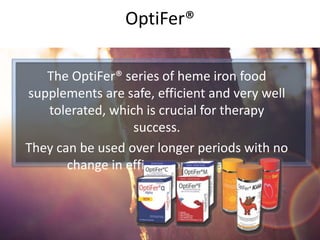
The OptiFer® series of heme iron food
supplements are safe, efficient and very well
tolerated, which is crucial for therapy
success.
They can be used over longer periods with no
change in efficacy or tolerance.
OptiFer®

Nutritional status and birth weight

  • 1.
    Nutritional status andbirth weight English Professor David Barkers epidemological research studies show that the nutritional status of the mother, mainly as hemoglobin count has an effect on fetal development.
  • 2.
    Nutritional status andbirth weight This has also been tied to the health of the infant throughout life.
  • 3.
    Nutritional status andbirth weight From the beginning of the century new-born babies weight as well as the placenta has been recorded. We know today that a low nutritional status, above all low hemoglobin values in the mother, is reflected in placental weight versus baby weight.
  • 4.
    Nutritional status andbirth weight By combining these data for more than 5 000 persons and comparing them with health development throughout life certain conclusions could be drawn.
  • 5.
    Nutritional status andbirth weight It turns out that those born by mothers with low nutritional status suffered from various internal diseases such as low blood pressure and diabetes to a higher degree, an increased risk of coronary heart disease and the disorders related to it: stroke, non-insulin dependent diabetes, raised blood pressure, and the metabolic syndrome
  • 6.
    Nutritional status andbirth weight A substantial number of studies show that mineral and vitamin supplements especially during the vital first trimester has a decisive influence on maternal nutritional status and birth weight of the baby.
  • 7.
    Nutritional status andbirth weight The "fetal origins hypothesis", states that cardiovascular disease and non-insulin dependent diabetes originate through adaptations that the fetus makes when it is undernourished.
  • 8.
    Nutritional status andbirth weight These adaptations may be cardiovascular, metabolic or endocrine and include slowing of growth, they permanently change the structure and function of the body.
  • 9.
    The OptiFer® seriesof heme iron food supplements are safe, efficient and very well tolerated, which is crucial for therapy success. They can be used over longer periods with no change in efficacy or tolerance. OptiFer®