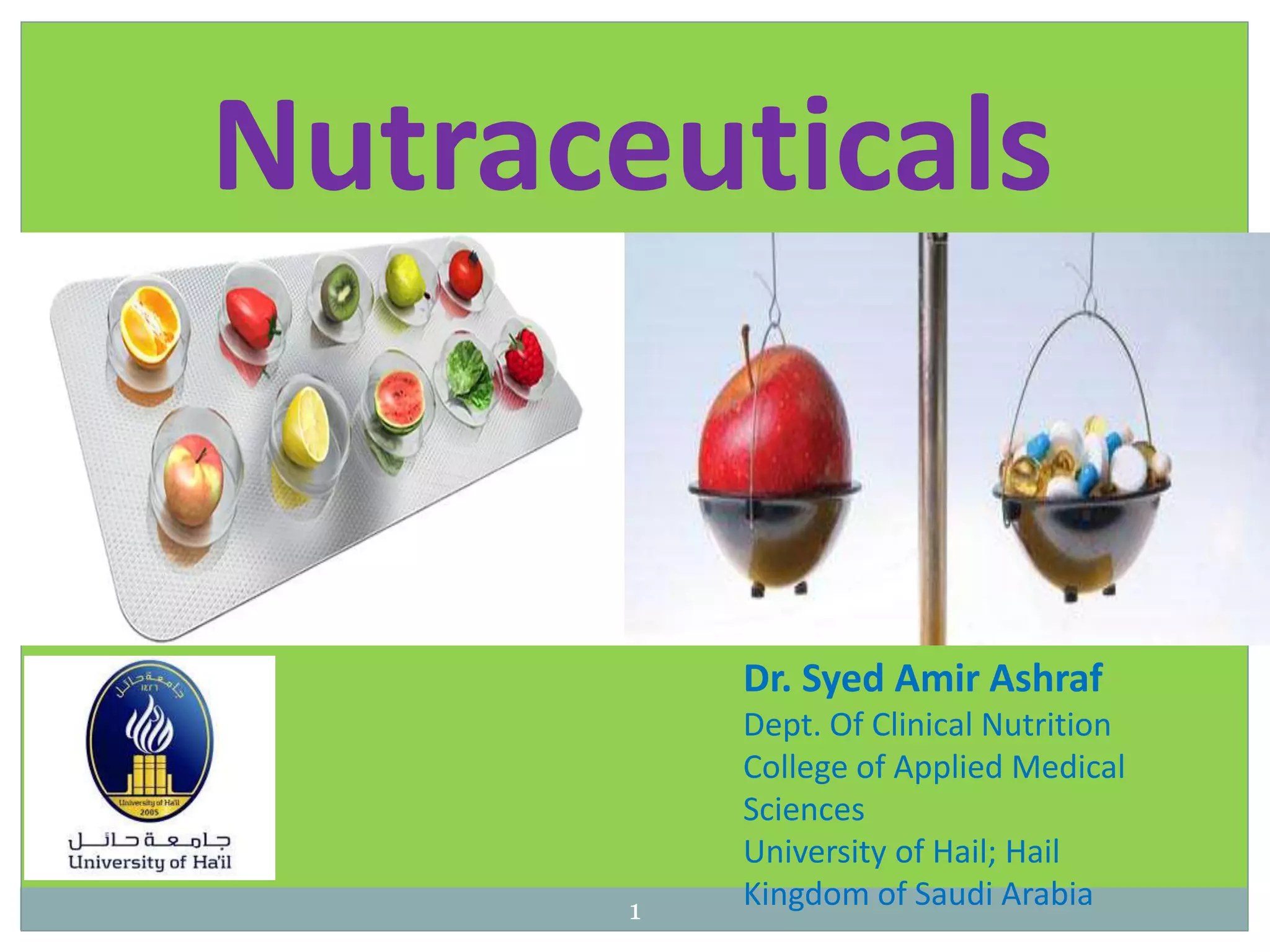
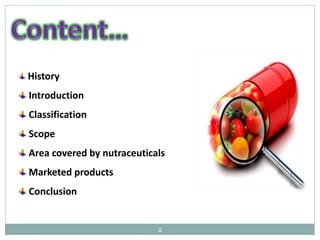
Nutraceuticals
1
Dr. Syed Amir Ashraf
Dept. Of Clinical Nutrition
College of Applied Medical
Sciences
University of Hail; Hail
Kingdom of Saudi Arabia
History
Introduction
Classification
Scope
Area covered by nutraceuticals
Marketed products
Conclusion
2
 The Greek physician Hippocrates, known as the “Father of
medicine” said “let food be your medicine”. The Philosophy
behind is:
“Focus on Prevention”
 The term "Nutraceutical" was coined by combining the terms
"Nutrition" and "Pharmaceutical" in 1989 by Dr. Stephen De
Felice.
3
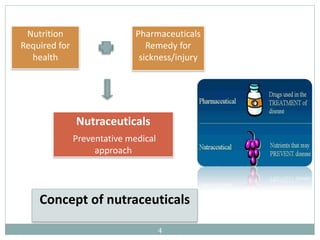
Nutrition
Required for
health
Pharmaceuticals
Remedy for
sickness/injury
Nutraceuticals
Preventative medical
approach
Concept of nutraceuticals
4
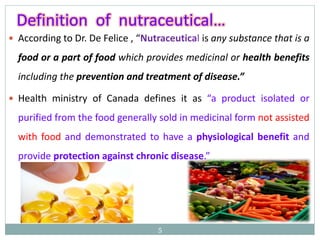
 According to Dr. De Felice , “Nutraceutical is any substance that is a
food or a part of food which provides medicinal or health benefits
including the prevention and treatment of disease.”
 Health ministry of Canada defines it as “a product isolated or
purified from the food generally sold in medicinal form not assisted
with food and demonstrated to have a physiological benefit and
provide protection against chronic disease.”
5
Definition of nutraceutical…
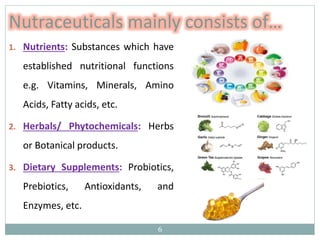
1. Nutrients: Substances which have
established nutritional functions
e.g. Vitamins, Minerals, Amino
Acids, Fatty acids, etc.
2. Herbals/ Phytochemicals: Herbs
or Botanical products.
3. Dietary Supplements: Probiotics,
Prebiotics, Antioxidants, and
Enzymes, etc.
Nutraceuticals mainly consists of…
6
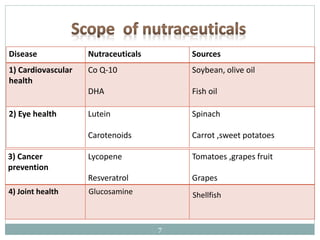
Disease Nutraceuticals Sources
1) Cardiovascular
health
Co Q-10
DHA
Soybean, olive oil
Fish oil
2) Eye health Lutein
Carotenoids
Spinach
Carrot ,sweet potatoes
7
3) Cancer
prevention
Lycopene
Resveratrol
Tomatoes ,grapes fruit
Grapes
4) Joint health Glucosamine Shellfish
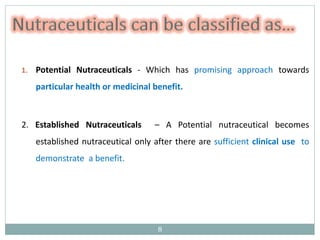
1. Potential Nutraceuticals - Which has promising approach towards
particular health or medicinal benefit.
2. Established Nutraceuticals – A Potential nutraceutical becomes
established nutraceutical only after there are sufficient clinical use to
demonstrate a benefit.
8
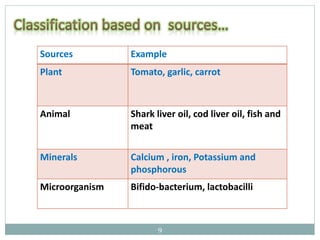
Sources Example
Plant Tomato, garlic, carrot
Animal Shark liver oil, cod liver oil, fish and
meat
Minerals Calcium , iron, Potassium and
phosphorous
Microorganism Bifido-bacterium, lactobacilli
9
10
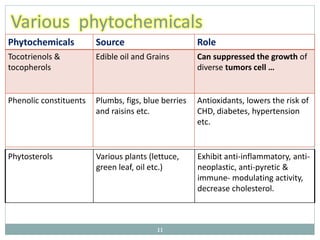
Phytochemicals Source Role
Tocotrienols &
tocopherols
Edible oil and Grains Can suppressed the growth of
diverse tumors cell …
Phenolic constituents Plumbs, figs, blue berries
and raisins etc.
Antioxidants, lowers the risk of
CHD, diabetes, hypertension
etc.
Various phytochemicals
11
Phytosterols Various plants (lettuce,
green leaf, oil etc.)
Exhibit anti-inflammatory, anti-
neoplastic, anti-pyretic &
immune- modulating activity,
decrease cholesterol.
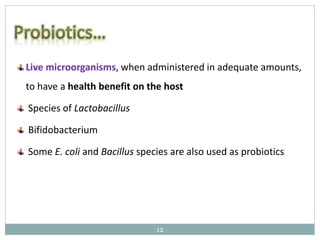
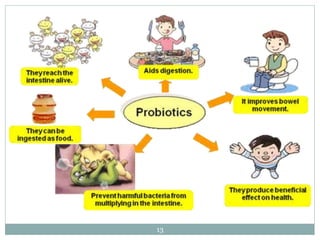
Live microorganisms, when administered in adequate amounts,
to have a health benefit on the host
Species of Lactobacillus
Bifidobacterium
Some E. coli and Bacillus species are also used as probiotics
12
13
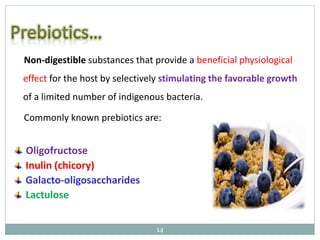
Non-digestible substances that provide a beneficial physiological
effect for the host by selectively stimulating the favorable growth
of a limited number of indigenous bacteria.
Commonly known prebiotics are:
Oligofructose
Inulin (chicory)
Galacto-oligosaccharides
Lactulose
14
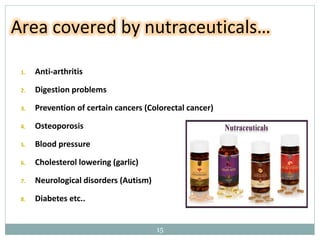
1. Anti-arthritis
2. Digestion problems
3. Prevention of certain cancers (Colorectal cancer)
4. Osteoporosis
5. Blood pressure
6. Cholesterol lowering (garlic)
7. Neurological disorders (Autism)
8. Diabetes etc..
Area covered by nutraceuticals…
15
1. Improve health
2. Delay aging
3. Increase life expectancy
4. Reduced side effects with desirable outcomes
5. Holistic approach
6. Markets focusing on supply of highly processed foods lacking sufficient
and appropriate nutrients
Advantages of nutraceuticals…
16
1. Not subjected to same testing and regulation as pharmaceuticals
2. Majority not regulated by FDA in USA
3. Companies creating unregulated products to create a wide profit
margin
4. Bioavailability of nutrients is lower
5. No regulatory definition
6. Effect may be attributed to placebo
Limitation…
17
Nutraceuticals are present in most of the food ingredients with varying
concentration.
Manipulating the diet to get maximum level of active components
(fermented food).
Fortifying food with active ingredients or fermentation of food products
(multigrain flour)
“There are no good or bad foods but
there are good or bad diets…”
18
1. Ashraf AS, Ahmad MF , “Nutraceutical market and its regulation” American Journal of Food
Technology. 6 (5) 342-347, 2011
2. Ashraf AS, Ahmad MF , “Nutraceutical is the need of hour” WJPPS. 2(5) 2516-2525, 2013
3. Ashraf AS, Ahmad MF, “Production and development of nutraceuticals using Bacillus subtilis
NCIM 2708 under solid state fermentation using response surface methodology” E S J. 24-26,
2013
4. Brower V. “Nutraceuticals: poised for a healthy slice of the healthcare market” Nat.
Biotechnol.1998, 16, 728-731.
5. Mahima ; Amit K; Ruchi T; K Karthik” Nutraceuticals from fruits and vegetables at glance” . Journal
of Biological sciences 2013,13(3):38-47
6. Raaz M; Priyanka S; Bina R; Chauhan AK. “Healthy living with Nutraceuticals” International
Research Journal of Pharmacy 2011,2(12),12-14
19

Nutraceutical ppt.

  • 1.
    Nutraceuticals 1 Dr. Syed AmirAshraf Dept. Of Clinical Nutrition College of Applied Medical Sciences University of Hail; Hail Kingdom of Saudi Arabia
  • 2.
    History Introduction Classification Scope Area covered bynutraceuticals Marketed products Conclusion 2
  • 3.
     The Greekphysician Hippocrates, known as the “Father of medicine” said “let food be your medicine”. The Philosophy behind is: “Focus on Prevention”  The term "Nutraceutical" was coined by combining the terms "Nutrition" and "Pharmaceutical" in 1989 by Dr. Stephen De Felice. 3
  • 4.
  • 5.
     According toDr. De Felice , “Nutraceutical is any substance that is a food or a part of food which provides medicinal or health benefits including the prevention and treatment of disease.”  Health ministry of Canada defines it as “a product isolated or purified from the food generally sold in medicinal form not assisted with food and demonstrated to have a physiological benefit and provide protection against chronic disease.” 5 Definition of nutraceutical…
  • 6.
    1. Nutrients: Substanceswhich have established nutritional functions e.g. Vitamins, Minerals, Amino Acids, Fatty acids, etc. 2. Herbals/ Phytochemicals: Herbs or Botanical products. 3. Dietary Supplements: Probiotics, Prebiotics, Antioxidants, and Enzymes, etc. Nutraceuticals mainly consists of… 6
  • 7.
    Disease Nutraceuticals Sources 1)Cardiovascular health Co Q-10 DHA Soybean, olive oil Fish oil 2) Eye health Lutein Carotenoids Spinach Carrot ,sweet potatoes 7 3) Cancer prevention Lycopene Resveratrol Tomatoes ,grapes fruit Grapes 4) Joint health Glucosamine Shellfish
  • 8.
    1. Potential Nutraceuticals- Which has promising approach towards particular health or medicinal benefit. 2. Established Nutraceuticals – A Potential nutraceutical becomes established nutraceutical only after there are sufficient clinical use to demonstrate a benefit. 8
  • 9.
    Sources Example Plant Tomato,garlic, carrot Animal Shark liver oil, cod liver oil, fish and meat Minerals Calcium , iron, Potassium and phosphorous Microorganism Bifido-bacterium, lactobacilli 9
  • 10.
  • 11.
    Phytochemicals Source Role Tocotrienols& tocopherols Edible oil and Grains Can suppressed the growth of diverse tumors cell … Phenolic constituents Plumbs, figs, blue berries and raisins etc. Antioxidants, lowers the risk of CHD, diabetes, hypertension etc. Various phytochemicals 11 Phytosterols Various plants (lettuce, green leaf, oil etc.) Exhibit anti-inflammatory, anti- neoplastic, anti-pyretic & immune- modulating activity, decrease cholesterol.
  • 12.
    Live microorganisms, whenadministered in adequate amounts, to have a health benefit on the host Species of Lactobacillus Bifidobacterium Some E. coli and Bacillus species are also used as probiotics 12
  • 13.
  • 14.
    Non-digestible substances thatprovide a beneficial physiological effect for the host by selectively stimulating the favorable growth of a limited number of indigenous bacteria. Commonly known prebiotics are: Oligofructose Inulin (chicory) Galacto-oligosaccharides Lactulose 14
  • 15.
    1. Anti-arthritis 2. Digestionproblems 3. Prevention of certain cancers (Colorectal cancer) 4. Osteoporosis 5. Blood pressure 6. Cholesterol lowering (garlic) 7. Neurological disorders (Autism) 8. Diabetes etc.. Area covered by nutraceuticals… 15
  • 16.
    1. Improve health 2.Delay aging 3. Increase life expectancy 4. Reduced side effects with desirable outcomes 5. Holistic approach 6. Markets focusing on supply of highly processed foods lacking sufficient and appropriate nutrients Advantages of nutraceuticals… 16
  • 17.
    1. Not subjectedto same testing and regulation as pharmaceuticals 2. Majority not regulated by FDA in USA 3. Companies creating unregulated products to create a wide profit margin 4. Bioavailability of nutrients is lower 5. No regulatory definition 6. Effect may be attributed to placebo Limitation… 17
  • 18.
    Nutraceuticals are presentin most of the food ingredients with varying concentration. Manipulating the diet to get maximum level of active components (fermented food). Fortifying food with active ingredients or fermentation of food products (multigrain flour) “There are no good or bad foods but there are good or bad diets…” 18
  • 19.
    1. Ashraf AS,Ahmad MF , “Nutraceutical market and its regulation” American Journal of Food Technology. 6 (5) 342-347, 2011 2. Ashraf AS, Ahmad MF , “Nutraceutical is the need of hour” WJPPS. 2(5) 2516-2525, 2013 3. Ashraf AS, Ahmad MF, “Production and development of nutraceuticals using Bacillus subtilis NCIM 2708 under solid state fermentation using response surface methodology” E S J. 24-26, 2013 4. Brower V. “Nutraceuticals: poised for a healthy slice of the healthcare market” Nat. Biotechnol.1998, 16, 728-731. 5. Mahima ; Amit K; Ruchi T; K Karthik” Nutraceuticals from fruits and vegetables at glance” . Journal of Biological sciences 2013,13(3):38-47 6. Raaz M; Priyanka S; Bina R; Chauhan AK. “Healthy living with Nutraceuticals” International Research Journal of Pharmacy 2011,2(12),12-14 19