Mrs. L.Bijayalakshmi Devi
Associate Professor
MKSSBTINE
DEFINITION
 Nursing is “the diagnosis and treatment
of human responses to actual or
potential health problems”. ANA.(1980)
 The statement was updated and entitled
Nursing’s Social Policy Statement
(1995)
 The new statement provides four essential features
of today’s contemporary nursing practice:
– 1. attention to the full range of human experiences
and responses to health and illness without
restriction to a problem-focused orientation.
– 2. integration of objective data with knowledge
gained from an understanding of the client’s or
group’s subjective experience
– 3. Application of scientific knowledge to the
processes of diagnosis and treatment
– Provision of a caring relationship that facilitates
health and healing (ANA, 1995)
 “Nursing is the holistic helping of
persons with their self-care activities in
relation to their health. This is an
interactive, interpersonal process that
nurtures strengths to enable
development, release, and channeling
of resources for coping with one’s
circumstances and environment. The
goal is to achieve a state of perceived
optimum health and contentment.”
(Erickson, Tomlin & Swain, 1983)
DEFINITION
 The nursing process is a deliberate problem
solving approach for meeting a person’s
health care & nursing needs.
 The nursing process is a systematic method
for taking independent nursing action.
 The nursing process is a problem-solving
method systematic, goal-directed, flexible,
rational approach which ensures consistent,
continuous, quality nursing care that provides
a basis for professional accountability.
Traditional steps are defined as,
1.ASSESMENT-
The systematic collection of data to
determine the patient’s health status &
identify any actual or political health problem.
Analysis may be included or discuss
separately .
2. DIAGNOSIS –
Identification of the following two types of
patients problems
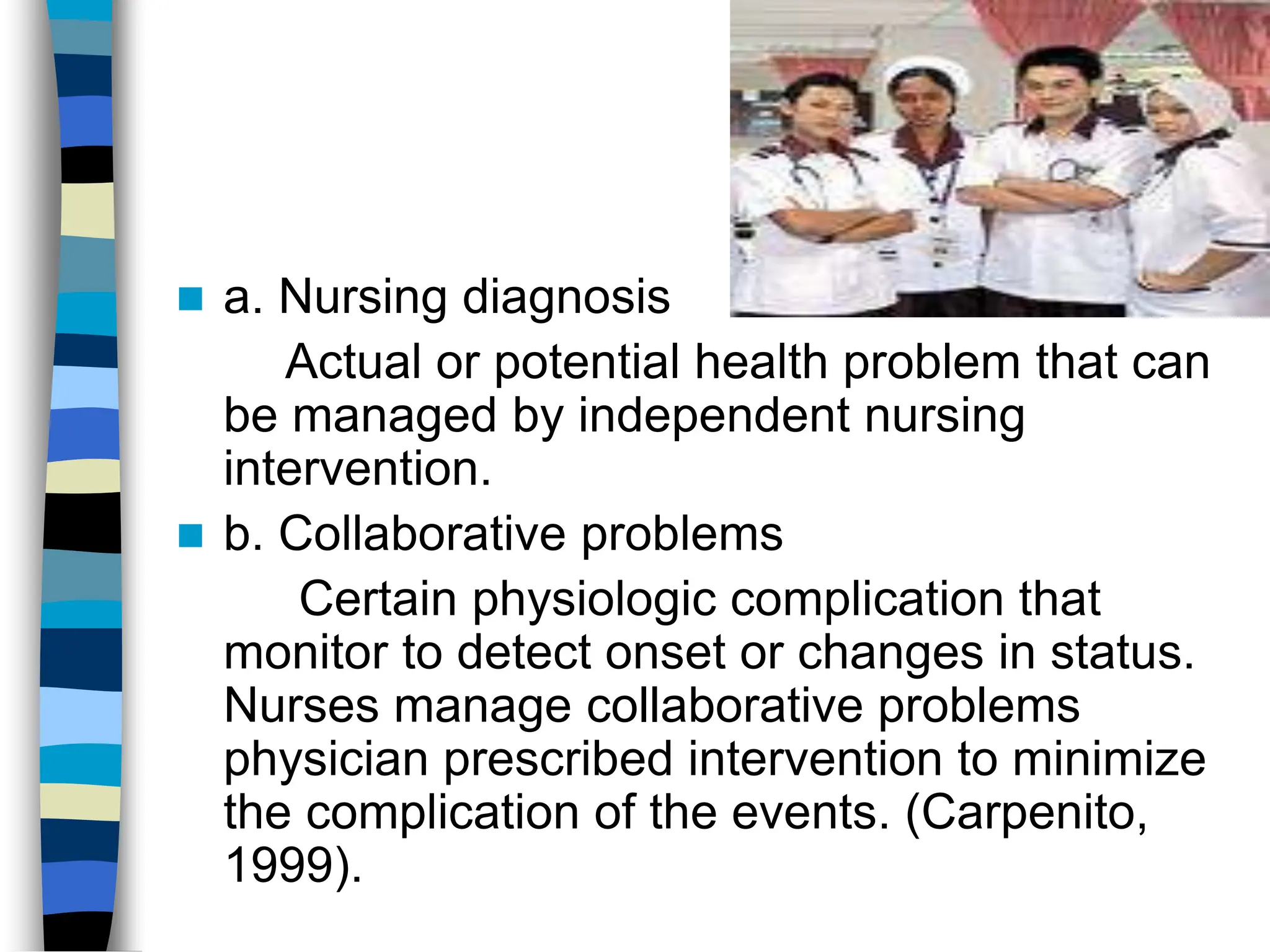
 a. Nursing diagnosis
Actual or potential health problem that can
be managed by independent nursing
intervention.
 b. Collaborative problems
Certain physiologic complication that
monitor to detect onset or changes in status.
Nurses manage collaborative problems
physician prescribed intervention to minimize
the complication of the events. (Carpenito,
1999).
3. PLANNING:
Development of goal & outcome ,as well as a
plan of care designed to assist the patient in
resolving the diagnosed problems &
achieving the identified goal & desired
outcome.
4. IMPLEMENTATION:
Actualization of the plan of care through
nursing intervention.
5. EVALUATION:
Determination of the patient’s responses to
the nursing intervention & the extent to which
the outcome have been achieved.
ASSESSMENT & METHOD OF
DATA COLLECTION:
It is an organized dynamic process involving
three basic activities
Systematically gathering data
Sorting & organizing the data collected
Documenting the data in a retrievable
format.
Data collection
 Patient’s history
 Physical examination
 Laboratory test
 The well defined database for a patient may
begin with admission signs and symptom,
chief complaint or medical diagnosis.
 The assessment data fall into two categories:
– Subjective data (patient and patient relatives)
– Objective data (lab test, physical examination,
health history, documentation)
Nursing diagnosis/need
identification
 The nursing diagnosis is “a clinical
judgement about individual, family or
community responses to actual or
potential health problem/life processes”
by NANDA.
 Time dependent
Point to remember:
 It is important to remember that nursing
diagnosis are not medical diagnosis
 They are not medical treatment prescribed by
the physician
 They are not diagnostic studies
 They are not the equipment used to implement
medical therapy.
 They are not the problems that the nurse
experiences while caring for the patient.
 They are the patient’s actual or potential health
problems that independent nursing actions can
resolve.
 It is not nursing goal or need.
 Collaborative Problem: Collaborative
problem are certain physiologic
complications that nurses monitor to
detect changes in status or onset of
complications. Nurses manage
collaborative problems using physician-
prescribed and nursing-prescribed
intervention to minimized complication.
(Carpenito, 1999)
ANALYSIS OF DATA
 Arriving at a nursing diagnosis involves
organizing the patient’s history, physical
examination, and lab. Data into cluster and
interpreting what the clusters reveal about
patient's ability to meet basic needs.
 Step of a ethical analysis:
– Assessment for ethical/moral situation of the
problem ( does the situation entail substantive
moral problems?)
– Planning include collecting information about fact,
treatment, values, belief, religious components,
identify ethical issues etc.
– Implement include list of alternative I.e
compare alternative ethical principles and
professional code of ethics.
– Evaluation decide and evaluate decision (
what is the best or morally correct action?
Or give the ethical reasons for your
decision?)
NURSING DIAGNOSIS STATEMENT.
 By remembering the basic guidelines it
ensures that diagnostic statement is correct:
1. Use proper terminology that reflects the
patients nursing need.
2. Make your statement concise so that it is
easily understood by other health team
members.
3. Use the most precise words possible.
4. Use a problem cause format stating the
problem and its related causes.
5. Use terminology recommended by NANDA
 There are 3 essential components in
nursing diagnosis which are referred as
PES format.
‘P’ Identifies the health problem.
‘E’ represents etiology.
‘S’ describes sign and symptoms
 These 3 parts are combined into one
statement by use of ‘’connecting words’’
hence the diagnosis would be written in
this manner-
problem related to ‘’etiology’’ evidenced
by signs and symptoms.
 The problem can be identified as the
human response to actual or potential
health problem as assessed by nurse.
 The etiology may be represented by
past experience,genetic
influence,current environmental factor
pathophysiological changes.
 The defining characteristics describe
what the client says and what the nurse
observes that indicates a particular
problem.
 Problem sensing
 Rule out process
 Synthesizing the data
 Evaluating or confirming the hypothesis
– Re-evaluate the problem list (an actual
need, a risk need, or a resolved need)
– Actual diagnosis: urine retention
– Wellness diagnosis: (more of an
opportunity than a need) e.g. readiness
for enhanced spiritual well-being
 Risk diagnosis refer to human responses to
health condition/life processes that may
developed in a vulnerable individual, family or
community which can be written in two part
statement as there are no s/s. E.g. Risk for
impaired physical immobility.
 Resolved diagnosis are those that no longer
require intervention. Because the need no
longer exist so no diagnostic statement is
needed.
 Other need identification may be help with
medical diagnosis like MI
 Sometime the client or significant may
misunderstand or wrongly percept resulting in
the belief that need exist. So nurse has to
address this to promote optimal well being.
e .g : client believe that after menopause
/hysterectomy sexual disease disappear.
 Reduce the need to basic component in order
to focus intervention on the roots of the
human responses e.g:
Statement writing
 Both the client problem and wellness
issues are being addressed.
 We state as “client diagnostic
statement” not client problem.
 When writing CDS, remember to include
qualifier or quantifier as appropriate
 NANDA has provided some flexibility of
nursing language by creating a multi-
axial taxonomy.
 An axis is defined as dimension of
human response that is considered in
diagnosis processes.
 Axis 1 is diagnosis concept.
 Axis 2 is time
 Axis 3 is unit of care
 Axis 4 is age
 Axis 5 is health status
 Axis 6 is descriptor
 Axis 7 is topology
 E.g: ineffective (descriptor) family (unit of
care) coping (diagnostic concept).
 Sometime specify is mention so it is important
that correct information is provided to make
clear communication.
 E.g: ineffective tissue perfusion (specify), the
modifier to specified is from the topology axis
(e.g: cerebral, renal) but in deficit knowledge
(specify), modifier is actually the topic which
client have deficit like diabetic foot care at
home
Omaha system
 Level 1: domain – health related/social
related
 Level 2: problem classification-
physical/psychological
 Level 3: modifier (individual/family)
 Level 4: sign and symptoms
1.Don’t state a need instead of a problem.
e.g: fluid replacement related to fever.
2.Don’t reverse the two parts of the statements.
e.g: lack of understanding related to non
compliance to DM diet.
3.Don’t identify an untreatable condition instead
of the actual problem it indicates.
e.g: inability to speak related to laryngectomy.
The following tips and examples should
make the distinction clear:
4. Don’t write a legally inadvisable statement.
e.g: red sacrum related to immobility.
5. Don’t identify as unhealthful a response that
would be appropriate or culturally
acceptable.
e.g: anger related to terminal illness.
6.Don’t make a tautological statement
e.g: pain related to alteration in comfort.
7.Don’t identify a nursing problem instead of a
personal problem.
e.g: difficulty suctioning related to thick secretion.
OUTCOME IDENTIFICATION
AND PLANNING.
 The nursing plan of care is a written
plan of action designed to help you
deliver quality patient care.
 It usually forms a permanent part of
patients health record and is used by
other members of health team.
 Should involve client, family to
contribute, participate in and take
responsibility for their own care.
The planning involve the
following stages or phases.
1. Assigning priorities to nursing
diagnosis and collaborative problems.
2. Specifying expected outcomes.
3. Specifying the immediate,
intermediate, and long term goals of
nursing action.
4. Identify specific nursing interventions
appropriate for attaining the outcomes.
5. Identifying interdependent
interventions.
6. Documenting the nursing diagnosis,
collaborative problems, EOC, nursing
goals and nursing interventions.
7. Communicating to appropriate
personnel about assessment data that
point to health needs that can best be
met by other members.
SETTING PRIORITIES.
 Assigning priorities to nursing diagnosis and
problems is a joint effort of nurse patient or
family member.
 Any disagreement about priorities is resolved
in a way which is mutually acceptable.
 Maslows hierarchy of needs provide a useful
frame work of prioritizing problems.
Establishing expected outcome
/Identification desired outcome
 Expected outcome of the nursing
interventions are stated in terms of patient’s
behaviour and time period as well as special
circumstances.
-EOC must be realistic, specific and consider pt.
desires or situation, measurable. And indicate
time frame
-EOC serves as a basis for evaluating the
effectiveness of interventions and for deciding
whether additional nursing care is needed or
whether plan of care to be revised.
 It is written by listing items/behavior that
can be observed and monitor.
 E.g: verbalize understanding of disease
process and potential complication.
 Have to use action verbs like discusses,
states, identifies, administer, explains
and reports. Passive words should be
avoided. Eoc sometime can be ongoing.
ESTABLISHING GOALS.
 The nursing action appropriate for attaining
the goals are identified,
-the patient and his or her family are included in
establishing goals for nursing action.
-immediate goals are those that can be reached
in a short period.
-intermediate and long term require a long time
to be achieved and usually involve preventing
complications and other health problems and
promoting self care and rehabilitation.
Determining Nursing Actions.
• The nurse take into consideration of patient
input and significant others.
• Identifies individualized interventions base on
patients age, circumstances and preferences
that addresses each outcome.
• Interventions should identify the activities
needed and who will carry them out.
• Plan health teaching and return
demonstration.
• Planned intervention should be ethical and
appropriate to patient’s culture, age or gender
& promote client strength whenever possible.
Nursing intervention
 It involves the nursing process carrying out
the proposed plan of nursing care
 The plan of nursing care serves as the basis
for implementation:
-the immediate, intermediate and long term
goals are used as a focus for implementation
of nursing interventions.
-revisions are made in plan of care,
 Implementation includes direct or indirect
execution of the planned interventions
 It is focused on solving patients diagnosis
and problems and achieving EOC thus
meeting the patients health needs.
Creating and documenting:
 Date when the intervention is written
 An action verb describing the activity to be
performed
 Qualifier of how? When? Where? Time freq.
& Amount has to be included
 Signature and/ or initial of originating nurse
Point to remember:
 Implementation should be accepted
nursing practice
 Reflecting knowledge of scientific
principles and nursing standards of care
and agency policies.
 Provide safety to client and do no harm
 CDS are supported by client data
 Goals are measurable and achievable
 Arrange in logical sequence
 Demonstrate individualized care
EVALUATION:
EVALUATION.
 It is the final step of nursing process,
allows the nurse to determine the
patients response to the nursing
intervention.
 3 STEP:
– Reassessment
– Modification of Plan of
care
– Termination of service
Through evaluation nurse can answer the
following questions:
1) Were the nursing diagnosis and
collaborative problems accurate?
2) Did the patient achieve the expected
outcome within the critical time period?
3) Have the patient’s nursing diagnosis been
resolved?
4) Have the collaborative problem been
resolved?
5) Have the patients nursing needs been met?
6) Should the nursing intervention be
continued,revised or discontinued?
7) Have any new problems evolved for
which nursing intervention have not
being planned?
8) What factors influenced the
achievement or lack of achievement of
the objectives?
9) Do priorities need to be reassigned?
10) Should changes be made in EOC and
outcome criteria?
DOCUMENTATION OF
OUTCOMES AND REVISION
OF PLAN:
 Outcomes are documented concisely and
objectively.
 Relates to the nursing diagnosis and
collaborative problem.
 Indicates whether the outcomes were met .
 Describe the patients response to
intervention.
 Include any additional pertinent data.
Nursing-Process.ppt

Nursing-Process.ppt

  • 1.
  • 2.
    DEFINITION  Nursing is“the diagnosis and treatment of human responses to actual or potential health problems”. ANA.(1980)  The statement was updated and entitled Nursing’s Social Policy Statement (1995)
  • 3.
     The newstatement provides four essential features of today’s contemporary nursing practice: – 1. attention to the full range of human experiences and responses to health and illness without restriction to a problem-focused orientation. – 2. integration of objective data with knowledge gained from an understanding of the client’s or group’s subjective experience – 3. Application of scientific knowledge to the processes of diagnosis and treatment – Provision of a caring relationship that facilitates health and healing (ANA, 1995)
  • 4.
     “Nursing isthe holistic helping of persons with their self-care activities in relation to their health. This is an interactive, interpersonal process that nurtures strengths to enable development, release, and channeling of resources for coping with one’s circumstances and environment. The goal is to achieve a state of perceived optimum health and contentment.” (Erickson, Tomlin & Swain, 1983)
  • 5.
    DEFINITION  The nursingprocess is a deliberate problem solving approach for meeting a person’s health care & nursing needs.  The nursing process is a systematic method for taking independent nursing action.  The nursing process is a problem-solving method systematic, goal-directed, flexible, rational approach which ensures consistent, continuous, quality nursing care that provides a basis for professional accountability.
  • 6.
    Traditional steps aredefined as, 1.ASSESMENT- The systematic collection of data to determine the patient’s health status & identify any actual or political health problem. Analysis may be included or discuss separately . 2. DIAGNOSIS – Identification of the following two types of patients problems
  • 7.
     a. Nursingdiagnosis Actual or potential health problem that can be managed by independent nursing intervention.  b. Collaborative problems Certain physiologic complication that monitor to detect onset or changes in status. Nurses manage collaborative problems physician prescribed intervention to minimize the complication of the events. (Carpenito, 1999).
  • 8.
    3. PLANNING: Development ofgoal & outcome ,as well as a plan of care designed to assist the patient in resolving the diagnosed problems & achieving the identified goal & desired outcome. 4. IMPLEMENTATION: Actualization of the plan of care through nursing intervention. 5. EVALUATION: Determination of the patient’s responses to the nursing intervention & the extent to which the outcome have been achieved.
  • 9.
    ASSESSMENT & METHODOF DATA COLLECTION: It is an organized dynamic process involving three basic activities Systematically gathering data Sorting & organizing the data collected Documenting the data in a retrievable format.
  • 10.
    Data collection  Patient’shistory  Physical examination  Laboratory test  The well defined database for a patient may begin with admission signs and symptom, chief complaint or medical diagnosis.  The assessment data fall into two categories: – Subjective data (patient and patient relatives) – Objective data (lab test, physical examination, health history, documentation)
  • 11.
    Nursing diagnosis/need identification  Thenursing diagnosis is “a clinical judgement about individual, family or community responses to actual or potential health problem/life processes” by NANDA.  Time dependent
  • 12.
    Point to remember: It is important to remember that nursing diagnosis are not medical diagnosis  They are not medical treatment prescribed by the physician  They are not diagnostic studies  They are not the equipment used to implement medical therapy.  They are not the problems that the nurse experiences while caring for the patient.  They are the patient’s actual or potential health problems that independent nursing actions can resolve.  It is not nursing goal or need.
  • 13.
     Collaborative Problem:Collaborative problem are certain physiologic complications that nurses monitor to detect changes in status or onset of complications. Nurses manage collaborative problems using physician- prescribed and nursing-prescribed intervention to minimized complication. (Carpenito, 1999)
  • 14.
    ANALYSIS OF DATA Arriving at a nursing diagnosis involves organizing the patient’s history, physical examination, and lab. Data into cluster and interpreting what the clusters reveal about patient's ability to meet basic needs.  Step of a ethical analysis: – Assessment for ethical/moral situation of the problem ( does the situation entail substantive moral problems?) – Planning include collecting information about fact, treatment, values, belief, religious components, identify ethical issues etc.
  • 15.
    – Implement includelist of alternative I.e compare alternative ethical principles and professional code of ethics. – Evaluation decide and evaluate decision ( what is the best or morally correct action? Or give the ethical reasons for your decision?)
  • 16.
    NURSING DIAGNOSIS STATEMENT. By remembering the basic guidelines it ensures that diagnostic statement is correct: 1. Use proper terminology that reflects the patients nursing need. 2. Make your statement concise so that it is easily understood by other health team members. 3. Use the most precise words possible. 4. Use a problem cause format stating the problem and its related causes. 5. Use terminology recommended by NANDA
  • 17.
     There are3 essential components in nursing diagnosis which are referred as PES format. ‘P’ Identifies the health problem. ‘E’ represents etiology. ‘S’ describes sign and symptoms  These 3 parts are combined into one statement by use of ‘’connecting words’’ hence the diagnosis would be written in this manner- problem related to ‘’etiology’’ evidenced by signs and symptoms.
  • 18.
     The problemcan be identified as the human response to actual or potential health problem as assessed by nurse.  The etiology may be represented by past experience,genetic influence,current environmental factor pathophysiological changes.  The defining characteristics describe what the client says and what the nurse observes that indicates a particular problem.
  • 19.
     Problem sensing Rule out process  Synthesizing the data  Evaluating or confirming the hypothesis – Re-evaluate the problem list (an actual need, a risk need, or a resolved need) – Actual diagnosis: urine retention – Wellness diagnosis: (more of an opportunity than a need) e.g. readiness for enhanced spiritual well-being
  • 20.
     Risk diagnosisrefer to human responses to health condition/life processes that may developed in a vulnerable individual, family or community which can be written in two part statement as there are no s/s. E.g. Risk for impaired physical immobility.  Resolved diagnosis are those that no longer require intervention. Because the need no longer exist so no diagnostic statement is needed.  Other need identification may be help with medical diagnosis like MI
  • 21.
     Sometime theclient or significant may misunderstand or wrongly percept resulting in the belief that need exist. So nurse has to address this to promote optimal well being. e .g : client believe that after menopause /hysterectomy sexual disease disappear.  Reduce the need to basic component in order to focus intervention on the roots of the human responses e.g:
  • 22.
    Statement writing  Boththe client problem and wellness issues are being addressed.  We state as “client diagnostic statement” not client problem.  When writing CDS, remember to include qualifier or quantifier as appropriate  NANDA has provided some flexibility of nursing language by creating a multi- axial taxonomy.
  • 23.
     An axisis defined as dimension of human response that is considered in diagnosis processes.  Axis 1 is diagnosis concept.  Axis 2 is time  Axis 3 is unit of care  Axis 4 is age  Axis 5 is health status  Axis 6 is descriptor  Axis 7 is topology
  • 24.
     E.g: ineffective(descriptor) family (unit of care) coping (diagnostic concept).  Sometime specify is mention so it is important that correct information is provided to make clear communication.  E.g: ineffective tissue perfusion (specify), the modifier to specified is from the topology axis (e.g: cerebral, renal) but in deficit knowledge (specify), modifier is actually the topic which client have deficit like diabetic foot care at home
  • 25.
    Omaha system  Level1: domain – health related/social related  Level 2: problem classification- physical/psychological  Level 3: modifier (individual/family)  Level 4: sign and symptoms
  • 26.
    1.Don’t state aneed instead of a problem. e.g: fluid replacement related to fever. 2.Don’t reverse the two parts of the statements. e.g: lack of understanding related to non compliance to DM diet. 3.Don’t identify an untreatable condition instead of the actual problem it indicates. e.g: inability to speak related to laryngectomy. The following tips and examples should make the distinction clear:
  • 27.
    4. Don’t writea legally inadvisable statement. e.g: red sacrum related to immobility. 5. Don’t identify as unhealthful a response that would be appropriate or culturally acceptable. e.g: anger related to terminal illness. 6.Don’t make a tautological statement e.g: pain related to alteration in comfort. 7.Don’t identify a nursing problem instead of a personal problem. e.g: difficulty suctioning related to thick secretion.
  • 28.
    OUTCOME IDENTIFICATION AND PLANNING. The nursing plan of care is a written plan of action designed to help you deliver quality patient care.  It usually forms a permanent part of patients health record and is used by other members of health team.  Should involve client, family to contribute, participate in and take responsibility for their own care.
  • 29.
    The planning involvethe following stages or phases. 1. Assigning priorities to nursing diagnosis and collaborative problems. 2. Specifying expected outcomes. 3. Specifying the immediate, intermediate, and long term goals of nursing action.
  • 30.
    4. Identify specificnursing interventions appropriate for attaining the outcomes. 5. Identifying interdependent interventions. 6. Documenting the nursing diagnosis, collaborative problems, EOC, nursing goals and nursing interventions. 7. Communicating to appropriate personnel about assessment data that point to health needs that can best be met by other members.
  • 31.
    SETTING PRIORITIES.  Assigningpriorities to nursing diagnosis and problems is a joint effort of nurse patient or family member.  Any disagreement about priorities is resolved in a way which is mutually acceptable.  Maslows hierarchy of needs provide a useful frame work of prioritizing problems.
  • 32.
    Establishing expected outcome /Identificationdesired outcome  Expected outcome of the nursing interventions are stated in terms of patient’s behaviour and time period as well as special circumstances. -EOC must be realistic, specific and consider pt. desires or situation, measurable. And indicate time frame -EOC serves as a basis for evaluating the effectiveness of interventions and for deciding whether additional nursing care is needed or whether plan of care to be revised.
  • 33.
     It iswritten by listing items/behavior that can be observed and monitor.  E.g: verbalize understanding of disease process and potential complication.  Have to use action verbs like discusses, states, identifies, administer, explains and reports. Passive words should be avoided. Eoc sometime can be ongoing.
  • 34.
    ESTABLISHING GOALS.  Thenursing action appropriate for attaining the goals are identified, -the patient and his or her family are included in establishing goals for nursing action. -immediate goals are those that can be reached in a short period. -intermediate and long term require a long time to be achieved and usually involve preventing complications and other health problems and promoting self care and rehabilitation.
  • 35.
    Determining Nursing Actions. •The nurse take into consideration of patient input and significant others. • Identifies individualized interventions base on patients age, circumstances and preferences that addresses each outcome. • Interventions should identify the activities needed and who will carry them out. • Plan health teaching and return demonstration. • Planned intervention should be ethical and appropriate to patient’s culture, age or gender & promote client strength whenever possible.
  • 36.
  • 37.
     It involvesthe nursing process carrying out the proposed plan of nursing care  The plan of nursing care serves as the basis for implementation: -the immediate, intermediate and long term goals are used as a focus for implementation of nursing interventions. -revisions are made in plan of care,  Implementation includes direct or indirect execution of the planned interventions  It is focused on solving patients diagnosis and problems and achieving EOC thus meeting the patients health needs.
  • 38.
    Creating and documenting: Date when the intervention is written  An action verb describing the activity to be performed  Qualifier of how? When? Where? Time freq. & Amount has to be included  Signature and/ or initial of originating nurse
  • 39.
    Point to remember: Implementation should be accepted nursing practice  Reflecting knowledge of scientific principles and nursing standards of care and agency policies.  Provide safety to client and do no harm  CDS are supported by client data  Goals are measurable and achievable  Arrange in logical sequence  Demonstrate individualized care
  • 40.
  • 41.
    EVALUATION.  It isthe final step of nursing process, allows the nurse to determine the patients response to the nursing intervention.  3 STEP: – Reassessment – Modification of Plan of care – Termination of service
  • 42.
    Through evaluation nursecan answer the following questions: 1) Were the nursing diagnosis and collaborative problems accurate? 2) Did the patient achieve the expected outcome within the critical time period? 3) Have the patient’s nursing diagnosis been resolved? 4) Have the collaborative problem been resolved? 5) Have the patients nursing needs been met?
  • 43.
    6) Should thenursing intervention be continued,revised or discontinued? 7) Have any new problems evolved for which nursing intervention have not being planned? 8) What factors influenced the achievement or lack of achievement of the objectives? 9) Do priorities need to be reassigned? 10) Should changes be made in EOC and outcome criteria?
  • 44.
    DOCUMENTATION OF OUTCOMES ANDREVISION OF PLAN:  Outcomes are documented concisely and objectively.  Relates to the nursing diagnosis and collaborative problem.  Indicates whether the outcomes were met .  Describe the patients response to intervention.  Include any additional pertinent data.