The Nursing Process andThe Nursing Process and
The Roy AdaptationThe Roy Adaptation
ModelModelModelModel
The Ro Adaptation ModelThe Ro Adaptation ModelThe Roy Adaptation ModelThe Roy Adaptation Model
 Nursing modelNursing model –– a model is an idea thata model is an idea that
explains by using symbolic and or physicalexplains by using symbolic and or physical
visualization. Can be verbal, schematic, orvisualization. Can be verbal, schematic, or
quantitative (math symbol)quantitative (math symbol)
 Basis from which nursing curriculum isBasis from which nursing curriculum is
developeddeveloped
 Basis for making nursing judgmentsBasis for making nursing judgments
regarding clinical experiencesregarding clinical experiences
 Framework on which a nurse makesFramework on which a nurse makes
decisions regarding patient caredecisions regarding patient care
The RAM was developed by SisterThe RAM was developed by Sisterp yp y
Callista RoyCallista Roy
 The recipient of nursing care is a biopsychosocialThe recipient of nursing care is a biopsychosocial
(spiritual) being or group in constant interaction(spiritual) being or group in constant interaction
with the environment. Open systemwith the environment. Open system
 GoalGoal -- the promotion of adaptation forthe promotion of adaptation for
i di id l d i h f h fi di id l d i h f h findividuals and groups in each of the fourindividuals and groups in each of the four
adaptive modes, thus contributing to health,adaptive modes, thus contributing to health,
quality of life and dying with dignityquality of life and dying with dignityquality of life, and dying with dignity.quality of life, and dying with dignity.
 Nurse’s activityNurse’s activity -- uses the nursing process touses the nursing process to
promote adaptation in each of the adaptivepromote adaptation in each of the adaptivepromote adaptation in each of the adaptivepromote adaptation in each of the adaptive
modes.modes.
AdaptationAdaptationAdaptationAdaptation
 the process and outcome wherebythe process and outcome whereby
thinking and feeling persons, asthinking and feeling persons, asg g p ,g g p ,
individuals or in groups, use consciousindividuals or in groups, use conscious
awareness and choice to create humanawareness and choice to create human
and environmental integrationand environmental integration
Adapti e mechanisms indi id alAdapti e mechanisms indi id alAdaptive mechanisms: individualAdaptive mechanisms: individual
Are mechanisms that help a person cope mentally,Are mechanisms that help a person cope mentally,
physically, socially, spiritually and emotionallyphysically, socially, spiritually and emotionally
 Regulator subsystem: responds automaticallyRegulator subsystem: responds automatically –– neuralneural Regulator subsystem: responds automaticallyRegulator subsystem: responds automatically –– neural,neural,
chemical and endocrine, stimuli come from the senseschemical and endocrine, stimuli come from the senses
 Cognator subsystem: respond through four cognitiveCognator subsystem: respond through four cognitive--
emotional channelsemotional channelsemotional channelsemotional channels
Perceptual and information processingPerceptual and information processing
learninglearninggg
judgmentjudgment
emotionemotion
Adapti e mechanisms G o pAdapti e mechanisms G o pAdaptive mechanisms: GroupAdaptive mechanisms: Group
 Innovator subsystem: Structures and processesInnovator subsystem: Structures and processes
for change and growth. Focuses on change.for change and growth. Focuses on change.
Think about familiesThink about families
 Stabilizer subsystem: Establishes structures,Stabilizer subsystem: Establishes structures,
values and daily activities. Family roles/rulesvalues and daily activities. Family roles/rules ––
who does what? Examplewho does what? Example –– mom is on strike, ismom is on strike, is
th f il t bili d?th f il t bili d?the family stabilized?the family stabilized?
Focus is on system maintenanceFocus is on system maintenance
Adaptation le elAdaptation le elAdaptation levelAdaptation level
 a changing point influenced by thea changing point influenced by the
situation and the internal resources of thesituation and the internal resources of the
person, family or group. The three levelsperson, family or group. The three levels
of adaptation are:of adaptation are:pp
 Integrated life processIntegrated life process
 Compensatory processCompensatory process Compensatory processCompensatory process
 Compromised processCompromised process
Integ ated life p ocessInteg ated life p ocessIntegrated life processIntegrated life process
 level at whichlevel at which
the structuresthe structuresthe structuresthe structures
and functions ofand functions of
a life process area life process area life process area life process are
working as aworking as a
h lh lwhole to meetwhole to meet
human needs.human needs.
Compensato p ocessCompensato p ocessCompensatory processCompensatory process
 level at whichlevel at which
coping mechanismscoping mechanismscoping mechanismscoping mechanisms
(cognator and(cognator and
regulator) haveregulator) haveregulator) haveregulator) have
been activated by abeen activated by a
h ll hh ll hchallenge to thechallenge to the
person or groupperson or group
Comp omised p ocessComp omised p ocessCompromised processCompromised process
 level resultinglevel resulting
from inadequatefrom inadequatefrom inadequatefrom inadequate
integrated andintegrated and
compensatorycompensatorycompensatorycompensatory
life processes;life processes;
d id ian adaptationan adaptation
problemproblem
Fo adapti e modesFo adapti e modesFour adaptive modesFour adaptive modes
 Three psychosocial and one physiologicThree psychosocial and one physiologic
mode. All impact each other like marbles.mode. All impact each other like marbles.pp
 Based on basic needsBased on basic needs
NeedNeed a requirement within an individuala requirement within an individual NeedNeed -- a requirement within an individuala requirement within an individual
or group which stimulates a response toor group which stimulates a response to
maintain integritymaintain integritymaintain integritymaintain integrity
Indi id al SelfIndi id al Self conceptconceptIndividual SelfIndividual Self--conceptconcept
Psychic and spiritual integrity: the need to knowPsychic and spiritual integrity: the need to know
who one iswho one is
Ph i l lfPh i l lf Physical selfPhysical self
Body sensationsBody sensations
B d i lB d i lBody image: lossBody image: loss
 Personal selfPersonal self
SelfSelf consistency: anxietyconsistency: anxietySelfSelf--consistency: anxietyconsistency: anxiety
SelfSelf--ideal: powerlessnessideal: powerlessness
MoralMoral ethicalethical spiritual self: guiltspiritual self: guiltMoralMoral--ethicalethical--spiritual self: guiltspiritual self: guilt
All Contribute to our self esteemAll Contribute to our self esteem
G o p selfG o p self conceptconceptGroup selfGroup self--conceptconcept
Identity integrity/group identityIdentity integrity/group identity
 Interpersonal relationshipsInterpersonal relationships Interpersonal relationshipsInterpersonal relationships
 Group selfGroup self--imageimage
S i l iliS i l ili Social milieuSocial milieu
 CultureCulture
Indi id al Role f nctionIndi id al Role f nctionIndividual Role functionIndividual Role function
Need is social integrityNeed is social integrity –– the need to know whothe need to know who
one is in relation to others so that one can act.one is in relation to others so that one can act.
 Role set: All of the roles a person holds at oneRole set: All of the roles a person holds at one Role set: All of the roles a person holds at oneRole set: All of the roles a person holds at one
time.time.
 Instrumental behaviors: goal orientatedInstrumental behaviors: goal orientated
b h i l i i i db h i l i i i d d id ibehavior, role activities, studentbehavior, role activities, student –– studying,studying,
mothermother –– rocking a crying babyrocking a crying baby
 Expressive behaviorsExpressive behaviors –– feelings and attitudesfeelings and attitudes Expressive behaviorsExpressive behaviors feelings and attitudesfeelings and attitudes
held by the person about performing the roleheld by the person about performing the role
 Requirements and other stimuliRequirements and other stimuli –– consumer,consumer,
reward access to facilities and circumstancesreward access to facilities and circumstancesreward, access to facilities and circumstances,reward, access to facilities and circumstances,
cooperation and collaborationcooperation and collaboration
G o p Role F nctionG o p Role F nctionGroup Role FunctionGroup Role Function
 Role clarity; the need to understand andRole clarity; the need to understand and
commit to fulfill expected tasks, so thatcommit to fulfill expected tasks, so thatp ,p ,
the group can achieve common goals.the group can achieve common goals.
 Aggregate role setAggregate role set –– all roles within aall roles within aAggregate role setAggregate role set all roles within aall roles within a
group. Complement of roles within a group.group. Complement of roles within a group.
 Developmental stageDevelopmental stage –– add new roles as weadd new roles as wep gp g
develop or maturedevelop or mature
Inte dependenceInte dependence Indi id alIndi id alInterdependenceInterdependence -- IndividualIndividual
 Relational integrity: feeling of security inRelational integrity: feeling of security in
nurturing relationships.nurturing relationships.g pg p
 Mode focuses on interactions related toMode focuses on interactions related to
the giving and receiving of love respectthe giving and receiving of love respectthe giving and receiving of love, respectthe giving and receiving of love, respect
and valueand value
 Significant othersSignificant others Significant othersSignificant others
 Support systemsSupport systems
G o p Inte dependenceG o p Inte dependenceGroup InterdependenceGroup Interdependence
Social context in which the group operatesSocial context in which the group operates
 ContextContext ContextContext
 InfrastructureInfrastructure
P ti i tP ti i t ParticipantsParticipants
Individual physiologic mode:Individual physiologic mode:p y gp y g
Needs/Complex ProcessesNeeds/Complex Processes
 OxygenationOxygenation -- needneed
 NutritionNutrition -- needneed
Eli i tiEli i ti dd EliminationElimination -- needneed
 Activity and restActivity and rest -- needneed
 ProtectionProtection -- needneed ProtectionProtection needneed
 SensesSenses –– complex process (CP)complex process (CP)
 Fluid, electrolyte, and acidFluid, electrolyte, and acid--base balancebase balance -- (CP)(CP), y ,, y , ( )( )
 Neurologic functionNeurologic function -- (CP)(CP)
 Endocrine functionEndocrine function -- (CP)(CP)
Adaptation p oblemsAdaptation p oblemsAdaptation problemsAdaptation problems
 occur in each adaptive mode whenoccur in each adaptive mode when
satisfaction of needs is not possiblesatisfaction of needs is not possiblepp
ResponsesResponsesResponsesResponses
 Adaptive responseAdaptive response -- behavior thatbehavior that
promote integrity in terms of the goals ofpromote integrity in terms of the goals of
human systems. Example: You run up thehuman systems. Example: You run up the
stairs to get your jacket, your pulse andstairs to get your jacket, your pulse and
espi ato ate inc ease to meet bodiesespi ato ate inc ease to meet bodiesrespiratory rate increase to meet bodiesrespiratory rate increase to meet bodies
needsneeds
Ineffective responseIneffective response behavior that doesbehavior that does Ineffective responseIneffective response -- behavior that doesbehavior that does
notnot contribute to the integrity of thecontribute to the integrity of the
individual or group Example: denial or aindividual or group Example: denial or aindividual or group. Example: denial or aindividual or group. Example: denial or a
rapid irregular pulse at restrapid irregular pulse at rest
N sing Actions/N sing P ocessN sing Actions/N sing P ocessNursing Actions/Nursing ProcessNursing Actions/Nursing Process
 Nursing process is ADPIENursing process is ADPIE
 Roy separates Assessment into twoRoy separates Assessment into two Roy separates Assessment into twoRoy separates Assessment into two
distinct phases:distinct phases:
First level assessment of behaviorFirst level assessment of behaviorFirst level assessment of behaviorFirst level assessment of behavior
Second level assessment of stimuliSecond level assessment of stimuli
Fi st le el assessmentFi st le el assessmentFirst level assessmentFirst level assessment
 Identify behaviors in each of theIdentify behaviors in each of the
adaptive modes. Internal or externaladaptive modes. Internal or externalpp
actions and reactions under specifiedactions and reactions under specified
circumstances.circumstances.
 PhysiologicPhysiologic--physicalphysical
 SelfSelf--conceptconcept--group identitygroup identity SelfSelf conceptconcept group identitygroup identity
 Role functionRole function
 InterdependenceInterdependence InterdependenceInterdependence
Beha io sBeha io sBehaviorsBehaviors
 Identified through nursing history and physicalIdentified through nursing history and physical
(see pages 5(see pages 5--9) and ongoing assessments. We9) and ongoing assessments. We
cluster them together in the 4 modes.cluster them together in the 4 modes.cluster them together in the 4 modes.cluster them together in the 4 modes.
 Identify and label if they are:Identify and label if they are:
 Subjective behaviors (s): symptoms. Ex. Aching painSubjective behaviors (s): symptoms. Ex. Aching pain
in left kneein left kneein left kneein left knee
 Objective behaviors (o): signs Ex. Temperature 101.4Objective behaviors (o): signs Ex. Temperature 101.4
 Identify if they are:Identify if they are:y yy y
 Adaptive (A), that is promote integrityAdaptive (A), that is promote integrity
 Ineffective (I), do not promote integrity or integrityIneffective (I), do not promote integrity or integrity
will be compromised.will be compromised.will be compromised.will be compromised.
Second Le el AssessmentSecond Le el AssessmentSecond Level AssessmentSecond Level Assessment
 Identify stimuli or influencing factorsIdentify stimuli or influencing factors
causing the behaviors assessed. Threecausing the behaviors assessed. Threegg
types of stimuli:types of stimuli:
 FocalFocalFocalFocal
 ContextualContextual
 ResidualResidual ResidualResidual
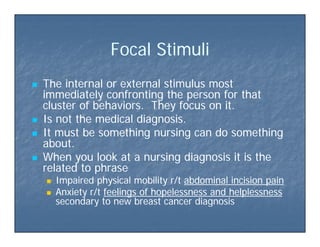
Focal Stim liFocal Stim liFocal StimuliFocal Stimuli
 The internal or external stimulus mostThe internal or external stimulus most
immediately confronting the person for thatimmediately confronting the person for that
cluster of behaviors. They focus on it.cluster of behaviors. They focus on it.cluster of behaviors. They focus on it.cluster of behaviors. They focus on it.
 Is not the medical diagnosis.Is not the medical diagnosis.
 It must be something nursing can do somethingIt must be something nursing can do something
bbabout.about.
 When you look at a nursing diagnosis it is theWhen you look at a nursing diagnosis it is the
related to phraserelated to phraserelated to phraserelated to phrase
 Impaired physical mobility r/tImpaired physical mobility r/t abdominal incision painabdominal incision pain
 Anxiety r/tAnxiety r/t feelings of hopelessness and helplessnessfeelings of hopelessness and helplessness
secondary to new breast cancer diagnosissecondary to new breast cancer diagnosissecondary to new breast cancer diagnosissecondary to new breast cancer diagnosis
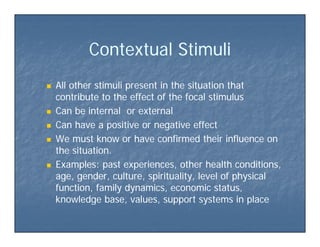
Conte t al Stim liConte t al Stim liContextual StimuliContextual Stimuli
 All other stimuli present in the situation thatAll other stimuli present in the situation that
contribute to the effect of the focal stimuluscontribute to the effect of the focal stimulus
C b i t l t lC b i t l t l Can be internal or externalCan be internal or external
 Can have a positive or negative effectCan have a positive or negative effect
 We must know or have confirmed their influence onWe must know or have confirmed their influence on We must know or have confirmed their influence onWe must know or have confirmed their influence on
the situation.the situation.
 Examples: past experiences, other health conditions,Examples: past experiences, other health conditions,
age, gender, culture, spirituality, level of physicalage, gender, culture, spirituality, level of physical
function, family dynamics, economic status,function, family dynamics, economic status,
knowledge base, values, support systems in placeknowledge base, values, support systems in placeknowledge base, values, support systems in placeknowledge base, values, support systems in place
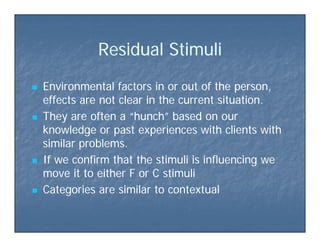
Resid al Stim liResid al Stim liResidual StimuliResidual Stimuli
 Environmental factors in or out of the person,Environmental factors in or out of the person,
effects are not clear in the current situation.effects are not clear in the current situation.
 They are often a “hunch” based on ourThey are often a “hunch” based on our
knowledge or past experiences with clients withknowledge or past experiences with clients with
i il bli il blsimilar problems.similar problems.
 If we confirm that the stimuli is influencing weIf we confirm that the stimuli is influencing we
it t ith F C ti liit t ith F C ti limove it to either F or C stimulimove it to either F or C stimuli
 Categories are similar to contextualCategories are similar to contextual
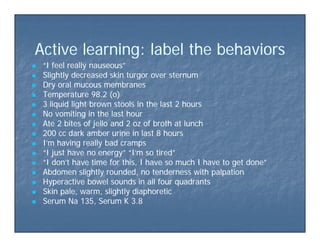
A ti l i l b l th b h iA ti l i l b l th b h iActive learning: label the behaviorsActive learning: label the behaviors
 “I feel really nauseous”“I feel really nauseous”
 Slightly decreased skin turgor over sternumSlightly decreased skin turgor over sternum Slightly decreased skin turgor over sternumSlightly decreased skin turgor over sternum
 Dry oral mucous membranesDry oral mucous membranes
 Temperature 98.2 (o)Temperature 98.2 (o)
 3 liquid light brown stools in the last 2 hours3 liquid light brown stools in the last 2 hoursq gq g
 No vomiting in the last hourNo vomiting in the last hour
 Ate 2 bites of jello and 2 oz of broth at lunchAte 2 bites of jello and 2 oz of broth at lunch
 200 cc dark amber urine in last 8 hours200 cc dark amber urine in last 8 hours
 I’m having really bad crampsI’m having really bad cramps
 “I just have no energy” “I’m so tired”“I just have no energy” “I’m so tired”
 “I don’t have time for this, I have so much I have to get done”“I don’t have time for this, I have so much I have to get done”
Abd li htl d d t d ith l tiAbd li htl d d t d ith l ti Abdomen slightly rounded, no tenderness with palpationAbdomen slightly rounded, no tenderness with palpation
 Hyperactive bowel sounds in all four quadrantsHyperactive bowel sounds in all four quadrants
 Skin pale, warm, slightly diaphoreticSkin pale, warm, slightly diaphoretic
 Serum Na 135 Serum K 3 8Serum Na 135 Serum K 3 8 Serum Na 135, Serum K 3.8Serum Na 135, Serum K 3.8
De elop a n sing ca e planDe elop a n sing ca e planDevelop a nursing care planDevelop a nursing care plan
 A care plan is holistic and identifies actualA care plan is holistic and identifies actual
and potential problems in each of the fourand potential problems in each of the four
modes. One care plan may have 20modes. One care plan may have 20
problems or diagnoses identified.problems or diagnoses identified.
 diagnosisdiagnosis
 goals/outcomesgoals/outcomes
 interventions with rationaleinterventions with rationale
 evaluationevaluation
 Nurse will manipulate or manage stimuli,Nurse will manipulate or manage stimuli,
hopefully eliminate or modify the focalhopefully eliminate or modify the focalp y yp y y
stimulus if the behavior is ineffective.stimulus if the behavior is ineffective.
 If behavior is adaptive the nurse willIf behavior is adaptive the nurse will If behavior is adaptive, the nurse willIf behavior is adaptive, the nurse will
reinforce or support this behavior.reinforce or support this behavior.
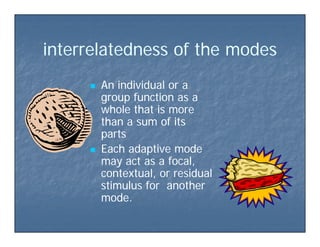
inte elatedness of the modesinte elatedness of the modesinterrelatedness of the modesinterrelatedness of the modes
 An individual or aAn individual or a
group function as agroup function as a
whole that is morewhole that is morewhole that is morewhole that is more
than a sum of itsthan a sum of its
partspartspp
 Each adaptive modeEach adaptive mode
may act as a focal,may act as a focal,
t t l id lt t l id lcontextual, or residualcontextual, or residual
stimulus for anotherstimulus for another
mode.mode.mode.mode.
N i P d RAM i t h llN i P d RAM i t h llNursing Process and RAM in a nutshellNursing Process and RAM in a nutshell
 11stst level assessment: Assess Behaviors ielevel assessment: Assess Behaviors ie the whatthe what
 22ndnd level assessment: Identify stimuli, ielevel assessment: Identify stimuli, ie the whythe why
Diagnosis:Diagnosis: What does it all mean?What does it all mean? Diagnosis:Diagnosis: What does it all mean?What does it all mean?
 Planning:Planning: What do you want them to do?What do you want them to do?
 Implementation:Implementation: What are you going to do about it?What are you going to do about it?pp y g gy g g
Nursing intervention number 1 is how you are going toNursing intervention number 1 is how you are going to
help them meet goal number 1help them meet goal number 1
 Evaluation:Evaluation: How did it work outHow did it work out what do you need towhat do you need to Evaluation:Evaluation: How did it work outHow did it work out, what do you need to, what do you need to
keep or change?keep or change?
Student Nurse versus ProfessionalStudent Nurse versus Professional
Nurse Care PlansNurse Care Plans
 When students do a “care plan” they are only addressingWhen students do a “care plan” they are only addressing
one problem. In contrast, a professional care plan isone problem. In contrast, a professional care plan is
holistic ie has all identified actual and potential problemsholistic ie has all identified actual and potential problems
ititon it.on it.
 Student care plans will have the entire nursing processStudent care plans will have the entire nursing process
on it with the addition of rational. They have to tell uson it with the addition of rational. They have to tell us
h o a e doing specific n sing inte entions ie theh o a e doing specific n sing inte entions ie thewhy you are doing specific nursing interventions, ie thewhy you are doing specific nursing interventions, ie the
scientific basis.scientific basis.
 A professional care plan document begins with theA professional care plan document begins with the
nursing diagnosis Assessment data is in the nursingnursing diagnosis Assessment data is in the nursingnursing diagnosis. Assessment data is in the nursingnursing diagnosis. Assessment data is in the nursing
history and physical, assessment notes and narrativehistory and physical, assessment notes and narrative
notes.notes.
Student Nurse versus ProfessionalStudent Nurse versus Professional
Nurse Care PlansNurse Care Plans
 In the stimuli columns:In the stimuli columns:
 Focal stimuli: Students need to do a mini patho treeFocal stimuli: Students need to do a mini patho tree
of the problem Start with the secondary to pieceof the problem Start with the secondary to pieceof the problem. Start with the secondary to pieceof the problem. Start with the secondary to piece
and work towards the r/t piece.and work towards the r/t piece.
 Contextual stimuli: they can not just name it theyContextual stimuli: they can not just name it they
h b fl lh b fl lhave to briefly explain it.have to briefly explain it.
Ex: do not just say religious beliefs, would say FollowsEx: do not just say religious beliefs, would say Follows
Catholic doctrineCatholic doctrine –– can not eat meat on Fridayscan not eat meat on Fridaysyy
during lent.during lent.
Ex: don’t say pain tolerance. Quantify it, do theyEx: don’t say pain tolerance. Quantify it, do they
have a high moderate or low pain tolerancehave a high moderate or low pain tolerancehave a high, moderate or low pain tolerance.have a high, moderate or low pain tolerance.

Nursingprocessandram

  • 1.
    The Nursing ProcessandThe Nursing Process and The Roy AdaptationThe Roy Adaptation ModelModelModelModel
  • 2.
    The Ro AdaptationModelThe Ro Adaptation ModelThe Roy Adaptation ModelThe Roy Adaptation Model  Nursing modelNursing model –– a model is an idea thata model is an idea that explains by using symbolic and or physicalexplains by using symbolic and or physical visualization. Can be verbal, schematic, orvisualization. Can be verbal, schematic, or quantitative (math symbol)quantitative (math symbol)  Basis from which nursing curriculum isBasis from which nursing curriculum is developeddeveloped  Basis for making nursing judgmentsBasis for making nursing judgments regarding clinical experiencesregarding clinical experiences  Framework on which a nurse makesFramework on which a nurse makes decisions regarding patient caredecisions regarding patient care
  • 3.
    The RAM wasdeveloped by SisterThe RAM was developed by Sisterp yp y Callista RoyCallista Roy  The recipient of nursing care is a biopsychosocialThe recipient of nursing care is a biopsychosocial (spiritual) being or group in constant interaction(spiritual) being or group in constant interaction with the environment. Open systemwith the environment. Open system  GoalGoal -- the promotion of adaptation forthe promotion of adaptation for i di id l d i h f h fi di id l d i h f h findividuals and groups in each of the fourindividuals and groups in each of the four adaptive modes, thus contributing to health,adaptive modes, thus contributing to health, quality of life and dying with dignityquality of life and dying with dignityquality of life, and dying with dignity.quality of life, and dying with dignity.  Nurse’s activityNurse’s activity -- uses the nursing process touses the nursing process to promote adaptation in each of the adaptivepromote adaptation in each of the adaptivepromote adaptation in each of the adaptivepromote adaptation in each of the adaptive modes.modes.
  • 4.
    AdaptationAdaptationAdaptationAdaptation  the processand outcome wherebythe process and outcome whereby thinking and feeling persons, asthinking and feeling persons, asg g p ,g g p , individuals or in groups, use consciousindividuals or in groups, use conscious awareness and choice to create humanawareness and choice to create human and environmental integrationand environmental integration
  • 5.
    Adapti e mechanismsindi id alAdapti e mechanisms indi id alAdaptive mechanisms: individualAdaptive mechanisms: individual Are mechanisms that help a person cope mentally,Are mechanisms that help a person cope mentally, physically, socially, spiritually and emotionallyphysically, socially, spiritually and emotionally  Regulator subsystem: responds automaticallyRegulator subsystem: responds automatically –– neuralneural Regulator subsystem: responds automaticallyRegulator subsystem: responds automatically –– neural,neural, chemical and endocrine, stimuli come from the senseschemical and endocrine, stimuli come from the senses  Cognator subsystem: respond through four cognitiveCognator subsystem: respond through four cognitive-- emotional channelsemotional channelsemotional channelsemotional channels Perceptual and information processingPerceptual and information processing learninglearninggg judgmentjudgment emotionemotion
  • 6.
    Adapti e mechanismsG o pAdapti e mechanisms G o pAdaptive mechanisms: GroupAdaptive mechanisms: Group  Innovator subsystem: Structures and processesInnovator subsystem: Structures and processes for change and growth. Focuses on change.for change and growth. Focuses on change. Think about familiesThink about families  Stabilizer subsystem: Establishes structures,Stabilizer subsystem: Establishes structures, values and daily activities. Family roles/rulesvalues and daily activities. Family roles/rules –– who does what? Examplewho does what? Example –– mom is on strike, ismom is on strike, is th f il t bili d?th f il t bili d?the family stabilized?the family stabilized? Focus is on system maintenanceFocus is on system maintenance
  • 7.
    Adaptation le elAdaptationle elAdaptation levelAdaptation level  a changing point influenced by thea changing point influenced by the situation and the internal resources of thesituation and the internal resources of the person, family or group. The three levelsperson, family or group. The three levels of adaptation are:of adaptation are:pp  Integrated life processIntegrated life process  Compensatory processCompensatory process Compensatory processCompensatory process  Compromised processCompromised process
  • 8.
    Integ ated lifep ocessInteg ated life p ocessIntegrated life processIntegrated life process  level at whichlevel at which the structuresthe structuresthe structuresthe structures and functions ofand functions of a life process area life process area life process area life process are working as aworking as a h lh lwhole to meetwhole to meet human needs.human needs.
  • 9.
    Compensato p ocessCompensatop ocessCompensatory processCompensatory process  level at whichlevel at which coping mechanismscoping mechanismscoping mechanismscoping mechanisms (cognator and(cognator and regulator) haveregulator) haveregulator) haveregulator) have been activated by abeen activated by a h ll hh ll hchallenge to thechallenge to the person or groupperson or group
  • 10.
    Comp omised pocessComp omised p ocessCompromised processCompromised process  level resultinglevel resulting from inadequatefrom inadequatefrom inadequatefrom inadequate integrated andintegrated and compensatorycompensatorycompensatorycompensatory life processes;life processes; d id ian adaptationan adaptation problemproblem
  • 11.
    Fo adapti emodesFo adapti e modesFour adaptive modesFour adaptive modes  Three psychosocial and one physiologicThree psychosocial and one physiologic mode. All impact each other like marbles.mode. All impact each other like marbles.pp  Based on basic needsBased on basic needs NeedNeed a requirement within an individuala requirement within an individual NeedNeed -- a requirement within an individuala requirement within an individual or group which stimulates a response toor group which stimulates a response to maintain integritymaintain integritymaintain integritymaintain integrity
  • 12.
    Indi id alSelfIndi id al Self conceptconceptIndividual SelfIndividual Self--conceptconcept Psychic and spiritual integrity: the need to knowPsychic and spiritual integrity: the need to know who one iswho one is Ph i l lfPh i l lf Physical selfPhysical self Body sensationsBody sensations B d i lB d i lBody image: lossBody image: loss  Personal selfPersonal self SelfSelf consistency: anxietyconsistency: anxietySelfSelf--consistency: anxietyconsistency: anxiety SelfSelf--ideal: powerlessnessideal: powerlessness MoralMoral ethicalethical spiritual self: guiltspiritual self: guiltMoralMoral--ethicalethical--spiritual self: guiltspiritual self: guilt All Contribute to our self esteemAll Contribute to our self esteem
  • 13.
    G o pselfG o p self conceptconceptGroup selfGroup self--conceptconcept Identity integrity/group identityIdentity integrity/group identity  Interpersonal relationshipsInterpersonal relationships Interpersonal relationshipsInterpersonal relationships  Group selfGroup self--imageimage S i l iliS i l ili Social milieuSocial milieu  CultureCulture
  • 14.
    Indi id alRole f nctionIndi id al Role f nctionIndividual Role functionIndividual Role function Need is social integrityNeed is social integrity –– the need to know whothe need to know who one is in relation to others so that one can act.one is in relation to others so that one can act.  Role set: All of the roles a person holds at oneRole set: All of the roles a person holds at one Role set: All of the roles a person holds at oneRole set: All of the roles a person holds at one time.time.  Instrumental behaviors: goal orientatedInstrumental behaviors: goal orientated b h i l i i i db h i l i i i d d id ibehavior, role activities, studentbehavior, role activities, student –– studying,studying, mothermother –– rocking a crying babyrocking a crying baby  Expressive behaviorsExpressive behaviors –– feelings and attitudesfeelings and attitudes Expressive behaviorsExpressive behaviors feelings and attitudesfeelings and attitudes held by the person about performing the roleheld by the person about performing the role  Requirements and other stimuliRequirements and other stimuli –– consumer,consumer, reward access to facilities and circumstancesreward access to facilities and circumstancesreward, access to facilities and circumstances,reward, access to facilities and circumstances, cooperation and collaborationcooperation and collaboration
  • 15.
    G o pRole F nctionG o p Role F nctionGroup Role FunctionGroup Role Function  Role clarity; the need to understand andRole clarity; the need to understand and commit to fulfill expected tasks, so thatcommit to fulfill expected tasks, so thatp ,p , the group can achieve common goals.the group can achieve common goals.  Aggregate role setAggregate role set –– all roles within aall roles within aAggregate role setAggregate role set all roles within aall roles within a group. Complement of roles within a group.group. Complement of roles within a group.  Developmental stageDevelopmental stage –– add new roles as weadd new roles as wep gp g develop or maturedevelop or mature
  • 16.
    Inte dependenceInte dependenceIndi id alIndi id alInterdependenceInterdependence -- IndividualIndividual  Relational integrity: feeling of security inRelational integrity: feeling of security in nurturing relationships.nurturing relationships.g pg p  Mode focuses on interactions related toMode focuses on interactions related to the giving and receiving of love respectthe giving and receiving of love respectthe giving and receiving of love, respectthe giving and receiving of love, respect and valueand value  Significant othersSignificant others Significant othersSignificant others  Support systemsSupport systems
  • 17.
    G o pInte dependenceG o p Inte dependenceGroup InterdependenceGroup Interdependence Social context in which the group operatesSocial context in which the group operates  ContextContext ContextContext  InfrastructureInfrastructure P ti i tP ti i t ParticipantsParticipants
  • 18.
    Individual physiologic mode:Individualphysiologic mode:p y gp y g Needs/Complex ProcessesNeeds/Complex Processes  OxygenationOxygenation -- needneed  NutritionNutrition -- needneed Eli i tiEli i ti dd EliminationElimination -- needneed  Activity and restActivity and rest -- needneed  ProtectionProtection -- needneed ProtectionProtection needneed  SensesSenses –– complex process (CP)complex process (CP)  Fluid, electrolyte, and acidFluid, electrolyte, and acid--base balancebase balance -- (CP)(CP), y ,, y , ( )( )  Neurologic functionNeurologic function -- (CP)(CP)  Endocrine functionEndocrine function -- (CP)(CP)
  • 19.
    Adaptation p oblemsAdaptationp oblemsAdaptation problemsAdaptation problems  occur in each adaptive mode whenoccur in each adaptive mode when satisfaction of needs is not possiblesatisfaction of needs is not possiblepp
  • 20.
    ResponsesResponsesResponsesResponses  Adaptive responseAdaptiveresponse -- behavior thatbehavior that promote integrity in terms of the goals ofpromote integrity in terms of the goals of human systems. Example: You run up thehuman systems. Example: You run up the stairs to get your jacket, your pulse andstairs to get your jacket, your pulse and espi ato ate inc ease to meet bodiesespi ato ate inc ease to meet bodiesrespiratory rate increase to meet bodiesrespiratory rate increase to meet bodies needsneeds Ineffective responseIneffective response behavior that doesbehavior that does Ineffective responseIneffective response -- behavior that doesbehavior that does notnot contribute to the integrity of thecontribute to the integrity of the individual or group Example: denial or aindividual or group Example: denial or aindividual or group. Example: denial or aindividual or group. Example: denial or a rapid irregular pulse at restrapid irregular pulse at rest
  • 21.
    N sing Actions/Nsing P ocessN sing Actions/N sing P ocessNursing Actions/Nursing ProcessNursing Actions/Nursing Process  Nursing process is ADPIENursing process is ADPIE  Roy separates Assessment into twoRoy separates Assessment into two Roy separates Assessment into twoRoy separates Assessment into two distinct phases:distinct phases: First level assessment of behaviorFirst level assessment of behaviorFirst level assessment of behaviorFirst level assessment of behavior Second level assessment of stimuliSecond level assessment of stimuli
  • 22.
    Fi st leel assessmentFi st le el assessmentFirst level assessmentFirst level assessment  Identify behaviors in each of theIdentify behaviors in each of the adaptive modes. Internal or externaladaptive modes. Internal or externalpp actions and reactions under specifiedactions and reactions under specified circumstances.circumstances.  PhysiologicPhysiologic--physicalphysical  SelfSelf--conceptconcept--group identitygroup identity SelfSelf conceptconcept group identitygroup identity  Role functionRole function  InterdependenceInterdependence InterdependenceInterdependence
  • 23.
    Beha io sBehaio sBehaviorsBehaviors  Identified through nursing history and physicalIdentified through nursing history and physical (see pages 5(see pages 5--9) and ongoing assessments. We9) and ongoing assessments. We cluster them together in the 4 modes.cluster them together in the 4 modes.cluster them together in the 4 modes.cluster them together in the 4 modes.  Identify and label if they are:Identify and label if they are:  Subjective behaviors (s): symptoms. Ex. Aching painSubjective behaviors (s): symptoms. Ex. Aching pain in left kneein left kneein left kneein left knee  Objective behaviors (o): signs Ex. Temperature 101.4Objective behaviors (o): signs Ex. Temperature 101.4  Identify if they are:Identify if they are:y yy y  Adaptive (A), that is promote integrityAdaptive (A), that is promote integrity  Ineffective (I), do not promote integrity or integrityIneffective (I), do not promote integrity or integrity will be compromised.will be compromised.will be compromised.will be compromised.
  • 24.
    Second Le elAssessmentSecond Le el AssessmentSecond Level AssessmentSecond Level Assessment  Identify stimuli or influencing factorsIdentify stimuli or influencing factors causing the behaviors assessed. Threecausing the behaviors assessed. Threegg types of stimuli:types of stimuli:  FocalFocalFocalFocal  ContextualContextual  ResidualResidual ResidualResidual
  • 25.
    Focal Stim liFocalStim liFocal StimuliFocal Stimuli  The internal or external stimulus mostThe internal or external stimulus most immediately confronting the person for thatimmediately confronting the person for that cluster of behaviors. They focus on it.cluster of behaviors. They focus on it.cluster of behaviors. They focus on it.cluster of behaviors. They focus on it.  Is not the medical diagnosis.Is not the medical diagnosis.  It must be something nursing can do somethingIt must be something nursing can do something bbabout.about.  When you look at a nursing diagnosis it is theWhen you look at a nursing diagnosis it is the related to phraserelated to phraserelated to phraserelated to phrase  Impaired physical mobility r/tImpaired physical mobility r/t abdominal incision painabdominal incision pain  Anxiety r/tAnxiety r/t feelings of hopelessness and helplessnessfeelings of hopelessness and helplessness secondary to new breast cancer diagnosissecondary to new breast cancer diagnosissecondary to new breast cancer diagnosissecondary to new breast cancer diagnosis
  • 26.
    Conte t alStim liConte t al Stim liContextual StimuliContextual Stimuli  All other stimuli present in the situation thatAll other stimuli present in the situation that contribute to the effect of the focal stimuluscontribute to the effect of the focal stimulus C b i t l t lC b i t l t l Can be internal or externalCan be internal or external  Can have a positive or negative effectCan have a positive or negative effect  We must know or have confirmed their influence onWe must know or have confirmed their influence on We must know or have confirmed their influence onWe must know or have confirmed their influence on the situation.the situation.  Examples: past experiences, other health conditions,Examples: past experiences, other health conditions, age, gender, culture, spirituality, level of physicalage, gender, culture, spirituality, level of physical function, family dynamics, economic status,function, family dynamics, economic status, knowledge base, values, support systems in placeknowledge base, values, support systems in placeknowledge base, values, support systems in placeknowledge base, values, support systems in place
  • 27.
    Resid al StimliResid al Stim liResidual StimuliResidual Stimuli  Environmental factors in or out of the person,Environmental factors in or out of the person, effects are not clear in the current situation.effects are not clear in the current situation.  They are often a “hunch” based on ourThey are often a “hunch” based on our knowledge or past experiences with clients withknowledge or past experiences with clients with i il bli il blsimilar problems.similar problems.  If we confirm that the stimuli is influencing weIf we confirm that the stimuli is influencing we it t ith F C ti liit t ith F C ti limove it to either F or C stimulimove it to either F or C stimuli  Categories are similar to contextualCategories are similar to contextual
  • 28.
    A ti li l b l th b h iA ti l i l b l th b h iActive learning: label the behaviorsActive learning: label the behaviors  “I feel really nauseous”“I feel really nauseous”  Slightly decreased skin turgor over sternumSlightly decreased skin turgor over sternum Slightly decreased skin turgor over sternumSlightly decreased skin turgor over sternum  Dry oral mucous membranesDry oral mucous membranes  Temperature 98.2 (o)Temperature 98.2 (o)  3 liquid light brown stools in the last 2 hours3 liquid light brown stools in the last 2 hoursq gq g  No vomiting in the last hourNo vomiting in the last hour  Ate 2 bites of jello and 2 oz of broth at lunchAte 2 bites of jello and 2 oz of broth at lunch  200 cc dark amber urine in last 8 hours200 cc dark amber urine in last 8 hours  I’m having really bad crampsI’m having really bad cramps  “I just have no energy” “I’m so tired”“I just have no energy” “I’m so tired”  “I don’t have time for this, I have so much I have to get done”“I don’t have time for this, I have so much I have to get done” Abd li htl d d t d ith l tiAbd li htl d d t d ith l ti Abdomen slightly rounded, no tenderness with palpationAbdomen slightly rounded, no tenderness with palpation  Hyperactive bowel sounds in all four quadrantsHyperactive bowel sounds in all four quadrants  Skin pale, warm, slightly diaphoreticSkin pale, warm, slightly diaphoretic  Serum Na 135 Serum K 3 8Serum Na 135 Serum K 3 8 Serum Na 135, Serum K 3.8Serum Na 135, Serum K 3.8
  • 29.
    De elop an sing ca e planDe elop a n sing ca e planDevelop a nursing care planDevelop a nursing care plan  A care plan is holistic and identifies actualA care plan is holistic and identifies actual and potential problems in each of the fourand potential problems in each of the four modes. One care plan may have 20modes. One care plan may have 20 problems or diagnoses identified.problems or diagnoses identified.  diagnosisdiagnosis  goals/outcomesgoals/outcomes  interventions with rationaleinterventions with rationale  evaluationevaluation
  • 30.
     Nurse willmanipulate or manage stimuli,Nurse will manipulate or manage stimuli, hopefully eliminate or modify the focalhopefully eliminate or modify the focalp y yp y y stimulus if the behavior is ineffective.stimulus if the behavior is ineffective.  If behavior is adaptive the nurse willIf behavior is adaptive the nurse will If behavior is adaptive, the nurse willIf behavior is adaptive, the nurse will reinforce or support this behavior.reinforce or support this behavior.
  • 31.
    inte elatedness ofthe modesinte elatedness of the modesinterrelatedness of the modesinterrelatedness of the modes  An individual or aAn individual or a group function as agroup function as a whole that is morewhole that is morewhole that is morewhole that is more than a sum of itsthan a sum of its partspartspp  Each adaptive modeEach adaptive mode may act as a focal,may act as a focal, t t l id lt t l id lcontextual, or residualcontextual, or residual stimulus for anotherstimulus for another mode.mode.mode.mode.
  • 32.
    N i Pd RAM i t h llN i P d RAM i t h llNursing Process and RAM in a nutshellNursing Process and RAM in a nutshell  11stst level assessment: Assess Behaviors ielevel assessment: Assess Behaviors ie the whatthe what  22ndnd level assessment: Identify stimuli, ielevel assessment: Identify stimuli, ie the whythe why Diagnosis:Diagnosis: What does it all mean?What does it all mean? Diagnosis:Diagnosis: What does it all mean?What does it all mean?  Planning:Planning: What do you want them to do?What do you want them to do?  Implementation:Implementation: What are you going to do about it?What are you going to do about it?pp y g gy g g Nursing intervention number 1 is how you are going toNursing intervention number 1 is how you are going to help them meet goal number 1help them meet goal number 1  Evaluation:Evaluation: How did it work outHow did it work out what do you need towhat do you need to Evaluation:Evaluation: How did it work outHow did it work out, what do you need to, what do you need to keep or change?keep or change?
  • 33.
    Student Nurse versusProfessionalStudent Nurse versus Professional Nurse Care PlansNurse Care Plans  When students do a “care plan” they are only addressingWhen students do a “care plan” they are only addressing one problem. In contrast, a professional care plan isone problem. In contrast, a professional care plan is holistic ie has all identified actual and potential problemsholistic ie has all identified actual and potential problems ititon it.on it.  Student care plans will have the entire nursing processStudent care plans will have the entire nursing process on it with the addition of rational. They have to tell uson it with the addition of rational. They have to tell us h o a e doing specific n sing inte entions ie theh o a e doing specific n sing inte entions ie thewhy you are doing specific nursing interventions, ie thewhy you are doing specific nursing interventions, ie the scientific basis.scientific basis.  A professional care plan document begins with theA professional care plan document begins with the nursing diagnosis Assessment data is in the nursingnursing diagnosis Assessment data is in the nursingnursing diagnosis. Assessment data is in the nursingnursing diagnosis. Assessment data is in the nursing history and physical, assessment notes and narrativehistory and physical, assessment notes and narrative notes.notes.
  • 34.
    Student Nurse versusProfessionalStudent Nurse versus Professional Nurse Care PlansNurse Care Plans  In the stimuli columns:In the stimuli columns:  Focal stimuli: Students need to do a mini patho treeFocal stimuli: Students need to do a mini patho tree of the problem Start with the secondary to pieceof the problem Start with the secondary to pieceof the problem. Start with the secondary to pieceof the problem. Start with the secondary to piece and work towards the r/t piece.and work towards the r/t piece.  Contextual stimuli: they can not just name it theyContextual stimuli: they can not just name it they h b fl lh b fl lhave to briefly explain it.have to briefly explain it. Ex: do not just say religious beliefs, would say FollowsEx: do not just say religious beliefs, would say Follows Catholic doctrineCatholic doctrine –– can not eat meat on Fridayscan not eat meat on Fridaysyy during lent.during lent. Ex: don’t say pain tolerance. Quantify it, do theyEx: don’t say pain tolerance. Quantify it, do they have a high moderate or low pain tolerancehave a high moderate or low pain tolerancehave a high, moderate or low pain tolerance.have a high, moderate or low pain tolerance.