NURSING CARE PLAN
ASSESSMENT DIAGNOSIS PLANNING INTERVENTIONS RATIONALE EVALUATION
S:”Mag aalasdos ng
madaling araw hindi
pa bumababa lagnat
niya tas pagkalipas
ng ilang minuto nag
si-seizure naman na
kaya
Itinakbo na namin
siya kaagad sa
hospital”as
verbalized by patient
mother.
O: V/S
T: 38.3 C
- Convulsion
- Flushed skin
Hyperthermia r/t
febrile seizure as
evidenced by
temperature of 38.3
C.
After 8 hrs. of nursing
interventions, the
patient body temp will
decrease from 38.3 C
to at least 36.5 to 37
C.
-Monitor and document
VS
-Kept side rails up to
prevent falling from
bed
-Encourage mother to
report any unusual sign
-Advise mother to keep
baby from harmful
things especially when
the seizure attacks
-Keep the patient on
side lying position
-Administer
paracetamol as
ordered.
-To have a baseline data
-To prevent injury that
may occur from
unpredictable movements
during a seizure.
-Can help find potential
health issues before they
become a problem.
-The parents take care to
prevent accidents.
-Minimizing the risk of
aspiration.
-It provides temporary
relief of fever.
After 8 hrs. of nursing
intervention the
patient body temp
was decrease from
38.3C to 36. 3 C.
GOAL MET
ASSESSMENT DIAGNOSIS PLANNING INTERVENTIONS RATIONALE EVALUATION
S:
O:
Risk for injury r/t
seizure.
Patient will be free
from injury when
seizure occurs.
-Asses and record
seizure activity and
location. Note the
duration of seizure,
parts of the body
involved, site of onset
and progression of
seizure
-Maintain side lying
position; keep padded
side rails up with the
bed in lowest position
and removed any
clutter from the child
-Remove all sharp
items near the child
-Stay with the child
during the phase of
seizures
-Advice parents to
remain calm during
seizure activity of the
child
-Educate parents
regarding
precautionary
measures during a
seizure
-Documentation of
information is essential for
the prevention of injury or
complications because of
seizure
-Side lying facilitates
drainage of secretions and
maintains airway patency;
padding protects the child
from injury during seizure
-To prevent injury if ever
there is a fall
-To provide support and
prevent any injury that
may happen to the child
-Allows the parents to
function properly for them
to protect the child from
injury
-Guarantees safe and
effective interventions to
avoid the incidence of
injury
The patient is free
from injury when
seizure occurs
ASSESSMENT DIAGNOSIS PLANNING INTERVENTIONS RATIONALE EVALUATION
S:
O:
T: 38. 3C
RR: 28
O2: 97%
Lab Result:
Hgb: 116 (low)
-General weakness
Fatigue related to
decreased
hemoglobin as
evidenced by general
weakness.
Short term:
After a day of
nursing intervention,
the client.
-will be observed
upon the reduction of
fatigue by reports of
increased energy
and ability to perform
desired activities.
Long term:
After 5 days of
nursing intervention,
the Client:
- Hgb lab values will
return to normal
-Monitor V/S
-Reassess lab values
- Ask patient’s mother
or guardian about the
diet of the patient
-Advise client’s
mother to add red
meat such as pork,
cow meat or leafy
vegetables.
-Monitor oxygen
saturation and
administer oxygen as
necessary.
-Inspect the color of
the patient’s skin and
compare findings to
what is expected for
their skin tone.
-Administer
medication as
prescribed
-For baseline data
-To monitor for any further
abnormalities
-To monitor any factors
affecting the said illness
-To increase production of
hemoglobin
-If SpO2 is <94%, deliver
oxygen via nasal cannula
at 2L/min and increase as
needed
-Pallor may indicate
anemia.
-To control underlying
illness
Short Term:
After a day of nursing
intervention, the
client mother.
- has reports of an
increased in energy
and able to perform
desired activities
Long term:
After 5 days of
nursing intervention,
the client:
- Hgb lab values was
return to normal.
ASSESSMENT DIAGNOSIS PLANNING INTERVENTIONS RATIONALE EVALUATION
S: Limang beses siya
tumae sa isang araw
kaya nag pa request
ako ng stool exam
tapos Nakita na may
mucus at bacteria sa
tae niya” As
verbalized by the
patient mother.
O:
-Increased bowel
sounds
-Frequent mushy
stools
-Green, loose, mucus
+2, bacteria+2
Diarrhea related to
presence of mucus
and bacteria in stool
as manifested by
frequent elimination
of green, loose
stools.
Short term:
After 1 hour of
discussion, the
parent will
demonstrate
appropriate behavior
to assist with
resolution with
causative factors like
proper food
preparation or
avoidance of irritating
foods.
Long term:
After a day of nursing
intervention, the
patient`s, mother will:
 Report
reduction in
frequency of
stools.
 Return to
normal stool
consistency
-Observe and record
stool frequency
characteristics, and
precipitating factors.
- Identify food and
fluids that precipitate
diarrhea, fruits, milk
products.
-Monitor intake and
output and note for the
character of stools.
-Provide prompt
diaper change and
gentle cleansing.
-Advise the patient
mother to add high
fiber intake in her
baby’s meal.
-Administer Probiotic
erceflora as ordered
by the physician.
- Help differentiate
individual diseases and
assesses severity of
episode.
- Avoiding intestinal
irritants promotes intestinal
rest.
- Provide information
about over all fluid balance
as well as guidelines for
fluid replacement.
-Because skin breakdown
can occur quickly when
diarrhea is present.
-To normalize consistency
of stools.
-To control and remove
extra bad bacteria
Short term:
After 1 hour of
discussion, the parent
was able to
demonstrate
appropriate behavior
to assist with
resolution with
causative factors like
proper food
preparation or
avoidance of irritating
foods.
Long term:
After a day of nursing
intervention, the
patient`s, mother was
able to:
 Report
reduction in
frequency of
stools.
 Return to
normal stool
consistency
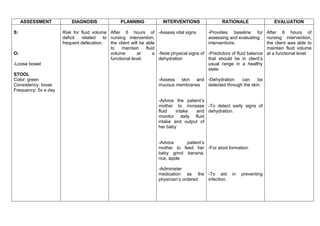
ASSESSMENT DIAGNOSIS PLANNING INTERVENTIONS RATIONALE EVALUATION
S:
O:
-Loose bowel
STOOL
Color: green
Consistency: loose
Frequency: 5x a day
Risk for fluid volume
deficit related to
frequent defecation.
After 6 hours of
nursing intervention,
the client will be able
to maintain fluid
volume at a
functional level.
-Assess vital signs
-Note physical signs of
dehydration
-Assess skin and
mucous membranes
-Advice the patient’s
mother to increase
fluid intake and
monitor daily fluid
intake and output of
her baby
-Advice patient’s
mother to feed her
baby grind banana,
rice, apple
-Administer
medication as the
physician’s ordered
-Provides baseline for
assessing and evaluating
interventions.
-Predictors of fluid balance
that should be in client’s
usual range in a healthy
state.
-Dehydration can be
detected through the skin.
-To detect early signs of
dehydration.
-For stool formation.
-To aid in preventing
infection.
After 6 hours of
nursing intervention,
the client was able to
maintain fluid volume
at a functional level.
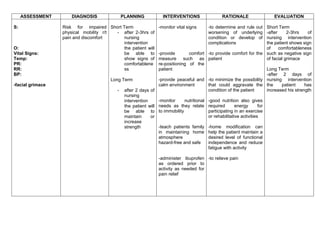
ASSESSMENT DIAGNOSIS PLANNING INTERVENTIONS RATIONALE EVALUATION
S:
O:
Vital Signs:
Temp:
PR:
RR:
BP:
-facial grimace
Risk for impaired
physical mobility r/t
pain and discomfort
Short Term
- after 2-3hrs of
nursing
intervention
the patient will
be able to
show signs of
comfortablene
ss
Long Term
- after 2 days of
nursing
intervention
the patient will
be able to
maintain or
increase
strength
-monitor vital signs
-provide comfort
measure such as
re-positioning of the
patient
-provide peaceful and
calm environment
-monitor nutritional
needs as they relate
to immobility
-teach patients family
in maintaining home
atmosphere
hazard-free and safe
-administer ibuprofen
as ordered prior to
activity as needed for
pain relief
-to determine and rule out
worsening of underlying
condition or develop of
complications
-to provide comfort for the
patient
-to minimize the possibility
that could aggravate the
condition of the patient
-good nutrition also gives
required energy for
participating in an exercise
or rehabilitative activities
-home modification can
help the patient maintain a
desired level of functional
independence and reduce
fatigue with activity
-to relieve pain
Short Term
-after 2-3hrs of
nursing intervention
the patient shows sign
of comfortableness
such as negative sign
of facial grimace
Long Term
-after 2 days of
nursing intervention
the patient has
increased his strength
Nursing care plan, intervention and management

Nursing care plan, intervention and management

  • 1.
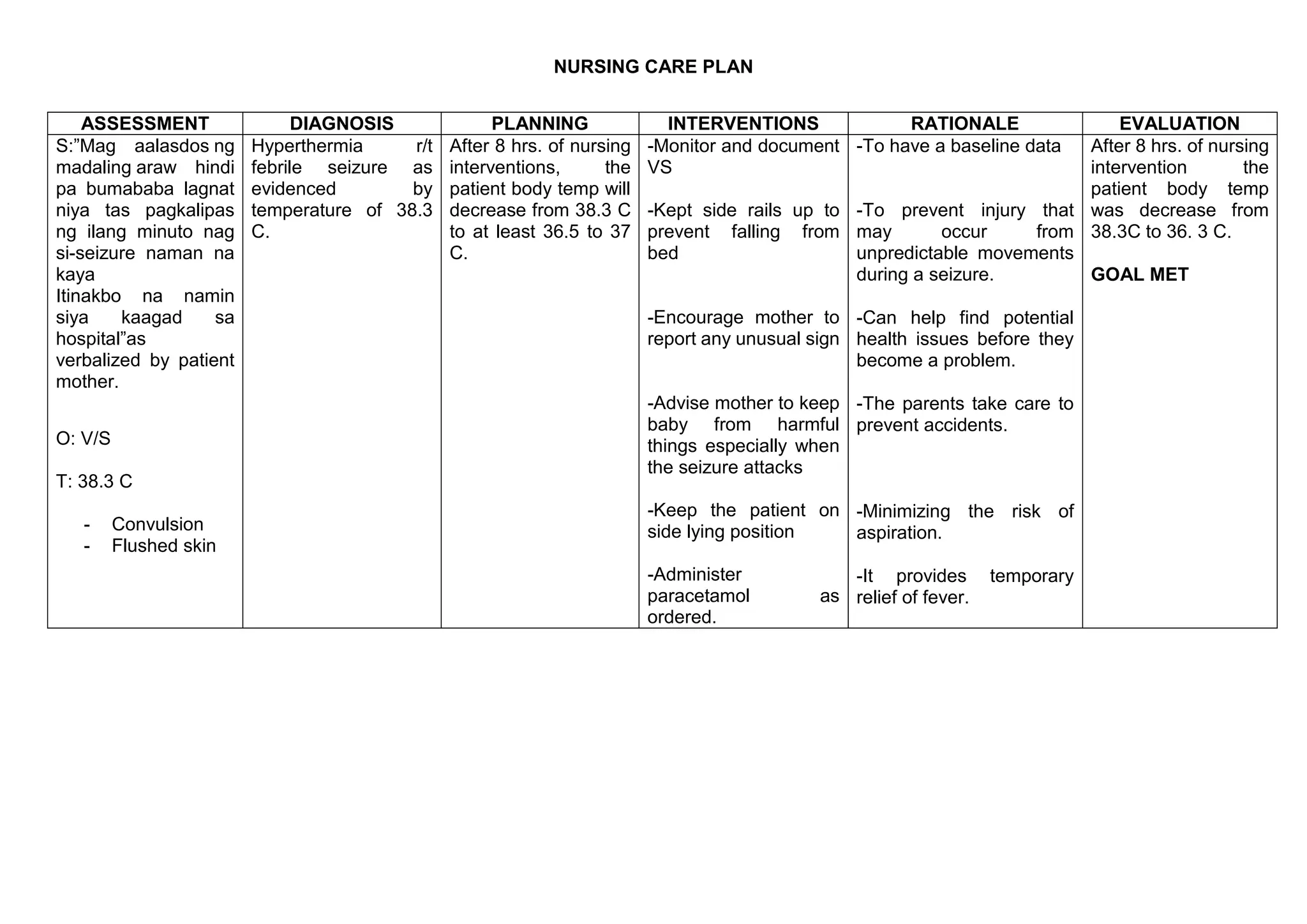
    NURSING CARE PLAN ASSESSMENTDIAGNOSIS PLANNING INTERVENTIONS RATIONALE EVALUATION S:”Mag aalasdos ng madaling araw hindi pa bumababa lagnat niya tas pagkalipas ng ilang minuto nag si-seizure naman na kaya Itinakbo na namin siya kaagad sa hospital”as verbalized by patient mother. O: V/S T: 38.3 C - Convulsion - Flushed skin Hyperthermia r/t febrile seizure as evidenced by temperature of 38.3 C. After 8 hrs. of nursing interventions, the patient body temp will decrease from 38.3 C to at least 36.5 to 37 C. -Monitor and document VS -Kept side rails up to prevent falling from bed -Encourage mother to report any unusual sign -Advise mother to keep baby from harmful things especially when the seizure attacks -Keep the patient on side lying position -Administer paracetamol as ordered. -To have a baseline data -To prevent injury that may occur from unpredictable movements during a seizure. -Can help find potential health issues before they become a problem. -The parents take care to prevent accidents. -Minimizing the risk of aspiration. -It provides temporary relief of fever. After 8 hrs. of nursing intervention the patient body temp was decrease from 38.3C to 36. 3 C. GOAL MET
  • 2.
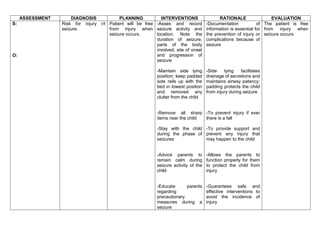
    ASSESSMENT DIAGNOSIS PLANNINGINTERVENTIONS RATIONALE EVALUATION S: O: Risk for injury r/t seizure. Patient will be free from injury when seizure occurs. -Asses and record seizure activity and location. Note the duration of seizure, parts of the body involved, site of onset and progression of seizure -Maintain side lying position; keep padded side rails up with the bed in lowest position and removed any clutter from the child -Remove all sharp items near the child -Stay with the child during the phase of seizures -Advice parents to remain calm during seizure activity of the child -Educate parents regarding precautionary measures during a seizure -Documentation of information is essential for the prevention of injury or complications because of seizure -Side lying facilitates drainage of secretions and maintains airway patency; padding protects the child from injury during seizure -To prevent injury if ever there is a fall -To provide support and prevent any injury that may happen to the child -Allows the parents to function properly for them to protect the child from injury -Guarantees safe and effective interventions to avoid the incidence of injury The patient is free from injury when seizure occurs
  • 3.
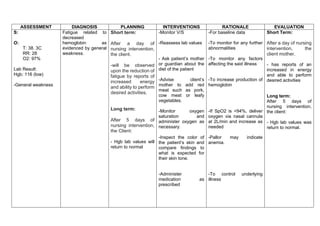
    ASSESSMENT DIAGNOSIS PLANNINGINTERVENTIONS RATIONALE EVALUATION S: O: T: 38. 3C RR: 28 O2: 97% Lab Result: Hgb: 116 (low) -General weakness Fatigue related to decreased hemoglobin as evidenced by general weakness. Short term: After a day of nursing intervention, the client. -will be observed upon the reduction of fatigue by reports of increased energy and ability to perform desired activities. Long term: After 5 days of nursing intervention, the Client: - Hgb lab values will return to normal -Monitor V/S -Reassess lab values - Ask patient’s mother or guardian about the diet of the patient -Advise client’s mother to add red meat such as pork, cow meat or leafy vegetables. -Monitor oxygen saturation and administer oxygen as necessary. -Inspect the color of the patient’s skin and compare findings to what is expected for their skin tone. -Administer medication as prescribed -For baseline data -To monitor for any further abnormalities -To monitor any factors affecting the said illness -To increase production of hemoglobin -If SpO2 is <94%, deliver oxygen via nasal cannula at 2L/min and increase as needed -Pallor may indicate anemia. -To control underlying illness Short Term: After a day of nursing intervention, the client mother. - has reports of an increased in energy and able to perform desired activities Long term: After 5 days of nursing intervention, the client: - Hgb lab values was return to normal.
  • 4.
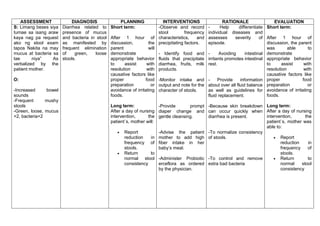
    ASSESSMENT DIAGNOSIS PLANNINGINTERVENTIONS RATIONALE EVALUATION S: Limang beses siya tumae sa isang araw kaya nag pa request ako ng stool exam tapos Nakita na may mucus at bacteria sa tae niya” As verbalized by the patient mother. O: -Increased bowel sounds -Frequent mushy stools -Green, loose, mucus +2, bacteria+2 Diarrhea related to presence of mucus and bacteria in stool as manifested by frequent elimination of green, loose stools. Short term: After 1 hour of discussion, the parent will demonstrate appropriate behavior to assist with resolution with causative factors like proper food preparation or avoidance of irritating foods. Long term: After a day of nursing intervention, the patient`s, mother will:  Report reduction in frequency of stools.  Return to normal stool consistency -Observe and record stool frequency characteristics, and precipitating factors. - Identify food and fluids that precipitate diarrhea, fruits, milk products. -Monitor intake and output and note for the character of stools. -Provide prompt diaper change and gentle cleansing. -Advise the patient mother to add high fiber intake in her baby’s meal. -Administer Probiotic erceflora as ordered by the physician. - Help differentiate individual diseases and assesses severity of episode. - Avoiding intestinal irritants promotes intestinal rest. - Provide information about over all fluid balance as well as guidelines for fluid replacement. -Because skin breakdown can occur quickly when diarrhea is present. -To normalize consistency of stools. -To control and remove extra bad bacteria Short term: After 1 hour of discussion, the parent was able to demonstrate appropriate behavior to assist with resolution with causative factors like proper food preparation or avoidance of irritating foods. Long term: After a day of nursing intervention, the patient`s, mother was able to:  Report reduction in frequency of stools.  Return to normal stool consistency
  • 5.
    ASSESSMENT DIAGNOSIS PLANNINGINTERVENTIONS RATIONALE EVALUATION S: O: -Loose bowel STOOL Color: green Consistency: loose Frequency: 5x a day Risk for fluid volume deficit related to frequent defecation. After 6 hours of nursing intervention, the client will be able to maintain fluid volume at a functional level. -Assess vital signs -Note physical signs of dehydration -Assess skin and mucous membranes -Advice the patient’s mother to increase fluid intake and monitor daily fluid intake and output of her baby -Advice patient’s mother to feed her baby grind banana, rice, apple -Administer medication as the physician’s ordered -Provides baseline for assessing and evaluating interventions. -Predictors of fluid balance that should be in client’s usual range in a healthy state. -Dehydration can be detected through the skin. -To detect early signs of dehydration. -For stool formation. -To aid in preventing infection. After 6 hours of nursing intervention, the client was able to maintain fluid volume at a functional level.
  • 6.
    ASSESSMENT DIAGNOSIS PLANNINGINTERVENTIONS RATIONALE EVALUATION S: O: Vital Signs: Temp: PR: RR: BP: -facial grimace Risk for impaired physical mobility r/t pain and discomfort Short Term - after 2-3hrs of nursing intervention the patient will be able to show signs of comfortablene ss Long Term - after 2 days of nursing intervention the patient will be able to maintain or increase strength -monitor vital signs -provide comfort measure such as re-positioning of the patient -provide peaceful and calm environment -monitor nutritional needs as they relate to immobility -teach patients family in maintaining home atmosphere hazard-free and safe -administer ibuprofen as ordered prior to activity as needed for pain relief -to determine and rule out worsening of underlying condition or develop of complications -to provide comfort for the patient -to minimize the possibility that could aggravate the condition of the patient -good nutrition also gives required energy for participating in an exercise or rehabilitative activities -home modification can help the patient maintain a desired level of functional independence and reduce fatigue with activity -to relieve pain Short Term -after 2-3hrs of nursing intervention the patient shows sign of comfortableness such as negative sign of facial grimace Long Term -after 2 days of nursing intervention the patient has increased his strength