CLASSROOM RULES
1. Listenattentively.
2. Raise your hand if you
want to answer or ask
question.
3. Respect each others.
4. Be participative.
6.
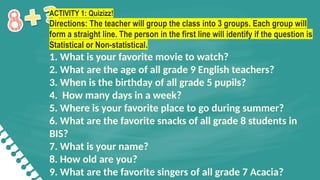
ACTIVITY 1: Quizizz!
Directions:The teacher will group the class into 3 groups. Each group will
form a straight line. The person in the first line will identify if the question is
Statistical or Non-statistical.
1. What is your favorite movie to watch?
2. What are the age of all grade 9 English teachers?
3. When is the birthday of all grade 5 pupils?
4. How many days in a week?
5. Where is your favorite place to go during summer?
6. What are the favorite snacks of all grade 8 students in
BIS?
7. What is your name?
8. How old are you?
9. What are the favorite singers of all grade 7 Acacia?
7.
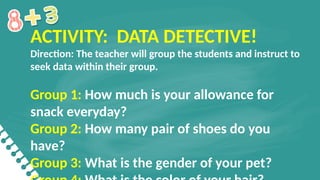
ACTIVITY: DATA DETECTIVE!
Direction:The teacher will group the students and instruct to
seek data within their group.
Group 1: How much is your allowance for
snack everyday?
Group 2: How many pair of shoes do you
have?
Group 3: What is the gender of your pet?
8.
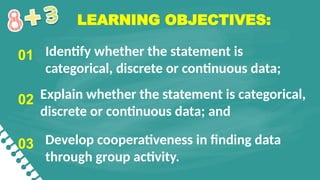
LEARNING OBJECTIVES:
01
03
02
Identify whetherthe statement is
categorical, discrete or continuous data;
Explain whether the statement is categorical,
discrete or continuous data; and
Develop cooperativeness in finding data
through group activity.
Observations- it focusesin determining
the changes in the attitude,
characteristics and behavior of people
or other subjects. This technique
includes watching and recording
actions and behaviors.
11.
Interviews- a qualitativeresearch
method that relies on asking
questions in order to collect data. It
involves two or more people, one of
whom is the interviewer asking the
questions.
12.
Focus Group Discussions-it is used
to know the thinking, feeling, or
opinion about certain phenomenon.
13.
Questionnaire- if youhave big number of
sample, it is the most practical way to use. You
gather data through writing. However, you must be
careful presenting your questions, since we need to
consider the culture, and characteristics of the
respondents. You may use email, letter, or personally
give your questionnaire to your respondents.
14.
Closed questions- Theseare questions
which can be answered with “Yes” or
“No,” or they have a limited set of
possible answers (such as: A, B, C, or
All of the above).
TYPES OF QUESTIONS
15.
Open-ended questions- Theseare
questions that allow someone to give
a free-form answer.
Example:
“How did you answer the modules?”
16.
Multiple-choice questions- Theseare questions
that provide a certain number of specific response
options as possible answers.
Example of multiple-choice question would be:
“How do you spend your free time?”. a. reading c.
surfing the internet b. listening to radio d. watching TV
e. others (please specify: __)
Statistics- is abranch of applied
mathematics specializing in
procedures for collecting, organizing,
presenting, analyzing, and interpreting
data through observations.
19.
Statistical Questions- isone that
can be answered by collecting
data that vary. There are two types
of data: numerical and categorical.
20.
Numerical data isdata in
the form of numbers. These
numbers can be a count of
objects, number, or any
data which uses numbers.
21.
Two kinds ofnumerical data:
A. Discrete Data- This is data that can be
counted and has a limited number of values.
1. Number of boys and girls in grade 7
Lauan.
2. The result of rolling a 3 dice.
3. The number of books in a shelves.
22.
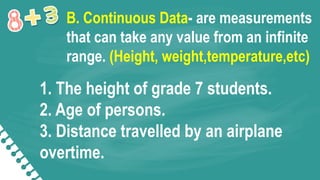
1. The heightof grade 7 students.
2. Age of persons.
3. Distance travelled by an airplane
overtime.
B. Continuous Data- are measurements
that can take any value from an infinite
range. (Height, weight,temperature,etc)
24.
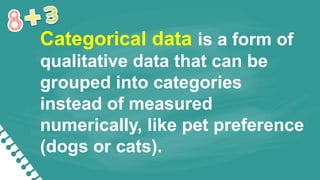
Categorical data isa form of
qualitative data that can be
grouped into categories
instead of measured
numerically, like pet preference
(dogs or cats).
25.
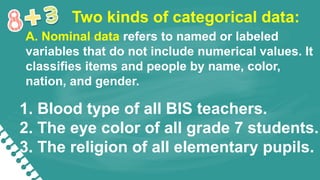
Two kinds ofcategorical data:
A. Nominal data refers to named or labeled
variables that do not include numerical values. It
classifies items and people by name, color,
nation, and gender.
1. Blood type of all BIS teachers.
2. The eye color of all grade 7 students.
3. The religion of all elementary pupils.
26.
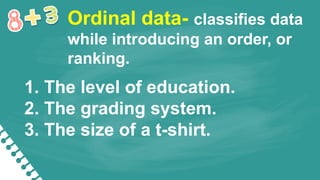
Ordinal data- classifiesdata
while introducing an order, or
ranking.
1. The level of education.
2. The grading system.
3. The size of a t-shirt.
28.
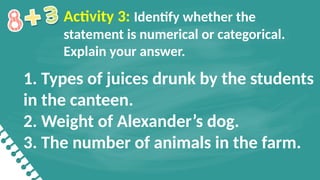
1. Types ofjuices drunk by the students
in the canteen.
2. Weight of Alexander’s dog.
3. The number of animals in the farm.
Activity 3: Identify whether the
statement is numerical or categorical.
Explain your answer.
29.
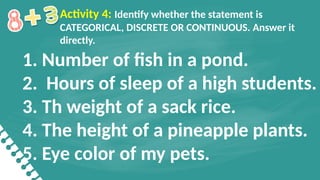
1. Number offish in a pond.
2. Hours of sleep of a high students.
3. Th weight of a sack rice.
4. The height of a pineapple plants.
5. Eye color of my pets.
Activity 4: Identify whether the statement is
CATEGORICAL, DISCRETE OR CONTINUOUS. Answer it
directly.
30.
6. Brand ofa ballpen in a class.
7. The number of students in a class.
8. Number of languages spoken by
Jose Rizal.
9. List of SSG Officers.
10. The results of rolling two dice.
Activity 4: Identify whether the statement is
CATEGORICAL, DISCRETE OR CONTINUOUS. Answer it
directly.
31.
Study in advanceabout formulating
statistical instruments.
ASSIGNMENT: