NUMBER
SYSTEM
DIVISIBILITY RULES
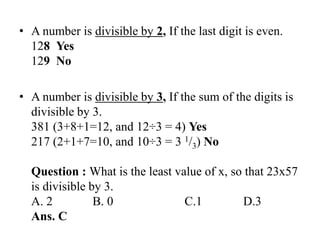
• A number is divisible by 2, If the last digit is even.
128 Yes
129 No
• A number is divisible by 3, If the sum of the digits is
divisible by 3.
381 (3+8+1=12, and 12÷3 = 4) Yes
217 (2+1+7=10, and 10÷3 = 3 1/3) No
Question : What is the least value of x, so that 23x57
is divisible by 3.
A. 2 B. 0 C.1 D.3
Ans. C
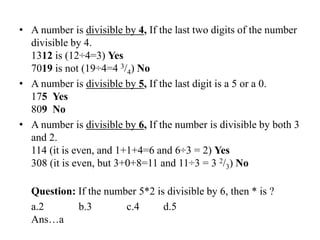
• A number is divisible by 4, If the last two digits of the number
divisible by 4.
1312 is (12÷4=3) Yes
7019 is not (19÷4=4 3/4) No
• A number is divisible by 5, If the last digit is a 5 or a 0.
175 Yes
809 No
• A number is divisible by 6, If the number is divisible by both 3
and 2.
114 (it is even, and 1+1+4=6 and 6÷3 = 2) Yes
308 (it is even, but 3+0+8=11 and 11÷3 = 3 2/3) No
Question: If the number 5*2 is divisible by 6, then * is ?
a.2 b.3 c.4 d.5
Ans…a
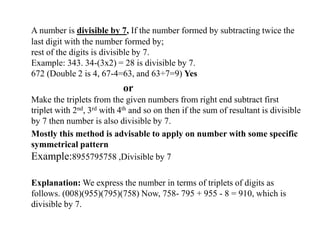
A number is divisible by 7, If the number formed by subtracting twice the
last digit with the number formed by;
rest of the digits is divisible by 7.
Example: 343. 34-(3x2) = 28 is divisible by 7.
672 (Double 2 is 4, 67-4=63, and 63÷7=9) Yes
or
Make the triplets from the given numbers from right end subtract first
triplet with 2nd, 3rd with 4th and so on then if the sum of resultant is divisible
by 7 then number is also divisible by 7.
Mostly this method is advisable to apply on number with some specific
symmetrical pattern
Example:8955795758 ,Divisible by 7
Explanation: We express the number in terms of triplets of digits as
follows. (008)(955)(795)(758) Now, 758- 795 + 955 - 8 = 910, which is
divisible by 7.
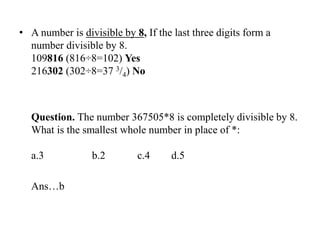
• A number is divisible by 8, If the last three digits form a
number divisible by 8.
109816 (816÷8=102) Yes
216302 (302÷8=37 3/4) No
Question. The number 367505*8 is completely divisible by 8.
What is the smallest whole number in place of *:
a.3 b.2 c.4 d.5
Ans…b
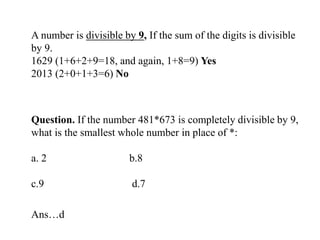
A number is divisible by 9, If the sum of the digits is divisible
by 9.
1629 (1+6+2+9=18, and again, 1+8=9) Yes
2013 (2+0+1+3=6) No
Question. If the number 481*673 is completely divisible by 9,
what is the smallest whole number in place of *:
a. 2 b.8
c.9 d.7
Ans…d
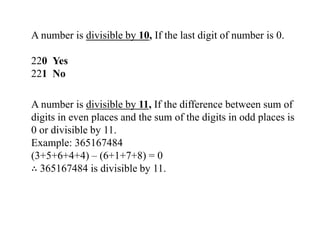
A number is divisible by 10, If the last digit of number is 0.
220 Yes
221 No
A number is divisible by 11, If the difference between sum of
digits in even places and the sum of the digits in odd places is
0 or divisible by 11.
Example: 365167484
(3+5+6+4+4) – (6+1+7+8) = 0
∴ 365167484 is divisible by 11.
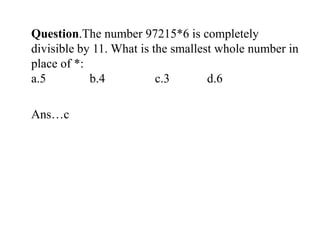
Question.The number 97215*6 is completely
divisible by 11. What is the smallest whole number in
place of *:
a.5 b.4 c.3 d.6
Ans…c
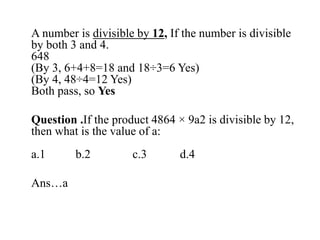
A number is divisible by 12, If the number is divisible
by both 3 and 4.
648
(By 3, 6+4+8=18 and 18÷3=6 Yes)
(By 4, 48÷4=12 Yes)
Both pass, so Yes
Question .If the product 4864 × 9a2 is divisible by 12,
then what is the value of a:
a.1 b.2 c.3 d.4
Ans…a
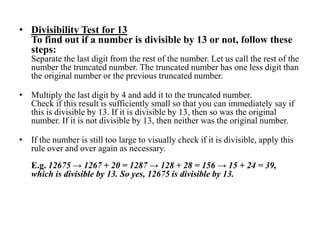
• Divisibility Test for 13
To find out if a number is divisible by 13 or not, follow these
steps:
Separate the last digit from the rest of the number. Let us call the rest of the
number the truncated number. The truncated number has one less digit than
the original number or the previous truncated number.
• Multiply the last digit by 4 and add it to the truncated number.
Check if this result is sufficiently small so that you can immediately say if
this is divisible by 13. If it is divisible by 13, then so was the original
number. If it is not divisible by 13, then neither was the original number.
• If the number is still too large to visually check if it is divisible, apply this
rule over and over again as necessary.
E.g. 12675 → 1267 + 20 = 1287 → 128 + 28 = 156 → 15 + 24 = 39,
which is divisible by 13. So yes, 12675 is divisible by 13.
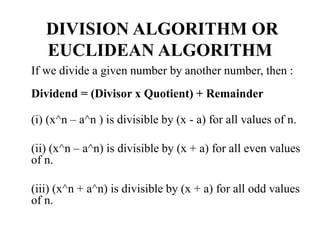
DIVISION ALGORITHM OR
EUCLIDEAN ALGORITHM
If we divide a given number by another number, then :
Dividend = (Divisor x Quotient) + Remainder
(i) (x^n – a^n ) is divisible by (x - a) for all values of n.
(ii) (x^n – a^n) is divisible by (x + a) for all even values
of n.
(iii) (x^n + a^n) is divisible by (x + a) for all odd values
of n.
REMAINDERS
Introduction
• Dividend = Divisor × Quotient + Remainder.
• Eg: Find the remainder of [(100 + 30 * 4 - 8 ) / 7]
• = Remainder[(Remainder[100/7] + Remainder[30/7] *
Remainder[4/7] - Remainder[8/7] ) / 7 ]
• = Remainder[(2 + 2 * 4 - 1)/7] = Remainder[9/7] = 2
 One common mistake:
• 15 / 9 is same as 5 / 3, remainder 2. Correct? No 15/9
will give a remainder of 6.
 make sure we multiply the remainder obtained with
the common factors we removed.
 Concept of negative remainder
• What is the remainder when 211 divided by 3?
• 2 = 3 * 1 + (-1), remainder is -1,
• Which is Remainder[-1/3] = -1
 Whenever you are getting negative number as a
remainder, make it positive by adding the divisor to
the negative remainder.
REMAINDER THEOREMS:
• Euler’s Remainder Theorem
Euler's theorem states that if P and N are
positive co prime integers, then:
Rem[PE[N]/N] = 1
where E[N]= N(1-
1
𝑎
)(1-
1
𝑏
)…
Where a,b are the possible prime factors of N
What is the remainder when 21865 is
divided by 17?
Remainder[21/17] = 4
Remainder [ 21865/ 17 ] = Remainder [ 4865/ 17 ]
4 and 17 are co prime numbers. ( A prime number is
always coprime to any other number)
φ(17) = 17 x ( 1 – 1 / 17) = 16.
So Euler’s theorem says Remainder [ 416/ 17 ] = 1
To use this result in the given problem we need to write
865 in 16n + r form.
865 = 16 * 54 + 1, so 4865 can be written as 416 * 54 x 4
Remainder[4865/17] = Remainder[ 416*54/17] * [4/17]
Remainder = 1 * 4 = 4
 Fermat’s little theorem
• Remainder of a( p – 1 )/ p is 1, which is Fermat’s little
theorem
• We can derive other useful results like
• Remainder of ap / p is a.
• (ap – a) is always divisible by a.
 Wilson’s theorem
• Remainder[(p-1)! / p ] = (p-1), if p is a prime number.
• We can also derive some useful results like
• Remainder of [(p-1)! + 1] / p is zero.
• Remainder of (p-2)! / p is 1.
CYCLIC PROPERTY OF REMAINDERS
For example,
Remainder [ 21 / 3 ] = 2, Remainder [ 22 / 3 ] = 1,
Remainder [ 23 / 3 ] = 2, Remainder [ 24 / 3 ] = 1 and
so on.
Pattern repeats in cycles of 2.
Remainder [ 2n / 3 ] = 2 when n is odd and 1 when n
is even
Eg: [ 23276 / 3 ] = 1(remainder)
Take another example with 9
• Remainder [ 91 / 11 ] = 9, Remainder [ 92 / 11 ] =
4, Remainder [ 93 / 11 ] = 3 , Remainder [ 94 / 11 ]
= 5
• Remainder [ 95 / 11 ] = 1, Remainder [ 96 / 11 ] =
9, Remainder [ 97 / 11 ] = 4, Remainder [ 98 / 11 ]
= 3
• Pattern repeats in cycles of 5.
• [ 9100 / 11 ]=1(remainder), 100 is in form 5n
FEW CONCEPTS CAN BE USED
• Remainder[(ax + 1)n / a] = 1 for all values of n.
• Remainder[(ax - 1)n / a ] = 1 when n is even
• Remainder[(ax - 1)n / a ] = (a-1) when n is odd.
• Remainder[(an + bn) / (a + b) ] = 0 when n is odd.
• Remainder[(an - bn) / (a + b) ] = 0 when n is even.
• Remainder [(an - bn) / (a - b) ] = 0
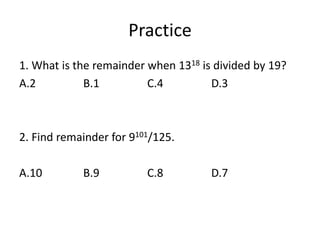
Practice
1. What is the remainder when 1318 is divided by 19?
A.2 B.1 C.4 D.3
2. Find remainder for 9101/125.
A.10 B.9 C.8 D.7
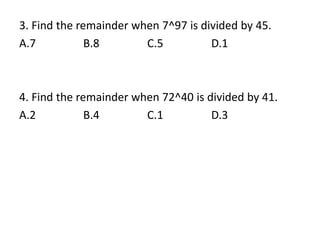
3. Find the remainder when 7^97 is divided by 45.
A.7 B.8 C.5 D.1
4. Find the remainder when 72^40 is divided by 41.
A.2 B.4 C.1 D.3
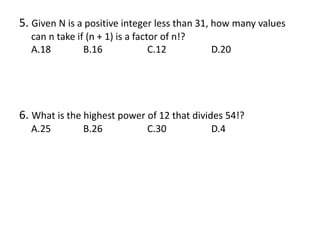
5. Given N is a positive integer less than 31, how many values
can n take if (n + 1) is a factor of n!?
A.18 B.16 C.12 D.20
6. What is the highest power of 12 that divides 54!?
A.25 B.26 C.30 D.4
FACTORIAL
Introduction
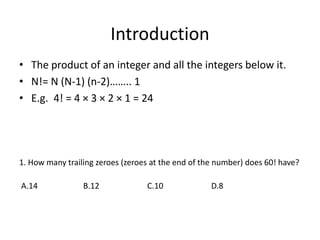
• The product of an integer and all the integers below it.
• N!= N (N-1) (n-2)…….. 1
• E.g. 4! = 4 × 3 × 2 × 1 = 24
1. How many trailing zeroes (zeroes at the end of the number) does 60! have?
A.14 B.12 C.10 D.8
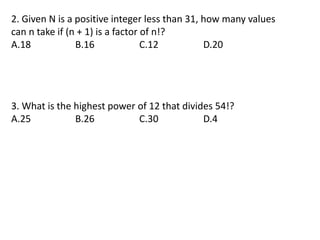
2. Given N is a positive integer less than 31, how many values
can n take if (n + 1) is a factor of n!?
A.18 B.16 C.12 D.20
3. What is the highest power of 12 that divides 54!?
A.25 B.26 C.30 D.4
FACTORS
Introduction
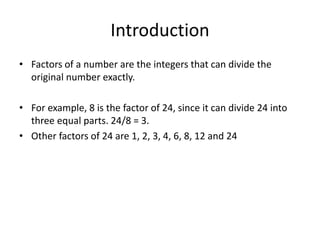
• Factors of a number are the integers that can divide the
original number exactly.
• For example, 8 is the factor of 24, since it can divide 24 into
three equal parts. 24/8 = 3.
• Other factors of 24 are 1, 2, 3, 4, 6, 8, 12 and 24
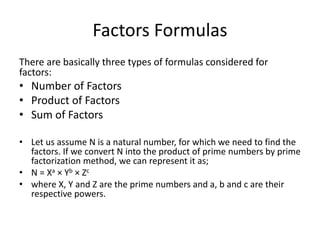
Factors Formulas
There are basically three types of formulas considered for
factors:
• Number of Factors
• Product of Factors
• Sum of Factors
• Let us assume N is a natural number, for which we need to find the
factors. If we convert N into the product of prime numbers by prime
factorization method, we can represent it as;
• N = Xa × Yb × Zc
• where X, Y and Z are the prime numbers and a, b and c are their
respective powers.
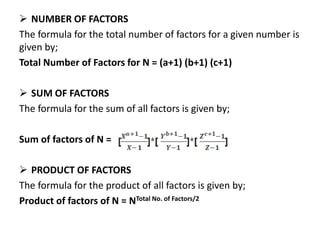
 NUMBER OF FACTORS
The formula for the total number of factors for a given number is
given by;
Total Number of Factors for N = (a+1) (b+1) (c+1)
 SUM OF FACTORS
The formula for the sum of all factors is given by;
Sum of factors of N =
 PRODUCT OF FACTORS
The formula for the product of all factors is given by;
Product of factors of N = NTotal No. of Factors/2
Example
Example: Find the total number of factors of 90 along with
sum and product of all factors.
Solution: 90 = 2 × 45 = 2 × 3 × 15 = 2 × 3 × 3 × 5
90 = 21 × 32 × 51
Here, X = 2, Y = 3, Z =5 and a = 1, b = 2, c = 1
Total number of factors of 90
= (a +1)(b+1)(c+1) = (1+1)(2+1)(1+1) = 2 × 3 × 2 = 12
Sum of factors of 90
= [(21+1-1)/2-1] × [(32+1-1)/3-1] × [(51+1-1)/5-1] = (3/1) × (26/2)
× (24/4) = 3 × 13 × 6 = 234
Product of factors of 90
= 90Total factors of 90/2 = 9012/2 = 906
Practice
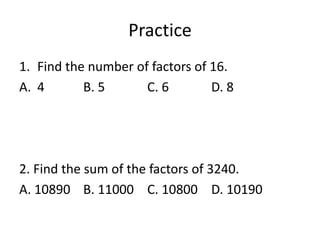
1. Find the number of factors of 16.
A. 4 B. 5 C. 6 D. 8
2. Find the sum of the factors of 3240.
A. 10890 B. 11000 C. 10800 D. 10190
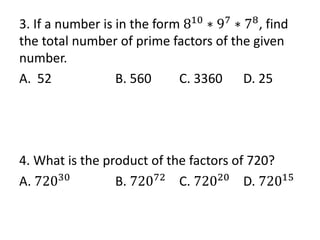
3. If a number is in the form 810
∗ 97
∗ 78
, find
the total number of prime factors of the given
number.
A. 52 B. 560 C. 3360 D. 25
4. What is the product of the factors of 720?
A. 72030
B. 72072
C. 72020
D. 72015
Number System.pptx

Number System.pptx

  • 1.
  • 2.
  • 3.
    • A numberis divisible by 2, If the last digit is even. 128 Yes 129 No • A number is divisible by 3, If the sum of the digits is divisible by 3. 381 (3+8+1=12, and 12÷3 = 4) Yes 217 (2+1+7=10, and 10÷3 = 3 1/3) No Question : What is the least value of x, so that 23x57 is divisible by 3. A. 2 B. 0 C.1 D.3 Ans. C
  • 4.
    • A numberis divisible by 4, If the last two digits of the number divisible by 4. 1312 is (12÷4=3) Yes 7019 is not (19÷4=4 3/4) No • A number is divisible by 5, If the last digit is a 5 or a 0. 175 Yes 809 No • A number is divisible by 6, If the number is divisible by both 3 and 2. 114 (it is even, and 1+1+4=6 and 6÷3 = 2) Yes 308 (it is even, but 3+0+8=11 and 11÷3 = 3 2/3) No Question: If the number 5*2 is divisible by 6, then * is ? a.2 b.3 c.4 d.5 Ans…a
  • 5.
    A number isdivisible by 7, If the number formed by subtracting twice the last digit with the number formed by; rest of the digits is divisible by 7. Example: 343. 34-(3x2) = 28 is divisible by 7. 672 (Double 2 is 4, 67-4=63, and 63÷7=9) Yes or Make the triplets from the given numbers from right end subtract first triplet with 2nd, 3rd with 4th and so on then if the sum of resultant is divisible by 7 then number is also divisible by 7. Mostly this method is advisable to apply on number with some specific symmetrical pattern Example:8955795758 ,Divisible by 7 Explanation: We express the number in terms of triplets of digits as follows. (008)(955)(795)(758) Now, 758- 795 + 955 - 8 = 910, which is divisible by 7.
  • 6.
    • A numberis divisible by 8, If the last three digits form a number divisible by 8. 109816 (816÷8=102) Yes 216302 (302÷8=37 3/4) No Question. The number 367505*8 is completely divisible by 8. What is the smallest whole number in place of *: a.3 b.2 c.4 d.5 Ans…b
  • 7.
    A number isdivisible by 9, If the sum of the digits is divisible by 9. 1629 (1+6+2+9=18, and again, 1+8=9) Yes 2013 (2+0+1+3=6) No Question. If the number 481*673 is completely divisible by 9, what is the smallest whole number in place of *: a. 2 b.8 c.9 d.7 Ans…d
  • 8.
    A number isdivisible by 10, If the last digit of number is 0. 220 Yes 221 No A number is divisible by 11, If the difference between sum of digits in even places and the sum of the digits in odd places is 0 or divisible by 11. Example: 365167484 (3+5+6+4+4) – (6+1+7+8) = 0 ∴ 365167484 is divisible by 11.
  • 9.
    Question.The number 97215*6is completely divisible by 11. What is the smallest whole number in place of *: a.5 b.4 c.3 d.6 Ans…c
  • 10.
    A number isdivisible by 12, If the number is divisible by both 3 and 4. 648 (By 3, 6+4+8=18 and 18÷3=6 Yes) (By 4, 48÷4=12 Yes) Both pass, so Yes Question .If the product 4864 × 9a2 is divisible by 12, then what is the value of a: a.1 b.2 c.3 d.4 Ans…a
  • 11.
    • Divisibility Testfor 13 To find out if a number is divisible by 13 or not, follow these steps: Separate the last digit from the rest of the number. Let us call the rest of the number the truncated number. The truncated number has one less digit than the original number or the previous truncated number. • Multiply the last digit by 4 and add it to the truncated number. Check if this result is sufficiently small so that you can immediately say if this is divisible by 13. If it is divisible by 13, then so was the original number. If it is not divisible by 13, then neither was the original number. • If the number is still too large to visually check if it is divisible, apply this rule over and over again as necessary. E.g. 12675 → 1267 + 20 = 1287 → 128 + 28 = 156 → 15 + 24 = 39, which is divisible by 13. So yes, 12675 is divisible by 13.
  • 12.
    DIVISION ALGORITHM OR EUCLIDEANALGORITHM If we divide a given number by another number, then : Dividend = (Divisor x Quotient) + Remainder (i) (x^n – a^n ) is divisible by (x - a) for all values of n. (ii) (x^n – a^n) is divisible by (x + a) for all even values of n. (iii) (x^n + a^n) is divisible by (x + a) for all odd values of n.
  • 13.
  • 14.
    Introduction • Dividend =Divisor × Quotient + Remainder. • Eg: Find the remainder of [(100 + 30 * 4 - 8 ) / 7] • = Remainder[(Remainder[100/7] + Remainder[30/7] * Remainder[4/7] - Remainder[8/7] ) / 7 ] • = Remainder[(2 + 2 * 4 - 1)/7] = Remainder[9/7] = 2
  • 15.
     One commonmistake: • 15 / 9 is same as 5 / 3, remainder 2. Correct? No 15/9 will give a remainder of 6.  make sure we multiply the remainder obtained with the common factors we removed.  Concept of negative remainder • What is the remainder when 211 divided by 3? • 2 = 3 * 1 + (-1), remainder is -1, • Which is Remainder[-1/3] = -1  Whenever you are getting negative number as a remainder, make it positive by adding the divisor to the negative remainder.
  • 16.
    REMAINDER THEOREMS: • Euler’sRemainder Theorem Euler's theorem states that if P and N are positive co prime integers, then: Rem[PE[N]/N] = 1 where E[N]= N(1- 1 𝑎 )(1- 1 𝑏 )… Where a,b are the possible prime factors of N
  • 17.
    What is theremainder when 21865 is divided by 17? Remainder[21/17] = 4 Remainder [ 21865/ 17 ] = Remainder [ 4865/ 17 ] 4 and 17 are co prime numbers. ( A prime number is always coprime to any other number) φ(17) = 17 x ( 1 – 1 / 17) = 16. So Euler’s theorem says Remainder [ 416/ 17 ] = 1 To use this result in the given problem we need to write 865 in 16n + r form. 865 = 16 * 54 + 1, so 4865 can be written as 416 * 54 x 4 Remainder[4865/17] = Remainder[ 416*54/17] * [4/17] Remainder = 1 * 4 = 4
  • 18.
     Fermat’s littletheorem • Remainder of a( p – 1 )/ p is 1, which is Fermat’s little theorem • We can derive other useful results like • Remainder of ap / p is a. • (ap – a) is always divisible by a.  Wilson’s theorem • Remainder[(p-1)! / p ] = (p-1), if p is a prime number. • We can also derive some useful results like • Remainder of [(p-1)! + 1] / p is zero. • Remainder of (p-2)! / p is 1.
  • 19.
    CYCLIC PROPERTY OFREMAINDERS For example, Remainder [ 21 / 3 ] = 2, Remainder [ 22 / 3 ] = 1, Remainder [ 23 / 3 ] = 2, Remainder [ 24 / 3 ] = 1 and so on. Pattern repeats in cycles of 2. Remainder [ 2n / 3 ] = 2 when n is odd and 1 when n is even Eg: [ 23276 / 3 ] = 1(remainder)
  • 20.
    Take another examplewith 9 • Remainder [ 91 / 11 ] = 9, Remainder [ 92 / 11 ] = 4, Remainder [ 93 / 11 ] = 3 , Remainder [ 94 / 11 ] = 5 • Remainder [ 95 / 11 ] = 1, Remainder [ 96 / 11 ] = 9, Remainder [ 97 / 11 ] = 4, Remainder [ 98 / 11 ] = 3 • Pattern repeats in cycles of 5. • [ 9100 / 11 ]=1(remainder), 100 is in form 5n
  • 21.
    FEW CONCEPTS CANBE USED • Remainder[(ax + 1)n / a] = 1 for all values of n. • Remainder[(ax - 1)n / a ] = 1 when n is even • Remainder[(ax - 1)n / a ] = (a-1) when n is odd. • Remainder[(an + bn) / (a + b) ] = 0 when n is odd. • Remainder[(an - bn) / (a + b) ] = 0 when n is even. • Remainder [(an - bn) / (a - b) ] = 0
  • 22.
    Practice 1. What isthe remainder when 1318 is divided by 19? A.2 B.1 C.4 D.3 2. Find remainder for 9101/125. A.10 B.9 C.8 D.7
  • 23.
    3. Find theremainder when 7^97 is divided by 45. A.7 B.8 C.5 D.1 4. Find the remainder when 72^40 is divided by 41. A.2 B.4 C.1 D.3
  • 24.
    5. Given Nis a positive integer less than 31, how many values can n take if (n + 1) is a factor of n!? A.18 B.16 C.12 D.20 6. What is the highest power of 12 that divides 54!? A.25 B.26 C.30 D.4
  • 25.
  • 26.
    Introduction • The productof an integer and all the integers below it. • N!= N (N-1) (n-2)…….. 1 • E.g. 4! = 4 × 3 × 2 × 1 = 24 1. How many trailing zeroes (zeroes at the end of the number) does 60! have? A.14 B.12 C.10 D.8
  • 27.
    2. Given Nis a positive integer less than 31, how many values can n take if (n + 1) is a factor of n!? A.18 B.16 C.12 D.20 3. What is the highest power of 12 that divides 54!? A.25 B.26 C.30 D.4
  • 28.
  • 29.
    Introduction • Factors ofa number are the integers that can divide the original number exactly. • For example, 8 is the factor of 24, since it can divide 24 into three equal parts. 24/8 = 3. • Other factors of 24 are 1, 2, 3, 4, 6, 8, 12 and 24
  • 30.
    Factors Formulas There arebasically three types of formulas considered for factors: • Number of Factors • Product of Factors • Sum of Factors • Let us assume N is a natural number, for which we need to find the factors. If we convert N into the product of prime numbers by prime factorization method, we can represent it as; • N = Xa × Yb × Zc • where X, Y and Z are the prime numbers and a, b and c are their respective powers.
  • 31.
     NUMBER OFFACTORS The formula for the total number of factors for a given number is given by; Total Number of Factors for N = (a+1) (b+1) (c+1)  SUM OF FACTORS The formula for the sum of all factors is given by; Sum of factors of N =  PRODUCT OF FACTORS The formula for the product of all factors is given by; Product of factors of N = NTotal No. of Factors/2
  • 32.
    Example Example: Find thetotal number of factors of 90 along with sum and product of all factors. Solution: 90 = 2 × 45 = 2 × 3 × 15 = 2 × 3 × 3 × 5 90 = 21 × 32 × 51 Here, X = 2, Y = 3, Z =5 and a = 1, b = 2, c = 1 Total number of factors of 90 = (a +1)(b+1)(c+1) = (1+1)(2+1)(1+1) = 2 × 3 × 2 = 12 Sum of factors of 90 = [(21+1-1)/2-1] × [(32+1-1)/3-1] × [(51+1-1)/5-1] = (3/1) × (26/2) × (24/4) = 3 × 13 × 6 = 234 Product of factors of 90 = 90Total factors of 90/2 = 9012/2 = 906
  • 33.
    Practice 1. Find thenumber of factors of 16. A. 4 B. 5 C. 6 D. 8 2. Find the sum of the factors of 3240. A. 10890 B. 11000 C. 10800 D. 10190
  • 34.
    3. If anumber is in the form 810 ∗ 97 ∗ 78 , find the total number of prime factors of the given number. A. 52 B. 560 C. 3360 D. 25 4. What is the product of the factors of 720? A. 72030 B. 72072 C. 72020 D. 72015

Editor's Notes