Number Base ConversionsSteven T. Jones3/22/20101Copyright 2010 Steven T. Jones
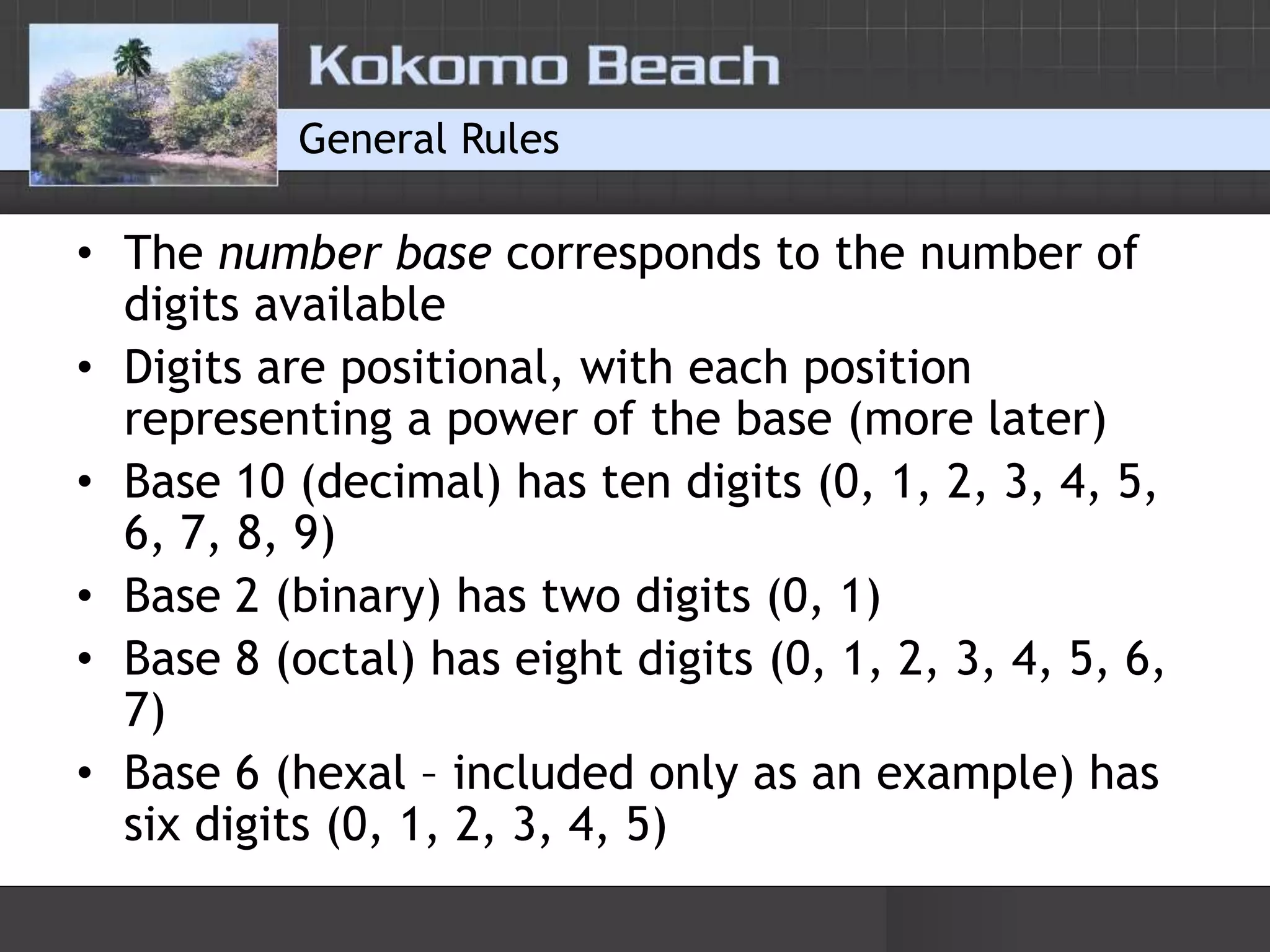
General RulesThe number base corresponds to the number of digits availableDigits are positional, with each position representing a power of the base (more later)Base 10 (decimal) has ten digits (0, 1, 2, 3, 4, 5, 6, 7, 8, 9)Base 2 (binary) has two digits (0, 1)Base 8 (octal) has eight digits (0, 1, 2, 3, 4, 5, 6, 7)Base 6 (hexal – included only as an example) has six digits (0, 1, 2, 3, 4, 5)
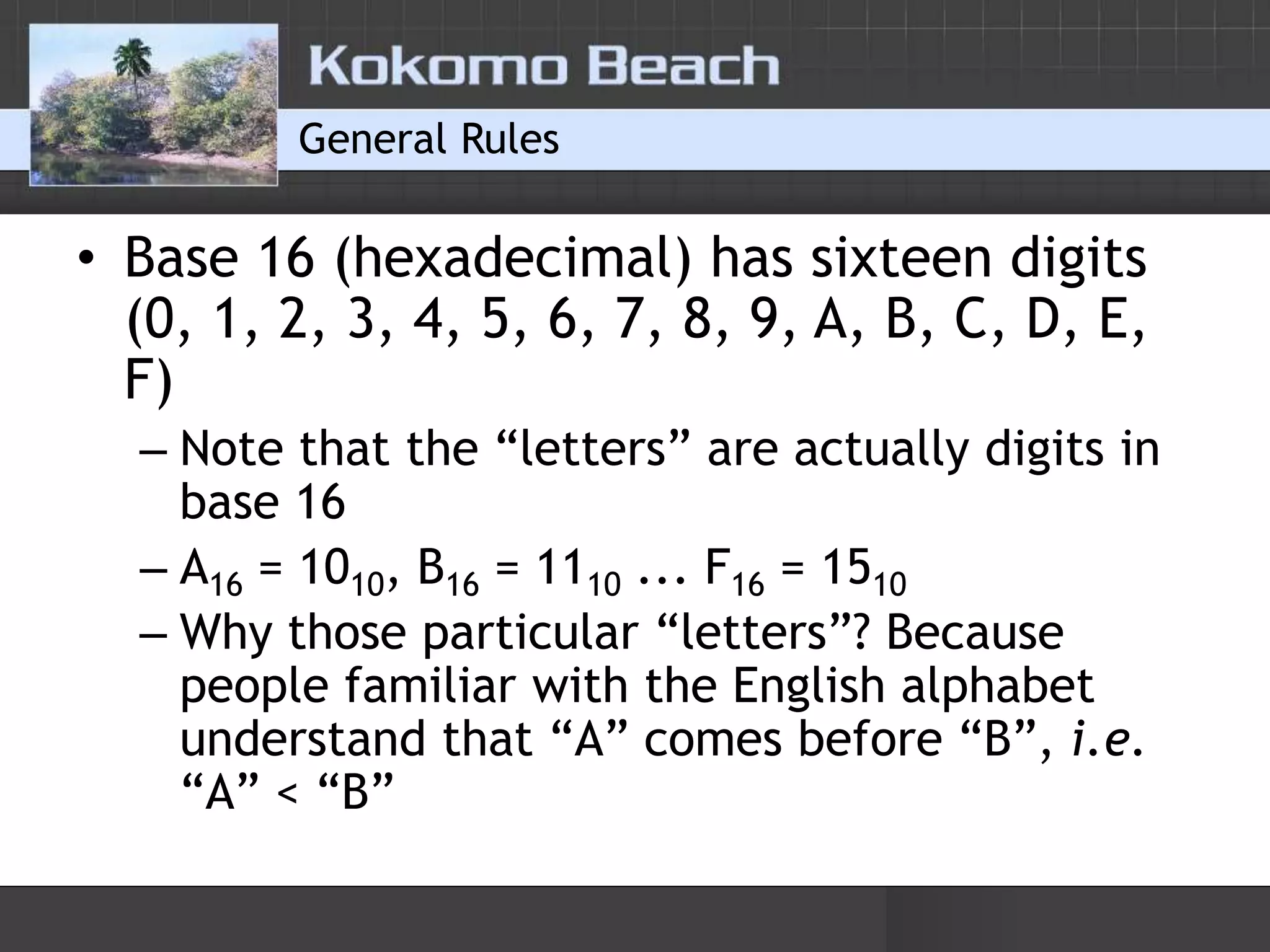
General RulesBase 16 (hexadecimal) has sixteen digits (0, 1, 2, 3, 4, 5, 6, 7, 8, 9, A, B, C, D, E, F)Note that the “letters” are actually digits in base 16A16 = 1010, B16 = 1110 ... F16 = 1510Why those particular “letters”? Because people familiar with the English alphabet understand that “A” comes before “B”, i.e. “A” < “B”
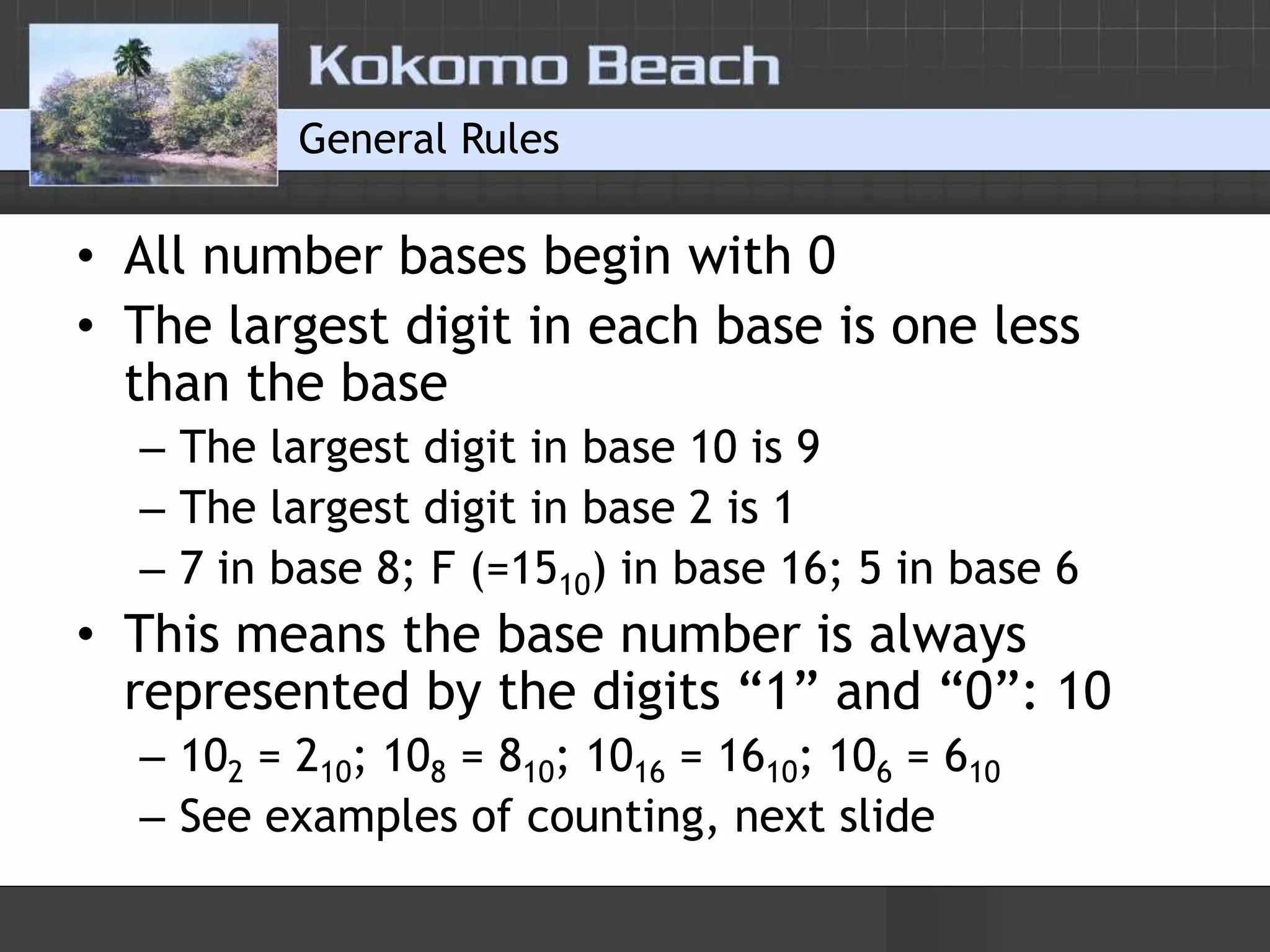
General RulesAll number bases begin with 0The largest digit in each base is one less than the baseThe largest digit in base 10 is 9The largest digit in base 2 is 17 in base 8; F (=1510) in base 16; 5 in base 6This means the base number is always represented by the digits “1” and “0”: 10102 = 210; 108 = 810; 1016 = 1610; 106 = 610See examples of counting, next slide
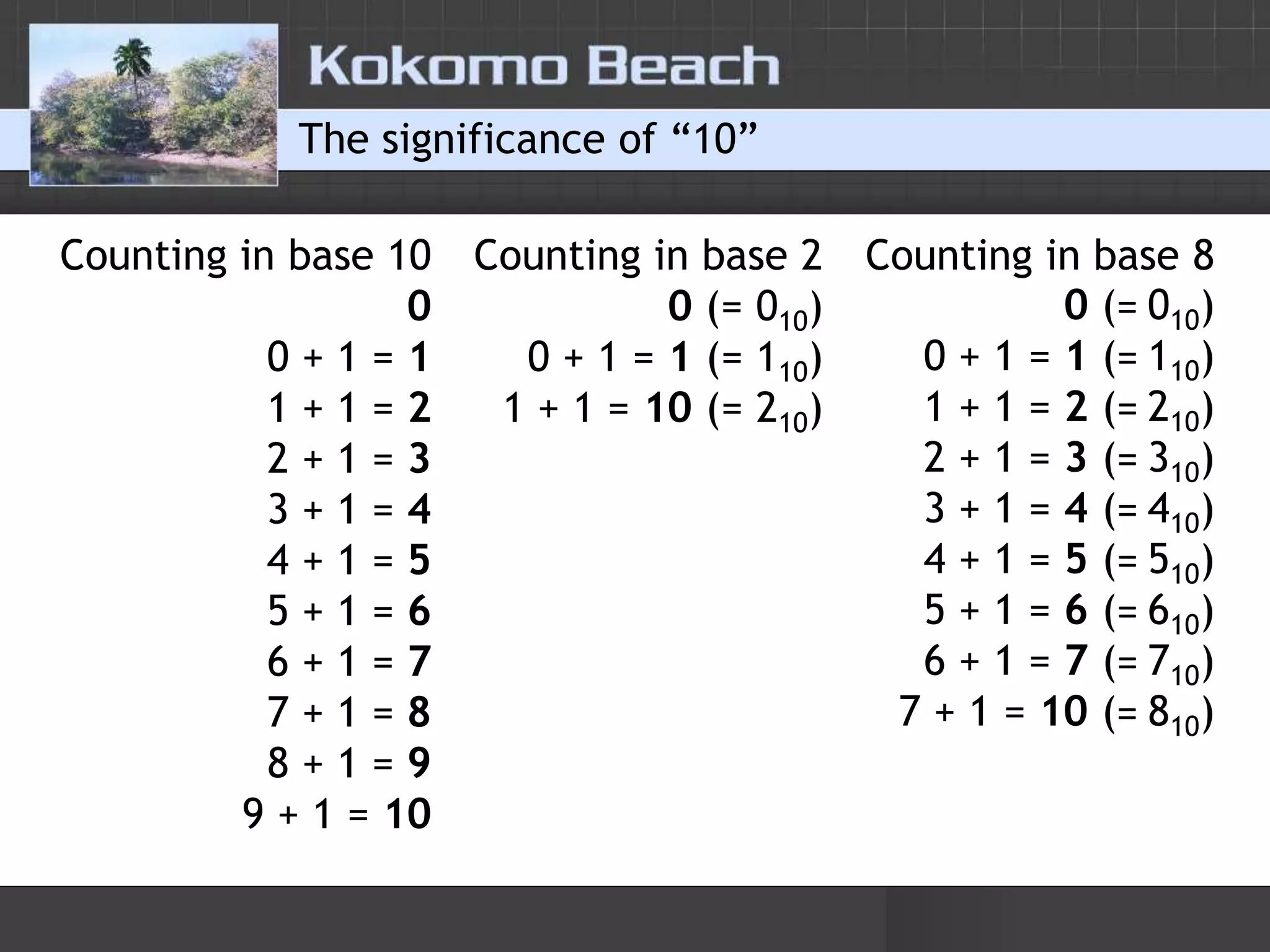
The significance of “10”Counting in base 20 (= 010)0 + 1 = 1 (= 110) 1 + 1 = 10 (= 210)Counting in base 80 (= 010)0 + 1 = 1 (= 110)1 + 1 = 2 (= 210)2 + 1 = 3 (= 310)3 + 1 = 4 (= 410)4 + 1 = 5 (= 510)5 + 1 = 6 (= 610)6 + 1 = 7 (= 710)7 + 1 = 10 (= 810)Counting in base 1000 + 1 =11 + 1 = 22 + 1 = 33 + 1 = 44 + 1 = 55 + 1 = 66 + 1 = 77 + 1 = 88 + 1 = 99 + 1 = 10
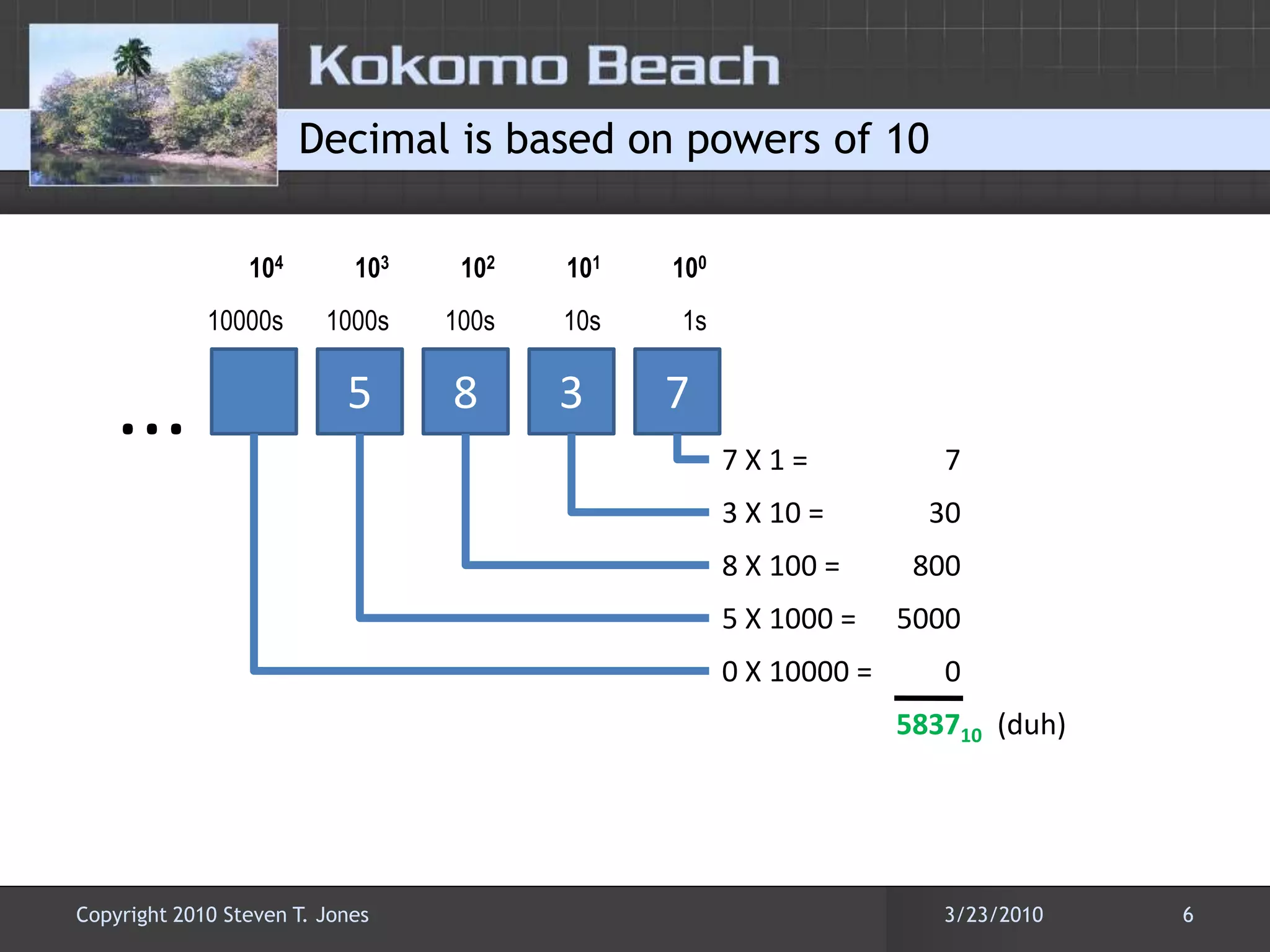
Decimal is based on powers of 101031021011001041000s100s10s1s10000s...58377 X 1 = 73 X 10 = 308 X 100 = 8005 X 1000 = 50000 X 10000 = 0583710(duh)3/22/20106Copyright 2010 Steven T. Jones
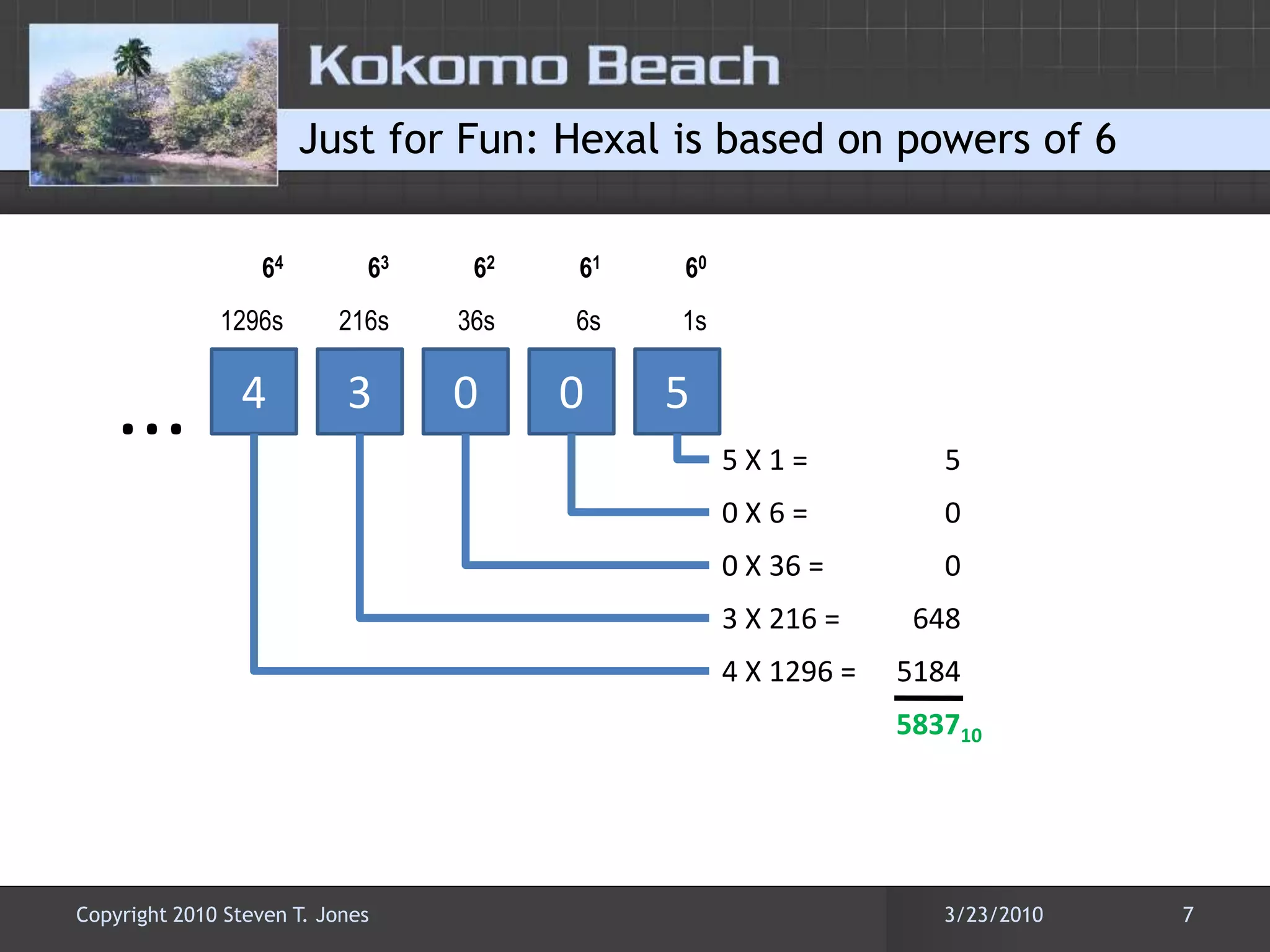
Just for Fun: Hexal is based on powers of 66362616064216s36s6s1s1296s...300545 X 1 = 50 X 6 = 00 X 36 = 03 X 216 = 6484 X 1296 = 51845837103/22/20107Copyright 2010 Steven T. Jones
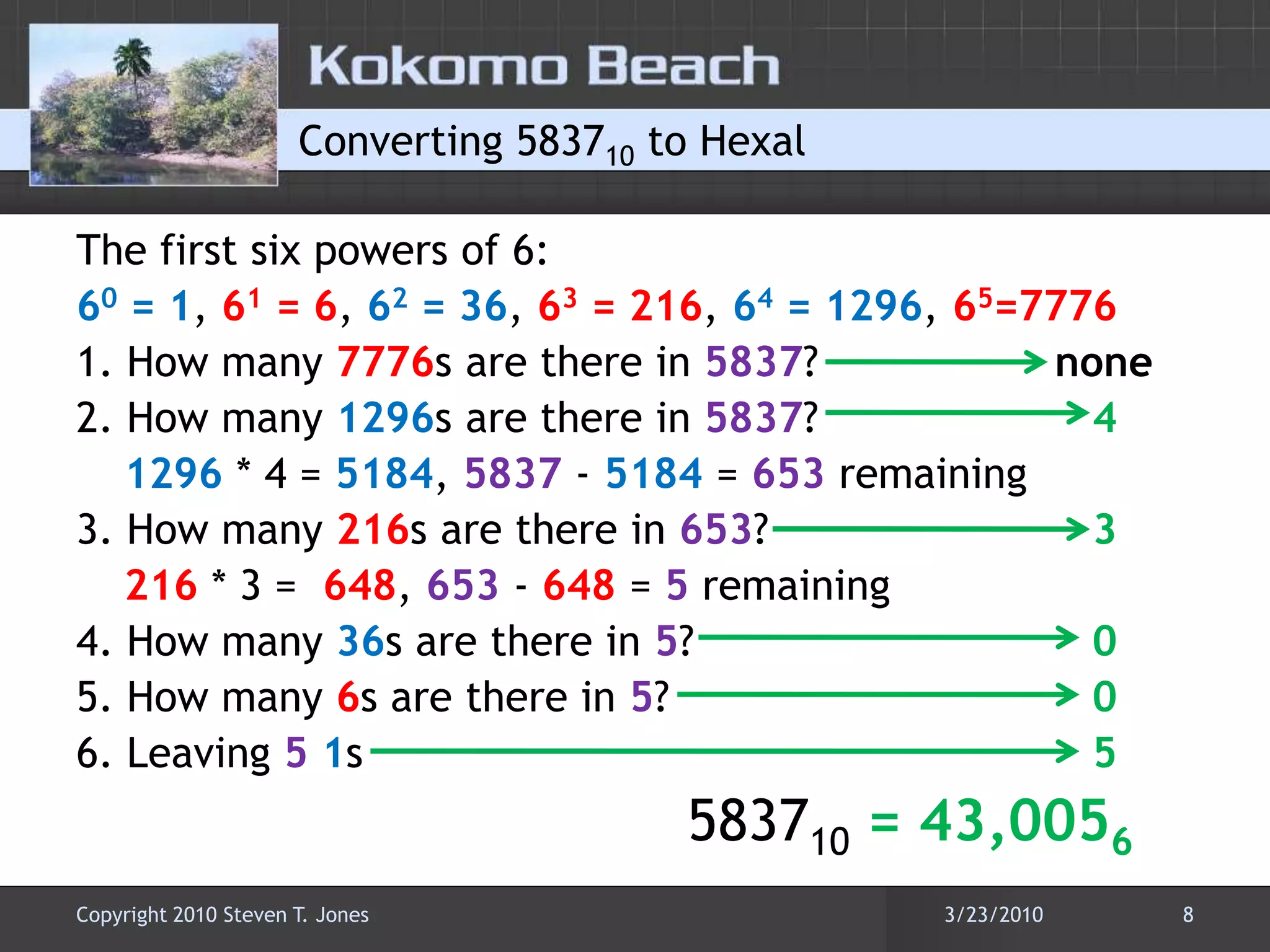
Converting 583710 to HexalThe first six powers of 6:60 = 1, 61 = 6, 62 = 36, 63 = 216, 64 = 1296, 65=77761. How many 7776s are there in 5837?           	       none2. How many 1296s are there in 5837?             	41296 * 4 = 5184, 5837 - 5184 = 653 remaining 3. How many 216s are there in 653?                   	3216 * 3 =  648, 653 - 648 = 5 remaining 4. How many 36s are there in 5?                         	05. How many 6s are there in 5?                           	06. Leaving 51s 			                           	5					583710 = 43,00563/22/20108Copyright 2010 Steven T. Jones
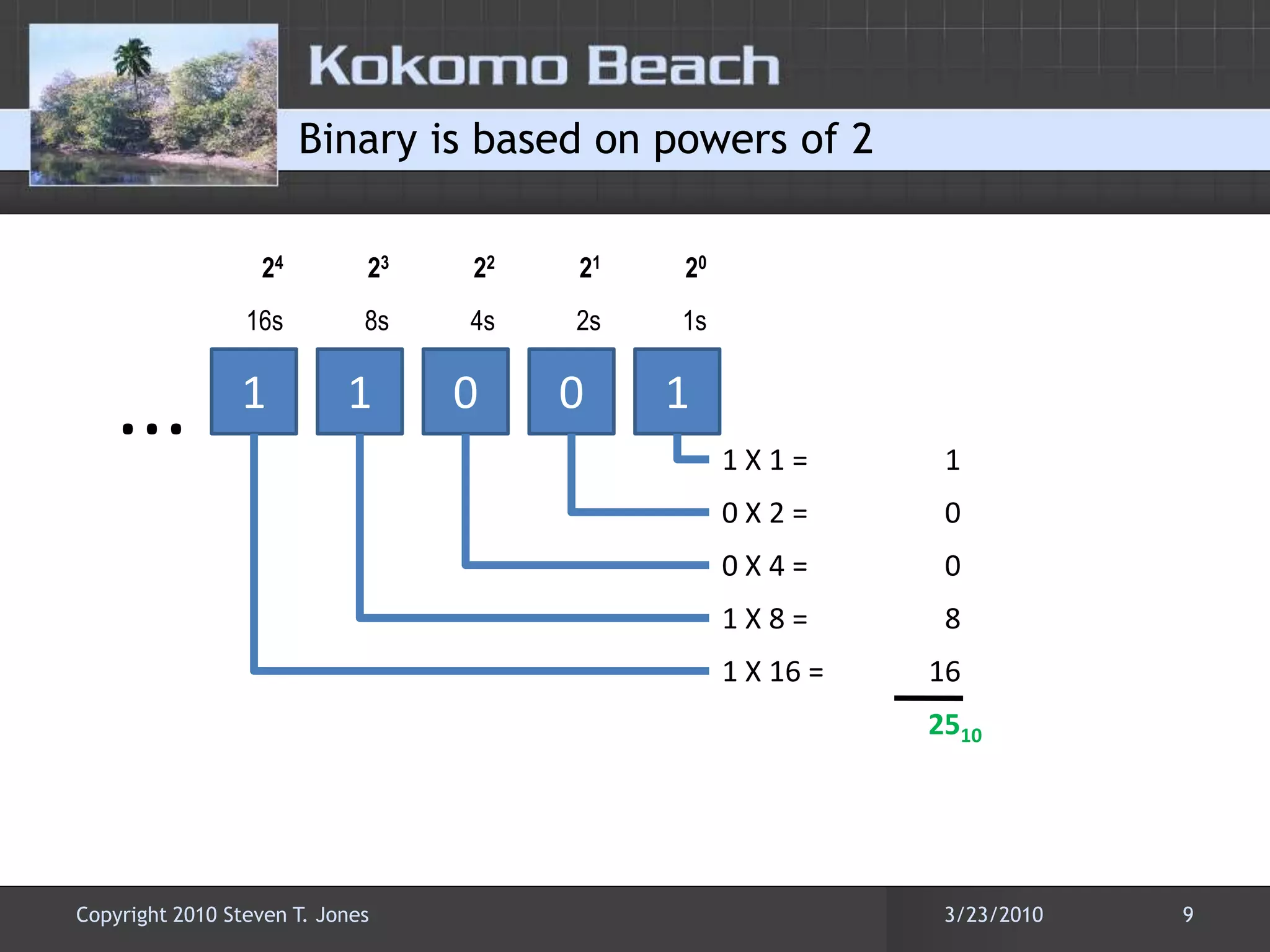
Binary is based on powers of 223222120248s4s2s1s16s...100111 X 1 = 10 X 2 = 00 X 4 = 01 X 8 = 81 X 16 = 1625103/22/20109Copyright 2010 Steven T. Jones
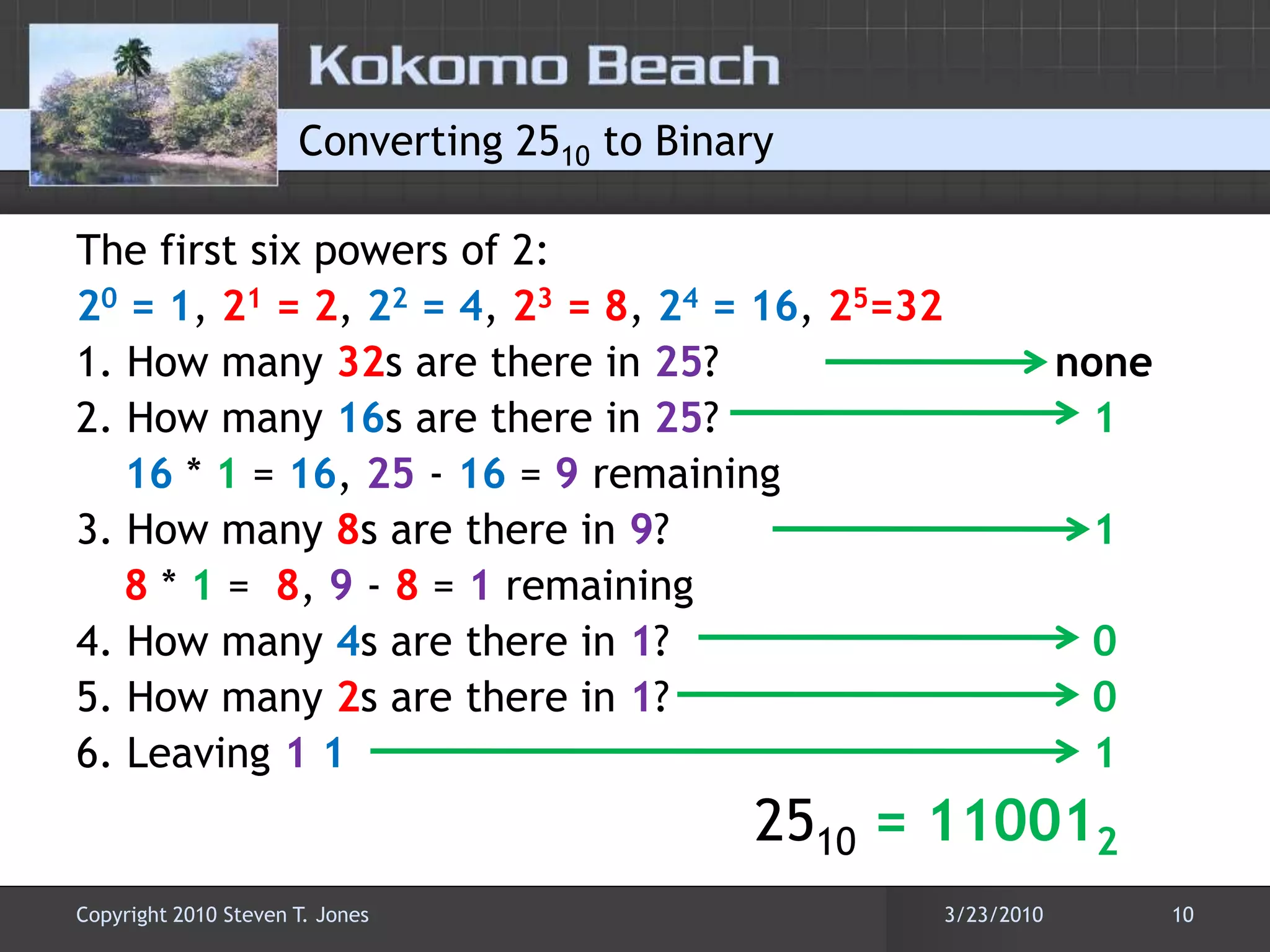
Converting 2510 to BinaryThe first six powers of 2:20= 1, 21= 2, 22= 4, 23= 8, 24= 16, 25=321. How many 32s are there in 25?           	       none2. How many 16s are there in 25?             		116 * 1 = 16, 25 - 16 = 9 remaining 3. How many 8s are there in 9?                   		18 * 1 =  8, 9 - 8 = 1 remaining 4. How many 4s are there in 1?                         	05. How many 2s are there in 1?                           	06. Leaving 111					   2510 = 1100123/22/201010Copyright 2010 Steven T. Jones
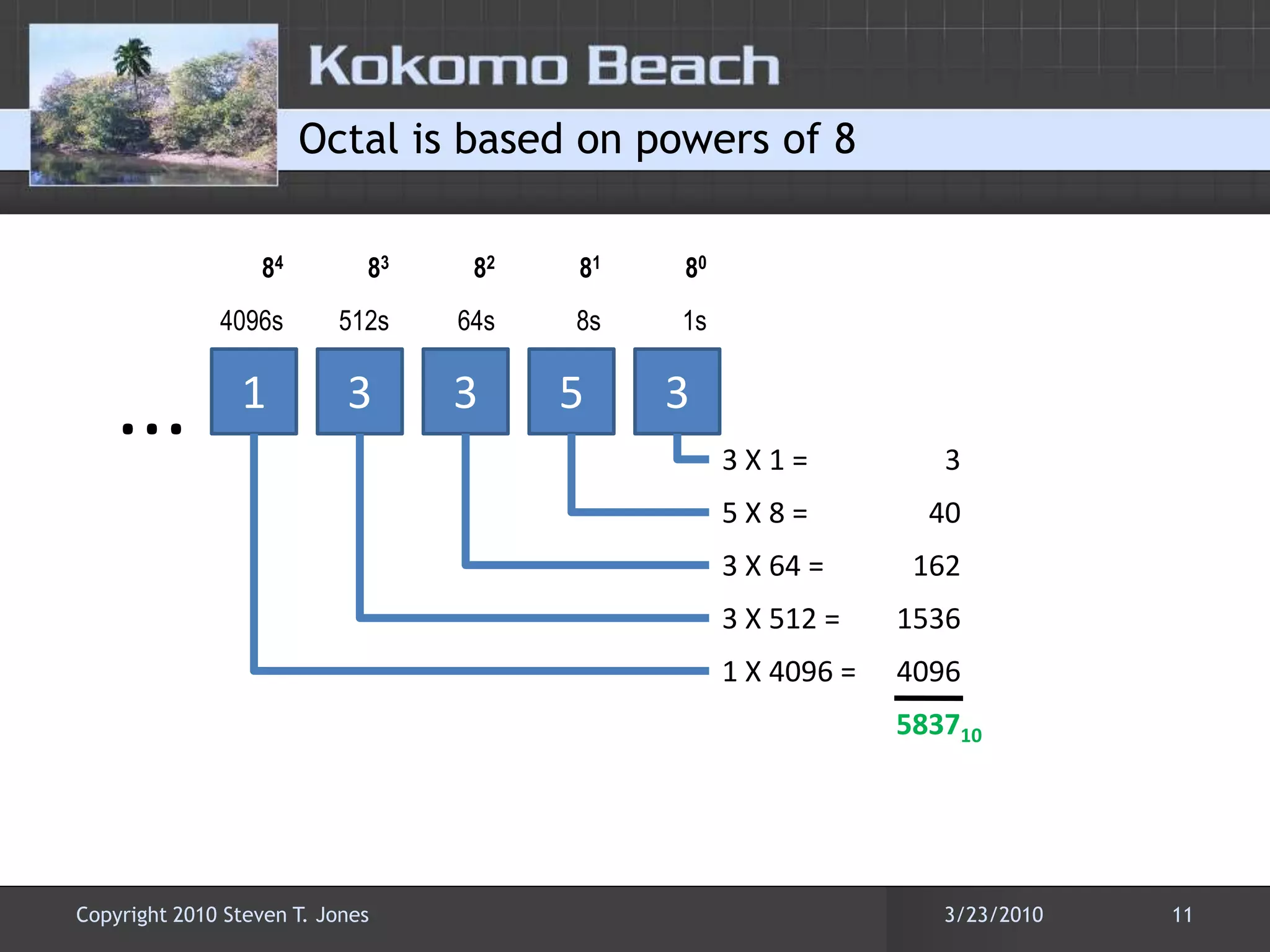
Octal is based on powers of 88382818084512s64s8s1s4096s...335313 X 1 = 35 X 8 = 403 X 64 = 1623 X 512 = 15361 X 4096 = 40965837103/22/201011Copyright 2010 Steven T. Jones
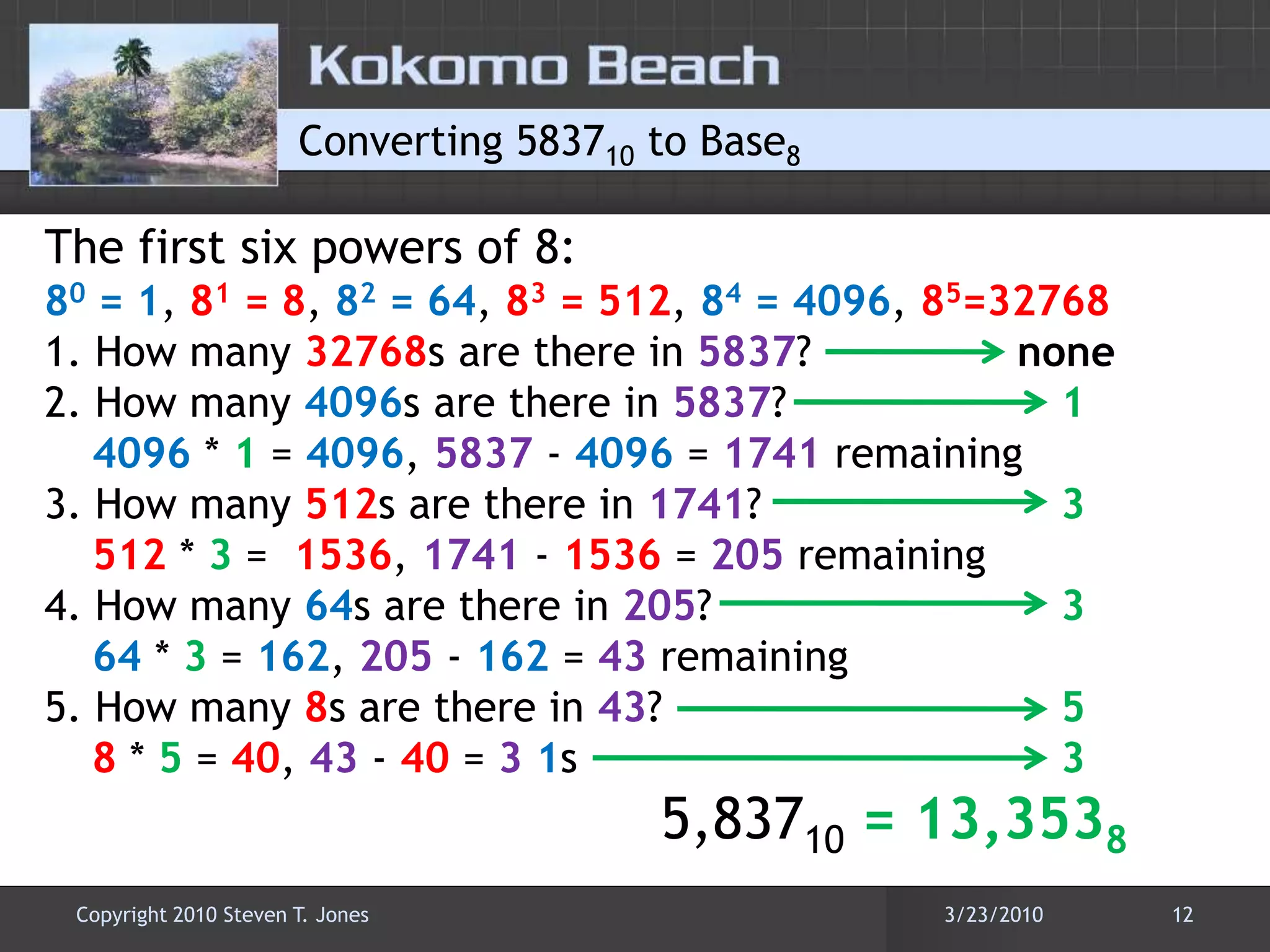
Converting 583710 to Base8The first six powers of 8:80= 1, 81= 8, 82= 64, 83= 512, 84= 4096, 85=327681. How many 32768s are there in 5837?                none2. How many 4096s are there in 5837?             	14096 * 1 = 4096, 5837 - 4096 = 1741 remaining 3. How many 512s are there in 1741?                   	3512 * 3 =  1536, 1741 - 1536 = 205 remaining 4. How many 64s are there in 205?                       	364* 3 = 162, 205 - 162 = 43 remaining 5. How many 8s are there in 43?                           	58* 5 = 40, 43 - 40 = 31s 				35,83710 = 13,35383/22/201012Copyright 2010 Steven T. Jones
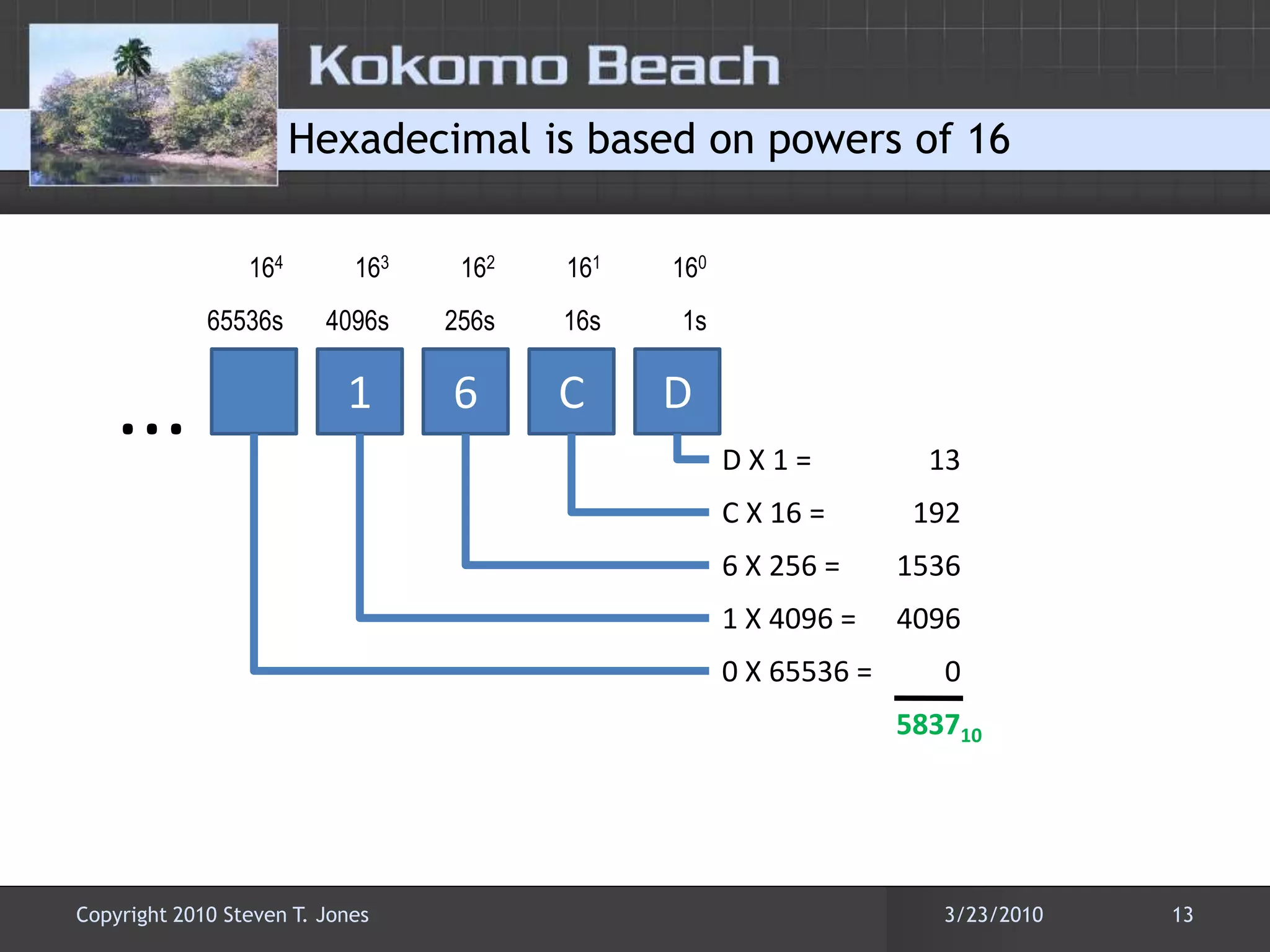
Hexadecimal is based on powers of 161631621611601644096s256s16s1s65536s...16CDD X 1 = 13C X 16 = 1926 X 256 = 15361 X 4096 = 40960 X 65536 = 05837103/22/201013Copyright 2010 Steven T. Jones
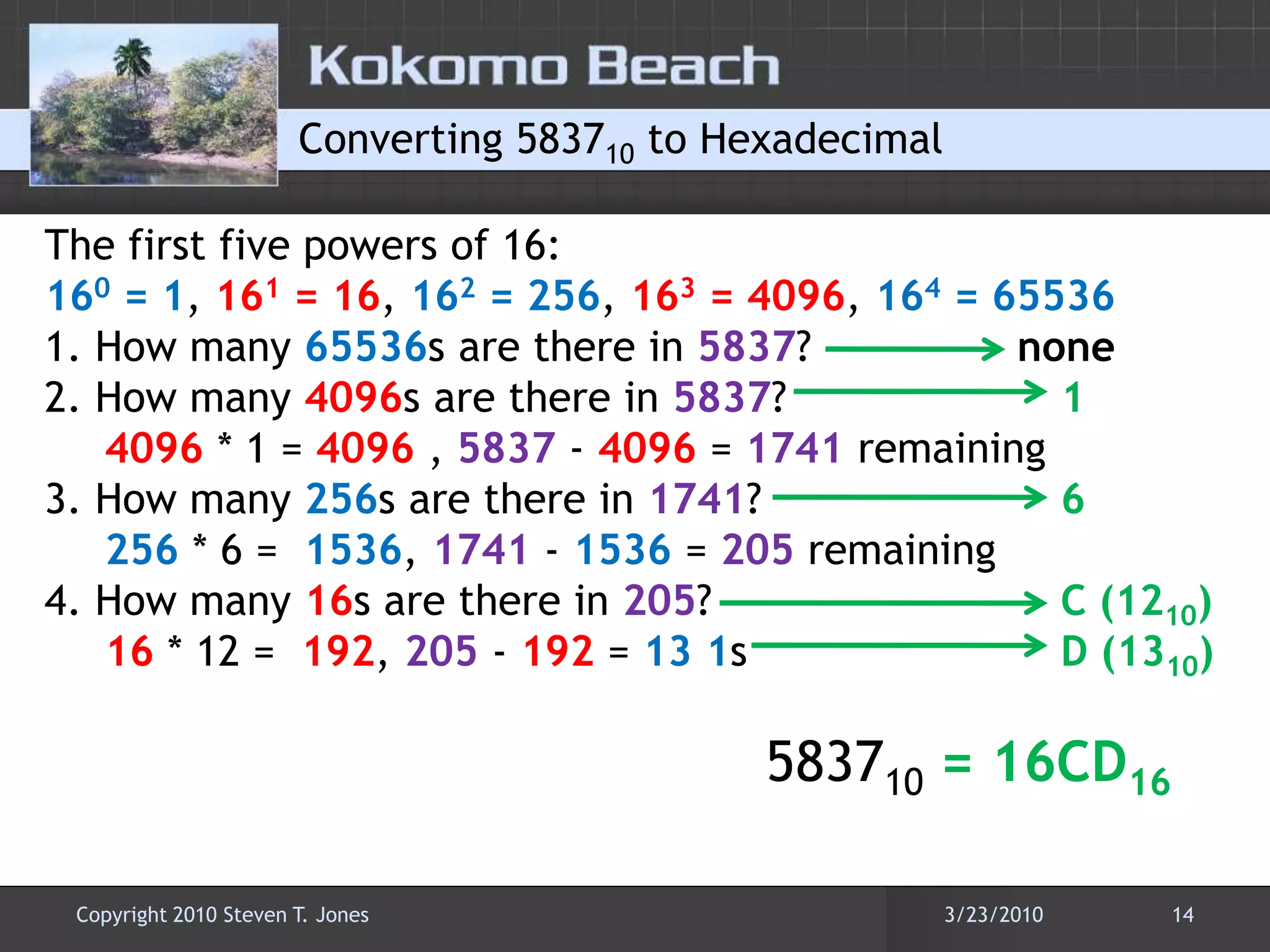
Converting 583710 to Hexadecimal The first five powers of 16:160= 1, 161= 16, 162= 256, 163= 4096, 164= 655361. How many 65536s are there in 5837?                none2. How many 4096s are there in 5837?            	1 4096 * 1 = 4096 , 5837 - 4096 = 1741 remaining 3. How many 256s are there in 1741?              	6 256 * 6 =  1536, 1741 - 1536 = 205 remaining 4. How many 16s are there in 205?                   	C (1210)16 * 12 =  192, 205 - 192 = 131s 			D (1310)						583710 = 16CD163/22/201014Copyright 2010 Steven T. Jones
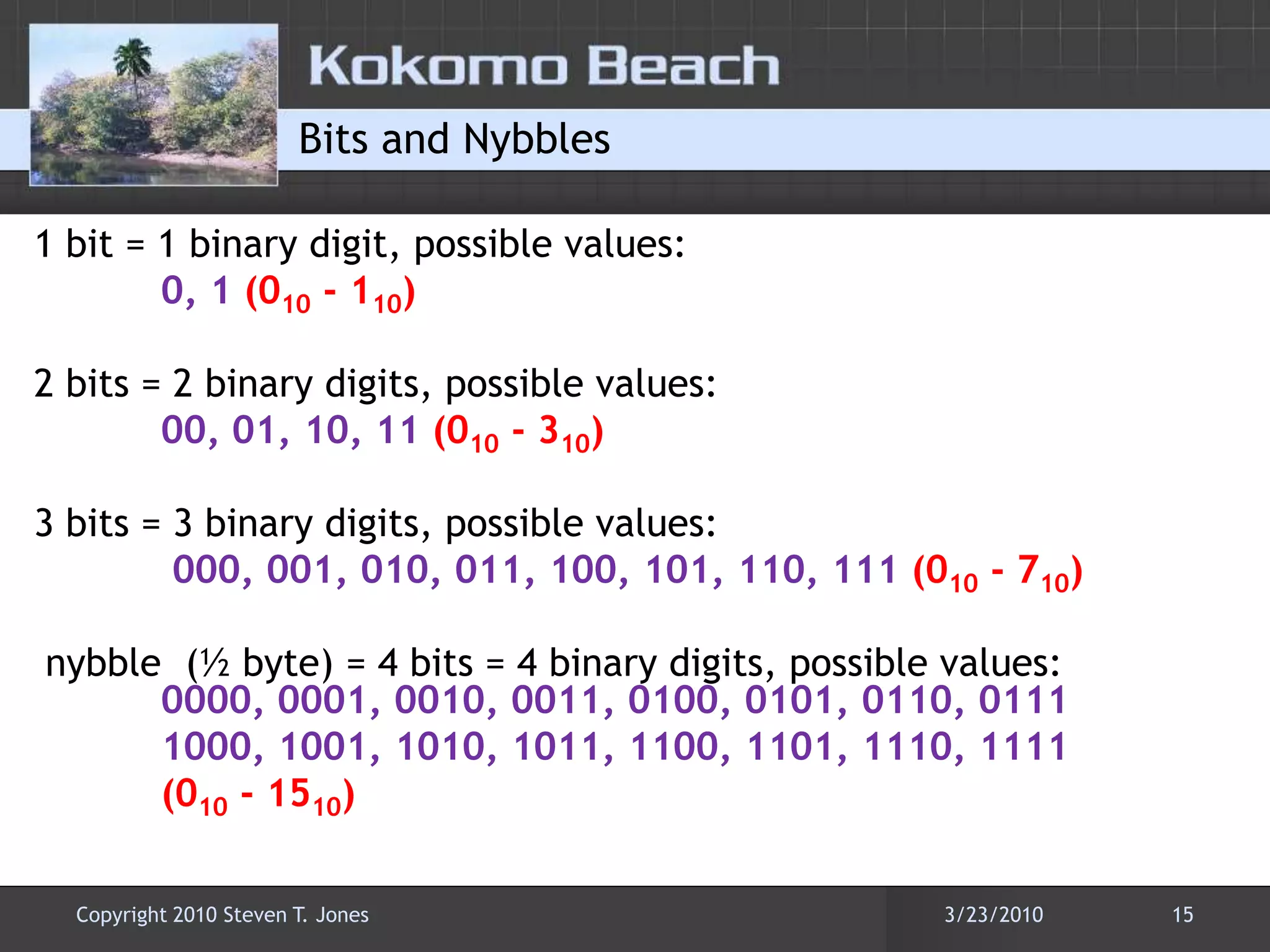
Bits and Nybbles1 bit = 1 binary digit, possible values: 0, 1 (010 - 110)2 bits = 2 binary digits, possible values:00, 01, 10, 11 (010 - 310)3 bits = 3 binary digits, possible values:000, 001, 010, 011, 100, 101, 110, 111 (010 - 710)nybble  (½ byte) = 4 bits = 4 binary digits, possible values: 	0000, 0001, 0010, 0011, 0100, 0101, 0110, 0111		1000, 1001, 1010, 1011, 1100, 1101, 1110, 1111(010 - 1510)3/22/201015Copyright 2010 Steven T. Jones
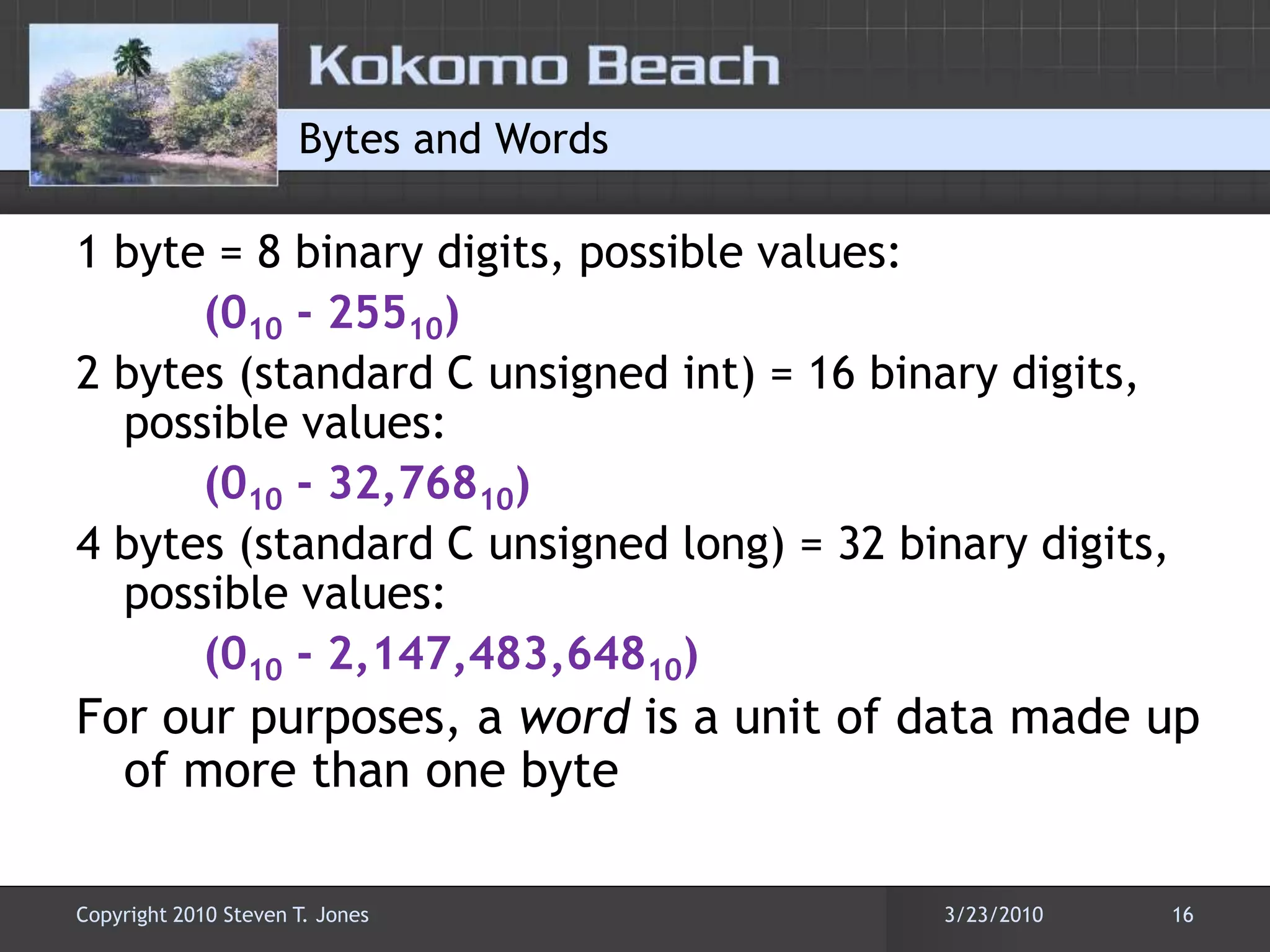
Bytes and Words1 byte = 8 binary digits, possible values: (010 - 25510)2 bytes (standard C unsigned int) = 16 binary digits, possible values:(010 - 32,76810)4 bytes (standard C unsigned long) = 32 binary digits, possible values:(010 - 2,147,483,64810)For our purposes, a word is a unit of data made up of more than one byte3/22/201016Copyright 2010 Steven T. Jones
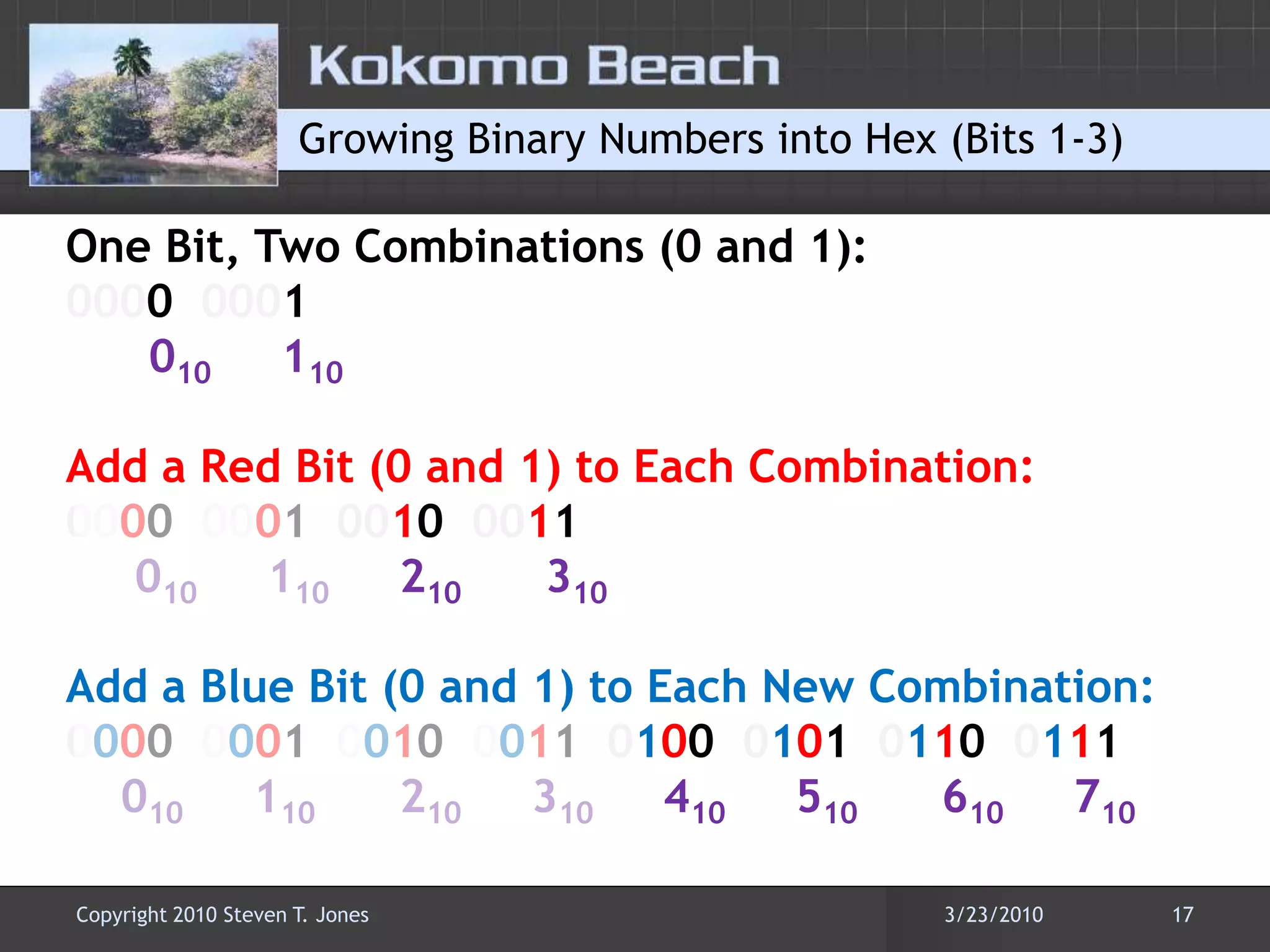
Growing Binary Numbers into Hex (Bits 1-3)One Bit, Two Combinations (0 and 1):00000001   	      010     110Add a Red Bit (0 and 1) to Each Combination:0000000100100011	     010     110     210      310Add a Blue Bit (0 and 1) to Each New Combination:0000000100100011 0100010101100111    010     110      210     310     410     510      610     7103/22/201017Copyright 2010 Steven T. Jones
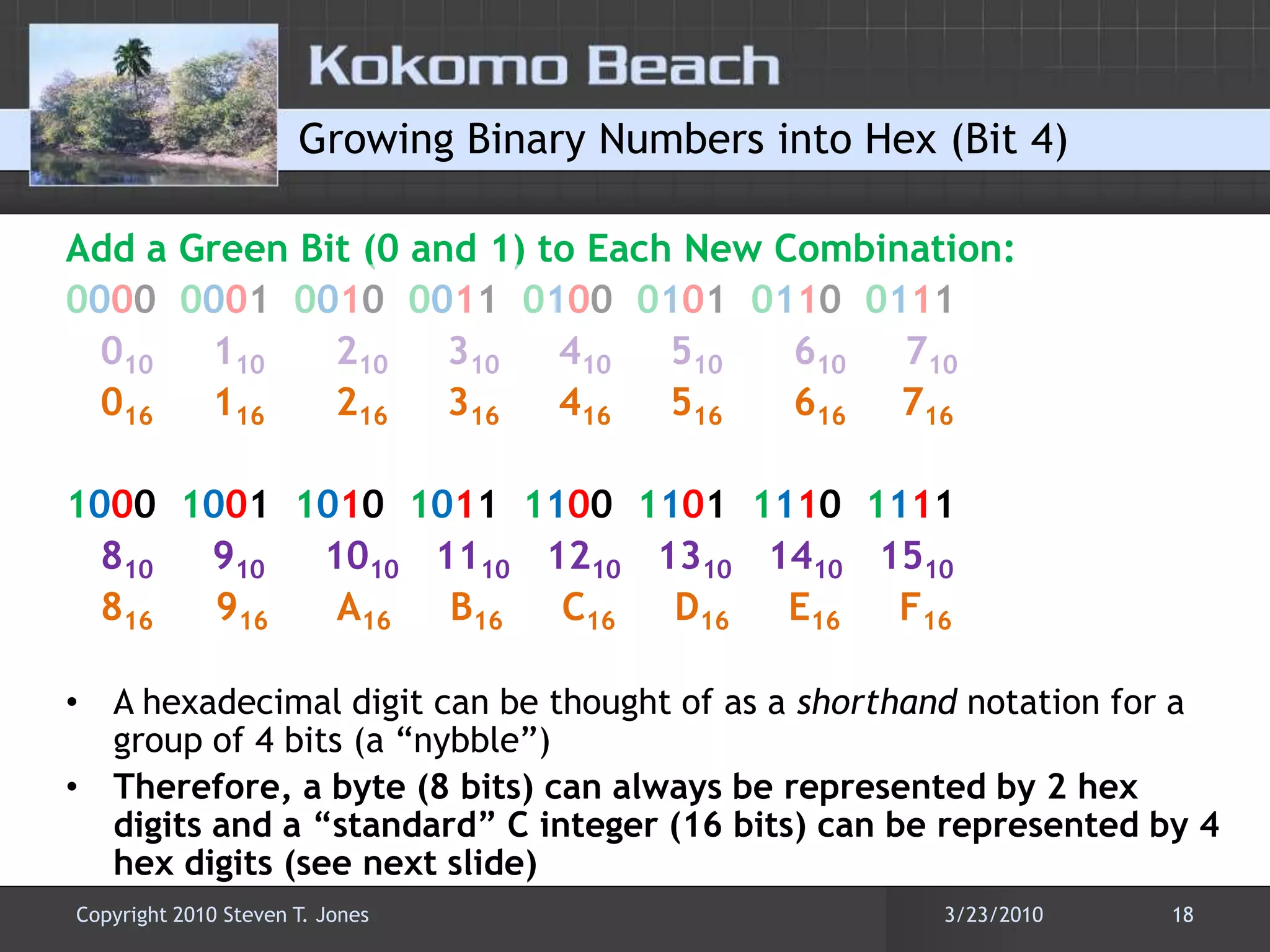
Growing Binary Numbers into Hex (Bit 4)Add a Green Bit (0 and 1) to Each New Combination:00000001001000110100010101100111   010     110      210     310     410     510      610     710   016     116      216     316     416     516      616     71610001001101010111100110111101111   810     910     1010   1110   1210   1310   1410   1510   816        916      A16     B16     C16     D16     E16     F16A hexadecimal digit can be thought of as a shorthand notation for a group of 4 bits (a “nybble”)Therefore, a byte (8 bits) can always be represented by 2 hex digits and a “standard” C integer (16 bits) can be represented by 4 hex digits (see next slide)3/22/201018Copyright 2010 Steven T. Jones
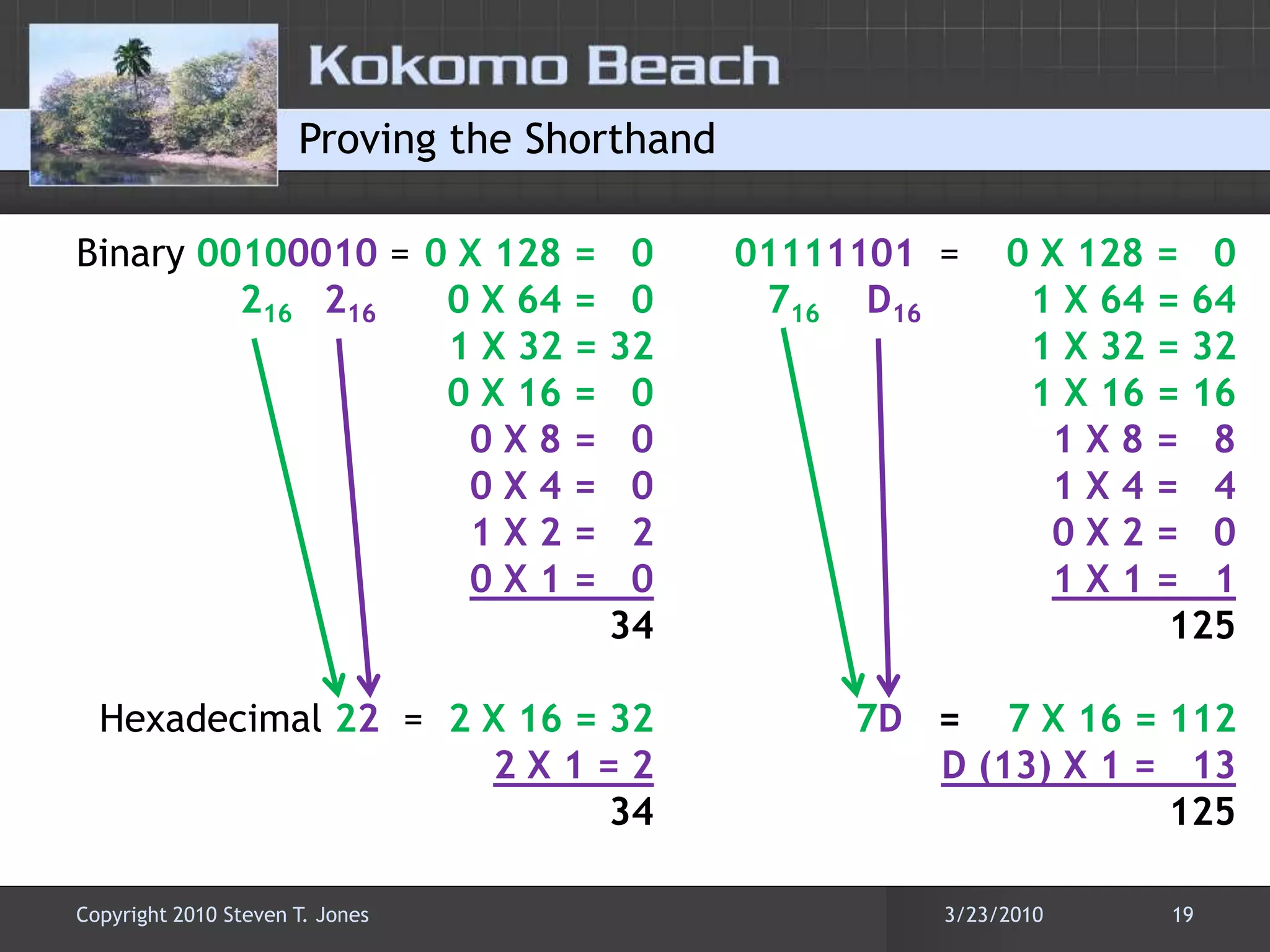
Proving the ShorthandBinary 00100010 = 	216216  Hexadecimal 22  =0 X 128 =   0	0 X 64 =   01 X 32 = 32	0 X 16 =   00 X 8 =   0	0 X 4 =   0	1 X 2 =   20 X 1 =   0342 X 16 = 322 X 1 = 23401111101=    0 X 128 =   0716D16              1 X 64 = 641 X 32 = 32	1 X 16 = 161 X 8 =   8	1 X 4 =   4	0 X 2 =   01 X 1 =   1125     7D   =    7 X 16 = 112D (13) X 1 =   131253/22/201019Copyright 2010 Steven T. Jones
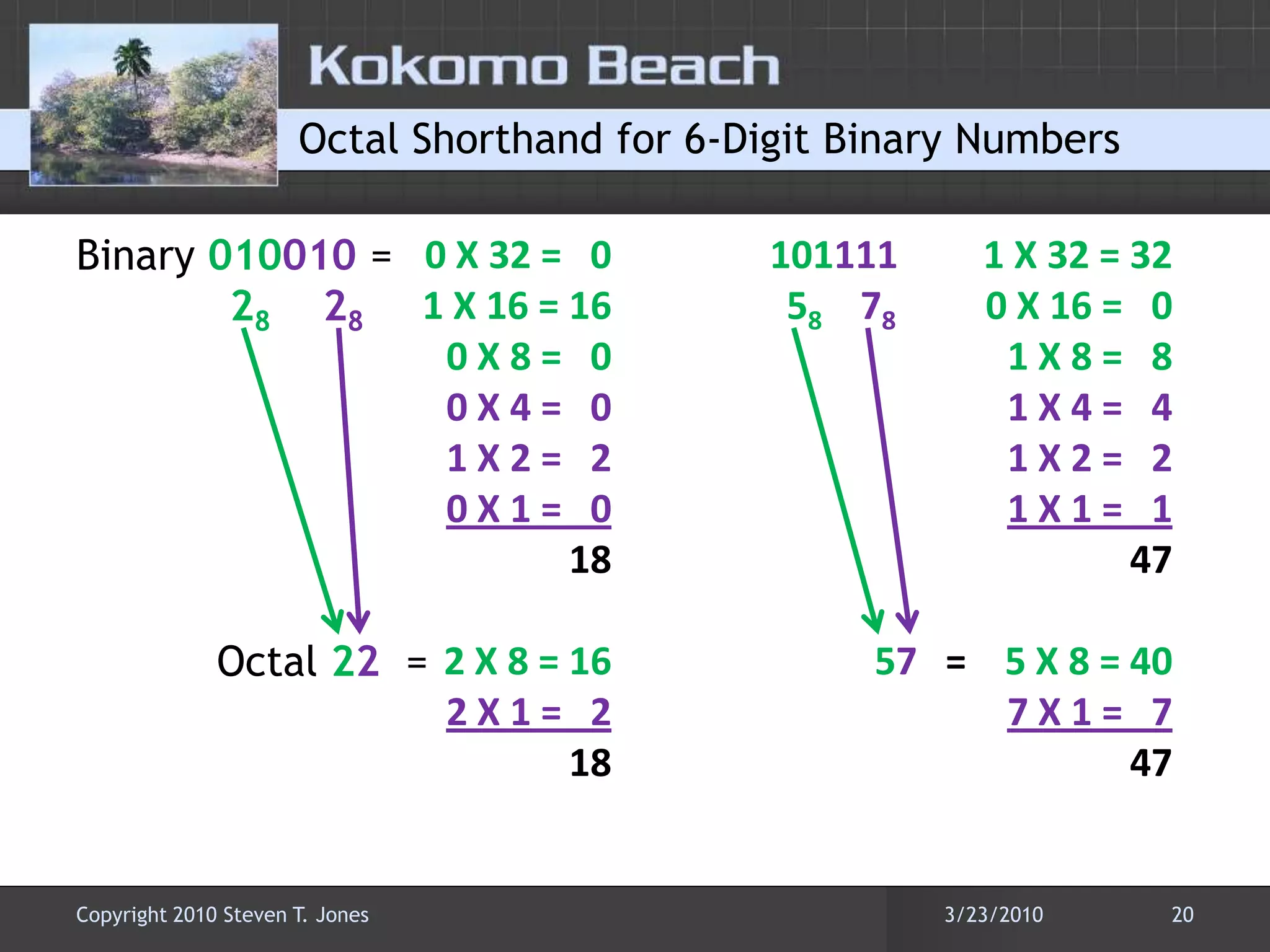
Octal Shorthand for 6-Digit Binary NumbersBinary 010010 = 	2828           Octal 22  =0X 32 =   01 X 16 = 160 X 8 =   0	0 X 4 =   0	1 X 2 =   20 X 1 =   0182 X 8 = 162 X 1 =   218101111         1 X 32 = 325878              0 X 16 =   01 X 8 =   81 X 4 =   4		1 X 2 =   21 X 1 =   14757=    5 X 8 = 407 X 1 =   7473/22/201020Copyright 2010 Steven T. Jones
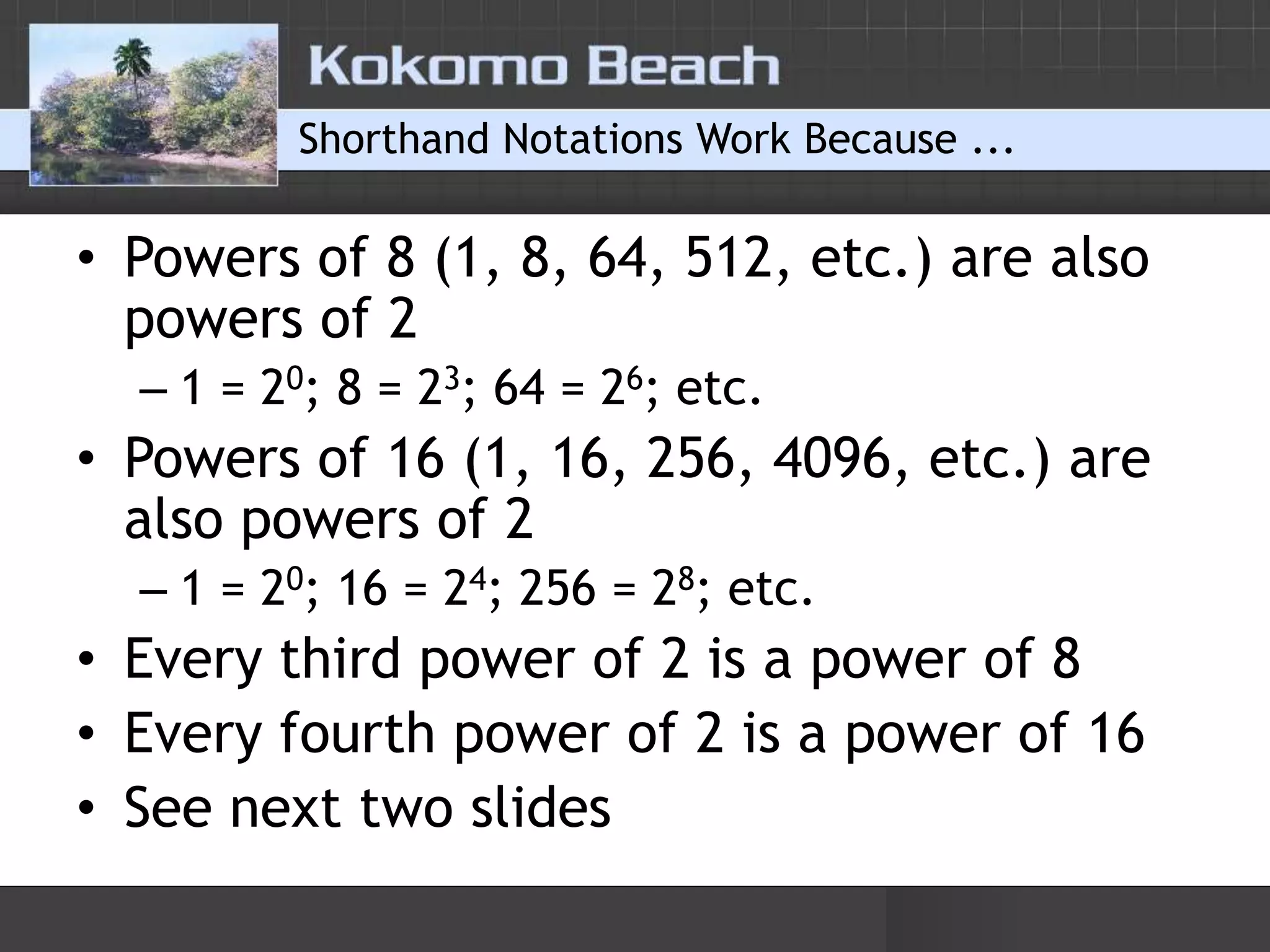
Shorthand Notations Work Because ...Powers of 8 (1, 8, 64, 512, etc.) are also powers of 21 = 20; 8 = 23; 64 = 26; etc.Powers of 16 (1, 16, 256, 4096, etc.) are also powers of 21 = 20; 16 = 24; 256 = 28; etc.Every third power of 2 is a power of 8Every fourth power of 2 is a power of 16See next two slides
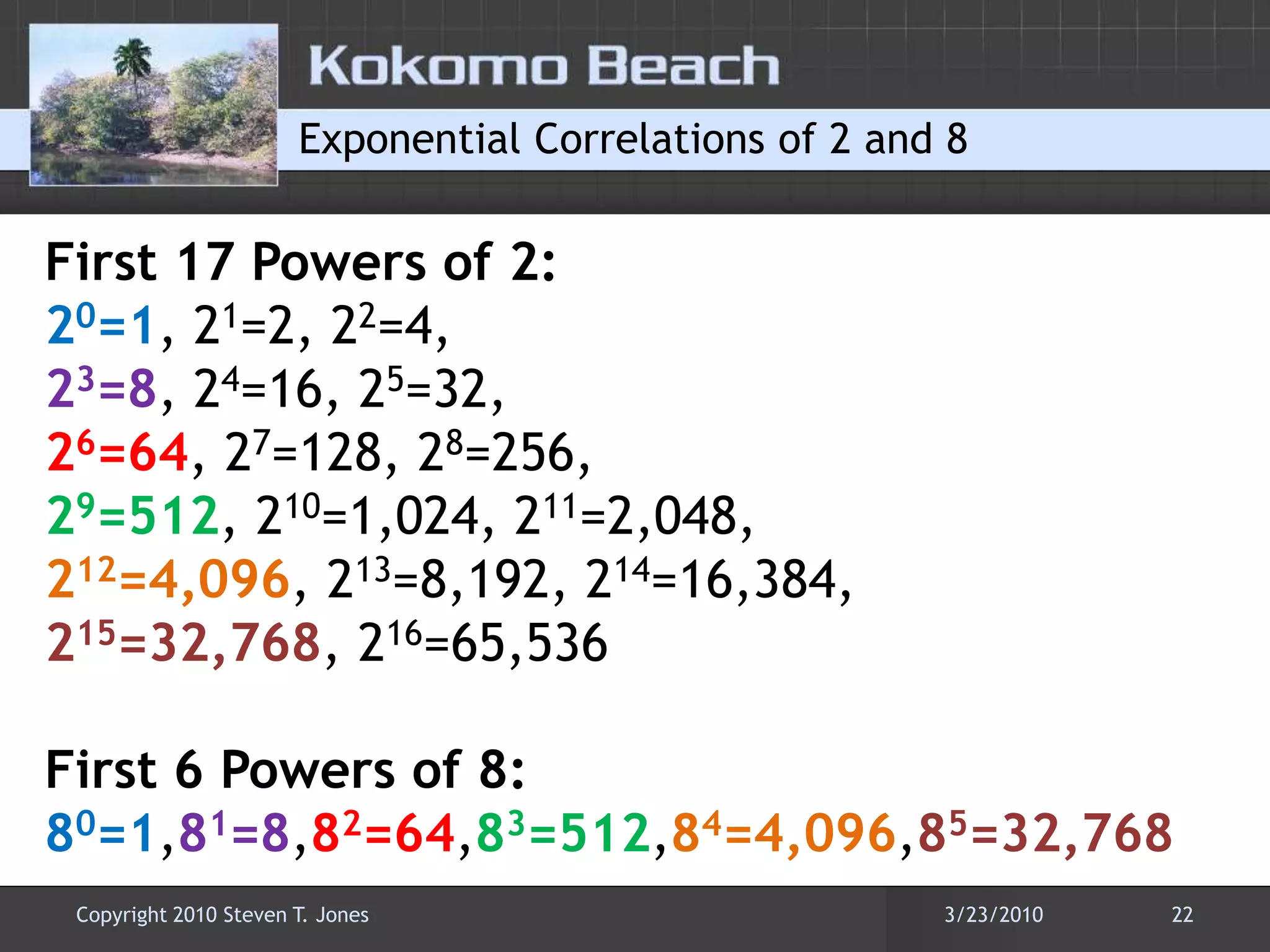
Exponential Correlations of 2 and 8First 17 Powers of 2:20=1, 21=2, 22=4, 23=8, 24=16, 25=32, 26=64, 27=128, 28=256, 29=512, 210=1,024, 211=2,048, 212=4,096, 213=8,192, 214=16,384, 215=32,768, 216=65,536First 6 Powers of 8:80=1,81=8,82=64,83=512,84=4,096,85=32,7683/22/201022Copyright 2010 Steven T. Jones
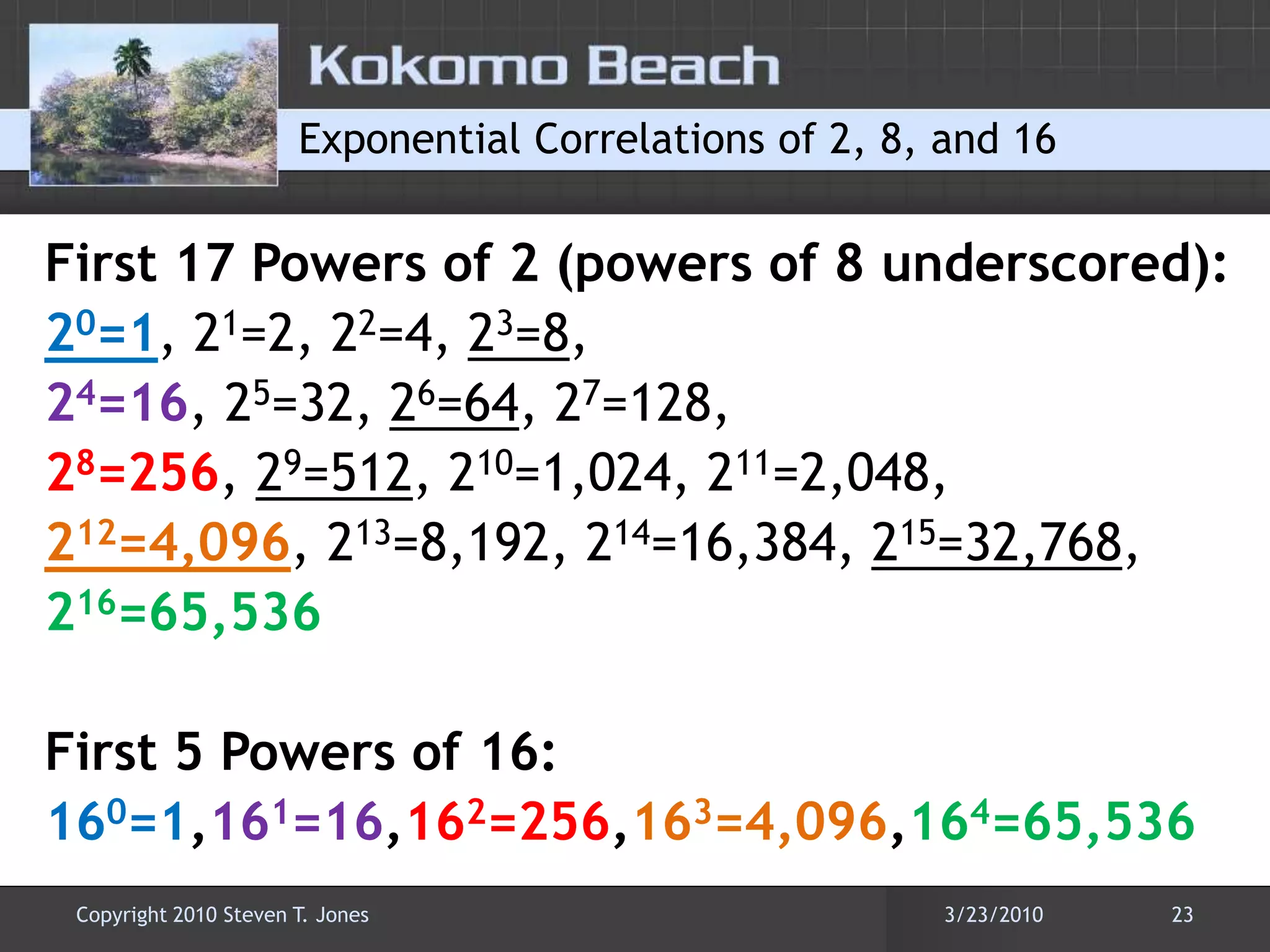
Exponential Correlations of 2, 8, and 16First 17 Powers of 2 (powers of 8 underscored):20=1, 21=2, 22=4, 23=8, 24=16, 25=32, 26=64, 27=128,28=256, 29=512, 210=1,024, 211=2,048, 212=4,096, 213=8,192, 214=16,384, 215=32,768, 216=65,536First 5 Powers of 16:160=1,161=16,162=256,163=4,096,164=65,5363/22/201023Copyright 2010 Steven T. Jones
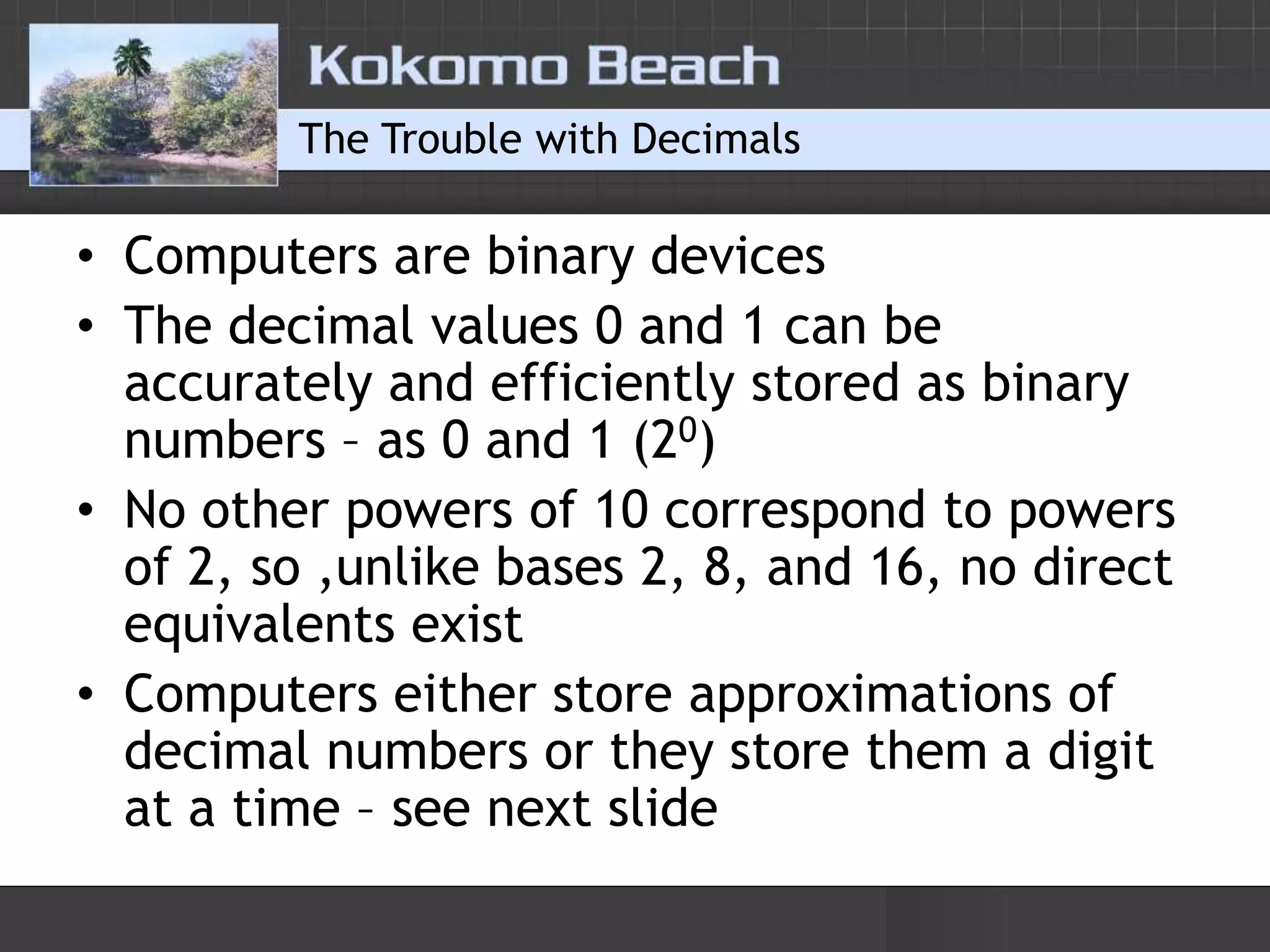
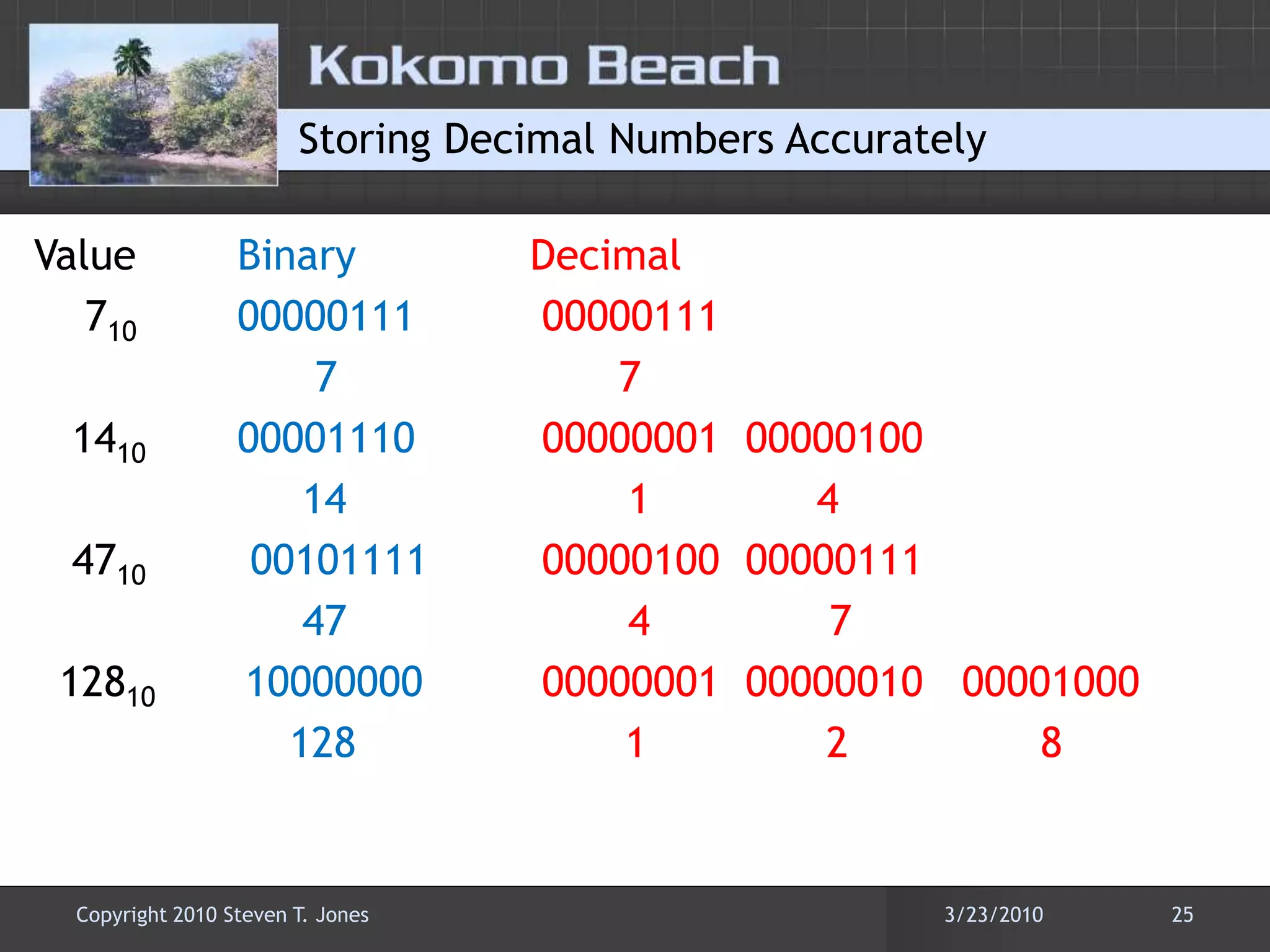
The Trouble with DecimalsComputers are binary devicesThe decimal values 0 and 1 can be accurately and efficiently stored as binary numbers – as 0 and 1 (20)No other powers of 10 correspond to powers of 2, so ,unlike bases 2, 8, and 16, no direct equivalents existComputers either store approximations of decimal numbers or they store them a digit at a time – see next slide
Storing Decimal Numbers AccuratelyValue	      BinaryDecimal    71000000111000001117  7   14100000111000000001000001001414   471000101111000001000000011147 4 7  12810100000000000000100000010000010001281283/22/201025Copyright 2010 Steven T. Jones
http://www.kokomobeach.com

Number Base Basics

  • 1.
    Number Base ConversionsStevenT. Jones3/22/20101Copyright 2010 Steven T. Jones
  • 2.
    General RulesThe numberbase corresponds to the number of digits availableDigits are positional, with each position representing a power of the base (more later)Base 10 (decimal) has ten digits (0, 1, 2, 3, 4, 5, 6, 7, 8, 9)Base 2 (binary) has two digits (0, 1)Base 8 (octal) has eight digits (0, 1, 2, 3, 4, 5, 6, 7)Base 6 (hexal – included only as an example) has six digits (0, 1, 2, 3, 4, 5)
  • 3.
    General RulesBase 16(hexadecimal) has sixteen digits (0, 1, 2, 3, 4, 5, 6, 7, 8, 9, A, B, C, D, E, F)Note that the “letters” are actually digits in base 16A16 = 1010, B16 = 1110 ... F16 = 1510Why those particular “letters”? Because people familiar with the English alphabet understand that “A” comes before “B”, i.e. “A” < “B”
  • 4.
    General RulesAll numberbases begin with 0The largest digit in each base is one less than the baseThe largest digit in base 10 is 9The largest digit in base 2 is 17 in base 8; F (=1510) in base 16; 5 in base 6This means the base number is always represented by the digits “1” and “0”: 10102 = 210; 108 = 810; 1016 = 1610; 106 = 610See examples of counting, next slide
  • 5.
    The significance of“10”Counting in base 20 (= 010)0 + 1 = 1 (= 110) 1 + 1 = 10 (= 210)Counting in base 80 (= 010)0 + 1 = 1 (= 110)1 + 1 = 2 (= 210)2 + 1 = 3 (= 310)3 + 1 = 4 (= 410)4 + 1 = 5 (= 510)5 + 1 = 6 (= 610)6 + 1 = 7 (= 710)7 + 1 = 10 (= 810)Counting in base 1000 + 1 =11 + 1 = 22 + 1 = 33 + 1 = 44 + 1 = 55 + 1 = 66 + 1 = 77 + 1 = 88 + 1 = 99 + 1 = 10
  • 6.
    Decimal is basedon powers of 101031021011001041000s100s10s1s10000s...58377 X 1 = 73 X 10 = 308 X 100 = 8005 X 1000 = 50000 X 10000 = 0583710(duh)3/22/20106Copyright 2010 Steven T. Jones
  • 7.
    Just for Fun:Hexal is based on powers of 66362616064216s36s6s1s1296s...300545 X 1 = 50 X 6 = 00 X 36 = 03 X 216 = 6484 X 1296 = 51845837103/22/20107Copyright 2010 Steven T. Jones
  • 8.
    Converting 583710 toHexalThe first six powers of 6:60 = 1, 61 = 6, 62 = 36, 63 = 216, 64 = 1296, 65=77761. How many 7776s are there in 5837? none2. How many 1296s are there in 5837? 41296 * 4 = 5184, 5837 - 5184 = 653 remaining 3. How many 216s are there in 653? 3216 * 3 = 648, 653 - 648 = 5 remaining 4. How many 36s are there in 5? 05. How many 6s are there in 5? 06. Leaving 51s 5 583710 = 43,00563/22/20108Copyright 2010 Steven T. Jones
  • 9.
    Binary is basedon powers of 223222120248s4s2s1s16s...100111 X 1 = 10 X 2 = 00 X 4 = 01 X 8 = 81 X 16 = 1625103/22/20109Copyright 2010 Steven T. Jones
  • 10.
    Converting 2510 toBinaryThe first six powers of 2:20= 1, 21= 2, 22= 4, 23= 8, 24= 16, 25=321. How many 32s are there in 25? none2. How many 16s are there in 25? 116 * 1 = 16, 25 - 16 = 9 remaining 3. How many 8s are there in 9? 18 * 1 = 8, 9 - 8 = 1 remaining 4. How many 4s are there in 1? 05. How many 2s are there in 1? 06. Leaving 111 2510 = 1100123/22/201010Copyright 2010 Steven T. Jones
  • 11.
    Octal is basedon powers of 88382818084512s64s8s1s4096s...335313 X 1 = 35 X 8 = 403 X 64 = 1623 X 512 = 15361 X 4096 = 40965837103/22/201011Copyright 2010 Steven T. Jones
  • 12.
    Converting 583710 toBase8The first six powers of 8:80= 1, 81= 8, 82= 64, 83= 512, 84= 4096, 85=327681. How many 32768s are there in 5837? none2. How many 4096s are there in 5837? 14096 * 1 = 4096, 5837 - 4096 = 1741 remaining 3. How many 512s are there in 1741? 3512 * 3 = 1536, 1741 - 1536 = 205 remaining 4. How many 64s are there in 205? 364* 3 = 162, 205 - 162 = 43 remaining 5. How many 8s are there in 43? 58* 5 = 40, 43 - 40 = 31s 35,83710 = 13,35383/22/201012Copyright 2010 Steven T. Jones
  • 13.
    Hexadecimal is basedon powers of 161631621611601644096s256s16s1s65536s...16CDD X 1 = 13C X 16 = 1926 X 256 = 15361 X 4096 = 40960 X 65536 = 05837103/22/201013Copyright 2010 Steven T. Jones
  • 14.
    Converting 583710 toHexadecimal The first five powers of 16:160= 1, 161= 16, 162= 256, 163= 4096, 164= 655361. How many 65536s are there in 5837? none2. How many 4096s are there in 5837? 1 4096 * 1 = 4096 , 5837 - 4096 = 1741 remaining 3. How many 256s are there in 1741? 6 256 * 6 = 1536, 1741 - 1536 = 205 remaining 4. How many 16s are there in 205? C (1210)16 * 12 = 192, 205 - 192 = 131s D (1310) 583710 = 16CD163/22/201014Copyright 2010 Steven T. Jones
  • 15.
    Bits and Nybbles1bit = 1 binary digit, possible values: 0, 1 (010 - 110)2 bits = 2 binary digits, possible values:00, 01, 10, 11 (010 - 310)3 bits = 3 binary digits, possible values:000, 001, 010, 011, 100, 101, 110, 111 (010 - 710)nybble (½ byte) = 4 bits = 4 binary digits, possible values: 0000, 0001, 0010, 0011, 0100, 0101, 0110, 0111 1000, 1001, 1010, 1011, 1100, 1101, 1110, 1111(010 - 1510)3/22/201015Copyright 2010 Steven T. Jones
  • 16.
    Bytes and Words1byte = 8 binary digits, possible values: (010 - 25510)2 bytes (standard C unsigned int) = 16 binary digits, possible values:(010 - 32,76810)4 bytes (standard C unsigned long) = 32 binary digits, possible values:(010 - 2,147,483,64810)For our purposes, a word is a unit of data made up of more than one byte3/22/201016Copyright 2010 Steven T. Jones
  • 17.
    Growing Binary Numbersinto Hex (Bits 1-3)One Bit, Two Combinations (0 and 1):00000001 010 110Add a Red Bit (0 and 1) to Each Combination:0000000100100011 010 110 210 310Add a Blue Bit (0 and 1) to Each New Combination:0000000100100011 0100010101100111 010 110 210 310 410 510 610 7103/22/201017Copyright 2010 Steven T. Jones
  • 18.
    Growing Binary Numbersinto Hex (Bit 4)Add a Green Bit (0 and 1) to Each New Combination:00000001001000110100010101100111 010 110 210 310 410 510 610 710 016 116 216 316 416 516 616 71610001001101010111100110111101111 810 910 1010 1110 1210 1310 1410 1510 816 916 A16 B16 C16 D16 E16 F16A hexadecimal digit can be thought of as a shorthand notation for a group of 4 bits (a “nybble”)Therefore, a byte (8 bits) can always be represented by 2 hex digits and a “standard” C integer (16 bits) can be represented by 4 hex digits (see next slide)3/22/201018Copyright 2010 Steven T. Jones
  • 19.
    Proving the ShorthandBinary00100010 = 216216 Hexadecimal 22 =0 X 128 = 0 0 X 64 = 01 X 32 = 32 0 X 16 = 00 X 8 = 0 0 X 4 = 0 1 X 2 = 20 X 1 = 0342 X 16 = 322 X 1 = 23401111101= 0 X 128 = 0716D16 1 X 64 = 641 X 32 = 32 1 X 16 = 161 X 8 = 8 1 X 4 = 4 0 X 2 = 01 X 1 = 1125 7D = 7 X 16 = 112D (13) X 1 = 131253/22/201019Copyright 2010 Steven T. Jones
  • 20.
    Octal Shorthand for6-Digit Binary NumbersBinary 010010 = 2828 Octal 22 =0X 32 = 01 X 16 = 160 X 8 = 0 0 X 4 = 0 1 X 2 = 20 X 1 = 0182 X 8 = 162 X 1 = 218101111 1 X 32 = 325878 0 X 16 = 01 X 8 = 81 X 4 = 4 1 X 2 = 21 X 1 = 14757= 5 X 8 = 407 X 1 = 7473/22/201020Copyright 2010 Steven T. Jones
  • 21.
    Shorthand Notations WorkBecause ...Powers of 8 (1, 8, 64, 512, etc.) are also powers of 21 = 20; 8 = 23; 64 = 26; etc.Powers of 16 (1, 16, 256, 4096, etc.) are also powers of 21 = 20; 16 = 24; 256 = 28; etc.Every third power of 2 is a power of 8Every fourth power of 2 is a power of 16See next two slides
  • 22.
    Exponential Correlations of2 and 8First 17 Powers of 2:20=1, 21=2, 22=4, 23=8, 24=16, 25=32, 26=64, 27=128, 28=256, 29=512, 210=1,024, 211=2,048, 212=4,096, 213=8,192, 214=16,384, 215=32,768, 216=65,536First 6 Powers of 8:80=1,81=8,82=64,83=512,84=4,096,85=32,7683/22/201022Copyright 2010 Steven T. Jones
  • 23.
    Exponential Correlations of2, 8, and 16First 17 Powers of 2 (powers of 8 underscored):20=1, 21=2, 22=4, 23=8, 24=16, 25=32, 26=64, 27=128,28=256, 29=512, 210=1,024, 211=2,048, 212=4,096, 213=8,192, 214=16,384, 215=32,768, 216=65,536First 5 Powers of 16:160=1,161=16,162=256,163=4,096,164=65,5363/22/201023Copyright 2010 Steven T. Jones
  • 24.
    The Trouble withDecimalsComputers are binary devicesThe decimal values 0 and 1 can be accurately and efficiently stored as binary numbers – as 0 and 1 (20)No other powers of 10 correspond to powers of 2, so ,unlike bases 2, 8, and 16, no direct equivalents existComputers either store approximations of decimal numbers or they store them a digit at a time – see next slide
  • 25.
    Storing Decimal NumbersAccuratelyValue BinaryDecimal 71000000111000001117 7 14100000111000000001000001001414 471000101111000001000000011147 4 7 12810100000000000000100000010000010001281283/22/201025Copyright 2010 Steven T. Jones
  • 26.