
Building Envelopes
and Thermal Mass Walls
Presented by:

Andy Turner
VP Sales and Marketing
Nuform Building Technologies Inc
Leed AP
History of Nuform
Building Technologies
Founded in 1992

 Royal Building Systems Technologies, LTD
Provides the world with leading edge
building systems and technologies
2007-Royal Building SystemsTechnologies
became Nuform Building Technologies
New Names-Same Great Products
Introduction
 Design, Engineering and
Specification Assistance
 Constructability Assistance
 Budgeting Assistance
 Sample Assistance
 Systems Testing
 LEED Analysis
 Thermal Analyses
 Construction
Comparisons
Introduction
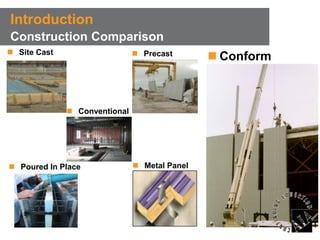
Construction Comparison
 Site Cast

 Precast

 Conventional

 Poured In Place

 Metal Panel

 Conform
AIA / CES Program Purpose
 This program is registered with the

AIA/CES for continuing professional
education.
 As such, it does not include content

deemed or construed to be an
approval or endorsement by the AIA of
any material of construction or any
method or manner of handling, using,
distributing, or dealing in any material
or product.
 Questions related to specific materials,

methods, and services will be
addressed at the conclusion of this
presentation.
Learning Objectives
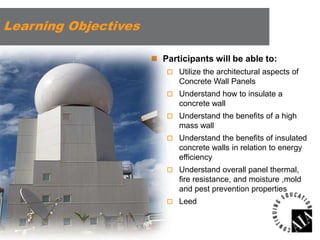
 Participants will be able to:
 Utilize the architectural aspects of

Concrete Wall Panels
 Understand how to insulate a

concrete wall
 Understand the benefits of a high

mass wall
 Understand the benefits of insulated

concrete walls in relation to energy
efficiency
 Understand overall panel thermal,

fire resistance, and moisture ,mold
and pest prevention properties
 Leed
Program Agenda
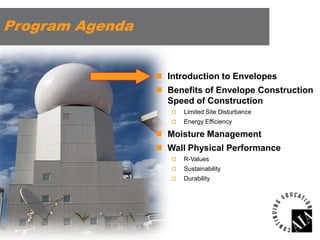
 Introduction to Envelopes
 Benefits of Envelope Construction
Speed of Construction


Limited Site Disturbance



Energy Efficiency

 Moisture Management
 Wall Physical Performance


R-Values



Sustainability



Durability
Introduction

Owner Benefits
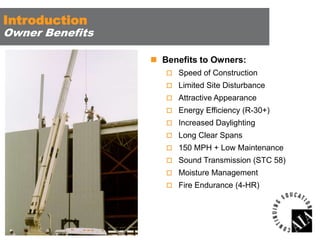
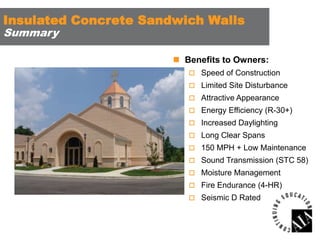
 Benefits to Owners:
 Speed of Construction
 Limited Site Disturbance
 Attractive Appearance
 Energy Efficiency (R-30+)
 Increased Daylighting
 Long Clear Spans

 150 MPH + Low Maintenance
 Sound Transmission (STC 58)
 Moisture Management
 Fire Endurance (4-HR)
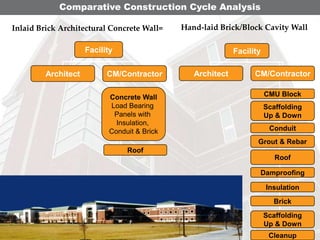
Comparative Construction Cycle Analysis
Inlaid Brick Architectural Concrete Wall=

Hand-laid Brick/Block Cavity Wall

Facility
Architect

Facility

CM/Contractor
Concrete Wall
Load Bearing
Panels with
Insulation,
Conduit & Brick

Architect

CM/Contractor
CMU Block
Scaffolding
Up & Down
Conduit
Grout & Rebar

Roof
Roof
Damproofing
Insulation
Brick
Scaffolding
Up & Down
Cleanup
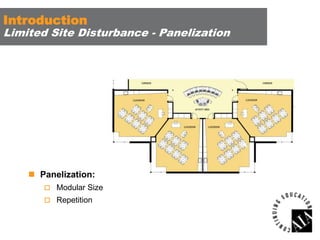
Introduction

Limited Site Disturbance - Panelization

 Panelization:
 Modular Size

 Repetition
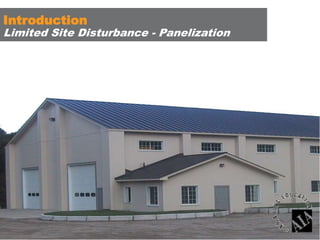
Introduction

Limited Site Disturbance - Panelization
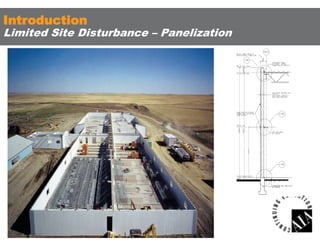
Introduction

Limited Site Disturbance – Panelization
Introduction

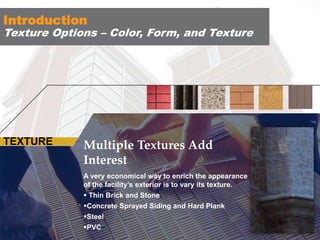
Texture Options – Color, Form, and Texture

TEXTURE

Multiple Textures
Add Interest
Multiple Textures Add
A very economical way to enrich
Interest

the appearance of your school’s
A very economical way to enrich its appearance
precast exterior is to vary the
of the facility’s exterior is to vary its texture.
texture.
 Thin Brick and Stone

 Sandblasting
Concrete Sprayed Siding and Hard Plank
Steel
 Acid Etching
PVC

 Retarding (Exposed Aggregate)
Introduction
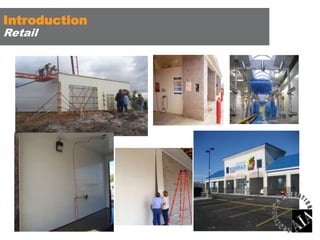
Retail
Introduction
Retail

Nordstrom
Irvine, CA
Introduction
Retail
Introduction
Retail
Introduction

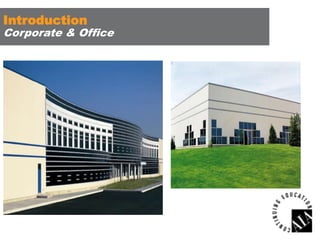
Corporate & Office
Introduction
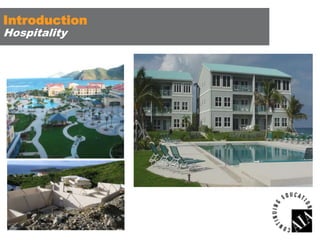
Hospitality
Introduction
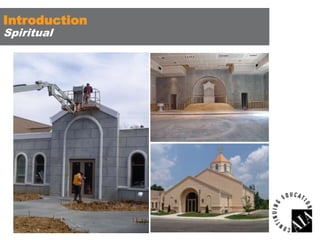
Spiritual
Introduction
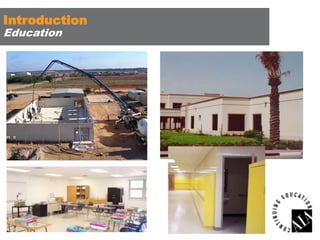
Education
Introduction
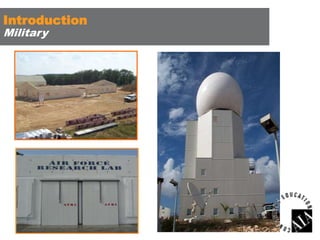
Military
Introduction
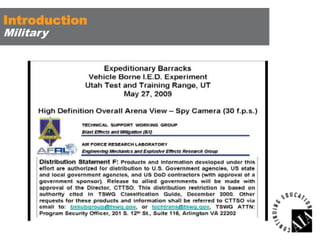
Military
Introduction
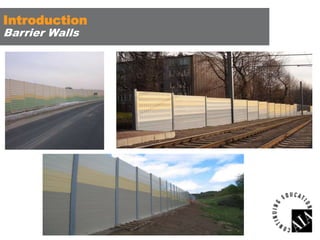
Barrier Walls
Introduction
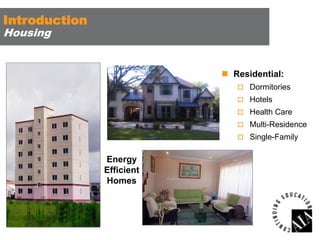
Housing

 Residential:
 Dormitories
 Hotels
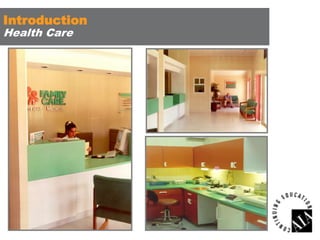
 Health Care
 Multi-Residence

 Single-Family

Energy
Efficient
Homes
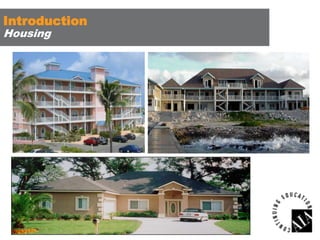
Introduction
Housing
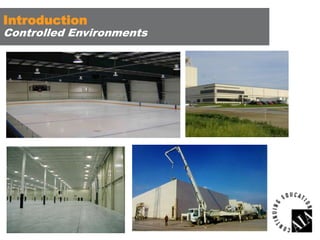
Introduction

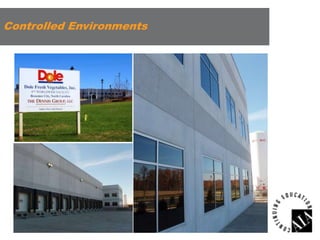
Controlled Environments
Introduction
Health Care
Introduction
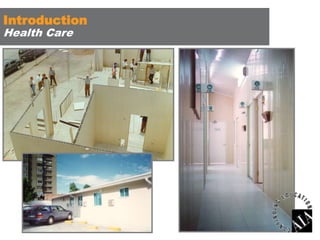
Health Care

Cook County Hospital
Chicago, IL
Introduction

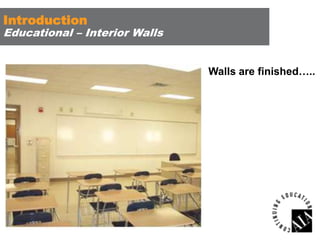
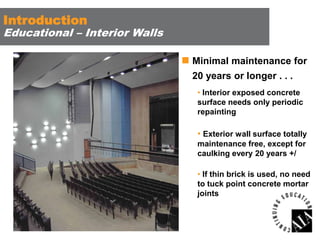
Educational – Interior Walls
Walls are finished…..
Introduction

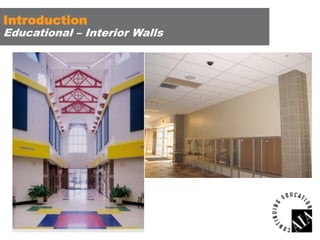
Educational – Interior Walls
Introduction

Educational – Interior Walls
 Minimal maintenance for
20 years or longer . . .
• Interior exposed concrete
surface needs only periodic
repainting

• Exterior wall surface totally
maintenance free, except for
caulking every 20 years +/
• If thin brick is used, no need
to tuck point concrete mortar
joints
Types of Concrete Wall Panels
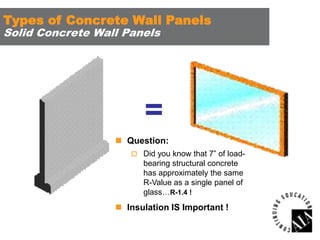
Solid Concrete Wall Panels

=
 Question:
 Did you know that 7” of load-

bearing structural concrete
has approximately the same
R-Value as a single panel of
glass…R-1.4 !

 Insulation IS Important !
Types of Concrete Wall Panels
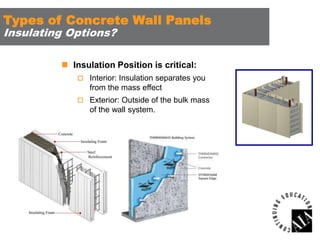
Insulating Options?

 Insulation Position is critical:
 Interior: Insulation separates you

from the mass effect
 Exterior: Outside of the bulk mass

of the wall system.
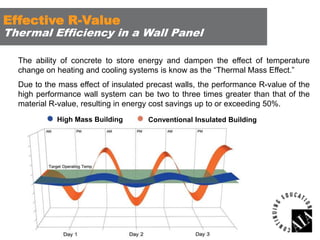
Effective R-Value

Thermal Efficiency in a Wall Panel
The ability of concrete to store energy and dampen the effect of temperature
change on heating and cooling systems is know as the “Thermal Mass Effect.”
Due to the mass effect of insulated precast walls, the performance R-value of the
high performance wall system can be two to three times greater than that of the
material R-value, resulting in energy cost savings up to or exceeding 50%.
High Mass Building

Conventional Insulated Building
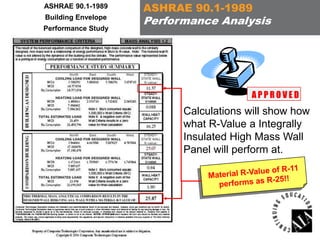
ASHRAE 90.1-1989
Building Envelope

Performance Study

ASHRAE 90.1-1989

Performance Analysis

APPROVED

Calculations will show how
what R-Value a Integrally
Insulated High Mass Wall
Panel will perform at.
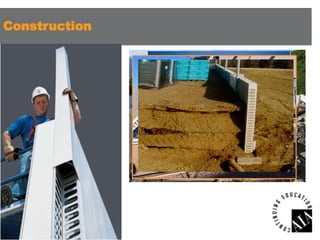
Construction
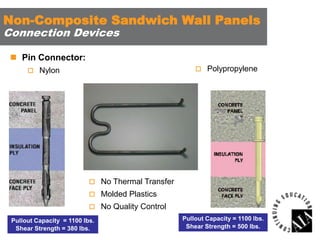
Non-Composite Sandwich Wall Panels
Connection Devices
 Pin Connector:
 Polypropylene

 Nylon

 No Thermal Transfer
 Molded Plastics
 No Quality Control
Pullout Capacity = 1100 lbs.
Shear Strength = 380 lbs.

Pullout Capacity = 1100 lbs.
Shear Strength = 500 lbs.
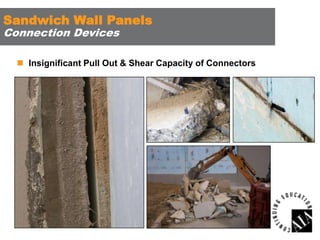
Sandwich Wall Panels
Connection Devices

 Insignificant Pull Out & Shear Capacity of Connectors
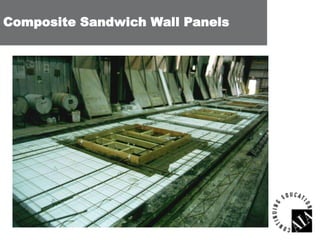
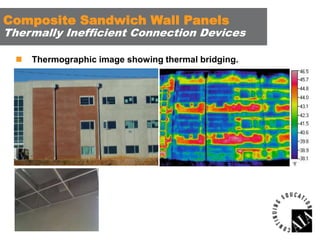
Composite Sandwich Wall Panels

Thermally Inefficient Connection Devices


Thermographic image showing thermal bridging.
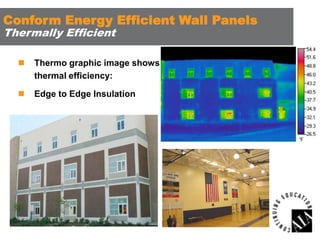
Conform Energy Efficient Wall Panels
Thermally Efficient


Thermo graphic image shows
thermal efficiency:



Edge to Edge Insulation
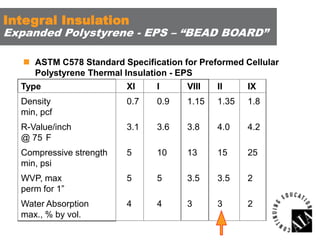
Integral Insulation

Expanded Polystyrene - EPS – “BEAD BOARD”
 ASTM C578 Standard Specification for Preformed Cellular
Polystyrene Thermal Insulation - EPS
Type

XI

I

VIII

II

IX

Density
min, pcf

0.7

0.9

1.15

1.35

1.8

R-Value/inch
@ 75 F

3.1

3.6

3.8

4.0

4.2

Compressive strength
min, psi

5

10

13

15

25

WVP, max
perm for 1”

5

5

3.5

3.5

2

Water Absorption
max., % by vol.

4

4

3

3

2
Integral Insulation

Polyisocyanurate – POLY ISO

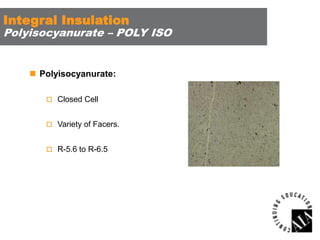
 Polyisocyanurate:
 Closed Cell

 Variety of Facers.

 R-5.6 to R-6.5
Integral Insulation

Polyisocyanurate – POLY ISO
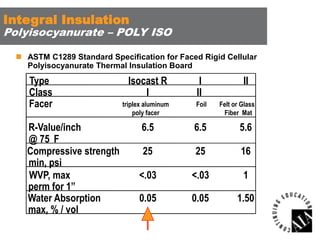
 ASTM C1289 Standard Specification for Faced Rigid Cellular
Polyisocyanurate Thermal Insulation Board

Type
Class
Facer
R-Value/inch
@ 75 F
Compressive strength
min, psi
WVP, max
perm for 1”
Water Absorption
max, % / vol

Isocast R
I

I
II

II

triplex aluminum
poly facer

Foil

Felt or Glass
Fiber Mat

6.5

6.5

5.6

25

25

16

<.03

<.03

1

0.05

0.05

1.50
Integral Insulation

Extruded Polystyrene – XPS

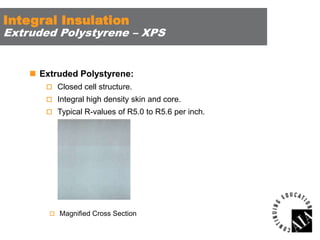
 Extruded Polystyrene:
 Closed cell structure.
 Integral high density skin and core.
 Typical R-values of R5.0 to R5.6 per inch.

 Magnified Cross Section
Insulation

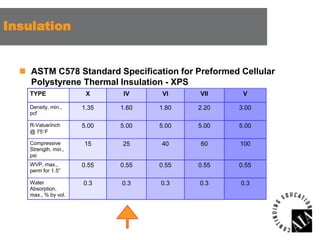
 ASTM C578 Standard Specification for Preformed Cellular
Polystyrene Thermal Insulation - XPS
TYPE

X

IV

VI

VII

V

Density, min.,
pcf

1.35

1.60

1.80

2.20

3.00

R-Value/inch
@ 75 F

5.00

5.00

5.00

5.00

5.00

15

25

40

60

100

0.55

0.55

0.55

0.55

0.55

0.3

0.3

0.3

0.3

0.3

Compressive
Strength, min.,
psi
WVP, max.,
perm for 1.5”
Water
Absorption,
max., % by vol.
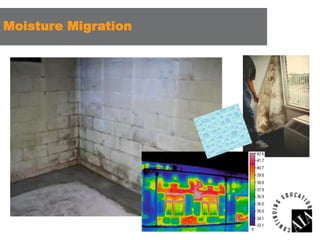
Moisture Migration
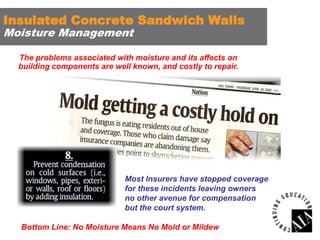
Insulated Concrete Sandwich Walls
Moisture Management

The problems associated with moisture and its affects on
building components are well known, and costly to repair.

Most Insurers have stopped coverage
for these incidents leaving owners
no other avenue for compensation
but the court system.
Bottom Line: No Moisture Means No Mold or Mildew
Insulated Concrete Sandwich Walls
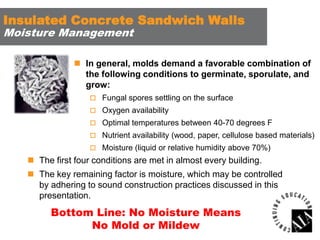
Moisture Management

 In general, molds demand a favorable combination of
the following conditions to germinate, sporulate, and
grow:
 Fungal spores settling on the surface
 Oxygen availability
 Optimal temperatures between 40-70 degrees F
 Nutrient availability (wood, paper, cellulose based materials)
 Moisture (liquid or relative humidity above 70%)

 The first four conditions are met in almost every building.
 The key remaining factor is moisture, which may be controlled
by adhering to sound construction practices discussed in this
presentation.

Bottom Line: No Moisture Means
No Mold or Mildew
Insulated Concrete Sandwich Walls
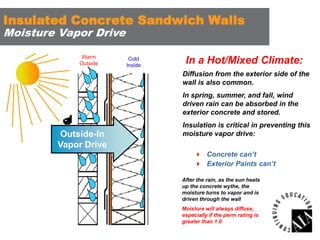
Moisture Vapor Drive
Warm
Outside

Cold
Inside

In a Hot/Mixed Climate:
Diffusion from the exterior side of the
wall is also common.
In spring, summer, and fall, wind
driven rain can be absorbed in the
exterior concrete and stored.

Outside-In
Vapor Drive

Insulation is critical in preventing this
moisture vapor drive:
 Concrete can’t
 Exterior Paints can’t
After the rain, as the sun heats
up the concrete wythe, the
moisture turns to vapor and is
driven through the wall
Moisture will always diffuse,
especially if the perm rating is
greater than 1.0
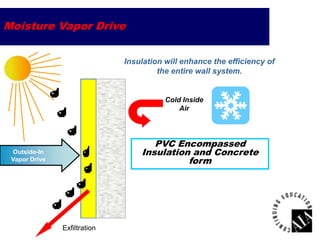
Moisture Vapor Drive
Insulation will enhance the efficiency of
the entire wall system.

Cold Inside
Air

PVC Encompassed
Insulation and Concrete
form

Outside-In
Vapor Drive

Exfiltration
Insulated Concrete Sandwich Walls
Moisture Vapor Drive

 What Is Vapor Diffusion?
 The Process by which water vapor migrates through a wall

system and it’s components such as gypsum, concrete,
insulation and paint.
 Each components of the wall system has a perm rating
 The International Building Code says that a material with a

perm rating of 1.0 or less is a vapor retarder.

 Examples of the average perm rating for different wall
components…
 Gypsum

12 - 50 perms

 Plastic Sheet Barriers (2-10 mil)

.16 – .03 perms

 Rigid Insulation

5.8 – .03 perms

 Concrete

3.2 perms

 PVC

0 perms
Moisture Vapor Drive
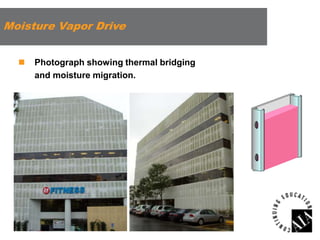


Photograph showing thermal bridging
and moisture migration.
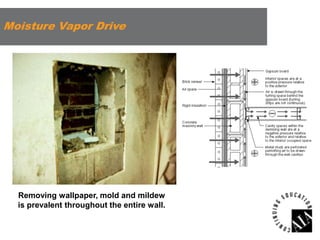
Moisture Vapor Drive

Removing wallpaper, mold and mildew
is prevalent throughout the entire wall.
Energy Efficiency

calate.
ncern.

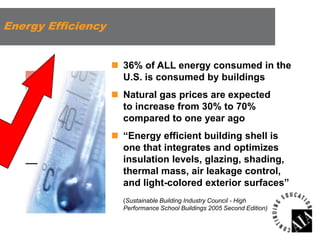
 36% of ALL energy consumed in the
U.S. is consumed by buildings
 Natural gas prices are expected
to increase from 30% to 70%
compared to one year ago
 “Energy efficient building shell is
one that integrates and optimizes
insulation levels, glazing, shading,
thermal mass, air leakage control,
and light-colored exterior surfaces”
(Sustainable Building Industry Council - High
Performance School Buildings 2005 Second Edition)
Effective R-Value

Thermal Loss Through Wall Panel
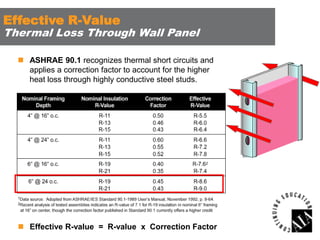
 ASHRAE 90.1 recognizes thermal short circuits and
applies a correction factor to account for the higher
heat loss through highly conductive steel studs.

 Effective R-value = R-value x Correction Factor
Effective R-Value

What R-Value are you Purchasing?
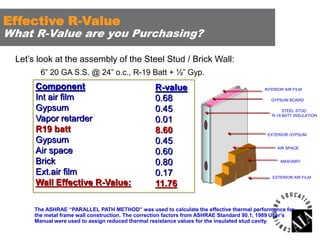
Let’s look at the assembly of the Steel Stud / Brick Wall:
6” 20 GA S.S. @ 24” o.c., R-19 Batt + ½” Gyp.

Component
Int air film
Gypsum
Vapor retarder
R19 batt
Gypsum
Air space
Brick
Ext.air film
Wall Effective R-Value:

R-value
0.68
0.45
0.01
8.60
0.45
0.60
0.80
0.17
11.76

INTERIOR AIR FILM
GYPSUM BOARD
STEEL STUD
R-19 BATT INSULATION

EXTERIOR GYPSUM

AIR SPACE
MASONRY

EXTERIOR AIR FILM

The ASHRAE “PARALLEL PATH METHOD” was used to calculate the effective thermal performance for
the metal frame wall construction. The correction factors from ASHRAE Standard 90.1, 1989 User’s
Manual were used to assign reduced thermal resistance values for the insulated stud cavity.
Effective R-Value

Thermal Loss Through Wall Panels

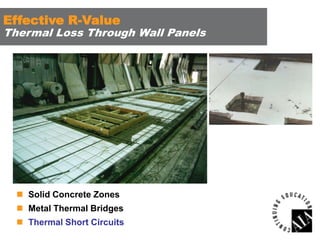
 Solid Concrete Zones
 Metal Thermal Bridges
 Thermal Short Circuits
Effective R-Value

Thermal Loss Through Wall Panel



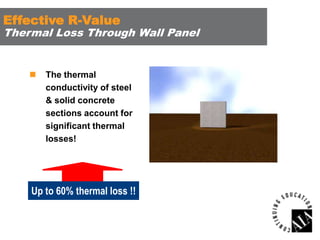
The thermal
conductivity of steel
& solid concrete
sections account for
significant thermal
losses!

Up to 60% thermal loss !!
Effective R-Value

Thermal Loss Through Wall Panel


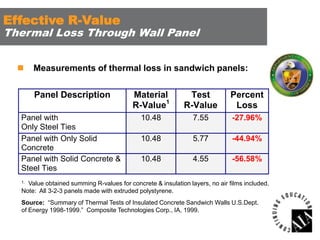
Measurements of thermal loss in sandwich panels:

Panel Description

Material
R-Value1

Test
R-Value

Percent
Loss

Panel with
Only Steel Ties
Panel with Only Solid
Concrete
Panel with Solid Concrete &
Steel Ties

10.48

7.55

-27.96%

10.48

5.77

-44.94%

10.48

4.55

-56.58%

1.

Value obtained summing R-values for concrete & insulation layers, no air films included.
Note: All 3-2-3 panels made with extruded polystyrene.
Source: “Summary of Thermal Tests of Insulated Concrete Sandwich Walls U.S.Dept.
of Energy 1998-1999.” Composite Technologies Corp., IA, 1999.
Effective R-Value

Thermal Efficiency in a Wall Panel



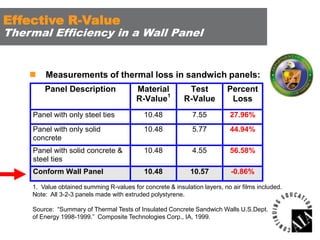
Measurements of thermal loss in sandwich panels:
Panel Description

Material
R-Value1

Test
R-Value

Percent
Loss

Panel with only steel ties

10.48

7.55

27.96%

Panel with only solid
concrete

10.48

5.77

44.94%

Panel with solid concrete &
steel ties

10.48

4.55

56.58%

Conform Wall Panel

10.48

10.57

-0.86%

1. Value obtained summing R-values for concrete & insulation layers, no air films included.
Note: All 3-2-3 panels made with extruded polystyrene.
Source: “Summary of Thermal Tests of Insulated Concrete Sandwich Walls U.S.Dept.
of Energy 1998-1999.” Composite Technologies Corp., IA, 1999.
Effective R-Value

Thermal Loss Through Wall Panel


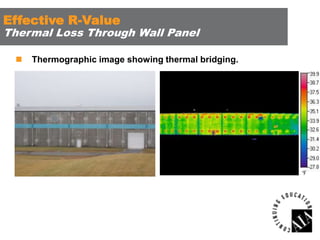
Thermographic image showing thermal bridging.
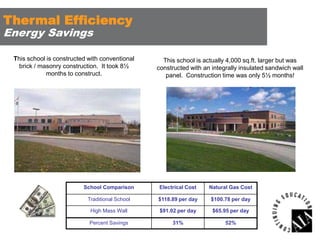
Thermal Efficiency
Energy Savings

This school is constructed with conventional
brick / masonry construction. It took 8½
months to construct.

This school is actually 4,000 sq.ft. larger but was
constructed with an integrally insulated sandwich wall
panel. Construction time was only 5½ months!

School Comparison

Electrical Cost

Natural Gas Cost

Traditional School

$118.89 per day

$100.78 per day

High Mass Wall

$91.02 per day

$65.95 per day

Percent Savings

31%

52%
Insulated Concrete Sandwich Walls
Sustainable Design – LEED

TM

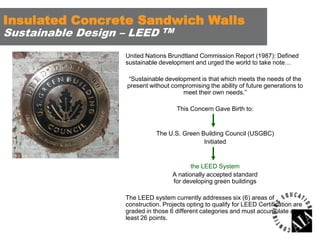
United Nations Brundtland Commission Report (1987): Defined
sustainable development and urged the world to take note…

“Sustainable development is that which meets the needs of the
present without compromising the ability of future generations to
meet their own needs.”
This Concern Gave Birth to:

The U.S. Green Building Council (USGBC)
Initiated

the LEED System
A nationally accepted standard
for developing green buildings
The LEED system currently addresses six (6) areas of
construction. Projects opting to qualify for LEED Certification are
graded in those 6 different categories and must accumulate at
least 26 points.
Insulated Concrete Sandwich Walls
Sustainable Design – LEED

TM

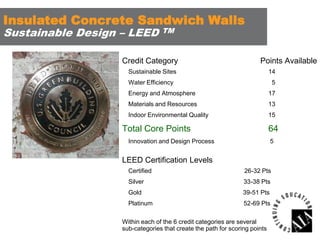
Credit Category

Points Available

Sustainable Sites

14

Water Efficiency

5

Energy and Atmosphere

17

Materials and Resources

13

Indoor Environmental Quality

15

Total Core Points

64

Innovation and Design Process

5

LEED Certification Levels
Certified

26-32 Pts

Silver

33-38 Pts

Gold

39-51 Pts

Platinum

52-69 Pts

Within each of the 6 credit categories are several
sub-categories that create the path for scoring points
Insulated Concrete Sandwich Walls
Sustainable Design – LEED

TM

 Sustainable Sites
Credit 5.1
Credit 5.2
Credit 7.1

Site Development, Protect or Restore Habitat
Site Development, Maximize Open Space
Heat Island Effect, Non-Roof

Points
1
1
0

 Energy & Atmosphere
Prereq 2
Credit 1

Minimum Energy Performance
Optimize Energy Performance 15% to 60%

Required
2

 Materials & Resources
Prereq 1
Credit 1.1
Credit 1.2
Credit 2.1
Credit 2.2
Credit 4.1
Credit 4.2
Credit 5.1
Credit 5.2

Storage and Collection of Recyclables
Building Reuse, Maintain 75% of Existing Walls, Floors & Roof
Building Reuse, Maintain 95% of Existing Walls, Floors & Roof
Construction Waste Management, Divert 50% from Disposal
Construction Waste Management, Divert 75% From Disposal
Recycled Content, Use 10% (Post-Consumer + Half Pre-Consumer)
Recycled Content, Use 20% (Post-Consumer + Half Pre-Consumer)
Regional Materials, 10% Extracted, Processed and Manufactured Regionally
Regional Materials, 20% Extracted, Processed and Manufactured Regionally

Required
0
0
1
1
1
1
1
1

 Indoor Environmental Quality
Credit 3.1

Construction IAQ Management Plan, During Construction

1

 Innovation & Design Process
Credit 1.1
Credit 1.2-1.4
Credit 2.1

Innovation in Design, Use of High Volume
supplementary Cementitious Materials.
Apply for other credits demonstrating exceptional performance
TM
LEED Accredited Professional

1
2
1

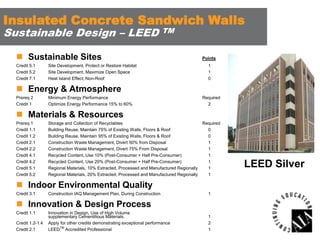
LEED Silver
Insulated Concrete Sandwich Walls
Summary

 Benefits to Owners:
 Speed of Construction
 Limited Site Disturbance
 Attractive Appearance
 Energy Efficiency (R-30+)
 Increased Daylighting
 Long Clear Spans

 150 MPH + Low Maintenance
 Sound Transmission (STC 58)
 Moisture Management
 Fire Endurance (4-HR)

 Seismic D Rated
Insulated Concrete Sandwich Walls
AIA / CES Program Purpose

American Institute of Architect
Continuing Education Systems.
This concludes the CES portion of the
program. Credit earned during this program
will be reported to CES Records for AIA
members. Certificate of Completion for nonAIA members is available on request.
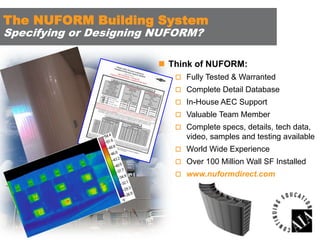
The NUFORM Building System
Specifying or Designing NUFORM?

 Think of NUFORM:
 Fully Tested & Warranted
 Complete Detail Database
 In-House AEC Support

 Valuable Team Member
 Complete specs, details, tech data,

video, samples and testing available
 World Wide Experience
 Over 100 Million Wall SF Installed
 www.nuformdirect.com
Building emvelopes and thermal mass walls

Building emvelopes and thermal mass walls

  • 1.
    Building Envelopes and ThermalMass Walls Presented by: Andy Turner VP Sales and Marketing Nuform Building Technologies Inc Leed AP
  • 2.
    History of Nuform BuildingTechnologies Founded in 1992  Royal Building Systems Technologies, LTD Provides the world with leading edge building systems and technologies 2007-Royal Building SystemsTechnologies became Nuform Building Technologies New Names-Same Great Products
  • 3.
    Introduction  Design, Engineeringand Specification Assistance  Constructability Assistance  Budgeting Assistance  Sample Assistance  Systems Testing  LEED Analysis  Thermal Analyses  Construction Comparisons
  • 4.
    Introduction Construction Comparison  SiteCast  Precast  Conventional  Poured In Place  Metal Panel  Conform
  • 5.
    AIA / CESProgram Purpose  This program is registered with the AIA/CES for continuing professional education.  As such, it does not include content deemed or construed to be an approval or endorsement by the AIA of any material of construction or any method or manner of handling, using, distributing, or dealing in any material or product.  Questions related to specific materials, methods, and services will be addressed at the conclusion of this presentation.
  • 6.
    Learning Objectives  Participantswill be able to:  Utilize the architectural aspects of Concrete Wall Panels  Understand how to insulate a concrete wall  Understand the benefits of a high mass wall  Understand the benefits of insulated concrete walls in relation to energy efficiency  Understand overall panel thermal, fire resistance, and moisture ,mold and pest prevention properties  Leed
  • 7.
    Program Agenda  Introductionto Envelopes  Benefits of Envelope Construction Speed of Construction  Limited Site Disturbance  Energy Efficiency  Moisture Management  Wall Physical Performance  R-Values  Sustainability  Durability
  • 8.
    Introduction Owner Benefits  Benefitsto Owners:  Speed of Construction  Limited Site Disturbance  Attractive Appearance  Energy Efficiency (R-30+)  Increased Daylighting  Long Clear Spans  150 MPH + Low Maintenance  Sound Transmission (STC 58)  Moisture Management  Fire Endurance (4-HR)
  • 9.
    Comparative Construction CycleAnalysis Inlaid Brick Architectural Concrete Wall= Hand-laid Brick/Block Cavity Wall Facility Architect Facility CM/Contractor Concrete Wall Load Bearing Panels with Insulation, Conduit & Brick Architect CM/Contractor CMU Block Scaffolding Up & Down Conduit Grout & Rebar Roof Roof Damproofing Insulation Brick Scaffolding Up & Down Cleanup
  • 10.
    Introduction Limited Site Disturbance- Panelization  Panelization:  Modular Size  Repetition
  • 11.
  • 12.
  • 13.
    Introduction Texture Options –Color, Form, and Texture TEXTURE Multiple Textures Add Interest Multiple Textures Add A very economical way to enrich Interest the appearance of your school’s A very economical way to enrich its appearance precast exterior is to vary the of the facility’s exterior is to vary its texture. texture.  Thin Brick and Stone  Sandblasting Concrete Sprayed Siding and Hard Plank Steel  Acid Etching PVC  Retarding (Exposed Aggregate)
  • 14.
  • 15.
  • 16.
  • 17.
  • 18.
  • 19.
  • 20.
  • 21.
  • 22.
  • 23.
  • 24.
  • 25.
    Introduction Housing  Residential:  Dormitories Hotels  Health Care  Multi-Residence  Single-Family Energy Efficient Homes
  • 26.
  • 27.
  • 28.
  • 29.
  • 30.
  • 31.
    Introduction Educational – InteriorWalls Walls are finished…..
  • 32.
  • 33.
    Introduction Educational – InteriorWalls  Minimal maintenance for 20 years or longer . . . • Interior exposed concrete surface needs only periodic repainting • Exterior wall surface totally maintenance free, except for caulking every 20 years +/ • If thin brick is used, no need to tuck point concrete mortar joints
  • 34.
    Types of ConcreteWall Panels Solid Concrete Wall Panels =  Question:  Did you know that 7” of load- bearing structural concrete has approximately the same R-Value as a single panel of glass…R-1.4 !  Insulation IS Important !
  • 35.
    Types of ConcreteWall Panels Insulating Options?  Insulation Position is critical:  Interior: Insulation separates you from the mass effect  Exterior: Outside of the bulk mass of the wall system.
  • 36.
    Effective R-Value Thermal Efficiencyin a Wall Panel The ability of concrete to store energy and dampen the effect of temperature change on heating and cooling systems is know as the “Thermal Mass Effect.” Due to the mass effect of insulated precast walls, the performance R-value of the high performance wall system can be two to three times greater than that of the material R-value, resulting in energy cost savings up to or exceeding 50%. High Mass Building Conventional Insulated Building
  • 37.
    ASHRAE 90.1-1989 Building Envelope PerformanceStudy ASHRAE 90.1-1989 Performance Analysis APPROVED Calculations will show how what R-Value a Integrally Insulated High Mass Wall Panel will perform at.
  • 38.
  • 39.
    Non-Composite Sandwich WallPanels Connection Devices  Pin Connector:  Polypropylene  Nylon  No Thermal Transfer  Molded Plastics  No Quality Control Pullout Capacity = 1100 lbs. Shear Strength = 380 lbs. Pullout Capacity = 1100 lbs. Shear Strength = 500 lbs.
  • 40.
    Sandwich Wall Panels ConnectionDevices  Insignificant Pull Out & Shear Capacity of Connectors
  • 41.
  • 42.
    Composite Sandwich WallPanels Thermally Inefficient Connection Devices  Thermographic image showing thermal bridging.
  • 43.
    Conform Energy EfficientWall Panels Thermally Efficient  Thermo graphic image shows thermal efficiency:  Edge to Edge Insulation
  • 44.
    Integral Insulation Expanded Polystyrene- EPS – “BEAD BOARD”  ASTM C578 Standard Specification for Preformed Cellular Polystyrene Thermal Insulation - EPS Type XI I VIII II IX Density min, pcf 0.7 0.9 1.15 1.35 1.8 R-Value/inch @ 75 F 3.1 3.6 3.8 4.0 4.2 Compressive strength min, psi 5 10 13 15 25 WVP, max perm for 1” 5 5 3.5 3.5 2 Water Absorption max., % by vol. 4 4 3 3 2
  • 45.
    Integral Insulation Polyisocyanurate –POLY ISO  Polyisocyanurate:  Closed Cell  Variety of Facers.  R-5.6 to R-6.5
  • 46.
    Integral Insulation Polyisocyanurate –POLY ISO  ASTM C1289 Standard Specification for Faced Rigid Cellular Polyisocyanurate Thermal Insulation Board Type Class Facer R-Value/inch @ 75 F Compressive strength min, psi WVP, max perm for 1” Water Absorption max, % / vol Isocast R I I II II triplex aluminum poly facer Foil Felt or Glass Fiber Mat 6.5 6.5 5.6 25 25 16 <.03 <.03 1 0.05 0.05 1.50
  • 47.
    Integral Insulation Extruded Polystyrene– XPS  Extruded Polystyrene:  Closed cell structure.  Integral high density skin and core.  Typical R-values of R5.0 to R5.6 per inch.  Magnified Cross Section
  • 48.
    Insulation  ASTM C578Standard Specification for Preformed Cellular Polystyrene Thermal Insulation - XPS TYPE X IV VI VII V Density, min., pcf 1.35 1.60 1.80 2.20 3.00 R-Value/inch @ 75 F 5.00 5.00 5.00 5.00 5.00 15 25 40 60 100 0.55 0.55 0.55 0.55 0.55 0.3 0.3 0.3 0.3 0.3 Compressive Strength, min., psi WVP, max., perm for 1.5” Water Absorption, max., % by vol.
  • 49.
  • 50.
    Insulated Concrete SandwichWalls Moisture Management The problems associated with moisture and its affects on building components are well known, and costly to repair. Most Insurers have stopped coverage for these incidents leaving owners no other avenue for compensation but the court system. Bottom Line: No Moisture Means No Mold or Mildew
  • 51.
    Insulated Concrete SandwichWalls Moisture Management  In general, molds demand a favorable combination of the following conditions to germinate, sporulate, and grow:  Fungal spores settling on the surface  Oxygen availability  Optimal temperatures between 40-70 degrees F  Nutrient availability (wood, paper, cellulose based materials)  Moisture (liquid or relative humidity above 70%)  The first four conditions are met in almost every building.  The key remaining factor is moisture, which may be controlled by adhering to sound construction practices discussed in this presentation. Bottom Line: No Moisture Means No Mold or Mildew
  • 52.
    Insulated Concrete SandwichWalls Moisture Vapor Drive Warm Outside Cold Inside In a Hot/Mixed Climate: Diffusion from the exterior side of the wall is also common. In spring, summer, and fall, wind driven rain can be absorbed in the exterior concrete and stored. Outside-In Vapor Drive Insulation is critical in preventing this moisture vapor drive:  Concrete can’t  Exterior Paints can’t After the rain, as the sun heats up the concrete wythe, the moisture turns to vapor and is driven through the wall Moisture will always diffuse, especially if the perm rating is greater than 1.0
  • 53.
    Moisture Vapor Drive Insulationwill enhance the efficiency of the entire wall system. Cold Inside Air PVC Encompassed Insulation and Concrete form Outside-In Vapor Drive Exfiltration
  • 54.
    Insulated Concrete SandwichWalls Moisture Vapor Drive  What Is Vapor Diffusion?  The Process by which water vapor migrates through a wall system and it’s components such as gypsum, concrete, insulation and paint.  Each components of the wall system has a perm rating  The International Building Code says that a material with a perm rating of 1.0 or less is a vapor retarder.  Examples of the average perm rating for different wall components…  Gypsum 12 - 50 perms  Plastic Sheet Barriers (2-10 mil) .16 – .03 perms  Rigid Insulation 5.8 – .03 perms  Concrete 3.2 perms  PVC 0 perms
  • 55.
    Moisture Vapor Drive  Photographshowing thermal bridging and moisture migration.
  • 56.
    Moisture Vapor Drive Removingwallpaper, mold and mildew is prevalent throughout the entire wall.
  • 57.
    Energy Efficiency calate. ncern.  36%of ALL energy consumed in the U.S. is consumed by buildings  Natural gas prices are expected to increase from 30% to 70% compared to one year ago  “Energy efficient building shell is one that integrates and optimizes insulation levels, glazing, shading, thermal mass, air leakage control, and light-colored exterior surfaces” (Sustainable Building Industry Council - High Performance School Buildings 2005 Second Edition)
  • 58.
    Effective R-Value Thermal LossThrough Wall Panel  ASHRAE 90.1 recognizes thermal short circuits and applies a correction factor to account for the higher heat loss through highly conductive steel studs.  Effective R-value = R-value x Correction Factor
  • 59.
    Effective R-Value What R-Valueare you Purchasing? Let’s look at the assembly of the Steel Stud / Brick Wall: 6” 20 GA S.S. @ 24” o.c., R-19 Batt + ½” Gyp. Component Int air film Gypsum Vapor retarder R19 batt Gypsum Air space Brick Ext.air film Wall Effective R-Value: R-value 0.68 0.45 0.01 8.60 0.45 0.60 0.80 0.17 11.76 INTERIOR AIR FILM GYPSUM BOARD STEEL STUD R-19 BATT INSULATION EXTERIOR GYPSUM AIR SPACE MASONRY EXTERIOR AIR FILM The ASHRAE “PARALLEL PATH METHOD” was used to calculate the effective thermal performance for the metal frame wall construction. The correction factors from ASHRAE Standard 90.1, 1989 User’s Manual were used to assign reduced thermal resistance values for the insulated stud cavity.
  • 60.
    Effective R-Value Thermal LossThrough Wall Panels  Solid Concrete Zones  Metal Thermal Bridges  Thermal Short Circuits
  • 61.
    Effective R-Value Thermal LossThrough Wall Panel  The thermal conductivity of steel & solid concrete sections account for significant thermal losses! Up to 60% thermal loss !!
  • 62.
    Effective R-Value Thermal LossThrough Wall Panel  Measurements of thermal loss in sandwich panels: Panel Description Material R-Value1 Test R-Value Percent Loss Panel with Only Steel Ties Panel with Only Solid Concrete Panel with Solid Concrete & Steel Ties 10.48 7.55 -27.96% 10.48 5.77 -44.94% 10.48 4.55 -56.58% 1. Value obtained summing R-values for concrete & insulation layers, no air films included. Note: All 3-2-3 panels made with extruded polystyrene. Source: “Summary of Thermal Tests of Insulated Concrete Sandwich Walls U.S.Dept. of Energy 1998-1999.” Composite Technologies Corp., IA, 1999.
  • 63.
    Effective R-Value Thermal Efficiencyin a Wall Panel  Measurements of thermal loss in sandwich panels: Panel Description Material R-Value1 Test R-Value Percent Loss Panel with only steel ties 10.48 7.55 27.96% Panel with only solid concrete 10.48 5.77 44.94% Panel with solid concrete & steel ties 10.48 4.55 56.58% Conform Wall Panel 10.48 10.57 -0.86% 1. Value obtained summing R-values for concrete & insulation layers, no air films included. Note: All 3-2-3 panels made with extruded polystyrene. Source: “Summary of Thermal Tests of Insulated Concrete Sandwich Walls U.S.Dept. of Energy 1998-1999.” Composite Technologies Corp., IA, 1999.
  • 64.
    Effective R-Value Thermal LossThrough Wall Panel  Thermographic image showing thermal bridging.
  • 65.
    Thermal Efficiency Energy Savings Thisschool is constructed with conventional brick / masonry construction. It took 8½ months to construct. This school is actually 4,000 sq.ft. larger but was constructed with an integrally insulated sandwich wall panel. Construction time was only 5½ months! School Comparison Electrical Cost Natural Gas Cost Traditional School $118.89 per day $100.78 per day High Mass Wall $91.02 per day $65.95 per day Percent Savings 31% 52%
  • 66.
    Insulated Concrete SandwichWalls Sustainable Design – LEED TM United Nations Brundtland Commission Report (1987): Defined sustainable development and urged the world to take note… “Sustainable development is that which meets the needs of the present without compromising the ability of future generations to meet their own needs.” This Concern Gave Birth to: The U.S. Green Building Council (USGBC) Initiated the LEED System A nationally accepted standard for developing green buildings The LEED system currently addresses six (6) areas of construction. Projects opting to qualify for LEED Certification are graded in those 6 different categories and must accumulate at least 26 points.
  • 67.
    Insulated Concrete SandwichWalls Sustainable Design – LEED TM Credit Category Points Available Sustainable Sites 14 Water Efficiency 5 Energy and Atmosphere 17 Materials and Resources 13 Indoor Environmental Quality 15 Total Core Points 64 Innovation and Design Process 5 LEED Certification Levels Certified 26-32 Pts Silver 33-38 Pts Gold 39-51 Pts Platinum 52-69 Pts Within each of the 6 credit categories are several sub-categories that create the path for scoring points
  • 68.
    Insulated Concrete SandwichWalls Sustainable Design – LEED TM  Sustainable Sites Credit 5.1 Credit 5.2 Credit 7.1 Site Development, Protect or Restore Habitat Site Development, Maximize Open Space Heat Island Effect, Non-Roof Points 1 1 0  Energy & Atmosphere Prereq 2 Credit 1 Minimum Energy Performance Optimize Energy Performance 15% to 60% Required 2  Materials & Resources Prereq 1 Credit 1.1 Credit 1.2 Credit 2.1 Credit 2.2 Credit 4.1 Credit 4.2 Credit 5.1 Credit 5.2 Storage and Collection of Recyclables Building Reuse, Maintain 75% of Existing Walls, Floors & Roof Building Reuse, Maintain 95% of Existing Walls, Floors & Roof Construction Waste Management, Divert 50% from Disposal Construction Waste Management, Divert 75% From Disposal Recycled Content, Use 10% (Post-Consumer + Half Pre-Consumer) Recycled Content, Use 20% (Post-Consumer + Half Pre-Consumer) Regional Materials, 10% Extracted, Processed and Manufactured Regionally Regional Materials, 20% Extracted, Processed and Manufactured Regionally Required 0 0 1 1 1 1 1 1  Indoor Environmental Quality Credit 3.1 Construction IAQ Management Plan, During Construction 1  Innovation & Design Process Credit 1.1 Credit 1.2-1.4 Credit 2.1 Innovation in Design, Use of High Volume supplementary Cementitious Materials. Apply for other credits demonstrating exceptional performance TM LEED Accredited Professional 1 2 1 LEED Silver
  • 69.
    Insulated Concrete SandwichWalls Summary  Benefits to Owners:  Speed of Construction  Limited Site Disturbance  Attractive Appearance  Energy Efficiency (R-30+)  Increased Daylighting  Long Clear Spans  150 MPH + Low Maintenance  Sound Transmission (STC 58)  Moisture Management  Fire Endurance (4-HR)  Seismic D Rated
  • 70.
    Insulated Concrete SandwichWalls AIA / CES Program Purpose American Institute of Architect Continuing Education Systems. This concludes the CES portion of the program. Credit earned during this program will be reported to CES Records for AIA members. Certificate of Completion for nonAIA members is available on request.
  • 71.
    The NUFORM BuildingSystem Specifying or Designing NUFORM?  Think of NUFORM:  Fully Tested & Warranted  Complete Detail Database  In-House AEC Support  Valuable Team Member  Complete specs, details, tech data, video, samples and testing available  World Wide Experience  Over 100 Million Wall SF Installed  www.nuformdirect.com