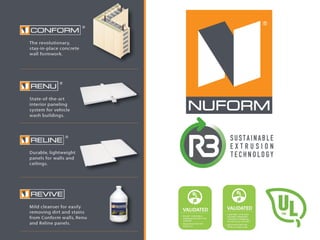
®
®

®

Get to Know Us Again

®

®

NEW NAMES.
SAME GREAT
PRODUCTS.
®

Our Commitment to
Our Environment
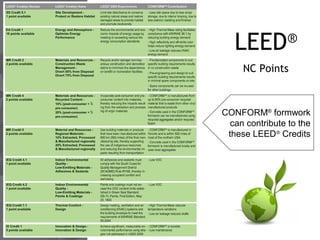
LEED

®

NC Points

CONFORM® formwork
can contribute to the
these LEED® Credits
®

®
®

What is CONFORM?

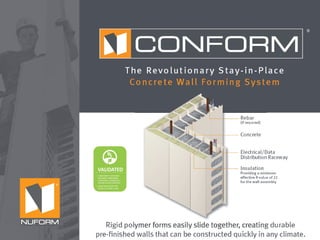
Patented Concrete Forming
Technology
Components interconnect together
to create a finished concrete wall
CONFORM is cost competitive with
quality CMU construction
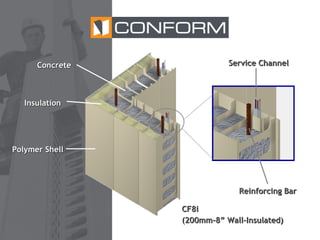
Concrete

Service Channel

Insulation

Polymer Shell

Reinforcing Bar
CF8i
(200mm-8” Wall-Insulated)
®

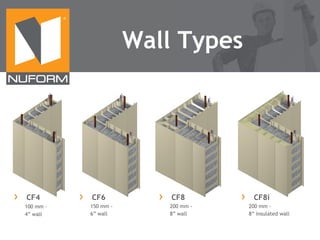
Wall Types

CF4
100 mm 4” wall

CF6

CF8

150 mm 6” wall

200 mm 8” wall

CF8i
200 mm 8” insulated wall
®

CONFORM is the
ONLY solution
that is:

Corrosion Resistant
Durable
Easy to Clean
Requires Minimal Maintenance
Constructs Quickly
Constructs
Quickly

Every Building is custom made in
our factory
All components are pre-cut and
labeled for easy on site assembly
Less skilled labor required on site
Cleaner overall work site
Types of Concrete Wall Panels
Solid Concrete Wall Panels

=
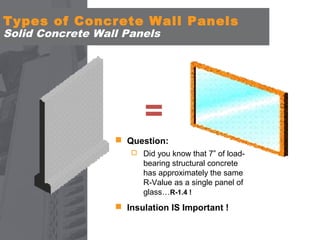
 Question:
 Did you know that 7” of load-

bearing structural concrete
has approximately the same
R-Value as a single panel of
glass…R-1.4 !

 Insulation IS Important !
Types of Concrete Wall Panels
Insulating Options?

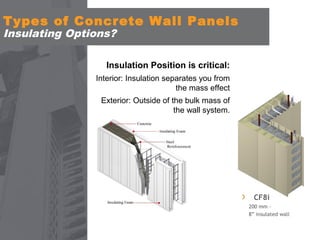
Insulation Position is critical:
Interior: Insulation separates you from
the mass effect
Exterior: Outside of the bulk mass of
the wall system.

CF8i
200 mm 8” insulated wall
Effective R-Value

Thermal Efficiency in a Wall Panel
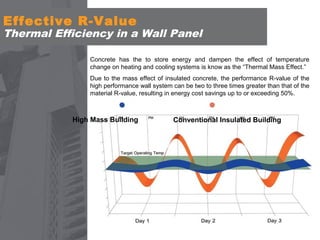
Concrete has the to store energy and dampen the effect of temperature
change on heating and cooling systems is know as the “Thermal Mass Effect.”
Due to the mass effect of insulated concrete, the performance R-value of the
high performance wall system can be two to three times greater than that of the
material R-value, resulting in energy cost savings up to or exceeding 50%.

High Mass Building

Conventional Insulated Building
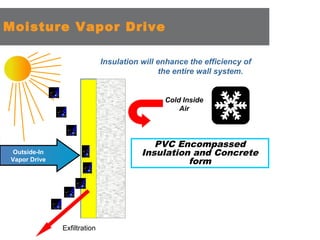
Moisture Vapor Drive
Insulation will enhance the efficiency of
the entire wall system.

Cold Inside
Air

PVC Encompassed
Insulation and Concrete
form

Outside-In
Vapor Drive

Exfiltration
Insulated Concrete Sandwich
Walls
Moisture Vapor Drive

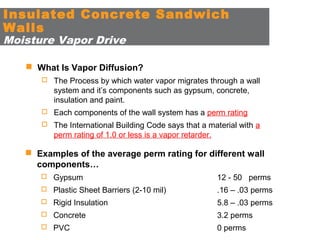
 What Is Vapor Diffusion?
 The Process by which water vapor migrates through a wall

system and it’s components such as gypsum, concrete,
insulation and paint.
 Each components of the wall system has a perm rating
 The International Building Code says that a material with a

perm rating of 1.0 or less is a vapor retarder.

 Examples of the average perm rating for different wall
components…
 Gypsum

12 - 50 perms

 Plastic Sheet Barriers (2-10 mil)

.16 – .03 perms

 Rigid Insulation

5.8 – .03 perms

 Concrete

3.2 perms

 PVC

0 perms
®

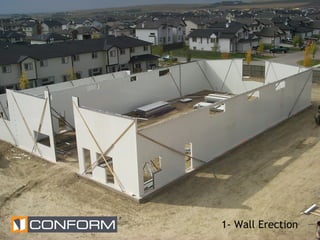
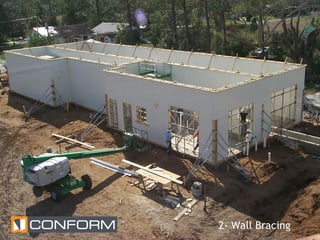
1- Wall Erection
®

2- Wall Bracing
®

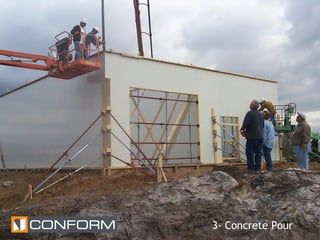
3- Concrete Pour
®

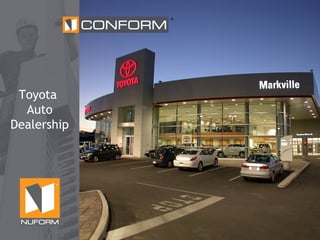
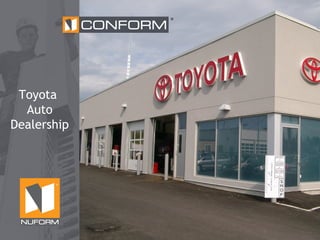
Toyota
Auto
Dealership

®
®

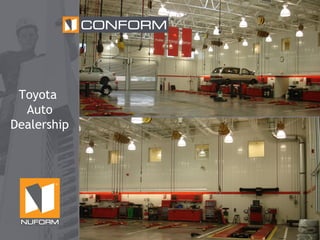
Toyota
Auto
Dealership

®
®

Toyota
Auto
Dealership

®
®

Toyota
Auto
Dealership

®
®

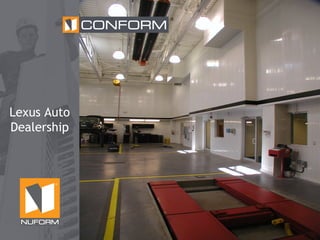
Lexus Auto
Dealership

®
®

Lexus Auto
Dealership

®
®

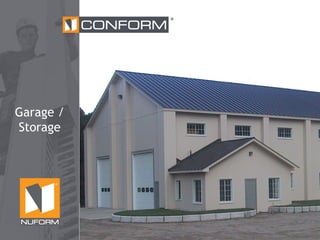
Garage /
Storage

®
®

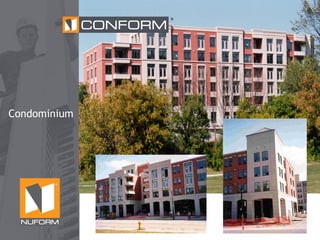
Condominium

®
®

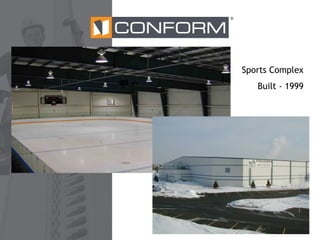
Sports Complex
Built - 1999
®

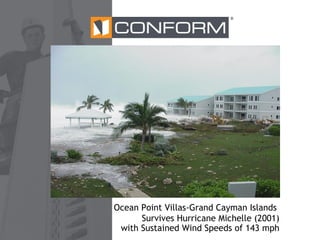
Ocean Point Villas-Grand Cayman Islands
Survives Hurricane Michelle (2001)


with Sustained Wind Speeds of 143 mph
®

Mid-Rise Residential-Cayman Islands
®

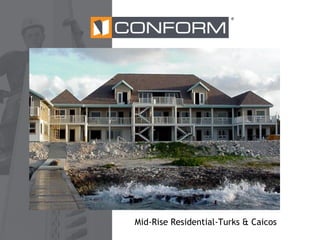
Mid-Rise Residential-Turks & Caicos
®

St. Peters School-St. Peters
Saint Maarten-Built 1998
®

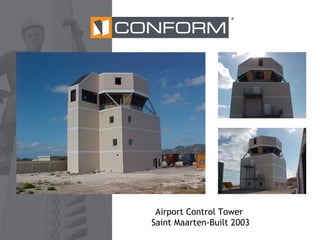
Airport Control Tower
Saint Maarten-Built 2003
®

RESIDENTIAL
®

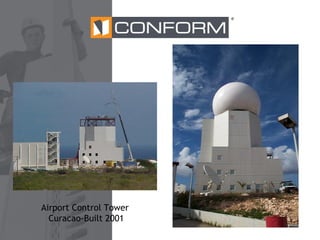
Airport Control Tower
Curacao-Built 2001
®

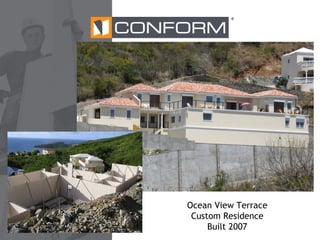
Ocean View Terrace
Custom Residence
Built 2007
®

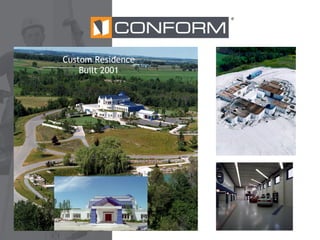
Custom Residence
Built 2001
®

Global Clientele
®

For additional information
visit our website

www.nuformdirect.com
or contact us toll free

1.877.747.WALL(9255)
NUFORM, CONFORM, RELINE, RENU and the N logo are Registered trademarks of Nuform Building Technologies Inc.

Greenbuild 2012 v2

Editor's Notes

  • #13 Did you know that that solid piece of concrete, while it has a great heat capacity, or ability to store heat or cooling loads, has very little insulating ability. In actuality, a 7” thick piece of concrete has the same R-value as a single pane of glass, or R-1.4. However, if you insulate the mass of concrete effectively, preventing the heating or cooling loads from escaping the mass, the wall can have a tremendous R-Value.
  • #14 This behavior is demonstrated in the 2003 IECC. The International Code has established terms for the location of insulation. They call out: Interior: Which is insulation on the inside of the bulk of mass. This is shown in the photo to the left where insulation is installed on the interior side of the tilt-up wall panel Exterior: Which is where the insulation is installed to the exterior of the mass of concrete. This is demonstrated in the center image, and would be an EIFS type application. This defeats the benefit of having the durability and architectural features of precast concrete. Integral: Integral is a panel where the insulation is sandwiched between two substantial amounts of mass.
  • #15 A Performance Study. What is that? Well, earlier when we talked about the benefit the code gives us for using a high mass wall with integral insluation, it was because we take advantage of the Thermal Mass of Concrete. This is the behavior of the interior layer of concrete acting as a heat sink and slowly releasing energy as opposed to the peaks and valleys present in a more traditional building envelope (Steel stud, wood frame, etc).
  • #16 The second step is a Envelope Performance Study, also dictated by ASHRAE 90.1. This particular study gives you the R-Value as a result of effectively utilizing the Thermal Mass of Concrete. It is dependent upon the location, occupancy type, wall panel area, and configuration. For this particular project, again a school in Atlanta, GA, the 4/2/4 Thermomass panel has an Effective R-Value of R-25.07. This is the R-Value the mechanical engineer should take into account when sizing his components. Historically, this has resulted in a Tonnage reduction of up to 37%.
  • #19 There is no question that Mold and Mildew is a significant concern. Whether it be insurance rates going up or health concerns, the issue is costly and serious.
  • #20 The reason this is a problem is because buildings are being constructed more tightly than ever before and are full of ingredients to spawn mold growth. Overall, there are 5 things requrired for mold to grow. Spores settling on the surface Oxygen Right Temperature (Ambient) Food Source (cellulose) Water Water is the one that is controllable because the first four are present in almost any building. THE MAIN THING TO GET ACROSS HERE IS WE HAVE TAKEN OUT THE CELLULOSE IN THE WALL ASSEMBLY AND, OTHER THAN A PIPE BREAKING, ARE DESIGNING THE WALL TO PREVENT WATER VAPOR FROM DIFFUSING AND GETTING THE WALL WET.
  • #21 In general sandwich panels, or any wall assembly for that matter is subjected to a significant difference in interior/exterior temperature and humidity. In this example, and one that we can all appreciate, on a hot day it will get warm outside and the air will be wet. When it is colder and dryer inside, there will be a significant outside-in vapor drive. The individual materials are responsible for controlling the vapor drive. Overall, insulation is critical to stopping that drive. Concrete cant stop it and paints cant either.
  • #22 MAIN POINT: EDGE TO EDGE INSLUATION IS CRITICAL AND THERMOMASS IS THE ONLY SYSTEM TO GIVE YOU NON-CONDUCTIVE CONNECTORS AND A CONTINUOS LAYER OF VAPOR RETARDING INSUALTION.
  • #23 According to the International Building Code, a material must have a perm rating of 1.0 or less. We touched on this when discussing the foams earlier. XPS has a perm rating of 0.55, ISO has a perm rating of 0.03. EPS has a perm rating of 3. In comparison, gypsum, concrete, and plastic sheets span the spectrum of perm ratings.
  • #25 I like to show this slide, as Im sure many of the architects in the audience are familiar with it. The steel studs represent thermal short circuits in the wall assembly. As a result of the thermal short circuits, the fiber-glass insulation’s R-Value is not achieved. The same theory is in play for Concrete Wall Assemblies. If the insulation layer is interrupted, the material R-Value will not be achieved, but additionally, there will be condensation issues as the vapor retarder or barrier is broken.