1
Gamma decay
Radioactive decay
2
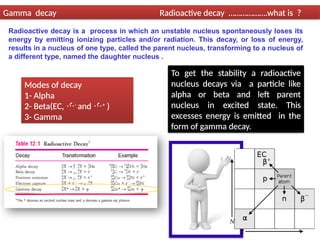
Gamma decay Radioactive decay ……………….what is ?
Radioactive decay is a process in which an unstable nucleus spontaneously loses its
energy by emitting ionizing particles and/or radiation. This decay, or loss of energy,
results in a nucleus of one type, called the parent nucleus, transforming to a nucleus of
a different type, named the daughter nucleus .
Modes of decay
1- Alpha
2- Beta(EC, -
and +
)
3- Gamma
To get the stability a radioactive
nucleus decays via a particle like
alpha or beta and left parent
nucleus in excited state. This
excesses energy is emitted in the
form of gamma decay.
3
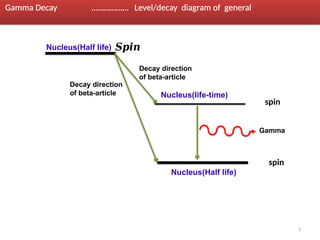
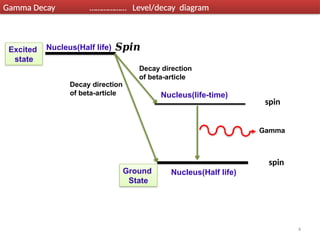
Gamma Decay ……………… Level/decay diagram of general
Nucleus(Half life)
spin
Nucleus(life-time)
𝑺𝒑𝒊𝒏
Decay direction
of beta-article
Gamma
spin
Nucleus(Half life)
Decay direction
of beta-article
4
Gamma Decay ……………… Level/decay diagram
Nucleus(Half life)
spin
Nucleus(life-time)
𝑺𝒑𝒊𝒏
Decay direction
of beta-article
Gamma
spin
Nucleus(Half life)
Decay direction
of beta-article
Excited
state
Ground
State
5
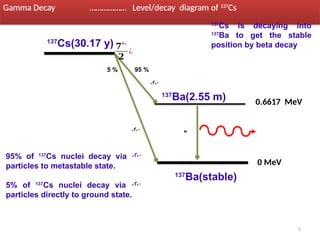
Gamma Decay ……………… Level/decay diagram of 137
Cs
137
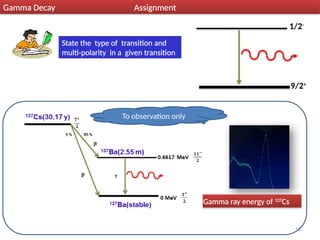
Cs(30.17 y)
0.6617 MeV
137
Ba(stable)
137
Ba(2.55 m)
0 MeV
𝟕
+¿
𝟐
¿
-
95 %
5 %
-

137
Cs is decaying into
137
Ba to get the stable
position by beta decay
95% of 137
Cs nuclei decay via -
particles to metastable state.
5% of 137
Cs nuclei decay via -
particles directly to ground state.
6
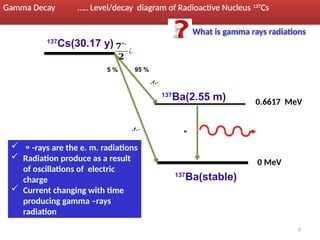
Gamma Decay ….. Level/decay diagram of Radioactive Nucleus 137
Cs
137
Cs(30.17 y)
0.6617 MeV
137
Ba(stable)
137
Ba(2.55 m)
0 MeV
𝟕
+¿
𝟐
¿
-
95 %
5 %
-

What is gamma rays radiations
 -rays are the e. m. radiations
 Radiation produce as a result
of oscillations of electric
charge
 Current changing with time
producing gamma –rays
radiation
7
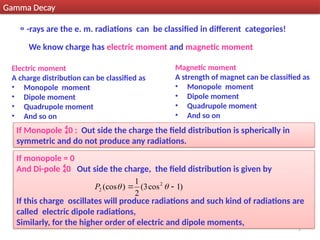
-rays are the e. m. radiations can be classified in different categories!
Gamma Decay
We know charge has electric moment and magnetic moment
Electric moment
A charge distribution can be classified as
• Monopole moment
• Dipole moment
• Quadrupole moment
• And so on
Magnetic moment
A strength of magnet can be classified as
• Monopole moment
• Dipole moment
• Quadrupole moment
• And so on
If Monopole 0 : Out side the charge the field distribution is spherically in
symmetric and do not produce any radiations.
If monopole = 0
And Di-pole 0 Out side the charge, the field distribution is given by
If this charge oscillates will produce radiations and such kind of radiations are
called electric dipole radiations,
Similarly, for the higher order of electric and dipole moments,
)
1
cos
3
(
2
1
)
(cos 2
2 
 

P
8
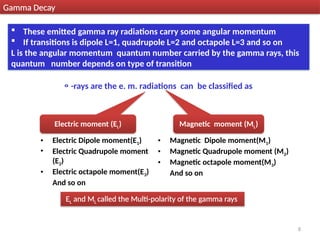
 These emitted gamma ray radiations carry some angular momentum
 If transitions is dipole L=1, quadrupole L=2 and octapole L=3 and so on
L is the angular momentum quantum number carried by the gamma rays, this
quantum number depends on type of transition
Gamma Decay
-rays are the e. m. radiations can be classified as
Electric moment (EL) Magnetic moment (ML)
• Electric Dipole moment(E1)
• Electric Quadrupole moment
(E2)
• Electric octapole moment(E3)
And so on
• Magnetic Dipole moment(M1)
• Magnetic Quadrupole moment (M2)
• Magnetic octapole moment(M3)
And so on
EL and ML called the Multi-polarity of the gamma rays
9
Unit 3- Gamma Decay Selections Rule
Saturday, January 4, 2025 9
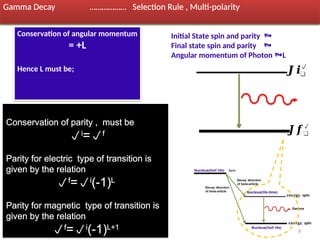
Gamma Decay ……………… Selection Rule , Multi-polarity
𝑱 𝒊❑

𝑱 𝒇 ❑

Initial State spin and parity 
Final state spin and parity 
Angular momentum of Photon L
Conservation of parity , must be
i
=f
Parity for electric type of transition is
given by the relation
f
=i
(-1)L
Parity for magnetic type of transition is
given by the relation
f
=i
(-1)L+1
Conservation of angular momentum
= +L
Hence L must be;
10
Unit 3- Gamma Decay Selections Rule
Saturday, January 4, 2025 10
Gamma Decay
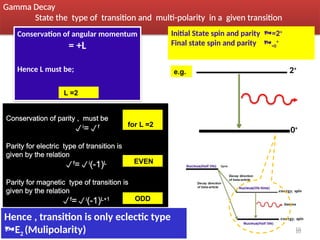
State the type of transition and multi-polarity in a given transition
2+
0+
Initial State spin and parity =2+
Final state spin and parity =0
+
Conservation of parity , must be
i
=f
Parity for electric type of transition is
given by the relation
f
=i
(-1)L
Parity for magnetic type of transition is
given by the relation
f
=i
(-1)L+1
Conservation of angular momentum
= +L
Hence L must be;
for L =2
EVEN
ODD
L =2
e.g.
Hence , transition is only eclectic type
E2 (Mulipolarity)
11
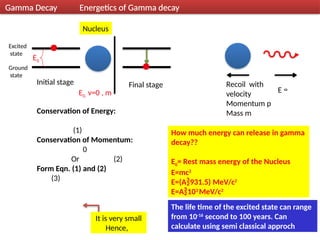
Initial stage
Excited
state
Ground
state
Final stage
Nucleus
Recoil with
velocity
Momentum p
Mass m
E
E0, v=0 , m
Conservation of Energy:
(1)
Conservation of Momentum:
0
Or (2)
Form Eqn. (1) and (2)
(3)
It is very small
Hence,
E0
Gamma Decay Energetics of Gamma decay
How much energy can release in gamma
decay??
E0= Rest mass energy of the Nucleus
E=mc2
E=(A931.5) MeV/c2
E=A103
MeV/c2
The life time of the excited state can range
from 10-16
second to 100 years. Can
calculate using semi classical approch
12
Gamma Decay …….Assignment
137
Cs(30.17 y)
136.907 amu
0.6617 MeV
137
Ba(stable)
136.905 amu
137
Ba(2.55 m)
0 MeV
-
95 %
5 %
-

137
Cs is decaying into
137
Ba to get the stable
position by beta decay
E1
E2
E3
Calculate E1-E3 , E1-E2 and E2-E3
Draw level diagrams for 60
Co and 22
Na
What is the difference between 80 keV X-ray and 80keV Gamma Ray
13
1/2-
9/2+
Gamma Decay Assignment
State the type of transition and
multi-polarity in a given transition
Gamma ray energy of 137
Cs
To observation only
14
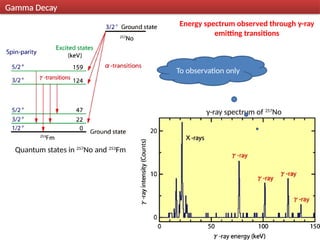
γ-ray spectrum of 257
No
Quantum states in 257
No and 253
Fm
Energy spectrum observed through γ-ray
emitting transitions
To observation only
Gamma Decay
15
Thanks

Nuclear Science- Radioactivity -Gamma decay

  • 1.
  • 2.
    2 Gamma decay Radioactivedecay ……………….what is ? Radioactive decay is a process in which an unstable nucleus spontaneously loses its energy by emitting ionizing particles and/or radiation. This decay, or loss of energy, results in a nucleus of one type, called the parent nucleus, transforming to a nucleus of a different type, named the daughter nucleus . Modes of decay 1- Alpha 2- Beta(EC, - and + ) 3- Gamma To get the stability a radioactive nucleus decays via a particle like alpha or beta and left parent nucleus in excited state. This excesses energy is emitted in the form of gamma decay.
  • 3.
    3 Gamma Decay ………………Level/decay diagram of general Nucleus(Half life) spin Nucleus(life-time) 𝑺𝒑𝒊𝒏 Decay direction of beta-article Gamma spin Nucleus(Half life) Decay direction of beta-article
  • 4.
    4 Gamma Decay ………………Level/decay diagram Nucleus(Half life) spin Nucleus(life-time) 𝑺𝒑𝒊𝒏 Decay direction of beta-article Gamma spin Nucleus(Half life) Decay direction of beta-article Excited state Ground State
  • 5.
    5 Gamma Decay ………………Level/decay diagram of 137 Cs 137 Cs(30.17 y) 0.6617 MeV 137 Ba(stable) 137 Ba(2.55 m) 0 MeV 𝟕 +¿ 𝟐 ¿ - 95 % 5 % -  137 Cs is decaying into 137 Ba to get the stable position by beta decay 95% of 137 Cs nuclei decay via - particles to metastable state. 5% of 137 Cs nuclei decay via - particles directly to ground state.
  • 6.
    6 Gamma Decay …..Level/decay diagram of Radioactive Nucleus 137 Cs 137 Cs(30.17 y) 0.6617 MeV 137 Ba(stable) 137 Ba(2.55 m) 0 MeV 𝟕 +¿ 𝟐 ¿ - 95 % 5 % -  What is gamma rays radiations  -rays are the e. m. radiations  Radiation produce as a result of oscillations of electric charge  Current changing with time producing gamma –rays radiation
  • 7.
    7 -rays are thee. m. radiations can be classified in different categories! Gamma Decay We know charge has electric moment and magnetic moment Electric moment A charge distribution can be classified as • Monopole moment • Dipole moment • Quadrupole moment • And so on Magnetic moment A strength of magnet can be classified as • Monopole moment • Dipole moment • Quadrupole moment • And so on If Monopole 0 : Out side the charge the field distribution is spherically in symmetric and do not produce any radiations. If monopole = 0 And Di-pole 0 Out side the charge, the field distribution is given by If this charge oscillates will produce radiations and such kind of radiations are called electric dipole radiations, Similarly, for the higher order of electric and dipole moments, ) 1 cos 3 ( 2 1 ) (cos 2 2     P
  • 8.
    8  These emittedgamma ray radiations carry some angular momentum  If transitions is dipole L=1, quadrupole L=2 and octapole L=3 and so on L is the angular momentum quantum number carried by the gamma rays, this quantum number depends on type of transition Gamma Decay -rays are the e. m. radiations can be classified as Electric moment (EL) Magnetic moment (ML) • Electric Dipole moment(E1) • Electric Quadrupole moment (E2) • Electric octapole moment(E3) And so on • Magnetic Dipole moment(M1) • Magnetic Quadrupole moment (M2) • Magnetic octapole moment(M3) And so on EL and ML called the Multi-polarity of the gamma rays
  • 9.
    9 Unit 3- GammaDecay Selections Rule Saturday, January 4, 2025 9 Gamma Decay ……………… Selection Rule , Multi-polarity 𝑱 𝒊❑  𝑱 𝒇 ❑  Initial State spin and parity  Final state spin and parity  Angular momentum of Photon L Conservation of parity , must be i =f Parity for electric type of transition is given by the relation f =i (-1)L Parity for magnetic type of transition is given by the relation f =i (-1)L+1 Conservation of angular momentum = +L Hence L must be;
  • 10.
    10 Unit 3- GammaDecay Selections Rule Saturday, January 4, 2025 10 Gamma Decay State the type of transition and multi-polarity in a given transition 2+ 0+ Initial State spin and parity =2+ Final state spin and parity =0 + Conservation of parity , must be i =f Parity for electric type of transition is given by the relation f =i (-1)L Parity for magnetic type of transition is given by the relation f =i (-1)L+1 Conservation of angular momentum = +L Hence L must be; for L =2 EVEN ODD L =2 e.g. Hence , transition is only eclectic type E2 (Mulipolarity)
  • 11.
    11 Initial stage Excited state Ground state Final stage Nucleus Recoilwith velocity Momentum p Mass m E E0, v=0 , m Conservation of Energy: (1) Conservation of Momentum: 0 Or (2) Form Eqn. (1) and (2) (3) It is very small Hence, E0 Gamma Decay Energetics of Gamma decay How much energy can release in gamma decay?? E0= Rest mass energy of the Nucleus E=mc2 E=(A931.5) MeV/c2 E=A103 MeV/c2 The life time of the excited state can range from 10-16 second to 100 years. Can calculate using semi classical approch
  • 12.
    12 Gamma Decay …….Assignment 137 Cs(30.17y) 136.907 amu 0.6617 MeV 137 Ba(stable) 136.905 amu 137 Ba(2.55 m) 0 MeV - 95 % 5 % -  137 Cs is decaying into 137 Ba to get the stable position by beta decay E1 E2 E3 Calculate E1-E3 , E1-E2 and E2-E3 Draw level diagrams for 60 Co and 22 Na What is the difference between 80 keV X-ray and 80keV Gamma Ray
  • 13.
    13 1/2- 9/2+ Gamma Decay Assignment Statethe type of transition and multi-polarity in a given transition Gamma ray energy of 137 Cs To observation only
  • 14.
    14 γ-ray spectrum of257 No Quantum states in 257 No and 253 Fm Energy spectrum observed through γ-ray emitting transitions To observation only Gamma Decay
  • 15.