Nr HARQ
• MAC protocol: It implements a fast retransmission system with delay less than 1ms in new radio,
called HARQ (Hybrid Automatic Repeat reQuest).
• RLC protocol: Even though HARQ is present at MAC but there might still be some possibility of errors in
the feedback system. So, for dealing with those errors, RLC has a slow retransmission system but with a
feedback protected by CRC. Compared to the HARQ acknowledgments, the RLC status reports are
transmitted relatively infrequently.
• PDCP protocol: This will guarantee in-sequence delivery of user data and it is mainly used during
handover as RLC and MAC buffers are flushed when a handover is executed.
• NR uses an asynchronous hybrid-ARQ protocol in both downlink and uplink, that is, the hybrid-ARQ
process which the downlink or uplink transmission relates to is explicitly signaled as part of the downlink
control information (DCI). The hybrid-ARQ mechanism in the MAC layer targets very fast
retransmissions and, consequently, feedback on success or failure of the downlink transmission is
provided to the gNB after each received transport block (for uplink transmission no explicit feedback
needs to be transmitted as the receiver and scheduler are in the same node).
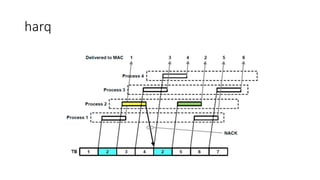
• HARQ is implemented to correct the erroneous packets coming from PHY layer. If the received data is
erroneous then the receiver buffers the data and requests for a re-transmission from the sender. When
the receiver receives the re-transmitted data, it then combines it with buffered data prior to channel
decoding and error detection. This helps in the performance of re-transmissions. For this to work, the
sending entity need to buffer the transmitted data until the ACK is received since the data needs to be
retransmitted in case a NACK is received.
• HARQ is a stop and wait (SAW) protocol with multiple processes. The protocol will continue to repair
one transmission without hindering other ongoing transmissions which can continue in parallel.
harq

Nr HARQ.pptx

  • 1.
  • 2.
    • MAC protocol:It implements a fast retransmission system with delay less than 1ms in new radio, called HARQ (Hybrid Automatic Repeat reQuest). • RLC protocol: Even though HARQ is present at MAC but there might still be some possibility of errors in the feedback system. So, for dealing with those errors, RLC has a slow retransmission system but with a feedback protected by CRC. Compared to the HARQ acknowledgments, the RLC status reports are transmitted relatively infrequently. • PDCP protocol: This will guarantee in-sequence delivery of user data and it is mainly used during handover as RLC and MAC buffers are flushed when a handover is executed. • NR uses an asynchronous hybrid-ARQ protocol in both downlink and uplink, that is, the hybrid-ARQ process which the downlink or uplink transmission relates to is explicitly signaled as part of the downlink control information (DCI). The hybrid-ARQ mechanism in the MAC layer targets very fast retransmissions and, consequently, feedback on success or failure of the downlink transmission is provided to the gNB after each received transport block (for uplink transmission no explicit feedback needs to be transmitted as the receiver and scheduler are in the same node). • HARQ is implemented to correct the erroneous packets coming from PHY layer. If the received data is erroneous then the receiver buffers the data and requests for a re-transmission from the sender. When the receiver receives the re-transmitted data, it then combines it with buffered data prior to channel decoding and error detection. This helps in the performance of re-transmissions. For this to work, the sending entity need to buffer the transmitted data until the ACK is received since the data needs to be retransmitted in case a NACK is received. • HARQ is a stop and wait (SAW) protocol with multiple processes. The protocol will continue to repair one transmission without hindering other ongoing transmissions which can continue in parallel.
  • 3.