Data and Computer
Communications
Eighth Edition
by William Stallings
Lecture slides by Lawrie Brown
Chapter 6 – Digital Data
Communications Techniques
Digital Data Communications
Techniques
 A conversation forms a two-way communication link;
there is a measure of symmetry between the two
parties, and messages pass to and fro. There is a
continual stimulus-response, cyclic action; remarks
call up other remarks, and the behavior of the two
individuals becomes concerted, co-operative, and
directed toward some goal. This is true
communication.
—On Human Communication, Colin Cherry
Asynchronous and
Synchronous Transmission
 timing problems require a mechanism to
synchronize the transmitter and receiver
 receiver samples stream at bit intervals
 if clocks not aligned and drifting will sample at
wrong time after sufficient bits are sent
 two solutions to synchronizing clocks
 asynchronous transmission
 synchronous transmission
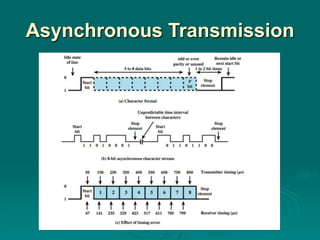
Asynchronous Transmission
Asynchronous - Behavior
 simple
 cheap
 overhead of 2 or 3 bits per char (~20%)
 good for data with large gaps (keyboard)
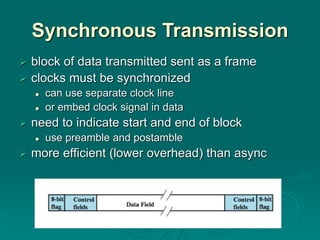
Synchronous Transmission
 block of data transmitted sent as a frame
 clocks must be synchronized
 can use separate clock line
 or embed clock signal in data
 need to indicate start and end of block
 use preamble and postamble
 more efficient (lower overhead) than async
Types of Error
 an error occurs when a bit is altered between
transmission and reception
 single bit errors
 only one bit altered
 caused by white noise
 burst errors
 contiguous sequence of B bits in which first last and
any number of intermediate bits in error
 caused by impulse noise or by fading in wireless
 effect greater at higher data rates
Error Detection
 will have errors
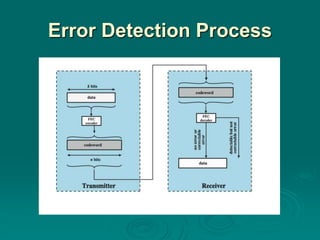
 detect using error-detecting code
 added by transmitter
 recalculated and checked by receiver
 still chance of undetected error
 parity
 parity bit set so character has even (even
parity) or odd (odd parity) number of ones
 even number of bit errors goes undetected
Error Detection Process
Cyclic Redundancy Check
 one of most common and powerful checks
 for block of k bits transmitter generates an
n bit frame check sequence (FCS)
 transmits k+n bits which is exactly divisible
by some number
 receiver divides frame by that number
 if no remainder, assume no error
 for math, see Stallings chapter 6
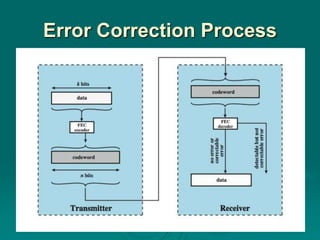
Error Correction
 correction of detected errors usually requires
data block to be retransmitted
 not appropriate for wireless applications
 bit error rate is high causing lots of retransmissions
 when propagation delay long (satellite) compared with
frame transmission time, resulting in retransmission of
frame in error plus many subsequent frames
 instead need to correct errors on basis of bits
received
 error correction provides this
Error Correction Process
How Error Correction Works
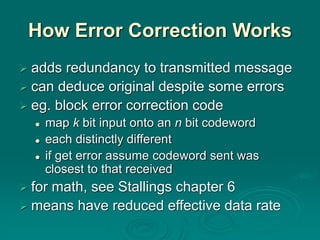
 adds redundancy to transmitted message
 can deduce original despite some errors
 eg. block error correction code
 map k bit input onto an n bit codeword
 each distinctly different
 if get error assume codeword sent was
closest to that received
 for math, see Stallings chapter 6
 means have reduced effective data rate
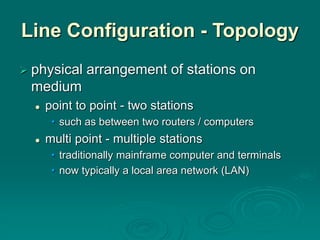
Line Configuration - Topology
 physical arrangement of stations on
medium
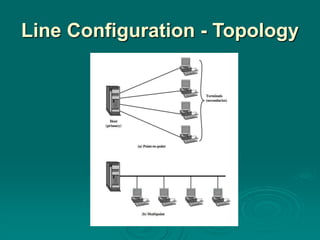
 point to point - two stations
• such as between two routers / computers
 multi point - multiple stations
• traditionally mainframe computer and terminals
• now typically a local area network (LAN)
Line Configuration - Topology
Line Configuration - Duplex
 classify data exchange as half or full duplex
 half duplex (two-way alternate)
 only one station may transmit at a time
 requires one data path
 full duplex (two-way simultaneous)
 simultaneous transmission and reception between
two stations
 requires two data paths
• separate media or frequencies used for each direction
 or echo canceling
Summary
 asynchronous verses synchronous
transmission
 error detection and correction
 line configuration issues

Digital Data Comm.ppt

  • 1.
    Data and Computer Communications EighthEdition by William Stallings Lecture slides by Lawrie Brown Chapter 6 – Digital Data Communications Techniques
  • 2.
    Digital Data Communications Techniques A conversation forms a two-way communication link; there is a measure of symmetry between the two parties, and messages pass to and fro. There is a continual stimulus-response, cyclic action; remarks call up other remarks, and the behavior of the two individuals becomes concerted, co-operative, and directed toward some goal. This is true communication. —On Human Communication, Colin Cherry
  • 3.
    Asynchronous and Synchronous Transmission timing problems require a mechanism to synchronize the transmitter and receiver  receiver samples stream at bit intervals  if clocks not aligned and drifting will sample at wrong time after sufficient bits are sent  two solutions to synchronizing clocks  asynchronous transmission  synchronous transmission
  • 4.
  • 5.
    Asynchronous - Behavior simple  cheap  overhead of 2 or 3 bits per char (~20%)  good for data with large gaps (keyboard)
  • 6.
    Synchronous Transmission  blockof data transmitted sent as a frame  clocks must be synchronized  can use separate clock line  or embed clock signal in data  need to indicate start and end of block  use preamble and postamble  more efficient (lower overhead) than async
  • 7.
    Types of Error an error occurs when a bit is altered between transmission and reception  single bit errors  only one bit altered  caused by white noise  burst errors  contiguous sequence of B bits in which first last and any number of intermediate bits in error  caused by impulse noise or by fading in wireless  effect greater at higher data rates
  • 8.
    Error Detection  willhave errors  detect using error-detecting code  added by transmitter  recalculated and checked by receiver  still chance of undetected error  parity  parity bit set so character has even (even parity) or odd (odd parity) number of ones  even number of bit errors goes undetected
  • 9.
  • 10.
    Cyclic Redundancy Check one of most common and powerful checks  for block of k bits transmitter generates an n bit frame check sequence (FCS)  transmits k+n bits which is exactly divisible by some number  receiver divides frame by that number  if no remainder, assume no error  for math, see Stallings chapter 6
  • 11.
    Error Correction  correctionof detected errors usually requires data block to be retransmitted  not appropriate for wireless applications  bit error rate is high causing lots of retransmissions  when propagation delay long (satellite) compared with frame transmission time, resulting in retransmission of frame in error plus many subsequent frames  instead need to correct errors on basis of bits received  error correction provides this
  • 12.
  • 13.
    How Error CorrectionWorks  adds redundancy to transmitted message  can deduce original despite some errors  eg. block error correction code  map k bit input onto an n bit codeword  each distinctly different  if get error assume codeword sent was closest to that received  for math, see Stallings chapter 6  means have reduced effective data rate
  • 14.
    Line Configuration -Topology  physical arrangement of stations on medium  point to point - two stations • such as between two routers / computers  multi point - multiple stations • traditionally mainframe computer and terminals • now typically a local area network (LAN)
  • 15.
  • 16.
    Line Configuration -Duplex  classify data exchange as half or full duplex  half duplex (two-way alternate)  only one station may transmit at a time  requires one data path  full duplex (two-way simultaneous)  simultaneous transmission and reception between two stations  requires two data paths • separate media or frequencies used for each direction  or echo canceling
  • 17.
    Summary  asynchronous versessynchronous transmission  error detection and correction  line configuration issues