Recommended
PPTX
PPTX
Complexity Classes.pptxfhasfuhaikfuahikhk
PPTX
Lecture 12A_NP-Completeness, P, NP, NPC, NP-Hard.pptx
PPTX
NP-Completeness-myppt.pptx
PPT
PDF
teteuueieoeofhfhfjffkkkfkfflflflhshssnnvmvvmvv,v,v,nnxmxxm
PDF
PDF
PDF
P, NP, NP-Hard & NP-complete problems, Optimization
PPT
PPTX
Webinar : P, NP, NP-Hard , NP - Complete problems
PPT
Introduction to NP Completeness
PDF
9. chapter 8 np hard and np complete problems
PPT
PDF
PPTX
P np & np completeness
PDF
np hard, np complete, polynomial and non polynomial
PDF
PPT
PPT
PDF
P, NP, NP-Complete, and NP-Hard
PDF
PPTX
Np completeness-Design and Analysis of Algorithms
PPT
PPTX
PPT
NP-Completeewwwwwwwwwwwkkjjejjwjjjjjjjjj
PPTX
PPTX
DAA_Hard_Problems_(4th_Sem).pptxxxxxxxxx
PPTX
Basic Volume Mass Relationship and unit weight as function of volumetric wate...
PDF
Decision-Support-Systems-and-Decision-Making-Processes.pdf
More Related Content
PPTX
PPTX
Complexity Classes.pptxfhasfuhaikfuahikhk
PPTX
Lecture 12A_NP-Completeness, P, NP, NPC, NP-Hard.pptx
PPTX
NP-Completeness-myppt.pptx
PPT
PDF
teteuueieoeofhfhfjffkkkfkfflflflhshssnnvmvvmvv,v,v,nnxmxxm
PDF
PDF
Similar to NP_Hard_NP_Complete_Presentation.pptxffs
PDF
P, NP, NP-Hard & NP-complete problems, Optimization
PPT
PPTX
Webinar : P, NP, NP-Hard , NP - Complete problems
PPT
Introduction to NP Completeness
PDF
9. chapter 8 np hard and np complete problems
PPT
PDF
PPTX
P np & np completeness
PDF
np hard, np complete, polynomial and non polynomial
PDF
PPT
PPT
PDF
P, NP, NP-Complete, and NP-Hard
PDF
PPTX
Np completeness-Design and Analysis of Algorithms
PPT
PPTX
PPT
NP-Completeewwwwwwwwwwwkkjjejjwjjjjjjjjj
PPTX
PPTX
DAA_Hard_Problems_(4th_Sem).pptxxxxxxxxx
Recently uploaded
PPTX
Basic Volume Mass Relationship and unit weight as function of volumetric wate...
PDF
Decision-Support-Systems-and-Decision-Making-Processes.pdf
PPTX
'LECTURE 7 - TYPES OF CONTRACTS_103902'.pptx
PPTX
Integrating Azure Event Services_ Event Grid, Event Hubs, and Service Bus.pptx
PDF
Fluid Mechanics, Heat Transfer, and Mass Transfer_ Chemical Engineering Pract...
PPTX
Fake News Detection System | Plagiarism detection
PPTX
Lubrication Neglect Causes More Downtime Than AI Ever Will Why Maintenance Fu...
PDF
Basic Thumb rule For switchgear Selection
PDF
JVM in the Age of AI: 2026 Edition - Deep Dive
PDF
0.39 Inch Micro-OLED Display 1024×768 XGA Panel Silicon OLED
PPTX
Origin of Soil and Grain Size with Introduction and explanation
PDF
Chris Elwell Woburn - An Experienced IT Executive
PDF
Day 01- Basic Knowledge for LPG system design.pdf
PPTX
35501622005_Sujay Samanta_Seminar22-26.pptx
PDF
Manual de instalacion de notifire NFS320
PDF
CME397 SURFACE ENGINEERING UNIT 1 FULL NOTES
PDF
ERTMS-conference-WS8_Presentations_v0.pdf
PPTX
Unit 3_statistical methods in data science.pptx
PPTX
Distresses in Road Flexible pavement.pptx
PPTX
We-Optimized-Everything-Except-Decision-Quality-Maintenance-MaintWiz.pptx
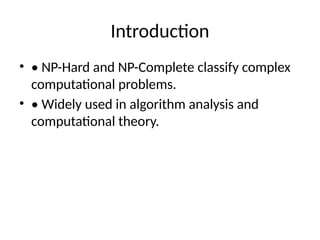
NP_Hard_NP_Complete_Presentation.pptxffs 1. 2. Introduction
• • NP-Hard and NP-Complete classify complex
computational problems.
• • Widely used in algorithm analysis and
computational theory.
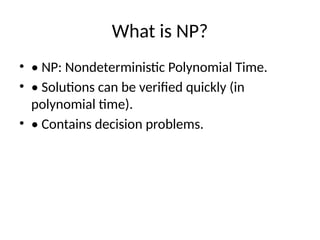
3. What is NP?
• • NP: Nondeterministic Polynomial Time.
• • Solutions can be verified quickly (in
polynomial time).
• • Contains decision problems.
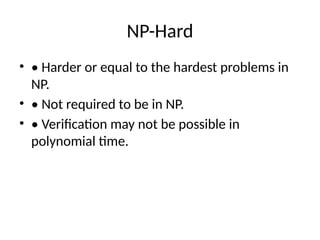
4. NP-Hard
• • Harder or equal to the hardest problems in
NP.
• • Not required to be in NP.
• • Verification may not be possible in
polynomial time.
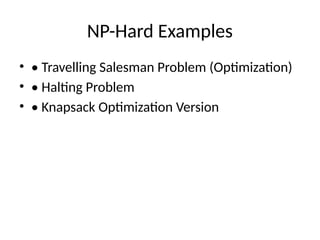
5. NP-Hard Examples
• • Travelling Salesman Problem (Optimization)
• • Halting Problem
• • Knapsack Optimization Version
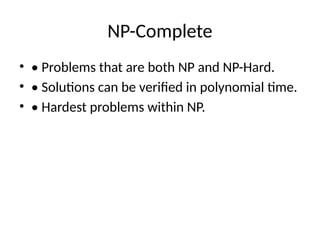
6. NP-Complete
• • Problems that are both NP and NP-Hard.
• • Solutions can be verified in polynomial time.
• • Hardest problems within NP.
7. 8. 9. Advantages
• • Helps classify computational problems by
difficulty.
• • Useful in optimization, AI, and algorithm
research.
• • Supports development of heuristics and
approximations.
10. Disadvantages
• • No known polynomial-time solution.
• • Very high computational cost.
• • Not suitable for real-time applications.
11. Conclusion
• • NP-Hard and NP-Complete are key concepts
in computational complexity.
• • They indicate the limits of fast algorithmic
solutions.