Jayson R. Sarin
Faculty, Mathematics and Science Division
jrsarin@urios.edu.ph
Implication, Biconditional
and Logical Equivalence
Father Saturnino Urios University
Arts and Sciences Program
GE 104: Mathematic in the Modern World
Connective # 4: Implication (symbol )
▰ If p and q are statement variables, the symbolic form of
“if p then q” is p q. This may also be read “p implies q”, “p only
if q or “if p, q”.
▰ Here p is called the hypothesis/antecedent statement and q is
called the conclusion/consequent statement.
▰ It is also called as conditional statement.
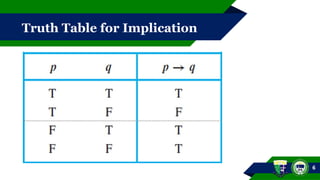
▰ “If p then q” is false when p is true and q is false, and it is true
otherwise.
▰ Note: p q is true if p is false, regardless of the truth of q.
2
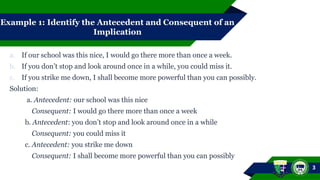
Example 1: Identify the Antecedent and Consequent of an
Implication
a. If our school was this nice, I would go there more than once a week.
b. If you don’t stop and look around once in a while, you could miss it.
c. If you strike me down, I shall become more powerful than you can possibly.
Solution:
a. Antecedent: our school was this nice
Consequent: I would go there more than once a week
b. Antecedent: you don’t stop and look around once in a while
Consequent: you could miss it
c. Antecedent: you strike me down
Consequent: I shall become more powerful than you can possibly
3
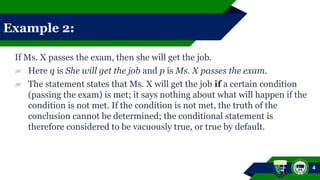
Example 2:
If Ms. X passes the exam, then she will get the job.
▰ Here q is She will get the job and p is Ms. X passes the exam.
▰ The statement states that Ms. X will get the job if a certain condition
(passing the exam) is met; it says nothing about what will happen if the
condition is not met. If the condition is not met, the truth of the
conclusion cannot be determined; the conditional statement is
therefore considered to be vacuously true, or true by default.
4
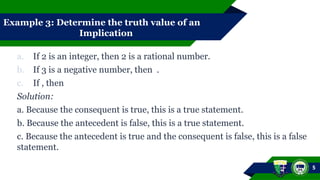
Example 3: Determine the truth value of an
Implication
a. If 2 is an integer, then 2 is a rational number.
b. If 3 is a negative number, then .
c. If , then
Solution:
a. Because the consequent is true, this is a true statement.
b. Because the antecedent is false, this is a true statement.
c. Because the antecedent is true and the consequent is false, this is a false
statement.
5
Truth Table for Implication
6
Connective # 5: Biconditional (symbol )
▰ If p and q are statement variables, the symbolic form
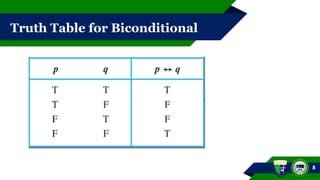
of “p if and only if q” is denoted by p q.
▰ It is true if both p and q have the same truth values.
▰ Note: p q is a short form for (p q) (q p)
7
Truth Table for Biconditional
8
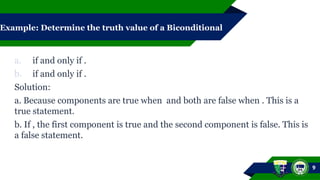
Example: Determine the truth value of a Biconditional
a. if and only if .
b. if and only if .
Solution:
a. Because components are true when and both are false when . This is a
true statement.
b. If , the first component is true and the second component is false. This is
a false statement.
9
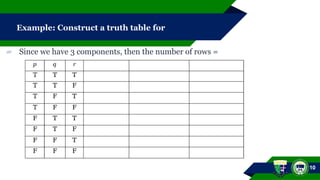
Example: Construct a truth table for
▰ Since we have 3 components, then the number of rows =
10
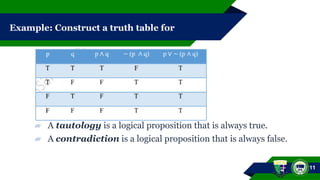
Example: Construct a truth table for
▰ A tautology is a logical proposition that is always true.
▰ A contradiction is a logical proposition that is always false.
11
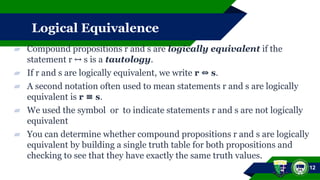
Logical Equivalence
▰ Compound propositions r and s are logically equivalent if the
statement r s is a
↔ tautology.
▰ If r and s are logically equivalent, we write r s
⇔ .
▰ A second notation often used to mean statements r and s are logically
equivalent is r s
≡ .
▰ We used the symbol or to indicate statements r and s are not logically
equivalent
▰ You can determine whether compound propositions r and s are logically
equivalent by building a single truth table for both propositions and
checking to see that they have exactly the same truth values.
12
Example 1:
Show that (p q) (q p) is logically equivalent to p q.
→ ∧ → ↔
Solution: Show the truth values of both propositions are identical.
13
It shows that [(p q) (q p)]
→ ∧ → (
⇔ p q)
↔ .
Example 2:
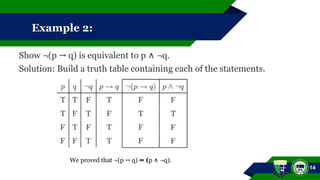
Show ¬(p q) is equivalent to p ¬q.
→ ∧
Solution: Build a truth table containing each of the statements.
14
We proved that ¬(p q)
→ (
⇔ p ¬q).
∧
The Converse, the Inverse, and the Contrapositive
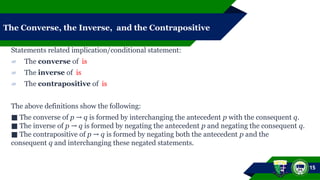
Statements related implication/conditional statement:
▰ The converse of is
▰ The inverse of is
▰ The contrapositive of is
The above definitions show the following:
■ The converse of p q
→ is formed by interchanging the antecedent p with the consequent q.
The inverse of
■ p q
→ is formed by negating the antecedent p and negating the consequent q.
The contrapositive of
■ p q
→ is formed by negating both the antecedent p and the
consequent q and interchanging these negated statements.
15
Example:
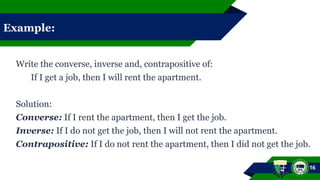
Write the converse, inverse and, contrapositive of:
If I get a job, then I will rent the apartment.
Solution:
Converse: If I rent the apartment, then I get the job.
Inverse: If I do not get the job, then I will not rent the apartment.
Contrapositive: If I do not rent the apartment, then I did not get the job.
16
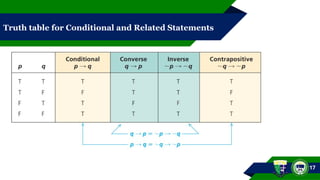
Truth table for Conditional and Related Statements
17
Example:
Solution:
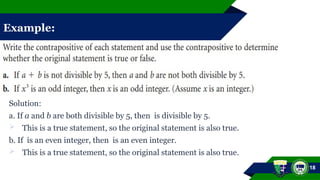
a. If a and b are both divisible by 5, then is divisible by 5.
 This is a true statement, so the original statement is also true.
b. If is an even integer, then is an even integer.
 This is a true statement, so the original statement is also true.
18
References:
Aufmann, R.N., Lockwood, J. S., Nation, R.D., Clegg, D.K. “Mathematical Excursions” (3rd
edition), Brooks Cole CENGAGE Learning
Baltazar, E. C., Ragasa, C., Evangelista, J. (2018). Mathematics in the Modern World. C & E
Publishing Inc.
Nocon, R. C., & Nocon, E.G. (2018).Essential Mathematics of the Modern World. C & E
Publishing Inc.
Kwong, H. (2021). A spiral Workbook for Discrete Mathematics, OpenSUNY, accessed 24
November 2021,
https://math.libretexts.org/Bookshelves/Combinatorics_and_Discrete_Mathematics/
A_Spiral_Workbook_for_Discrete_Mathematics_(Kwong)
19

Lecture_-_Logic_part_2.pptttttttttttttttt

  • 1.
    Jayson R. Sarin Faculty,Mathematics and Science Division jrsarin@urios.edu.ph Implication, Biconditional and Logical Equivalence Father Saturnino Urios University Arts and Sciences Program GE 104: Mathematic in the Modern World
  • 2.
    Connective # 4:Implication (symbol ) ▰ If p and q are statement variables, the symbolic form of “if p then q” is p q. This may also be read “p implies q”, “p only if q or “if p, q”. ▰ Here p is called the hypothesis/antecedent statement and q is called the conclusion/consequent statement. ▰ It is also called as conditional statement. ▰ “If p then q” is false when p is true and q is false, and it is true otherwise. ▰ Note: p q is true if p is false, regardless of the truth of q. 2
  • 3.
    Example 1: Identifythe Antecedent and Consequent of an Implication a. If our school was this nice, I would go there more than once a week. b. If you don’t stop and look around once in a while, you could miss it. c. If you strike me down, I shall become more powerful than you can possibly. Solution: a. Antecedent: our school was this nice Consequent: I would go there more than once a week b. Antecedent: you don’t stop and look around once in a while Consequent: you could miss it c. Antecedent: you strike me down Consequent: I shall become more powerful than you can possibly 3
  • 4.
    Example 2: If Ms.X passes the exam, then she will get the job. ▰ Here q is She will get the job and p is Ms. X passes the exam. ▰ The statement states that Ms. X will get the job if a certain condition (passing the exam) is met; it says nothing about what will happen if the condition is not met. If the condition is not met, the truth of the conclusion cannot be determined; the conditional statement is therefore considered to be vacuously true, or true by default. 4
  • 5.
    Example 3: Determinethe truth value of an Implication a. If 2 is an integer, then 2 is a rational number. b. If 3 is a negative number, then . c. If , then Solution: a. Because the consequent is true, this is a true statement. b. Because the antecedent is false, this is a true statement. c. Because the antecedent is true and the consequent is false, this is a false statement. 5
  • 6.
    Truth Table forImplication 6
  • 7.
    Connective # 5:Biconditional (symbol ) ▰ If p and q are statement variables, the symbolic form of “p if and only if q” is denoted by p q. ▰ It is true if both p and q have the same truth values. ▰ Note: p q is a short form for (p q) (q p) 7
  • 8.
    Truth Table forBiconditional 8
  • 9.
    Example: Determine thetruth value of a Biconditional a. if and only if . b. if and only if . Solution: a. Because components are true when and both are false when . This is a true statement. b. If , the first component is true and the second component is false. This is a false statement. 9
  • 10.
    Example: Construct atruth table for ▰ Since we have 3 components, then the number of rows = 10
  • 11.
    Example: Construct atruth table for ▰ A tautology is a logical proposition that is always true. ▰ A contradiction is a logical proposition that is always false. 11
  • 12.
    Logical Equivalence ▰ Compoundpropositions r and s are logically equivalent if the statement r s is a ↔ tautology. ▰ If r and s are logically equivalent, we write r s ⇔ . ▰ A second notation often used to mean statements r and s are logically equivalent is r s ≡ . ▰ We used the symbol or to indicate statements r and s are not logically equivalent ▰ You can determine whether compound propositions r and s are logically equivalent by building a single truth table for both propositions and checking to see that they have exactly the same truth values. 12
  • 13.
    Example 1: Show that(p q) (q p) is logically equivalent to p q. → ∧ → ↔ Solution: Show the truth values of both propositions are identical. 13 It shows that [(p q) (q p)] → ∧ → ( ⇔ p q) ↔ .
  • 14.
    Example 2: Show ¬(pq) is equivalent to p ¬q. → ∧ Solution: Build a truth table containing each of the statements. 14 We proved that ¬(p q) → ( ⇔ p ¬q). ∧
  • 15.
    The Converse, theInverse, and the Contrapositive Statements related implication/conditional statement: ▰ The converse of is ▰ The inverse of is ▰ The contrapositive of is The above definitions show the following: ■ The converse of p q → is formed by interchanging the antecedent p with the consequent q. The inverse of ■ p q → is formed by negating the antecedent p and negating the consequent q. The contrapositive of ■ p q → is formed by negating both the antecedent p and the consequent q and interchanging these negated statements. 15
  • 16.
    Example: Write the converse,inverse and, contrapositive of: If I get a job, then I will rent the apartment. Solution: Converse: If I rent the apartment, then I get the job. Inverse: If I do not get the job, then I will not rent the apartment. Contrapositive: If I do not rent the apartment, then I did not get the job. 16
  • 17.
    Truth table forConditional and Related Statements 17
  • 18.
    Example: Solution: a. If aand b are both divisible by 5, then is divisible by 5.  This is a true statement, so the original statement is also true. b. If is an even integer, then is an even integer.  This is a true statement, so the original statement is also true. 18
  • 19.
    References: Aufmann, R.N., Lockwood,J. S., Nation, R.D., Clegg, D.K. “Mathematical Excursions” (3rd edition), Brooks Cole CENGAGE Learning Baltazar, E. C., Ragasa, C., Evangelista, J. (2018). Mathematics in the Modern World. C & E Publishing Inc. Nocon, R. C., & Nocon, E.G. (2018).Essential Mathematics of the Modern World. C & E Publishing Inc. Kwong, H. (2021). A spiral Workbook for Discrete Mathematics, OpenSUNY, accessed 24 November 2021, https://math.libretexts.org/Bookshelves/Combinatorics_and_Discrete_Mathematics/ A_Spiral_Workbook_for_Discrete_Mathematics_(Kwong) 19