III. Rate of dissolving & Solubility A. Solubility is the ability of one thing to dissolve in another 1. miscible – able to dissolve 2. immiscible – unable to dissolve
3. “like dissolves like” so polar substances dissolve in other polar substances but not in nonpolar stuff a. salt (ionic & polar) dissolves in      water (polar) b. vitamin k (nonpolar) dissolves in    fat (nonpolar) c. oil (nonpolar) does not dissolve in    water (polar)
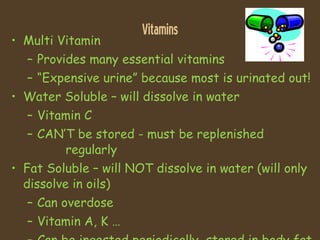
Vitamins Multi Vitamin Provides many essential vitamins “ Expensive urine” because most is urinated out! Water Soluble – will dissolve in water Vitamin C CAN’T be stored - must be replenished    regularly Fat Soluble – will NOT dissolve in water (will only dissolve in oils) Can overdose  Vitamin A, K … Can be ingested periodically, stored in body fat
B. Common ways to increase the rate of dissolving 1. Increase Temperature.  Increasing the temperature adds more energy and creates more collisions of solute and solvent to help  dissolve . a.  Ex:  dissolving sugar in Warm tea vs. cold tea
2. Increase surface area.  Smaller pieces dissolve more quickly because there are more places to interact between solvent and solute.  Pulverize = crush or smash  a. Ex:  Sugar packets vs. Sugar cubes
3. Increase  movement  (stirring).  By adding motion you add kinetic energy and move the solvent around to dissolve it.  a.  Ex:  Stirring the sugar into the tea vs. letting it dissolve on its own
C. Dissolving gases follow different rules 1. Gases dissolved in liquids prefer  lower  temperatures.  Cold soda has more carbonation than warm sodas
2. Prefer less movement, more movement lets the gas  escape  more easily.  Shaken sodas lose the dissolved gases quickly & so have fewer bubbles.
3. Increased Pressure increases rate of dissolving.  So when the bottle the soda they bottle it under higher pressure to keep the gas dissolved in it
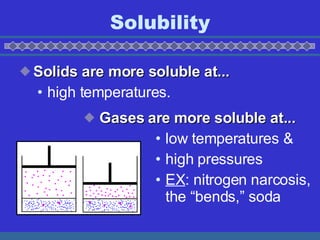
Solubility Solids are more soluble at... high temperatures. Gases are more soluble at... low temperatures & high pressures EX : nitrogen narcosis, the “bends,” soda
IV. Concentrations of solution – how “strong” or “weak” the solution is A. 3 types of solutions based on  concentration  of dissolved solute
1.  Unsaturated solution  – Solution that can easily dissolve more of the solute does not require an increase in temperature to add more solute.  a. Ex. Weak sweet tea or unconcentrated acid.
2.  Saturated solution  – Solution that has the maximum amount of solute dissolved for that temperature.  Any  change  in temperature will affect the concentration.
3.  Supersaturated solution  – Solution that has a higher concentration of solute than it normally would at that temperature.  It was heated up, come out of solution.  Typically can’t be disturbed or it will      crystallize.
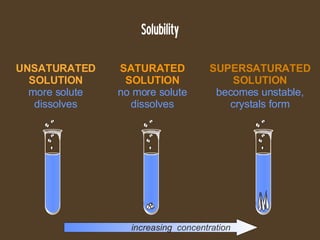
Solubility increasing  concentration SATURATED SOLUTION no more solute dissolves UNSATURATED SOLUTION more solute dissolves SUPERSATURATED SOLUTION becomes unstable, crystals form
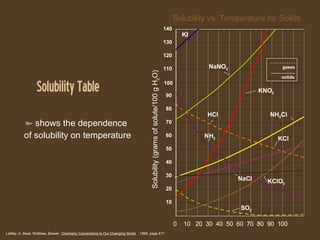
B. Solubility Chart 1. Shows how the solubility changes    at different temps
Solubility Table LeMay Jr, Beall, Robblee, Brower,  Chemistry Connections to Our Changing World  , 1996, page 517 0  10  20  30  40  50  60  70  80  90  100 Solubility vs. Temperature for Solids Solubility (grams of solute/100 g H 2 O) KI KCl 20 10 30 40 50 60 70 80 90 110 120 130 140 100 NaNO 3 KNO 3 HCl NH 4 Cl NH 3 NaCl KClO 3 SO 2 shows the dependence  of solubility on temperature gases solids
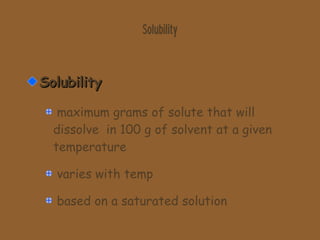
Solubility Solubility maximum grams of solute that will dissolve  in 100 g of solvent at a given temperature varies with temp based on a saturated solution
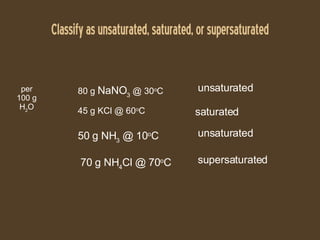
Classify as unsaturated, saturated, or supersaturated per 100 g H 2 O 80 g  NaNO 3  @ 30 o C unsaturated saturated unsaturated supersaturated 45 g KCl @ 60 o C 50 g NH 3  @ 10 o C 70 g NH 4 Cl @ 70 o C

Notes Solubility3

  • 1.
    III. Rate ofdissolving & Solubility A. Solubility is the ability of one thing to dissolve in another 1. miscible – able to dissolve 2. immiscible – unable to dissolve
  • 2.
    3. “like dissolveslike” so polar substances dissolve in other polar substances but not in nonpolar stuff a. salt (ionic & polar) dissolves in water (polar) b. vitamin k (nonpolar) dissolves in fat (nonpolar) c. oil (nonpolar) does not dissolve in water (polar)
  • 3.
    Vitamins Multi VitaminProvides many essential vitamins “ Expensive urine” because most is urinated out! Water Soluble – will dissolve in water Vitamin C CAN’T be stored - must be replenished regularly Fat Soluble – will NOT dissolve in water (will only dissolve in oils) Can overdose Vitamin A, K … Can be ingested periodically, stored in body fat
  • 4.
    B. Common waysto increase the rate of dissolving 1. Increase Temperature. Increasing the temperature adds more energy and creates more collisions of solute and solvent to help dissolve . a. Ex: dissolving sugar in Warm tea vs. cold tea
  • 5.
    2. Increase surfacearea. Smaller pieces dissolve more quickly because there are more places to interact between solvent and solute. Pulverize = crush or smash a. Ex: Sugar packets vs. Sugar cubes
  • 6.
    3. Increase movement (stirring). By adding motion you add kinetic energy and move the solvent around to dissolve it. a. Ex: Stirring the sugar into the tea vs. letting it dissolve on its own
  • 7.
    C. Dissolving gasesfollow different rules 1. Gases dissolved in liquids prefer lower temperatures. Cold soda has more carbonation than warm sodas
  • 8.
    2. Prefer lessmovement, more movement lets the gas escape more easily. Shaken sodas lose the dissolved gases quickly & so have fewer bubbles.
  • 9.
    3. Increased Pressureincreases rate of dissolving. So when the bottle the soda they bottle it under higher pressure to keep the gas dissolved in it
  • 10.
    Solubility Solids aremore soluble at... high temperatures. Gases are more soluble at... low temperatures & high pressures EX : nitrogen narcosis, the “bends,” soda
  • 11.
    IV. Concentrations ofsolution – how “strong” or “weak” the solution is A. 3 types of solutions based on concentration of dissolved solute
  • 12.
    1. Unsaturatedsolution – Solution that can easily dissolve more of the solute does not require an increase in temperature to add more solute. a. Ex. Weak sweet tea or unconcentrated acid.
  • 13.
    2. Saturatedsolution – Solution that has the maximum amount of solute dissolved for that temperature. Any change in temperature will affect the concentration.
  • 14.
    3. Supersaturatedsolution – Solution that has a higher concentration of solute than it normally would at that temperature. It was heated up, come out of solution. Typically can’t be disturbed or it will crystallize.
  • 15.
    Solubility increasing concentration SATURATED SOLUTION no more solute dissolves UNSATURATED SOLUTION more solute dissolves SUPERSATURATED SOLUTION becomes unstable, crystals form
  • 16.
    B. Solubility Chart1. Shows how the solubility changes at different temps
  • 17.
    Solubility Table LeMayJr, Beall, Robblee, Brower, Chemistry Connections to Our Changing World , 1996, page 517 0 10 20 30 40 50 60 70 80 90 100 Solubility vs. Temperature for Solids Solubility (grams of solute/100 g H 2 O) KI KCl 20 10 30 40 50 60 70 80 90 110 120 130 140 100 NaNO 3 KNO 3 HCl NH 4 Cl NH 3 NaCl KClO 3 SO 2 shows the dependence of solubility on temperature gases solids
  • 18.
    Solubility Solubility maximumgrams of solute that will dissolve in 100 g of solvent at a given temperature varies with temp based on a saturated solution
  • 19.
    Classify as unsaturated,saturated, or supersaturated per 100 g H 2 O 80 g NaNO 3 @ 30 o C unsaturated saturated unsaturated supersaturated 45 g KCl @ 60 o C 50 g NH 3 @ 10 o C 70 g NH 4 Cl @ 70 o C