The State of Information Fluency Issues, Questions, Directions
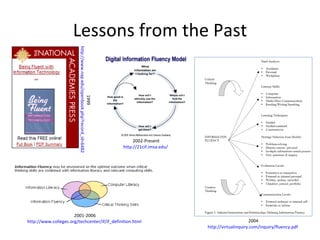
Lessons from the Past 1999 http://www.nap.edu/openbook.php?record_id=6482   2001-2006 http://www.colleges.org/techcenter/if/if_definition.html   2002-Present http://21cif.imsa.edu/   2004 http://virtualinquiry.com/inquiry/fluency.pdf
Similar, Recent, Emerging Models http://www.ala.org/ala/mgrps/divs/aasl/aaslproftools/learningstandards/AASL_LearningStandards.pdf   http://www.iste.org/Content/NavigationMenu/NETS/ForStudents/2007Standards/NETS_for_Students_2007_Standards.pdf   http://if.ucf.edu/ifaq.php
Library as Natural Habitat http://library.louisville.edu/infoliteracy/   Charles Kratz Dean of Libraries and Information Fluency University of Scranton http://www.edpath.com/images/IFReport2.pdf
Web Search in its Place
Relationship Between Digital Literacy and Information Fluency http://www.flickr.com/photos/xdmag/2496338119/
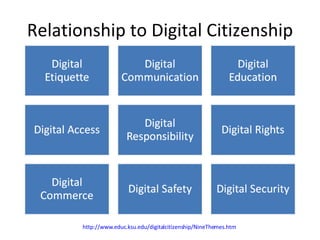
Relationship to Digital Citizenship http://www.educ.ksu.edu/digitalcitizenship/NineThemes.htm
Relationship to the PLE http://www.flickr.com/photos/5tein/2271568921/   http://eduspaces.net/csessums/files/1/9894/weblogbrainstorming.jpg   monkey
Multiple Literacies http://www.flickr.com/photos/lizgdesign/2296356113/
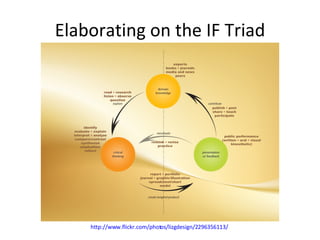
Elaborating on the IF Triad http://www.flickr.com/photos/lizgdesign/2296356113/
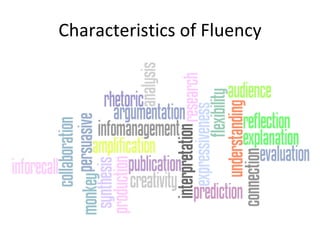
Characteristics of Fluency
Contemplation, Reflection and Speed http://www.flickr.com/photos/lizgdesign/2296356113/
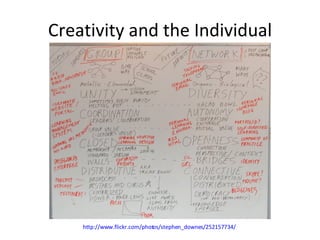
Creativity and the Individual http://www.flickr.com/photos/stephen_downes/252157734/
Let’s Do It http://www.flickr.com/photos/furnari/145165473/

Notes on Information Fluency

Editor's Notes

  • #2 Some thoughts about Information Fluency to guide us in the current development. Guidelines for this development: we are creating a 1-credit course that includes activities currently found in LS 101, but expanded and, most importantly, contextualized with an eye toward instilling basic concepts of information fluency. Clearly, this course could be 3 credits and still not cover all the possible ground that comprises Information Fluency, not to mention issues that arise from our target audience being those who are least likely to even know what their eventual academic discipline will be, much less be conversant enough with it to have an understanding of that discipline's specific information ecology (publications, info resources and repositories, active communities) and networks. Options beyond the 1-credit course include: creating 3 1-credit stacked units that expand on the concepts in (what I will call, for now) Information Fluency 101, creating a capstone course intended for seniors that would require them to delve into their discipline and community, or creating modules that are kind of a combination of the first two ideas.