Opener:

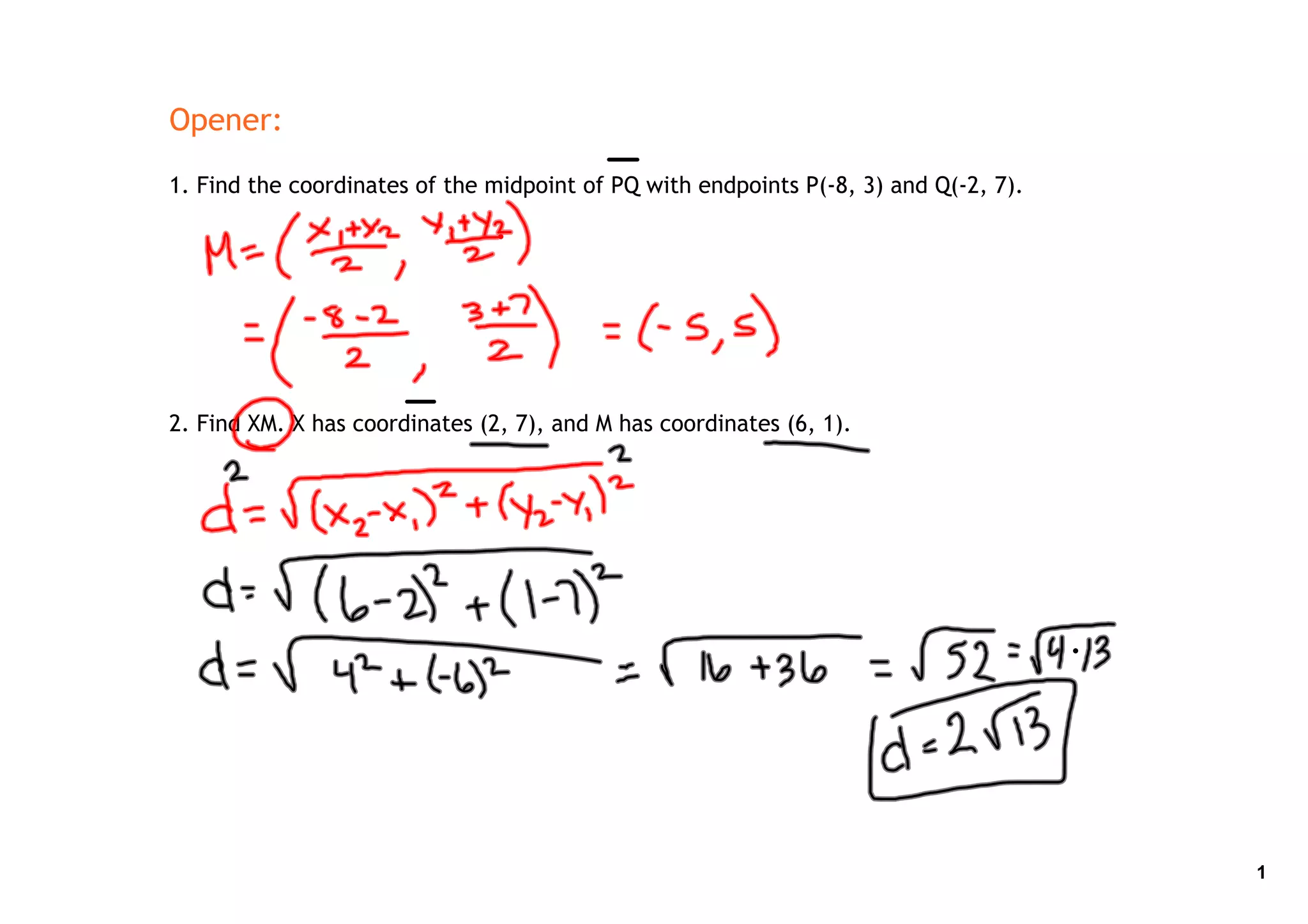
1. Find the coordinates of the midpoint of PQ with endpoints P(‐8, 3) and Q(‐2, 7).


2. Find XM. X has coordinates (2, 7), and M has coordinates (6, 1).


                                                                                      1
Extra Distance & Midpoint Practice:


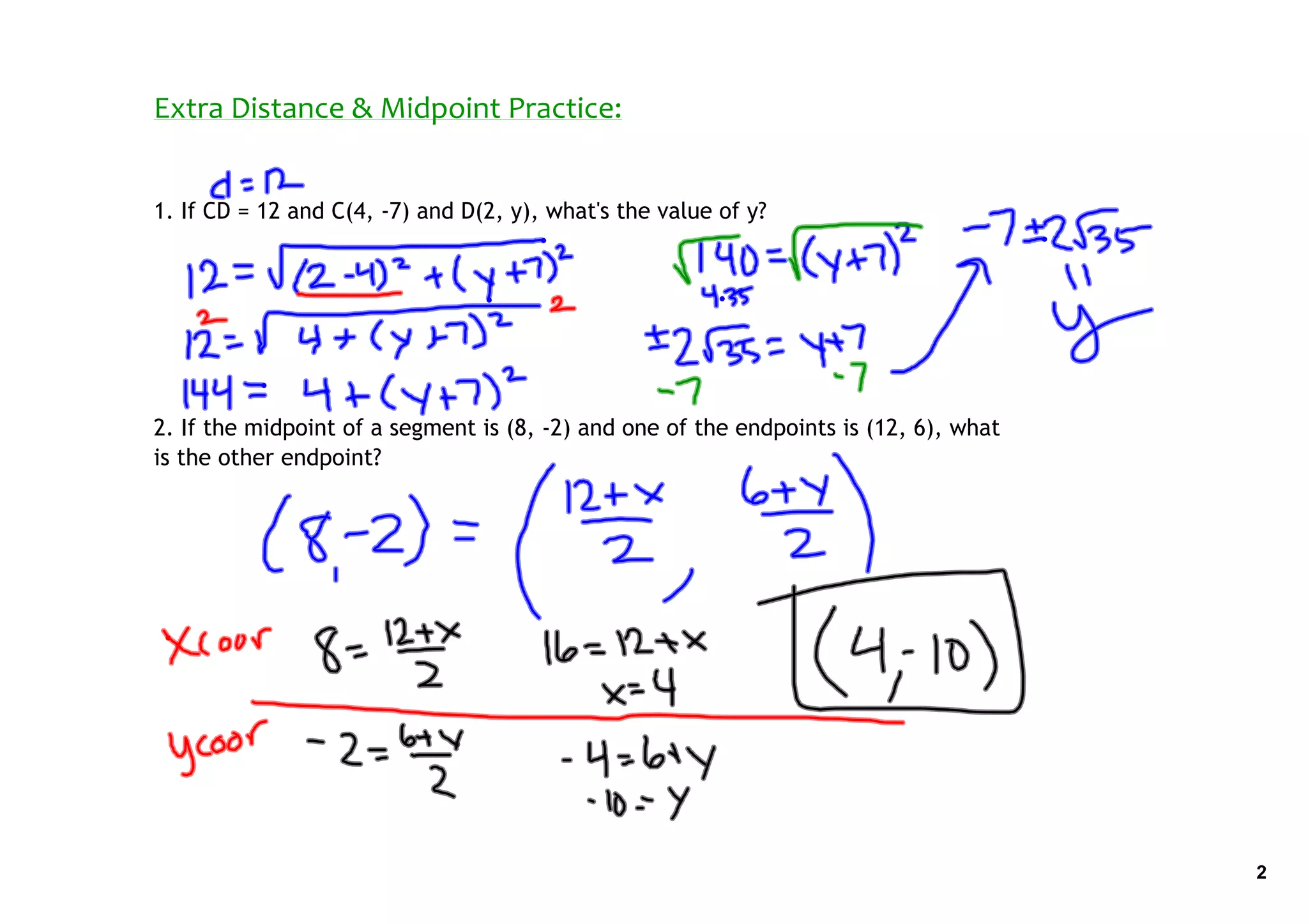
1. If CD = 12 and C(4, ‐7) and D(2, y), what's the value of y?


2. If the midpoint of a segment is (8, ‐2) and one of the endpoints is (12, 6), what
is the other endpoint?


                                                                                       2
Homework Add‐On:

   Choose at least 3 of the problems that you got deductions on from 
   your quiz.

   Write a new quiz problem that tests the same skill in a similar way 
   (using a quadratic for example in #15).

   Solve each problem, showing your work to demonstrate that you 
   understand your mistakes.

   If you do more than 3, you may receive some type of reward for your 
   efforts... 


                                                                          3
Section 1.7: Transformations in the Coordinate Plane

     Some vocabulary:

           1. Transformation: a change in the position,
                              size or shape of a figure

           2. Preimage: the original figure

           3. Image: the resulting figure after
                     the transformation

           4. Reflection: (flip) a transformation
                          across a line

           5. Rotation: (turn) a transformation
                        about a point

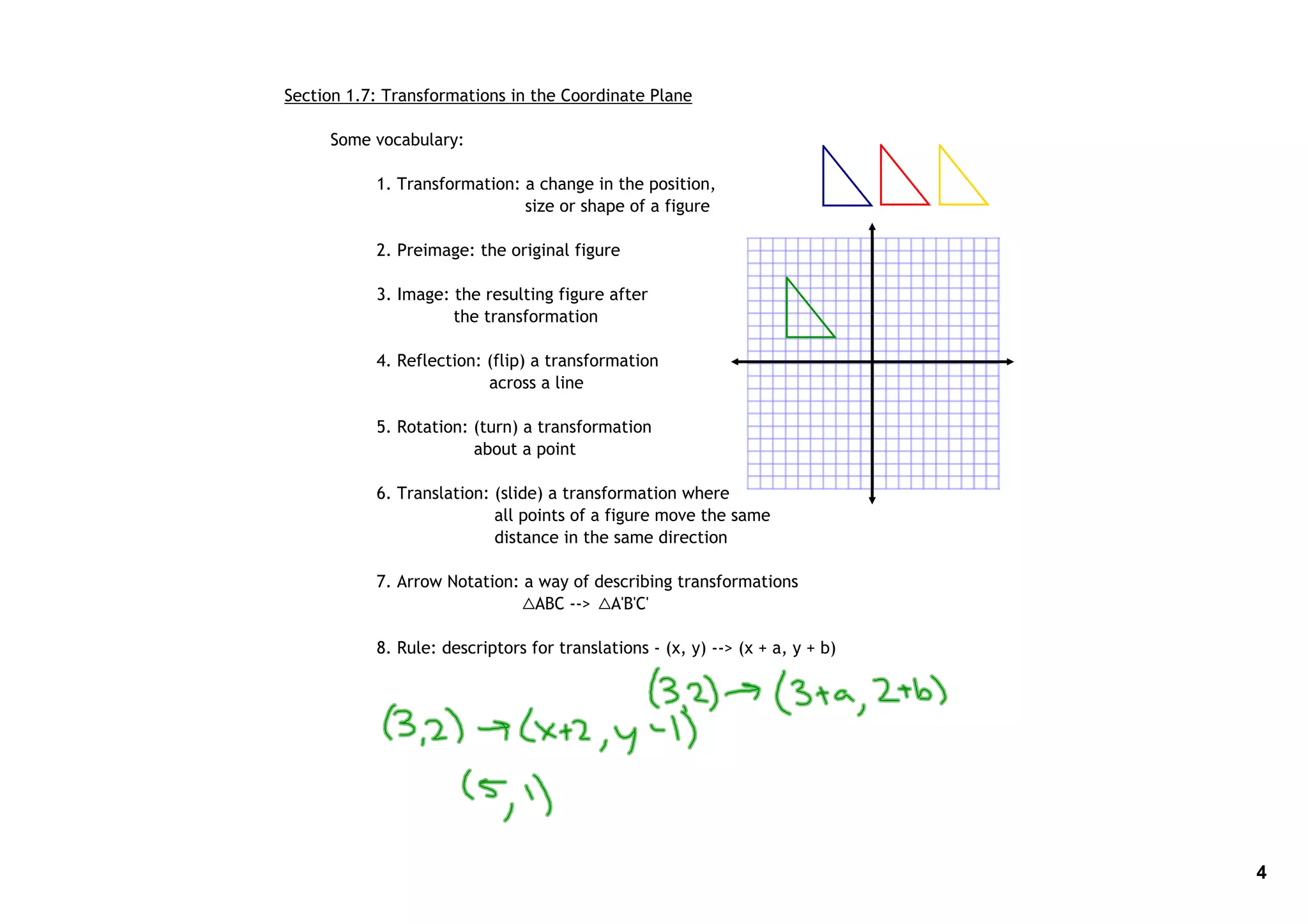
           6. Translation: (slide) a transformation where
                           all points of a figure move the same
                           distance in the same direction

           7. Arrow Notation: a way of describing transformations
                               ABC ‐‐> A'B'C'

           8. Rule: descriptors for translations ‐ (x, y) ‐‐> (x + a, y + b)


                                                                               4

Notes Day 6

  • 1.
    Opener: 1. Find thecoordinates of the midpoint of PQ with endpoints P(‐8, 3) and Q(‐2, 7). 2. Find XM. X has coordinates (2, 7), and M has coordinates (6, 1). 1
  • 2.
    Extra Distance & Midpoint Practice: 1. If CD= 12 and C(4, ‐7) and D(2, y), what's the value of y? 2. If the midpoint of a segment is (8, ‐2) and one of the endpoints is (12, 6), what is the other endpoint? 2
  • 3.
    Homework Add‐On: Choose at least 3 of the problems that you got deductions on from  your quiz. Write a new quiz problem that tests the same skill in a similar way  (using a quadratic for example in #15). Solve each problem, showing your work to demonstrate that you  understand your mistakes. If you do more than 3, you may receive some type of reward for your  efforts...  3
  • 4.
    Section 1.7: Transformationsin the Coordinate Plane Some vocabulary: 1. Transformation: a change in the position, size or shape of a figure 2. Preimage: the original figure 3. Image: the resulting figure after the transformation 4. Reflection: (flip) a transformation across a line 5. Rotation: (turn) a transformation about a point 6. Translation: (slide) a transformation where all points of a figure move the same distance in the same direction 7. Arrow Notation: a way of describing transformations ABC ‐‐> A'B'C' 8. Rule: descriptors for translations ‐ (x, y) ‐‐> (x + a, y + b) 4