

Adam Geller www.notebooksrock.org
The Why of Science Notebooks How to Create Science Notebooks Assessing Science Notebooks Using Science Notebooks Questions / Contact info
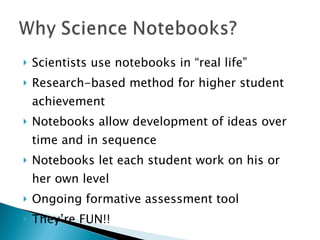
Scientists use notebooks in “real life” Research-based method for higher student achievement Notebooks allow development of ideas over time and in sequence Notebooks let each student work on his or her own level Ongoing formative assessment tool They’re FUN!!
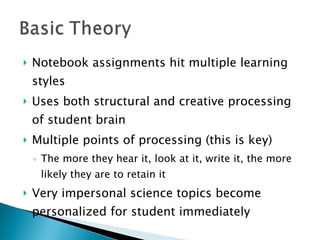
Notebook assignments hit multiple learning styles  Uses both structural and creative processing of student brain Multiple points of processing (this is key) The more they hear it, look at it, write it, the more likely they are to retain it Very impersonal science topics become personalized for student immediately
The Why of Science Notebooks How to Create Science Notebooks Assessing Science Notebooks Make and Take (if time) Questions / Contact info
My format is standardized for all students Some teachers take a  laissez faire  approach to organization and structure… your choice (however, not recommended)
Easy to tell at a glance what is missing Simple way for any student to find out what was done when absent (there are X other students with same notebook) Faster to grade… they’re all the same Teacher’s copy can be general template without any answers Side benefit: teaches organization, planning and structure
Nearly impossible to coordinate purchase and selling of an excellent quality notebook A copy shop will produce, staple and deliver to your door! Template files are production-ready and exist for all core subjects  Note bene : Buy a heavy-duty stapler to reinforce the copier staples
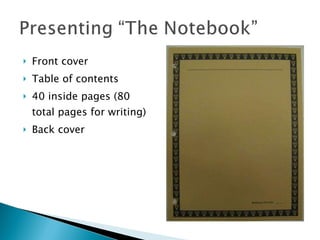
Front cover Table of contents 40 inside pages (80 total pages for writing) Back cover
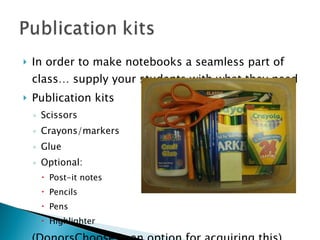
In order to make notebooks a seamless part of class… supply your students with what they need Publication kits Scissors Crayons/markers Glue Optional: Post-it notes Pencils Pens Highlighter (DonorsChoose is an option for acquiring this)
The Why of Science Notebooks How to Create Science Notebooks Assessing Science Notebooks Using Science Notebooks Questions / Contact info
Collecting notebooks would be a horrible idea because it would take horribly long to grade Develop your own assessment philosophy Decide what the notebook represents Decide how much weight it will have in the grade Determine whether completing an assignment fulfills the purpose of the notebook for your class
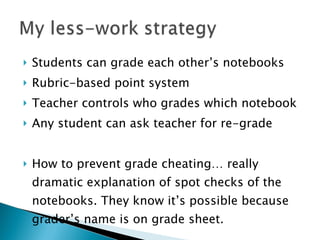
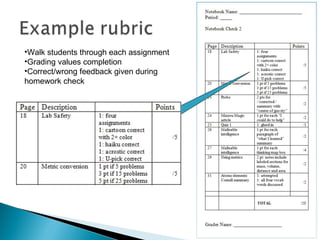
Students can grade each other’s notebooks Rubric-based point system Teacher controls who grades which notebook Any student can ask teacher for re-grade How to prevent grade cheating… really dramatic explanation of spot checks of the notebooks. They know it’s possible because grader’s name is on grade sheet.
Walk students through each assignment Grading values completion Correct/wrong feedback given during homework check
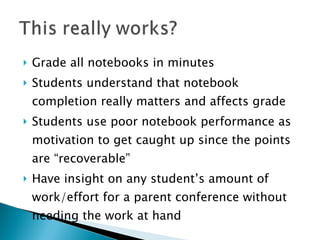
Grade all notebooks in minutes Students understand that notebook completion really matters and affects grade Students use poor notebook performance as motivation to get caught up since the points are “recoverable” Have insight on any student’s amount of work/effort for a parent conference without needing the work at hand
The Why of Science Notebooks How to Create Science Notebooks Assessing Science Notebooks Using Science Notebooks Questions / Contact info
Remember that we must TEACH our students about the notebooks just like any other system or procedure in the classroom Time spent at the beginning of the year on teaching the method and system will save countless time throughout the year Habit of mind
Everything.
Notes Quizzes Homework Lab data Worksheets Foldables Progress reports Syllabus


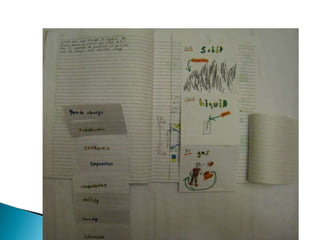
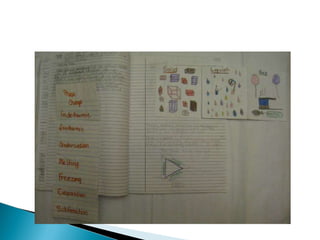
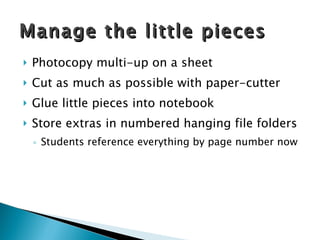
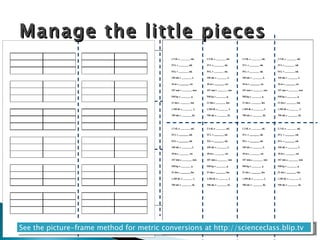
Photocopy multi-up on a sheet Cut as much as possible with paper-cutter Glue little pieces into notebook Store extras in numbered hanging file folders Students reference everything by page number now Manage the little pieces
See the picture-frame method for metric conversions at http://scienceclass.blip.tv Manage the little pieces
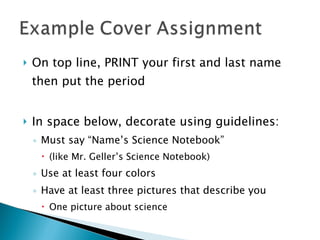
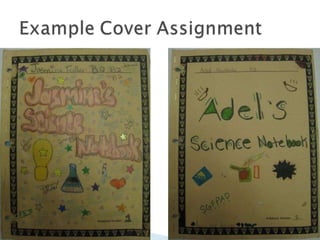
On top line, PRINT your first and last name then put the period In space below, decorate using guidelines: Must say “Name’s Science Notebook”  (like Mr. Geller’s Science Notebook) Use at least four colors Have at least three pictures that describe you One picture about science
 
Right hand side = odd Left hand side = even Have students label pages in chunks! Prevents tearing out pages because they’re all expected to be there Numbering pages
Must model this for students before it will be a procedure and ultimately a habit Students can learn to take the topic from the notes, or from somewhere on board/PowerPoint
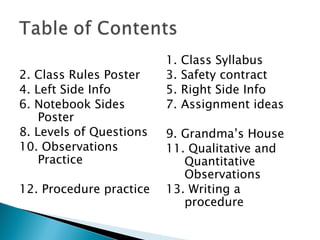
2. Class Rules Poster 4. Left Side Info 6. Notebook Sides Poster 8. Levels of Questions 10. Observations Practice 12. Procedure practice 1. Class Syllabus 3. Safety contract 5. Right Side Info 7. Assignment ideas 9. Grandma’s House 11. Qualitative and Quantitative Observations 13. Writing a procedure
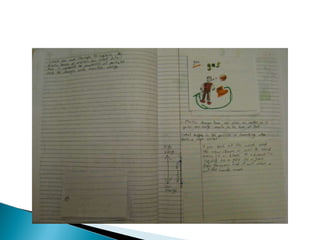
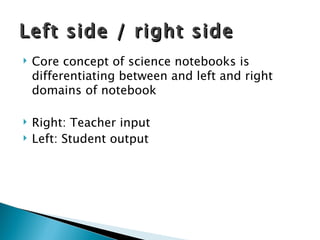
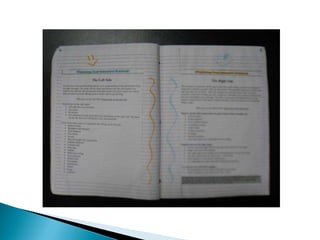
Left side / right side Core concept of science notebooks is differentiating between and left and right domains of notebook Right: Teacher input Left: Student output
 
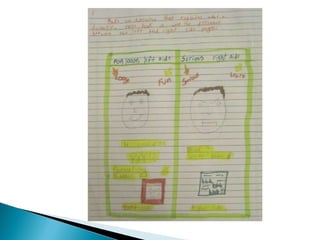
Example of a processing assignment for homework: Create a poster to illustrate the difference between a left and right side page of the notebook Must use at least four colors (Generally speaking, I always required at least four colors for credit) Student output for everything
 
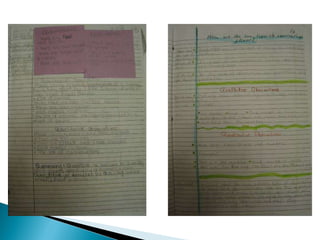
Cornell notes are good for kids You can incorporate them into any of your lessons with same note-taking strategies Cornell notes in the notebook Cuts prep Saves paper Builds note-taking skills for kids
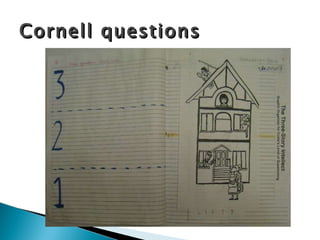
Grandma’s house: Mechanism to teach Cornell questioning (Hey… every page is set up for Cornell notes!) This is Costa’s three levels of questioning Cornell questions
Cornell questions
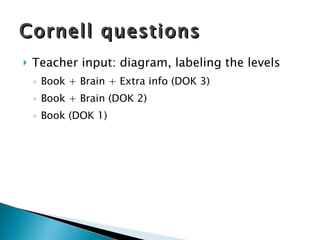
Teacher input: diagram, labeling the levels  Book + Brain + Extra info (DOK 3) Book + Brain (DOK 2) Book (DOK 1) Cornell questions
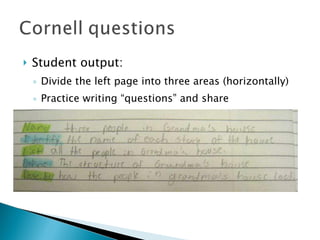
Student output:  Divide the left page into three areas (horizontally) Practice writing “questions” and share
STAR method S = Set it up (title, date) T = Take notes A = Ask questions R = Review and summarize*  *once per lesson, not page Great intro lesson for Cornell practice is “Qualitative and quantitative observations” All skills should be through the context of content Cornell procedure
 
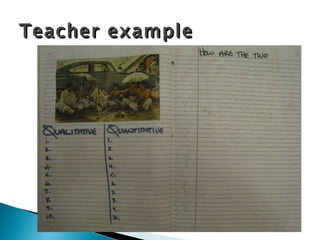
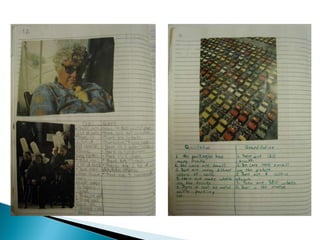
Student output assignment: Cut out any picture from a magazine Make a T-chart under the picture Qualitative – left side Quantitative – right side 5 observations for each column Processing opportunity
Teacher example
 
Each student has ownership Each assignment is not able to be copied from another student Even if the students help each other, they still have individualized product E A S Y  to spot check homework and provide feedback within seconds (I have a system that can help)
The Why of Science Notebooks How to Create Science Notebooks Assessing Science Notebooks Using Science Notebooks Questions / Contact info
Templates, example assignments, etc http://www.notebooksrock.org Adam Geller [email_address]

Notebooks Rock

  • 1.
  • 2.
    The Why ofScience Notebooks How to Create Science Notebooks Assessing Science Notebooks Using Science Notebooks Questions / Contact info
  • 3.
    The Why ofScience Notebooks How to Create Science Notebooks Assessing Science Notebooks Using Science Notebooks Questions / Contact info
  • 4.
    Scientists use notebooksin “real life” Research-based method for higher student achievement Notebooks allow development of ideas over time and in sequence Notebooks let each student work on his or her own level Ongoing formative assessment tool They’re FUN!!
  • 5.
    Notebook assignments hitmultiple learning styles Uses both structural and creative processing of student brain Multiple points of processing (this is key) The more they hear it, look at it, write it, the more likely they are to retain it Very impersonal science topics become personalized for student immediately
  • 6.
    The Why ofScience Notebooks How to Create Science Notebooks Assessing Science Notebooks Make and Take (if time) Questions / Contact info
  • 7.
    My format isstandardized for all students Some teachers take a laissez faire approach to organization and structure… your choice (however, not recommended)
  • 8.
    Easy to tellat a glance what is missing Simple way for any student to find out what was done when absent (there are X other students with same notebook) Faster to grade… they’re all the same Teacher’s copy can be general template without any answers Side benefit: teaches organization, planning and structure
  • 9.
    Nearly impossible tocoordinate purchase and selling of an excellent quality notebook A copy shop will produce, staple and deliver to your door! Template files are production-ready and exist for all core subjects Note bene : Buy a heavy-duty stapler to reinforce the copier staples
  • 10.
    Front cover Tableof contents 40 inside pages (80 total pages for writing) Back cover
  • 11.
    In order tomake notebooks a seamless part of class… supply your students with what they need Publication kits Scissors Crayons/markers Glue Optional: Post-it notes Pencils Pens Highlighter (DonorsChoose is an option for acquiring this)
  • 12.
    The Why ofScience Notebooks How to Create Science Notebooks Assessing Science Notebooks Using Science Notebooks Questions / Contact info
  • 13.
    Collecting notebooks wouldbe a horrible idea because it would take horribly long to grade Develop your own assessment philosophy Decide what the notebook represents Decide how much weight it will have in the grade Determine whether completing an assignment fulfills the purpose of the notebook for your class
  • 14.
    Students can gradeeach other’s notebooks Rubric-based point system Teacher controls who grades which notebook Any student can ask teacher for re-grade How to prevent grade cheating… really dramatic explanation of spot checks of the notebooks. They know it’s possible because grader’s name is on grade sheet.
  • 15.
    Walk students througheach assignment Grading values completion Correct/wrong feedback given during homework check
  • 16.
    Grade all notebooksin minutes Students understand that notebook completion really matters and affects grade Students use poor notebook performance as motivation to get caught up since the points are “recoverable” Have insight on any student’s amount of work/effort for a parent conference without needing the work at hand
  • 17.
    The Why ofScience Notebooks How to Create Science Notebooks Assessing Science Notebooks Using Science Notebooks Questions / Contact info
  • 18.
    Remember that wemust TEACH our students about the notebooks just like any other system or procedure in the classroom Time spent at the beginning of the year on teaching the method and system will save countless time throughout the year Habit of mind
  • 19.
  • 20.
    Notes Quizzes HomeworkLab data Worksheets Foldables Progress reports Syllabus
  • 21.
  • 22.
  • 23.
  • 24.
  • 25.
    Photocopy multi-up ona sheet Cut as much as possible with paper-cutter Glue little pieces into notebook Store extras in numbered hanging file folders Students reference everything by page number now Manage the little pieces
  • 26.
    See the picture-framemethod for metric conversions at http://scienceclass.blip.tv Manage the little pieces
  • 27.
    On top line,PRINT your first and last name then put the period In space below, decorate using guidelines: Must say “Name’s Science Notebook” (like Mr. Geller’s Science Notebook) Use at least four colors Have at least three pictures that describe you One picture about science
  • 28.
  • 29.
    Right hand side= odd Left hand side = even Have students label pages in chunks! Prevents tearing out pages because they’re all expected to be there Numbering pages
  • 30.
    Must model thisfor students before it will be a procedure and ultimately a habit Students can learn to take the topic from the notes, or from somewhere on board/PowerPoint
  • 31.
    2. Class RulesPoster 4. Left Side Info 6. Notebook Sides Poster 8. Levels of Questions 10. Observations Practice 12. Procedure practice 1. Class Syllabus 3. Safety contract 5. Right Side Info 7. Assignment ideas 9. Grandma’s House 11. Qualitative and Quantitative Observations 13. Writing a procedure
  • 32.
    Left side /right side Core concept of science notebooks is differentiating between and left and right domains of notebook Right: Teacher input Left: Student output
  • 33.
  • 34.
    Example of aprocessing assignment for homework: Create a poster to illustrate the difference between a left and right side page of the notebook Must use at least four colors (Generally speaking, I always required at least four colors for credit) Student output for everything
  • 35.
  • 36.
    Cornell notes aregood for kids You can incorporate them into any of your lessons with same note-taking strategies Cornell notes in the notebook Cuts prep Saves paper Builds note-taking skills for kids
  • 37.
    Grandma’s house: Mechanismto teach Cornell questioning (Hey… every page is set up for Cornell notes!) This is Costa’s three levels of questioning Cornell questions
  • 38.
  • 39.
    Teacher input: diagram,labeling the levels Book + Brain + Extra info (DOK 3) Book + Brain (DOK 2) Book (DOK 1) Cornell questions
  • 40.
    Student output: Divide the left page into three areas (horizontally) Practice writing “questions” and share
  • 41.
    STAR method S= Set it up (title, date) T = Take notes A = Ask questions R = Review and summarize* *once per lesson, not page Great intro lesson for Cornell practice is “Qualitative and quantitative observations” All skills should be through the context of content Cornell procedure
  • 42.
  • 43.
    Student output assignment:Cut out any picture from a magazine Make a T-chart under the picture Qualitative – left side Quantitative – right side 5 observations for each column Processing opportunity
  • 44.
  • 45.
  • 46.
    Each student hasownership Each assignment is not able to be copied from another student Even if the students help each other, they still have individualized product E A S Y to spot check homework and provide feedback within seconds (I have a system that can help)
  • 47.
    The Why ofScience Notebooks How to Create Science Notebooks Assessing Science Notebooks Using Science Notebooks Questions / Contact info
  • 48.
    Templates, example assignments,etc http://www.notebooksrock.org Adam Geller [email_address]