SS112 Interpersonal 
Cross Cultural 
Communication 
Week 5
Congratulations!!! 
• You have completed 
the first four chapters 
(Part 1) of your 
textbook. 
• There will be a test on 
Part 1 next week. 
• So let’s review!!!
Part One-Communication Across Cultures 
• Provides a foundation for understanding the process 
of multicultural communication. 
• Defines key terms such as communication, culture, 
and intercultural communication. 
• Describes cultural variations in behavior as they 
pertain to the United States and other parts of the 
world. 
• Introduces conceptual models of communication and 
intercultural communication. 
• Introduces various verbal and nonverbal 
communication patterns. 
.
Part One-Communication Across Cultures 
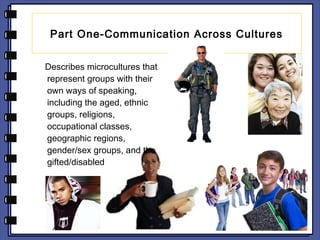
Describes microcultures that 
represent groups with their 
own ways of speaking, 
including the aged, ethnic 
groups, religions, 
occupational classes, 
geographic regions, 
gender/sex groups, and the 
gifted/disabled
After studying chapter 1, you should be able 
to: 
• Relate examples of diversity at home and abroad. 
• Describe globalization and information technology. 
• Be aware that diversity can lead to conflict. 
• Know what intercultural competence involves, 
• Understand how the field of intercultural 
communication study developed in the U.S.A. 
• Know why you should study intercultural 
communication. 
• Explain the origins of intercultural contact,
After studying chapter 2, you should be able 
to: 
• Define culture in several ways—in the classical 
tradition, in a very broad manner and in a narrower 
sense. 
• Describe the general characteristics of culture. 
• Explain what causes cultures to change 
• Recognize the universal characteristics of culture. 
• Understand the value orientation system for 
comparing cultures
After studying chapter 3, you should be able 
to: 
• Distinguish between oral and mediated 
communication. 
• Define oral communication and differentiate between 
verbal and nonverbal forms. 
• Explain the communication process and how its 
elements interrelate 
• Understand the impact of mediated communication 
on intercultural encounters.
After studying chapter 4, you should be able 
to: 
• Differentiate between macro-culture, micro- culture, 
subculture and co-culture. 
• Describe the dominate U.S.A. macro-culture and 
other microcultures. 
• Explain a person’s membership in several 
microcultures. 
• Define intercultural communication and note culture’s 
impact on communication. 
• Identify and explain six axioms about intercultural 
communication. 
• Name and define the divisions related to intercultural 
communication. 
• Group cultures according to their similarities.

Notebook ss112-week five

  • 1.
    SS112 Interpersonal CrossCultural Communication Week 5
  • 2.
    Congratulations!!! • Youhave completed the first four chapters (Part 1) of your textbook. • There will be a test on Part 1 next week. • So let’s review!!!
  • 3.
    Part One-Communication AcrossCultures • Provides a foundation for understanding the process of multicultural communication. • Defines key terms such as communication, culture, and intercultural communication. • Describes cultural variations in behavior as they pertain to the United States and other parts of the world. • Introduces conceptual models of communication and intercultural communication. • Introduces various verbal and nonverbal communication patterns. .
  • 4.
    Part One-Communication AcrossCultures Describes microcultures that represent groups with their own ways of speaking, including the aged, ethnic groups, religions, occupational classes, geographic regions, gender/sex groups, and the gifted/disabled
  • 5.
    After studying chapter1, you should be able to: • Relate examples of diversity at home and abroad. • Describe globalization and information technology. • Be aware that diversity can lead to conflict. • Know what intercultural competence involves, • Understand how the field of intercultural communication study developed in the U.S.A. • Know why you should study intercultural communication. • Explain the origins of intercultural contact,
  • 6.
    After studying chapter2, you should be able to: • Define culture in several ways—in the classical tradition, in a very broad manner and in a narrower sense. • Describe the general characteristics of culture. • Explain what causes cultures to change • Recognize the universal characteristics of culture. • Understand the value orientation system for comparing cultures
  • 7.
    After studying chapter3, you should be able to: • Distinguish between oral and mediated communication. • Define oral communication and differentiate between verbal and nonverbal forms. • Explain the communication process and how its elements interrelate • Understand the impact of mediated communication on intercultural encounters.
  • 8.
    After studying chapter4, you should be able to: • Differentiate between macro-culture, micro- culture, subculture and co-culture. • Describe the dominate U.S.A. macro-culture and other microcultures. • Explain a person’s membership in several microcultures. • Define intercultural communication and note culture’s impact on communication. • Identify and explain six axioms about intercultural communication. • Name and define the divisions related to intercultural communication. • Group cultures according to their similarities.