
Note Taking Skills
By
Miss Thanchanok Insamian
No.11

TESOL7
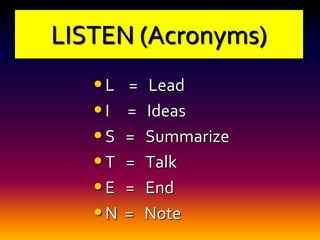
LISTEN (Acronyms)
•L
•I
•S
•T
•E
•N

=
=
=
=
=
=

Lead
Ideas
Summarize
Talk
End
Note
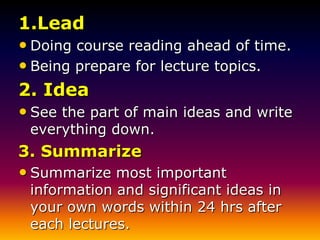
1.Lead
• Doing course reading ahead of time.
• Being prepare for lecture topics.
2. Idea
• See the part of main ideas and write
everything down.

3. Summarize

• Summarize most important

information and significant ideas in
your own words within 24 hrs after
each lectures.
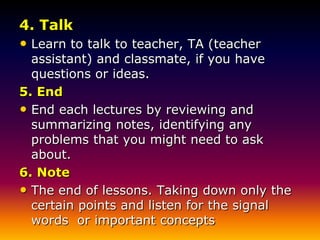
4. Talk
• Learn to talk to teacher, TA (teacher

assistant) and classmate, if you have
questions or ideas.
5. End
• End each lectures by reviewing and
summarizing notes, identifying any
problems that you might need to ask
about.
6. Note
• The end of lessons. Taking down only the
certain points and listen for the signal
words or important concepts
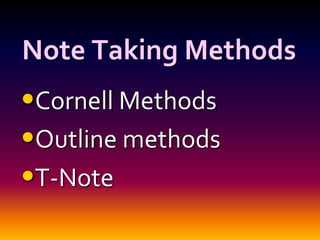
Note Taking Methods

•Cornell Methods
•Outline methods
•T-Note
Cornell Methods
• Cornell Methods: involves

dividing a sheet of paper into
three parts: main ideas (key
words), details and summary.
Outline methods
Outline methods:
good for showing major points
and supporting ideas
T-Note
• T-Note: Useful for problem-based

classes such as math and
engineering. T-Note involves
diving a sheet of paper into two
parts: Writing term, equations,
formula, theories on the left hand
side
5 Rs!
• Record: Recording your notes.
• Reduce: Reducing them to key points and

summarize them into your own words.
• Recite: Reciting the information out loud can help
you retain information.
• Reflect: Reflecting how information in the note
relate to the course objectives even the course of
study and help them make critical connection.
• Review: Reviewing the notes the same day of
class. Summarize the note onto the single sheet
at the end of each weeks. Then review each
sheets before the exam.

Note taking skills

  • 1.
    Note Taking Skills By MissThanchanok Insamian No.11 TESOL7
  • 2.
  • 3.
    1.Lead • Doing coursereading ahead of time. • Being prepare for lecture topics. 2. Idea • See the part of main ideas and write everything down. 3. Summarize • Summarize most important information and significant ideas in your own words within 24 hrs after each lectures.
  • 4.
    4. Talk • Learnto talk to teacher, TA (teacher assistant) and classmate, if you have questions or ideas. 5. End • End each lectures by reviewing and summarizing notes, identifying any problems that you might need to ask about. 6. Note • The end of lessons. Taking down only the certain points and listen for the signal words or important concepts
  • 5.
    Note Taking Methods •CornellMethods •Outline methods •T-Note
  • 6.
    Cornell Methods • CornellMethods: involves dividing a sheet of paper into three parts: main ideas (key words), details and summary.
  • 7.
    Outline methods Outline methods: goodfor showing major points and supporting ideas
  • 8.
    T-Note • T-Note: Usefulfor problem-based classes such as math and engineering. T-Note involves diving a sheet of paper into two parts: Writing term, equations, formula, theories on the left hand side
  • 9.
    5 Rs! • Record:Recording your notes. • Reduce: Reducing them to key points and summarize them into your own words. • Recite: Reciting the information out loud can help you retain information. • Reflect: Reflecting how information in the note relate to the course objectives even the course of study and help them make critical connection. • Review: Reviewing the notes the same day of class. Summarize the note onto the single sheet at the end of each weeks. Then review each sheets before the exam.