Business Plans: A Roadmap
For You
Your presenter
Mark Lieberman
SCORE
► About SCORE
► Educational programs
► One-on-one counseling
► Mentoring
► Consulting
► We offer, you choose
If You Have to Leave Now …
4 Links You Should Have
➢Me:Mark.Lieberman01@gmail.com
➢MyLinkedin:linkedin.com/in/liebermanmak
➢SCORE Local: www.scorechicago.org
➢SCORE National: www.score.org
Today’s Topic
▪Business Plan, what? why? when? who? how?
▪Elements of good Business Plan
▪Brief descriptions of each of elements
▪How to write one?
▪Common mistakes to avoid
“Would you tell me,
please, which way I
ought to go from here?"
"That depends a good
deal on where you want
to get to."
"I don't much care
where –"
"Then it doesn't matter
which way you go.”
― Lewis Carroll, Alice
in Wonderland
Why Bother?
Cheshire Cat ,
John Tenniel, 1865
Business Plans Don’t Guarantee Success
But They Sure Improve the Odds
Remember
Only You Can
Make
the Business Plan
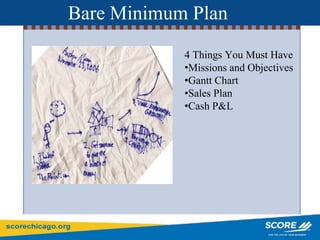
Bare Minimum Plan
4 Things You Must Have
•Missions and Objectives
•Gantt Chart
•Sales Plan
•Cash P&L
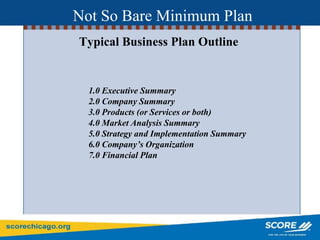
Typical Business Plan Outline
1.0 Executive Summary
2.0 Company Summary
3.0 Products (or Services or both)
4.0 Market Analysis Summary
5.0 Strategy and Implementation Summary
6.0 Company’s Organization
7.0 Financial Plan
Not So Bare Minimum Plan
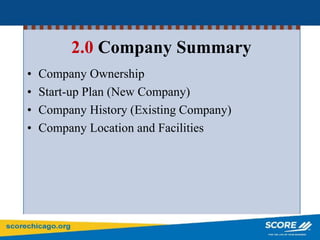
2.0 Company Summary
• Company Ownership
• Start-up Plan (New Company)
• Company History (Existing Company)
• Company Location and Facilities
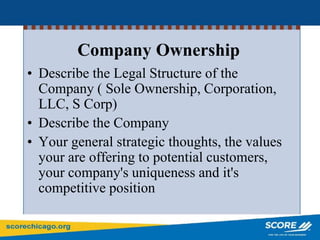
Company Ownership
• Describe the Legal Structure of the
Company ( Sole Ownership, Corporation,
LLC, S Corp)
• Describe the Company
• Your general strategic thoughts, the values
your are offering to potential customers,
your company's uniqueness and it's
competitive position
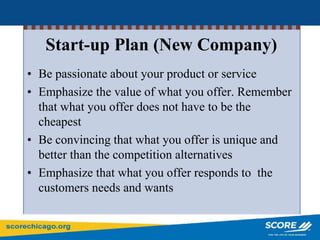
Start-up Plan (New Company)
• Be passionate about your product or service
• Emphasize the value of what you offer. Remember

that what you offer does not have to be the
cheapest
• Be convincing that what you offer is unique and
better than the competition alternatives
• Emphasize that what you offer responds to the
customers needs and wants
3.0 Products (or Services or both)
• Describe your product and/or service
• Your product against the competition
• Product source (s)
• Technological support
• Vision of the future
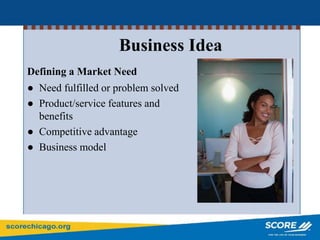
Business Idea
Defining a Market Need
● Need fulfilled or problem solved
● Product/service features and
benefits
● Competitive advantage
● Business model
Your product against the competition
• General comparison against what the competition
offers
• Discuss how your product or service are
positioned in the market
• Why your customers will prefer what you offer
• An idea of the price, the target market and the
uniqueness of what you offer
• Are you offering better product or services, better
quality or some important features not available in
the market
4.0 Market Analysis Summary
• Market Segmentation
• Target Market Segment Strategy
• Market Needs
• Competition and Buying Patterns
• Defined your product, service and
customer’s benefits?
• Defined your total market, segment and
niche?
• Conducted a sample survey of
prospective customers?
• Researched your market and sales
prospects?
• Researched your present and future
competition?
For Your Market Analysis, Have You:
5.0 Strategy and Implementation Summary
What is it that if it fails will tank your whole business?
Set goals to address via an action
plan
Print out 4 times and put everywhere: car,
bathroom mirror, etc. so you don’t forget or
ignore
Keys to Success
• Quality and Customer Satisfaction
• Convenient Location
• Price benefit versus value offered
• Uniqueness in product or service
• Benefits over competition
• Legal – patent
• Intellectual Property
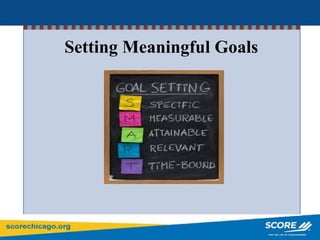
Setting Meaningful Goals
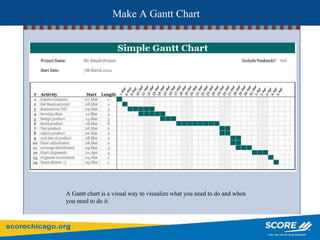
A Gantt chart is a visual way to visualize what you need to do and when
you need to do it.
Make A Gantt Chart
6.0 Company’s Organization
Organization summary:
• Number of employees
• Number of Managers
• How many Founders
• Employees positions that will be filled
• General description of key members
responsibilities
Management Team
▪Business structure
▪Board of Directors (if Corporation)
▪Organization Chart
▪Key management team
▪Job descriptions
▪Personnel: needs; hiring; training
▪Compensation & benefits
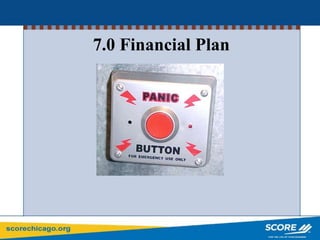
7.0 Financial Plan
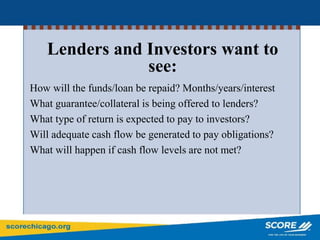
How will the funds/loan be repaid? Months/years/interest
What guarantee/collateral is being offered to lenders?
What type of return is expected to pay to investors?
Will adequate cash flow be generated to pay obligations?
What will happen if cash flow levels are not met?
Lenders and Investors want to
see:
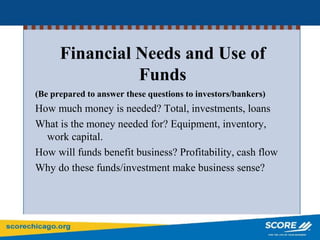
(Be prepared to answer these questions to investors/bankers)
How much money is needed? Total, investments, loans
What is the money needed for? Equipment, inventory,
work capital.
How will funds benefit business? Profitability, cash flow
Why do these funds/investment make business sense?
Financial Needs and Use of
Funds
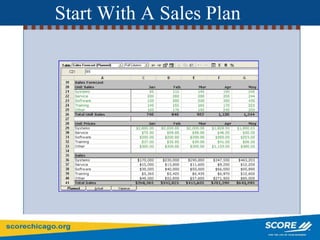
Start With A Sales Plan
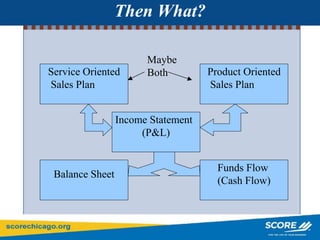
Then What?
Service Oriented
Sales Plan
Product Oriented
Sales Plan
Income Statement
(P&L)
Balance Sheet
Funds Flow
(Cash Flow)
Maybe
Both
1.0 Executive Summary
• Mission
• Objectives
• Key to Success
Mission
(Use the best technology, tradition, quality of product/services)
To satisfy a growing market at competitive prices
Offer products/services with a competitive advantage
Provide the best customer service.
Objectives
(Measurable objectives drive the changing direction of a company)
Increase sales in one to three years
Maintain gross margin above X% throughout a period
Increase sales of certain more marketable lines
Introduce new product lines to replace vanishing ones
Mission and Objectives
For an Effective Executive Summary:
▪Write this section last
▪Brief business description
▪Brief market description
▪Expected revenue and profit
▪Investment and capital requirements
▪Uses of funds
▪ROI (Rate of Return)
▪How the borrowed capital would be paid back?
Writing The Plan
▪You write it
▪Professional software packages?
▪Consultants? -- NO
▪Grammar; spelling; punctuations; editing;
presentations, page numbers
▪Solicit feedback
▪Revise, update often
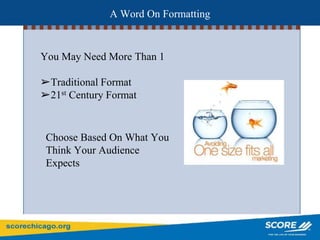
A Word On Formatting
You May Need More Than 1
➢Traditional Format
➢21st Century Format
Choose Based On What You
Think Your Audience
Expects
Common Mistakes
▪Poor research
▪Not understanding the market
▪Not understanding the target market
▪No clear focus on competitors
▪Unrealistic financial projections
▪Over hype
What More to Do
●Blank Pro Forma
Statements (great for start
up expense check lists)
●500 business plans – free
to view
●Check your public
library
●Get a SCORE
counselor to help
Free Help Available at the Score Website
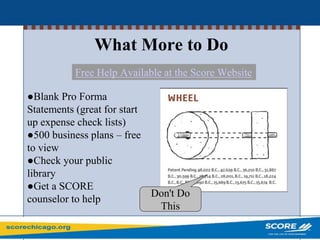
Don't Do
This
4 Links You Should Have
➢Me:Mark.Lieberman01@gmail.com
➢MyLinkedin:linkedin.com/in/liebermanmark
➢SCORE Local: www.scorechicago.org
➢SCORE National: www.score.org
Q&A

Not Animated.pptx

  • 1.
    Business Plans: ARoadmap For You
  • 2.
  • 3.
    SCORE ► About SCORE ►Educational programs ► One-on-one counseling ► Mentoring ► Consulting ► We offer, you choose
  • 4.
    If You Haveto Leave Now … 4 Links You Should Have ➢Me:Mark.Lieberman01@gmail.com ➢MyLinkedin:linkedin.com/in/liebermanmak ➢SCORE Local: www.scorechicago.org ➢SCORE National: www.score.org
  • 5.
    Today’s Topic ▪Business Plan,what? why? when? who? how? ▪Elements of good Business Plan ▪Brief descriptions of each of elements ▪How to write one? ▪Common mistakes to avoid
  • 6.
    “Would you tellme, please, which way I ought to go from here?" "That depends a good deal on where you want to get to." "I don't much care where –" "Then it doesn't matter which way you go.” ― Lewis Carroll, Alice in Wonderland Why Bother? Cheshire Cat , John Tenniel, 1865
  • 7.
    Business Plans Don’tGuarantee Success But They Sure Improve the Odds
  • 8.
  • 9.
    Bare Minimum Plan 4Things You Must Have •Missions and Objectives •Gantt Chart •Sales Plan •Cash P&L
  • 10.
    Typical Business PlanOutline 1.0 Executive Summary 2.0 Company Summary 3.0 Products (or Services or both) 4.0 Market Analysis Summary 5.0 Strategy and Implementation Summary 6.0 Company’s Organization 7.0 Financial Plan Not So Bare Minimum Plan
  • 11.
    2.0 Company Summary •Company Ownership • Start-up Plan (New Company) • Company History (Existing Company) • Company Location and Facilities
  • 12.
    Company Ownership • Describethe Legal Structure of the Company ( Sole Ownership, Corporation, LLC, S Corp) • Describe the Company • Your general strategic thoughts, the values your are offering to potential customers, your company's uniqueness and it's competitive position
  • 13.
    Start-up Plan (NewCompany) • Be passionate about your product or service • Emphasize the value of what you offer. Remember that what you offer does not have to be the cheapest • Be convincing that what you offer is unique and better than the competition alternatives • Emphasize that what you offer responds to the customers needs and wants
  • 14.
    3.0 Products (orServices or both) • Describe your product and/or service • Your product against the competition • Product source (s) • Technological support • Vision of the future
  • 15.
    Business Idea Defining aMarket Need ● Need fulfilled or problem solved ● Product/service features and benefits ● Competitive advantage ● Business model
  • 16.
    Your product againstthe competition • General comparison against what the competition offers • Discuss how your product or service are positioned in the market • Why your customers will prefer what you offer • An idea of the price, the target market and the uniqueness of what you offer • Are you offering better product or services, better quality or some important features not available in the market
  • 17.
    4.0 Market AnalysisSummary • Market Segmentation • Target Market Segment Strategy • Market Needs • Competition and Buying Patterns
  • 18.
    • Defined yourproduct, service and customer’s benefits? • Defined your total market, segment and niche? • Conducted a sample survey of prospective customers? • Researched your market and sales prospects? • Researched your present and future competition? For Your Market Analysis, Have You:
  • 19.
    5.0 Strategy andImplementation Summary What is it that if it fails will tank your whole business? Set goals to address via an action plan Print out 4 times and put everywhere: car, bathroom mirror, etc. so you don’t forget or ignore
  • 20.
    Keys to Success •Quality and Customer Satisfaction • Convenient Location • Price benefit versus value offered • Uniqueness in product or service • Benefits over competition • Legal – patent • Intellectual Property
  • 21.
  • 22.
    A Gantt chartis a visual way to visualize what you need to do and when you need to do it. Make A Gantt Chart
  • 23.
    6.0 Company’s Organization Organizationsummary: • Number of employees • Number of Managers • How many Founders • Employees positions that will be filled • General description of key members responsibilities
  • 24.
    Management Team ▪Business structure ▪Boardof Directors (if Corporation) ▪Organization Chart ▪Key management team ▪Job descriptions ▪Personnel: needs; hiring; training ▪Compensation & benefits
  • 25.
  • 26.
    How will thefunds/loan be repaid? Months/years/interest What guarantee/collateral is being offered to lenders? What type of return is expected to pay to investors? Will adequate cash flow be generated to pay obligations? What will happen if cash flow levels are not met? Lenders and Investors want to see:
  • 27.
    (Be prepared toanswer these questions to investors/bankers) How much money is needed? Total, investments, loans What is the money needed for? Equipment, inventory, work capital. How will funds benefit business? Profitability, cash flow Why do these funds/investment make business sense? Financial Needs and Use of Funds
  • 28.
    Start With ASales Plan
  • 29.
    Then What? Service Oriented SalesPlan Product Oriented Sales Plan Income Statement (P&L) Balance Sheet Funds Flow (Cash Flow) Maybe Both
  • 30.
    1.0 Executive Summary •Mission • Objectives • Key to Success
  • 31.
    Mission (Use the besttechnology, tradition, quality of product/services) To satisfy a growing market at competitive prices Offer products/services with a competitive advantage Provide the best customer service. Objectives (Measurable objectives drive the changing direction of a company) Increase sales in one to three years Maintain gross margin above X% throughout a period Increase sales of certain more marketable lines Introduce new product lines to replace vanishing ones Mission and Objectives
  • 32.
    For an EffectiveExecutive Summary: ▪Write this section last ▪Brief business description ▪Brief market description ▪Expected revenue and profit ▪Investment and capital requirements ▪Uses of funds ▪ROI (Rate of Return) ▪How the borrowed capital would be paid back?
  • 33.
    Writing The Plan ▪Youwrite it ▪Professional software packages? ▪Consultants? -- NO ▪Grammar; spelling; punctuations; editing; presentations, page numbers ▪Solicit feedback ▪Revise, update often
  • 34.
    A Word OnFormatting You May Need More Than 1 ➢Traditional Format ➢21st Century Format Choose Based On What You Think Your Audience Expects
  • 35.
    Common Mistakes ▪Poor research ▪Notunderstanding the market ▪Not understanding the target market ▪No clear focus on competitors ▪Unrealistic financial projections ▪Over hype
  • 36.
    What More toDo ●Blank Pro Forma Statements (great for start up expense check lists) ●500 business plans – free to view ●Check your public library ●Get a SCORE counselor to help Free Help Available at the Score Website Don't Do This
  • 37.
    4 Links YouShould Have ➢Me:Mark.Lieberman01@gmail.com ➢MyLinkedin:linkedin.com/in/liebermanmark ➢SCORE Local: www.scorechicago.org ➢SCORE National: www.score.org
  • 39.