Mastering Massive Data Volumes with Hypertable Doug Judd www.hypertable.org
Talk Outline Overview Architecture Performance Evaluation Case Studies
Hypertable Overview Massively Scalable Database Modeled after Google’s Bigtable Open Source (GPL 2 license) High Performance Implementation (C++) Thrift Interface for all popular High Level Languages: Java, Ruby, Python, PHP, etc Project started March 2007 @ Zvents
Bigtable: the infrastructure that Google is built on Bigtable is a proven design Underpins 100+ Google services:    YouTube, Blogger, Google Earth, Google   Maps, Orkut, Gmail, Google Analytics,  Google Book Search, Google Code, Crawl Database… Part of larger scalable computing stack: Bigtable + GFS + MapReduce Provides  strong consistency
Hypertable In Use Today
Architecture
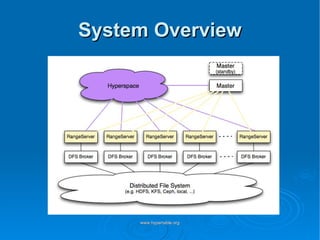
System Overview
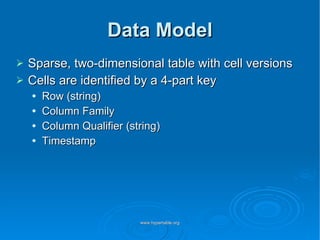
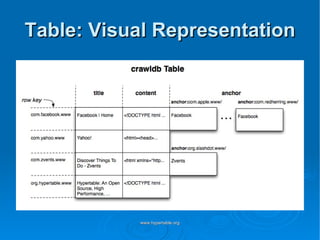
Data Model Sparse, two-dimensional table with cell versions Cells are identified by a 4-part key Row (string) Column Family Column Qualifier (string) Timestamp
Table: Visual Representation
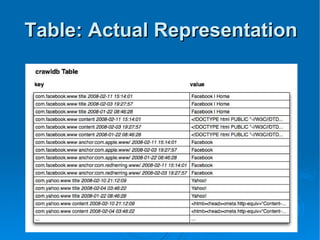
Table: Actual Representation
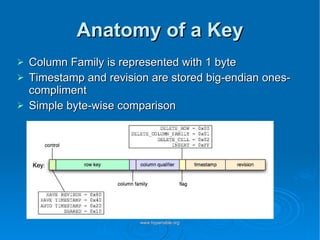
Anatomy of a Key Column Family is represented with 1 byte Timestamp and revision are stored big-endian ones-compliment Simple byte-wise comparison
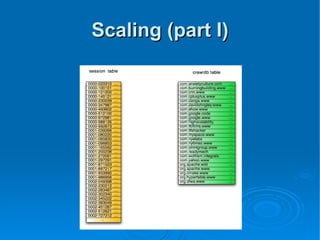
Scaling (part I)
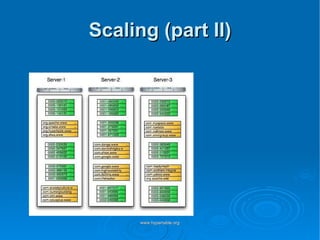
Scaling (part II)
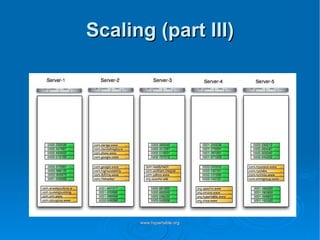
Scaling (part III)
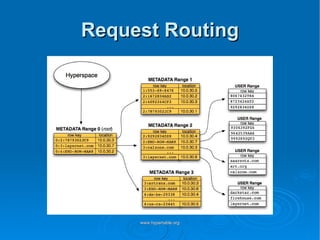
Request Routing
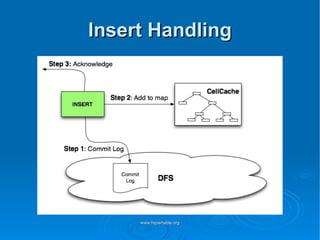
Insert Handling
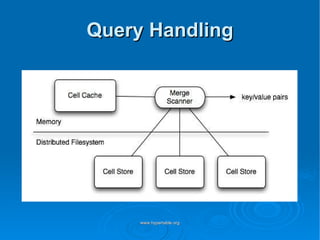
Query Handling
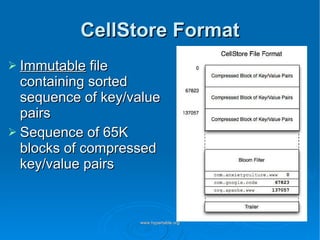
CellStore Format Immutable  file containing sorted sequence of key/value pairs Sequence of 65K blocks of compressed key/value pairs
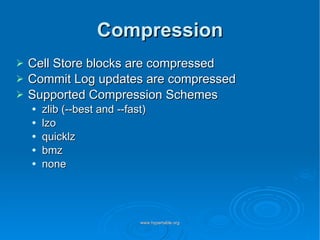
Compression Cell Store blocks are compressed Commit Log updates are compressed Supported Compression Schemes zlib (--best and --fast) lzo quicklz bmz none
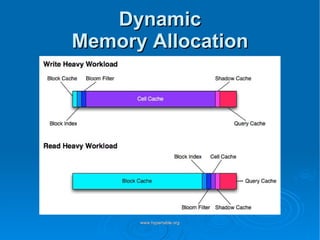
Caching Block Cache Caches CellStore blocks Blocks are cached uncompressed Dynamically adjusted size based on workload Query Cache Caches query results
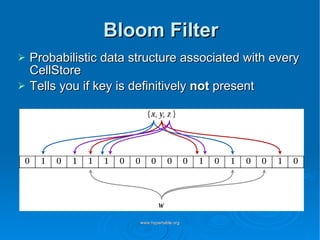
Bloom Filter Probabilistic data structure associated with every CellStore Tells you if key is definitively  not  present
Dynamic Memory Allocation
Performance Evaluation
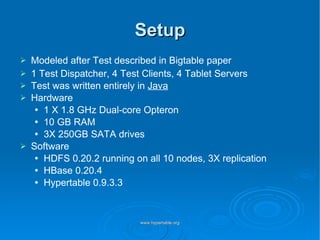
Setup Modeled after Test described in Bigtable paper 1 Test Dispatcher, 4 Test Clients, 4 Tablet Servers Test was written entirely in  Java Hardware 1 X 1.8 GHz Dual-core Opteron 10 GB RAM 3X 250GB SATA drives Software HDFS 0.20.2 running on all 10 nodes, 3X replication HBase 0.20.4 Hypertable 0.9.3.3
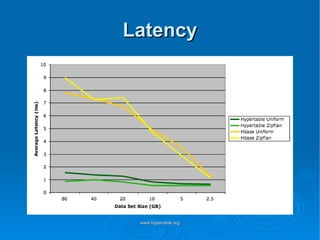
Latency
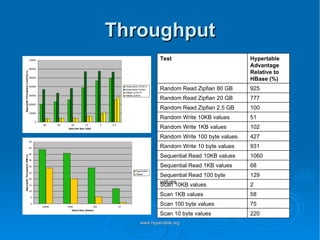
Throughput 220 Scan 10 byte values 75 Scan 100 byte values 58 Scan 1KB values 2 Scan 10KB values 129 Sequential Read 100 byte  values 68 Sequential Read 1KB values 1060 Sequential Read 10KB values 931 Random Write 10 byte values 427 Random Write 100 byte values 102 Random Write 1KB values 51 Random Write 10KB values 100 Random Read Zipfian 2.5 GB 777 Random Read Zipfian 20 GB 925 Random Read Zipfian 80 GB Hypertable Advantage Relative to HBase (%) Test
Detailed Report http://blog.hypertable.com/?p=14
Case Studies
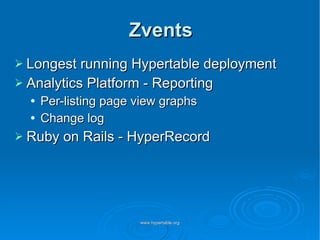
Zvents Longest running Hypertable deployment Analytics Platform - Reporting Per-listing page view graphs Change log Ruby on Rails - HyperRecord
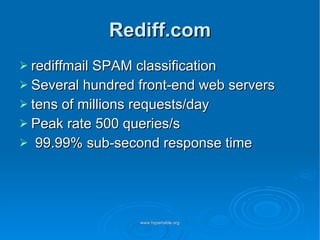
Rediff.com rediffmail SPAM classification Several hundred front-end web servers tens of millions requests/day Peak rate 500 queries/s 99.99% sub-second response time
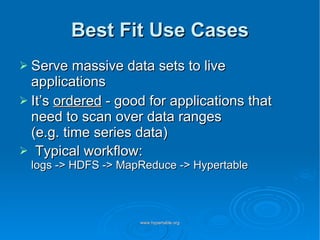
Best Fit Use Cases Serve massive data sets to live applications It’s  ordered  - good for applications that need to scan over data ranges (e.g. time series data) Typical workflow: logs -> HDFS -> MapReduce -> Hypertable
Resources Project site:   www. hypertable .org Twitter:  hypertable Commercial Support:   www.hypertable.com
Q&A

Nosql frankfurt

  • 1.
    Mastering Massive DataVolumes with Hypertable Doug Judd www.hypertable.org
  • 2.
    Talk Outline OverviewArchitecture Performance Evaluation Case Studies
  • 3.
    Hypertable Overview MassivelyScalable Database Modeled after Google’s Bigtable Open Source (GPL 2 license) High Performance Implementation (C++) Thrift Interface for all popular High Level Languages: Java, Ruby, Python, PHP, etc Project started March 2007 @ Zvents
  • 4.
    Bigtable: the infrastructurethat Google is built on Bigtable is a proven design Underpins 100+ Google services: YouTube, Blogger, Google Earth, Google Maps, Orkut, Gmail, Google Analytics, Google Book Search, Google Code, Crawl Database… Part of larger scalable computing stack: Bigtable + GFS + MapReduce Provides strong consistency
  • 5.
  • 6.
  • 7.
  • 8.
    Data Model Sparse,two-dimensional table with cell versions Cells are identified by a 4-part key Row (string) Column Family Column Qualifier (string) Timestamp
  • 9.
  • 10.
  • 11.
    Anatomy of aKey Column Family is represented with 1 byte Timestamp and revision are stored big-endian ones-compliment Simple byte-wise comparison
  • 12.
  • 13.
  • 14.
  • 15.
  • 16.
  • 17.
  • 18.
    CellStore Format Immutable file containing sorted sequence of key/value pairs Sequence of 65K blocks of compressed key/value pairs
  • 19.
    Compression Cell Storeblocks are compressed Commit Log updates are compressed Supported Compression Schemes zlib (--best and --fast) lzo quicklz bmz none
  • 20.
    Caching Block CacheCaches CellStore blocks Blocks are cached uncompressed Dynamically adjusted size based on workload Query Cache Caches query results
  • 21.
    Bloom Filter Probabilisticdata structure associated with every CellStore Tells you if key is definitively not present
  • 22.
  • 23.
  • 24.
    Setup Modeled afterTest described in Bigtable paper 1 Test Dispatcher, 4 Test Clients, 4 Tablet Servers Test was written entirely in Java Hardware 1 X 1.8 GHz Dual-core Opteron 10 GB RAM 3X 250GB SATA drives Software HDFS 0.20.2 running on all 10 nodes, 3X replication HBase 0.20.4 Hypertable 0.9.3.3
  • 25.
  • 26.
    Throughput 220 Scan10 byte values 75 Scan 100 byte values 58 Scan 1KB values 2 Scan 10KB values 129 Sequential Read 100 byte values 68 Sequential Read 1KB values 1060 Sequential Read 10KB values 931 Random Write 10 byte values 427 Random Write 100 byte values 102 Random Write 1KB values 51 Random Write 10KB values 100 Random Read Zipfian 2.5 GB 777 Random Read Zipfian 20 GB 925 Random Read Zipfian 80 GB Hypertable Advantage Relative to HBase (%) Test
  • 27.
  • 28.
  • 29.
    Zvents Longest runningHypertable deployment Analytics Platform - Reporting Per-listing page view graphs Change log Ruby on Rails - HyperRecord
  • 30.
    Rediff.com rediffmail SPAMclassification Several hundred front-end web servers tens of millions requests/day Peak rate 500 queries/s 99.99% sub-second response time
  • 31.
    Best Fit UseCases Serve massive data sets to live applications It’s ordered - good for applications that need to scan over data ranges (e.g. time series data) Typical workflow: logs -> HDFS -> MapReduce -> Hypertable
  • 32.
    Resources Project site: www. hypertable .org Twitter: hypertable Commercial Support: www.hypertable.com
  • 33.

Editor's Notes

  • #5 Describe the 360 degree panoramic view feature of Google Maps
  • #9 Spend some time
  • #10 Spend some time.
  • #30 Genesis crawl database …