Submitted By-:
Vrijnesh Kumar(GL)
Satyaketu singh
Shivam mishra
sunny dewol
Firoz akthar
MD.Faizanullah
Ratnesh kumar
Arun shani
Guided By-:
Ar. Pankaj mishra
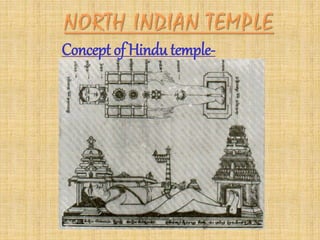
The Hindu temple architecture is an open, symmetry driven
structure, with many variations, on a square grid of Padas,
deploying perfect geometric shapes such as circles and squares.
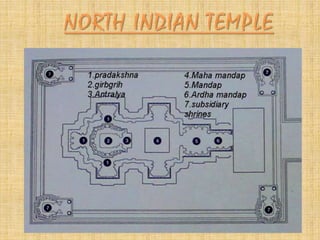
A Hindu temple consists of an inner sanctum, the Garbha
Griha or womb-chamber, where the primary idol or deity is
housed along with Purusa. The garbhagriha is crowned by a
tower-like Shikhara, also called the Vimana. The architecture
includes an ambulatory for parikrama (circumambulation), a
congregation hall, and sometimes an antechamber and porch.
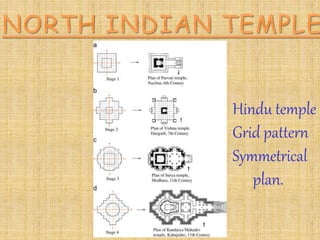
Hindu temple
Grid pattern
Symmetrical
plan.
Hindu Architecture
(1)-North Hindu style(A.D.600 to present day).
(2)-Central Hindu style(A.D.450-750 and 1000-
1325 to present day).
(3)-South Hindu style(A.D.625-1750to the present
day).
Concept of Hindu temple-
North Hindu style or indo aryan-style
This style had spread over at least three-fourth part of northern
India.
the earliest movement started in the state of orrisa,the land
of the Oriyas, its ancient name kalinga.it offer strong resistance
to maurays but finally subdued to Ashoka in 260 b.c. after
Ashoka’s death Kalinga regained its independence and latter
became more powerful under kharvela.in a.d.610 it was under
king sasanka but after his death Harsha conquered Orrisha.
The beginning of this Orissa group is seen at Bhuvaneshwar
where there are about thirty temples most important are the
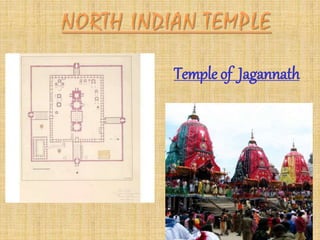
temple of Jagannath at puri (1000 a.d.) built by Mahasivagupta
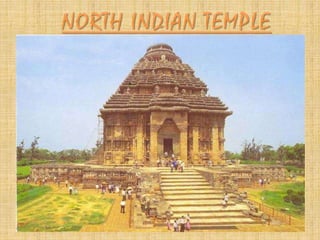
Yayati -2 and sun temple at Konark (1250A.D.)built by
narasingha-1.
the other groups are confined to some area such as at
Khajuraho all of which were built in a period of hundred years
from A.D.950 to 1050 under chandella Rajput rajas of
Bundhelkhand who ruled from Mahoba.the largest of entire
series is Shiva temple of Kandariya Mahadev (1000 A.D.)at
khajuraho.
North hindu style
(a)-Temples of Orissa group(Kalinga)(A.D. 800-1250)
(b)-Temple in Kashmir(8th century)
(c)-Templeof Khajuraho group (M.P.)(950-1050 A.D.)
(d)-Temple of Rajaputana Group (8th-11th century.)
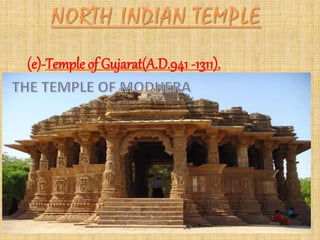
(e)-Templeof Gujarat(A.D.941 -1311).
(f)-Temple of Gwalior(M.P.)(11tnh-16th century)
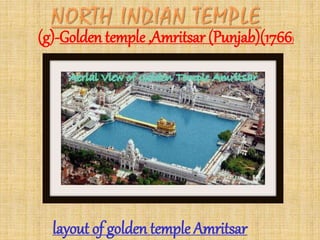
(g)-Golden temple Amritsar (Punjab)(1766)
(h)-Temple of Deccan(11th century to 13th century)
(a)-Temples of Orissa
group(kalinga)(A.D. 800-
1250)
Characteristics Features
andTypical Examples.
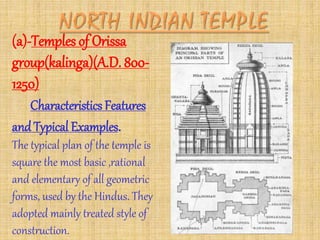
The typical plan of the temple is
square the most basic ,rational
and elementary of all geometric
forms, used by the Hindus. They
adopted mainly treated style of
construction.
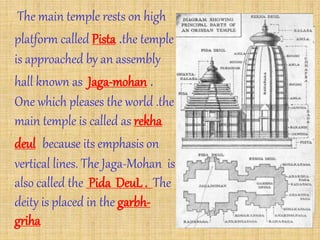
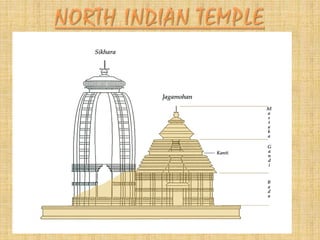
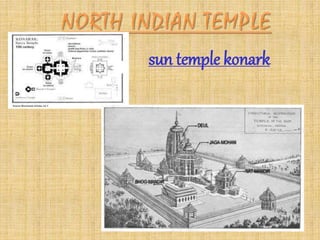
The main temple rests on high
platform called Pista .the temple
is approached by an assembly
hall known as Jaga-mohan .
One which pleases the world .the
main temple is called as rekha
deul because its emphasis on
vertical lines. The Jaga-Mohan is
also called the Pida DeuL . The
deity is placed in the garbh-
griha
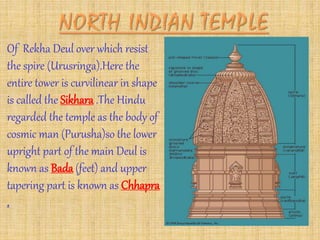
Of Rekha Deul over which resist
the spire (Urusringa).Here the
entire tower is curvilinear in shape
is called the Sikhara .The Hindu
regarded the temple as the body of
cosmic man (Purusha)so the lower
upright part of the main Deul is
known as Bada (feet) and upper
tapering part is known as Chhapra
.
The Chhapra is a large melon shaped feature
called AmalAka (cap stone) crowned with KalAsa
(head)-callEd Amrit -kalasa symbolic the jar of
Nectar. similarly the Jaga-mohan has the lowEr
upright part-the Bada and upper tapering part
Pida in the form of a terraced pyramid which is
crowned with Ghanta-Kalasa the temple is now
the abode of God as manifested in human shape.
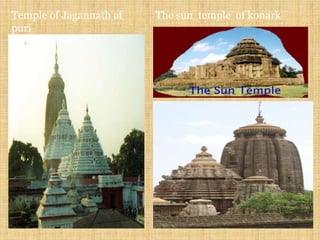
Temple of Jagannath at
puri
The sun temple of konark
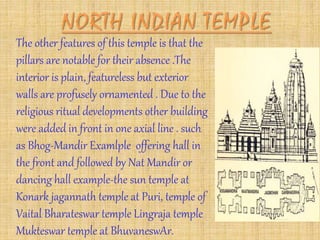
The other features of this temple is that the
pillars are notable for their absence .The
interior is plain, featureless but exterior
walls are profusely ornamented . Due to the
religious ritual developments other building
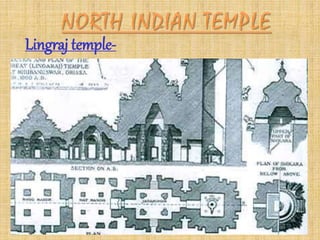
were added in front in one axial line . such
as Bhog-Mandir Examlple offering hall in
the front and followed by Nat Mandir or
dancing hall example-the sun temple at
Konark jagannath temple at Puri, temple of
Vaital Bharateswar temple Lingraja temple
Mukteswar temple at BhuvaneswAr.
sun temple konark
Lingraj temple-
Temple of Jagannath
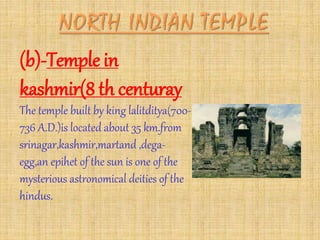
(b)-Temple in
kashmir(8 th centuray
The temple built by king lalitditya(700-
736 A.D.)is located about 35 km.from
srinagar,kashmir,martand ,dega-
egg,an epihet of the sun is one of the
mysterious astronomical deities of the
hindus.
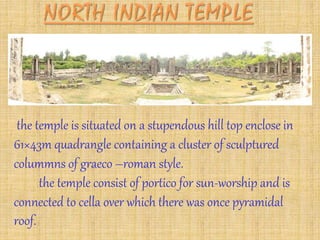
the temple is situated on a stupendous hill top enclose in
61Ɨ43m quadrangle containing a cluster of sculptured
colummns of graeco –roman style.
the temple consist of portico for sun-worship and is
connected to cella over which there was once pyramidal
roof.
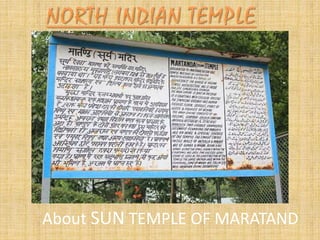
About SUN TEMPLE OF MARATAND
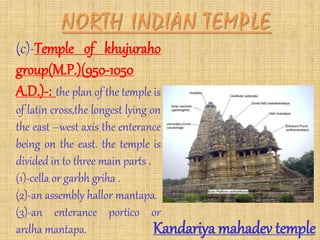
(c)-Temple of khujuraho
group(M.P.)(950-1050
A.D.)-: the plan of the temple is
of latin cross,the longest lying on
the east –west axis the enterance
being on the east. the temple is
divided in to three main parts .
(1)-cella or garbh griha .
(2)-an assembly hallor mantapa.
(3)-an enterance portico or
ardha mantapa. Kandariya mahadev temple
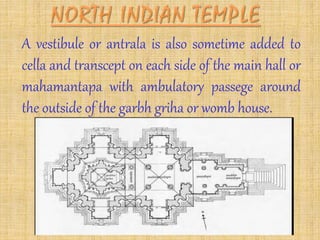
A vestibule or antrala is also sometime added to
cella and transcept on each side of the main hall or
mahamantapa with ambulatory passege around
the outside of the garbh griha or womb house.
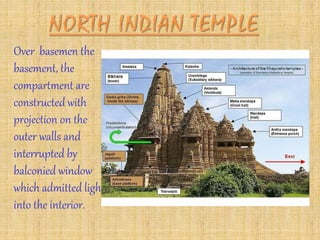
Over basemen the
basement, the
compartment are
constructed with
projection on the
outer walls and
interrupted by
balconied window
which admitted light
into the interior.
(d)-Temple of Rajputana Group
(8th-11th centuray.)
charcterstics features
The temple have three to five shrine .
shikhra over the cella is similar to orissa
group of temples but more refinEd in
treatment. the pillars are exquisitely
carved with foliated motif.
In addition temples they
constructed many other
structures as semi-religious
character .to commemorate
the victory jaya stambhas
were erected.also kirti
stamhas were built as
pillars of frame.
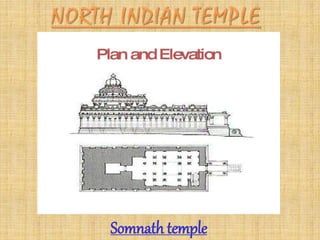
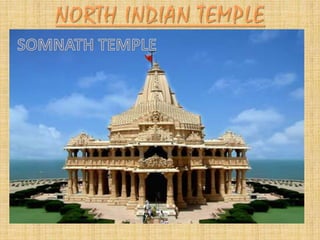
(e)-Temple of Gujarat(A.D.941 -1311).
Somnath temple
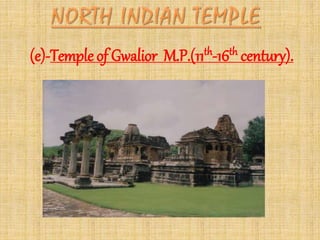
(f)-Temple of gwalior(M.P.)(11tnh-16th centuray)
(e)-Temple of Gwalior M.P.(11th-16th century).
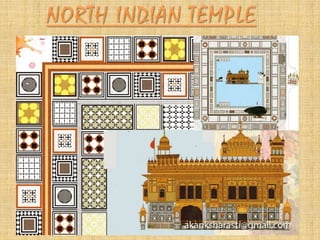
layout of golden temple Amritsar
(g)-Golden temple ,Amritsar (Punjab)(1766)
North indian temple

North indian temple

  • 1.
    Submitted By-: Vrijnesh Kumar(GL) Satyaketusingh Shivam mishra sunny dewol Firoz akthar MD.Faizanullah Ratnesh kumar Arun shani Guided By-: Ar. Pankaj mishra
  • 2.
    The Hindu templearchitecture is an open, symmetry driven structure, with many variations, on a square grid of Padas, deploying perfect geometric shapes such as circles and squares. A Hindu temple consists of an inner sanctum, the Garbha Griha or womb-chamber, where the primary idol or deity is housed along with Purusa. The garbhagriha is crowned by a tower-like Shikhara, also called the Vimana. The architecture includes an ambulatory for parikrama (circumambulation), a congregation hall, and sometimes an antechamber and porch.
  • 3.
  • 4.
    Hindu Architecture (1)-North Hindustyle(A.D.600 to present day). (2)-Central Hindu style(A.D.450-750 and 1000- 1325 to present day). (3)-South Hindu style(A.D.625-1750to the present day).
  • 5.
  • 7.
    North Hindu styleor indo aryan-style This style had spread over at least three-fourth part of northern India. the earliest movement started in the state of orrisa,the land of the Oriyas, its ancient name kalinga.it offer strong resistance to maurays but finally subdued to Ashoka in 260 b.c. after Ashoka’s death Kalinga regained its independence and latter became more powerful under kharvela.in a.d.610 it was under king sasanka but after his death Harsha conquered Orrisha.
  • 8.
    The beginning ofthis Orissa group is seen at Bhuvaneshwar where there are about thirty temples most important are the temple of Jagannath at puri (1000 a.d.) built by Mahasivagupta Yayati -2 and sun temple at Konark (1250A.D.)built by narasingha-1. the other groups are confined to some area such as at Khajuraho all of which were built in a period of hundred years from A.D.950 to 1050 under chandella Rajput rajas of Bundhelkhand who ruled from Mahoba.the largest of entire series is Shiva temple of Kandariya Mahadev (1000 A.D.)at khajuraho.
  • 9.
    North hindu style (a)-Templesof Orissa group(Kalinga)(A.D. 800-1250) (b)-Temple in Kashmir(8th century) (c)-Templeof Khajuraho group (M.P.)(950-1050 A.D.) (d)-Temple of Rajaputana Group (8th-11th century.) (e)-Templeof Gujarat(A.D.941 -1311). (f)-Temple of Gwalior(M.P.)(11tnh-16th century) (g)-Golden temple Amritsar (Punjab)(1766) (h)-Temple of Deccan(11th century to 13th century)
  • 10.
    (a)-Temples of Orissa group(kalinga)(A.D.800- 1250) Characteristics Features andTypical Examples. The typical plan of the temple is square the most basic ,rational and elementary of all geometric forms, used by the Hindus. They adopted mainly treated style of construction.
  • 11.
    The main templerests on high platform called Pista .the temple is approached by an assembly hall known as Jaga-mohan . One which pleases the world .the main temple is called as rekha deul because its emphasis on vertical lines. The Jaga-Mohan is also called the Pida DeuL . The deity is placed in the garbh- griha
  • 12.
    Of Rekha Deulover which resist the spire (Urusringa).Here the entire tower is curvilinear in shape is called the Sikhara .The Hindu regarded the temple as the body of cosmic man (Purusha)so the lower upright part of the main Deul is known as Bada (feet) and upper tapering part is known as Chhapra .
  • 13.
    The Chhapra isa large melon shaped feature called AmalAka (cap stone) crowned with KalAsa (head)-callEd Amrit -kalasa symbolic the jar of Nectar. similarly the Jaga-mohan has the lowEr upright part-the Bada and upper tapering part Pida in the form of a terraced pyramid which is crowned with Ghanta-Kalasa the temple is now the abode of God as manifested in human shape.
  • 15.
    Temple of Jagannathat puri The sun temple of konark
  • 16.
    The other featuresof this temple is that the pillars are notable for their absence .The interior is plain, featureless but exterior walls are profusely ornamented . Due to the religious ritual developments other building were added in front in one axial line . such as Bhog-Mandir Examlple offering hall in the front and followed by Nat Mandir or dancing hall example-the sun temple at Konark jagannath temple at Puri, temple of Vaital Bharateswar temple Lingraja temple Mukteswar temple at BhuvaneswAr.
  • 18.
  • 19.
  • 20.
  • 21.
    (b)-Temple in kashmir(8 thcenturay The temple built by king lalitditya(700- 736 A.D.)is located about 35 km.from srinagar,kashmir,martand ,dega- egg,an epihet of the sun is one of the mysterious astronomical deities of the hindus.
  • 22.
    the temple issituated on a stupendous hill top enclose in 61Ɨ43m quadrangle containing a cluster of sculptured colummns of graeco –roman style. the temple consist of portico for sun-worship and is connected to cella over which there was once pyramidal roof.
  • 23.
    About SUN TEMPLEOF MARATAND
  • 24.
    (c)-Temple of khujuraho group(M.P.)(950-1050 A.D.)-:the plan of the temple is of latin cross,the longest lying on the east –west axis the enterance being on the east. the temple is divided in to three main parts . (1)-cella or garbh griha . (2)-an assembly hallor mantapa. (3)-an enterance portico or ardha mantapa. Kandariya mahadev temple
  • 25.
    A vestibule orantrala is also sometime added to cella and transcept on each side of the main hall or mahamantapa with ambulatory passege around the outside of the garbh griha or womb house.
  • 26.
    Over basemen the basement,the compartment are constructed with projection on the outer walls and interrupted by balconied window which admitted light into the interior.
  • 27.
    (d)-Temple of RajputanaGroup (8th-11th centuray.) charcterstics features The temple have three to five shrine . shikhra over the cella is similar to orissa group of temples but more refinEd in treatment. the pillars are exquisitely carved with foliated motif.
  • 28.
    In addition templesthey constructed many other structures as semi-religious character .to commemorate the victory jaya stambhas were erected.also kirti stamhas were built as pillars of frame.
  • 29.
  • 30.
  • 31.
  • 32.
    (e)-Temple of GwaliorM.P.(11th-16th century).
  • 33.
    layout of goldentemple Amritsar (g)-Golden temple ,Amritsar (Punjab)(1766)