Normalization By  Hardik Sondagar
Chapter Objectives The purpose of normailization Data redundancy and Update Anomalies Functional Dependencies The Process of Normalization First Normal Form (1NF) Second Normal Form (2NF) Third Normal Form (3NF)
Chapter Objectives (2) General Definition of Second and Third Normal Form Boyce-Codd Normal Form (BCNF) Fourth Normal Form (4NF) Fifth Normal Form (5NF)
The Purpose of Normalization Normalization   is a technique for producing a set of relations with desirable properties, given the data requirements of an enterprise. The process of normalization  is a formal method that  identifies relations based on their primary or candidate keys and the functional dependencies among their  attributes.
Update Anomalies Relations that have redundant data may have problems called  update anomalies , which are classified as , Insertion anomalies Deletion anomalies Modification anomalies
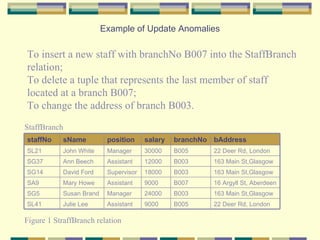
Example of Update Anomalies To insert a new staff with branchNo B007 into the StaffBranch relation; To delete a tuple that represents the last member of staff located at a branch B007; To change the address of branch B003. StaffBranch Figure 1 StraffBranch relation staffNo sName position salary branchNo bAddress SL21 John White Manager 30000 B005 22 Deer Rd, London SG37 Ann Beech Assistant 12000 B003 163 Main St,Glasgow SG14 David Ford Supervisor 18000 B003 163 Main St,Glasgow SA9 Mary Howe Assistant 9000 B007 16 Argyll St, Aberdeen SG5 Susan Brand Manager 24000 B003 163 Main St,Glasgow SL41 Julie Lee Assistant 9000 B005 22 Deer Rd, London
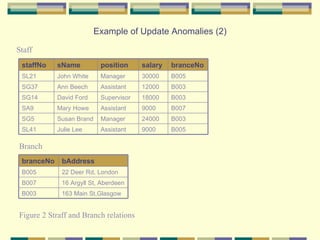
Example of Update Anomalies (2) Figure 2 Straff and Branch relations Staff Branch staffNo sName position salary branceNo SL21 John White Manager 30000 B005 SG37 Ann Beech Assistant 12000 B003 SG14 David Ford Supervisor 18000 B003 SA9 Mary Howe Assistant 9000 B007 SG5 Susan Brand Manager 24000 B003 SL41 Julie Lee Assistant 9000 B005 branceNo bAddress B005 22 Deer Rd, London B007 16 Argyll St, Aberdeen B003 163 Main St,Glasgow
Functional Dependencies Functional dependency  describes the relationship between attributes in a relation. For example, if A and B are attributes of relation R, and B is  functionally dependent on A ( denoted A  B), if each value of A is associated with exactly one value of B. ( A and B may each consist of one or more attributes.) A B B is functionally dependent on A Determinant Refers to the attribute or group of attributes on the left-hand side of the arrow of a functional dependency
Functional Dependencies (2) Trival functional dependency   means that the right-hand side is a subset ( not necessarily a proper subset) of the left- hand side. For example: (See Figure 1) staffNo, sName    sName staffNo, sName    staffNo They do not provide any additional information about possible integrity constraints on the values held by these attributes. We are normally more interested in  nontrivial dependencies  because they represent integrity constraints for the relation.
Functional Dependencies (3) Main characteristics of functional dependencies in normalization Have a  one-to-one  relationship between attribute(s) on the left- and right- hand side of a dependency; hold for  all time ; are  nontrivial .
Identifying the primary key Functional Dependencies (4) Functional dependency   is a property of the meaning or  semantics of the attributes in a relation. When a functional  dependency is present, the dependency is specified as a  constraint  between the attributes. An important integrity constraint to consider first is  the identification of candidate keys, one of which is selected to  be the primary key  for the relation using functional dependency.
Functional Dependencies (5) Inference Rules A set of all functional dependencies that are implied by a given set of functional dependencies X is called closure of X, written X + . A set of inference rule is needed to compute X +  from X. Armstrong’s axioms Relfexivity:  If B is a subset of A, them A    B Augmentation: If A    B, then A, C    B Transitivity: If A    B and B    C, then A   C Self-determination:    A    A Decomposition: If A    B,C  then A    B and A   C Union: If A    B and A    C, then A   B,C Composition: If A    B and C    D, then A,C   B,
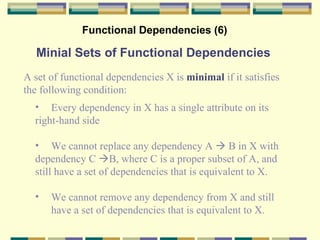
Functional Dependencies (6) Minial Sets of Functional Dependencies A set of functional dependencies X is  minimal  if it satisfies  the following condition: Every dependency in X has a single attribute on its  right-hand side We cannot replace any dependency  A    B in X with dependency C   B, where C is a proper subset of A, and still have a set of dependencies that is equivalent to X. We cannot remove any dependency from X and still have a set of dependencies that is equivalent to X.
Functional Dependencies (7) Example of A Minial Sets of Functional Dependencies A set of functional dependencies for the StaffBranch relation  satisfies the three conditions for producing a minimal set. staffNo    sName staffNo    position staffNo    salary staffNo    branchNo staffNo    bAddress branchNo    bAddress branchNo, position    salary bAddress, position    salary
The Process of Normalization Normalization  is often executed as a series of steps. Each step  corresponds to a specific normal form that has known properties. As normalization proceeds, the relations become progressively  more restricted in format, and also less vulnerable to update  anomalies. For the relational data model, it is important to recognize that it is only first normal form (1NF) that is critical in creating relations. All the subsequent normal forms are optional.
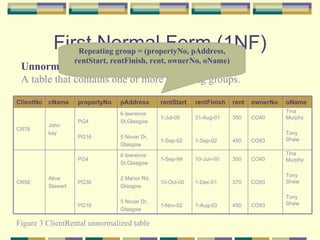
First Normal Form (1NF) Unnormalized form (UNF) A table that contains one or more repeating groups. Figure 3 ClientRental unnormalized table Repeating group = (propertyNo, pAddress, rentStart, rentFinish, rent, ownerNo, oName) ClientNo cName propertyNo pAddress rentStart rentFinish rent ownerNo oName CR76 John kay PG4 PG16 6 lawrence St,Glasgow 5 Novar Dr, Glasgow 1-Jul-00 1-Sep-02 31-Aug-01 1-Sep-02 350 450 CO40 CO93 Tina Murphy Tony Shaw CR56 Aline Stewart PG4 PG36 PG16 6 lawrence St,Glasgow 2 Manor Rd, Glasgow 5 Novar Dr, Glasgow 1-Sep-99 10-Oct-00 1-Nov-02 10-Jun-00 1-Dec-01 1-Aug-03 350 370 450 CO40 CO93 CO93 Tina Murphy Tony Shaw Tony Shaw
Definition of 1NF First Normal Form  is a relation in which the intersection of each row and column contains one and only one value. There are two approaches to removing repeating groups from  unnormalized tables: Removes the repeating groups by entering appropriate data  in the empty columns of rows containing the repeating data. 2. Removes the repeating group by placing the repeating data,  along with a copy of the original key attribute(s), in a separate  relation. A primary key is identified for the new relation.
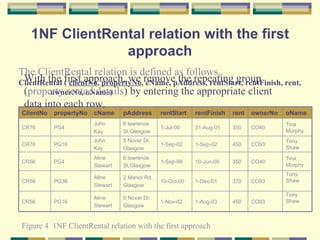
1NF ClientRental relation with the first approach Figure 4  1NF ClientRental relation with the first approach The ClientRental relation is defined as follows, ClientRental (  clientNo ,  propertyNo , cName, pAddress, rentStart, rentFinish, rent,  ownerNo, oName) With the first approach, we remove the repeating group ( property rented details ) by entering the appropriate client  data into each row. ClientNo propertyNo cName pAddress rentStart rentFinish rent ownerNo oName CR76 PG4 John Kay 6 lawrence St,Glasgow 1-Jul-00 31-Aug-01 350 CO40 Tina Murphy CR76 PG16 John Kay 5 Novar Dr, Glasgow 1-Sep-02 1-Sep-02 450 CO93 Tony Shaw CR56 PG4 Aline Stewart 6 lawrence St,Glasgow 1-Sep-99 10-Jun-00 350 CO40 Tina Murphy CR56 PG36 Aline Stewart 2 Manor Rd, Glasgow 10-Oct-00 1-Dec-01 370 CO93 Tony Shaw CR56 PG16 Aline Stewart 5 Novar Dr, Glasgow 1-Nov-02 1-Aug-03 450 CO93 Tony Shaw
1NF ClientRental relation with the second approach With the second approach, we remove the repeating group  ( property rented details ) by placing the repeating data along with  a copy of the original key attribute ( clientNo ) in a separte relation. Client ( clientNo , cName) PropertyRentalOwner  ( clientNo ,  propertyNo , pAddress, rentStart,  rentFinish, rent, ownerNo, oName) Figure 5  1NF ClientRental relation with the second approach ClientNo cName CR76 John  Kay CR56 Aline  Stewart ClientNo propertyNo pAddress rentStart rentFinish rent ownerNo oName CR76 PG4 6 lawrence St,Glasgow 1-Jul-00 31-Aug-01 350 CO40 Tina Murphy CR76 PG16 5 Novar Dr, Glasgow 1-Sep-02 1-Sep-02 450 CO93 Tony Shaw CR56 PG4 6 lawrence St,Glasgow 1-Sep-99 10-Jun-00 350 CO40 Tina Murphy CR56 PG36 2 Manor Rd, Glasgow 10-Oct-00 1-Dec-01 370 CO93 Tony Shaw CR56 PG16 5 Novar Dr, Glasgow 1-Nov-02 1-Aug-03 450 CO93 Tony Shaw
Full functional dependency Full functional dependency  indicates that if A and B are  attributes of a relation, B is fully functionally dependent on A if B is functionally dependent on A, but not on any proper subset of A. A functional dependency A  B is  partially dependent   if there is some attributes that can be removed from A and the dependency still holds.
Second Normal Form (2NF) Second normal form (2NF)   is a relation that is in first normal form and every non-primary-key attribute is fully functionally dependent on the primary key. The normalization of 1NF relations to 2NF involves the removal of  partial dependencies . If a partial dependency exists, we remove the function dependent attributes from the relation by placing them in a new relation along with a copy of their determinant.
2NF ClientRental relation The  ClientRental  relation has the following functional  dependencies: fd1  clientNo, propertyNo    rentStart, rentFinish  (Primary Key) fd2 clientNo    cName ( Partial dependency ) fd3 propertyNo    pAddress, rent, ownerNo, oName   ( Partial dependency ) fd4 ownerNo    oName (Transitive Dependency) fd5 clientNo, rentStart    propertyNo, pAddress,  rentFinish, rent, ownerNo, oName (Candidate key) fd6 propertyNo, rentStart    clientNo, cName, rentFinish  (Candidate key)
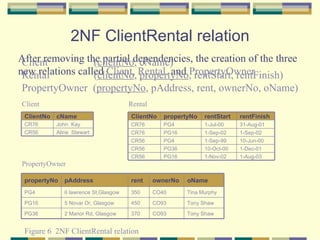
2NF ClientRental relation After removing the partial dependencies, the creation of the three  new relations called  Client, Rental,  and  PropertyOwner Client Rental PropertyOwner Client   ( clientNo , cName) Rental   ( clientNo ,  propertyNo , rentStart, rentFinish) PropertyOwner  ( propertyNo , pAddress, rent, ownerNo, oName) Figure 6  2NF ClientRental relation ClientNo cName CR76 John  Kay CR56 Aline  Stewart ClientNo propertyNo rentStart rentFinish CR76 PG4 1-Jul-00 31-Aug-01 CR76 PG16 1-Sep-02 1-Sep-02 CR56 PG4 1-Sep-99 10-Jun-00 CR56 PG36 10-Oct-00 1-Dec-01 CR56 PG16 1-Nov-02 1-Aug-03 propertyNo pAddress rent ownerNo oName PG4 6 lawrence St,Glasgow 350 CO40 Tina Murphy PG16 5 Novar Dr, Glasgow 450 CO93 Tony Shaw PG36 2 Manor Rd, Glasgow 370 CO93 Tony Shaw
Third Normal Form (3NF) Transitive dependency  A condition where A, B, and C are attributes of a relation such that if A     B and B     C, then C is transitively dependent on A via B (provided that A is not functionally dependent on B or C). Third normal form (3NF) A relation that is in first and second normal form, and in which  no non-primary-key attribute is  transitively  dependent on the  primary key. The normalization of 2NF relations to 3NF involves the removal of transitive dependencies by placing the attribute(s) in a new relation along with a copy of the determinant.
3NF ClientRental relation The functional dependencies for the  Client ,  Rental  and  PropertyOwner  relations are as follows: Client fd2 clientNo    cName   (Primary Key) Rental fd1  clientNo, propertyNo    rentStart, rentFinish  (Primary Key) fd5 clientNo, rentStart    propertyNo, rentFinish (Candidate key) fd6 propertyNo, rentStart    clientNo, rentFinish  (Candidate key) PropertyOwner fd3 propertyNo    pAddress, rent, ownerNo, oName     (Primary Key) fd4 ownerNo    oName ( Transitive Dependency )
3NF ClientRental relation The resulting 3NF relations have the forms: Client   ( clientNo , cName) Rental   ( clientNo ,  propertyNo , rentStart, rentFinish) PropertyOwner  ( propertyNo , pAddress, rent, ownerNo) Owner   ( ownerNo , oName)
3NF ClientRental relation Client Rental PropertyOwner Owner Figure 7  2NF ClientRental relation ClientNo cName CR76 John  Kay CR56 Aline  Stewart ClientNo propertyNo rentStart rentFinish CR76 PG4 1-Jul-00 31-Aug-01 CR76 PG16 1-Sep-02 1-Sep-02 CR56 PG4 1-Sep-99 10-Jun-00 CR56 PG36 10-Oct-00 1-Dec-01 CR56 PG16 1-Nov-02 1-Aug-03 propertyNo pAddress rent ownerNo PG4 6 lawrence St,Glasgow 350 CO40 PG16 5 Novar Dr, Glasgow 450 CO93 PG36 2 Manor Rd, Glasgow 370 CO93 ownerNo oName CO40 Tina Murphy CO93 Tony Shaw
Boyce-Codd Normal Form (BCNF) Boyce-Codd normal form (BCNF) A relation is in BCNF, if and only if, every determinant is a  candidate key. The difference between 3NF and BCNF  is that for a functional dependency A    B, 3NF allows this dependency in a relation  if B is a primary-key attribute and A is not a candidate key,  whereas BCNF insists that for this dependency to remain in a relation, A must be a candidate key.
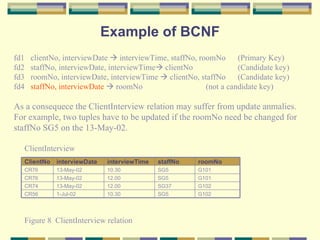
Example of BCNF fd1  clientNo, interviewDate    interviewTime, staffNo, roomNo  (Primary Key) fd2  staffNo,  interviewDate, interviewTime    clientNo   (Candidate key) fd3  roomNo,  interviewDate, interviewTime     clientNo, staffNo  (Candidate key) fd4  staffNo, interviewDate     roomNo  (not a candidate key) As a consequece the ClientInterview relation may suffer from update anmalies. For example, two tuples have to be updated if the roomNo need be changed for staffNo SG5 on the 13-May-02. Figure 8  ClientInterview relation ClientInterview ClientNo interviewDate interviewTime staffNo roomNo CR76 13-May-02 10.30 SG5 G101 CR76 13-May-02 12.00 SG5 G101 CR74 13-May-02 12.00 SG37 G102 CR56 1-Jul-02 10.30 SG5 G102
Example of BCNF(2) To transform the ClientInterview relation to BCNF, we must remove the violating functional dependency by creating two new relations called Interview and SatffRoom as shown below, Interview ( clientNo ,  interviewDate , interviewTime, staffNo) StaffRoom( staffNo ,  interviewDate,  roomNo) Interview StaffRoom Figure 9  BCNF Interview and StaffRoom relations ClientNo interviewDate interviewTime staffNo CR76 13-May-02 10.30 SG5 CR76 13-May-02 12.00 SG5 CR74 13-May-02 12.00 SG37 CR56 1-Jul-02 10.30 SG5 staffNo interviewDate roomNo SG5 13-May-02 G101 SG37 13-May-02 G102 SG5 1-Jul-02 G102
Fourth Normal Form (4NF) Multi-valued dependency (MVD)  represents a dependency between attributes (for example, A,  B and C) in a relation, such that for each value of A there is a  set of values for B and a set of value for C. However, the set of  values for B and C are independent of each other. A multi-valued dependency can be further defined as being  trivial or nontrivial.   A MVD A   > B in relation R is defined  as being trivial if B is a subset of A  or A U B = R  A MVD is defined as being nontrivial if neither of the above two conditions is satisfied.
Fourth Normal Form (4NF) Fourth normal form (4NF)  A relation that is in Boyce-Codd normal form and contains no nontrivial multi-valued dependencies.
Fifth Normal Form (5NF) Lossless-join dependency A property of decomposition, which ensures that no spurious tuples are generated when relations are reunited through a natural join operation. Join dependency Describes a type of dependency. For example, for a relation R with subsets of the attributes of R denoted as A, B, …, Z, a relation R satisfies a join dependency if, and only if, every legal value of R is equal to the join of its projections on A, B, …, Z. Fifth normal form (5NF) A relation that has no join dependency.

Normalization

  • 1.
    Normalization By Hardik Sondagar
  • 2.
    Chapter Objectives Thepurpose of normailization Data redundancy and Update Anomalies Functional Dependencies The Process of Normalization First Normal Form (1NF) Second Normal Form (2NF) Third Normal Form (3NF)
  • 3.
    Chapter Objectives (2)General Definition of Second and Third Normal Form Boyce-Codd Normal Form (BCNF) Fourth Normal Form (4NF) Fifth Normal Form (5NF)
  • 4.
    The Purpose ofNormalization Normalization is a technique for producing a set of relations with desirable properties, given the data requirements of an enterprise. The process of normalization is a formal method that identifies relations based on their primary or candidate keys and the functional dependencies among their attributes.
  • 5.
    Update Anomalies Relationsthat have redundant data may have problems called update anomalies , which are classified as , Insertion anomalies Deletion anomalies Modification anomalies
  • 6.
    Example of UpdateAnomalies To insert a new staff with branchNo B007 into the StaffBranch relation; To delete a tuple that represents the last member of staff located at a branch B007; To change the address of branch B003. StaffBranch Figure 1 StraffBranch relation staffNo sName position salary branchNo bAddress SL21 John White Manager 30000 B005 22 Deer Rd, London SG37 Ann Beech Assistant 12000 B003 163 Main St,Glasgow SG14 David Ford Supervisor 18000 B003 163 Main St,Glasgow SA9 Mary Howe Assistant 9000 B007 16 Argyll St, Aberdeen SG5 Susan Brand Manager 24000 B003 163 Main St,Glasgow SL41 Julie Lee Assistant 9000 B005 22 Deer Rd, London
  • 7.
    Example of UpdateAnomalies (2) Figure 2 Straff and Branch relations Staff Branch staffNo sName position salary branceNo SL21 John White Manager 30000 B005 SG37 Ann Beech Assistant 12000 B003 SG14 David Ford Supervisor 18000 B003 SA9 Mary Howe Assistant 9000 B007 SG5 Susan Brand Manager 24000 B003 SL41 Julie Lee Assistant 9000 B005 branceNo bAddress B005 22 Deer Rd, London B007 16 Argyll St, Aberdeen B003 163 Main St,Glasgow
  • 8.
    Functional Dependencies Functionaldependency describes the relationship between attributes in a relation. For example, if A and B are attributes of relation R, and B is functionally dependent on A ( denoted A B), if each value of A is associated with exactly one value of B. ( A and B may each consist of one or more attributes.) A B B is functionally dependent on A Determinant Refers to the attribute or group of attributes on the left-hand side of the arrow of a functional dependency
  • 9.
    Functional Dependencies (2)Trival functional dependency means that the right-hand side is a subset ( not necessarily a proper subset) of the left- hand side. For example: (See Figure 1) staffNo, sName  sName staffNo, sName  staffNo They do not provide any additional information about possible integrity constraints on the values held by these attributes. We are normally more interested in nontrivial dependencies because they represent integrity constraints for the relation.
  • 10.
    Functional Dependencies (3)Main characteristics of functional dependencies in normalization Have a one-to-one relationship between attribute(s) on the left- and right- hand side of a dependency; hold for all time ; are nontrivial .
  • 11.
    Identifying the primarykey Functional Dependencies (4) Functional dependency is a property of the meaning or semantics of the attributes in a relation. When a functional dependency is present, the dependency is specified as a constraint between the attributes. An important integrity constraint to consider first is the identification of candidate keys, one of which is selected to be the primary key for the relation using functional dependency.
  • 12.
    Functional Dependencies (5)Inference Rules A set of all functional dependencies that are implied by a given set of functional dependencies X is called closure of X, written X + . A set of inference rule is needed to compute X + from X. Armstrong’s axioms Relfexivity: If B is a subset of A, them A  B Augmentation: If A  B, then A, C  B Transitivity: If A  B and B  C, then A  C Self-determination: A  A Decomposition: If A  B,C then A  B and A  C Union: If A  B and A  C, then A  B,C Composition: If A  B and C  D, then A,C  B,
  • 13.
    Functional Dependencies (6)Minial Sets of Functional Dependencies A set of functional dependencies X is minimal if it satisfies the following condition: Every dependency in X has a single attribute on its right-hand side We cannot replace any dependency A  B in X with dependency C  B, where C is a proper subset of A, and still have a set of dependencies that is equivalent to X. We cannot remove any dependency from X and still have a set of dependencies that is equivalent to X.
  • 14.
    Functional Dependencies (7)Example of A Minial Sets of Functional Dependencies A set of functional dependencies for the StaffBranch relation satisfies the three conditions for producing a minimal set. staffNo  sName staffNo  position staffNo  salary staffNo  branchNo staffNo  bAddress branchNo  bAddress branchNo, position  salary bAddress, position  salary
  • 15.
    The Process ofNormalization Normalization is often executed as a series of steps. Each step corresponds to a specific normal form that has known properties. As normalization proceeds, the relations become progressively more restricted in format, and also less vulnerable to update anomalies. For the relational data model, it is important to recognize that it is only first normal form (1NF) that is critical in creating relations. All the subsequent normal forms are optional.
  • 16.
    First Normal Form(1NF) Unnormalized form (UNF) A table that contains one or more repeating groups. Figure 3 ClientRental unnormalized table Repeating group = (propertyNo, pAddress, rentStart, rentFinish, rent, ownerNo, oName) ClientNo cName propertyNo pAddress rentStart rentFinish rent ownerNo oName CR76 John kay PG4 PG16 6 lawrence St,Glasgow 5 Novar Dr, Glasgow 1-Jul-00 1-Sep-02 31-Aug-01 1-Sep-02 350 450 CO40 CO93 Tina Murphy Tony Shaw CR56 Aline Stewart PG4 PG36 PG16 6 lawrence St,Glasgow 2 Manor Rd, Glasgow 5 Novar Dr, Glasgow 1-Sep-99 10-Oct-00 1-Nov-02 10-Jun-00 1-Dec-01 1-Aug-03 350 370 450 CO40 CO93 CO93 Tina Murphy Tony Shaw Tony Shaw
  • 17.
    Definition of 1NFFirst Normal Form is a relation in which the intersection of each row and column contains one and only one value. There are two approaches to removing repeating groups from unnormalized tables: Removes the repeating groups by entering appropriate data in the empty columns of rows containing the repeating data. 2. Removes the repeating group by placing the repeating data, along with a copy of the original key attribute(s), in a separate relation. A primary key is identified for the new relation.
  • 18.
    1NF ClientRental relationwith the first approach Figure 4 1NF ClientRental relation with the first approach The ClientRental relation is defined as follows, ClientRental ( clientNo , propertyNo , cName, pAddress, rentStart, rentFinish, rent, ownerNo, oName) With the first approach, we remove the repeating group ( property rented details ) by entering the appropriate client data into each row. ClientNo propertyNo cName pAddress rentStart rentFinish rent ownerNo oName CR76 PG4 John Kay 6 lawrence St,Glasgow 1-Jul-00 31-Aug-01 350 CO40 Tina Murphy CR76 PG16 John Kay 5 Novar Dr, Glasgow 1-Sep-02 1-Sep-02 450 CO93 Tony Shaw CR56 PG4 Aline Stewart 6 lawrence St,Glasgow 1-Sep-99 10-Jun-00 350 CO40 Tina Murphy CR56 PG36 Aline Stewart 2 Manor Rd, Glasgow 10-Oct-00 1-Dec-01 370 CO93 Tony Shaw CR56 PG16 Aline Stewart 5 Novar Dr, Glasgow 1-Nov-02 1-Aug-03 450 CO93 Tony Shaw
  • 19.
    1NF ClientRental relationwith the second approach With the second approach, we remove the repeating group ( property rented details ) by placing the repeating data along with a copy of the original key attribute ( clientNo ) in a separte relation. Client ( clientNo , cName) PropertyRentalOwner ( clientNo , propertyNo , pAddress, rentStart, rentFinish, rent, ownerNo, oName) Figure 5 1NF ClientRental relation with the second approach ClientNo cName CR76 John Kay CR56 Aline Stewart ClientNo propertyNo pAddress rentStart rentFinish rent ownerNo oName CR76 PG4 6 lawrence St,Glasgow 1-Jul-00 31-Aug-01 350 CO40 Tina Murphy CR76 PG16 5 Novar Dr, Glasgow 1-Sep-02 1-Sep-02 450 CO93 Tony Shaw CR56 PG4 6 lawrence St,Glasgow 1-Sep-99 10-Jun-00 350 CO40 Tina Murphy CR56 PG36 2 Manor Rd, Glasgow 10-Oct-00 1-Dec-01 370 CO93 Tony Shaw CR56 PG16 5 Novar Dr, Glasgow 1-Nov-02 1-Aug-03 450 CO93 Tony Shaw
  • 20.
    Full functional dependencyFull functional dependency indicates that if A and B are attributes of a relation, B is fully functionally dependent on A if B is functionally dependent on A, but not on any proper subset of A. A functional dependency A  B is partially dependent if there is some attributes that can be removed from A and the dependency still holds.
  • 21.
    Second Normal Form(2NF) Second normal form (2NF) is a relation that is in first normal form and every non-primary-key attribute is fully functionally dependent on the primary key. The normalization of 1NF relations to 2NF involves the removal of partial dependencies . If a partial dependency exists, we remove the function dependent attributes from the relation by placing them in a new relation along with a copy of their determinant.
  • 22.
    2NF ClientRental relationThe ClientRental relation has the following functional dependencies: fd1 clientNo, propertyNo  rentStart, rentFinish (Primary Key) fd2 clientNo  cName ( Partial dependency ) fd3 propertyNo  pAddress, rent, ownerNo, oName ( Partial dependency ) fd4 ownerNo  oName (Transitive Dependency) fd5 clientNo, rentStart  propertyNo, pAddress, rentFinish, rent, ownerNo, oName (Candidate key) fd6 propertyNo, rentStart  clientNo, cName, rentFinish (Candidate key)
  • 23.
    2NF ClientRental relationAfter removing the partial dependencies, the creation of the three new relations called Client, Rental, and PropertyOwner Client Rental PropertyOwner Client ( clientNo , cName) Rental ( clientNo , propertyNo , rentStart, rentFinish) PropertyOwner ( propertyNo , pAddress, rent, ownerNo, oName) Figure 6 2NF ClientRental relation ClientNo cName CR76 John Kay CR56 Aline Stewart ClientNo propertyNo rentStart rentFinish CR76 PG4 1-Jul-00 31-Aug-01 CR76 PG16 1-Sep-02 1-Sep-02 CR56 PG4 1-Sep-99 10-Jun-00 CR56 PG36 10-Oct-00 1-Dec-01 CR56 PG16 1-Nov-02 1-Aug-03 propertyNo pAddress rent ownerNo oName PG4 6 lawrence St,Glasgow 350 CO40 Tina Murphy PG16 5 Novar Dr, Glasgow 450 CO93 Tony Shaw PG36 2 Manor Rd, Glasgow 370 CO93 Tony Shaw
  • 24.
    Third Normal Form(3NF) Transitive dependency A condition where A, B, and C are attributes of a relation such that if A  B and B  C, then C is transitively dependent on A via B (provided that A is not functionally dependent on B or C). Third normal form (3NF) A relation that is in first and second normal form, and in which no non-primary-key attribute is transitively dependent on the primary key. The normalization of 2NF relations to 3NF involves the removal of transitive dependencies by placing the attribute(s) in a new relation along with a copy of the determinant.
  • 25.
    3NF ClientRental relationThe functional dependencies for the Client , Rental and PropertyOwner relations are as follows: Client fd2 clientNo  cName (Primary Key) Rental fd1 clientNo, propertyNo  rentStart, rentFinish (Primary Key) fd5 clientNo, rentStart  propertyNo, rentFinish (Candidate key) fd6 propertyNo, rentStart  clientNo, rentFinish (Candidate key) PropertyOwner fd3 propertyNo  pAddress, rent, ownerNo, oName (Primary Key) fd4 ownerNo  oName ( Transitive Dependency )
  • 26.
    3NF ClientRental relationThe resulting 3NF relations have the forms: Client ( clientNo , cName) Rental ( clientNo , propertyNo , rentStart, rentFinish) PropertyOwner ( propertyNo , pAddress, rent, ownerNo) Owner ( ownerNo , oName)
  • 27.
    3NF ClientRental relationClient Rental PropertyOwner Owner Figure 7 2NF ClientRental relation ClientNo cName CR76 John Kay CR56 Aline Stewart ClientNo propertyNo rentStart rentFinish CR76 PG4 1-Jul-00 31-Aug-01 CR76 PG16 1-Sep-02 1-Sep-02 CR56 PG4 1-Sep-99 10-Jun-00 CR56 PG36 10-Oct-00 1-Dec-01 CR56 PG16 1-Nov-02 1-Aug-03 propertyNo pAddress rent ownerNo PG4 6 lawrence St,Glasgow 350 CO40 PG16 5 Novar Dr, Glasgow 450 CO93 PG36 2 Manor Rd, Glasgow 370 CO93 ownerNo oName CO40 Tina Murphy CO93 Tony Shaw
  • 28.
    Boyce-Codd Normal Form(BCNF) Boyce-Codd normal form (BCNF) A relation is in BCNF, if and only if, every determinant is a candidate key. The difference between 3NF and BCNF is that for a functional dependency A  B, 3NF allows this dependency in a relation if B is a primary-key attribute and A is not a candidate key, whereas BCNF insists that for this dependency to remain in a relation, A must be a candidate key.
  • 29.
    Example of BCNFfd1 clientNo, interviewDate  interviewTime, staffNo, roomNo (Primary Key) fd2 staffNo, interviewDate, interviewTime  clientNo (Candidate key) fd3 roomNo, interviewDate, interviewTime  clientNo, staffNo (Candidate key) fd4 staffNo, interviewDate  roomNo (not a candidate key) As a consequece the ClientInterview relation may suffer from update anmalies. For example, two tuples have to be updated if the roomNo need be changed for staffNo SG5 on the 13-May-02. Figure 8 ClientInterview relation ClientInterview ClientNo interviewDate interviewTime staffNo roomNo CR76 13-May-02 10.30 SG5 G101 CR76 13-May-02 12.00 SG5 G101 CR74 13-May-02 12.00 SG37 G102 CR56 1-Jul-02 10.30 SG5 G102
  • 30.
    Example of BCNF(2)To transform the ClientInterview relation to BCNF, we must remove the violating functional dependency by creating two new relations called Interview and SatffRoom as shown below, Interview ( clientNo , interviewDate , interviewTime, staffNo) StaffRoom( staffNo , interviewDate, roomNo) Interview StaffRoom Figure 9 BCNF Interview and StaffRoom relations ClientNo interviewDate interviewTime staffNo CR76 13-May-02 10.30 SG5 CR76 13-May-02 12.00 SG5 CR74 13-May-02 12.00 SG37 CR56 1-Jul-02 10.30 SG5 staffNo interviewDate roomNo SG5 13-May-02 G101 SG37 13-May-02 G102 SG5 1-Jul-02 G102
  • 31.
    Fourth Normal Form(4NF) Multi-valued dependency (MVD) represents a dependency between attributes (for example, A, B and C) in a relation, such that for each value of A there is a set of values for B and a set of value for C. However, the set of values for B and C are independent of each other. A multi-valued dependency can be further defined as being trivial or nontrivial. A MVD A  > B in relation R is defined as being trivial if B is a subset of A or A U B = R A MVD is defined as being nontrivial if neither of the above two conditions is satisfied.
  • 32.
    Fourth Normal Form(4NF) Fourth normal form (4NF) A relation that is in Boyce-Codd normal form and contains no nontrivial multi-valued dependencies.
  • 33.
    Fifth Normal Form(5NF) Lossless-join dependency A property of decomposition, which ensures that no spurious tuples are generated when relations are reunited through a natural join operation. Join dependency Describes a type of dependency. For example, for a relation R with subsets of the attributes of R denoted as A, B, …, Z, a relation R satisfies a join dependency if, and only if, every legal value of R is equal to the join of its projections on A, B, …, Z. Fifth normal form (5NF) A relation that has no join dependency.