More Related Content

PPT

PDF
17-Relational Design Algorithms-07-06-2023.pdf 
PPTX
Basics of Functional Dependencies and Normalization for Relational Databases.... 
PDF
DAtaBase DAtaBaseDAtaBase Chapter14.pdf 
PPTX
Chapter14-DBMS.pptx.................................. 
PPT
Normalisation_2-1-1-normalization in Database management system (1).ppt 
PPT
basic concepts of Entity relationship diagram 
PPT
Chapter10in normalization for Data base management system .ppt Similar to CSE311_DBMSDBMS_Slide09_Normalization.ppt

PPT
Chapter 14: Normalization and Transitive dependency 
PPT

PPTX
normalization in SQL BEST NOTES PPT AVAILABLE 
PPT
Normalization_dsa_project_easy_with_graph.ppt 
PPTX
Normalization.pptx Functional dependence 
PPT
Database Normalization Normal Forms.ppt 
PPT

PPT

PPT
database management systems presents.ppt 
PPT
NORMALIZATION in database management systems 
PPT
Functional Dependencies and Normalization with well explained examples and pr... 
PPTX

PPTX
TBaaaaaaaaaaaaaaaaaaaaaaaaaaaaaaaaaaaaaD05.pptx 
PPTX
Fd & Normalization - Database Management System 
PPT

PPT
DBMS-Unit-3.0 Functional dependencies.ppt 
PPT

PPT
Function Dependencies and Normalization 
PPTX
nosql-module1ppt-230309062548-d60645ec.pptx 
PPTX
CC03_FDAnnnnnnnnnnnnnnnnnnnnnndNoon.pptx Recently uploaded

PPTX
Unit II Introduction to C programming ppts 
PDF
Finite Automata With Output - Moore and Mealy Machines definitions and Solved... 
PDF
lecture notes digital_design_examples.pdf 
PDF
Performance Benchmarking Strategies for AI/HPC/EdgeAI 
PDF
Stiffness Matrix Method of Analysis for beams and frames 
PPTX
70,000 RPM Aerospace Bearing Testing – Why High-Speed Validation Is Critical 
PPTX
Why Precision Matters CO2 N2 Gas Filling Systems Neometrix 
PDF
Java Programming core java and basics concepts 
PDF
A wire harness (also called a wiring harness or cable harness) 
PDF
Foundations of AI and ML - Mechanical Engineering Perspectives.pdf 
PPTX
Solar PV An Essential Requirement in renewable energy based sources Industria... 
PPTX
1.1 Structure of Materials_Material science.pptx 
PPTX
Steam Turbines basicsproperties power plant-1.pptx 
PPTX
Atlassian for the New Age: Efficiency, Alignment & Collaboration at Scale 
PPTX
analog communication part one lecture note 
PPTX
Design and Development of Friction Stir Welding joints of Aluminium and Coppe... 
PPTX
analog communication part two lecture note 
PPTX
Hospital Management System Project- 220180107010.pptx 
PPTX
Ortho Graphic Projections for civil engineering.pptx 
PPT
5.1 Basic concept and hierarchy.ppt1234564 CSE311_DBMSDBMS_Slide09_Normalization.ppt
- 1.
- 2.
Copyright © 2016Ramez Elmasri and Shamkant B. Navathe
CHAPTER 14
Basics of Functional Dependencies
and Normalization for Relational
Databases
Slide 14- 2
- 3.
Copyright © 2016Ramez Elmasri and Shamkant B. Navathe
Chapter Outline
1 Informal Design Guidelines for Relational Databases
1.1 Semantics of the Relation Attributes
1.2 Redundant Information in Tuples and Update Anomalies
1.3 Null Values in Tuples
1.4 Spurious Tuples
2 Functional Dependencies (FDs)
2.1 Definition of Functional Dependency
Slide 14- 3
- 4.
Copyright © 2016Ramez Elmasri and Shamkant B. Navathe
Chapter Outline
3 Normal Forms Based on Primary Keys
3.1 Normalization of Relations
3.2 Practical Use of Normal Forms
3.3 Definitions of Keys and Attributes Participating in Keys
3.4 First Normal Form
3.5 Second Normal Form
3.6 Third Normal Form
4 General Normal Form Definitions for 2NF and 3NF (For
Multiple Candidate Keys)
5 BCNF (Boyce-Codd Normal Form)
Slide 14- 4
- 5.
Copyright © 2016Ramez Elmasri and Shamkant B. Navathe
Chapter Outline
6 Multivalued Dependency and Fourth Normal Form
7 Join Dependencies and Fifth Normal Form
Slide 14- 5
- 6.
Copyright © 2016Ramez Elmasri and Shamkant B. Navathe
1. Informal Design Guidelines for
Relational Databases (1)
What is relational database design?
The grouping of attributes to form "good" relation
schemas
Two levels of relation schemas
The logical "user view" level
The storage "base relation" level
Design is concerned mainly with base relations
What are the criteria for "good" base relations?
Slide 14- 6
- 7.
Copyright © 2016Ramez Elmasri and Shamkant B. Navathe
Informal Design Guidelines for Relational
Databases (2)
We first discuss informal guidelines for good relational
design
Then we discuss formal concepts of functional
dependencies and normal forms
- 1NF (First Normal Form)
- 2NF (Second Normal Form)
- 3NF (Third Noferferferfewrmal Form)
- BCNF (Boyce-Codd Normal Form)
Additional types of dependencies, further normal forms,
relational design algorithms by synthesis are discussed in
Chapter 15
Slide 14- 7
- 8.
Copyright © 2016Ramez Elmasri and Shamkant B. Navathe
1.1 Semantics of the Relational
Attributes must be clear
GUIDELINE 1: Informally, each tuple in a relation should
represent one entity or relationship instance. (Applies to
individual relations and their attributes).
Attributes of different entities (EMPLOYEEs,
DEPARTMENTs, PROJECTs) should not be mixed in the
same relation
Only foreign keys should be used to refer to other entities
Entity and relationship attributes should be kept apart as
much as possible.
Bottom Line: Design a schema that can be explained
easily relation by relation. The semantics of attributes
should be easy to interpret.
Slide 14- 8
- 9.
Copyright © 2016Ramez Elmasri and Shamkant B. Navathe
Figure 14.1 A simplified COMPANY
relational database schema
Slide 14- 9
Figure 14.1 A simplified
COMPANY relational
database schema.
- 10.
Copyright © 2016Ramez Elmasri and Shamkant B. Navathe
1.2 Redundant Information in Tuples and
Update Anomalies
Information is stored redundantly
Wastes storage
Causes problems with update anomalies
Insertion anomalies
Deletion anomalies
Modification anomalies
Slide 14- 10
- 11.
Copyright © 2016Ramez Elmasri and Shamkant B. Navathe
EXAMPLE OF AN UPDATE ANOMALY
Consider the relation:
EMP_PROJ(Emp#, Proj#, Ename, Pname,
No_hours)
Update Anomaly:
Changing the name of project number P1 from
“Billing” to “Customer-Accounting” may cause this
update to be made for all 100 employees working
on project P1.
Slide 14- 11
- 12.
Copyright © 2016Ramez Elmasri and Shamkant B. Navathe
EXAMPLE OF AN INSERT ANOMALY
Consider the relation:
EMP_PROJ(Emp#, Proj#, Ename, Pname,
No_hours)
Insert Anomaly:
Cannot insert a project unless an employee is
assigned to it.
Conversely
Cannot insert an employee unless an he/she is
assigned to a project.
Slide 14- 12
- 13.
Copyright © 2016Ramez Elmasri and Shamkant B. Navathe
EXAMPLE OF A DELETE ANOMALY
Consider the relation:
EMP_PROJ(Emp#, Proj#, Ename, Pname,
No_hours)
Delete Anomaly:
When a project is deleted, it will result in deleting
all the employees who work on that project.
Alternately, if an employee is the sole employee on
a project, deleting that employee would result in
deleting the corresponding project.
Slide 14- 13
- 14.
Copyright © 2016Ramez Elmasri and Shamkant B. Navathe
Figure 14.3 Two relation schemas
suffering from update anomalies
Slide 14- 14
Figure 14.3
Two relation schemas
suffering from update
anomalies. (a)
EMP_DEPT and (b)
EMP_PROJ.
- 15.
Copyright © 2016Ramez Elmasri and Shamkant B. Navathe
Figure 14.4 Sample states for
EMP_DEPT and EMP_PROJ
Slide 14- 15
Figure 14.4
Sample states for EMP_DEPT
and EMP_PROJ resulting from
applying NATURAL JOIN to the
relations in Figure 14.2. These
may be stored as base relations
for performance reasons.
- 16.
Copyright © 2016Ramez Elmasri and Shamkant B. Navathe
Guideline for Redundant Information in
Tuples and Update Anomalies
GUIDELINE 2:
Design a schema that does not suffer from the
insertion, deletion and update anomalies.
If there are any anomalies present, then note them
so that applications can be made to take them into
account.
Slide 14- 16
- 17.
Copyright © 2016Ramez Elmasri and Shamkant B. Navathe
1.3 Null Values in Tuples
GUIDELINE 3:
Relations should be designed such that their
tuples will have as few NULL values as possible
Attributes that are NULL frequently could be
placed in separate relations (with the primary key)
Reasons for nulls:
Attribute not applicable or invalid
Attribute value unknown (may exist)
Value known to exist, but unavailable
Slide 14- 17
- 18.
Copyright © 2016Ramez Elmasri and Shamkant B. Navathe
1.4 Generation of Spurious Tuples – avoid
at any cost
Bad designs for a relational database may result
in erroneous results for certain JOIN operations
The "lossless join" property is used to guarantee
meaningful results for join operations
GUIDELINE 4:
The relations should be designed to satisfy the
lossless join condition.
No spurious tuples should be generated by doing
a natural-join of any relations.
Slide 14- 18
- 19.
Copyright © 2016Ramez Elmasri and Shamkant B. Navathe
Spurious Tuples (2)
There are two important properties of decompositions:
a) Non-additive or losslessness of the corresponding join
b) Preservation of the functional dependencies.
Note that:
Property (a) is extremely important and cannot be
sacrificed.
Property (b) is less stringent and may be sacrificed. (See
Chapter 15).
Slide 14- 19
- 20.
Copyright © 2016Ramez Elmasri and Shamkant B. Navathe
2. Functional Dependencies
Functional dependencies (FDs)
Are used to specify formal measures of the
"goodness" of relational designs
And keys are used to define normal forms for
relations
Are constraints that are derived from the meaning
and interrelationships of the data attributes
A set of attributes X functionally determines a set
of attributes Y if the value of X determines a
unique value for Y
Slide 14- 20
- 21.
Copyright © 2016Ramez Elmasri and Shamkant B. Navathe
2.1 Defining Functional Dependencies
X Y holds if whenever two tuples have the same value
for X, they must have the same value for Y
For any two tuples t1 and t2 in any relation instance r(R): If
t1[X]=t2[X], then t1[Y]=t2[Y]
X Y in R specifies a constraint on all relation instances
r(R)
Written as X Y; can be displayed graphically on a
relation schema as in Figures. ( denoted by the arrow: ).
FDs are derived from the real-world constraints on the
attributes
Slide 14- 21
- 22.
Copyright © 2016Ramez Elmasri and Shamkant B. Navathe
Examples of FD constraints (1)
Social security number determines employee
name
SSN ENAME
Project number determines project name and
location
PNUMBER {PNAME, PLOCATION}
Employee ssn and project number determines the
hours per week that the employee works on the
project
{SSN, PNUMBER} HOURS
Slide 14- 22
- 23.
Copyright © 2016Ramez Elmasri and Shamkant B. Navathe
Examples of FD constraints (2)
An FD is a property of the attributes in the
schema R
The constraint must hold on every relation
instance r(R)
If K is a key of R, then K functionally determines
all attributes in R
(since we never have two distinct tuples with
t1[K]=t2[K])
Slide 14- 23
- 24.
Copyright © 2016Ramez Elmasri and Shamkant B. Navathe
Defining FDs from instances
Note that in order to define the FDs, we need to
understand the meaning of the attributes involved
and the relationship between them.
An FD is a property of the attributes in the schema R
Given the instance (population) of a relation, all we
can conclude is that an FD may exist between
certain attributes.
What we can definitely conclude is – that certain
FDs do not exist because there are tuples that show
a violation of those dependencies.
Slide 14- 24
- 25.
Copyright © 2016Ramez Elmasri and Shamkant B. Navathe
Figure 14.7 Ruling Out FDs
Slide 14- 25
Note that given the state of the TEACH relation, we can
say that the FD: Text → Course may exist. However, the
FDs Teacher → Course, Teacher → Text and
Couse → Text are ruled out.
- 26.
Copyright © 2016Ramez Elmasri and Shamkant B. Navathe
Figure 14.8 What FDs may exist?
Slide 14- 26
A relation R(A, B, C, D) with its extension.
Which FDs may exist in this relation?
- 27.
Copyright © 2016Ramez Elmasri and Shamkant B. Navathe
3 Normal Forms Based on Primary Keys
3.1 Normalization of Relations
3.2 Practical Use of Normal Forms
3.3 Definitions of Keys and Attributes
Participating in Keys
3.4 First Normal Form
3.5 Second Normal Form
3.6 Third Normal Form
Slide 14- 27
- 28.
Copyright © 2016Ramez Elmasri and Shamkant B. Navathe
3.1 Normalization of Relations (1)
Normalization:
The process of decomposing unsatisfactory "bad"
relations by breaking up their attributes into
smaller relations
Normal form:
Condition using keys and FDs of a relation to
certify whether a relation schema is in a particular
normal form
Slide 14- 28
- 29.
Copyright © 2016Ramez Elmasri and Shamkant B. Navathe
Normalization of Relations (2)
2NF, 3NF, BCNF
based on keys and FDs of a relation schema
4NF
based on keys, multi-valued dependencies : MVDs;
5NF
based on keys, join dependencies : JDs
Additional properties may be needed to ensure a
good relational design (lossless join, dependency
preservation; see Chapter 15)
Slide 14- 29
- 30.
Copyright © 2016Ramez Elmasri and Shamkant B. Navathe
3.2 Practical Use of Normal Forms
Normalization is carried out in practice so that the
resulting designs are of high quality and meet the
desirable properties
The practical utility of these normal forms becomes
questionable when the constraints on which they are
based are hard to understand or to detect
The database designers need not normalize to the highest
possible normal form
(usually up to 3NF and BCNF. 4NF rarely used in practice.)
Denormalization:
The process of storing the join of higher normal form
relations as a base relation—which is in a lower normal form
Slide 14- 30
- 31.
Copyright © 2016Ramez Elmasri and Shamkant B. Navathe
3.3 Definitions of Keys and Attributes
Participating in Keys (1)
A superkey of a relation schema R = {A1, A2, ....,
An} is a set of attributes S subset-of R with the
property that no two tuples t1 and t2 in any legal
relation state r of R will have t1[S] = t2[S]
A key K is a superkey with the additional
property that removal of any attribute from K will
cause K not to be a superkey any more.
Slide 14- 31
- 32.
Copyright © 2016Ramez Elmasri and Shamkant B. Navathe
Definitions of Keys and Attributes
Participating in Keys (2)
If a relation schema has more than one key, each
is called a candidate key.
One of the candidate keys is arbitrarily designated
to be the primary key, and the others are called
secondary keys.
A Prime attribute must be a member of some
candidate key
A Nonprime attribute is not a prime attribute—
that is, it is not a member of any candidate key.
Slide 14- 32
- 33.
Copyright © 2016Ramez Elmasri and Shamkant B. Navathe
3.4 First Normal Form
Disallows
composite attributes
multivalued attributes
nested relations; attributes whose values for an
individual tuple are non-atomic
Considered to be part of the definition of a
relation
Most RDBMSs allow only those relations to be
defined that are in First Normal Form
Slide 14- 33
- 34.
Copyright © 2016Ramez Elmasri and Shamkant B. Navathe
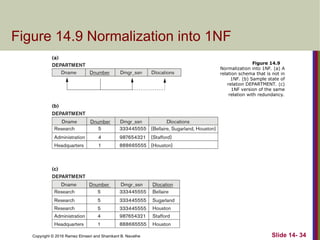
Figure 14.9 Normalization into 1NF
Slide 14- 34
Figure 14.9
Normalization into 1NF. (a) A
relation schema that is not in
1NF. (b) Sample state of
relation DEPARTMENT. (c)
1NF version of the same
relation with redundancy.
- 35.
Copyright © 2016Ramez Elmasri and Shamkant B. Navathe
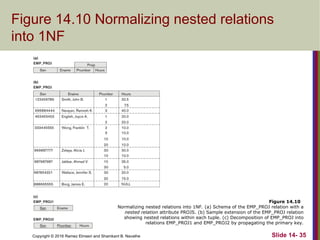
Figure 14.10 Normalizing nested relations
into 1NF
Slide 14- 35
Figure 14.10
Normalizing nested relations into 1NF. (a) Schema of the EMP_PROJ relation with a
nested relation attribute PROJS. (b) Sample extension of the EMP_PROJ relation
showing nested relations within each tuple. (c) Decomposition of EMP_PROJ into
relations EMP_PROJ1 and EMP_PROJ2 by propagating the primary key.
- 36.
Copyright © 2016Ramez Elmasri and Shamkant B. Navathe
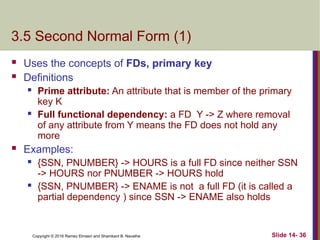
3.5 Second Normal Form (1)
Uses the concepts of FDs, primary key
Definitions
Prime attribute: An attribute that is member of the primary
key K
Full functional dependency: a FD Y -> Z where removal
of any attribute from Y means the FD does not hold any
more
Examples:
{SSN, PNUMBER} -> HOURS is a full FD since neither SSN
-> HOURS nor PNUMBER -> HOURS hold
{SSN, PNUMBER} -> ENAME is not a full FD (it is called a
partial dependency ) since SSN -> ENAME also holds
Slide 14- 36
- 37.
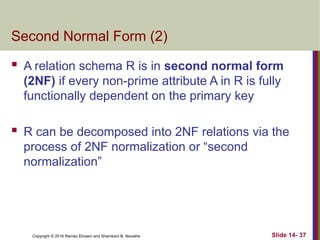
Copyright © 2016Ramez Elmasri and Shamkant B. Navathe
Second Normal Form (2)
A relation schema R is in second normal form
(2NF) if every non-prime attribute A in R is fully
functionally dependent on the primary key
R can be decomposed into 2NF relations via the
process of 2NF normalization or “second
normalization”
Slide 14- 37
- 38.
Copyright © 2016Ramez Elmasri and Shamkant B. Navathe
Figure 14.11 Normalizing into 2NF and
3NF
Slide 14- 38
Figure 14.11
Normalizing into 2NF and 3NF. (a)
Normalizing EMP_PROJ into 2NF
relations. (b) Normalizing EMP_DEPT
into 3NF relations.
- 39.
Copyright © 2016Ramez Elmasri and Shamkant B. Navathe
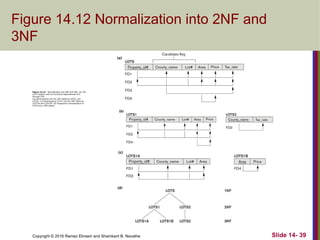
Figure 14.12 Normalization into 2NF and
3NF
Slide 14- 39
Figure 14.12 Normalization into 2NF and 3NF. (a) The
LOTS relation with its functional dependencies FD1
through FD4.
(b) Decomposing into the 2NF relations LOTS1 and
LOTS2. (c) Decomposing LOTS1 into the 3NF relations
LOTS1A and LOTS1B. (d) Progressive normalization of
LOTS into a 3NF design.
- 40.
Copyright © 2016Ramez Elmasri and Shamkant B. Navathe
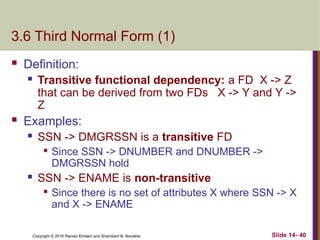
3.6 Third Normal Form (1)
Definition:
Transitive functional dependency: a FD X -> Z
that can be derived from two FDs X -> Y and Y ->
Z
Examples:
SSN -> DMGRSSN is a transitive FD
Since SSN -> DNUMBER and DNUMBER ->
DMGRSSN hold
SSN -> ENAME is non-transitive
Since there is no set of attributes X where SSN -> X
and X -> ENAME
Slide 14- 40
- 41.
Copyright © 2016Ramez Elmasri and Shamkant B. Navathe
Third Normal Form (2)
A relation schema R is in third normal form (3NF) if it is
in 2NF and no non-prime attribute A in R is transitively
dependent on the primary key
R can be decomposed into 3NF relations via the process
of 3NF normalization
NOTE:
In X -> Y and Y -> Z, with X as the primary key, we consider
this a problem only if Y is not a candidate key.
When Y is a candidate key, there is no problem with the
transitive dependency .
E.g., Consider EMP (SSN, Emp#, Salary ).
Here, SSN -> Emp# -> Salary and Emp# is a candidate key.
Slide 14- 41
- 42.
Copyright © 2016Ramez Elmasri and Shamkant B. Navathe
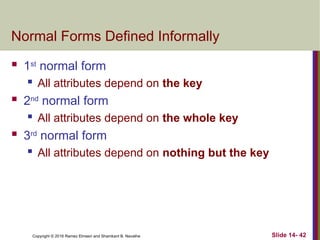
Normal Forms Defined Informally
1st
normal form
All attributes depend on the key
2nd
normal form
All attributes depend on the whole key
3rd
normal form
All attributes depend on nothing but the key
Slide 14- 42
- 43.
Copyright © 2016Ramez Elmasri and Shamkant B. Navathe
4. General Normal Form Definitions (For
Multiple Keys) (1)
The above definitions consider the primary key
only
The following more general definitions take into
account relations with multiple candidate keys
Any attribute involved in a candidate key is a
prime attribute
All other attributes are called non-prime
attributes.
Slide 14- 43
- 44.
Copyright © 2016Ramez Elmasri and Shamkant B. Navathe
4.1 General Definition of 2NF (For
Multiple Candidate Keys)
A relation schema R is in second normal form
(2NF) if every non-prime attribute A in R is fully
functionally dependent on every key of R
In Figure 14.12 the FD
County_name → Tax_rate violates 2NF.
So second normalization converts LOTS into
LOTS1 (Property_id#, County_name, Lot#, Area, Price)
LOTS2 ( County_name, Tax_rate)
Slide 14- 44
- 45.
Copyright © 2016Ramez Elmasri and Shamkant B. Navathe
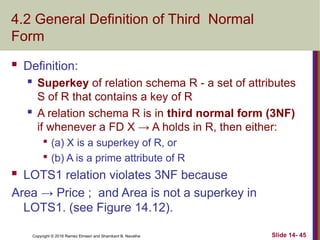
4.2 General Definition of Third Normal
Form
Definition:
Superkey of relation schema R - a set of attributes
S of R that contains a key of R
A relation schema R is in third normal form (3NF)
if whenever a FD X → A holds in R, then either:
(a) X is a superkey of R, or
(b) A is a prime attribute of R
LOTS1 relation violates 3NF because
Area → Price ; and Area is not a superkey in
LOTS1. (see Figure 14.12).
Slide 14- 45
- 46.
Copyright © 2016Ramez Elmasri and Shamkant B. Navathe
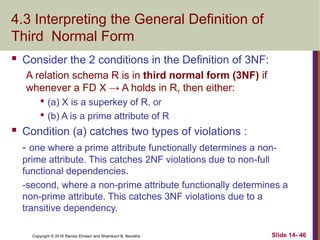
4.3 Interpreting the General Definition of
Third Normal Form
Consider the 2 conditions in the Definition of 3NF:
A relation schema R is in third normal form (3NF) if
whenever a FD X → A holds in R, then either:
(a) X is a superkey of R, or
(b) A is a prime attribute of R
Condition (a) catches two types of violations :
- one where a prime attribute functionally determines a non-
prime attribute. This catches 2NF violations due to non-full
functional dependencies.
-second, where a non-prime attribute functionally determines a
non-prime attribute. This catches 3NF violations due to a
transitive dependency.
Slide 14- 46
- 47.
Copyright © 2016Ramez Elmasri and Shamkant B. Navathe
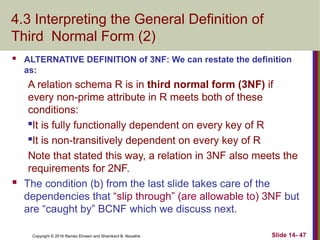
4.3 Interpreting the General Definition of
Third Normal Form (2)
ALTERNATIVE DEFINITION of 3NF: We can restate the definition
as:
A relation schema R is in third normal form (3NF) if
every non-prime attribute in R meets both of these
conditions:
It is fully functionally dependent on every key of R
It is non-transitively dependent on every key of R
Note that stated this way, a relation in 3NF also meets the
requirements for 2NF.
The condition (b) from the last slide takes care of the
dependencies that “slip through” (are allowable to) 3NF but
are “caught by” BCNF which we discuss next.
Slide 14- 47
- 48.
Copyright © 2016Ramez Elmasri and Shamkant B. Navathe
5. BCNF (Boyce-Codd Normal Form)
A relation schema R is in Boyce-Codd Normal Form
(BCNF) if whenever an FD X → A holds in R, then X is a
superkey of R
Each normal form is strictly stronger than the previous one
Every 2NF relation is in 1NF
Every 3NF relation is in 2NF
Every BCNF relation is in 3NF
There exist relations that are in 3NF but not in BCNF
Hence BCNF is considered a stronger form of 3NF
The goal is to have each relation in BCNF (or 3NF)
Slide 14- 48
- 49.
Copyright © 2016Ramez Elmasri and Shamkant B. Navathe Slide 14- 49
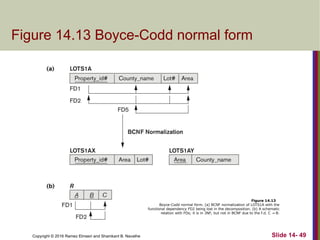
Figure 14.13 Boyce-Codd normal form
Figure 14.13
Boyce-Codd normal form. (a) BCNF normalization of LOTS1A with the
functional dependency FD2 being lost in the decomposition. (b) A schematic
relation with FDs; it is in 3NF, but not in BCNF due to the f.d. C B.
→
- 50.
Copyright © 2016Ramez Elmasri and Shamkant B. Navathe
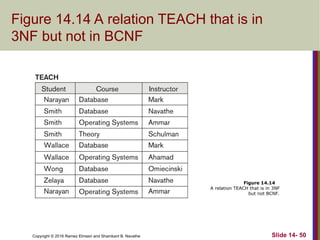
Figure 14.14 A relation TEACH that is in
3NF but not in BCNF
Slide 14- 50
Figure 14.14
A relation TEACH that is in 3NF
but not BCNF.
- 51.
Copyright © 2016Ramez Elmasri and Shamkant B. Navathe
Achieving the BCNF by Decomposition (1)
Two FDs exist in the relation TEACH:
fd1: { student, course} -> instructor
fd2: instructor -> course
{student, course} is a candidate key for this relation and
that the dependencies shown follow the pattern in Figure
14.13 (b).
So this relation is in 3NF but not in BCNF
A relation NOT in BCNF should be decomposed so as to
meet this property, while possibly forgoing the
preservation of all functional dependencies in the
decomposed relations.
(See Algorithm 15.3)
Slide 14- 51
- 52.
Copyright © 2016Ramez Elmasri and Shamkant B. Navathe
Achieving the BCNF by Decomposition (2)
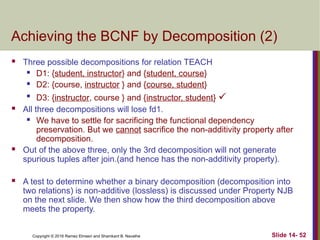
Three possible decompositions for relation TEACH
D1: {student, instructor} and {student, course}
D2: {course, instructor } and {course, student}
D3: {instructor, course } and {instructor, student}
All three decompositions will lose fd1.
We have to settle for sacrificing the functional dependency
preservation. But we cannot sacrifice the non-additivity property after
decomposition.
Out of the above three, only the 3rd decomposition will not generate
spurious tuples after join.(and hence has the non-additivity property).
A test to determine whether a binary decomposition (decomposition into
two relations) is non-additive (lossless) is discussed under Property NJB
on the next slide. We then show how the third decomposition above
meets the property.
Slide 14- 52
- 53.
Copyright © 2016Ramez Elmasri and Shamkant B. Navathe Slide 14- 53
Test for checking non-additivity of Binary
Relational Decompositions
Testing Binary Decompositions for Lossless
Join (Non-additive Join) Property
Binary Decomposition: Decomposition of a
relation R into two relations.
PROPERTY NJB (non-additive join test for
binary decompositions): A decomposition D =
{R1, R2} of R has the lossless join property with
respect to a set of functional dependencies F on R
if and only if either
The f.d. ((R1 ∩ R2) (R1- R2)) is in F+
, or
The f.d. ((R1 ∩ R2) (R2 - R1)) is in F+
.
- 54.
Copyright © 2016Ramez Elmasri and Shamkant B. Navathe Slide 14- 54
Test for checking non-additivity of Binary
Relational Decompositions
If you apply the NJB test to the 3 decompositions
of the TEACH relation:
D1 gives Student Instructor or Student
Course, none of which is true.
D2 gives Course Instructor or Course
Student, none of which is true.
However, in D3 we get Instructor Course or
Instructor Student.
Since Instructor Course is indeed true, the NJB
property is satisfied and D3 is determined as a non-
additive (good) decomposition.
- 55.
Copyright © 2016Ramez Elmasri and Shamkant B. Navathe Slide 14-55
General Procedure for achieving BCNF
when a relation fails BCNF
Here we make use the algorithm from Chapter 15
(Algorithm 15.5):
Let R be the relation not in BCNF, let X be a subset-of R,
and let X A be the FD that causes a violation of BCNF.
Then R may be decomposed into two relations:
(i) R –A and (ii) X υ A.
If either R –A or X υ A. is not in BCNF, repeat the process.
Note that the f.d. that violated BCNF in TEACH was Instructor Course.
Hence its BCNF decomposition would be :
(TEACH – COURSE) and (Instructor υ Course), which gives
the relations: (Instructor, Student) and (Instructor, Course) that we
obtained before in decomposition D3.
- 56.
Copyright © 2016Ramez Elmasri and Shamkant B. Navathe
Chapter Summary
Informal Design Guidelines for Relational
Databases
Functional Dependencies (FDs)
Normal Forms (1NF, 2NF, 3NF)Based on Primary
Keys
General Normal Form Definitions of 2NF and 3NF
(For Multiple Keys)
BCNF (Boyce-Codd Normal Form)
Slide 14- 56






![Copyright © 2016 Ramez Elmasri and Shamkant B. Navathe
2.1 Defining Functional Dependencies
X Y holds if whenever two tuples have the same value
for X, they must have the same value for Y
For any two tuples t1 and t2 in any relation instance r(R): If
t1[X]=t2[X], then t1[Y]=t2[Y]
X Y in R specifies a constraint on all relation instances
r(R)
Written as X Y; can be displayed graphically on a
relation schema as in Figures. ( denoted by the arrow: ).
FDs are derived from the real-world constraints on the
attributes
Slide 14- 21](https://image.slidesharecdn.com/cse311iahslide09normalization-250831055644-5e77ce41/85/CSE311_DBMSDBMS_Slide09_Normalization-ppt-21-320.jpg)

![Copyright © 2016 Ramez Elmasri and Shamkant B. Navathe
Examples of FD constraints (2)
An FD is a property of the attributes in the
schema R
The constraint must hold on every relation
instance r(R)
If K is a key of R, then K functionally determines
all attributes in R
(since we never have two distinct tuples with
t1[K]=t2[K])
Slide 14- 23](https://image.slidesharecdn.com/cse311iahslide09normalization-250831055644-5e77ce41/85/CSE311_DBMSDBMS_Slide09_Normalization-ppt-23-320.jpg)



![Copyright © 2016 Ramez Elmasri and Shamkant B. Navathe
3.3 Definitions of Keys and Attributes
Participating in Keys (1)
A superkey of a relation schema R = {A1, A2, ....,
An} is a set of attributes S subset-of R with the
property that no two tuples t1 and t2 in any legal
relation state r of R will have t1[S] = t2[S]
A key K is a superkey with the additional
property that removal of any attribute from K will
cause K not to be a superkey any more.
Slide 14- 31](https://image.slidesharecdn.com/cse311iahslide09normalization-250831055644-5e77ce41/85/CSE311_DBMSDBMS_Slide09_Normalization-ppt-31-320.jpg)