BVM Engineering College
Subject: Database
Management System
Name Enrollment No.
Sagar Pandav 140070107028
Abhishek Parmar 140070107030
NORMAL FORMS
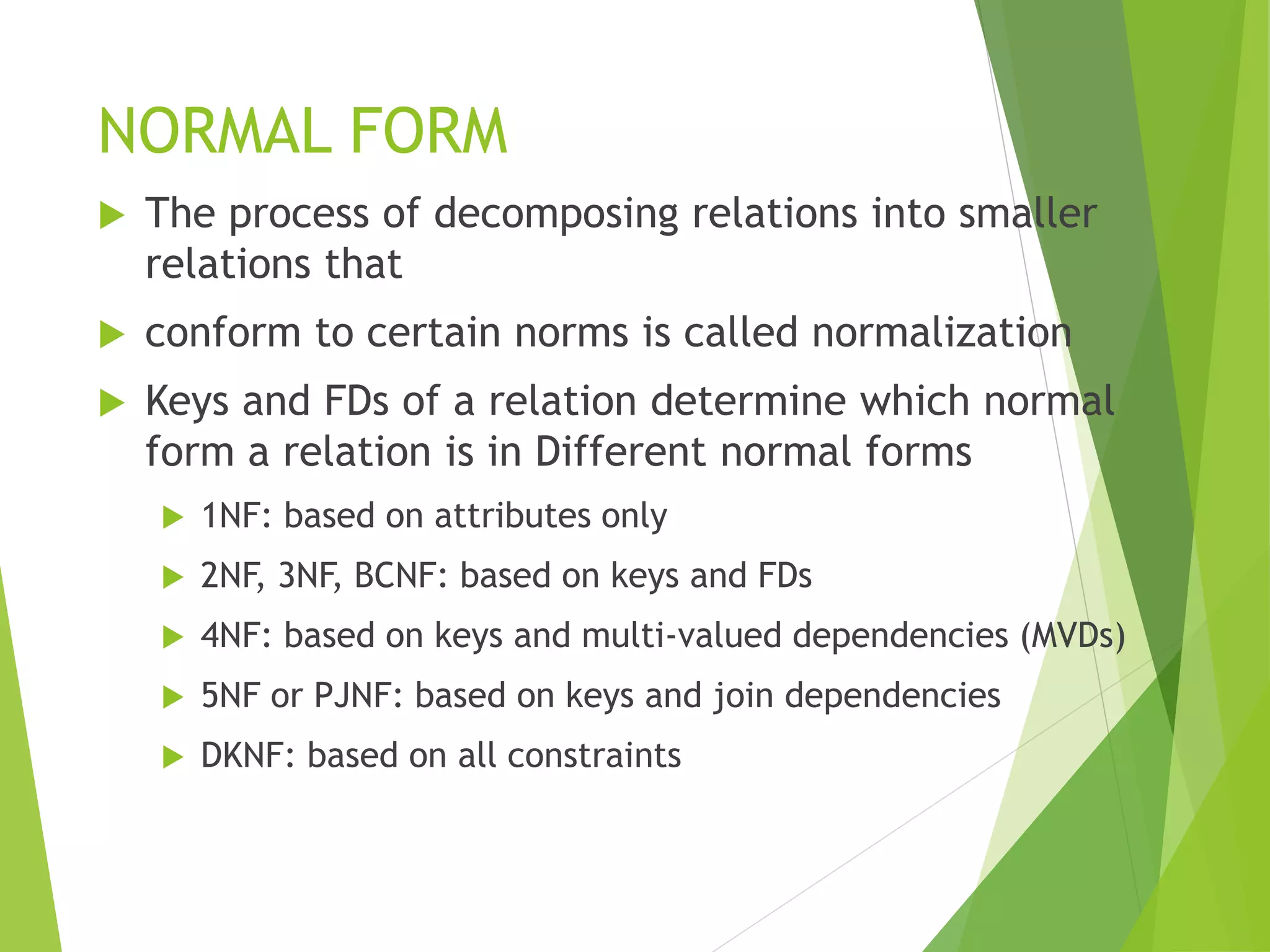
NORMAL FORM
 The process of decomposing relations into smaller
relations that
 conform to certain norms is called normalization
 Keys and FDs of a relation determine which normal
form a relation is in Different normal forms
 1NF: based on attributes only
 2NF, 3NF, BCNF: based on keys and FDs
 4NF: based on keys and multi-valued dependencies (MVDs)
 5NF or PJNF: based on keys and join dependencies
 DKNF: based on all constraints
First Normal Form (1NF)
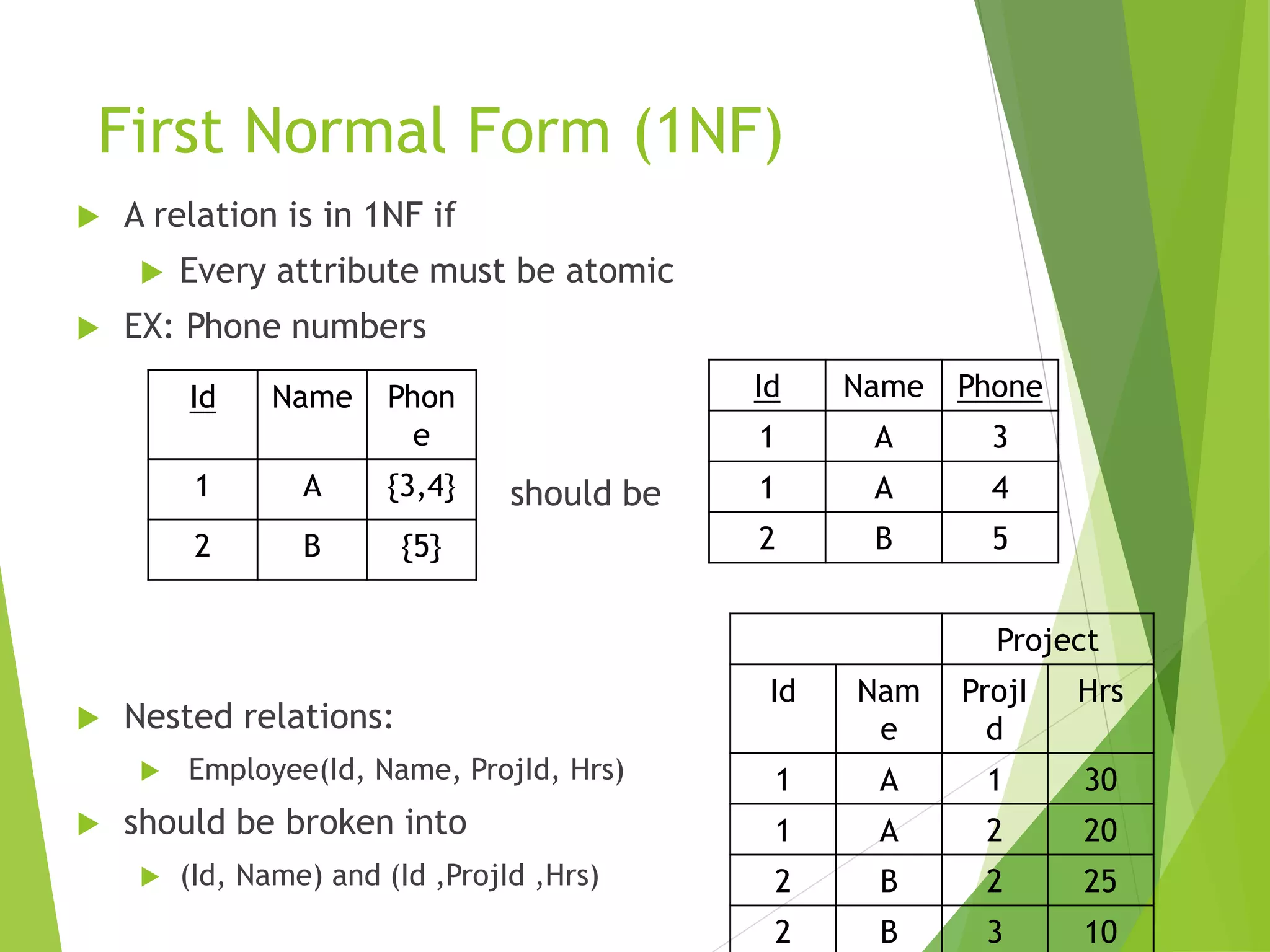
 A relation is in 1NF if
 Every attribute must be atomic
 EX: Phone numbers
should be
 Nested relations:
 Employee(Id, Name, ProjId, Hrs)
 should be broken into
 (Id, Name) and (Id ,ProjId ,Hrs)
Id Name Phon
e
1 A {3,4}
2 B {5}
Id Name Phone
1 A 3
1 A 4
2 B 5
Project
Id Nam
e
ProjI
d
Hrs
1 A 1 30
1 A 2 20
2 B 2 25
2 B 3 10
Second normal form (2NF)
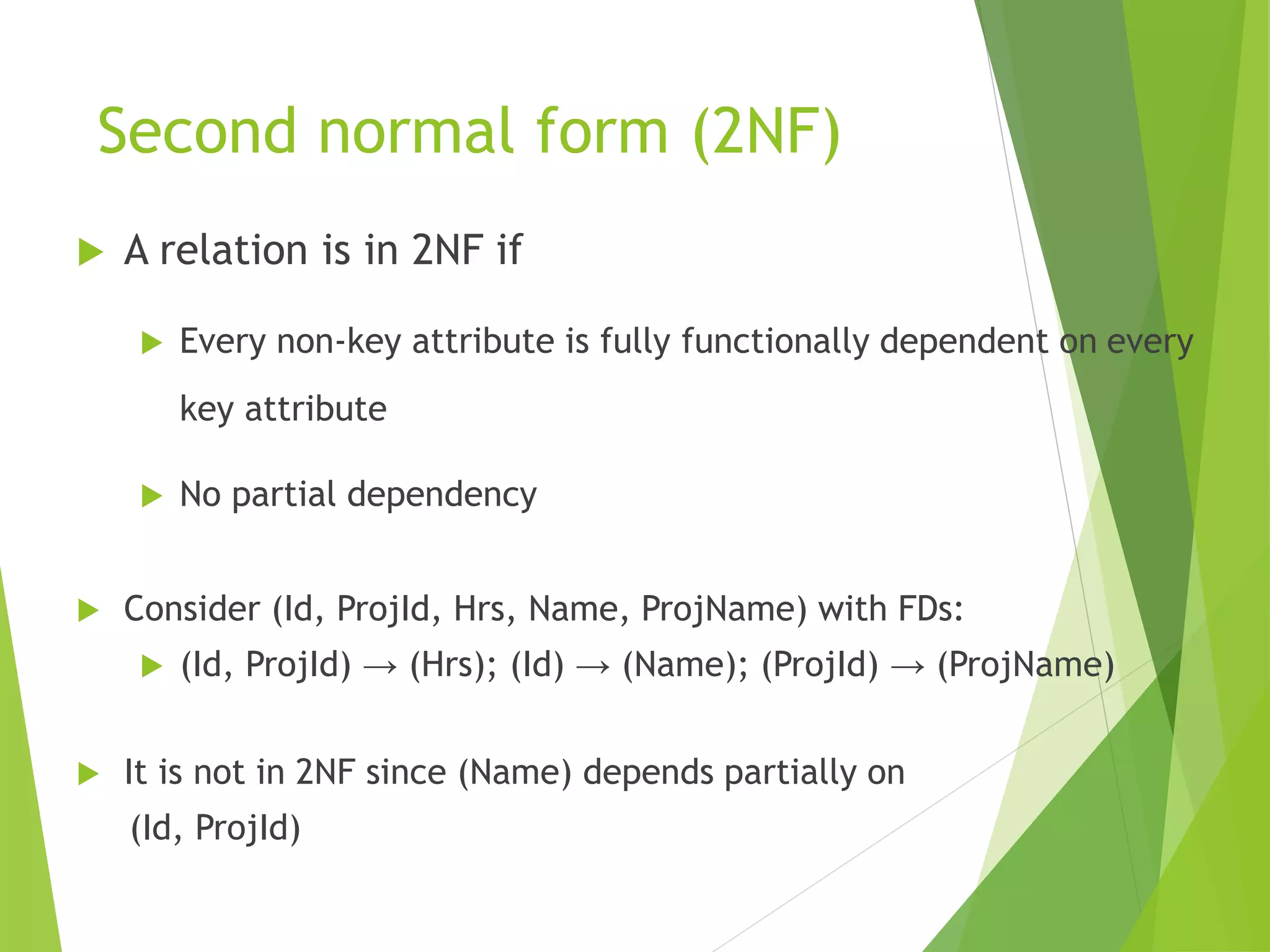
 A relation is in 2NF if
 Every non-key attribute is fully functionally dependent on every
key attribute
 No partial dependency
 Consider (Id, ProjId, Hrs, Name, ProjName) with FDs:
 (Id, ProjId) → (Hrs); (Id) → (Name); (ProjId) → (ProjName)
 It is not in 2NF since (Name) depends partially on
(Id, ProjId)
Second normal form (2NF)
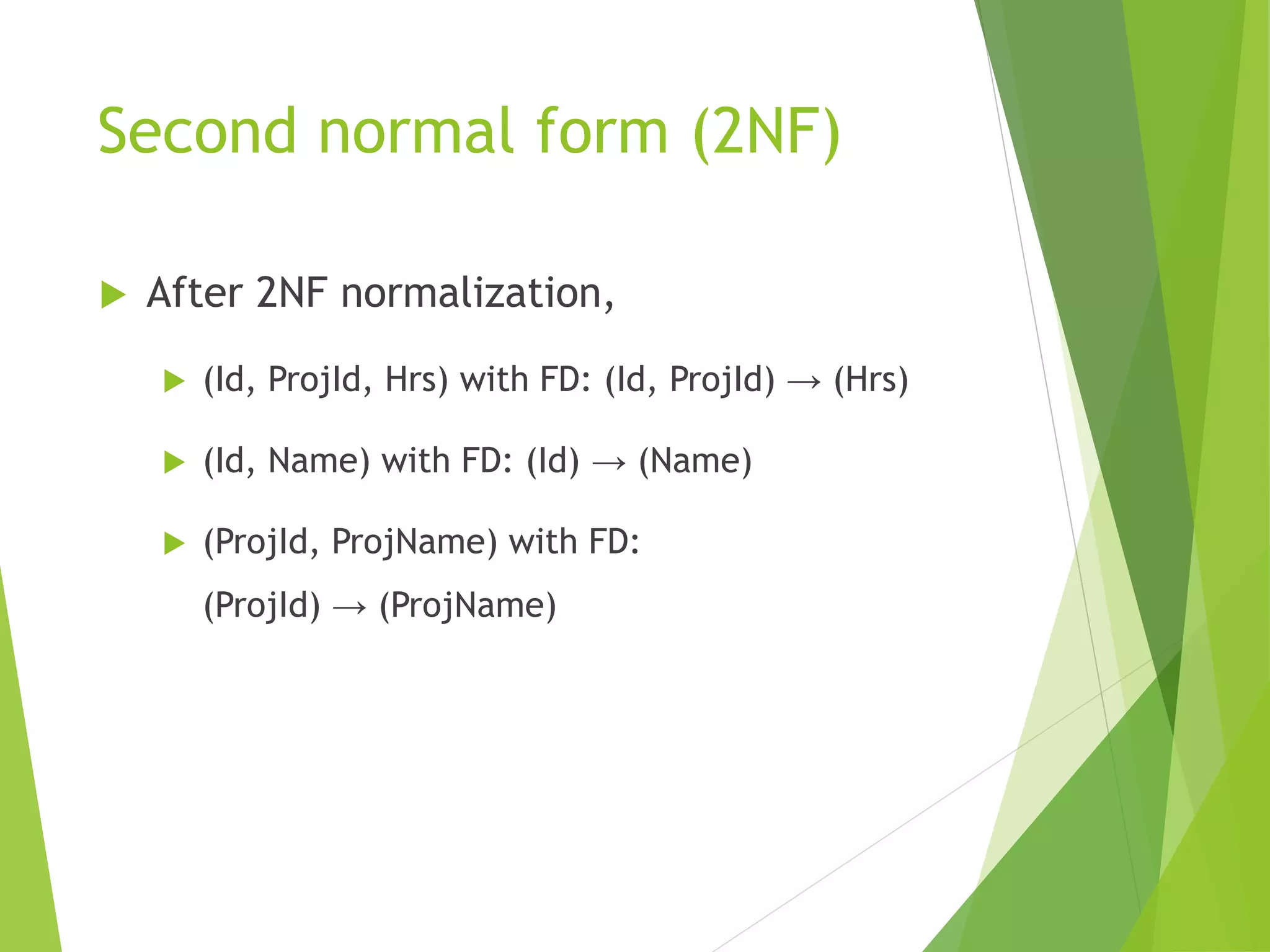
 After 2NF normalization,
 (Id, ProjId, Hrs) with FD: (Id, ProjId) → (Hrs)
 (Id, Name) with FD: (Id) → (Name)
 (ProjId, ProjName) with FD:
(ProjId) → (ProjName)
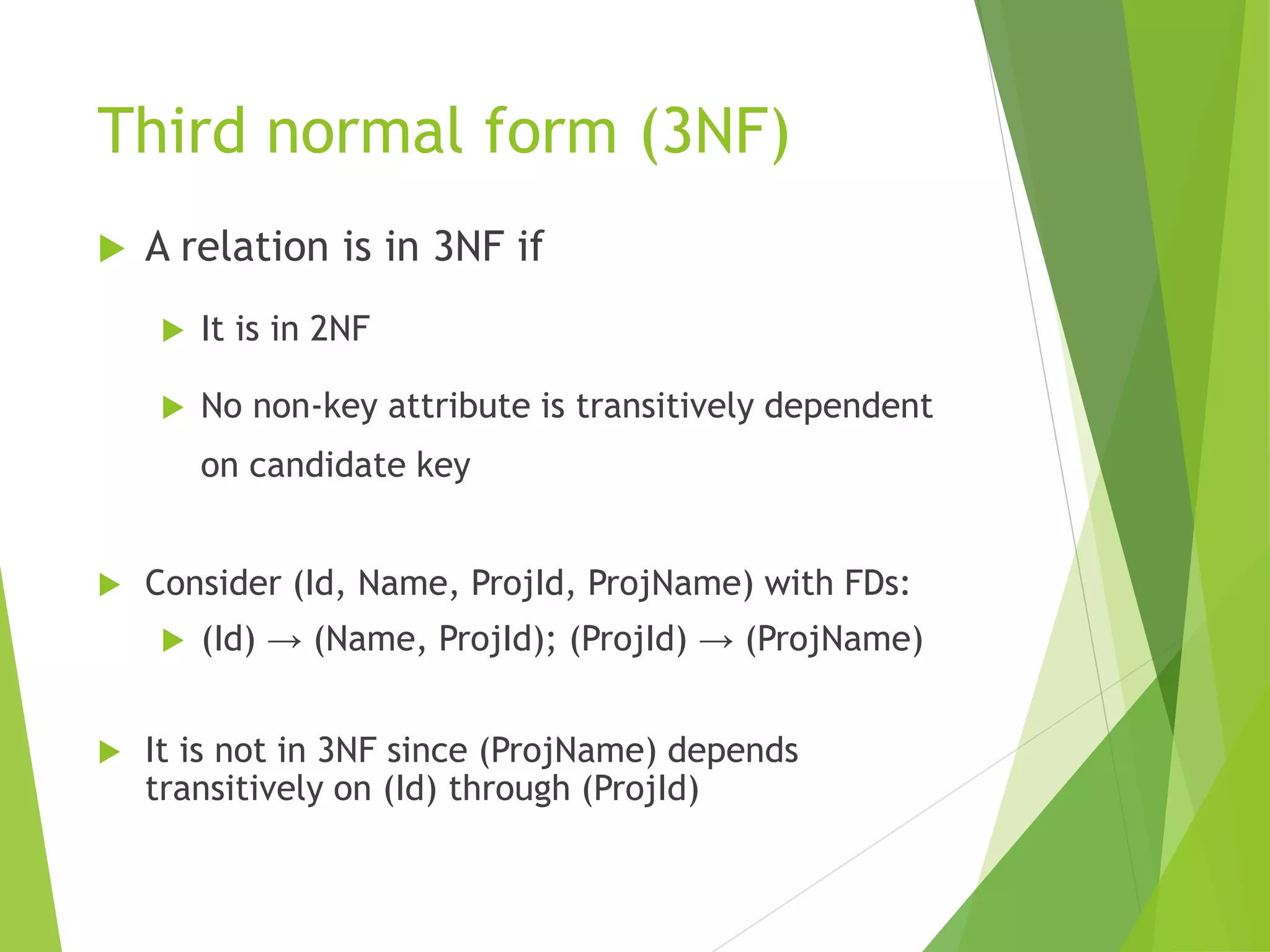
Third normal form (3NF)
 A relation is in 3NF if
 It is in 2NF
 No non-key attribute is transitively dependent
on candidate key
 Consider (Id, Name, ProjId, ProjName) with FDs:
 (Id) → (Name, ProjId); (ProjId) → (ProjName)
 It is not in 3NF since (ProjName) depends
transitively on (Id) through (ProjId)
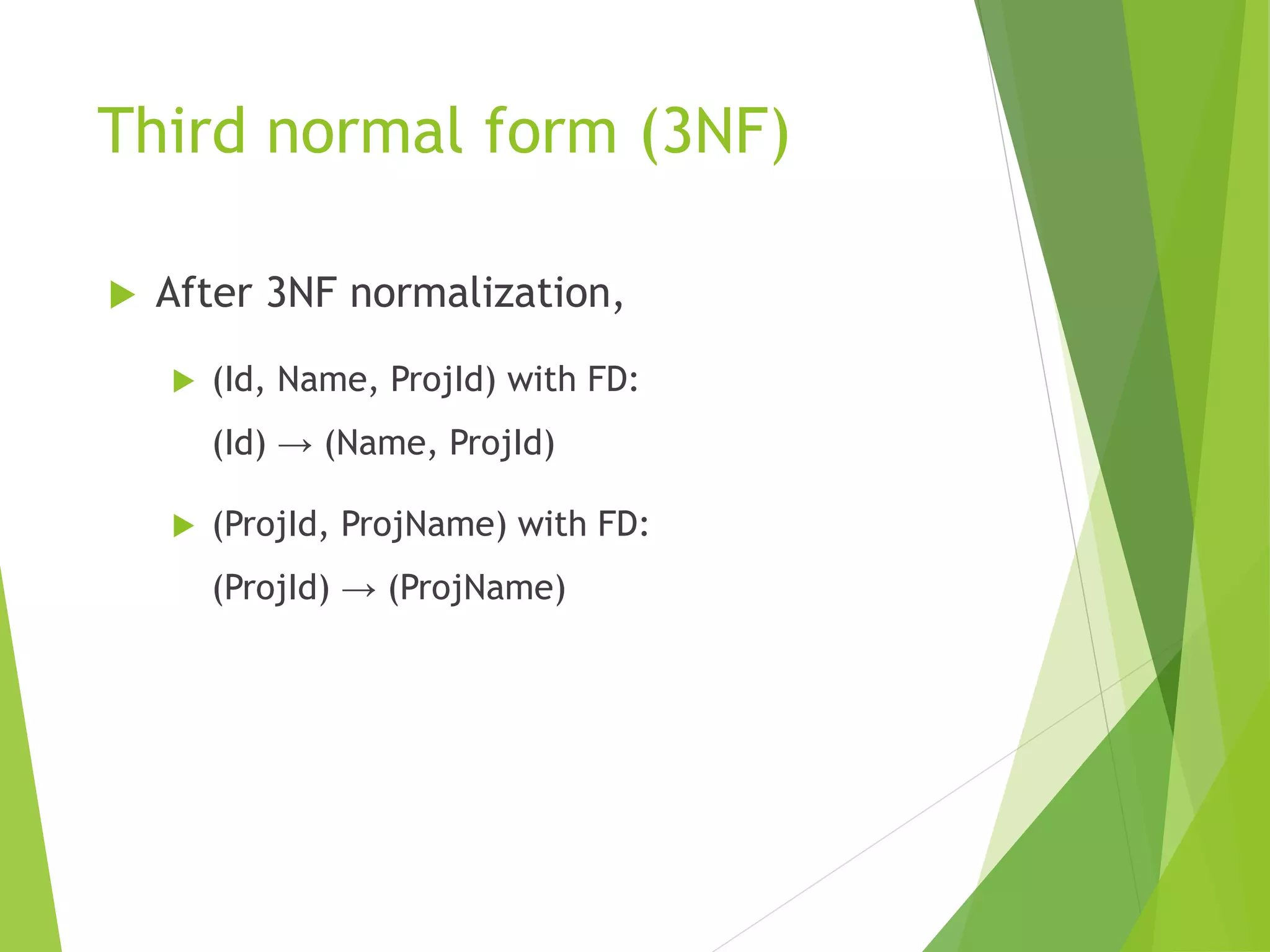
Third normal form (3NF)
 After 3NF normalization,
 (Id, Name, ProjId) with FD:
(Id) → (Name, ProjId)
 (ProjId, ProjName) with FD:
(ProjId) → (ProjName)
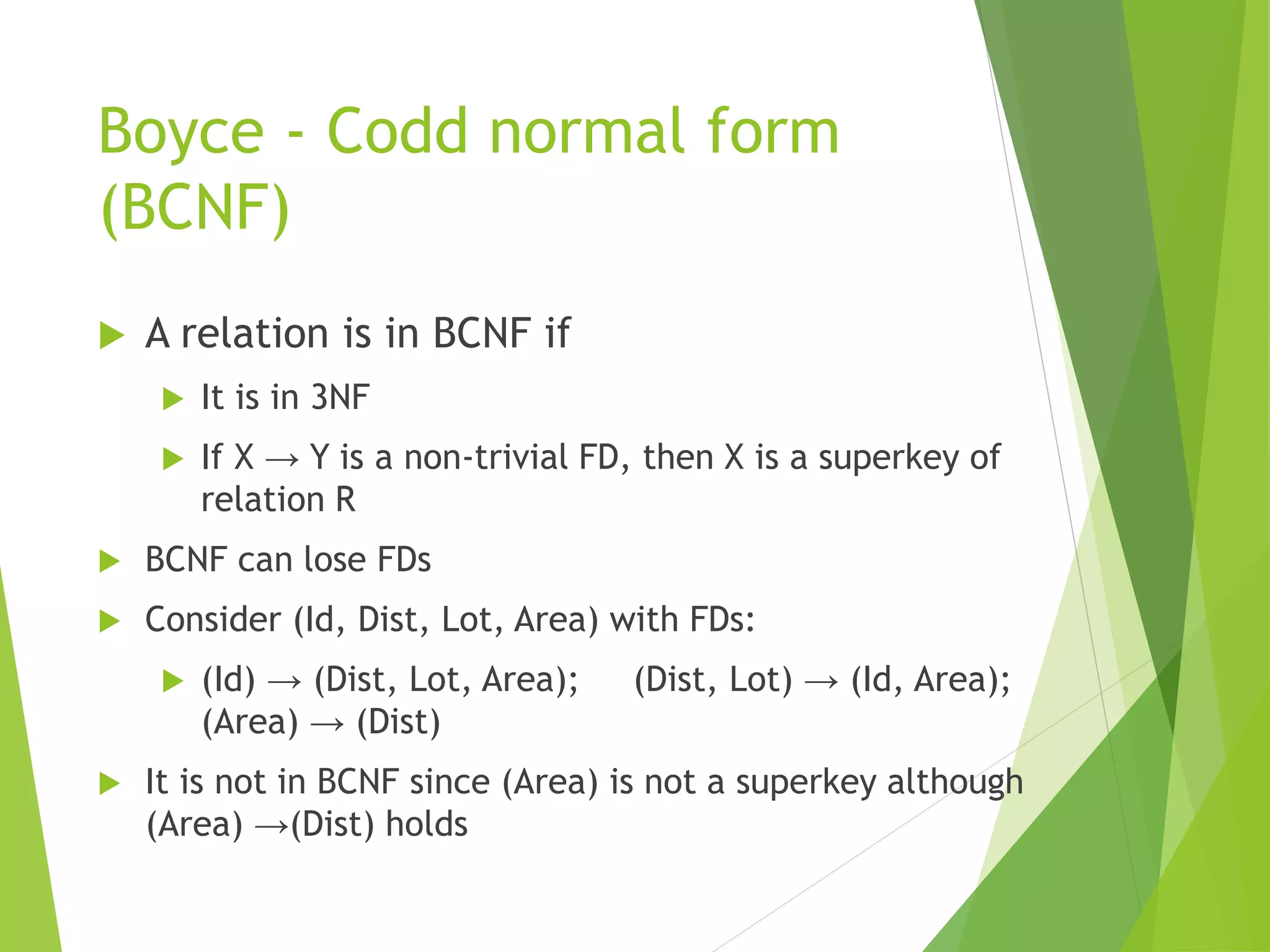
Boyce - Codd normal form
(BCNF)
 A relation is in BCNF if
 It is in 3NF
 If X → Y is a non-trivial FD, then X is a superkey of
relation R
 BCNF can lose FDs
 Consider (Id, Dist, Lot, Area) with FDs:
 (Id) → (Dist, Lot, Area); (Dist, Lot) → (Id, Area);
(Area) → (Dist)
 It is not in BCNF since (Area) is not a superkey although
(Area) →(Dist) holds
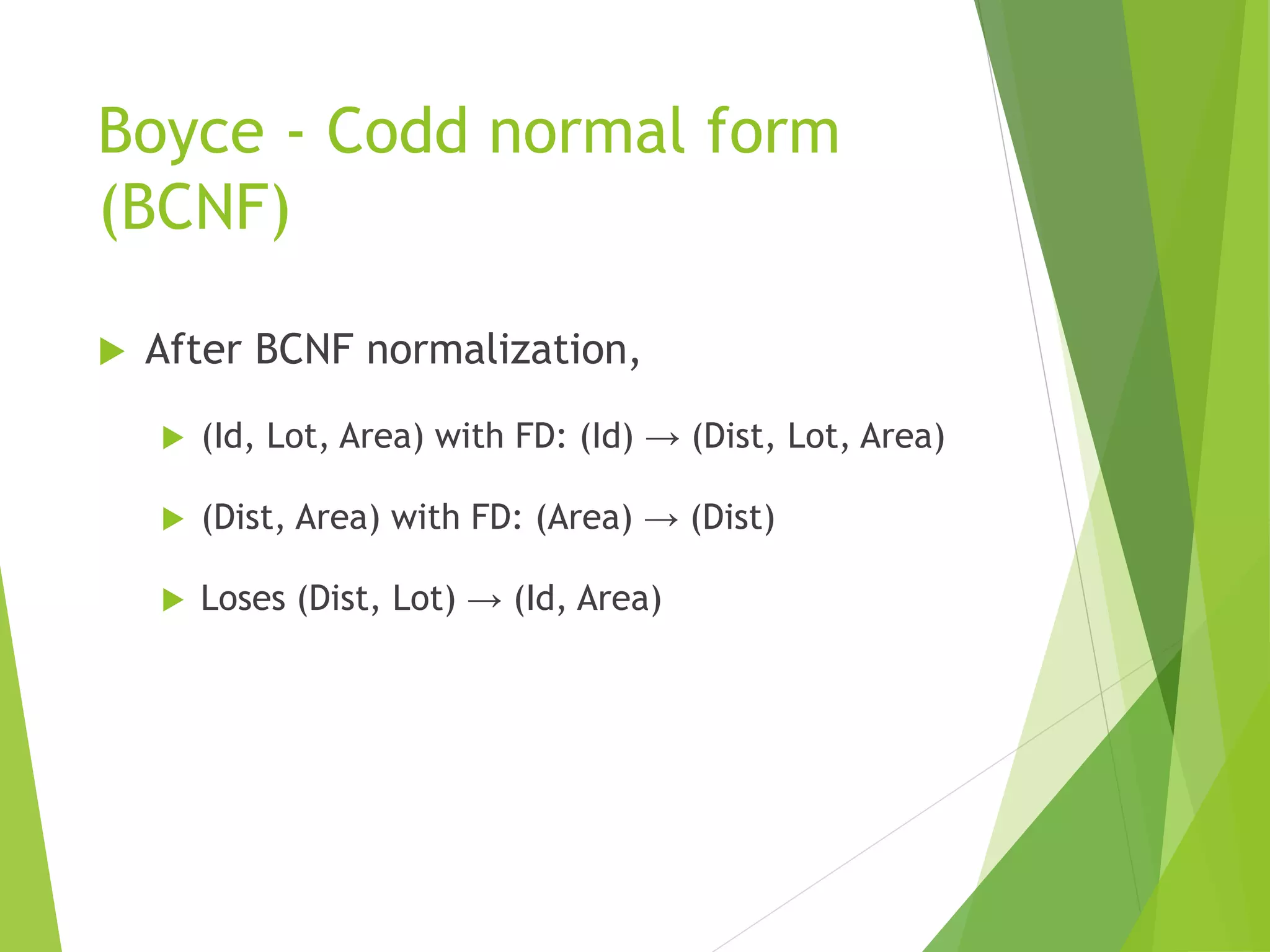
Boyce - Codd normal form
(BCNF)
 After BCNF normalization,
 (Id, Lot, Area) with FD: (Id) → (Dist, Lot, Area)
 (Dist, Area) with FD: (Area) → (Dist)
 Loses (Dist, Lot) → (Id, Area)
Normalization

Normalization

  • 1.
    BVM Engineering College Subject:Database Management System Name Enrollment No. Sagar Pandav 140070107028 Abhishek Parmar 140070107030 NORMAL FORMS
  • 2.
    NORMAL FORM  Theprocess of decomposing relations into smaller relations that  conform to certain norms is called normalization  Keys and FDs of a relation determine which normal form a relation is in Different normal forms  1NF: based on attributes only  2NF, 3NF, BCNF: based on keys and FDs  4NF: based on keys and multi-valued dependencies (MVDs)  5NF or PJNF: based on keys and join dependencies  DKNF: based on all constraints
  • 3.
    First Normal Form(1NF)  A relation is in 1NF if  Every attribute must be atomic  EX: Phone numbers should be  Nested relations:  Employee(Id, Name, ProjId, Hrs)  should be broken into  (Id, Name) and (Id ,ProjId ,Hrs) Id Name Phon e 1 A {3,4} 2 B {5} Id Name Phone 1 A 3 1 A 4 2 B 5 Project Id Nam e ProjI d Hrs 1 A 1 30 1 A 2 20 2 B 2 25 2 B 3 10
  • 4.
    Second normal form(2NF)  A relation is in 2NF if  Every non-key attribute is fully functionally dependent on every key attribute  No partial dependency  Consider (Id, ProjId, Hrs, Name, ProjName) with FDs:  (Id, ProjId) → (Hrs); (Id) → (Name); (ProjId) → (ProjName)  It is not in 2NF since (Name) depends partially on (Id, ProjId)
  • 5.
    Second normal form(2NF)  After 2NF normalization,  (Id, ProjId, Hrs) with FD: (Id, ProjId) → (Hrs)  (Id, Name) with FD: (Id) → (Name)  (ProjId, ProjName) with FD: (ProjId) → (ProjName)
  • 6.
    Third normal form(3NF)  A relation is in 3NF if  It is in 2NF  No non-key attribute is transitively dependent on candidate key  Consider (Id, Name, ProjId, ProjName) with FDs:  (Id) → (Name, ProjId); (ProjId) → (ProjName)  It is not in 3NF since (ProjName) depends transitively on (Id) through (ProjId)
  • 7.
    Third normal form(3NF)  After 3NF normalization,  (Id, Name, ProjId) with FD: (Id) → (Name, ProjId)  (ProjId, ProjName) with FD: (ProjId) → (ProjName)
  • 8.
    Boyce - Coddnormal form (BCNF)  A relation is in BCNF if  It is in 3NF  If X → Y is a non-trivial FD, then X is a superkey of relation R  BCNF can lose FDs  Consider (Id, Dist, Lot, Area) with FDs:  (Id) → (Dist, Lot, Area); (Dist, Lot) → (Id, Area); (Area) → (Dist)  It is not in BCNF since (Area) is not a superkey although (Area) →(Dist) holds
  • 9.
    Boyce - Coddnormal form (BCNF)  After BCNF normalization,  (Id, Lot, Area) with FD: (Id) → (Dist, Lot, Area)  (Dist, Area) with FD: (Area) → (Dist)  Loses (Dist, Lot) → (Id, Area)