Physiological changes
during puerperium
Ms.Richa Goswami
Lecturer
M.B.N.C
Puerperium is the period following
childbirth during which the body tissues,
specially the pelvic organs revert back
approximately to the pre-pregnant state
both anatomically and physiologically.
Involution is the process whereby the
reproductive organs return to their
nonpregnant state.
Duration: placenta is expelled TO lasts
for approximately 6 weeks
The period is arbitrarily divided into –
Immediate
• Within
24 hrs
Early
• Up to 7
days
Remote
• Up to 6
weeks
Involution of the uterus
Anatomical consideration
the uterus becomes firm and retracted
with alternate hardening and softening.
The uterus measures about 20 X 12 X 7.5
cm.(length, breath and thickness)
 Weight :about 1000 gms.
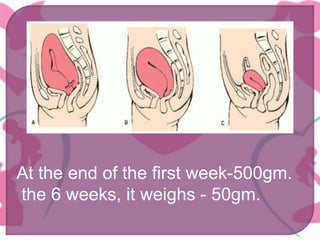
At the end of the first week-500gm.
the 6 weeks, it weighs - 50gm.
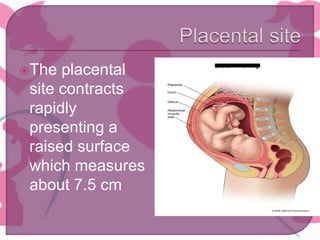
The placental
site contracts
rapidly
presenting a
raised surface
which measures
about 7.5 cm
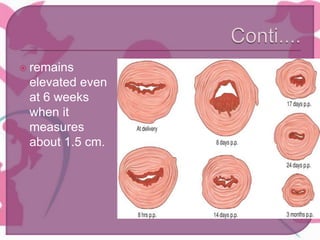
 remains
elevated even
at 6 weeks
when it
measures
about 1.5 cm.
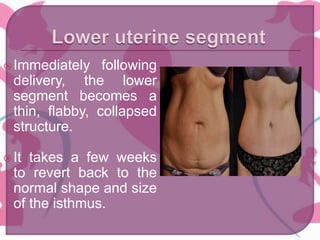
Immediately following
delivery, the lower
segment becomes a
thin, flabby, collapsed
structure.
It takes a few weeks
to revert back to the
normal shape and size
of the isthmus.
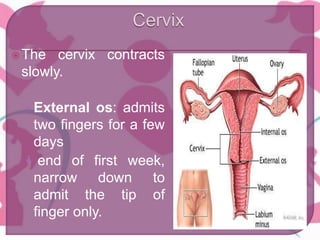
The cervix contracts
slowly.
• External os: admits
two fingers for a few
days
• end of first week,
narrow down to
admit the tip of
finger only.
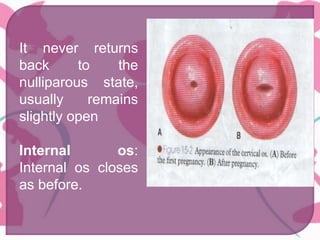
It never returns
back to the
nulliparous state,
usually remains
slightly open
Internal os:
Internal os closes
as before.
The physiological process of involution is
most marked in the body of the uterus.
Changes occur in the following
components:
1. Muscles
2. Blood vessels
3. Endometrium
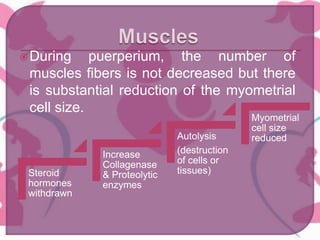
During puerperium, the number of
muscles fibers is not decreased but there
is substantial reduction of the myometrial
cell size.
Steroid
hormones
withdrawn
Increase
Collagenase
& Proteolytic
enzymes
Autolysis
(destruction
of cells or
tissues)
Myometrial
cell size
reduced
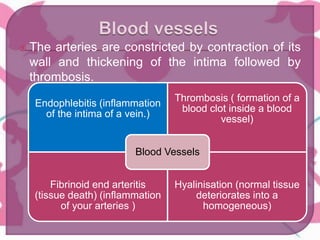
 The arteries are constricted by contraction of its
wall and thickening of the intima followed by
thrombosis.
Endophlebitis (inflammation
of the intima of a vein.)
Thrombosis ( formation of a
blood clot inside a blood
vessel)
Fibrinoid end arteritis
(tissue death) (inflammation
of your arteries )
Hyalinisation (normal tissue
deteriorates into a
homogeneous)
Blood Vessels
 The superficial layer becomes necrotic and is
sloughed in the lochia.
 The basal layer adjacent to the myometrium
remains intact and is the source of new
endometrium.
 The endometrium arises from proliferation of
the endometrial glandular remnants and the
stroma of the inter glandular connective
tissue.
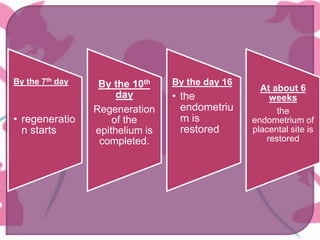
By the 7th day
• regeneratio
n starts
By the 10th
day
Regeneration
of the
epithelium is
completed.
By the day 16
• the
endometriu
m is
restored
At about 6
weeks
the
endometrium of
placental site is
restored
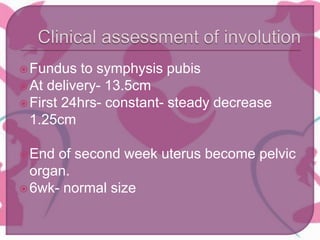
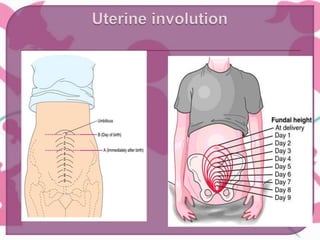
Fundus to symphysis pubis
At delivery- 13.5cm
First 24hrs- constant- steady decrease
1.25cm
End of second week uterus become pelvic
organ.
6wk- normal size
Subinvolution- involution may be affected
adversely
Superinvolution- lactating mother-smaller
in size uterus
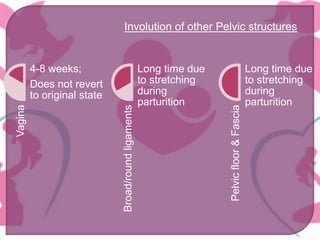
Vagina
4-8 weeks;
Does not revert
to original state
Broad/roundligaments
Long time due
to stretching
during
parturition
Pelvicfloor&Fascia
Long time due
to stretching
during
parturition
Involution of other Pelvic structures
 Takes a long time(4-8 weeks) to involute.
 It regains its tone but never to the virginal state.
 The mucosa remains delicate for the first few
weeks and submucous venous congestion
persists even longer.
 Rugae partially reappear at third week.
 The introitus remains permanently larger than the
virginal state.
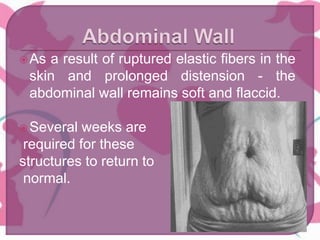
As a result of ruptured elastic fibers in the
skin and prolonged distension - the
abdominal wall remains soft and flaccid.
Several weeks are
required for these
structures to return to
normal.

Vaginal discharge
for the 1st fortnight
during puerperium.
Originates-uterine
body, cervix and
vagina
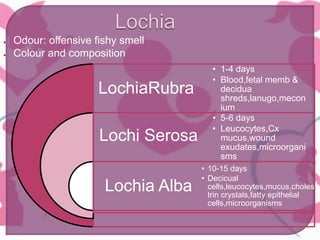
● Odour: offensive fishy smell
● Colour and composition
LochiaRubra
Lochi Serosa
Lochia Alba
• 1-4 days
• Blood,fetal memb &
decidua
shreds,lanugo,mecon
ium
• 5-6 days
• Leucocytes,Cx
mucus,wound
exudates,microorgani
sms
• 10-15 days
• Decicual
cells,leucocytes,mucus,choles
trin crystals,fatty epithelial
cells,microorganisms
Odour- malodour-infection
Amount- scanty or absent- lochiometra
(distension of the uterus by retained
lochia.)
Excessive- infection
Colour- red colour beyond- subinvolution
or retained bites of conceptus
Duration- more than 3wk – genital lesion
Temperature
after birth- first 24
hours- slight increase-
99f
3rd day-slight rise-
breast engorgement-
not more than 24hr
Occasionally, Genito
urinary infection rise
temperature
 After the initial tachycardia
associated with labour and
delivery, a bradycardia often
develops in the early
puerperium.
 2nd day pulse settles down in
normal
 Pulse rise- pain or
excitement
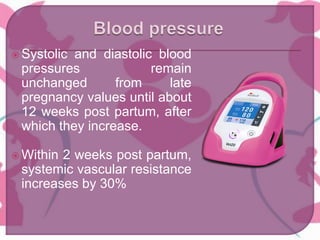
 Systolic and diastolic blood
pressures remain
unchanged from late
pregnancy values until about
12 weeks post partum, after
which they increase.
 Within 2 weeks post partum,
systemic vascular resistance
increases by 30%
Systolic and diastolic blood pressures
remain unchanged from late pregnancy
values until about 12 weeks post partum,
after which they increase.
Within 2 weeks post partum, systemic
vascular resistance increases by 30%
 The bladder wall becomes oedematous and
hyperaemic and often shows evidences of
submucous extravasations of blood.
 the bladder may be over distended without any
desire to pass urine.
 Common urinary problems- incomplete emptying,
over distended.
 Dilated ureters and renal pelvis return to normal
size within 8 weeks
Increase thirst- loss of fluid
Constipation- delayed GI motility, mild
iueus following delivery, perineal
discomfort.
Some having anal incontinence (bowel
control problem)
Weight loss- 5-6 kg – expulsion of fetus,
placenta, liquor and blood loss
Weight loss- Diuresis
 continue up to 6 wk
Fluid loss- 2 litres during 1st wk
Additional 1.5 litres –next 5 wk
 amount of fluid loss depend on – amount
of retained during pregnancy, dehydration
and blood loss during delivery
Loss of salt and water-pre eclampsia and
eclampsia.
At delivery- decrease due to blood loss and
dehydration
2nd wk – normal
Cardiac out put: rise 80% - Returned to normal
level by 1 week after delivery
RBC and haematocrit- 8wk
Platelet- 4 to 10 days
The white blood cell count sometimes reaches
30,000/L - stress
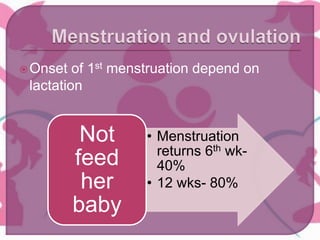
Onset of 1st menstruation depend on
lactation
• Menstruation
returns 6th wk-
40%
• 12 wks- 80%
Not
feed
her
baby
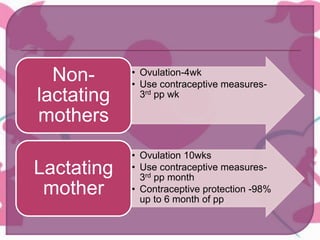
• Ovulation-4wk
• Use contraceptive measures-
3rd pp wk
Non-
lactating
mothers
• Ovulation 10wks
• Use contraceptive measures-
3rd pp month
• Contraceptive protection -98%
up to 6 month of pp
Lactating
mother
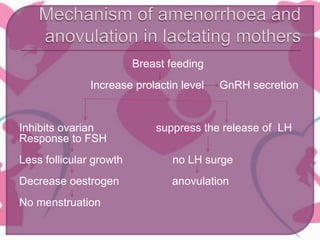
Breast feeding
Increase prolactin level GnRH secretion
Inhibits ovarian suppress the release of LH
Response to FSH
Less follicular growth no LH surge
Decrease oestrogen anovulation
No menstruation
Normal puerperium

Normal puerperium

  • 1.
  • 3.
    Puerperium is theperiod following childbirth during which the body tissues, specially the pelvic organs revert back approximately to the pre-pregnant state both anatomically and physiologically. Involution is the process whereby the reproductive organs return to their nonpregnant state.
  • 4.
    Duration: placenta isexpelled TO lasts for approximately 6 weeks The period is arbitrarily divided into – Immediate • Within 24 hrs Early • Up to 7 days Remote • Up to 6 weeks
  • 5.
    Involution of theuterus Anatomical consideration the uterus becomes firm and retracted with alternate hardening and softening. The uterus measures about 20 X 12 X 7.5 cm.(length, breath and thickness)  Weight :about 1000 gms.
  • 6.
    At the endof the first week-500gm. the 6 weeks, it weighs - 50gm.
  • 7.
    The placental site contracts rapidly presentinga raised surface which measures about 7.5 cm
  • 8.
     remains elevated even at6 weeks when it measures about 1.5 cm.
  • 9.
    Immediately following delivery, thelower segment becomes a thin, flabby, collapsed structure. It takes a few weeks to revert back to the normal shape and size of the isthmus.
  • 10.
    The cervix contracts slowly. •External os: admits two fingers for a few days • end of first week, narrow down to admit the tip of finger only.
  • 11.
    It never returns backto the nulliparous state, usually remains slightly open Internal os: Internal os closes as before.
  • 12.
    The physiological processof involution is most marked in the body of the uterus. Changes occur in the following components: 1. Muscles 2. Blood vessels 3. Endometrium
  • 13.
    During puerperium, thenumber of muscles fibers is not decreased but there is substantial reduction of the myometrial cell size. Steroid hormones withdrawn Increase Collagenase & Proteolytic enzymes Autolysis (destruction of cells or tissues) Myometrial cell size reduced
  • 14.
     The arteriesare constricted by contraction of its wall and thickening of the intima followed by thrombosis. Endophlebitis (inflammation of the intima of a vein.) Thrombosis ( formation of a blood clot inside a blood vessel) Fibrinoid end arteritis (tissue death) (inflammation of your arteries ) Hyalinisation (normal tissue deteriorates into a homogeneous) Blood Vessels
  • 15.
     The superficiallayer becomes necrotic and is sloughed in the lochia.  The basal layer adjacent to the myometrium remains intact and is the source of new endometrium.  The endometrium arises from proliferation of the endometrial glandular remnants and the stroma of the inter glandular connective tissue.
  • 16.
    By the 7thday • regeneratio n starts By the 10th day Regeneration of the epithelium is completed. By the day 16 • the endometriu m is restored At about 6 weeks the endometrium of placental site is restored
  • 17.
    Fundus to symphysispubis At delivery- 13.5cm First 24hrs- constant- steady decrease 1.25cm End of second week uterus become pelvic organ. 6wk- normal size
  • 19.
    Subinvolution- involution maybe affected adversely Superinvolution- lactating mother-smaller in size uterus
  • 20.
    Vagina 4-8 weeks; Does notrevert to original state Broad/roundligaments Long time due to stretching during parturition Pelvicfloor&Fascia Long time due to stretching during parturition Involution of other Pelvic structures
  • 21.
     Takes along time(4-8 weeks) to involute.  It regains its tone but never to the virginal state.  The mucosa remains delicate for the first few weeks and submucous venous congestion persists even longer.  Rugae partially reappear at third week.  The introitus remains permanently larger than the virginal state.
  • 22.
    As a resultof ruptured elastic fibers in the skin and prolonged distension - the abdominal wall remains soft and flaccid. Several weeks are required for these structures to return to normal.
  • 23.
    Vaginal discharge for the1st fortnight during puerperium. Originates-uterine body, cervix and vagina
  • 24.
    ● Odour: offensivefishy smell ● Colour and composition LochiaRubra Lochi Serosa Lochia Alba • 1-4 days • Blood,fetal memb & decidua shreds,lanugo,mecon ium • 5-6 days • Leucocytes,Cx mucus,wound exudates,microorgani sms • 10-15 days • Decicual cells,leucocytes,mucus,choles trin crystals,fatty epithelial cells,microorganisms
  • 25.
    Odour- malodour-infection Amount- scantyor absent- lochiometra (distension of the uterus by retained lochia.) Excessive- infection Colour- red colour beyond- subinvolution or retained bites of conceptus Duration- more than 3wk – genital lesion
  • 26.
    Temperature after birth- first24 hours- slight increase- 99f 3rd day-slight rise- breast engorgement- not more than 24hr Occasionally, Genito urinary infection rise temperature
  • 27.
     After theinitial tachycardia associated with labour and delivery, a bradycardia often develops in the early puerperium.  2nd day pulse settles down in normal  Pulse rise- pain or excitement
  • 28.
     Systolic anddiastolic blood pressures remain unchanged from late pregnancy values until about 12 weeks post partum, after which they increase.  Within 2 weeks post partum, systemic vascular resistance increases by 30%
  • 29.
    Systolic and diastolicblood pressures remain unchanged from late pregnancy values until about 12 weeks post partum, after which they increase. Within 2 weeks post partum, systemic vascular resistance increases by 30%
  • 30.
     The bladderwall becomes oedematous and hyperaemic and often shows evidences of submucous extravasations of blood.  the bladder may be over distended without any desire to pass urine.  Common urinary problems- incomplete emptying, over distended.  Dilated ureters and renal pelvis return to normal size within 8 weeks
  • 31.
    Increase thirst- lossof fluid Constipation- delayed GI motility, mild iueus following delivery, perineal discomfort. Some having anal incontinence (bowel control problem)
  • 32.
    Weight loss- 5-6kg – expulsion of fetus, placenta, liquor and blood loss Weight loss- Diuresis  continue up to 6 wk
  • 33.
    Fluid loss- 2litres during 1st wk Additional 1.5 litres –next 5 wk  amount of fluid loss depend on – amount of retained during pregnancy, dehydration and blood loss during delivery Loss of salt and water-pre eclampsia and eclampsia.
  • 34.
    At delivery- decreasedue to blood loss and dehydration 2nd wk – normal Cardiac out put: rise 80% - Returned to normal level by 1 week after delivery RBC and haematocrit- 8wk Platelet- 4 to 10 days The white blood cell count sometimes reaches 30,000/L - stress
  • 35.
    Onset of 1stmenstruation depend on lactation • Menstruation returns 6th wk- 40% • 12 wks- 80% Not feed her baby
  • 36.
    • Ovulation-4wk • Usecontraceptive measures- 3rd pp wk Non- lactating mothers • Ovulation 10wks • Use contraceptive measures- 3rd pp month • Contraceptive protection -98% up to 6 month of pp Lactating mother
  • 37.
    Breast feeding Increase prolactinlevel GnRH secretion Inhibits ovarian suppress the release of LH Response to FSH Less follicular growth no LH surge Decrease oestrogen anovulation No menstruation