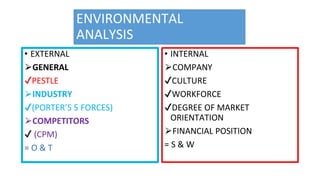
ENVIRONMENTAL
ANALYSIS
• EXTERNAL
⮚GENERAL
✔PESTLE
⮚INDUSTRY
✔(PORTER’S 5 FORCES)
⮚COMPETITORS
✔ (CPM)
= O & T
• INTERNAL
⮚COMPANY
✔CULTURE
✔WORKFORCE
✔DEGREE OF MARKET
ORIENTATION
⮚FINANCIAL POSITION
= S & W
PESTLE analysis
Malaysia
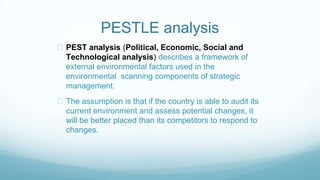
PESTLE analysis
PEST analysis (Political, Economic, Social and
Technological analysis) describes a framework of
external environmental factors used in the
environmental scanning components of strategic
management.
The assumption is that if the country is able to audit its
current environment and assess potential changes, it
will be better placed than its competitors to respond to
changes.
Malaysia (Political analysis)
Malaysia is a multi-party democracy country.
The ruling Alliance party (Barisan Nasional) party has been in power over 63
years. (This fact provided the country with a high degree of stability, which is
important factor for businesses investing in the country). Although the helm was
mandated to PH in 2018, post GE14, it was somehow returned to BN smoothly
without any hostility. Similarly the change of government happened post GE15
in 2022 where PH won majority and formed Unity government with BN in its
formation.
Corruption does exist in the country. (This fact may become a barrier to foreign
businesses as it adds to firms costs and can cause problems), ref:
https://www.transparency.org/en/cpi/2021
Transparency International ranks Malaysia 61 of 180 countries in its Corruption
Perceptions Index. Malaysia also saw a decline in Dec 2022 where CPI score
dropped from 48 to 47. Nevertheless rank improved from 62 to 61..
Malaysia (Economic analysis)
Malaysia’s main attraction as a location for business is
its vibrant economy.
Over the last 10 years, economic growth has averaged 7%
per year.
This rate of growth has lead to a large increase in
consumer incomes and therefore demand, which has
attracted retailers such as IKEA, Tesco and AEON.
Malaysian location makes it ideally placed to engage in
international trade.
Exports account for 37% of Malaysia’s GDP and the country
achieves a healthy current account surplus.
Malaysia (Social analysis)
The Malaysian population consists of three main
groups: Malay (60%), Chinese (30%) and Indian (10%).
This mix of populations gives Malaysia a rich and vibrant
culture, and the country is seen as an example of racial
harmony as the different populations have existed
peacefully together for years.
The country is predominately Islamic in its religion but it’s
only the Malay muslims who are bound by Islamic laws; the
rest of the population are free to practise their own
religions.
Malaysia (Social analysis) cont.
The mixture of religions in the country gives rise to a
large number of religious celebrations - Malaysia has
more public holidays than any other country.
The cultural differences mean that businesses
entering the country will have to adapt their products
and business practices to suit the needs of the
population.
Malaysia (Technological
analysis)
The Malaysia is still need to develop its technology to
enable it to compete in international markets.
In 1996, the govt. initiated the ‘Multimedia Super Corridor’
(MSC), which is a strip of land stretching from the central
business district of Kuala Lumpur to the out-of-town Kuala
Lumpur International Airport.
This corridor hosts more than 360 multinationals, including
foreign-owned and home-growth Malaysian companies, all
focused on multimedia and communications products.
It continue to expand and attract world-leading ICT
companies.
Malaysia (Technological
analysis) cont.
The high levels of investment in training and education,
including the creation of a number of ‘Smart Schools’, and
an excellent infrastructure, including a brand new town
called Cyberjaya.
Cyberjaya is a ‘self-contained intelligent city with world-class
IT infrastructure’.
It’s this level of technological support that makes
Malaysia an attractive place for foreign firms to do
business.
In fact, Cyberjaya is considered one of the top three
destinations for business support services and outsourcing
in the world.
Malaysia (Legal analysis)
The Malaysian legal system is based on British
common law, although Islamic law is applied to the
Muslim population.
The British law element can be seen as an advantage to
firms investing in the country as the law will be familiar
to them.
However, although the legal basis of the system is
British, many of the punishments for those who break
the
law are far harsher - the death penalty and flogging are still
widely used.
Therefore, investing in a foreign country need to be
familiar with the laws there and confident that they will be
applied fairly.
Malaysia (Environmental
analysis)
The rapid development of Malaysia has come with high
environmental costs (negative externalities).
According to a data from the UN, Malaysia’s deforestation
rate is increasing at a faster rate than other tropical
country.
Since 2000, the country has lost an average of 140,200
hectares – 0.65% of its forest area – per year.
Much of the country’s land that was once rainforest is
now given over to the production of palm oil, which is
used for the processing food we eat and as a source of
biofuel.
Malaysia (Environmental
analysis) cont.
Malaysian environmental impact has been criticised by
environmental groups as it has a devastating effect on
the habitats of some rare wildlife.
Malaysians, and particularly the govt. have little time for
these criticisms and see them as evidence of Western
hypocrisy over environmental issues.
However, Western companies need to be careful
that they aren’t seen to be participating in this
environmental damage as they may face
demonstrations and protests from pressure groups
such as Greenpeace and the World Wildlife Fund.
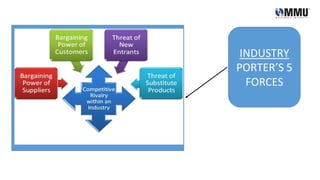
INDUSTRY
PORTER’S 5
FORCES
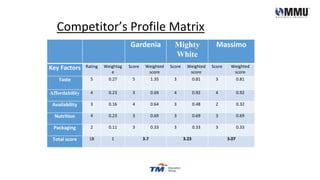
Competitor’s Profile Matrix
Gardenia Mighty
White
Massimo
Key Factors Rating Weightag
e
Score Weighted
score
Score Weighted
score
Score Weighted
score
Taste 5 0.27 5 1.35 3 0.81 3 0.81
Affordability 4 0.23 3 0.69 4 0.92 4 0.92
Availability 3 0.16 4 0.64 3 0.48 2 0.32
Nutrition 4 0.23 3 0.69 3 0.69 3 0.69
Packaging 2 0.11 3 0.33 3 0.33 3 0.33
Total score 18 1 3.7 3.23 3.07

Analyzing the Market Environment.pptx

  • 1.
    ENVIRONMENTAL ANALYSIS • EXTERNAL ⮚GENERAL ✔PESTLE ⮚INDUSTRY ✔(PORTER’S 5FORCES) ⮚COMPETITORS ✔ (CPM) = O & T • INTERNAL ⮚COMPANY ✔CULTURE ✔WORKFORCE ✔DEGREE OF MARKET ORIENTATION ⮚FINANCIAL POSITION = S & W
  • 2.
  • 3.
    PESTLE analysis PEST analysis(Political, Economic, Social and Technological analysis) describes a framework of external environmental factors used in the environmental scanning components of strategic management. The assumption is that if the country is able to audit its current environment and assess potential changes, it will be better placed than its competitors to respond to changes.
  • 4.
    Malaysia (Political analysis) Malaysiais a multi-party democracy country. The ruling Alliance party (Barisan Nasional) party has been in power over 63 years. (This fact provided the country with a high degree of stability, which is important factor for businesses investing in the country). Although the helm was mandated to PH in 2018, post GE14, it was somehow returned to BN smoothly without any hostility. Similarly the change of government happened post GE15 in 2022 where PH won majority and formed Unity government with BN in its formation. Corruption does exist in the country. (This fact may become a barrier to foreign businesses as it adds to firms costs and can cause problems), ref: https://www.transparency.org/en/cpi/2021 Transparency International ranks Malaysia 61 of 180 countries in its Corruption Perceptions Index. Malaysia also saw a decline in Dec 2022 where CPI score dropped from 48 to 47. Nevertheless rank improved from 62 to 61..
  • 5.
    Malaysia (Economic analysis) Malaysia’smain attraction as a location for business is its vibrant economy. Over the last 10 years, economic growth has averaged 7% per year. This rate of growth has lead to a large increase in consumer incomes and therefore demand, which has attracted retailers such as IKEA, Tesco and AEON. Malaysian location makes it ideally placed to engage in international trade. Exports account for 37% of Malaysia’s GDP and the country achieves a healthy current account surplus.
  • 6.
    Malaysia (Social analysis) TheMalaysian population consists of three main groups: Malay (60%), Chinese (30%) and Indian (10%). This mix of populations gives Malaysia a rich and vibrant culture, and the country is seen as an example of racial harmony as the different populations have existed peacefully together for years. The country is predominately Islamic in its religion but it’s only the Malay muslims who are bound by Islamic laws; the rest of the population are free to practise their own religions.
  • 7.
    Malaysia (Social analysis)cont. The mixture of religions in the country gives rise to a large number of religious celebrations - Malaysia has more public holidays than any other country. The cultural differences mean that businesses entering the country will have to adapt their products and business practices to suit the needs of the population.
  • 8.
    Malaysia (Technological analysis) The Malaysiais still need to develop its technology to enable it to compete in international markets. In 1996, the govt. initiated the ‘Multimedia Super Corridor’ (MSC), which is a strip of land stretching from the central business district of Kuala Lumpur to the out-of-town Kuala Lumpur International Airport. This corridor hosts more than 360 multinationals, including foreign-owned and home-growth Malaysian companies, all focused on multimedia and communications products. It continue to expand and attract world-leading ICT companies.
  • 9.
    Malaysia (Technological analysis) cont. Thehigh levels of investment in training and education, including the creation of a number of ‘Smart Schools’, and an excellent infrastructure, including a brand new town called Cyberjaya. Cyberjaya is a ‘self-contained intelligent city with world-class IT infrastructure’. It’s this level of technological support that makes Malaysia an attractive place for foreign firms to do business. In fact, Cyberjaya is considered one of the top three destinations for business support services and outsourcing in the world.
  • 10.
    Malaysia (Legal analysis) TheMalaysian legal system is based on British common law, although Islamic law is applied to the Muslim population. The British law element can be seen as an advantage to firms investing in the country as the law will be familiar to them. However, although the legal basis of the system is British, many of the punishments for those who break the law are far harsher - the death penalty and flogging are still widely used. Therefore, investing in a foreign country need to be familiar with the laws there and confident that they will be applied fairly.
  • 11.
    Malaysia (Environmental analysis) The rapiddevelopment of Malaysia has come with high environmental costs (negative externalities). According to a data from the UN, Malaysia’s deforestation rate is increasing at a faster rate than other tropical country. Since 2000, the country has lost an average of 140,200 hectares – 0.65% of its forest area – per year. Much of the country’s land that was once rainforest is now given over to the production of palm oil, which is used for the processing food we eat and as a source of biofuel.
  • 12.
    Malaysia (Environmental analysis) cont. Malaysianenvironmental impact has been criticised by environmental groups as it has a devastating effect on the habitats of some rare wildlife. Malaysians, and particularly the govt. have little time for these criticisms and see them as evidence of Western hypocrisy over environmental issues. However, Western companies need to be careful that they aren’t seen to be participating in this environmental damage as they may face demonstrations and protests from pressure groups such as Greenpeace and the World Wildlife Fund.
  • 13.
  • 14.
    Competitor’s Profile Matrix GardeniaMighty White Massimo Key Factors Rating Weightag e Score Weighted score Score Weighted score Score Weighted score Taste 5 0.27 5 1.35 3 0.81 3 0.81 Affordability 4 0.23 3 0.69 4 0.92 4 0.92 Availability 3 0.16 4 0.64 3 0.48 2 0.32 Nutrition 4 0.23 3 0.69 3 0.69 3 0.69 Packaging 2 0.11 3 0.33 3 0.33 3 0.33 Total score 18 1 3.7 3.23 3.07