October 27, 2009   Nonprofits and the 2010 Census: Nuts & Bolts
What’s at Stake? Allocation of federal funds $440 billion annually Political apportionment Number of representatives Redistricting Community infrastructure Location of schools, hospitals, businesses
AGENDA   Taking the 2010 Census Overview of timeline Hard-to-count populations Major census operations: Start to finish Strategy Discussion: What nonprofits can do to increase participation  How  Nonprofits Count!  can help your nonprofit Q & A
OVERVIEW OF  2010 CENSUS TIMELINE   Fall 2009:  Local Census Offices  open; recruitment begins January 2010:  Paid media campaign  kicks off Feb. - March:  Update/Leave  operation March - April:  Mail-out/Mail-back  phase April:  Group Quarters  enumeration
May - July:  Nonresponse Follow-Up  phase  July - August:  Coverage Follow-Up  &  Coverage Improvement  operations December 31, 2010:  First population numbers  reported OVERVIEW OF  2010 CENSUS TIMELINE  (con’t.)
12 Regional Census Centers/Census Offices About 500 Local Census Offices (LCOs) Oct. - Dec. 2009: Remaining LCOs open Fall 2009: Massive recruitment & interviewing begin LOCAL CENSUS OFFICES
Peak 2010 workforce: 1.2 million Census takers; crew leaders; supervisors; LCO managers & administrative staff ALL employees: Background checks & fingerprinting (plus federal e-Verify) U.S. citizenship required; some exceptions for work-authorized legal residents HIRING
CENSUS OPERATIONS: NUTS & BOLTS COMMUNICATIONS CAMPAIGN Education phase Awareness phase Motivational phase
QUESTIONNAIRE DELIVERY Advance letter Mid-February: Update/Leave areas March 8 - 10: Remainder of country (except island & remote areas) Controversy over in-language messages (dropped from 2000) Mail-out/Mail-back -- March through April English-only forms Bilingual forms -- About 13.5 million nationwide In-language forms -- Request by phone or visit QACs
QUESTIONNAIRE DELIVERY (continued) Update/Leave Rural areas Selected Gulf Coast parishes/counties Update/Enumerate (March 22 - May 29) Remote areas Indian reservations Areas with mail delivery primarily to P.O. boxes Thank you/Reminder cards March 22 - 24 Target return date is April 1, 2010 (Census Day)
QUESTIONNAIRE DELIVERY (continued) Replacement questionnaires “ Blanketed” -- 25 million; hard-to-count areas (<59% mail response in 2000) “ Targeted” -- 15 million; low mail response (59 - 67% in 2000) Be Counted forms (Available March 19 - April 19) Questionnaire Assistance Centers (QACs)  (Feb. 26 - April 19) Telephone Questionnaire Assistance lines (Feb. 25 - July 30)
Hard to Count Populations The Census Bureau has identified some populations as more difficult to count. These include: Low income populations Communities of color Non-English speakers Immigrants Children People living in complex households  People experiencing homelessness
“ STREET & SHELTER” COUNT Called “Service-Based Enumeration” March 29 - 31, in evening and night time hours Census takers visit pre-identified shelters, food kitchens, and mobile food vans Census takers visit pre-identified outdoor locations where homeless people tend to sleep
GROUP QUARTERS (GQ) College dorms, military barracks, prisons, juvenile detention centers, long-term nursing homes, etc. February 1 - March 19: Group Quarters advance visits April 1 - May 21: Group Quarters enumeration Residence rule: Residents of group quarters are counted at that facility, regardless of where they may have lived previously or where they might live when they leave the facility
TRANSITORY LOCATIONS March 22 - April 9, 2010 Pre-identified sites visited by census takers Examples:  Migrant farmworker camps Marinas Traveling carnivals
NONRESPONSE FOLLOW-UP (NRFU) May 1 - July 10 Most costly and labor intensive census operation Up to six visits per housing unit Sworn translators used, if necessary Census takers may ask landlords or neighbors for basic information, if necessary
COVERAGE FOLLOW-UP April 26 - August 13 Conducted primarily by telephone Coverage improvement: Follow-up on “ coverage” questions on census form (indicating possible undercount or overcount) Large households 7+ residents for English and in-language forms 9+ residents for bilingual forms
COVERAGE FOLLOW-UP (con’t.) Resolve housing unit duplicates (field visits) Resolve count discrepancies on forms Administrative records check (IRS, SSA, etc.) -- focused on undercount (e.g. omissions)
VACANT DELETE CHECK July 26 - Aug. 25 Confirming housing units added during: New construction program (by local govts.) Addresses accepted through LUCA appeals Confirm housing units identified as vacant or non-existent during NRFU
CENSUS COVERAGE MEASUREMENT (CCM) August 14 - October 2, 2010: Personal interviews (no mail-out/mail-back) 2011: CCM personal and housing unit follow-up 2012: Publish  estimates  of census undercounts (omissions) and overcounts (duplicates & other erroneous counts) for nation and states
DATA PUBLICATION SCHEDULE By December 31, 2010: Census Bureau sends state population totals (including members of the armed forces & federal civilian employees stationed overseas) to the President, along with the apportionment of the U.S. House of Representatives By April 1, 2011:  Census Bureau sends block level data to State officials for redistricting under Public Law 94-171 Spring 2011 and beyond: Census Bureau begins releasing 2010 Census Summary Files, with data for all governmental jurisdictions
 
For further information: Terri Ann Lowenthal Legislative & Policy Consultant e-mail:  [email_address] Phone: 203-353-4364 www.thecensusproject.org
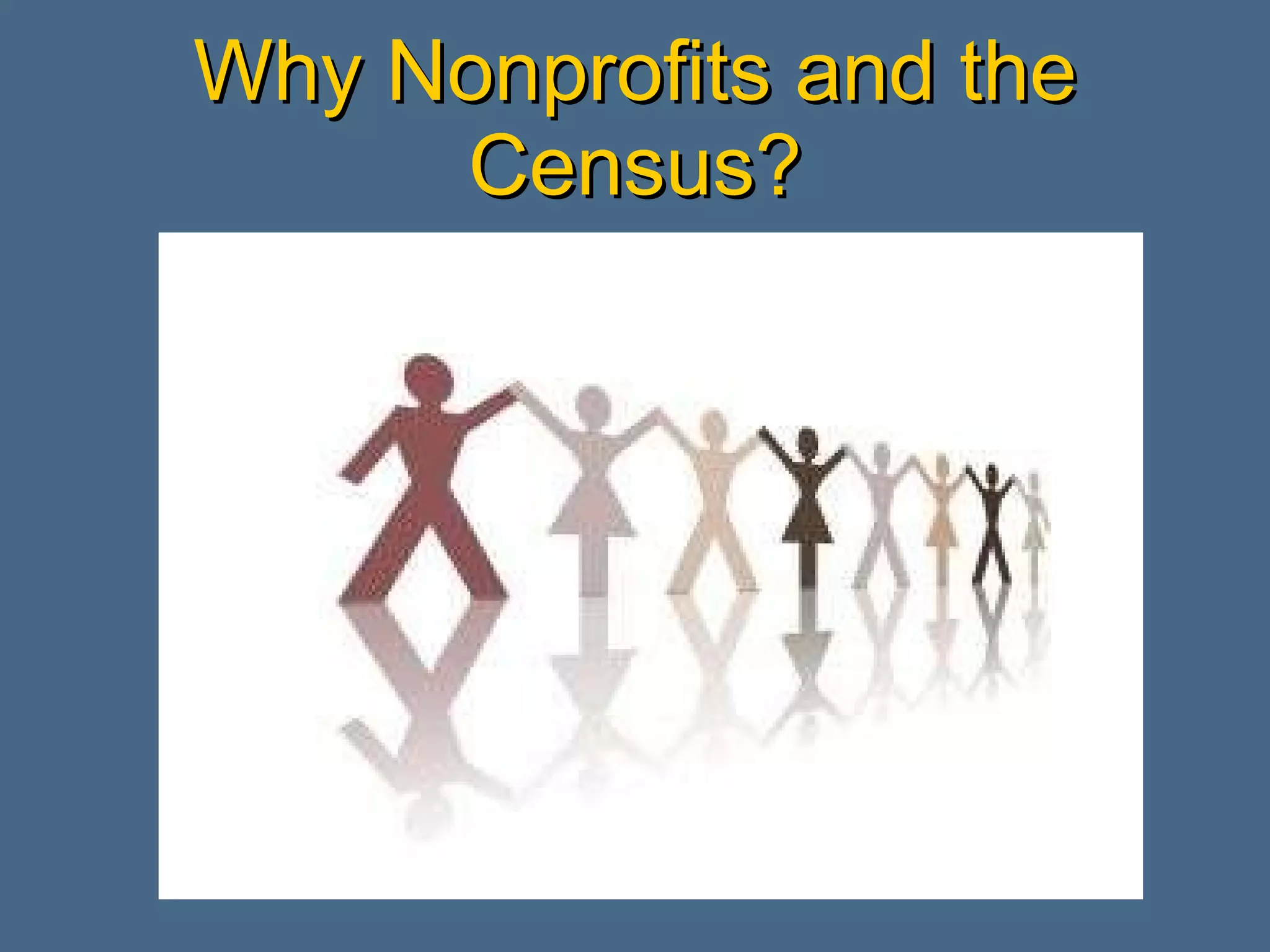
Why Nonprofits and the Census?
Why Nonprofits? ACCESS: To hard to count communities TRUST: Nonprofits are trusted messengers  CULTURAL COMPETENCY:  Highest response when people approached by people of similar cultural backgrounds in a culturally  appropriate way
Benefits to the nonprofit sector: Every person not counted leaves money and power on the table Nonprofit communities being fully represented means more power for nonprofits  Playing a key role in reinventing our nation and our communities Thoughtful planning of community infrastructure
Would you leave money just sitting on the table?
What can nonprofits do to promote the census? … .8 Simple Things
1. Partner with the Census   It’s simple: Sign up with your Regional Census Office and receive the most up-to-date information on how to engage your community in the 2010 Census www.NonprofitsCount.org
2. Add to Your Communications Where : Website, E-Updates, Newsletters What : Key deadlines, websites to go to, Drop In articles When:  Basic info now; More urgency in late fall and 2010
3. Have Information in Your Office   Train your staff to answer basic questions Sample Census forms  Signage promoting Census participation Contact information for Local Census Offices Information on job opportunities
4. Distribute Promotional Materials   Promotional items are synonymous with the decennial census.  Request these items from your Regional Census Office (RCO) and begin distributing them to your communities. Items currently available: Chip clips, bags, stickers, balloons, pens, pencils, window decals, etc.
5. Host Community Events   Hosting community events and forums can be a great tool for educating people about the 2010 Census.  Your Census Bureau Partnership Specialist and the Local Census Office can be great partners in these.
6.  Be or Promote Questionnaire Assistance Centers and Be Counted Centers Questionnaire Assistance Centers   A trained Census enumerator to assist people in filling out and returning their form at your community-based nonprofit.  Assistance guides will be available in 59 languages. Be Counted Sites Be Counted forms are census questionnaires available at community locations, for people who did not receive a census form in the mail or who believe they were not otherwise included on any other census questionnaire.  Be counted forms will be available in English, Spanish, Chinese (simplified), Korean, Vietnamese, and Russian. The form should be picked up and mailed back in the attached postage-paid envelope.
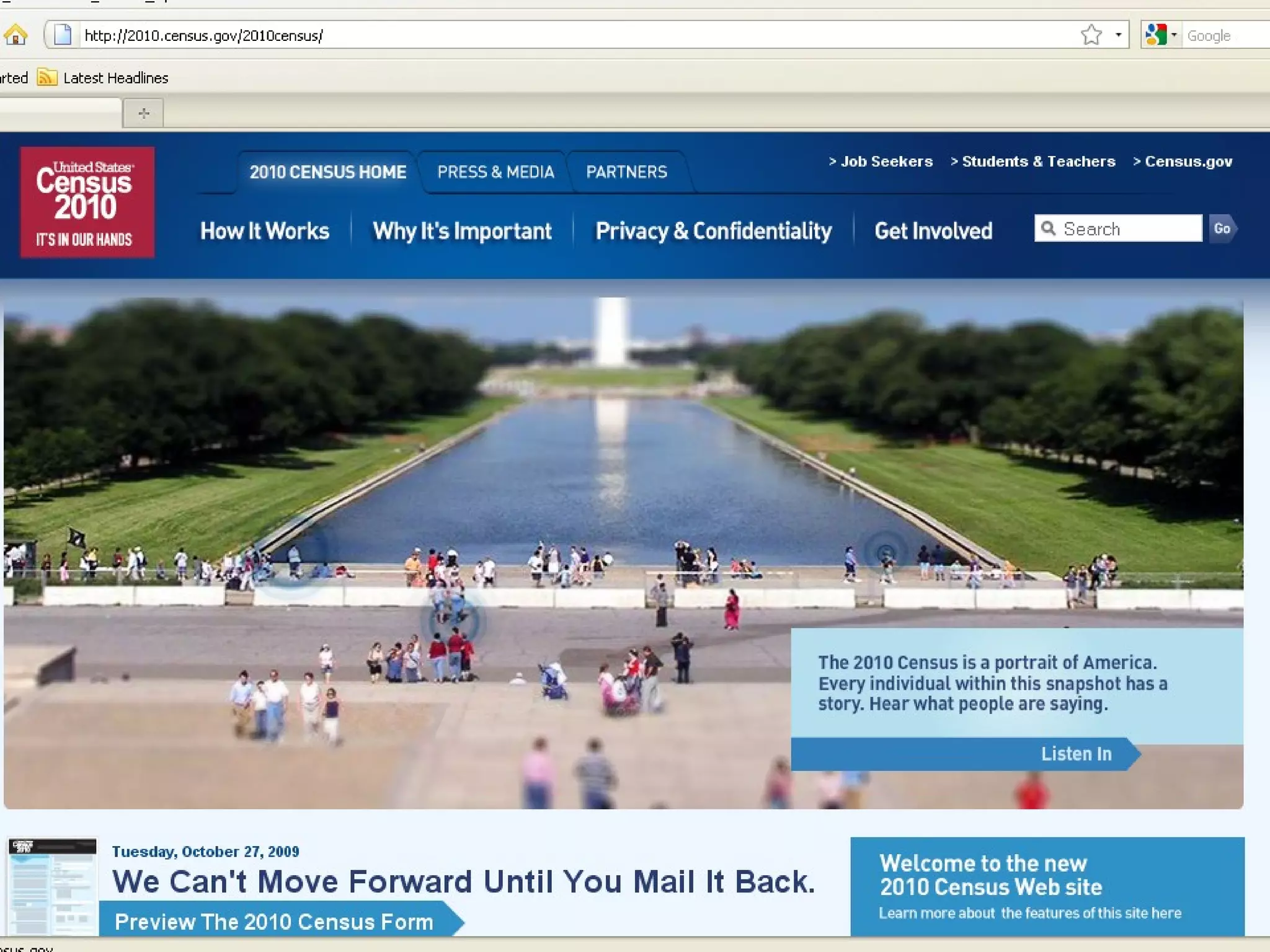
7. Promote Jobs   The 2010 census will be the largest peace-time mobilization of temporary jobs in our country’s history. The Census wants and needs to hire people from hard-to-count communities. You can help your communities find out about jobs with the Census.   http://2010.census.gov/2010censusjobs/ Peak recruitment: Fall 2009 Peak hiring: Spring 2010
8. Join or Form a Complete Count Committee A Complete Count Committee is a team of community members working together to ensure that all those in their community (however they define ‘community’) are counted in the 2010 Census.   Join a CCC of your Mayor’s office or a leading civic organization …or form your own.
Complete Count Committees can be formed by: Nonprofit organizations Ethnic Alliances Geographically Interest Areas
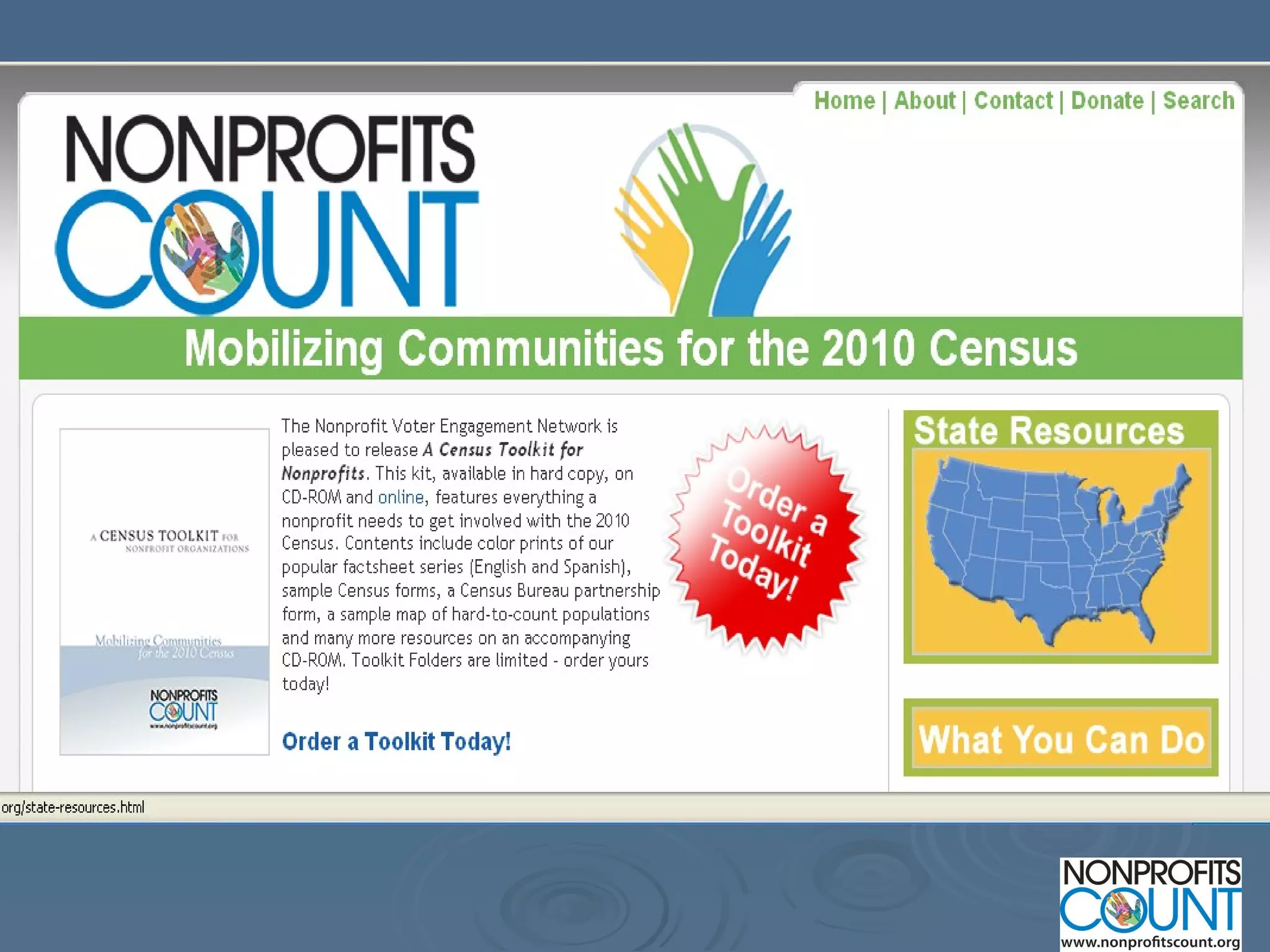
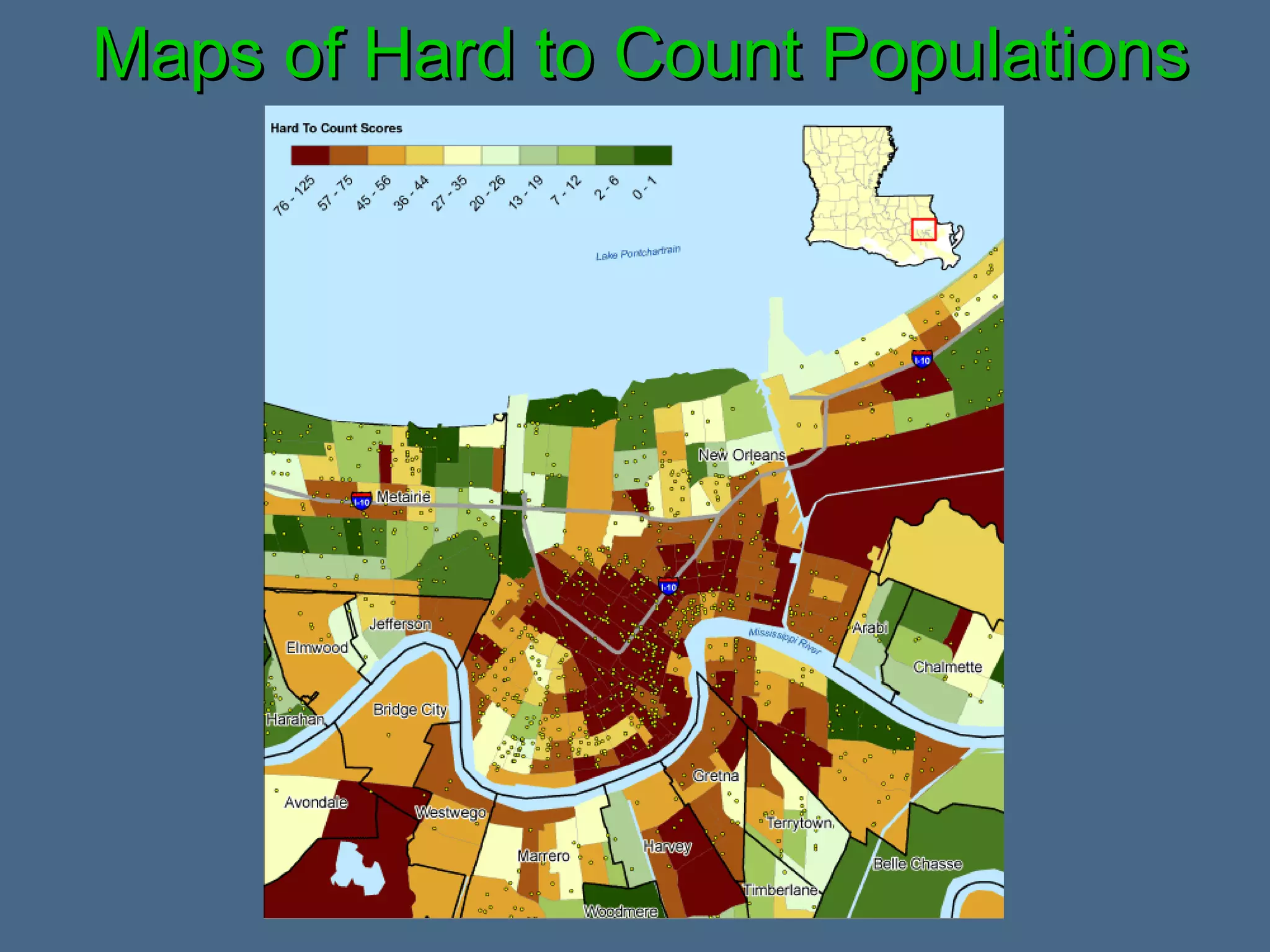
How Can Nonprofits Count! Help? Website –  www.NonprofitsCount.org 50 state map  Census resource downloads  Maps of hard-to-count populations Access to translated materials
 
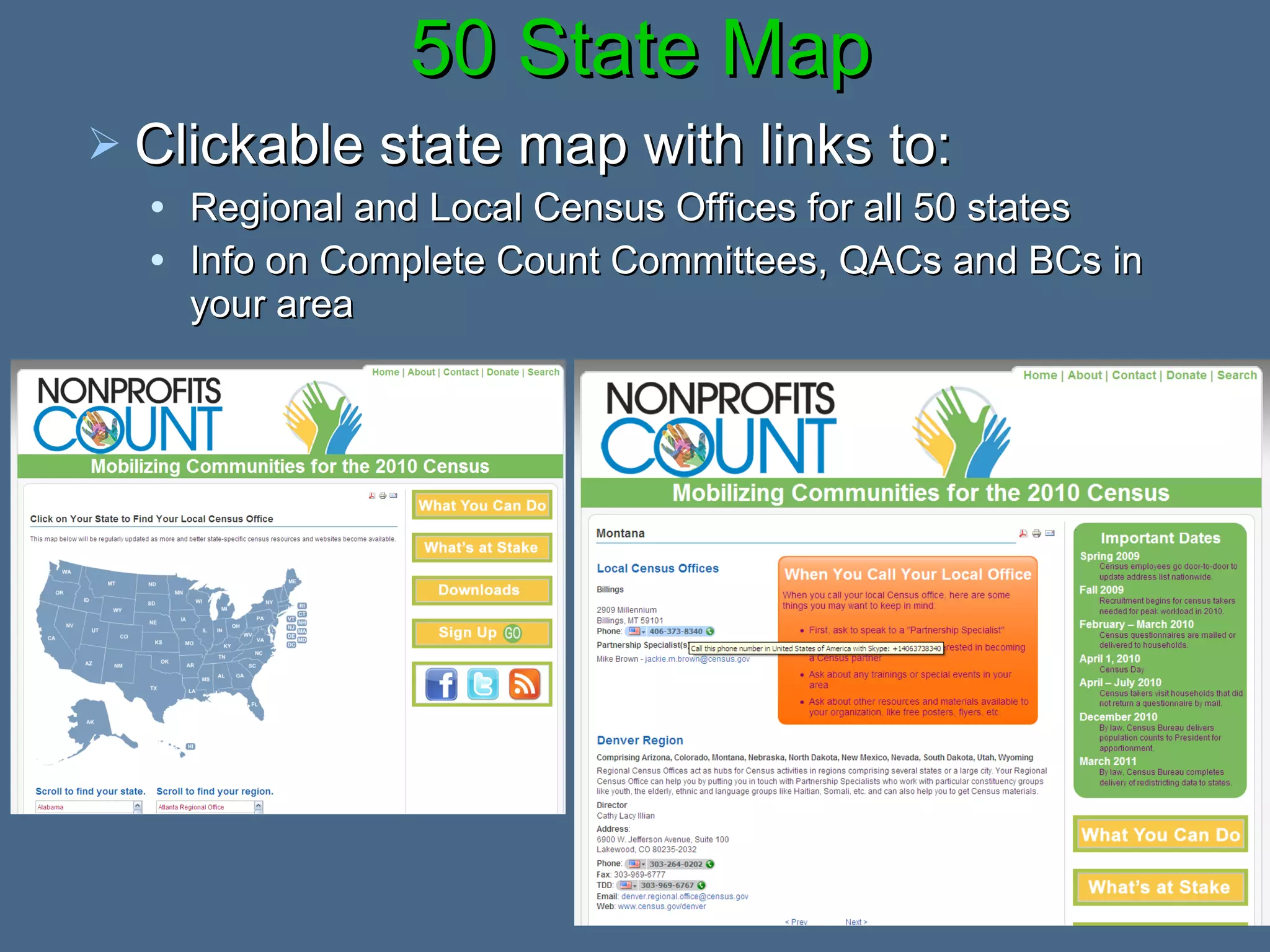
50 State Map Clickable state map with links to: Regional and Local Census Offices for all 50 states Info on Complete Count Committees, QACs and BCs in your area
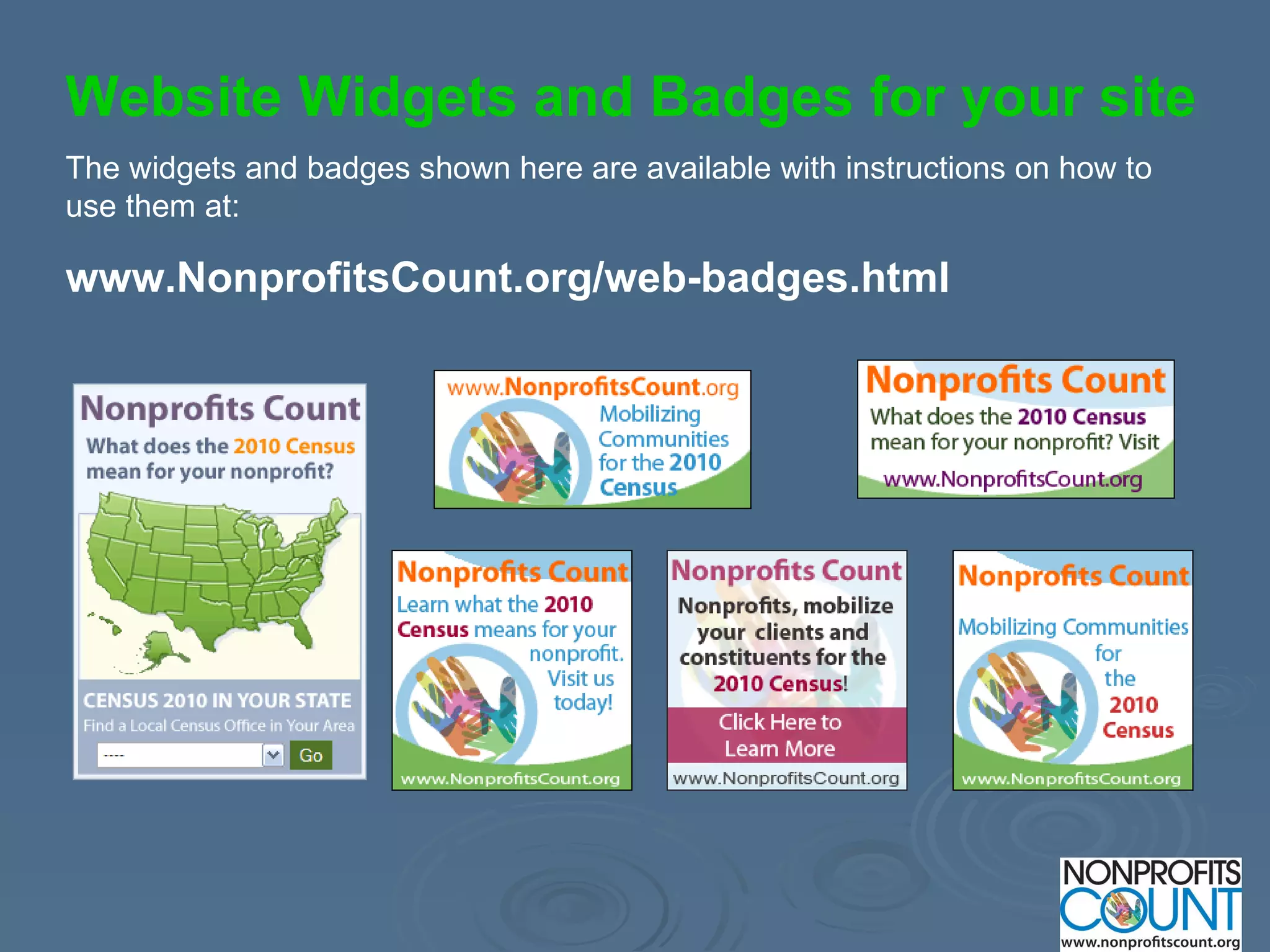
Website Widgets and Badges for your site The widgets and badges shown here are available with instructions on how to use them at: www.NonprofitsCount.org/web-badges.html
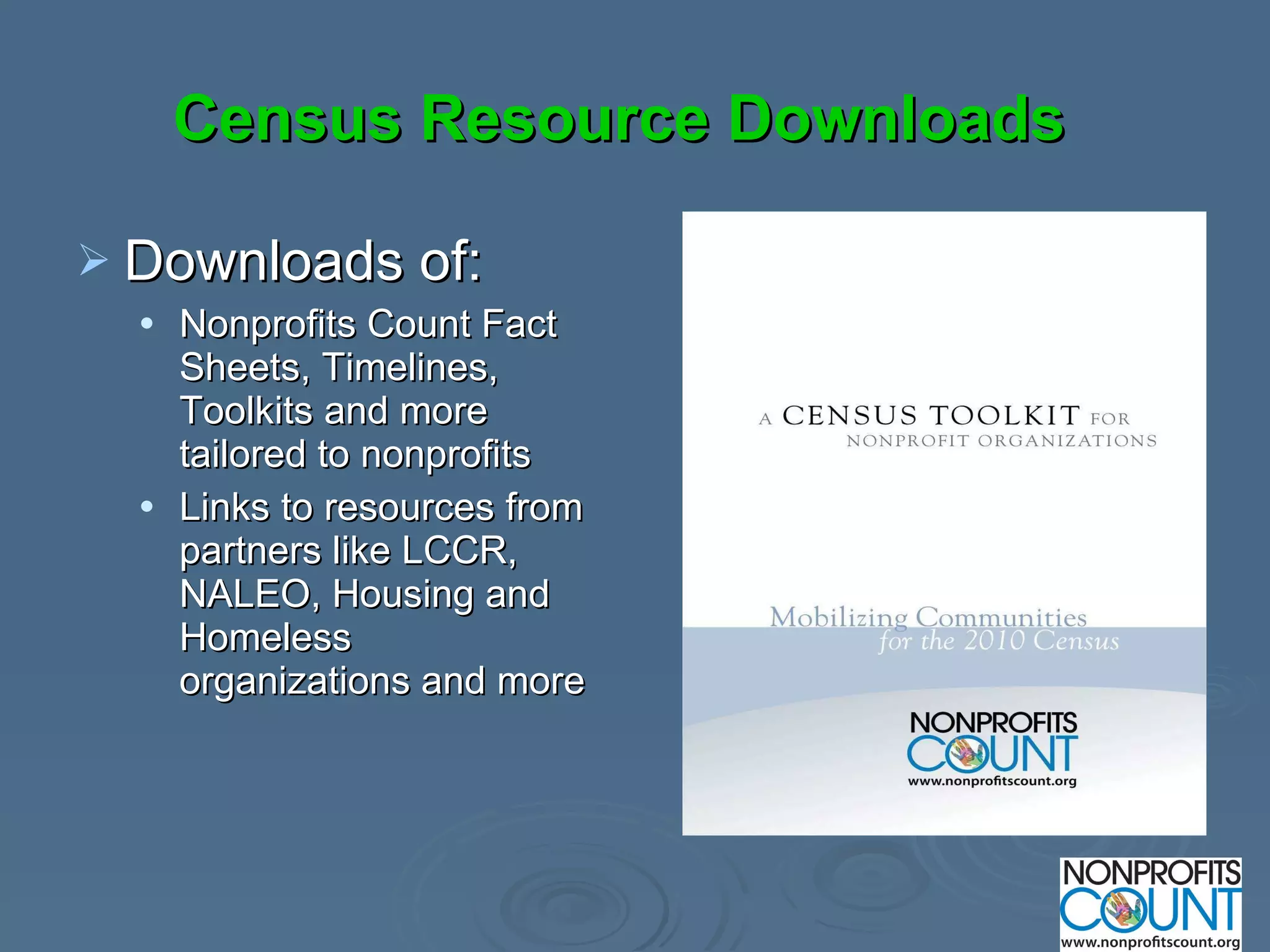
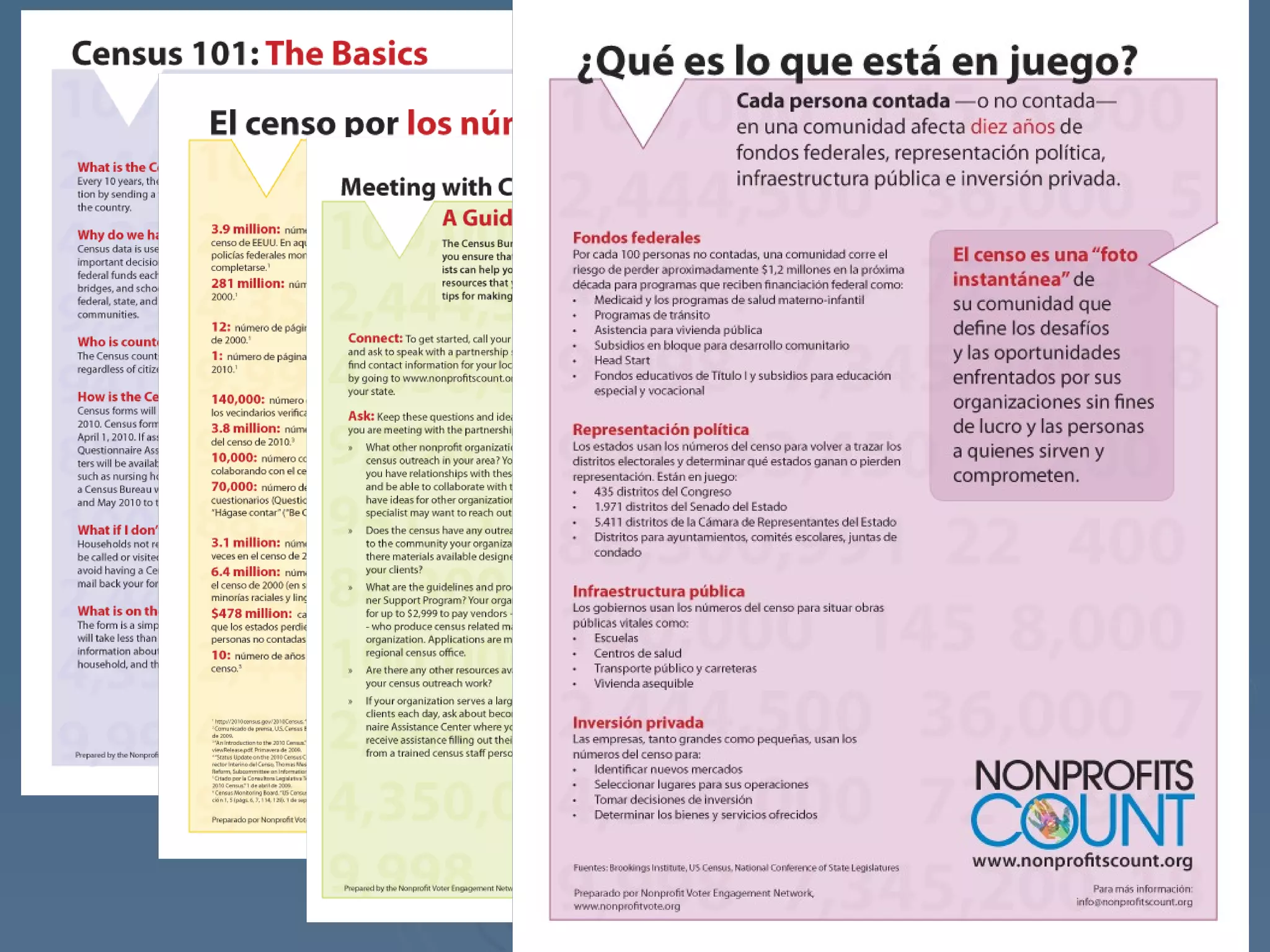
Census Resource Downloads Downloads of:  Nonprofits Count Fact Sheets, Timelines, Toolkits and more tailored to nonprofits Links to resources from partners like LCCR, NALEO, Housing and Homeless organizations and more
 
Maps of Hard to Count Populations
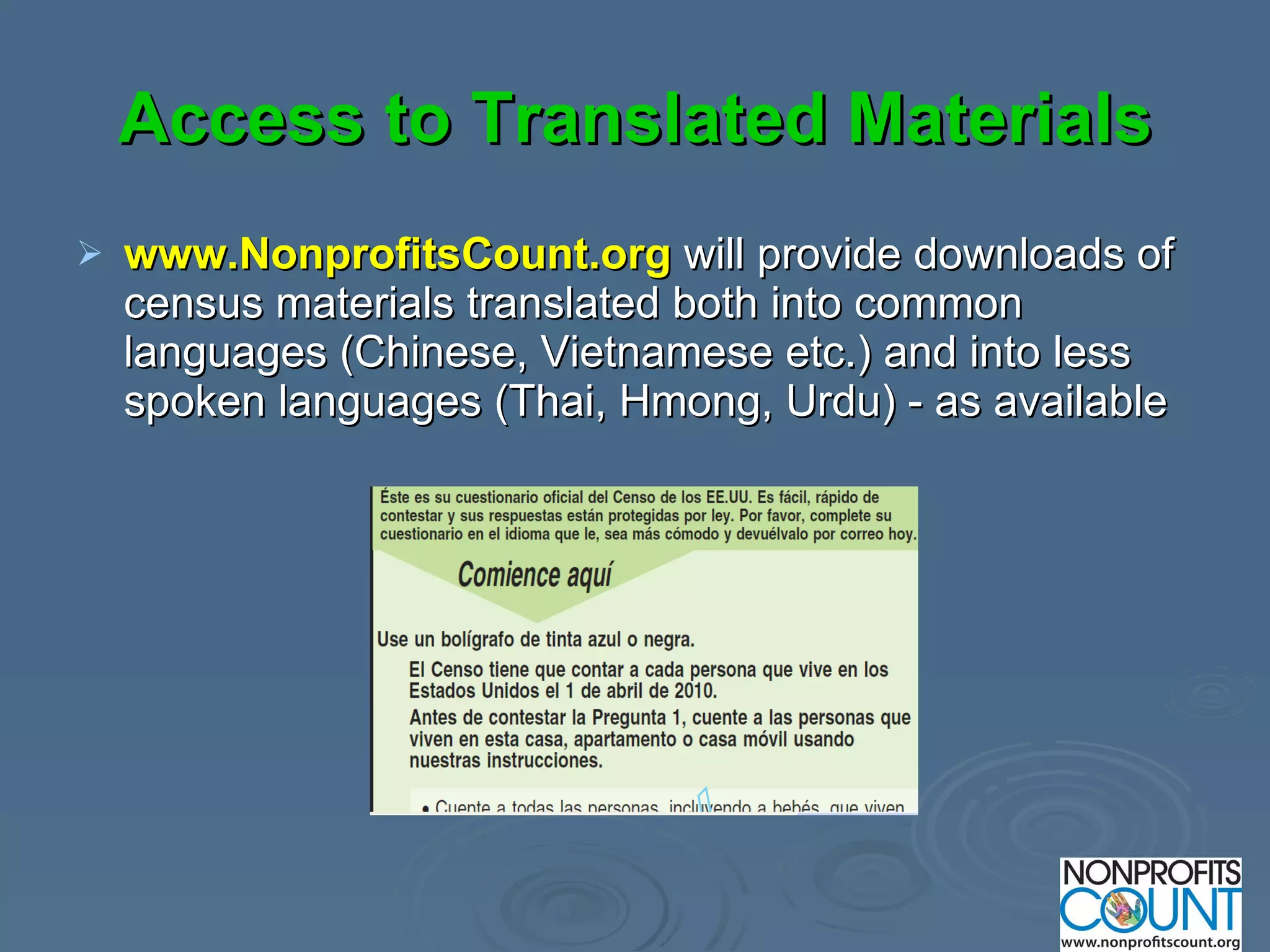
Access to Translated Materials www.NonprofitsCount.org  will provide downloads of census materials translated both into common languages (Chinese, Vietnamese etc.) and into less spoken languages (Thai, Hmong, Urdu) - as available
For more information:   www.nonprofitscount.org   651-757-3086 [email_address]

Nonprofits and the 2010 Census

  • 1.
    October 27, 2009 Nonprofits and the 2010 Census: Nuts & Bolts
  • 2.
    What’s at Stake?Allocation of federal funds $440 billion annually Political apportionment Number of representatives Redistricting Community infrastructure Location of schools, hospitals, businesses
  • 3.
    AGENDA Taking the 2010 Census Overview of timeline Hard-to-count populations Major census operations: Start to finish Strategy Discussion: What nonprofits can do to increase participation How Nonprofits Count! can help your nonprofit Q & A
  • 4.
    OVERVIEW OF 2010 CENSUS TIMELINE Fall 2009: Local Census Offices open; recruitment begins January 2010: Paid media campaign kicks off Feb. - March: Update/Leave operation March - April: Mail-out/Mail-back phase April: Group Quarters enumeration
  • 5.
    May - July: Nonresponse Follow-Up phase July - August: Coverage Follow-Up & Coverage Improvement operations December 31, 2010: First population numbers reported OVERVIEW OF 2010 CENSUS TIMELINE (con’t.)
  • 6.
    12 Regional CensusCenters/Census Offices About 500 Local Census Offices (LCOs) Oct. - Dec. 2009: Remaining LCOs open Fall 2009: Massive recruitment & interviewing begin LOCAL CENSUS OFFICES
  • 7.
    Peak 2010 workforce:1.2 million Census takers; crew leaders; supervisors; LCO managers & administrative staff ALL employees: Background checks & fingerprinting (plus federal e-Verify) U.S. citizenship required; some exceptions for work-authorized legal residents HIRING
  • 8.
    CENSUS OPERATIONS: NUTS& BOLTS COMMUNICATIONS CAMPAIGN Education phase Awareness phase Motivational phase
  • 9.
    QUESTIONNAIRE DELIVERY Advanceletter Mid-February: Update/Leave areas March 8 - 10: Remainder of country (except island & remote areas) Controversy over in-language messages (dropped from 2000) Mail-out/Mail-back -- March through April English-only forms Bilingual forms -- About 13.5 million nationwide In-language forms -- Request by phone or visit QACs
  • 10.
    QUESTIONNAIRE DELIVERY (continued)Update/Leave Rural areas Selected Gulf Coast parishes/counties Update/Enumerate (March 22 - May 29) Remote areas Indian reservations Areas with mail delivery primarily to P.O. boxes Thank you/Reminder cards March 22 - 24 Target return date is April 1, 2010 (Census Day)
  • 11.
    QUESTIONNAIRE DELIVERY (continued)Replacement questionnaires “ Blanketed” -- 25 million; hard-to-count areas (<59% mail response in 2000) “ Targeted” -- 15 million; low mail response (59 - 67% in 2000) Be Counted forms (Available March 19 - April 19) Questionnaire Assistance Centers (QACs) (Feb. 26 - April 19) Telephone Questionnaire Assistance lines (Feb. 25 - July 30)
  • 12.
    Hard to CountPopulations The Census Bureau has identified some populations as more difficult to count. These include: Low income populations Communities of color Non-English speakers Immigrants Children People living in complex households People experiencing homelessness
  • 13.
    “ STREET &SHELTER” COUNT Called “Service-Based Enumeration” March 29 - 31, in evening and night time hours Census takers visit pre-identified shelters, food kitchens, and mobile food vans Census takers visit pre-identified outdoor locations where homeless people tend to sleep
  • 14.
    GROUP QUARTERS (GQ)College dorms, military barracks, prisons, juvenile detention centers, long-term nursing homes, etc. February 1 - March 19: Group Quarters advance visits April 1 - May 21: Group Quarters enumeration Residence rule: Residents of group quarters are counted at that facility, regardless of where they may have lived previously or where they might live when they leave the facility
  • 15.
    TRANSITORY LOCATIONS March22 - April 9, 2010 Pre-identified sites visited by census takers Examples: Migrant farmworker camps Marinas Traveling carnivals
  • 16.
    NONRESPONSE FOLLOW-UP (NRFU)May 1 - July 10 Most costly and labor intensive census operation Up to six visits per housing unit Sworn translators used, if necessary Census takers may ask landlords or neighbors for basic information, if necessary
  • 17.
    COVERAGE FOLLOW-UP April26 - August 13 Conducted primarily by telephone Coverage improvement: Follow-up on “ coverage” questions on census form (indicating possible undercount or overcount) Large households 7+ residents for English and in-language forms 9+ residents for bilingual forms
  • 18.
    COVERAGE FOLLOW-UP (con’t.)Resolve housing unit duplicates (field visits) Resolve count discrepancies on forms Administrative records check (IRS, SSA, etc.) -- focused on undercount (e.g. omissions)
  • 19.
    VACANT DELETE CHECKJuly 26 - Aug. 25 Confirming housing units added during: New construction program (by local govts.) Addresses accepted through LUCA appeals Confirm housing units identified as vacant or non-existent during NRFU
  • 20.
    CENSUS COVERAGE MEASUREMENT(CCM) August 14 - October 2, 2010: Personal interviews (no mail-out/mail-back) 2011: CCM personal and housing unit follow-up 2012: Publish estimates of census undercounts (omissions) and overcounts (duplicates & other erroneous counts) for nation and states
  • 21.
    DATA PUBLICATION SCHEDULEBy December 31, 2010: Census Bureau sends state population totals (including members of the armed forces & federal civilian employees stationed overseas) to the President, along with the apportionment of the U.S. House of Representatives By April 1, 2011: Census Bureau sends block level data to State officials for redistricting under Public Law 94-171 Spring 2011 and beyond: Census Bureau begins releasing 2010 Census Summary Files, with data for all governmental jurisdictions
  • 22.
  • 23.
    For further information:Terri Ann Lowenthal Legislative & Policy Consultant e-mail: [email_address] Phone: 203-353-4364 www.thecensusproject.org
  • 24.
    Why Nonprofits andthe Census?
  • 25.
    Why Nonprofits? ACCESS:To hard to count communities TRUST: Nonprofits are trusted messengers CULTURAL COMPETENCY: Highest response when people approached by people of similar cultural backgrounds in a culturally appropriate way
  • 26.
    Benefits to thenonprofit sector: Every person not counted leaves money and power on the table Nonprofit communities being fully represented means more power for nonprofits Playing a key role in reinventing our nation and our communities Thoughtful planning of community infrastructure
  • 27.
    Would you leavemoney just sitting on the table?
  • 28.
    What can nonprofitsdo to promote the census? … .8 Simple Things
  • 29.
    1. Partner withthe Census It’s simple: Sign up with your Regional Census Office and receive the most up-to-date information on how to engage your community in the 2010 Census www.NonprofitsCount.org
  • 30.
    2. Add toYour Communications Where : Website, E-Updates, Newsletters What : Key deadlines, websites to go to, Drop In articles When: Basic info now; More urgency in late fall and 2010
  • 31.
    3. Have Informationin Your Office Train your staff to answer basic questions Sample Census forms Signage promoting Census participation Contact information for Local Census Offices Information on job opportunities
  • 32.
    4. Distribute PromotionalMaterials Promotional items are synonymous with the decennial census. Request these items from your Regional Census Office (RCO) and begin distributing them to your communities. Items currently available: Chip clips, bags, stickers, balloons, pens, pencils, window decals, etc.
  • 33.
    5. Host CommunityEvents Hosting community events and forums can be a great tool for educating people about the 2010 Census. Your Census Bureau Partnership Specialist and the Local Census Office can be great partners in these.
  • 34.
    6. Beor Promote Questionnaire Assistance Centers and Be Counted Centers Questionnaire Assistance Centers A trained Census enumerator to assist people in filling out and returning their form at your community-based nonprofit. Assistance guides will be available in 59 languages. Be Counted Sites Be Counted forms are census questionnaires available at community locations, for people who did not receive a census form in the mail or who believe they were not otherwise included on any other census questionnaire. Be counted forms will be available in English, Spanish, Chinese (simplified), Korean, Vietnamese, and Russian. The form should be picked up and mailed back in the attached postage-paid envelope.
  • 35.
    7. Promote Jobs The 2010 census will be the largest peace-time mobilization of temporary jobs in our country’s history. The Census wants and needs to hire people from hard-to-count communities. You can help your communities find out about jobs with the Census. http://2010.census.gov/2010censusjobs/ Peak recruitment: Fall 2009 Peak hiring: Spring 2010
  • 36.
    8. Join orForm a Complete Count Committee A Complete Count Committee is a team of community members working together to ensure that all those in their community (however they define ‘community’) are counted in the 2010 Census. Join a CCC of your Mayor’s office or a leading civic organization …or form your own.
  • 37.
    Complete Count Committeescan be formed by: Nonprofit organizations Ethnic Alliances Geographically Interest Areas
  • 38.
    How Can NonprofitsCount! Help? Website – www.NonprofitsCount.org 50 state map Census resource downloads Maps of hard-to-count populations Access to translated materials
  • 39.
  • 40.
    50 State MapClickable state map with links to: Regional and Local Census Offices for all 50 states Info on Complete Count Committees, QACs and BCs in your area
  • 41.
    Website Widgets andBadges for your site The widgets and badges shown here are available with instructions on how to use them at: www.NonprofitsCount.org/web-badges.html
  • 42.
    Census Resource DownloadsDownloads of: Nonprofits Count Fact Sheets, Timelines, Toolkits and more tailored to nonprofits Links to resources from partners like LCCR, NALEO, Housing and Homeless organizations and more
  • 43.
  • 44.
    Maps of Hardto Count Populations
  • 45.
    Access to TranslatedMaterials www.NonprofitsCount.org will provide downloads of census materials translated both into common languages (Chinese, Vietnamese etc.) and into less spoken languages (Thai, Hmong, Urdu) - as available
  • 46.
    For more information: www.nonprofitscount.org 651-757-3086 [email_address]

Editor's Notes

  • #9 Sources: Brookings Institution, “Federal Funds Distributed On the Basis of Census Bureau Statistics, United States, FY 2007,” December 2008. U.S. Census Bureau, “Uses of Population and Income Statistics in Federal Funds Distribution -- With a Focus on Census Bureau Data,” Governments Division Research Rpt. #2009-1, June 23, 2009.