

Don’t Blow Your InterviewPhillip Bergquist, Michigan Primary Care Associationpbergquist@mpca.net517-827-0472
First Things FirstYour resume, cover letter and initial correspondence with anyone looking to hire will get you an interview or a trip to the trash canYour interview and references will get you a job or a rejectionYour interview follow-up will “seal the deal” or make the hiring professional think twice
The Types of InterviewersGut Instinct InterviewersPersonal and Feeling InterviewersConversational InterviewersBehavior-Based Interviewerswww.youtube.com/watch?v=-zIQruPEDmg
Gut Instinct InterviewersThey are quick to make a decision about youThey don’t speak much about the job requirementsThey want to know if they like you and if you’ll fit in They will finish interview quickly if they don’t like youPerfect Your AppearanceBe ConfidentMake an Excellent First Impression
Personal & Feeling InterviewersThey want to know more… your values, your feelings, how you think and how you react to situationsThey will probe your character and ask a lot of questions on your personal qualitiesThey want to know if your values and personality fit with the company and the teamKnow Your ValuesKnow How They Can Contribute
Conversational InterviewersThey move from topic to topic quicklyThey are easy going, conversational and informalThey will ask general questions about your career and backgroundThey will make the interview sound like an easy going conversationThink Quickly on Your FeetDon’t Drop Your Guard
Behavior-Based InterviewersThey will ask detailed questions and take notesThey will use assessment tools to They are objective and fact-oriented They want to know how your experience  and skills will directly help the companyKnow Your Competencies / SkillsCommunicate How they Will Benefit the Company
Interviewer AwkwardnessGroup Activity- Understanding the People Asking the QuestionsYour Best FriendThe InterrogatorThe One Who Has Better Things to DoThe Inappropriate OneThe Rule FollowerThe JokerThe WeirdoThe No-Nonsense OneThe Blank SlateThe Mafiawww.cnn.com/2010/LIVING/worklife/02/17/cb.types.of.interviews/index.html
Interview TeamsYou’re very likely to get interview with a team of professionalsSize them up just as they are sizing you upAnswer their questions in a manner consistent with the type of interviewer they areAddress and make eye contact with everyone in the room, even if some are only listening or taking notes
Key StepsInterview SchedulingInterview PreparationThe Waiting RoomThe Interview RoomThe InterviewInterview Follow-Up
Interview SchedulingCheck your email and phone oftenRespond promptlyIf at all humanly possible accommodate the interviewer’s schedule, not your ownDon’t use lack of transportation or child care issues as reasons you can’t make an interview time, those are major red flagsDon’t use your current job as a reason either, use a sick day or vacation time to be there when the interviewer requests
Interview PreparationReview the company’s website in detailMission/VisionPrograms and ServicesTwo Most Recent Annual ReportsRecent Press ReleasesKey Staff (especially those in the job department, team or program)Virtually memorize the position description and job responsibilitiesMap out how your experience and skills fit the job in advanceWrite down questions to ask the interviewers in advanceBring extra copies of anything you’ve provided including your resume and referencesAnticipate and have answers mentally prepared for common interview questions
Questions TypesMost interviews have a mix of several varieties of questions, recognize the type and provide an appropriate answerOpen-Ended- Give more than a yes or no answerClose-Ended- Provide brief and specific informationHypothetical- Ask follow-ups before answering, show your problem solving skillsLeading- Give a positive, unassuming answer that points out how you match their needsMulti-Barreled- Make quick notes so that you can quickly remember to hit all facetsBehavioral- Describe the situation, the problem, the action you took and the result- be honest (STAR)
Interview QuestionsGroup Activity- Coming Up With Good AnswersI’m going to ask many of you a question, you’ll have one minute to answer- get ready!http://www.jobinterviewquestions.org/questions/general-questions.asphttp://www.jobinterviewquestions.org/questions/sample-questions.asphttp://www.jobinterviewquestions.org/questions/job-specific-questions.asp
The Waiting RoomArrive 10 minutes earlyDon’t arrive too early, interviewers are busyArriving late is virtually a guarantee you won’t get the job- no matter what the excuseLook Impeccable!Fill out the forms they ask you to complete politely, no matter how annoying or redundantDon’t make phone calls or text and make sure your devices are in silent modeRead something about the company that is sitting around in the waiting areaHave your “shaking hand” free and ready
The Interview RoomPay attention to how the room is laid out and sit in the appropriate placeMake sure you are sitting in a seat that allows for comfortable eye contact with the interviewersPolitely accept their offer of something to drinkYou’ll be happy you have a glass of water laterHave copies of your materials, paper, penand schedule organized and readily accessibleDon’t fidget, tap or chew and sit up straight
The InterviewRemember or write down and use the interviewer’s names in conversationRemember that most initial interviews are scheduled for 30 minutes or lessMake sure your answers are complete but keep them concise, no exchange should last longer than 3-4 minutesYou have to be yourself under pressure, “diagnose” your anxiety and work through it before you’re in the roomUse examples that illustrate your strengths at work and personallySpeak about things that you feel really strongly about, if you feel strongly about it you will sound enthusiastic, authenticand engaged
Interview Follow-UpSend a follow-up email the day after your interviewMost of us think of clever things to say after the fact, include one or two of those, referring to something specific from the interviewSend a hand-written interview thank you note as wellSince snail mail will take several days to arrive it will give you another chance to make a good impression, often as they are making important decisionsMonitor your email and phone closely, answer follow-ups promptlyOne follow-up phone call is allowable, but never more than one and never less than a week from the interview
The Biggest Don’tsSome of the Worst…Being LateNot Being Dressed Appropriately (Glitter, Flip Flops, Overbearing Perfume…You Name It!)Failing to Research the CompanyAsking No QuestionsBeing Unprepared for Standard QuestionsAnswers More than 3 Minutes Long“You Know”, “Like”, “I Guess”, “Um”Oversharing (Personal or Previous Professional)ChewingBringing Along Someone Else (Mother, Kid, “Ride”)Asking about Salary/Benefits UpfrontBluetoothRidiculous Email Addresses
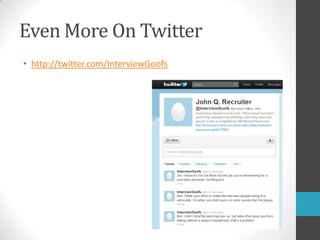
Even More On Twitterhttp://twitter.com/InterviewGoofs
Final ThoughtsYou've got through the door. They want it to be you. The job is yours to lose…  the process you're in now is a testTheir starting point will be this: "Well, it all looks good on paper, let's get them in and see how they do in person.”Be the right person!http://www.impactfactory.com/gate/new_job_interview_skills_hints_and_tips/fungate_174-1103-91240.html

Don’t Blow Your Interview

  • 1.
    Don’t Blow YourInterviewPhillip Bergquist, Michigan Primary Care Associationpbergquist@mpca.net517-827-0472
  • 2.
    First Things FirstYourresume, cover letter and initial correspondence with anyone looking to hire will get you an interview or a trip to the trash canYour interview and references will get you a job or a rejectionYour interview follow-up will “seal the deal” or make the hiring professional think twice
  • 3.
    The Types ofInterviewersGut Instinct InterviewersPersonal and Feeling InterviewersConversational InterviewersBehavior-Based Interviewerswww.youtube.com/watch?v=-zIQruPEDmg
  • 4.
    Gut Instinct InterviewersTheyare quick to make a decision about youThey don’t speak much about the job requirementsThey want to know if they like you and if you’ll fit in They will finish interview quickly if they don’t like youPerfect Your AppearanceBe ConfidentMake an Excellent First Impression
  • 5.
    Personal & FeelingInterviewersThey want to know more… your values, your feelings, how you think and how you react to situationsThey will probe your character and ask a lot of questions on your personal qualitiesThey want to know if your values and personality fit with the company and the teamKnow Your ValuesKnow How They Can Contribute
  • 6.
    Conversational InterviewersThey movefrom topic to topic quicklyThey are easy going, conversational and informalThey will ask general questions about your career and backgroundThey will make the interview sound like an easy going conversationThink Quickly on Your FeetDon’t Drop Your Guard
  • 7.
    Behavior-Based InterviewersThey willask detailed questions and take notesThey will use assessment tools to They are objective and fact-oriented They want to know how your experience and skills will directly help the companyKnow Your Competencies / SkillsCommunicate How they Will Benefit the Company
  • 8.
    Interviewer AwkwardnessGroup Activity-Understanding the People Asking the QuestionsYour Best FriendThe InterrogatorThe One Who Has Better Things to DoThe Inappropriate OneThe Rule FollowerThe JokerThe WeirdoThe No-Nonsense OneThe Blank SlateThe Mafiawww.cnn.com/2010/LIVING/worklife/02/17/cb.types.of.interviews/index.html
  • 9.
    Interview TeamsYou’re verylikely to get interview with a team of professionalsSize them up just as they are sizing you upAnswer their questions in a manner consistent with the type of interviewer they areAddress and make eye contact with everyone in the room, even if some are only listening or taking notes
  • 10.
    Key StepsInterview SchedulingInterviewPreparationThe Waiting RoomThe Interview RoomThe InterviewInterview Follow-Up
  • 11.
    Interview SchedulingCheck youremail and phone oftenRespond promptlyIf at all humanly possible accommodate the interviewer’s schedule, not your ownDon’t use lack of transportation or child care issues as reasons you can’t make an interview time, those are major red flagsDon’t use your current job as a reason either, use a sick day or vacation time to be there when the interviewer requests
  • 12.
    Interview PreparationReview thecompany’s website in detailMission/VisionPrograms and ServicesTwo Most Recent Annual ReportsRecent Press ReleasesKey Staff (especially those in the job department, team or program)Virtually memorize the position description and job responsibilitiesMap out how your experience and skills fit the job in advanceWrite down questions to ask the interviewers in advanceBring extra copies of anything you’ve provided including your resume and referencesAnticipate and have answers mentally prepared for common interview questions
  • 13.
    Questions TypesMost interviewshave a mix of several varieties of questions, recognize the type and provide an appropriate answerOpen-Ended- Give more than a yes or no answerClose-Ended- Provide brief and specific informationHypothetical- Ask follow-ups before answering, show your problem solving skillsLeading- Give a positive, unassuming answer that points out how you match their needsMulti-Barreled- Make quick notes so that you can quickly remember to hit all facetsBehavioral- Describe the situation, the problem, the action you took and the result- be honest (STAR)
  • 14.
    Interview QuestionsGroup Activity-Coming Up With Good AnswersI’m going to ask many of you a question, you’ll have one minute to answer- get ready!http://www.jobinterviewquestions.org/questions/general-questions.asphttp://www.jobinterviewquestions.org/questions/sample-questions.asphttp://www.jobinterviewquestions.org/questions/job-specific-questions.asp
  • 15.
    The Waiting RoomArrive10 minutes earlyDon’t arrive too early, interviewers are busyArriving late is virtually a guarantee you won’t get the job- no matter what the excuseLook Impeccable!Fill out the forms they ask you to complete politely, no matter how annoying or redundantDon’t make phone calls or text and make sure your devices are in silent modeRead something about the company that is sitting around in the waiting areaHave your “shaking hand” free and ready
  • 16.
    The Interview RoomPayattention to how the room is laid out and sit in the appropriate placeMake sure you are sitting in a seat that allows for comfortable eye contact with the interviewersPolitely accept their offer of something to drinkYou’ll be happy you have a glass of water laterHave copies of your materials, paper, penand schedule organized and readily accessibleDon’t fidget, tap or chew and sit up straight
  • 17.
    The InterviewRemember orwrite down and use the interviewer’s names in conversationRemember that most initial interviews are scheduled for 30 minutes or lessMake sure your answers are complete but keep them concise, no exchange should last longer than 3-4 minutesYou have to be yourself under pressure, “diagnose” your anxiety and work through it before you’re in the roomUse examples that illustrate your strengths at work and personallySpeak about things that you feel really strongly about, if you feel strongly about it you will sound enthusiastic, authenticand engaged
  • 18.
    Interview Follow-UpSend afollow-up email the day after your interviewMost of us think of clever things to say after the fact, include one or two of those, referring to something specific from the interviewSend a hand-written interview thank you note as wellSince snail mail will take several days to arrive it will give you another chance to make a good impression, often as they are making important decisionsMonitor your email and phone closely, answer follow-ups promptlyOne follow-up phone call is allowable, but never more than one and never less than a week from the interview
  • 19.
    The Biggest Don’tsSomeof the Worst…Being LateNot Being Dressed Appropriately (Glitter, Flip Flops, Overbearing Perfume…You Name It!)Failing to Research the CompanyAsking No QuestionsBeing Unprepared for Standard QuestionsAnswers More than 3 Minutes Long“You Know”, “Like”, “I Guess”, “Um”Oversharing (Personal or Previous Professional)ChewingBringing Along Someone Else (Mother, Kid, “Ride”)Asking about Salary/Benefits UpfrontBluetoothRidiculous Email Addresses
  • 20.
    Even More OnTwitterhttp://twitter.com/InterviewGoofs
  • 21.
    Final ThoughtsYou've gotthrough the door. They want it to be you. The job is yours to lose… the process you're in now is a testTheir starting point will be this: "Well, it all looks good on paper, let's get them in and see how they do in person.”Be the right person!http://www.impactfactory.com/gate/new_job_interview_skills_hints_and_tips/fungate_174-1103-91240.html