GROUP THREE
Non
Odontogenic
Infections
MEMBERS
1. Isra Suleman
2. kaltun Abdisalam
3. Khalid Mohamed
4. Mahado Isse
5.Mohamed Abdirahaman
6.Mohamed Dahir
7.Nasren Omar
8. Abdihakim Mohamoud
9. Hamse Abdikarem
10. Abdifatah Jama
INTRODUCTION:
- Non-odontogenic infections refer to infections in the
oral and maxillofacial region that do not originate from
the teeth.
- These infections can involve various structures,
including soft tissues, bones, salivary glands, and
lymph nodes.
- Understanding non-odontogenic infections is crucial
for accurate diagnosis and appropriate management
CLASSIFICATION OF NON-
ODONTOGENIC INFECTIONS
Non-Odontogenic Infections can be classified into four
main categories:
1. Bacterial Infections:
- Most common type of non-odontogenic infections.
- Caused by various bacteria, including Streptococcus,
Staphylococcus, and Fusobacterium species.
Examples include cellulitis, and cervicofacial
necrotizing fasciitis.
2. Viral Infections:
- Viruses can cause infections in the oral and
maxillofacial region.
- Common viral infections include herpes simplex virus
(HSV), varicella-zoster virus (VZV), and Epstein-Barr
virus (EBV).
- Herpetic infections can present as oral ulcers,
herpetic gingivostomatitis, or herpes zoster (shingles)
in the trigeminal nerve distribution.
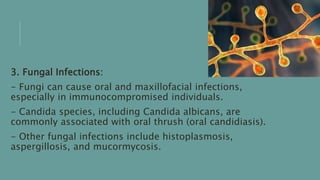
3. Fungal Infections:
- Fungi can cause oral and maxillofacial infections,
especially in immunocompromised individuals.
- Candida species, including Candida albicans, are
commonly associated with oral thrush (oral candidiasis).
- Other fungal infections include histoplasmosis,
aspergillosis, and mucormycosis.
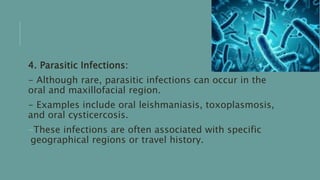
4. Parasitic Infections:
- Although rare, parasitic infections can occur in the
oral and maxillofacial region.
- Examples include oral leishmaniasis, toxoplasmosis,
and oral cysticercosis.
-These infections are often associated with specific
geographical regions or travel history.
BACTERIAL INFECTIONS
Bacterial infections are the most common type of non-
odontogenic infections. They can affect various structures
in the oral and maxillofacial region. Common bacterial
infections include:
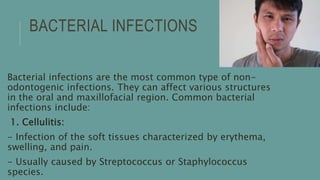
1. Cellulitis:
- Infection of the soft tissues characterized by erythema,
swelling, and pain.
- Usually caused by Streptococcus or Staphylococcus
species.
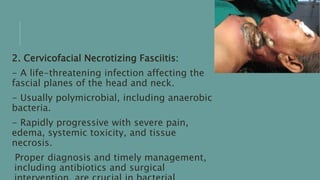
2. Cervicofacial Necrotizing Fasciitis:
- A life-threatening infection affecting the
fascial planes of the head and neck.
- Usually polymicrobial, including anaerobic
bacteria.
- Rapidly progressive with severe pain,
edema, systemic toxicity, and tissue
necrosis.
Proper diagnosis and timely management,
including antibiotics and surgical
VIRAL INFECTIONS
Viral infections can also cause non-odontogenic infections
in the oral and maxillofacial region. Some common viral
infections include:
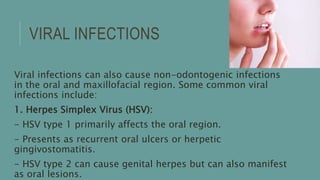
1. Herpes Simplex Virus (HSV):
- HSV type 1 primarily affects the oral region.
- Presents as recurrent oral ulcers or herpetic
gingivostomatitis.
- HSV type 2 can cause genital herpes but can also manifest
as oral lesions.
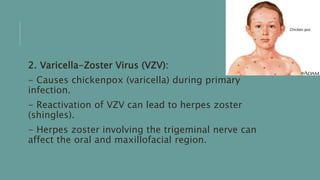
2. Varicella-Zoster Virus (VZV):
- Causes chickenpox (varicella) during primary
infection.
- Reactivation of VZV can lead to herpes zoster
(shingles).
- Herpes zoster involving the trigeminal nerve can
affect the oral and maxillofacial region.
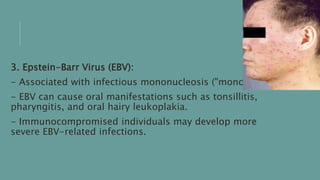
3. Epstein-Barr Virus (EBV):
- Associated with infectious mononucleosis ("mono").
- EBV can cause oral manifestations such as tonsillitis,
pharyngitis, and oral hairy leukoplakia.
- Immunocompromised individuals may develop more
severe EBV-related infections.
Diagnosis of viral infections often involves clinical examination
and laboratory tests, such as viral culture or polymerase chain
reaction (PCR). Treatment focuses on symptom management,
antiviral medications, and supportive care.
FUNGAL INFECTIONS
Fungal infections can affect the oral and maxillofacial
region, particularly in immunocompromised individuals.
Common fungal infections include:
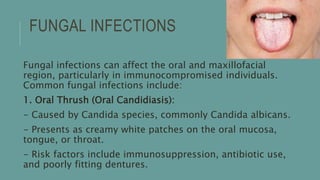
1. Oral Thrush (Oral Candidiasis):
- Caused by Candida species, commonly Candida albicans.
- Presents as creamy white patches on the oral mucosa,
tongue, or throat.
- Risk factors include immunosuppression, antibiotic use,
and poorly fitting dentures.
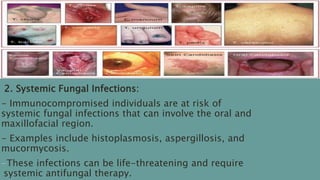
2. Systemic Fungal Infections:
- Immunocompromised individuals are at risk of
systemic fungal infections that can involve the oral and
maxillofacial region.
- Examples include histoplasmosis, aspergillosis, and
mucormycosis.
-These infections can be life-threatening and require
systemic antifungal therapy.
Diagnosis of fungal infections may involve clinical
examination, microscopic examination of oral swabs,
or fungal culture. Treatment includes antifungal
medications and addressing underlying risk factors.
PARASITIC INFECTIONS
Although rare, parasitic infections can occur in the
oral and maxillofacial region. Some examples include:
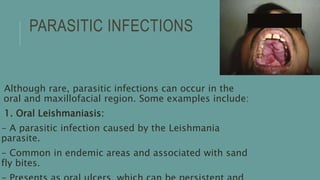
1. Oral Leishmaniasis:
- A parasitic infection caused by the Leishmania
parasite.
- Common in endemic areas and associated with sand
fly bites.
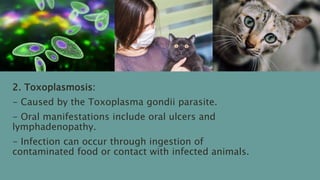
2. Toxoplasmosis:
- Caused by the Toxoplasma gondii parasite.
- Oral manifestations include oral ulcers and
lymphadenopathy.
- Infection can occur through ingestion of
contaminated food or contact with infected animals.
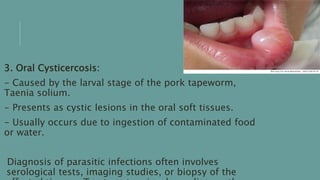
3. Oral Cysticercosis:
- Caused by the larval stage of the pork tapeworm,
Taenia solium.
- Presents as cystic lesions in the oral soft tissues.
- Usually occurs due to ingestion of contaminated food
or water.
Diagnosis of parasitic infections often involves
serological tests, imaging studies, or biopsy of the
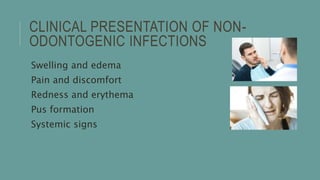
CLINICAL PRESENTATION OF NON-
ODONTOGENIC INFECTIONS
Swelling and edema
Pain and discomfort
Redness and erythema
Pus formation
Systemic signs
DIAGNOSTIC EVALUATION
Medical History and Physical Examination
Imaging Studies: Radiographic imaging, such as X-rays, CT scans, or
MRI
Laboratory Tests:
-Blood tests, including complete blood count (CBC) and inflammatory
markers (e.g., C-reactive protein), Microbiological cultures and
Biopsy or aspirate of the affected tissue.
Specialized Tests:
- Polymerase chain reaction (PCR) and Serological tests
TREATMENT APPROACHES
The management of non-odontogenic infections depends on the
underlying cause, severity of the infection, and patient-specific
factors. Treatment approaches include:
1. Antibiotics:- Broad-spectrum antibiotics
2. Antiviral or Antifungal Medications
3. Drainage of Abscesses
4. Supportive Measures
5. Referral to Specialists
COMPLICATIONS AND PROGNOSIS
Non-odontogenic infections can lead to various
complications, and the prognosis depends on several
factors:
1. Spread of Infection: cellulitis, osteomyelitis, or
mediastinitis.
2. Systemic Involvement: Sepsis or organ dysfunction.
3. Tissue Damage and Functionality: tissue necrosis,
scarring, or functional impairments.
4. Underlying Health Conditions
PREVENTION STRATEGIES
1. Oral Hygiene
2. Lifestyle Modifications
3. Personal Protective Measures
4. Infection Control in Healthcare Settings
5. Education and Awarenes
REFERENCES:
1. Smith A, Johnson B. Non-odontogenic infections of the oral and
maxillofacial region: a comprehensive review. Journal of Oral and
Maxillofacial Surgery. 2018;46(2):87-94.
2. Brown C, Jones D. Deep neck space infections: a review of the literature.
Journal of Otolaryngology. 2019;35(3):153-162.
3. Patel N, Williams D. Management of parotitis in adults: current trends and
future prospects. Oral and Maxillofacial Surgery Clinics of North America.
2021;33(1):25-33.
4. Lee K, Nguyen L. Radiographic imaging in non-odontogenic infections: a
systematic review. Oral Radiology. 2020;28(2):75-82.
5. National Institute for Health and Care Excellence. Clinical knowledge
summaries: Non-odontogenic facial pain. Available at: [insert URL here].
THANK YOU

Non-odontogenic.pptx

  • 1.
  • 2.
    MEMBERS 1. Isra Suleman 2.kaltun Abdisalam 3. Khalid Mohamed 4. Mahado Isse 5.Mohamed Abdirahaman 6.Mohamed Dahir 7.Nasren Omar 8. Abdihakim Mohamoud 9. Hamse Abdikarem 10. Abdifatah Jama
  • 3.
    INTRODUCTION: - Non-odontogenic infectionsrefer to infections in the oral and maxillofacial region that do not originate from the teeth. - These infections can involve various structures, including soft tissues, bones, salivary glands, and lymph nodes. - Understanding non-odontogenic infections is crucial for accurate diagnosis and appropriate management
  • 4.
    CLASSIFICATION OF NON- ODONTOGENICINFECTIONS Non-Odontogenic Infections can be classified into four main categories: 1. Bacterial Infections: - Most common type of non-odontogenic infections. - Caused by various bacteria, including Streptococcus, Staphylococcus, and Fusobacterium species. Examples include cellulitis, and cervicofacial necrotizing fasciitis.
  • 5.
    2. Viral Infections: -Viruses can cause infections in the oral and maxillofacial region. - Common viral infections include herpes simplex virus (HSV), varicella-zoster virus (VZV), and Epstein-Barr virus (EBV). - Herpetic infections can present as oral ulcers, herpetic gingivostomatitis, or herpes zoster (shingles) in the trigeminal nerve distribution.
  • 6.
    3. Fungal Infections: -Fungi can cause oral and maxillofacial infections, especially in immunocompromised individuals. - Candida species, including Candida albicans, are commonly associated with oral thrush (oral candidiasis). - Other fungal infections include histoplasmosis, aspergillosis, and mucormycosis.
  • 7.
    4. Parasitic Infections: -Although rare, parasitic infections can occur in the oral and maxillofacial region. - Examples include oral leishmaniasis, toxoplasmosis, and oral cysticercosis. -These infections are often associated with specific geographical regions or travel history.
  • 8.
    BACTERIAL INFECTIONS Bacterial infectionsare the most common type of non- odontogenic infections. They can affect various structures in the oral and maxillofacial region. Common bacterial infections include: 1. Cellulitis: - Infection of the soft tissues characterized by erythema, swelling, and pain. - Usually caused by Streptococcus or Staphylococcus species.
  • 9.
    2. Cervicofacial NecrotizingFasciitis: - A life-threatening infection affecting the fascial planes of the head and neck. - Usually polymicrobial, including anaerobic bacteria. - Rapidly progressive with severe pain, edema, systemic toxicity, and tissue necrosis. Proper diagnosis and timely management, including antibiotics and surgical
  • 10.
    VIRAL INFECTIONS Viral infectionscan also cause non-odontogenic infections in the oral and maxillofacial region. Some common viral infections include: 1. Herpes Simplex Virus (HSV): - HSV type 1 primarily affects the oral region. - Presents as recurrent oral ulcers or herpetic gingivostomatitis. - HSV type 2 can cause genital herpes but can also manifest as oral lesions.
  • 11.
    2. Varicella-Zoster Virus(VZV): - Causes chickenpox (varicella) during primary infection. - Reactivation of VZV can lead to herpes zoster (shingles). - Herpes zoster involving the trigeminal nerve can affect the oral and maxillofacial region.
  • 12.
    3. Epstein-Barr Virus(EBV): - Associated with infectious mononucleosis ("mono"). - EBV can cause oral manifestations such as tonsillitis, pharyngitis, and oral hairy leukoplakia. - Immunocompromised individuals may develop more severe EBV-related infections.
  • 13.
    Diagnosis of viralinfections often involves clinical examination and laboratory tests, such as viral culture or polymerase chain reaction (PCR). Treatment focuses on symptom management, antiviral medications, and supportive care.
  • 14.
    FUNGAL INFECTIONS Fungal infectionscan affect the oral and maxillofacial region, particularly in immunocompromised individuals. Common fungal infections include: 1. Oral Thrush (Oral Candidiasis): - Caused by Candida species, commonly Candida albicans. - Presents as creamy white patches on the oral mucosa, tongue, or throat. - Risk factors include immunosuppression, antibiotic use, and poorly fitting dentures.
  • 15.
    2. Systemic FungalInfections: - Immunocompromised individuals are at risk of systemic fungal infections that can involve the oral and maxillofacial region. - Examples include histoplasmosis, aspergillosis, and mucormycosis. -These infections can be life-threatening and require systemic antifungal therapy.
  • 16.
    Diagnosis of fungalinfections may involve clinical examination, microscopic examination of oral swabs, or fungal culture. Treatment includes antifungal medications and addressing underlying risk factors.
  • 17.
    PARASITIC INFECTIONS Although rare,parasitic infections can occur in the oral and maxillofacial region. Some examples include: 1. Oral Leishmaniasis: - A parasitic infection caused by the Leishmania parasite. - Common in endemic areas and associated with sand fly bites.
  • 18.
    2. Toxoplasmosis: - Causedby the Toxoplasma gondii parasite. - Oral manifestations include oral ulcers and lymphadenopathy. - Infection can occur through ingestion of contaminated food or contact with infected animals.
  • 19.
    3. Oral Cysticercosis: -Caused by the larval stage of the pork tapeworm, Taenia solium. - Presents as cystic lesions in the oral soft tissues. - Usually occurs due to ingestion of contaminated food or water. Diagnosis of parasitic infections often involves serological tests, imaging studies, or biopsy of the
  • 20.
    CLINICAL PRESENTATION OFNON- ODONTOGENIC INFECTIONS Swelling and edema Pain and discomfort Redness and erythema Pus formation Systemic signs
  • 21.
    DIAGNOSTIC EVALUATION Medical Historyand Physical Examination Imaging Studies: Radiographic imaging, such as X-rays, CT scans, or MRI Laboratory Tests: -Blood tests, including complete blood count (CBC) and inflammatory markers (e.g., C-reactive protein), Microbiological cultures and Biopsy or aspirate of the affected tissue. Specialized Tests: - Polymerase chain reaction (PCR) and Serological tests
  • 22.
    TREATMENT APPROACHES The managementof non-odontogenic infections depends on the underlying cause, severity of the infection, and patient-specific factors. Treatment approaches include: 1. Antibiotics:- Broad-spectrum antibiotics 2. Antiviral or Antifungal Medications 3. Drainage of Abscesses 4. Supportive Measures 5. Referral to Specialists
  • 23.
    COMPLICATIONS AND PROGNOSIS Non-odontogenicinfections can lead to various complications, and the prognosis depends on several factors: 1. Spread of Infection: cellulitis, osteomyelitis, or mediastinitis. 2. Systemic Involvement: Sepsis or organ dysfunction. 3. Tissue Damage and Functionality: tissue necrosis, scarring, or functional impairments. 4. Underlying Health Conditions
  • 24.
    PREVENTION STRATEGIES 1. OralHygiene 2. Lifestyle Modifications 3. Personal Protective Measures 4. Infection Control in Healthcare Settings 5. Education and Awarenes
  • 25.
    REFERENCES: 1. Smith A,Johnson B. Non-odontogenic infections of the oral and maxillofacial region: a comprehensive review. Journal of Oral and Maxillofacial Surgery. 2018;46(2):87-94. 2. Brown C, Jones D. Deep neck space infections: a review of the literature. Journal of Otolaryngology. 2019;35(3):153-162. 3. Patel N, Williams D. Management of parotitis in adults: current trends and future prospects. Oral and Maxillofacial Surgery Clinics of North America. 2021;33(1):25-33. 4. Lee K, Nguyen L. Radiographic imaging in non-odontogenic infections: a systematic review. Oral Radiology. 2020;28(2):75-82. 5. National Institute for Health and Care Excellence. Clinical knowledge summaries: Non-odontogenic facial pain. Available at: [insert URL here].
  • 26.