Noise and Vibration Engineering Laboratory
 Introduction to VI software and Data Acquisition (DAQ) systems.
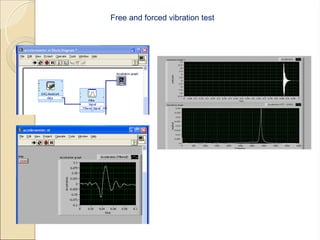
 Vibration response of a given structure using free and forced vibration test –
FRF, Damping ratio with and without smart materials.
 Vibration response of a balanced and unbalanced system.
 Shock response of a system subjected to impact loading.
 Sound level measurement using (a) Sound level meter and (b) Microphone and
VI software.
 Determination of mass ratio in tuned Dynamic vibration Absorber.
CASE STUDY
Experiment modal analysis of components / assemblies of mechanical systems
Introduction to LabVIEW and Data Acquisition (DAQ)
systems
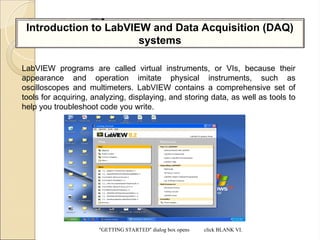
LabVIEW programs are called virtual instruments, or VIs, because their
appearance and operation imitate physical instruments, such as
oscilloscopes and multimeters. LabVIEW contains a comprehensive set of
tools for acquiring, analyzing, displaying, and storing data, as well as tools to
help you troubleshoot code you write.
“GETTING STARTED” dialog box opens click BLANK VI.
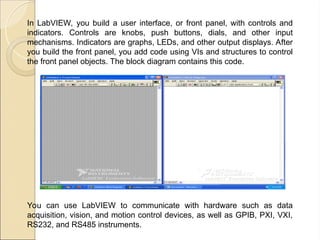
In LabVIEW, you build a user interface, or front panel, with controls and
indicators. Controls are knobs, push buttons, dials, and other input
mechanisms. Indicators are graphs, LEDs, and other output displays. After
you build the front panel, you add code using VIs and structures to control
the front panel objects. The block diagram contains this code.
You can use LabVIEW to communicate with hardware such as data
acquisition, vision, and motion control devices, as well as GPIB, PXI, VXI,
RS232, and RS485 instruments.
Data Acquisition System (DAQ)
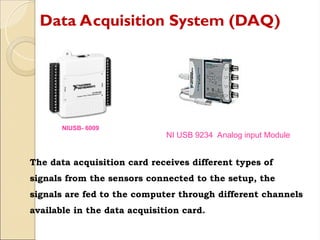
NIUSB- 6009
The data acquisition card receives different types of
signals from the sensors connected to the setup, the
signals are fed to the computer through different channels
available in the data acquisition card.
NI USB 9234 Analog input Module
Free and forced vibration test
Noise and Vibration Engineering Laboratory.ppt

Noise and Vibration Engineering Laboratory.ppt

  • 1.
    Noise and VibrationEngineering Laboratory
  • 2.
     Introduction toVI software and Data Acquisition (DAQ) systems.  Vibration response of a given structure using free and forced vibration test – FRF, Damping ratio with and without smart materials.  Vibration response of a balanced and unbalanced system.  Shock response of a system subjected to impact loading.  Sound level measurement using (a) Sound level meter and (b) Microphone and VI software.  Determination of mass ratio in tuned Dynamic vibration Absorber. CASE STUDY Experiment modal analysis of components / assemblies of mechanical systems
  • 3.
    Introduction to LabVIEWand Data Acquisition (DAQ) systems LabVIEW programs are called virtual instruments, or VIs, because their appearance and operation imitate physical instruments, such as oscilloscopes and multimeters. LabVIEW contains a comprehensive set of tools for acquiring, analyzing, displaying, and storing data, as well as tools to help you troubleshoot code you write. “GETTING STARTED” dialog box opens click BLANK VI.
  • 4.
    In LabVIEW, youbuild a user interface, or front panel, with controls and indicators. Controls are knobs, push buttons, dials, and other input mechanisms. Indicators are graphs, LEDs, and other output displays. After you build the front panel, you add code using VIs and structures to control the front panel objects. The block diagram contains this code. You can use LabVIEW to communicate with hardware such as data acquisition, vision, and motion control devices, as well as GPIB, PXI, VXI, RS232, and RS485 instruments.
  • 5.
    Data Acquisition System(DAQ) NIUSB- 6009 The data acquisition card receives different types of signals from the sensors connected to the setup, the signals are fed to the computer through different channels available in the data acquisition card. NI USB 9234 Analog input Module
  • 6.
    Free and forcedvibration test