SMALL AND MEDIUM BUSINESS TECHNOLOGY STRATEGIES
10 Benefits of
Managed IT ServicesPresented By: NLogix, LLC| Revised: December 2015
Statement of Confidentiality
This document contains trade secrets and information that is company sensitive, proprietary, and confidential, the
disclosure of which would provide a competitive advantage to others. Therefore, this document shall not be dis-
closed, used, or duplicated, in whole or in part, for any purpose other than to evaluate the requirements herein.
Copyright © 2015 NLogix, LLC. All rights reserved.
This ebook will evaluate the differences between traditional technical
support practices and modern managed IT practices, and the pros and
cons of both in regards to small and medium-sized businesses.
This ebook is an introduction to Managed IT Services and is geared
towards business owners and executives for businesses that either
have no internal IT department or a small on-staff IT team.
Managed IT Services
Monitoring, Maintenance, and
Technical Support for your entire
network, vastly reducing downtime
and support costs.
Security Solutions
Antivirus, Antimalware, Threat Prevention,
Firewall, and Content Filtering Solutions to
protect your infrastructure from internal
and external threats.
Email Hosting and Protection
Hosted and onsite email implementation,
management, spam protection and email
scrubbing.
Backup and Disaster Recovery
Complete data backup solutions and
business continuity planning.
Hardware, Software, and Overall Tech-
nology Support
Implementation, configuration,
management and support for custom
technology solutions for your business.
CONTACT US
(317) 671-8200
helpdesk@nlogix.com
About NLogix, LLC
NLogix, LLC provides IT consulting and support services for small and medium-sized businesses covering all aspects
of your company’s business needs. For more information, check out our website at
www.nlogix.com
FOLLOW US!
Fb.NLogix.com
@NLogixLLC
Traditional IT Methods
Organizations rely on computers and other technology in order to maintain effective day-to-day business.
Unfortunately, most small businesses cannot afford to have an on-site technician to take care of immediate
issues that arise, answer support questions for employees, and perform general maintenance on the hardware
and software that keeps operations running smoothly. When a problem arises, businesses typically reach out to a
technical support company, local guru, or IT firm.
The Problem with Traditional IT Methods
The traditional IT practice is often coined the “break-fix” method. When something, such as a computer, network, or
server, is broken, tech support arrives on-site to fix it. They track their time and materials during the repair process.
Often, a close business relationship between the two parties is never established – the technician may not be familiar
with all of the intricacies and scope of the business’s IT needs, resulting in misguided support and even more billable
time to resolve it. All the while the business is suffering a loss in productivity as the staff members affected by the
outage experience downtime, and cannot perform their jobs as effectively without their working equipment.
This last issue is even a side-effect of the most proficient technician under
the traditional IT model – the business pays the technician for fixing the issue
while experiencing costly downtime. Depending on the employee’s role in
the company, this could lead to missed opportunities, lower productivity, and
necessary overtime in order to meet deadlines – all of which cost the busi-
ness money.
A seemingly simple IT outage can add up to be a large, unexpected expense
very quickly. Let’s look at two formulas for estimating the cost of downtime.
P = (Number of users affected) x (% of Productivity Loss) x (Average salary per hour) x (Duration of downtime)
R = (Number of users affected) x (% of Revenue Loss) x (Average profit per employee per hour) x (Duration)
P + R = $$$
Productivity Loss Formula
Revenue Loss Formula
Overall Loss Due to Downtime
Traditional IT technical
support methods are
mocked and scrutinized
constantly, yet some
businesses continue to
invest in their IT only
when it breaks.
The Modern IT Method – Defining Managed Services
The philosophy behind modern-day IT services is wrapped around some very simple tried and true best
practices:
 Regular maintenance prolongs the usability and performance of computer systems
 Security patches and software updates protect the network from many threats and issues.
 Remote technical support can reduce support costs by eliminating transportation for most issues.
 Proactive monitoring and early detection can pinpoint issues for resolution before they cause
downtime.
 Thorough documentation and network maps give technicians a precise overview of a business’s IT
needs even the event of special cases and intricacies and streamline support visits.
 Reporting and tracking can segregate troublesome devices for replacement.
IT firms adopt managed IT service methods in order to provide much higher quality service for their cus-
tomers. The relationship is much more of a partnership and although it creates a higher expectation for the
IT firm to provide stellar service, the methods also enable them to do so.
There are three core elements that a Managed IT provider swears by:
Many small and medium-sized businesses can’t afford to staff an internal IT department to keep up
with the day-to-day maintenance, issues, and technical support, let alone with managing new imple-
mentations, upgrades, and expansion. Organizations take advantage of Managed IT providers as their
consultants, on top of managing and maintaining the day-to-day IT issues and preventing downtime.
Your Managed IT provider takes time to get to know and document your entire IT infrastructure, your
specific needs, requirements, and overall goals that your technology is driving you towards. Instead of
just fixing case-by-case issues, Managed IT providers such as NLogix, LLC. Services partner with busi-
nesses in order to take over all aspects of technology, from infrastructure to vendor management,
maintenance to upgrades, and consulting for solutions to continue to increase productivity so your
business can focus on generating revenue and growing.
In other words, you get all of the benefits of having an in-house IT department without the costs of
staffing one or more dedicated employees. You get full access to professional support, goal-oriented
solutions, and downtime-preventing maintenance.
It’s not uncommon for businesses to treat their network and computers much like a household appliance; when it
breaks, you pay someone to fix it. Some companies hire internal computer technicians just to keep up with prob-
lems. Managed IT is the sensible middle ground; your trusted IT provider isn’t on payroll, but they are dedicated to
making sure everyone is up and running. There are plenty of benefits to this alone that can greatly benefit your
company’s productivity and expenses.
.
1. Think of Managed IT Services as Outsourcing
your internal IT department
Many issues can be detected early and prevented before they escalate and start to lower the
utilization of your staff and cause a loss of time and money. Some of these issues include:
 Hard drive Failure Warnings
 Hard Drive Fragmentation and Disk Space Warnings
 Malware, Spyware, and Rootkit Detection
 Antivirus Updates and Issues
 Outdated Windows Updates and Service Packs
 Windows Update Failures
 Windows Licensing issues
 Duplicate Network Addresses
 Unexpected Changes in System Hardware
 CPU and Memory Issues
 Event and Error Logging
 And Much More
Often, day-to-day computer issues start out barely noticeable. Much like that tiny rattle in your
car, overtime they can go from being a no-big-deal status to an overnight-in-the-shop ordeal.
Managed IT providers run reporting and monitoring tools that detect issues and report back
whenever a potential problem is discovered. That way, it can be fixed before it causes frustration
and downtime for your employee.
2. Early issues detection leads to fewer problems
that actually affects the end-user
While remote technical support isn’t new, a part of the Managed IT provider’s toolset includes easy remote
access to all workstations on your network. This means issues can be looked at quickly without needing to
dispatch a technician to your location.
Not all issues can be solved remotely, such as hardware issues where the PC needs a component replaced
or isn’t booting, but the majority of day-to-day issues that take up your employees valuable time, such as
errors, application issues, and support questions don’t require an on-site visit and can be resolved quickly if
remote access is readily available.
Remote access is secure, and usually included in the Managed IT provider’s monitoring and maintenance
toolset, making it a simple, cost effective, no-brainer addition to any small business’s IT package.
Many workstation issues can be solved remotely without the need for an on-site visit. When
that’s the case, utilizing remote access reduces the expenses of the IT provider which are
then passed on to you. This also grants faster response times since the technician doesn’t
need to physically drive to your business.
3. Remote Technical Support reduces overall IT
expenses with shorter response times.
When technology fails, your first inclination is to contact the vendor to try to get as much free
support as possible (or at least agreed to in your warranty). This usually includes long, pointless
phone calls where you or your employees get cycled around a call center. More often than not
the issue doesn’t get fixed on the first call and you are back to square one. Managed IT providers
can not only handle specific hardware and software support, but handle managing your IT
vendors for you.
4. With a trusted Managed IT consultant, your
business won’t need to rely on vendor support
When compared to the standard break-fix computer company, Managed IT firms deal with business-class
vendors very often and often build relationships with vendors. This means things like warranty and support
agreements can all be handled by your outsourced IT firm instead of by your employees, and support for
specific hardware and software can be done right through your IT consultant instead of by multiple vendors.
This gives you and your staff a single point of contact for all of your technical support needs.
On top of that, often Managed IT firms like
NLogix, LLC deal with specific vendors and have access to
special solutions and services that aren’t always offered to
small businesses, such as bulk licensing and better support
options.
Being able to funnel all of your IT support and have one
support number for all issues alleviates a lot of time and
hassle for your employees when they need support, and a
good IT firm that practices Managed IT should be able to
cover that for your business.
The key element of a Managed IT Service is that you aren’t paying to have issues fixed; you are paying to
have them prevented. With Managed IT, you pay to prevent downtime and maintain your expensive IT
infrastructure. Regular maintenance plays a huge impact
on stability, performance, security, and longevity of your
network and the devices on it.
Think of it this way; when you are experiencing downtime,
it is an emergency, and Managed IT providers like NLogix, LLC see it as such. Due to the nature of the rela-
tionship, when your network is down, it’s the IT provider that is losing money. Fortunately, this drives the
IT firm to utilize the very best practices and run top-notch maintenance and always-on reporting tools to
prevent any downtime at all.
When there is the inevitable downtime, however, it is fixed as quickly as possible. Depending on your con-
tract with your IT provider, some or all emergency fees can be covered under your agreement.
IT issues can become expensive very quickly, especially when they aren’t taken
care of promptly. Network and server outages can leave some or all of your
employees stranded unable to do their jobs. You continue to pay them despite a
huge hit to productivity and then you need to pay for the problem to get resolved.
“With Managed IT, you pay to
prevent downtime and maintain
your expensive IT infrastructure.”
5. The Break/Fix Practice forces you to pay
when you are down and already losing
money
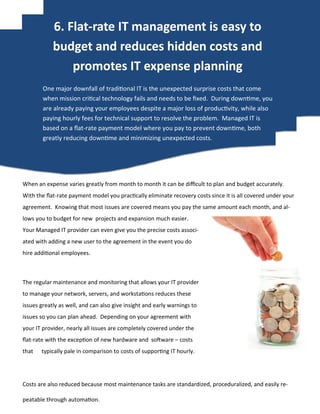
When an expense varies greatly from month to month it can be difficult to plan and budget accurately.
With the flat-rate payment model you practically eliminate recovery costs since it is all covered under your
agreement. Knowing that most issues are covered means you pay the same amount each month, and al-
lows you to budget for new projects and expansion much easier.
Your Managed IT provider can even give you the precise costs associ-
ated with adding a new user to the agreement in the event you do
hire additional employees.
The regular maintenance and monitoring that allows your IT provider
to manage your network, servers, and workstations reduces these
issues greatly as well, and can also give insight and early warnings to
issues so you can plan ahead. Depending on your agreement with
your IT provider, nearly all issues are completely covered under the
flat-rate with the exception of new hardware and software – costs
that typically pale in comparison to costs of supporting IT hourly.
Costs are also reduced because most maintenance tasks are standardized, proceduralized, and easily re-
peatable through automation.
One major downfall of traditional IT is the unexpected surprise costs that come
when mission critical technology fails and needs to be fixed. During downtime, you
are already paying your employees despite a major loss of productivity, while also
paying hourly fees for technical support to resolve the problem. Managed IT is
based on a flat-rate payment model where you pay to prevent downtime, both
greatly reducing downtime and minimizing unexpected costs.
6. Flat-rate IT management is easy to
budget and reduces hidden costs and
promotes IT expense planning
For your managed IT provider, it’s not enough that your computers and server are working – they need to
be working for your business. Managed IT providers understand day-to-day business processes and best
practices and focus solutions strictly on the small and medium business landscape.
IT providers like NLogix, LLC can work with you, taking on the role of a CIO to help you establish long term
implementations for your business through new solutions, security,
training, and best practices that can improve your bottom line.
Your IT service provider should offer quarterly or bi-yearly reviews
to provide consulting to ensure your IT solutions match your
visions for your business.
When your IT infrastructure works, it can greatly increase the productivity of your users,
but what about goals specific to your company? Your Managed IT provider serves the
role of a consultant for your business development regarding how technology can drive
your business forward. From new solutions to better internal practices, your goals can
be achieved through professional management of your technology.
7. You get a powerful alignment of your IT
and business goals.
(Your technology works for you!)
Besides better performance, less downtime, and fewer issues,
properly managed IT services are generally cheaper than the
alternatives because it takes less time and effort to maintain
technology than it does to fix it when things were left to go wrong.
You get access to knowledgeable, professional support without being
nickeled and dimed for each call or issue. There aren’t hourly onsite
charges either. Since your outsourced IT department is accountable
for your uptime, issues and emergencies are typically covered under
your clearly-defined agreement.
Simply put, when you take care of your IT, it breaks less. All of the benefits of managed
IT naturally leads to lower costs. Network and hardware integrity is constantly being
monitored and proper maintenance is ensuring the health of your IT infrastructure,
which eliminates surprise costs and faster-than-normal depreciation. Early detection con-
tributes to fewer emergencies which result in fewer tech support calls.
8. Businesses that manage and outsource
their IT properly greatly reduce overall IT
expenses
Looking to implement a secondary office to function over the same network or controlling the web con-
tent your users can access? Taking advantage of Managed IT providers like NLogix, LLC , Inc. Services can
help bring cutting-edge solutions to improve your day-to-day. Here are just a few of the solutions NLogix,
LLC can offer you:
 Voice over IP phone systems
 Data Backup, Disaster Recovery, and Business Continuity
 Firewall and Security Solutions and Web Content Filtering
 Server Virtualization
 Virtual Private Networks
 Telecommunication Solutions
 Smartphone and Mobile Solutions
 Security Policy Management and Administration
 Email hosting and Spam Protection
 Software Solutions, Productivity Suites, CRM packages
 And much more.
Running a small business doesn’t mean you need to suffer from the lowest-end solutions.
Enterprise-level support and solutions can be made available to your organization to give
you the cutting edge in communications or to help you sleep at night with bullet-proof
backup and security. When partnering with a Managed IT provider, you can get access to
technology solutions that are normally reserved for big corporate enterprises at costs
geared towards your budget.
9. Your business can take advantage of
enterprise-level solutions for small
business costs
Employees should perform the tasks they were paid to do, not general IT maintenance. Just as concerning,
most of these critical tasks aren’t performed properly or at all, leading to additional issues, security
breaches, and costly downtime.
A Managed IT provider can easily perform these repetitive maintenance tasks through automated tools
and monitoring applications that report back any issues or missing updates. Through best practices and
documented procedures, these routine tasks can be performed quickly and cost-effectively without
needing to take an employee offline and tasks that require the workstation to be rebooted or need
resources to run scans can be scheduled for after-hours.
With Managed IT services, your staff no longer needs to focus on keeping their workstation up-to-date with
Windows updates, run disk defrags or virus scans, or waste time on PC maintenance, effectively returning
precious time to your organization and allowing employees to get more done during the course of the
business day.
Standard IT operations consist of many critical, yet repetitive technical tasks that take time and
experience to perform. The traditional method had no place for many of these time-consuming
critical tasks due to the hourly billing that most traditional IT providers charge. This means that
these standard, day-to-day tasks, such as updating and running antivirus, applying and testing
Windows security patches, and monitoring the health of data backup solutions, are the
responsibility of the employee or not attended to at all.
10. Managed IT Services allow businesses to
free up resources and focus on core business
objectives
Focus on your Business
Not your Technology
Eliminate downtime, lower and budget your IT expenses, and improve productivity with Managed IT Services.
Learn more today by calling NLogix, LLC at (317) 671-8200 or visiting us on the web at:
www.nlogix.com
Get a FREE Managed
IT Consultation

NLOGIX

  • 1.
    SMALL AND MEDIUMBUSINESS TECHNOLOGY STRATEGIES 10 Benefits of Managed IT ServicesPresented By: NLogix, LLC| Revised: December 2015 Statement of Confidentiality This document contains trade secrets and information that is company sensitive, proprietary, and confidential, the disclosure of which would provide a competitive advantage to others. Therefore, this document shall not be dis- closed, used, or duplicated, in whole or in part, for any purpose other than to evaluate the requirements herein. Copyright © 2015 NLogix, LLC. All rights reserved. This ebook will evaluate the differences between traditional technical support practices and modern managed IT practices, and the pros and cons of both in regards to small and medium-sized businesses. This ebook is an introduction to Managed IT Services and is geared towards business owners and executives for businesses that either have no internal IT department or a small on-staff IT team.
  • 2.
    Managed IT Services Monitoring,Maintenance, and Technical Support for your entire network, vastly reducing downtime and support costs. Security Solutions Antivirus, Antimalware, Threat Prevention, Firewall, and Content Filtering Solutions to protect your infrastructure from internal and external threats. Email Hosting and Protection Hosted and onsite email implementation, management, spam protection and email scrubbing. Backup and Disaster Recovery Complete data backup solutions and business continuity planning. Hardware, Software, and Overall Tech- nology Support Implementation, configuration, management and support for custom technology solutions for your business. CONTACT US (317) 671-8200 helpdesk@nlogix.com About NLogix, LLC NLogix, LLC provides IT consulting and support services for small and medium-sized businesses covering all aspects of your company’s business needs. For more information, check out our website at www.nlogix.com FOLLOW US! Fb.NLogix.com @NLogixLLC
  • 3.
    Traditional IT Methods Organizationsrely on computers and other technology in order to maintain effective day-to-day business. Unfortunately, most small businesses cannot afford to have an on-site technician to take care of immediate issues that arise, answer support questions for employees, and perform general maintenance on the hardware and software that keeps operations running smoothly. When a problem arises, businesses typically reach out to a technical support company, local guru, or IT firm. The Problem with Traditional IT Methods The traditional IT practice is often coined the “break-fix” method. When something, such as a computer, network, or server, is broken, tech support arrives on-site to fix it. They track their time and materials during the repair process. Often, a close business relationship between the two parties is never established – the technician may not be familiar with all of the intricacies and scope of the business’s IT needs, resulting in misguided support and even more billable time to resolve it. All the while the business is suffering a loss in productivity as the staff members affected by the outage experience downtime, and cannot perform their jobs as effectively without their working equipment. This last issue is even a side-effect of the most proficient technician under the traditional IT model – the business pays the technician for fixing the issue while experiencing costly downtime. Depending on the employee’s role in the company, this could lead to missed opportunities, lower productivity, and necessary overtime in order to meet deadlines – all of which cost the busi- ness money. A seemingly simple IT outage can add up to be a large, unexpected expense very quickly. Let’s look at two formulas for estimating the cost of downtime. P = (Number of users affected) x (% of Productivity Loss) x (Average salary per hour) x (Duration of downtime) R = (Number of users affected) x (% of Revenue Loss) x (Average profit per employee per hour) x (Duration) P + R = $$$ Productivity Loss Formula Revenue Loss Formula Overall Loss Due to Downtime Traditional IT technical support methods are mocked and scrutinized constantly, yet some businesses continue to invest in their IT only when it breaks.
  • 4.
    The Modern ITMethod – Defining Managed Services The philosophy behind modern-day IT services is wrapped around some very simple tried and true best practices:  Regular maintenance prolongs the usability and performance of computer systems  Security patches and software updates protect the network from many threats and issues.  Remote technical support can reduce support costs by eliminating transportation for most issues.  Proactive monitoring and early detection can pinpoint issues for resolution before they cause downtime.  Thorough documentation and network maps give technicians a precise overview of a business’s IT needs even the event of special cases and intricacies and streamline support visits.  Reporting and tracking can segregate troublesome devices for replacement. IT firms adopt managed IT service methods in order to provide much higher quality service for their cus- tomers. The relationship is much more of a partnership and although it creates a higher expectation for the IT firm to provide stellar service, the methods also enable them to do so. There are three core elements that a Managed IT provider swears by:
  • 5.
    Many small andmedium-sized businesses can’t afford to staff an internal IT department to keep up with the day-to-day maintenance, issues, and technical support, let alone with managing new imple- mentations, upgrades, and expansion. Organizations take advantage of Managed IT providers as their consultants, on top of managing and maintaining the day-to-day IT issues and preventing downtime. Your Managed IT provider takes time to get to know and document your entire IT infrastructure, your specific needs, requirements, and overall goals that your technology is driving you towards. Instead of just fixing case-by-case issues, Managed IT providers such as NLogix, LLC. Services partner with busi- nesses in order to take over all aspects of technology, from infrastructure to vendor management, maintenance to upgrades, and consulting for solutions to continue to increase productivity so your business can focus on generating revenue and growing. In other words, you get all of the benefits of having an in-house IT department without the costs of staffing one or more dedicated employees. You get full access to professional support, goal-oriented solutions, and downtime-preventing maintenance. It’s not uncommon for businesses to treat their network and computers much like a household appliance; when it breaks, you pay someone to fix it. Some companies hire internal computer technicians just to keep up with prob- lems. Managed IT is the sensible middle ground; your trusted IT provider isn’t on payroll, but they are dedicated to making sure everyone is up and running. There are plenty of benefits to this alone that can greatly benefit your company’s productivity and expenses. . 1. Think of Managed IT Services as Outsourcing your internal IT department
  • 6.
    Many issues canbe detected early and prevented before they escalate and start to lower the utilization of your staff and cause a loss of time and money. Some of these issues include:  Hard drive Failure Warnings  Hard Drive Fragmentation and Disk Space Warnings  Malware, Spyware, and Rootkit Detection  Antivirus Updates and Issues  Outdated Windows Updates and Service Packs  Windows Update Failures  Windows Licensing issues  Duplicate Network Addresses  Unexpected Changes in System Hardware  CPU and Memory Issues  Event and Error Logging  And Much More Often, day-to-day computer issues start out barely noticeable. Much like that tiny rattle in your car, overtime they can go from being a no-big-deal status to an overnight-in-the-shop ordeal. Managed IT providers run reporting and monitoring tools that detect issues and report back whenever a potential problem is discovered. That way, it can be fixed before it causes frustration and downtime for your employee. 2. Early issues detection leads to fewer problems that actually affects the end-user
  • 7.
    While remote technicalsupport isn’t new, a part of the Managed IT provider’s toolset includes easy remote access to all workstations on your network. This means issues can be looked at quickly without needing to dispatch a technician to your location. Not all issues can be solved remotely, such as hardware issues where the PC needs a component replaced or isn’t booting, but the majority of day-to-day issues that take up your employees valuable time, such as errors, application issues, and support questions don’t require an on-site visit and can be resolved quickly if remote access is readily available. Remote access is secure, and usually included in the Managed IT provider’s monitoring and maintenance toolset, making it a simple, cost effective, no-brainer addition to any small business’s IT package. Many workstation issues can be solved remotely without the need for an on-site visit. When that’s the case, utilizing remote access reduces the expenses of the IT provider which are then passed on to you. This also grants faster response times since the technician doesn’t need to physically drive to your business. 3. Remote Technical Support reduces overall IT expenses with shorter response times.
  • 8.
    When technology fails,your first inclination is to contact the vendor to try to get as much free support as possible (or at least agreed to in your warranty). This usually includes long, pointless phone calls where you or your employees get cycled around a call center. More often than not the issue doesn’t get fixed on the first call and you are back to square one. Managed IT providers can not only handle specific hardware and software support, but handle managing your IT vendors for you. 4. With a trusted Managed IT consultant, your business won’t need to rely on vendor support When compared to the standard break-fix computer company, Managed IT firms deal with business-class vendors very often and often build relationships with vendors. This means things like warranty and support agreements can all be handled by your outsourced IT firm instead of by your employees, and support for specific hardware and software can be done right through your IT consultant instead of by multiple vendors. This gives you and your staff a single point of contact for all of your technical support needs. On top of that, often Managed IT firms like NLogix, LLC deal with specific vendors and have access to special solutions and services that aren’t always offered to small businesses, such as bulk licensing and better support options. Being able to funnel all of your IT support and have one support number for all issues alleviates a lot of time and hassle for your employees when they need support, and a good IT firm that practices Managed IT should be able to cover that for your business.
  • 9.
    The key elementof a Managed IT Service is that you aren’t paying to have issues fixed; you are paying to have them prevented. With Managed IT, you pay to prevent downtime and maintain your expensive IT infrastructure. Regular maintenance plays a huge impact on stability, performance, security, and longevity of your network and the devices on it. Think of it this way; when you are experiencing downtime, it is an emergency, and Managed IT providers like NLogix, LLC see it as such. Due to the nature of the rela- tionship, when your network is down, it’s the IT provider that is losing money. Fortunately, this drives the IT firm to utilize the very best practices and run top-notch maintenance and always-on reporting tools to prevent any downtime at all. When there is the inevitable downtime, however, it is fixed as quickly as possible. Depending on your con- tract with your IT provider, some or all emergency fees can be covered under your agreement. IT issues can become expensive very quickly, especially when they aren’t taken care of promptly. Network and server outages can leave some or all of your employees stranded unable to do their jobs. You continue to pay them despite a huge hit to productivity and then you need to pay for the problem to get resolved. “With Managed IT, you pay to prevent downtime and maintain your expensive IT infrastructure.” 5. The Break/Fix Practice forces you to pay when you are down and already losing money
  • 10.
    When an expensevaries greatly from month to month it can be difficult to plan and budget accurately. With the flat-rate payment model you practically eliminate recovery costs since it is all covered under your agreement. Knowing that most issues are covered means you pay the same amount each month, and al- lows you to budget for new projects and expansion much easier. Your Managed IT provider can even give you the precise costs associ- ated with adding a new user to the agreement in the event you do hire additional employees. The regular maintenance and monitoring that allows your IT provider to manage your network, servers, and workstations reduces these issues greatly as well, and can also give insight and early warnings to issues so you can plan ahead. Depending on your agreement with your IT provider, nearly all issues are completely covered under the flat-rate with the exception of new hardware and software – costs that typically pale in comparison to costs of supporting IT hourly. Costs are also reduced because most maintenance tasks are standardized, proceduralized, and easily re- peatable through automation. One major downfall of traditional IT is the unexpected surprise costs that come when mission critical technology fails and needs to be fixed. During downtime, you are already paying your employees despite a major loss of productivity, while also paying hourly fees for technical support to resolve the problem. Managed IT is based on a flat-rate payment model where you pay to prevent downtime, both greatly reducing downtime and minimizing unexpected costs. 6. Flat-rate IT management is easy to budget and reduces hidden costs and promotes IT expense planning
  • 11.
    For your managedIT provider, it’s not enough that your computers and server are working – they need to be working for your business. Managed IT providers understand day-to-day business processes and best practices and focus solutions strictly on the small and medium business landscape. IT providers like NLogix, LLC can work with you, taking on the role of a CIO to help you establish long term implementations for your business through new solutions, security, training, and best practices that can improve your bottom line. Your IT service provider should offer quarterly or bi-yearly reviews to provide consulting to ensure your IT solutions match your visions for your business. When your IT infrastructure works, it can greatly increase the productivity of your users, but what about goals specific to your company? Your Managed IT provider serves the role of a consultant for your business development regarding how technology can drive your business forward. From new solutions to better internal practices, your goals can be achieved through professional management of your technology. 7. You get a powerful alignment of your IT and business goals. (Your technology works for you!)
  • 12.
    Besides better performance,less downtime, and fewer issues, properly managed IT services are generally cheaper than the alternatives because it takes less time and effort to maintain technology than it does to fix it when things were left to go wrong. You get access to knowledgeable, professional support without being nickeled and dimed for each call or issue. There aren’t hourly onsite charges either. Since your outsourced IT department is accountable for your uptime, issues and emergencies are typically covered under your clearly-defined agreement. Simply put, when you take care of your IT, it breaks less. All of the benefits of managed IT naturally leads to lower costs. Network and hardware integrity is constantly being monitored and proper maintenance is ensuring the health of your IT infrastructure, which eliminates surprise costs and faster-than-normal depreciation. Early detection con- tributes to fewer emergencies which result in fewer tech support calls. 8. Businesses that manage and outsource their IT properly greatly reduce overall IT expenses
  • 13.
    Looking to implementa secondary office to function over the same network or controlling the web con- tent your users can access? Taking advantage of Managed IT providers like NLogix, LLC , Inc. Services can help bring cutting-edge solutions to improve your day-to-day. Here are just a few of the solutions NLogix, LLC can offer you:  Voice over IP phone systems  Data Backup, Disaster Recovery, and Business Continuity  Firewall and Security Solutions and Web Content Filtering  Server Virtualization  Virtual Private Networks  Telecommunication Solutions  Smartphone and Mobile Solutions  Security Policy Management and Administration  Email hosting and Spam Protection  Software Solutions, Productivity Suites, CRM packages  And much more. Running a small business doesn’t mean you need to suffer from the lowest-end solutions. Enterprise-level support and solutions can be made available to your organization to give you the cutting edge in communications or to help you sleep at night with bullet-proof backup and security. When partnering with a Managed IT provider, you can get access to technology solutions that are normally reserved for big corporate enterprises at costs geared towards your budget. 9. Your business can take advantage of enterprise-level solutions for small business costs
  • 14.
    Employees should performthe tasks they were paid to do, not general IT maintenance. Just as concerning, most of these critical tasks aren’t performed properly or at all, leading to additional issues, security breaches, and costly downtime. A Managed IT provider can easily perform these repetitive maintenance tasks through automated tools and monitoring applications that report back any issues or missing updates. Through best practices and documented procedures, these routine tasks can be performed quickly and cost-effectively without needing to take an employee offline and tasks that require the workstation to be rebooted or need resources to run scans can be scheduled for after-hours. With Managed IT services, your staff no longer needs to focus on keeping their workstation up-to-date with Windows updates, run disk defrags or virus scans, or waste time on PC maintenance, effectively returning precious time to your organization and allowing employees to get more done during the course of the business day. Standard IT operations consist of many critical, yet repetitive technical tasks that take time and experience to perform. The traditional method had no place for many of these time-consuming critical tasks due to the hourly billing that most traditional IT providers charge. This means that these standard, day-to-day tasks, such as updating and running antivirus, applying and testing Windows security patches, and monitoring the health of data backup solutions, are the responsibility of the employee or not attended to at all. 10. Managed IT Services allow businesses to free up resources and focus on core business objectives
  • 15.
    Focus on yourBusiness Not your Technology Eliminate downtime, lower and budget your IT expenses, and improve productivity with Managed IT Services. Learn more today by calling NLogix, LLC at (317) 671-8200 or visiting us on the web at: www.nlogix.com Get a FREE Managed IT Consultation