Global Business Presentation
By Nina Darling
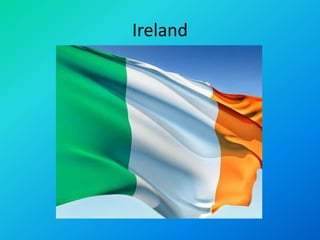
Ireland
Customs of Ireland
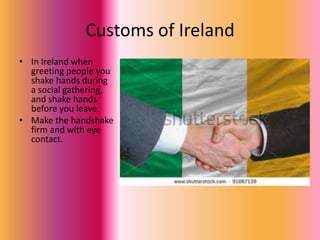
• In Ireland when
greeting people you
shake hands during
a social gathering,
and shake hands
before you leave.
• Make the handshake
firm and with eye
contact.
Customs of Ireland
• Business entertainment is
commonly conducted in
restaurants.
• Business dinners are usually
considered more of a social
occasion and a good way to
develop relationships.
• Spouses may or may not be
invited to a business dinner.
• The small plate next to a dinner
plate is for peelings removed
from boiled potatoes.
• It is polite to eat everything
served to you in a private home.
• Table manners are the same as in
England, only a bit more relaxed.
• Refusing a drink can be perceived
as insult in Ireland.
• Always buy your round of drinks.
Customs of Ireland
• The Irish are not very
physically
demonstrative and are
not comfortable with
public displays of
affection.
• The Irish are
uncomfortable with
loud, aggressive, and
arrogant behavior.
• A "Reverse V for
victory" gesture is
considered obscene.
Translation
• "Dia duit is ainm dom Nina Darling. Fáilte go
dtí mo láthair agus buíochas a ghabháil leat as
teacht. Beidh mé ag caint leat faoi na custaim
Irlend. I Éirinn leat a shake lámha ann ag titim
ar imeachtaí sóisialta, déan cinnte go
ndéanann tú teagmháil súl."
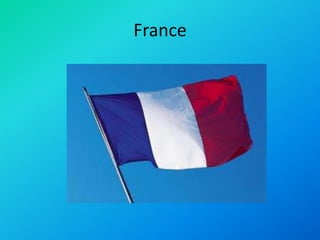
France
Customs of France
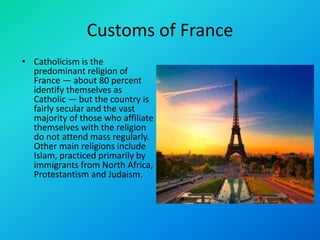
• Catholicism is the
predominant religion of
France — about 80 percent
identify themselves as
Catholic — but the country is
fairly secular and the vast
majority of those who affiliate
themselves with the religion
do not attend mass regularly.
Other main religions include
Islam, practiced primarily by
immigrants from North Africa,
Protestantism and Judaism.
Customs of France
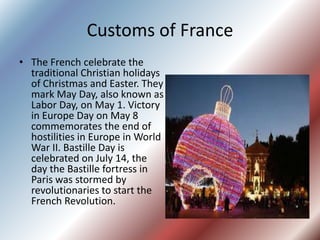
• The French celebrate the
traditional Christian holidays
of Christmas and Easter. They
mark May Day, also known as
Labor Day, on May 1. Victory
in Europe Day on May 8
commemorates the end of
hostilities in Europe in World
War II. Bastille Day is
celebrated on July 14, the
day the Bastille fortress in
Paris was stormed by
revolutionaries to start the
French Revolution.
Customs of France
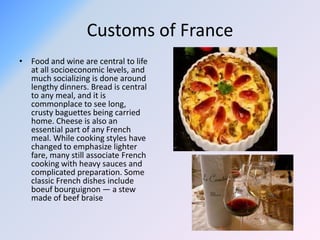
• Food and wine are central to life
at all socioeconomic levels, and
much socializing is done around
lengthy dinners. Bread is central
to any meal, and it is
commonplace to see long,
crusty baguettes being carried
home. Cheese is also an
essential part of any French
meal. While cooking styles have
changed to emphasize lighter
fare, many still associate French
cooking with heavy sauces and
complicated preparation. Some
classic French dishes include
boeuf bourguignon — a stew
made of beef braise
Translation
• "Bonjour mon nom est Nina chérie. Bienvenue
sur ma présentation et je vous remercie d'être
venus. Je vais parler à vous aujourd'hui sur les
coutumes d'affaires de France. France Ils
célèbrent quelque chose qui s'appelle peut le
jour sur le premier juin pour la Fête du Travail.
En France, ils Donc, manger de la nourriture
avec le vin et le fromage est un élément
essentiel de toute cuisine française. "
Italy
Customs of Italy
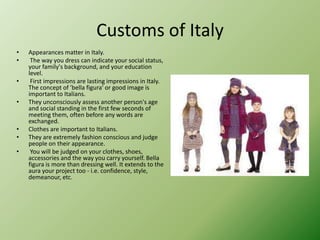
• Appearances matter in Italy.
• The way you dress can indicate your social status,
your family's background, and your education
level.
• First impressions are lasting impressions in Italy.
The concept of 'bella figura' or good image is
important to Italians.
• They unconsciously assess another person's age
and social standing in the first few seconds of
meeting them, often before any words are
exchanged.
• Clothes are important to Italians.
• They are extremely fashion conscious and judge
people on their appearance.
• You will be judged on your clothes, shoes,
accessories and the way you carry yourself. Bella
figura is more than dressing well. It extends to the
aura your project too - i.e. confidence, style,
demeanour, etc.
Customs of Italy
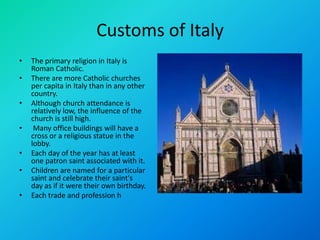
• The primary religion in Italy is
Roman Catholic.
• There are more Catholic churches
per capita in Italy than in any other
country.
• Although church attendance is
relatively low, the influence of the
church is still high.
• Many office buildings will have a
cross or a religious statue in the
lobby.
• Each day of the year has at least
one patron saint associated with it.
• Children are named for a particular
saint and celebrate their saint's
day as if it were their own birthday.
• Each trade and profession h
Customs Of Italy
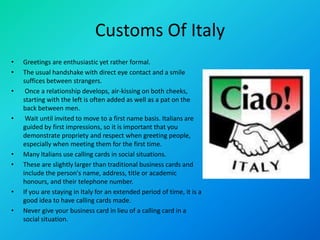
• Greetings are enthusiastic yet rather formal.
• The usual handshake with direct eye contact and a smile
suffices between strangers.
• Once a relationship develops, air-kissing on both cheeks,
starting with the left is often added as well as a pat on the
back between men.
• Wait until invited to move to a first name basis. Italians are
guided by first impressions, so it is important that you
demonstrate propriety and respect when greeting people,
especially when meeting them for the first time.
• Many Italians use calling cards in social situations.
• These are slightly larger than traditional business cards and
include the person's name, address, title or academic
honours, and their telephone number.
• If you are staying in Italy for an extended period of time, it is a
good idea to have calling cards made.
• Never give your business card in lieu of a calling card in a
social situation.
Translation
• "Ciao il mio nome è Nina Tesoro. Benvenuti
nella mia presentazione e vi ringrazio per
essere venuti. Parlerò a voi oggi sulle
consuetudini commerciali d'Italia. Italia ti
agitare lì le mani quando li si incontra. Ey In
Italia si fanno contatto . "

Nina darling presentation

  • 1.
  • 2.
  • 3.
    Customs of Ireland •In Ireland when greeting people you shake hands during a social gathering, and shake hands before you leave. • Make the handshake firm and with eye contact.
  • 4.
    Customs of Ireland •Business entertainment is commonly conducted in restaurants. • Business dinners are usually considered more of a social occasion and a good way to develop relationships. • Spouses may or may not be invited to a business dinner. • The small plate next to a dinner plate is for peelings removed from boiled potatoes. • It is polite to eat everything served to you in a private home. • Table manners are the same as in England, only a bit more relaxed. • Refusing a drink can be perceived as insult in Ireland. • Always buy your round of drinks.
  • 5.
    Customs of Ireland •The Irish are not very physically demonstrative and are not comfortable with public displays of affection. • The Irish are uncomfortable with loud, aggressive, and arrogant behavior. • A "Reverse V for victory" gesture is considered obscene.
  • 6.
    Translation • "Dia duitis ainm dom Nina Darling. Fáilte go dtí mo láthair agus buíochas a ghabháil leat as teacht. Beidh mé ag caint leat faoi na custaim Irlend. I Éirinn leat a shake lámha ann ag titim ar imeachtaí sóisialta, déan cinnte go ndéanann tú teagmháil súl."
  • 7.
  • 8.
    Customs of France •Catholicism is the predominant religion of France — about 80 percent identify themselves as Catholic — but the country is fairly secular and the vast majority of those who affiliate themselves with the religion do not attend mass regularly. Other main religions include Islam, practiced primarily by immigrants from North Africa, Protestantism and Judaism.
  • 9.
    Customs of France •The French celebrate the traditional Christian holidays of Christmas and Easter. They mark May Day, also known as Labor Day, on May 1. Victory in Europe Day on May 8 commemorates the end of hostilities in Europe in World War II. Bastille Day is celebrated on July 14, the day the Bastille fortress in Paris was stormed by revolutionaries to start the French Revolution.
  • 10.
    Customs of France •Food and wine are central to life at all socioeconomic levels, and much socializing is done around lengthy dinners. Bread is central to any meal, and it is commonplace to see long, crusty baguettes being carried home. Cheese is also an essential part of any French meal. While cooking styles have changed to emphasize lighter fare, many still associate French cooking with heavy sauces and complicated preparation. Some classic French dishes include boeuf bourguignon — a stew made of beef braise
  • 11.
    Translation • "Bonjour monnom est Nina chérie. Bienvenue sur ma présentation et je vous remercie d'être venus. Je vais parler à vous aujourd'hui sur les coutumes d'affaires de France. France Ils célèbrent quelque chose qui s'appelle peut le jour sur le premier juin pour la Fête du Travail. En France, ils Donc, manger de la nourriture avec le vin et le fromage est un élément essentiel de toute cuisine française. "
  • 12.
  • 13.
    Customs of Italy •Appearances matter in Italy. • The way you dress can indicate your social status, your family's background, and your education level. • First impressions are lasting impressions in Italy. The concept of 'bella figura' or good image is important to Italians. • They unconsciously assess another person's age and social standing in the first few seconds of meeting them, often before any words are exchanged. • Clothes are important to Italians. • They are extremely fashion conscious and judge people on their appearance. • You will be judged on your clothes, shoes, accessories and the way you carry yourself. Bella figura is more than dressing well. It extends to the aura your project too - i.e. confidence, style, demeanour, etc.
  • 14.
    Customs of Italy •The primary religion in Italy is Roman Catholic. • There are more Catholic churches per capita in Italy than in any other country. • Although church attendance is relatively low, the influence of the church is still high. • Many office buildings will have a cross or a religious statue in the lobby. • Each day of the year has at least one patron saint associated with it. • Children are named for a particular saint and celebrate their saint's day as if it were their own birthday. • Each trade and profession h
  • 15.
    Customs Of Italy •Greetings are enthusiastic yet rather formal. • The usual handshake with direct eye contact and a smile suffices between strangers. • Once a relationship develops, air-kissing on both cheeks, starting with the left is often added as well as a pat on the back between men. • Wait until invited to move to a first name basis. Italians are guided by first impressions, so it is important that you demonstrate propriety and respect when greeting people, especially when meeting them for the first time. • Many Italians use calling cards in social situations. • These are slightly larger than traditional business cards and include the person's name, address, title or academic honours, and their telephone number. • If you are staying in Italy for an extended period of time, it is a good idea to have calling cards made. • Never give your business card in lieu of a calling card in a social situation.
  • 16.
    Translation • "Ciao ilmio nome è Nina Tesoro. Benvenuti nella mia presentazione e vi ringrazio per essere venuti. Parlerò a voi oggi sulle consuetudini commerciali d'Italia. Italia ti agitare lì le mani quando li si incontra. Ey In Italia si fanno contatto . "