ITALY 
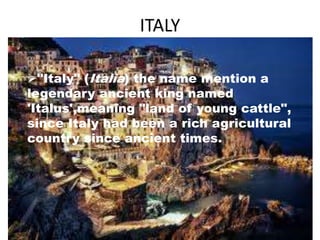
"Italy" (Italia) the name mention a 
legendary ancient king named 
'Italus',meaning "land of young cattle", 
since Italy had been a rich agricultural 
country since ancient times.
Location of Italy 
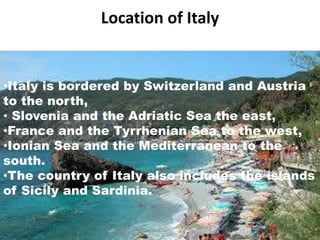
•Italy is a country in south-western Europe 
•Italy is bordered by Switzerland and Austria 
to the north, 
• Slovenia and the Adriatic Sea the east, 
•France and the Tyrrhenian Sea to the west, 
•Ionian Sea and the Mediterranean to the 
south. 
•The country of Italy also includes the islands 
of Sicily and Sardinia.
History of Italy 
•Roman Empire declined and “fell” in the fifth centur y Italy was the target of 
several invasions, and the previously united region broke apart. 
. Italy, and its smaller states, also went through stages of foreign domination 
. A war between Austria and France in 1859 allowed several small states to 
merge with Piedmont; 
•Modern Italy is democratic republic, and has been since the modern 
constitution came into effect in 1948. 
• This followed a referendum in 1946 which voted to abolish the previous 
monarchy by twelve million votes to ten.
Italian Culture 
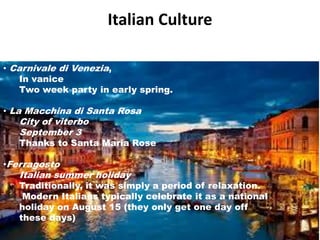
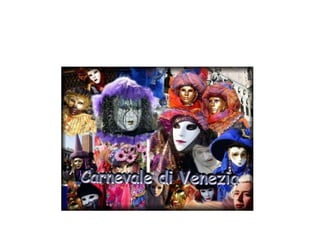
• Carnivale di Venezia, 
In vanice 
Two week party in early spring. 
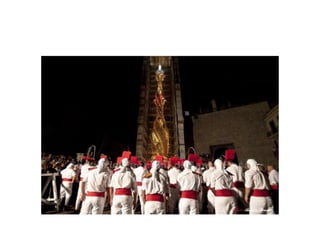
• La Macchina di Santa Rosa 
City of viterbo 
September 3 
Thanks to Santa Maria Rose 
•Ferragosto 
Italian summer holiday 
Traditionally, it was simply a period of relaxation. 
Modern Italians typically celebrate it as a national 
holiday on August 15 (they only get one day off 
these days)
Italian customs 
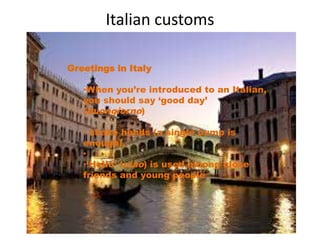
Greetings in Italy 
•When you’re introduced to an Italian, 
you should say ‘good day’ 
(buongiorno) 
• shake hands (a single pump is 
enough). 
• 
•‘Hello’ (ciao) is used among close 
friends and young people
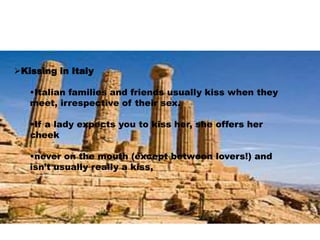
Kissing in Italy 
•Italian families and friends usually kiss when they 
meet, irrespective of their sex. 
•If a lady expects you to kiss her, she offers her 
cheek 
•never on the mouth (except between lovers!) and 
isn’t usually really a kiss,
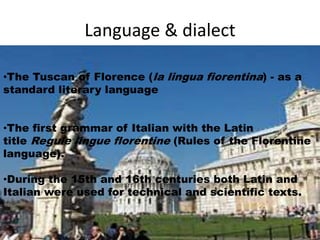
Language & dialect 
•The Tuscan of Florence (la lingua fiorentina) - as a 
standard literary language 
•The first grammar of Italian with the Latin 
title Regule lingue florentine (Rules of the Florentine 
language). 
•During the 15th and 16th centuries both Latin and 
Italian were used for technical and scientific texts.
Sample text in Italian 
•Tutti gli esseri umani nascono liberi ed 
eguali in dignità e diritti. Essi sono dotati 
di ragione e di coscienza e devono agire 
gli uni verso gli altri in spirito di 
fratellanza. 
Translation 
•All human beings are born free and equal 
in dignity and rights. They are endowed 
with reason and conscience and should 
act towards one another in a spirit of 
brotherhood. 
(Article 1 of the Universal Declaration of 
Human Rights)
Famous Foods from Italy 
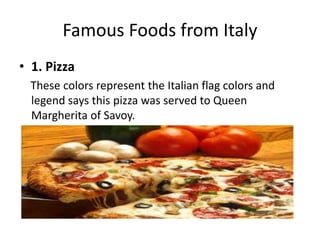
• 1. Pizza 
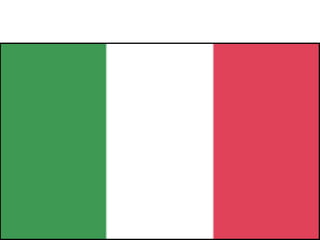
These colors represent the Italian flag colors and 
legend says this pizza was served to Queen 
Margherita of Savoy.
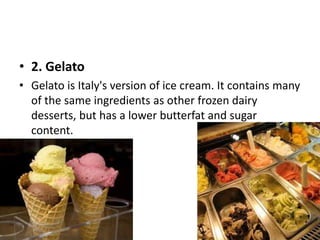
• 2. Gelato 
• Gelato is Italy's version of ice cream. It contains many 
of the same ingredients as other frozen dairy 
desserts, but has a lower butterfat and sugar 
content.
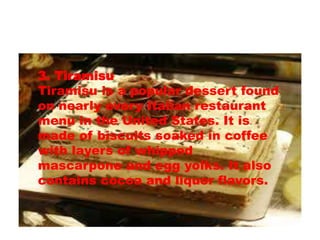
3. Tiramisu 
Tiramisu is a popular dessert found 
on nearly every Italian restaurant 
menu in the United States. It is 
made of biscuits soaked in coffee 
with layers of whipped 
mascarpone and egg yolks. It also 
contains cocoa and liquor flavors.
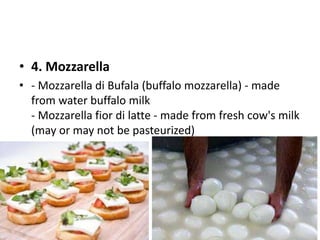
• 4. Mozzarella 
• - Mozzarella di Bufala (buffalo mozzarella) - made 
from water buffalo milk 
- Mozzarella fior di latte - made from fresh cow's milk 
(may or may not be pasteurized)
Speciality 
• Amazing beache 
• Amazing architecture
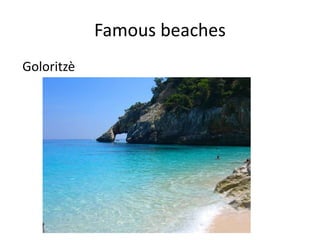
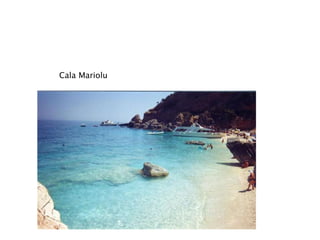
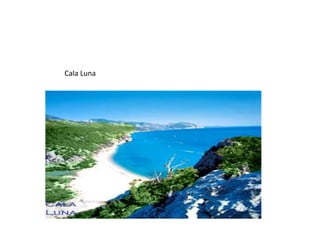
Famous beaches 
Goloritzè
Cala Mariolu
Cala Luna
Famous architecture 
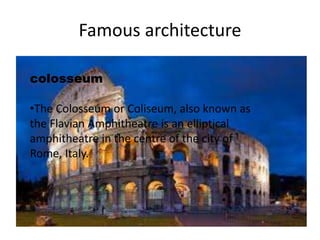
colosseum 
•The Colosseum or Coliseum, also known as 
the Flavian Amphitheatre is an elliptical 
amphitheatre in the centre of the city of 
Rome, Italy.
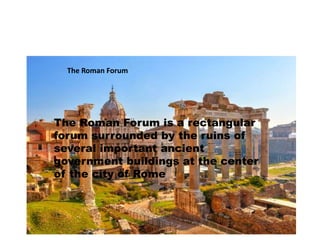
The Roman Forum 
The Roman Forum is a rectangular 
forum surrounded by the ruins of 
several important ancient 
government buildings at the center 
of the city of Rome
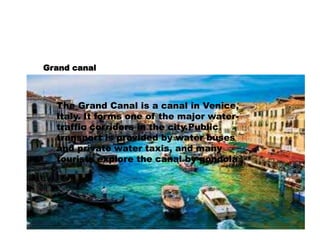
Grand canal 
The Grand Canal is a canal in Venice, 
Italy. It forms one of the major water-traffic 
corridors in the city.Public 
transport is provided by water buses 
and private water taxis, and many 
tourists explore the canal by gondola

ITALY

  • 2.
    ITALY "Italy" (Italia)the name mention a legendary ancient king named 'Italus',meaning "land of young cattle", since Italy had been a rich agricultural country since ancient times.
  • 3.
    Location of Italy •Italy is a country in south-western Europe •Italy is bordered by Switzerland and Austria to the north, • Slovenia and the Adriatic Sea the east, •France and the Tyrrhenian Sea to the west, •Ionian Sea and the Mediterranean to the south. •The country of Italy also includes the islands of Sicily and Sardinia.
  • 4.
    History of Italy •Roman Empire declined and “fell” in the fifth centur y Italy was the target of several invasions, and the previously united region broke apart. . Italy, and its smaller states, also went through stages of foreign domination . A war between Austria and France in 1859 allowed several small states to merge with Piedmont; •Modern Italy is democratic republic, and has been since the modern constitution came into effect in 1948. • This followed a referendum in 1946 which voted to abolish the previous monarchy by twelve million votes to ten.
  • 5.
    Italian Culture •Carnivale di Venezia, In vanice Two week party in early spring. • La Macchina di Santa Rosa City of viterbo September 3 Thanks to Santa Maria Rose •Ferragosto Italian summer holiday Traditionally, it was simply a period of relaxation. Modern Italians typically celebrate it as a national holiday on August 15 (they only get one day off these days)
  • 9.
    Italian customs Greetingsin Italy •When you’re introduced to an Italian, you should say ‘good day’ (buongiorno) • shake hands (a single pump is enough). • •‘Hello’ (ciao) is used among close friends and young people
  • 10.
    Kissing in Italy •Italian families and friends usually kiss when they meet, irrespective of their sex. •If a lady expects you to kiss her, she offers her cheek •never on the mouth (except between lovers!) and isn’t usually really a kiss,
  • 11.
    Language & dialect •The Tuscan of Florence (la lingua fiorentina) - as a standard literary language •The first grammar of Italian with the Latin title Regule lingue florentine (Rules of the Florentine language). •During the 15th and 16th centuries both Latin and Italian were used for technical and scientific texts.
  • 12.
    Sample text inItalian •Tutti gli esseri umani nascono liberi ed eguali in dignità e diritti. Essi sono dotati di ragione e di coscienza e devono agire gli uni verso gli altri in spirito di fratellanza. Translation •All human beings are born free and equal in dignity and rights. They are endowed with reason and conscience and should act towards one another in a spirit of brotherhood. (Article 1 of the Universal Declaration of Human Rights)
  • 13.
    Famous Foods fromItaly • 1. Pizza These colors represent the Italian flag colors and legend says this pizza was served to Queen Margherita of Savoy.
  • 14.
    • 2. Gelato • Gelato is Italy's version of ice cream. It contains many of the same ingredients as other frozen dairy desserts, but has a lower butterfat and sugar content.
  • 15.
    3. Tiramisu Tiramisuis a popular dessert found on nearly every Italian restaurant menu in the United States. It is made of biscuits soaked in coffee with layers of whipped mascarpone and egg yolks. It also contains cocoa and liquor flavors.
  • 16.
    • 4. Mozzarella • - Mozzarella di Bufala (buffalo mozzarella) - made from water buffalo milk - Mozzarella fior di latte - made from fresh cow's milk (may or may not be pasteurized)
  • 17.
    Speciality • Amazingbeache • Amazing architecture
  • 18.
  • 19.
  • 20.
  • 21.
    Famous architecture colosseum •The Colosseum or Coliseum, also known as the Flavian Amphitheatre is an elliptical amphitheatre in the centre of the city of Rome, Italy.
  • 22.
    The Roman Forum The Roman Forum is a rectangular forum surrounded by the ruins of several important ancient government buildings at the center of the city of Rome
  • 23.
    Grand canal TheGrand Canal is a canal in Venice, Italy. It forms one of the major water-traffic corridors in the city.Public transport is provided by water buses and private water taxis, and many tourists explore the canal by gondola