NIK
E
By: Amanda Albert
 Bill Bowerman

 Tiger Woods

 Phil Knight

 Lance Armstrong

 Blue Ribbon Tiger Shoes

 Nike Shox

 The Start of Nike Brand &

 Secret Tournament

Company

 Mission Statement

 Creative Shoe Design

 Mark Parker

 The Soul of Nike

 NikeiD

 Michael Jordan

 The ‗Girl Effect‘

 Air Max

 Nike + iPod

 ―Just Do It‖

 NFL

 Niketown

 Summary

 World Cup

 Resources
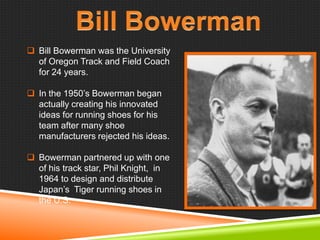
 Bill Bowerman was the University
of Oregon Track and Field Coach
for 24 years.
 In the 1950‘s Bowerman began
actually creating his innovated
ideas for running shoes for his
team after many shoe
manufacturers rejected his ideas.
 Bowerman partnered up with one
of his track star, Phil Knight, in
1964 to design and distribute
Japan‘s Tiger running shoes in
the U.S.
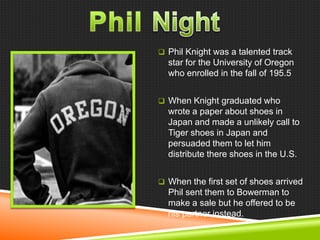
 Phil Knight was a talented track

star for the University of Oregon
who enrolled in the fall of 195.5
 When Knight graduated who

wrote a paper about shoes in
Japan and made a unlikely call to
Tiger shoes in Japan and
persuaded them to let him
distribute there shoes in the U.S.
 When the first set of shoes arrived

Phil sent them to Bowerman to
make a sale but he offered to be
his partner instead.
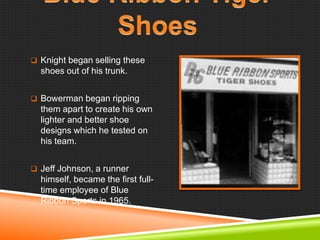
 Knight began selling these

shoes out of his trunk.
 Bowerman began ripping

them apart to create his own
lighter and better shoe
designs which he tested on
his team.
 Jeff Johnson, a runner

himself, became the first fulltime employee of Blue
Ribbon Sports in 1965.
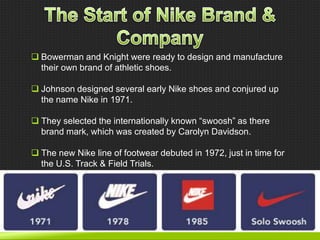
 Bowerman and Knight were ready to design and manufacture
their own brand of athletic shoes.
 Johnson designed several early Nike shoes and conjured up
the name Nike in 1971.
 They selected the internationally known ―swoosh‖ as there
brand mark, which was created by Carolyn Davidson.
 The new Nike line of footwear debuted in 1972, just in time for
the U.S. Track & Field Trials.
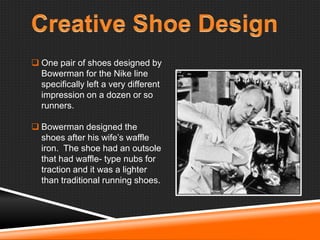
 One pair of shoes designed by
Bowerman for the Nike line
specifically left a very different
impression on a dozen or so
runners.
 Bowerman designed the
shoes after his wife‘s waffle
iron. The shoe had an outsole
that had waffle- type nubs for
traction and it was a lighter
than traditional running shoes.
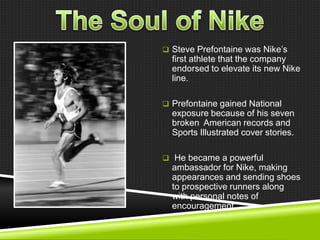
 Steve Prefontaine was Nike‘s

first athlete that the company
endorsed to elevate its new Nike
line.
 Prefontaine gained National

exposure because of his seven
broken American records and
Sports Illustrated cover stories.
 He became a powerful

ambassador for Nike, making
appearances and sending shoes
to prospective runners along
with personal notes of
encouragement.
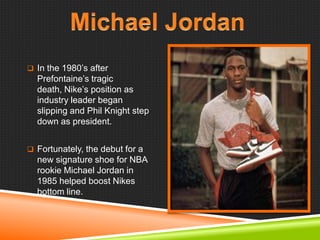
 In the 1980‘s after

Prefontaine‘s tragic
death, Nike‘s position as
industry leader began
slipping and Phil Knight step
down as president.
 Fortunately, the debut for a

new signature shoe for NBA
rookie Michael Jordan in
1985 helped boost Nikes
bottom line.
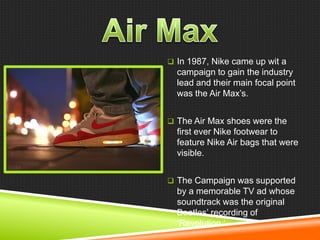
 In 1987, Nike came up wit a

campaign to gain the industry
lead and their main focal point
was the Air Max‘s.
 The Air Max shoes were the

first ever Nike footwear to
feature Nike Air bags that were
visible.
 The Campaign was supported

by a memorable TV ad whose
soundtrack was the original
Beatles‘ recording of
‗Revolution.‘
 Building on its momentum, Nike

launched a new empowering
series of ads with the tagline ―Just
do it.‖
 The series included three ads with

a young two-sport athlete named
Bo Jackson, who espoused the
benefits of a new cross-training
shoe.
 By the end of the 1980‘s, Nike had

regained its position as the
industry leader, the first and only
time a company in the athletic
footwear/apparel industry has
accomplished such a feat.

http://www.youtube.com/watch?v=AXVAiFBEp
wA
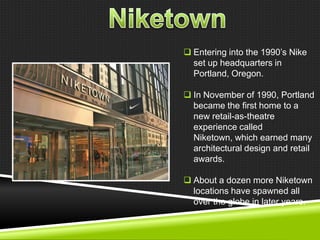
 Entering into the 1990‘s Nike
set up headquarters in
Portland, Oregon.
 In November of 1990, Portland
became the first home to a
new retail-as-theatre
experience called
Niketown, which earned many
architectural design and retail
awards.
 About a dozen more Niketown
locations have spawned all
over the globe in later years.
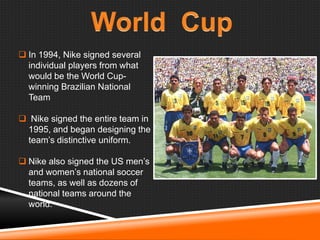
 In 1994, Nike signed several
individual players from what
would be the World Cupwinning Brazilian National
Team
 Nike signed the entire team in
1995, and began designing the
team‘s distinctive uniform.
 Nike also signed the US men‘s
and women‘s national soccer
teams, as well as dozens of
national teams around the
world.
 While Nike had designed

footwear and apparel for golf
and soccer for a number of
years, the mid-1990s signaled a
deepening commitment to truly
excel in these sports.
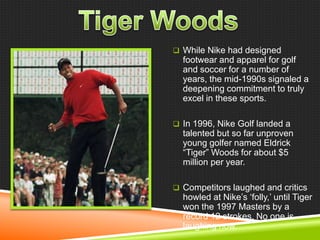
 In 1996, Nike Golf landed a

talented but so far unproven
young golfer named Eldrick
―Tiger‖ Woods for about $5
million per year.
 Competitors laughed and critics

howled at Nike‘s ‗folly,‘ until Tiger
won the 1997 Masters by a
record 12 strokes. No one is
laughing now.
 Nike also began investing in the
sport of cycling, including a
promising young cyclist who
appeared to be on his way to
success until he was diagnosed
with cancer.
 He lost most of his sponsors, but
Nike elected to stay with him.
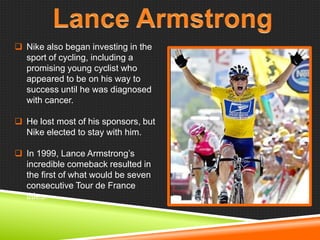
 In 1999, Lance Armstrong‘s
incredible comeback resulted in
the first of what would be seven
consecutive Tour de France
titles.
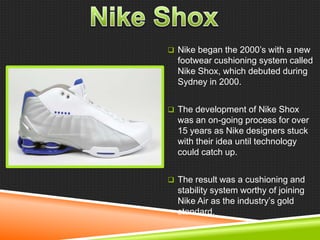
 Nike began the 2000‘s with a new

footwear cushioning system called
Nike Shox, which debuted during
Sydney in 2000.
 The development of Nike Shox

was an on-going process for over
15 years as Nike designers stuck
with their idea until technology
could catch up.
 The result was a cushioning and

stability system worthy of joining
Nike Air as the industry‘s gold
standard.
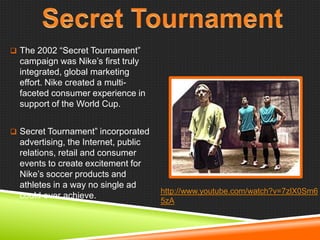
 The 2002 ―Secret Tournament‖

campaign was Nike‘s first truly
integrated, global marketing
effort. Nike created a multifaceted consumer experience in
support of the World Cup.
 Secret Tournament‖ incorporated

advertising, the Internet, public
relations, retail and consumer
events to create excitement for
Nike‘s soccer products and
athletes in a way no single ad
could ever achieve.

http://www.youtube.com/watch?v=7zlX0Sm6
5zA
To bring inspiration and innovation
to every athlete* in the world.
* If you have a body, you
are an athlete.
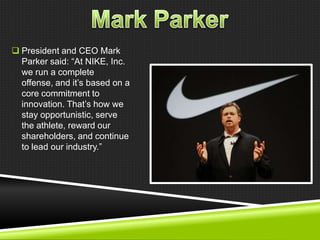
 President and CEO Mark
Parker said: ―At NIKE, Inc.
we run a complete
offense, and it‘s based on a
core commitment to
innovation. That‘s how we
stay opportunistic, serve
the athlete, reward our
shareholders, and continue
to lead our industry.‖
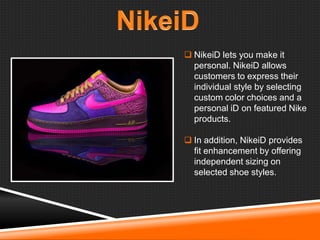
 NikeiD lets you make it
personal. NikeiD allows
customers to express their
individual style by selecting
custom color choices and a
personal iD on featured Nike
products.
 In addition, NikeiD provides
fit enhancement by offering
independent sizing on
selected shoe styles.
 Nike believes in the power of
unleashing human potential –
on the field, on the court, and
in life.
 When a girl in the developing
world realizes her
potential, she isn‘t the only one
who escapes poverty—she
brings her
family, community, and country
with her.
 Investing in a girl stops poverty
before it starts, that‘s the girl
effect.

http://www.youtube.com/watch?v=1e8xgF0Jt
Vg
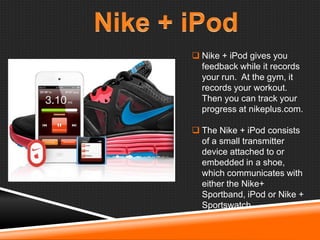
 Nike + iPod gives you
feedback while it records
your run. At the gym, it
records your workout.
Then you can track your
progress at nikeplus.com.
 The Nike + iPod consists
of a small transmitter
device attached to or
embedded in a shoe,
which communicates with
either the Nike+
Sportband, iPod or Nike +
Sportswatch.
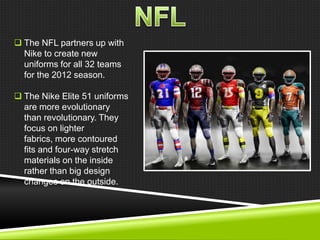
 The NFL partners up with
Nike to create new
uniforms for all 32 teams
for the 2012 season.
 The Nike Elite 51 uniforms
are more evolutionary
than revolutionary. They
focus on lighter
fabrics, more contoured
fits and four-way stretch
materials on the inside
rather than big design
changes on the outside.
 It all started with just a simple handshake but soon became the

world‘s leading supplier of athletic shoes and apparel, Nike Inc.
 Since the 1960‘s Nike has been bringing inspiration and innovation

to every athlete in the world.
 The infamous Nike ―swoosh‖ is one of the best-known brand

symbols on the planet.
 Nike has been able to take the number one spot in the industry and

remain there because of its ability to simultaneously keep up with
the ever-changing fashion and technology of today‘s world, while
still being able to provide high-quality shoes and apparel to its
millions of customers.
 Nike‘s competitive edge is key to their success; they go where no

other company has gone, building experiences around their brand.
 http://apple.com/ipod/nike/
 http://help-us.nike.com/app/answers/detail/a_id/3392/~/what-is-

nikeid%3F
 http://nikeinc.com/pages/about-nike-inc
 http://nikeinc.com/pages/history-heritage
 http://nikeinc.com/pages/the-girl-effect
 http://nikeinc.com/pages/the-nike-foundation
 http://usatoday.com/sports/football/nfl/story/2012-04-03/nike-new-

uniform-design/53982596/1
 http://youtube.com

Nike

  • 1.
  • 3.
     Bill Bowerman Tiger Woods  Phil Knight  Lance Armstrong  Blue Ribbon Tiger Shoes  Nike Shox  The Start of Nike Brand &  Secret Tournament Company  Mission Statement  Creative Shoe Design  Mark Parker  The Soul of Nike  NikeiD  Michael Jordan  The ‗Girl Effect‘  Air Max  Nike + iPod  ―Just Do It‖  NFL  Niketown  Summary  World Cup  Resources
  • 4.
     Bill Bowermanwas the University of Oregon Track and Field Coach for 24 years.  In the 1950‘s Bowerman began actually creating his innovated ideas for running shoes for his team after many shoe manufacturers rejected his ideas.  Bowerman partnered up with one of his track star, Phil Knight, in 1964 to design and distribute Japan‘s Tiger running shoes in the U.S.
  • 5.
     Phil Knightwas a talented track star for the University of Oregon who enrolled in the fall of 195.5  When Knight graduated who wrote a paper about shoes in Japan and made a unlikely call to Tiger shoes in Japan and persuaded them to let him distribute there shoes in the U.S.  When the first set of shoes arrived Phil sent them to Bowerman to make a sale but he offered to be his partner instead.
  • 6.
     Knight beganselling these shoes out of his trunk.  Bowerman began ripping them apart to create his own lighter and better shoe designs which he tested on his team.  Jeff Johnson, a runner himself, became the first fulltime employee of Blue Ribbon Sports in 1965.
  • 7.
     Bowerman andKnight were ready to design and manufacture their own brand of athletic shoes.  Johnson designed several early Nike shoes and conjured up the name Nike in 1971.  They selected the internationally known ―swoosh‖ as there brand mark, which was created by Carolyn Davidson.  The new Nike line of footwear debuted in 1972, just in time for the U.S. Track & Field Trials.
  • 8.
     One pairof shoes designed by Bowerman for the Nike line specifically left a very different impression on a dozen or so runners.  Bowerman designed the shoes after his wife‘s waffle iron. The shoe had an outsole that had waffle- type nubs for traction and it was a lighter than traditional running shoes.
  • 9.
     Steve Prefontainewas Nike‘s first athlete that the company endorsed to elevate its new Nike line.  Prefontaine gained National exposure because of his seven broken American records and Sports Illustrated cover stories.  He became a powerful ambassador for Nike, making appearances and sending shoes to prospective runners along with personal notes of encouragement.
  • 10.
     In the1980‘s after Prefontaine‘s tragic death, Nike‘s position as industry leader began slipping and Phil Knight step down as president.  Fortunately, the debut for a new signature shoe for NBA rookie Michael Jordan in 1985 helped boost Nikes bottom line.
  • 11.
     In 1987,Nike came up wit a campaign to gain the industry lead and their main focal point was the Air Max‘s.  The Air Max shoes were the first ever Nike footwear to feature Nike Air bags that were visible.  The Campaign was supported by a memorable TV ad whose soundtrack was the original Beatles‘ recording of ‗Revolution.‘
  • 12.
     Building onits momentum, Nike launched a new empowering series of ads with the tagline ―Just do it.‖  The series included three ads with a young two-sport athlete named Bo Jackson, who espoused the benefits of a new cross-training shoe.  By the end of the 1980‘s, Nike had regained its position as the industry leader, the first and only time a company in the athletic footwear/apparel industry has accomplished such a feat. http://www.youtube.com/watch?v=AXVAiFBEp wA
  • 13.
     Entering intothe 1990‘s Nike set up headquarters in Portland, Oregon.  In November of 1990, Portland became the first home to a new retail-as-theatre experience called Niketown, which earned many architectural design and retail awards.  About a dozen more Niketown locations have spawned all over the globe in later years.
  • 14.
     In 1994,Nike signed several individual players from what would be the World Cupwinning Brazilian National Team  Nike signed the entire team in 1995, and began designing the team‘s distinctive uniform.  Nike also signed the US men‘s and women‘s national soccer teams, as well as dozens of national teams around the world.
  • 15.
     While Nikehad designed footwear and apparel for golf and soccer for a number of years, the mid-1990s signaled a deepening commitment to truly excel in these sports.  In 1996, Nike Golf landed a talented but so far unproven young golfer named Eldrick ―Tiger‖ Woods for about $5 million per year.  Competitors laughed and critics howled at Nike‘s ‗folly,‘ until Tiger won the 1997 Masters by a record 12 strokes. No one is laughing now.
  • 16.
     Nike alsobegan investing in the sport of cycling, including a promising young cyclist who appeared to be on his way to success until he was diagnosed with cancer.  He lost most of his sponsors, but Nike elected to stay with him.  In 1999, Lance Armstrong‘s incredible comeback resulted in the first of what would be seven consecutive Tour de France titles.
  • 17.
     Nike beganthe 2000‘s with a new footwear cushioning system called Nike Shox, which debuted during Sydney in 2000.  The development of Nike Shox was an on-going process for over 15 years as Nike designers stuck with their idea until technology could catch up.  The result was a cushioning and stability system worthy of joining Nike Air as the industry‘s gold standard.
  • 18.
     The 2002―Secret Tournament‖ campaign was Nike‘s first truly integrated, global marketing effort. Nike created a multifaceted consumer experience in support of the World Cup.  Secret Tournament‖ incorporated advertising, the Internet, public relations, retail and consumer events to create excitement for Nike‘s soccer products and athletes in a way no single ad could ever achieve. http://www.youtube.com/watch?v=7zlX0Sm6 5zA
  • 20.
    To bring inspirationand innovation to every athlete* in the world. * If you have a body, you are an athlete.
  • 21.
     President andCEO Mark Parker said: ―At NIKE, Inc. we run a complete offense, and it‘s based on a core commitment to innovation. That‘s how we stay opportunistic, serve the athlete, reward our shareholders, and continue to lead our industry.‖
  • 22.
     NikeiD letsyou make it personal. NikeiD allows customers to express their individual style by selecting custom color choices and a personal iD on featured Nike products.  In addition, NikeiD provides fit enhancement by offering independent sizing on selected shoe styles.
  • 23.
     Nike believesin the power of unleashing human potential – on the field, on the court, and in life.  When a girl in the developing world realizes her potential, she isn‘t the only one who escapes poverty—she brings her family, community, and country with her.  Investing in a girl stops poverty before it starts, that‘s the girl effect. http://www.youtube.com/watch?v=1e8xgF0Jt Vg
  • 24.
     Nike +iPod gives you feedback while it records your run. At the gym, it records your workout. Then you can track your progress at nikeplus.com.  The Nike + iPod consists of a small transmitter device attached to or embedded in a shoe, which communicates with either the Nike+ Sportband, iPod or Nike + Sportswatch.
  • 25.
     The NFLpartners up with Nike to create new uniforms for all 32 teams for the 2012 season.  The Nike Elite 51 uniforms are more evolutionary than revolutionary. They focus on lighter fabrics, more contoured fits and four-way stretch materials on the inside rather than big design changes on the outside.
  • 26.
     It allstarted with just a simple handshake but soon became the world‘s leading supplier of athletic shoes and apparel, Nike Inc.  Since the 1960‘s Nike has been bringing inspiration and innovation to every athlete in the world.  The infamous Nike ―swoosh‖ is one of the best-known brand symbols on the planet.  Nike has been able to take the number one spot in the industry and remain there because of its ability to simultaneously keep up with the ever-changing fashion and technology of today‘s world, while still being able to provide high-quality shoes and apparel to its millions of customers.  Nike‘s competitive edge is key to their success; they go where no other company has gone, building experiences around their brand.
  • 27.
     http://apple.com/ipod/nike/  http://help-us.nike.com/app/answers/detail/a_id/3392/~/what-is- nikeid%3F http://nikeinc.com/pages/about-nike-inc  http://nikeinc.com/pages/history-heritage  http://nikeinc.com/pages/the-girl-effect  http://nikeinc.com/pages/the-nike-foundation  http://usatoday.com/sports/football/nfl/story/2012-04-03/nike-new- uniform-design/53982596/1  http://youtube.com