Download as PDF, PPTX
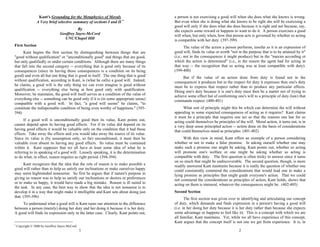
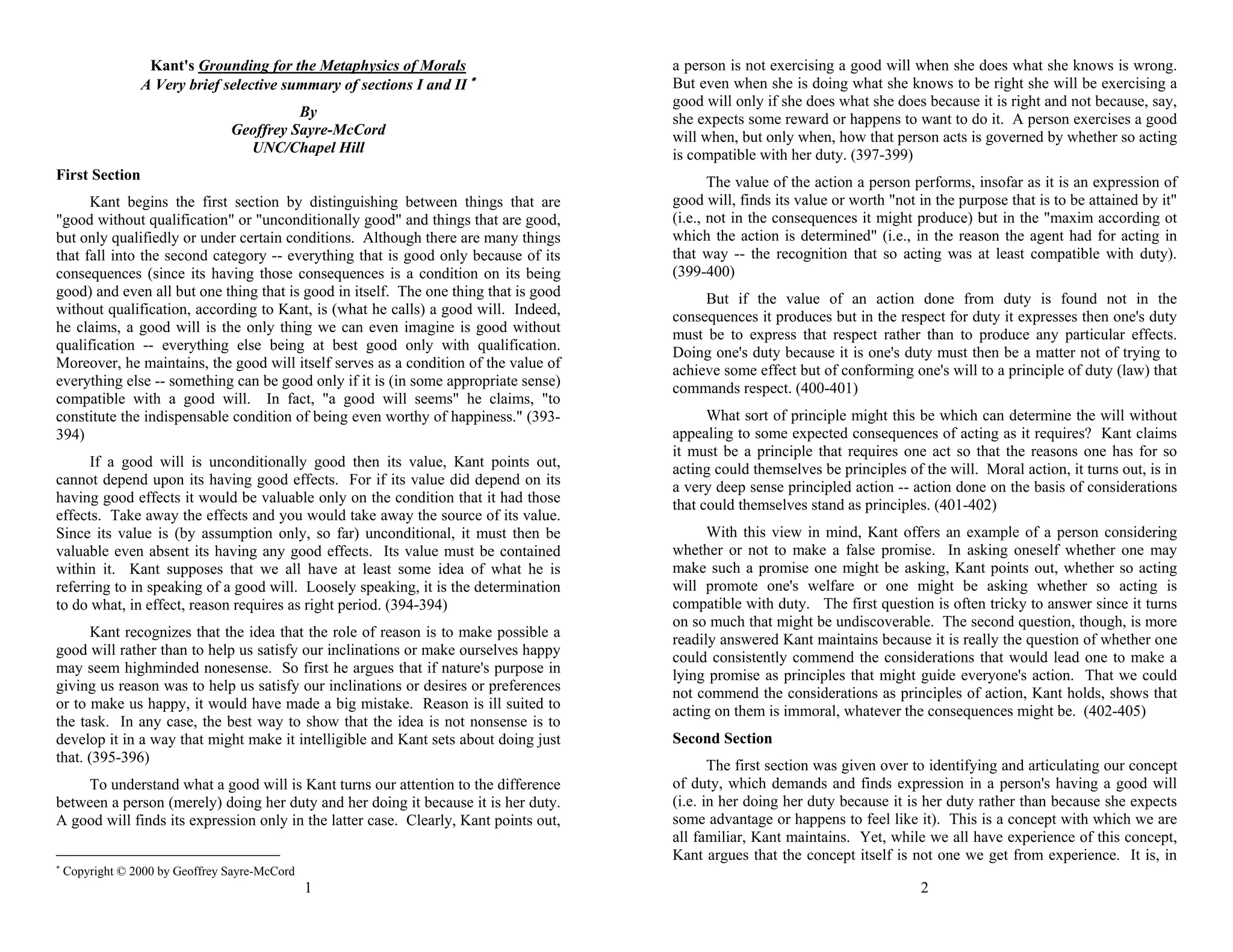
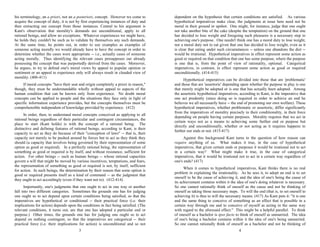
![oneself as being unmarried. To believe one is to believe the other. In neither
case, of course, is Kant committed to denying that people sometimes fail to will
-- or believe -- as rationality requires. Such failures are all too familiar. What
he is trying to do is identify what the failure consists in, and his answer is that
(outside of morality) failures of practical rationality are failures to take what one
recognizes to be the necessary steps to achieving one's ends while not
abandoning the ends. In the face of a hypothetical imperative, there are two
ways to preserve one's practical rationality: (1) take the necessary means to
achieving the ends the give the imperative its practical force or (2) abandon
those ends. Either is a rational response to one's situation. What is irrational is
retaining the end while failing to take the steps one recognizes as necessary for
its achievement. (417-420)
When it comes to categorical imperatives, Kant thinks the problem of
making sense of even its possibility is a genuine challenge. Categorical
imperatives differ from hypothetical imperatives in that, by not presupposing
any particular ends they cannot derive their rational force from our having
adopted those ends. Nor can we hope to discover a categorical imperative's force
by looking to examples of agents exercising a good will because we can never
be sure we have an example on hand. Instead of directly defending the force of
the categorical imperative, Kant turns to the problem of identifying its content.
What is it that reason might require unconditionally of all rational agents
without regard to their particular ends or purposes? (420)
In answering this question, Kant notes that the content of a categorical
imperative must be found solely in the form of the imperative (as an
unconditional law that applies to all) and its demand that the will conform to it.
"Hence," he writes as if the implication were at all clear, "there is only pone
categorical imperative and it is this: Act only according to that maxim whereby
you can at the same time will that it should become a universal law" [p. 30;
italics added]. More colloquially, the demand is that in whatever you do you
should act for reasons that could serve as acceptable reasons for anyone. To
make an exception of oneself, to act for reasons one could not acknowledge as
acceptable were someone else to act on them, is to act immorally. How exactly
this specific demand is supposed to follow from the form and force of a
categorical imperative is a matter of serious and interesting controversy. Yet the
principle itself has struck many as capturing an important feature of morality --
that its demands are universal and require, in some significant sense, that we
treat all people the same. To act immorally is, on this view, to put oneself
"above the law" -- not the civil law of some society or other (which might, after
all, be a deeply immoral society) but the law one's own reason imposes upon
one. And the immorally is found not principally in the acts one performs but, as
Socrates emphasized, in the reasons one has for so acting. (421)
Kant then offers four examples of immoral actions, selected in part because
they highlight the two different ways a person might fail to be acting on a
maxim that would meet the requirements of the categorical imperative. A
maxim might fail by not being universalizable -- by being such that the very
conception of it as being a law governing all is inconsistent. (We have, as Kant
would put it, a perfect duty to refrain from acting on such maxims.) Or a
maxim that might be universalizable might fail the requirements of the
categorical imperative by being such that a person could not consistently will
that the maxim be a universal law. (We have, as Kant would put it, an imperfect
duty to refrain from acting on such maxims.) In both cases, the failure of the
maxim is a failure of consistency in an important sense. There is no question
that an immoral maxim can itself be perfectly consistent, after all people
actually act on them. What is inconsistent is either (i) the conception of that
maxim as a universal law or (ii) willing that the maxim serve as a universal law.
Thus in testing a maxim (and so evaluating an action that might be performed on
its basis) we can look for two kinds of inconsistency -- inconsistency in
conception and inconsistency in willing.
The first and second examples are supposed to be cases in which the agent
is considering acting on a maxim that cannot consistently be conceived as a
universal law. The third and forth examples are supposed to be cases in which
the agent is considering acting on a maxim that can consistently be conceived as
a universal law but that cannot consistently be willed. The difference between
the first and third, on the one hand, and the second and the forth on the other, is
that the former have to do with one's treatment of oneself, while the latter have
to do with one's treatment of others. (421-425)
Kant next offers some important observations concerning what could not
serve as the source or foundation of morals. In particular, he argues, morality
cannot legitimately be grounded merely in human nature, even as it applies to
humans and applies in a way that is sensitive to our nature. (425-426)
The unconditional force of the categorical imperative is explicable, Kant
maintains, only on the supposition that it derives its authority purely from our
capacity, as rational beings, to determine our actions by the representation of
certain options as required by rationally necessary laws (i.e. hypothetical and
categorical imperatives). If those rationally necessary laws requires some action
unconditionally, that action will be required of all rational beings (human and
otherwise), and the actions prescribed are "objective ends" that are "valid for all
rational beings". They will be the actions that are morally required. If, on the
other hand, the rationally necessary laws require the adoption of some action
only conditionally (say on the condition the agent happens to adopt some end or
purpose) that action's worth is derived from, and contingent on, the agent having
adopted the end or purpose in question. And assuming the action is not
incompatible with a morally required action it will be morally permissible. (426-
428)
How must we conceive of rational beings in order to make sense of their
wills as grounds of unconditional (and conditional) value? Only, Kant supposes,
by thinking of rational beings as ends in themselves (and not merely more or
5 6](https://image.slidesharecdn.com/kant-101103195954-phpapp02/85/Kant-3-320.jpg)

Kant's Grounding for the Metaphysics of Morals discusses the difference between things that are unconditionally good and those that are good only under certain conditions. Kant argues that a good will is the only thing that is unconditionally good. He also discusses the difference between acting from duty versus acting for other reasons like reward or inclination. Kant proposes the categorical imperative as the moral law: to act only according to maxims that one can universalize as applying to all people. He provides examples of actions that fail the categorical imperative test by either not being universally applicable or by being actions one could not consistently will to be universalized.


