TRAINING FOR STRESS
LEARNING TO TAKE THE HEAT
Chris Nickson FACEM FCICM
Intensivist, The Alfred ICU
http://intensiveblog.com/training-for-
Objectives
1. Discuss acute stress and the effects on
performance
2. Discuss strategies and techniques for
maintaining performance in stressful
situations
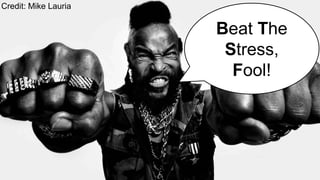
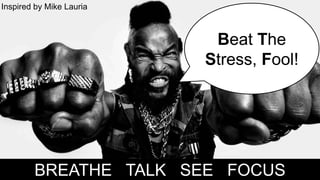
Beat The
Stress,
Fool!
Credit: Mike Lauria
What is stress?
The Stress Response
An evolved stereotypical response
with physiological and psychological effects
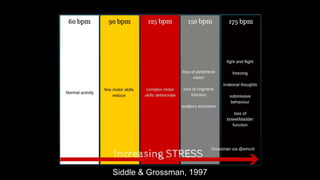
Siddle & Grossman, 1997
Bandwidth Overload
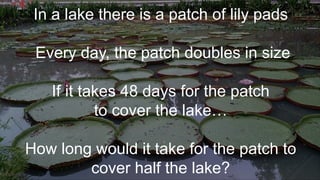
In a lake there is a patch of lily pads
Every day, the patch doubles in size
If it takes 48 days for the patch
to cover the lake…
How long would it take for the patch to
cover half the lake?
How is the stress response
triggered?
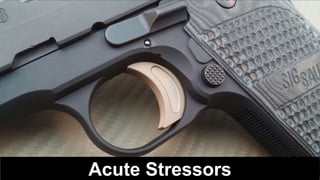
Acute Stressors
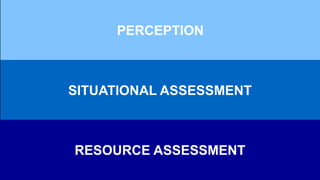
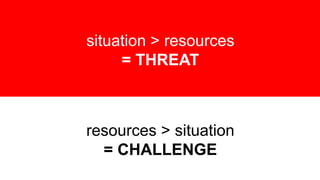
PERCEPTION
SITUATIONAL ASSESSMENT
RESOURCE ASSESSMENT
situation > resources
= THREAT
resources > situation
= CHALLENGE
Stress can be positive!
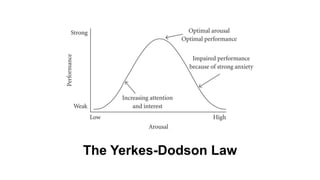
The Yerkes-Dodson Law
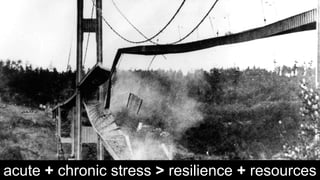
acute + chronic stress > resilience + resources
How can we train for stress?
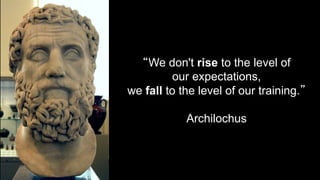
“We don't rise to the level of
our expectations,
we fall to the level of our training.”
Archilochus
Stress Inoculation Training
Stress Exposure Training
(1) Conceptualisation
(2) Rehearsal
(3) Application
Prepare before stress
Overlearning
Mental practice
Visualisation and Mental Practice
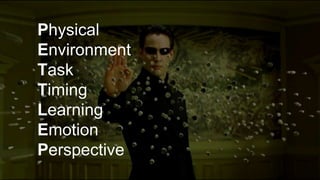
Physical
Environment
Task
Timing
Learning
Emotion
Perspective
Reset during stress
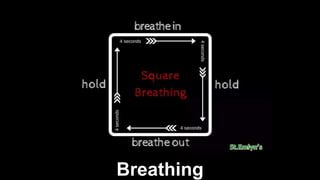
Breathing
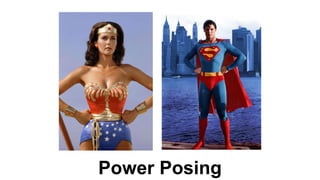
Power Posing
Talk
(Self) Talk
Reflect and recover after stress
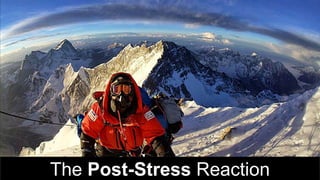
The Post-Stress Reaction
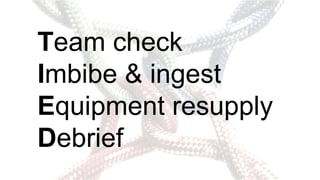
Team check
Imbibe & ingest
Equipment resupply
Debrief
The stress response
is normal
The stress response is
physical and psychological
The stress response
is modifiable
We can modify
our perceptions
We can prepare
for stress
We can reset
our responses in real-time
We can reflect
and recover
We need to
train for stress
Beat The
Stress, Fool!
BREATHE TALK SEE FOCUS
Inspired by Mike Lauria
http://intensiveblog.com/training-for-

Nickson training for stress 20170720

Editor's Notes

  • #5 This is Mr T saying “Beat The Stress, Fool!” If you only remember one thing from this talk, remember this… We will come back to it at the end, but it might make more sense and be more memorable if you know who Mr T is - here he is playing “Clubber Lang’ - Rocky Balboa’s nemesis in Rocky 3:
  • #9 physiological effects: “fight or flight or freeze” result from activation of the limbic system and hypothalamus - anterior hypothalmus stimulates the ANS resulting in adrenaline release from the adrenal medulla - ACTH release from the pituitary gland stimulates glucocorticoid release from the adrenal cortex manifestions: tachycardia perspiration and clammy skin tachypnea dry mouth urination and even defecation - “scared shitless” the physical effects may compound the psychological effects, in particular they tend to optimise gross motor function at the expense of fine motor control (e.g. tremor may worsen performance of technical skills) In Grossman’s cult book, ‘On Combat’ he popularises the idea of degrees of stress - condition white, yellow, red, grey, black - correlates with the stress reaction and that there are certain thresholds for degree of impairment I think this should be taken with a grain of salt, the correlation with heart-rate is imperfect and how stress manifests differs in different people and in different circumstances However, the take home is that excessive arousal from an acute stress response can have catastrophic effects on performance. This is important because doctors are notorious for under-estimating the effects of stress on our performance
  • #36 We’ve discussed