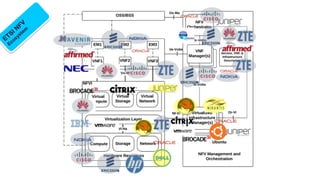
< NFV >
Telco Transformation Unfolded
Faisal Mobarak
Core Network Planning
Grameenphone
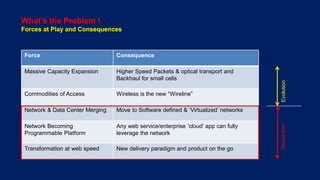
What’s the Problem !
Forces at Play and Consequences
Force Consequence
Massive Capacity Expansion Higher Speed Packets & optical transport and
Backhaul for small cells
Commodities of Access Wireless is the new “Wireline”
Network & Data Center Merging Move to Software defined & ‘Virtualized’ networks
Network Becoming
Programmable Platform
Any web service/enterprise ‘cloud’ app can fully
leverage the network
Transformation at web speed New delivery paradigm and product on the go
EvolutionRevolution
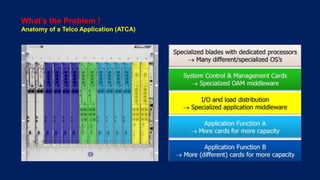
What’s the Problem !
Anatomy of a Telco Application (ATCA)
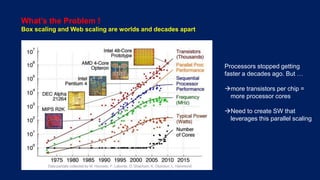
What’s the Problem !
Box scaling and Web scaling are worlds and decades apart
Processors stopped getting
faster a decades ago. But …
more transistors per chip =
more processor cores
Need to create SW that
leverages this parallel scaling
Probes
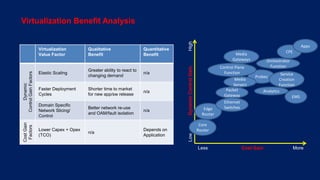
Virtualization Benefit Analysis
Virtualization
Value Factor
Qualitative
Benefit
Quantitative
Benefit
Dynamic
ControlGainFactors
Elastic Scaling
Greater ability to react to
changing demand
n/a
Faster Deployment
Cycles
Shorter time to market
for new app/sw release
n/a
Domain Specific
Network Slicing/
Control
Better network re-use
and OAM/fault isolation
n/a
CostGain
Factors
Lower Capex + Opex
(TCO)
n/a
Depends on
Application
Core
Router
Edge
Router
Ethernet
Switches
Packet
Gateway
Media
Servers
Media
Gateways
Control Plane
Function
CPE
Apps
Orchestrator
Function
EMS
Analytics
Service
Creation
Function
Less Cost Gain More
LowDynamicControlGainHigh
6 © Nokia 2016
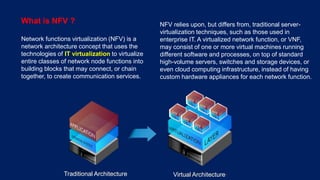
What is NFV ?
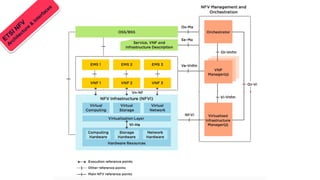
Network functions virtualization (NFV) is a
network architecture concept that uses the
technologies of IT virtualization to virtualize
entire classes of network node functions into
building blocks that may connect, or chain
together, to create communication services.
NFV relies upon, but differs from, traditional server-
virtualization techniques, such as those used in
enterprise IT. A virtualized network function, or VNF,
may consist of one or more virtual machines running
different software and processes, on top of standard
high-volume servers, switches and storage devices, or
even cloud computing infrastructure, instead of having
custom hardware appliances for each network function.
Traditional Architecture Virtual Architecture
7 © Nokia 2016
NFV Development Background
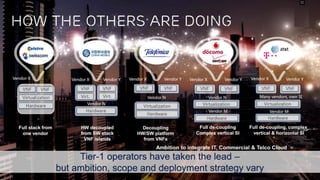
At the end of November in 2012, 13 Tier-one operators (including AT&T, British Telecom, Deutsche
Telekom, Orange, Italy Telecom, Telefonica, Verizon, Vodafone, and CMCC) establish the European
Telecommunications Standards Institute (ETSI) Network Functions Virtualization (NFV) Industry
Specification Group (ISG).
Four years and over 50 publications later, the ISG NFV community has evolved through several
phases, its publications have moved from pre-standardization studies to detailed specifications (see
Release 2 and Release 3) and the early Proof of Concepts (PoCs) efforts have evolved and led to
interoperability events (Plugtests). This large community (290+ companies including 38 of the world's
major service providers) is still working intensely to develop the required standards for NFV as well as
sharing their experiences of NFV implementation and testing.
The NFV enables operators to reduce costs, improve efficiency on management, maintenance as well
as service development, and provide great potential in energy-saving, openness as well as innovation.
These advantages attract operators most.
8 © Nokia 2016
9 © Nokia 2016
10 © Nokia 2016
11 © Nokia 2016
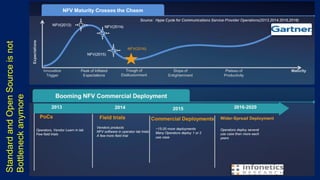
StandardandOpenSourceisnot
Bottleneckanymore
12 © Nokia 2016
13 © Nokia 2016
14 © Nokia 2016
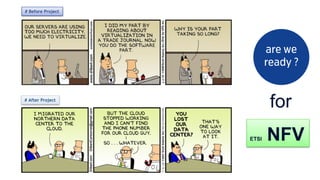
# Before Project
# After Project
for
ETSI NFV
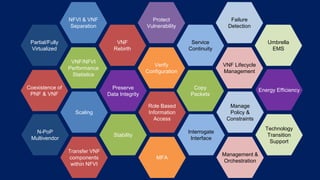
VNF/NFVI
Performance
Statistics
NFVI & VNF
Separation
VNF
Rebirth
Verify
Configuration
Protect
Vulnerability
Service
Continuity
Partial/Fully
Virtualized
VNF Lifecycle
Management
Failure
Detection
Umbrella
EMS
Transfer VNF
components
within NFVI
Scaling
Stability
MFA
Role Based
Information
Access
Interrogate
Interface
N-PoP
Multivendor
Management &
Orchestration
Manage
Policy &
Constraints
Technology
Transition
Support
Preserve
Data Integrity
Copy
Packets
Coexistence of
PNF & VNF
Energy Efficiency
16 © Nokia 2016
17 © Nokia 2016
Thanks for Listening … enjoy bdNOG6

NFV - Telco Transformation Unfolded

  • 1.
    < NFV > TelcoTransformation Unfolded Faisal Mobarak Core Network Planning Grameenphone
  • 2.
    What’s the Problem! Forces at Play and Consequences Force Consequence Massive Capacity Expansion Higher Speed Packets & optical transport and Backhaul for small cells Commodities of Access Wireless is the new “Wireline” Network & Data Center Merging Move to Software defined & ‘Virtualized’ networks Network Becoming Programmable Platform Any web service/enterprise ‘cloud’ app can fully leverage the network Transformation at web speed New delivery paradigm and product on the go EvolutionRevolution
  • 3.
    What’s the Problem! Anatomy of a Telco Application (ATCA)
  • 4.
    What’s the Problem! Box scaling and Web scaling are worlds and decades apart Processors stopped getting faster a decades ago. But … more transistors per chip = more processor cores Need to create SW that leverages this parallel scaling
  • 5.
    Probes Virtualization Benefit Analysis Virtualization ValueFactor Qualitative Benefit Quantitative Benefit Dynamic ControlGainFactors Elastic Scaling Greater ability to react to changing demand n/a Faster Deployment Cycles Shorter time to market for new app/sw release n/a Domain Specific Network Slicing/ Control Better network re-use and OAM/fault isolation n/a CostGain Factors Lower Capex + Opex (TCO) n/a Depends on Application Core Router Edge Router Ethernet Switches Packet Gateway Media Servers Media Gateways Control Plane Function CPE Apps Orchestrator Function EMS Analytics Service Creation Function Less Cost Gain More LowDynamicControlGainHigh
  • 6.
    6 © Nokia2016 What is NFV ? Network functions virtualization (NFV) is a network architecture concept that uses the technologies of IT virtualization to virtualize entire classes of network node functions into building blocks that may connect, or chain together, to create communication services. NFV relies upon, but differs from, traditional server- virtualization techniques, such as those used in enterprise IT. A virtualized network function, or VNF, may consist of one or more virtual machines running different software and processes, on top of standard high-volume servers, switches and storage devices, or even cloud computing infrastructure, instead of having custom hardware appliances for each network function. Traditional Architecture Virtual Architecture
  • 7.
    7 © Nokia2016 NFV Development Background At the end of November in 2012, 13 Tier-one operators (including AT&T, British Telecom, Deutsche Telekom, Orange, Italy Telecom, Telefonica, Verizon, Vodafone, and CMCC) establish the European Telecommunications Standards Institute (ETSI) Network Functions Virtualization (NFV) Industry Specification Group (ISG). Four years and over 50 publications later, the ISG NFV community has evolved through several phases, its publications have moved from pre-standardization studies to detailed specifications (see Release 2 and Release 3) and the early Proof of Concepts (PoCs) efforts have evolved and led to interoperability events (Plugtests). This large community (290+ companies including 38 of the world's major service providers) is still working intensely to develop the required standards for NFV as well as sharing their experiences of NFV implementation and testing. The NFV enables operators to reduce costs, improve efficiency on management, maintenance as well as service development, and provide great potential in energy-saving, openness as well as innovation. These advantages attract operators most.
  • 8.
  • 9.
  • 10.
  • 11.
    11 © Nokia2016 StandardandOpenSourceisnot Bottleneckanymore
  • 12.
  • 13.
  • 14.
    14 © Nokia2016 # Before Project # After Project for ETSI NFV
  • 15.
    VNF/NFVI Performance Statistics NFVI & VNF Separation VNF Rebirth Verify Configuration Protect Vulnerability Service Continuity Partial/Fully Virtualized VNFLifecycle Management Failure Detection Umbrella EMS Transfer VNF components within NFVI Scaling Stability MFA Role Based Information Access Interrogate Interface N-PoP Multivendor Management & Orchestration Manage Policy & Constraints Technology Transition Support Preserve Data Integrity Copy Packets Coexistence of PNF & VNF Energy Efficiency
  • 16.
  • 17.
  • 18.
    Thanks for Listening… enjoy bdNOG6