B.M.S INSTITUTE OF
TECHNOLOGY & MANAGEMENT
DEPARTMENT OF CIVIL ENGINEERING
A TECHNICAL SEMINAR
ON
DECENTRALIZED TREATMENT SYSTEM (DTS)
BY:-
SHUBHAM BHAGAT
CONTENTS
 What is DTS?
Reuse Potential of DTS
Modules of DTS
Biogas Settler (BGST)
Fluidized Bed Reactor (FBR)
Fluidized Film Reactor (FFR)
Planted Gravel Filter (PGF)
Case Studies
 Advantages
What is DTS?
 A Decentralized Treatment Systems (DTS) is a combination
of different wastewater treatment technologies cascaded in
modules to a full-blown system.
 A (DTS) treats wastewater by making maximum use of
natural gifts like gravity, microbiological activity etc.
 This results in a system which can work without technical
energy input (in fact it’s producing energy in form of
methane/biogas) and needs only minimal maintenance.
 DTS application provides state of the art technology at
affordable prices because material/inputs used for
construction are locally available.
REUSE POTENTIAL OF DTS
Wastewater is a resource, containing Water, nutrients and some
energy.
The water can be reused after treatment for irrigation, flushing,
washing, cooling/heating, after respective polishing modules are
introduced.
The mineralized sludge gets periodically removed from the
tanks, and becomes after some further treatment (e.g. co-
composting with organic material) a valuable soil conditioner
and fertilizer.
The energy is tapped as biogas (methane), formed in the
anaerobic modules of the system, and can be used for cooking,
lighting or electricity production.
Modules of DTS
The anaerobic core modules are:
 Biogas Settler (BGST)
 Fluidized Bed Reactor (FBR)
 Fixed Film Reactor (FFR)
Plus (+) optional modules are:
 Plated Gravel Filter (PGF) vertical or horizontal flow
 Sand filter (SF) (slow, rapid, aerated)
 chlorine dosing station (CL)
 UV-treatment (UV)
 Maturation pond(s)
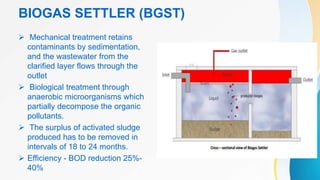
BIOGAS SETTLER (BGST)
 Mechanical treatment retains
contaminants by sedimentation,
and the wastewater from the
clarified layer flows through the
outlet
 Biological treatment through
anaerobic microorganisms which
partially decompose the organic
pollutants.
 The surplus of activated sludge
produced has to be removed in
intervals of 18 to 24 months.
 Efficiency - BOD reduction 25%-
40%
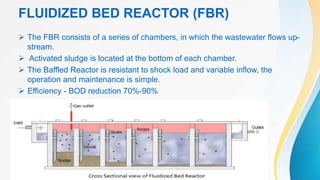
FLUIDIZED BED REACTOR (FBR)
 The FBR consists of a series of chambers, in which the wastewater flows up-
stream.
 Activated sludge is located at the bottom of each chamber.
 The Baffled Reactor is resistant to shock load and variable inflow, the
operation and maintenance is simple.
 Efficiency - BOD reduction 70%-90%
FIXED FILM REACTOR (FFR)
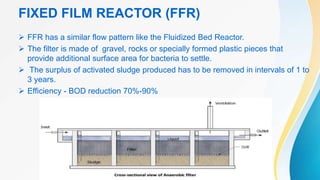
 FFR has a similar flow pattern like the Fluidized Bed Reactor.
 The filter is made of gravel, rocks or specially formed plastic pieces that
provide additional surface area for bacteria to settle.
 The surplus of activated sludge produced has to be removed in intervals of 1 to
3 years.
 Efficiency - BOD reduction 70%-90%
PLANTED GRAVEL FILTER (PGF)
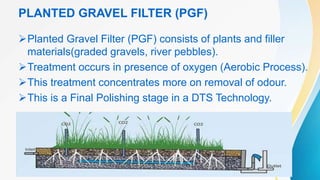
Planted Gravel Filter (PGF) consists of plants and filler
materials(graded gravels, river pebbles).
Treatment occurs in presence of oxygen (Aerobic Process).
This treatment concentrates more on removal of odour.
This is a Final Polishing stage in a DTS Technology.
CASE STUDIES
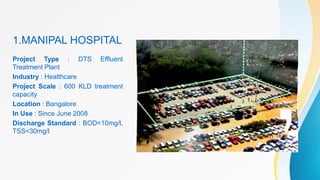
Project Type : DTS Effluent
Treatment Plant
Industry : Healthcare
Project Scale : 600 KLD treatment
capacity
Location : Bangalore
In Use : Since June 2008
Discharge Standard : BOD<10mg/l,
TSS<30mg/l
1.MANIPAL HOSPITAL
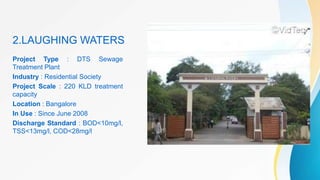
Project Type : DTS Sewage
Treatment Plant
Industry : Residential Society
Project Scale : 220 KLD treatment
capacity
Location : Bangalore
In Use : Since June 2008
Discharge Standard : BOD<10mg/l,
TSS<13mg/l, COD<28mg/l
2.LAUGHING WATERS
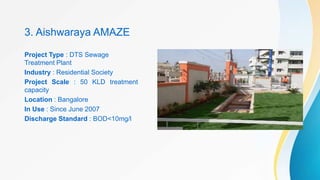
3. Aishwaraya AMAZE
Project Type : DTS Sewage
Treatment Plant
Industry : Residential Society
Project Scale : 50 KLD treatment
capacity
Location : Bangalore
In Use : Since June 2007
Discharge Standard : BOD<10mg/l
KEY FEATURES
100% Sustainable
0% Energy Usage
5% Sludge Creation
100% Adherence
0% Noise Pollution
93% Lower Maintenance Cost
0% CO2 Emissions
REFERENCES
http://ulrich.co.in/waste_water.php
http://www.bor-plastika.eu/wastewater-treatment-
plants/fbr-devices/
DECENTRALIZED TREATMENT SYSTEM

DECENTRALIZED TREATMENT SYSTEM

  • 1.
    B.M.S INSTITUTE OF TECHNOLOGY& MANAGEMENT DEPARTMENT OF CIVIL ENGINEERING A TECHNICAL SEMINAR ON DECENTRALIZED TREATMENT SYSTEM (DTS) BY:- SHUBHAM BHAGAT
  • 2.
    CONTENTS  What isDTS? Reuse Potential of DTS Modules of DTS Biogas Settler (BGST) Fluidized Bed Reactor (FBR) Fluidized Film Reactor (FFR) Planted Gravel Filter (PGF) Case Studies  Advantages
  • 3.
  • 4.
     A DecentralizedTreatment Systems (DTS) is a combination of different wastewater treatment technologies cascaded in modules to a full-blown system.  A (DTS) treats wastewater by making maximum use of natural gifts like gravity, microbiological activity etc.  This results in a system which can work without technical energy input (in fact it’s producing energy in form of methane/biogas) and needs only minimal maintenance.  DTS application provides state of the art technology at affordable prices because material/inputs used for construction are locally available.
  • 5.
    REUSE POTENTIAL OFDTS Wastewater is a resource, containing Water, nutrients and some energy. The water can be reused after treatment for irrigation, flushing, washing, cooling/heating, after respective polishing modules are introduced. The mineralized sludge gets periodically removed from the tanks, and becomes after some further treatment (e.g. co- composting with organic material) a valuable soil conditioner and fertilizer. The energy is tapped as biogas (methane), formed in the anaerobic modules of the system, and can be used for cooking, lighting or electricity production.
  • 6.
    Modules of DTS Theanaerobic core modules are:  Biogas Settler (BGST)  Fluidized Bed Reactor (FBR)  Fixed Film Reactor (FFR) Plus (+) optional modules are:  Plated Gravel Filter (PGF) vertical or horizontal flow  Sand filter (SF) (slow, rapid, aerated)  chlorine dosing station (CL)  UV-treatment (UV)  Maturation pond(s)
  • 7.
    BIOGAS SETTLER (BGST) Mechanical treatment retains contaminants by sedimentation, and the wastewater from the clarified layer flows through the outlet  Biological treatment through anaerobic microorganisms which partially decompose the organic pollutants.  The surplus of activated sludge produced has to be removed in intervals of 18 to 24 months.  Efficiency - BOD reduction 25%- 40%
  • 8.
    FLUIDIZED BED REACTOR(FBR)  The FBR consists of a series of chambers, in which the wastewater flows up- stream.  Activated sludge is located at the bottom of each chamber.  The Baffled Reactor is resistant to shock load and variable inflow, the operation and maintenance is simple.  Efficiency - BOD reduction 70%-90%
  • 9.
    FIXED FILM REACTOR(FFR)  FFR has a similar flow pattern like the Fluidized Bed Reactor.  The filter is made of gravel, rocks or specially formed plastic pieces that provide additional surface area for bacteria to settle.  The surplus of activated sludge produced has to be removed in intervals of 1 to 3 years.  Efficiency - BOD reduction 70%-90%
  • 10.
    PLANTED GRAVEL FILTER(PGF) Planted Gravel Filter (PGF) consists of plants and filler materials(graded gravels, river pebbles). Treatment occurs in presence of oxygen (Aerobic Process). This treatment concentrates more on removal of odour. This is a Final Polishing stage in a DTS Technology.
  • 11.
  • 12.
    Project Type :DTS Effluent Treatment Plant Industry : Healthcare Project Scale : 600 KLD treatment capacity Location : Bangalore In Use : Since June 2008 Discharge Standard : BOD<10mg/l, TSS<30mg/l 1.MANIPAL HOSPITAL
  • 13.
    Project Type :DTS Sewage Treatment Plant Industry : Residential Society Project Scale : 220 KLD treatment capacity Location : Bangalore In Use : Since June 2008 Discharge Standard : BOD<10mg/l, TSS<13mg/l, COD<28mg/l 2.LAUGHING WATERS
  • 14.
    3. Aishwaraya AMAZE ProjectType : DTS Sewage Treatment Plant Industry : Residential Society Project Scale : 50 KLD treatment capacity Location : Bangalore In Use : Since June 2007 Discharge Standard : BOD<10mg/l
  • 15.
    KEY FEATURES 100% Sustainable 0%Energy Usage 5% Sludge Creation 100% Adherence 0% Noise Pollution 93% Lower Maintenance Cost 0% CO2 Emissions
  • 16.