E-CONTENT DEVELOPMENT OF 
NEWTON’ S THIRD LAW OF MOTION 
1. HOME 
 http://www.physicsclassroom.com/class/newtlaws/Lesson-1/Newton-s-First- 
Law 
 http://www.physics.about.com 
 http://www.physics.umn.edu 
 http://physics.info/newton-first/ 
 http://www.physics4kids.com 
2. OBJECTIVES 
 To develop e-content on the topic ‘Newton’s first law of motion’ 
 To form the concept of force 
 To develop an understanding of Newton’s first law of motion and its 
applications in real life situations
3. TOPIC
4. E-CONTENT ANALYSIS 
TERMS: Force, Newton’s third law of motion 
FACTS 
 ACTION : Rider jumps off the skateboard. 
 REACTION: The skateboard responds to that action by traveling some 
distance in the opposite direction. 
 Force exerted by object on man Force exerted by man on object
 Air rushes down, balloon goes up 
 The recoil that occurs after shooting a gun.
CONCEPTS 
1) FORCE : It is that which moves an object from a state of rest or brings a moving object to a 
state of rest. 
LAW 
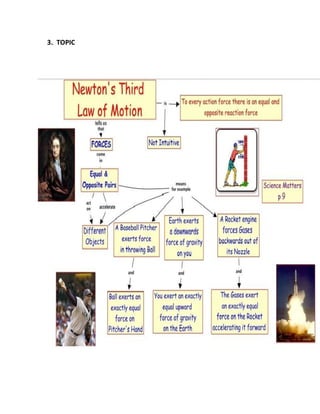
NEWTON’S THIRD LAW OF MOTION:” To every action there is always opposed an equal 
reaction: or the mutual actions of two bodies upon each other are always equal, and directed to 
contrary parts.” 
SUMMARY 
The third law states that all forces exist in pairs: if one object A exerts a force FA on a second 
object B, then B simultaneously exerts a force FB on A, and the two forces are equal and 
opposite: FA = −FB. The third law means that all forces are interactions between different 
bodies, and thus that there is no such thing as a unidirectional force or a force that acts on only 
one body. This law is sometimes referred to as the action-reaction law, with FA called the 
"action" and FB the "reaction". The action and the reaction are simultaneous, and it does not 
matter which is called the action and which is called reaction; both forces are part of a single 
interaction, and neither force exists without the other. The two forces in Newton's third law are 
of the same type (e.g., if the road exerts a forward frictional force on an accelerating car's ti res, 
then it is also a frictional force that Newton's third law predicts for the tires pushing backward 
on the road). 
From a conceptual standpoint, Newton's third law is seen when a person walks: they push 
against the floor, and the floor pushes against the person. Similarly, the tires of a car push 
against the road while the road pushes back on the tires—the tires and road 
simultaneously push against each other. In swimming, a person interacts with the water, 
pushing the water backward, while the water simultaneously pushes the person forward— 
both the person and the water push against each other. The reaction forces account for the 
motion in these examples. These forces depend on friction; a person or car on ice, for 
example, may be unable to exert the action force to produce the needed reaction force.

Newton's third law

  • 1.
    E-CONTENT DEVELOPMENT OF NEWTON’ S THIRD LAW OF MOTION 1. HOME  http://www.physicsclassroom.com/class/newtlaws/Lesson-1/Newton-s-First- Law  http://www.physics.about.com  http://www.physics.umn.edu  http://physics.info/newton-first/  http://www.physics4kids.com 2. OBJECTIVES  To develop e-content on the topic ‘Newton’s first law of motion’  To form the concept of force  To develop an understanding of Newton’s first law of motion and its applications in real life situations
  • 2.
  • 3.
    4. E-CONTENT ANALYSIS TERMS: Force, Newton’s third law of motion FACTS  ACTION : Rider jumps off the skateboard.  REACTION: The skateboard responds to that action by traveling some distance in the opposite direction.  Force exerted by object on man Force exerted by man on object
  • 4.
     Air rushesdown, balloon goes up  The recoil that occurs after shooting a gun.
  • 5.
    CONCEPTS 1) FORCE: It is that which moves an object from a state of rest or brings a moving object to a state of rest. LAW NEWTON’S THIRD LAW OF MOTION:” To every action there is always opposed an equal reaction: or the mutual actions of two bodies upon each other are always equal, and directed to contrary parts.” SUMMARY The third law states that all forces exist in pairs: if one object A exerts a force FA on a second object B, then B simultaneously exerts a force FB on A, and the two forces are equal and opposite: FA = −FB. The third law means that all forces are interactions between different bodies, and thus that there is no such thing as a unidirectional force or a force that acts on only one body. This law is sometimes referred to as the action-reaction law, with FA called the "action" and FB the "reaction". The action and the reaction are simultaneous, and it does not matter which is called the action and which is called reaction; both forces are part of a single interaction, and neither force exists without the other. The two forces in Newton's third law are of the same type (e.g., if the road exerts a forward frictional force on an accelerating car's ti res, then it is also a frictional force that Newton's third law predicts for the tires pushing backward on the road). From a conceptual standpoint, Newton's third law is seen when a person walks: they push against the floor, and the floor pushes against the person. Similarly, the tires of a car push against the road while the road pushes back on the tires—the tires and road simultaneously push against each other. In swimming, a person interacts with the water, pushing the water backward, while the water simultaneously pushes the person forward— both the person and the water push against each other. The reaction forces account for the motion in these examples. These forces depend on friction; a person or car on ice, for example, may be unable to exert the action force to produce the needed reaction force.