Jacqueline MougelNew York City: The Crossroad of World Trade
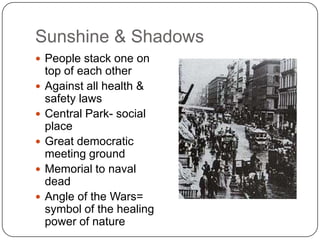
Sunshine & ShadowsPeople stack one on top of each otherAgainst all health & safety lawsCentral Park- social placeGreat democratic meeting groundMemorial to naval deadAngle of the Wars= symbol of the healing power of nature
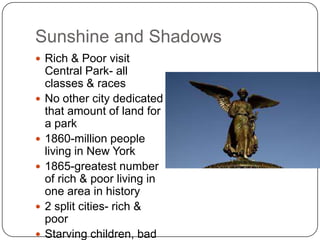
Sunshine and ShadowsRich & Poor visit Central Park- all classes & racesNo other city dedicated that amount of land for a park1860-million people living in New York1865-greatest number of rich & poor living in one area in history2 split cities- rich & poorStarving children, bad traffic
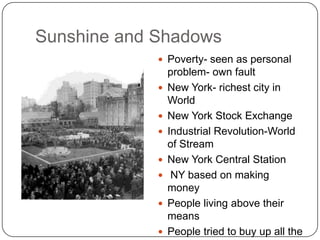
Sunshine and ShadowsPoverty- seen as personal problem- own faultNew York- richest city in WorldNew York Stock ExchangeIndustrial Revolution-World of StreamNew York Central Station NY based on making moneyPeople living above their meansPeople tried to buy up all the gold to control nation’s economy
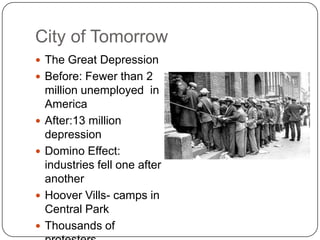
City of TomorrowThe Great DepressionBefore: Fewer than 2 million unemployed  in AmericaAfter:13 million depressionDomino Effect: industries fell one after anotherHoover Vills- camps in Central Park Thousands of protesters
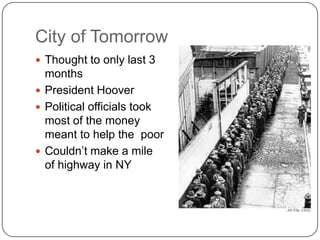
City of TomorrowThought to only last 3 monthsPresident HooverPolitical officials took most of the money meant to help the  poorCouldn’t make a mile of highway in NY
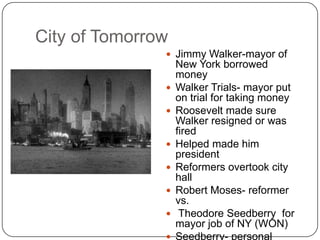
City of TomorrowJimmy Walker-mayor of New York borrowed moneyWalker Trials- mayor put on trial for taking moneyRoosevelt made sure Walker resigned or was firedHelped made him presidentReformers overtook city hallRobert Moses- reformer vs. Theodore Seedberry  for mayor job of NY (WON)Seedberry- personal symbol of NY
A Merger That Puts New York on TopBy Mike CloughAmerica Online’s decision to buy Time Warner=  New York will or will not dominate the new American global information economyRivals: Southern California, the Bay Area, & Redmond, WashingtonIndependence: Boston & Philadelphia was ahead of NYNew Orleans: challenger to become commercial center of nationNew York: Good location of port & growing capital marketsNY leader’s ability to envision the future path of national economy & develop strategies to put NY ahead
The Great Transatlantic Migrations1870-1914: US took largest number of immigrants in history- 23 million US- nation of immigrants1924: 5 ½ million foreigners went to Argentina, 4 ½ million to Canada (smaller population= immigration had a larger impact on these nation than US)1914 Argentine: 1/3 foreign-born1914 US: 1/6 foreign-bornBrazil – 4 million Europeans, more Italian immigrants than US until 1900
The Great Transatlantic Migrations1870-1917: great transatlantic migration: flow of migrants to US from EuropeSteamships took Spanish workers to Argentinean construction sites, German peasant to homestead in Canada, Italian laborers  to Brazilian coffee plantationsMigration of Chinese, Japanese, Indian workers to Fiji, Peru, CaliforniaSteamship travel, need for industrial labor force, opening of national borders= people to AmericaEuropeans: jobseeks
The Great Transatlantic MigrationsEuropean villages migrated in chains following relatives or neighborsEthnic enclaves replicated familiar ways in new settingWage-labor immigration was predominantly male1/3 immigrants returned unable to find workUS: sheer volume of immigration & diversity of sources3/5 of all European immigrants went to USUS developed the most vocal & powerful anit-immigrant movement in New WorldAnglo-Prostestant society feared dark skinned non- English Catholic & Jewish immigrants

New york city

  • 1.
    Jacqueline MougelNew YorkCity: The Crossroad of World Trade
  • 2.
    Sunshine & ShadowsPeoplestack one on top of each otherAgainst all health & safety lawsCentral Park- social placeGreat democratic meeting groundMemorial to naval deadAngle of the Wars= symbol of the healing power of nature
  • 3.
    Sunshine and ShadowsRich& Poor visit Central Park- all classes & racesNo other city dedicated that amount of land for a park1860-million people living in New York1865-greatest number of rich & poor living in one area in history2 split cities- rich & poorStarving children, bad traffic
  • 4.
    Sunshine and ShadowsPoverty-seen as personal problem- own faultNew York- richest city in WorldNew York Stock ExchangeIndustrial Revolution-World of StreamNew York Central Station NY based on making moneyPeople living above their meansPeople tried to buy up all the gold to control nation’s economy
  • 5.
    City of TomorrowTheGreat DepressionBefore: Fewer than 2 million unemployed in AmericaAfter:13 million depressionDomino Effect: industries fell one after anotherHoover Vills- camps in Central Park Thousands of protesters
  • 6.
    City of TomorrowThoughtto only last 3 monthsPresident HooverPolitical officials took most of the money meant to help the poorCouldn’t make a mile of highway in NY
  • 7.
    City of TomorrowJimmyWalker-mayor of New York borrowed moneyWalker Trials- mayor put on trial for taking moneyRoosevelt made sure Walker resigned or was firedHelped made him presidentReformers overtook city hallRobert Moses- reformer vs. Theodore Seedberry for mayor job of NY (WON)Seedberry- personal symbol of NY
  • 8.
    A Merger ThatPuts New York on TopBy Mike CloughAmerica Online’s decision to buy Time Warner= New York will or will not dominate the new American global information economyRivals: Southern California, the Bay Area, & Redmond, WashingtonIndependence: Boston & Philadelphia was ahead of NYNew Orleans: challenger to become commercial center of nationNew York: Good location of port & growing capital marketsNY leader’s ability to envision the future path of national economy & develop strategies to put NY ahead
  • 9.
    The Great TransatlanticMigrations1870-1914: US took largest number of immigrants in history- 23 million US- nation of immigrants1924: 5 ½ million foreigners went to Argentina, 4 ½ million to Canada (smaller population= immigration had a larger impact on these nation than US)1914 Argentine: 1/3 foreign-born1914 US: 1/6 foreign-bornBrazil – 4 million Europeans, more Italian immigrants than US until 1900
  • 10.
    The Great TransatlanticMigrations1870-1917: great transatlantic migration: flow of migrants to US from EuropeSteamships took Spanish workers to Argentinean construction sites, German peasant to homestead in Canada, Italian laborers to Brazilian coffee plantationsMigration of Chinese, Japanese, Indian workers to Fiji, Peru, CaliforniaSteamship travel, need for industrial labor force, opening of national borders= people to AmericaEuropeans: jobseeks
  • 11.
    The Great TransatlanticMigrationsEuropean villages migrated in chains following relatives or neighborsEthnic enclaves replicated familiar ways in new settingWage-labor immigration was predominantly male1/3 immigrants returned unable to find workUS: sheer volume of immigration & diversity of sources3/5 of all European immigrants went to USUS developed the most vocal & powerful anit-immigrant movement in New WorldAnglo-Prostestant society feared dark skinned non- English Catholic & Jewish immigrants