prof.Dr. Rabea M. Ali
New trend in
maternity
nursing
Philosophy of Maternal and Child Health Nursing
 Maternal and child health nursing is family
centered; assessment data must include a family
and individual assessment.
 Maternal and child health nursing is community
centered; the health of families depends on and
influences the health of communities.
 Maternal and child health nursing is research
oriented, because research is the means
whereby critical knowledge increases.
 Both nursing theory and evidence-based practice
provide a foundation for nursing care
Cont.…
 A maternal and child health nurse serves as an
advocate to protect the rights of all family
members, including the fetus.
 Maternal and child health nursing includes a high
degree of independent nursing functions,
because teaching and counseling are so
frequently required.
 Promoting health is an important nursing role,
because this protects the health of the next
generation.
 Pregnancy or childhood illness can be stressful
and can alter family life in both subtle and
extensive ways.
Cont.
Personal, cultural, and religious attitudes
and beliefs influence the meaning of
illness and its impact on the family.
Maternal and child health nursing is a
challenging role for a nurse and is a major
factor in promoting high-level wellness in
families
Common Measures to Ensure Family-
Centered Maternal and Child Health Care
Principle
1. The family is the basic unit of
society.
2. Families represent racial, ethnic,
cultural, and socioeconomic
diversity.
3. Children grow both individually and
as part of a family.
Nursing Interventions
 Consider the family as a whole as well as its
individual members.
 Encourage families to reach out to their
community so that family members are not
isolated from their community or from each
other.
 Encourage family bonding through rooming-in in
both maternal and child health hospital settings.
 Participate in early hospital discharge programs
to reunite families as soon as possible.
 Encourage family and sibling visits in the hospital
to promote family contacts.
Cont.
 Assess families for strengths as well as specific
needs or challenges.
 Respect diversity in families as a unique
quality of that family.
 Encourage families to give care to a newborn
or ill child.
 Include developmental stimulation in nursing
care.
 Share or initiate information on health
planning with family members so that care is
family oriented.
family-centered care and the nursing process
American Nurses Association/Society of Pediatric Nurses
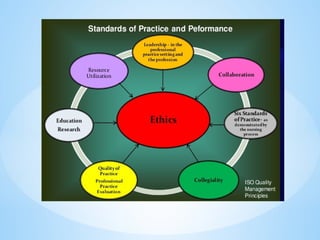
Standards of Care and Professional Performance Standards
of Care Comprehensive pediatric nursing care focuses on
helping children and their families and communities
achieve their optimum health potentials
This is best achieved within the framework of family-
centered care and the nursing process, including
primary, secondary, and tertiary care coordinated across
health care and community settings.
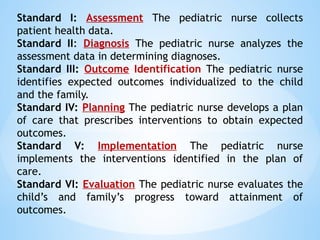
Standard I: Assessment The pediatric nurse collects
patient health data.
Standard II: Diagnosis The pediatric nurse analyzes the
assessment data in determining diagnoses.
Standard III: Outcome Identification The pediatric nurse
identifies expected outcomes individualized to the child
and the family.
Standard IV: Planning The pediatric nurse develops a plan
of care that prescribes interventions to obtain expected
outcomes.
Standard V: Implementation The pediatric nurse
implements the interventions identified in the plan of
care.
Standard VI: Evaluation The pediatric nurse evaluates the
child’s and family’s progress toward attainment of
outcomes.
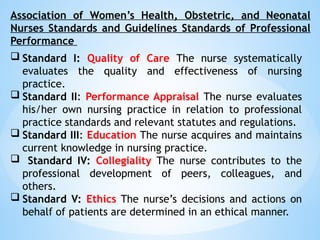
Association of Women’s Health, Obstetric, and Neonatal
Nurses Standards and Guidelines Standards of Professional
Performance
 Standard I: Quality of Care The nurse systematically
evaluates the quality and effectiveness of nursing
practice.
 Standard II: Performance Appraisal The nurse evaluates
his/her own nursing practice in relation to professional
practice standards and relevant statutes and regulations.
 Standard III: Education The nurse acquires and maintains
current knowledge in nursing practice.
 Standard IV: Collegiality The nurse contributes to the
professional development of peers, colleagues, and
others.
 Standard V: Ethics The nurse’s decisions and actions on
behalf of patients are determined in an ethical manner.
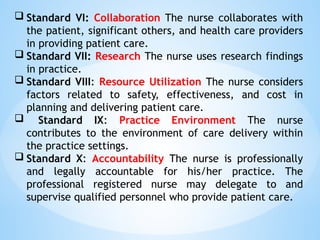
 Standard VI: Collaboration The nurse collaborates with
the patient, significant others, and health care providers
in providing patient care.
 Standard VII: Research The nurse uses research findings
in practice.
 Standard VIII: Resource Utilization The nurse considers
factors related to safety, effectiveness, and cost in
planning and delivering patient care.
 Standard IX: Practice Environment The nurse
contributes to the environment of care delivery within
the practice settings.
 Standard X: Accountability The nurse is professionally
and legally accountable for his/her practice. The
professional registered nurse may delegate to and
supervise qualified personnel who provide patient care.
Trend
In the changing scenario of health care
system of today’s world, the trends in
maternal and newborn health nursing are
also changing.(Radhika,2016)
New Trends in Maternity's & Midwifery Nursing is
rapidly changing the world, that required
professionals to remain up-to-date in order to
react to new any developments as they occur
Technological Advances
 Today fetal monitoring has progressed
from the use of Feto-scope to electronic
fetal monitor such as:
1. Bella beat Shell
2. Bloom life
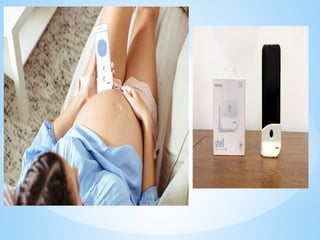
Bella beat's Shell : app It works to amplify the
sound of baby's heartbeat when pressed to the
mother's body, as well as to let to record the audio
and even share it with friends and family via the
app. to regular appointments.
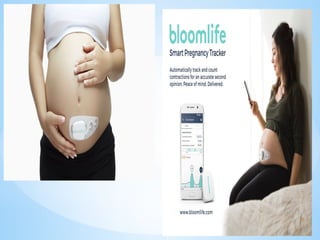
Bloom life
woman not supposed to wear it the whole time
but for one, two or three months of third
trimester. It sticks onto the belly and measures
the count and timing of contractions (both
Braxton Hicks and labor) via electrical signals
from the uterine muscle.
Noninvasive prenatal testing or NIPT (2000s)
a blood test, can be done as early as the 9th week of pregnancy
and can screen for chromosomal abnormalities in baby. Unlike
amniocentesis, NIPT carries no risk of miscarriage. Early diagnosis
of chromosomal disorders, including microdeletions ensures that
affected babies receive the care they need as soon as possible.
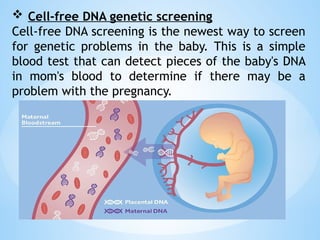
 Cell-free DNA genetic screening
Cell-free DNA screening is the newest way to screen
for genetic problems in the baby. This is a simple
blood test that can detect pieces of the baby's DNA
in mom's blood to determine if there may be a
problem with the pregnancy.
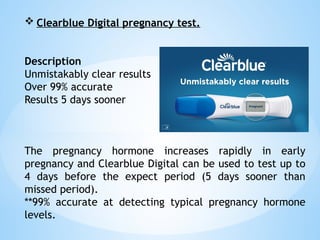
 Clearblue Digital pregnancy test.
Description
Unmistakably clear results
Over 99% accurate
Results 5 days sooner
The pregnancy hormone increases rapidly in early
pregnancy and Clearblue Digital can be used to test up to
4 days before the expect period (5 days sooner than
missed period).
**99% accurate at detecting typical pregnancy hormone
levels.
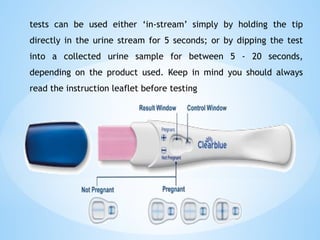
tests can be used either ‘in-stream’ simply by holding the tip
directly in the urine stream for 5 seconds; or by dipping the test
into a collected urine sample for between 5 - 20 seconds,
depending on the product used. Keep in mind you should always
read the instruction leaflet before testing
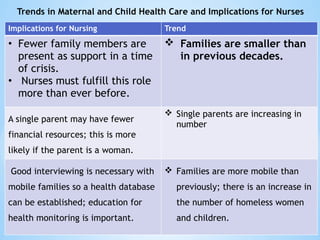
Implications for Nursing Trend
• Fewer family members are
present as support in a time
of crisis.
• Nurses must fulfill this role
more than ever before.
 Families are smaller than
in previous decades.
A single parent may have fewer
financial resources; this is more
likely if the parent is a woman.
 Single parents are increasing in
number
Good interviewing is necessary with
mobile families so a health database
can be established; education for
health monitoring is important.
 Families are more mobile than
previously; there is an increase in
the number of homeless women
and children.
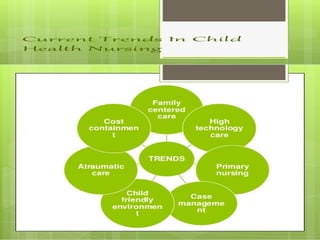
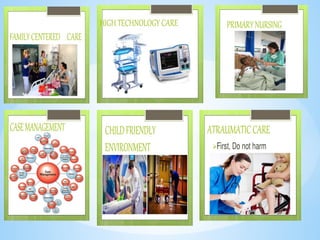
Trends in Maternal and Child Health Care and Implications for Nurses
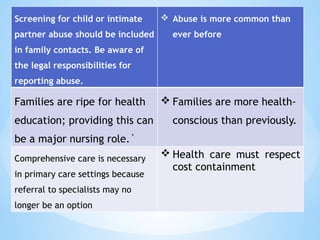
Screening for child or intimate
partner abuse should be included
in family contacts. Be aware of
the legal responsibilities for
reporting abuse.
 Abuse is more common than
ever before
Families are ripe for health
education; providing this can
be a major nursing role.`
 Families are more health-
conscious than previously.
Comprehensive care is necessary
in primary care settings because
referral to specialists may no
longer be an option
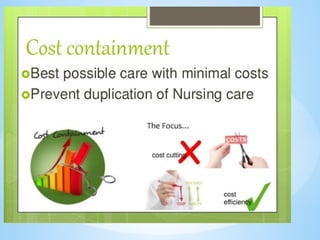
 Health care must respect
cost containment
New-trends-in-maternity-nursing practice

New-trends-in-maternity-nursing practice

  • 1.
    prof.Dr. Rabea M.Ali New trend in maternity nursing
  • 2.
    Philosophy of Maternaland Child Health Nursing  Maternal and child health nursing is family centered; assessment data must include a family and individual assessment.  Maternal and child health nursing is community centered; the health of families depends on and influences the health of communities.  Maternal and child health nursing is research oriented, because research is the means whereby critical knowledge increases.  Both nursing theory and evidence-based practice provide a foundation for nursing care
  • 3.
    Cont.…  A maternaland child health nurse serves as an advocate to protect the rights of all family members, including the fetus.  Maternal and child health nursing includes a high degree of independent nursing functions, because teaching and counseling are so frequently required.  Promoting health is an important nursing role, because this protects the health of the next generation.  Pregnancy or childhood illness can be stressful and can alter family life in both subtle and extensive ways.
  • 4.
    Cont. Personal, cultural, andreligious attitudes and beliefs influence the meaning of illness and its impact on the family. Maternal and child health nursing is a challenging role for a nurse and is a major factor in promoting high-level wellness in families
  • 5.
    Common Measures toEnsure Family- Centered Maternal and Child Health Care Principle 1. The family is the basic unit of society. 2. Families represent racial, ethnic, cultural, and socioeconomic diversity. 3. Children grow both individually and as part of a family.
  • 6.
    Nursing Interventions  Considerthe family as a whole as well as its individual members.  Encourage families to reach out to their community so that family members are not isolated from their community or from each other.  Encourage family bonding through rooming-in in both maternal and child health hospital settings.  Participate in early hospital discharge programs to reunite families as soon as possible.  Encourage family and sibling visits in the hospital to promote family contacts.
  • 7.
    Cont.  Assess familiesfor strengths as well as specific needs or challenges.  Respect diversity in families as a unique quality of that family.  Encourage families to give care to a newborn or ill child.  Include developmental stimulation in nursing care.  Share or initiate information on health planning with family members so that care is family oriented.
  • 8.
    family-centered care andthe nursing process American Nurses Association/Society of Pediatric Nurses Standards of Care and Professional Performance Standards of Care Comprehensive pediatric nursing care focuses on helping children and their families and communities achieve their optimum health potentials This is best achieved within the framework of family- centered care and the nursing process, including primary, secondary, and tertiary care coordinated across health care and community settings.
  • 9.
    Standard I: AssessmentThe pediatric nurse collects patient health data. Standard II: Diagnosis The pediatric nurse analyzes the assessment data in determining diagnoses. Standard III: Outcome Identification The pediatric nurse identifies expected outcomes individualized to the child and the family. Standard IV: Planning The pediatric nurse develops a plan of care that prescribes interventions to obtain expected outcomes. Standard V: Implementation The pediatric nurse implements the interventions identified in the plan of care. Standard VI: Evaluation The pediatric nurse evaluates the child’s and family’s progress toward attainment of outcomes.
  • 11.
    Association of Women’sHealth, Obstetric, and Neonatal Nurses Standards and Guidelines Standards of Professional Performance  Standard I: Quality of Care The nurse systematically evaluates the quality and effectiveness of nursing practice.  Standard II: Performance Appraisal The nurse evaluates his/her own nursing practice in relation to professional practice standards and relevant statutes and regulations.  Standard III: Education The nurse acquires and maintains current knowledge in nursing practice.  Standard IV: Collegiality The nurse contributes to the professional development of peers, colleagues, and others.  Standard V: Ethics The nurse’s decisions and actions on behalf of patients are determined in an ethical manner.
  • 12.
     Standard VI:Collaboration The nurse collaborates with the patient, significant others, and health care providers in providing patient care.  Standard VII: Research The nurse uses research findings in practice.  Standard VIII: Resource Utilization The nurse considers factors related to safety, effectiveness, and cost in planning and delivering patient care.  Standard IX: Practice Environment The nurse contributes to the environment of care delivery within the practice settings.  Standard X: Accountability The nurse is professionally and legally accountable for his/her practice. The professional registered nurse may delegate to and supervise qualified personnel who provide patient care.
  • 14.
    Trend In the changingscenario of health care system of today’s world, the trends in maternal and newborn health nursing are also changing.(Radhika,2016) New Trends in Maternity's & Midwifery Nursing is rapidly changing the world, that required professionals to remain up-to-date in order to react to new any developments as they occur
  • 19.
    Technological Advances  Todayfetal monitoring has progressed from the use of Feto-scope to electronic fetal monitor such as: 1. Bella beat Shell 2. Bloom life
  • 20.
    Bella beat's Shell: app It works to amplify the sound of baby's heartbeat when pressed to the mother's body, as well as to let to record the audio and even share it with friends and family via the app. to regular appointments.
  • 22.
    Bloom life woman notsupposed to wear it the whole time but for one, two or three months of third trimester. It sticks onto the belly and measures the count and timing of contractions (both Braxton Hicks and labor) via electrical signals from the uterine muscle.
  • 24.
    Noninvasive prenatal testingor NIPT (2000s) a blood test, can be done as early as the 9th week of pregnancy and can screen for chromosomal abnormalities in baby. Unlike amniocentesis, NIPT carries no risk of miscarriage. Early diagnosis of chromosomal disorders, including microdeletions ensures that affected babies receive the care they need as soon as possible.
  • 25.
     Cell-free DNAgenetic screening Cell-free DNA screening is the newest way to screen for genetic problems in the baby. This is a simple blood test that can detect pieces of the baby's DNA in mom's blood to determine if there may be a problem with the pregnancy.
  • 26.
     Clearblue Digitalpregnancy test. Description Unmistakably clear results Over 99% accurate Results 5 days sooner The pregnancy hormone increases rapidly in early pregnancy and Clearblue Digital can be used to test up to 4 days before the expect period (5 days sooner than missed period). **99% accurate at detecting typical pregnancy hormone levels.
  • 27.
    tests can beused either ‘in-stream’ simply by holding the tip directly in the urine stream for 5 seconds; or by dipping the test into a collected urine sample for between 5 - 20 seconds, depending on the product used. Keep in mind you should always read the instruction leaflet before testing
  • 28.
    Implications for NursingTrend • Fewer family members are present as support in a time of crisis. • Nurses must fulfill this role more than ever before.  Families are smaller than in previous decades. A single parent may have fewer financial resources; this is more likely if the parent is a woman.  Single parents are increasing in number Good interviewing is necessary with mobile families so a health database can be established; education for health monitoring is important.  Families are more mobile than previously; there is an increase in the number of homeless women and children. Trends in Maternal and Child Health Care and Implications for Nurses
  • 29.
    Screening for childor intimate partner abuse should be included in family contacts. Be aware of the legal responsibilities for reporting abuse.  Abuse is more common than ever before Families are ripe for health education; providing this can be a major nursing role.`  Families are more health- conscious than previously. Comprehensive care is necessary in primary care settings because referral to specialists may no longer be an option  Health care must respect cost containment