Made By:
SIMRaN KUMaR
ClaSS : 8th
B
FOR ENDING VIOLENCE
AGAINST WOMEN
CRIMES AGAINST WOMEN
Following are the crimes that are
increasing day by day among women:
 CHILD MARRIAGE
 DOMESTIC VIOLENCE
 DOWRY
 SEXUAL HARASSMENT
 RAPE
 TRAFFICKING
 FEMALE INFANTICIDE & SEX-SELECTIVE
ABORTION
CHILD MARRIAGECHILD MARRIAGE
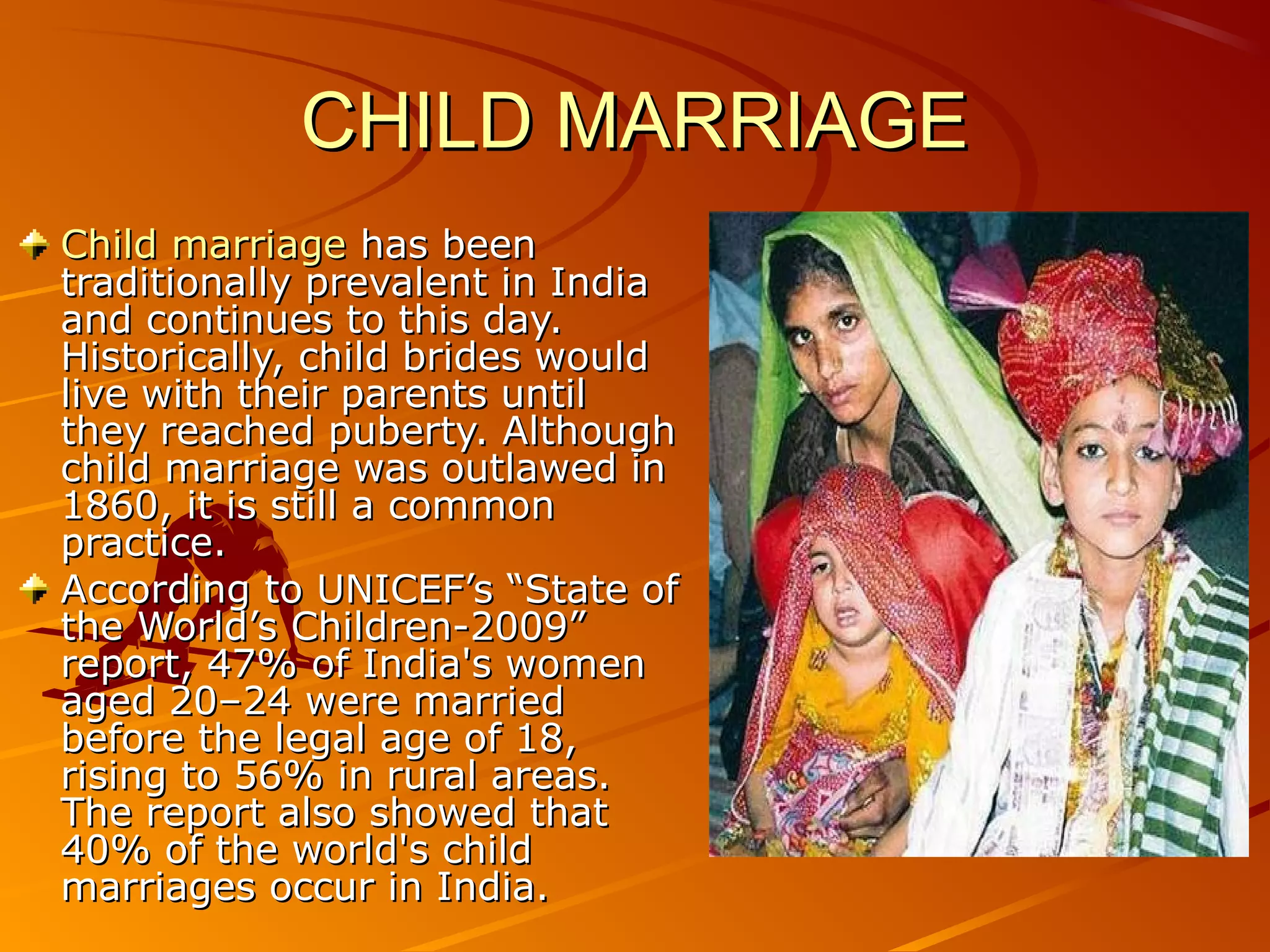
Child marriageChild marriage has beenhas been
traditionally prevalent in Indiatraditionally prevalent in India
and continues to this day.and continues to this day.
Historically, child brides wouldHistorically, child brides would
live with their parents untillive with their parents until
they reached puberty. Althoughthey reached puberty. Although
child marriage was outlawed inchild marriage was outlawed in
1860, it is still a common1860, it is still a common
practice.practice.
According to UNICEF’s “State ofAccording to UNICEF’s “State of
the World’s Children-2009”the World’s Children-2009”
report, 47% of India's womenreport, 47% of India's women
aged 20–24 were marriedaged 20–24 were married
before the legal age of 18,before the legal age of 18,
rising to 56% in rural areas.rising to 56% in rural areas.
The report also showed thatThe report also showed that
40% of the world's child40% of the world's child
marriages occur in India.marriages occur in India.
DOMESTIC VIOLENCEDOMESTIC VIOLENCE
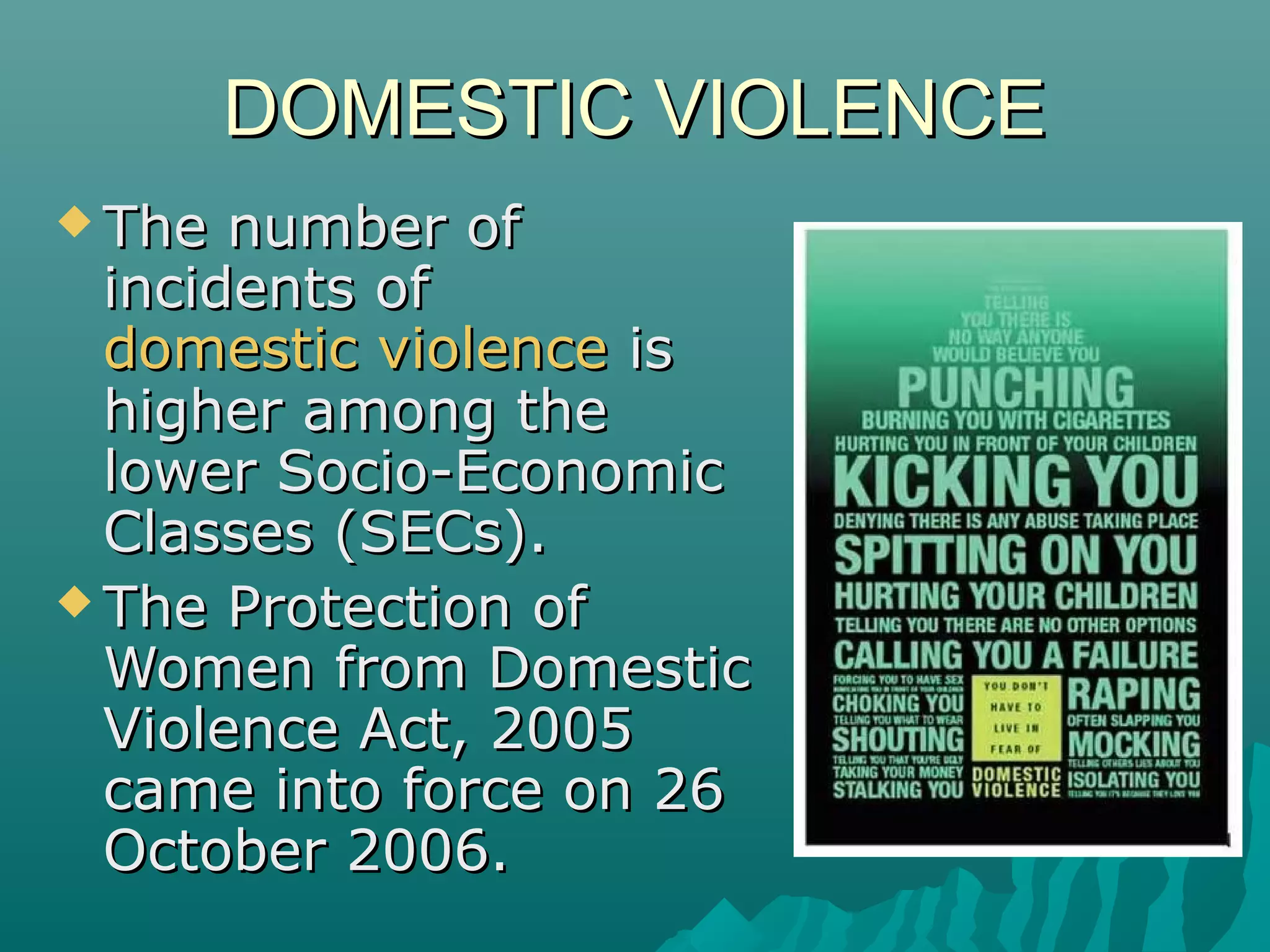
 The number ofThe number of
incidents ofincidents of
domestic violencedomestic violence isis
higher among thehigher among the
lower Socio-Economiclower Socio-Economic
Classes (SECs).Classes (SECs).
 The Protection ofThe Protection of
Women from DomesticWomen from Domestic
Violence Act, 2005Violence Act, 2005
came into force on 26came into force on 26
October 2006.October 2006.
DOWRYDOWRY
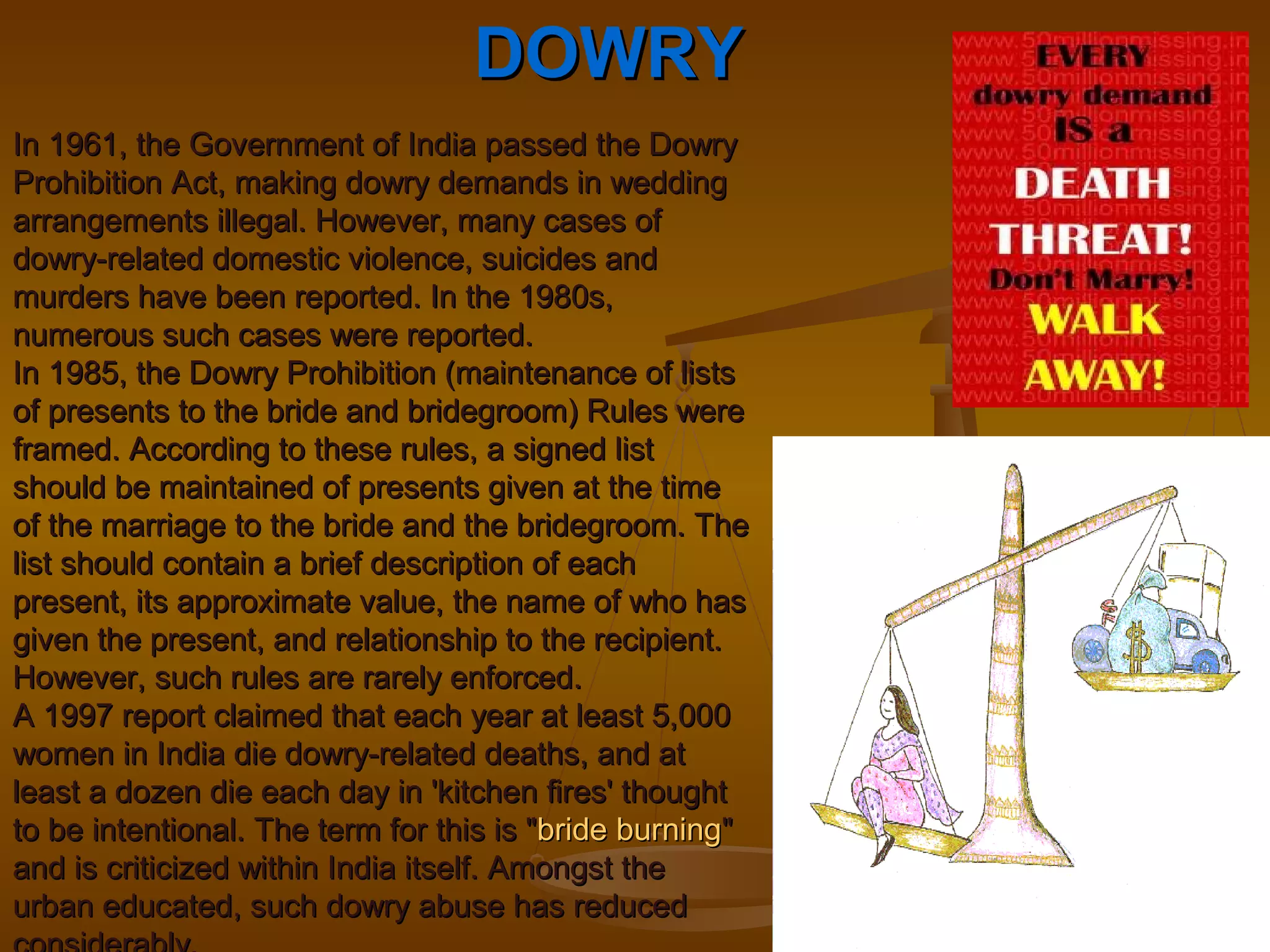
In 1961, the Government of India passed the DowryIn 1961, the Government of India passed the Dowry
Prohibition Act, making dowry demands in weddingProhibition Act, making dowry demands in wedding
arrangements illegal. However, many cases ofarrangements illegal. However, many cases of
dowry-related domestic violence, suicides anddowry-related domestic violence, suicides and
murders have been reported. In the 1980s,murders have been reported. In the 1980s,
numerous such cases were reported.numerous such cases were reported.
In 1985, the Dowry Prohibition (maintenance of listsIn 1985, the Dowry Prohibition (maintenance of lists
of presents to the bride and bridegroom) Rules wereof presents to the bride and bridegroom) Rules were
framed. According to these rules, a signed listframed. According to these rules, a signed list
should be maintained of presents given at the timeshould be maintained of presents given at the time
of the marriage to the bride and the bridegroom. Theof the marriage to the bride and the bridegroom. The
list should contain a brief description of eachlist should contain a brief description of each
present, its approximate value, the name of who haspresent, its approximate value, the name of who has
given the present, and relationship to the recipient.given the present, and relationship to the recipient.
However, such rules are rarely enforced.However, such rules are rarely enforced.
A 1997 report claimed that each year at least 5,000A 1997 report claimed that each year at least 5,000
women in India die dowry-related deaths, and atwomen in India die dowry-related deaths, and at
least a dozen die each day in 'kitchen fires' thoughtleast a dozen die each day in 'kitchen fires' thought
to be intentional. The term for this is "to be intentional. The term for this is "bride burningbride burning""
and is criticized within India itself. Amongst theand is criticized within India itself. Amongst the
urban educated, such dowry abuse has reducedurban educated, such dowry abuse has reduced
SEXUAL HARASSMENTSEXUAL HARASSMENT
Eve teasingEve teasing is a euphemism used foris a euphemism used for
sexual harassment or molestation ofsexual harassment or molestation of
women by men. Many activists blame thewomen by men. Many activists blame the
rising incidents of sexual harassmentrising incidents of sexual harassment
against women on the influence ofagainst women on the influence of
"Western culture". In 1987, The Indecent"Western culture". In 1987, The Indecent
Representation of Women (Prohibition)Representation of Women (Prohibition)
Act was passed to prohibit indecentAct was passed to prohibit indecent
representation of women throughrepresentation of women through
advertisements or in publications,advertisements or in publications,
writings, paintings or in any other manner.writings, paintings or in any other manner.
Of the total number of crimes againstOf the total number of crimes against
women reported in 1990, half related towomen reported in 1990, half related to
molestation and harassment in themolestation and harassment in the
workplace. In 1997, in a landmarkworkplace. In 1997, in a landmark
judgement [judgement [ambiguousambiguous], the Supreme], the Supreme
Court of India took a strong stand againstCourt of India took a strong stand against
sexual harassment of women in thesexual harassment of women in the
workplace. The Court also laid downworkplace. The Court also laid down
detailed guidelines for prevention anddetailed guidelines for prevention and
redressal of grievances. The Nationalredressal of grievances. The National
Commission for Women subsequentlyCommission for Women subsequently
elaborated these guidelines into a Codeelaborated these guidelines into a Code
of Conduct for employers.of Conduct for employers.
RAPERAPE
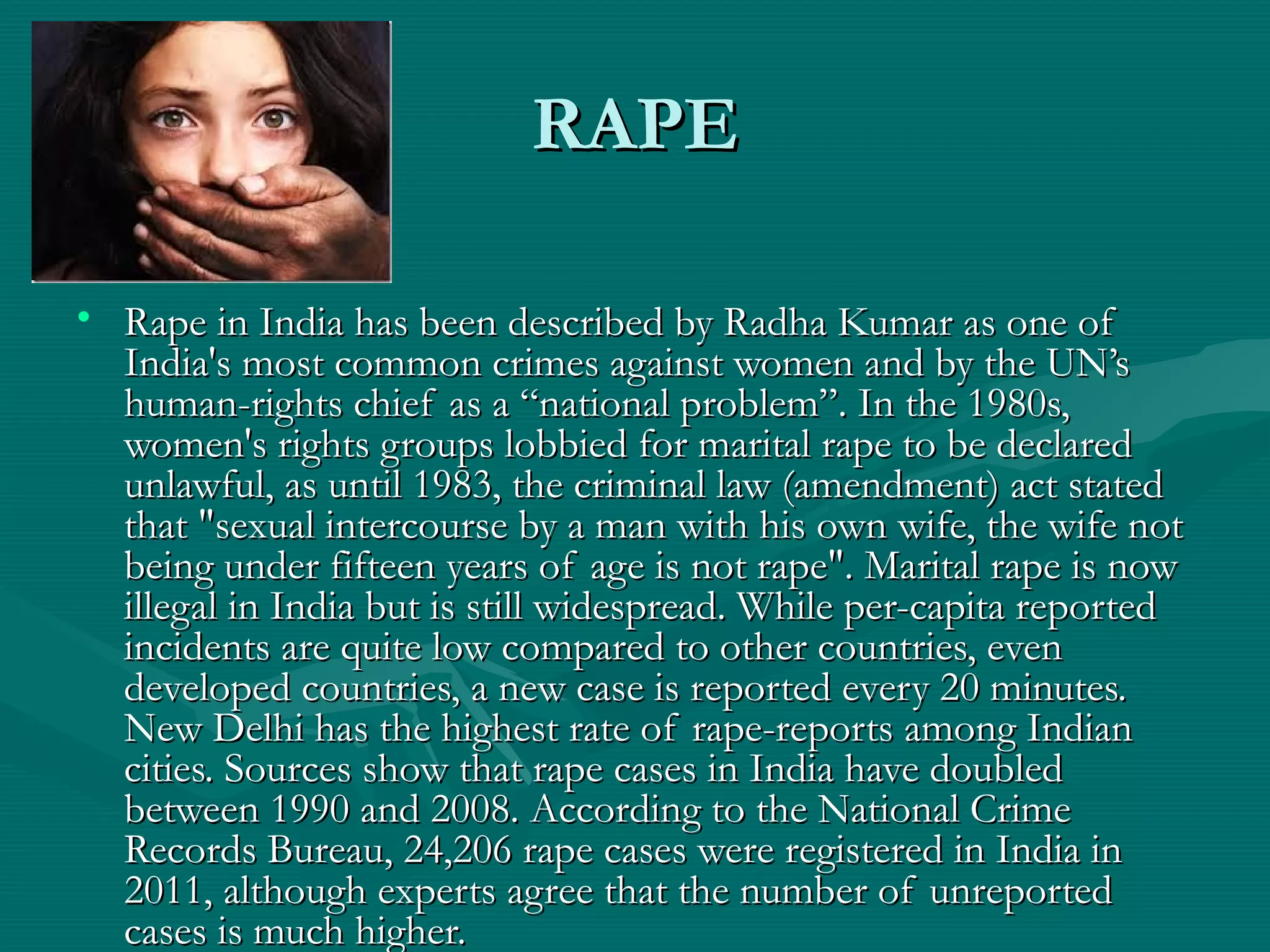
• Rape in India has been described by Radha Kumar as one ofRape in India has been described by Radha Kumar as one of
India's most common crimes against women and by the UN’sIndia's most common crimes against women and by the UN’s
human-rights chief as a “national problem”. In the 1980s,human-rights chief as a “national problem”. In the 1980s,
women's rights groups lobbied for marital rape to be declaredwomen's rights groups lobbied for marital rape to be declared
unlawful, as until 1983, the criminal law (amendment) act statedunlawful, as until 1983, the criminal law (amendment) act stated
that "sexual intercourse by a man with his own wife, the wife notthat "sexual intercourse by a man with his own wife, the wife not
being under fifteen years of age is not rape". Marital rape is nowbeing under fifteen years of age is not rape". Marital rape is now
illegal in India but is still widespread. While per-capita reportedillegal in India but is still widespread. While per-capita reported
incidents are quite low compared to other countries, evenincidents are quite low compared to other countries, even
developed countries, a new case is reported every 20 minutes.developed countries, a new case is reported every 20 minutes.
New Delhi has the highest rate of rape-reports among IndianNew Delhi has the highest rate of rape-reports among Indian
cities. Sources show that rape cases in India have doubledcities. Sources show that rape cases in India have doubled
between 1990 and 2008. According to the National Crimebetween 1990 and 2008. According to the National Crime
Records Bureau, 24,206 rape cases were registered in India inRecords Bureau, 24,206 rape cases were registered in India in
2011, although experts agree that the number of unreported2011, although experts agree that the number of unreported
cases is much higher.cases is much higher.
TRAFFICKINGTRAFFICKING
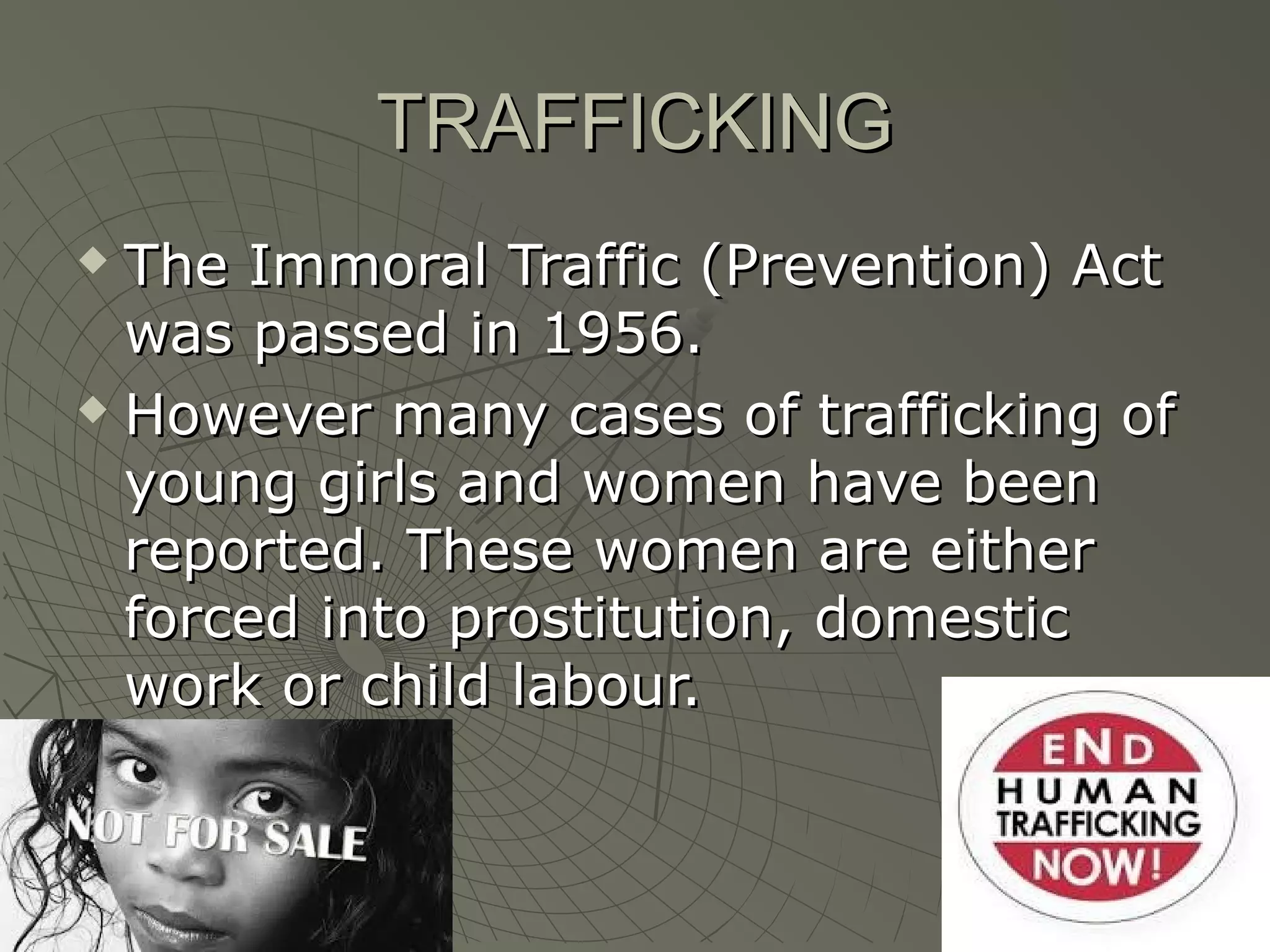
 The Immoral Traffic (Prevention) ActThe Immoral Traffic (Prevention) Act
was passed in 1956.was passed in 1956.
 However many cases of trafficking ofHowever many cases of trafficking of
young girls and women have beenyoung girls and women have been
reported. These women are eitherreported. These women are either
forced into prostitution, domesticforced into prostitution, domestic
work or child labour.work or child labour.
FEMALE INFANTICIDE & SEX-FEMALE INFANTICIDE & SEX-
SELECTIVE ABORTIONSELECTIVE ABORTION
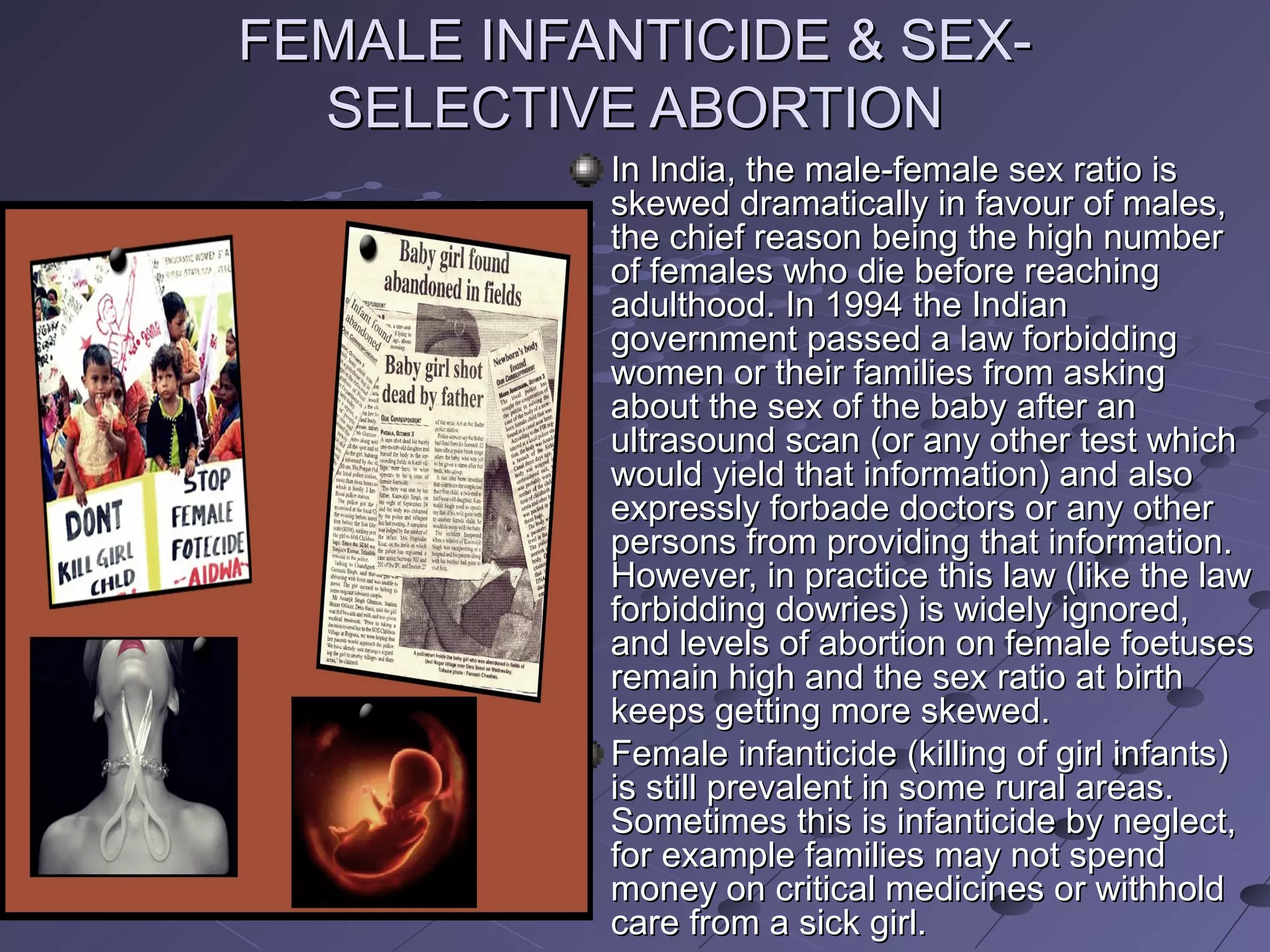
In India, the male-female sex ratio isIn India, the male-female sex ratio is
skewed dramatically in favour of males,skewed dramatically in favour of males,
the chief reason being the high numberthe chief reason being the high number
of females who die before reachingof females who die before reaching
adulthood. In 1994 the Indianadulthood. In 1994 the Indian
government passed a law forbiddinggovernment passed a law forbidding
women or their families from askingwomen or their families from asking
about the sex of the baby after anabout the sex of the baby after an
ultrasound scan (or any other test whichultrasound scan (or any other test which
would yield that information) and alsowould yield that information) and also
expressly forbade doctors or any otherexpressly forbade doctors or any other
persons from providing that information.persons from providing that information.
However, in practice this law (like the lawHowever, in practice this law (like the law
forbidding dowries) is widely ignored,forbidding dowries) is widely ignored,
and levels of abortion on female foetusesand levels of abortion on female foetuses
remain high and the sex ratio at birthremain high and the sex ratio at birth
keeps getting more skewed.keeps getting more skewed.
Female infanticide (killing of girl infants)Female infanticide (killing of girl infants)
is still prevalent in some rural areas.is still prevalent in some rural areas.
Sometimes this is infanticide by neglect,Sometimes this is infanticide by neglect,
for example families may not spendfor example families may not spend
money on critical medicines or withholdmoney on critical medicines or withhold
care from a sick girl.care from a sick girl.
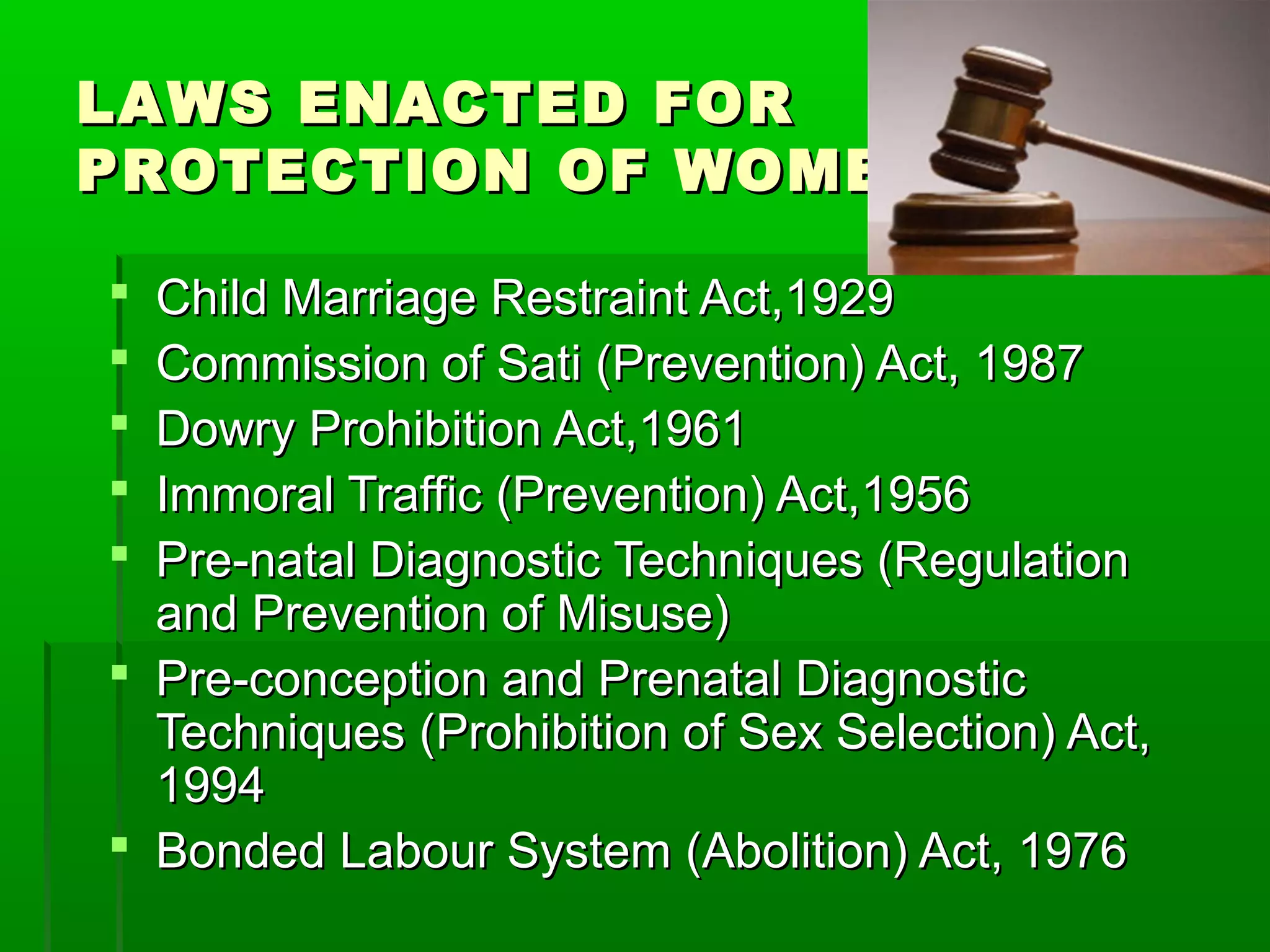
LAWS ENACTED FORLAWS ENACTED FOR
PROTECTION OF WOMENPROTECTION OF WOMEN
 Child Marriage Restraint Act,1929Child Marriage Restraint Act,1929
 Commission of Sati (Prevention) Act, 1987Commission of Sati (Prevention) Act, 1987
 Dowry Prohibition Act,1961Dowry Prohibition Act,1961
 Immoral Traffic (Prevention) Act,1956Immoral Traffic (Prevention) Act,1956
 Pre-natal Diagnostic Techniques (RegulationPre-natal Diagnostic Techniques (Regulation
and Prevention of Misuse)and Prevention of Misuse)
 Pre-conception and Prenatal DiagnosticPre-conception and Prenatal Diagnostic
Techniques (Prohibition of Sex Selection) Act,Techniques (Prohibition of Sex Selection) Act,
19941994
 Bonded Labour System (Abolition) Act, 1976Bonded Labour System (Abolition) Act, 1976

New microsoft power point presentation

  • 1.
    Made By: SIMRaN KUMaR ClaSS: 8th B FOR ENDING VIOLENCE AGAINST WOMEN
  • 2.
    CRIMES AGAINST WOMEN Followingare the crimes that are increasing day by day among women:  CHILD MARRIAGE  DOMESTIC VIOLENCE  DOWRY  SEXUAL HARASSMENT  RAPE  TRAFFICKING  FEMALE INFANTICIDE & SEX-SELECTIVE ABORTION
  • 3.
    CHILD MARRIAGECHILD MARRIAGE ChildmarriageChild marriage has beenhas been traditionally prevalent in Indiatraditionally prevalent in India and continues to this day.and continues to this day. Historically, child brides wouldHistorically, child brides would live with their parents untillive with their parents until they reached puberty. Althoughthey reached puberty. Although child marriage was outlawed inchild marriage was outlawed in 1860, it is still a common1860, it is still a common practice.practice. According to UNICEF’s “State ofAccording to UNICEF’s “State of the World’s Children-2009”the World’s Children-2009” report, 47% of India's womenreport, 47% of India's women aged 20–24 were marriedaged 20–24 were married before the legal age of 18,before the legal age of 18, rising to 56% in rural areas.rising to 56% in rural areas. The report also showed thatThe report also showed that 40% of the world's child40% of the world's child marriages occur in India.marriages occur in India.
  • 4.
    DOMESTIC VIOLENCEDOMESTIC VIOLENCE The number ofThe number of incidents ofincidents of domestic violencedomestic violence isis higher among thehigher among the lower Socio-Economiclower Socio-Economic Classes (SECs).Classes (SECs).  The Protection ofThe Protection of Women from DomesticWomen from Domestic Violence Act, 2005Violence Act, 2005 came into force on 26came into force on 26 October 2006.October 2006.
  • 5.
    DOWRYDOWRY In 1961, theGovernment of India passed the DowryIn 1961, the Government of India passed the Dowry Prohibition Act, making dowry demands in weddingProhibition Act, making dowry demands in wedding arrangements illegal. However, many cases ofarrangements illegal. However, many cases of dowry-related domestic violence, suicides anddowry-related domestic violence, suicides and murders have been reported. In the 1980s,murders have been reported. In the 1980s, numerous such cases were reported.numerous such cases were reported. In 1985, the Dowry Prohibition (maintenance of listsIn 1985, the Dowry Prohibition (maintenance of lists of presents to the bride and bridegroom) Rules wereof presents to the bride and bridegroom) Rules were framed. According to these rules, a signed listframed. According to these rules, a signed list should be maintained of presents given at the timeshould be maintained of presents given at the time of the marriage to the bride and the bridegroom. Theof the marriage to the bride and the bridegroom. The list should contain a brief description of eachlist should contain a brief description of each present, its approximate value, the name of who haspresent, its approximate value, the name of who has given the present, and relationship to the recipient.given the present, and relationship to the recipient. However, such rules are rarely enforced.However, such rules are rarely enforced. A 1997 report claimed that each year at least 5,000A 1997 report claimed that each year at least 5,000 women in India die dowry-related deaths, and atwomen in India die dowry-related deaths, and at least a dozen die each day in 'kitchen fires' thoughtleast a dozen die each day in 'kitchen fires' thought to be intentional. The term for this is "to be intentional. The term for this is "bride burningbride burning"" and is criticized within India itself. Amongst theand is criticized within India itself. Amongst the urban educated, such dowry abuse has reducedurban educated, such dowry abuse has reduced
  • 6.
    SEXUAL HARASSMENTSEXUAL HARASSMENT EveteasingEve teasing is a euphemism used foris a euphemism used for sexual harassment or molestation ofsexual harassment or molestation of women by men. Many activists blame thewomen by men. Many activists blame the rising incidents of sexual harassmentrising incidents of sexual harassment against women on the influence ofagainst women on the influence of "Western culture". In 1987, The Indecent"Western culture". In 1987, The Indecent Representation of Women (Prohibition)Representation of Women (Prohibition) Act was passed to prohibit indecentAct was passed to prohibit indecent representation of women throughrepresentation of women through advertisements or in publications,advertisements or in publications, writings, paintings or in any other manner.writings, paintings or in any other manner. Of the total number of crimes againstOf the total number of crimes against women reported in 1990, half related towomen reported in 1990, half related to molestation and harassment in themolestation and harassment in the workplace. In 1997, in a landmarkworkplace. In 1997, in a landmark judgement [judgement [ambiguousambiguous], the Supreme], the Supreme Court of India took a strong stand againstCourt of India took a strong stand against sexual harassment of women in thesexual harassment of women in the workplace. The Court also laid downworkplace. The Court also laid down detailed guidelines for prevention anddetailed guidelines for prevention and redressal of grievances. The Nationalredressal of grievances. The National Commission for Women subsequentlyCommission for Women subsequently elaborated these guidelines into a Codeelaborated these guidelines into a Code of Conduct for employers.of Conduct for employers.
  • 7.
    RAPERAPE • Rape inIndia has been described by Radha Kumar as one ofRape in India has been described by Radha Kumar as one of India's most common crimes against women and by the UN’sIndia's most common crimes against women and by the UN’s human-rights chief as a “national problem”. In the 1980s,human-rights chief as a “national problem”. In the 1980s, women's rights groups lobbied for marital rape to be declaredwomen's rights groups lobbied for marital rape to be declared unlawful, as until 1983, the criminal law (amendment) act statedunlawful, as until 1983, the criminal law (amendment) act stated that "sexual intercourse by a man with his own wife, the wife notthat "sexual intercourse by a man with his own wife, the wife not being under fifteen years of age is not rape". Marital rape is nowbeing under fifteen years of age is not rape". Marital rape is now illegal in India but is still widespread. While per-capita reportedillegal in India but is still widespread. While per-capita reported incidents are quite low compared to other countries, evenincidents are quite low compared to other countries, even developed countries, a new case is reported every 20 minutes.developed countries, a new case is reported every 20 minutes. New Delhi has the highest rate of rape-reports among IndianNew Delhi has the highest rate of rape-reports among Indian cities. Sources show that rape cases in India have doubledcities. Sources show that rape cases in India have doubled between 1990 and 2008. According to the National Crimebetween 1990 and 2008. According to the National Crime Records Bureau, 24,206 rape cases were registered in India inRecords Bureau, 24,206 rape cases were registered in India in 2011, although experts agree that the number of unreported2011, although experts agree that the number of unreported cases is much higher.cases is much higher.
  • 8.
    TRAFFICKINGTRAFFICKING  The ImmoralTraffic (Prevention) ActThe Immoral Traffic (Prevention) Act was passed in 1956.was passed in 1956.  However many cases of trafficking ofHowever many cases of trafficking of young girls and women have beenyoung girls and women have been reported. These women are eitherreported. These women are either forced into prostitution, domesticforced into prostitution, domestic work or child labour.work or child labour.
  • 9.
    FEMALE INFANTICIDE &SEX-FEMALE INFANTICIDE & SEX- SELECTIVE ABORTIONSELECTIVE ABORTION In India, the male-female sex ratio isIn India, the male-female sex ratio is skewed dramatically in favour of males,skewed dramatically in favour of males, the chief reason being the high numberthe chief reason being the high number of females who die before reachingof females who die before reaching adulthood. In 1994 the Indianadulthood. In 1994 the Indian government passed a law forbiddinggovernment passed a law forbidding women or their families from askingwomen or their families from asking about the sex of the baby after anabout the sex of the baby after an ultrasound scan (or any other test whichultrasound scan (or any other test which would yield that information) and alsowould yield that information) and also expressly forbade doctors or any otherexpressly forbade doctors or any other persons from providing that information.persons from providing that information. However, in practice this law (like the lawHowever, in practice this law (like the law forbidding dowries) is widely ignored,forbidding dowries) is widely ignored, and levels of abortion on female foetusesand levels of abortion on female foetuses remain high and the sex ratio at birthremain high and the sex ratio at birth keeps getting more skewed.keeps getting more skewed. Female infanticide (killing of girl infants)Female infanticide (killing of girl infants) is still prevalent in some rural areas.is still prevalent in some rural areas. Sometimes this is infanticide by neglect,Sometimes this is infanticide by neglect, for example families may not spendfor example families may not spend money on critical medicines or withholdmoney on critical medicines or withhold care from a sick girl.care from a sick girl.
  • 10.
    LAWS ENACTED FORLAWSENACTED FOR PROTECTION OF WOMENPROTECTION OF WOMEN  Child Marriage Restraint Act,1929Child Marriage Restraint Act,1929  Commission of Sati (Prevention) Act, 1987Commission of Sati (Prevention) Act, 1987  Dowry Prohibition Act,1961Dowry Prohibition Act,1961  Immoral Traffic (Prevention) Act,1956Immoral Traffic (Prevention) Act,1956  Pre-natal Diagnostic Techniques (RegulationPre-natal Diagnostic Techniques (Regulation and Prevention of Misuse)and Prevention of Misuse)  Pre-conception and Prenatal DiagnosticPre-conception and Prenatal Diagnostic Techniques (Prohibition of Sex Selection) Act,Techniques (Prohibition of Sex Selection) Act, 19941994  Bonded Labour System (Abolition) Act, 1976Bonded Labour System (Abolition) Act, 1976